over July poll
pp. 19-20 · Read in the full issue

the month
Question marks over July poll
Once more the “to be or not to be” of the Territorial Assembly elections due in July (PIM Jan. p 26) is at the forefront of New Caledonia’s political preoccupations.
France plans that the elec tions should usher in a five year autonomy period, to be fol lowed by a vote on self-de termination in 1989. Leaders of the anti-independence Republi can Party (RPCR) plan to triumphantly resume the power they lost in June 1982, when the centrists of the FNSC switched sides, under French guidance, and went into the coalition government council with the Independence Front (IF).
The Republicans have waited for these elections to prove that the socialist experiment has not worked, and that the majority of the territory’s population are still fiercely opposed to inde pendence.
Recently the IF gave France notice that they won’t partic pate in any future elections except a vote on self-de termination “for the Kanak people alone”. The territory has been .given no clues as to the plans of the French Govern ment to accommodate the IF demands for electoral reform.
But it would be strange for the ruling French Socialist Par ty, which supported the IF before they came to power, and steered them into local power 18 months ago, to stand back and hand the Republicans an election victory on a plate.
If the elections do not take place as scheduled, or if there is electoral reform, the Republi cans have threatened they will physically prevent both the South Pacific Conference and the Festival of Pacific Arts from being held in Noumea in Octo ber and December respectively.
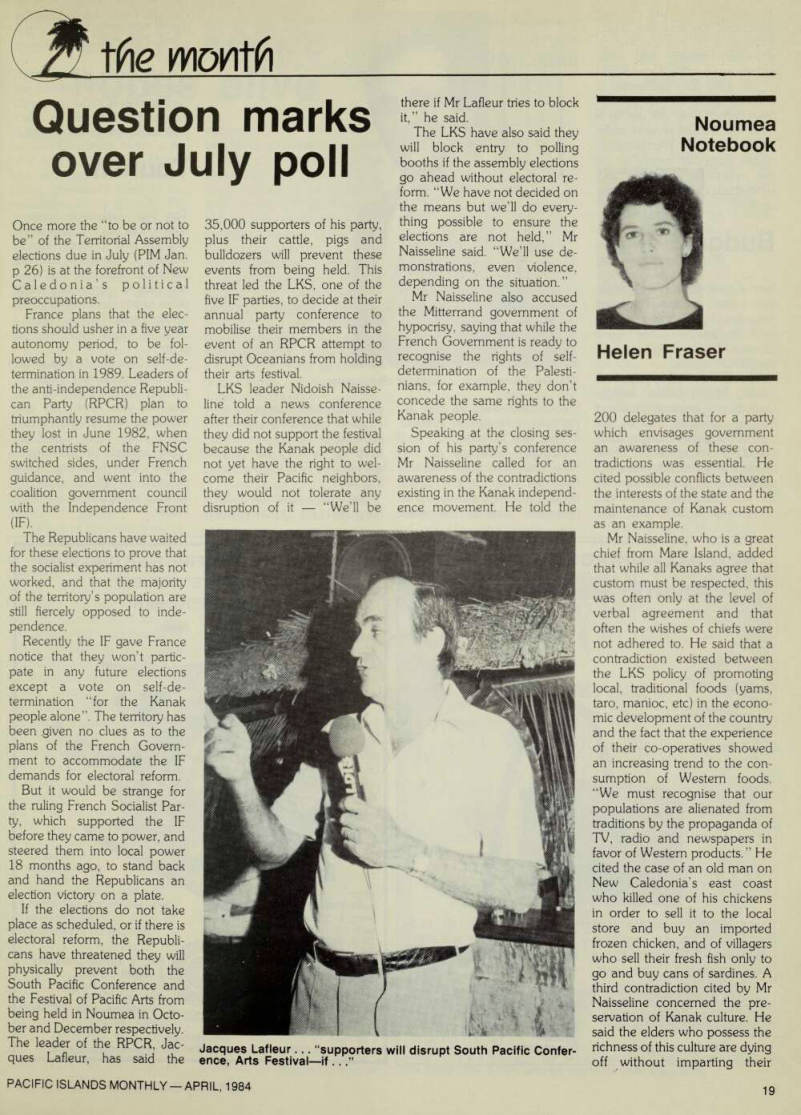
The leader of the RPCR, Jac ques Lafleur, has said the
35,000 supporters of his party, plus their cattle, pigs and bulldozers will prevent these events from being held. This threat led the LKS, one of the five IF parties, to decide at their annual party conference to mobilise their members in the event of an RPCR attempt to disrupt Oceanians from holding their arts festival.
LKS leader Nidoish Naisseline told a news conference after their conference that while they did not support the festival because the Kanak people did not yet have the right to welcome their Pacific neighbors, they would not tolerate any disruption of it “We’ll be
there if Mr Lafleur tries to block it,” he said.
The LKS have also said they will block entry to polling booths if the assembly elections go ahead without electoral re form. “We have not decided on the means but we’ll do every thing possible to ensure the elections are not held,” Mr Naisseline said. “We’ll use de monstrations, even violence, depending on the situation.”
Mr Naisseline also accused the Mitterrand government of hypocrisy, saying that while the French Government is ready to recognise the rights of self determination of the Palesti nians, for example, they don’t concede the same rights to the Kanak people.
Speaking at the closing ses sion of his party’s conference Mr Naisseline called for an awareness of the contradictions existing in the Kanak independ ence movement. He told the
Noumea Notebook
200 delegates that for a party which envisages government an awareness of these con tradictions was essential. He cited possible conflicts between the interests of the state and the maintenance of Kanak custom as an example.
Mr Naisseline, who is a great chief from Mare Island, added that while all Kanaks agree that custom must be respected, this was often only at the level of verbal agreement and that often the wishes of chiefs were not adhered to. He said that a contradiction existed between the LKS policy of promoting local, traditional foods (yams, taro, manioc, etc) in the econo mic development of the country and the fact that the experience of their co-operatives showed an increasing trend to the con sumption of Western foods.
“We must recognise that our populations are alienated from traditions by the propaganda of TV, radio and newspapers in favor of Western products. ” He cited the case of an old man on New Caledonia’s east coast who killed one of his chickens in order to sell it to the local store and buy an imported frozen chicken, and of villagers who sell their fresh fish only to go and buy cans of sardines. A third contradiction cited by Mr Naisseline concerned the pre servation of Kanak culture. He said the elders who possess the richness of this culture are dying off without imparting their
Jacques Lafleur. .. “supporters will disrupt South Pacific Confer ence, Arts Festival—if..
Helen Fraser
knowledge to the young generation because the youth have gone off into the French schooling system, and have grown apart from the elders.
The LKS also elaborated a detailed program of govern ment which they will use as a basis of discussion with other political parties. The program places particular emphasis on the economic, industrial and agricultural development of the territory.
Budget
New Caledonia’s 1984 budget was passed in the Territorial Assembly by 19 votes to 11, with the Independence Front and the FNSC voting for it and the RPCR against.
The CFP3I billion (approx imately $A223 million) budget features an increase in direct taxation, bringing it to 24 per cent of budgetary receipts com pared with 16 per cent in 1980.
Indirect taxes, which were 37 per cent in 1982 have fallen to 31 per cent this year. Also decreasing is aid from the
French state which fell from 30 per cent of receipts in 1980 to 27 per cent in 1984.
Running expenses of the New Caledonia administration have decreased in this year’s budget, as have the expenses of personnel. One of the main
expenditure features of the gov ernment council’s budget is an increase in public works pro jects, up from 11 per cent of spending in 1980 to 13 per cent this year.
Speaking against the budget, Republican spokesman
Georges Faure, warned that the RPCR would re-examine the tax structure when they regain power.
A new feature of the taxation structure is taxes'of up to 60 per cent on people in the super-rich income bracket, said to affect 140 taxpayers in the territory.
Tourism
The New Caledonia govern ment councillor in charge of the tourism and transport sectors Stanley Camerlynck told the Territorial Assembly that tour ism here is expanding, while other tourist destinations in the South Pacific had recorded a drop in tourist numbers last year.
New Caledonia’s figures are up by 5.4 per cent. He said the territory received 87,000 visi tors last year, a 40 per cent increse since 1978. Mr Camer lynck said New Caledonia hoped to attain 109,000 visitors in 1984 with the aid of a large promotional effort, especially focused on Australia. Helen Fraser.
Stanley Camerlynck ... upbeat on tourism.