of Captain
pp. 15-17 · Read in the full issue
The Death of Captain Cook
Printed here is the first of two parts of a lecture, “The Death of Captain Cook”, delivered by Professor Greg Dening of the History Depart ment of the University of Melbourne, to an audience of more than 300 at the State Library of New South Wales on February 14.
The lecture inaugurated a series known as the Dulcie Stretton Lectures, and was spon sored by The Library Society, a friends’ or ganisation based on the State Library of NSW.
You will know that the Hawaiian islands are a chain of islands stretching 500 kilometres on a northwest line, from Kauai in the north to Oahu, Molokai, Maui and Hawaii in the southeast. And you will know that James Cook in 1778 on his third voyage of exploration in the Resolution and Discovery, having mapped all the southern seas in his previous voyages, was sailing north from Tahiti to discover if there were a northwest passage between the Pacific and the Atlantic. Cook was pleased to come upon the island of Kauai. The islanders were recognisably Polynesian and he had experience of their ways and their language in all parts of the Pacific from Tonga to New Zealand to Easter Island. Most of all he knew he had a place of refreshment and retirement when the northern winter made passage too dangerous. So he provisioned himself quickly at Kauai, named the islands the Sandwich Islands, and went on with nothing remarkable to note save the warm welcome he and his men had been given, especially by the women, who sought intercourse with the sailors almost frenetically.
The sailors were flattered, of course, and willing to oblige, even though Cook had strictly forbidden all contact with women because he did not want to be first to bring them “the venereals”, but the sailors were also a little puzzled by behavior that seemed extravagantly lubricious even for Polynesians. They would know 13 months later when they returned that things are never what they seem in contact between cultures. The women came back to the ships then to secrete in the decking the umbilical cords of the children they had conceived. They had borne the children of gods and men, just as they bore and were eager to bear, out of marriage, the children of their chiefs who were also gods and men.
Historians in hindsight, and indeed Cook’s colleagues in reflection on what happened on this third voyage, have agreed that even at this stage all was not well. Cook’s temper, never good, was less in control, and he flogged more than 45 per cent of his crew, and many of them more than once. Poor Bligh, who wanted so
much to be a hero like Cook, has been thought to be a violent man for flogging only nine per cent of his crew. Cook’s cool judgment with native peoples seems awry, and patience thin. He was sick with eight years of the strain of leadership in dangerous places and the horrendous food of voyaging. His poor stomach, kidneys, bowels and lungs would offer a grim picture for any “Body Program”. Sir James Watts, a medical historian, has played on the irony that in saving himself from scurvy and a Vitamin C deficiency, Cook lost out on Vitamin B, and he may have had worms which deprived him of niacin and thiamine. For those who do not read boxes of breakfast cereals seriously, Sir James has a grim warning as to what a lack of niacin and thiamin can bring: fatigue, headache and insomnia, breathlessness, irritability and depression, painful mouth and tongue, digestive disturbances, loss of interest and initiative, constipation or diarrhoea, loss of concentration and memory, psycho-neurotic personality change, sensitivity to sun light . . . “Historians,” Sir James warns, “have ignored for too long the serious effects on decision-making from Vitamin B deficiences, which could help to explain some otherwise inexplicable actions of the great naval commanders.” Be that as it may, the Resolution’s men went to the northwest coast murmuring among themselves at their commander’s ill temper, and wondering at his imprudences.
The Hawaiian chain which they now left had been settled some 1500 years before by the same Polynesian people that had been blown or had sailed to every island in the vast Pacific. In their isolation on their different islands the Polynesians developed variations on the different themes of their culture. But they all, being islanders, were preoccupied with the history of where they had come from and the prospects of where they might go. Their myths told them they came from a distant place and they would go to a far-off land. Tahiti in all its dialectal differences is the Polynesian word for a “distant place. ” Hawaii with all its dialectal differences is a “far-off land.” Life, the Polynesians knew, both as
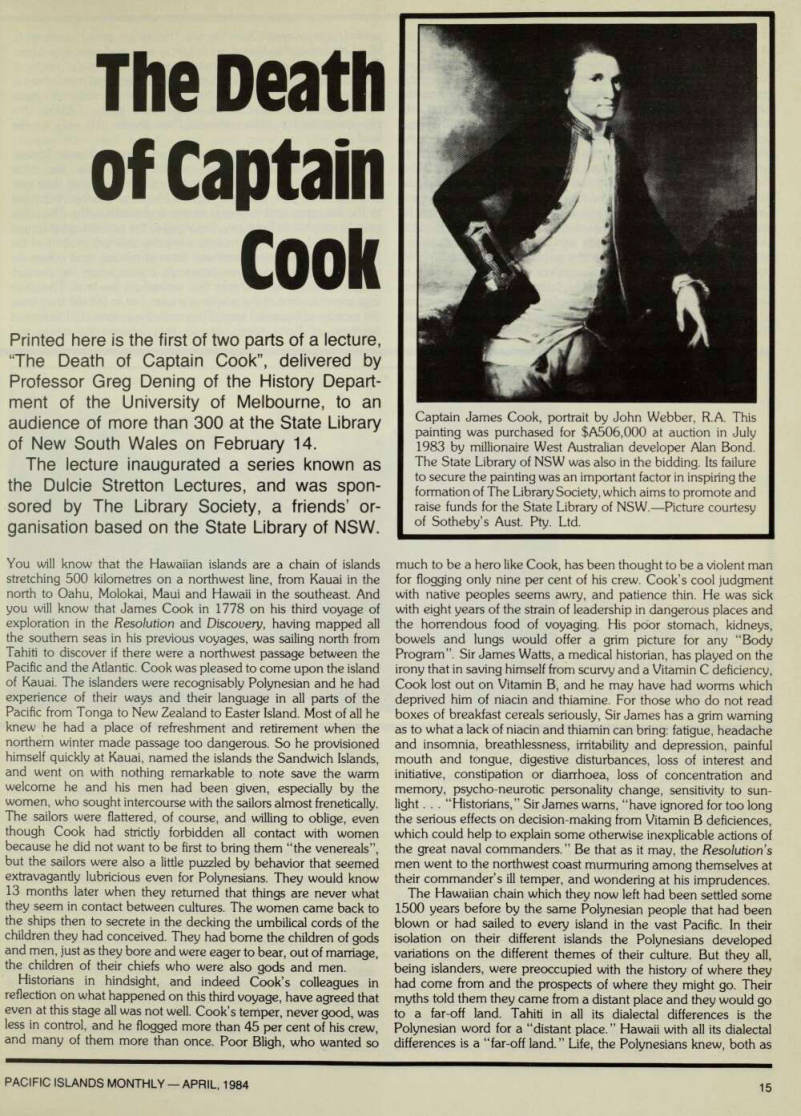
Captain James Cook, portrait by John Webber, R.A. This painting was purchased for $A506,000 at auction in July 1983 by millionaire West Australian developer Alan Bond.
The State Library of NSW was also in the bidding. Its failure to secure the painting was an important factor in inspiring the formation of The Library Society, which aims to promote and raise funds for the State Library of NSW.—Picture courtesy of Sotheby’s Aust. Pty. Ltd.
individuals and as groups, both now and in the past, was a journey from Tahiti to Hawaii.
The Polynesians had another puzzle about themselves. They puzzled how to describe, how to act out, how to establish the proper relationship between the raw violence of power and the controlled violence of authority. Think for a moment of our own political system: think of the distinction we make of the legal authority of the crown and the power of politicians. Think of the etiquette, the protocols, the rituals by which we divorce authority of the crown and political power and the ramifications of that distinction through all of our social and legal life. Mr Hawke said recently that the world would be a better place if Soviet Russia and Communist China played cricket. I heard him say in that that he saw in cricket something he valued in culture the subtlety of the balance of rule and custom, the thin line that could be walked between competitive hostility and acceptable sportsmanship. We would be hard put to describe ourselves, whether republican or monarchist, without pointing to the balances we make between power and authority in our courts, parliaments and in government at all levels. And if we were asked to explain it, we would talk history Magna Carta, Long Parliament, Common Law. We put
accession were about how the son had taken power, usurped it, killed his father. He buried his father as if he had conquered him.
Then he gained authority by marrying into the people of the land.
Indeed the women of the land, not just his wife, gave themselves to the chiefs, as they had given themselves to the Resolution’s men, for the sake of the children they would bear. “Chiefs,” the Hawaiians said in their proverbs, “are sharks that walk on the land.”
The Hawaiians played out these oppositions of stranger/Native, Sea/Land, Death/Life in innumerable ways. But the most important was in the seasons of their year. They divided their year into two. One part, the eight months March to October, belonged to the strangers and their god of war and sacrifice, Ku. The other part, November to February, belonged to the natives and their god of the land, Lono. Eight months were the ordinary months of the year, time of war and sacrifices, time of taboos, time when the chiefs demanded awesome protocols, a time when the proverb rang true: chiefs were sharks that walked on the land. The other four months were of the northern winter, but in Hawaii they were the months of bountiful food. They were the season of thunder and lightning, of Kona winds, of rain that scoured the creeks and
enormous social, educational and mythical energy into making the distinction and keeping it real.
The Polynesians had some sense of the same opposition between power and authority. Their rulers, their chiefs, had both power and authority, but the Polynesians understood that the two came from different sources. They understood that power, always violent, always usurping, came from outside, belonged to strangers. But authority was always legitimate, always came from within, belonged to those born with it, belonged to natives. They set up their understanding in myths about the past, but also the present. At some time strangers had come from a distant place, Tahiti; they came with war, with human sacrifice. They came as man-eaters, cannibals. They came with their god of war and sacrifice Ku. Strangers came from the sea, “from beyond the sky.”
When the strangers came to the Hawaiian Islands, they found natives there, born of the land, belonging to the productive land.
The strangers conquered the natives, took power but gained authority by marrying the women of the land, by marrying into lines that were native. These myths were stories about the past but they were also cosmologies about the present. So when a chief died and his first-bom son came to power the ceremonies of
brought the fish. They called it makahiki ma-tahiti, a voyage from a distant place. It celebrated the voyage of the god of the natives, Lono, to Hawaii. He came every year with the rising of the Pleiades and left with their setting. Makahiki was a carnival season in which there was no war or sacrifice, in which there were games, in which there were no taboos that if broken would bring death.
The productivity of the land was celebrated in gifts to the chiefs in their role as legitimate authority over the land. Makahiki began with a procession, early in November. The symbols of Lono were taken around the island in a right-handed procession. Clockwise, land to the right, sea to the left: land, life, right; sea, death, left. The chiefs retired to their own properties around which left-handed processions were made in sign of dispossession of their violent power. The symbols of Lono were a wooden crosspiece from which hung strips of white bark cloth and the skins of a bird, the albatross. At each district boundary which the Lono procession crossed there were ceremonies of gift-giving of food in extravagant abundance. The procession having circuited the island ended in Lono’s temple. When the makahiki season was finished Lono’s temple was dismantled. In the last days of the season the chiefs landed on the beach before the temple and as strangers in
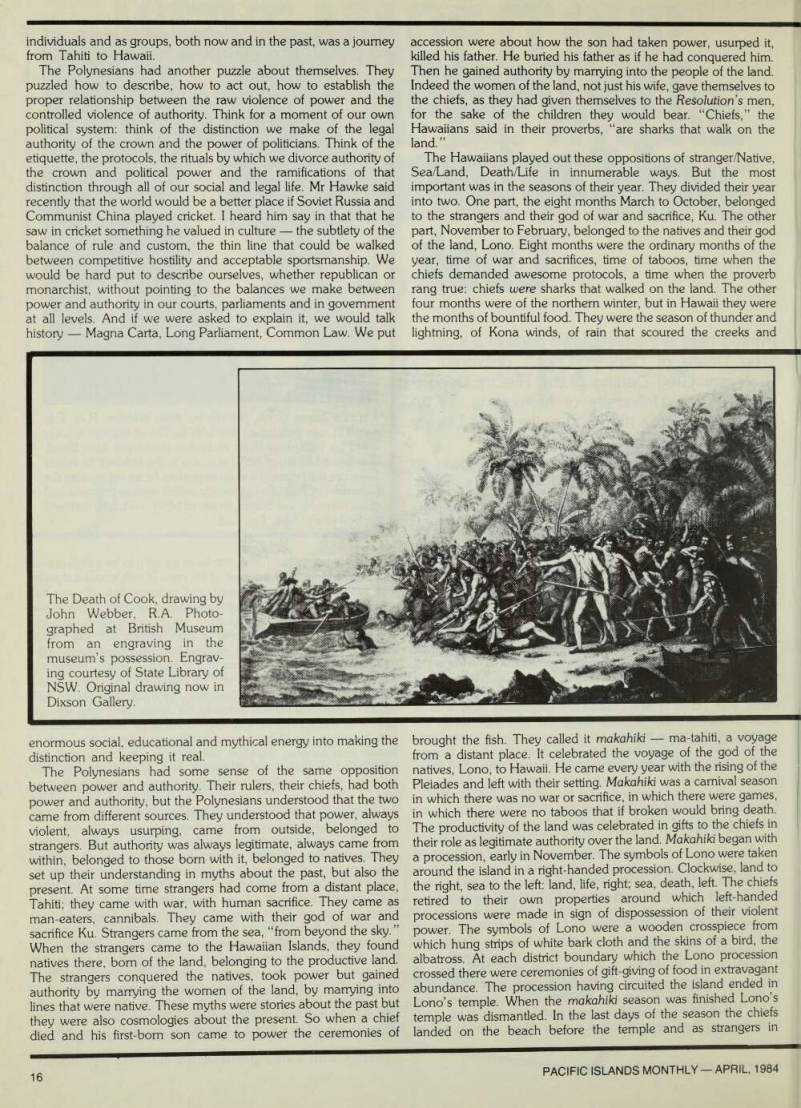
The Death of Cook, drawing by John Webber, R.A. Photo graphed at British Museum from an engraving in the museum’s possession. Engrav ing courtesy of State Library of NSW. Original drawing now in Dixson Gallery.
ceremonial battle defeated Lono and the natives again. They began the new year with a human sacrifice to Ku. A canoe was launched filled with food and gifts and Lono’s symbols and set adrift in the expectation that it would return again with Lono at makahiki.
With the coming of the northern cold and autumn fogs Cook turned south. He arrived off Maui on Novenber 26, 1778. He was crankier than ever and his crew were cranky at him. He was making them drink spruce beer instead of their grog and they murmured as the phrase went, mutinously. No use telling them that their grog was deficient in both Vitamin C and Vitamin B, they liked it. What was worse, Cook told them they were not going to winter in an island haven, they were going to keep at sea the whole winter long. He was still angry that he had not been able to keep his men from the women on his earlier visit to Kauai, and it was soon clear from the women who now came off to the ships, that the “venereals” had spread very quickly indeed. He had obviously decided that three months in one spot in the Hawaiian islands would not do his crew or the islanders any good. And he thought he would be better supplied with frequent visits to new places. So he began a long punishing voyage in huge winter seas, tacking and
black stone with huts and statues and altars of wood or matting.
The priests of the temple came to the Resolution and were importunate that Cook land. When he did the people had melted away or covered their faces and bent to the ground as a crier went before Cook crying Lono, and warned them to make obeisance.
The priests led Cook around the pantheon of their gods in the temple. He was extraordinarily malleable to their wishes, prostrating himself at the statues, kissing them. The priests installed him on a sort of platform, anointed him, fed him, extended his arms like a cross of makahiki , wrapped him in a red tapa cloth, and began a litany that ended in a chant of Lono, Lono, Lono.
When they were finished with him, Cook asked if he could have a small enclosure beside the temple for his use as an observatory.
The priests were delighted to accommodate the tents and all the paraphernalia for observing the stars. The Pleiades were about to set and they were watching the stars as well. They kept asking when Lono would go. Kalaniopu’u, the chief of Hawaii, came with all the majesty of Hawaiian high chiefs. He would not meet Cook on the Resolution. He met Cook on the beach near Lono’s temple.
He did not challenge him, it is true: he honored Cook with the great feather capes, the Hawaiian’s richest possession. The British
tacking again around the island of Hawaii. He would come to shore to trade and provision, then continue on his clockwise voyage around the island. Each time they came near to shore they noticed that the people were extraordinarily generous with their gifts of food from their land: they also noticed there were no chiefs among them. And all the people called Cook Lono. His own officers gave up trying to tell them that his name was Kuki or Tuti and began to refer to him as Lono too. And so under their white sails hanging from the cross of their masts and yards they made a right-handed procession around the island. On January 17, they arrived at Kealekekua Bay. They were astounded at the welcome they received. There were a thousand canoes in the bay, 10,000 islanders in them. They did not know that Lono’s makahiki The path of the god they called it procession began and ended every year at Kealekekua Bay, and that they were expected.
Kealekekua Bay is a half-moon bay with high cliffs in the centre, flattening to plains on both horns. In 1779 there was a large cluster of houses, almost a village, at the north-western comer and on the south-eastern corner there was a temple, or heiau. For the season of makahiki this heiau was Lono’s temple where the procession began and ended. In the Hawaiian style it was a raised platform of
Museum has it still. And he too kept asking when Lono would go.
They went on February 4, the day the Pleiades set in 1779, the precise day makahiki ended. Before they went they needed firewood and they asked the priests if they could have the fencing and even the statues of Lono’s temple. The priests were not offended. They said they might have it all, save one statue of Ku.
His season was about to begin. They happily helped dismantle the temple, as they always did.
The season of Ku would ordinarily begin with a human sacrifice.
Two days before the Resolution left, William Watman, a much loved older seaman, died of a stroke. Cook’s crew were pleased that the chiefs asked them to bury Watman in the stone pavement of the temple. But they were a little mystified at the extravagant ceremony that accompanied the burial. All night the Hawiians chanted and prayed around the grave. They piled sacrifices of their own, pigs and food, around the cross that marked it. There is a plaque there now commemorating William Watman’s burial as the first Christian service in Hawaii. That may be so. No doubt the priests of Lono and Ku thought it more ecumenical than that, and the chiefs had made their sacrifice. • Next Month: Death, and a double apotheosis.
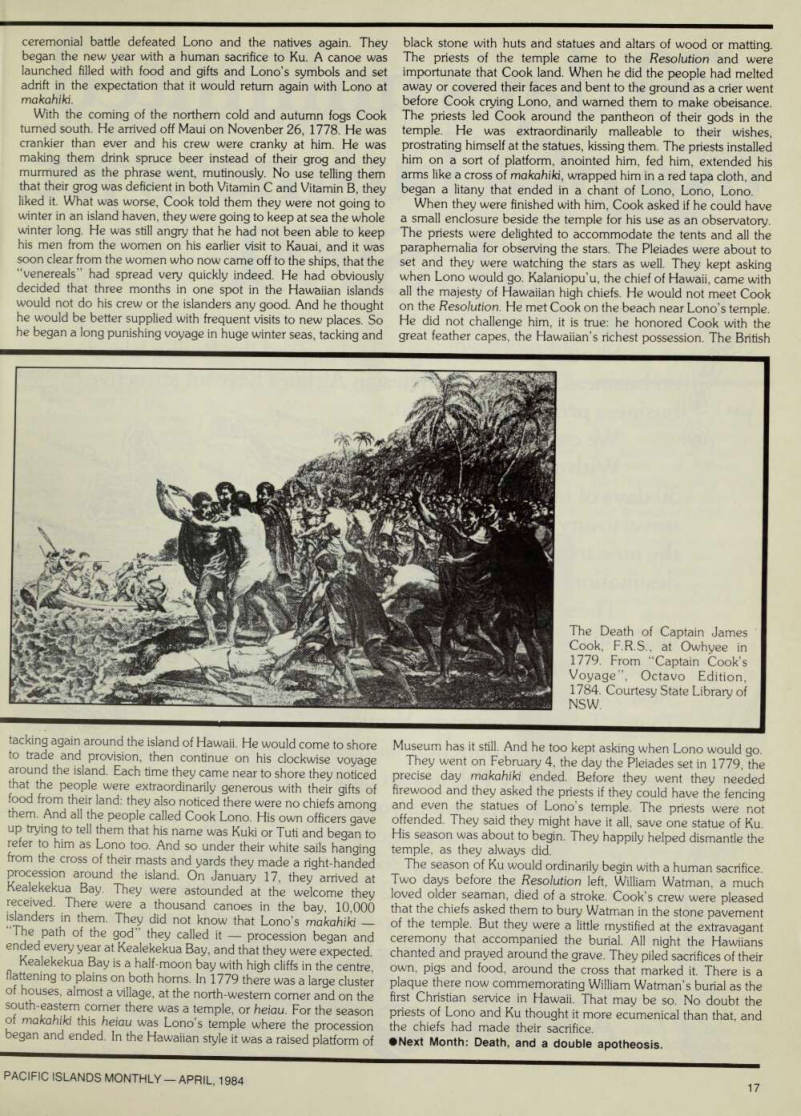
The Death of Captain James Cook, F.R.S., at Owhyee in 1779. From “Captain Cook’s Voyage”, Octavo Edition, 1784. Courtesy State Library of