on telecommunications
pp. 11-13 · Read in the full issue

Some lack of communication on telecommunications
Telecommunications writer LIZ FELL reports on the 1984 conference of the Pacific Telecom munications Council (PTC). She writes of frictions between representatives of small Paci fic Island nations and the giants of the Pacific Rim, but also notes that some of the giants, notably the U.S. and Japan, didn’t seem to be getting along all that well together either.
The weather is always an im portant attraction for those attending the annual confer ence of the Pacific Telecom munications Council (PTC) at the lavish Sheraton Hotel over looking Waikiki beach in Hawaii.
This year both the weather outside and the temperature inside were constant topics for discussion. It was sunny and warm in Waikiki in January but freezing inside the over-air conditioned hotel. There was more than a sneaking suspicion that the temperature had been lowered for the benefit of the high-technology which was being exhibited in the confer ence area. It was also snowing in New York and Washington as American Government and industry leaders at the conference never tired of ex plaining.
While most conferees came from the U.S. there was also a sizeable contingent from Pacific Rim nations such as Japan, Canada, Australia and South America, with several people coming from as far afield as Russia, China, the U.K. and France.
Also this year, financial assist ance to the amount of SUS6O,OOO was provided by the United States Information Service (USIS). This allowed the participation of a small group from Western Samoa, Fiji, Palau, Ponape, Tonga, Cook Islands, and the Mar shalls, as well as people from Indonesia, Malaysia and Thai land. PTC President Joseph Gancie expressed his commit ment to extending this repre sentation next year.
Despite the South Pacific is lands presence, their concerns were only really expressed in one major plenary session on the last day. This session drew together representatives from disparate parts of the Pacific to discuss ways in which their governments could co-operate and take advantage of the
growth in telecommunications services.
The speakers were all high level officials from the U.S., Peru, Chile and Japan. The respondents came from In donesia, Fiji and Western Samoa. Taking the lead, the U.S. speaker outlined some recent initiatives to assist under resourced and under-de veloped nations. These in cluded the National Aeronau tics and Space Administration (NASA) study of South Pacific needs, the development of a low-cost, low-power earth sta tion for satellite links in rural areas, and the formation of the
U.S. Telecommunications Training Institute.
The institute is a co-operative venture between many of the large U.S. telecommunictions corporations and the U.S. Gov ernment. It offers technical and management training to people from developing nations at va rious sites in the U.S. One international telecommunica tions consultant put its aims very succintly when she said that it was an attempt to get people to “Buy American”. It is clearly hoped that institute graduates will think of U.S. products when (and if) they are eventually in a position to influ
ence purchasing decisions.
The Japanese Government representative at the session also spoke of the various types of co-operation and assistance offered by his country to less developed nations. These in volve acceptance of trainees, despatch of experts for on-the spot training, and surveys and technological co-operation cen tres in places such as Thailand, Indonesia and the Philippines.
Japan also provides substantial financial assistance to organisa tions such as the International Telecommunications Union, which remains the primary tele communications training pro vider in this area.
Respondents were all quick to criticise the U.S. training initiative. Emori Naqova from Fiji pointed out that South Pacific nations have a low eco nomic base which means they simply can’t afford to send skilled technicians or engineers away to be further trained in high technology without creat ing hardship. Inevitably they leave gaps behind.
“It is more practical if the
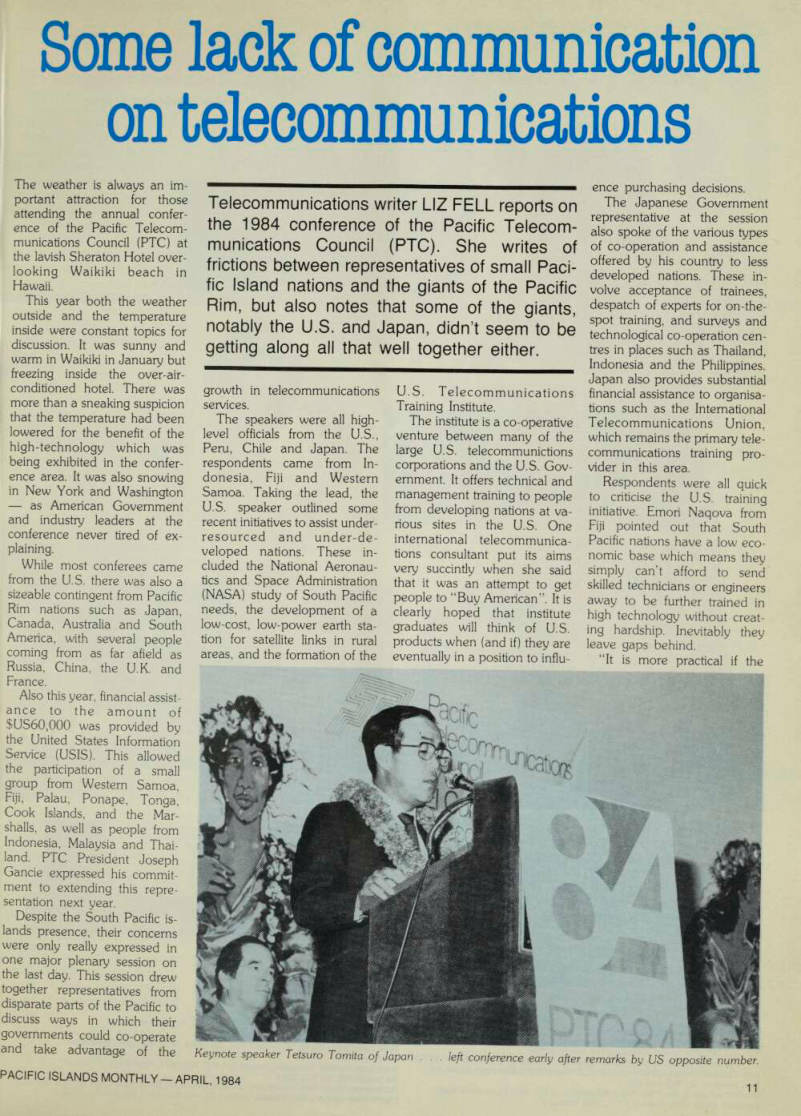
Keynote speaker Tetsuro Tomita of Japan ... left conference early after remarks by US opposite number.
expertise comes to us and sets up high-level courses. At least our skilled staff can be called out to assist if there are prob lems with the network,” he said.
Naqova went on to praise a Japanese initiative of 1983: A six-week course was organised and conducted in Fiji for South Pacific engineers and technical officers to be trained in satellite technology, fibre optics, and other advanced systems. He expressed gratitude to the Japanese Government, and the hope that this was only the start of a series of similar courses to be conducted within the South Pacific region. If such courses were to be conducted away from the region, scholarships at least would be necessary, he said.
Western Samoa’s respon dent, J. W. Moore, was also critical of the “well-meaning offers” from developed coun tries. He pointed out that, leav ing aside those countries chich have a per capita income within the range of $4OOO-$ 10,000, there were still 45 other coun tries in the Pacific Basin with per capita incomes between 1 $lOO-$3OO per annum. He suggested that the audience should look at telecommunica tions development in this con text, recognising that it was often a low financial and politi cal priority for developing na tions.
Despite the friction between developed and developing countries at this one session, it was tensions generated be tween the Americans and Japanese that really dominated the conference.
Keynote speakers Tetsuro Tomita, deputy director-general of the policy bureau in the Japanese ministry of posts and
telecommunications, and
Lionel Olmer, U.S. under-sec retary of commerce for in ternational trade, used the opening session as a stage to rehearse some of the argu ments being used in the on going telecommunications trade talks between these two nations.
In fact, in response to some of the criticisms levelled by Olmer, Tomita cut short his stay at the conference and returned to Japan.
Over the past couple of years, the U.S. has been ex-
erting pressure on the Japanese Government to open up its lucrative telecommunications market to U.S. suppliers. Olmer noted certain “deregulatory” moves of the Japanese with approval, and went on to dis cuss a new proposal which may go before the Japanese Diet in the course of 1984.
This proposal will open up the Japanese monopoly, the Nippon Telegraph and Tele phone public company (NTT), to competition. However, it may also restrict U.S. com panies from competing by fore ign-ownership and domestic content requirements.
Olmer departed from his pre pared speech with words of criticism of this possibility. He said: “We view with concern any provisions of this character, and have so informed the Japanese Government. We hope that Japan continues a process of opening up its mar ket to competition by accelerat ing not discouraging foreign participation.”
Mr Tomita returned to Japan the next day.
One of the areas of negotia tion between the Japanese and Americans is the regional satel lite system which Japan has proposed for the Pacific. This proposal, first outlined at the PTC conference last year, in volves the provision of high speed links between the nations
of the Pacific Rim, and tele phone links for remote areas in the Pacific islands.
At a press briefing during the conference, Dr Saburo Okita, former foreign minister of Japan, and now chairman of the Institute for Domestic and International Policy Studies, confirmed reports that the U.S. and Japan were discussing this satellite proposal as a co-opera tive venture.
Okita stated that the Japanese were feeling pressure to purchase U.S. satellites. If this regional proposal were im plemented, it would involve the two countries pooling their re sources. The production of the satellites would be commis sioned to the U.S., and the Japanese would lease out trans ponders on the satellite if they wished.
The Japanese proposal still requires consensus among leaders in Japan. If it were to become a reality, the Japanese believe it could be integrated with the existing global satellite service provided by Intelsat, the international satellite organisa tion to which most developed nations are signatories.
Joseph Pelton from Intelsat is not so certain. He announced Intelsat’s approval of a new service called VISTA at the conference. This service was designed with South Pacific ru ral needs in mind, and while it is
still far from ideal, Felton is obviously hoping it will be used for the planned South Pacific domestic telephone links.
Smaller sessions and work shops provided a wealth of information in other areas. The communication needs of expor ters, health workers, scientists and those involved in long distance learning were on the agenda. There were also special sessions covering the use of ATS-1 social service satellite networks in the South Pacific, and the A.I.D. rural satellite projects in Indonesia, Peru and the Caribbean.
Many of these smaller ses sions were marred by the fact that so many speakers had evidently failed to master the simplest techniques of speaking into a microphone. Such wide spread incapacity was all the more extraordinary in a gather ing in which most participants were inolved in manufacturing, buying, selling and distributing the technology of the com munications industry.
The organisers have been watching this annual event grow larger over the last six years. Next year they anticipate that participants will break the 500 limit, the number re garded as the maximum if effective, informal contacts and formal discussions are to re main the conference goals.
Liz Fell.
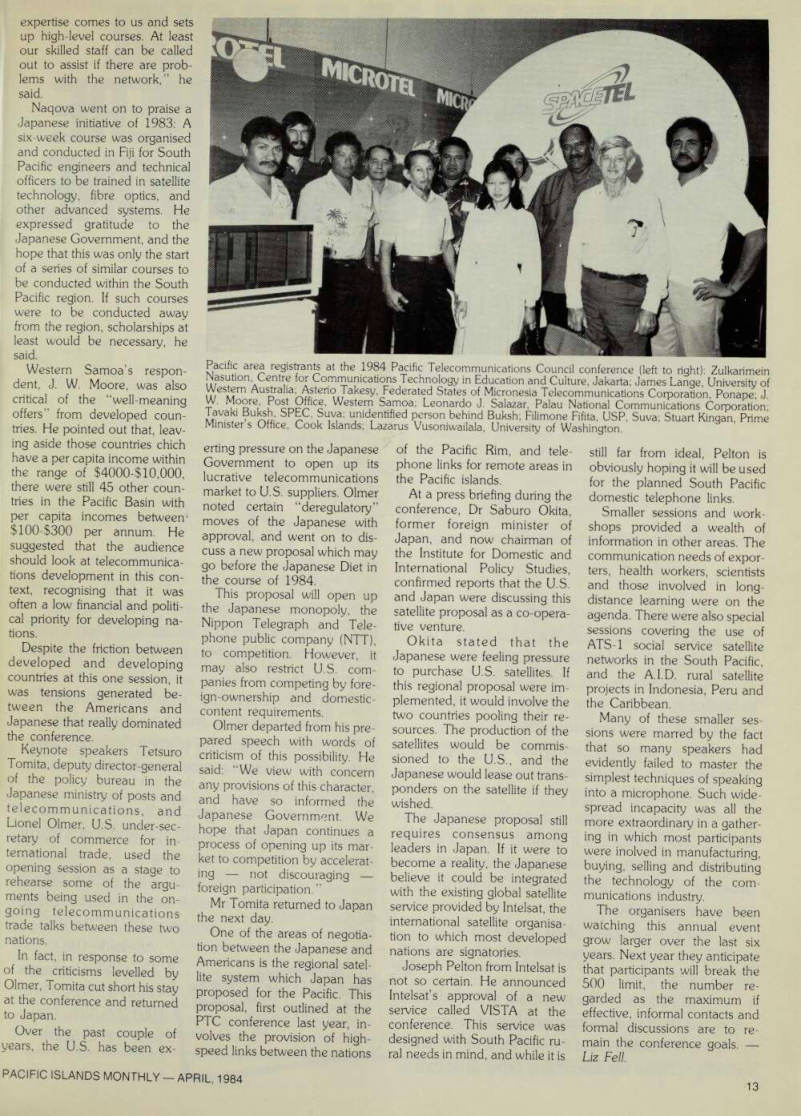
Pacific area registrants at the 1984 Pacific Telecommunications Council conference (left to right): Zulkarimein Nasution, Centre for Communications Technology in Education and Culture, Jakarta; James Lange, University of Western Australia; Asterio Takesy, Federated States of Micronesia Telecommunications Corporation, Ponape; J.
W. Moore, Post Office, Western Samoa; Leonardo J. Salazar, Palau National Communications Corporation; Tavaki Buksh, SPEC, Suva; unidentified person behind Buksh; Fifimone Fifita, USP, Suva; Stuart Kingan, Prime Minister's Office, Cook Islands; Lazarus Vusoniwailala, University of Washington.