New Caledonia:
pp. 9-10 · Read in the full issue
the gulf widens
of W ®h d - t 0 P ubllsh f r GARRY BARKER was in New Caledonia at the time of a February land occupation fnH he « or J h w est of tha ™ am lsland - Here he looks at both sides of the argument in New Caledonia sat^sf^d 8 vvhate 88 and d l, ff,cult t,me for everyone” in the territory, predicting that “nobody will be totally
Another tense chapter in the long story of New Caledonian independence from France is now being written in Noumea against a background of hardening positions, declining pahence, and rising anxieties. 1 he five Melanesian political parties making up the Independence Front have begun to respond to their own hardmers who themselves are makng poetical capital out of the ncreasingly shrill reactions of
>o-called nght-wing extremists
>n the “French settlers’” side.
The right-wing groups, corn posed of Europeans, many of them farmers, do not see how they can give up that which they have created, and wish to remain “French” forevermore, They are not French now, any more than South Africa’s Afrikaaners are Dutch and would not be either welcome or happy, in France if they turned up as a 50,000-strong group of refugees. Which is not the present point, but part of their dilemma The “left” is predominantly
Melanesian, although liberalminded Europeans have joined with them, convinced that noone. whatever his political hue, has any chance of a future here unless independence is embraced, and made to work.
Each side is now beginning to frighten the other.
In mid-February right-wing stalwarts issued an aggressive statement demanding continuation of the status quo, virtually without end.
The left, represented by the Independence Front, a very
loose collection of five political parties, immediately countered by sending a telex to France’s President Mitterrand deman ding that all here who did not accept independence should be repatriated to France im mediately, They alleged that the “malcontents” were mostly ex- Algerian colons, former para troopers and “other fascists” who ought to be heaved out, anyway but, as usual in these affairs, the truth is a good deal more complicated than that.
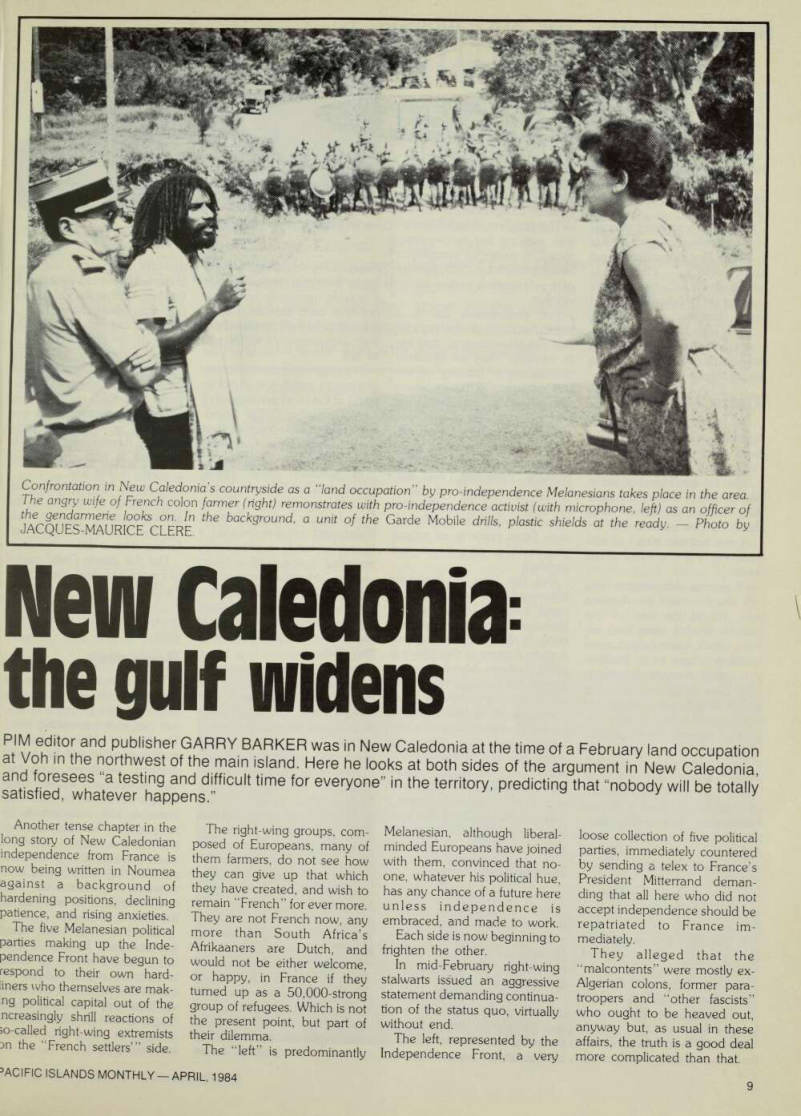
Confrontation in New Caledonia's countryside as a "land occupation" by pro-independence Melanesians takes place in the area, the angry wife of French colon farmer (right) remonstrates with pro-independence activist (with microphone, left) as an officer of the gendarmerie looks on. In the backgroud, a unit of the Garde Mobile drills, plastic shields at the ready.- Photo by
Jacques-Maurice Clere.
It all adds up to the virtual sinking of the moderate major ity of the middle ground. In creasingly those who are wor ried about the complications of independence . . . and they in clude people of all races, indi genous, immigrant and mixed .. . are finding themselves forced to take one side or the other.
I spoke to a pleasant woman with a middle-management job in a busy Noumea office. “ I am not French,” she said, “although my father was. I went to Paris on holiday last year. I was a stranger.
“New Caledonia is my home.
I was bom here. My children were bom here. If they throw us out, where will we go?
Where to go?
“It is difficult to get into Australia or New Zealand these days, since they changed the immigration laws.
“But we don’t want to leave.
All we have in the world is here.
Why should we leave? Why should we be pushed out?”
“I am not yet afraid of vio lence but I am worried it will come. ”
Of course this woman was not like the hard-line farmers who are at the seat of the present trouble over land re form which, essentially, means handing it back to its Melane sian tribal owners. Inevitably they have a different outlook and, being in the country, do not have the feeling of com munity enjoyed by the people of Noumea.
The capital is, in fact, not a Pacific city at all but a very French enclave of 60,000 souls, of whom only about 7000 are Melanesian. The architecture, the gardens, streets, shops and cafes could have been plucked ready-made out of the South of France.
In some respects it is this very cosiness which causes part of the problem.
In the last French general election about 80 per cent of New Caledonians voted for the conservative Giscard d’Estaing.
That the socialist Mitterrand won was regarded as a disaster for their interests.
Cooler heads reject this no tion, saying that whoever has
power in France must proceed as fast as possible with Melane sian independence.
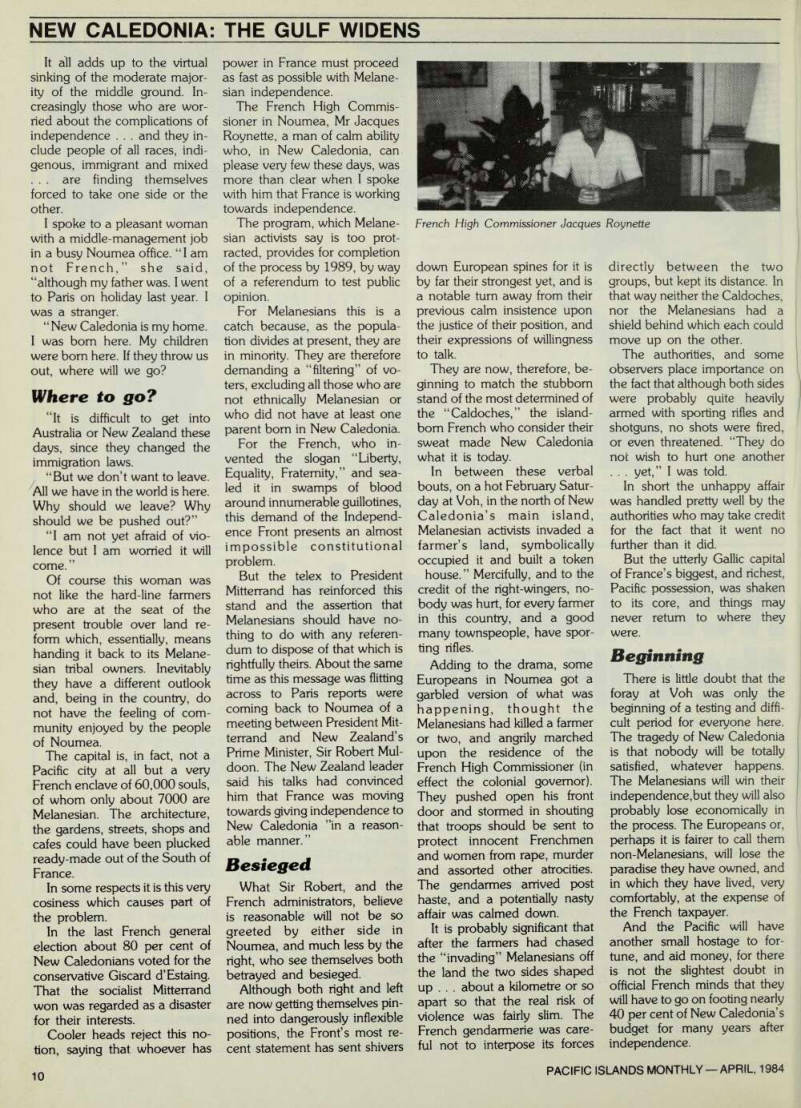
The French High Commis sioner in Noumea, Mr Jacques Roynette, a man of calm ability who, in New Caledonia, can please very few these days, was more than clear when I spoke with him that France is working towards independence.
The program, which Melane sian activists say is too prot racted, provides for completion of the process by 1989, by way of a referendum to test public opinion.
For Melanesians this is a catch because, as the popula tion divides at present, they are in minority. They are therefore demanding a “filtering” of vo ters, excluding all those who are not ethnically Melanesian or who did not have at least one parent bom in New Caledonia.
For the French, who in vented the slogan “Liberty, Equality, Fraternity,” and sea led it in swamps of blood around innumerable guillotines, this demand of the Independ ence Front presents an almost impossible constitutional problem.
But the telex to President Mitterrand has reinforced this stand and the assertion that Melanesians should have no thing to do with any referen dum to dispose of that which is rightfully theirs. About the same time as this message was flitting across to Paris reports were coming back to Noumea of a meeting between President Mit terrand and New Zealand’s Prime Minister, Sir Robert Mul doon. The New Zealand leader said his talks had convinced him that France was moving towards giving independence to New Caledonia ”in a reason able manner.”
Besieged
What Sir Robert, and the French administrators, believe is reasonable will not be so greeted by either side in Noumea, and much less by the right, who see themselves both betrayed and besieged.
Although both right and left are now getting themselves pin ned into dangerously inflexible positions, the Front’s most re cent statement has sent shivers
down European spines for it is by far their strongest yet, and is a notable turn away from their previous calm insistence upon the justice of their position, and their expressions of willingness to talk.
They are now, therefore, be ginning to match the stubborn stand of the most determined of the “Caldoches,” the island bom French who consider their sweat made New Caledonia what it is today.
In between these verbal bouts, on a hot February Satur day at Voh, in the north of New Caledonia’s main island, Melanesian activists invaded a farmer’s land, symbolically occupied it and built a token house. ” Mercifully, and to the credit of the right-wingers, no body was hurt, for every farmer in this country, and a good many townspeople, have spor ting rifles.
Adding to the drama, some Europeans in Noumea got a garbled version of what was happening, thought the Melanesians had killed a farmer or two, and angrily marched upon the residence of the French High Commissioner (in effect the colonial governor).
They pushed open his front door and stormed in shouting that troops should be sent to protect innocent Frenchmen and women from rape, murder and assorted other atrocities.
The gendarmes arrived post haste, and a potentially nasty affair was calmed down.
It is probably significant that after the farmers had chased the “invading” Melanesians off the land the two sides shaped up . . . about a kilometre or so apart so that the real risk of violence was fairly slim. The French gendarmerie was care ful not to interpose its forces
directly between the two groups, but kept its distance. In that way neither the Caldoches, nor the Melanesians had a shield behind which each could move up on the other.
The authorities, and some observers place importance on the fact that although both sides were probably quite heavily armed with sporting rifles and shotguns, no shots were fired, or even threatened. “They do not wish to hurt one another . . . yet,” I was told.
In short the unhappy affair was handled pretty well by the authorities who may take credit for the fact that it went no further than it did.
But the utterly Gallic capital of France’s biggest, and richest, Pacific possession, was shaken to its core, and things may never return to where they were.
Beginning
There is little doubt that the foray at Voh was only the beginning of a testing and diffi cult period for everyone here.
The tragedy of New Caledonia is that nobody will be totally satisfied, whatever happens.
The Melanesians will win their independence,but they will also probably lose economically in the process. The Europeans or, perhaps it is fairer to call them non-Melanesians, will lose the paradise they have owned, and in which they have lived, very comfortably, at the expense of the French taxpayer.
And the Pacific will have another small hostage to for tune, and aid money, for there is not the slightest doubt in official French minds that they will have to go on footing nearly 40 per cent of New Caledonia’s budget for many years after independence.
French High Commissioner Jacques Roynette