PNG looking again
p. 28 · Read in the full issue
at TV?
Papua New Guinea may be toying again with the introduc tion of commercial television.
Speculation is strong in Port Moresby that the government is tempted by an offer reportedly made by the independent Newcastle station NBN3. PNG Prime Minister, Michael So mare. rejected these sugges tions when he was questioned during a February press confer ence in Port Moresby and said television would be introduced to PNG when the country could afford it, which was not now.
No deal had been signed, he said. However,speculation con tinues along the lines that NBN3 would provide the prog ramming and the expertise while the PNG government would establish its equity by handing over about $1 million worth of television studio equipment said to be in store there.
The rumors have rekindled the interest of Australian and New Zealand television promo ters who, while cautious about PNG’s prospects as a television market, feel they ought to have a foot in the door, if not a whole leg.
A thriving video library sys tem operates almost every where in PNG, just as it does in Fiji and other Pacific islands, offering, in the view of many citizens, most of the benefits of broadcast television, while at the same time avoiding some of the pain.
PNG (but not Fiji, whose
government lays claim to the electronic air waves) also has a well-developed market in domestic satellite dishes in which the Australian company, Hills, famous for their rotary clothes lines, seem dominant.
These generally pick up the Australian Broadcasting Com mission’s country programs satellite-beamed to rural Queensland and the Northern Territory.
Mr Somare is undoubtedly firm in his belief that his country cannot afford itself to establish a television network. Even to ser vice Port Moresby would cost the government more than it could reasonably afford. He is also thought to feel that even if private television stations are allowed to set up, the govern ment should have some control over program content, perhaps using the National Broadcasting
Commission’s resources to pro vide news and current affairs segments.
Late last year the idea of opening the country to televi sion was being floated fairly prominently, but the fever cooled after a very firm govern ment statement opposing the notion, again on grounds of cost.
Fiji, which has taken a very measured look at the idea, seems to have made its mind up very firmly that it will not have private broadcasters handling the medium, and that it cannot afford to do it itself.
Instead, Fiji has opted for video and has set about estab lishing its own cassette produc-
tion unit, funded in part by foreign aid, a good deal of it reportedly promised by West Germany.
The Pacific country most generously served with televi sion is American Samoa where, it is widely conceded, the less said about it, the better.
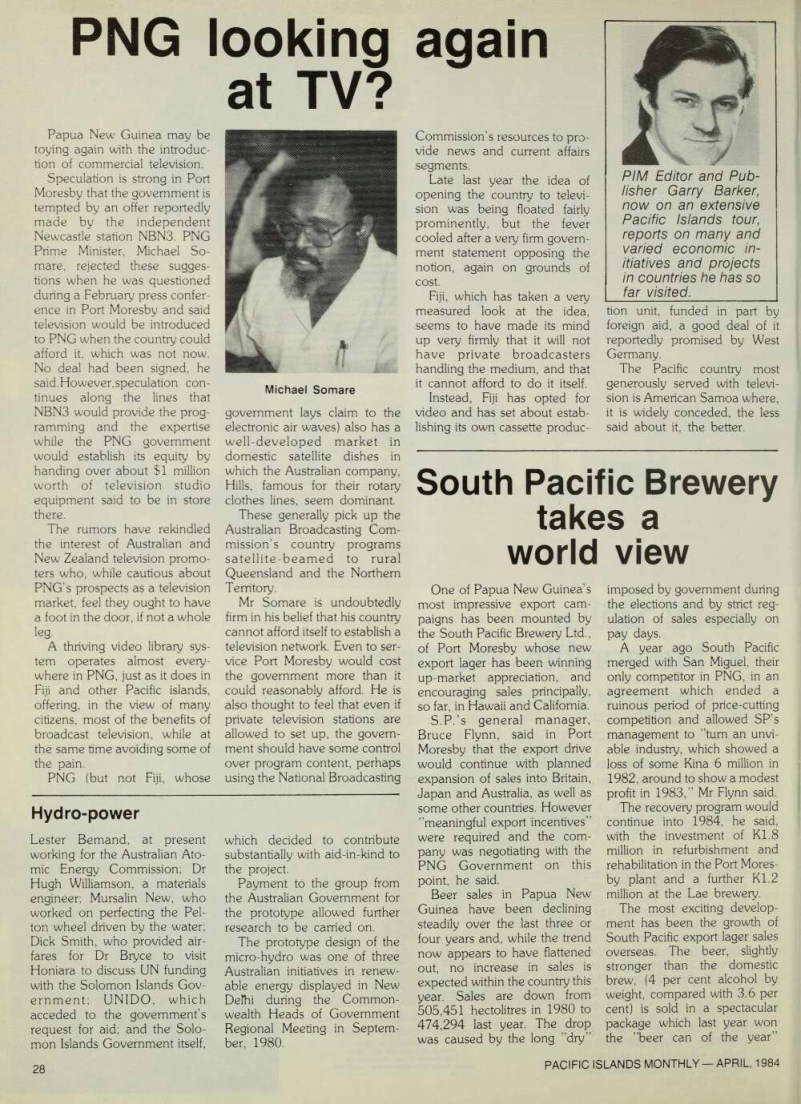
Michael Somare
PIM Editor and Pub lisher Garry Barker, now on an extensive Pacific Islands tour, reports on many and varied economic in itiatives and projects in countries he has so far visited.