Tikopia
pp. 42-45 · Read in the full issue

Discovering the three ages of mysterious Tikopia
Tikopia: The Prehistory and Ecology of a Polynesian Out lier. Bernice P. Bishop Museum Bulletin 238. Published by Ber nice P. Bishop Museum Press, Honolulu, Hawaii, 96819. ISBM 0 91 0240 30 2. No price provided.
This weighty and profusely illustrated tome by Pat Kirch and Doug Yen discusses archeologic al research carried out in 1977 and 1978 on Tikopia, a tiny Polynesian “outlier” in the Southeast Solomons. It forms a perfect companion volume to the many publications of Sir Ray mond Firth on the ethnography and oral history of the island, based on his field work there in 1928-29, 1952 and again in 1966.
Here we find archeological confirmation of the substance of oral history collected by Firth, and previously considered by many other anthropologists to be purely mythical accounts. In ad dition, the extended time-depth provided by archeology carries us back much further in the is land’s history, beyond folk mem ory. Never has the value of integ rating both archaeological and ethnographic approaches in
studying the cultures of the Pacific been so admirably de monstrated as in this book. The integration of both approaches gives us a much fuller picture, which cannot be independently gained from either. While ar cheologists have accepted this for decades, few of our an thropological colleagues have been convinced; a reading of this volume might change a few pre viously sceptical minds.
The nearly 400 pages are by no means light reading, and it is a work clearly written for the Pacific specialist rather than a more general audience. While the concluding chapters, which provide a synthesis of the culture history of Tikopia, are compara tively easy reading, much of the rest of the volume is taken up with detailed discussions of geomorphology, shell adze clas sification, meat weights, fish species identifications, and ar cheological test pit stratigraphic columns. I think it would be useful for PIM readers to have a summary of some of the main findings of the author’s research, and some discussion of the rele vance of this small island to the prehistory of the Western Pacific.
The most immediate questions raised by the Polynesian lan guage and culture of Tikopia, like other “outliers” found along the fringe of Melanesia, are; where did the people come from, and when did they arrive? One old theory was that the outliers represented Polynesians left be hind on the journey eastwards from a supposed homeland in South-east Asia. A competing view was that they represented a more recent “backwash” of set tlements westwards from Poly nesia, drift voyagers from West ern Polynesia who arrived in Melanesia only a few hundred years ago. Recent archeological research, of which Kirch’s and Yen’s book is probably the most thorough example, has confirm ed the latter theory, but also shown that the history of human occupation of these islands ex tends back considerably longer than the few hundred years of Polynesian occupation. Melane sian cultures previously in habited them, to be assimilated or perhaps even exterminated by the Polynesian migrants. Thus Tikopia’s history goes back three millennia, while the Polynesian elements of its culture appear only within the last 700 or so years.
People have often tended to think of “traditional” societies in the Pacific as essentially stat ic, unchanging for perhaps thousands of years, and existing in perfect harmony with their environment before the fatal im pact of European colonisation.
The picture presented here, how ever, is one of continuous and sometimes abrupt change changes in culture, economy, and almost certainly population replacement as well. Kirch and Yen distinguish three main phases in the history of Tikopia, exclusive of the period of Euro pean contact: the initial settle ment or Kiki phase from 900-100
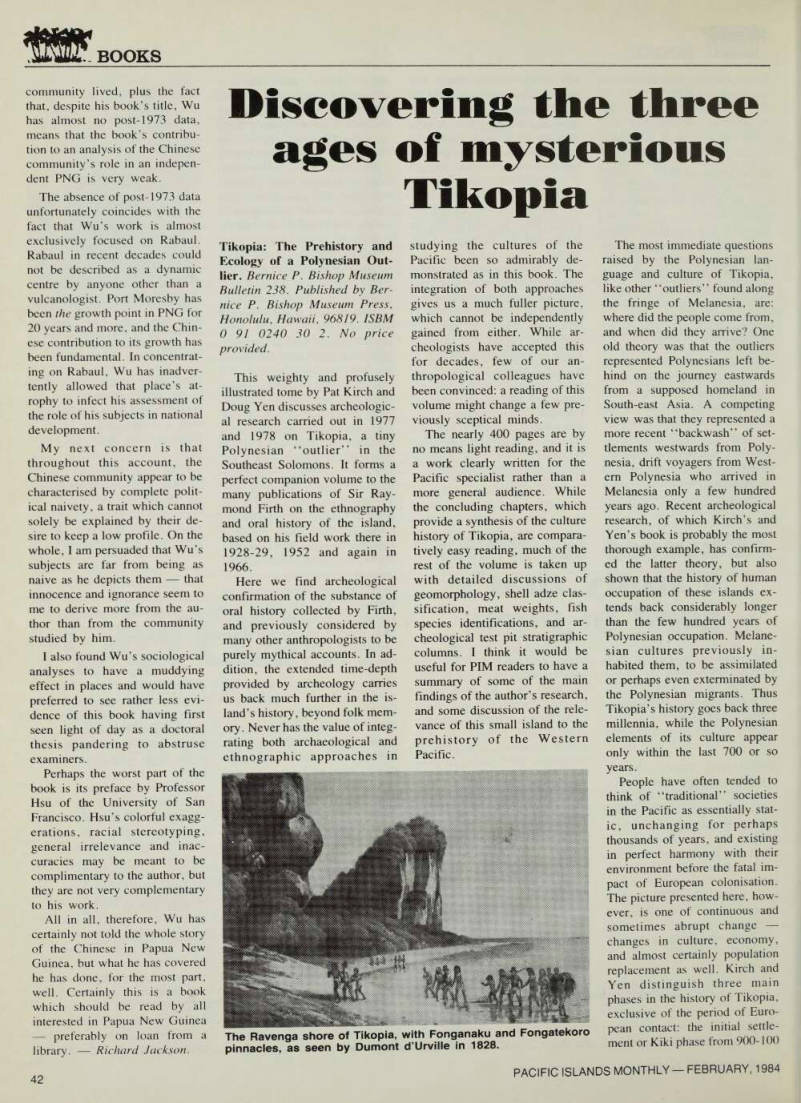
The Ravenga shore of Tikopia, with Fonganaku and Fongatekoro pinnacles, as seen by Dumont d’Urville in 1828.
BC, the Sinapupu phase 100 BC to 1200 AD, and the Polynesian, or Tuakamali, phase from 1200 to about 1800 AD. The oral history of the Tikopia collected by Firth relates only to this more recent phase.
Who were the initial inhabit ants? They were clearly as sociated with the great colonising wave, the so-called Lapita ex pansion, out of the Bismarck Archipelago, which took place 3000-4000 years ago. The Lapita colonisation, named after the dis tinctive pottery style associated with it, led to the initial occupa tion of Fiji and Western Poly nesia, and almost certainly the initial settlement of New Caledonia, Vanuatu and Sol omon Islands. Whether these colonisers were more Melanesian or Polynesian in appearance can not be established until more skeletons from the period are excavated and analysed. What is certain is that the languages (or language) they spoke were an cestral to those spoken today both in Polynesia and much of Island Melanesia. While the main thrust of colonisation was clearly southwards and east wards, there is evidence of back wash westwards even in this ear ly period a forerunner of later Polynesian drift voyages.
Wherever the immediate homeland of the colonisers of Tikopia was, they found an is land which looked quite different from what it does today. The land area was only 72 per cent of its present size, while the area of the reef flat was correspondingly larger. At that time the brackish crater lake in the middle of the island was an open bay with rich fish and shellfish resources. The Ropera swamp where Cyrtosper ma taro is now grown was then an area of open reef flat. The island was covered in forest and, with the exception of the coconut, would have had very few edible plants naturally grow ing on it. Birds and marine life were especially abundant in this pristine environment.
From the first day ashore the human settlers would have had a tremendous impact on the envi ronment. By predation and habitat destruction the fauna and flora were quickly decimated.
The megapode bird, and prob ably one species of rail, were hunted to extinction, the shellfish beds were heavily exploited, and the forest was burned to clear gardens where a range of in troduced crops were grown, Ground mammals were in troduced for the first time: pig, dog and the Polynesian rat, as well as chickens, The culture of these initial settlers associates them clearly with the Lapita expansion. The early pottery recovered on the island, though locally made, is wit Wn the Lapita tradition. Links wl > h both to north and S ° f Uth arC shown b >V he P resence °( eXOt "; ™ ter l als s ‘°ne a " d ? he ? from the main S ° loi ™ n lsla " ds - obsld ' a " from ‘ he B ' S t mar " k . Archi P ela g° of Pa P ua New Guinea and volcanic SS fr ° m the Banks Islands in Va "“ atu - The transition between the J C .' k ‘ phase and the sucteedln « Cyrtosper- Slna P u P u P ha * 15 thc most ab ™pt , m the Tlko P ia sequence, Local manufaclure of PO«ery “f* a " d a neW st y le of P otter y ? a " ed Man S aasi is imported fr °m Vanuatu, probably from the lsland of Santo ' New orn ament ,ypeS COm f in ' and a ,abu on eatln B turtles, sharks and rays seems to have come into effect they disappear from the menu in this phase, Are we seeing the replacement of one people by another, an intrusive population coming in from the south and dominating or wiping out the initial colonisers?
Kirch and Yen are understand ably cautious, hedging their bets until the comparative picture from the nearby islands becomes clearer. At present all we have are intriguing hints of sudden cultural changes in a wide area of the Pacific about 2000 years ago.
These are suggested by cessation of pottery manufacture altogether in some areas, and replacement of Lapita-like pottery by radical ly different styles in others. Thus pottery disappears in Santa Cruz and the Reef Islands, Tonga, Samoa, Futuna and probably Uvea (Wallis). In Fiji Lapita is replaced by Paddle Impressed pottery, Mangaasi pottery be comes dominant in central and north Vanuatu and displaces Lapita pottery in New Caledonia, where it is clearly an intrusive tradition (as it is on Tikopia and near by Vanikoro). Big changes were obviously occurring in the Western Pacific at this time, the first major cultural reshuffle since initial settlement 1000 or so years previously. Only more ar cheological research in the reg ion will allow us to explain this important, but at present poorly understood, period of Melane sian and Polynesian prehistory.
The Sinapupu phase lasts for just over 1000 years. During this period forest clearance for ag riculture and subsequent erosion began to alter the appearance of the island, while the build-up of sand dunes added to its land area.
Although marine resources con tinued to be exploited, we find an increasing reliance on domestic
pigs in the diet. New settlements were begun in this phase, pre sumably representing a rapidly growing poulation. Contacts with other islands continued with volcanic glass and pottery im ported from Vanuatu, chert prob ably from Ulawa in Solomon Islands and a single piece of Paddle Impressed pottery from Fiji. This last may well be witness to the arrival of a canoe load of drift voyagers from Fiji.
The transition at about 1200 AD to the Tuakamali phase is not as abrupt as that between the Kiki and Sinapupu phases. De spite some cultural continuity, however, there are some major changes and it is in this phase that the distinctive Tikopian cul ture of today developed. Without doubt this phase represents new colonists from Western Poly nesia who mixed with, and came to dominate culturally, the earlier Melanesian population. Pottery
imports from Vanuatu diappear
at the time when Mangaasi pot tery ceases to be manufactured in central Vanuatu. New artefact types occur on Tikopia, and the stone architecture of this period also has many close parallels with Western Polynesia. In addi tion, stone adzes were imported from that area. Volcanic glass was still being imported from Vanuatu and arrows and the oc casional pig were brought in from the nearer Solomon Islands.
The links with Western Poly nesia shown archeologically are of course explicit in Tikopian oral tradition, with particular lineages tracing their origins to Uvea (Wallis), Samoa, and
Tonga.
During this phase there was considerable expansion of settle ments, and, presumably, con tinuous growth in population. At the same time major changes occurred in the landscape. By a complex mixture of natural and human forces, the land area of the island increased, the Ropera swamp formed, and finally the salt water bay was cut off from the sea and transformed into a brackish lake. The closure of the bay and subsequent loss of fish and shellfish resources would have been disastrous for those living on its inner shore. This event provides a partial explana tion for the major wars of that
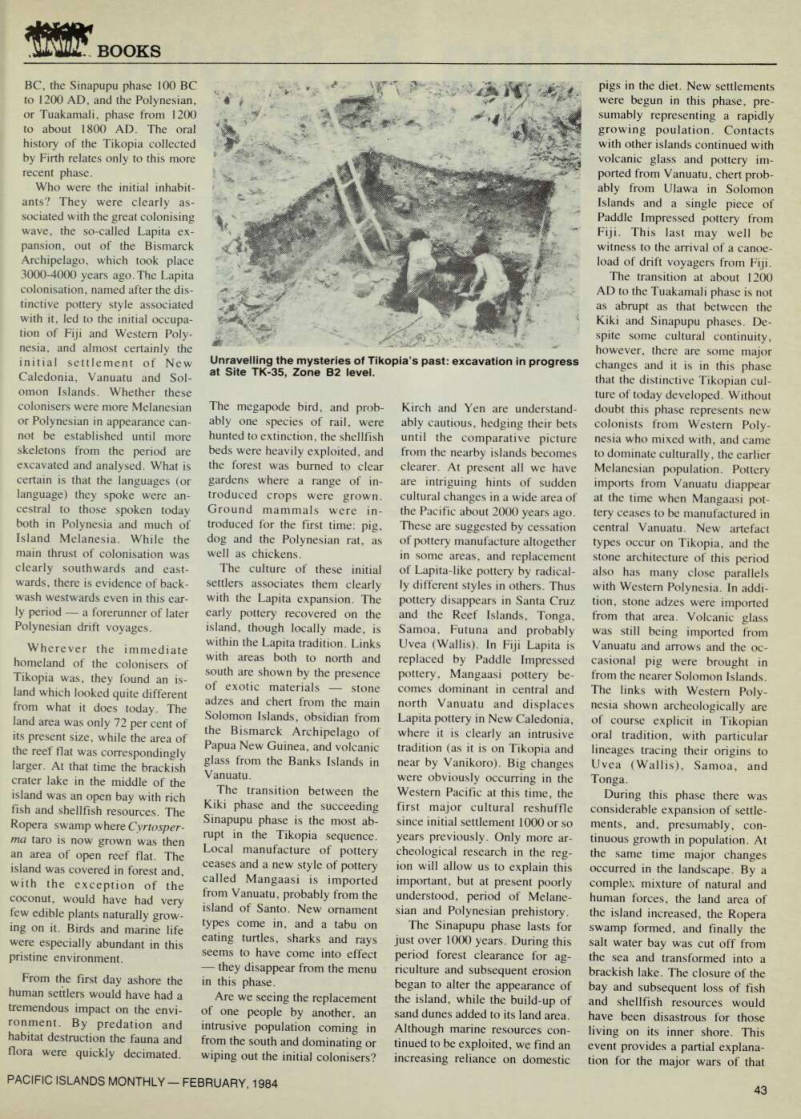
Unravelling the mysteries of Tikopia’s past: excavation in progress at Site TK-35, Zone B2 level.
period recorded in Tikopian trad ition. In these wars one clan was exterminated except for one in fant boy, while another group chose exile rather than annihilation.
In the earlier part of the
Tuakamali phase pig husbandry
continued, providing a major
source of protein second only to fish. The destruction of the pig herds near the end of the phase appears to have taken place be cause their damage to gardens had become too much of a bur den. Another event late in the sequence is the disappearance of spiny puffer fish and moray eels from the diet, both known to have been tabu according to the ethnographic accounts. The tur tles, sharks and rays which were tabued in the Sinapupu phase appear again in the Tuakamali as once more acceptable fare. There
were major changes in agricul
ture during this period, with the previously dominant slash-and burn agriculture gving way to the intensive “agro-forestry” sys tem of today.
The boundary between the Tuakamalia and the historic phase on Tikopia is a hazy one, and in many ways current Tiko pian culture shows clear con tinuity with the Tuakamali. Parti sans of early Spanish influence in the Pacific will be disappointed to hear that the authors consider that the first contact of the Tiko
pians with Europeans, the
Spaniards of Quiros’ 1606 ex pedition, had no appreciable im pact on their culture. By the early 1800 s. European influence was becoming more marked: shell tools were replaced by metal, and tobacco and infectious dis eases were introduced. It seems unlikely, however, that Joe the Lascar or Martin Buchert, who were left on Tikopia by the Hunt er in 1813 during the second recorded visit by Europeans to the island, had much impact.
When met with again 13 years later, Joe appears to have be
come completey integrated with
in Tikopian culture (rather than vice versa). Buchert, who begg ed to be taken off the island, presented a rather pathetic figure as a semi-outcast rather than the benevolent agent of “superior” civilization which some would like to see in him.
In conclusion, the picture of
Tikopian prehistory which Kirch
and Yen paint for us is not one of three static millennia, but of con tinuous and sometimes abrupt cultural change. The people who inhabited the island were not “children of nature” but active creators of their environment who took their part in the com plex events which shaped the history of the Pacific up to and
beyond its “discovery” by Euro
peans. As we find out more about this period of history we come to see that it was just as
exciting as the history being
made today. Some things never
change. Matthew Spriggs.
* Dr Spriggs is an assistant pro fessor of anthropology at the University of Hawaii at Manoa.
Books received
Schooner from Windward: Two Cen turies of Hawaiian Inter-island Ship ping. By Mifflin Thomas. Published 1983 by University of Hawaii Press, 2840 Kolowalu Street, Honolulu. Hawaii 96822. ISBN 0-8248-0799-5. Price U 5521.95.
Pacific Basket Makers: A Living Tradi tion. Edited by Suzi Jones. Published for Consortium for Pacific Arts and Cultures.
Honolulu, Hawaii, by the University of Alaska Museum, Fairbanks. Alaska. 1983. No price or ISBN given.
Population of Papua New Guinea.
Country Monograph Series No. 7.2. Pub lished 1982 by ESCAP and the South Pacific Commission, Noumea. New Caledonia. No price or ISBN given.
Land, People & Government: Public- Lands Policy in the South Pacific. Pub lished 1981 by The Institute of Pacific Studies in association with The Lincoln Institute of Land Policy, USP, Suva. Fiji.
No ISBN or price given.
Oceanic Linguistics. Vol. XX, No. I. By Albert J. Schutz and Tsunoda Tasaku.
Published bi-annually by University of Hawaii Press, 2840 Kolowalu Street, Hon olulu, Hawaii 96822. Subscription price US$lO for two issues per annum. No
Isbn.
Vaka i Taukei: The Fijian Way of Life.
By Asesela Ravuvu. Published by the Institute of Pacific Studies of the Universi ty of the South Pacific, Suva, Fiji, 1983.
No price or ISBN given.
The Australian Presence in the Pacific: Burns Philp 1914-1946. By K. Buckley and K. Klugman. Published by George Allen & Unwin Australia Pty. Ltd,. 8 Napier Street, North Sydney, NSW. 2060, 1983. Library of Congress Catalog Card No. 83-71275. Price A 519.95.
Law and Social Change in Papua New Guinea. By D. Weisbrot, A. Paliwala, A.
Sawyerr. Published by Butterworths Pty.
Ltd., 271-273 Lane Cove Road, North Ryde, NSW, 2113, 1982. ISBN 0 409 30918 4. Price A 532.50.
The Sketchbook of HMS Endeavour. By Graham Bryce. Published by William Col lins Pty. Ltd., 55 Clarence Street, Sydney, NSW, 2000, 1983. ISBN 0 00 195171 8.
Price A 512.95.