good in parts
pp. 41-42 · Read in the full issue
Chinese in PNG: A study that’s good in parts
The Chinese in Papua New Guinea: 1880-1980. By David Y. H. Yu. Published by the Chin ese University Press, the Chinese University of Hong Kong, Sha tin, N.T., Hong Kong. ISBN 962 201 255 1. Price SUS 17.50.
The resident ethnic Chinese population of Papua New Guinea has never exceeded 3,500 per sons. Moreover, for the greater part of the country’s colonial history, their presence in any significant numbers was restrict ed to Rabaul and the islands, particularly New Ireland. It was only during the 19505, with changes in the laws relating to Australian citizenship, that they were allowed to reside in the then Territory of Papua, and Port
Moresby.
Yet they have had an impact on PNG’s development which far outweighs their tiny numerical strength. What’s more, they have exhibited considerable staying
power. This has been despite the hostility which from time to time has been their lot from other resident foreigners and from Papua New Guineans. Such hos tility is still present, as was vividly illustrated as recently as September 1981 when the then Prime Minister, Sir Julius Chan, was the recipient of public racial slurs (“the Chinese half-caste is very cunning ... a snake in the grass”) from one of his own ministers. In comparison with such insults, Sir Julius must feel positively complimented by be ing dubbed the “Namatanai Kanaka” as he is by some other senior politicians.
Sir Julius’ achievement of the prime ministership was also indi cative that the Chinese contribu tion to PNG’s development has not been solely economic.
Moreover, he is not the only example of such contributions: Sir John Yock Lunn, PNG’s
senior librarian and royal tour organiser, has long been a trusted aide of present Prime Minister Michael Somare; Robert Seeto has been New Ireland’s provin cial premier for several years; James Seeto, whose house domi
nates Moresby’s snob Tuaguba
Hill, has made tremendous con tributions to the running of a variety of national institutions for many years.
The general ignorance evinced by many people of the Chinese in PNG, their origins, outlook, suc cesses and failures, and their internal politics should be greatly reduced by Dr Wu’s book. Cer tainly I leamt a great deal from it and must state from the outset that I enjoyed reading it.
After starting off with a gener al introduction which explains some fascinating details of ori gins and family names, Wu deals successively with the Chinese migrants’ histories under Ger man and Australian rule, the migrants’ own accounts of why they came and how they reacted to New Guinea, a tentative ac count of how they endured
Japanese occupation (a section
which, Wu more or less admits, raises more questions than it ans wers), the relationship between commerce and kinship/descent structures among the migrants, their internal socio-political or
ganisation, and, lastly, their
reaction to PNG’s independence.
Wu nails several misconcep tions (and downright lies) about the Chinese: he is at particular pains to point out that almost none of them came to New Guinea as “coolies”, but that most came as craftsmen and tradesmen. However, on this point he certainly overlooks the numbers of Chinese brought into New Guinea by the Germans prior to the establishment of Rabaul a point made very well in Stewart Firth’s recent book on German New Guinea. Wu’s dis cussion of the failures and suc cesses of individuals’ business ventures, combined with a care ful sifting of statistics, also does much to show how relatively few migrants ever really struck it rich even if the few who did so were often very rich indeed. Wu agrues that success was achieved
by hard work, family cohesion,
and the fact that, no matter how
close family ties were, everyone in the family business was ex pected to pull their weight, draw only a wage, and a share in dividends. He does this rather well.
I found his chapter on internal socio-political organisations by far the most interesting in the book. Wu traces the interwoven links between individual families (the Chans, Chows and Achuns), the Catholic Church, and the New Guinea Chinese Associa tion, and shows the delicate ten sions which arose between this group and other Chinese families (the Seetos and the Cheongs), the less influential Methodist Church, and the Kuo Min Tang.
The linkages Wu delineates are still of importance in under standing certain strategic, ongo ing alliances in PNG politics for example, the still close links between the Chow family and Sir Julius Chan’s Peoples Progress Party.
However, I also have several reservations about the book.
Throughout, I felt that Wu’s sympathy for his subjects occa sionally tends to mar his objec tivity he rarely makes any criticism of them. Far more im portantly, Wu shows few signs of being able to see the Chinese community as others, particular ly Papua New Guineans, see them. This is a vital flaw since if Wu is trying to assess how the migrants adapted to their new environment, it must surely be necessary for him to understand that environment. This lack of evident understanding for the cir cumstances in which the migrant
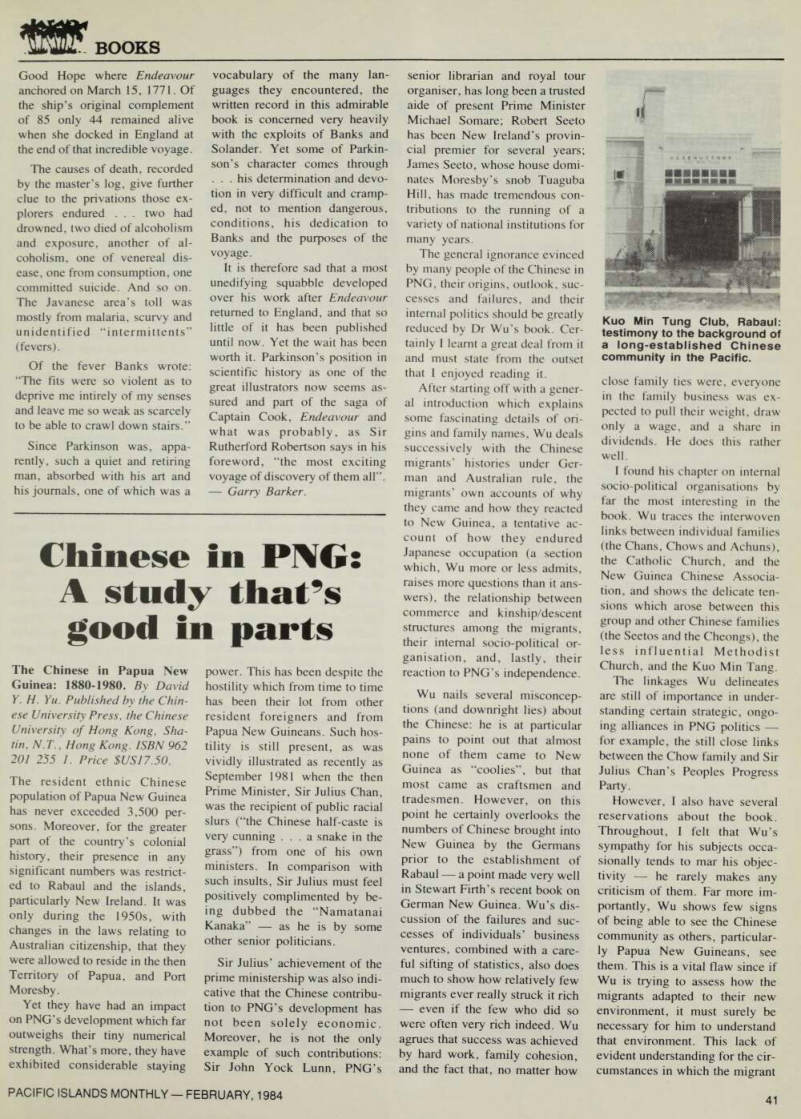
Kuo Min Tung Club, Rabaul: testimony to the background of a long-established Chinese community in the Pacific.
community lived, plus the fact that, despite his book’s title, Wu has almost no post-1973 data, means that the book’s contribu tion to an analysis of the Chinese community’s role in an indepen dent PNG is very weak.
The absence of post-1973 data unfortunately coincides with the fact that Wu’s work is almost exclusively focused on Rabaul.
Rabaul in recent decades could not be described as a dynamic centre by anyone other than a
vulcanologist. Port Moresby has
been the growth point in PNG for 20 years and more, and the Chin ese contribution to its growth has been fundamental. In concentrat ing on Rabaul, Wu has inadver tently allowed that place’s at rophy to infect his assessment of the role of his subjects in national
development.
My next concern is that throughout this account, the Chinese community appear to be
characterised by complete polit
ical naivety, a trait which cannot
solely be explained by their de
sire to keep a low profile. On the whole, I am persuaded that Wu’s subjects are far from being as naive as he depicts them that innocence and ignorance seem to me to derive more from the au thor than from the community studied by him.
I also found Wu’s sociological analyses to have a muddying effect in places and would have preferred to see rather less evi dence of this book having first seen light of day as a doctoral thesis pandering to abstruse examiners.
Perhaps the worst part of the book is its preface by Professor Hsu of the University of San Francisco. Hsu’s colorful exagg erations, racial stereotyping, general irrelevance and inac curacies may be meant to be complimentary to the author, but they are not very complementary to his work.
All in all, therefore, Wu has certainly not told the whole story of the Chinese in Papua New Guinea, but what he has covered he has done, for the most part, well. Certainly this is a book which should be read by all interested in Papua New Guinea preferably on loan from a
library.
Richard Jackson.