young genius gets his due
pp. 39-41 · Read in the full issue
Sydney Parkinson: At last a young genius gets his due
Sydney Parkinson, Artist of Cook’s Endeavour Voyage.
Edited by D. J. Carr. Published by the British Museum (Natural History) in association with Australian National University Press, Canberra. 300 pp.ISBN 0 7081 1172 6. Price $A49.95.
Those of us embroiled in the complexities of modern life, rushing, it often seems, in ever decreasing circles of 20th century confusion, may be forgi ven for marvelling at how much, creatively, was achieved in a very short span by our ancestors.
Mozart is the example much quoted for the prodigious output of immortal music he achieved in a life which, today, would be thought hardly begun.
Now, belatedly, we have pro per recognition of another man
who in less than four years of exploring the Pacific with the extraordinary Captain James Cook, left an historical record not only voluminous but of great and lasting quality.
Sydney Parkinson was the younger of two artists recruited by the naturalist Banks for Cook’s voyage in Endeavour. He was then 22. He died in Java in 1771 at the age of 26 leaving nearly 1000 botanical paintings and sketches as well as literal stacks of other artistic records of the new lands discovered and the people and fauna which in habited them.
This book, a beautifully pro duced volume, printed by Griffin Press of South Australia, is the first to properly convey the great skill and wide interests of this young genius, and it does him
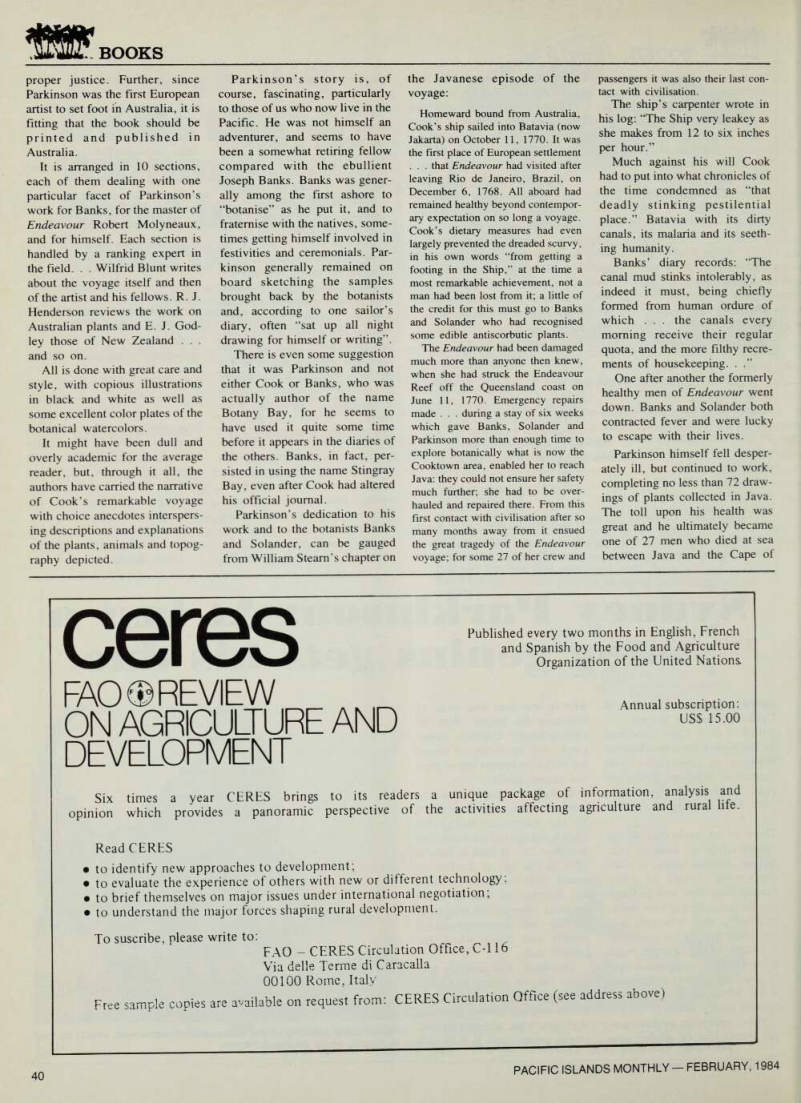
Parkinson’s painting of the cotton-eared marmoset, which he saw in Brazil, south of the Amazon.
proper Justice. Further, since Parkinson was the first European artist to set foot in Australia, it is fitting that the book should be
printed and published in
Australia.
It is arranged in 10 sections, each of them dealing with one particular facet of Parkinson’s work for Banks, for the master of Endeavour Robert Molyneaux, and for himself. Each section is handled by a ranking expert in the field. . . Wilfrid Blunt writes about the voyage itself and then of the artist and his fellows. R. J.
Henderson reviews the work on Australian plants and E. J. God ley those of New Zealand . . . and so on.
All is done with great care and
style, with copious illustrations
in black and white as well as some excellent color plates of the botanical watercolors.
It might have been dull and overly academic for the average reader, but, through it all, the authors have carried the narrative of Cook’s remarkable voyage with choice anecdotes interspers
ing descriptions and explanations
of the plants, animals and topog
raphy depicted.
Parkinson’s story is, of
course, fascinating, particularly
to those of us who now live in the Pacific. He was not himself an adventurer, and seems to have been a somewhat retiring fellow compared with the ebullient Joseph Banks. Banks was gener ally among the first ashore to “botanise” as he put it, and to fraternise with the natives, some times getting himself involved in festivities and ceremonials. Par kinson generally remained on
board sketching the samples
brought back by the botanists and, according to one sailor’s diary, often “sat up all night drawing for himself or writing”.
There is even some suggestion that it was Parkinson and not either Cook or Banks, who was actually author of the name Botany Bay, for he seems to have used it quite some time before it appears in the diaries of the others. Banks, in fact, per sisted in using the name Stingray Bay, even after Cook had altered his official journal.
Parkinson’s dedication to his work and to the botanists Banks and Solander, can be gauged from William Steam’s chapter on
the Javanese episode of the voyage: Homeward bound from Australia, Cook’s ship sailed into Batavia (now Jakarta) on October 11, 1770. It was the first place of European settlement . . . that Endeavour had visited after leaving Rio de Janeiro, Brazil, on December 6, 1768. All aboard had remained healthy beyond contempor ary expectation on so long a voyage.
Cook’s dietary measures had even largely prevented the dreaded scurvy, in his own words “from getting a footing in the Ship,” at the time a most remarkable achievement, not a man had been lost from it; a little of the credit for this must go to Banks and Solander who had recognised some edible antiscorbutic plants.
The Endeavour had been damaged much more than anyone then knew, when she had struck the Endeavour Reef off the Queensland coast on June 11, 1770. Emergency repairs made . . . during a stay of six weeks which gave Banks, Solander and Parkinson more than enough time to explore botanically what is now the Cooktown area, enabled her to reach Java: they could not ensure her safety much further; she had to be over hauled and repaired there. From this first contact with civilisation after so many months away from it ensued the great tragedy of the Endeavour voyage; for some 27 of her crew and
passengers it was also their last con tact with civilisation.
The ship’s carpenter wrote in his log: “The Ship very leakey as she makes from 12 to six inches per hour.”
Much against his will Cook had to put into what chronicles of the time condemned as “that
deadly stinking pestilential
place.” Batavia with its dirty canals, its malaria and its seeth
ing humanity.
Banks’ diary records: “The canal mud stinks intolerably, as indeed it must, being chiefly formed from human ordure of which . . . the canals every
morning receive their regular
quota, and the more filthy recre
ments of housekeeping. .
One after another the formerly healthy men of Endeavour went down. Banks and Solander both contracted fever and were lucky to escape with their lives.
Parkinson himself fell desper ately ill, but continued to work, completing no less than 72 draw ings of plants collected in Java.
The toll upon his health was great and he ultimately became one of 27 men who died at sea between Java and the Cape of
Good Hope where Endeavour anchored on March 15, 1771. Of
the ship’s original complement
of 85 only 44 remained alive when she docked in England at the end of that incredible voyage.
The causes of death, recorded
by the master’s log, give further
clue to the privations those ex plorers endured . . . two had drowned, two died of alcoholism and exposure, another of al coholism, one of venereal dis ease, one from consumption, one committed suicide. And so on.
The Javanese area’s toll was mostly from malaria, scurvy and unidentified “intermittents” (fevers).
Of the fever Banks wrote: “The fits were so violent as to deprive me intirely of my senses and leave me so weak as scarcely to be able to crawl down stairs.”
Since Parkinson was, appa
rently, such a quiet and retiring
man, absorbed with his art and his journals, one of which was a
vocabulary of the many lan guages they encountered, the written record in this admirable book is concerned very heavily with the exploits of Banks and Solander. Yet some of Parkin son’s character comes through ... his determination and devo tion in very difficult and cramp ed, not to mention dangerous, conditions, his dedication to Banks and the purposes of the voyage.
It is therefore sad that a most
unedifying squabble developed
over his work after Endeavour returned to England, and that so little of it has been published until now. Yet the wait has been worth it. Parkinson’s position in scientific history as one of the great illustrators now seems as sured and part of the saga of Captain Cook, Endeavour and what was probably, as Sir Rutherford Robertson says in his foreword, “the most exciting voyage of discovery of them all”.
Garry Barker.