Pacific

Islands
Monthly
mM
American Samoa US$l 75 Australia *A$l.5O Cook Islands NZ$l 50 R j' F 51.50 Hawaii US$l.95 Kiribati A 51.75 Nauru A 51.75 New Caledonia CFPI9O
New Zealand NZ$2.OO Niue s NZ$l.5O Norfolk Island A 51.50 Papua New Guinea «$1.50 Solomon Islands 551.50 Tahiti CFP22O Tonga P 1.50 Tuvalu A 51.75
Usa U 552.25
USTT and Guam US$l.95 Vanuatu VT1.50 Western Samoa T 1.95 'Recommended retail price only Registered by Australia Post Publication No. NBPI2IO
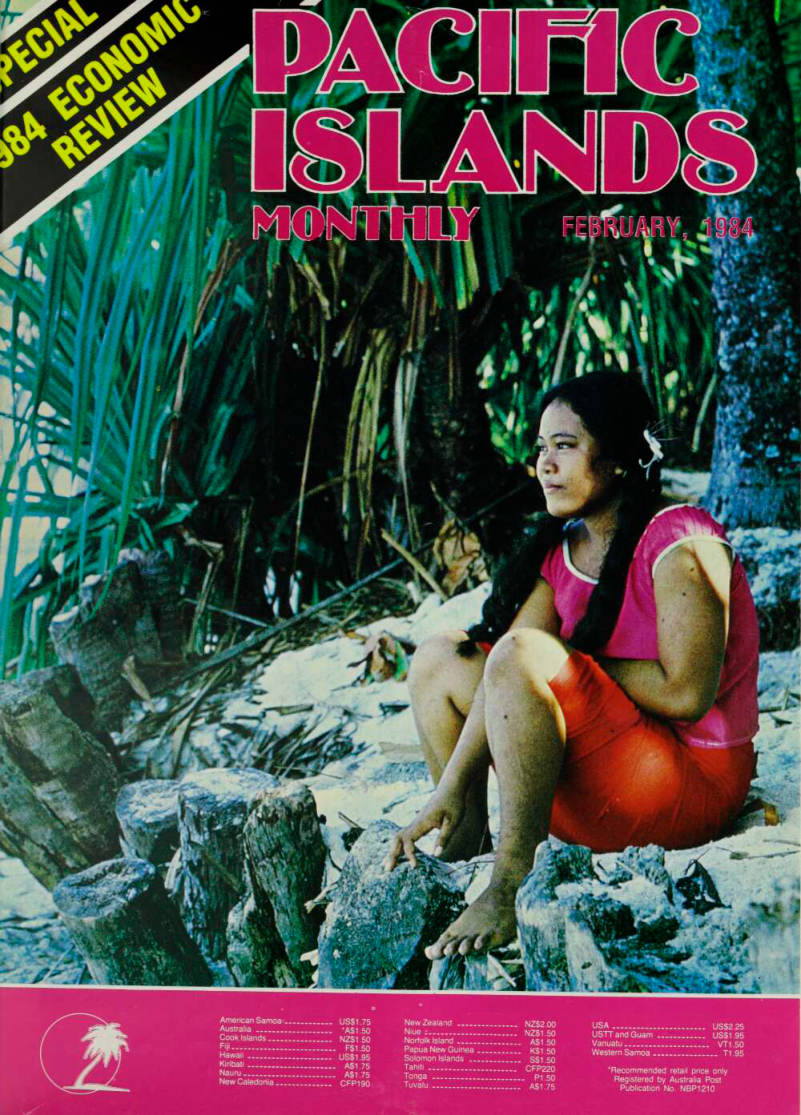
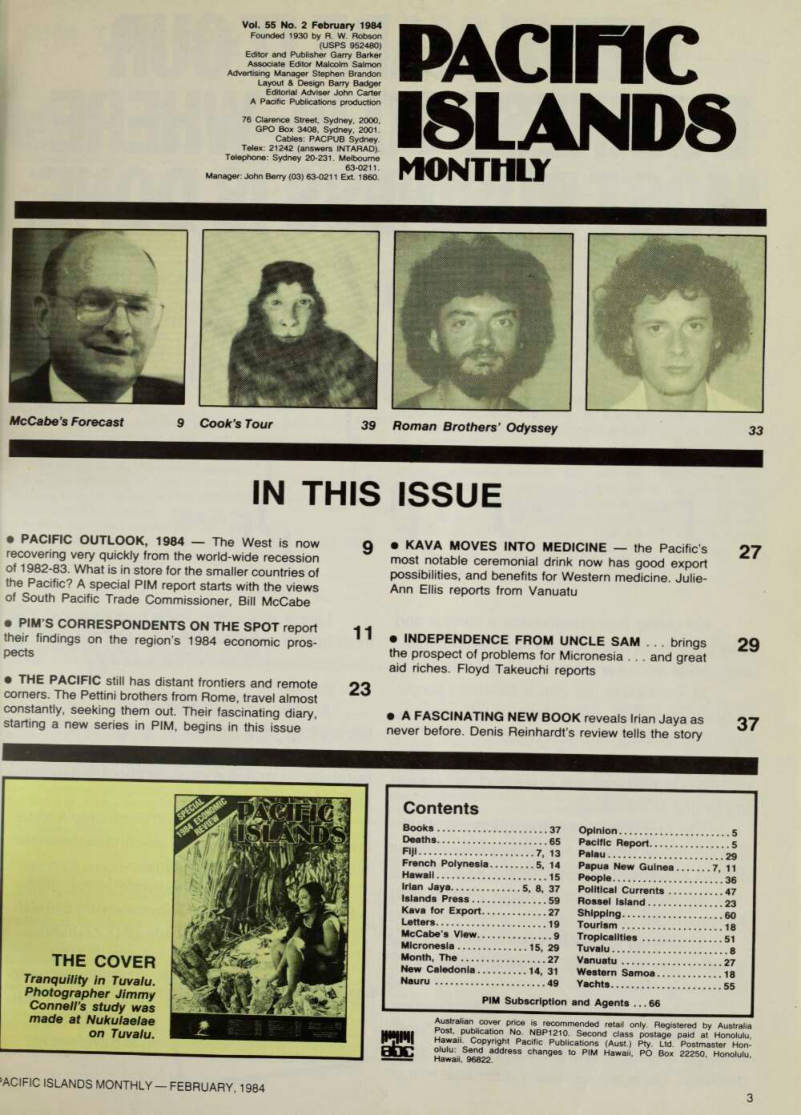
The Cover
Tranquility in Tuvalu.
Photographer Jimmy Connell’s study was made at Nukulaelae on Tuvalu.
Advertisements & other items, pp. 2-3 (2 items)
A new legend begins.
.. % ■~r ■■ m
Photo: Equipment may vary in some countries.
The 1984 Civic 2-door Hatchback, combining innovative technologies with the great Civic tradition, is a very special car. For this new Civic is destined to become the model on which other cars in this class will be based.
Distinguished by a long roofline and rear appearance, the 2-door Hatchback’s flush-surface aerodynamic design gives superb stability at high speeds, improves fuel economy, and provides a truly spacious interior.
Interior space is also expanded by the Honda concept of making all mechanical parts as small as possible, leaving more room for people. High-tech components include an ultra-compact, economical-yet-powerful OHC, 12-valve engine, and space-saving Sportec suspension that really
smooths out the road.
The Civic 2-door Hatchback. Its new technology confirms that a new legend has begun.
2-door Hatchback
ITRALIA: !
' Manners Plaza, KIRIBATI: Atoll Motor & Marino i
pan CM 96950/COOK I
moa) Ltd. P.O. Box 576. Apia/S
NAURU:
Pago Pago., , Tullamarine. Victona 3043. Bennett Honda Pty., Ltd.: /PAPUA NEW GUINEA: Toba Pty., Ltd. PO. Box 503, Port Me < 49. Bairiki Tarawa. Republic of Kiribati/U.S. TRUST TERRITORY: U Box 74. Rarotonga/GUAM: Mark s Motor Co., I LOMON ISLANDS: Guadalcanal Garage Limited P.O Box 537, Honiara/NE i Republic of Nauru/FIJI: Carpenters Motors Private Mail Bag. Suva, Ftji/fl ; Service Center Ltd. P.O. Box 1138. Pago Pago. American Samoa 96799/ Will Park. N S W. 2164 / NEW ZEALAND: NZMV tonda Distribution S.A.R.L. 8 P 1665. Papeete i Development Association P.O Box 235. CHfF Agana/ WESTERN SAMOA: Motor Distributes ; Societe Du Chalandage 8, Rue de la somme-B P 9 I SAMOA: Holiday Motors, Parts and Service PO Box 96c ■: Tonga Industrial Traders P.O. Box 1035, Nuku alofa. Tonjr
Islands
PACIFIC
MONTHLY
Vol. 55 No. 2 February 1984
McCabe’s Forecast 9
Cook’s Tour 39
Roman Brothers’ Odyssey 33
In This Issue
• PACIFIC OUTLOOK, 1984 The West is now q recovering very quickly from the world-wide recession ** of 1982-83. What is in store for the smaller countries of the Pacific? A special PIM report starts with the views of South Pacific Trade Commissioner, Bill McCabe • PIM’S CORRESPONDENTS ON THE SPOT report a their findings on the region’s 1984 economic pros- 1 1 pects • THE PACIFIC still has distant frontiers and remote oo corners. The Pettini brothers from Rome, travel almost constantly, seeking them out. Their fascinating diary, starting a new series in PIM, begins in this issue
• KAVA MOVES INTO MEDICINE the Pacific’s O? most notable ceremonial drink now has good export possibilities, and benefits for Western medicine. Julie- Ann Ellis reports from Vanuatu • INDEPENDENCE FROM UNCLE SAM . . brings 29 the prospect of problems for Micronesia . . . and great aid riches. Floyd Takeuchi reports • A FASCINATING NEW BOOK reveals Irian Jaya as 07 never before. Denis Reinhardt’s review tells the story
Contents
Books 37 Deaths 65
F Ui 7, 13
French Polynesia 5, 14 Hawaii 15 Irian Jaya 5,8, 37 Islands Press 59 Kava for Export 27 Letters 19 McCabe’s View 9 Micronesia 15, 29 Month, The 27 New Caledonia 14, 31 Nauru 49
Opinion 5 Pacific Report 5 Palau 29 Papua New Guinea 7, 11 People 36 Political Currents 47 Rossel Island 23 Shipping 60 Tourism 10 Troplcalities 51 Tuvalu 0 Vanuatu 27 Western Samoa 18 Yachts 55
PIM Subscription and Agents ... 66
Australian cover pnce is recommended retail only. Registered by Australia Post, publication No. NBPI2IO. Second class postage paid at Honolulu Hawaii. Copyright Pacific Publications (Aust.) Pty. Ltd. Postmaster Hon oiulu: Send address changes to PIM Hawaii, PO Box 22250, Honolulu Hawaii, 96822.
Advertisements & other items, pp. 3-4 (2 items)
’Acific Islands Monthly - February, 1984
3
Founded 1930 by R. W. Robson
(USPS 952480)
Editor and Publisher Garry Barker Associate Editor Malcolm Salmon Advertising Manager Stephen Brandon Layout & Design Barry Badger Editorial Adviser John Carter A Pacific Publications production 76 Clarence Street, Sydney, 2000, GPO Box 3408. Sydney, 2001.
Cables: PACPUB Sydney.
Telex; 21242 (answers INTARAD).
Telephone: Sydney 20-231. Melbourne 63-0211.
Manager: John Berry (03) 63-0211 Ext. 1860.
Business To Be Where
WE’VE MADE HOUR
MOST BUSINESS IS DONE.
i e
RABAUL
PORT MORESBY
DARWIN
PERTH
ADELAIDE
I
NADI
S J
TAHITI
AUCKLAND
ROTORUA
WELLINGTON
CHRISTCHURCH
QUEENSTOWN
No matter how comfortable a hotel is and how good its facilities are, it’s to no avail if that same hotel isn’t near where you want it to be.
At Travelodge our aim is to attract people in business, which, quite simply, is why you can find us in so many business centres.
Not surprisingly, more and more people, particularly with business to transact, are choosing to stay at Travelodge.
The one hotel group that offers excellent service and facilities at a realistic price. Plus the distinct advantage of being ideally located in or near the business centre of major metropolitan and provincial cities.
Since your hotel often has to serve as an office too, we provide you with first class business facilities.
Dictation and transcription, photocopying, telex, national and international courier services, business breakfasts and rooms for large or small meetings. There are also many other little extras.
Like a newspaper every morning and fresh fruit in your room on arrival. There’s also complimentary coffee in the lobby for you and your guests.
Another thing that won’t go unnoticed is the millions of dollars spent on the facilities today’s businessmen and women demand. Large, tastefully decorated rooms, excellent restaurants and intimate bars.
Stay at Travelodge. You’ll not only find us conveniently located, you’ll also find that a warm reception is just the beginning.
For reservations world-wide please phone Sydney (02) 267 2144. Melbourne (03) 690 6111.
Brisbane (07) 2218586.
Adelaide (08)
223 6288. Canberra (062) 491424. Perth (09) 3253811. Or your travel agent. n
BUSINESS
class
Pim Opinion
Politics in the Pacific have always had their own unique style and vigor, elements which have frequently conspired to confuse the foreign mind, leading it sometimes to despair and more often to the erroneous conclusion that disaster’s brink awaits, but inches away.
In this area Fiji is at least as renowned as anywhere else, having also what might be termed the “Bombay Factor” adding, if the metaphor may be excused, curry to an already active pot.
But, even for Fiji, the sudden resignation (PIM Jan. p 42) of so senior, and highly-respected, a figure as Charles Walker, the minister of finance, is somewhat unusual. And what makes it even more curious, and intriguing to outsiders, is the fact that Mr Walker offered no public explanation of his action.
It was widely assumed, both inside Fiji and outside, that he resigned in protest over his Government’s decision to give public servants a pay rise at a time when all other workers were either being asked to accept a pay freeze, were facing redundancy, or had been laid off.
Since the public sector in all its incarnations employs about 60 per cent of the wage-earning force in Fiji, and since Fiji now faces some very serious economic problems, such a reason could be readily
accepted, and applauded.
But his own Budget, tabled in Parliament only a short time before, had virtually conceded that some token payment was due public servants as a set-off against their accepting a system of redundancies in order to lighten the government payroll.
It is also true, however, that the Budget spoke of dire problems weighing upon the nation, and had increased the already very heavy burden carried by taxpayers, both corporate and individual.
Reports from Suva say Mr Walker arrived at a Cabinet meeting with his resignation letter in his pocket, waited until the Prime
Minister, Ratu Sir Kamisese Mara, had left, and then sent the letter along to him by messenger. Whether Mr Walker and Ratu Mara subsequently met is unknown.
No unusual public outcry, nor any political brawl, preceded the resignation. No rumor of it had so much as brushed the normally gossip-strewn streets of Suva prior to the act.
Since Fiji is a place where the production of rumor has been refined to an artform, all manner of stories sprang up to explain the sudden departure for the back benches of so eminent a father of his country.
None had any basis in known fact, and Mr Walker made no public statements. He simply allowed all the rumors to circulate and, ultimately, exhaust themselves.
Anywhere else this sort of thing might have triggered a first-class political crisis. Mr Walker is one of the original Mara team members and, for a time, was widely tipped as a “compromise” candidate to replace Ratu Mara when he finally steps out of the prime minister’s office. He has also earned genuine international applause for the very conservative and wise fashion in which he has managed Fiji’s finances.
His departure, particularly in this somewhat melodramtic fashion, might be seen as a weakening of Ratu Mara and his Alliance government. But, in fact, the Opposition looks in worse shape than the government.
The new Minister of Finance, Mosese Qionibaravi, is well regarded and has apparently assumed duty with little difficulty or upset.
Business appears to be proceeding as usual with no real crisis in view.
Thus, while admitting ourselves singularly puzzled by Mr Walker’s sudden departure, we are constrained to salute Fiji for the serenity and apparent ease with which it absorbed the loss of a man so recently regarded as a pillar of the government.
Pacific Report


Pacific Nations On London ‘Rescue’ List
Nauru, Tuvalu, Kiribati, Tonga and Vanuatu are on the list of small Commonwealth nations said to have been drawn up as possible recipients of help from a British commando-style strike force in the event of internal or external threats to their political stability. An Australian newspaper reported in January that the force would be drawn from Britain’s elite Special Air Services (SAS) unit, and its naval counterpart, the Special Boats Squadron (SBS). The report said that SAS men posing as tourists had been active over the past year “mapping out landing sites on more than a dozen ‘micro-states’ and have charted politically sensitive buildings such as radio stations and police stations where arms may be stored”.
Suharto-Somare On Irian Java , Cuba
Papua New Guinea Prime Minister Michael Somare said on national radio on December 20 that he had been impressed with Indonesian assurances of determined efforts to develop and improve the lives and conditions of Melanesians in Indonesia’s Irian Jaya province. Mr Somare said that, as a Melanesian, he had been concerned about the situation in Irian Jaya before his week-long visit to Indonesia earlier in the month. He said; “I made it clear to President Suharto that we recognise that Irian Jaya is part of the Indonesian nation. At the same time we are concerned about the fate of Melanesians in that province.” The prime minister said that the Indonesians had told him that more than 80 per cent of government officials in Irian Jaya are Melanesians. “They (Indonesian officials) gave me the impression that lhe y are making a determined effort to ensure that the Melane sians of the province are not left out of the race for development With
that, we will have to be satisfied.” But Mr Somare warned that PNG had to be careful not to meddle in the affairs of another independent country. The line was fine, and he was out to make sure that PNG did the proper and responsible thing at all levels. In a separate statement following his return to Port Moresby, Mr Somare revealed that President Suharto had expressed his concern at the establishment of diplomatic relations between Vanuatu and Cuba. Mr Somare said he had told him that Vanuatu was an independent country in charge of its own foreign relations, but that PNG and other pacific Islands nations were also concerned. Mr Somare said he told President Suharto that, at the South Pacific Forum meeting in Canberra in August, Pacific Islands leaders had met informally with Vanuatu Prime Minister Fr Walter Lini to tell him about their concern. Mr Somare added that anywhere Cuba went there were always problems.
Australian Labor Man Stirs Gallic Gall
The Australian weekly, The National Times, reports: The French, a touchy people at the best of times, are in high dudgeon over a recent unofficial visit to their Pacific territories by one of the high-ranking brothers of the Australian Labor Party. The South Australian State ALP Secretary, Chns Schacht, spent four days in French Polynesia last November en route to a Socialist International Bureau meeting in Europe. Schacht, who is also chairman of the ALP’s international committee, immediately made contact with Jacqui Drollet, who heads the Te Mana Te Nunaa (Power to the People) Party the only pro independence party in French Polynesia. Monsieur Drollet’s group now has only a small base in the Tahitian assembly but is working actively with other Pacific groups outside French Polynesia to end
French rule in the region. To the chagrin of local security police, Schacht and Drollet seem to be cementing a firm political friendship.
Schacht outraged local establishment types with references in speeches to “French-occupied Polynesia” and his tub-thumping against nuclear testing in the region. A number of the local gendarmerie turned out to “note” his departure when he flew on to Europe, and the Power to the People Party has been warned by local security that Schacht could have some difficulty gaining entry to the territory next time round. (See also “Postmark Papeete” column, this issue.)
Sages Look At Future Of U.S.P.
A conference in Suva in December on the future course of the University of the South Pacific called for a study to assess the region’s educational requirements, and how best to meet them. The four-day conference of specialists in various fields issued a statement saying that due to economic constraints, consideration should be given to the university reducing and consolidating its activities in areas no longer felt to be necessary. The statement said there were two broad areas of common need which the USP could look to strengthening. These were applied studies, and business studies, with a program incorporating economics, accounting, commercial law, computers and administra tion. The conference also called for a review after five years of a number of courses, and of the continued need for them. These included diploma courses in education and fisheries, and the advanced teaching certificate in agriculture. USP Vice-Chancellor Geoffrey Gaston said the university senate would respond with interest and enthusiasm to the recommendations and proposals, adding that he regarded the conference as having been highly successful. Mr Gaston said the university would be enrolling Bachelor of Science students at the Alafua campus in Western Samoa in 1984. He said it would see them through the course, whatever happened with the development of a Western Samoan national univeristy.
Png: Namaliu Defends French Ship Visit
Papua New Guinea’s Foreign Minister Rabbie Namaliu has defended his government’s decision to permit a Christmas visit to Port Moresby by the French warship Doudart de Lagree. Replying to an attack by Opposition Leader lambakey Okuk, who said that the government was using “double standards” in permitting the visit while it condemned France’s nuclear testing in the Pacific, Mr Namaliu said that PNG had a range of options for registering concern over the nuclear testing, and that not all of them had yet been used. He said it was important to keep a channel of communications open with Paris so that PNG’s concern on other matters, such as independence for New Caledonia, could be conveyed to the French Government.
New Year’S Honors In Png, Fjjj
Papua New Guinea’s education minister was made a knight in the Queen’s New Year’s Honors. Australian-born Sir Barry Holloway went to PNG as a patrol officer in the days of the old Australian administration, and became one of the leaders of the Pangu Party. He was a Speaker of the PNG Parliament in 1972-77. He became a naturalised PNG citizen at independence in 1975. Heading the list of 17 Fiji citizens honored in the list is Minister for Agriculture Jonate Mavoa, who becomes a Companion of the Order of St Michael and St George for his distinguished career in the Fiji public service.
Png Govt., Judiciary, In Dispute
Papua New Guinea’s government and judiciary are in dispute over a law that obliges judges to jail people for a range of offences. The law, in effect since July 1983, sets minimum sentences, such as three years for breaking and entering. PNG’s judges, in their 1983 annual report, say they believe the law will not improve law and order in the country. They say the real problem lies in areas such as weaknesses in criminal investigation, poor preparation of prosecution cases, and the large number of arrest warrants issued but not followed up by police.
However, PNG Justice Minister Tony Bais says parliament stepped in because the courts had been too lenient.
Bikini Still “Off Limits” Scientists
U.S scientists say that Bikini Atoll, used for nuclear weapons tests until 25 years ago, is still not fit for human habitation. The scientists say that local fish and rain water are safe for eating and drinking, but that more than SUSIOO million would have to be spent before food
grown on the islands could be eaten. They say that, without the clean up, any food grown on the islands would be dangerously con taminated for the next 100 years. The islands were chosen by the U.S.
Government for the tests in the late 19405. By 1958, 23 atomic or hydrogen bombs had been detonated over the atoll. Some islanders went back to Bikini in the 19705, but were moved out again in 1978.
The Bikini Islanders are now living on Kili island, nearly 700 kilometres south of their home islands.
Niue Gets Drought Aid
Drought assistance of $15,000 has been given to the government of Niue by the South Pacific Bureau for Economic Co-operation (SPEC). A one-month state of emergency was declared in Niue in December, and authorities were considering extending it. Drought on the island has lasted for nearly two years. Niue has also asked the United Nations and Australia for assistance.
FORUM LINE OPTIMISM AGAIN THANKS TO PNG Director of the South Pacific Bureau for Economic Co-operation (SPEC), Mahe Tupouniua, said in December that the Pacific Forum shipping line was now in a position to buy most of its own containers.
He said this followed confirmation he had just received from Prime Minister Michael Somare of Papua New Guinea that his country would be contributing SAI.4 million to the line. Mr Tupouniua said the payment would meet conditions laid down under a loan agreement with the European Investment Bank which will make funds available to the line to buy the containers. Mr Somare’s announcement fulfilled an undertaking given at the 1982 South Pacific Forum meeting in New Zealand. A number of Forum governments have contributed a total of almost $8 million to the line since the New Zealand meeting.
A Million Indonesian Families To Move
It has been announced in Jakarta that, under the nation’s fourth Five- Year Plan, between 800,000 and a million families will be resettled.
To accommodate them, the Indonesian Government has reclaimed a total of 800,000 hectares of land in a number of islands outside Java and Bali, including the Riau and Natuna groups, and Irian Jaya. He said that in the Natuna group and in areas bordering foreign territory (such as Papua New Guinea) re-settler communities would consist mostly of members of the armed forces. Indonesia’s transmigrasi (transmigration) program has now been going 15 years and has so far moved two million persons in about 600,000 families. Transmigrant numbers have been increased in each five-year period.
A.C.P. COUNTRIES CHANGE TACK ON SUGAR PRICE In an exchange of letters, the African, Caribbean and Pacific (ACP) countries have now agreed to accept an increase of four per cent in sugar prices for the 1983-84 season. The price for raw sugar shipped to the European Economic Community (EEC) within the 1983-84 quota is 443.4 ecu per tonne, or 5tg274.31. The rate of increase was established when prices were set earlier in 1983 for EEC domestical ly-produced sugar quota. The rise was not immediately accepted by the ACP countries, but they have now changed their minds. The European sugar market remains difficult for cane-producing coun tries, particularly because of continued high productive of beet sugar.
The total beet production for the EEC is now expected to be 700,000 tonnes higher than the August, 1983 forecast. Production in Poland and the USSR is also expected to be considerably higher than early estimates. The EEC total production in 1983-84 is now expected to exceed 11 million tonnes, raw sugar. Meanwhile, sugar industry experts remain gloomy about prospects for a new International Sugar Agreement being negotiated in any atmosphere of flexibility among delegates from the EEC. General belief is that the atmosphere at the last EEC Heads of Government meeting in Athens was so uneasy that no new policies can be expected to come easily, though compromise, even on Common Agricultural Policy items, is probably inevitable.
Suva To Have Its Malaysia House
Suva is to get a brand-new multi-storey Malaysia House, which will serve as the headquarters of the new thnist of Malaysian interests into the South Pacific. The new building will be the property of Malaysian Overseas Investment Corporation (MOIC), and as well as serving as MOIC regional headquarters, will lease office and retail space. MOIC - which represents the spearhead of the Malaysian Government inspired push into the Island countries of the South Pacific is a
newly-created trading and investment house formed in line with the policy of Prime Minister Mahathir of supporting the creation of Malaysian trading houses along the lines of Japan’s sogo shosha.
James Clad, writing in The Far Eastern Economic Review , states that it has 10 shareholders, each owning 10 per cent of MOIC. They include the Guthrie group, the Kuok brothers, Malaysian United Industries (MUI), Multi-Purpose Holdings (MPH the trading arm of the Malaysian Chinese Assocation), and Sime Darby-Pemas.
According to Clad, the main idea behind MOIC is that it should oversee the investment of several million dollars in plantation-crop development in some of the larger Island countries particularly Papua New Guinea, Solomon Island and Fiji. Clad writes: “Although the details of MOIC’s proposals remain privileged, the Review understands that it may begin insurance and banking operations in Fiji, using MUI and MPH expertise. This initiative has reportedly caused some consternation among long-established branch offices of Australian and New Zealand banks in Suva. After the first flush of enthusiasm, however, implementation of investment ideas may proceed at a slower pace than politicians might wish.”
Tuvalu Stakes 200-Mile Claim
The Tuvalu Parliament has approved a bill establishing the country’s 200-mile exclusive economic zone and extending its territorial sea limits from three miles to 12 miles.
Irian Java Highway Work
About 37 kilometres of the planned 350 km long Abepantai-Obruk- Oksibil trans-Irian highway has so far been completed by the Indonesian ministry of works. A further 27 km have been cleared and consolidated sufficiently for cars and trucks to use, and another 17 km has been cleared to rough-track status. The highway is planned to stretch along the Indonesia-Papua New Guinea border from north to south, and will link with the Merauke-Tanamerah highway stretching from the south coast to the north.
Islands Sailboats For Oz Market?
South Pacific Trade Commissioner, and keen amateur yachtsman Bill McCabe believes there is an opportunity for someone in, say, Fiji, or elsewhere in the Pacific, to capitalise on the upsurge of interest in sail boating in Australia. Yachting has always been a major sport in Australian and New Zealand, but with the resurgence of economic activity, and the impetus given by Australia’s great win in the 1983 America’s Cup series, conditions have seldom been better. “The cost of building a hull in Fiji is probably half what it is in Australia,” he said. “Also, they make some very good boat fittings in New Zealand.
If a boat was built in Fiji, probably to an established design, under licence, to take New Zealand fittings which can come into Australia under the Closer Economic Realtions (CER) concessions, then a good craftsman should be able to find a ready market. I’m not talking about mass production but of one-off hulls in the 40 ft. range, steel or fibreglass. There’s definitely a market here for those . . low volume, high quality, known design, nice Pacific timber fittings. If something like that could be landed in Australia at half to three quarter of Sydney-made prices, you’d really have something.
Tax/Plant Expansion Trade-Off In Pago
Van Camp Seafood, one of two tuna canneries operating in American Samoa, has announced the conclusion of an agreement with the territorial government for a 10-year tax exemption in exchange for the company’s investing SUS3.S million in plant expansion. Under the agreement, full tax will be paid on the first 25,000 tonnes of annual production, but no tax on the next 25,000. The company is also reported to have settled a claim by the territorial government for tax arrears.
Four Islander High-Flyers In W.C.C.
Church leaders from the Pacific Islands how hold four places on the central committee of the World Council of Churches. The 145member committee sets policies for the W.C.C. The four Pacific Islands members ar the Rev. Inoke Manoulivou, president of the Methodist Church of Fiji, the Rev. Puafitu Faa’alo, general secretary of the Church of Tuvalu, Mrs Celine Hoiore of the Evangelical Church of French Polynesia, and the Rev. Albert Toburua, moderator of the United Church of Papua New Guinea and Solomon Islands.
Advertisements & other items, pp. 6-8 (1 item)
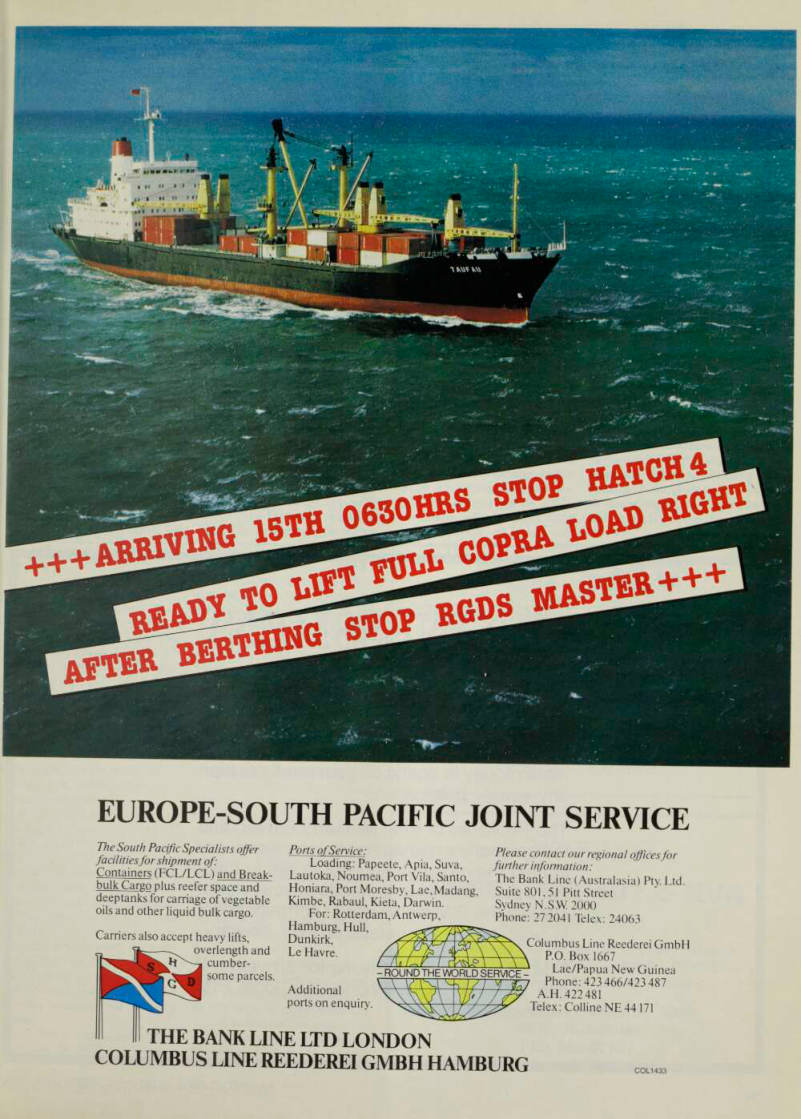
Europe.
BANK LINE and
COLUMBUS LINE
24 day service to
Europe.
Need we say more...
D G The Joint Service Partners offer facilities for shipment of: Containers (FCiyLCL) and Break-bulk Cargo plus reefer space and deeptanks for carriage of vegetable oils and other liquid bulk cargo.
Carriers also accept heavy lifts, overlength and cumbersome parcels.
Ports of Service: Loading: Papeete, Apia, Suva, Lautoka, Noumea, Port Vila, Santo, Honiara, Port Moresby, Lae, Madang, Kimbe, Rabaul, Kieta, Darwin. For: Rotterdam, Antwerp, Hamburg, Hull, Dunkirk, Le Havre.
Additional ports on enquiry.
Please contact our regional offices for further information: The Bank Line (Australasia) Pty Ltd Suite 801,51 Pitt St, Sydney, NSW, Australia 2000 Phone 27 2041 Telex 24063 Columbus Line Reederei GmbH P.O. Box 1 667, Lae/Papua New Guinea.
Phone: 423466/423487/AH. 422481 Telex: Colline NE 441 71 The South Pacific Specialists for over 75 years
Four Ways to Better
Heating & cooking
with
Reliability & Savings
ALL PURPOSE BOILERS
ENERGY SYSTEMS
fa.
COMMERCIAL STOVES
DOMESTIC STOVES
Improve your current heating and cooking facilities now, and save on fuel costs almost immediately.
At Water Wheel Exports, we're pleased to introduce an exciting range of alternative heating, cooking and solar energy products to suit all domestic, commercial and industrial market requirements.
Naturally, the key advantage of installing a solid fuel stove, boiler or solar energy hot water system, is the fact that you'll never again be totally dependent on gas or electricity for all your heating or cooking requirements.
And, when you consider you're also investing in long-term reliability, it means you'll make substantial savings year after year, after year...
For complete details on our export range of 'Fuel Efficient Money Saving', heating and cooking products, please, fill in the coupon below.
Water Wheel Exports Ply. Ltd. Exporters of a large and diverse range of products to the Pacific region.
WATER WHEEL EXPORTS PTY. lID.,
53-57 Market Street, South Melbourne, 3205. Victoria, Australia. Telephone: 699 1722, Telex: AA32165.
Telegraphic Address: "Watermill”, Melbourne
NAME:
ADDRESS:
COUNTRY: TELEPHONE:
PLEASE SUPPLY INFORMATION ON:
DOMESTIC □ INDUSTRIAL □ COMMERCIAL □
APPLICATIONS OF:
STOVES □ BOILERS □ SOU\R ENERGY SYSTEMS □
Tough Times, But
1984 Economic Report
Light Ahead
The American economy is back in gear. In Australia bankers are cautious, but optimism ishigh. Butwhat of the Pacific, which traditionally lags 12 months behind its rim-neighbors in reaction to world-wide economic trends? In the following pages PIM looks at the prospects.
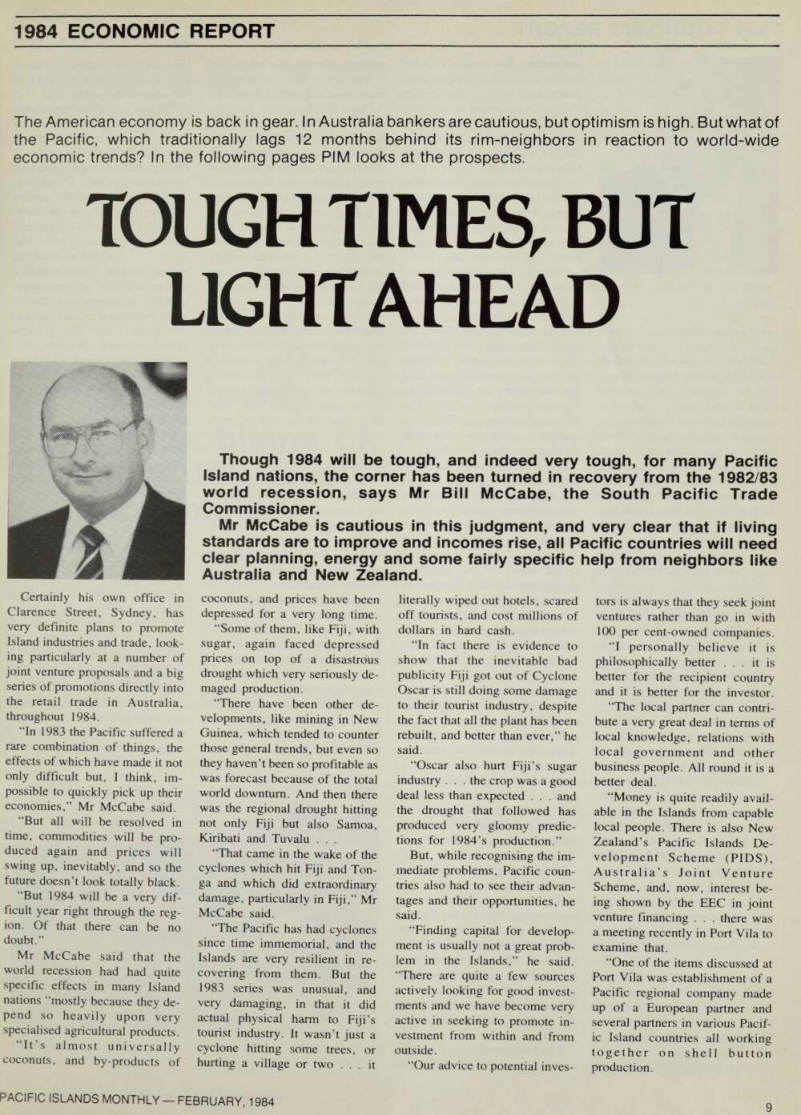
Though 1984 will be tough, and indeed very tough, for many Pacific Island nations, the corner has been turned in recovery from the 1982/83 world recession, says Mr Bill McCabe, the South Pacific Trade Commissioner.
Mr McCabe is cautious in this judgment, and very clear that if living standards are to improve and incomes rise, all Pacific countries will need clear planning, energy and some fairly specific help from neighbors like Australia and New Zealand.
Certainly his own office in Clarence Street, Sydney, has very definite plans to promote Island industries and trade, look ing particularly at a number of joint venture proposals and a big series of promotions directly into the retail trade in Australia, throughout 1984.
“In 1983 the Pacific suffered a rare combination of things, the effects of which have made it not only difficult but, I think, im possible to quickly pick up their economies,” Mr McCabe said.
“But all will be resolved in time, commodities will be pro duced again and prices will swing up, inevitably, and so the future doesn’t look totally black.
“But 1984 will be a very dif ficult year right through the reg ion. Of that there can be no doubt.”
Mr McCabe said that the world recession had had quite specific effects in many Island nations “mostly because they de pend so heavily upon very specialised agricultural products.
“It’s almost universally coconuts, and by-products of
coconuts, and prices have been depressed for a very long time.
“Some of them, like Fiji, with sugar, again faced depressed prices on top of a disastrous drought which very seriously de maged production.
“There have been other de velopments, like mining in New Guinea, which tended to counter those general trends, but even so they haven’t been so profitable as was forecast because of the total world downturn. And then there was the regional drought hitting not only Fiji but also Samoa, Kiribati and Tuvalu . . .
“That came in the wake of the cyclones which hit Fiji and Ton ga and which did extraordinary damage, particularly in Fiji,” Mr McCabe said.
“The Pacific has had cyclones since time immemorial, and the Islands are very resilient in re covering from them. But the 1983 series was unusual, and very damaging, in that it did actual physical harm to Fiji’s tourist industry. It wasn’t just a cyclone hitting some trees, or hurting a village or two ... it
literally wiped out hotels, scared off tourists, and cost millions of dollars in hard cash.
“In fact there is evidence to show that the inevitable bad publicity Fiji got out of Cyclone Oscar is still doing some damage to their tourist industry, despite the fact that all the plant has been rebuilt, and better than ever,” he said.
“Oscar also hurt Fiji’s sugar industry . . . the crop was a good deal less than expected . . . and the drought that followed has produced very gloomy predic tions for 1984’s production.”
But, while recognising the im mediate problems, Pacific coun tries also had to see their advan tages and their opportunities, he said.
“Finding capital for develop ment is usually not a great prob lem in the Islands,” he said.
“There are quite a few sources actively looking for good invest ments and we have become very active in seeking to promote in vestment from within and from outside.
“Our advice to potential inves
tors is always that they seek joint ventures rather than go in with 100 per cent-owned companies.
“I personally believe it is philosophically better ... it is better for the recipient country and it is better for the investor.
“The local partner can contri bute a very great deal in terms of local knowledge, relations with local government and other business people. All round it is a better deal.
“Money is quite readily avail
able in the Islands from capable local people. There is also New Zealand’s Pacific Islands De velopment Scheme (PIDS), Australia’s Joint Venture Scheme, and, now, interest be ing shown by the EEC in joint venture financing . . . there was a meeting recently in Port Vila to examine that.
“One of the items discussed at Port Vila was establishment of a Pacific regional company made up of a European partner and several partners in various Pacif ic Island countries all working together on shell button production.
“It is intended to be a total export company . . . the island countries will provide the shell and make button blanks. These will be collected at a central point and finished . . . there is already a factory at Port Vila . . . and the French partner will undertake to market the product.
Each of the separate joint venture companies would a shareholder in the Port Vila factory.
“I’m not sure how far it has gone, but it is a very interesting concept with a lot of promise; a first in terms of international cooperation at a business level.
“There are many multi nationals operating in the Pacif ic,” he said, “almost all of them foreign-owned. This would be a first genuinely Pacific multi
national company.”
Mr McCabe concedes that in almost all cases in the Pacific one is dealing with fairly low tech nology, very closely allied to primary products. “Nor do I en
visage the early advent of high
tech companies in the region.
“But we are observing an in creasing interest in putting indus tries into the Pacific which do involve high, or higher, technol ogy. I’m not talking about com puter manufacture, but I am talk ing about things like boat
building and equipping.
“There is already a quite sub stantial engineering base in some of the countries and examples of successful exploitation of them,” he said.
Fiji was, of course, well ahead in this area with quite sophis ticated establishments operating
in the engineering, ship-repair,
computing, printing, construc
tion and other fields and was already a Pacific centre for such
activities. But some smaller countries were also making progress.
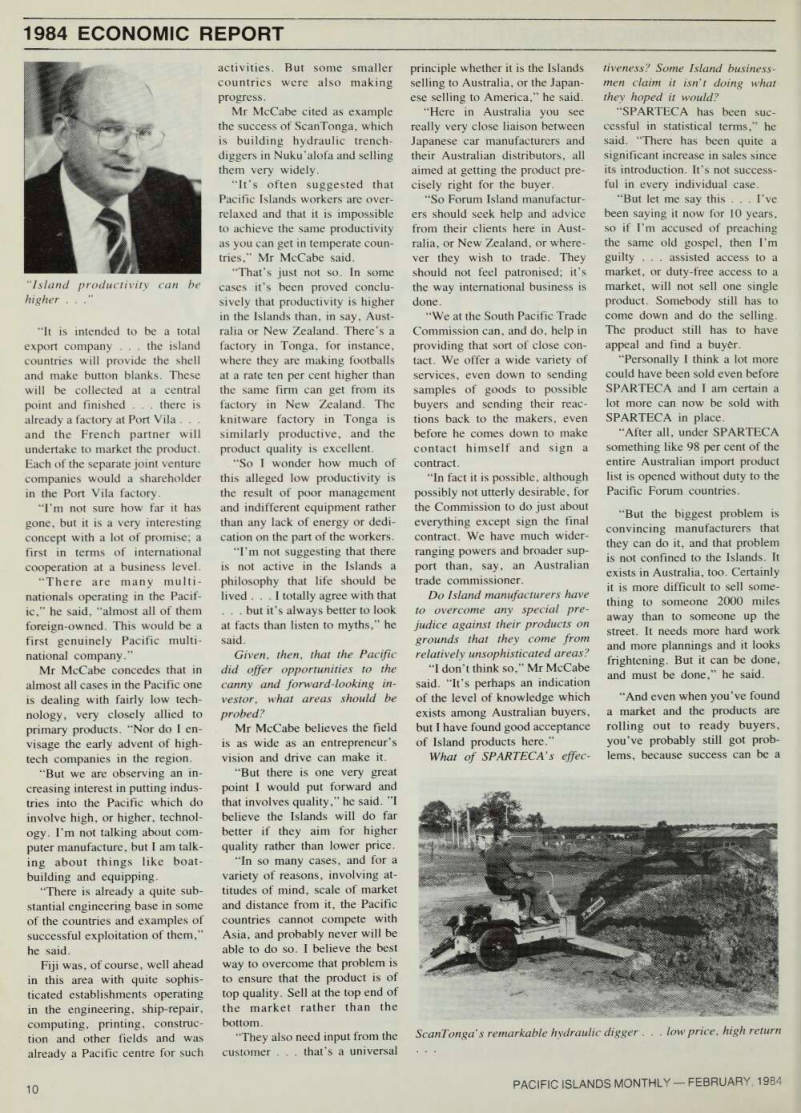
Mr McCabe cited as example the success of Scan Tonga, which
is building hydraulic trench
diggers in Nuku’alofa and selling them very widely.
“It’s often suggested that Pacific Islands workers are over relaxed and that it is impossible to achieve the same productivity as you can get in temperate coun tries,” Mr McCabe said.
“That’s just not so. In some cases it’s been proved conclu
sively that productivity is higher
in the Islands than, in say, Aust ralia or New Zealand. There’s a factory in Tonga, for instance, where they are making footballs at a rate ten per cent higher than the same firm can get from its factory in New Zealand. The knitware factory in Tonga is
similarly productive, and the
product quality is excellent.
“So I wonder how much of this alleged low productivity is the result of poor management and indifferent equipment rather than any lack of energy or dedi cation on the part of the workers.
“I’m not suggesting that there is not active in the Islands a philosophy that life should be lived ... I totally agree with that . . . but it’s always better to look at facts than listen to myths,” he said.
Given, then, that the Pacific did offer opportunities to the canny and forward-looking in vestor, what areas should be
probed?
Mr McCabe believes the field is as wide as an entrepreneur’s vision and drive can make it.
“But there is one very great point I would put forward and that involves quality,” he said. ”1 believe the Islands will do far better if they aim for higher quality rather than lower price.
“In so many cases, and for a variety of reasons, involving at titudes of mind, scale of market and distance from it, the Pacific countries cannot compete with Asia, and probably never will be able to do so. I believe the best way to overcome that problem is to ensure that the product is of top quality. Sell at the top end of the market rather than the bottom.
“They also need input from the customer . . . that’s a universal
principle whether it is the Islands selling to Australia, or the Japan ese selling to America,” he said.
“Here in Australia you see really very close liaison between Japanese car manufacturers and their Australian distributors, all aimed at getting the product pre
cisely right for the buyer.
“So Forum Island manufactur ers should seek help and advice from their clients here in Aust ralia, or New Zealand, or where ver they wish to trade. They should not feel patronised; it’s the way international business is done.
“We at the South Pacific Trade Commission can, and do, help in providing that sort of close con tact. We offer a wide variety of services, even down to sending
samples of goods to possible
buyers and sending their reac tions back to the makers, even before he comes down to make contact himself and sign a contract.
“In fact it is possible, although possibly not utterly desirable, for the Commission to do just about everything except sign the final contract. We have much wider ranging powers and broader sup port than, say, an Australian trade commissioner.
Do Island manufacturers have to overcome any special pre judice against their products on
grounds that they come from
relatively unsophisticated areas?
“I don’t think so,” Mr McCabe said. “It’s perhaps an indication of the level of knowledge which exists among Australian buyers, but I have found good acceptance of Island products here.”
What of SPARTECA’s effec
tiveness? Some Island business men claim it isn’t doing what
they hoped it would?
“SPARTECA has been suc cessful in statistical terms,” he said. “There has been quite a significant increase in sales since its introduction. It’s not success ful in every individual case.
“But let me say this . . . I’ve been saying it now for 10 years, so if I’m accused of preaching the same old gospel, then I’m guilty . . . assisted access to a market, or duty-free access to a market, will not sell one single product. Somebody still has to come down and do the selling.
The product still has to have appeal and find a buyfcr.
“Personally I think a lot more could have been sold even before SPARTECA and I am certain a lot more can now be sold with SPARTECA in place.
“After all, under SPARTECA something like 98 per cent of the
entire Australian import product
list is opened without duty to the Pacific Forum countries.
“But the biggest problem is convincing manufacturers that they can do it, and that problem is not confined to the Islands. It exists in Australia, too. Certainly it is more difficult to sell some thing to someone 2000 miles away than to someone up the street. It needs more hard work and more plannings and it looks frightening. But it can be done, and must be done,” he said.
“And even when you’ve found a market and the products are rolling out to ready buyers,
you’ve probably still got prob
lems, because success can be a
“Island productivity can be higher . . .”
ScanTonga ’s remarkable hydraulic digger . . . low price, high return
problem . . . sometimes the big gest of the lot . . . for the sup plier then has to have access to enough money to provide credit to his customers, at least until the goods can arrive.
“One of the significant ele ments in marketing from the South Pacific which is not yet covered is the provision not so much of money as the insurance that the supplying company will receive payment for its goods,”
Mr McCabe said.
“If we had a scheme which could provide such insurance cover then it should be possible for the local banks to supply funds.
“It could be done by govern
ment guarantee; it might even be done commercially. I suspect that some of the Forum Island countries are perhaps too small to provide a broad enough base for insurance, but you never know what a clever insurance company
might put together. Certainly a
scheme such as the one running in Australia would be of enorm ous benefit to Forum exporters.
“In the end, of course, it all comes down to hard work and business acumen ... as well as courage. The markets are there,
and they are growing.
“There is a community of in terest embracing Australia, New Zealand and the Pacific Islands.
All it needs is development.
community
Papua New Guinea
Special problems of a highly diversified community
Sir Julius Chan, a former finance minister and later prime minister of Papua New Guinea, cast a somewhat cynical eye over the 1984 budget papers when they were tabled in parliament late last year. He said he couldn’t help but comment on govern ment intentions to “cool down” some sections of the economy. In his view. Sir Julius said, no economy could be cooled down until it was first heated up. “And we have never been in that fortu nate position,” he added.
Through all the changing for tunes of his long political career, one thing can never be taken away from Sir Julius: his record as a finance minister. His con tribution to financial stability and investment confidence and his commitment to a hard currency concept when there were tempt ing short-term alternatives are important in PNG’s modem fi nancial history. The role which Sir Julius played in retaining international confidence in PNG’s financial management is often overlooked, overshadowed perhaps by the dissent which accompanied his later identity as prime minister.
Viewed against this back
ground Sir Julius does himself and PNG a disservice by suggest ing that the economy needs warming up, or that it is unfortu nate economy. The truth is that PNG’s economy, of all Third World and new-nation economies, is singularly well founded and is in a strong posi tion for immediate development.
PNG has a national budget which exceeds $lOOO million, it has a
self-sustaining subsistence
economy for those of its people who are outside the mainstream cash economy, and it has estab lished an extremely successful marriage with outside investment interests. About 27 per cent of its budget revenue comes from an Australian grant in aid, but in today’s climate, and given the relationship existing between the two countries, this is not a weakness. It is providing an as sured and important bridging fund while PNG develops its internal financial resources.
Other credit aspects of the PNG economy are its mineral resources, mainly copper and gold at present. One major mine already operates, a second will soon be commissioned, and there is clear potential for more. The
terms of PNG involvement in the
multi-national mining companies
are good and the relationships are
generally untroubled.
On paper PNG also has a good agricultural potential, but it is very much the victim of the mercurial international com modities market, a situation shared by many countries in the tropical belt. Real agricultural export prices are at present well below the average prices of the 19705. The crop export slump has particularly affected coffee and cocoa, and there is no im mediate indication of recovery.
During the period of Australian administration in PNG the gener al belief was that agricultural exports would provide the back bone of the future economy. Pre sent thinking still attaches big
importance to agriculture, but
there is a continual process of revision on what the crops should be. The recent opening of a PNG sugar industry is part of the new thinking. Another aspect of the new thinking is the development of crops which can save overseas expenditure rather than directly earn money. Ethanol additives for petroleum fuels is one
example.
In summary, rural industry at present is not prospering, but nor is it in disarray. The system of rural production by big estates, once criticised as an arm of col onialism, is proving to be some thing of a salvation. Peasant farming tends to collapse when
the going gets tough. But big
centralised estates are forced to practise new methods and to try new crops and new ideas to ensure survival. They have much more to lose than the peasant farmer or small-holder.
At base PNG has an economy with very sound potential. Polit ical leaders across party boun daries and economic advisers see the real problem as socio economic rather than purely economic. This is not as fine a point as it may appear. An economic seminar at the Univer sity of Papua New Guinea in Port Moresby was once told: “There’s nothing wrong with the money, the stability and the viability of this country it’s how money is spent at home and how it is shared around in a widely diver sified community that causes trouble.”
Andy Vickerman, lecturer in economics at the university, add ed to this when he discussed recently the problems of for
mulating taxation policies. So
many people were outside the cash economy, he said, that PNG had an excessively narrow tax base for the size of its population and the extent of its national budget. This was not an uncom
mon problem among developing
countries, he said, and placed constraints on financial planning.
Prime Minister Michael So mare has acknowledged that the financial, social and cultural dis parities of his country’s three million people create one of the
biggest problems facing his gov
ernment, and the greater part of this problem is composed of socio-economic factors.
The world-wide recession of the past three years has affected the PNG economy, but to a lesser degree than in developed coun tries. Regional economists es timated that PNG suffered a 6 or 7 per cent setback to its overall economic structure as a result of the world conditions. The PNG government believes it has turn ed the comer and that 1984 will see a rise of 4.5 per cent in the gross domestic product. The gross domestic product figure is seen as a particularly important indicator in PNG. This is be cause only part of the community is in the cash economy, and many standard indicators such as employment and cost of living figures are of only limited value in assessing national trends. Af ter 1984 the government believes that the gross domestic product will show a growth rate of about 6 per cent a year. Inflation in PNG, on a number of recent estimates, has been running at 10 per cent and the government be lieves that the overall figure for 1984 will be 9 per cent. PNG’s inflation has been largely a pro duct of external forces, although perhaps not to the extent the government likes to claim.
Finance Minister Phillip Bouraga sees the economy at present as just emerging from a trough which was marked by a drying-up of investment and de cline in export earnings. He told parliament in November: “But now we are poised for a climb to prosperity. As a government we have reached the end of our
expenditure cuts. The founda tions of confidence and stability have been laid, the groundwork is present for a major revival of private investment, and we have created the conditions for recov ery. It is now up to the country to get to work.”
Disregarding the element of
tub-thumping, Mr Bouraga’s
statement describes two impor tant aspects of the PNG
economy. The first is that suc cessive governments (the Chan government as well as several Somare governments) may not have been financially bold but they have created financial sta bility. The other is that PNG’s immediate prosperity is very much dependent on an upturn in the international economy, and given this break the country is likely to enter a period of impor tant financial consolidation.
Advertisements & other items, p. 12 (1 item)
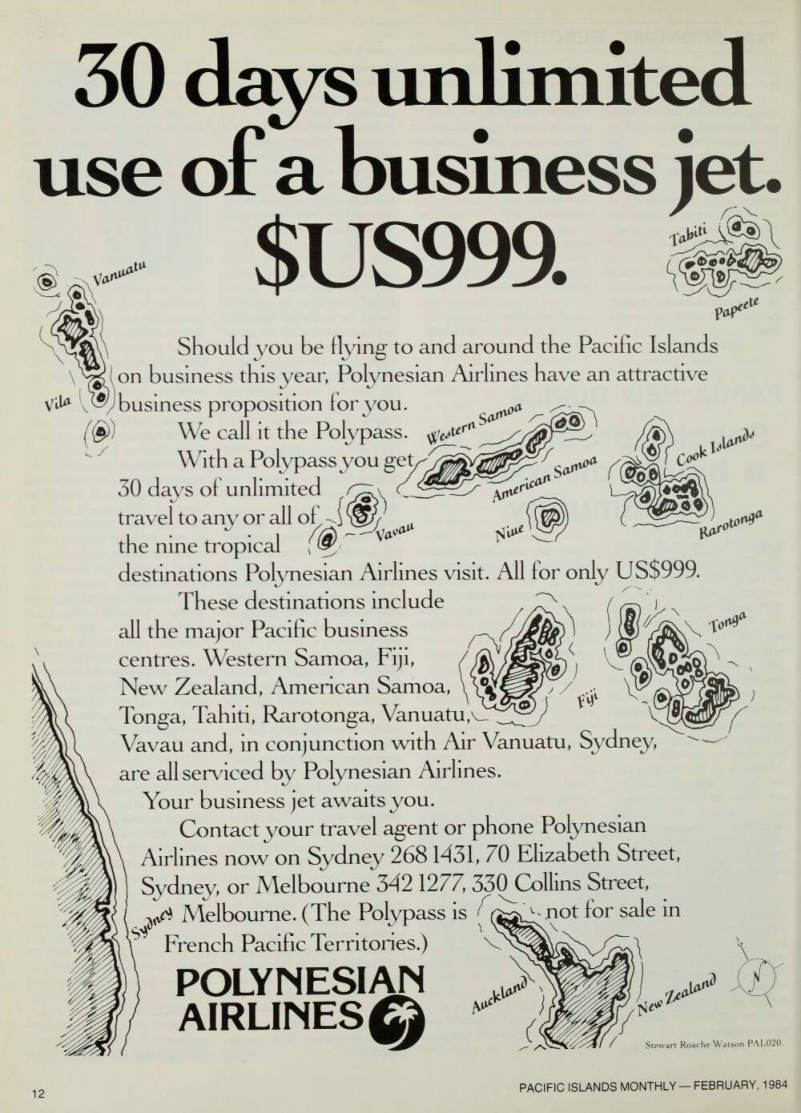
use of a business jet.
M % > 6P dojft c*
30 days unlimited
- SUS 999.
Should you be Hying to and around the Pacific Islands on business this year, Polynesian Airlines have an attractive business proposition lor you.
We call it the Polypass. tcrrt ,/ With a Polypassyou s^ a (\ 30 days ol unlimited C9X travel to any or all of 4w . \m I 1 • ■ \ f(a) 'V 5 / the nine tropical ; destinations Polynesian Airlines visit. All for only US$999.
These destinations include 77, all the major Pacific business centres. Western Samoa, Fiji, New Zealand, American Samoa, \ Vy Tonga, Tahiti, Rarotonga, Vanuatu, V"
Vavau and, in conjunction with Air Vanuatu, Sydney, are all serviced by Polynesian Airlines.
Your business jet awaits you.
Contact your travel agent or phone Polynesian Airlines now on Sydney 2681431, 70 Elizabeth Street, Sydney, or Melbourne 3421277, 330 Collins Street, y'} Melbourne. (The Polypass is v mot tor sale m French Pacific Territories.)
POLYNESIAN
AIRLINES (jj
& « \ow \ Stewart Roache Watson PALO2O
A tough testing time
Fiji
A tough testing time for economy and political system
Barely a soul in Fiji, with the possible exception of some union leaders, does not appreciate how difficult an economic year 1984 will be for their country.
In common with several other Pacific Island nations the com bined effects of cyclone and drought in 1983 set up a financial chain reaction which some ex pect will take at least a full 12 months, and probably more, to work through.
Adding to this is an atmos phere of political unease . . . tempers were frayed and patience sorely tried during the long and unhappy Royal Commission into the 1982 general election, and feelings among political leaders since then have been fractious.
This culminated, in the final days of December, in a walk-out from Parliament of the almost entirely Indian opposition, the National Federation Party, on an issue which, in easier times, might never have arisen ... the authority of the Speaker, Tomasi Vakatora, to require the Leader of the Opposition, Jai Ram Re ddy, to observe the custom of the House by standing when addres sing the Chair.
One Hong Kong entrepreneur, visiting Fiji on a regional tour devoted to finding new places to invest the money he wished to remove from his home colony, was heard to say: “Fiji cannot truly claim political stability until the Opposition party has not only won an election, but been al
lowed by all citizens to govern.”
Then he went on his way.
Be that view as it may, most objective observers of Fiji be lieve it remains a good place in which to invest, and are still reasonably confident that, de spite alarums such as Decem ber’s pettishness in the House, the country is big enough and stable enough (and perhaps scared enough of the consequ ences of a serious inter-racial mistake), to go on being stable and progressive.
Yet on both grounds, econom ics and politics, 1984 will be a very testing year.
Cyclone Oscar, which hit last April, was vastly more damaging than the run-of-the-mill cyclones which all Pacific islands have long since learned to endure.
Oscar not only hit the sugar, but it flattened the tourist industry on the western Division coast as no cyclone had done before.
The inevitable publicity, most of it fuelled by interviews with over-excited tourists keen to exp lain their heroism in the face of appalling danger, not only brought visits to a complete stop at the time, but has continued to damage Fiji as a destination, although the tourist industry plant is now completely rebuilt and, indeed, upgraded.
Tourism lately surpassed sugar as Fiji’s prime source of income.
The $4O million insurance payout for the cyclone damage provided a badly-needed injec tion of spending money and, for a time, trade picked up handily, particularly in the building and associated industries which had been seriously depressed. But all of that is now spent, unemploy ment is again very high and growing, and prospects are gloomy for many workers.
For the first time in its history the Fiji Sugar Corporation is budgeting a loss for 1984, the direct product of the disastrous drought of 1983 and also the very large amounts spent in the last few years in updating plant to cope with expected record crops.
Many lay-offs have exacerbated the overall decline in employ ment and also damaged general retail trade in sugar areas.
As it is, Fiji’s income from sugar in 1984 is not expected to rise over $9O million, which re presents a drop of more than 40 per cent in the national income from that vital source.
The national airline, Air Pacif ic, has gambled a good deal, for Fiji if not directly for itself, upon the success of its Project Ameri ca, a relatively ambitious scheme for a company of Air Pacific’s size. This provides a three-times a-week service between Nadi and Honolulu, flying a wet-leased DC-10 using Western Airlines flight crew and male and female Air Pacific cabin crew.
At $398 (Fiji currency) round trip, Nadi-Honolulu, a trip to and from Suva thrown in free, the fare is attractive, if not exactly
profit-oriented for Air Pacific.
The airline expects to lose at least a couple of million dollars running Project America in the first year but, given only even reasonable loadings, and an aver age spending of $7OO per tourist per visit, it could net Fiji the best part of $2O million additional foreign revenue, and provide de sperately needed extra employment.
But a rise in unemployment and, indeed, a rise in tourist derived income, is dependent up on further investment in the in dustry. And here, while the pic ture is not exactly throbbing with life, it is a good deal more healthy in prospect than anything else in the country.
Three major hotel develop ments are in train, two on islands offshore from Nadi/Lautoka and the third on one of the most attractive beaches on Viti Levu’s western coast.
Elsewhere the picture is mur ky. Manufacturing shows only moderate promise, even with the very practical aid of SP ARTEC A giving Fiji, among Forum Island nations, very generous duty-free access to Australia and New Zealand.
Most companies are very short of cash and are carrying very heavy debt ... a perennial problem in Fiji where business practices generally owe more to Bombay than to Sydney. This also hinders development and
flexibility.
Yet with all its current, in herited, and forseen problems, Fiji remains one of the most promising of the Pacific’s na tions. It is already embracing sophisticated industrial and business techniques and, though yet cautiously, is beginning to compete for business in quite tough export markets.
It has so far enjoyed very conservative and wise manage ment of its finances under the direction of Finance Minister Charles Walker. He resigned last December for personal reasons which remain unexplained. But even without him, there should be little or no change in estab lished monetary policies.
Given that, some sound over seas investments and a reason ably smooth political climate, Fiji should survive 1984 some what battered, but unbowed.
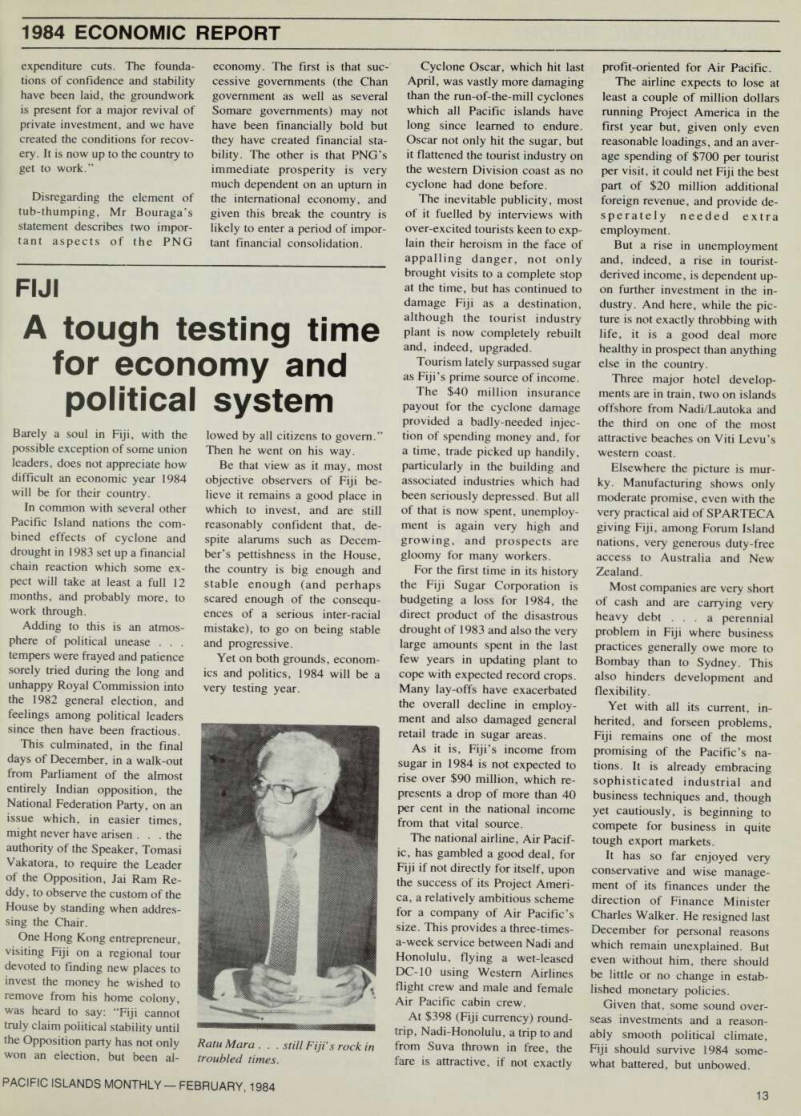
Ratu Mara . . . still Fiji’s rock in troubled times.
Windfall from the
French Polynesia
Windfall from the big winds of ’82-’83
The six cyclones which hit French Polynesia between De cember 1982 and April 1983 caused material losses amounting to about CFPI6 billion (about SAI2O million). But most of the destruction was wrought on pri vate homes, perhaps as many as 10,000 of them. So, whatever the personal inconvenience suf fered by their owners, the dam age was not as crippling to the economy as if important indus tries and production centres had been wiped out.
Looking back on the events of the past eight months or so, it is
now generally acknowledged
that the relief and reconstruction program, which has been carried out with great determination and skill by Vice-President Gaston Flosse and his men, has definite ly served as a stimulus to local business and trade, and has
created jobs.
Flosse very promptly con sidered that top priority should be given to the people of the disinherited Tuamotu atolls, who depend for their living on the sale of copra a source of income of which they were abruptly de
prived by the terrific damage
done by the cyclones to their coconut plantations. He therefore spent most of the CFP3 billion
scraped together by reshuffling
the 1983 Budget and creating new taxes on building materials such as timber, cement, and cor rugated iron, which were given away free to homeless Tuamotu islanders.
In addition, all men and wo men who had nothing to do after losing their palm trees and coconuts were hired at regular rates of pay and put to work
clearing the plantations and
planting coconuts, regardless of
who the owners of the land con cerned happened to be. When they have completed this task,
they will be employed, on equal
ly favorable terms, on building
concrete anti-cyclone shelters.
The French Government chipped in another CFP3 billion as an outright gift. This money is now being used to compensate about 5000 low-income families for the loss of their furniture and household goods. The special re construction agency set up by the local Government Council will also soon receive a French Gov ernment loan of CFP3.S billion at the modest interest rate of 4.5 per cent.
As for tourism, which now constitutes the territory’s main industry (PIM Feb ’B3 p 32),
none of the major hotels suffered
serious damage. Many hotel
owners and travel agents are, of course, fearful that the cyclones will have given the islands a bad name, with adverse effects on their industry for years to come.
But these fears do not seem to be shared by the big multi national hotel chains. For exam ple, both the Hyatt and Hilton corporations have recently en tered into definite commitments to build huge 250-room hotels at Borabora. Nor are they put off by the fact that the number of tour ists visiting French Polynesia has been relatively stagnant since 1975 at something under 100,000 a year. It is their ap praisal that the problem lies in the limited capacity of the local hotels. Accordingly, they plan to build some more. Of course, they also expect that Mr Flosse will take action to do away with some of the privileges enjoyed by the French airline UTA, which has so far managed to
keep severe restrictions on all
foreign charter traffic . . .
Final proof that the cyclones have not ruined the country is
provided by the 1984 Budget.
Adopted in mid-December ’B3, it
contains no special cyclone
emergency provisions. The grand total comes to CFP36 bill ion. In accordance with long established patterns, it is shared out as follows: municipalities CFP6.45 billion, public works 5.68 billion, education 4.58 bill ion, public debt 3.19 billion, health 3.19 billion, social wel fare 2.38 billion.
Also in line with a hallowed colonial tradition, the revenues are almost wholly derived from customs duties and indirect taxes. And there is no doubt that the .main reason Tahiti is attract ing increasing numbers of French settlers is the very special and modem kind of paradise they find there a fiscal paradise.
Marie-Therese and Bengt Daniels son.
year program
New Caledonia
First steps in line with a three year program
New Caledonia’s 1984 Budget
expenditure of
CFP31,200,000,000 (about $A232 million) is directed to the
promotion of balanced regional
development, and lessening the
dependence of the economy on the nickel industry.
CFP4 billion (about $3O mill ion) will be devoted to infrastruc ture projects such as roads, wharves, and so on.
Heavy expenditure will also be devoted to the promotion of ag riculture and animal husbandry, and to fisheries and the timber
industry.
Small businesses are to be en couraged, and tourism, while be ing promoted, is to be increas ingly integrated with the Melane sian way of life.
The territory has experienced a
decline in cattle numbers, due mainly to settlers ceasing opera tions following land claims by Melanesian tribes.
But the Government Council lor in charge of the economy, Henri Bailly, told PIM that cat tle-breeding was now picking up again, and that increasing num bers of Melanesians were taking up cattle runs.
The focus of the land redis tribution, he said, is to give back land to tribes who submit an economic proposition for use of the land along with their claim.
For the first time. New Caledonia has a three-year economic planning framework, a result of the general economic summit meeting held in Noumea in June, 1983. The summit,
which brought together political.
administrative, union, business, professional, church and educa tion leaders, set the guidelines for the organisation of produc tion and the provision of infras tructure works over the next three years.
The territory’s coffee industry was in decline in 1983, leading to imports of coffee from Vanuatu and some African coun tries. It has been given a boost with an injection of funds to the tune of CFP1,215,000,000 (ab out $9 million) for the next three years, which was voted recently by the Territorial Assembly. Fol lowing the lack of success of “Operation Coffee” launched five years ago, emphasis is to be put on larger coffee plantations run by co-operatives and groups of productions to cut water and
equipment costs. “Operation
Coffee”, or “Sun Coffee”, was an attempt to convert Melanesian growers to a coffee type which does not grow in the shade, as they had been used to.
Inflation in the territory ran at 11.1 per cent for the 12 months to November, 1983.
Henri Bailly says the Govern ment Council is aiming to reduce this to seven per cent in 1984.
The territory has had a price
freeze in operation since Octob er, which is to be lifted in March.
Mr Bailly is optimistic about the territory’s economic pros pects for 1984. He says: “The nickel and cattle industries are picking up, and there is no sign of a drop in investments on
the contrary, we have a bot tleneck of investment applica tions waiting to be dealt with.
“We also have cut back as far as possible on the running ex penses of the administration to permit heavier investment in
public works.”
Helen Fraser.
but, then again,
Micronesia
It could be heaven but, then again, it could be hell
Micronesia enters 1984 on the verge of either the biggest economic boom in its history, or a quick slide into a cesspit of corruption and fraud. Just when the islands will stand on the brink of this precipice depends on the Congress of the United States.
Approval this year of the Compact of Free Association seems likely for the Marshall Islands and the Federated States of Micronesia (comprising Kos rae, Ponape, Truk and Yap). The Congress nearly a decade ago approved US commonwealth status for the Northern Mariana Islands, a relationship which will go into full force when the 37year-old trusteeship is terminated.
What happens in Palau is another matter (see “Notes from the North” column, this issue). If that group does not soon agree upon its future political status, it could remain under the American flag.
Implementation of free associ ation will open the fiscal flood gates for Micronesia. Billions of dollars worth of aid will pour into the islands, some of it dedi cated to specific projects (par ticularly construction and related efforts), but a considerable amount will be left to the discre tion of national governments.
In addition, there will be the potential to raise other funds.
Palau already has printed its own stamps, and raised a reported SUSI million through its efforts.
The Marshall Islands has talked of the possibility, but so far plans
are on hold. The FSM held talks in Honolulu last December, and appears ready this year to com mit itself to a philatelic venture.
Last year’s drought hit Mic ronesia hard. But the rains have returned, and in that respect 1984 may be a “normal” year. Since there is no commercial agricul ture to speak of, the greatest damage was to subsistence crops, and local productivity, which was disrupted by limited water hours.
Indeed, the greatest influence on Micronesia’s economic out look for this year is political.
Potential investors, local business executives, and foreign governments ready to provide additional developmental assist ance, all await the passage of the free association compacts in the US Congress.
When that happens and it is only a matter of when, and not if Micronesians will have the potential to build nations with financial resources that would make their South Pacific collea gues stare in envy.
Still, the key to economic suc cess in Micronesia this year and in coming years will be the de velopment of adequate account ing practices. Without them, Micronesia could too easily be come the scene of corruption and graft on a scale unprecedented in the Pacific. If that happens, what is now a hopeful future could turn into an economic nightmare.
Floyd K. Takeuchi.
Beyond tourism,
Hawaii
Beyond tourism, defence, a quest for diversity
Hawaii’s economy in 1984 is expected to be boosted by a 9.3 per cent increase in U.S. Gov ernment spending in the Islands, but, in general, the state will recover more slowly than the mainland from the 1982-83 re cession, says the Bank of Hawaii in its annual review for 1983.
Agriculture and manufacturing
both suffer from problems, and
unemployment is rising whereas
on the mainland it is declining.
Yet the state’s unemployment rate, which hit a high of 7.2 per cent in June, 1983, is still behind the U.S. national average of 10.4.
Hawaii was a good deal less affected by the recession than was the mainland but, today, the Islands are also profiting less from the national recovery.
Major buffers during the
downturn were increased spend ing on defence by the U.S. Gov ernment and, oddly perhaps, a rise in tourist numbers. This lat ter phenomenon at a time when, nationally, Americans had less to spend might have been achieved at the expense of the trans- Atlantic travel trade as those who customarily spent their vacations in Europe sought more econom ical relaxation.
In fact visitor arrivals in 1982, when the recession was hitting its depths, were a record, passing four million for the first time.
Last year there was a further small rise and this year is expect ed to see at least maintenance of these high levels, or even a small increase. Visitors spent nearly SUS 4 billion in Hawaii last year, which is about one quarter of the state’s total expenditures.
The bank’s review goes into considerable detail in examining trends over the last half-decade or more in the now all-important tourist industry and concludes that something of a plateau may have been reached. The boom years of the ’6os and ’7os are
over, the industry is established, internationally, as well as on the mainland.
Yet significant changes are
seen. Where, previously, Hawaii was a destination for middle and upper-income groups (and re mains so) the pattern has de finitely swung over to high volume, low-cost, tourism.
While this has resulted in steady growth of visitor arrivals and spending, it has also made the state more vulnerable to econom ic surges and declines on the mainland.
Generally, says the bank, the visitor and defence industries’ dominance of the state’s economy is seen as as not heal thy, “The search for ways of restoring a more diversified economic base for Hawaii has become a major aspect ...”
“Various activities from ocean mining to aquaculture to exotic fruits and alternative energy have been identified as potential and
perhaps preferred industries to
promote,” says the bank. “All of the non-traditional areas pro posed remain unproven. The true candidates for industrial develop ment must ultimately be deter mined by the firms at risk in the ventures: and the noteworthy de velopment at this stage of the economy’s transition is the grow ing official resolve to stimulate new and dynamic forms ol economic activity in the state.”
Advertisements & other items, pp. 16-17 (1 item)
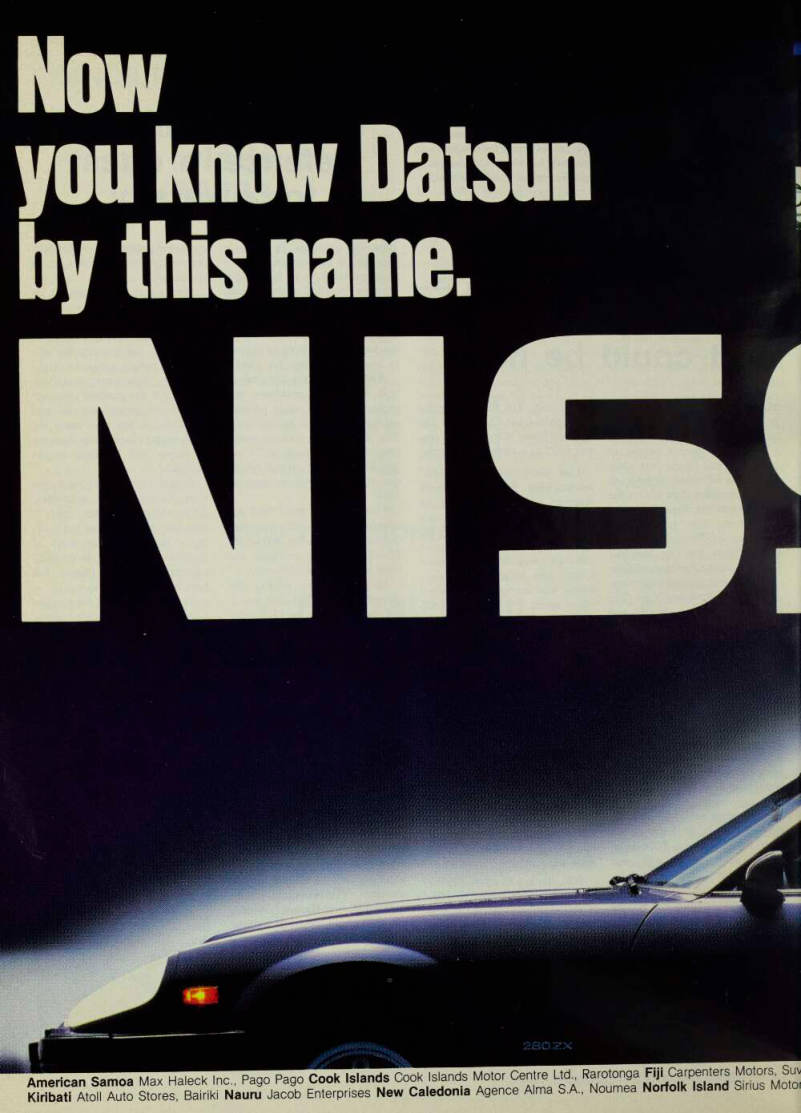
by this name.
Now
you know Datsun
( r a .
'■ ill mr
20OZX
nrs ~\y loionrio r/intnr Ppntrp i tri Rarotonaa Fiji Carpenters Motors, Suv Store s aßairiki 1 Nauru tlaaDtJ 1 Enterprises New Caledonia Agence Alma S.A., Noumea Norfolk Island Sirius Motor
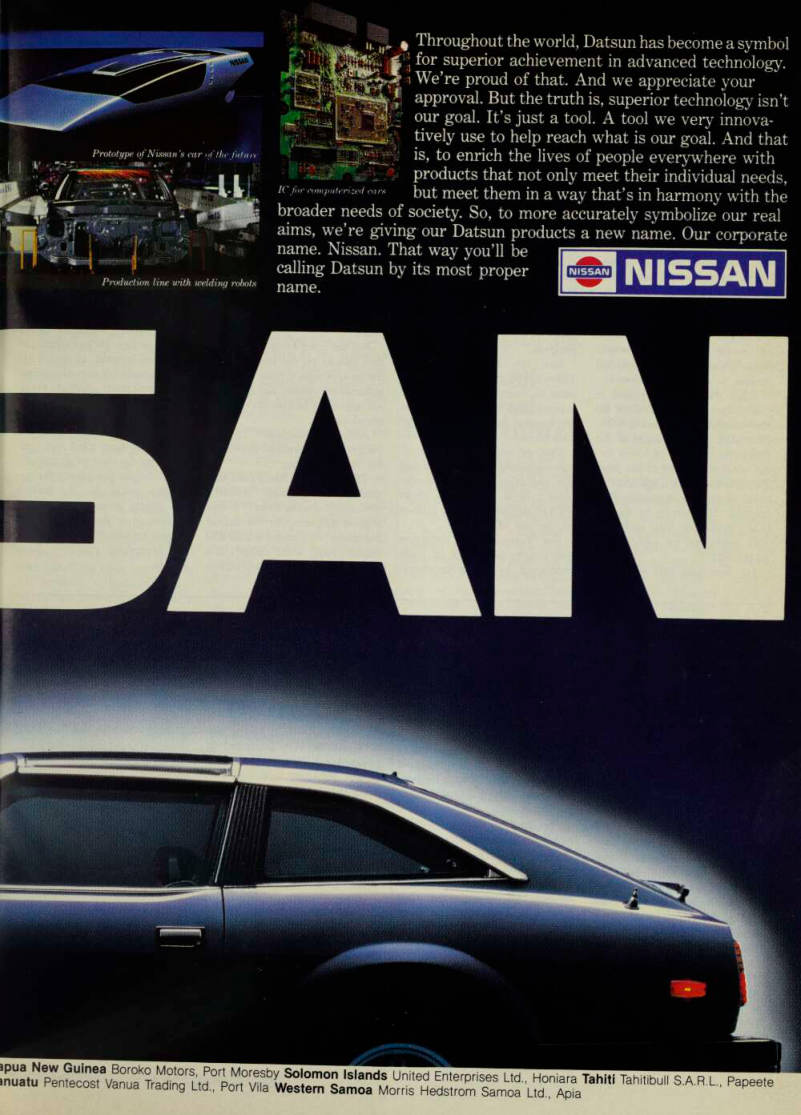
Prototype ofNi ’s car ofthefutun » - "' i % Throughout the world, Datsun has become a symbol ■ 1 for superior achievement in advanced technology. r • t, r Production line with welding robots We’re proud of that. And we appreciate your approval. But the truth is, superior technology isn’t our goal. It’s just a tool. A tool we very innovatively use to help reach what is our goal. And that is, to enrich the lives of people everywhere with products that not only meet their individual needs, but meet them in a way that’s in harmony with the broader needs of society. So, to more accurately symbolize our real aims, we’re giving our Datsun products a new name. Our corporate name. Nissan. That way you’ll be to IC/or computerized can calling Datsun by its most proper name.
Inissan]
NISSAN
▲ L S.A.R.L, Papeete
Wearing a blindfold,
Western Samoa
Wearing a blindfold, we walk boldly into 1984
For all they understood about the state of the country’s economy, the people of Western Samoa might have walked into 1984 wearing a blindfold.
This was despite a stormy,
three-week-long budget debate in
parliament in December which, one might have thought, would
have spread ample light on this
subject, if on nothing else.
What they do understand is that Prime Minister Tofilau Eti has conspicuously failed to deliv er on his promise made at the beginning of 1983 of lower liv ing costs at the end of the year.
The prime minister admitted as much in his budget speech when he said: “The extent of the na tion’s problems was such that they could not be solved in a
single year.”
He then said that the tough
measures proposed in the 1984 budget were part of “an on-going program for national economic recovery leading to a path of sustained economic growth”. He added: “We must consolidate the gains that have been made and press forward to achieve further
progress.”
But, for Opposition Leader Tupuola Efi, there just aren’t any gains to “consolidate”. Instead of solving problems, he said, the government had simply created new ones.
One of the major improve ments claimed by Tofilau Eti was the reduction of the govern ment’s local debt from about SWSIO million to $1.2 million by the end of 1983.
For Tupuola, the reduction was simply the result of loans contracted by the government.
“How can that be a gain?” he asked. ”It is simply paying one debt by incurring another one.”
He was also critical of the five per cent interest rate on the new International Monetary Fund loan of $8 million, pointing out that his government had raised loans with the IMF at 3.05 per cent interest.
Of the government’s action in dropping its tender system of importation, Tupuola said the government had made mislead ing claims that the tender system was working well, and then had chopped it. “Why chop a system if it was working so well?” he asked.
But the chief focus of opposi tion attacks on the budget were the government’s plan for a) a national university, and b) a ma jor upgrading of Faleolo interna tional airport.
Although included in the budget, it contained no provision for their financing.
The opposition had a field day pushing the question “Where’s the money coming from?” It was a good question, for the airport extension is estimated to cost $lO million, and, while nobody has yet put a figure on the university
project, everybody is agreed that it would cost “many millions”.
Government MP Faasootauloa Semu Pulagi, speaking to a re porter, said that if countries like Australia and New Zealand would not assist with financing the university project, the gov ernment would seek help from communist China or Russia.
The budget debate finally de generated into a slanging match in which outrageous insults were hurled about in parliament.
Opposition MP Fuimano made Western Samoan parliamentary
history by getting himself sus
pended from parliament for six months, during which he would receive no pay. He had refused to withdraw remarks in which he called Speaker Nonumalo Sofara an “animal thief’. Nobody knew the details, but a letter in a local paper later claimed that on a past occasion the person concerned had indeed been tried and con victed for the theft of an animal.
But despite everything the op position could do, the budget was finally passed at $85.6 million, it is the highest ever, comparing with $69.2 million for
the preceding year.
Sano
Malifa.
brightest hope’,
Tourism still the brightest hope’, says Westpac man
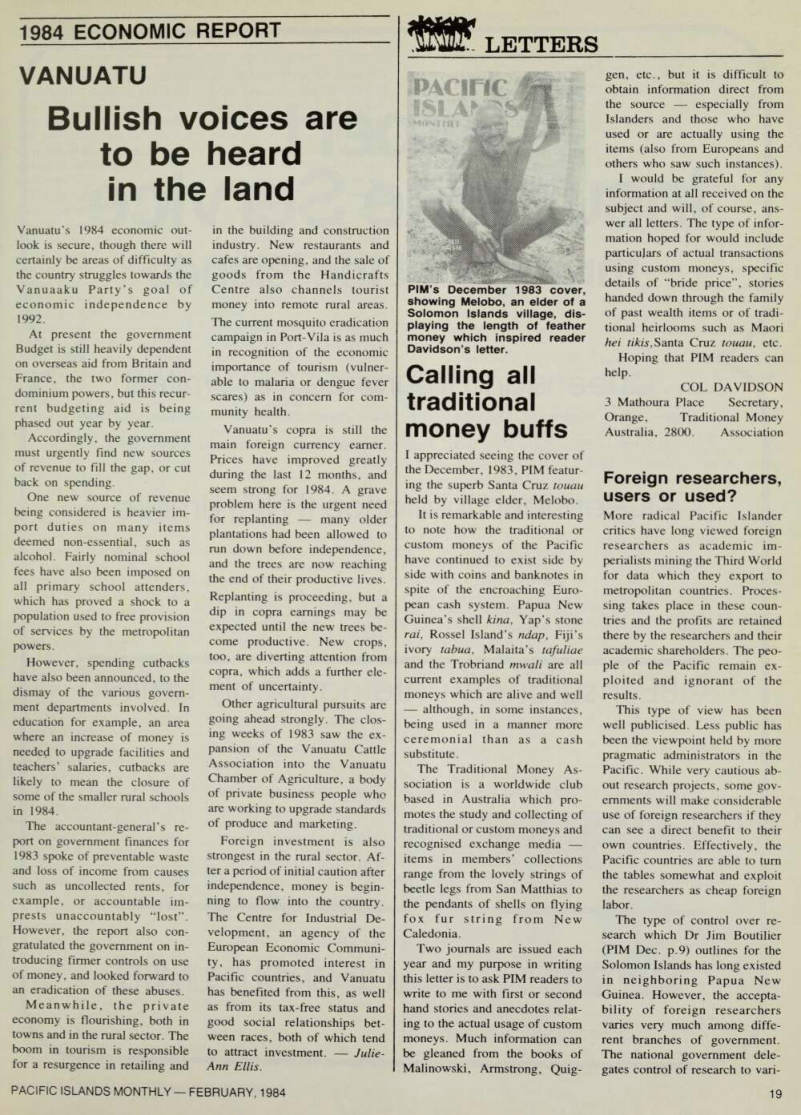
Tourism remains the single best prospect for Pacific Island na tions seeking to expand their foreign trade, but with care, foresight, and a realisation of the standards required, some had a future in manufacturing, says R.
J. Huey, new chief manager, Fiji and Pacific Islands, for the West pac Banking Corporation. (West pac is the new name of the former Bank of New South Wales.) Mr Huey has replaced Geoff Yates, who has returned to Aust ralia at the end of his tour in Fiji.
“I’m bullish about tourism”, said Mr Huey. “The traffic into the Pacific from Australia and most other source-countries should pick up as the world economy improves, people have more money to spend, and begin looking about for good holidays.
“Fiji has a good image, and so do Vanuatu and New Caledonia, which have the added advantage for Australian and American tourists, particularly, of being culturally different.
“But all of them have to keep a very hard eye on the quality of
the product they offer. Competi
tion is stiff, and will probably get stiffer.
“So much is tied up with im age,” he said. “Word-of-mouth publicity is very powerful, for and against. It only needs one family to come back to Australia or the U.S. complaining they
were ripped off by some shop
keeper to do a very great deal of damage to a country’s tourist
industry.”
As tourism grew there would be need for new investment in hotels and other plant, he said.
Indeed most Pacific countries al ready needed more tourist rooms if they were to expand their
trading.
“I will be very interested in promoting investment and trade,” Mr Huey said.
He was not, however, overly optimistic, he said, about manu facturing being able to make sub stantial contributions to export earnings, even in more advanced Pacific countries like Fiji. But there was room for improving the present situation, particularly if entrepreneurs set out to produce items the countries were good at, and did so with a keen eye to quality, as well as price.
“Obviously most will look
first towards replacing imports.
In Fiji the Monosavu hydro electric scheme is a classic exam ple of how investment within a nation can save millions of dol lars in foreign exchange. It was a
very big investment by the stan dards of the country, and servic ing the debt will be a burden but in the long term it will be of great benefit to Fiji,” he said.
Elsewhere the Pacific Islands could look towards fisheries, food production, and, in several important cases, timber sales, as means of boosting their export earnings, he said.
Mr R. J. Huey
Bullish voices are
Vanuatu
Bullish voices are to be heard in the land
Vanuatu’s 1984 economic out look is secure, though there will certainly be areas of difficulty as the country struggles towards the
Vanuaaku Party’s goal of
economic independence by
1992.
At present the government
Budget is still heavily dependent
on overseas aid from Britain and France, the two former con dominium powers, but this recur rent budgeting aid is being phased out year by year.
Accordingly, the government must urgently find new sources of revenue to fill the gap, or cut back on spending.
One new source of revenue being considered is heavier im port duties on many items deemed non-essential, such as alcohol. Fairly nominal school fees have also been imposed on all primary school attenders, which has proved a shock to a population used to free provision of services by the metropolitan powers.
However, spending cutbacks have also been announced, to the dismay of the various govern ment departments involved. In education for example, an area where an increase of money is needed to upgrade facilities and teachers’ salaries, cutbacks are likely to mean the closure of some of the smaller rural schools in 1984.
The accountant-general’s re port on government finances for 1983 spoke of preventable waste and loss of income from causes such as uncollected rents, for example, or accountable im prests unaccountably “lost”.
However, the report also con gratulated the government on in troducing firmer controls on use of money, and looked forward to an eradication of these abuses.
Meanwhile, the private economy is flourishing, both in towns and in the rural sector. The boom in tourism is responsible for a resurgence in retailing and
in the building and construction industry. New restaurants and cafes are opening, and the sale of goods from the Handicrafts Centre also channels tourist money into remote rural areas.
The current mosquito eradication campaign in Port-Vila is as much in recognition of the economic importance of tourism (vulner able to malaria or dengue fever scares) as in concern for com
munity health.
Vanuatu’s copra is still the main foreign currency earner.
Prices have improved greatly
during the last 12 months, and seem strong for 1984. A grave problem here is the urgent need for replanting many older plantations had been allowed to run down before independence, and the trees are now reaching the end of their productive lives.
Replanting is proceeding, but a dip in copra earnings may be expected until the new trees be come productive. New crops, too, are diverting attention from copra, which adds a further ele ment of uncertainty.
Other agricultural pursuits are going ahead strongly. The clos ing weeks of 1983 saw the ex pansion of the Vanuatu Cattle Association into the Vanuatu Chamber of Agriculture, a body of private business people who are working to upgrade standards
of produce and marketing.
Foreign investment is also strongest in the rural sector. Af ter a period of initial caution after
independence, money is begin
ning to flow into the country.
The Centre for Industrial De velopment, an agency of the European Economic Communi ty, has promoted interest in Pacific countries, and Vanuatu has benefited from this, as well as from its tax-free status and
good social relationships bet
ween races, both of which tend
to attract investment.
Julie-
Ann Ellis.
Calling all

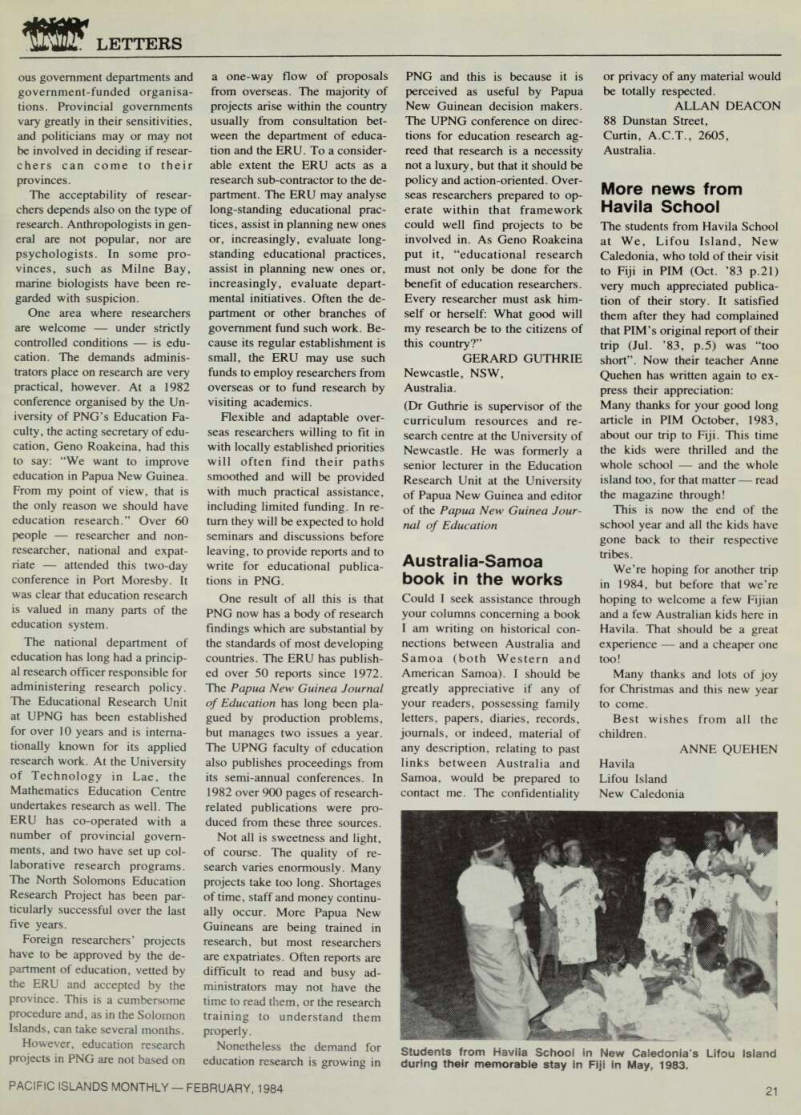
Letters
traditional
money buffs
I appreciated seeing the cover of the December, 1983, PIM featur ing the superb Santa Cruz touau held by village elder, Melobo.
It is remarkable and interesting to note how the traditional or custom moneys of the Pacific have continued to exist side by side with coins and banknotes in spite of the encroaching Euro pean cash system. Papua New Guinea’s shell kina. Yap’s stone rai, Rossel Island’s ndap, Fiji’s
ivory tabua, Malaita’s tafuliae
and the Trobriand mwali are all current examples of traditional moneys which are alive and well although, in some instances, being used in a manner more ceremonial than as a cash substitute.
The Traditional Money As sociation is a worldwide club based in Australia which pro motes the study and collecting of traditional or custom moneys and
recognised exchange media
items in members’ collections range from the lovely strings of beetle legs from San Matthias to the pendants of shells on flying fox fur string from New Caledonia.
Two journals are issued each year and my purpose in writing this letter is to ask PIM readers to write to me with first or second hand stories and anecdotes relat ing to the actual usage of custom moneys. Much information can be gleaned from the books of
Malinowski, Armstrong, Quig
gen, etc., but it is difficult to obtain information direct from the source especially from Islanders and those who have used or are actually using the items (also from Europeans and others who saw such instances).
I would be grateful for any information at all received on the subject and will, of course, ans wer all letters. The type of infor mation hoped for would include particulars of actual transactions
using custom moneys, specific
details of “bride price”, stories handed down through the family of past wealth items or of tradi tional heirlooms such as Maori hei tikis, Santa Cruz touau, etc.
Hoping that PIM readers can
help.
Col Davidson
3 Mathoura Place Secretary,
Orange, Traditional Money
Australia, 2800. Association
Foreign researchers,
users or used?
More radical Pacific Islander critics have long viewed foreign researchers as academic im perialists mining the Third World for data which they export to metropolitan countries. Proces sing takes place in these coun tries and the profits are retained there by the researchers and their academic shareholders. The peo ple of the Pacific remain ex ploited and ignorant of the results.
This type of view has been well publicised. Less public has been the viewpoint held by more pragmatic administrators in the Pacific. While very cautious ab out research projects, some gov ernments will make considerable use of foreign researchers if they can see a direct benefit to their own countries. Effectively, the Pacific countries are able to turn the tables somewhat and exploit the researchers as cheap foreign labor.
The type of control over re search which Dr Jim Boutilier (PIM Dec. p. 9) outlines for the Solomon Islands has long existed
in neighboring Papua New
Guinea. However, the accepta
bility of foreign researchers
varies very much among diffe rent branches of government.
The national government dele gates control of research to vari
PIM’s December 1983 cover, showing Melobo, an elder of a Solomon Islands village, dis playing the length of feather money which inspired reader Davidson’s letter.
ous government departments and
government-funded organisa
tions. Provincial governments vary greatly in their sensitivities, and politicians may or may not be involved in deciding if resear chers can come to their
provinces.
The acceptability of resear chers depends also on the type of research. Anthropologists in gen eral are not popular, nor are psychologists. In some pro vinces, such as Milne Bay, marine biologists have been re garded with suspicion.
One area where researchers are welcome under strictly controlled conditions is edu cation. The demands adminis trators place on research are very practical, however. At a 1982 conference organised by the Un iversity of PNG’s Education Fa culty, the acting secretary of edu cation, Geno Roakeina, had this to say: “We want to improve education in Papua New Guinea.
From my point of view, that is the only reason we should have education research.” Over 60 people researcher and non researcher, national and expat riate attended this two-day conference in Port Moresby. It was clear that education research is valued in many parts of the education system.
The national department of education has long had a princip al research officer responsible for
administering research policy.
The Educational Research Unit at UPNG has been established for over 10 years and is interna tionally known for its applied research work. At the University of Technology in Lae, the Mathematics Education Centre undertakes research as well. The ERU has co-operated with a number of provincial govern ments, and two have set up col laborative research programs.
The North Solomons Education Research Project has been par ticularly successful over the last five years.
Foreign researchers’ projects
have to be approved by the de partment of education, vetted by the ERU and accepted by the province. This is a cumbersome procedure and, as in the Solomon Islands, can take several months.
However, education research projects in PNG are not based on
a one-way flow of proposals from overseas. The majority of projects arise within the country usually from consultation bet ween the department of educa tion and the ERU. To a consider able extent the ERU acts as a research sub-contractor to the de partment. The ERU may analyse long-standing educational prac tices, assist in planning new ones
or, increasingly, evaluate long
standing educational practices,
assist in planning new ones or,
increasingly, evaluate depart
mental initiatives. Often the de partment or other branches of government fund such work. Be cause its regular establishment is small, the ERU may use such funds to employ researchers from overseas or to fund research by
visiting academics.
Flexible and adaptable over seas researchers willing to fit in
with locally established priorities
will often find their paths smoothed and will be provided with much practical assistance, including limited funding. In re turn they will be expected to hold seminars and discussions before leaving, to provide reports and to write for educational publica tions in PNG.
One result of all this is that PNG now has a body of research findings which are substantial by the standards of most developing countries. The ERU has publish ed over 50 reports since 1972.
The Papua New Guinea Journal
of Education has long been pla
gued by production problems,
but manages two issues a year.
The UPNG faculty of education
also publishes proceedings from
its semi-annual conferences. In 1982 over 900 pages of research related publications were pro duced from these three sources.
Not all is sweetness and light, of course. The quality of re
search varies enormously. Many
projects take too long. Shortages
of time, staff and money continu ally occur. More Papua New Guineans are being trained in research, but most researchers are expatriates. Often reports are difficult to read and busy ad ministrators may not have the time to read them, or the research training to understand them
properly.
Nonetheless the demand for education research is growing in
PNG and this is because it is
perceived as useful by Papua
New Guinean decision makers.
The UPNG conference on direc tions for education research ag reed that research is a necessity not a luxury, but that it should be policy and action-oriented. Over seas researchers prepared to op erate within that framework could well find projects to be involved in. As Geno Roakeina put it, “educational research must not only be done for the benefit of education researchers.
Every researcher must ask him self or herself: What good will my research be to the citizens of
this country?”
Gerard Guthrie
Newcastle, NSW, Australia. (Dr Guthrie is supervisor of the curriculum resources and re search centre at the University of Newcastle. He was formerly a senior lecturer in the Education Research Unit at the University of Papua New Guinea and editor of the Papua New Guinea Jour nal of Education
Australia-Samoa
book in the works
Could I seek assistance through your columns concerning a book I am writing on historical con nections between Australia and Samoa (both Western and American Samoa). I should be greatly appreciative if any of
your readers, possessing family
letters, papers, diaries, records, journals, or indeed, material of any description, relating to past links between Australia and Samoa, would be prepared to contact me. The confidentiality
or privacy of any material would be totally respected.
Allan Deacon
88 Dunstan Street, Curtin, A.C.T., 2605, Australia.
More news from
Havila School
The students from Havila School at We, Lifou Island, New Caledonia, who told of their visit to Fiji in PIM (Oct. ’B3 p. 21)
very much appreciated publica
tion of their story. It satisfied them after they had complained that PlM’s original report of their trip (Jul. ’B3, p. 5) was “too short”. Now their teacher Anne Quehen has written again to ex press their appreciation:
Many thanks for your good long
article in PIM October, 1983, about our trip to Fiji. This time the kids were thrilled and the whole school and the whole island too, for that matter read
the magazine through!
This is now the end of the school year and all the kids have gone back to their respective tribes.
We’re hoping for another trip in 1984, but before that we’re hoping to welcome a few Fijian and a few Australian kids here in Havila. That should be a great experience and a cheaper one too!
Many thanks and lots of joy for Christmas and this new year to come.
Best wishes from all the children.
Anne Quehen
Havila Lifou Island New Caledonia
Students from Havila School in New Caledonia's Lifou Island during their memorable stay in Fiji in May, 1983.
Advertisements & other items, pp. 20-22 (1 item)
Expert
Insurance Service
throughout the islands
Queensland Insurance (Fiji) Limited
Head Office: Queensland Insurance Centre, Victoria Parade SUVA. General Manager: R. Jackson.
Assistant Manager: Vijay Lai. Phone 23 851.
LAUTOKA OFFICE: Burns Philp Bldg., Naviti St. District Manager: R. Sharma. Phone 60 642 LABASA OFFICE: Burns Philp Bldg Phone: 8 2139
Queensland Insurance (PNG) Limited
PAPUA NEW GUINEA
Head Office. B.N.G. Building, Musgrave St..PORT MORESBY. General Manager: T. H. Sarti Phone: 212144 LAE 4th St. & Coronation Drive District Manager: C. D Hillier Phone: 423873 MOUNT HAGEN Hagen Drive. District Manager R. She!bourn Phone: 521002.
ARAWA: Chebu St., District Manager; B. Bowers Phone: 95 1555 MADANG: Kasagten St,. District Manager: J. Longbut Phone: 82 2020 RABAUL: Wirraway St. District Managerß. McManus Phone: 921014
QBE Insurance (International) Limited
VANUATU. PORT VILA: Rue de Paris, Suite 19. Oceania Bldg Manager; I R Martin.
Phone: 2299.
SANTO: Burns Philp ( Vanuatu) Ltd. Phone: 230.
PACIFIC AGENCIES
NEW CALEDONIA Ste. W. A. Johnston, S.A.R.L. 5 Rue Anatole France, NOUMEA Phone: 272083.
TAHITI Arthur Chung. Immeuble B I S., Front de Mer, PAPEETE Phone: 2.86.19 NIUE: Burns Philp (South Sea) Company Ltd, NORFOLK ISLAND: Burns Philp ('N I ) Company Ltd. Phone: 2191 SAMOA APIA, Burns Philp (South Sea) Company Ltd. Phone: 22611 TONGA Burns Philp (South Sea) Company Ltd. NUKUALOFA Phone 21500 HAAPAI VAVAU
MEMBERS OF THE
INSURANCE GROUP LIMITED
Skip into Video
Hitachi’s front-loading VT-33E(AU) makes video viewing more enjoyable without making operation more complex. Besides bidirectional Visual Search at 4 times normal speed and a convenient Freeze Frame function during playback, it incorporates a very special Skip Search feature which automatically alternates between Visual Search and Fast Forward at 10-second intervals to get to the desired scene faster than ever before. What’s more, this model comes with a handy, wired remote control unit, a
3-program/2-week
preset recording timer, large multifunctional selector switches, and an Instant Recording Timer (IRT) for fuss-free programming.
Video couldn’t be more simple or more fun than the VT-33E(AU) from Hitachi.
O SOG
AO* 60 s e° Skip Search available by remote control aO 5® C aO
VMS
PAL
VHS
n• n n tu. u u < > =3
0 HITACHI
•AUSTRALIA: Hitachi Sales Australia Pty., Ltd., 153 Keys Road, Moorabbin, Victoria 3189; Phone: (555) 8722 •NEW ZEALAND: AWA New Zealand Limited, Wi-neera Drive, P.O. Box 50-248, Porirua;Phone: PRO 75-069 •PAPUA NEW GUINEA: S.o. Svensson (N.G.) Ltd., P.O. Box 705, Port Moresby; Phone: 21-2111 •FIJI ISLANDS: AWA New Zealand Limited, 47 Foster Road (P.O. Box 858),Suva,Fiji; Phone: 312070 •NEW CALEDONIA: Caldis, B.P, Ml, Noumea; Phone; 26.23.50 •TAHITI: Ets Chene Alain, P.O. Box 272, Papeete; Phone: 2.88.68 •SOLOMON ISLANDS: Technique Radios Centre Ltd., P.O. Box 465, Honiara; Phone: 416
Rossel island’s welcome mat is
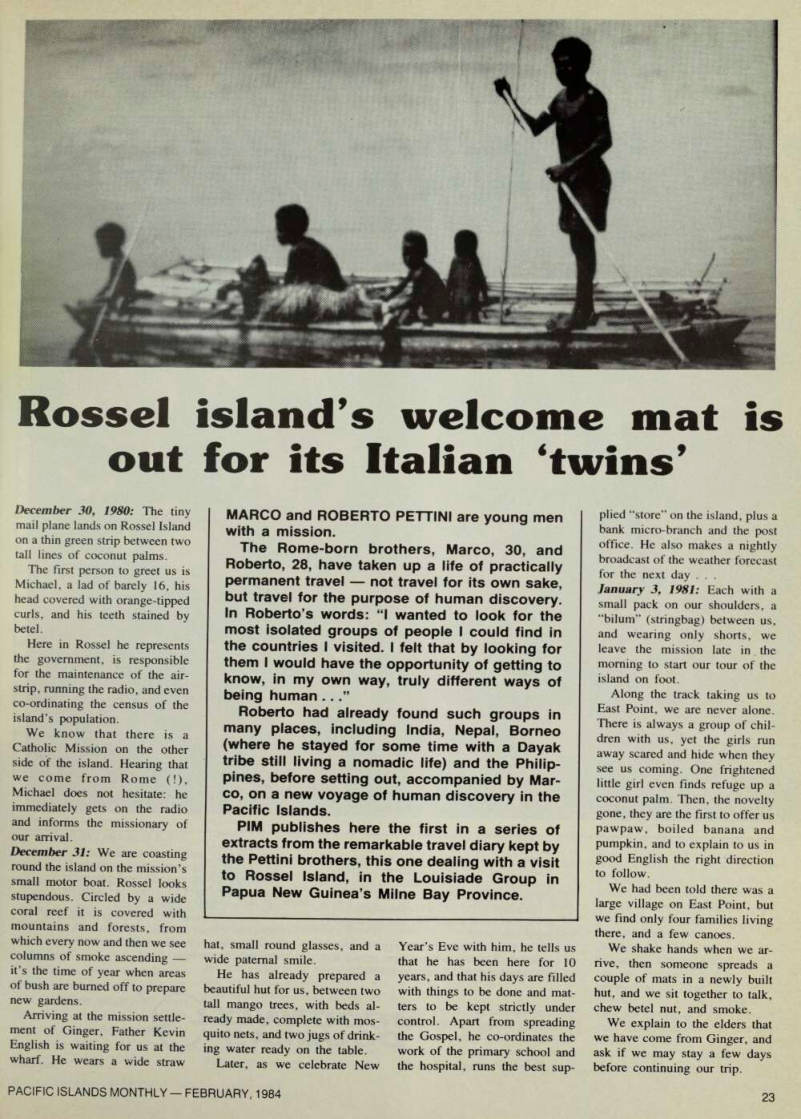
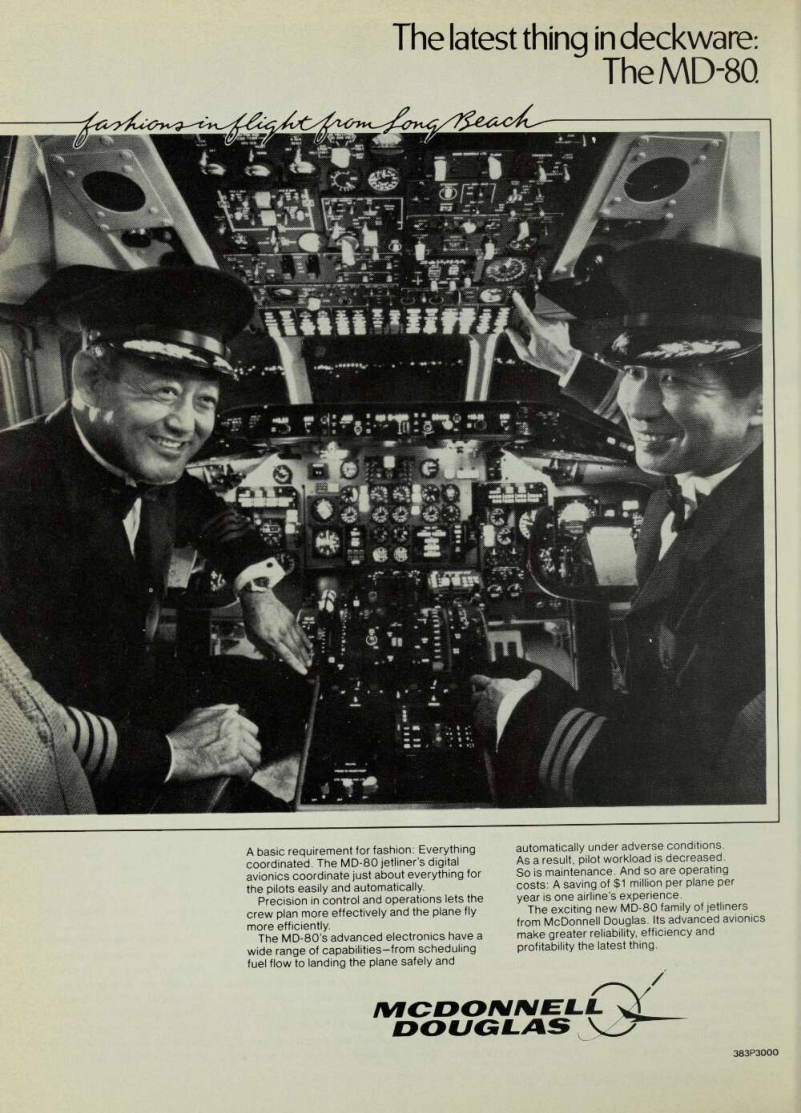
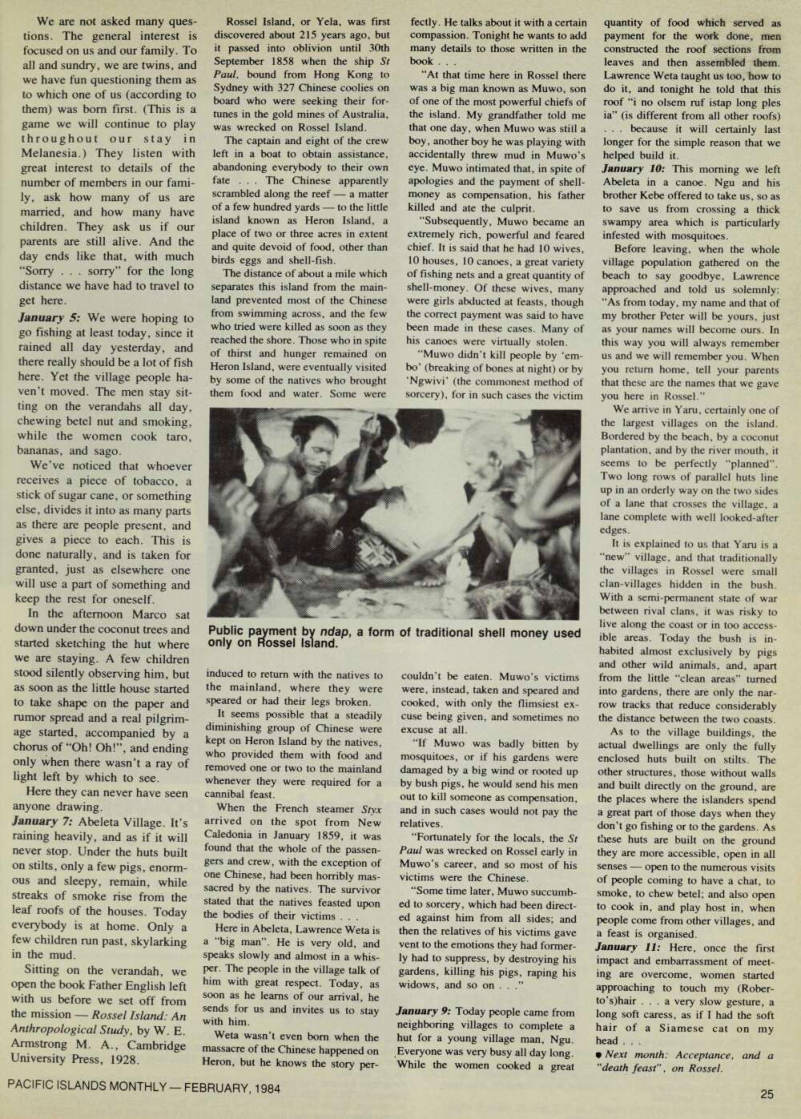
out for its Italian ’twins’
MARCO and ROBERTO PETTINI are young men with a mission.
The Rome-born brothers, Marco, 30, and Roberto, 28, have taken up a life of practically permanent travel not travel for its own sake, but travel for the purpose of human discovery.
In Roberto’s words: “I wanted to look for the most isolated groups of people I could find In the countries I visited. I felt that by looking for them I would have the opportunity of getting to know, in my own way, truly different ways of being human ..
Roberto had already found such groups in many places, including India, Nepal, Borneo (where he stayed for some time with a Dayak tribe still living a nomadic life) and the Philip pines, before setting out, accompanied by Mar co, on a new voyage of human discovery in the Pacific Islands.
PIM publishes here the first in a series of extracts from the remarkable travel diary kept by the Pettini brothers, this one dealing with a visit to Rossel Island, in the Louisiade Group in Papua New Guinea’s Milne Bay Province.
December 30, 1980: The tiny mail plane lands on Rossel Island on a thin green strip between two tall lines of coconut palms.
The first person to greet us is Michael, a lad of barely 16, his head covered with orange-tipped curls, and his teeth stained by betel.
Here in Rossel he represents the government, is responsible for the maintenance of the air strip, running the radio, and even co-ordinating the census of the
island’s population.
We know that there is a Catholic Mission on the other side of the island. Hearing that we come from Rome (!), Michael does not hesitate: he immediately gets on the radio and informs the missionary of our arrival.
December 31: We are coasting round the island on the mission’s small motor boat. Rossel looks stupendous. Circled by a wide coral reef it is covered with mountains and forests, from which every now and then we see columns of smoke ascending it’s the time of year when areas of bush are burned off to prepare new gardens.
Arriving at the mission settle ment of Ginger, Father Kevin English is waiting for us at the wharf. He wears a wide straw
hat, small round glasses, and a wide paternal smile, He has already prepared a beautiful hut for us, between two tall mango trees, with beds al ready made, complete with mos quito nets, and two jugs of drink ing water ready on the table, Later, as we celebrate New
Year’s Eve with him, he tells us that he has been here for 10 years, and that his days are filled with things to be done and mat ters to be kept strictly under
control. Apart from spreading
the Gospel, he co-ordinates the work of the primary school and the hospital, runs the best sup
plied “store” on the island, plus a bank micro-branch and the post office. He also makes a nightly broadcast of the weather forecast for the next day . . .
January 3, 1981: Each with a small pack on our shoulders, a “bilum” (stringbag) between us, and wearing only shorts, we leave the mission late in the morning to start our tour of the island on foot.
Along the track taking us to East Point, we are never alone.
There is always a group of chil dren with us, yet the girls run away scared and hide when they see us coming. One frightened little girl even finds refuge up a coconut palm. Then, the novelty gone, they are the first to offer us pawpaw, boiled banana and pumpkin, and to explain to us in
good English the right direction
to follow.
We had been told there was a large village on East Point, but we find only four families living there, and a few canoes.
We shake hands when we ar rive, then someone spreads a couple of mats in a newly built hut, and we sit together to talk, chew betel nut, and smoke.
We explain to the elders that we have come from Ginger, and ask if we may stay a few days
before continuing our trip.
We are not asked many ques tions. The general interest is focused on us and our family. To all and sundry, we are twins, and we have fun questioning them as to which one of us (according to them) was bom first. (This is a game we will continue to play throughout our stay in Melanesia.) They listen with great interest to details of the number of members in our fami ly, ask how many of us are married, and how many have children. They ask us if our parents are still alive. And the day ends like that, with much “Sorry . . . sorry” for the long distance we have had to travel to get here.
January 5: We were hoping to go fishing at least today, since it rained all day yesterday, and there really should be a lot of fish here. Yet the village people ha ven’t moved. The men stay sit ting on the verandahs all day, chewing betel nut and smoking, while the women cook taro, bananas, and sago.
We’ve noticed that whoever receives a piece of tobacco, a stick of sugar cane, or something else, divides it into as many parts as there are people present, and gives a piece to each. This is done naturally, and is taken for granted, just as elsewhere one will use a part of something and keep the rest for oneself.
In the afternoon Marco sat down under the coconut trees and started sketching the hut where we are staying. A few children stood silently observing him, but as soon as the little house started to take shape on the paper and rumor spread and a real pilgrim age started, accompanied by a chorus of “Oh! Oh!”, and ending only when there wasn’t a ray of light left by which to see.
Here they can never have seen
anyone drawing.
January 7: Abeleta Village. It’s raining heavily, and as if it will never stop. Under the huts built on stilts, only a few pigs, enorm ous and sleepy, remain, while streaks of smoke rise from the leaf roofs of the houses. Today everybody is at home. Only a few children run past, skylarking in the mud.
Sitting on the verandah, we open the book Father English left with us before we set off from the mission Rossel Island: An
Anthropological Study, by W. E.
Armstrong M. A., Cambridge
University Press, 1928.
Rossel Island, or Yela, was first discovered about 215 years ago, but it passed into oblivion until 30th September 1858 when the ship St Paul, bound from Hong Kong to Sydney with 327 Chinese coolies on board who were seeking their for tunes in the gold mines of Australia, was wrecked on Rossel Island.
The captain and eight of the crew left in a boat to obtain assistance, abandoning everybody to their own fate . . . The Chinese apparently scrambled along the reef a matter of a few hundred yards to the little island known as Heron Island, a place of two or three acres in extent and quite devoid of food, other than birds eggs and shell-fish.
The distance of about a mile which separates this island from the main land prevented most of the Chinese from swimming across, and the few who tried were killed as soon as they reached the shore. Those who in spite of thirst and hunger remained on Heron Island, were eventually visited by some of the natives who brought them food and water. Some were
induced to return with the natives to the mainland, where they were speared or had their legs broken.
It seems possible that a steadily diminishing group of Chinese were kept on Heron Island by the natives, who provided them with food and removed one or two to the mainland whenever they were required for a cannibal feast.
When the French steamer Styx arrived on the spot from New Caledonia in January 1859, it was found that the whole of the passen gers and crew, with the exception of one Chinese, had been horribly mas sacred by the natives. The survivor stated that the natives feasted upon the bodies of their victims . . .
Here in Abeleta, Lawrence Weta is a “big man”. He is very old, and speaks slowly and almost in a whis per. The people in the village talk of him with great respect. Today, as soon as he learns of our arrival, he sends for us and invites us to stay with him.
Weta wasn’t even bom when the massacre of the Chinese happened on Heron, but he knows the story per
fectly. He talks about it with a certain compassion. Tonight he wants to add many details to those written in the book . . .
“At that time here in Rossel there was a big man known as Muwo, son of one of the most powerful chiefs of the island. My grandfather told me that one day, when Muwo was still a boy, another boy he was playing with accidentally threw mud in Muwo’s eye. Muwo intimated that, in spite of apologies and the payment of shell money as compensation, his father killed and ate the culprit.
“Subsequently, Muwo became an extremely rich, powerful and feared chief. It is said that he had 10 wives, 10 houses, 10 canoes, a great variety of fishing nets and a great quantity of shell-money. Of these wives, many were girls abducted at feasts, though the correct payment was said to have been made in these cases. Many of his canoes were virtually stolen.
“Muwo didn’t kill people by ‘em bo’ (breaking of bones at night) or by ‘Ngwivi’ (the commonest method of sorcery), for in such cases the victim
couldn’t be eaten. Muwo’s victims were, instead, taken and speared and cooked, with only the flimsiest ex cuse being given, and sometimes no excuse at all.
“If Muwo was badly bitten by mosquitoes, or if his gardens were damaged by a big wind or rooted up by bush pigs, he would send his men out to kill someone as compensation, and in such cases would not pay the relatives.
“Fortunately for the locals, the St Paul was wrecked on Rossel early in Muwo’s career, and so most of his victims were the Chinese.
“Some time later, Muwo succumb ed to sorcery, which had been direct ed against him from all sides; and then the relatives of his victims gave vent to the emotions they had former ly had to suppress, by destroying his gardens, killing his pigs, raping his widows, and so on . .
January 9: Today people came from neighboring villages to complete a hut for a young village man, Ngu.
Everyone was very busy all day long.
While the women cooked a great
quantity of food which served as payment for the work done, men constructed the roof sections from leaves and then assembled them.
Lawrence Weta taught us too, how to do it, and tonight he told that this roof “i no olsem ruf istap long pies ia” (is different from all other roofs) . . . because it will certainly last longer for the simple reason that we helped build it.
January 10: This morning we left Abeleta in a canoe. Ngu and his brother Kebe offered to take us, so as to save us from crossing a thick swampy area which is particularly infested with mosquitoes.
Before leaving, when the whole village population gathered on the beach to say goodbye, Lawrence approached and told us solemnly: “As from today, my name and that of my brother Peter will be yours, just as your names will become ours. In this way you will always remember us and we will remember you. When you return home, tell your parents that these are the names that we gave you here in Rossel.”
We arrive in Yam, certainly one of the largest villages on the island.
Bordered by the beach, by a coconut plantation, and by the river mouth, it seems to be perfectly “planned”.
Two long rows of parallel huts line up in an orderly way on the two sides of a lane that crosses the village, a lane complete with well looked-after edges.
It is explained to us that Yam is a “new” village, and that traditionally the villages in Rossel were small clan-villages hidden in the bush.
With a semi-permanent state of war between rival clans, it was risky to live along the coast or in too access ible areas. Today the bush is in
habited almost exclusively by pigs
and other wild animals, and, apart from the little “clean areas” turned into gardens, there are only the nar row tracks that reduce considerably the distance between the two coasts.
As to the village buildings, the actual dwellings are only the fully enclosed huts built on stilts. The other structures, those without walls and built directly on the ground, are the places where the islanders spend a great part of those days when they don’t go fishing or to the gardens. As these huts are built on the ground they are more accessible, open in all senses open to the numerous visits of people coming to have a chat, to smoke, to chew betel; and also open to cook in, and play host in, when people come from other villages, and a feast is organised.
January 11: Here, once the first impact and embarrassment of meet ing are overcome, women started approaching to touch my (Rober to’s)hair ... a very slow gesture, a long soft caress, as if I had the soft hair of a Siamese cat on my head . . . • Next month: Acceptance, and a "death feast", on Rossel.
Public payment by ndap, a form of traditional shell money used only on Rossel Island.
Advertisements & other items, pp. 24-26 (1 item)
The latest thing in deckware:
TheMD-8Q
c ■ A basic requirement for fashion: Everything coordinated. The MD-80 jetliner’s digital avionics coordinate just about everything for the pilots easily and automatically.
Precision in control and operations lets the crew plan more effectively and the plane fly more efficiently.
The MD-80’s advanced electronics have a wide range of capabilities-from scheduling fuel flow to landing the plane safely and automatically under adverse conditions.
As a result, pilot workload is decreased.
So is maintenance. And so are operating costs; A saving of $1 million per plane per year is one airline’s experience.
The exciting new MD-80 family of jetliners from McDonnell Douglas. Its advanced avionics make greater reliability, efficiency and profitability the latest thing. 383P3000 /
MCDO/V/VELt
Pioneer puts you ahead with power.
The KEH-9000 is no ordinary “regular” in-dash car stereo. For one, it has more than twice the power of ordinary types. Its “2-Way High-Power” system generates a hefty 20W per channel of maximum power output. And that’s a full 20 per channel, to be sure, because it comes from four separate and discrete power amps strapped together in pairs for faultless performance.
The “2-Way” advantage comes in when you hook up an extra stereo-pair of speakers and divide those four amps to deliver a big 6.5 watts to each. The front-to-rear “fader” control is built into the preamp, so you don’t lose a bit of the dynamic low-frequency punch your music deserves.
The KEH-9000, despite its compact size, also offers the latest in car-audio technology and features. There’s auto-reverse cassetting with Dolby* noise reduction, Quartz-PLL preset tuning with ARC-V auto-reception control for ideal FM listening, a 5-band graphic equalizer, a bright Liquid-Crystal Display, and much more.
Go with the powerful one that puts you ahead—the KEH-9000, from Pioneer.
CH> PIONEER'
* ‘Dolby’ and the double-D symbol are trademarks of Dolby Laboratories Licensing Corporation. The Pioneer KEH-9000 comes with a wired remote control for Up/Down Seek.
For further Information, please contact; .
Australia: Pioneer Electronics Australia Pty. Ltd. (Incorporated in Victoria), P.O. Box 295, Mordialloc, Victoria, 3195 Tel: 580-9911 Fill Islands: Brijlal & Company, G.P.O. Box No. 362, Suva, Fiji Islands Tel: 22258 New Zealand: Monaco Distributors Ltd., 2 Poland Road, Glenfield, Auckland, New Zealand Tel: (09) 444-9144 Norfolk Island: Burns Philp (Norfolk Island) Ltd., P.O. Box 21, Norfolk Island Vanuatu* Rumc Philn (Vanuatu) Ltd.. Vila. Vanuatu Nauru Island: Jacob Enterprises, P.O. Box No. 4, Republic of Nauru Tahiti: Tahiti Hi-Fi, P.O. Box 848, Papeete, Tahiti . . .
New Caledonia: Menard Pacifique Sari, B.P. 3899, Noumea, New Caledonia American Transpac Corporation, P.O. Box 1477, Pago Pago, American Samoa 96799 Tel: 633-5224 Rarotonga: South SeasTntemationa. Ltd., P.O. 80x49, 232 ‘ D0n..0 Kiouu ftuinoa* Rali Merchants Ptv. Ltd., P.O. Box 6103, Boroko Tel. 254887
Looking at kava
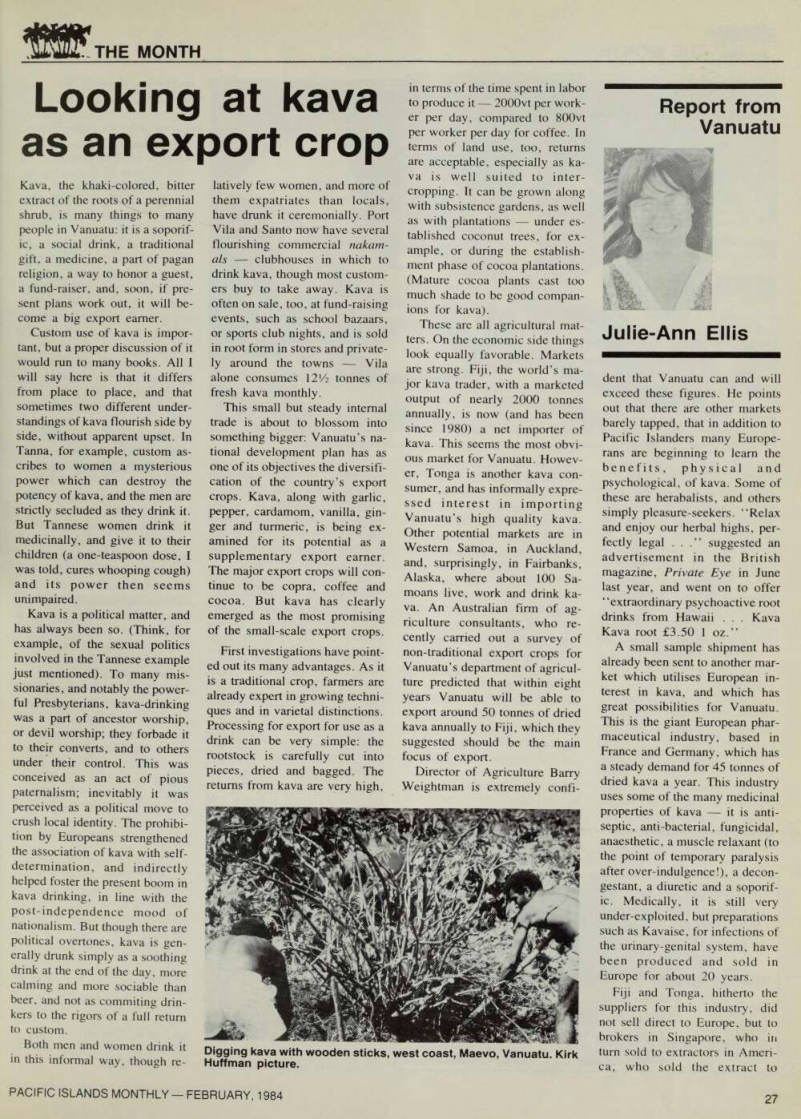
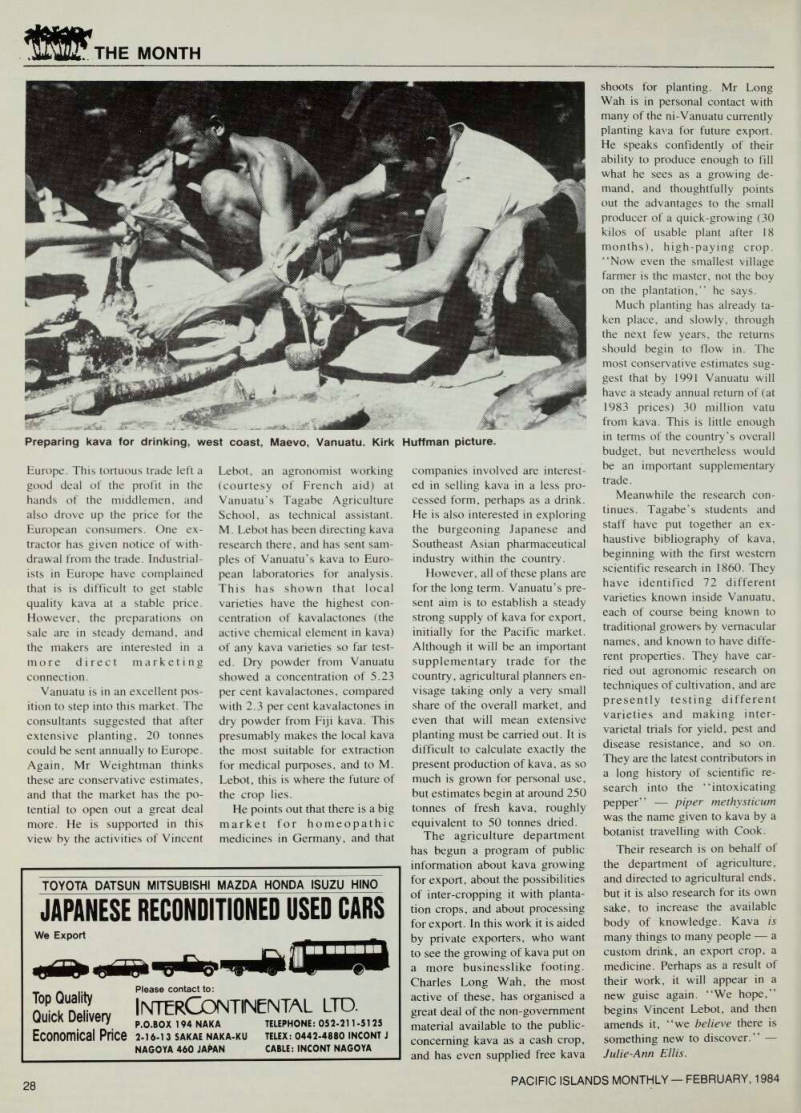
The Month
Looking at kava as an export crop
Kava, the khaki-colored, bitter extract of the roots of a perennial shrub, is many things to many people in Vanuatu: it is a soporif ic, a social drink, a traditional gift, a medicine, a part of pagan religion, a way to honor a guest, a fund-raiser, and, soon, if pre sent plans work out, it will be come a big export earner.
Custom use of kava is impor tant, but a proper discussion of it would run to many books. All I will say here is that it differs from place to place, and that sometimes two different under standings of kava flourish side by side, without apparent upset. In Tanna, for example, custom as cribes to women a mysterious power which can destroy the potency of kava, and the men are strictly secluded as they drink it.
But Tannese women drink it medicinally, and give it to their children (a one-teaspoon dose, I was told, cures whooping cough) and its power then seems
unimpaired.
Kava is a political matter, and has always been so. (Think, for example, of the sexual politics involved in the Tannese example just mentioned). To many mis sionaries, and notably the power
ful Presbyterians, kava-drinking
was a part of ancestor worship, or devil worship; they forbade it to their converts, and to others under their control. This was conceived as an act of pious paternalism; inevitably it was perceived as a political move to crush local identity. The prohibi
tion by Europeans strengthened
the association of kava with self
determination, and indirectly
helped foster the present boom in kava drinking, in line with the post-independence mood of nationalism. But though there are political overtones, kava is gen
erally drunk simply as a soothing
drink at the end of the day, more calming and more sociable than beer, and not as commiting drin kers to the rigors of a full return to custom.
Both men and women drink it in this informal way, though re
latively few women, and more of them expatriates than locals, have drunk it ceremonially. Port Vila and Santo now have several flourishing commercial nakam als clubhouses in which to drink kava, though most custom ers buy to take away. Kava is often on sale, too, at fund-raising events, such as school bazaars, or sports club nights, and is sold in root form in stores and private ly around the towns Vila alone consumes 12Vi tonnes of fresh kava monthly.
This small but steady internal trade is about to blossom into
something bigger: Vanuatu’s na
tional development plan has as one of its objectives the diversifi cation of the country’s export crops. Kava, along with garlic, pepper, cardamom, vanilla, gin ger and turmeric, is being ex amined for its potential as a supplementary export earner.
The major export crops will con tinue to be copra, coffee and cocoa. But kava has clearly emerged as the most promising of the small-scale export crops.
First investigations have point
ed out its many advantages. As it is a traditional crop, farmers are already expert in growing techni ques and in varietal distinctions.
Processing for export for use as a drink can be very simple; the rootstock is carefully cut into pieces, dried and bagged. The returns from kava are very high,
in terms of the time spent in labor to produce it 2000vt per work er per day, compared to 800vt per worker per day for coffee. In terms of land use, too, returns are acceptable, especially as ka va is well suited to inter cropping. It can be grown along with subsistence gardens, as well as with plantations under es tablished coconut trees, for ex ample, or during the establish ment phase of cocoa plantations. (Mature cocoa plants cast too much shade to be good compan ions for kava).
These are all agricultural mat ters. On the economic side things look equally favorable. Markets are strong. Fiji, the world’s ma jor kava trader, with a marketed output of nearly 2000 tonnes annually, is now (and has been since 1980) a net importer of kava. This seems the most obvi ous market for Vanuatu. Howev er, Tonga is another kava con sumer, and has informally expre ssed interest in importing Vanuatu’s high quality kava.
Other potential markets are in Western Samoa, in Auckland, and, surprisingly, in Fairbanks, Alaska, where about 100 Sa moans live, work and drink ka va. An Australian firm of ag riculture consultants, who re cently carried out a survey of non-traditional export crops for Vanuatu’s department of agricul ture predicted that within eight years Vanuatu will be able to export around 50 tonnes of dried kava annually to Fiji, which they suggested should be the main focus of export.
Director of Agriculture Barry Weightman is extremely confi-
Report from Vanuatu
dent that Vanuatu can and will exceed these figures. He points out that there are other markets barely tapped, that in addition to Pacific Islanders many Europe ans are beginning to leam the benefits, physical and psychological, of kava. Some of these are herabalists, and others simply pleasure-seekers. “Relax and enjoy our herbal highs, per fectly legal . . .’’ suggested an advertisement in the British magazine, Private Eye in June last year, and went on to offer “extraordinary psychoactive root drinks from Hawaii . . . Kava Kava root £3.50 1 oz.”
A small sample shipment has already been sent to another mar ket which utilises European in terest in kava, and which has great possibilities for Vanuatu.
This is the giant European phar maceutical industry, based in France and Germany, which has a steady demand for 45 tonnes of dried kava a year. This industry uses some of the many medicinal properties of kava it is anti septic, anti-bacterial, fungicidal, anaesthetic, a muscle relaxant (to the point of temporary paralysis after over-indulgence!), a decon gestant, a diuretic and a soporif ic. Medically, it is still very under-exploited, but preparations such as Kavaise, for infections of the urinary-genital system, have been produced and sold in Europe for about 20 years.
Fiji and Tonga, hitherto the suppliers for this industry, did not sell direct to Europe, but to brokers in Singapore, who in turn sold to extractors in Ameri ca, who sold the extract to
Digging kava with wooden sticks, west coast, Maevo, Vanuatu. Kirk Huffman picture.
Julie-Ann Ellis
Europe. This tortuous trade left a good deal of the profit in the hands of the middlemen, and also drove up the price for the European consumers. One ex tractor has given notice of with drawal from the trade. Industrial ists in Europe have complained that is is difficult to get stable quality kava at a stable price.
However, the preparations on sale are in steady demand, and the makers are interested in a more direct marketing connection.
Vanuatu is in an excellent pos ition to step into this market. The consultants suggested that after extensive planting, 20 tonnes could be sent annually to Europe.
Again, Mr Weightman thinks
these are conservative estimates, and that the market has the po tential to open out a great deal more. He is supported in this view by the activities of Vincent
Lebot, an agronomist working (courtesy of French aid) at
Vanuatu’s Tagabe Agriculture
School, as technical assistant.
M. Lebot has been directing kava research there, and has sent sam ples of Vanuatu’s kava to Euro pean laboratories for analysis.
This has shown that local varieties have the highest con centration of kavalactones (the active chemical element in kava) of any kava varieties so far test ed. Dry powder from Vanuatu showed a concentration of 5.23 per cent kavalactones, compared with 2.3 per cent kavalactones in
dry powder from Fiji kava. This
presumably makes the local kava the most suitable for extraction for medical purposes, and to M.
Lebot, this is where the future of the crop lies.
He points out that there is a big market for homeopathic medicines in Germany, and that
companies involved are interest ed in selling kava in a less pro cessed form, perhaps as a drink.
He is also interested in exploring
the burgeoning Japanese and
Southeast Asian pharmaceutical industry within the country.
However, all of these plans are for the long term. Vanuatu’s pre sent aim is to establish a steady strong supply of kava for export, initially for the Pacific market.
Although it will be an important supplementary trade for the
country, agricultural planners en
visage taking only a very small share of the overall market, and even that will mean extensive planting must be carried out. It is difficult to calculate exactly the present production of kava, as so much is grown for personal use, but estimates begin at around 250 tonnes of fresh kava, roughly equivalent to 50 tonnes dried.
The agriculture department
has begun a program of public information about kava growing for export, about the possibilities of inter-cropping it with planta tion crops, and about processing for export. In this work it is aided by private exporters, who want to see the growing of kava put on a more businesslike footing.
Charles Long Wah, the most active of these, has organised a great deal of the non-govemment material available to the public concerning kava as a cash crop, and has even supplied free kava
shoots for planting. Mr Long Wah is in personal contact with many of the ni-Vanuatu currently planting kava for future export.
He speaks confidently of their ability to produce enough to fill what he sees as a growing de mand, and thoughtfully points out the advantages to the small producer of a quick-growing (30 kilos of usable plant after 18 months), high-paying crop.
“Now even the smallest village farmer is the master, not the boy on the plantation,” he says.
Much planting has already ta ken place, and slowly, through the next few years, the returns should begin to flow in. The most conservative estimates sug gest that by 1991 Vanuatu will have a steady annual return of (at 1983 prices) 30 million vatu from kava. This is little enough in terms of the country’s overall budget, but nevertheless would
be an important supplementary
trade.
Meanwhile the research con tinues. Tagabe’s students and staff have put together an ex haustive bibliography of kava, beginning with the first western scientific research in 1860. They have identified 72 different varieties known inside Vanuatu, each of course being known to traditional growers by vernacular names, and known to have diffe rent properties. They have car ried out agronomic research on techniques of cultivation, and are
presently testing different
varieties and making inter varietal trials for yield, pest and disease resistance, and so on.
They are the latest contributors in a long history of scientific re search into the “intoxicating
pepper” piper methysticum
was the name given to kava by a botanist travelling with Cook.
Their research is on behalf of
the department of agriculture,
and directed to agricultural ends, but it is also research for its own sake, to increase the available body of knowledge. Kava is many things to many people a custom drink, an export crop, a medicine. Perhaps as a result of their work, it will appear in a
new guise again. “We hope,”
begins Vincent Lebot, and then amends it, “we believe there is something new to discover.”
Julie-Ann Ellis.
Preparing kava for drinking, west coast, Maevo, Vanuatu. Kirk Huffman picture.
Advertisements & other items, p. 28 (1 item)
Japanese Reconditioned Used Cars
TOYOTA DATSUN MITSUBISHI MAZDA HONDA ISUZU HINO
We Export u*«u - ... Please contact to:
JJJSL IWERGONTNENTAL LTD,
UUIUV UCNVCiy P.0.80X 194 NAKA TELEPHONE: 052-211-5125 Economical Price 2-16-1 3 SAKAE NAKA-KU TELEX: 0442-4880 INCONT J
NAGOYA 460 JAPAN CABLE: INCONT NAGOYA
for principles?
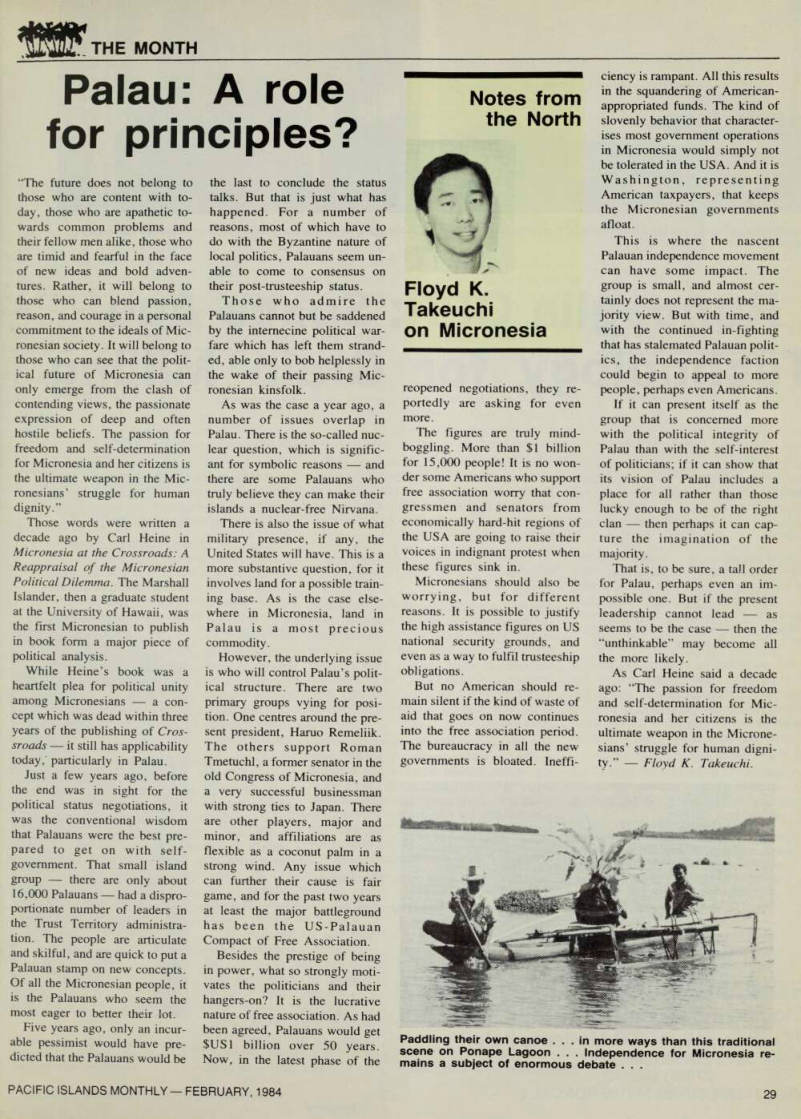
Palau: A role for principles?
“The future does not belong to those who are content with to day, those who are apathetic to wards common problems and their fellow men alike, those who are timid and fearful in the face of new ideas and bold adven tures. Rather, it will belong to those who can blend passion, reason, and courage in a personal commitment to the ideals of Mic ronesian society. It will belong to those who can see that the polit ical future of Micronesia can only emerge from the clash of
contending views, the passionate
expression of deep and often hostile beliefs. The passion for freedom and self-determination for Micronesia and her citizens is the ultimate weapon in the Mic ronesians ’ struggle for human
dignity.”
Those words were written a decade ago by Carl Heine in Micronesia at the Crossroads: A Reappraisal of the Micronesian Political Dilemma. The Marshall Islander, then a graduate student at the University of Hawaii, was the first Micronesian to publish in book form a major piece of
political analysis.
While Heine’s book was a
heartfelt plea for political unity
among Micronesians a con cept which was dead within three years of the publishing of Cros sroads it still has applicability
today, particularly in Palau.
Just a few years ago, before the end was in sight for the political status negotiations, it was the conventional wisdom that Palauans were the best pre pared to get on with self government. That small island group there are only about 16,000 Palauans had a dispro portionate number of leaders in the Trust Territory administra tion. The people are articulate and skilful, and are quick to put a Palauan stamp on new concepts.
Of all the Micronesian people, it is the Palauans who seem the most eager to better their lot.
Five years ago, only an incur able pessimist would have pre dicted that the Palauans would be
the last to conclude the status talks. But that is just what has happened. For a number of reasons, most of which have to do with the Byzantine nature of local politics, Palauans seem un able to come to consensus on their post-trusteeship status.
Those who admire the Palauans cannot but be saddened by the internecine political war fare which has left them strand ed, able only to bob helplessly in the wake of their passing Mic ronesian kinsfolk.
As was the case a year ago, a number of issues overlap in Palau. There is the so-called nuc lear question, which is signific ant for symbolic reasons and there are some Palauans who truly believe they can make their islands a nuclear-free Nirvana.
There is also the issue of what military presence, if any, the United States will have. This is a more substantive question, for it involves land for a possible train ing base. As is the case else where in Micronesia, land in Palau is a most precious
commodity.
However, the underlying issue is who will control Palau’s polit ical structure. There are two
primary groups vying for posi
tion. One centres around the pre sent president, Haruo Remeliik.
The others support Roman Tmetuchl, a former senator in the old Congress of Micronesia, and a very successful businessman with strong ties to Japan. There are other players, major and minor, and affiliations are as flexible as a coconut palm in a strong wind. Any issue which can further their cause is fair game, and for the past two years at least the major battleground has been the US-Palauan Compact of Free Association.
Besides the prestige of being in power, what so strongly moti vates the politicians and their hangers-on? It is the lucrative nature of free association. As had been agreed, Palauans would get SUSI billion over 50 years.
Now, in the latest phase of the
Notes from the North
reopened negotiations, they re portedly are asking for even more.
The figures are truly mind boggling. More than $1 billion for 15,000 people! It is no won der some Americans who support free association worry that con gressmen and senators from economically hard-hit regions of the USA are going to raise their voices in indignant protest when these figures sink in.
Micronesians should also be worrying, but for different reasons. It is possible to justify the high assistance figures on US national security grounds, and even as a way to fulfil trusteeship obligations.
But no American should re main silent if the kind of waste of aid that goes on now continues into the free association period.
The bureaucracy in all the new governments is bloated. Ineffi
ciency is rampant. All this results in the squandering of American appropriated funds. The kind of slovenly behavior that character ises most government operations in Micronesia would simply not be tolerated in the USA. And it is
Washington, representing
American taxpayers, that keeps the Micronesian governments afloat.
This is where the nascent Palauan independence movement can have some impact. The group is small, and almost cer tainly does not represent the ma jority view. But with time, and with the continued in-fighting that has stalemated Palauan polit ics, the independence faction could begin to appeal to more
people, perhaps even Americans.
If it can present itself as the group that is concerned more with the political integrity of Palau than with the self-interest of politicians; if it can show that its vision of Palau includes a place for all rather than those lucky enough to be of the right clan then perhaps it can cap ture the imagination of the
majority.
That is, to be sure, a tall order for Palau, perhaps even an im possible one. But if the present leadership cannot lead as seems to be the case then the “unthinkable” may become all the more likely.
As Carl Heine said a decade ago: “The passion for freedom and self-determination for Mic ronesia and her citizens is the ultimate weapon in the Microne sians’ struggle for human digni
ty.”
Floyd K. Takeuchi.
Paddling their own canoe ... in more ways than this traditional scene on Ponape Lagoon . . . Independence for Micronesia re mains a subject of enormous debate . . .
Floyd K.
Takeuchi on Micronesia
Roncaglia OPR: Space Age
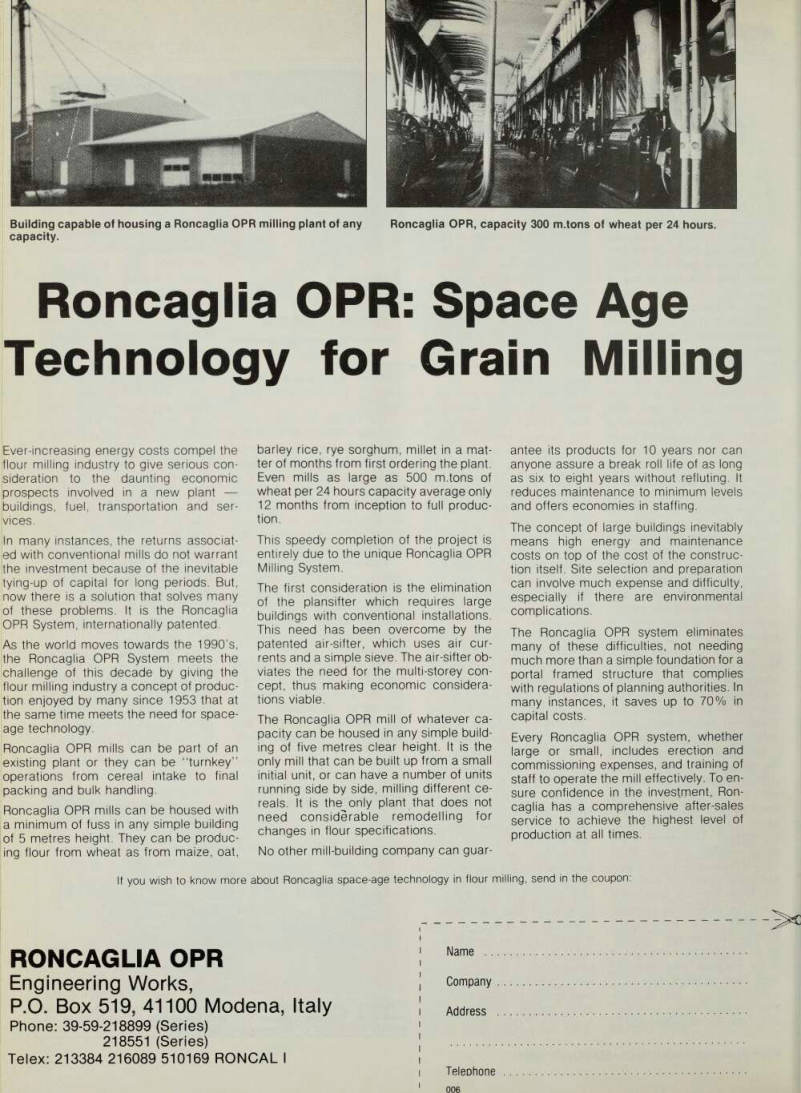
Technology for Grain Milling
Ever-increasing energy costs compel the flour milling industry to give serious con sideration to the daunting economic prospects involved in a new plant buildings, fuel, transportation and ser vices.
In many instances, the returns associat ed with conventional mills do not warrant the investment because of the inevitable tying-up of capital for long periods. But, now there is a solution that solves many of these problems. It is the Roncaglia OPR System, internationally patented.
As the world moves towards the 1990’5, the Roncaglia OPR System meets the challenge of this decade by giving the flour milling industry a concept of produc tion enjoyed by many since 1953 that at the same time meets the need for space age technology.
Roncaglia OPR mills can be part of an existing plant or they can be “turnkey” operations from cereal intake to final packing and bulk handling.
Roncaglia OPR mills can be housed with a minimum of fuss in any simple building of 5 metres height. They can be produc ing flour from wheat as from maize, oat,
barley rice, rye sorghum, millet in a mat ter of months from first ordering the plant.
Even mills as large as 500 m.tons of wheat per 24 hours capacity average only 12 months from inception to full produc tion.
This speedy completion of the project is entirely due to the unique Roncaglia OPR Milling System.
The first consideration is the elimination of the plansifter which requires large buildings with conventional installations.
This need has been overcome by the patented air-sifter, which uses air cur rents and a simple sieve. The air-sifter ob viates the need for the multi-storey con cept, thus making economic considera tions viable.
The Roncaglia OPR mill of whatever ca pacity can be housed in any simple build ing of five metres clear height. It is the only mill that can be built up from a small initial unit, or can have a number of units running side by side, milling different ce reals. It is the only plant that does not need considerable remodelling for changes in flour specifications.
No other mill-building company can guar
antee its products for 10 years nor can anyone assure a break roll life of as long as six to eight years without refluting. It reduces maintenance to minimum levels and offers economies in staffing.
The concept of large buildings inevitably means high energy and maintenance costs on top of the cost of the construc tion itself. Site selection and preparation can involve much expense and difficulty, especially if there are environmental complications.
The Roncaglia OPR system eliminates many of these difficulties, not needing much more than a simple foundation for a portal framed structure that complies with regulations of planning authorities. In many instances, it saves up to 70% in capital costs.
Every Roncaglia OPR system, whether large or small, includes erection and commissioning expenses, and training of staff to operate the mill effectively. To en sure confidence in the investment, Ron caglia has a comprehensive after-sales service to achieve the highest level of production at all times.
If you wish to know more about Roncaglia space-age technology in flour milling, send in the coupon;
Building capable of housing a Roncaglia OPR milling plant of any capacity.
Roncaglia OPR, capacity 300 m.tons of wheat per 24 hours.
Advertisements & other items, p. 30 (1 item)
Engineering Works,
Name Company Address Teleohone 006
RONCAGLIA OPR
Engineering Works, P.O. Box 519, 41100 Modena, Italy Phone: 39-59-218899 (Series) 218551 (Series) Telex: 213384 216089 510169 RONCAL I
Statute plan
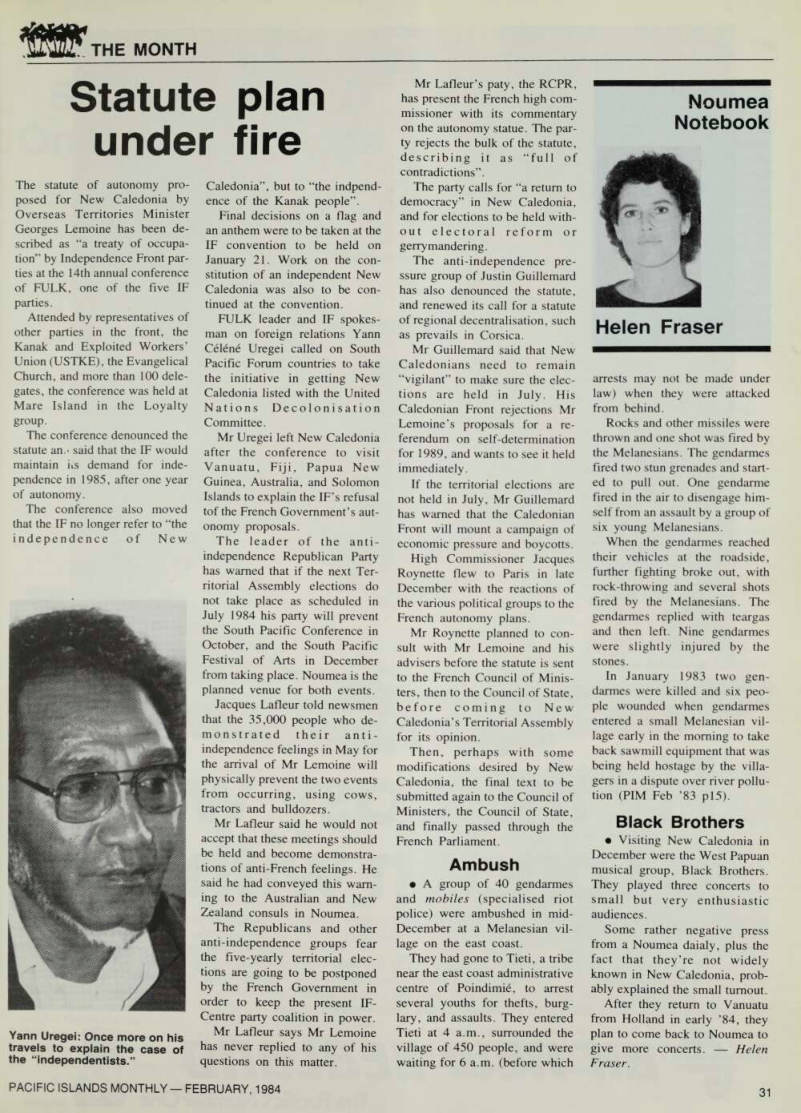
under fire
The statute of autonomy pro posed for New Caledonia by Overseas Territories Minister Georges Lemoine has been de scribed as “a treaty of occupa tion” by Independence Front par ties at the 14th annual conference of FULK, one of the five IF
parties.
Attended by representatives of
other parties in the front, the Kanak and Exploited Workers’
Union (USTKE), the Evangelical Church, and more than 100 dele gates, the conference was held at Mare Island in the Loyalty group.
The conference denounced the statute an.- said that the IF would maintain its demand for inde pendence in 1985, after one year of autonomy.
The conference also moved that the IF no longer refer to “the independence of New
Caledonia”, but to “the indpend ence of the Kanak people”.
Final decisions on a flag and an anthem were to be taken at the IF convention to be held on January 21. Work on the con stitution of an independent New Caledonia was also to be con tinued at the convention.
FULK leader and IF spokes man on foreign relations Yann Celene Uregei called on South Pacific Forum countries to take the initiative in getting New Caledonia listed with the United Nations Decolonisation Committee.
Mr Uregei left New Caledonia after the conference to visit Vanuatu, Fiji, Papua New Guinea, Australia, and Solomon Islands to explain the IP’s refusal tof the French Government’s aut onomy proposals.
The leader of the anti independence Republican Party has warned that if the next Ter ritorial Assembly elections do not take place as scheduled in July 1984 his party will prevent the South Pacific Conference in October, and the South Pacific Festival of Arts in December from taking place. Noumea is the planned venue for both events.
Jacques Lafleur told newsmen that the 35,000 people who de monstrated their anti independence feelings in May for the arrival of Mr Lemoine will physically prevent the two events from occurring, using cows, tractors and bulldozers.
Mr Lafleur said he would not accept that these meetings should be held and become demonstra tions of anti-French feelings. He said he had conveyed this warn ing to the Australian and New Zealand consuls in Noumea.
The Republicans and other anti-independence groups fear the five-yearly territorial elec tions are going to be postponed by the French Government in order to keep the present IF- Centre party coalition in power.
Mr Lafleur says Mr Lemoine has never replied to any of his questions on this matter.
Mr Lafleur’s paty, the RCPR, has present the French high com missioner with its commentary on the autonomy statue. The par ty rejects the bulk of the statute, describing it as “full of contradictions”.
The party calls for “a return to democracy” in New Caledonia, and for elections to be held with out electoral reform or
gerrymandering.
The anti-independence pre ssure group of Justin Guillemard has also denounced the statute, and renewed its call for a statute of regional decentralisation, such as prevails in Corsica.
Mr Guillemard said that New Caledonians need to remain “vigilant” to make sure the elec tions are held in July. His Caledonian Front rejections Mr Lemoine’s proposals for a re ferendum on self-determination for 1989, and wants to see it held
immediately.
If the territorial elections are not held in July, Mr Guillemard has warned that the Caledonian Front will mount a campaign of economic pressure and boycotts.
High Commissioner Jacques
Roynette flew to Paris in late December with the reactions of the various political groups to the French autonomy plans.
Mr Roynette planned to con sult with Mr Lemoine and his advisers before the statute is sent to the French Council of Minis ters, then to the Council of State, before coming to New Caledonia’s Territorial Assembly for its opinion.
Then, perhaps with some modifications desired by New Caledonia, the final text to be submitted again to the Council of Ministers, the Council of State,
and finally passed through the
French Parliament.
Ambush
• A group of 40 gendarmes and mobiles (specialised riot police) were ambushed in mid- December at a Melanesian vil lage on the east coast.
They had gone to Tieti, a tribe near the east coast administrative centre of Poindimie, to arrest several youths for thefts, burg lary, and assaults. They entered Tieti at 4 a.m., surrounded the village of 450 people, and were waiting for 6 a.m. (before which
Noumea Notebook
arrests may not be made under law) when they were attacked from behind.
Rocks and other missiles were thrown and one shot was fired by the Melanesians. The gendarmes fired two stun grenades and start ed to pull out. One gendarme fired in the air to disengage him self from an assault by a group of six young Melanesians.
When the gendarmes reached their vehicles at the roadside, further fighting broke out, with rock-throwing and several shots fired by the Melanesians. The gendarmes replied with teargas and then left. Nine gendarmes were slightly injured by the stones.
In January 1983 two gen darmes were killed and six peo ple wounded when gendarmes entered a small Melanesian vil lage early in the morning to take back sawmill equipment that was being held hostage by the villa gers in a dispute over river pollu tion (PIM Feb ’B3 pi 5).
Black Brothers
• Visiting New Caledonia in December were the West Papuan musical group. Black Brothers.
They played three concerts to small but very enthusiastic audiences.
Some rather negative press from a Noumea daialy, plus the fact that they’re not widely known in New Caledonia, prob ably explained the small turnout.
After they return to Vanuatu from Holland in early ’B4, they plan to come back to Noumea to
give more concerts.
Fraser.
Helen
Yann Uregei: Once more on his travels to explain the case of the “independentists.”
Helen Fraser
Advertisements & other items, p. 32 (1 item)
ndon wit
1 A\> Eg 7L dir nrw zed La n a Id.
to us.
We make it easy for you to enjoy a comfortable and friendly flight to London, with our superb 747 Service all the way from Nadi or Papeete.
We also make it easy for business and holiday travellers to enjoy low-cost stopovers in Fiji, Tahiti, Honolulu or Los Angeles.
If you’re going beyond London, on business or pleasure, our 747 service gives you convenient connections.
Making everything easy for you is easy for us, because we’re your kind of people. So, tell your travel agent: “I’d rather fly Number One to London”.
air heuj z
The Pacific’s Number One
m
GOLDOBOB
Socialist Input
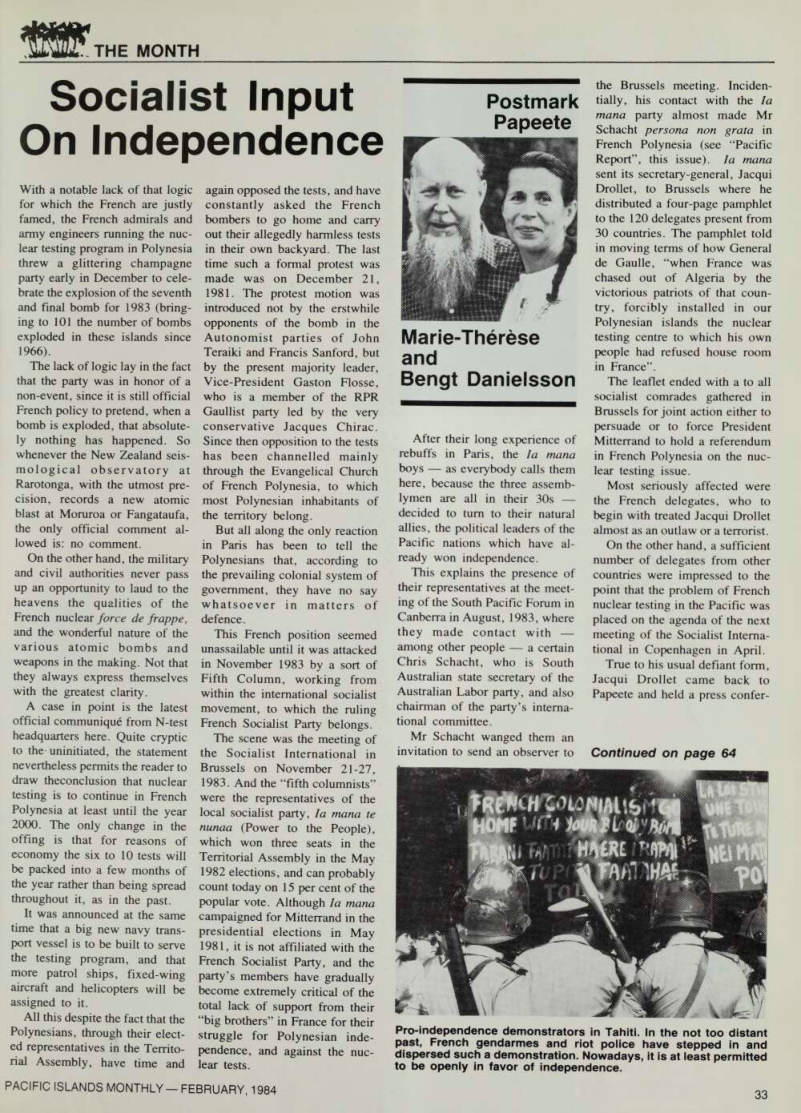


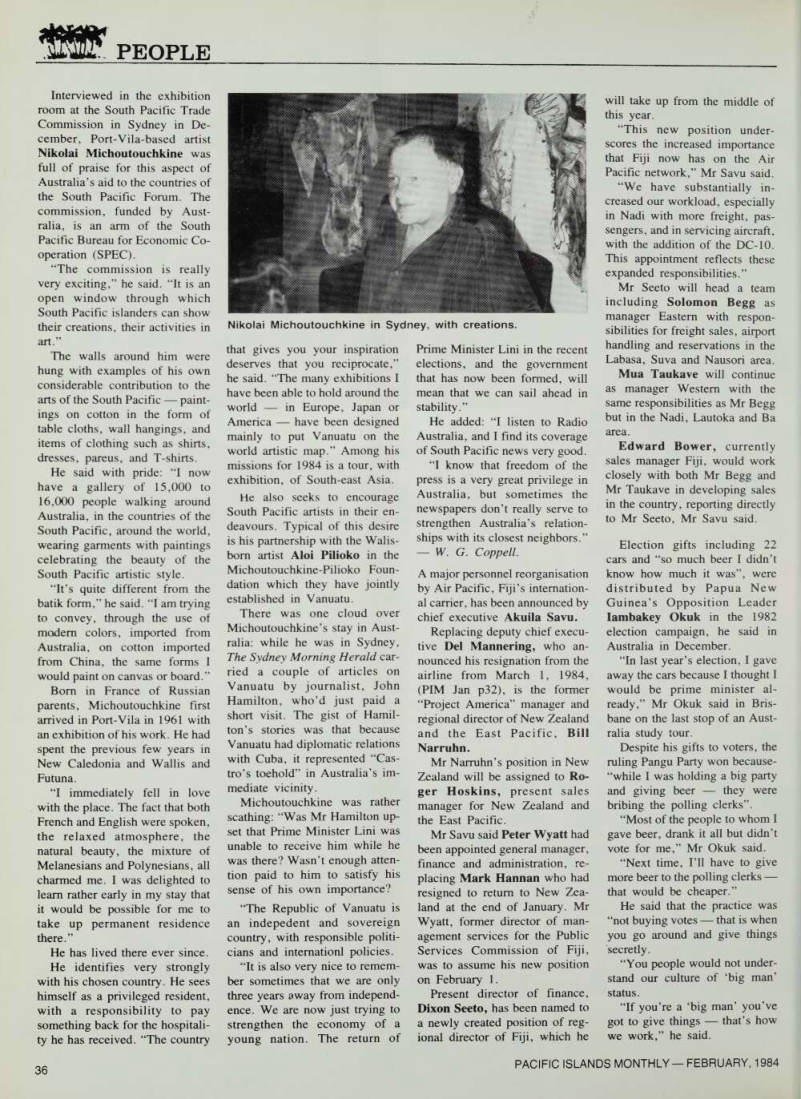
On Independence
With a notable lack of that logic for which the French are justly famed, the French admirals and army engineers running the nuc lear testing program in Polynesia threw a glittering champagne party early in December to cele brate the explosion of the seventh and final bomb for 1983 (bring ing to 101 the number of bombs exploded in these islands since 1966).
The lack of logic lay in the fact that the party was in honor of a non-event, since it is still official French policy to pretend, when a bomb is exploded, that absolute ly nothing has happened. So whenever the New Zealand seis mological observatory at Rarotonga, with the utmost pre cision, records a new atomic blast at Moruroa or Fangataufa, the only official comment al lowed is: no comment.
On the other hand, the military and civil authorities never pass up an opportunity to laud to the heavens the qualities of the French nuclear force de frappe, and the wonderful nature of the various atomic bombs and weapons in the making. Not that they always express themselves with the greatest clarity.
A case in point is the latest official communique from N-test headquarters here. Quite cryptic to the uninitiated, the statement nevertheless permits the reader to draw theconclusion that nuclear testing is to continue in French Polynesia at least until the year 2000. The only change in the offing is that for reasons of economy the six to 10 tests will be packed into a few months of the year rather than being spread throughout it, as in the past.
It was announced at the same time that a big new navy trans port vessel is to be built to serve the testing program, and that more patrol ships, fixed-wing aircraft and helicopters will be assigned to it.
All this despite the fact that the Polynesians, through their elect ed representatives in the Territo rial Assembly, have time and
again opposed the tests, and have constantly asked the French bombers to go home and carry out their allegedly harmless tests in their own backyard. The last time such a formal protest was made was on December 21, 1981. The protest motion was introduced not by the erstwhile opponents of the bomb in the Autonomist parties of John Teraiki and Francis Sanford, but by the present majority leader, Vice-President Gaston Flosse, who is a member of the RPR Gaullist party led by the very conservative Jacques Chirac.
Since then opposition to the tests has been channelled mainly through the Evangelical Church of French Polynesia, to which most Polynesian inhabitants of the territory belong.
But all along the only reaction in Paris has been to tell the Polynesians that, according to the prevailing colonial system of government, they have no say whatsoever in matters of defence.
This French position seemed unassailable until it was attacked in November 1983 by a sort of Fifth Column, working from within the international socialist movement, to which the ruling French Socialist Party belongs.
The scene was the meeting of the Socialist International in Brussels on November 21-27, 1983. And the “fifth columnists” were the representatives of the local socialist party, la mana te nunaa (Power to the People), which won three seats in the Territorial Assembly in the May 1982 elections, and can probably count today on 15 per cent of the popular vote. Although la mana campaigned for Mitterrand in the presidential elections in May 1981, it is not affiliated with the French Socialist Party, and the party’s members have gradually become extremely critical of the total lack of support from their “big brothers” in France for their struggle for Polynesian inde pendence, and against the nuc lear tests.
Postmark Papeete
After their long experience of rebuffs in Paris, the la mana boys as everybody calls them here, because the three assemb lymen are all in their 30s decided to turn to their natural allies, the political leaders of the Pacific nations which have al
ready won independence.
This explains the presence of their representatives at the meet ing of the South Pacific Forum in Canberra in August, 1983, where they made contact with among other people a certain Chris Schacht, who is South Australian state secretary of the Australian Labor party, and also chairman of the party’s interna tional committee.
Mr Schacht wanged them an invitation to send an observer to
the Brussels meeting. Inciden tally, his contact with the la mana party almost made Mr Schacht persona non grata in French Polynesia (see “Pacific Report”, this issue). la mana sent its secretary-general, Jacqui Drollet, to Brussels where he distributed a four-page pamphlet to the 120 delegates present from 30 countries. The pamphlet told in moving terms of how General de Gaulle, “when France was chased out of Algeria by the victorious patriots of that coun try, forcibly installed in our Polynesian islands the nuclear testing centre to which his own people had refused house room in France”.
The leaflet ended with a to all socialist comrades gathered in Brussels for joint action either to persuade or to force President Mitterrand to hold a referendum in French Polynesia on the nuc lear testing issue.
Most seriously affected were the French delegates, who to begin with treated Jacqui Drollet almost as an outlaw or a terrorist.
On the other hand, a sufficient number of delegates from other countries were impressed to the point that the problem of French nuclear testing in the Pacific was placed on the agenda of the next meeting of the Socialist Interna tional in Copenhagen in April.
True to his usual defiant form, Jacqui Drollet came back to Papeete and held a press confer-
Continued on page 64
Pro-independence demonstrators in Tahiti. In the not too distant past, French gendarmes and riot police have stepped in and dispersed such a demonstration. Nowadays, it is at least permitted to be openly in favor of independence.
Marie-Thérèse and Bengt Danielsson
ence to publicise this victory for his party. He also announced that an association of “progressive political parties in the Pacific region” was in the offing . . .
It might have been pure coin cidence, but when the older and larger nationalist party, Pupu Here Aia, held its annual con vention a few days later, anti nuclear feeling was running more than usually high, and a resolu tion was unanimously adopted requesting an immediate end to nuclear testing. Seventeen speak ers gave it their support. Because independence has for so long been described as the main goal of the party, fewer speakers felt obliged to speak to the resolution calling for the creation of an independent Polynesian state, with some sort of commonwealth ties with France. This, too, was adopted unanimously. The party holds six seats in the Territorial Assembly, which corresponds to a 20 per cent slice of the electorate.
Still another highlight of the meeting was the election of a successor to party leader John Teariki, who died in an accident in early October last year (PIM Nov. p 6, Dec. p 65). The two main contenders were Milou Ebb, whose strongest appeal is to the rural electorate of Polynesian farmers and fishermen, and Jean Juventin, who as mayor of Papeete, has a large number of
uprooted Polynesian immigrants
and workers in his electorate.
Fortunately for the unity of the party, a deal had been worked out before the convention: Juven tin was elected chairman, and Ebb vice-chairman. The thing went off without a hitch.
Then, in the very next week, Teariki’s old comrade-in-arms in
the 20-year-long battle against
the bomb, Francis Sanford, mus tered his troops or rather what was left of them after the defeat of his Ea api party in the May 1982 elections. The defeat was due mostly to internal dissen
sions or, to put it more crude ly, to the personal ambition of some of Sanford’s lieutenants.
But here they all were again, the defectors, detractors, and de viationists, sitting in a neat row like schoolchildren at a gradua tion ceremony.
Naturally, the headmaster was Francis Sanford, now 70, and the party’s elder statesman. Mr San ford very wisely refused to ac cept any other position than the purely ceremonial one of honor ary chairman, 200 or so dele gates to the conference elected the mayor of Punaauia, Jacques Vii, as the party’s working chairman.
The party’s new program,
adopted by acclamation, declares
that independence for the Poly nesian people is “inscribed in the book of history”. At the same time, France is designated as the natural partner to turn to for support and assistance even after
independence a viewpoint
which corresponds fairly well to the thinking of most local politi cians. For the rest, the program is mainly concerned with fight ing the evils brought about by the
enforced militarisation and col onisation of the territory. The remedies proposed are in fact very much like those advocated by the la mana party.
During its past, when Ea api teamed with Pupu Here Aia to form the ruling majority the Front Uni as the combination was called the two parties often took as much as 60 per cent of the vote. What sort of vote could the reborn, but de capitated, Ea api party count on now? It’s hard to say, but our guess is 10 to 15 per cent.
Adding up the various percen tages of the electorate command by the three parties discussed here, one is tempted to the con clusion that December 1983 could well prove to be a turning point in the history of French Polynesia the moment when the pro-independence forces in the territory very discreetly pass ed the 50 per cent mark. As for the nuclear test issue, there is no doubt that a fairly conducted referendum on the matter would
produce an even larger majority
against. Marie-Therese
and Bengt Daniels son.
Advertisements & other items, pp. 34-35 (1 item)
New *B4 Toyota Hilux
INTRODUCING PERFOB
Performance p comfort.
Performance plus durability.
Performance plus variety.
Advanced, powerful new engines put you in command with higher torque, better efficiency. Inside, more driving comfort than ever before with a roomier cabin, bigger windscreens, and lean, clean instrumentation. Newly designed suspension gives you big carrying capability, yet carries you in comfort. HILUX is one tough truck with a suspension you can count on. Choose from a wide variety, including 4WD regular or double cab and two new additions 2WD extra cab and flatdeck. The all-new Toyota HILUX. Add it all up, and you have performance plus! n
TOYOTA
QUALITY SERVICE
AMERICAN SAMOA: BURNS PHILP (SOUTH SEA)
CO., LTD., P.O. Box 129, Pago Pago.
COOK ISLANDS: COOK ISLANDS TRADING
CORPORATION LTD., Private Bag, Rarotonga.
FIJI: AUTOMOTIVE SUPPLIES COMPANY, G.P.O.
Box 355, Suva. r.UAM A MICRONESIA: ATKINS. KROLL (GUAM) LTD. 443 South Marine Drive, Tamuning.
KIRIBATI: TARAWA MOTORS, P.O. Box 36, Bairiki, Tarawa, Kiribati.
NAURU: NAURU COOPERATIVE SOCIETY.
NEW CALEDONIA: SERVICE IMPORTATION
AUTOMOBILE DU PACIFIQUE, Rond-Point du Pacifiqu i /ctatinn Tntah b p 438. Noumea.
VANCE PLUS!
& 1 New 2.4-htre diesel engine 4WD Double Cab RFOLK ISLAND: SORRY’S LIMITED, P.O. Box 169.
NEW GUINEA: ELA MOTORS, A Division of ns Philp (PNG) Ltd., P.O. Box 75, Port Moresby.
IPAN; MICROL CORPORATION, P.O. Box 267,
pan.
LOMON; MENDANA ENTERPRISES (5.1.) LTD.,
' O. Box 174, Honiara.
TAHITI: NIPPON AUTOMOTO, P.O. Box 342, Papeete.
TONGA: BURNS PHILP (SOUTH SEA) CO., LTD., P.O. Box 55, Nuku’alofa.
VANUATU: VANUATU MOTORS, P.O. Box 18,
Port Vila.
WESTERN SAMOA: BURNS PHILP (SOUTH SEA)
CO., LTD., P.O. Box 188, Apia.
People
Interviewed in the exhibition room at the South Pacific Trade Commission in Sydney in De cember, Port-Vila-based artist Nikolai Michoutouchkine was full of praise for this aspect of Australia’s aid to the countries of the South Pacific Forum. The commission, funded by Aust ralia, is an arm of the South Pacific Bureau for Economic Co
operation (SPEC).
“The commission is really very exciting,” he said. “It is an open window through which South Pacific islanders can show their creations, their activities in art.”
The walls around him were hung with examples of his own considerable contribution to the arts of the South Pacific — paint ings on cotton in the form of table cloths, wall hangings, and items of clothing such as shirts, dresses, pareus, and T-shirts.
He said with pride: “I now have a gallery of 15,000 to
16,000 people walking around
Australia, in the countries of the South Pacific, around the world,
wearing garments with paintings
celebrating the beauty of the South Pacific artistic style.
“It’s quite different from the batik form,” he said. “I am trying to convey, through the use of modem colors, imported from Australia, on cotton imported from China, the same forms I would paint on canvas or board.”
Bom in France of Russian parents, Michoutouchkine first arrived in Port-Vila in 1961 with an exhibition of his work. He had spent the previous few years in New Caledonia and Wallis and Futuna.
“I immediately fell in love with the place. The fact that both French and English were spoken, the relaxed atmosphere, the natural beauty, the mixture of Melanesians and Polynesians, all charmed me. I was delighted to learn rather early in my stay that it would be possible for me to take up permanent residence there.”
He has lived there ever since.
He identifies very strongly with his chosen country. He sees himself as a privileged resident, with a responsibility to pay something back for the hospitali ty he has received. “The country
that gives you your inspiration deserves that you reciprocate,” he said. “The many exhibitions I have been able to hold around the world in Europe, Japan or America have been designed mainly to put Vanuatu on the world artistic map.” Among his missions for 1984 is a tour, with exhibition, of South-east Asia.
He also seeks to encourage South Pacific artists in their en deavours. Typical of this desire is his partnership with the Walis bom artist Aloi Pilioko in the Michoutouchkine-Pilioko Foun dation which they have jointly established in Vanuatu.
There was one cloud over Michoutouchkine’s stay in Aust ralia: while he was in Sydney, The Sydney Morning Herald car ried a couple of articles on
Vanuatu by journalist, John
Hamilton, who’d just paid a short visit. The gist of Hamil ton’s stories was that because Vanuatu had diplomatic relations with Cuba, it represented “Cas tro’s toehold” in Australia’s im
mediate vicinity.
Michoutouchkine was rather scathing: “Was Mr Hamilton up set that Prime Minister Lini was unable to receive him while he was there? Wasn’t enough atten tion paid to him to satisfy his sense of his own importance?
“The Republic of Vanuatu is
an indepedent and sovereign
country, with responsible politi
cians and intemationl policies.
“It is also very nice to remem ber sometimes that we are only three years away from independ ence. We are now just trying to strengthen the economy of a young nation. The return of
Prime Minister Lini in the recent elections, and the government that has now been formed, will mean that we can sail ahead in
stability.”
He added: “I listen to Radio Australia, and I find its coverage of South Pacific news very good.
“I know that freedom of the press is a very great privilege in Australia, but sometimes the newspapers don’t really serve to strengthen Australia’s relation ships with its closest neighbors.”
W. G. Coppell.
A major personnel reorganisation
by Air Pacific, Fiji’s internation al carrier, has been announced by chief executive Akuila Savu.
Replacing deputy chief execu
tive Del Mannering, who an nounced his resignation from the airline from March 1, 1984, (PIM Jan p 32), is the former “Project America” manager and regional director of New Zealand and the East Pacific, Bill Narruhn.
Mr Narruhn’s position in New Zealand will be assigned to Ro ger Hoskins, present sales manager for New Zealand and the East Pacific.
Mr Savu said Peter Wyatt had
been appointed general manager,
finance and administration, re placing Mark Hannan who had resigned to return to New Zea land at the end of January. Mr Wyatt, former director of man agement services for the Public Services Commission of Fiji, was to assume his new position on February 1.
Present director of finance, Dixon Seeto, has been named to a newly created position of reg ional director of Fiji, which he
will take up from the middle of this year.
“This new position under scores the increased importance that Fiji now has on the Air Pacific network,” Mr Savu said.
“We have substantially in creased our workload, especially in Nadi with more freight, pas sengers, and in servicing aircraft, with the addition of the DC-10.
This appointment reflects these
expanded responsibilities.”
Mr Seeto will head a team
including Solomon Begg as
manager Eastern with respon sibilities for freight sales, airport handling and reservations in the Labasa, Suva and Nausori area.
Mua Taukave will continue as manager Western with the same responsibilities as Mr Begg but in the Nadi, Lautoka and Ba area.
Edward Bower, currently sales manager Fiji, would work closely with both Mr Begg and Mr Taukave in developing sales in the country, reporting directly to Mr Seeto, Mr Savu said.
Election gifts including 22
cars and “so much beer I didn’t know how much it was”, were
distributed by Papua New
Guinea’s Opposition Leader lambakey Okuk in the 1982 election campaign, he said in Australia in December.
“In last year’s election, I gave away the cars because I thought I would be prime minister al ready,” Mr Okuk said in Bris bane on the last stop of an Aust ralia study tour.
Despite his gifts to voters, the ruling Pangu Party won because “while I was holding a big party and giving beer they were
bribing the polling clerks”.
“Most of the people to whom I gave beer, drank it all but didn’t vote for me,” Mr Okuk said.
“Next time, I’ll have to give more beer to the polling clerks that would be cheaper.”
He said that the practice was “not buying votes that is when you go around and give things
secretly.
“You people would not under stand our culture of ‘big man’ status.
“If you’re a ‘big man’ you’ve
got to give things that’s how we work,” he said.
Nikolai Michoutouchkine in Sydney, with creations.
Irian Java: Wide angle lens,
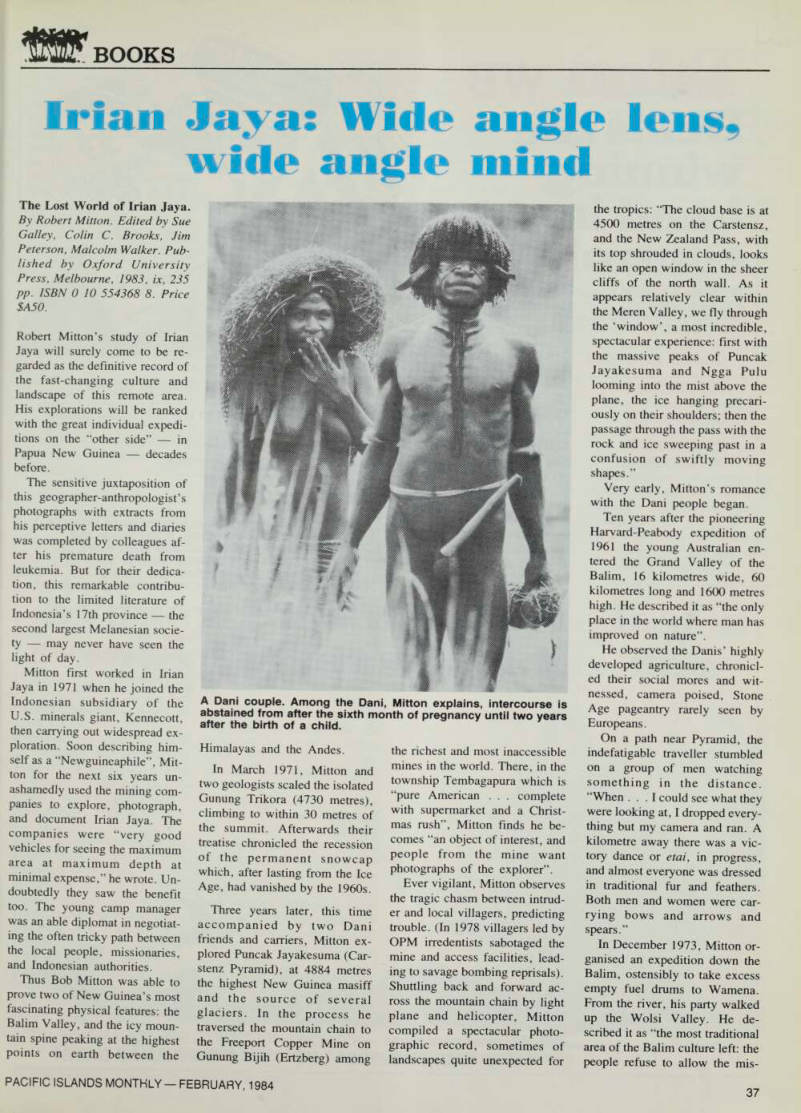

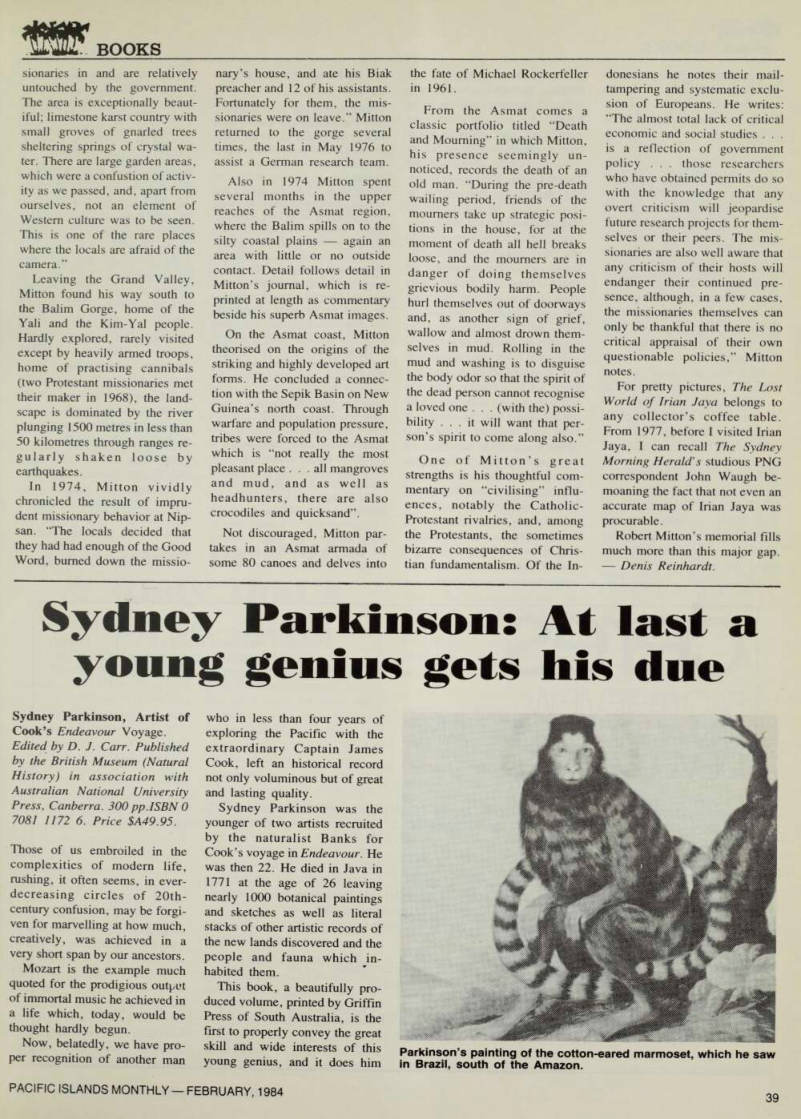
Books
Irian Java: Wide angle lens, wide angle mind
The Lost World of Irian Jaya.
By Robert Mitton. Edited by Sue Galley, Colin C. Brooks, Jim Peterson, Malcolm Walker. Pub lished by Oxford University Press, Melbourne, 1983, ix, 235 pp. ISBN 0 10 554368 8. Price
Saso.
Robert Mitton’s study of Irian Jaya will surely come to be re garded as the definitive record of the fast-changing culture and landscape of this remote area.
His explorations will be ranked with the great individual expedi tions on the “other side” in Papua New Guinea decades before.
The sensitive juxtaposition of
this geographer-anthropologist’s
photographs with extracts from his perceptive letters and diaries was completed by colleagues af ter his premature death from leukemia. But for their dedica tion, this remarkable contribu tion to the limited literature of Indonesia’s 17th province the second largest Melanesian socie ty may never have seen the light of day.
Mitton first worked in Irian Jaya in 1971 when he joined the Indonesian subsidiary of the U.S. minerals giant, Kennecott, then carrying out widespread ex ploration. Soon describing him self as a “Newguineaphile”, Mit ton for the next six years un ashamedly used the mining com panies to explore, photograph, and document Irian Jaya. The companies were “very good vehicles for seeing the maximum area at maximum depth at minimal expense,” he wrote. Un doubtedly they saw the benefit too. The young camp manager was an able diplomat in negotiat ing the often tricky path between the local people, missionaries, and Indonesian authorities.
Thus Bob Mitton was able to prove two of New Guinea’s most fascinating physical features; the Balim Valley, and the icy moun tain spine peaking at the highest points on earth between the
Himalayas and the Andes.
In March 1971, Mitton and two geologists scaled the isolated Gunung Trikora (4730 metres), climbing to within 30 metres of the summit. Afterwards their treatise chronicled the recession of the permanent snowcap which, after lasting from the Ice Age, had vanished by the 19605.
Three years later, this time accompanied by two Dani friends and carriers, Mitton ex plored Puncak Jayakesuma (Car stenz Pyramid), at 4884 metres the highest New Guinea masiff and the source of several glaciers. In the process he traversed the mountain chain to the Freeport Copper Mine on
Gunung Bijih (Ertzberg) among
the richest and most inaccessible mines in the world. There, in the township Tembagapura which is
“pure American . . . complete
with supermarket and a Christ mas rush”, Mitton finds he be comes “an object of interest, and people from the mine want photographs of the explorer”.
Ever vigilant, Mitton observes the tragic chasm between intrud er and local villagers, predicting trouble. (In 1978 villagers led by OPM irredentists sabotaged the mine and access facilities, lead ing to savage bombing reprisals).
Shuttling back and forward ac ross the mountain chain by light plane and helicopter, Mitton compiled a spectacular photo graphic record, sometimes of landscapes quite unexpected for
the tropics: “The cloud base is at 4500 metres on the Carstensz, and the New Zealand Pass, with its top shrouded in clouds, looks like an open window in the sheer cliffs of the north wall. As it appears relatively clear within the Meren Valley, we fly through the ‘window’, a most incredible, spectacular experience: first with the massive peaks of Puncak Jayakesuma and Ngga Pulu looming into the mist above the plane, the ice hanging precari ously on their shoulders; then the passage through the pass with the rock and ice sweeping past in a confusion of swiftly moving shapes.”
Very early, Mitton’s romance with the Dani people began.
Ten years after the pioneering Harvard-Peabody expedition of 1961 the young Australian en tered the Grand Valley of the Balim, 16 kilometres wide, 60 kilometres long and 1600 metres high. He described it as “the only place in the world where man has improved on nature”.
He observed the Danis’ highly developed agriculture, chronicl ed their social mores and wit nessed, camera poised. Stone Age pageantry rarely seen by
Europeans.
On a path near Pyramid, the indefatigable traveller stumbled on a group of men watching something in the distance.
“When ... I could see what they were looking at, I dropped every thing but my camera and ran. A kilometre away there was a vic tory dance or etai, in progress, and almost everyone was dressed in traditional fur and feathers.
Both men and women were car rying bows and arrows and spears.”
In December 1973, Mitton or ganised an expedition down the Balim, ostensibly to take excess empty fuel drums to Wamena.
From the river, his party walked up the Wolsi Valley. He de scribed it as “the most traditional area of the Balim culture left: the people refuse to allow the mis
A Dani couple. Among the Dani, Mitton explains, intercourse is abstained from after the sixth month of pregnancy until two years after the birth of a child.
sionaries in and are relatively untouched by the government.
The area is exceptionally beautiful; limestone karst country with small groves of gnarled trees sheltering springs of crystal water. There are large garden areas, whichwereaconfustionofactivity as we passed, and, apart from ourselves, not an element of Western culture was to be seen.
Thts is one of the rare places where the locals are afraid of the camera.
Leaving the Grand Valley, M.tton found h.s way south to the Bahm Gorge, home of the Yah and the Kim-Yal people.
Hardly explored, rarely visited except by heavily armed troops, home of practising cannibals (two Protestant missionaries met their maker in 1968), the landscape is dominated by the river plunging 1500 metres in less than 50 kilometres through ranges regularly shaken loose by earthquakes.
In 1974, Mitton vividly chronicled the result of imprudent missionary behavior at Nipsan. “The locals decided that they had had enough of the Good Word, burned down the missio-
nary’s house, and ate his Biak preacher and 12 of his assistants.
Fortunately for them, the mis sionaries were on leave.” Mitton returned to the gorge several times, the last in May 1976 to assist a German research team, A|so jn |974 Mitton spent severa| months jn the u reaches of the Asmat ion where the Ba|im ills on (0 the si|ty coasta| p|ains jn an area with little or n 0 outside contact. Detail follows detail in Mitton . s Jouma |, which is re . printed at , ength as comm entary bes , de his s uperb Asmat jm Asmat coast, Mitton theorised on the origins of the
striking and highly developed art
forms. He concluded a connec tion with the Sepik Basin on New Guinea s north coast. Through warfare and population pressure, tribes were forced to the Asmat which is “ not reall y the most pleasant place ... all mangroves and mud > and as well as headhunters, there are also crocodiles and quicksand”, Not discouraged, Mitton par takes in an Asmat armada of some 80 canoes and delves into
the fate of Michael Rockerfeller in 1961.
From the Asmat comes a classic portfolio titled “Death and Mourning” in which Mitton, his presence seemingly un noticed, records the death of an old man. “During the pre-death wailing period, friends of the mourners take up strategic posi tions in the house, for at the moment of death all hell breaks loose, and the mourners are in
danger of doing themselves
grievious bodily harm. People
hurl themselves out of doorways and, as another sign of grief, wallow and almost drown them selves in mud. Rolling in the mud and washing is to disguise the body odor so that the spirit of the dead person cannot recognise a loved one . . . (with the) possi bility ... it will want that per son’s spirit to come along also.”
One of Milton’s great strengths is his thoughtful com mentary on “civilising” influ ences, notably the Catholic- Protestant rivalries, and, among the Protestants, the sometimes bizarre consequences of Chris tian fundamentalism. Of the In
donesians he notes their mail
tampering and systematic exclu
sion of Europeans. He writes: “The almost total lack of critical economic and social studies . . . is a reflection of government
policy . . . those researchers
who have obtained permits do so with the knowledge that any overt criticism will jeopardise future research projects for them selves or their peers. The mis sionaries are also well aware that any criticism of their hosts will endanger their continued pre sence, although, in a few cases, the missionaries themselves can only be thankful that there is no critical appraisal of their own
questionable policies,” Mitton
notes.
For pretty pictures. The Lost World of Irian Jay a belongs to any collector’s coffee table.
From 1977, before I visited Irian Jaya, I can recall The Sydney Morning Herald’s studious PNG
correspondent John Waugh be
moaning the fact that not even an accurate map of Irian Jaya was procurable.
Robert Milton’s memorial fills much more than this major gap.
Denis Reinhardt.
Advertisements & other items, p. 38 (1 item)
Talon wb
Deals the
winning
hand in rat
control!
TALON WB is a world breakthrough in killing rats and mice. Developed by ICI Tasman in New Zealand talon wb is a sure way to increase profits by eliminating RAT DAMAGE TO CROPS! st $ &J* Sr <s
Cf) °*S/
la -f
O CD ■6 o o SOLID BLOCKS Can be w,red or nailed out of reach of children & animals. Easily handled - won't blow away.
WATERPROOF Safe vear round use - will not dissolve, resists mould for extended periods.
DEADLY
EFFECTIVE
POWERFUL
Kills even the toughest rats - including those resistant to warfarin based poisons.
Highly attractive to rats & mice - no pre-baiting Is required.
Kills more rats - a lethal dose can be consumed In a single feed.
WARNING
Do not lay baits In places accessible to children, pets and domestic animals, wash hands and exposed skin before meals and after work. Do not store near food or feed. Burn or bury all rodent bodies and uneaten bait. Empty containers should not be re-used but disposed of safely.
Udonwß
ICr\ A Product of SS7 ICf Tasman Limited P.O Box 900, Auckland, New Zealand Whatever your crops COCOA COCONUTS SUGARCANE.
RATS KILL PROFITS! NOW TALON WB KILLS RATS!
young genius gets his due
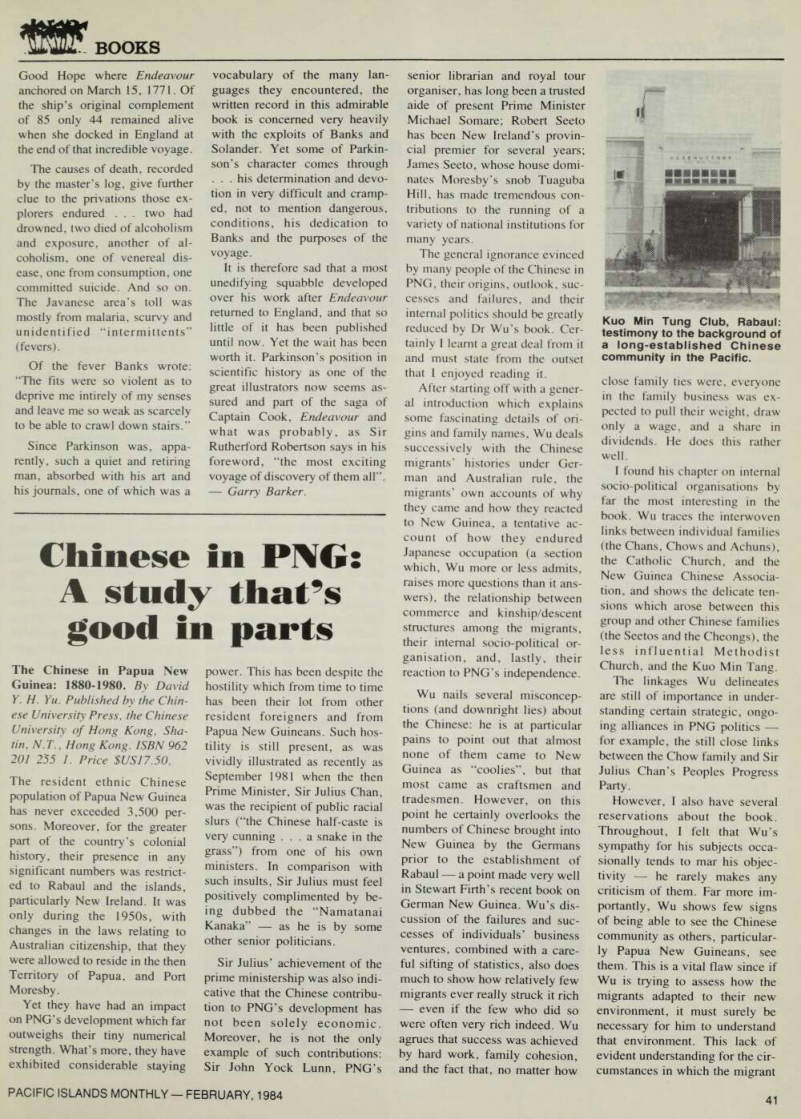
Sydney Parkinson: At last a young genius gets his due
Sydney Parkinson, Artist of Cook’s Endeavour Voyage.
Edited by D. J. Carr. Published by the British Museum (Natural History) in association with Australian National University Press, Canberra. 300 pp.ISBN 0 7081 1172 6. Price $A49.95.
Those of us embroiled in the complexities of modern life, rushing, it often seems, in ever decreasing circles of 20th century confusion, may be forgi ven for marvelling at how much, creatively, was achieved in a very short span by our ancestors.
Mozart is the example much quoted for the prodigious output of immortal music he achieved in a life which, today, would be thought hardly begun.
Now, belatedly, we have pro per recognition of another man
who in less than four years of exploring the Pacific with the extraordinary Captain James Cook, left an historical record not only voluminous but of great and lasting quality.
Sydney Parkinson was the younger of two artists recruited by the naturalist Banks for Cook’s voyage in Endeavour. He was then 22. He died in Java in 1771 at the age of 26 leaving nearly 1000 botanical paintings and sketches as well as literal stacks of other artistic records of the new lands discovered and the people and fauna which in habited them.
This book, a beautifully pro duced volume, printed by Griffin Press of South Australia, is the first to properly convey the great skill and wide interests of this young genius, and it does him
Parkinson’s painting of the cotton-eared marmoset, which he saw in Brazil, south of the Amazon.
proper Justice. Further, since Parkinson was the first European artist to set foot in Australia, it is fitting that the book should be
printed and published in
Australia.
It is arranged in 10 sections, each of them dealing with one particular facet of Parkinson’s work for Banks, for the master of Endeavour Robert Molyneaux, and for himself. Each section is handled by a ranking expert in the field. . . Wilfrid Blunt writes about the voyage itself and then of the artist and his fellows. R. J.
Henderson reviews the work on Australian plants and E. J. God ley those of New Zealand . . . and so on.
All is done with great care and
style, with copious illustrations
in black and white as well as some excellent color plates of the botanical watercolors.
It might have been dull and overly academic for the average reader, but, through it all, the authors have carried the narrative of Cook’s remarkable voyage with choice anecdotes interspers
ing descriptions and explanations
of the plants, animals and topog
raphy depicted.
Parkinson’s story is, of
course, fascinating, particularly
to those of us who now live in the Pacific. He was not himself an adventurer, and seems to have been a somewhat retiring fellow compared with the ebullient Joseph Banks. Banks was gener ally among the first ashore to “botanise” as he put it, and to fraternise with the natives, some times getting himself involved in festivities and ceremonials. Par kinson generally remained on
board sketching the samples
brought back by the botanists and, according to one sailor’s diary, often “sat up all night drawing for himself or writing”.
There is even some suggestion that it was Parkinson and not either Cook or Banks, who was actually author of the name Botany Bay, for he seems to have used it quite some time before it appears in the diaries of the others. Banks, in fact, per sisted in using the name Stingray Bay, even after Cook had altered his official journal.
Parkinson’s dedication to his work and to the botanists Banks and Solander, can be gauged from William Steam’s chapter on
the Javanese episode of the voyage: Homeward bound from Australia, Cook’s ship sailed into Batavia (now Jakarta) on October 11, 1770. It was the first place of European settlement . . . that Endeavour had visited after leaving Rio de Janeiro, Brazil, on December 6, 1768. All aboard had remained healthy beyond contempor ary expectation on so long a voyage.
Cook’s dietary measures had even largely prevented the dreaded scurvy, in his own words “from getting a footing in the Ship,” at the time a most remarkable achievement, not a man had been lost from it; a little of the credit for this must go to Banks and Solander who had recognised some edible antiscorbutic plants.
The Endeavour had been damaged much more than anyone then knew, when she had struck the Endeavour Reef off the Queensland coast on June 11, 1770. Emergency repairs made . . . during a stay of six weeks which gave Banks, Solander and Parkinson more than enough time to explore botanically what is now the Cooktown area, enabled her to reach Java: they could not ensure her safety much further; she had to be over hauled and repaired there. From this first contact with civilisation after so many months away from it ensued the great tragedy of the Endeavour voyage; for some 27 of her crew and
passengers it was also their last con tact with civilisation.
The ship’s carpenter wrote in his log: “The Ship very leakey as she makes from 12 to six inches per hour.”
Much against his will Cook had to put into what chronicles of the time condemned as “that
deadly stinking pestilential
place.” Batavia with its dirty canals, its malaria and its seeth
ing humanity.
Banks’ diary records: “The canal mud stinks intolerably, as indeed it must, being chiefly formed from human ordure of which . . . the canals every
morning receive their regular
quota, and the more filthy recre
ments of housekeeping. .
One after another the formerly healthy men of Endeavour went down. Banks and Solander both contracted fever and were lucky to escape with their lives.
Parkinson himself fell desper ately ill, but continued to work, completing no less than 72 draw ings of plants collected in Java.
The toll upon his health was great and he ultimately became one of 27 men who died at sea between Java and the Cape of
Good Hope where Endeavour anchored on March 15, 1771. Of
the ship’s original complement
of 85 only 44 remained alive when she docked in England at the end of that incredible voyage.
The causes of death, recorded
by the master’s log, give further
clue to the privations those ex plorers endured . . . two had drowned, two died of alcoholism and exposure, another of al coholism, one of venereal dis ease, one from consumption, one committed suicide. And so on.
The Javanese area’s toll was mostly from malaria, scurvy and unidentified “intermittents” (fevers).
Of the fever Banks wrote: “The fits were so violent as to deprive me intirely of my senses and leave me so weak as scarcely to be able to crawl down stairs.”
Since Parkinson was, appa
rently, such a quiet and retiring
man, absorbed with his art and his journals, one of which was a
vocabulary of the many lan guages they encountered, the written record in this admirable book is concerned very heavily with the exploits of Banks and Solander. Yet some of Parkin son’s character comes through ... his determination and devo tion in very difficult and cramp ed, not to mention dangerous, conditions, his dedication to Banks and the purposes of the voyage.
It is therefore sad that a most
unedifying squabble developed
over his work after Endeavour returned to England, and that so little of it has been published until now. Yet the wait has been worth it. Parkinson’s position in scientific history as one of the great illustrators now seems as sured and part of the saga of Captain Cook, Endeavour and what was probably, as Sir Rutherford Robertson says in his foreword, “the most exciting voyage of discovery of them all”.
Garry Barker.
Advertisements & other items, p. 40 (1 item)
ceres
FAO ©REVIEW
ON AGRICULTURE AND
DEVELOPMENT
Published every two months in English, French and Spanish by the Food and Agriculture Organization of the United Nations.
Annual subscription; US$ 15.00 Six times a year CERES brings to its readers a unique package of information, analysis and opinion which provides a panoramic perspective of the activities affecting agriculture and rural hie.
Read CERES • to identify new approaches to development; • to evaluate the experience of others with new or different technology. • to brief themselves on major issues under international negotiation; • to understand the major forces shaping rural development.
To suscribe, please write to: FAO - CERES Circulation Office, C-l 16 Via delle Terme di Caracaila 00100 Rome, Italy Free sample copies are available on request from: CERES Circulation Office (see address above)
good in parts
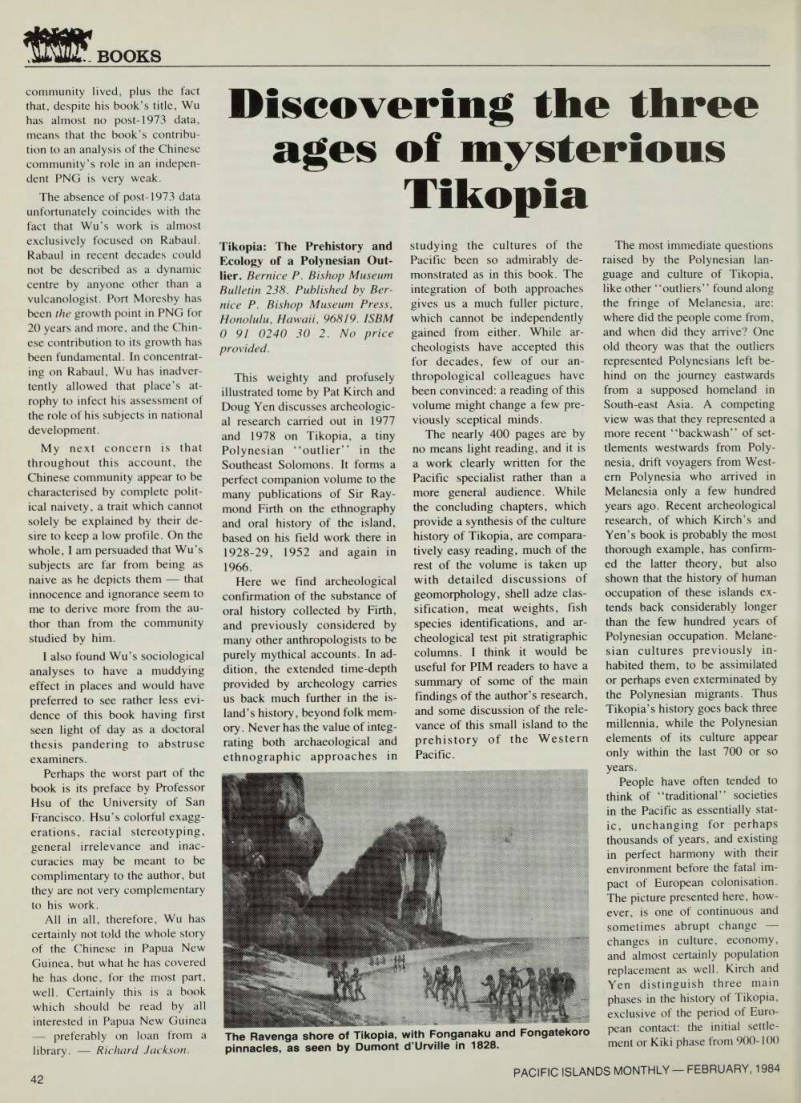
Chinese in PNG: A study that’s good in parts
The Chinese in Papua New Guinea: 1880-1980. By David Y. H. Yu. Published by the Chin ese University Press, the Chinese University of Hong Kong, Sha tin, N.T., Hong Kong. ISBN 962 201 255 1. Price SUS 17.50.
The resident ethnic Chinese population of Papua New Guinea has never exceeded 3,500 per sons. Moreover, for the greater part of the country’s colonial history, their presence in any significant numbers was restrict ed to Rabaul and the islands, particularly New Ireland. It was only during the 19505, with changes in the laws relating to Australian citizenship, that they were allowed to reside in the then Territory of Papua, and Port
Moresby.
Yet they have had an impact on PNG’s development which far outweighs their tiny numerical strength. What’s more, they have exhibited considerable staying
power. This has been despite the hostility which from time to time has been their lot from other resident foreigners and from Papua New Guineans. Such hos tility is still present, as was vividly illustrated as recently as September 1981 when the then Prime Minister, Sir Julius Chan, was the recipient of public racial slurs (“the Chinese half-caste is very cunning ... a snake in the grass”) from one of his own ministers. In comparison with such insults, Sir Julius must feel positively complimented by be ing dubbed the “Namatanai Kanaka” as he is by some other senior politicians.
Sir Julius’ achievement of the prime ministership was also indi cative that the Chinese contribu tion to PNG’s development has not been solely economic.
Moreover, he is not the only example of such contributions: Sir John Yock Lunn, PNG’s
senior librarian and royal tour organiser, has long been a trusted aide of present Prime Minister Michael Somare; Robert Seeto has been New Ireland’s provin cial premier for several years; James Seeto, whose house domi
nates Moresby’s snob Tuaguba
Hill, has made tremendous con tributions to the running of a variety of national institutions for many years.
The general ignorance evinced by many people of the Chinese in PNG, their origins, outlook, suc cesses and failures, and their internal politics should be greatly reduced by Dr Wu’s book. Cer tainly I leamt a great deal from it and must state from the outset that I enjoyed reading it.
After starting off with a gener al introduction which explains some fascinating details of ori gins and family names, Wu deals successively with the Chinese migrants’ histories under Ger man and Australian rule, the migrants’ own accounts of why they came and how they reacted to New Guinea, a tentative ac count of how they endured
Japanese occupation (a section
which, Wu more or less admits, raises more questions than it ans wers), the relationship between commerce and kinship/descent structures among the migrants, their internal socio-political or
ganisation, and, lastly, their
reaction to PNG’s independence.
Wu nails several misconcep tions (and downright lies) about the Chinese: he is at particular pains to point out that almost none of them came to New Guinea as “coolies”, but that most came as craftsmen and tradesmen. However, on this point he certainly overlooks the numbers of Chinese brought into New Guinea by the Germans prior to the establishment of Rabaul a point made very well in Stewart Firth’s recent book on German New Guinea. Wu’s dis cussion of the failures and suc cesses of individuals’ business ventures, combined with a care ful sifting of statistics, also does much to show how relatively few migrants ever really struck it rich even if the few who did so were often very rich indeed. Wu agrues that success was achieved
by hard work, family cohesion,
and the fact that, no matter how
close family ties were, everyone in the family business was ex pected to pull their weight, draw only a wage, and a share in dividends. He does this rather well.
I found his chapter on internal socio-political organisations by far the most interesting in the book. Wu traces the interwoven links between individual families (the Chans, Chows and Achuns), the Catholic Church, and the New Guinea Chinese Associa tion, and shows the delicate ten sions which arose between this group and other Chinese families (the Seetos and the Cheongs), the less influential Methodist Church, and the Kuo Min Tang.
The linkages Wu delineates are still of importance in under standing certain strategic, ongo ing alliances in PNG politics for example, the still close links between the Chow family and Sir Julius Chan’s Peoples Progress Party.
However, I also have several reservations about the book.
Throughout, I felt that Wu’s sympathy for his subjects occa sionally tends to mar his objec tivity he rarely makes any criticism of them. Far more im portantly, Wu shows few signs of being able to see the Chinese community as others, particular ly Papua New Guineans, see them. This is a vital flaw since if Wu is trying to assess how the migrants adapted to their new environment, it must surely be necessary for him to understand that environment. This lack of evident understanding for the cir cumstances in which the migrant
Kuo Min Tung Club, Rabaul: testimony to the background of a long-established Chinese community in the Pacific.
community lived, plus the fact that, despite his book’s title, Wu has almost no post-1973 data, means that the book’s contribu tion to an analysis of the Chinese community’s role in an indepen dent PNG is very weak.
The absence of post-1973 data unfortunately coincides with the fact that Wu’s work is almost exclusively focused on Rabaul.
Rabaul in recent decades could not be described as a dynamic centre by anyone other than a
vulcanologist. Port Moresby has
been the growth point in PNG for 20 years and more, and the Chin ese contribution to its growth has been fundamental. In concentrat ing on Rabaul, Wu has inadver tently allowed that place’s at rophy to infect his assessment of the role of his subjects in national
development.
My next concern is that throughout this account, the Chinese community appear to be
characterised by complete polit
ical naivety, a trait which cannot
solely be explained by their de
sire to keep a low profile. On the whole, I am persuaded that Wu’s subjects are far from being as naive as he depicts them that innocence and ignorance seem to me to derive more from the au thor than from the community studied by him.
I also found Wu’s sociological analyses to have a muddying effect in places and would have preferred to see rather less evi dence of this book having first seen light of day as a doctoral thesis pandering to abstruse examiners.
Perhaps the worst part of the book is its preface by Professor Hsu of the University of San Francisco. Hsu’s colorful exagg erations, racial stereotyping, general irrelevance and inac curacies may be meant to be complimentary to the author, but they are not very complementary to his work.
All in all, therefore, Wu has certainly not told the whole story of the Chinese in Papua New Guinea, but what he has covered he has done, for the most part, well. Certainly this is a book which should be read by all interested in Papua New Guinea preferably on loan from a
library.
Richard Jackson.
Tikopia
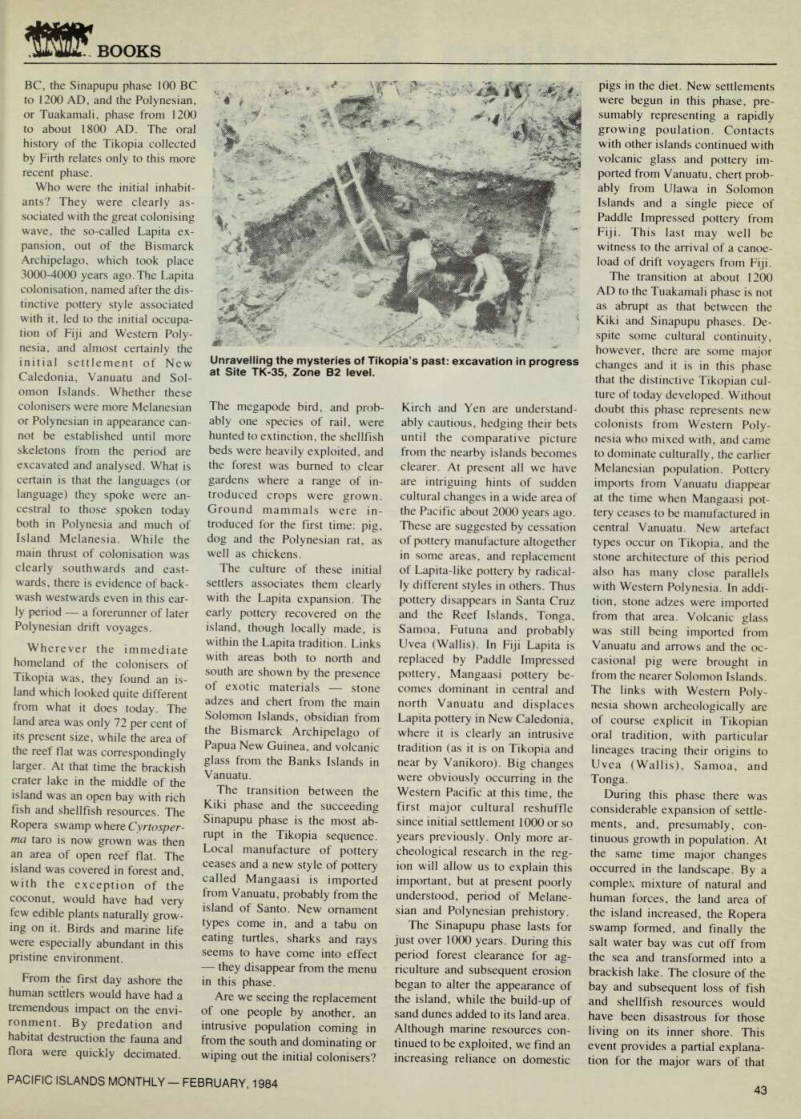

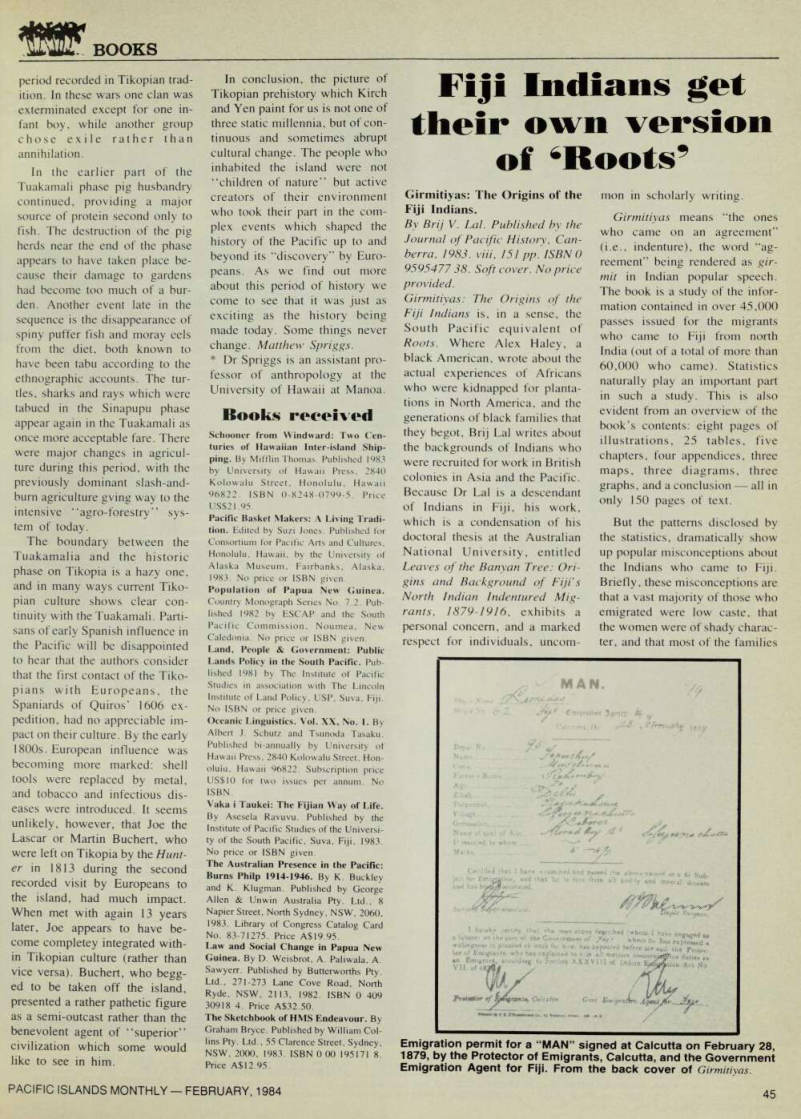
Discovering the three ages of mysterious Tikopia
Tikopia: The Prehistory and Ecology of a Polynesian Out lier. Bernice P. Bishop Museum Bulletin 238. Published by Ber nice P. Bishop Museum Press, Honolulu, Hawaii, 96819. ISBM 0 91 0240 30 2. No price provided.
This weighty and profusely illustrated tome by Pat Kirch and Doug Yen discusses archeologic al research carried out in 1977 and 1978 on Tikopia, a tiny Polynesian “outlier” in the Southeast Solomons. It forms a perfect companion volume to the many publications of Sir Ray mond Firth on the ethnography and oral history of the island, based on his field work there in 1928-29, 1952 and again in 1966.
Here we find archeological confirmation of the substance of oral history collected by Firth, and previously considered by many other anthropologists to be purely mythical accounts. In ad dition, the extended time-depth provided by archeology carries us back much further in the is land’s history, beyond folk mem ory. Never has the value of integ rating both archaeological and ethnographic approaches in
studying the cultures of the Pacific been so admirably de monstrated as in this book. The integration of both approaches gives us a much fuller picture, which cannot be independently gained from either. While ar cheologists have accepted this for decades, few of our an thropological colleagues have been convinced; a reading of this volume might change a few pre viously sceptical minds.
The nearly 400 pages are by no means light reading, and it is a work clearly written for the Pacific specialist rather than a more general audience. While the concluding chapters, which provide a synthesis of the culture history of Tikopia, are compara tively easy reading, much of the rest of the volume is taken up with detailed discussions of geomorphology, shell adze clas sification, meat weights, fish species identifications, and ar cheological test pit stratigraphic columns. I think it would be useful for PIM readers to have a summary of some of the main findings of the author’s research, and some discussion of the rele vance of this small island to the prehistory of the Western Pacific.
The most immediate questions raised by the Polynesian lan guage and culture of Tikopia, like other “outliers” found along the fringe of Melanesia, are; where did the people come from, and when did they arrive? One old theory was that the outliers represented Polynesians left be hind on the journey eastwards from a supposed homeland in South-east Asia. A competing view was that they represented a more recent “backwash” of set tlements westwards from Poly nesia, drift voyagers from West ern Polynesia who arrived in Melanesia only a few hundred years ago. Recent archeological research, of which Kirch’s and Yen’s book is probably the most thorough example, has confirm ed the latter theory, but also shown that the history of human occupation of these islands ex tends back considerably longer than the few hundred years of Polynesian occupation. Melane sian cultures previously in habited them, to be assimilated or perhaps even exterminated by the Polynesian migrants. Thus Tikopia’s history goes back three millennia, while the Polynesian elements of its culture appear only within the last 700 or so years.
People have often tended to think of “traditional” societies in the Pacific as essentially stat ic, unchanging for perhaps thousands of years, and existing in perfect harmony with their environment before the fatal im pact of European colonisation.
The picture presented here, how ever, is one of continuous and sometimes abrupt change changes in culture, economy, and almost certainly population replacement as well. Kirch and Yen distinguish three main phases in the history of Tikopia, exclusive of the period of Euro pean contact: the initial settle ment or Kiki phase from 900-100
The Ravenga shore of Tikopia, with Fonganaku and Fongatekoro pinnacles, as seen by Dumont d’Urville in 1828.
BC, the Sinapupu phase 100 BC to 1200 AD, and the Polynesian, or Tuakamali, phase from 1200 to about 1800 AD. The oral history of the Tikopia collected by Firth relates only to this more recent phase.
Who were the initial inhabit ants? They were clearly as sociated with the great colonising wave, the so-called Lapita ex pansion, out of the Bismarck Archipelago, which took place 3000-4000 years ago. The Lapita colonisation, named after the dis tinctive pottery style associated with it, led to the initial occupa tion of Fiji and Western Poly nesia, and almost certainly the initial settlement of New Caledonia, Vanuatu and Sol omon Islands. Whether these colonisers were more Melanesian or Polynesian in appearance can not be established until more skeletons from the period are excavated and analysed. What is certain is that the languages (or language) they spoke were an cestral to those spoken today both in Polynesia and much of Island Melanesia. While the main thrust of colonisation was clearly southwards and east wards, there is evidence of back wash westwards even in this ear ly period a forerunner of later Polynesian drift voyages.
Wherever the immediate homeland of the colonisers of Tikopia was, they found an is land which looked quite different from what it does today. The land area was only 72 per cent of its present size, while the area of the reef flat was correspondingly larger. At that time the brackish crater lake in the middle of the island was an open bay with rich fish and shellfish resources. The Ropera swamp where Cyrtosper ma taro is now grown was then an area of open reef flat. The island was covered in forest and, with the exception of the coconut, would have had very few edible plants naturally grow ing on it. Birds and marine life were especially abundant in this pristine environment.
From the first day ashore the human settlers would have had a tremendous impact on the envi ronment. By predation and habitat destruction the fauna and flora were quickly decimated.
The megapode bird, and prob ably one species of rail, were hunted to extinction, the shellfish beds were heavily exploited, and the forest was burned to clear gardens where a range of in troduced crops were grown, Ground mammals were in troduced for the first time: pig, dog and the Polynesian rat, as well as chickens, The culture of these initial settlers associates them clearly with the Lapita expansion. The early pottery recovered on the island, though locally made, is wit Wn the Lapita tradition. Links wl > h both to north and S ° f Uth arC shown b >V he P resence °( eXOt "; ™ ter l als s ‘°ne a " d ? he ? from the main S ° loi ™ n lsla " ds - obsld ' a " from ‘ he B ' S t mar " k . Archi P ela g° of Pa P ua New Guinea and volcanic SS fr ° m the Banks Islands in Va "“ atu - The transition between the J C .' k ‘ phase and the sucteedln « Cyrtosper- Slna P u P u P ha * 15 thc most ab ™pt , m the Tlko P ia sequence, Local manufaclure of PO«ery “f* a " d a neW st y le of P otter y ? a " ed Man S aasi is imported fr °m Vanuatu, probably from the lsland of Santo ' New orn ament ,ypeS COm f in ' and a ,abu on eatln B turtles, sharks and rays seems to have come into effect they disappear from the menu in this phase, Are we seeing the replacement of one people by another, an intrusive population coming in from the south and dominating or wiping out the initial colonisers?
Kirch and Yen are understand ably cautious, hedging their bets until the comparative picture from the nearby islands becomes clearer. At present all we have are intriguing hints of sudden cultural changes in a wide area of the Pacific about 2000 years ago.
These are suggested by cessation of pottery manufacture altogether in some areas, and replacement of Lapita-like pottery by radical ly different styles in others. Thus pottery disappears in Santa Cruz and the Reef Islands, Tonga, Samoa, Futuna and probably Uvea (Wallis). In Fiji Lapita is replaced by Paddle Impressed pottery, Mangaasi pottery be comes dominant in central and north Vanuatu and displaces Lapita pottery in New Caledonia, where it is clearly an intrusive tradition (as it is on Tikopia and near by Vanikoro). Big changes were obviously occurring in the Western Pacific at this time, the first major cultural reshuffle since initial settlement 1000 or so years previously. Only more ar cheological research in the reg ion will allow us to explain this important, but at present poorly understood, period of Melane sian and Polynesian prehistory.
The Sinapupu phase lasts for just over 1000 years. During this period forest clearance for ag riculture and subsequent erosion began to alter the appearance of the island, while the build-up of sand dunes added to its land area.
Although marine resources con tinued to be exploited, we find an increasing reliance on domestic
pigs in the diet. New settlements were begun in this phase, pre sumably representing a rapidly growing poulation. Contacts with other islands continued with volcanic glass and pottery im ported from Vanuatu, chert prob ably from Ulawa in Solomon Islands and a single piece of Paddle Impressed pottery from Fiji. This last may well be witness to the arrival of a canoe load of drift voyagers from Fiji.
The transition at about 1200 AD to the Tuakamali phase is not as abrupt as that between the Kiki and Sinapupu phases. De spite some cultural continuity, however, there are some major changes and it is in this phase that the distinctive Tikopian cul ture of today developed. Without doubt this phase represents new colonists from Western Poly nesia who mixed with, and came to dominate culturally, the earlier Melanesian population. Pottery
imports from Vanuatu diappear
at the time when Mangaasi pot tery ceases to be manufactured in central Vanuatu. New artefact types occur on Tikopia, and the stone architecture of this period also has many close parallels with Western Polynesia. In addi tion, stone adzes were imported from that area. Volcanic glass was still being imported from Vanuatu and arrows and the oc casional pig were brought in from the nearer Solomon Islands.
The links with Western Poly nesia shown archeologically are of course explicit in Tikopian oral tradition, with particular lineages tracing their origins to Uvea (Wallis), Samoa, and
Tonga.
During this phase there was considerable expansion of settle ments, and, presumably, con tinuous growth in population. At the same time major changes occurred in the landscape. By a complex mixture of natural and human forces, the land area of the island increased, the Ropera swamp formed, and finally the salt water bay was cut off from the sea and transformed into a brackish lake. The closure of the bay and subsequent loss of fish and shellfish resources would have been disastrous for those living on its inner shore. This event provides a partial explana tion for the major wars of that
Unravelling the mysteries of Tikopia’s past: excavation in progress at Site TK-35, Zone B2 level.
period recorded in Tikopian trad ition. In these wars one clan was exterminated except for one in fant boy, while another group chose exile rather than annihilation.
In the earlier part of the
Tuakamali phase pig husbandry
continued, providing a major
source of protein second only to fish. The destruction of the pig herds near the end of the phase appears to have taken place be cause their damage to gardens had become too much of a bur den. Another event late in the sequence is the disappearance of spiny puffer fish and moray eels from the diet, both known to have been tabu according to the ethnographic accounts. The tur tles, sharks and rays which were tabued in the Sinapupu phase appear again in the Tuakamali as once more acceptable fare. There
were major changes in agricul
ture during this period, with the previously dominant slash-and burn agriculture gving way to the intensive “agro-forestry” sys tem of today.
The boundary between the Tuakamalia and the historic phase on Tikopia is a hazy one, and in many ways current Tiko pian culture shows clear con tinuity with the Tuakamali. Parti sans of early Spanish influence in the Pacific will be disappointed to hear that the authors consider that the first contact of the Tiko
pians with Europeans, the
Spaniards of Quiros’ 1606 ex pedition, had no appreciable im pact on their culture. By the early 1800 s. European influence was becoming more marked: shell tools were replaced by metal, and tobacco and infectious dis eases were introduced. It seems unlikely, however, that Joe the Lascar or Martin Buchert, who were left on Tikopia by the Hunt er in 1813 during the second recorded visit by Europeans to the island, had much impact.
When met with again 13 years later, Joe appears to have be
come completey integrated with
in Tikopian culture (rather than vice versa). Buchert, who begg ed to be taken off the island, presented a rather pathetic figure as a semi-outcast rather than the benevolent agent of “superior” civilization which some would like to see in him.
In conclusion, the picture of
Tikopian prehistory which Kirch
and Yen paint for us is not one of three static millennia, but of con tinuous and sometimes abrupt cultural change. The people who inhabited the island were not “children of nature” but active creators of their environment who took their part in the com plex events which shaped the history of the Pacific up to and
beyond its “discovery” by Euro
peans. As we find out more about this period of history we come to see that it was just as
exciting as the history being
made today. Some things never
change. Matthew Spriggs.
* Dr Spriggs is an assistant pro fessor of anthropology at the University of Hawaii at Manoa.
Books received
Schooner from Windward: Two Cen turies of Hawaiian Inter-island Ship ping. By Mifflin Thomas. Published 1983 by University of Hawaii Press, 2840 Kolowalu Street, Honolulu. Hawaii 96822. ISBN 0-8248-0799-5. Price U 5521.95.
Pacific Basket Makers: A Living Tradi tion. Edited by Suzi Jones. Published for Consortium for Pacific Arts and Cultures.
Honolulu, Hawaii, by the University of Alaska Museum, Fairbanks. Alaska. 1983. No price or ISBN given.
Population of Papua New Guinea.
Country Monograph Series No. 7.2. Pub lished 1982 by ESCAP and the South Pacific Commission, Noumea. New Caledonia. No price or ISBN given.
Land, People & Government: Public- Lands Policy in the South Pacific. Pub lished 1981 by The Institute of Pacific Studies in association with The Lincoln Institute of Land Policy, USP, Suva. Fiji.
No ISBN or price given.
Oceanic Linguistics. Vol. XX, No. I. By Albert J. Schutz and Tsunoda Tasaku.
Published bi-annually by University of Hawaii Press, 2840 Kolowalu Street, Hon olulu, Hawaii 96822. Subscription price US$lO for two issues per annum. No
Isbn.
Vaka i Taukei: The Fijian Way of Life.
By Asesela Ravuvu. Published by the Institute of Pacific Studies of the Universi ty of the South Pacific, Suva, Fiji, 1983.
No price or ISBN given.
The Australian Presence in the Pacific: Burns Philp 1914-1946. By K. Buckley and K. Klugman. Published by George Allen & Unwin Australia Pty. Ltd,. 8 Napier Street, North Sydney, NSW. 2060, 1983. Library of Congress Catalog Card No. 83-71275. Price A 519.95.
Law and Social Change in Papua New Guinea. By D. Weisbrot, A. Paliwala, A.
Sawyerr. Published by Butterworths Pty.
Ltd., 271-273 Lane Cove Road, North Ryde, NSW, 2113, 1982. ISBN 0 409 30918 4. Price A 532.50.
The Sketchbook of HMS Endeavour. By Graham Bryce. Published by William Col lins Pty. Ltd., 55 Clarence Street, Sydney, NSW, 2000, 1983. ISBN 0 00 195171 8.
Price A 512.95.
Advertisements & other items, p. 44 (1 item)
Starting & Staying
V,
AMP
UJED
■5 .r*, y
UPW
mr /•VSStisii m 0232 G 232327
Power Boats Need Different Batteries
There is a big difference between a car battery and a marine battery.
A car battery, for example, is never really discharged, as it is only used for a few seconds each day and promptly re-charged. Not so your cruiser or sportsfisherman.
Starting the engine is only the beginning. During the day, weekend or cruise, how often will you run the live bait tank, the depth sounder, the nav. lights or maintain a listening watch on your radio transceiver?
As well as cranking power, boats need staying power. Boats need Besco's Marine Batteries, deep cycle, heavy duty marine batteries. ’
If your boat is getting a little flat in the electrics department, write or phone BESCO today and ask for more information, more facts about
BESCO MARINE BA TTERIES.
BESCO
Batteries Division Of Sims Products Pty. Ltd.
A Peko Wa/lsend Group Member Papua New Guinea; Lae, Automarine Industries, P.O. Box 785, Ph. 42-1125; Rabaul, Automarine Industries, P.O. Box 248, Ph. 92-2574; Port Moresby, Par Sales .P.O. Bo>c 1680.
Boroko, Ph. 25-6266. Fiji: Suva, Fiji Bandag, 23 Sinoma Street, Walu Bay, Ph. 31-1200. New Caledonia: Noumea, Andre Thuilier, BP 889, Ph. 27-4906. Solomon Islands: Honiara, Guadalcanal Electrics Ltd., P.O. Box 521. Hongkong: Kowloon, T. L. Knight & Co., P.O. Box 95585 TST, Ph. 366-5341. New Zealand: Auckland, Battery Services (Ind.) pd., P.O. Box 27- 375, Ph. 69-4111; Wellington, Gould Batteries, 58 Hautana Street, Lower Hurt, TLX NZ3714 Australia: Sydney, Besco Batteries, P.O. Box 1, Villawood, Ph. 632-0251, TLX 21886, Jarwil International Pty. Ltd., 410 Kent Street, Sydney, Ph. 264-3477, TLX 72102.
LEADERS IN BATTERY
Fiji Indians get

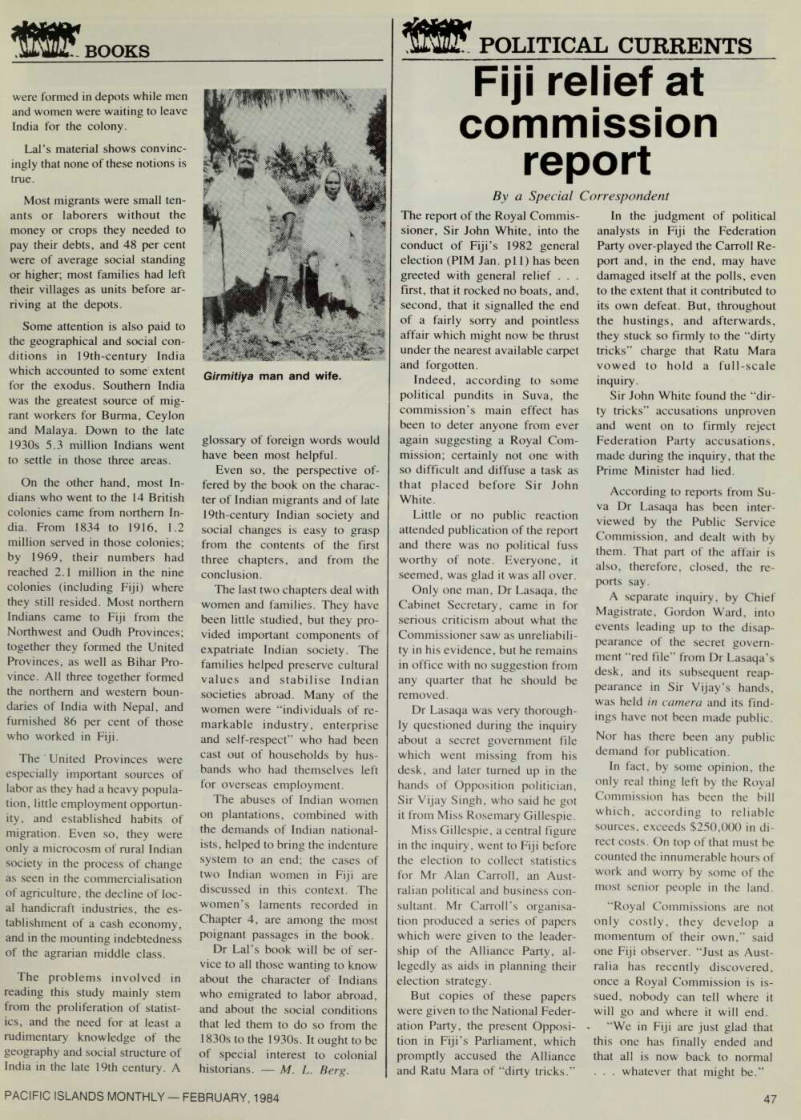
their own version of 'Roots'
Girmitiyas: The Origins of the Fiji Indians. nn-'i/rinif.ii ; B\ Bnj V. Lai. Published b\ the , . .. ... ... • Journal of Pacific History, Can- . ,no 3 /c/ icDArn berra, 1983. vm. 151 pp. ISBN 0 0?0 r> 77 3ft c f ' 9595477 38. Soft cover. No price ... provided. . . . , G mnitivas: The Origins of the . tiji Indians is, m a sense, the 0 .
South Pacific equivalent of „ ... * ...
Roots. Where Alex Haley, a ... , . black American, wrote about the „. r . actual experiences of Africans , ... . . who were kidnapped for planta- . . . , , tions in North America, and the ... . generations of black families that , n.i i
they begot, Bnj Lai writes about
, ,' , .. . the backgrounds of Indians who ... , n. . were recruited for work m British . * , . ... colonies m Asia and the Pacific.
D * . , , Because Dr Lai is a descendant c , . r-... . of Indians in Fiji, his work, which is a condensation of his doctoral thesis at the Australian National University, entitled Leaves of the Banyan Tree: Origins and Background of Fiji’s North Indian Indentured Migrants, 1879-1916, exhibits a personal concern, and a marked respect for individuals, uncom-
mon in scholarly writing.
Girmitiyas means the ones who came on an agreement .., , , , ( ie > indenture), the word ag „. . . reement being rendered as gir ••, , , nut m Indian popular speech. ™ . . . ' . e 1 he book is a study ot the mtor , .c ™rv mation contained m over 45,000 . . passes issued for the migrants . _... . who came to rni from north , .. . , .
India (out of a total of more than , . 60,000 who came). Statistics .. . naturally play an important part , . JT. . , in such a study. This is also . , evident from an overview of the . book s contents; eight pages of ... & L , & illustrations, 25 tables, five . r chapters, four appendices, three . , maps, three diagrams, three .. , . graphs, and a conclusion all m , only 150 pages of text, v b But the patterns disclosed by the statistics, dramatically show
up popular misconceptions about
the Indians who came to Fiji.
Briefly, these misconceptions are
that a vast majority of those who emigrated were low caste, that the women were of shady charac ter, and that most of the families
Emigration permit for a “MAN” signed at Calcutta on February 28, 1879, by the Protector of Emigrants, Calcutta, and the Government Emigration Agent for Fiji. From the back cover of Girmitiyas.
were formed in depots while men and women were waiting to leave India for the colony.
Lai’s material shows convinc ingly that none of these notions is true.
Most migrants were small ten ants or laborers without the money or crops they needed to pay their debts, and 48 per cent were of average social standing or higher; most families had left their villages as units before ar
riving at the depots.
Some attention is also paid to the geographical and social con ditions in 19th-century India which accounted to some extent for the exodus. Southern India was the greatest source of mig rant workers for Burma, Ceylon and Malaya. Down to the late 1930 s 5.3 million Indians went to settle in those three areas.
On the other hand, most In dians who went to the 14 British colonies came from northern In dia. From 1834 to 1916, 1.2 million served in those colonies; by 1969, their numbers had reached 2.1 million in the nine
colonies (including Fiji) where
they still resided. Most northern Indians came to Fiji from the Northwest and Oudh Provinces; together they formed the United Provinces, as well as Bihar Pro vince. All three together formed the northern and western boun daries of India with Nepal, and furnished 86 per cent of those who worked in Fiji.
The ' United Provinces were
especially important sources of
labor as they had a heavy popula tion, little employment opportun ity, and established habits of migration. Even so, they were only a microcosm of rural Indian society in the process of change as seen in the commercialisation of agriculture, the decline of loc al handicraft industries, the es tablishment of a cash economy, and in the mounting indebtedness of the agrarian middle class.
The problems involved in
reading this study mainly stem
from the proliferation of statist ics, and the need for at least a
rudimentary knowledge of the
geography and social structure of India in the late 19th century. A
glossary of foreign words would have been most helpful.
Even so, the perspective of fered by the book on the charac ter of Indian migrants and of late
19th-century Indian society and
social changes is easy to grasp from the contents of the first three chapters, and from the conclusion.
The last two chapters deal with women and families. They have been little studied, but they pro vided important components of
expatriate Indian society. The
families helped preserve cultural values and stabilise Indian societies abroad. Many of the women were “individuals of re
markable industry, enterprise
and self-respect” who had been cast out of households by hus bands who had themselves left for overseas employment.
The abuses of Indian women on plantations, combined with the demands of Indian national ists, helped to bring the indenture system to an end; the cases of two Indian women in Fiji are discussed in this context. The women’s laments recorded in Chapter 4, are among the most poignant passages in the book.
Dr Lai’s book will be of ser vice to all those wanting to know about the character of Indians who emigrated to labor abroad, and about the social conditions that led them to do so from the 1830 s to the 19305. It ought to be of special interest to colonial
historians.
M. L. Berg.
Girmitiya man and wife.
Advertisements & other items, p. 46 (1 item)
Sansui Integra
Convenience
If you're looking for a component system that sounds great, operates with fingertip ease, yet doesn't cost a bundle, then take a look at Sansui's compact new Integrated Component Systems.
System M 77, for instance, gives you a programmable linear-tracking turntable. Compu Edit, for automatic recording. The Compu-Selector System for one-touch operation. And even an optional graphic equalizer with a built-in spectrum analyzer so your music sounds just the way you like it best.
See and hear the newest idea in sound today at your nearest Sansui dealer. * ' s m I *» i P I m • Australia VANFI (Aust.) PTY. LTD. 297, City Road, South Melbourne, Victona .3205, Australia y ' p q °|° x 5518 Boroko Port 929-0293 • Fiji PRABHU BROTHERS LTD, P.O. Box 183, Nadi Phone: 71122 • Papua New Guinea OCEANIA INDENT AGENCY (P.N.G.) PTY LTUPO jvi MER CIE R Moresby Phone: 256411 •New Zealand DAVID REID ELECTRONICS LTD. P.O. Box 2630, Auckland Phone: 488-049 Ca/ed, HLFI vilfphone 2035 B.P 1123. Noumea Phone: 27.59.11 • Central Pacific NAURU CO-OPERATIVE SOCIETY Republic of Nauru • Vanuatu THE SOUND CENTRE LTD. P.O. Box 484, Vila • Tahiti DIMECO SIMEL B.P. Box 3333 Papeete Phone: 26979
report
Political Currents
Fiji relief at commission report
By a Special Correspondent
The report of the Royal Commis sioner, Sir John White, into the conduct of Fiji’s 1982 general election (PIM Jan. pi 1) has been greeted with general relief . . . first, that it rocked no boats, and, second, that it signalled the end of a fairly sorry and pointless affair which might now be thrust under the nearest available carpet
and forgotten.
Indeed, according to some political pundits in Suva, the commission’s main effect has been to deter anyone from ever
again suggesting a Royal Com
mission; certainly not one with so difficult and diffuse a task as that placed before Sir John White.
Little or no public reaction attended publication of the report and there was no political fuss worthy of note. Everyone, it seemed, was glad it was all over.
Only one man. Dr Lasaqa, the Cabinet Secretary, came in for serious criticism about what the Commissioner saw as unreliabili ty in his evidence, but he remains in office with no suggestion from any quarter that he should be removed.
Dr Lasaqa was very thorough
ly questioned during the inquiry
about a secret government file which went missing from his desk, and later turned up in the
hands of Opposition politician.
Sir Vijay Singh, who said he got it from Miss Rosemary Gillespie.
Miss Gillespie, a central figure in the inquiry, went to Fiji before the election to collect statistics for Mr Alan Carroll, an Aust ralian political and business con sultant. Mr Carroll’s organisa tion produced a series of papers which were given to the leader ship of the Alliance Party, al legedly as aids in planning their election strategy.
But copies of these papers were given to the National Feder ation Party, the present Opposi tion in Fiji’s Parliament, which promptly accused the Alliance and Ratu Mara of “dirty tricks.”
In the judgment of political analysts in Fiji the Federation Party over-played the Carroll Re port and, in the end, may have damaged itself at the polls, even to the extent that it contributed to its own defeat. But, throughout the hustings, and afterwards, they stuck so firmly to the “dirty tricks” charge that Ratu Mara vowed to hold a full-scale
inquiry.
Sir John White found the “dir ty tricks” accusations unproven and went on to firmly reject Federation Party accusations, made during the inquiry, that the Prime Minister had lied.
According to reports from Su va Dr Lasaqa has been inter viewed by the Public Service Commission, and dealt with by them. That part of the affair is also, therefore, closed, the re ports say.
A separate inquiry, by Chief Magistrate, Gordon Ward, into events leading up to the disap pearance of the secret govern ment “red file” from Dr Lasaqa’s desk, and its subsequent reap pearance in Sir Vijay’s hands, was held in camera and its find ings have not been made public.
Nor has there been any public demand for publication.
In fact, by some opinion, the only real thing left by the Royal Commission has been the bill which, according to reliable sources, exceeds $250,000 in di rect costs. On top of that must be counted the innumerable hours of work and worry by some of the most senior people in the land.
“Royal Commissions are not
only costly, they develop a
momentum of their own,” said one Fiji observer. “Just as Aust ralia has recently discovered, once a Royal Commission is is sued, nobody can tell where it will go and where it will end. * “We in Fiji are just glad that this one has finally ended and that all is now back to normal . . . whatever that might be.”
Advertisements & other items, p. 48 (1 item)
iittitv
I it B I I iW
ft'l3
1 3 Si 5 I I
iiiVN
ci'OiW
i s f 1 a
iittitv
Australia can supply an extremely wide range of the most advanced materials handling equipment.
Conveyors, cranes, hoists, girder trolleys, idlers, chains, tier racks, pallets-virtually anything needed to move goods or materials quickly, efficiently, dependably. Equipment that’s the result of vast experience gained in all types of mining and manufacturing industries. Australian equipment is being used throughout the world in factories, on wharves, in mining areas. Check to see how it can satisfy your requirements.
Ask the expert
who knows Australia For details of suppliers phone or telex the Australian Trade Commissioner at Port Moresby: Phone 25 9333 Telex NE 22109.
Honolulu: Phone (808) 524 5050 Telex 633128.
Suva: Phone 31 2844 Telex FJ 2126.
Noumea: Phone 27 2414 Telex 087.
Ask the Australian IMe Commissioner
Unchanged change
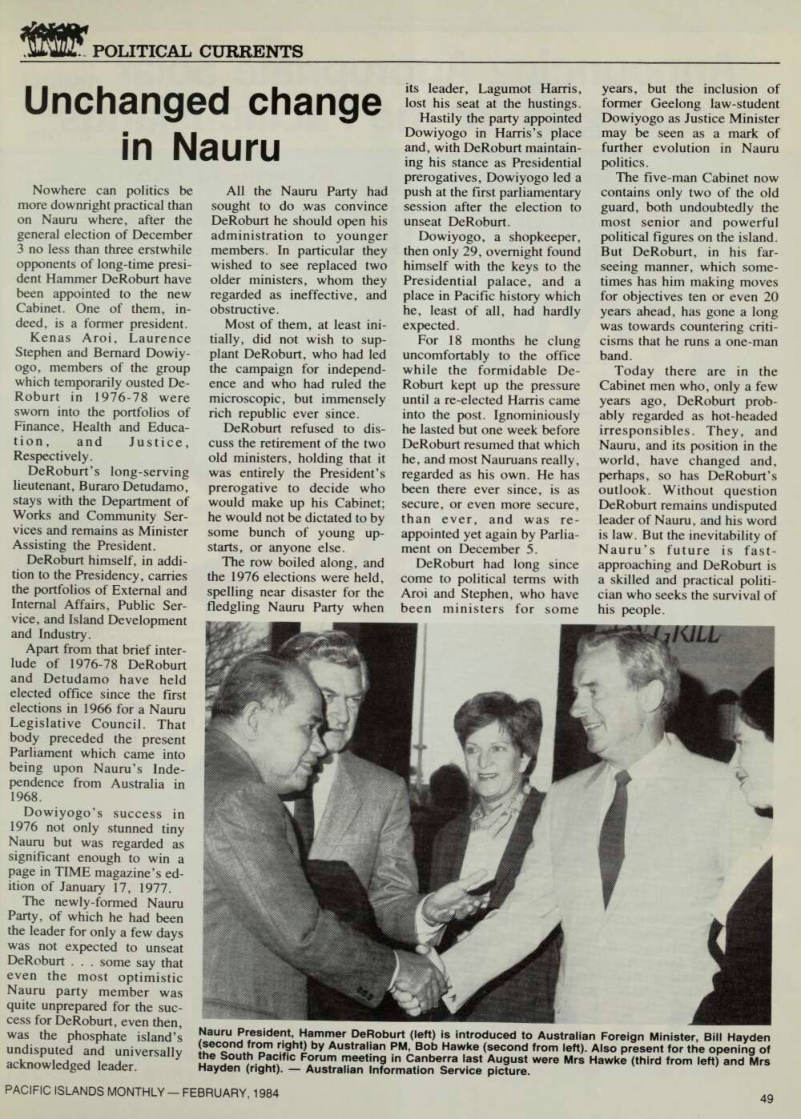
in Nauru
Nowhere can politics be more downright practical than on Nauru where, after the general election of December 3 no less than three erstwhile opponents of long-time presi dent Hammer Deßoburt have been appointed to the new Cabinet. One of them, in deed, is a former president.
Kenas Aroi, Laurence Stephen and Bernard Dowiy ogo, members of the group which temporarily ousted De- Roburt in 1976-78 were sworn into the portfolios of Finance, Health and Educa tion, and Justice, Respectively.
Deßoburt’s long-serving
lieutenant, Buraro Detudamo, stays with the Department of Works and Community Ser vices and remains as Minister Assisting the President.
Deßoburt himself, in addi tion to the Presidency, carries the portfolios of External and Internal Affairs, Public Ser vice, and Island Development and Industry.
Apart from that brief inter lude of 1976-78 Deßoburt and Detudamo have held elected office since the first elections in 1966 for a Nauru Legislative Council. That body preceded the present Parliament which came into being upon Nauru’s Inde pendence from Australia in 1968.
Dowiyogo’s success in 1976 not only stunned tiny Nauru but was regarded as significant enough to win a page in TIME magazine’s ed ition of January 17, 1977.
The newly-formed Nauru Party, of which he had been the leader for only a few days was not expected to unseat Deßoburt . . . some say that even the most optimistic Nauru party member was quite unprepared for the suc cess for Deßoburt, even then, was the phosphate island’s undisputed and universally
acknowledged leader.
All the Nauru Party had sought to do was convince Deßoburt he should open his administration to younger members. In particular they wished to see replaced two older ministers, whom they regarded as ineffective, and obstructive.
Most of them, at least ini tially, did not wish to sup plant Deßoburt, who had led the campaign for independ ence and who had ruled the microscopic, but immensely rich republic ever since.
Deßoburt refused to dis cuss the retirement of the two old ministers, holding that it was entirely the President’s prerogative to decide who would make up his Cabinet; he would not be dictated to by some bunch of young up starts, or anyone else.
The row boiled along, and the 1976 elections were held, spelling near disaster for the fledgling Nauru Party when
its leader, Lagumot Harris, lost his seat at the hustings.
Hastily the party appointed Dowiyogo in Harris’s place and, with Deßoburt maintain ing his stance as Presidential prerogatives, Dowiyogo led a push at the first parliamentary session after the election to unseat Deßoburt.
Dowiyogo, a shopkeeper, then only 29, overnight found himself with the keys to the Presidential palace, and a place in Pacific history which he, least of all, had hardly expected.
For 18 months he clung uncomfortably to the office while the formidable De- Roburt kept up the pressure until a re-elected Harris came into the post. Ignominiously he lasted but one week before Deßoburt resumed that which he, and most Nauruans really, regarded as his own. He has been there ever since, is as secure, or even more secure, than ever, and was re appointed yet again by Parlia ment on December 5.
Deßoburt had long since come to political terms with Aroi and Stephen, who have been ministers for some
years, but the inclusion of former Geelong law-student Dowiyogo as Justice Minister may be seen as a mark of further evolution in Nauru politics.
The five-man Cabinet now contains only two of the old guard, both undoubtedly the most senior and powerful political figures on the island.
But Deßoburt, in his far seeing manner, which some times has him making moves for objectives ten or even 20 years ahead, has gone a long was towards countering criti cisms that he runs a one-man band.
Today there are in the Cabinet men who, only a few years ago, Deßoburt prob ably regarded as hot-headed irresponsibles. They, and Nauru, and its position in the world, have changed and, perhaps, so has Deßoburt’s outlook. Without question Deßoburt remains undisputed leader of Nauru, and his word is law. But the inevitability of Nauru’s future is fast approaching and Deßoburt is a skilled and practical politi cian who seeks the survival of his people.
Nauru President, Hammer DeRoburt (left) is Introduced to Australian Foreign Minister, Bill Hayden (second from right) by Australian PM, Bob Hawke (second from left). Also present for the opening of the South Pacific Forum meeting in Canberra last August were Mrs Hawke (third from left) and Mrs Hayden (right). - Australian Information Service picture.
Advertisements & other items, p. 50 (1 item)
Announcing Appropriate Solar
Technologies for the Pacific Islands
Inter Island Solar Supply is the largest distributor of solar thermal and solar electric products to the Pacific Basin since 1975.
PT-40 Self-Contained 40 gallon Solar Water Heater Stainless Steel Progressive Tube Design' Triple Glazed for Heat Retention Simple Installation. No Pumps, No Controls, No Maintenance 20 Year Warranty • Lowest Price Solar Edwards 1 Thermosyphon Systems (passive) Solec Int’l.
'Solar Electric Panels]
•V.V • Superior Silicone Cell Quality and Expert Module Construction Higher Electric Output than any Solar Cells Available Inter Island also carries appropriate Solar Electric Appliances including 12 Volt Refrigerators, Lighting Systems, and Pumps.
Choice of 48, 80, 116 or 160 Gallon Systems* Highly Insulated Stainless Steel Storage Cylinder • Efficient Absorbers with Fiberglass Insulation and Double Sealed Glazing > Operates by Natural Water Convection 1 and has no Moving Parts • Best System Buy
Dealers, government agencies and
individuals, write us for complete
technical and pricing information.
Contact our Sales Representative,
John Grandinetti at:
INTER ISLAND SOLAR SUPPLY
345 A Nimitz Highway
Honolulu, Hawaii 96817
ph raom 523-0711
Queen Emma
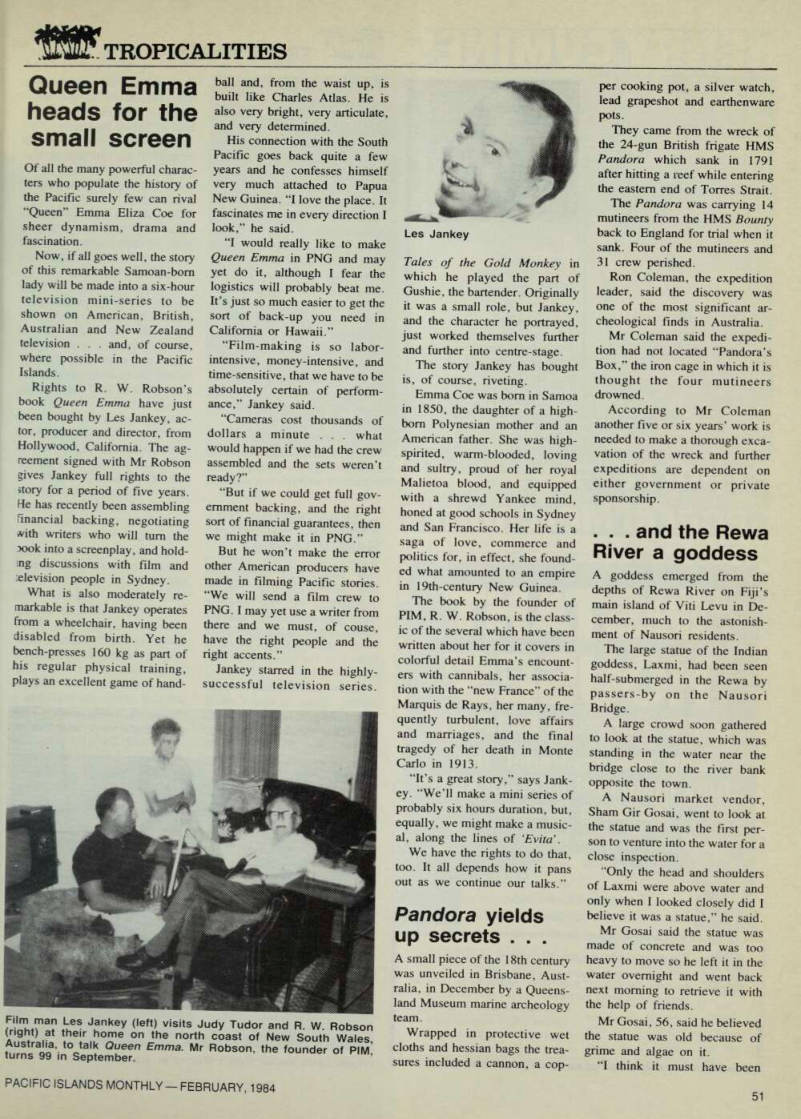
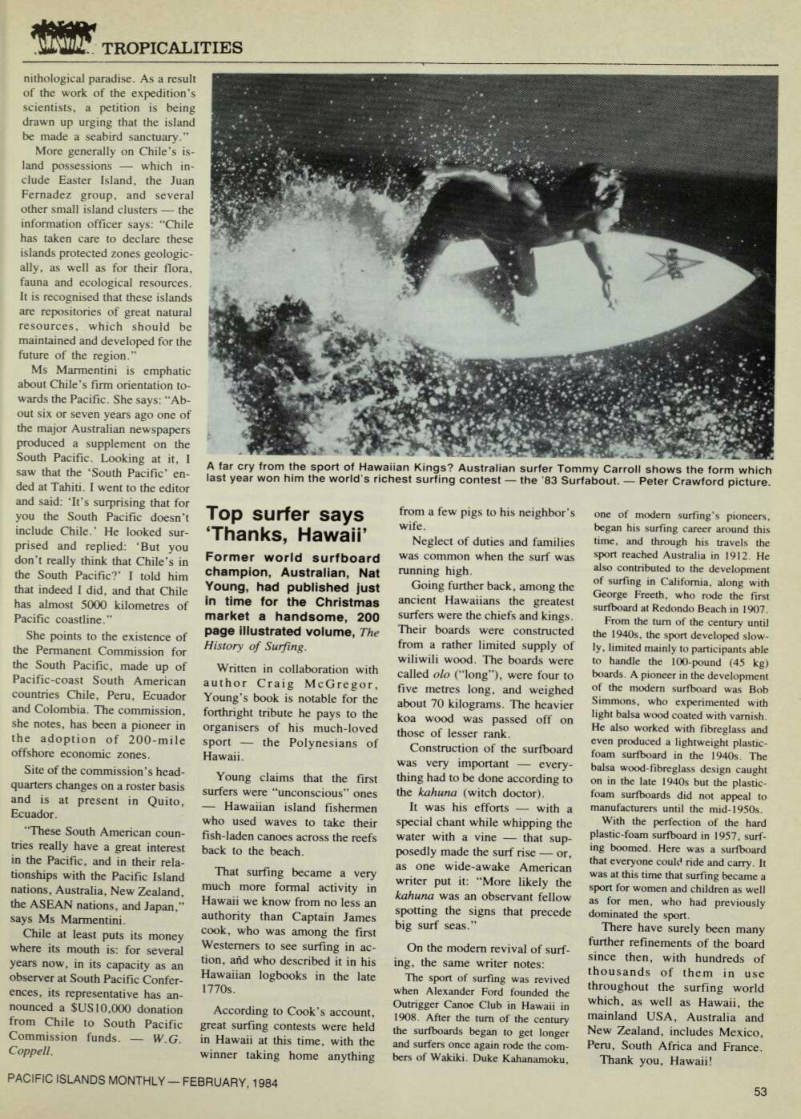
Tropicalities
Queen Emma heads for the small screen
Of all the many powerful charac ters who populate the history of the Pacific surely few can rival “Queen” Emma Eliza Coe for sheer dynamism, drama and fascination.
Now, if all goes well, the story of this remarkable Samoan-bom lady will be made into a six-hour television mini-series to be shown on American, British, Australian and New Zealand television . . . and, of course, where possible in the Pacific Islands.
Rights to R. W. Robson’s book Queen Emma have just been bought by Les Jankey, ac tor, producer and director, from Hollywood, California. The ag reement signed with Mr Robson gives Jankey full rights to the story for a period of five years.
He has recently been assembling financial backing, negotiating with writers who will turn the x>ok into a screenplay, and hold ing discussions with film and ;elevision people in Sydney.
What is also moderately re markable is that Jankey operates from a wheelchair, having been disabled from birth. Yet he bench-presses 160 kg as part of his regular physical training, plays an excellent game of hand
ball and, from the waist up, is built like Charles Atlas. He is also very bright, very articulate, and very determined.
His connection with the South Pacific goes back quite a few years and he confesses himself very much attached to Papua New Guinea. “I love the place. It fascinates me in every direction I look,” he said.
“I would really like to make Queen Emma in PNG and may yet do it, although I fear the logistics will probably beat me.
It’s just so much easier to get the sort of back-up you need in California or Hawaii.”
“Film-making is so labor intensive, money-intensive, and time-sensitive, that we have to be absolutely certain of perform ance,” Jankey said.
“Cameras cost thousands of dollars a minute . . . what would happen if we had the crew assembled and the sets weren’t ready?”
“But if we could get full gov ernment backing, and the right sort of financial guarantees, then we might make it in PNG.”
But he won’t make the error other American producers have made in filming Pacific stories.
“We will send a film crew to PNG. I may yet use a writer from there and we must, of couse, have the right people and the right accents.”
Jankey starred in the highly successful television series.
Tales of the Gold Monkey in which he played the part of Gushie, the bartender. Originally it was a small role, but Jankey, and the character he portrayed, just worked themselves further and further into centre-stage.
The story Jankey has bought is, of course, riveting.
Emma Coe was bom in Samoa in 1850, the daughter of a high born Polynesian mother and an American father. She was high spirited, warm-blooded, loving and sultry, proud of her royal Malietoa blood, and equipped with a shrewd Yankee mind, honed at good schools in Sydney and San Francisco. Her life is a saga of love, commerce and politics for, in effect, she found ed what amounted to an empire in 19th-century New Guinea.
The book by the founder of PIM, R. W. Robson, is the class ic of the several which have been written about her for it covers in colorful detail Emma’s encount ers with cannibals, her associa tion with the “new France” of the Marquis de Rays, her many, fre quently turbulent, love affairs and marriages, and the final tragedy of her death in Monte Carlo in 1913.
“It’s a great story,” says Jank ey. “We’ll make a mini series of probably six hours duration, but, equally, we might make a music al, along the lines of ‘Evita’.
We have the rights to do that, too. It all depends how it pans out as we continue our talks.”
Pandora yields
up secrets . . .
A small piece of the 18th century was unveiled in Brisbane, Aust ralia, in December by a Queens land Museum marine archeology team.
Wrapped in protective wet cloths and hessian bags the trea sures included a cannon, a cop
per cooking pot, a silver watch, lead grapeshot and earthenware pots.
They came from the wreck of the 24-gun British frigate HMS Pandora which sank in 1791 after hitting a reef while entering the eastern end of Torres Strait.
The Pandora was carrying 14 mutineers from the HMS Bounty back to England for trial when it sank. Four of the mutineers and 31 crew perished.
Ron Coleman, the expedition leader, said the discovery was one of the most significant ar cheological finds in Australia.
Mr Coleman said the expedi tion had not located “Pandora’s Box,” the iron cage in which it is thought the four mutineers drowned.
According to Mr Coleman another five or six years’ work is needed to make a thorough exca vation of the wreck and further
expeditions are dependent on
either government or private
sponsorship.
. . . and the Rewa
River a goddess
A goddess emerged from the depths of Rewa River on Fiji’s main island of Viti Levu in De cember, much to the astonish ment of Nausori residents.
The large statue of the Indian goddess, Laxmi, had been seen half-submerged in the Rewa by passers-by on the Nausori
Bridge.
A large crowd soon gathered to look at the statue, which was standing in the water near the bridge close to the river bank opposite the town.
A Nausori market vendor, Sham Gir Gosai, went to look at the statue and was the first per son to venture into the water for a
close inspection.
“Only the head and shoulders of Laxmi were above water and only when I looked closely did I believe it was a statue,” he said.
Mr Gosai said the statue was made of concrete and was too heavy to move so he left it in the water overnight and went back next morning to retrieve it with the help of friends.
Mr Gosai, 56, said he believed the statue was old because of grime and algae on it.
“I think it must have been
Film man Les Jankey (left) Visits Judy Tudor and R. W. Robson (right) at their home on the north coast of New South Wales, Australia, to talk Queen Emma. Mr Robson, the founder of PIM, turns 99 in September.
Les Jankey
brought from India by indentured laborers,” he said.
Mr Gosai’s theory of how it ended up in the river was that it must have fallen off a pontoon aout 50 years ago. Pontoons were used to carry people and goods across the river before the bridge was built and they used to berth on the bank near where the
statue reappeared.
He said that the statue could have fallen off a pontoon into deep water and, because it was so heavy no one could retrieve it.
He said that previously the water was deep around the area where the statue was found, but silt had built up close to the river bank over the years.
Mr Gosai said recent rains had caused a minor landslide on the bank and probably exposed the statue.
Mr Gosai was keeping the statue at his home and said he would build a small temple for it within a month. Pranesh Nageshwar in The Fiji Times.
Seabird heaven of
Sala y Gomez
“When the scientists first set foot on the island the birds were not in the least afraid of them. They had never seen human beings before, or been the victims of
human aggression. So they just
looked at the newcomers with
curiosity.”
Maria-Luz Marmentini, infor mation officer at the Chilean
consulate-general in Sydney,
Australia, describes in these
terms the start of a recent scien tific expedition to the unin habited, Chilean-controlled is land of Sala y Gomez.
Sala y Gomez is situated at latitude 26 deg. 28 min. S, lon gitude 105 deg. 28 min. W north, and slightly to the east, of Easter Island.
As described in Pacific Islands Pilot, it is “little more than a heap of dark brown volcanic rocks, covered in places with whitish earth and sand”.
“Its greatest height is 29.9 metres ... In the centre of the islet is a long narrow gorge, over which the sea washes in bad weather. There is little vegeta tion and no fresh water. Landing is only possible on the southern side, and then only when the sea is very calm.”
Sala y Gomez was discovered in 1793 by a Spanish commander of that name. In Chilean legend the island is “home to all the seabirds of the South Pacific”. It is also and even more notably “the place of origin of the God-creator of all the earth.
Make-Make .”
The recent expedition to the island, sponsored by the Univer sity of Chile, included in its ranks the Easter Islander Felipe Teao, who won fame for his open-boat voyage from Easter Island to the Tuamotus, made without benefit of navigational instruments.
Ms Marmentini said: “The ex pedition discovered that Sala y Gomez has an enormous wealth of seabirds it really is or-
Frigate birds are on Sala y Gomez in great numbers.
nithological paradise. As a result of the work of the expedition’s scientists, a petition is being drawn up urging that the island be made a seabird sanctuary.”
More generally on Chile’s is land possessions which in clude Easter Island, the Juan Fernadez group, and several other small island clusters the information officer says: “Chile has taken care to declare these islands protected zones geologic ally, as well as for their flora, fauna and ecological resources.
It is recognised that these islands are repositories of great natural resources, which should be maintained and developed for the future of the region.”
Ms Marmentini is emphatic about Chile’s firm orientation to wards the Pacific. She says: “Ab out six or seven years ago one of the major Australian newspapers produced a supplement on the South Pacific. Looking at it, I saw that the ‘South Pacific’ en ded at Tahiti. I went to the editor and said: ‘lt’s surprising that for you the South Pacific doesn’t include Chile.’ He looked sur prised and replied: ‘But you don’t really think that Chile’s in the South Pacific?’ I told him that indeed I did, and that Chile has almost 5000 kilometres of Pacific coastline.”
She points to the existence of the Permanent Commission for the South Pacific, made up of Pacific-coast South American countries Chile, Peru, Ecuador and Colombia. The commission, she notes, has been a pioneer in the adoption of 200-mile offshore economic zones.
Site of the commission’s head quarters changes on a roster basis and is at present in Quito, Ecuador.
“These South American coun tries really have a great interest in the Pacific, and in their rela tionships with the Pacific Island nations, Australia, New Zealand, the ASEAN nations, and Japan,” says Ms Marmentini.
Chile at least puts its money where its mouth is: for several years now, in its capacity as an observer at South Pacific Confer ences, its representative has an nounced a SUS 10,000 donation from Chile to South Pacific Commission funds. W.G.
Coppell.
Top surfer says
‘Thanks, Hawaii’
Former world surfboard champion, Australian, Nat Young, had published just in time for the Christmas market a handsome, 200 page illustrated volume, The History of Surfing.
Written in collaboration with author Craig McGregor, Young’s book is notable for the forthright tribute he pays to the organisers of his much-loved sport the Polynesians of Hawaii.
Young claims that the first surfers were “unconscious” ones Hawaiian island fishermen who used waves to take their fish-laden canoes across the reefs back to the beach.
That surfing became a very much more formal activity in Hawaii we know from no less an authority than Captain James cook, who was among the first Westerners to see surfing in ac tion, and who described it in his Hawaiian logbooks in the late 17705.
According to Cook’s account, great surfing contests were held in Hawaii at this time, with the winner taking home anything
from a few pigs to his neighbor’s wife.
Neglect of duties and families was common when the surf was running high.
Going further back, among the ancient Hawaiians the greatest surfers were the chiefs and kings.
Their boards were constructed from a rather limited supply of wiliwili wood. The boards were called 010 (“long”), were four to five metres long, and weighed about 70 kilograms. The heavier koa wood was passed off on those of lesser rank.
Construction of the surfboard was very important every thing had to be done according to the kahuna (witch doctor).
It was his efforts with a special chant while whipping the water with a vine that sup posedly made the surf rise or, as one wide-awake American writer put it: “More likely the kahuna was an observant fellow spotting the signs that precede big surf seas.”
On the modem revival of surf ing, the same writer notes: The sport of surfing was revived when Alexander Ford founded the Outrigger Canoe Club in Hawaii in 1908. After the turn of the century the surfboards began to get longer and surfers once again rode the com bers of Wakiki. Duke Kahanamoku,
one of modem surfing’s pioneers, began his surfing career around this time, and through his travels the sport reached Australia in 1912. He also contributed to the development of surfing in California, along with George Freeth, who rode the first surfboard at Redondo Beach in 1907.
From the turn of the century until the 19405, the sport developed slow ly, limited mainly to participants able to handle the 100-pound (45 kg) boards. A pioneer in the development of the modem surfboard was Bob Simmons, who experimented with light balsa wood coated with varnish.
He also worked with fibreglass and even produced a lightweight plastic foam surfboard in the 19405. The
balsa wood-fibreglass design caught
on in the late 1940 s but the plastic foam surfboards did not appeal to manufacturers until the mid-19505.
With the perfection of the hard plastic-foam surfboard in 1957, surf ing boomed. Here was a surfboard that everyone could ride and carry. It was at this time that surfing became a sport for women and children as well as for men, who had previously dominated the sport.
There have surely been many further refinements of the board since then, with hundreds of thousands of them in use
throughout the surfing world
which, as well as Hawaii, the mainland USA, Australia and New Zealand, includes Mexico, Peru, South Africa and France.
Thank you, Hawaii!
A far cry from the sport of Hawaiian Kings? Australian surfer Tommy Carroll shows the form which last year won him the world’s richest surfing contest - the ’83 Surfabout. - Peter Crawford picture.
The helper helped
himself
A man who claimed he could help a couple to have children had robbed them of their gold sovereigns after telling them to walk into the sea without looking back, Suva Court heard in December.
The man, Tulsi Ram, 28, of Lami, pleaded not guilty to the theft of seven gold sovereigns, the property of Dhani Ram, 22.
Dhani Ram told the court he had been married for a year but he and his wife, Nirmala Wati, had not been able to have children.
Tulsi Ram had introduced himself to them and told them he was Dhani Ram’s uncle and that he knew what had to be done to enable them to have a child.
He said they had to buy yaqo na and cigarettes. When this was done, they went to a spare bed room where they mixed the ya qona, served Tulsi ram, and then, on instructions from Tulsi Ram, prayed to Dakuwaqa, Fi jian god, and to Brahma, a Hindu
god.
Tulsi Ram told them he would then speak in a foreign tongue and later translate it for them.
Dhani Ram said that Tulsi Ram then started speaking in Fijian and later switched to Hin dustani, saying they were not to worry about having a child.
Tulsi Ram then gave a list of
things he required, including ya
qona, cigarettes, rum, seven eggs, two bottles of milk, a coconut, fish, camphor and turmeric.
He then came out of the “trance” and told them he would return the following morning to collect the items.
He arrived the next morning and went through a similar ritual, Dhani Ram said.
Tulsi Ram then said if there was money or gold in the house it should be given to him. They gave him seven gold sovereigns Dhani Ram said.
Tulsi Ram then told them to take the ingredients to the sea at Suva Point and to walk into the water until it reached their necks.
Dhani Ram said that he and his wife had obeyed, and when they returned home, the sovereigns
were missing.
The case was adjourned to a date in January.
Micronesia on
show in London
The British Museum’s Ethno
graphy Department opened a
new Micronesian Exhibition on December 14, 1983, at the Museum of Mankind in London.
The occasion was marked by the appearance of a delegation of three Palauans headed by the Ibedul, high chief and mayor of Koror, capital of the Republic of Palau-westemmost of the Mic ronesian islands. No more ap propriate guest of honor could have attended, for the exhibition pays tribute to his ancestors who 200 years ago befriended the shipwrecked English crew of an East India Company packet, the Antelope. The Captain of the
Antelope, Henry Wilson of
Rotherhithe on the south bank of the Thames, returned to London with many gifts bestowed on him by the people of Palau, the is lands he recorded as “The Pelews”. Many of these gifts are included in the exhibition along with portraits of the Captain, of “Abba Thulle” (the Ibedul at the time of the shipwreck) and of “Prince Lee Boo”, a 19-year-old member of the Abba Thulle’s family who was brought to Lon don by Captain Wilson to attend school and to learn the ways of the English, only to become a victim of smallpox. The prince’s tomb in the churchyard of St.
Mary’s Rotherhithe, has been a reminder of these events over all of the 200 years that have inter-
vened. The items now on ex hibit, however, are rarely seen.
Entering the Museum of Man kind’s newly decorated central foyer, the visitor is confronted by marble stairs leading directly to the Micronesian exhibit which has been titled “Pattern of Is lands: Micronesia Yesterday and Today” by the exhibition’s or ganiser, Ms Dorota Starzecka, assistant keeper. Among the is lands represented, in addition to Palau, are Yap, Truk, Ponape, and Kosrae of the Caroline Is lands and various of the Mar shall, Mariana, and Gilbert (Kiribati) islands. But it is the Palauan artifacts that stand out
including, especially, a huge
bird-shaped “tureen”, the largest
of many items made of wood and inlaid with mother-of-pearl that were given to Captain Wilson and, many years after his death, donated to the British Museum.
To balance the exhibition, the contemporary scene in Mic
ronesia is provided visually by an
impressive collection of photo
graphs which were made avail able to the Museum for this occasion. Many of the photos were taken by former Trust Ter ritory of the Pacific Islands resi dents Richard and Margaret Kan ost, Royal Gifford, George Calli son, Margo and Janice Vitarelli, and Ginger Curtis Wilbur. Pro minence was also given to the professional work of H.W. Reed of Guam whose expert photo graphy covered a wide spectrum of Micronesia. Thanks to Robert and Hera Owen, longtime resi dents of Palau, the unique work of Palauan artist Charlie Gibbons was also featured among the
displays.
Visitors to the exhibition, which continues for at least six months into 1984, would be well advised to also attend at a nearby theatre the musical Poppy which, albeit humorously, tells the story of the English United East India Company’s activities and takes the audience on a voyage to India and China not unlike the voyage of the Antelope that opened the door to Micronesia for the
English. This highly acclaimed
musical/pantomime is also scheduled to be seen on Broad way, and one can hope, might find its way into some of the theatres of the Pacific Basin.
To see the exhibition itself, “Pattern of Islands”, one must, alas, leave the islands and travel to London. But then, the primary objective of the exhibit, to in form the people of London and England and the millions of peo ple who visit here, will be ac complished and the term Mic ronesia may take on a new mean ing — instead of the literal “Lit tle Islands” the new meaning may translate to “entralling is lands” worthy of far more re spectful attention than they have received over most of the 200 years since Captain Wilson stumbled upon them and came away with his treasures. Had those treasures, once labelled as mere “curiosities” (as were even Captain Cook’s), been lost they could hardly be replaced, not even by the competent craftsmen still at work employing the tradi tional art forms of the islands.
That they have been so well preserved in the past and are now, if only for a relatively short time, so well displayed, merits a hearty “well done” to the British
Museum’s Ethnography Depart
ment, and especially to Ms Star zecka who particularly ack nowledged the support and en couragement she received from retired London artist Nevil Dickin.
Among the most interested guests at the reception on open ing day was the Reverend Nicholas Richards of St. Mary’s whose Parish of Rotherhithe even now is making plans to observe 1984 as the bicentennial year of Prince Lee Boo’s stay in London, a stay that will not be
forgotten.
Daniel J. Peacock
in London.
Advertisements & other items, pp. 52-54 (1 item)
Houses’
Jl
LOCAL AGENTS AND
REPRESENTATION
428 George St., Sydney.
Cables: Henco Sydney.
G.P.O. Box 3949.
Telephone: 232 5377.
For specialised and personalised buying service throughout the Pacific Islands and the East.
Resident Agents in other Pacific Territories.
PAPUA NEW GUINEA
RABAUL: M. & C. Seeto, P.O. Box 131, Rabaul.
Telephone 92 2919.
MADANG: W. Double, P.O. Box 22, Madang.
Telephone 82 2696.
FIJI
K. Witherington Ltd., P.O. Box 293, Suva.
Telephone 22 356.
VANUATU
John Lum & Associates, P.O. Box 65, Santo.
Telephone 329.
SOLOMON ISLANDS
Mr. Tom Lo, P.O. Box 327, Honiara.
Telephone 399 8 18
HOUSES’
and Commercial Buildings
with Therma-Panelf the
fully insulated inter-locking
Building System
Cyclone rated
W*** 10UHo H
Economical • Fast The building you can assemble George Hudson Homes (Aust.) pty. Ltd. 186 Hume Highway Cabramatta NSW 2166 Australia. Tel: (02) 727 9066. Telex: AA25800 Post coupon for details and prices.
Name.
Address .Tel:
Stay at Aggie Grey’s . . . the South Pacific’s
legendary hotel.
Situated right in the heart of Western Samoa. Enjoy Polynesian-style friendliness and service, in cool surroundings, superb entertainment and food.
Magnificent white sand beaches only a short drive away. Airconditioned rooms, swimming pool and full bar facilities.
Bookings through Union Steamship Company of NZ, Pan Am, Air New Zealand or direct to Aggie Grey’s, Apia, Western Samoa. Cables: ‘AGGIES'Apia.
Esmeralda wins hearts
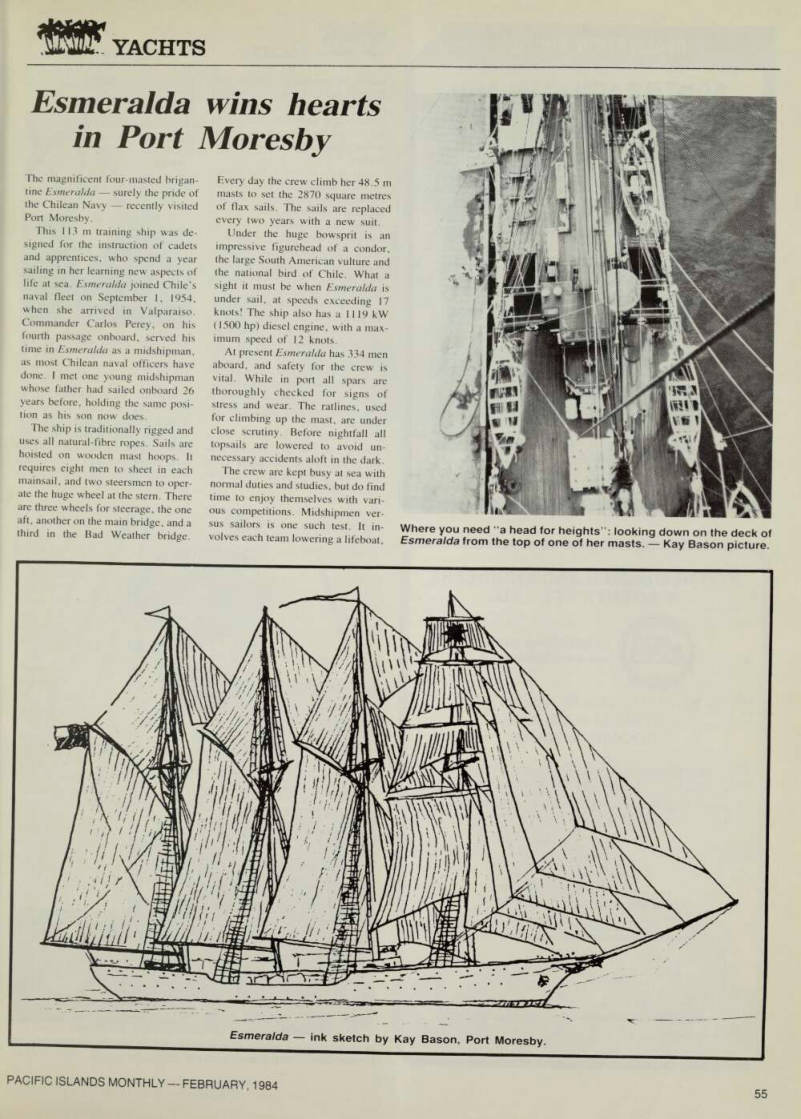
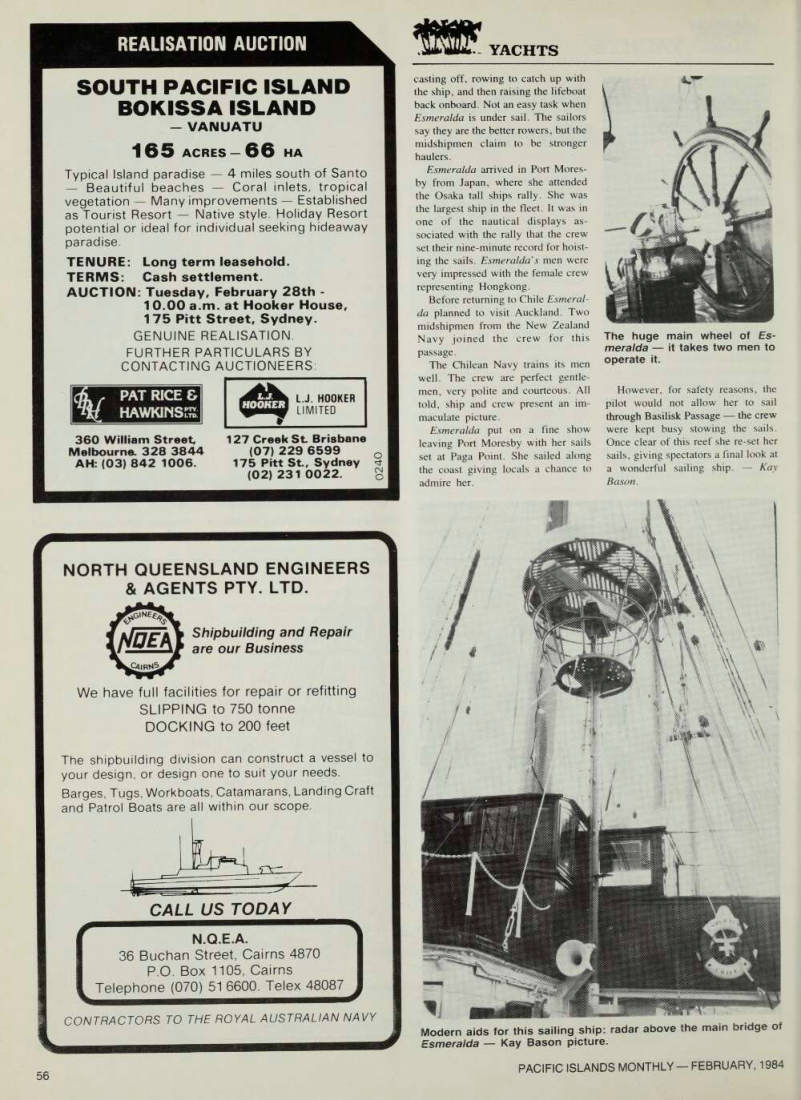
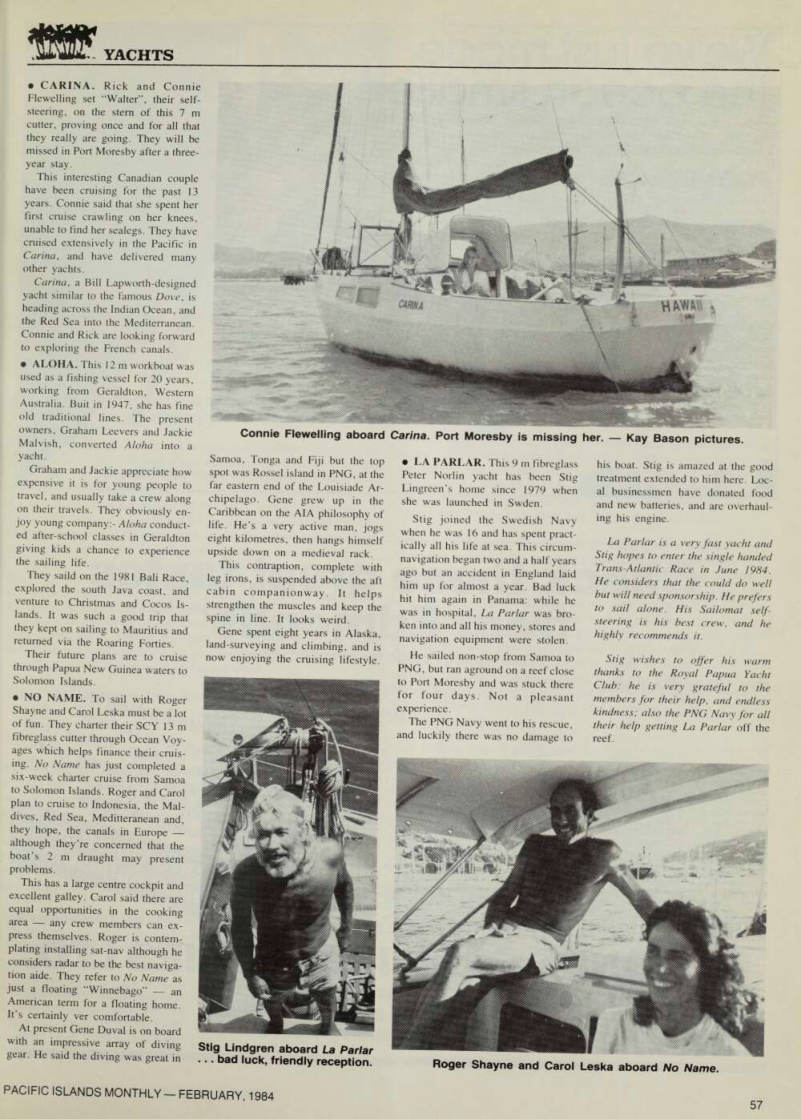
Yachts
Esmeralda wins hearts in Port Moresby
The magnificent four-masted brigan tine Esmeralda surely the pride of the Chilean Navy recently visited
Port Moresby.
This 113 m training ship was de signed for the instruction of cadets and apprentices, who spend a year sailing in her learning new aspects of life at sea. Esmeralda joined Chile’s naval fleet on September 1, 1954, when she arrived in Valparaiso.
Commander Carlos Percy, on his fourth passage onboard, served his time in Esmeralda as a midshipman, as most Chilean naval officers have done. I met one young midshipman whose father had sailed onboard 26 years before, holding the same posi tion as his son now does.
The ship is traditionally rigged and
uses all natural-fibre ropes. Sails are hoisted on wooden mast hoops. It requires eight men to sheet in each mainsail, and two steersmen to oper ate the huge wheel at the stem. There are three wheels for steerage, the one aft, another on the main bridge, and a third in the Bad Weather bridge.
Every day the crew climb her 48.5 m masts to set the 2870 square metres of flax sails. The sails are replaced every two years with a new suit.
Under the huge bowsprit is an impressive figurehead of a condor, the large South American vulture and the national bird of Chile. What a sight it must be when Esmeralda is under sail, at speeds exceeding 17 knots! The ship also has a 1119 kW (1500 hp) diesel engine, with a max imum speed of 12 knots.
At present Esmeralda has 334 men aboard, and safety for the crew is vital. While in port all spars are thoroughly checked for signs of stress and wear. The ratlines, used for climbing up the mast, are under close scrutiny. Before nightfall all topsails are lowered to avoid un necessary accidents aloft in the dark.
The crew are kept busy at sea with normal duties and studies, but do find time to enjoy themselves with vari ous competitions. Midshipmen ver sus sailors is one such test. It in volves each team lowering a lifeboat.
Where you need "a head for heights”: looking down on the deck of Esmeralda from the top of one of her masts. - Kay Bason picture.
Esmeralda - ink sketch by Kay Bason, Port Moresby.
casting off, rowing to catch up with the ship, and then raising the lifeboat back onboard. Not an easy task when Esmeralda is under sail. The sailors say they are the better rowers, but the midshipmen claim to be stronger haulers.
Esmeralda arrived in Port Mores by from Japan, where she attended the Osaka tall ships rally. She was the largest ship in the fleet. It was in one of the nautical displays as sociated with the rally that the crew set their nine-minute record for hoist ing the sails. Esmeralda’s men were very impressed with the female crew
representing Hongkong.
Before returning to Chile Esmeral da planned to visit Auckland. Two midshipmen from the New Zealand Navy joined the crew for this passage.
The Chilean Navy trains its men well. The crew are perfect gentle men, very polite and courteous. All told, ship and crew present an im maculate picture.
Esmeralda put on a fine show leaving Port Moresby with her sails set at Paga Point. She sailed along the coast giving locals a chance to admire her.
However, for safety reasons, the pilot would not allow her to sail through Basilisk Passage the crew were kept busy stowing the sails.
Once clear of this reef she re-set her sails, giving spectators a final look at a wonderful sailing ship. Kay Bason.
The huge main wheel of Es meralda - it takes two men to operate it.
Modern aids for this sailing ship: radar above the main bridge of Esmeralda - Kay Bason picture.
• CARINA. Rick and Connie Flewelling set “Walter”, their self steering, on the stem of this 7 m cutter, proving once and for all that they really are going. They will be missed in Port Moresby after a three year stay.
This interesting Canadian couple have been cruising for the past 13 years. Connie said that she spent her first cruise crawling on her knees, unable to find her sealegs. They have cruised extensively in the Pacific in Carina, and have delivered many other yachts.
Carina, a Bill Lapworth-designed yacht similar to the famous Dove, is heading across the Indian Ocean, and the Red Sea into the Mediterranean.
Connie and Rick are looking forward to exploring the French canals. • ALOHA. This 12 m workboat was used as a fishing vessel for 20 years, working from Geraldton, Western Australia. Buit in 1947, she has fine old traditional lines. The present owners, Graham Lee vers and Jackie Malvish, converted Aloha into a yacht.
Graham and Jackie appreciate how expensive it is for young people to travel, and usually take a crew along on their travels. They obviously en joy young company:- Aloha conduct ed after-school classes in Geraldton giving kids a chance to experience the sailing life.
They saild on the 1981 Bali Race, explored the south Java coast, and venture to Christmas and Cocos Is lands. It was such a good trip that they kept on sailing to Mauritius and returned via the Roaring Forties.
Their future plans are to cruise through Papua New Guinea waters to Solomon Islands. • NO NAME. To sail with Roger Shayne and Carol Leska must be a lot of fun. They charter their SCY 13 m
fibreglass cutter through Ocean Voy
ages which helps finance their cruis ing. No Name has just completed a six-week charter cruise from Samoa to Solomon Islands. Roger and Carol plan to cruise to Indonesia, the Mal dives, Red Sea, Meditteranean and,
they hope, the canals in Europe
although they’re concerned that the boat’s 2 m draught may present problems.
This has a large centre cockpit and excellent galley. Carol said there are equal opportunities in the cooking area any crew members can ex press themselves. Roger is contem
plating installing sat-nav although he
considers radar to be the best naviga tion aide. They refer to No Name as just a floating “Winnebago” an American term for a floating home.
It’s certainly ver comfortable.
At present Gene Duval is on board with an impressive array of diving gear. He said the diving was great in
Samoa, Tonga and Fiji but the top spot was Rossel island in PNG, at the far eastern end of the Louisiade Ar chipelago. Gene grew up in the Caribbean on the AIA philosophy of life. He’s a very active man, jogs eight kilometres, then hangs himself upside down on a medieval rack.
This contraption, complete with leg irons, is suspended above the aft cabin companionway. It helps strengthen the muscles and keep the spine in line. It looks weird.
Gene spent eight years in Alaska, land-surveying and climbing, and is now enjoying the cruising lifestyle.
• LA PARLAR. This 9 m fibreglass Peter Norlin yacht has been Stig Lingreen’s home since 1979 when she was launched in Swden.
Stig joined the Swedish Navy
when he was 16 and has spent pract ically all his life at sea. This circum navigation began two and a half years ago but an accident in England laid him up for almost a year. Bad luck hit him again in Panama; while he was in hospital. La Parlar was bro ken into and all his money, stores and navigation equipment were stolen.
He sailed non-stop from Samoa to PNG, but ran aground on a reef close to Port Moresby and was stuck there for four days. Not a pleasant experience.
The PNG Navy went to his rescue, and luckily there was no damage to
his boat. Stig is amazed at the good treatment extended to him here. Loc al businessmen have donated food and new batteries, and are overhaul
ing his engine.
La Parlar is a very fast yacht and Stig hopes to enter the single handed Trans-Atlantic Race in June 1984.
He considers that the could do well but will need sponsorship. He prefers to sail alone. His Sailomat self steering is his best crew, and he highly recommends it.
Stig wishes to offer his warm thanks to the Royal Papua Yacht Club: he is very grateful to the members for their help, and endless kindness; also the PNG Navy for all their help getting La Parlar off the reef.
Stig Lindgren aboard La Parlar ... bad luck, friendly reception.
Connie Flewelling aboard Carina. Port Moresby is missing her. - Kay Bason pictures.
Roger Shayne and Carol Leska aboard No Name.
Advertisements & other items, pp. 56-58 (1 item)
Bokissa Island
REALISATION AUCTION
SOUTH PACIFIC ISLAND
- VANUATU
165 ACRES - 66 HA
Typical Island paradise 4 miles south of Santo Beautiful beaches Coral inlets, tropical vegetation Many improvements Established as Tourist Resort Native style. Holiday Resort potential or ideal for individual seeking hideaway paradise.
TENURE: Long term leasehold.
TERMS: Cash settlement.
AUCTION: Tuesday, February 28th - 1 0.00 a.m. at Hooker House, 175 Pitt Street, Sydney.
GENUINE REALISATION.
FURTHER PARTICULARS BY
CONTACTING AUCTIONEERS:
360 William Street 127 Creek St Brisbane Melbourne. 328 3844 (07) 229 6599 AH: (03) 842 1006. 175 Pitt St, Sydney (02) 231 0022.
NORTH QUEENSLAND ENGINEERS
& AGENTS PTY. LTD.
We have full facilities for repair or refitting SLIPPING to 750 tonne DOCKING to 200 feet The shipbuilding division can construct a vessel to your design, or design one to suit your needs.
Barges, Tugs, Workboats, Catamarans, Landing Craft and Patrol Boats are all within our scope.
CALL US TODAY
I N.Q.E.A.
36 Buchan Street, Cairns 4870 P.O. Box 1105, Cairns Telephone (070) 51 6600. Telex 48087 J
CONTRACTORS TO THE ROYAL AUSTRALIAN NAVY
kjnck\ Shipbuilding and Repair jiUL f\h are our Business
We’ve just made
the ocean smaller!
Polynesia Line's new MS Polynesia 550-container ship provides regular monthly cargo service between Papeete, Pago Pago and Apia in the South Pacific, and Long Beach and Oakland on the US Pacific Coast.
POLYNESIA LINE
Interocean Steamship Corporation General Agent q£ 9 <2 AS K O 3* 3 5* v Mofgan-V&mex Boite Postal 449 Papeete, Tom CoWe' , MOf®r Pago inc. 1478 Serving Polynesia is all we do—and we do it better!
Check these great tastes
from Edmonds*
Serving the Pacific for over 100 years
Products Available
Baking Powder Custard Jelly Pancake Mix Pikelet Mix Beef Stock Chicken Stock Scone Mix Pastry Mix Donut Mix Sponge Mix Bun Mix Soups Pickles Preserves Pkt Cake Mixes Mixed Fruit for Baking Cheesecake Peanut Butter Sandwich Spreads Rice Risotto Quick Snacks Imitation Cherries Glace Cherries Cocktail Cherries in maraschino oil Canned Mushrooms Curry Powder Breadcrumbs Glucose D Vita Crunch Breakfast Cereals Fla-vor-ice (liquid ice block) Flour Icing Sugar Mix n Bake Pastries Peanuts Coconut Rice packs Sugar Sachets Soya Oil Honey Cordials Cornflour Cut Peel Crystallised Ginger Pet Food Detergent Disinfectant Ant Killer Our Famous Brands u9 h ° ut
b' e 03 ’ Miu®
V . a na i O " 3 iciah 03 ’
F ■ ‘'-tern S^&o^°v*^ atU ’
is* 11 ?Guinea^
Co°*\, . ICI
Proudly manufactured in New Zealand by
EDMONDS FOOD INDUSTRIES LTD
*Ask for our
PC Box 27-249 Mt Roskill
AUCKLAND NZ
Brochure Factory 83 Telephone 698-167 Cable Address Sunshine Telex Address 21690
Illustrated product catalogue
and export price list.
Bankers National Bank Year Established 1881 Export Manager Tony Babbage incl W F Tucker & Company Limited
Press
From the
Islands
The Papua New Guinea Post-Courier, Port Moresby A member of a gang which robbed a liquor shop at Wau in the Morobe Province has been shot dead with an arrow by a security guard. Police said the nine-man gang held up the security guard at gunpoint. They broke in and stole liquor. One of the gang members who was the last to leave was shot with an arrow under his left armpit.
He collapsed and died 25 metres from the shop. His accomplice escaped from the scene. The manager of the Wau Hotel, Mr Kopas Spori, said “The situation in Wau is very frightening. The people here are living in constant fear.”
Part of a letter in The Fiji Times from an Australian resident, Mr John Cougle, who is highly critical of Fiji’s investment incentive climate.
Fiji is attempting to lure Australian businesses and businessmen with descriptions of the “wonderful opportunities” that exist in “parad ise. But the government of “paradise” appears to think that everyone who falls into the trap of opening a business in Fiji does so for one of two reasons; permanent residence with a work permit or citizenship. There is no provision for an investor to come and go as he pleases, to supervise his investment which certainly needs a lot of supervision. And as for “free flow of funds” for investors, forget it.
Once the investment is in the country the onus is on you to prove that it s yours to get out but it can be done sooner or later, provided you are not in a rush. This must be the greatest farce publicised by the Economic Development Board. All one can say to Fiji is: “Don’t clean up your own back yard by throwing muck into your neighbor’s.
Help the investor, and he will help you. Hinder him, and your industrial and rural development programs will be delayed, if not cancelled ’ as they have been in our case.
Broadcast news item from Radio Vanuatu, Port Vila The Vanuatu Women in Business Assocation has decided to change its name. It will now be known as Association Blong ol Woman Efate.
Percy Chatterton, in his weekly column in The Times of Papua New Guinea, criticises official reaction to problems in the Bomana jail near Port Moresby Of all recent news items the one which cries out loudest for comment is that the Bomana Corrective Institution is to be closed to the outside world. All visitors, including relatives, priests and pastors, are to be excluded and Sunday church services are banned, there is obviously a crisis out there; but this way of meeting it is surely a policy of despair and perhaps a prelude to disaster.
Marianas Variety News and Views, Saipan, Mariana Islands We understand that a bunch of folks have been sent from here to Taiwan to study slaughter-house construction. Makes no sense to us since we don’t have Chinese pigs here.
The Flotsam and Jetsam co tmn in The Fiji Times Hundreds of people in the Suva-Nausori area were excited just before Christmans about “a shining UFO” flying slowly across the skies one morning about 1300 metres high. Those who have lived in Nadi at irst laughed it off as a weather balloon. But a spokesman from the
J Laucala Bay weather station reported that it was not a weather I balloon. ‘To us it looks like a parachute with a platform at the bottom ’ and with bright, shining lights all round,” the spokesman said. The “shining UFO” was first sighted over Nausori Airport about 9 a.m., and then it slowly floated over the Suva city. The only plausible explanation was that it was an object put up for Christmas season advertising. But this could not be confirmed.
Uni Tavur, Port Moresby, the newsletter of the University of Papua New guinea Fifteen years it’s a long wait for a pay rise. The two longest serving ancillary cooks at the university mess have been working for 15 years without any pay increase. Thomas Buna and Kawgo Daware said it was about time ancillary cooks had promotions and pay increases.
The Fiji Times, Suva The prime minister, Ratu Sir Kamisese Mara, has set up a team to review medical reports on some of his cabinet ministers. The team, made up mainly of suva doctors, decides if ministers are medically fit to continue in their portfolios. The Fiji Times was told. Although two cabinet ministers had been cleared by the colonial War Memorial Hospital, their medical reports were “reviewed” by the team. A member of the team confirmed that not all ministers were medically examined or had their medical histories reviewed.
Maureen Mopio, writing in The Times of Papua New Guinea
Port Moresby
Trendy Papua New Guinean women are now getting their hair cut in the punk style worn by rock stars. In recent months women have been wearing the sort of softer curly type of hair called the “wet perm look” and costing up to 40 kina a time at the hairdressers. But now hair is getting hard again, and some women in Port Moresby with the grace jane” style wear their hair in two-tone colors.
Parts of a letter in The Times of Papua New Guinea, Port Moresby, in which Mr Joe Chan describes the aftermath to a critical speech he gave to a handcraft marketing seminar On arrival at an artifact shop with two friends our reception left a lot to be desired. An item was selected and after carefully inspecting the item and price, a firm decision was made to purchase. The only lady behind the counter commented “That will cost you 40 kina because of the embarrassment you have caused me in Port Moresby.” The item was clearly marked 20 kina, and this clearly reflected a colonialist attitude. This was a flagrant and discriminatory breach of commercial law and consumer protection. It is not felt that the people of this town would normally extend this form of discourtesy to nationals from other provinces.
The Papua New Guinea Post-Courier, Port Moresby A ban on garbage collection imposed on 3000 people in Madang is working wonders, according to the president of the Madang Town Council, Mr Jacob Wama. The ban was imposed on people who had not paid their garbage fees. Mr Wama said people were turning up to pay their debts. Some provincial government leaders and senior public servants still had to pay debts totalling about 100,000 kina, he said. He threatened to make public the names of debtors who did not pay what they owed.
From the government newspaper Tam Tam, Port-Vlla, Vanuatu, and published under the heading “Government officers attacked”.
The Banks and Torres Island government headquarters at Sola in Vanualava has once again this year come under heavy attack from millions of bloodthirsty mosquitoes. Mr George Palmer, the treasurer, is reported as saying: “It is impossible to either work in the offices or sleep at night. Mosquito nets are useless the mosquitoes just drill through them to get to the skin”. Nearby Arep school is also badly affected, Mr Palmer says. He confirms that local authorities are helpless against the mosquitoes. Any help to solve the problem would be much appreciated, he says.
Advertisements & other items, p. 59 (1 item)
59
3 ACIFIC ISLANDS MONTHLY FEBRUARY, 1984
From The Islands Press
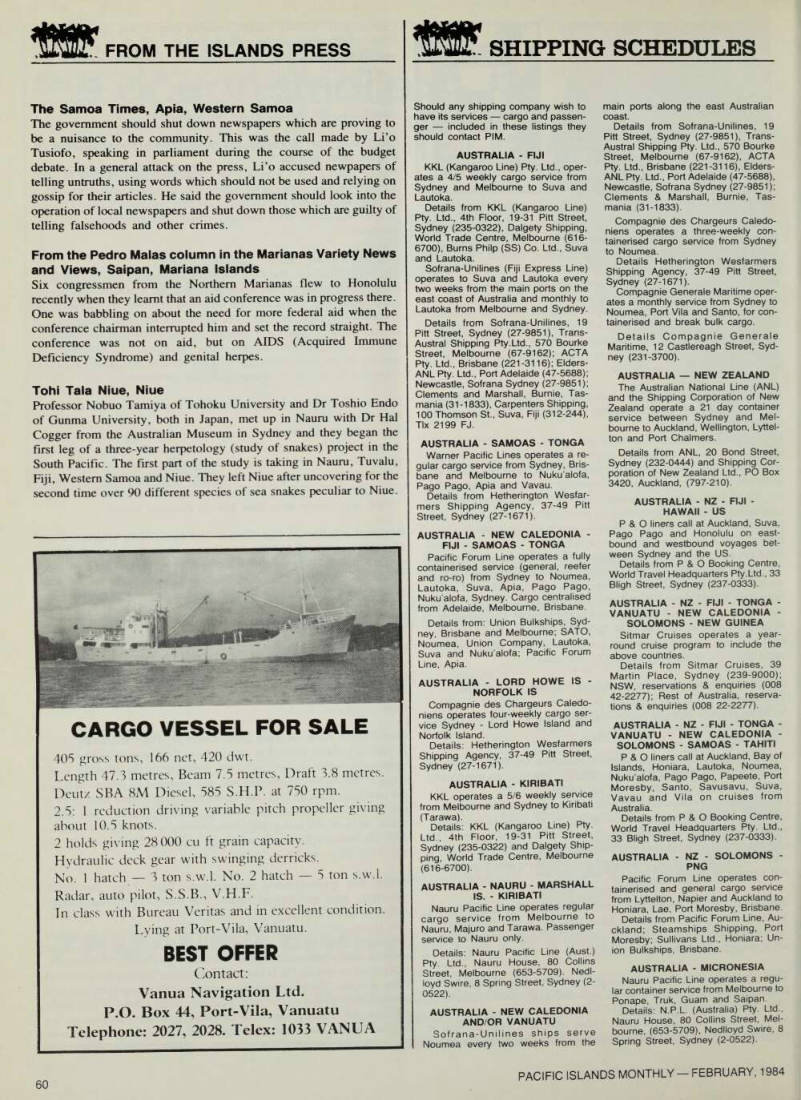
The Samoa Times, Apia, Western Samoa The government should shut down newspapers which are proving to be a nuisance to the community. This was the call made by Li’o Tusiofo, speaking in parliament during the course of the budget debate. In a general attack on the press, Li’o accused newpapers of telling untruths, using words which should not be used and relying on gossip for their articles. He said the government should look into the operation of local newspapers and shut down those which are guilty of telling falsehoods and other crimes.
From the Pedro Males column in the Marianas Variety News and Views, Saipan, Mariana Islands Six congressmen from the Northern Marianas flew to Honolulu recently when they learnt that an aid conference was in progress there.
One was babbling on about the need for more federal aid when the conference chairman interrupted him and set the record straight. The conference was not on aid, but on AIDS (Acquired Immune
Deficiency Syndrome) and genital herpes.
Tohi Tala Niue, Niue Professor Nobuo Tamiya of Tohoku University and Dr Toshio Endo of Gunma University, both in Japan, met up in Nauru with Dr Hal Cogger from the Australian Museum in Sydney and they began the first leg of a three-year herpetology (study of snakes) project in the South Pacific. The first part of the study is taking in Nauru, Tuvalu, Fiji, Western Samoa and Niue. They left Niue after uncovering for the second time over 90 different species of sea snakes peculiar to Niue.
Shipping Schedules
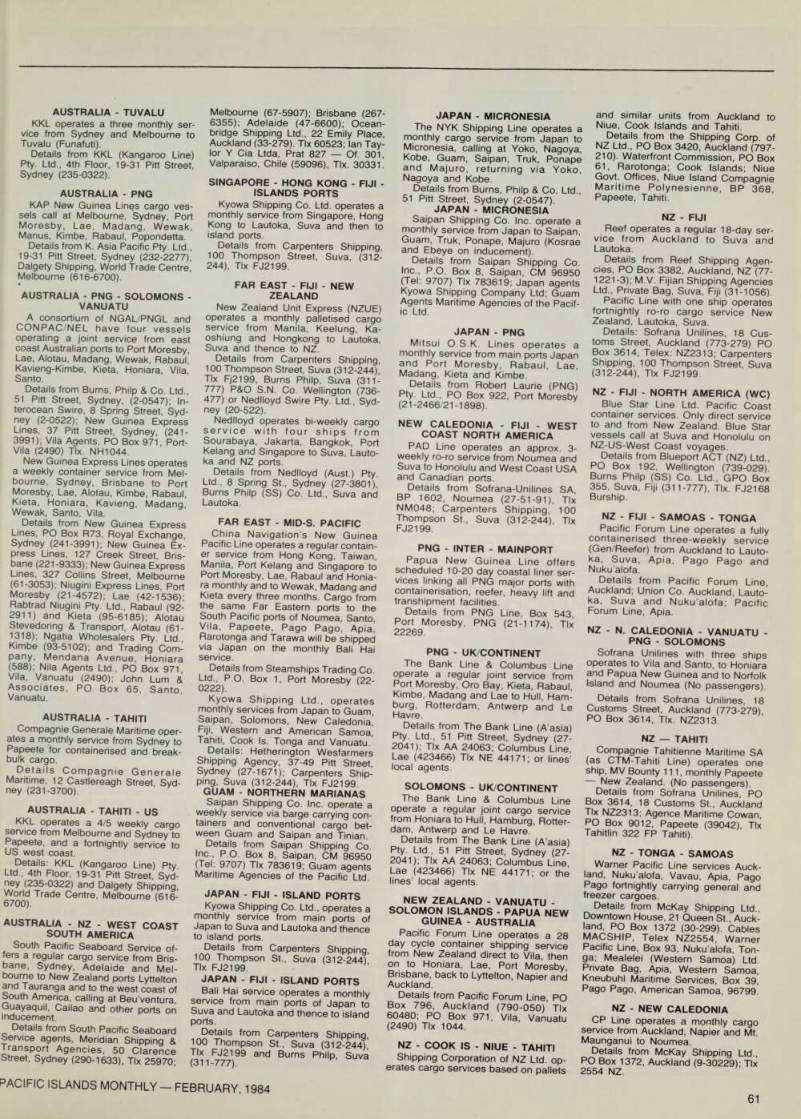
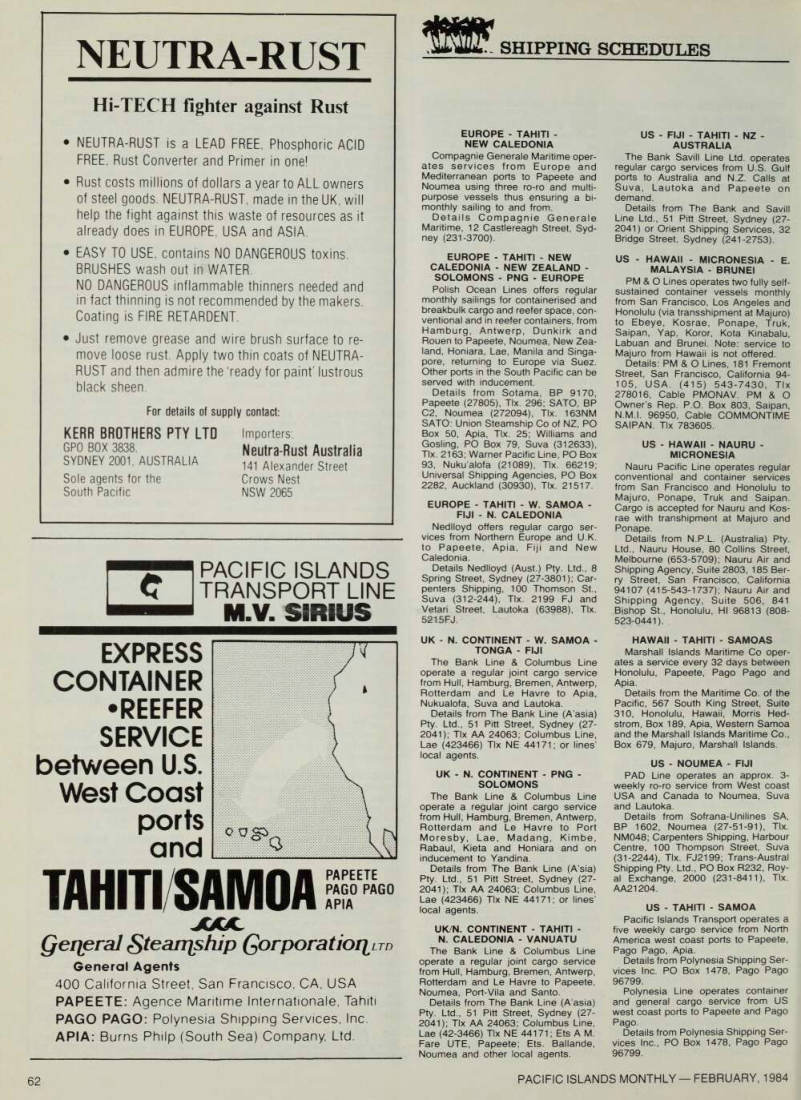
Should any shipping company wish to have its services cargo and passen ger included in these listings they should contact PIM.
Australia - Fiji
KKL (Kangaroo Line) Pty. Ltd., oper ates a 4/5 weekly cargo service from Sydney and Melbourne to Suva and Lautoka.
Details from KKL (Kangaroo Line) Pty. Ltd., 4th Floor, 19-31 Pitt Street, Sydney (235-0322), Dalgety Shipping, World Trade Centre, Melbourne (616- 6700), Burns Philp (SS) Co. Ltd., Suva and Lautoka.
Sofrana-Unilines (Fiji Express Line) operates to Suva and Lautoka every two weeks from the main ports on the east coast of Australia and monthly to Lautoka from Melbourne and Sydney.
Details from Sofrana-Unilines, 19 Pitt Street, Sydney (27-9851), Trans- Austral Shipping f%.Ltd., 570 Bourke Street, Melbourne (67-9162); ACTA Pty. Ltd., Brisbane (221-3116); Elders- ANL Pty. Ltd., Port Adelaide (47-5688); Newcastle, Sofrana Sydney (27-9851); Clements and Marshall, Burnie, Tas mania (31-1833), Carpenters Shipping, 100 Thomson St., Suva, Fiji (312-244), Tlx 2199 FJ.
Australia - Samoas - Tonga
Warner Pacific Lines operates a re gular cargo service from Sydney, Bris bane and Melbourne to Nuku’alofa, Pago Pago, Apia and Vavau.
Details from Hetherington Wesfar mers Shipping Agency, 37-49 Pitt Street, Sydney (27-1671).
Australia - New Caledonia -
Fiji - Samoas - Tonga
Pacific Forum Line operates a fully containerised service (general, reefer and ro-ro) from Sydney to Noumea, Lautoka, Suva, Apia, Pago Pago, Nukualofa, Sydney. Cargo centralised from Adelaide, Melbourne, Brisbane.
Details from: Union Bulkships, Syd ney, Brisbane and Melbourne; SATO, Noumea, Union Company, Lautoka, Suva and Nuku’alofa; Pacific Forum Line, Apia.
Australia - Lord Howe Is -
Norfolk Is
Compagnie des Chargeurs Caledo niens operates four-weekly cargo ser vice Sydney - Lord Howe Island and Norfolk Island.
Details: Hetherington Wesfarmers Shipping Agency, 37-49 Pitt Street,
Sydney (27-1671).
Australia - Kiribati
KKL operates a 5/6 weekly service from Melbourne and Sydney to Kiribati (Tarawa).
Details: KKL (Kangaroo Line) Pty.
Ltd., 4th Floor, 19-31 Pitt Street, Sydney (235-0322) and Dalgety Ship ping, World Trade Centre, Melbourne (616-6700).
Australia - Nauru - Marshall
Is. - Kiribati
Nauru Pacific Line operates regular cargo service from Melbourne to Nauru. Majuro and Tarawa. Passenger service to Nauru only.
Details: Nauru Pacific Line (Aust.) Pty. Ltd., Nauru House, 80 Collins Street, Melbourne (653-5709). Nedl loyd Swire, 8 Spring Street, Sydney (2- 0522).
Australia - New Caledonia
And/Or Vanuatu
Sofrana-Unilines ships serve Noumea every two weeks from the
main ports along the east Australian coast.
Details from Sofrana-Unilines, 19 Pitt Street, Sydney (27-9851), Trans- Austral Shipping Pty. Ltd., 570 Bourke Street, Melbourne (67-9162), ACTA Pty. Ltd., Brisbane (221-3116), Elders- ANL Pty. Ltd., Port Adelaide (47-5688), Newcastle, Sofrana Sydney (27-9851); Clements & Marshall, Burnie, Tas mania (31-1833).
Compagnie des Chargeurs Caledo niens operates a three-weekly con tainerised cargo service from Sydney to Noumea.
Details Hetherington Wesfarmers Shipping Agency, 37-49 Pitt Street, Sydney (27-1671).
Compagnie Generale Maritime oper ates a monthly service from Sydney to Noumea, Port Vila and Santo, for con tainerised and break bulk cargo.
Details Compagnie Generale Maritime, 12 Castlereagh Street, Syd ney (231-3700).
Australia New Zealand
The Australian National Line (ANL) and the Shipping Corporation of New Zealand operate a 21 day container service between Sydney and Mel bourne to Auckland, Wellington, Lyttel ton and Port Chalmers.
Details from ANL, 20 Bond Street, Sydney (232-0444) and Shipping Cor poration of New Zealand Ltd., PO Box 3420, Auckland, (797-210).
Australia - Nz - Fiji -
Hawaii - Us
P & O liners call at Auckland, Suva, Pago Pago and Honolulu on east bound and westbound voyages bet ween Sydney and the US.
Details from P & O Booking Centre, World Travel Headquarters Pty.Ltd., 33 Bligh Street, Sydney (237-0333).
AUSTRALIA - NZ - FIJI - TONGA -
Vanuatu - New Caledonia -
Solomons - New Guinea
Sitmar Cruises operates a year round cruise program to include the above countries.
Details from Sitmar Cruises, 39 Martin Place, Sydney (239-9000); NSW, reservations & enquiries (008 42-2277); Rest of Australia, reserva tions & enquiries (008 22-2277).
AUSTRALIA - NZ - FIJI - TONGA -
Vanuatu - New Caledonia -
Solomons - Samoas - Tahiti
P & O liners call at Auckland, Bay of Islands, Honiara, Lautoka, Noumea, Nukualofa, Pago Pago, Papeete, Port Moresby, Santo, Savusavu, Suva, Vavau and Vila on cruises from Australia.
Details from P & O Booking Centre, World Travel Headquarters Pty. Ltd., 33 Bligh Street, Sydney (237-0333).
Australia - Nz - Solomons -
Png
Pacific Forum Line operates con tainerised and general cargo service from Lyttelton, Napier and Auckland to Honiara, Lae, Port Moresby, Brisbane.
Details from Pacific Forum Line, Au ckland; Steamships Shipping, Port Moresby: Sullivans Ltd., Honiara; Un ion Bulkships, Brisbane.
Australia - Micronesia
Nauru Pacific Line operates a regu lar container service from Melbourne to Ponape, Truk, Guam and Saipan.
Details: N.P.L. (Australia) Pty. Ltd., Nauru House, 80 Collins Street, Mel bourne, (653-5709), Nedlloyd Swire, 8 Spring Street, Sydney (2-0522).
Australia - Tuvalu
KKL operates a three monthly ser vice from Sydney and Melbourne to Tuvalu (Funafuti).
Details from KKL (Kangaroo Line) Pty. Ltd., 4th Floor, 19-31 Pitt Street, Sydney (235-0322).
Australia - Png
KAP New Guinea Linqs cargo ves sels call at Melbourne, Sydney, Port Moresby, Lae, Madang, Wewak, Manus, Kimbe, Rabaul, Popondetta.
Details from K. Asia Pacific Pty. Ltd., 19-31 Pitt Street, Sydney (232-2277), Dalgety Shipping, World Trade Centre, Melbourne (616-6700).
Australia - Png - Solomons -
Vanuatu
A consortium of NGAL/PNGL and CONPAC/NEL have four vessels operating a joint service from east coast Australian ports to Port Moresby, Lae, Alotau, Madang, Wewak, Rabaul, Kavieng-Kimbe, Kieta, Honiara, Vila, Santo.
Details from Burns, Philp & Co. Ltd., 51 Pitt Street, Sydney, (2-0547); In terocean Swire, 8 Spring Street, Syd ney (2-0522); New Guinea Express Lines, 37 Pitt Street, Sydney, (241- 3991); Vila Agents, PO Box 971, Port- Vila (2490) Tlx. NH1044.
New Guinea Express Lines operates a weekly container service from Mel bourne, Sydney, Brisbane to Port Moresby, Lae, Alotau, Kimbe, Rabaul, Kieta, Honiara, Kavieng, Madang, Wewak, Santo, Vila.
Details from New Guinea Express Lines, PO Box R 73, Royal Exchange, Sydney (241-3991); New Guinea Ex press Lines, 127 Creek Street, Bris bane (221-9333); New Guinea Express Lines, 327 Collins Street, Melbourne (61-3053); Niugini Express Lines, Port Moresby (21-4572); Lae (42-1536); Rabtrad Niugini Pty. Ltd., Rabaul (92- 2911) and Kieta (95-6185); Alotau Stevedoring & Transport, Alotau (61- 1318); Ngatia Wholesalers Pty. Ltd Kimbe (93-5102); and Trading Com pany, Mendana Avenue, Honiara (588); Nila Agents Ltd., PO Box 971 Vila, Vanuatu (2490); John Lum & Associates, PO Box 65, Santo Vanuatu.
Australia - Tahiti
Compagnie Generale Maritime oper ates a mpnthly service from Sydney to Papeete for containerised and break bulk cargo.
Details Compagnie Generale Maritime, 12 Castlereagh Street, Syd ney (231-3700).
Australia - Tahiti - Us
KKL operates a 4/5 weekly cargo service from Melbourne and Sydney to Papeete, and a fortnightly service to US west coast.
Details: KKL (Kangaroo Line) Pty Ltd., 4th Floor, 19-31 Pitt Street, Syd ney (235-0322) and Dalgety Shipping, World Trade Centre, Melbourne (616- 6700).
Australia - Nz - West Coast
South America
South Pacific Seaboard Service of fers a regular cargo service from Bris bane, Sydney, Adelaide and Mel bourne to New Zealand ports Lyttelton and Tauranga and to the west coast of South America, calling at Beu’ventura Guayaquil, Cailao and other ports ori inducement.
Details from South Pacific Seaboard Service agents, Meridian Shipping & Transport Agencies, 50 Clarence Street. Sydney (290-1633), Tlx 25970'
Melbourne (67-5907); Brisbane (267- 6355); Adelaide (47-6600); Ocean bridge Shipping Ltd., 22 Emily Place, Auckland (33-279). Tlx 60523; lan Tay lor Y Cia Ltd a, Prat 827 Of. 301, Valparaiso, Chile (59096), Tlx. 30331.
SINGAPORE - HONG KONG - FIJI -
Islands Ports
Kyowa Shipping Co. Ltd. operates a monthly service from Singapore, Hong Kong to Lautoka, Suva and then to island ports.
Details from Carpenters Shipping, 100 Thompson Street, Suva, (312- 244), Tlx FJ2199.
Far East - Fiji - New
Zealand
New Zealand Unit Express (NZUE) operates a monthly palletised cargo service from Manila, Keelung, Ka oshiung and Hongkong to Lautoka, Suva and thence to NZ.
Details from Carpenters Shipping, 100 Thompson Street, Suva (312-244), Tlx Fj2199, Burns Philp, Suva (311- 777) P&O S.N. Co. Wellington (736- 477) or Nedlloyd Swire Pty. Ltd., Syd ney (20-522).
Nedlloyd operates bi-weekly cargo service with four ships from Sourabaya, Jakarta, Bangkok, Port Kelang and Singapore to Suva, Lauto ka and NZ ports.
Details from Nedlloyd (Aust.) Pty.
Ltd., 8 Spring St., Sydney (27-3801), Burns Philp (SS) Co. Ltd., Suva and Lautoka.
Far East - Mid-S. Pacific
China Navigation’s New Guinea Pacific Line operates a regular contain er service from Hong Kong, Taiwan, Manila, Port Kelang and Singapore to Port Moresby, Lae, Rabaul and Honia ra monthly and to Wewak, Madang and Kieta every three months. Cargo from the same Far Eastern ports to the South Pacific ports of Noumea, Santo, Vila, Papeete, Pago Pago, Apia, Rarotonga and Tarawa will be shipped via Japan on the monthly Bali Hai service.
Details from Steamships Trading Co.
Ltd., P.O. Box 1, Port Moresby (22- 0222).
Kyowa Shipping Ltd., operates monthly services from Japan to Guam, Saipan, Solomons, New Caledonia, Fiji, Western and American Samoa, Tahiti, Cook Is. Tonga and Vanuatu.
Details; Hetherington Wesfarmers Shipping Agency, 37-49 Pitt Street Sydney (27-1671); Carpenters Ship ping, Suva (312-244), Tlx FJ2199.
Guam - Northern Marianas
Saipan Shipping Co. Inc. operate a weekly service via barge carrying con tainers and conventional cargo bet ween Guam and Saipan and Tinian.
Details from Saipan Shipping Co.
Inc., P.O. Box 8, Saipan, CM 96950 (Tel; 9707) Tlx 783619; Guam agents Maritime Agencies of the Pacific Ltd.
Japan - Fiji - Island Ports
Kyowa Shipping Co. Ltd., operates a monthly service from main ports of Japan to Suva and Lautoka and thence to island ports.
Details from Carpenters Shipping, 100 Thompson St., Suva (312-244) Tlx FJ2199.
Japan - Fiji - Island Ports
Bali Hai service operates a monthly service from main ports of Japan to Suva and Lautoka and thence to island ports.
Details from Carpenters Shipping 100 Thompson St., Suva (312-244), Tlx FJ2199 and Burns Philp, Suva (311-777). M
Japan - Micronesia
The NYK Shipping Line operates a monthly cargo service from Japan to Micronesia, calling at Yoko, Nagoya, Kobe, Guam, Saipan, Truk, Ponape and Majuro, returning via Yoko, Nagoya and Kobe.
Details from Burns, Philp & Co. Ltd., 51 Pitt Street, Sydney (2-0547).
Japan - Micronesia
Saipan Shipping Co. Inc. operate a monthly service from Japan to Saipan, Guam, Truk, Ponape, Majuro (Kosrae and Ebeye on inducement).
Details from Saipan Shipping Co.
Inc., P.O. Box 8, Saipan, CM 96950 (Tel: 9707) Tlx 783619; Japan agents Kyowa Shipping Company Ltd; Guam Agents Maritime Agencies of the Pacif ic Ltd.
Japan - Png
Mitsui O.S.K. Lines operates a monthly service from main ports Japan and Port Moresby, Rabaul, Lae, Madang, Kieta and Kimbe.
Details from Robert Laurie (PNG) Pty Ltd., PC Box 922, Port Moresby (21-2466/21-1898).
New Caledonia - Fiji - West
Coast North America
PAD Line operates an approx. 3weekly ro-ro service from Noumea and Suva to Honolulu and West Coast USA and Canadian ports.
Details from Sofrana-Unilines SA, BP 1602, Noumea (27-51-91), Tlx NMO4B; Carpenters Shipping, 100 Thompson St., Suva (312-244), Tlx FJ2199.
Png - Inter - Mainport
Papua New Guinea Line offers scheduled 10-20 day coastal liner ser vices linking all PNG major ports with containerisation, reefer, heavy lift and transhipment facilities.
Details from PNG Line, Box 543, Port Moresby, PNG (21-1174), Tlx 22269.
Png - Uk/Continent
The Bank Line & Columbus Line operate a regular joint service from Port Moresby, Oro Bay, Kieta, Rabaul, Kimbe, Madang and Lae to Hull, Ham burg, Rotterdam, Antwerp and Le Havre.
Details from The Bank Line (A’asia) Pty. Ltd., 51 Pitt Street, Sydney (27- 2041); Tlx AA 24063; Columbus Line, Lae (423466) Tlx NE 44171; or lines’ local agents.
Solomons - Uk/Continent
The Bank Line & Columbus Line operate a regular joint cargo service from Honiara to Hull, Hamburg, Rotter dam, Antwerp and Le Havre.
Details from The Bank Line (A’asia) Pty. Ltd., 51 Pitt Street, Sydney (27- 2041); Tlx AA 24063; Columbus Line, Lae (423466) Tlx NE 44171; or the lines’ local agents.
New Zealand - Vanuatu -
Solomon Islands - Papua New
Guinea - Australia
Pacific Forum Line operates a 28 day cycle container shipping service from New Zealand direct to Vila, then on to Honiara, Lae, Port Moresby Brisbane, back to Lyttelton, Napier and Auckland.
Details from Pacific Forum Line, PO Box 796, Auckland (790-050) Tlx 60480; PO Box 971, Vila, Vanuatu (2490) Tlx 1044.
NZ - COOK IS - NIUE - TAHITI Shipping Corporation of NZ Ltd. op erates cargo services based on pallets
and similar units from Auckland to Niue, Cook Islands and Tahiti.
Details from the Shipping Corp. of NZ Ltd., PO Box 3420, Auckland (797- 210). Waterfront Commission, PO Box 61, Rarotonga: Cook Islands; Niue Govt. Offices, Niue Island Compagnie Maritime Polynesienne, BP 368, Papeete, Tahiti.
Nz - Fiji
Reef operates a regular 18-day ser vice from Auckland to Suva and Lautoka.
Details from Reef Shipping Agen cies, PO Box 3382, Auckland, NZ (77- 1221-3); M.V. Fijian Shipping Agencies Ltd., Private Bag, Suva, Fiji (31-1056).
Pacific Line with one ship operates fortnightly ro-ro cargo service New Zealand, Lautoka, Suva.
Details; Sofrana Unilines, 18 Cus toms Street, Auckland (773-279) PO Box 3614, Telex: NZ2313, Carpenters Shipping, 100 Thompson Street, Suva (312-244), Tlx FJ2199.
NZ - FIJI - NORTH AMERICA (WC) Blue Star Line Ltd. Pacific Coast container services. Only direct service to and from New Zealand. Blue Star vessels call at Suva and Honolulu on NZ-US-West Coast voyages.
Details from Blueport ACT (NZ) Ltd., PO Box 192, Wellington (739-029).
Burns Philp (SS) Co. Ltd., GPO Box 355, Suva, Fiji (311-777), Tlx. FJ2168 Burship.
NZ - FIJI - SAMOAS - TONGA Pacific Forum Line operates a fully containerised three-weekly service (Gen/Reefer) from Auckland to Lauto ka, Suva, Apia, Pago Pago and Nukualofa.
Details from Pacific Forum Line, Auckland; Union Co. Auckland, Lauto ka, Suva and Nukualofa; Pacific Forum Line, Apia.
NZ - N. CALEDONIA - VANUATU -
Png - Solomons
Sofrana Unilines with three ships operates to Vila and Santo, to Honiara and Papua New Guinea and to Norfolk Island and Noumea (No passengers).
Details from Sofrana Unilines, 18 Customs Street, Auckland (773-279) PO Box 3614, Tlx. NZ2313.
Nz Tahiti
Compagnie Tahitienne Maritime SA (as CTM-Tahiti Line) operates one ship, MV Bounty 111, monthly Papeete New Zealand. (No passengers).
Details from Sofrana Unilines, PO Box 3614, 18 Customs St., Auckland Tlx NZ2313; Agence Maritime Cowan, PO Box 9012, Papeete (39042), Tlx Tahitlin 322 FP Tahiti).
Nz - Tonga - Samoas
Warner Pacific Line services Auck land, Nukualofa, Vavau, Apia, Pago Pago fortnightly carrying general and freezer cargoes.
Details from McKay Shipping Ltd.
Downtown House, 21 Queen St., Auck land, PO Box 1372 (30-299). Cables MACSHIP, Telex NZ2554, Warner Pacific Line, Box 93, Nukualofa, Ton ga; Mealelei (Western Samoa) Ltd.
Private Bag, Apia, Western Samoa, Kneubuhl Maritime Services, Box 39, Pago Pago, American Samoa, 96799.
Nz - New Caledonia
CP Line operates a monthly cargo service from Auckland, Napier and Mt.
Maunganui to Noumea.
Details from McKay Shipping Ltd., PO Box 1372, Auckland (9-30229)- Tlx 2554 NZ.
Europe - Tahiti -
New Caledonia
Compagnie Generale Maritime oper ates services from Europe and Mediterranean ports to Papeete and Noumea using three ro-ro and multi purpose vessels thus ensuring a bi monthly sailing to and from.
Details Compagnie Generale Maritime, 12 Castlereagh Street, Syd ney (231-3700).
Europe - Tahiti - New
Caledonia - New Zealand -
Solomons - Png - Europe
Polish Ocean Lines offers regular monthly sailings for containerised and breakbulk cargo and reefer space, con ventional and in reefer containers, from Hamburg, Antwerp, Dunkirk and Rouen to Papeete, Noumea, New Zea land, Honiara, Lae, Manila and Singa pore, returning to Europe via Suez.
Other ports in the South Pacific can be served with inducement.
Details from Sotama, BP 9170, Papeete (27805), Tlx. 296; SATO, BP C 2, Noumea (272094), Tlx. 163 NM SATO: Union Steamship Co of NZ, PO Box 50, Apia, Tlx. 25; Williams and Gosling, PO Box 79, Suva (312633), Tlx. 2163; Warner Pacific Line, PO Box 93, Nukualofa (21089), Tlx. 66219; Universal Shipping Agencies, PO Box 2282, Auckland (30930), Tlx. 21517.
EUROPE - TAHITI - W. SAMOA -
Fiji - N. Caledonia
Nedlloyd offers regular cargo ser vices from Northern Europe and U.K. to Papeete, Apia, Fiji and New Caledonia.
Details Nedlloyd (Aust.) Pty. Ltd., 8 Spring Street, Sydney (27-3801); Car penters Shipping, 100 Thomson St., Suva (312-244), Tlx. 2199 FJ and Vetari Street, Lautoka (63988), Tlx. 5215FJ.
UK - N. CONTINENT - W. SAMOA -
Tonga - Fiji
The Bank Line & Columbus Line operate a regular joint cargo service from Hull, Hamburg, Bremen, Antwerp, Rotterdam and Le Havre to Apia, Nukualofa, Suva and Lautoka.
Details from The Bank Line (A’asia) Pty. Ltd., 51 Pitt Street, Sydney (27- 2041); Tlx AA 24063; Columbus Line, Lae (423466) Tlx NE 44171; or lines’ local agents.
UK - N. CONTINENT - PNG -
Solomons
The Bank Line & Columbus Line operate a regular joint cargo service from Hull, Hamburg, Bremen, Antwerp, Rotterdam and Le Havre to Port Moresby, Lae, Madang, Kimbe, Rabaul, Kieta and Honiara and on inducement to Yandina.
Details from The Bank Line (A’sia) Pty. Ltd., 51 Pitt Street, Sydney (27- 2041); Tlx AA 24063; Columbus Line, Lae (423466) Tlx NE 44171; or lines’ local agents.
Uk/N. Continent - Tahiti -
N. Caledonia - Vanuatu
The Bank Line & Columbus Line operate a regular joint cargo service from Hull, Hamburg, Bremen, Antwerp, Rotterdam and Le Havre to Papeete, Noumea, Port-Vila and Santo.
Details from The Bank Line (A'asia) Pty. Ltd., 51 Pitt Street, Sydney (27- 2041); Tlx AA 24063; Columbus Line, Lae (42-3466) Tlx NE 44171; Ets A M.
Fare UTE, Papeete; Ets. Ballande, Noumea and other local agents.
US - FIJI - TAHITI - NZ -
Australia
The Bank Savill Line Ltd. operates regular cargo services from U.S. Gulf ports to Australia and N.Z. Calls at Suva, Lautoka and Papeete on demand.
Details from The Bank and Savill Line Ltd., 51 Pitt Street, Sydney (27- 2041) or Orient Shipping Services, 32 Bridge Street, Sydney (241-2753).
US - HAWAII - MICRONESIA - E.
Malaysia - Brunei
PM & O Lines operates two fully self sustained container vessels monthly from San Francisco, Los Angeles and Honolulu (via transshipment at Majuro) to Ebeye, Kosrae, Ponape, Truk, Saipan, Yap, Koror, Kota Kinabalu, Labuan and Brunei. Note: service to Majuro from Hawaii is not offered.
Details: PM & O Lines, 181 Fremont Street, San Francisco, California 94- 105, USA. (415) 543-7430, Tlx
278016, Cable Pmonav. Pm & O
Owner’s Rep. P.O. Box 803, Saipan,
N.M.I. 96950, Cable Commontime
Saipan. Tlx 783605.
Us - Hawaii - Nauru -
Micronesia
Nauru Pacific Line operates regular conventional and container services from San Francisco and Honolulu to Majuro, Ponape, Truk and Saipan.
Cargo is accepted for Nauru and Kos rae with transhipment at Majuro and Ponape.
Details from N.P.L. (Australia) Pty.
Ltd., Nauru House, 80 Collins Street, Melbourne (653-5709); Nauru Air and Shipping Agency, Suite 2803, 185 Ber ry Street, San Francisco, California 94107 (415-543-1737); Nauru Air and Shipping Agency, Suite 506, 841 Bishop St., Honolulu, HI 96813 (808- 523-0441).
Hawaii - Tahiti - Samoas
Marshall Islands Maritime Co oper ates a service every 32 days between Honolulu, Papeete, Pago Pago and Apia.
Details from the Maritime Co. of the Pacific, 567 South King Street, Suite 310, Honolulu, Hawaii, Morris Hed strom, Box 189, Apia, Western Samoa and the Marshall Islands Maritime Co., Box 679, Majuro, Marshall Islands.
Us - Noumea - Fiji
PAD Line operates an approx. 3weekly ro-ro service from West coast USA and Canada to Noumea, Suva and Lautoka.
Details from Sofrana-Unilines SA, BP 1602, Noumea (27-51-91), Tlx.
NMO4B; Carpenters Shipping, Harbour Centre, 100 Thompson Street, Suva (31-2244), Tlx. FJ2199; Trans-Austral Shipping Pty. Ltd., PO Box R 232, Roy al Exchange, 2000 (231-8411), Tlx.
AA21204.
Us - Tahiti - Samoa
Pacific Islands Transport operates a five weekly cargo service from North America west coast ports to Papeete, Pago Pago, Apia.
Details from Polynesia Shipping Ser vices Inc. PO Box 1478, Pago Pago 96799.
Polynesia Line operates container and general cargo service from US west coast ports to Papeete and Pago Pago.
Details from Polynesia Shipping Ser vices Inc., PO Box 1478, Pago Pago 96799.
Advertisements & other items, pp. 60-64 (3 items)
Best Offer
, *wm
CARGO VESSEL FOR SALE
405 gross tons, 166 net, 420 dwt.
Length 47.3 metres, Beam 7.5 metres, Draft 3.8 metres.
Dcutz SB A 8M Diesel, 585 S.H.P. at 750 rpm. 2.5: 1 reduction driving variable pitch propeller giving about 10.5 knots. 2 holds giving 28 000 cu ft grain capacity.
Hydraulic deck gear with swinging derricks.
No. 1 hatch 3 ton s.w.l. No. 2 hatch 5 ton s.w.l.
Radar, auto pilot, 5.5.8., V.H.F.
In class with Bureau Veritas and in excellent condition.
Lying at Port-Vila, Vanuatu.
BEST OFFER
Contact: Vanua Navigation Ltd.
P.O. Box 44, Port-Vila, Vanuatu Telephone: 2027, 2028. Telex; 1033 VANUA
Tahiti Samoa ™
NEUTRA-RUST
Hi-TECH fighter against Rust
• NEUTRA-RUST is a LEAD FREE, Phosphoric ACID FREE. Rust Converter and Primer in one! • Rust costs millions of dollars a year to ALL owners of steel goods. NEUTRA-RUST. made in the UK, will help the fight against this waste of resources as it already does in EUROPE. USA and ASIA. • EASY TO USE. contains NO DANGEROUS toxins.
BRUSHES wash out in WATER.
NO DANGEROUS inflammable thinners needed and in fact thinning is not recommended by the makers.
Coating is FIRE RETARDENT. • Just remove grease and wire brush surface to remove loose rust. Apply two thin coats of NEUTRA- RUST and then admire the ‘ready for paint’ lustrous black sheen.
For details of supply contact:
KERR BROTHERS PTY LTD
GPO BOX 3838,
SYDNEY 2001, AUSTRALIA
Sole agents for the South Pacific Importers: Neutra-Rust Australia 141 Alexander Street Crows Nest
NSW 2065
c
PACIFIC ISLANDS
TRANSPORT LINE
M.V. SIRIUS
EXPRESS
CONTAINER
•REEFER
SERVICE
between U.S.
West Coast ports and co^
TAHITI SAMOA ™
xcc Qeqeral Qorpora i m General Agents 400 California Street, San Francisco, CA, USA PAPEETE: Agence Maritime Internationale, Tahiti PAGO PAGO: Polynesia Shipping Services, Inc.
APIA: Burns Philp (South Sea) Company, Ltd.
- 't 9 tmm m** t a .1 !•»■••• •? -V - -
PJg oesoji^^^
-„c mJSSJ
jVRRW®2
EUROPE-SOUTH PACIFIC JOINT SERVICE
The South Pacific Specialists offer facilities for shipment of: Containers (FCL/LCL) and Breakbulk Cargo plus reefer space and deeptanks for carriage of vegetable oils and other liquid bulk cargo.
Carriers also accept heavy lifts, overlength and cumbersome parcels.
Ports of Service: Loading: Papeete, Apia, Suva, Lautoka, Noumea, Port Vila, Santo, Honiara, Port Moresby, Lae,Madang, Kimbe, Rabaul, Kieta, Darwin.
For: Rotterdam, Antwerp, Hamburg, Hull, Dunkirk, Le Havre.
Additional ports on enquiry.
- ROUND THE WORLD SERVICE
Please contact our regional offices for further information: The Bank Line (Australasia) Pty. Ltd.
Suite 801,51 Pitt Street Sydney N.S.W. 2000 Phone: 27 2041 Telex: 24063 Columbus Line Reederei GmbH P.O. Box 1667 Lae/Papua New Guinea it—fT] Phone; 423 466/423 487 A.H.422481 Telex; Colline NE 44171
THE BANK LINE LTD LONDON
COLUMBUS LINE REEDEREI GMBH HAMBURG
BUSINESSMEN!
Pacific Islands Monthly is the widestcirculating magazine in the Pacific area. It is therefore your best market place, and your best worker, reaching more people with more money to spend on your products than any similar publication.
The Publisher of PIM, Mr Garry Barker, and the company’s manager, Mr John Berry, are touring the region. If you would like to meet them and discuss your needs or your views, contact the PIM distributor or correspondent in your centre for details of their itinerary.
PIM has served the Pacific for 50 years. It can work for YOU. Phone your local PIM representative now.
Socialist Input ...
64
PACIFIC ISLANDS MONTHLY FEBRUARY, 1984
Socialist Input ... (Continued from page 33)
Deaths
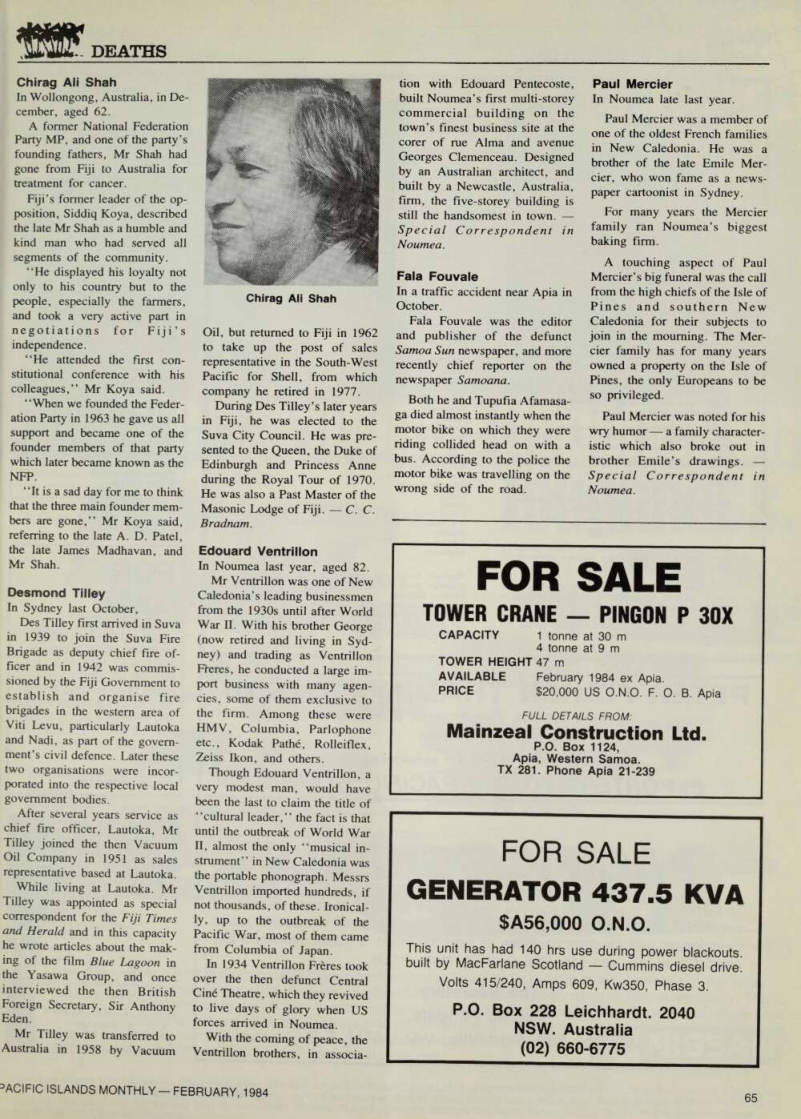
Chirag All Shah In Wollongong, Australia, in De cember, aged 62.
A former National Federation Party MP, and one of the party’s founding fathers, Mr Shah had gone from Fiji to Australia for treatment for cancer.
Fiji’s former leader of the op position, Siddiq Koya, described the late Mr Shah as a humble and kind man who had served all segments of the community.
“He displayed his loyalty not only to his country but to the people, especially the farmers, and took a very active part in negotiations for Fiji’s independence.
“He attended the first con stitutional conference with his colleagues,” Mr Koya said.
“When we founded the Feder ation Party in 1963 he gave us all support and became one of the founder members of that party which later became known as the
Nfp.
“It is a sad day for me to think that the three main founder mem bers are gone,” Mr Koya said, referring to the late A. D. Patel, the late James Madhavan, and Mr Shah.
Desmond Tilley
In Sydney last October, Des Tilley first arrived in Suva in 1939 to join the Suva Fire Brigade as deputy chief fire of ficer and in 1942 was commis sioned by the Fiji Government to establish and organise fire brigades in the western area of Viti Levu, particularly Lautoka and Nadi, as part of the govern ment’s civil defence. Later these two organisations were incor porated into the respective local government bodies.
After several years service as chief fire officer, Lautoka, Mr Tilley joined the then Vacuum Oil Company in 1951 as sales representative based at Lautoka.
While living at Lautoka. Mr Tilley was appointed as special correspondent for the Fiji Times and Herald and in this capacity he wrote articles about the mak ing of the film Blue Lagoon in the Yasawa Group, and once interviewed the then British
Foreign Secretary, Sir Anthony
Eden.
Mr Tilley was transferred to Australia in 1958 by Vacuum
Oil, but returned to Fiji in 1962 to take up the post of sales representative in the South-West Pacific for Shell, from which company he retired in 1977.
During Des Tilley’s later years in Fiji, he was elected to the Suva City Council. He was pre sented to the Queen, the Duke of Edinburgh and Princess Anne during the Royal Tour of 1970.
He was also a Past Master of the Masonic Lodge of Fiji. C. C.
Bradnam.
Edouard Ventrillon In Noumea last year, aged 82.
Mr Ventrillon was one of New Caledonia’s leading businessmen from the 1930 s until after World War 11. With his brother George (now retired and living in Syd ney) and trading as Ventrillon Fferes, he conducted a large im port business with many agen cies, some of them exclusive to the firm. Among these were HMV, Columbia, Parlophone etc., Kodak Pathe, Rolleiflex, Zeiss Ikon, and others.
Though Edouard Ventrillon, a very modest man, would have been the last to claim the title of “cultural leader,” the fact is that until the outbreak of World War 11, almost the only “musical in strument” in New Caledonia was the portable phonograph. Messrs Ventrillon imported hundreds, if not thousands, of these. Ironical ly, up to the outbreak of the Pacific War, most of them came from Columbia of Japan.
In 1934 Ventrillon Freres took over the then defunct Central Cine Theatre, which they revived to live days of glory when US forces arrived in Noumea.
With the coming of peace, the Ventrillon brothers, in associa
tion with Edouard Pentecoste, built Noumea’s first multi-storey commercial building on the town’s finest business site at the corer of rue Alma and avenue
Georges Clemenceau. Designed
by an Australian architect, and built by a Newcastle, Australia, firm, the five-storey building is still the handsomest in town.
Special Correspondent in
Noumea.
Fala Fouvale In a traffic accident near Apia in October.
Fala Fouvale was the editor and publisher of the defunct Samoa Sun newspaper, and more recently chief reporter on the newspaper Samoana.
Both he and Tupufia Afamasa ga died almost instantly when the motor bike on which they were riding collided head on with a bus. According to the police the motor bike was travelling on the wrong side of the road.
Paul Mercier In Noumea late last year.
Paul Mercier was a member of one of the oldest French families in New Caledonia. He was a brother of the late Emile Mer cier, who won fame as a news paper cartoonist in Sydney.
For many years the Mercier
family ran Noumea’s biggest
baking firm.
A touching aspect of Paul Mercier’s big funeral was the call from the high chiefs of the Isle of Pines and southern New Caledonia for their subjects to join in the mourning. The Mer cier family has for many years owned a property on the Isle of Pines, the only Europeans to be
so privileged.
Paul Mercier was noted for his wry humor a family character istic which also broke out in brother Emile’s drawings.
Special Correspondent in
Noumea.
Chirag Ali Shah
Advertisements & other items, pp. 65-66 (2 items)
65
ISLANDS MONTHLY FEBRUARY, 1984
For Sale
TOWER CRANE PINGON P 30X
CAPACITY 1 tonne at 30 m 4 tonne at 9 m
TOWER HEIGHT 47 m
AVAILABLE February 1984 ex Apia.
PRICE $20,000 US 0.N.0. F. O. B. Apia
FULL DETAILS FROM:
Mainzeal Construction Ltd.
P.O. Box 1124, Apia, Western Samoa.
TX 281. Phone Apia 21-239
FOR SALE
GENERATOR 437.5 KVA
$A56,000 0.N.0.
This unit has had 140 hrs use during power blackouts, built by MacFarlane Scotland Cummins diesel drive.
Volts 415/240, Amps 609, Kw3so, Phase 3.
P-O. Box 228 Leichhardt. 2040 NSW. Australia (02) 660-6775
mW
SERVICE PAGE
KaiMß
MCDl^imiW
AUSTRALIA; Distribution: The Herald and Weekly Times Ltd , 44-74 Flinders St., Melbourne, Vic., 3000. Advertising Reps Brisbane D. Wood, Anday Agency, CCA Centre, Dayboro Road, Closeburn 4520; Box 1918, GPO Brisbane, 4001; Adelaide Hastwell Williamson Rouse Pty. Ltd., PO Box 419, Norwood, SA, 5067; 59 Kensington Road, Norwood; telephone (08) 332-3322, telex 87113; Perth Allen & Associates, Suite 2, 284 Stirling St., Perth, WA, 6000, telephone (09) 328-9593 or (09) 328-9363.
FIJI: Distribution and subscriptions Desai Bookshops, P.O. Box 160, Suva, Fiji, telephone Suva 23036.
Advertising Fiji Times & Herald Ltd., 20 Gordon St., Suva, telephone 31-2111, telex FJ2124.
FRENCH POLYNESIA: Distribution Hachette Pacifique, 10 Ave Bruat, Papeete, telephone 25610.
HAWAII, UNITED STATES: Distribution PIM, Hawaii, PO Box 22250, Honolulu, Hawaii, 96822. Advertising Brian C. Asgill, Apt. 1308, 1676 Ala Moana Blvd., Honolulu, Hawaii, 96815, telephone (808) 955-9718.
JAPAN: Advertising and subscriptions Universal Media Corporation, GPO Box 46, Tokyo, telephone 666- 3036, cables UNIMEDIA Tokyo, telex 2524665.
KOREA: Advertising and subscriptions World Marketing, Inc, Box 4010, Seoul; phone 776-5291-3, telex K 23232.
MALAYSIA: Advertising and subscriptions Worldwide Media Services, 57-B Komplex Damai, Jin Dato Haji Eusoff, Kuala Lumpur, telephone 63-9340, cables WORLDMEDIA Kuala Lumpur, telex 31533.
NEW CALEDONIA: Distribution Depot Centre de Presse Michel Pentecost, CBP2, Noumea, telephone 27- 2434, 27-4729.
NEW ZEALAND: Distribution Gordon & Gotch, PO Box 584, 2 Carr Road, Mt. Roskill, Auckland 4 Advertising International Media Representatives Ltd., PO Box 2313, Auckland, telephone 79-5487; 49-3389, cables Intereps, Auckland. Subscriptions Ross Haines & Son Ltd., PO Box 1289, Auckland, telephone 76-9042.
PAPUA NEW GUINEA: Distribution Gordon & Gotch, PO Box 3395, Port Moresby, telephone 25-4551, 25-4855.
Advertising PNG Post-Courier, PO Box 85, Port Moresby, telephone 21-2577, telex 22120.
PHILIPPINES: Advertising The GF Group, 12 San Ignacio St., Uroaneta Village, Makati, Metro Manila, telephone 817-7299, telex 45950 and 4233.
UNITED KINGDOM; The Herald & Weekly Times Ltd., No 1 Maltravers Street,London WC2R 3DZ, England, telephone 01 836 5162, telex London 21989.
UNITED STATES MAINLAND: Advertising Joshua B.
Powers Jr., Powers International Inc., 551 Fifth Ave., New York, New York 10 017, telephone 867-9580, telex 236514.
Subscriptions PIM, Hawaii, PO Box 22250, Honolulu, Hawaii, 96822.
SUBSCRIPTIONS
Payments by personal cheque are only acceptable in Australian (from a branch in Australia), U S. and New Zealand currency. For all other remittances please, send an international bank draft in Australian dollars.
Published monthly by Pacific Publications (Aust.) Pty.
Ltd. and printed in Australia by Quadricolor Industries Pty. Ltd., Mulgrave, Vic.
PETER FISHER TRADING Pty.Ltd.
381 PITT STREET, SYDNEY, 2000, AUSTRALIA
Telephone: 264 5395
TELEX: AUSTAS AA20149 ATT. PETER FISHER
EXPORTERS TO THE PACIFIC ISLANDS
PACIFIC PENPALS
To friends who may wish to improve their hobbies or interests and to friends who would like to correspond with other friends who live in all the pacific island countries as well as other countries all over the world. If you’re interested and would like to join, you can write to us for more details.
The Secretary, Pacific Penpals, P.O. Box 580, Port Vila, VANUATU, S.P.
Advertising
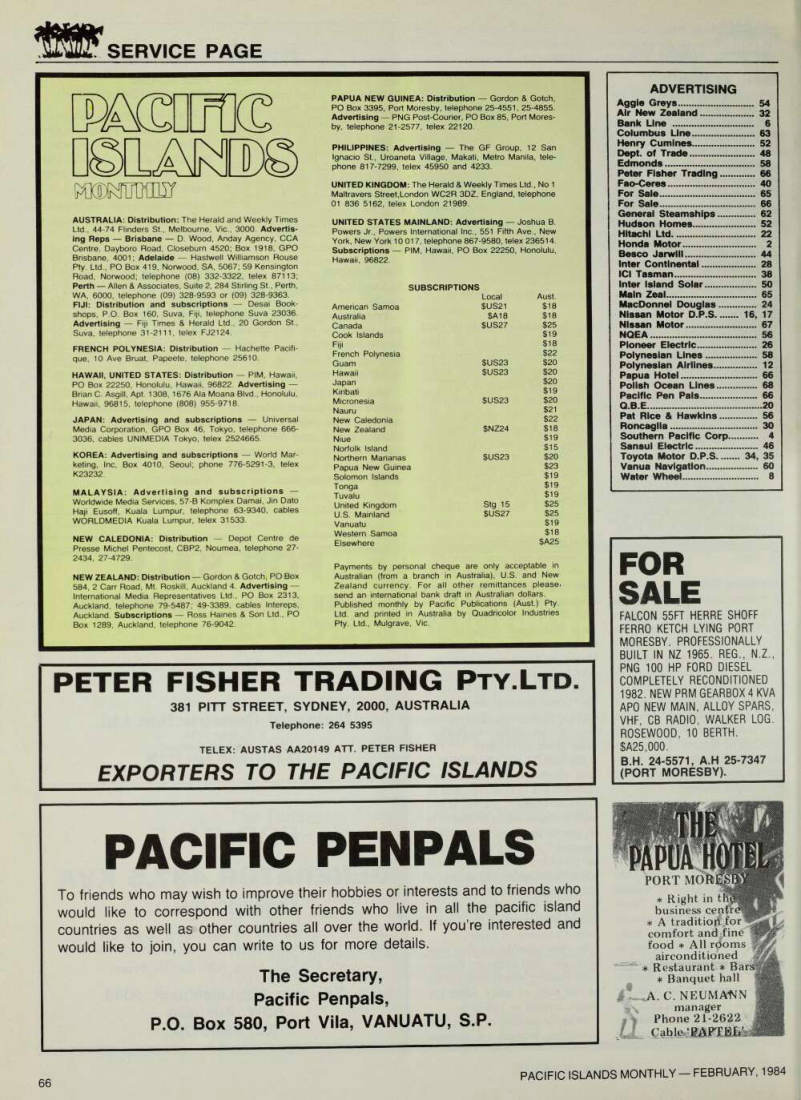
Aggie Greys 54 Air New Zealand 32 Bank Line 6 Columbus Line 63 Henry Cumines 52 Dept, of Trade 48 Edmonds 58 Peter Fisher Trading 66 Fao-Ceres 40 For Sale 65 For Sale 66 General Steamships 62 Hudson Homes 52 Hitachi Ltd 22 Honda Motor 2 Besco Jarwill 44 Inter Continental 28 ICI Tasman 38 Inter Island Solar 50 Main Zeal 65 MacDonnel Douglas 24 Nissan Motor D.P.S 16, 17 Nissan Motor 67
Nqea 56
Pioneer Electric 26 Polynesian Lines 58 Polynesian Airlines 12 Papua Hotel 66 Polish Ocean Lines 68 Pacific Pen Pals 66
Q.B.E 20
Pat Rice & Hawkins 56 Roncaglia 30 Southern Pacific Corp 4 Sansui Electric 46 Toyota Motor D.P.S 34, 35 Vanua Navigation 60 Water Wheel 8
Advertisements & other items, pp. 66-68 (1 item)
Sale
FOR
FALCON 55FT HERRE SHOFF
FERRO KETCH LYING PORT
MORESBY. PROFESSIONALLY
BUILT IN NZ 1965. REG., N.Z.,
PNG 100 HP FORD DIESEL
COMPLETELY RECONDITIONED
1982. NEW PRM GEARBOX 4 KVA
APO NEW MAIN, ALLOY SPARS,
VHF, CB RADIO, WALKER LOG.
ROSEWOOD, 10 BERTH.
$A25,000.
B.H. 24-5571, A.H 25-7347
(PORT MORESBY).
PORT MOh
* Right in tl business cenflc^ ♦ A traditio|tfor comfort food ♦ All airconditioned * Restaurant * Bai * Banquet hall
NEUMANN
manager Phone 21-2622 Cabled!
Toughness.
Nissan Cabstar Nissan Sunn) Nissan Vanette Nissan Urvan
PATROL
NISSAN
Nissan Patrol Datsun Pickup 4WD That s why Nissan means higher performance. Toughness is total. Every member of the widely? 6 lineup has extra strength and durability built-in along with superior maneuverability These n Eat P thi 0 H merS a d h liver penny-pinching fuel economy and tough reliability. Once you discover how great the ride and handling ease are, you will understand what makes Nissan commercial and passenger vehicles worldwide favorites.
There’s more to a Nissan than meets the eye.
NISSAN
Bainki Nauru Jacob Enterprises - Suva Kiribati Atoll Auto Stores, Solomon Islands United Enterprises Ltd Honiara Tahiti Tahitibun'sA rT a ° d * S D US * M ° tor w Papua New Guinea Boroko Motors, Port Moresby Morris Hedstrom Samoa Ltd., Aoia Tahitibull S.A.R.L, Papeete Vanuatu Pentecost Vanua Trading Ltd., Port Vila Western Samoa
POLS.
i ■■ ud General Management, to Lutego 24,81-364 GDYNIA, POLAND, Phone: 20-19-01, Cables: POLOCEAN Telex: 054-231
lAN IL
INJ
■J \ fx Q .liK ’v ■iVKv... rv-* *4 mm .»« .r I • % • ; •. : - --m •*VV : -v.tt Ii- JiFK v>*. fe ■**
illi
■ A-
SOUTH PACIFIC SERVICE
We offer monthly service to and from: GDYNIA, HAMBURG, ROTTERDAM, MIDDLESBOROUGH/IMMINGHAM, ANTWERP, DUNKIRK, ROUEN, PAPEETE (via PANAMA), NOUMEA, AUCKLAND, HONIARA, RABAUL, LAE, SINGAPORE, by our multipurpose vessels carrying dry and reefer containers, reefer chambers, heavy lifts, breakbulk or
palletized, butk liquids.
POLISH OCEAN LINES Representatives AUCKLAND T.B.A. Telex 21517 NZ “UNHSHtP”. SYDNEY Mr Walenciak Telex 20428 AA “SLEIGH"
POLISH OCEAN LINES Agents
TAHITI SOTAMA Telex 296 FP “COUTIMEX”. NEW CALEDONIA SATO Telex 163 NM “SATO”. AUCKLAND UNIVERSAL SHIPPING AGENCIES LTD., Telex 21517 NZ “UNISHIP”. SOLOMONS MELAN CHINE SHIPPING CO., LTD Telex 66335 HO “SYMECO . PNG QTPAMQWJPS TRArUWn C.H ITD TeU»y 49A9S NF “STEAM"