Pacific
Islands
Monthly
WSiPilllpJ
Samoa JjlSfe U§W^7s^
Aoktralia ’ *Asl^o Codb IsM® .jjjafr NZ$l SoS F *l 50 ? W* m* ■ US$l.95
W T A 51.75
Mm'i 1 As 1.75
£N .Ifcaiedoma _M_ CFPI9O iß|w Zealand . NZS&OOT
- Nz$L.5O
)s|ar|[ —\L . >A$ 1.50 Vapua New ffijinea K. 1.50 'Solomon Islands 551.50 -Tahiti m CFP22O
Tonga —'■»*§& —+ -^PI-50
Tuvalu — V * —...l 75
Usa 4. |Jus$2 25
USTT and Guar* 1- 1 k)S$l 95 kVanucKu " % —yVTI.SO mA. T 1.95 only «nwistnr>d bvMstralta Post.
N»Bp1210 G
iroraw: mmmm* un.RjnMy^LHE ■BeWotr®!
Advertisements & other items, p. 2 (1 item)
Hitachi
1 I Every feature top-quality v recording/playback for excep! the SR mode plus up to 18 hours of continuous video enjoyment in the LP mode. Superb stereo sound with Dolby noise reduction circuitry. Convenient, streamlined front-loading tape' transport mechanism. Five-program/two-week preset timer recording facility. Instant Recording Timer for fuss-free program setting. A 13-mode wireless remote control unit. A taperemaining time indicator. They are all in one video tape recorder —the VT-19E (AU), only from Hitachi.
"ACHI
■ ... V . , f %
MIC
VHSi
Him. r«*§6g}.
S ter eo QQf^uv-S,
IIPtSII
VMS
pas
HITACHI
•AUSTRALIA: Hitachi Sales Australia Pty., Ltd., 153 Keys Road, Moorabbin, Victoria 3189; Phone: (555) 8722 •NEW ZEALAND: AWA New Zealand Limited, Wi-neera Drive, P.O. Box 50-248, Porirua; Phone; PRO 75-069 • PAPUA NEW GUINEA: S.O. Svensson (N.G.) Ltd., P.O. Box 705, Port Moresby; Phone: 21-2111 •FIJI ISLANDS: AWA New Zealand Limited, 47 Foster Road (P.O. Box 858) Suva Fiji; Phone: 312070 •NEW CALEDONIA: Caldis, B.P. Ml, Noumea; Phone: 26.23.50 •TAHITI: Ets Chene Alain, P.O. Box 272, Papeete; Phone: 2.88.68 •SOLOMON ISLANDS; Technique Radios Centre Ltd., P.O. Box 465, Honiara; Phone: 416
Pacific
Islands
Monthly
Vol. 55 No. 1
January 1984
(Usps 952480)
Founded 1930 by R. W. Robson AUSTRALIA: Distribution: The Herald and Weekly Times Ltd., 44-74 Flinders St., Melbourne, Vic., 3000. Advertis ing Reps Brisbane D. Wood, Anday Agency, CCA Centre, Dayboro Road. Closeburn 4520; Box 1918, GPO Brisbane, 4001; Adelaide Hastwell Williamson Rouse Pty. Ltd., PO Box 419, Nonwood, SA, 5067; 59 Kensington Road, Norwood; telephone (08) 332-3322, telex 87113; Perth Allen & Associates, Suite 2, 284 Stirling St., Perth, WA, 6000, telephone (09) 328-9593 or (09) 328-9363 FIJI: Distribution and subscriptions Desai Book shops, P.O. Box 160, Suva, Fiji, telephone Suva 23036.
Advertising Fiji Times & Herald Ltd., 20 Gordon St., Suva, telephone 31-2111, telex FJ2124.
FRENCH POLYNESIA: Distribution Hachette Pacifi que, 10 Ave Bruat, Papeete, telephone 25610.
HAWAII, UNITED STATES: Distribution PIM, Hawaii.
PO Box 22250, Honolulu, Hawaii, 96822 Advertising Brian C. Asgill, Apt. 1308, 1676 Ala Moana Blvd., Honolulu, Hawaii, 96815, telephone (808) 955-9718.
JAPAN: Advertising and subscriptions Universal Media Corporation, GPO Box 46, Tokyo, telephone 666- 3036, cables UNIMEDIA Tokyo, telex 2524665.
KOREA: Advertising and subscriptions World Mar keting, Inc. Box 4010, Seoul; phone 776-5291-3, telex K 23232.
MALAYSIA: Advertising and subscriptions Worldwide Media Services, 57-B Komplex Damai, Jin Dato Haji Eusoff, Kuala Lumpur, telephone 63-9340, cables WORLDMEDIA Kuala Lumpur, telex 31533.
NEW CALEDONIA: Distribution Depot Centre de Presse Michel Pentecost, CBP2, Noumea, telephone 27- 2434, 27-4729.
NEW ZEALAND: Distribution Gordon & Gotch, PO Box 584, 2 Carr Road, Mt. Roskill, Auckland 4 Advertising International Media Representatives Ltd., PO Box 2313, Auckland, telephone 79-5487; 49-3389, cables Intereps, Auckland. Subscriptions Ross Haines & Son Ltd., PO Box 1289, Auckland, telephone 76-9042.
PAPUA NEW GUINEA: Distribution Gordon & Gotch, PO Box 3395, Port Moresby, telephone 25-4551, 25-4855.
Advertising PNG Post-Courier, PO Box 85, Port Mores by, telephone 21-2577, telex 22120.
PHILIPPINES: Advertising The GF Group, 12 San Ignacio St., Uroaneta Village, Makati, Metro Manila, tele phone 817-7299, telex 45950 and 4233.
UNITED KINGDOM; The Herald & Weekly Times Ltd., No 1 Maltravers Street,London WC2R 3DZ, England, telephone 01 836 5162. telex London 21989.
UNITED STATES MAINLAND: Advertising Joshua B.
Powers Jr., Powers International Inc., 551 Fifth Ave., New York, New York 10 017, telephone 867-9580, telex 236514.
Subscriptions PIM, Hawaii, PO Box 22250, Honolulu, Hawaii, 96822.
Payments by personal cheque are only acceptable in Australian (from a branch in Australia), U.S. and New Zealand currency. For all other remittances please send an international bank draft in Australian dollars.
Published monthly by Pacific Publications (Aust.) Pty.
Ltd. and printed in Australia by Quadricolor Industries Pty. Ltd., Mulgrave, Vic.
Australian cover price is recommended retail only.
Registered by Australia Post, publication No. NBPI2IO.
Second class postage paid at Honolulu, Hawaii. Copy right Pacific Publications (Aust.) Pty. Ltd.
Postmaster Honolulu: Send address changes to PIM Hawaii, PO Box 22250, Honolulu, Hawaii, 96822.
Subscriptions
Local Aust.
American Samoa $US21 $18 Australia $A18 $18 Canada $US27 $25 Cook Islands $19 Fiji $18 French Polynesia $22 Guam $US23 $20 Hawaii $US23 $20 Japan $20 Kiribati $19 Micronesia $US23 $20 Nauru $21 New Caledonia $22 New Zealand $NZ24 $18 Niue $19 Norfolk Island $15 Northern Marianas $US23 $20 Papua New Guinea $23 Solomon Islands $19 Tonga $19 Tuvalu $19 United Kingdom Stg 15 $25 U.S. Mainland $US27 $25 Vanuatu $19 Western Samoa $18 Elsewhere $A25
Inside
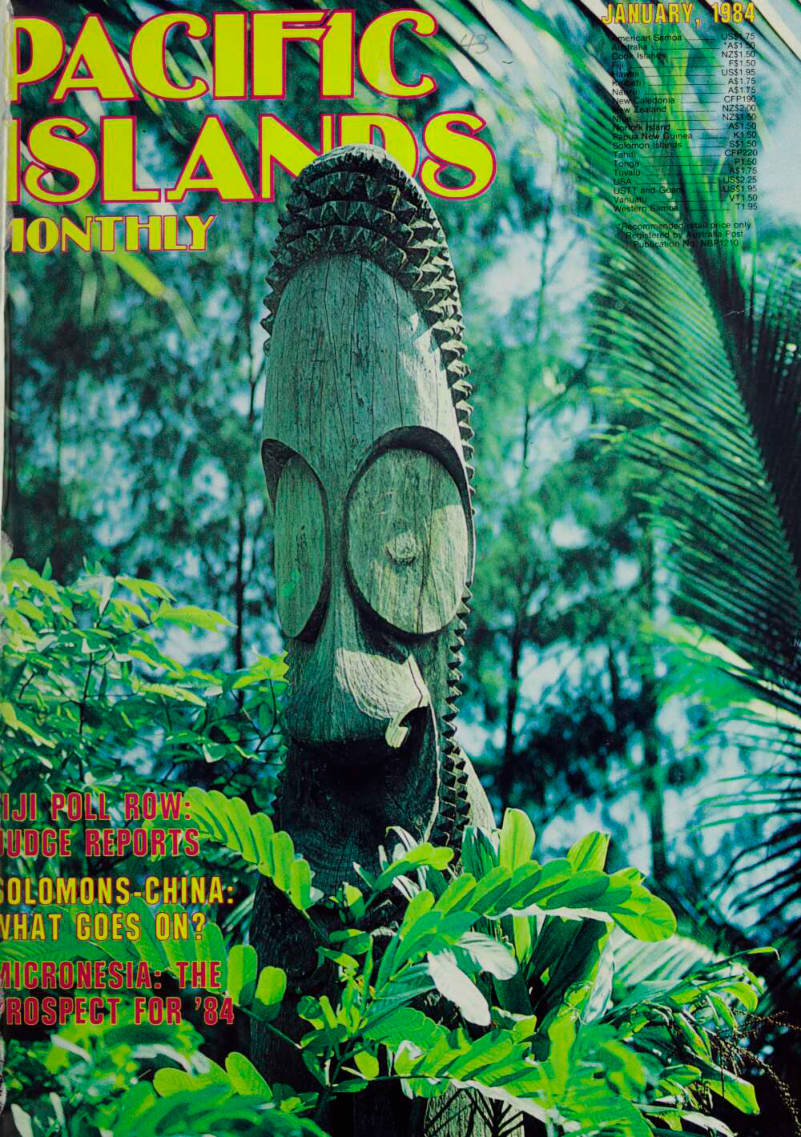
• FIJI GETS ITS WHITE REPORT Retired New Zealand judge Sir John White in his long-awaited report on Fiji’s stormy 1982 election has found that charges of “dirty tricks” made by both sides in the election were in general unproven. The report has been widely welcomed, but there is one dissenting voice 11 • NEW CALEDONIA THE ISSUE OF ELECTORAL REFORM Helen Fraser reports from Noumea that, in the wake of the November visit of Overseas Territories Minister Georges Lemoine, reform of the electoral law in particular, some restriction on the right of some categories of the population to vote on the territory’s future is at the heart of the current political debate 26 • MICRONESIA FLOYD’S FEARLESS FORECAST Floyd K. Takeuchi dusts off his crystal ball for a look into Micronesia’s 1984, the year in which the long U.S. trusteeship will be finally terminated (at least in most of the territory) . 14 • HOTEL STRIKE IN TAHITI Marie-Therese and Bengt Danielsson turn in a probing analysis of the first-ever strike by Tahitian employees of the island’s four big foreign-owned tourist hotels 17 • THE SOLOMONS AND CHINA A special correspondent reviews some curious aspects of the present state of relations between a small southwest Pacific country, the giant People s Republic of China, and the “third party”, Taiwan, raising the possibility that new conditions could be creating grounds for new departures on the issue of the “two Chinas” 41 • SPEC TAKES ON THE BIG ONES The South Pacific Bureau for Economic Co-operation, using funds from the United Nations Development Program and other sources, has launched a year-long survey of shipping and air services in the Pacific two issues of vital concern to the well-being of the region 49 Cover picture: A slit gong rises in imposing fashion from the verdure on Vanuatu's Anatom Island (previously known as Aneityum), in the far south of the archipelago. Air Melanesiae picture.
Books 33 Cooking, Pacific style 38 Cook Islands 45 Deaths 58 Fiji 11, 42, 48 French Polynesia 7, 17, 39 Hawaii 45 Islands Press 10 Kiribati 49 Letters 7 Micronesia 14, 35 Month, The 14 New Caledonia 26 Notes from the North 14 Noumea Notebook 26 Pacific Report 5
Papua New Guinea 33 People 29 Political Currents 39 Postmark Papeete 17 Publishing in the Pacific 15 Report from Vanuatu 21 Samoa Report 23 Shipping 49 Shipping schedules 56 Solomon Islands 41, 43, 47 Tradewinds 48 Tropicalities 43 Vanuatu 21 View from Honolulu 15 Western Samoa 7, 23, 47, 49 Yachts 51
PlM’s new publisher
Pacific Islands Monthly has a new publisher. He is Mr Garry Barker, formerly General Manager of the Fiji Times and Herald Ltd.
Mr Barker has more than 25 years’ interna tional experience as a journalist and publisher, and a very long family association with the Pacific. He is a grand-nephew of Sir Alport Barker, who was the owner and publisher of the Fiji Tinneduntil its purchase in 1955 by R. W.
Robson, founder and first publisher of Pacific Islands Monthly. Another great-uncle was curator of the Fiji Museum and an authority on Pacific customs, history and artifacts.
Prior to his four year term in Fiji, Mr Barker was for seven years managing editor of the Melbourne Herald and Weekly Times Ltd’s European bureau in London, covering the major news events of Britain, Europe and the Middle East.
Earlier he had served some four years in the United States, and seven years in South-East Asia as a foreign correspondent covering such diverse events as the rise of Fidel Castro, the
election of President Kennedy, a plethora of summit meetings, the formation of Malaysia, the fall of President Sukarno, a bunch of battles in Vietnam and Borneo, and much else besides. In between he was Overseas Services Editor for The Herald and Weekly Times, in Melbourne.
Mr Barker is a member of the British Institute of Directors, a Fellow of the Fiji Institute of Management and of the Institute of Advertising.
He was one of the founders of the Common wealth Journalists’ Association and sat on the Council of the Commonwealth Press Union.
Mr Barker’s appointment opens a new era for PIM in which it not only will be maintained as the region’s premier news magazine and forum, but also will be developed to further reflect the great changes occuring in this most important of the world’s oceanic areas.
Even now, as this issue reaches the news stands Mr Barker is already travelling the area, renewing old associations, meeting community and business leaders, and briefing PlM’s exten sive network of correspondents, agents and distributors.
Advertisements & other items, pp. 3-4 (2 items)
3
PACIFIC ISLANDS MONTHLY —JANUARY, 1984
• Publisher, Garry Barker. • Editor, Angus Smales. • Associate Editor, Malcolm Salmon. • Advertising Manager, Stephen Brandon. • Editorial Adviser, John Carter.
A Pacific Publications production. 76 Clarence Street, Sydney, NSW, 2000. GPO Box 3408, Sydney, NSW, 2001. Cables PACPUB Sydney. Telex 21242 (answers INTARAD). Telephone: Sydney (02) 2-0231, Melbourne (03) 63-0211. Manager, John Berry (03) 63-0211, Ext. 1860.
Expert
Insurance Service
throughout the islands
Queensland Insurance (Fiji) Limited
Head Office: Queensland Insurance Centre, Victoria Parade SUVA. General Manager: R. Jackson Phone 23 851.
LAUTOKA OFFICE: Burns Philp Bldg., Naviti St. District Manager: R. Sharma. Phone 60 642 LABASA OFFICE: Burns Philp Bldg. Phone: 8 2139
Queensland Insurance (PNG) Limited
PAPUA NEW GUINEA
Head Office. B.N.G. Building, Musgrave St..PORT MORESBY. General Manager: T. H. Sarti Phone: 212144.
LAE 4th St. & Coronation Drive. District Manager: C. D. Hitlier Phone: 423873.
MOUNT HAGEN Hagen Drive. District Manager: R. Shelbourn Phone: 521002.
ARAWA: Chebu St., District Manager; B. Bowers Phone: 95 1555 MADANG: Kasagten St., District Manager: J. Longbut Phone: 82 2020 RABAUL: Wirraway St. District Manager R. McManus Phone: 921014
QBE Insurance (International) Limited
VANUATU , PORT VILA: Rue de Paris, Suite 19, Oceania Bldg. Manager: I. R Martin.
Phone: 2299.
SANTO: Burns Philp ( Vanuatu) Ltd Phone: 230.
PACIFIC AGENCIES
NEW CALEDONIA. Ste. W. A. Johnston, S.A.R.L. 5 Rue Anatole France, NOUMEA.
Phone: 272083, TAHITI: Arthur Chung. Immeuble BIS., Front de Mer, PAPEETE . Phone: 2.86.19 NIUE: Burns Philp (South Sea) Company Ltd.
NORFOLK ISLAND: Burns Philp ('N I ) Company Ltd. Phone: 2191 SAMOA APIA, Burns Philp (South Sea) Company Ltd. Phone: 22611 TONGA Burns Philp (South Sea) Company Ltd. NUKUALOFA Phone 21500 HAAPAI, VAVAU &
MEMBERS OF THE
QBE INSURANCE GROUP LIMITED
Pacific Report
“Png Should Join Asean” Chan
Sir Julius Chan, former prime minister of Papua New Guinea, has urged that his country join the Association of Southeast Asian Nations (ASEAN). Speaking at a ceremony at the University of Technology in Lae during which he received an honorary doctorate, Sir Julius said that PNG is geographically part of the Southeast Asian region, and joining ASEAN would be a positive statement of its intention to take an active part in regional affairs. Sir Julius said PNG’s immediate post independence foreign policy of “friends to all, enemies to none” was well and trully gone, and the country should now accept that it must make the choice as to who its real friends were. PNG’s neighbor across the border in Irian Jaya, Indonesia, is the largest and most influential member of ASEAN. Fears of Indonesian intentions with regard to PNG are widespread among Papua New Guineans. Dr John Waiko, a history lecturer at the University of PNG, writing on his countrymen’s attitudes to Australia in the The Sydney Morning Herald on November 29, said: “We believe that when, not if, Papua New Guinea is invaded, Australia might not act with the speed with which it came to our aid 40 years ago. Australia may evacuate its citizens and leave us to face the enemy.” Although not named, he clearly meant Indonesia as “the enemy”. Perhaps Sir Julius has adopted the well-known principle; “If you can’t beat ’em, join ’em.”
Fiji To Host Lome Meeting
Fiji will host the third African-Caribbean-Pacific (AGP) meeting with the European Economic Community (EEC) to compile the Lome 111 agreement. Dates have not yet been fixed but the meeting will be in April or May, possibly beginning towards the end of April and continuing into May. Sixty-three countries will Kp rpnrpcjpntpH
Santo Rebellion Pay-Out: Sus4.S Million
The long-drawn saga of payment of compensation for damage caused by the 1980 secessionist rebellion on Vanuatu’s island of Santo seems to be drawing to a close. The accountancy firm of Peat, Marwick and Mitchell has had its report on more than 1000 damages claims from businesses and individuals accept ed by the British Government, which has agreed to pay the equivalent of about SUSI.S million in compensation, one-third of the total amount. A spokesman for the French Government has agreed that France will match the British contribution. The Vanuatu Government is to pay the remaining third.
Png Chogrm Off, Friends Still Invited
Papua New Guinea’s Prime Minister Michael Somare announc ed in December that a Commonwealth Heads of Government Regional Meeting (CHOGRM) planned for Port Moresby this year will not now be held. Only two days before it had been reported from New Delhi that the Port Moresby meeting would go ahead. Announcing the cancellation, Mr Somare added, however, that all regional Commonwealth heads of government had been invited to the opening of PNG’s new parliament building on August 7, 1984. He said the leaders will then have an informal meeting, which would “recapture the original atmos phere of the regional summits”. He said Asian and Pacific leaders at the November 1983 meeting in New Delhi had agreed that the official regional meeting was “not necessary”. Concern had been expressed that the CHOGRM were being held too often.
Niue Seeks Drought Aid
The Niue Government has appealed to the UN’s Food and Agriculture Organisation office in Western Samoa for emergen cy relief to bridge gaps in water and food supplies created by the prolonged drought which is hitting most countries in the region.
Niue is expecting a gift of $NZ21,591 from the South Pacific Bureau for Economic Co-operation’s disaster relief fund and has asked for $20,000 from the Australian bilateral aid program, in addition to the funding by Australia of a water bore project which includes the sinking of eight wells.
New Cabinet In Nauru
Following parliamentary elections in December, the new parlia ment of Nauru re-elected Hammer Deßoburt as president of the
republic. The new Cabinet chosen by President Deßoburt is: Hammer Deßoburt: president, minister for external affairs, minister for internal affairs, minister in charge of the public service, minister for island development and industry; Buraro Detrudamo: minister for works and communications, minister assisting the president; Kenas Aroi: minister for finance; Laur ence Stephen; minister for health and education; Bernard Dowiyogo: minister for justice.
“GEAR UP FOR TV NOW” PNG RADIO CHIEF The chairman of Papua New Guinea’s National Broadcasting Commission has warned against delaying the introduction of television to the country. Speaking at the December 1 10th anniversary celebrations of the NBC, Austin Sapias said central planners must prepare to broadcast television, or face the consequences. The government of Prime Minister Somare has directed the NBC to take no further action on television until firm guidelines for its introduction are set by Cabinet. The NBC already has a television studio, and the equipment to broadcast signals. Mr Sapias said that, as responsible broadcasters, the NBC was alarmed at the amount of recorded foreign video programs being brought into the country without any alternative being provided. The NBC came into being on December 1, 1973, when it took over the PNG service of the Australian Broadcasting Commission and the government radio service of the Australian PNG administration.
Samoan Teachers Slam Uni. Plan
In a letter to the Western Samoa Minister for Education, Le Mamea Ropati, the Teachers Association of Samoa has op posed the government’s plan to establish a national university, a plan which, the teachers say, “will only result in serious damage”. The teachers described the country’s education system as being like a “child still grabbing for support as it walks because its bones are not strong enough yet”. The association also expressed deep concern at the alleged diversion of funds from the Australian aid program previously earmarked for education curriculum development, to the re-construction of the Faleolo airport folowing the government’s decision to halt the curriculum program. (PIM Dec. p 5).
Fiji Booze Exported To New Zealand
South Pacific Distilleries, of Lautoka, Fiji, has broken into the New Zealand liquor market. It has shipped its first major export order of gin and vodka, worth about $A25,000, to New Zealand, and is negotiating for a second order. The company is a subsidiary of the Fiji Sugar Corporation and, since its formation in 1979, has accumulated losses totalling $1,401,576 up to last March 31. However, in the last 12 months, gross revenue increased by 193 per cent over the previous year’s revenue. The distillery, which won gold medals at an international show in London recently with its rum, produces whisky under its own “Old Club” label and gin and vodka under the “Booths” and “Cossack” labels.
Namaliu Raps Oz, Png, Businessmen
In a paper on bilateral trade presented to last year’s annual joint meeting of the PNG-Australia Business Co-operation Commit tee in Port Moresby, Foreign Affairs and Trade Minister Rabbie Namaliu complained that Australians were not taking enough interest in setting up joint ventures with PNG firms. “Your twin business co-operation committees have now been operating for some years, but apart from the establishment of the Australian Executive Service Overseas Program (AESOP) scheme, I have yet to see some positive effects of your endeavors”, Mr Namaliu said.
INDONESIA OFFERS AID TO FIJI, W. SAMOA A government delegation from Indonesia held talks in Suva in November with Fiji government officials. The Indonesians are believed to have offered to train Fiji personnel in agriculture, forestry, trade, communications and other fields. The delegation later went on to Western Samoa for similar meetings.
Eec Helps Out On Coconuts, Tourism
The European Economic Community has agreed to finance a study of the coconut industry in eight South Pacific countries
with the aim of identifying products that can be marketed on a co operative basis by the countries concerned. The study will also recommend areas of possible co-operation in research and product development. The study will examine the coconut industry in Papua New Guinea, Solomon Islands, Vanuatu, Western Samoa, Tonga, Fiji, Tuvalu and Kiribati. In another development, the EEC has agreed in principle to finance a promotional film on the tourist industries of PNG, Fiji, Tonga, Western Samoa and Kiribati. The film will be distributed to travel agencies throughout the world.
PNG: DASH TO SELL DASH 7s IS HALTED The Papua New Guinea Government has decided not to sell the three Dash 7 aircraft in its Air Niugini fleet after hearing that there would have been a loss of Kl 2 million (SAI6 million) on the sale, a much greater amount than had been budgeted for.
The sale would have realised KlO million for the aircraft, the original purchase price of which was K 7.5 million each. Lease obligations attached to the Dash 7s would have cost the government K 22 million. The Dutchairline KLM, which manages Air Niugini, made the original assessment on which the govern ment based its decision to sell. Also, it had been assumed that the sale would increase the airline’s income by K 3.7 million a year through savings on the lease payments, but selling the Dash 7s would have increased profits by only K 2.7 million a year.
Usp-Upng Exchanges Saved For Now
An injection of emergency funds by the University of the South Pacific and its instutute of Pacific Studies has saved the university’s student exchange scheme with the University of Papua New Guinea at least for this year. USP Vice-Chancellor Geoffrey Caston had earlier announced suspension for the scheme due to lack of funds (PIM Dec. p 6).
U.S. Tuna Boat Captain Killed
The captain of an American tuna boat, Ocean Pearl, was killed and six crewmen seriously injured in November when the vessel’s engine exploded in waters off Tuvalu. The injured crewmen were flown more than 100 kilometres to Tuvalu for medical treatment and then transferred to Honolulu. The vessel was towed to American Samoa for inspection by officials.
Fiji: Malaysian Canner Taken Over
Castle Trading, a Malaysian canning company which had operated in Fiji from 1977 to the end of 1982, has been taken over by Burns Philp and the Fiji Government’s National Market ing Authority. The company produced a range of foods including desiccated coconut, canned pineapple, noodles and chili for the local market and for export. It is believed that unreliability in the supply of raw materials was the main reason it went into receivership in December 1982.
Labor Relations Seminar In Ponape
The International Labor Organisation (ILO) sponsored a semi nar in Ponape, Federated States of Micronesia, in December.
ILO spokesman in Suva David Groman said the seminar aimed to create an awareness of different industrial systems, and the importance of good industrial relations in economic development.
Pacific Harbour On The Market
One of Fiji’s biggest tourist resorts, Pacific Harbour, was up for sale in November after being seized for repayment of a mortgage. Fiji’s National Provident Fund, which put up about $F4.6 million in loans for the project, exercised its rights as mortgagee to dispose of the property in an effort to recover its money. The complex is owned by Pacific Hotels, which in turn is owned by Suburban Investments, whose American owner, Harold Wosepka, was recently convicted of fraud by a U.S. court.
Trukese Pore Over Constitutions
A five-man mission from the state of Truk, which is part of the Federated States of Micronesia, made a Pacific tour in Novem ber studying constitutional arrangements in Tonga, Western and American Samoa, and Hawaii. The tour formed part of the preparations to draw up a constitution for Truk.
Nobody Breathed The Word “Blackmail”
The French-language monthly 30 Jours speculated in its November issue on the possibility that economic considerations
might gag Australia and New Zealand on the question of independence for New Caledonia. It said: “The recent silence of these two countries might also be explained by the fact that they are taking into account their economic interests, which are a lot more important to them than the political demands of certain micro-states. In adopting strong positions on New Caledonia, New Zealand and Australia could run the risk of compromising trade agreements reached with countries of the European Economic Community, and France in particular, for the sale of New Zealand dairy products, and, in Australia’s case, uranium.
Australia, moreover, is buying helicopters from France. As far as Fiji is concerned, its sugar exports to EEC countries depend to a certain extent on the moderate nature of its policies.”
Hefty Fund For Education Of Fijians
The Fiji Government has announced a special grant of $F3.5 mijlion to help upgrade education among the country’s ethnic Fijian population. The money will be administered by a special unit within the Department of Fijian affairs. Setting up of the unit was recommended by the Great Council of Chiefs, which advises the government on matters affecting the Fijian population.
Air Tungaru Seeks Nadi Flight
Air Tungaru, Kiribati’s national airline, has applied to Fiji for permission to operate one flight every 14 days between Tarawa and Nadi, using a Boeing 727.
Solomons Wants Out Of Air Pacific
The Solomon Islands Government is offering to sell its share holding in Fiji international airline Air Pacific, just under one per cent, for about $A74,000. Solomon Islands appears to be loosening its ties with some of its neighbors. It has opted out of the Pacific Forum Shipping Line and is co-operating closely with Vanuatu in its Air Vanuatu airline. It also has its own domestic airline, Solair. The Fiji Government is considering the Solomons’ offer.
Honolulu Seminar On Islands Exports
The U.S. Agency for International Development, supported by the Pan-Pacific Alliance for Trade and Development, will spon sor a week-long regional conference in Honolulu March 18 to 23 on the theme “Exporting Pacific Island products to the United States market”. Through panel discussions, a trade exhibit and an empl sis on “one-on-one” sessions featuring personal assistance to Island producers by state government and private sector experts, the conference will focus on practical training in producing exports for the American market.
Solomons Copra Outut Down
Copra production in Solomon Islands for the first half of 1983 was 11,783 tonnes, 32 per cent lower than for the first half of 1982, due mainly to the after effects of Cyclone Bernie which hit the country’s Western Province in April, 1982.
Tonga’S German Maritime Know-How
A government marine training school, funded with a grant of $500,000 from the West German Government, will open in Tonga early this year with an initial intake of 25 students.
Navigation, engineering and catering form the main areas of instruction, and four teachers from West Germany will conduct courses for 18 months.
Png-Australia Defence Talks
Discussions have been held in Port Moresby between Aust ralian Defence Department officials and their opposite numbers in PNG on future defence co-operation. Australia has allocated K 12.4 million ($A16.5 million) for the defence co-operation programme.
Drinking Drivers Of Kiribati
Of more than 3200 traffic offences recorded in Kiribati in 1981, more than half were drink-related, the police have reported, and 162 people were killed or injured. Casualties in the previous year totalled 111.
Japan Funds Fiji, Tuvalu Fishing Survey
A joint fisheries survey to last nearly two years will begin in Fiji and Tuvalu waters in May. The Fiji and Tuvalu governments, the Tuvalu fisheries agency, the Ika Corporation of Fiji and the Japan International Co-operation Agency will be represented on a management committee. All expenses will be met by the Japanese Government.
Pacific: Know
Letters
The French Pacific: Know the facts?
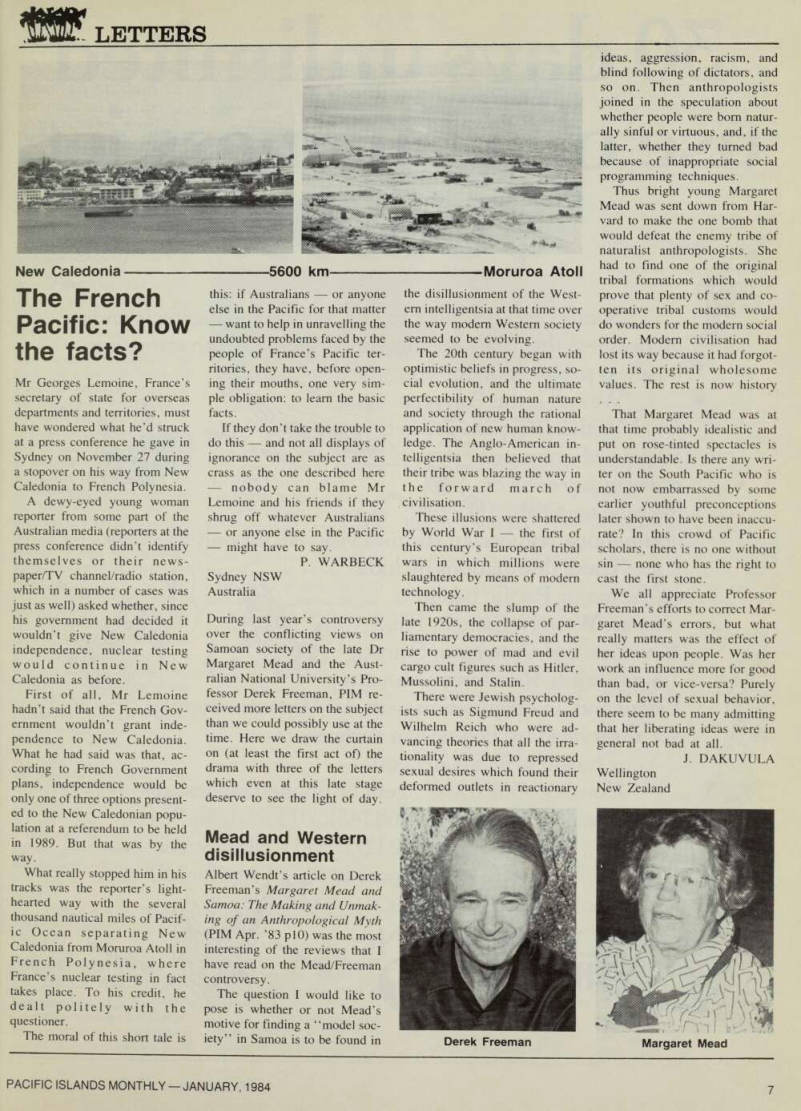
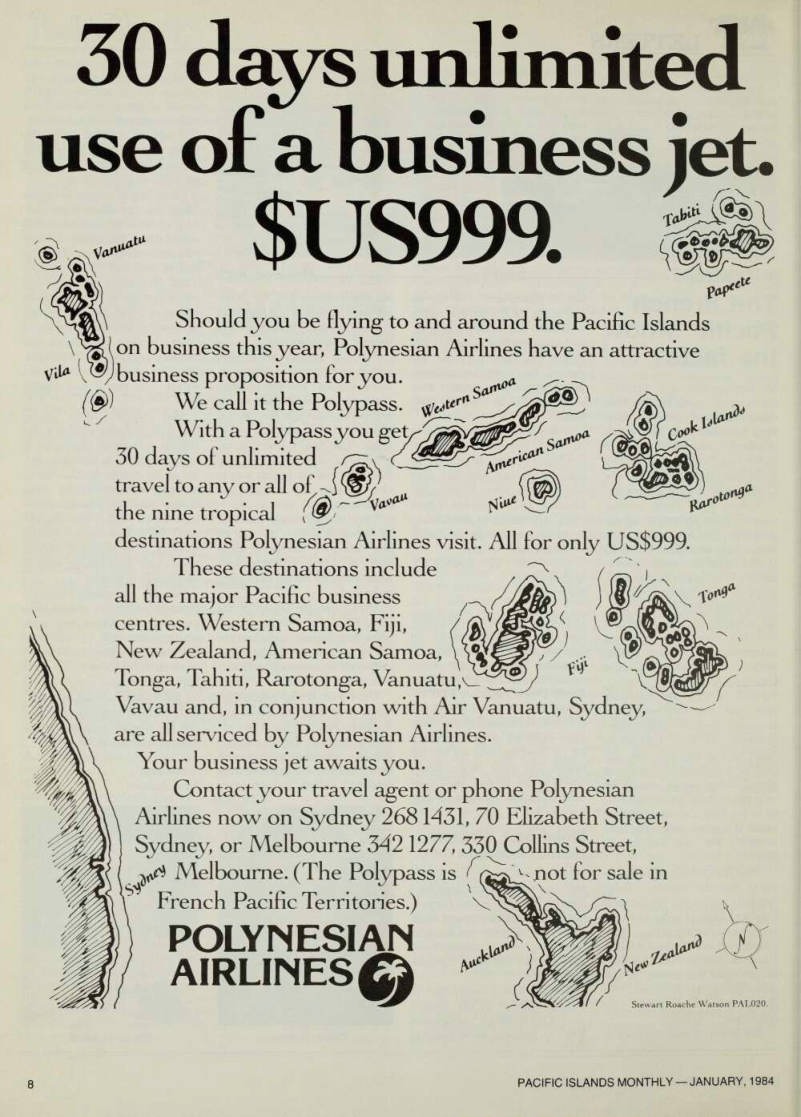
New Caledonia
-5600 km
Moruroa Atoll
Mr Georges Lemoine, France’s secretary of state for overseas departments and territories, must have wondered what he’d struck at a press conference he gave in Sydney on November 27 during a stopover on his way from New Caledonia to French Polynesia.
A dewy-eyed young woman reporter from some part of the Australian media (reporters at the press conference didn’t identify themselves or their news paper/TV channel/radio station, which in a number of cases was just as well) asked whether, since his government had decided it wouldn’t give New Caledonia independence, nuclear testing would continue in New Caledonia as before.
First of all, Mr Lemoine hadn’t said that the French Gov ernment wouldn’t grant inde pendence to New Caledonia.
What he had said was that, ac cording to French Government plans, independence would be only one of three options present ed to the New Caledonian popu lation at a referendum to be held in 1989. But that was by the way.
What really stopped him in his tracks was the reporter’s light hearted way with the several thousand nautical miles of Pacif ic Ocean separating New Caledonia from Moruroa Atoll in French Polynesia, where France’s nuclear testing in fact takes place. To his credit, he dealt politely with the questioner.
The moral of this short tale is
this: if Australians or anyone else in the Pacific for that matter want to help in unravelling the undoubted problems faced by the people of France’s Pacific ter ritories, they have, before open ing their mouths, one very sim ple obligation; to leam the basic facts.
If they don’t take the trouble to do this and not all displays of ignorance on the subject are as crass as the one described here nobody can blame Mr Lemoine and his friends if they shrug off whatever Australians or anyone else in the Pacific might have to say.
P. Warbeck
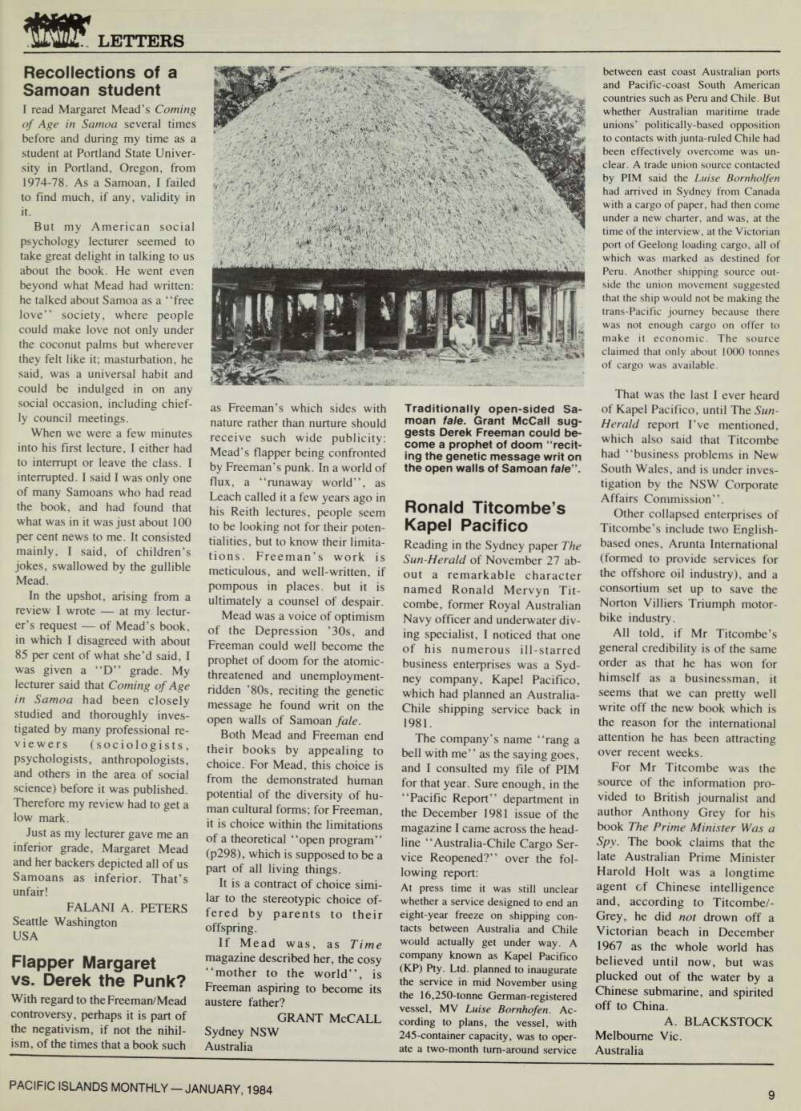
Sydney NSW Australia During last year’s controversy over the conflicting views on Samoan society of the late Dr Margaret Mead and the Aust ralian National University’s Pro fessor Derek Freeman, PIM re ceived more letters on the subject than we could possibly use at the time. Here we draw the curtain on (at least the first act of) the drama with three of the letters which even at this late stage deserve to see the light of day.
Mead and Western
disillusionment
Albert Wendt’s article on Derek Freeman’s Margaret Mead and Samoa: The Making and Unmak ing of an Anthropological Myth (PIM Apr. ’B3 plO) was the most interesting of the reviews that I have read on the Mead/Freeman controversy.
The question I would like to pose is whether or not Mead’s motive for finding a “model soc iety’’ in Samoa is to be found in
the disillusionment of the West ern intelligentsia at that time over the way modem Western society seemed to be evolving.
The 20th century began with optimistic beliefs in progress, so cial evolution, and the ultimate perfectibility of human nature and society through the rational application of new human know ledge. The Anglo-American in telligentsia then believed that their tribe was blazing the way in the forward march of civilisation.
These illusions were shattered by World War I the first of this century’s European tribal wars in which millions were slaughtered by means of modern
technology.
Then came the slump of the late 19205, the collapse of par liamentary democracies, and the rise to power of mad and evil cargo cult figures such as Hitler, Mussolini, and Stalin.
There were Jewish psycholog ists such as Sigmund Freud and Wilhelm Reich who were ad vancing theories that all the irra tionality was due to repressed sexual desires which found their deformed outlets in reactionary
ideas, aggression, racism, and blind following of dictators, and so on. Then anthropologists joined in the speculation about whether people were bom natur ally sinful or virtuous, and, if the latter, whether they turned bad because of inappropriate social programming techniques.
Thus bright young Margaret Mead was sent down from Har vard to make the one bomb that would defeat the enemy tribe of naturalist anthropologists. She had to find one of the original tribal formations which would prove that plenty of sex and co operative tribal customs would do wonders for the modern social order. Modem civilisation had lost its way because it had forgot ten its original wholesome values. The rest is now history That Margaret Mead was at that time probably idealistic and put on rose-tinted spectacles is understandable. Is there any wri ter on the South Pacific who is not now embarrassed by some earlier youthful preconceptions later shown to have been inaccu rate? In this crowd of Pacific scholars, there is no one without sin none who has the right to cast the first stone.
We all appreciate Professor Freeman’s efforts to correct Mar garet Mead’s errors, but what really matters was the effect of her ideas upon people. Was her work an influence more for good than bad, or vice-versa? Purely on the level of sexual behavior, there seem to be many admitting that her liberating ideas were in general not bad at all.
J. Dakuvula
Wellington New Zealand
Derek Freeman
Margaret Mead
Recollections of a
Samoan student
I read Margaret Mead’s Coming of Age in Samoa several times before and during my time as a student at Portland State Univer sity in Portland, Oregon, from 1974-78. As a Samoan, I failed to find much, if any, validity in it.
But my American social psychology lecturer seemed to take great delight in talking to us about the book. He went even beyond what Mead had written: he talked about Samoa as a “free love” society, where people could make love not only under the coconut palms but wherever they felt like it; masturbation, he said, was a universal habit and could be indulged in on any social occasion, including chief ly council meetings.
When we were a few minutes into his first lecture, I either had to interrupt or leave the class. I interrupted. I said I was only one of many Samoans who had read the book, and had found that what was in it was just about 100 per cent news to me. It consisted mainly, I said, of children’s jokes, swallowed by the gullible Mead.
In the upshot, arising from a review I wrote at my lectur er’s request of Mead’s book, in which I disagreed with about 85 per cent of what she’d said, I was given a “D” grade. My lecturer said that Coming of Age in Samoa had been closely studied and thoroughly inves tigated by many professional re
viewers (sociologists,
psychologists, anthropologists,
and others in the area of social science) before it was published.
Therefore my review had to get a low mark.
Just as my lecturer gave me an inferior grade, Margaret Mead and her backers depicted all of us Samoans as inferior. That’s unfair!
Falani A. Peters
Seattle Washington
Usa
Flapper Margaret
vs. Derek the Punk?
With regard to the Freeman/Mead controversy, perhaps it is part of the negativism, if not the nihil ism, of the times that a book such
as Freeman’s which sides with nature rather than nurture should receive such wide publicity: Mead’s flapper being confronted by Freeman’s punk. In a world of flux, a “runaway world”, as Leach called it a few years ago in his Reith lectures, people seem to be looking not for their poten tialities, but to know their limita tions. Freeman’s work is meticulous, and well-written, if pompous in places, but it is ultimately a counsel of despair.
Mead was a voice of optimism of the Depression ’3os, and Freeman could well become the prophet of doom for the atomic threatened and unemployment ridden ’Bos, reciting the genetic message he found writ on the open walls of Samoan fale.
Both Mead and Freeman end their books by appealing to choice. For Mead, this choice is from the demonstrated human potential of the diversity of hu man cultural forms; for Freeman, it is choice within the limitations of a theoretical “open program” (p 298), which is supposed to be a part of all living things.
It is a contract of choice simi lar to the stereotypic choice of fered by parents to their
offspring.
If Mead was, as Time magazine described her, the cosy ‘‘mother to the world”, is Freeman aspiring to become its austere father?
Grant Mccall
Sydney NSW Australia
Ronald Titcombe’s
Kapel Pacifico
Reading in the Sydney paper The Sun-Herald of November 27 ab out a remarkable character named Ronald Mervyn Tit combe, former Royal Australian Navy officer and underwater div ing specialist, I noticed that one of his numerous ill-starred business enterprises was a Syd ney company, Kapel Pacifico, which had planned an Australia- Chile shipping service back in 1981.
The company’s name “rang a bell with me” as the saying goes, and I consulted my file of PIM for that year. Sure enough, in the “Pacific Report” department in the December 1981 issue of the magazine I came across the head line “Australia-Chile Cargo Ser vice Reopened?” over the fol lowing report; At press time it was still unclear whether a service designed to end an eight-year freeze on shipping con tacts between Australia and Chile would actually get under way. A company known as Kapel Pacifico (KP) Pty. Ltd. planned to inaugurate the service in mid November using the 16,250-tonne German-registered vessel, MV Luise Bornhofen. Ac cording to plans, the vessel, with 245-container capacity, was to oper ate a two-month turn-around service
between east coast Australian ports and Pacific-coast South American countries such as Peru and Chile. But whether Australian maritime trade unions’ politically-based opposition to contacts with junta-ruled Chile had been effectively overcome was un clear. A trade union source contacted by PIM said the Luise Bornholfen had arrived in Sydney from Canada with a cargo of paper, had then come under a new charter, and was, at the time of the interview, at the Victorian port of Geelong loading cargo, all of which was marked as destined for Peru. Another shipping source out side the union movement suggested that the ship would not be making the trans-Pacific journey because there was not enough cargo on offer to make it economic. The source claimed that only about 1000 tonnes of cargo was available.
That was the last I ever heard of Kapel Pacifico, until The Sun- Herald report I’ve mentioned, which also said that Titcombe had “business problems in New South Wales, and is under inves tigation by the NSW Corporate Affairs Commission”.
Other collapsed enterprises of Titcombe’s include two English based ones, Arunta International (formed to provide services for the offshore oil industry), and a consortium set up to save the Norton Villiers Triumph motor
bike industry.
All told, if Mr Titcombe’s general credibility is of the same order as that he has won for himself as a businessman, it seems that we can pretty well write off the new book which is the reason for the international attention he has been attracting over recent weeks.
For Mr Titcombe was the source of the information pro vided to British journalist and author Anthony Grey for his book The Prime Minister Was a Spy. The book claims that the late Australian Prime Minister Harold Holt was a longtime agent of Chinese intelligence and, according to Titcombe/- Grey, he did not drown off a Victorian beach in December 1967 as the whole world has believed until now, but was plucked out of the water by a Chinese submarine, and spirited off to China.
A. Blackstock
Melbourne Vic.
Australia
Traditionally open-sided Sa moan fate. Grant McCall sug gests Derek Freeman could be come a prophet of doom “recit ing the genetic message writ on the open walls of Samoan fale".
Advertisements & other items, pp. 8-10 (2 items)
30 days unlimited
use of a business jet.
m % \] M \
SUS 999.
t (&t * Should you be flying to and around the Pacific Islands on business this year, Polynesian Airlines have an attractive business proposition for you. s*** 0 * We call it the Polypass. 30 --- i V) With a Polypass you c days o( unlimited \ travel to any or all of A \§£y the nine tropical (&• 4 . 0« % •4 destinations Polynesian Airlines visit. All for only US$999.
These destinations include 7^ all the major Pacific business n/M) m t ** centres. Western Samoa, Fiji, New Zealand, American Samoa, V ..- t Tonga, Tahiti, Rarotonga, Vanuatu Vavau and, in conjunction with Air Vanuatu, Sydney, are all serviced by Polynesian Airlines.
Your business jet awaits you.
Contact your travel agent or phone Polynesian Airlines now on Sydney 2681431, 70 Elizabeth Street, Sydney, or Melbourne 342 1277,330 Collins Street, yvri Melbourne. (The Polypass is f not for sale in French Pacific Territories.)
POLYNESIAN *?Wm]
** \ r Stewart Roache Watson PALO2O.
From the
ISLANDS
PRESS
Sir Percy Chatterton, former missionary and parliamen tarian, writing in The Times of Papua New Guinea, Port Moresby, about Tok Pisin (also known as Pidgin English, Melanesian Pidgin and Neo-Melanesian) When Pidgin had broken free from its racist background and when it was spoken by people who spoke it as a language in its own right, and not as a kind of broken English, I came quite to like it and to enjoy listening to it. But what has come over it today, especially in our national parliament, where some mem bers speak in a jumble of alternate Pidgin and English (pity the poor interpreters) and others in a kind of Pidgin that must be quite unintelligible to the average listener . . . Dear national leaders, if you want to talk to us in Pidgin, please, especially when you are on the air, use the sort of Pidgin that can be understood in the villages and shanty settlements.
From the Flotsam and Jetsam column, The Fiji Times, Suva A mystery surrounding two vehicles which share the same regist ration number remained unsolved, with road transport officials unable to explain it. It was discovered that an S. Nair Transport Company bus and an East-West Constructions light goods vehicle shared the same number on their registration plates. Both com pany managements claimed that their vehicles were legally regis tered with the licensing office at Valelevu. The Controller of Transport, Mr Bob Walker, was unable to provide any explana tion for the identical number plates. Efforts to obtain information from other road transport officials were unsuccessful. The Fiji Times believes the Minister for Transport, Mr Ted Beddoes, has ordered an investigation into it. Meanwhile both vehicles are running on the roads.
Part of a Samoa Times editorial on a government pro posal to take over the local campus of the University of the South Pacific as the nucleus of a University of Western Samoa If the government goes ahead with its hasty decision to establish a Western Samoa national university, then it must do so without taking over the facilities at Alafua of the University of the South Pacific (USP). First of all, the facilities were built for the use of the whole region, with assistance given by aid donors on that understanding. Secondly, the facilities were handed over in 1977 on the understanding that they would be held by the USP for up to 60 years. For the minister of education to now argue that a formal lease was not signed is nothing more than a desperate attempt to justify the unjustifiable. . . . and some comment on the same subject in a read er’s letter to The Samoa Times It seems that our government is making a big mistake. I have been to the campus at Alafua many times and it is not that good. I think our government should use the Mormon Church place at Pesega for a university. It is much nicer than Alafua, and easier to get to the buses.
Tuvalu News Sheet, Funafuti On Friday the Funafuti Lonely Hearts, Darts, Drinking, Sporting and Cribbage Club held a grand darts and cribbage tourney at the club house. The evening was attended by more than two dozen assorted pitchers and players. The convenor, Mr David Abbott, made a presentation to Mr Bo Kirton who had been
unanimously voted Most Inebriated Player of 1983. In presenting the award, a silver tankard, the convenor spoke at some length of Mr Kirton’s amazing abilities and his contribution to the up standing reputation of the club.
The Times of Papua New Guinea, Port Moresby, report ing a widely-circulated rumor about the cause of floods near the city of Lae It was said that people were flocking to the Angau general hospital in Lae, and for a gate fee of three kina they could see a woman who had given birth to snakes. The story went that this particular women had killed a snake while in her garden, but the snake returned to her at night while she was asleep and was sharing a bed with her when her husband arrived. The angered husband was just about to finish off the snake when the snake warned that if he killed it then his wife would also die.
But he killed the snake, which was a form taken by an ancestor.
The angry ancestors were now seeking revenge, leading to trou bles and floods.
Dr G. Kristoffa Ninkama in a letter published in the Papua New Guinea Post-Courier, Port Moresby, in which he endorses the standards being achieved by PNG medical graduates At the same time I agree that unnecessary strings of degrees obtained in the fields unrelated to the faculty being engaged in is a total waste apart from prestige. It reminds me of my boyhood days when I made my toy lorry look impressive with as many trailers and wheels as possible, but really it was useless to my community.
A comment on the 1984 budget from opposition politi cian Sir Julius Chan, quoted in the Papua New Guinea Post-Courier, Port Moresby The only time an economy should be cooled down is when it has previously heated up. Unfortunately we have never been in that fortunate position.
From a lecture on beekeeping, given by Mr Kerry Simp son of New Zealand and reported in the Tuvalu News Sheet Mr Simpson says (on beekeeping trials on Vaitupu) that two major problems were encountered during the trials. The first had to do with the toads who sat round the hives at night and ate the bees as they came in. The problem was solved by raising the hives two feet off the ground, and the toads were not able to jump that high.
Editorial comment from the Papua New Guinea Post-Courier, Port Moresby The reduction on appeal of a one-year jail term to a 100 kina fine, in a case involving a man who jumped the fence into Murray Barracks to listen to a rock concert, is welcome indeed.
The appeal judge, Mr Justice Amet, held that new minimum penalties prescribed under amendments to the Summary Offences Act do not remove from magistrates the power to levy fines, where appropriate, rather than imposing jail terms. There is little doubt that the public accepts the need for harsher prison sentences to help curb lawlessness. But the desire to hear a rock concert and inability to pay entrance money, is lawlessness of a relatively minor kind. One hundred kina seems a better remedy than a year in the cells.
From the Big Ears column in Viewpoint, Rarotonga, Cook Islands.
Big Ears said that a passenger just arrived on the beach was telling him that arriving at Rarotonga International Airport these days is just like entering a police state, what with all the uniforms in evidence at the airport. This guy said to Big Ears that he thought we in the Cooks were trying to attract tourists not to put them off. It was then suggested it would be nice to see the airport staff in pareo shirts or the like. Big Ears said that he had heard it all before. At one time a couple of years ago he was told it couldn’t be done. Why? Because the uniforms are the reason the staff join in the first place.
says Fiji’s White Report
AT LAST, THE LAST WORD ON A 1982 ELECTION ‘Dirty tricks’ charge unproven, says Fiji’s White Report
The Royal Commissioner who inquired into events surrounding Fiji’s turbulent 1982 general election has found that it was “not established that repugnant strategies (from the report pre pared for the ruling Alliance Par ty by Australian business consul tant Alan Carroll) were adopted or implemented” by the party.
The report by the commission er, retired New Zealand judge Sir John White, was tabled in parlia ment in Suva on November 22.
Sir John was appointed after the elections to decide on three broad allegations.
The first centred on the Carroll Report, and whether the Alliance Party had implemented it in its election campaigning.
The second was whether the Alliance Party had used (Aust ralian Government-funded) Fiji Government media consultant Clive Speed in its campaign, and whether the Opposition National Federation Party (NFP) had col laborated with overseas media particularly the Australian Broadcasting Commission’s TV team from the program Four Cor ners, and the Australian weekly newspaper The National Times to discredit the Alliance.
The third concerned Alliance allegations that the NFP received financial aid from the Soviet Un ion during the election.
On the first issue, Sir John said it was a reasonable inference that the Alliance had implement ed recommendations in the re port. “On the other hand,” he went on, “I found that it had not been established that any repug nant recommendation had been implemented, as alleged”. (The “repugnant” recommendations allegedly contained in the report were: that the government should “pile up charges” against West ern United Front leader Ratu Osea Gavidi so he could not contest the election; that the Fi jian Nationalist Party leader Sakeasi Butadroka should be bribed to keep him out of the election; and that efforts should be made to divide the Indian
community along religious lines, to the electoral advantage of the Alliance Party.) Sir John said that in consider ing the charge that Mr Speed had acted for the Alliance, he had found that “of his own volition, or at the behest of Mr Carroll, Mr Speed had assisted members of
the Carroll team in a minor role”.
Ruling that the NFP had not collaborated with the Four Cor ners TV program team, and The National Times newspaper, he found that neither the Times nor the TV program “was deliberate ly directed towards injuring the Alliance, but that each was di rected against the consultants”.
On the matter of the NFP’s alleged deal with the Russians, Sir John ruled that there was no evidence that NFP member and
former Opposition leader Siddiq
Koya had ever signed any docu ments purporting to be agree ments with the Russians. There was no evidence that the photo copied “Koya Letter” was a copy of any document that Mr Koya had in fact signed.
Of Rosemary Gillespie, a for mer researcher with the Carroll team who “blew the whistle” on the team by revealing the con tents of the report. Sir John said she had “acted out of a sense of
duty, as she understood it, and, if I may say so, with courage”.
On other matters, Sir John ruled that while the Alliance had denied commissioning the Car roll Report, he found that it had done so.
Lawyers for both the Alliance Party and the NFP hailed Sir John’s report as a vindication of their side.
A dissenting voice was that of Ms Gillespie, who was in Fiji on a private visit when the report was released. She said the fact that both political parties were claiming victories from the re port proved that Sir John had tried to please everyone.
“Sir John, in his report, seems to be more concerned with the personal reputation of the witnes ses rather than finding the facts,” she said.
“I think the report is quite unsatisfactory, and people will be questioning his findings for a long time”.
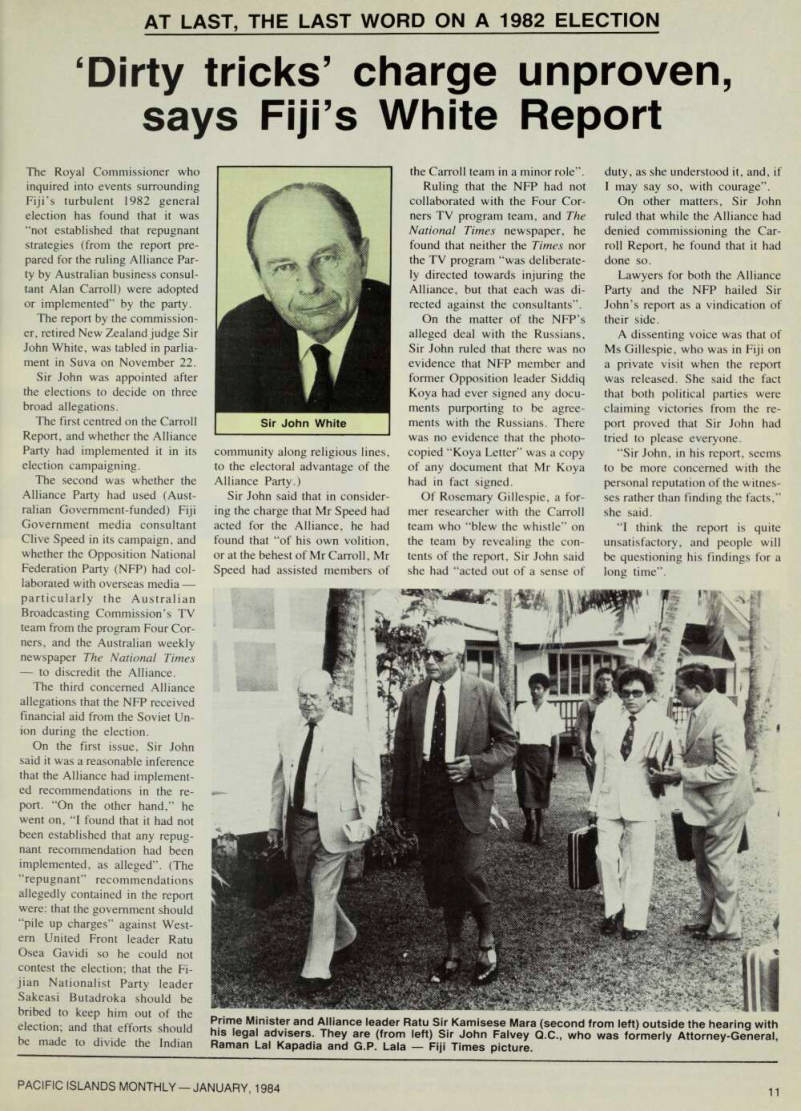
Prime Minister and Alliance leader Ratu Sir Kamisese Mara (second from left) outside the hearing with his legal advisers. They are (from left) Sir John Falvey Q.C., who was formerly Attorney-General, Raman Lai Kapadia and G.P. Lala Fiji Times picture.
Sir John White
Advertisements & other items, pp. 12-13 (1 item)
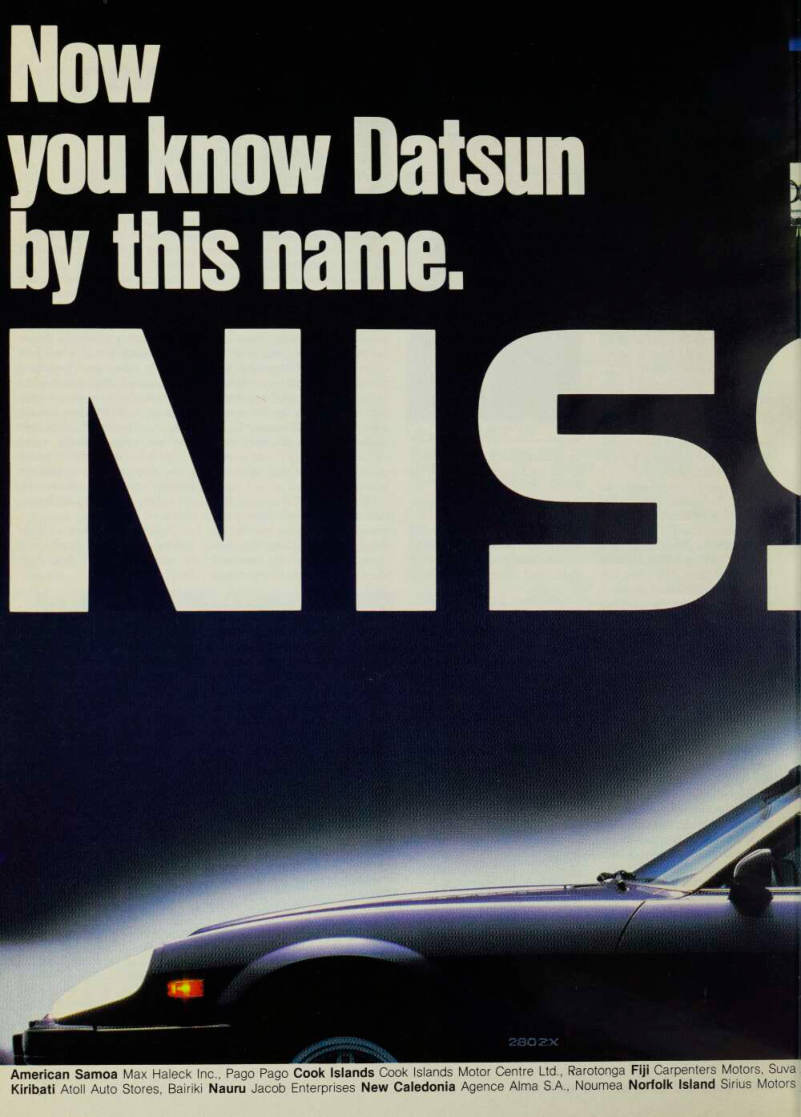
by this name.
Now you know Datsun by this name. i mm m American Samoa Max Haleck Inc., Pago Pago Cook islands Cook Islands Motor Centre Ltd., Rarotonga Fiji Carpenters Motors, Suva Kiribati Atoll Auto Stores, Bairiki Nauru Jacob Enterprises New Caledonia Agence Alma S.A., Noumea Norfolk Island Sirius Motors
shiiS
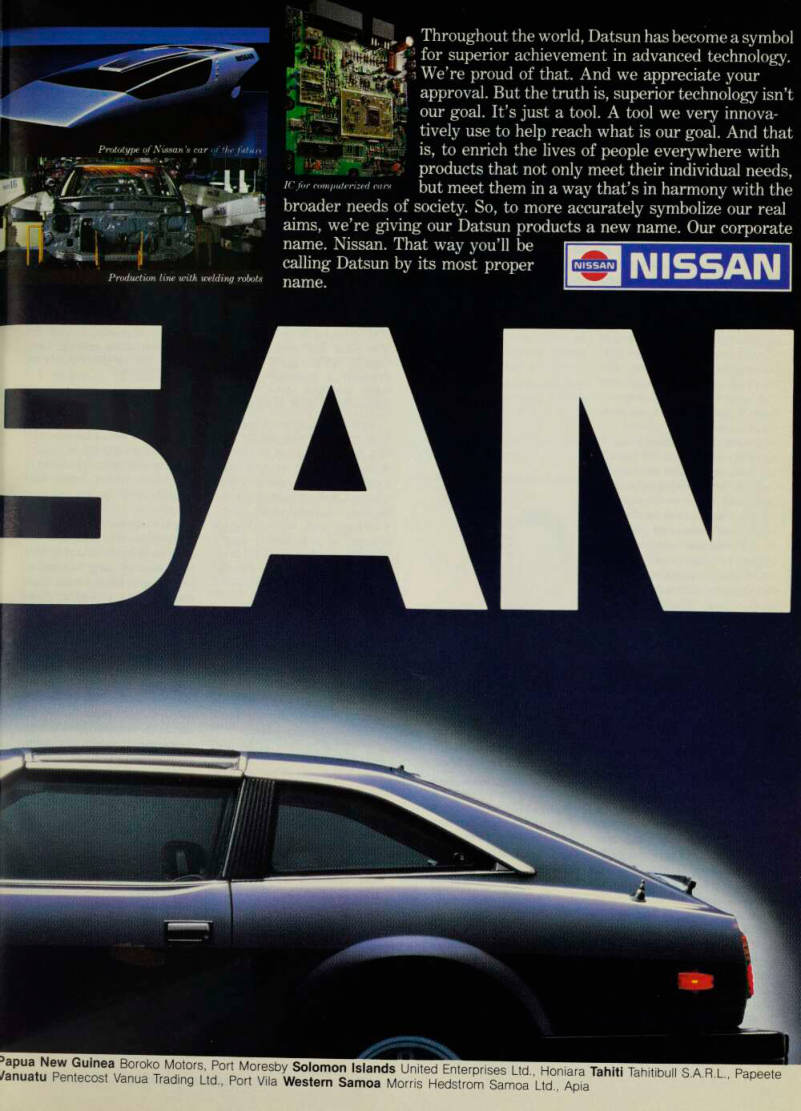
-’ • \ •- ..f ♦ • —*'# w * Throughout the world, Datsun has become a symbo for superior achievement in advanced technology. •i We’re proud of that. And we appreciate your 1 approval. But the truth is, superior technology isn’t our goal. It’s just a tool. A tool we very innovatively use to help reach what is our goal. And that is, to enrich the lives of people everywhere with products that not only meet their individual needs, but meet them in a way that’s in harmony with the broader needs of society. So, to more accurately symbolize our real aims, we’re giving our Datsun products a new name. Our corporate name. Nissan. That way you’ll be IC for computerized cars Production line with welding robots calling Datsun by its most proper name.
NISSAN
NISSAN
Floyd’s Fearless
The Month
Floyd’s Fearless Forecast for ’84
Predictions are the stuff of fools or gamblers, and a good journal ist should be neither. But fate tempts us all, even the most cautious of columnists. So herewith is Floyd’s Fearless Forecast for Micronesia.
Most important, 1984 will be the year America’s long trustee ship is finally terminated at least in most of Micronesia. By November or December, the U.S. Congress should have had enough time to approve the free association compacts with the Marshall Islands and the Federated States of Micronesia.
Palau is another matter, more of which in a moment.
Assuming President Ronald Reagan is re-elected and at this early stage, with the Ameri can economy shifting into high gear, that must be considered likely termination by the end of the year seems quite possible.
If a Democratic administration comes to power the situation could change dramatically. But that must be counted as a long shot and, after all, this is prediction time.
Congress will act favorably because it has no other option.
U.S. strategic interests are well protected by free association, perhaps too much so in some cases. And certainly in the Northern Marianas, which will become a U.S. commonwealth, the people welcome full Ameri can citizenship with open arms.
In addition, Micronesians have in plebiscites made it clear that either free association or commonwealth statuses are the relationships of choice. It would be hard for senators or congress men to vote against the “will of the people”.
What of the United Nations, which has ostensible oversight of the Trust Territory? In reality, the U.N. has been a symbolic lord of the Micronesian realm; the decisions that count have always been made in Washing ton. So it seems likely that the United States will opt to present the U.N. with a termination pac kage that has been, in effect.
signed, sealed and delivered.
Given a probable veto by the Soviet Union of the post trusteeship arrangements in the Security Council (under which the Trust Territory of the Pacific Islands falls), the Reagan ad ministration (or any other for that matter) would avoid that body. A more reasonable course would have Washington tell either the General Assembly or the Trus teeship Council that the U.S. was ending its administration in ac cordance with the trusteeship ag reement, and with the wishes of the Micronesian people and leave it at that.
The question of Palau may take longer to answer. Two fac tors are influencing the outcome
of the political and constitutional stalemate in those islands.
One, perhaps the most impor tant, is the second presidential elections scheduled for this com ing November. This is the vote that counts and for the past two years local forces have been realigning themselves for the contest. Palauans are pragmatic in their politics; they know that
regardless of the group’s political
relationship with the United States, they have to live on a day-to-day basis with their elect ed leadership. Far better to be on the winning side than wait
another four years to return from the political hinterlands.
Because of this, the free as sociation compact has become a pawn in the “larger” local polit ical scene. Factions and influen tial individuals have supported, and opposed, free association primarily as a means to further their personal or group political goals. There has been an unfortu nate lack of broad-based debate on the issues of nationalism.
The second major factor in fluencing events in Palau is the “nuclear issue”. Resolution of the difference between the com pact and Palau’s constitution is primarily a political issue: it has been clear from the beginning that the reality of the situation demands a pragmatic answer rather than one based on con stitutional or legal niceties.
That is why renewed negotia tions between Palau and the Un ited States took place in Hawaii in mid-December. At press time, the following was evident: a new compact will emerge from the process, one based on the “old” compact but with enough
changes to (one hopes) satisfy
the many constituencies in Palau.
It is notable that the Palauan
delegation included nearly every
faction from the group.
What U.S. Ambassador Fred Zeder has essentially told the Palauans is that they must either put up with broad-based ag reement on the new relationship or shut up and accept the
reality of a continuing trusteeship
administration solely for Palau into the indefinite future.
What has become of the nuc lear problem is unclear at press time. Some sources say the U.S.
has dropped its military require
ments completely, but that seems unlikely. Others say the Palauans would agree to a U.S. military training presence as called for in the original compact, but for more than the SUSI billion over 50 years that had been agreed upon. That seems quite likely from the Palauan perspective, but while some increase may be forthcoming, it is hard to see how the United States could ag ree to a radical jump in funding levels for Palau.
How long will this all take?
If all goes well, both sides could complete their differences
by early this year. That would give time for the holding of a new referendum. It is clear another vote would have to take place, but would likely require only a simple majority and have none of the trick questions that caused such problems last February.
A less optimistic but still real istic prediction is that Palau will be on track by the end of August or perhaps by early September, just in time for the local elec tions. Such a timetable allows the local politicos to try to claim credit for “saving” free associa tion and the big bucks that are a part of the agreement.
In any case it would be quite surprising if Palau’s problems dragged on through 1984. It is not in Palau’s favor for the un certainties to continue foreign governments, which are being courted for additional aid, are uncomfortable at the seemingly endless squabbling. And when the Palauans see their Microne sian brethren beginning to reap the financial benefits of free as sociation, they will want their piece of the pie, too.
Such predictions, of course, come with no guarantees. But the odds would seen to favor the outcomes described here. In both cases general trusteeship is sues and specific Palauan ques tions it is really nothing more than predicting the certain out come. The major disagreement comes on timing and on that score, only time will tell.
Floyd K. Takeuchi.
Notes from the North Floyd K.
Takeuchi on Micronesia
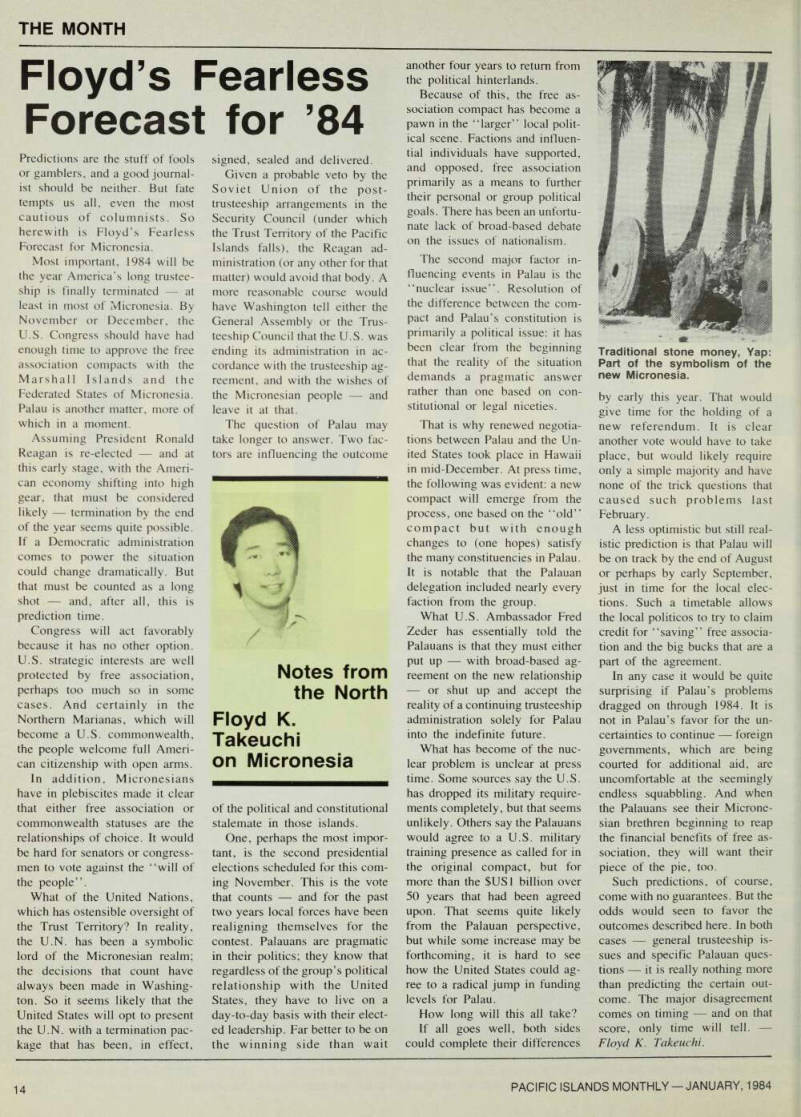
Traditional stone money, Yap: Part of the symbolism of the new Micronesia.
publishing

Focus on Pacific publishing
A symposium, “Publishing in Hawaii and the Pacific Islands”, was held in Honolulu on Novem ber 18-19. The affair was co sponsored by several teaching units of the University of Hawaii (UH), the university’s press, and the East West Center’s Com munication Institute.
The symposium was the brain child of Dr Miles Jackson, for mer territorial librarian of Ameri can Samoa, and now Dean of UH’s Graduate School of Library Studies. Its purpose was to pro vide educators, librarians, pub lishers, writers and booksellers with information on the issues and problems of publishing in Hawaii and the Pacific.
Most of the speakers and par ticipants in the discussion were from Hawaii, so the event had a distinctly Hawaiian bias. How ever, three speakers from abroad did expand the scope of topics and discussion: Kevin Walcot, publisher. Word Publishing Company, Papua New Guinea; Albert Wendt, author and profes sor of Pacific Literature, Univer sity of the South Pacific; and lan Willison, curator, English Lan guage Collections, British Library.
Walcot gave the opening address. He focused on problems of publishing that are common to the Pacific region as a whole, and those that are more peculiar to PNG. Concerning the former, it was clear that the problems which- plague publishing in the islands are for the most part the same ones causing difficulties in other areas. While the Pacific area is vast, it tends to be ignored because its total population is small by world standards. Costs are high because of the sums involved in moving people and goods over the great distances between island groups and the world centres of industrial pro duction. There are serious prob lems with technical facilities.
The linguistic diversity of the region causes problems, and, in the case of publishing, makes for small reading audiences. Furth er, societies that have long relied
upon rich oral traditions are not quick to produce literary ones.
A combination of all these factors accounts for the fact that there is little commercial incen tive to enter publishing enter prises in the Pacific.
While problems exist in abundance, Walcot suggested that there are also certain oppor tunities for the resourceful pub lisher. For example, there is no publication in the region design ed for women, and there is a potential youth market because Pacific populations are young.
Willison talked about the gen eral place of the written word in the scheme of things, at least in the pre-television era. He noted that “the world’s ordered experi ence of itself is determined by writers” that is, what is writ ten and published largely shapes our perceptions of people, places, events, and things.
Willison went on to suggest that the Pacific as we know it was created by writers. The ac counts of the voyages of James Cook and other European explor ers gave form to the initial per ceptions of the Pacific in the Western world. The writings of missionaries and colonial ad ministrators followed. An thropologists (while not specific ally mentioned) added their views. In this regard, one thinks of the perceptions of Samoans created by Margaret Mead in the late 19205, and the current con troversy as to the accuracy of those images stirred by Derek Freeman’s recent book.
Willison commented that new perceptions are now being of fered by indigenous Pacific wri ters who have emerged in recent years. Specific attention was called to Lali: A Pacific Antholo gy (1980), edited by Albert Wendt, for two reasons: 1) it is the first representative anthology of what has been written in English by Pacific islanders, and 2) it has appeared in the predo minant mode of publishing today a quality paperback issued by a large publishing conglomerate
(Longman Paul Ltd of New Zea land) with branches and repre sentatives throughout the world.
The problems of contemporary publishing were very much on the minds of local writers in Hawaii. They too find that poten tial reading audiences are limited, but the reasons are not
those resulting from linguistic
diversity or the smallness of par ticular language groups: rather, many local writers are from minority ethnic groups which do not share the values of the polit
ically and economically power
ful, and their literary efforts are simply not welcomed in the lar
ger society.
Roland Kotani is the editor of Ka Huliau (The Turning Point) which is self-described as
“Hawaii’s Grassroots Journal’’.
It is relatively new (founded in early 1983), appears every six weeks, and has a circulation of about 3000. Kotani reported that there is a resurgence of a local people’s movement. It sees Hawaii as a special place, whose environment should be respect ed. Kotani contrasted the present with the 1950 s and 1960 s when tourism and the economy were expanding, and pride was taken in recently achieved statehood (1959). He sees similarities bet ween the present literature of the grassroots movements and pre- World War II Hawaii, when ethnic and labor presses were flourishing.
Dr Haunani Kay Trask, a young Hawaiian woman and as sistant professor of American Studies at UH, is conducting
research on Hawaiian political movements. In her opinion, Hawaii offers a poor publishing environment for local writers, and she views Hawaii not as part of the U.S. but as an American colony.
Poet Richard Hamasaki is the editor and publisher of Seaweeds and Constructions, an indepen dent art and literary journal. He noted that 95 per cent of the indigenous literature of the Pacif ic appears only in pamphlet-like forms, their circulations are limited, and most people never get to see them.
Darrell Lum, editor of Bam boo Ridge the Hawaii Writer’s Quarterly, with a circulation of 500, reported that in his experi ence local writers are ignored.
He indicated that a large body of literature is being written, but commercial and university pre sses are simply not interested. As a consequence, the potential market for the output of local writers can only be guessed at.
Associate Professor Rubellite Kawena Johnson is a Hawaiian who teaches her own language at UH, and she chaired the discus sion on local writers. Her recent book Kumulipo: Hawaiian Hymn of Creation, Volume 1, published by UH Press, has been well received as a scholarly work.
Johnson agreed, however, with the general sentiments express ed, and that there should be room for the publication of dissenting opinion in Hawaii.
Albert Wendt discussed his own writing. For him, writing can be fun, especially when it “pours well”. But more often than not, it is simply hard work.
Great commitment is required, and it is a very lonesome en deavor. Wendt’s emphasis on hard work and commitment re mind one of Ernest Heming way’s reflections upon the art of writing in his The Moveable Feast.
The point of literature, accord ing to Wendt, is to create mean ing, and here it would appear that he is in agreement with Willison.
With regard to his own work, Wendt hopes that he has destroy ed some stereotypes about Sa moans and has presented some more accurate views. He sug gested with a smile that he might well have created some new stereotypes in the process.
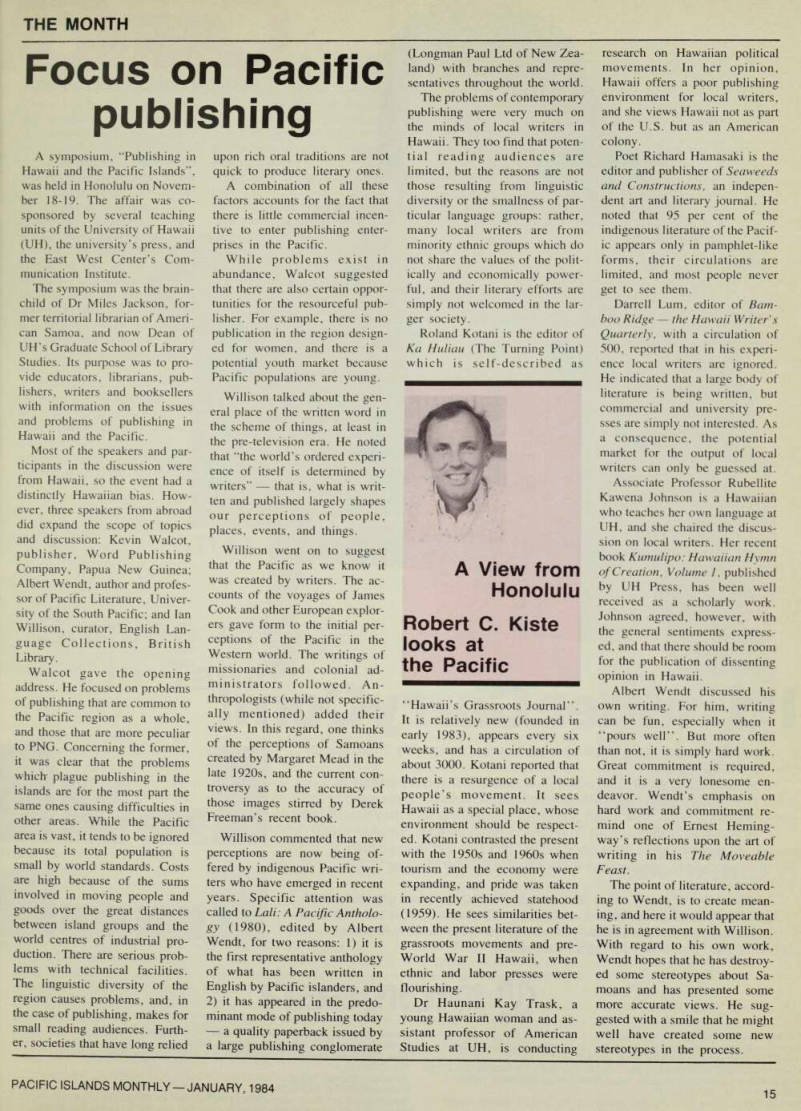
A View from Honolulu Robert C. Kiste looks at the Pacific
Wendt encouraged local wri ters in Hawaii. Commenting on a literature of dissent, he indicated that it was his own observation that in former colonised areas of the world, indigenous writers emerge and go through an initial period of criticising the colonial power. After independence, the new governments become the focal point of criticism.
Because of colonial boun daries, Wendt recalled that in the past he had never thought of Hawaii as part of the Pacific.
However, with the emergence of local writers in Hawaii, and Hawaii’s participation in the South Pacific Festival of Arts, he now thinks of Hawaii as being at least more involved with the reg ion.
With regard to Pacific writers elsewhere, Wendt reminded, the audience that the Institute of Pacific Studies (IPS), at the Un iversity of the South Pacific, is without parallel in providing a publishing avenue for Pacific
writers. He called the IPS effort one of the most exciting publish ing ventures in the academic
world today. With justification
Wendt credited the IPS program as being largely due to the work of one dedicated man, Professor Ron Crocombe.
One part of the symposium looked at things from the view
point of publishers. Benjamin
Bess, publisher of Bess Press,
Honolulu, reported that large
mainland publishing houses are not interested in a regional mar ket. This leaves room within a region for a proliferation of small publishers, and Bess indicated that there are 40 in Hawaii alone.
Bess himself publishes educa tional materials for Hawaiian his tory and language study prog rams. He would like to see the small publishers form a Hawaii book publishers association so that they can join forces to mar ket nationally, locate and share
expertise, etc.
Gary Cooper, director of mar
keting, UH Press, commented on
his organisation being perceived
as a regional press, and also a relatively small one. National re
viewers for prestigious publica
tions like The New York Review of Books appear uninterested in items with a regional focus. The large chains of bookstores (there are two really giant ones in the U.S. mainland) are not interested in books that do not receive national reviews.
Further, they want to deal only with a few publishers, and they choose the large, well known firms, with plenty of advertising funds behind them. Even when the UH Press has a book which might be of interest to a wider audience than a purely regional one, it is usually unable to gain any national notice. A case in point is a quite recent release, Hawaii Under the Rising Sun by Dr John J. Stephan, UH profes sor of history. It is a well written, thoroughly researched, and fas
cinating account of Japan’s plans
for the conquest and rule of Hawaii after Pearl Harbor. It should appeal to many with inter ests in World War II, but is receiving scant attention on the mainland.
As a final point, Walcot also mentioned that news in the Pacif ic still flows along the lines established in colonial times.
American flag islands receive most news from U.S. sources and almost nothing from coun tries in the Pacific itself. The flow of news and the content of newspapers were the topics of a talk given by Dr Jim Richstad, editor. Pacific Islands Communi cation Journal. John Simpson, Pacific Daily News, and Floyd Takeuchi, formerly of PDN and now with the Honolulu Advertis er, felt that there are some, if only few, signs of change for the better. However, they provided impressions rather than hard da ta. All agreed that the formation of a Pacific news service is long
overdue.
Robert C. Kiste.
Advertisements & other items, p. 16 (1 item)
I’d rather Carry Com!
SH
rllllll
CK-7T
Portable Component System
I’d rather Carry Com!
Why? Because it packs like a portable, yet unpacks like a true home hi-fi component system.
So I have the best of both worlds—a home hi-fi and a portable hi-fi, and the sound is great no matter where I play it. And because each of the components is separable, I can place the speakers where they sound best.
Carry Com is also powerful. The CK-11T has 220 watts of peak music cower. All three models have good power though, and they all have a ceautiful and deep bass sound thanks to the unique Pioneer FLAT
iA/OOFER design.
Carry Com has many other features, including a 5-band graphic equalzer, that add up to great sound, and along with the convenience of it all, really don’t see the need for any other stereo system. Now that’s sensible. And that’s why I’d rather Carry Com.
CK-11T
CK-5F
(U) PIONEER
>r further information, please contact: istralia: Pioneer Electronics Australia Pty. Ltd. (Incorporated in Victoria), D. Box 295, Mordialloc, Victoria, 3195 Tel: 580-9911 ji Islands: Brijlal & Company, G.PO. Box No. 362, Suva, Fiji Islands Tel: 22258 jw Zealand: Monaco Distributors Ltd., 2 Poland Road, Glenfield, Auckland, :w Zealand Tel: (09) 444-9144 >rfolk Island: Burns Philp (Norfolk Island) Ltd., P.O. Box 21, Norfolk Island muatu: Burns Philp (Vanuatu) Ltd., Vila, Vanuatu Nauru Island: Jacob Enterprises, P.O. Box No. 4, Republic of Nauru Tahiti: Tahiti Hi-Fi, P.O. Box 848, Papeete, Tahiti New Caledonia: Menard Pacifique Sari, B.P 3899, Noumea, New Caledonia Tel: 27-62.23 American Samoa: Transpac Corporation, P.O. Box 1477, Pago Pago, American Samoa 96799 Tel: 633-5224 Rarotonga: South Seas International Ltd., P.O. Box 49, Rarotonga, Cook Islands Tel: 2327 Papua New Guinea: Bali Merchants Pty. Ltd., P.O. Box 6103, Boroko Tel: 254887
Coming of age
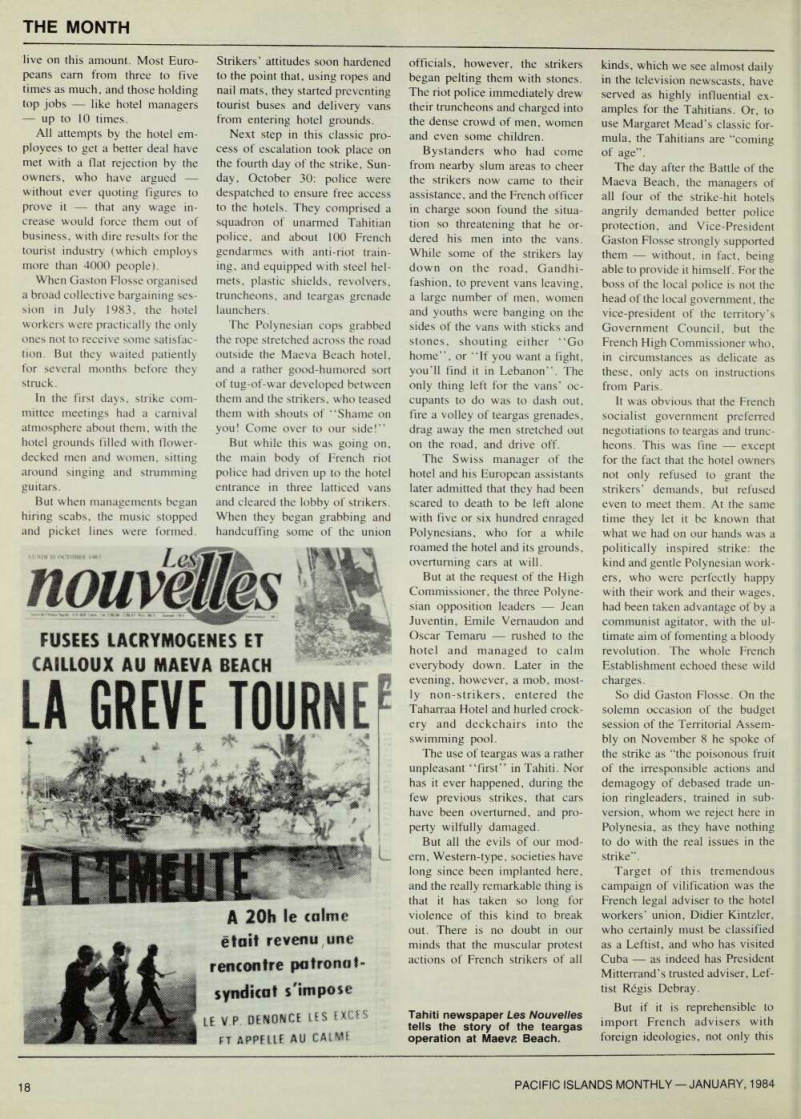
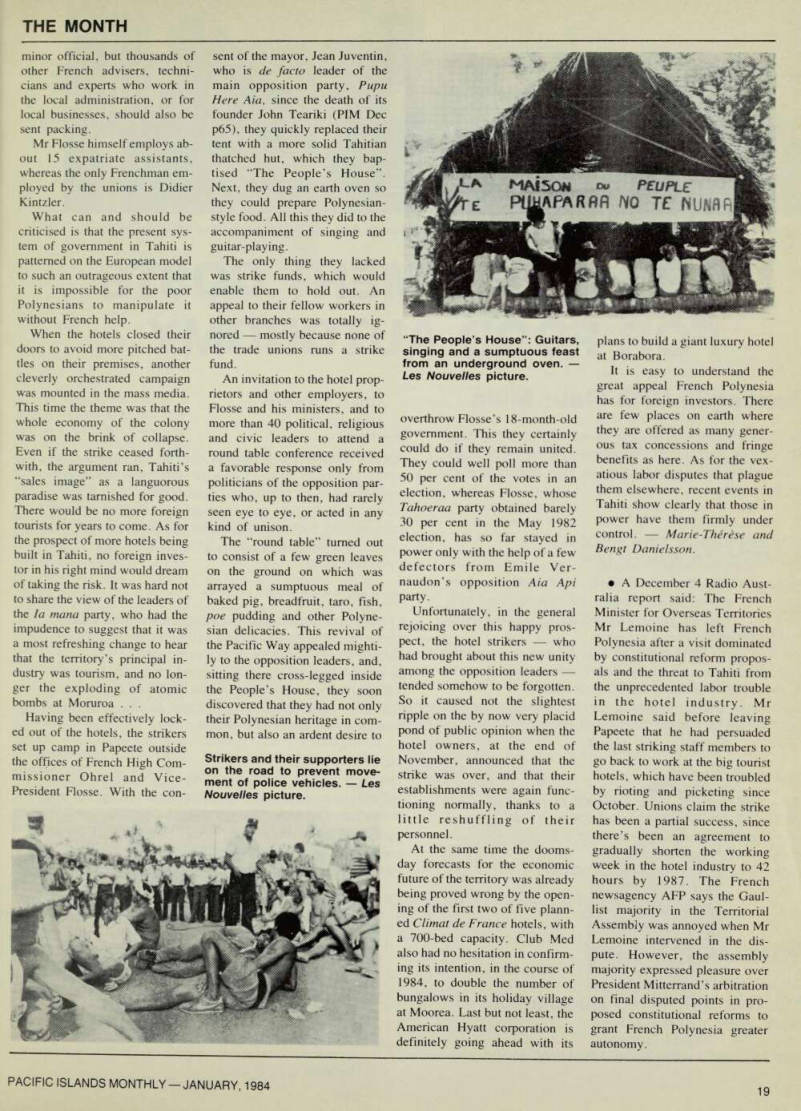
in Tahiti
If October in Tahiti was the month in which the island’s big hoteliers did battle with the formidable Brigette Bardot over her campaign for a worldwide tourist boycott of Tahiti on the issue of the eating of dogmeat there (PIM Dec p 15), November was the month in which they fought a battle of another kind against their own workers, over pay and conditions.
In true Tahitian style, the local hotel workers have traditionally been sweet, kind, cheerful, and so little interested in money as to reject the demeaning European custom of tipping. In fact, they are still that way in the smaller, locally owned hotels, with their relaxed, informal atmosphere.
But the four big foreign-
owned hotels on the island the Maeva Beach, the Beachcomber, the Taharaa, and the Matavai, each with more than 200 rooms must, in the nature of things, be run with the same impersonal efficiency as a European factory.
Significantly, these were the on ly hotels hit by the strike launch ed by hotel workers on October 27.
Far from keeping pace with recent developments in the tour ist industry, French Polynesia’s labor legislation dates from 1952 back in the colonial Stone Age, when there were no tourist hotels at all.
The key feature of the legisla tion is of the catch-22 type; you cannot go on strike against this legislation, because the legisla
tion forbids you to go on strike!
Just as the legislation is out of date, wages too have fallen be hind the spiralling cost of living.
So it was no surprise, not long ago, when the hotel workers formed themselves into a trade union, on the French model.
It was only then that the public at large learned that hotel em ployees in Tahiti work a 48-hour week or six full days but are paid for only 40 hours. The rationale behind this arrangement is that three hours are deducted for six half-hour periods in which the lucky employees may con sume a free lunch, and then a further period of five hours which is counted as “idle time’’.
All this is in sharp contrast to the hours worked by government officials. This is a maximum of 39 which, incidentally, is the legal limit in France for employ ees in all callings.
The present wage is CFP6O,OOO a month. Compared with wages paid in other Pacific Island countries, it looks fine
it’s equal to about SUS3BB, or $A425, at December 1983 ex change rates.
But it must be realised that it is quite impossible for a Tahitian worker, with a family to support and no other source of income, to
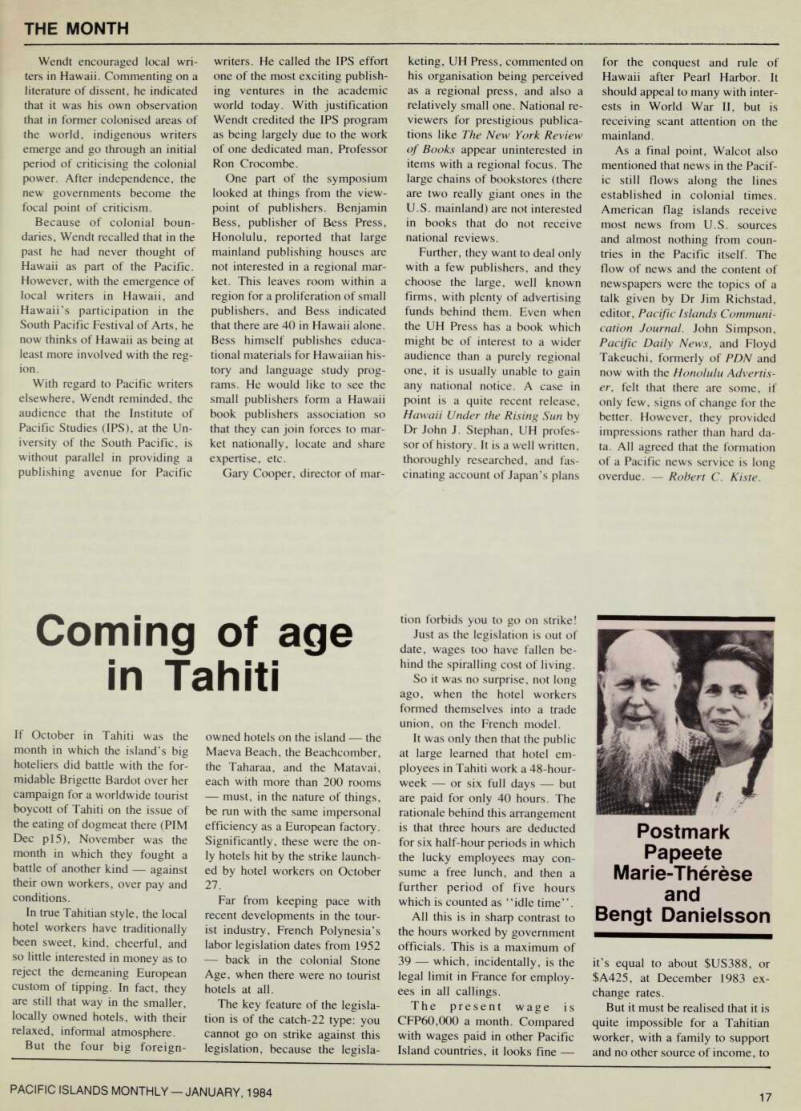
Postmark Papeete Marie-Therese and Bengt Danielsson
live on this amount. Most Euro peans earn from three to five times as much, and those holding top jobs like hotel managers up to 10 times.
All attempts by the hotel em ployees to get a better deal have met with a flat rejection by the owners, who have argued without ever quoting figures to prove it that any wage in crease would force them out of business, with dire results for the
tourist industry (which employs
more than 4000 people).
When Gaston Flosse organised a broad collective bargaining ses sion in July 1983, the hotel workers were practically the only ones not to receive some satisfac tion. But they waited patiently for several months before they struck.
In the first days, strike com mittee meetings had a carnival atmosphere about them, with the hotel grounds filled with flower decked men and women, sitting
around singing and strumming
guitars.
But when managements began hiring scabs, the music stopped and picket lines were formed.
Strikers’ attitudes soon hardened to the point that, using ropes and nail mats, they started preventing tourist buses and delivery vans
from entering hotel grounds.
Next step in this classic pro cess of escalation took place on the fourth day of the strike, Sun day, October 30: police were despatched to ensure free access to the hotels. They comprised a squadron of unarmed Tahitian police, and about 100 French gendarmes with anti-riot train ing, and equipped with steel hel mets, plastic shields, revolvers, truncheons, and teargas grenade launchers.
The Polynesian cops grabbed
the rope stretched across the road outside the Maeva Beach hotel, and a rather good-humored sort
of tug-of-war developed between
them and the strikers, who teased them with shouts of “Shame on you! Come over to our side!’’
But while this was going on, the main body of French riot police had driven up to the hotel entrance in three latticed vans and cleared the lobby of strikers.
When they began grabbing and
handcuffing some of the union
officials, however, the strikers began pelting them with stones.
The riot police immediately drew their truncheons and charged into the dense crowd of men, women and even some children.
Bystanders who had come from nearby slum areas to cheer the strikers now came to their assistance, and the French officer in charge soon found the situa tion so threatening that he or dered his men into the vans.
While some of the strikers lay down on the road, Gandhi fashion, to prevent vans leaving, a large number of men, women and youths were banging on the sides of the vans with sticks and stones, shouting either “Go home’’, or “If you want a fight, you’ll find it in Lebanon’’. The only thing left for the vans’ oc cupants to do was to dash out, fire a volley of teargas grenades, drag away the men stretched out on the road, and drive off.
The Swiss manager of the hotel and his European assistants later admitted that they had been scared to death to be left alone with five or six hundred enraged Polynesians, who for a while roamed the hotel and its grounds, overturning cars at will.
But at the request of the High Commissioner, the three Polyne sian opposition leaders Jean Juventin, Emile Vemaudon and Oscar Temaru rushed to the hotel and managed to calm everybody down. Later in the evening, however, a mob, most ly non-strikers, entered the Taharraa Hotel and hurled crock ery and deckchairs into the
swimming pool.
The use of teargas was a rather unpleasant “first’’ in Tahiti. Nor has it ever happened, during the few previous strikes, that cars have been overturned, and pro
perty wilfully damaged.
But all the evils of our mod em, Western-type, societies have long since been implanted here, and the really remarkable thing is that it has taken so long for violence of this kind to break out. There is no doubt in our minds that the muscular protest actions of French strikers of all
kinds, which we see almost daily in the television newscasts, have served as highly influential ex amples for the Tahitians. Or, to use Margaret Mead’s classic for mula, the Tahitians are “coming
of age”.
The day after the Battle of the Maeva Beach, the managers of all four of the strike-hit hotels
angrily demanded better police
protection, and Vice-President Gaston Flosse strongly supported them without, in fact, being able to provide it himself. For the boss of the local police is not the head of the local government, the
vice-president of the territory’s
Government Council, but the French High Commissioner who, in circumstances as delicate as these, only acts on instructions from Paris.
It was obvious that the French socialist government preferred negotiations to teargas and trunc heons. This was fine except for the fact that the hotel owners not only refused to grant the strikers’ demands, but refused even to meet them. At the same time they let it be known that what we had on our hands was a
politically inspired strike; the
kind and gentle Polynesian work ers, who were perfectly happy with their work and their wages, had been taken advantage of by a communist agitator, with the ul timate aim of fomenting a bloody revolution. The whole French Establishment echoed these wild
charges.
So did Gaston Flosse. On the solemn occasion of the budget session of the Territorial Assem bly on November 8 he spoke of the strike as “the poisonous fruit of the irresponsible actions and demagogy of debased trade un ion ringleaders, trained in sub version, whom we reject here in
Polynesia, as they have nothing
to do with the real issues in the strike”.
Target of this tremendous campaign of vilification was the French legal adviser to the hotel workers’ union, Didier Kintzler, who certainly must be classified as a Leftist, and who has visited Cuba as indeed has President Mitterrand’s trusted adviser, Lef
tist Regis Debray.
But if it is reprehensible to import French advisers with
foreign ideologies, not only this
Tahiti newspaper Les Nouvelles tells the story of the teargas operation at Maeva Beach.
minor official, but thousands of other French advisers, techni cians and experts who work in the local administration, or for local businesses, should also be
sent packing.
Mr Flosse himself employs ab out 15 expatriate assistants, whereas the only Frenchman em ployed by the unions is Didier Kintzler.
What can and should be criticised is that the present sys tem of government in Tahiti is patterned on the European model to such an outrageous extent that it is impossible for the poor
Polynesians to manipulate it
without French help.
When the hotels closed their doors to avoid more pitched bat tles on their premises, another
cleverly orchestrated campaign
was mounted in the mass media.
This time the theme was that the whole economy of the colony was on the brink of collapse.
Even if the strike ceased forth with, the argument ran, Tahiti’s “sales image” as a languorous paradise was tarnished for good.
There would be no more foreign tourists for years to come. As for the prospect of more hotels being built in Tahiti, no foreign inves tor in his right mind would dream of taking the risk. It was hard not to share the view of the leaders of the la mana party, who had the impudence to suggest that it was a most refreshing change to hear that the territory’s principal in dustry was tourism, and no lon ger the exploding of atomic bombs at Moruroa . . .
Having been effectively lock
ed out of the hotels, the strikers set up camp in Papeete outside the offices of French High Com missioner Ohrel and Vice- President Flosse. With the con
sent of the mayor, Jean Juventin, who is de facto leader of the main opposition party, Pupu Here Aia, since the death of its founder John Teariki (PIM Dec p 65), they quickly replaced their tent with a more solid Tahitian thatched hut, which they bap tised “The People’s House”.
Next, they dug an earth oven so they could prepare Polynesian style food. All this they did to the accompaniment of singing and guitar-playing.
The only thing they lacked was strike funds, which would enable them to hold out. An appeal to their fellow workers in other branches was totally ig nored mostly because none of the trade unions runs a strike fund.
An invitation to the hotel prop rietors and other employers, to Flosse and his ministers, and to more than 40 political, religious and civic leaders to attend a round table conference received a favorable response only from politicians of the opposition par ties who, up to then, had rarely seen eye to eye, or acted in any kind of unison.
The “round table” turned out to consist of a few green leaves on the ground on which was arrayed a sumptuous meal of baked pig, breadfruit, taro, fish, poe pudding and other Polyne sian delicacies. This revival of the Pacific Way appealed mighti ly to the opposition leaders, and, sitting there cross-legged inside the People’s House, they soon discovered that they had not only their Polynesian heritage in com mon, but also an ardent desire to
overthrow Flosse’s 18-month-old government. This they certainly could do if they remain united.
They could well poll more than 50 per cent of the votes in an election, whereas Flosse, whose Tahoeraa party obtained barely 30 per cent in the May 1982 election, has so far stayed in power only with the help of a few defectors from Emile Ver naudon’s opposition Aia Api party.
Unfortunately, in the general rejoicing over this happy pros pect, the hotel strikers who had brought about this new unity among the opposition leaders tended somehow to be forgotten.
So it caused not the slightest ripple on the by now very placid pond of public opinion when the hotel owners, at the end of November, announced that the strike was over, and that their establishments were again func tioning normally, thanks to a little reshuffling of their personnel.
At the same time the dooms day forecasts for the economic future of the territory was already being proved wrong by the open ing of the first two of five plann ed Climat de France hotels, with a 700-bed capacity. Club Med also had no hesitation in confirm ing its intention, in the course of 1984, to double the number of bungalows in its holiday village at Moorea. Last but not least, the American Hyatt corporation is definitely going ahead with its
plans to build a giant luxury hotel at Borabora.
It is easy to understand the great appeal French Polynesia has for foreign investors. There are few places on earth where they are offered as many gener ous tax concessions and fringe benefits as here. As for the vex atious labor disputes that plague them elsewhere, recent events in Tahiti show clearly that those in power have them firmly under control. Marie-Therese and Bengt Danielsson. • A December 4 Radio Aust ralia report said: The French Minister for Overseas Territories Mr Lemoine has left French Polynesia after a visit dominated by constitutional reform propos als and the threat to Tahiti from the unprecedented labor trouble in the hotel industry. Mr Lemoine said before leaving Papeete that he had persuaded the last striking staff members to go back to work at the big tourist hotels, which have been troubled by rioting and picketing since October. Unions claim the strike has been a partial success, since there’s been an agreement to gradually shorten the working week in the hotel industry to 42 hours by 1987. The French newsagency AFP says the Gaul list majority in the Territorial Assembly was annoyed when Mr Lemoine intervened in the dis pute. However, the assembly majority expressed pleasure over President Mitterrand’s arbitration on final disputed points in pro posed constitutional reforms to grant French Polynesia greater autonomy.
Strikers and their supporters lie on the road to prevent move ment of police vehicles. - Les Nouvelles picture.
“The People’s House”: Guitars, singing and a sumptuous feast from an underground oven.- Les Nouvelles picture.
Advertisements & other items, p. 20 (1 item)
Light Investment Costs
Building capable of housing a Roncaglia OPR milling plant of any Roncaglia OPR, capacity 300 m.tons of wheat per 24 hours, capacity.
FOR FOOD AUTONOMY
Roncaglia OPR Flour Mills
The flour milling technology developed over the past 30 years by Roncaglia OPR enables individual growers and farming cooperatives to set up their own independent flour mills.
RATIONALISATION: WITH SPACE AGE
TECHNOLOGY RONCAGLIA OPR
Roncaglia OPR flour mills have rationalised the processing of grains (wheat, maize, oat, barley, rice, rye, sorghum, millet etc.) into flour and drastically cut initial investment costs.
The Roncaglia OPR mill goes everywhere, even where public facilities are almost absent; even where there is no electricity thanks to its own generator.
Its modular design means it can be adapted to meet the demand by means of modular enlargements.
TRAINING
Buyer’s local staff is trained both at Roncaglia OPR works and mills thus to ensure complete knowledge and expertise on plants and flour milling.
On-site installation and start-up are carried out by experienced technicians whose cooperation with the clients guarantees gradual smooth and easy plant commissioning.
SELF-SUFFICIENCY
A network of autonomous Roncaglia OPR milling plants throughout the nation allows self-sufficiency flour production in every centre of consumption.
By means of that, agricultural producers, whether individuals or cooperatives, with the installation of Roncaglia OPR mills, directly contribute to the socio-economic development of their country.
LOW INVESTMENT
The investment for the installation of Roncaglia OPR flour mill is the lowest possible today in the field.
A simple structure 5 metres high is enough to house Roncaglia OPR plants.
Installation time never exceeds 30 days.
INDEPENDENCE
The high returns Roncaglia OPR internationally patented plants assure, cut the lockup time for capital and make for rapid industrial growth.
Roncaglia OPR technology, valid because advanced and simple, serves the need for independence of every public and private concern.
If you wish to know more about Roncaglia OPR technology send in the coupon
RONCAGLIA OPR
Engineering Works,
P.O. Box 519, 41100 Modena, Italy
Phone: 39-59-218899 (Series) 218551 (Series) Telex: 213384 216089 510169 RONCAL I Name ..
Company Address Telephone x 0022
Small, practical,
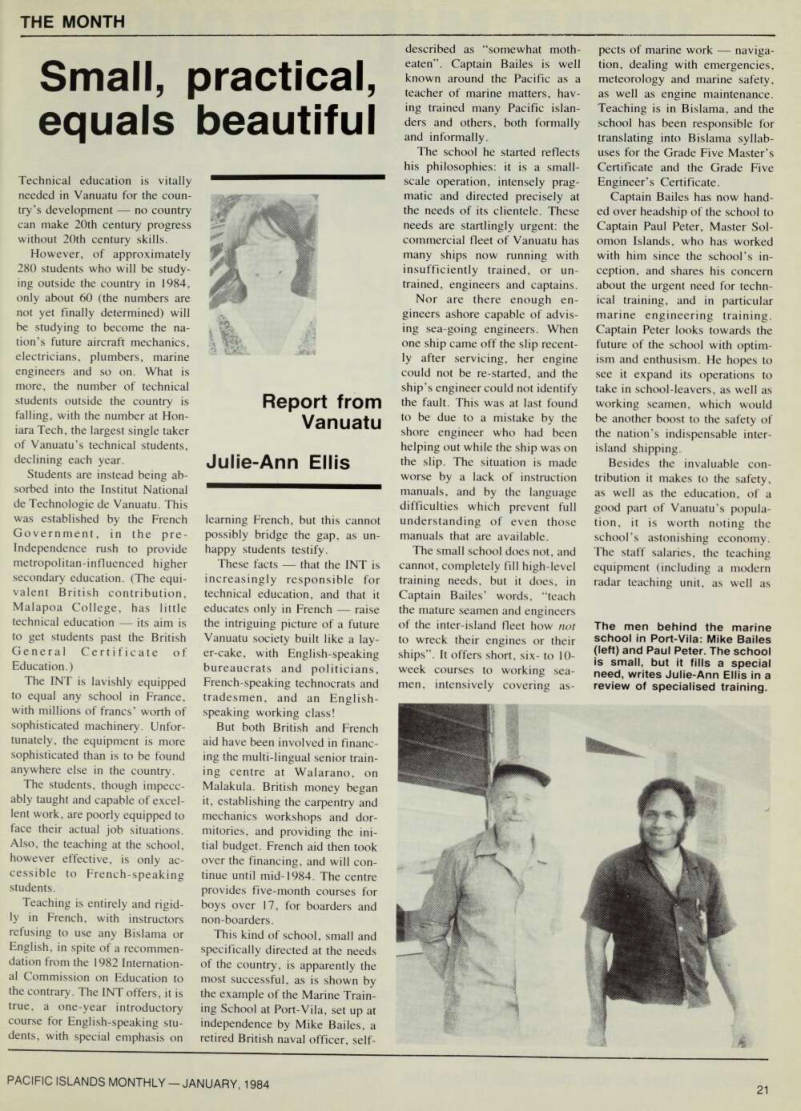
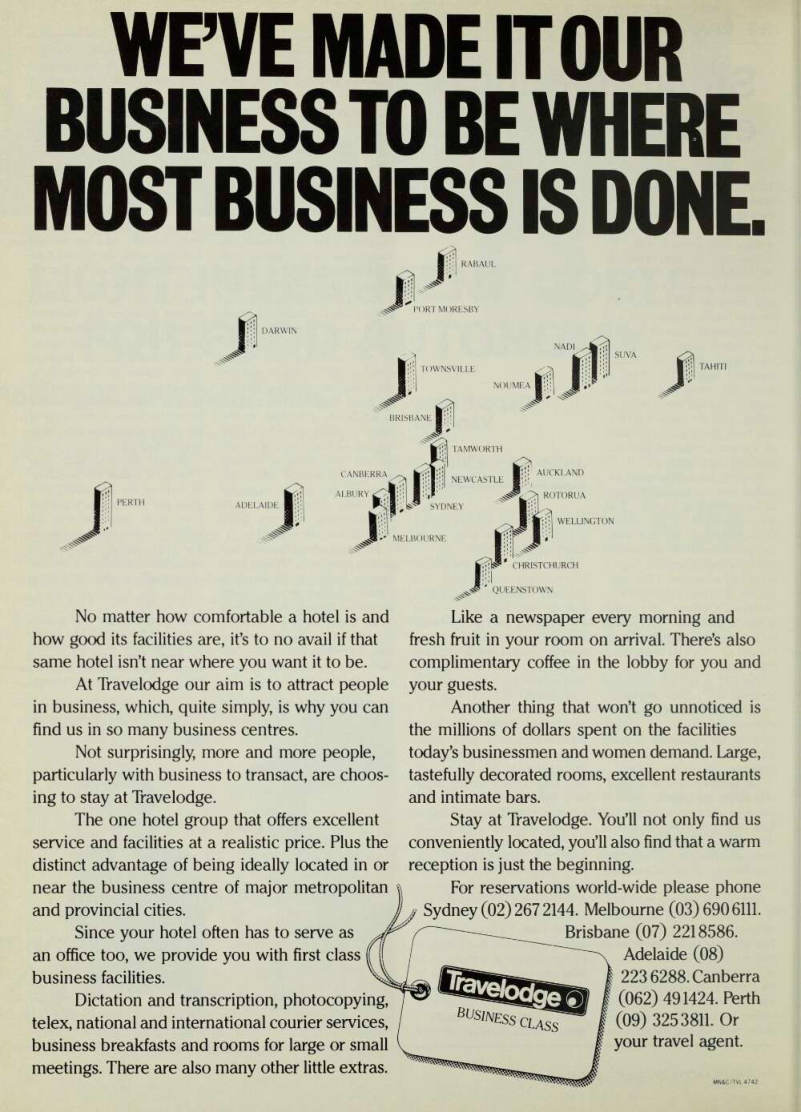
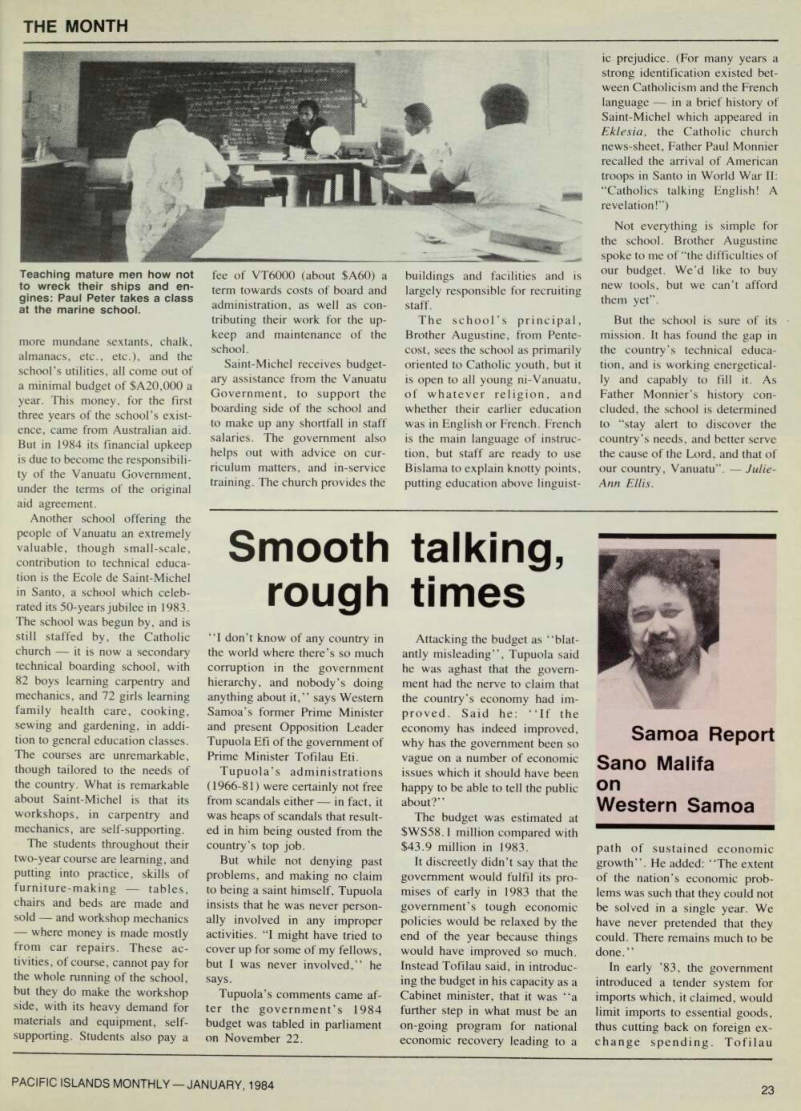
equals beautiful
Technical education is vitally needed in Vanuatu for the coun try’s development no country can make 20th century progress without 20th century skills.
However, of approximately 280 students who will be study ing outside the country in 1984, only about 60 (the numbers are not yet finally determined) will be studying to become the na tion’s future aircraft mechanics, electricians, plumbers, marine engineers and so on. What is more, the number of technical students outside the country is falling, with the number at Hon iara Tech, the largest single taker of Vanuatu’s technical students, declining each year.
Students are instead being ab sorbed into the Institut National de Technologic de Vanuatu. This was established by the French Government, in the pre- Independence rush to provide metropolitan-influenced higher secondary education. (The equi valent British contribution, Malapoa College, has little technical education its aim is to get students past the British General Certificate of Education.) The INT is lavishly equipped to equal any school in France, with millions of francs’ worth of sophisticated machinery. Unfor tunately, the equipment is more sophisticated than is to be found anywhere else in the country.
The students, though impecc ably taught and capable of excel lent work, are poorly equipped to face their actual job situations.
Also, the teaching at the school, however effective, is only ac cessible to French-speaking students.
Teaching is entirely and rigid ly in French, with instructors refusing to use any Bislama or English, in spite of a recommen dation from the 1982 Internation al Commission on Education to the contrary. The INT offers, it is true, a one-year introductory course for English-speaking stu dents, with special emphasis on
leaming French, but this cannot possibly bridge the gap, as un happy students testify.
These facts that the INT is increasingly responsible for technical education, and that it educates only in French raise the intriguing picture of a future Vanuatu society built like a lay er-cake, with English-speaking bureaucrats and politicians, French-speaking technocrats and tradesmen, and an English speaking working class!
But both British and French aid have been involved in financ ing the multi-lingual senior train ing centre at Walarano, on Malakula. British money began it, establishing the carpentry and mechanics workshops and dor mitories, and providing the ini tial budget. French aid then took over the financing, and will con tinue until mid-1984. The centre provides five-month courses for boys over 17, for boarders and non-boarders.
This kind of school, small and specifically directed at the needs of the country, is apparently the most successful, as is shown by the example of the Marine Train ing School at Port-Vila, set up at independence by Mike Bailes, a retired British naval officer, self
described as “somewhat moth eaten”. Captain Bailes is well known around the Pacific as a teacher of marine matters, hav ing trained many Pacific islan ders and others, both formally and informally.
The school he started reflects his philosophies: it is a small scale operation, intensely prag matic and directed precisely at the needs of its clientele. These needs are startlingly urgent: the commercial fleet of Vanuatu has many ships now running with insufficiently trained, or un trained, engineers and captains.
Nor are there enough en gineers ashore capable of advis ing sea-going engineers. When one ship came off the slip recent ly after servicing, her engine could not be re-started, and the ship’s engineer could not identify the fault. This was at last found to be due to a mistake by the shore engineer who had been helping out while the ship was on the slip. The situation is made worse by a lack of instruction manuals, and by the language difficulties which prevent full understanding of even those manuals that are available.
The small school does not, and cannot, completely fill high-level training needs, but it does, in Captain Bailes’ words, “teach the mature seamen and engineers of the inter-island fleet how not to wreck their engines or their ships”. It offers short, six- to 10week courses to working sea men, intensively covering as
pects of marine work naviga tion, dealing with emergencies, meteorology and marine safety, as well as engine maintenance.
Teaching is in Bislama, and the school has been responsible for translating into Bislama syllab uses for the Grade Five Master’s Certificate and the Grade Five Engineer’s Certificate.
Captain Bailes has now hand ed over headship of the school to Captain Paul Peter, Master Sol omon Islands, who has worked with him since the school’s in ception, and shares his concern about the urgent need for techn ical training, and in particular marine engineering training.
Captain Peter looks towards the future of the school with optim ism and enthusism. He hopes to see it expand its operations to take in school-leavers, as well as working seamen, which would be another boost to the safety of the nation’s indispensable inter island shipping.
Besides the invaluable con tribution it makes to the safety, as well as the education, of a good part of Vanuatu’s popula tion, it is worth noting the school’s astonishing economy.
The staff salaries, the teaching equipment (including a modem radar teaching unit, as well as
Report from Vanuatu Julie-Ann Ellis
The men behind the marine school in Port-Vila: Mike Bailes (left) and Paul Peter. The school is small, but it fills a special need, writes Julie-Ann Ellis in a review of specialised training.
more mundane sextants, chalk, almanacs, etc., etc.), and the school’s utilities, all come out of a minimal budget of $A20,000 a year. This money, for the first three years of the school’s exist ence, came from Australian aid.
But in 1984 its financial upkeep is due to become the responsibili ty of the Vanuatu Government, under the terms of the original aid agreement.
Another school offering the people of Vanuatu an extremely valuable, though small-scale, contribution to technical educa tion is the Ecole de Saint-Michel in Santo, a school which celeb rated its 50-years jubilee in 1983.
The school was begun by, and is still staffed by, the Catholic church it is now a secondary technical boarding school, with 82 boys learning carpentry and mechanics, and 72 girls learning family health care, cooking, sewing and gardening, in addi tion to general education classes.
The courses are unremarkable, though tailored to the needs of the country. What is remarkable about Saint-Michel is that its workshops, in carpentry and mechanics, are self-supporting.
The students throughout their two-year course are learning, and putting into practice, skills of
furniture-making tables,
chairs and beds are made and sold and workshop mechanics where money is made mostly from car repairs. These ac tivities, of course, cannot pay for the whole running of the school, but they do make the workshop side, with its heavy demand for materials and equipment, self supporting. Students also pay a
fee of VT6OOO (about SA6O) a term towards costs of board and administration, as well as con tributing their work for the up keep and maintenance of the school.
Saint-Michel receives budget ary assistance from the Vanuatu Government, to support the boarding side of the school and to make up any shortfall in staff salaries. The government also helps out with advice on cur riculum matters, and in-service training. The church provides the
buildings and facilities and is
largely responsible for recruiting
staff.
The school’s principal, Brother Augustine, from Pente cost, sees the school as primarily oriented to Catholic youth, but it is open to all young ni-Vanuatu, of whatever religion, and whether their earlier education was in English or French. French is the main language of instruc tion, but staff are ready to use
Bislama to explain knotty points,
putting education above linguist
ic prejudice. (For many years a strong identification existed bet ween Catholicism and the French language in a brief history of Saint-Michel which appeared in Eklesia, the Catholic church news-sheet. Father Paul Monnier recalled the arrival of American troops in Santo in World War II:
“Catholics talking English! A
revelation!”) Not everything is simple for the school. Brother Augustine spoke to me of “the difficulties of our budget. We’d like to buy new tools, but we can’t afford
them yet”.
But the school is sure of its mission. It has found the gap in the country’s technical educa tion, and is working energetical ly and capably to fill it. As Father Monnier’s history con cluded, the school is determined to “stay alert to discover the country’s needs, and better serve the cause of the Lord, and that of
our country, Vanuatu”.
Julie-
Ann Ellis.
Teaching mature men how not to wreck their ships and en gines: Paul Peter takes a class at the marine school.
Advertisements & other items, p. 22 (1 item)
Most Business Is Done
WE’VE MADE HOUR
BUSINESS TO BE WHERE
l
PERTH
I
ADELAIDE
l® J '
PORT MORESBY
rOWNSVILLE
NADI
I
NOUMEA
TAMWORTH
!■ NEWCASTLE
I
SYDNEY
•*' MELBOURNE
P
SUVA
TAHITI
AUCKLAND
ROTORUA
WELLINGTON
CHRISTCHURCH
QUEENSTOWN
No matter how comfortable a hotel is and how good its facilities are, it’s to no avail if that same hotel isn’t near where you want it to be.
At Travelodge our aim is to attract people in business, which, quite simply, is why you can find us in so many business centres.
Not surprisingly, more and more people, particularly with business to transact, are choosing to stay at Travelodge.
The one hotel group that offers excellent service and facilities at a realistic price. Plus the distinct advantage of being ideally located in or near the business centre of major metropolitan and provincial cities.
Since your hotel often has to serve as an office too, we provide you with first class business facilities.
Dictation and transcription, photocopying, telex, national and international courier services, business breakfasts and rooms for large or small meetings. There are also many other little extras.
Like a newspaper every morning and fresh fruit in your room on arrival. There’s also complimentary coffee in the lobby for you and your guests.
Another thing that won’t go unnoticed is the millions of dollars spent on the facilities today’s businessmen and women demand. Large, tastefully decorated rooms, excellent restaurants and intimate bars.
Stay at Travelodge. You’ll not only find us conveniently located, you’ll also find that a warm reception is just the beginning.
For reservations world-wide please phone Sydney (02) 267 2144. Melbourne (03)6906111.
Brisbane (07) 2218586.
Adelaide (08)
223 6288. Canberra (062) 491424. Perth (09) 3253811. Or your travel agent.
MN&C/TVL 4742
4
Smooth talking,

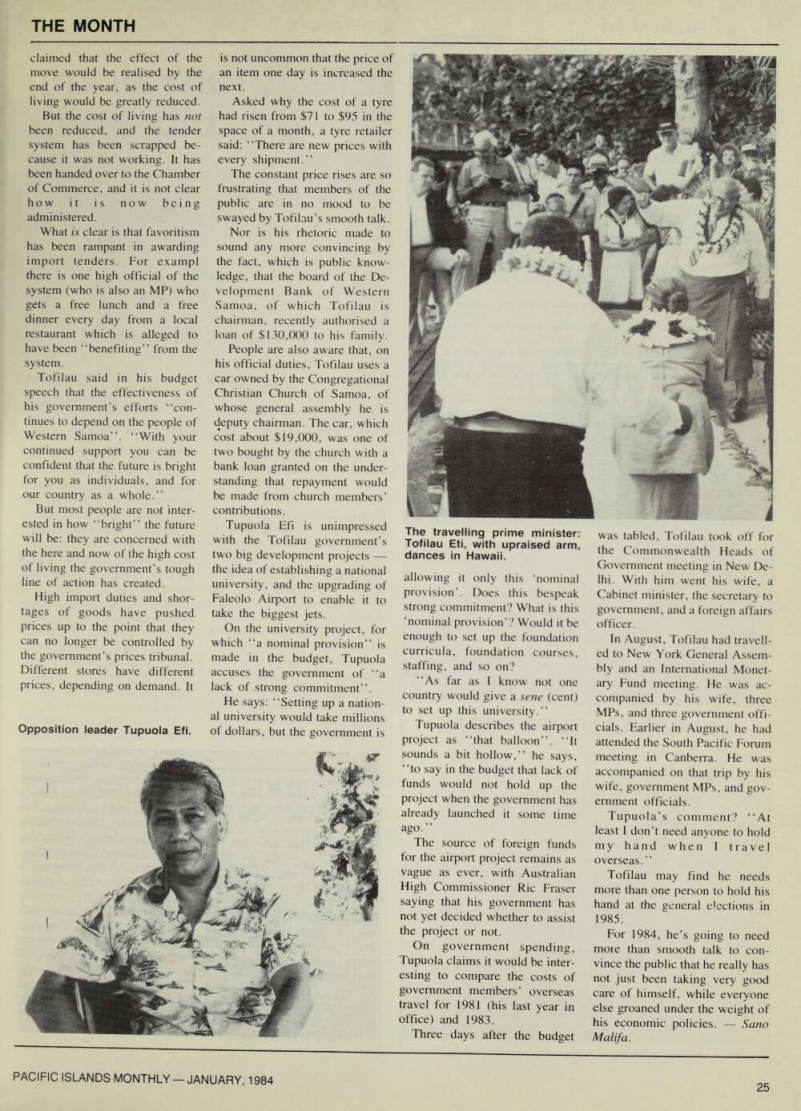
rough times
“I don’t know of any country in the world where there’s so much corruption in the government hierarchy, and nobody’s doing anything about it,” says Western Samoa’s former Prime Minister and present Opposition Leader Tupuola Efi of the government of Prime Minister Tofilau Eti.
Tupuola’s administrations (1966-81) were certainly not free from scandals either— in fact, it was heaps of scandals that result ed in him being ousted from the country’s top Job.
But while not denying past problems, and making no claim to being a saint himself, Tupuola insists that he was never person ally involved in any improper activities. “I might have tried to cover up for some of my fellows, but I was never involved,” he says.
Tupuola’s comments came af ter the government’s 1984 budget was tabled in parliament on November 22.
Attacking the budget as “blat antly misleading”, Tupuola said he was aghast that the govern ment had the nerve to claim that the country’s economy had im proved. Said he: “If the economy has indeed improved, why has the government been so vague on a number of economic issues which it should have been happy to be able to tell the public about?”
The budget was estimated at SWSSB.I million compared with $43.9 million in 1983.
It discreetly didn’t say that the government would fulfil its pro mises of early in 1983 that the government’s tough economic policies would be relaxed by the end of the year because things would have improved so much.
Instead Tofilau said, in introduc ing the budget in his capacity as a Cabinet minister, that it was “a further step in what must be an on-going program for national economic recovery leading to a
path of sustained economic growth”. He added: “The extent of the nation’s economic prob lems was such that they could not be solved in a single year. We have never pretended that they could. There remains much to be done.”
In early ’B3, the government introduced a tender system for imports which, it claimed, would limit imports to essential goods, thus cutting back on foreign ex change spending. Tofilau
Samoa Report Sano Malifa on Western Samoa
claimed that the effect of the move would be realised by the end of the year, as the cost of living would be greatly reduced.
But the cost of living has not been reduced, and the tender system has been scrapped be cause it was not working. It has been handed over to the Chamber of Commerce, and it is not clear how it is now being administered.
What is clear is that favoritism has been rampant in awarding
import tenders. For exampl
there is one high official of the system (who is also an MP) who gets a free lunch and a free dinner every day from a local restaurant which is alleged to have been “benefiting” from the system.
Tofilau said in his budget speech that the effectiveness of his government’s efforts “con tinues to depend on the people of Western Samoa”. “With your continued support you can be confident that the future is bright for you as individuals, and for our country as a whole.”
But most people are not inter ested in how “bright” the future will be: they are concerned with the here and now of the high cost of living the government’s tough line of action has created.
High import duties and shor tages of goods have pushed prices up to the point that they can no longer be controlled by the government’s prices tribunal.
Different stores have different prices, depending on demand. It
is not uncommon that the price of an item one day is increased the next.
Asked why the cost of a tyre had risen from $7l to $95 in the space of a month, a tyre retailer said: “There are new prices with
every shipment.”
The constant price rises are so frustrating that members of the public are in no mood to be swayed by Tofilau’s smooth talk.
Nor is his rhetoric made to sound any more convincing by the fact, which is public know ledge, that the board of the De velopment Bank of Western Samoa, of which Tofilau is chairman, recently authorised a loan of $130,000 to his family.
People are also aware that, on his official duties, Tofilau uses a car owned by the Congregational Christian Church of Samoa, of whose general assembly he is deputy chairman. The car, which cost about $19,000, was one of two bought by the church with a bank loan granted on the under standing that repayment would be made from church members’ contributions.
Tupuola Efi is unimpressed
with the Tofilau government’s
two big development projects
the idea of establishing a national university, and the upgrading of Faleolo Airport to enable it to
take the biggest jets.
On the university project, for which “a nominal provision” is made in the budget, Tupuola accuses the government of “a lack of strong commitment”.
He says: “Setting up a nation al university would take millions of dollars, but the government is
allowing it only this ‘nominal provision’. Does this bespeak strong commitment? What is this ‘nominal provision’ ? Would it be enough to set up the foundation curricula, foundation courses, staffing, and so on?
“As far as I know not one country would give a sene (cent) to set up this university.”
Tupuola describes the airport project as “that balloon”. “It sounds a bit hollow,” he says, “to say in the budget that lack of funds would not hold up the project when the government has already launched it some time ago.”
The source of foreign funds for the airport project remains as vague as ever, with Australian High Commissioner Ric Fraser saying that his government has not yet decided whether to assist the project or not.
On government spending, Tupuola claims it would be inter esting to compare the costs of government members’ overseas travel for 1981 (his last year in office) and 1983.
Three days after the budget
was tabled, Tofilau took off for the Commonwealth Heads of Government meeting in New De lhi. With him went his wife, a Cabinet minister, the secretary to government, and a foreign affairs officer.
In August, Tofilau had travell ed to New York General Assem bly and an International Monet ary Fund meeting. He was ac companied by his wife, three MPs, and three government offi cials. Earlier in August, he had attended the South Pacific Forum meeting in Canberra. He was accompanied on that trip by his wife, government MPs, and gov ernment officials.
Tupuola’s comment? “At least I don’t need anyone to hold my hand when I travel overseas.”
Tofilau may find he needs more than one person to hold his hand at the general elections in 1985.
For 1984, he’s going to need moie than smooth talk to con vince the public that he really has not just been taking very good care of himself, while everyone else groaned under the weight of
his economic policies.
Sano
Malifa.
Opposition leader Tupuola Efi.
The travelling prime minister: Tofilau Eti, with upraised arm, dances in Hawaii.
Advertisements & other items, pp. 24-26 (1 item)
Toughness.
Nissan Cabstar Nissan Sunny Nissan Vanette m n Nissan Urvan \J
PATROL
Nissan Patrol Datsun Pickup 4WD That’s why Nissan means higher performance. Toughness is total. Every member of the widerange lineup has extra strength and durability built-in along with superior maneuverability. These high performers deliver penny-pinching fuel economy and tough reliability. Once you discover how great the ride and handling ease are, you will understand what makes « * .. *ii i • i i j...: y i oui uiuiiuv/ wuw ■ Nissan commercial and passenger vehicles worldwide favorites.
There’s more to a Nissan than meets the eye.
NISSAN
American Samoa Max Haleck Inc., Pago Pago Cook Islands Cook Islands Motor Centre Ltd., Rarotonga Fiji Carpenters Motors, Suva Kiribati Atoll Auto Stores, Bairiki Nauru Jacob Enterprises New Caledonia Agence Alma S.A., Noumea Norfolk Island Sirius Motors Papua New Guinea Boroko Motors, Port Moresby Solomon Islands United Enterprises Ltd., Honiara Tahiti Tahitibull S.A.R.L, Papeete Vanuatu Pentecost Vanua Trading Ltd., Port Vila Western Samoa Morris Hedstrom Samoa Ltd., Apia
Australian
Maritime College
CERTIFICATE OF COMPETENCY COURSES
1004 Certificate Commencing Date
• MASTER CLASS 1 13.2.84
• MASTER CLASS 2 12.3.84
Courses: Operate on a modular basis consisting of multiple subjects examined separately, allowing the student maximum flexibility in planning his or her study. Students could attend the college for about three or four weeks and complete a couple of subjects, or stay nine months and finish a certificate. Wherever possible the college will seek exemptions from equivalent Department of Transport and Construction exams for successful students.
DOTC prerequisite short courses: Also offered including: Radar Observer, Radar Simulator, Firefighting, Survival and Radio Telephone (restricted).
Other Courses: Also available for lower grade certificates.
Accommodation and meals: Available on campus at reasonable cost.
The College is situated on a picturesque site overlooking the Tamar River, 7 km from the city of Launceston, and close to major tourist attractions. College facilities include some of the most sophisticated equipment in Australia.
Applications to: The Admissions Office, (PIM) Australian Maritime College, P.O. Box 986,
LAUNCESTON, Tas. 7250.
Phone: (003) 26 0731 For further Information: contact Mr L. Piper on (003) 26 0764 or = Mr P. McGovern on (003) 26 0708. £
CARGO VESSEL FOR SALE
405 gross tons, 166 net, 420 dwt.
Length 47.3 metres, Beam 7.5 metres, Draft 3.8 metres.
Dcutz SBA 8M Diesel, 585 S.H.P. at 750 rpm. 2.5: 1 reduction driving variable pitch propeller giving about 10.5 knots. 2 holds giving 28000 cu ft grain capacity.
Hydraulic deck gear with swinging derricks.
No. 1 hatch 3 ton s.w.l. No. 2 hatch 5 ton s.w.l.
Radar, auto pilot, 5.5.8., V.H.F.
In class with Bureau Veritas and in excellent condition.
Lying at Port-Vila, Vanuatu.
BEST OFFER
Contact: Vanua Navigation Ltd.
P.O. Box 44, Port-Vila, Vanuatu Telephone: 2027, 2028. Telex: 1033 VANUA
Electoral reform
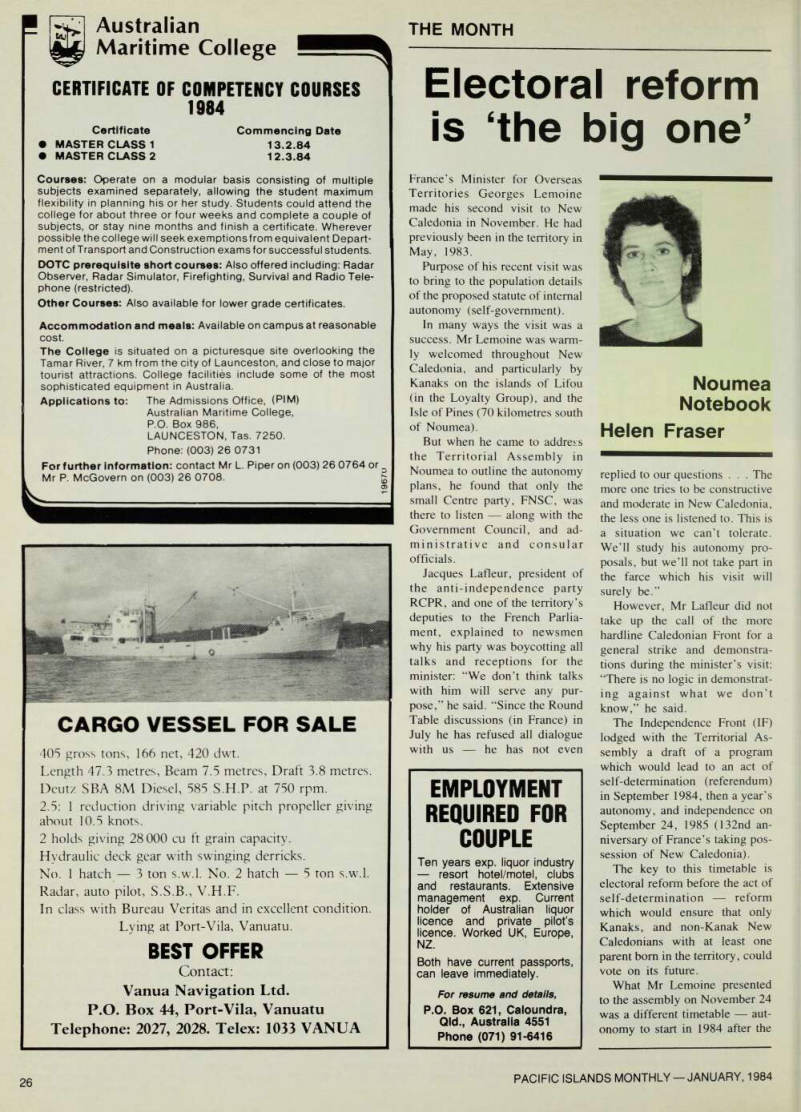
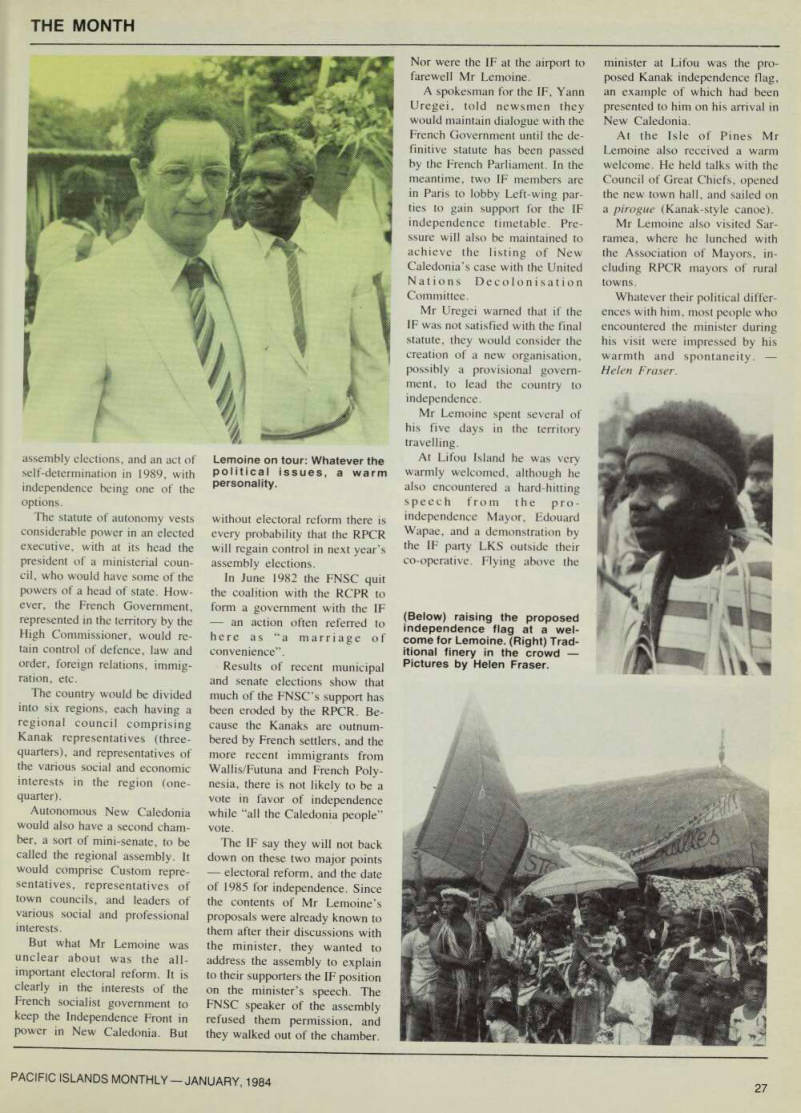
is ‘the big one’
France’s Minister for Overseas Territories Georges Lemoine made his second visit to New Caledonia in November. He had previously been in the territory in May, 1983.
Purpose of his recent visit was to bring to the population details of the proposed statute of internal autonomy (self-government).
In many ways the visit was a success. Mr Lemoine was warm ly welcomed throughout New Caledonia, and particularly by Kanaks on the islands of Lifou (in the Loyalty Group), and the Isle of Pines (70 kilometres south of Noumea).
But when he came to address the Territorial Assembly in Noumea to outline the autonomy plans, he found that only the small Centre party, FNSC, was there to listen along with the Government Council, and ad ministrative and consular officials.
Jacques Lafleur, president of the anti-independence party RCPR, and one of the territory’s deputies to the French Parlia ment, explained to newsmen why his party was boycotting all talks and receptions for the minister: “We don’t think talks with him will serve any pur pose,” he said. “Since the Round Table discussions (in France) in July he has refused all dialogue with us he has not even
replied to our questions . . . The more one tries to be constructive and moderate in New Caledonia, the less one is listened to. This is a situation we can’t tolerate.
We’ll study his autonomy pro posals, but we’ll not take part in the farce which his visit will surely be.”
However, Mr Lafleur did not take up the call of the more hardline Caledonian Front for a general strike and demonstra tions during the minister’s visit; “There is no logic in demonstrat ing against what we don’t know,” he said.
The Independence Front (IF) lodged with the Territorial As sembly a draft of a program which would lead to an act of self-determination (referendum) in September 1984, then a year’s autonomy, and independence on September 24, 1985 (132nd an niversary of France’s taking pos session of New Caledonia).
The key to this timetable is electoral reform before the act of self-determination reform which would ensure that only Kanaks, and non-Kanak New Caledonians with at least one parent bom in the territory, could vote on its future.
What Mr Lemoine presented to the assembly on November 24 was a different timetable aut onomy to start in 1984 after the
Noumea Notebook Helen Fraser
assembly elections, and an act of self-determination in 1989, with independence being one of the options.
The statute of autonomy vests considerable power in an elected executive, with at its head the president of a ministerial coun cil, who would have some of the powers of a head of state. How ever, the French Government, represented in the territory by the High Commissioner, would re tain control of defence, law and order, foreign relations, immig ration, etc.
The country would be divided into six regions, each having a regional council comprising Kanak representatives (three quarters), and representatives of the various social and economic interests in the region (one quarter).
Autonomous New Caledonia would also have a second cham ber, a sort of mini-senate, to be called the regional assembly. It would comprise Custom repre sentatives, representatives of town councils, and leaders of various social and professional interests.
But what Mr Lemoine was unclear about was the all important electoral reform. It is clearly in the interests of the French socialist government to keep the Independence Front in power in New Caledonia. But
without electoral reform there is every probability that the RPCR will regain control in next year’s assembly elections.
In June 1982 the FNSC quit the coalition with the RCPR to form a government with the IF an action often referred to here as “a marriage of convenience”.
Results of recent municipal and senate elections show that much of the FNSC’s support has been eroded by the RPCR. Be cause the Kanaks are outnum bered by French settlers, and the more recent immigrants from Wallis/Futuna and French Poly nesia, there is not likely to be a vote in favor of independence while “all the Caledonia people” vote.
The IF say they will not back down on these two major points electoral reform, and the date of 1985 for independence. Since the contents of Mr Lemoine’s proposals were already known to them after their discussions with the minister, they wanted to address the assembly to explain to their supporters the IF position on the minister’s speech. The FNSC speaker of the assembly refused them permission, and they walked out of the chamber.
Nor were the IF at the airport to farewell Mr Lemoine.
A spokesman for the IF, Yann Uregei, told newsmen they would maintain dialogue with the French Government until the de finitive statute has been passed by the French Parliament. In the meantime, two IF members are in Paris to lobby Left-wing par ties to gain support for the IF independence timetable. Pre ssure will also be maintained to achieve the listing of New Caledonia’s case with the United Nations Decolonisation Committee.
Mr Uregei warned that if the IF was not satisfied with the final statute, they would consider the creation of a new organisation, possibly a provisional govern ment, to lead the country to independence.
Mr Lemoine spent several of his five days in the territory travelling.
At Lifou Island he was very warmly welcomed, although he also encountered a hard-hitting speech from the pro independence Mayor, Edouard Wapae, and a demonstration by the IF party LKS outside their co-operative. Flying above the
minister at Lifou was the pro
posed Kanak independence flag,
an example of which had been presented to him on his arrival in New Caledonia.
At the Isle of Pines Mr Lemoine also received a warm welcome. He held talks with the Council of Great Chiefs, opened the new town hall, and sailed on a pirogue (Kanak-style canoe).
Mr Lemoine also visited Sar ramea, where he lunched with the Association of Mayors, in cluding RPCR mayors of rural towns.
Whatever their political differ ences with him, most people who encountered the minister during his visit were impressed by his warmth and spontaneity.
Helen Fraser.
Lemoine on tour: Whatever the political issues, a warm personality.
(Below) raising the proposed independence flag at a wel come for Lemoine. (Right) Trad itional finery in the crowd - Pictures by Helen Fraser.
Advertisements & other items, pp. 26-28 (1 item)
Required For
EMPLOYMENT
COUPLE
Ten years exp. liquor industry resort hotel/motel, clubs and restaurants. Extensive management exp. Current holder of Australian liquor licence and private pilot’s licence. Worked UK, Europe, NZ.
Both have current passports, can leave immediately.
For resume and details, P.O. Box 621, Caloundra, Old., Australia 4551 Phone (071) 91-6416
■ * ® j*ii tl* 11 » • •; WSMSimp j, » •• «•
SMP| ' A ‘
• s
IHASTSR^
HGD»
STOP
bebt*®*®
attee
EUROPE-SOUTH PACIFIC JOINT SERVICE
The South Pacific Specialists offer facilities for shipment of: Containers (FCL/LCL) and Breakbulk Cargo plus reefer space and deeptanks for carriage of vegetable oils and other liquid bulk cargo.
Carriers also accept heavy lifts, overlength and cumbersome parcels.
Ports of Service: Loading: Papeete, Apia, Suva, Lautoka, Noumea, Port Vila, Santo, Honiara, Port Moresby, Lae,Madang, Kimbe, Rabaul, Kieta, Darwin.
For: Rotterdam, Antwerp, Hamburg, Hull, Dunkirk, Le Havre.
Please contact our regional offices for further information: The Bank Line (Australasia) Pty. Ltd.
Suite 801,51 Pitt Street Sydney N.S W. 2000 Phone: 272041 Telex: 24063 Additional ports on enquiry.
P.O. Box 1667 Lae/Papua New Guinea Phone: 423 466/423 487 A.H. 422481 Telex: Colline NE 44171
THE BANK LINE LTD LONDON
COLUMBUS LINE REEDEREI GMBH HAMBURG
People
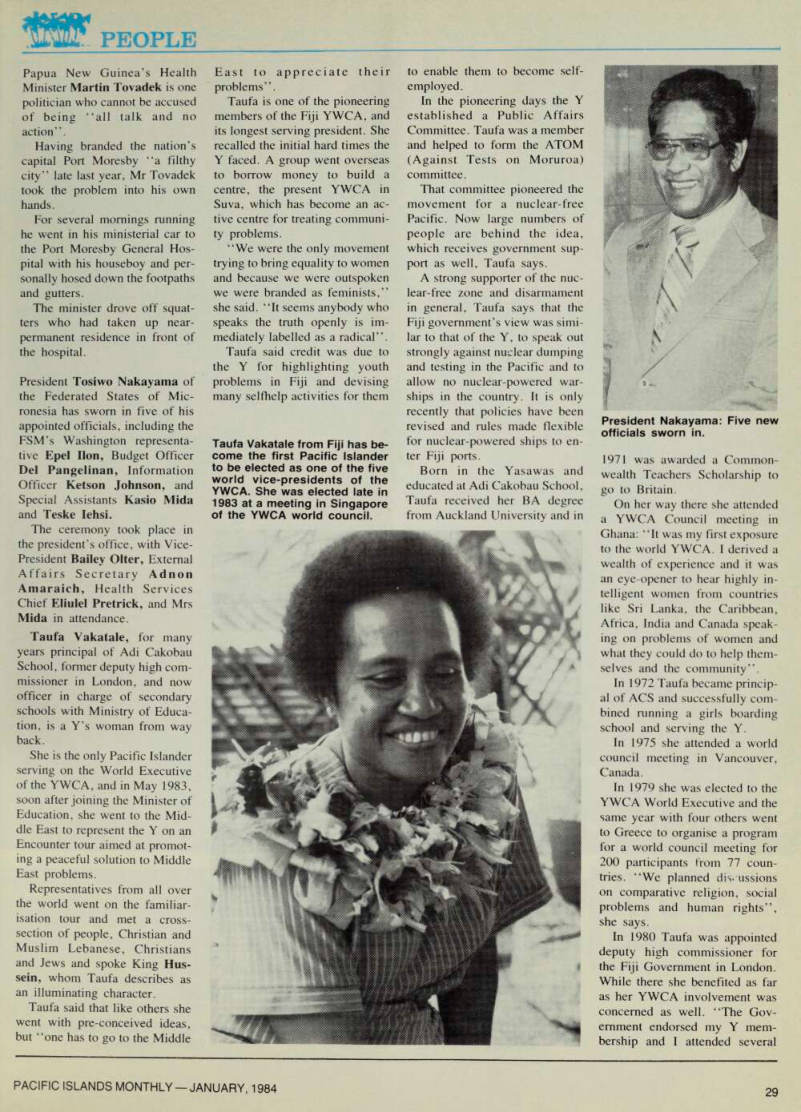


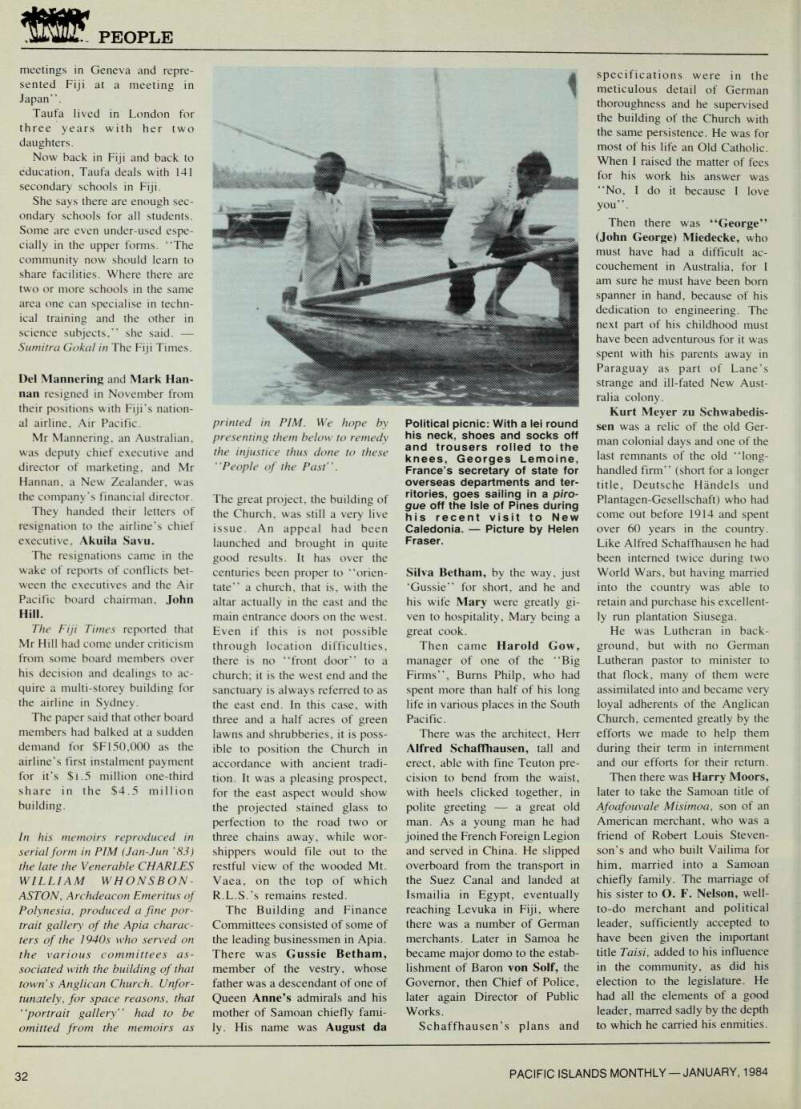
Papua New Guinea’s Health Minister Martin Tovadek is one politician who cannot be accused of being “all talk and no action”.
Having branded the nation’s
capital Port Moresby “a filthy
city” late last year, Mr Tovadek took the problem into his own hands.
For several mornings running
he went in his ministerial car to the Port Moresby General Hos pital with his houseboy and per sonally hosed down the footpaths and gutters.
The minister drove off squat ters who had taken up near permanent residence in front of
the hospital.
President Tosiwo Nakayama of the Federated States of Mic ronesia has sworn in five of his
appointed officials, including the
FSM’s Washington representa tive Epel Hon, Budget Officer Del Pangelinan, Information Officer Ketson Johnson, and Special Assistants Kasio Mida and Teske lehsi.
The ceremony took place in the president’s office, with Vice- President Bailey Olter, External Affairs Secretary Adnon Amaraich, Health Services Chief Eliulel Pretrick, and Mrs Mida in attendance.
Taufa Vakatale, for many years principal of Adi Cakobau School, former deputy high com missioner in London, and now officer in charge of secondary schools with Ministry of Educa tion, is a Y’s woman from way back.
She is the only Pacific Islander serving on the World Executive of the YWCA, and in May 1983, soon after joining the Minister of Education, she went to the Mid dle East to represent the Y on an Encounter tour aimed at promot ing a peaceful solution to Middle
East problems.
Representatives from all over the world went on the familiar isation tour and met a cross section of people, Christian and Muslim Lebanese, Christians and Jews and spoke King Hus sein, whom Taufa describes as an illuminating character.
Taufa said that like others she went with pre-conceived ideas, but “one has to go to the Middle
East to appreciate their
problems”.
Taufa is one of the pioneering members of the Fiji YWCA, and
its longest serving president. She
recalled the initial hard times the Y faced. A group went overseas to borrow money to build a centre, the present YWCA in Suva, which has become an ac tive centre for treating communi
ty problems.
“We were the only movement
trying to bring equality to women
and because we were outspoken we were branded as feminists,” she said. “It seems anybody who speaks the truth openly is im mediately labelled as a radical”.
Taufa said credit was due to the Y for highlighting youth
problems in Fiji and devising
many selfhelp activities for them
to enable them to become self
employed.
In the pioneering days the Y established a Public Affairs Committee. Taufa was a member and helped to form the ATOM (Against Tests on Moruroa) committee.
That committee pioneered the movement for a nuclear-free Pacific. Now large numbers of people are behind the idea, which receives government sup port as well, Taufa says.
A strong supporter of the nuc lear-free zone and disarmament in general, Taufa says that the Fiji government’s view was simi lar to that of the Y, to speak out
strongly against nuclear dumping
and testing in the Pacific and to allow no nuclear-powered war ships in the country. It is only recently that policies have been revised and rules made flexible for nuclear-powered ships to en ter Fiji ports.
Born in the Yasawas and educated at Adi Cakobau School, Taufa received her BA degree from Auckland University and in
1971 was awarded a Common wealth Teachers Scholarship to go to Britain.
On her way there she attended a YWCA Council meeting in Ghana: “It was my first exposure to the world YWCA. I derived a wealth of experience and it was an eye-opener to hear highly in telligent women from countries like Sri Lanka, the Caribbean, Africa, India and Canada speak ing on problems of women and what they could do to help them selves and the community”.
In 1972 Taufa became princip al of ACS and successfully com bined running a girls boarding school and serving the Y.
In 1975 she attended a world council meeting in Vancouver, Canada.
In 1979 she was elected to the YWCA World Executive and the same year with four others went to Greece to organise a program for a world council meeting for 200 participants from 77 coun tries. “We planned discussions on comparative religion, social problems and human rights”, she says.
In 1980 Taufa was appointed deputy high commissioner for the Fiji Government in London.
While there she benefited as far as her YWCA involvement was concerned as well. “The Gov ernment endorsed my Y mem bership and I attended several
Taufa Vakatale from Fiji has be come the first Pacific Islander to be elected as one of the five world vice-presidents of the YWCA. She was elected late in 1983 at a meeting in Singapore of the YWCA world council.
President Nakayama: Five new officials sworn in.
meetings in Geneva and repre sented Fiji at a meeting in
Japan”.
Taufa lived in London for three years with her two
daughters.
Now back in Fiji and back to education, Taufa deals with 141
secondary schools in Fiji.
She says there are enough sec ondary schools for all students.
Some are even under-used espe cially in the upper forms. “The community now should leam to share facilities. Where there are two or more schools in the same area one can specialise in techn ical training and the other in science subjects,” she said.
Sumitra Gokal in The Fiji Times.
Del Mannering and Mark Han nan resigned in November from their positions with Fiji’s nation al airline. Air Pacific.
Mr Mannering, an Australian, was deputy chief executive and director of marketing, and Mr Hannan, a New Zealander, was the company’s financial director.
They handed their letters of resignation to the airline’s chief executive, Akuila Savu.
The resignations came in the wake of reports of conflicts bet ween the executives and the Air Pacific board chairman. John Hill.
The Fiji Times reported that Mr Hill had come under criticism from some board members over his decision and dealings to ac
quire a multi-storey building for
the airline in Sydney.
The paper said that other board members had balked at a sudden demand for $F 150,000 as the airline’s first instalment payment for it’s $1.5 million one-third share in the $4.5 million
building.
In his memoirs reproduced in serial form in PIM (Jan-Jun ’B3) the late the Venerable CHARLES
William Whonsbon
ASTON, Archdeacon Emeritus of
Polynesia, produced a fine por
trait gallery of the Apia charac ters of the 1940 s who served on the various committees as sociated with the building of that
town’s Anglican Church. Unfor
tunately, for space reasons, that “portrait gallery” had to be omitted from the memoirs as
printed in PIM. We hope by presenting them below to remedy the injustice thus done to these
“People of the Past”.
The great project, the building of the Church, was still a very live issue. An appeal had been launched and brought in quite good results. It has over the centuries been proper to “orien tate” a church, that is, with the altar actually in the east and the main entrance doors on the west.
Even if this is not possible through location difficulties, there is no “front door” to a church; it is the west end and the sanctuary is always referred to as the east end. In this case, with three and a half acres of green lawns and shrubberies, it is poss ible to position the Church in accordance with ancient tradi tion. It was a pleasing prospect, for the east aspect would show the projected stained glass to perfection to the road two or three chains away, while wor shippers would file out to the restful view of the wooded Mt.
Vaea, on the top of which R.L.S.’s remains rested.
The Building and Finance Committees consisted of some of the leading businessmen in Apia.
There was Gussie Betham, member of the vestry, whose father was a descendant of one of Queen Anne’s admirals and his mother of Samoan chiefly fami ly. His name was August da
Silva Betham, by the way, just ’Gussie” for short, and he and
his wife Mary were greatly gi
ven to hospitality, Mary being a
great cook.
Then came Harold Gow, manager of one of the “Big Firms”, Bums Philp, who had spent more than half of his long life in various places in the South Pacific.
There was the architect, Herr Alfred Schaffhausen, tall and erect, able with fine Teuton pre cision to bend from the waist, with heels clicked together, in polite greeting a great old man. As a young man he had
joined the French Foreign Legion
and served in China. He slipped overboard from the transport in the Suez Canal and landed at
Ismailia in Egypt, eventually
reaching Levuka in Fiji, where there was a number of German merchants. Later in Samoa he became major domo to the estab lishment of Baron von Self, the Governor, then Chief of Police, later again Director of Public Works.
Schaffhausen’s plans and
specifications were in the meticulous detail of German
thoroughness and he supervised
the building of the Church with the same persistence. He was for most of his life an Old Catholic.
When I raised the matter of fees for his work his answer was “No, I do it because I love you”.
Then there was “George” (John George) Miedecke, who must have had a difficult ac couchement in Australia, for I am sure he must have been bom spanner in hand, because of his dedication to engineering. The next part of his childhood must have been adventurous for it was spent with his parents away in Paraguay as part of Lane’s strange and ill-fated New Aust
ralia colony.
Kurt Meyer zu Schwabedis sen was a relic of the old Ger man colonial days and one of the last remnants of the old “long handled firm” (short for a longer title, Deutsche Handels und Plantagen-Gesellschaft) who had come out before 1914 and spent over 60 years in the country.
Like Alfred Schaffhausen he had been interned twice during two World Wars, but having married into the country was able to retain and purchase his excellent
ly run plantation Siusega.
He was Lutheran in back ground, but with no German Lutheran pastor to minister to that flock, many of them were assimilated into and became very loyal adherents of the Anglican Church, cemented greatly by the efforts we made to help them during their term in internment and our efforts for their return.
Then there was Harry Moors, later to take the Samoan title of Afoafouvale Misimoa, son of an American merchant, who was a friend of Robert Louis Steven son’s and who built Vailima for him, married into a Samoan
chiefly family. The marriage of
his sister to O. F. Nelson, well to-do merchant and political
leader, sufficiently accepted to
have been given the important title Taisi, added to his influence in the community, as did his election to the legislature. He had all the elements of a good
leader, marred sadly by the depth
to which he carried his enmities.
Political picnic: With a lei round his neck, shoes and socks off and trousers rolled to the knees, Georges Lemoine, France’s secretary of state for overseas departments and ter ritories, goes sailing in a piro gue off the Isle of Pines during his recent visit to New Caledonia. - Picture by Helen Fraser.
Advertisements & other items, pp. 30-31 (1 item)
Land Cruis
A
LAND
CRUISER
Si
LAND CRUIS
STATION WA
Sb
TOYOTA
QUALITY SERVICE
I
AMERICAN SAMOA: BURNS PHILP (SOUTH SEA)
CO., LTD.. P.O. Box 129, Pago Pago.
COOK ISLANDS: COOK ISLANDS TRADING
CORPORATION LTD., P.O. Box 92, Rarotonga.
FIJI: AUTOMOTIVE SUPPLIES COMPANY, G.P.O.
Box 355, Suva.
GUAM & MICRONESIA: ATKINS, KROLL (GUAM) LTD., 443 South Marine Drive,Tamuning.
KIRIBATI: TARAWA MOTORS, P.O. Box 36.
Bairiki, Tarawa, Kiribati.
NAURU: NAURU COOPERATIVE SOCIETY.
NEW CALEDONIA: SERVICE IMPORTATION
AUTOMOBILE DU PACIFIQUE, Rond-Point
Hu Pacifique (Station Total) B.P. 438, Noumea.
NORFOLK ISLAND: BORRY’S LIMITED, P.O. Box 169,
PAPUA NEW GUINEA: ELA MOTORS,
Scratchley Rd„ Badili, P.O. Box 75, Port Moresby.
SAIPAN: MICROL CORPORATION, P.O. Box 267,
Saipan.
SOLOMON: MENDANA ENTERPRISES (5.1.) LTD.,
G.P.O. Box 174, Honiara.
TAHITI: NIPPON AUTOMOTO, P.O. Box 342, Papeete.
TONGA: BURNS PHILP (SOUTH SEA) CO., LTD.
P.O. Box 55, Nukualofa.
VANUATU: VANUATU MOTORS, P.O. Box 18,
Port Vila.
WESTERN SAMOA: BURNS PHILP (SOUTH SEA)
CO., LTD., P.O. Box 188, Apia.
No matter how tough the work, how rough the road, Toyota commercial vehicles ride easy. That’s because every one, from the sleek Land Cruiser to our heavy duty trucks, is built to be rugged, reliable and comfortable. And there’s a Toyota to tackle any job, from offthe-road recreation to heavy-duty hauling. While your Toyota is doing the heavy work, you can ride easy, too.
That’s because you know every Toyota is backed up by our fast, reliable worldwide service system. Let Toyota make it easy for you.
The Toyota range includes: COROLLA, STARLET CORONA, CRESSIDA. HI-LUX, STOUT
HI ACE, DYNA, COASTER and LANDCRUISER
HI-LUX DOUBLE CAB
DYNA
TOYOTA
Where content
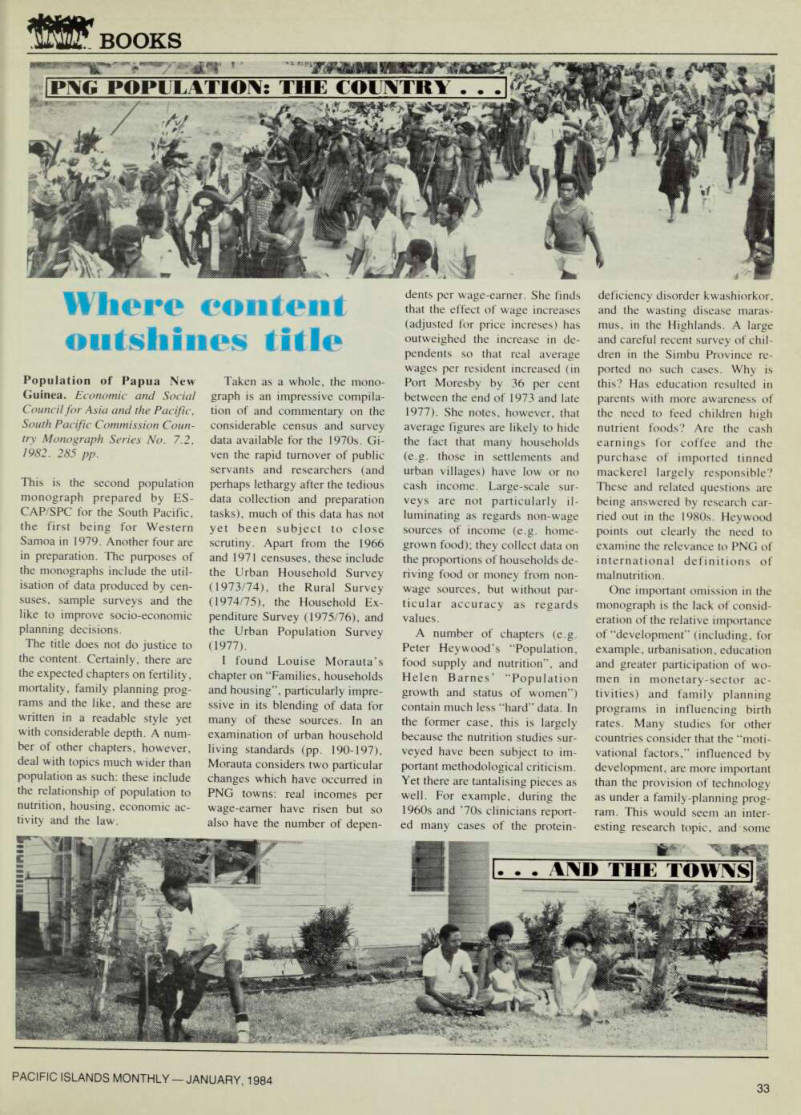
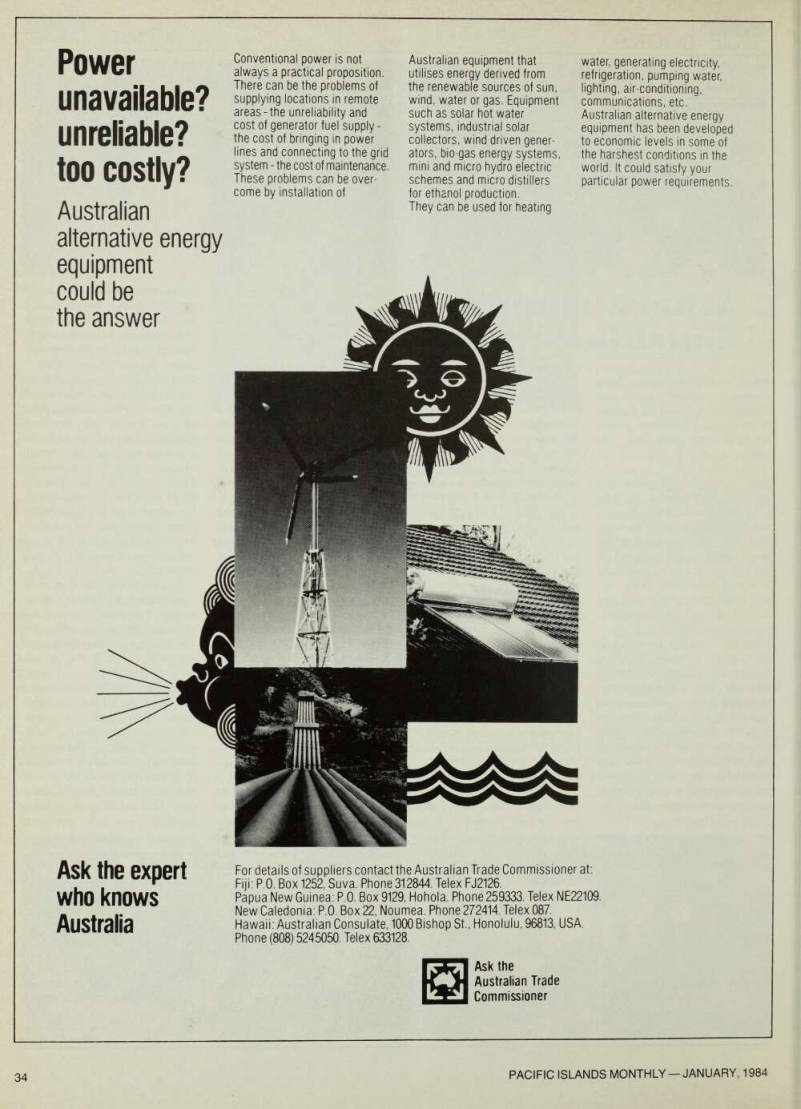
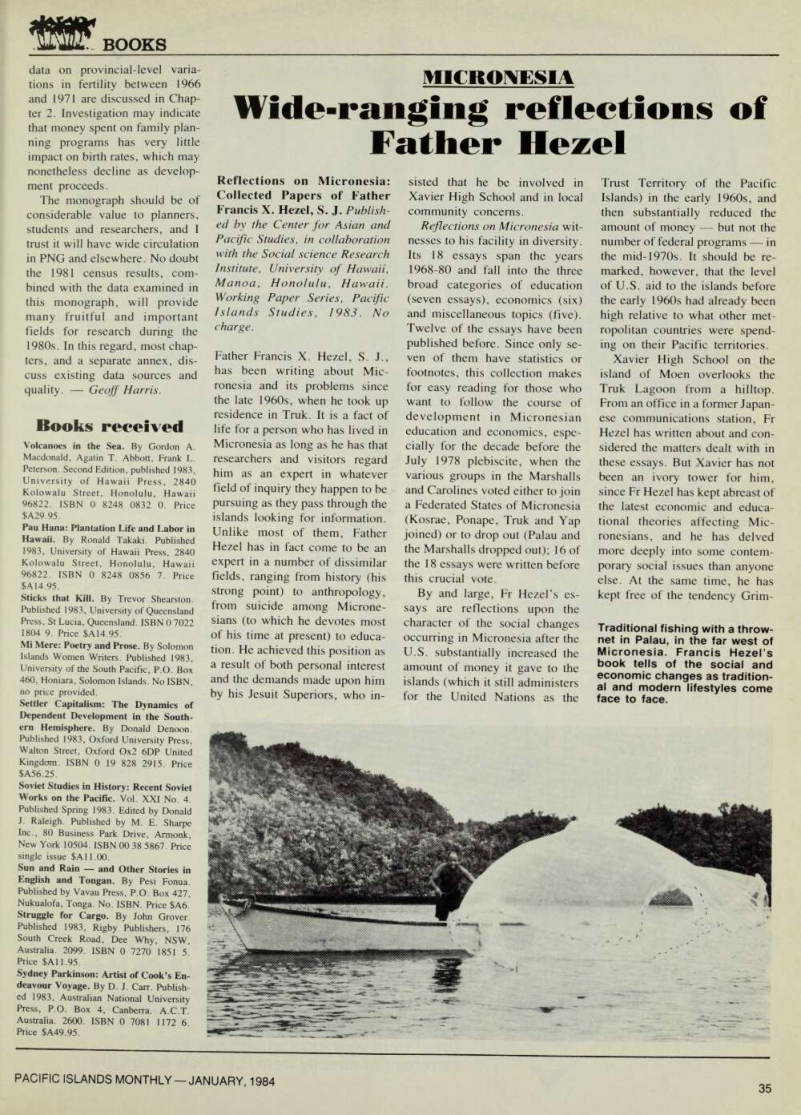
Books
Where content outshines title
PNC POPULATION: THE COUNTRY . . .
Population of Papua New Guinea. Economic and Social Council for Asia and the Pacific, South Pacific Commission Coun try Monograph Series No. 7.2, 1982. 285 pp.
This is the second population monograph prepared by ES CAP/SPC for the South Pacific, the first being for Western Samoa in 1979. Another four are in preparation. The purposes of the monographs include the util isation of data produced by cen suses, sample surveys and the like to improve socio-economic planning decisions.
The title does not do justice to the content. Certainly, there are the expected chapters on fertility, mortality, family planning prog rams and the like, and these are written in a readable style yet with considerable depth. A num ber of other chapters, however, deal with topics much wider than population as such; these include the relationship of population to nutrition, housing, economic ac tivity and the law.
Taken as a whole, the mono graph is an impressive compila tion of and commentary on the considerable census and survey data available for the 19705. Gi ven the rapid turnover of public servants and researchers (and perhaps lethargy after the tedious data collection and preparation tasks), much of this data has not yet been subject to close scrutiny. Apart from the 1966 and 1971 censuses, these include the Urban Household Survey (1973/74), the Rural Survey (1974/75), the Household Ex penditure Survey (1975/76), and the Urban Population Survey (1977).
I found Louise Morauta’s chapter on “Families, households and housing”, particularly impre ssive in its blending of data for many of these sources. In an examination of urban household living standards (pp. 190-197), Morauta considers two particular changes which have occurred in PNG towns: real incomes per wage-earner have risen but so also have the number of depen
dents per wage-earner. She finds that the effect of wage increases (adjusted for price increses) has outweighed the increase in de pendents so that real average wages per resident increased (in Port Moresby by 36 per cent between the end of 1973 and late 1977). She notes, however, that average figures are likely to hide the fact that many households (e.g. those in settlements and urban villages) have low or no cash income. Large-scale sur veys are not particularly il luminating as regards non-wage sources of income (e.g. home grown food); they collect data on the proportions of households de riving food or money from non wage sources, but without par ticular accuracy as regards values.
A number of chapters (e.g.
Peter Heywood’s “Population, food supply and nutrition”, and Helen Barnes’ “Population growth and status of women”) contain much less “hard” data. In the former case, this is largely because the nutrition studies sur veyed have been subject to im portant methodological criticism.
Yet there are tantalising pieces as well. For example, during the
1960 s and ’7os clinicians report
ed many cases of the protein
deficiency disorder kwashiorkor, and the wasting disease maras mus, in the Highlands. A large and careful recent survey of chil dren in the Simbu Province re ported no such cases. Why is this? Has education resulted in parents with more awareness of the need to feed children high nutrient foods? Are the cash earnings for coffee and the purchase of imported tinned mackerel largely responsible?
These and related questions are being answered by research car ried out in the 1980 s. Hey wood points out clearly the need to examine the relevance to PNG of international definitions of malnutrition.
One important omission in the monograph is the lack of consid eration of the relative importance of “development” (including, for example, urbanisation, education and greater participation of wo men in monetary-sector ac tivities) and family planning programs in influencing birth rates. Many studies for other countries consider that the “moti vational factors,” influenced by development, are more important than the provision of technology as under a family-planning prog ram. This would seem an inter esting research topic, and some
. . . And The Towns
data on provincial-level varia tions in fertility between 1966 and 1971 are discussed in Chap ter 2. Investigation may indicate that money spent on family plan ning programs has very little impact on birth rates, which may nonetheless decline as develop
ment proceeds.
The monograph should be of considerable value to planners, students and researchers, and I trust it will have wide circulation in PNG and elsewhere. No doubt the 1981 census results, com bined with the data examined in
this monograph, will provide
many fruitful and important fields for research during the 1980 s. In this regard, most chap ters, and a separate annex, dis cuss existing data sources and
quality. Geoff Harris.
Books received
Volcanoes in the Sea. By Gordon A.
Macdonald, Agatin T. Abbott, Frank L.
Peterson. Second Edition, published 1983, University of Hawaii Press, 2840 Kolowalu Street, Honolulu, Hawaii 96822. ISBN 0 8248 0832 0. Price 5A29.95.
Pan Hana; Plantation Life and Labor in Hawaii. By Ronald Takaki. Published 1983, University of Hawaii Press, 2840 Kolowalu Street, Honolulu, Hawaii 96822. ISBN 0 8248 0856 7. Price 5A14.95.
Sticks that Kill. By Trevor Shearston.
Published 1983, University of Queensland Press, St Lucia, Queensland. ISBN 0 7022 1804 9. Price 5A14.95.
Mi Mere: Poetry and Prose. By Solomon Islands Women Writers. Published 1983, University of the South Pacific, P.O. Box 460, Honiara, Solomon Islands. No ISBN, no price provided.
Settler Capitalism: The Dynamics of Dependent Development in the South ern Hemisphere. By Donald Denoon.
Published 1983, Oxford University Press, Walton Street, Oxford ox 2 6DP United Kingdom. ISBN 0 19 828 2915. Price 5A56.25.
Soviet Studies in History: Recent Soviet Works on the Pacific. Vol. XXI No. 4.
Published Spring 1983. Edited by Donald J. Raleigh. Published by M. E. Sharpe Inc., 80 Business Park Drive, Artnonk, New York 10504. ISBN 00 38 5867. Price single issue $A 11.00.
Sun and Rain and Other Stories in English and Tongan. By Pesi Fonua.
Published by Vavau Press, P.O. Box 427, Nukualofa, Tonga. No. ISBN. Price SA6.
Struggle for Cargo. By John Grover.
Published 1983, Rigby Publishers, 176 South Creek Road, Dee Why, NSW, Australia. 2099. ISBN 0 7270 1851 5.
Price $A 11.95.
Sydney Parkinson: Artist of Cook’s En deavour Voyage. By D. J. Carr. Publish ed 1983, Australian National University Press, P.O. Box 4, Canberra. A.C.T.
Australia. 2600. ISBN 0 7081 1172 6.
Price $A49.95.
Advertisements & other items, p. 34 (1 item)
too costly?
Power
unavailable?
unreliable?
too costly?
Australian
alternative energy
equipment
could be
the answer
Conventional power is not always a practical proposition.
There can be the problems of supplying locations in remote areas-the unreliability and cost of generator fuel supplythe cost of bringing in power lines and connecting to the grid system - the cost of maintenance.
These problems can be overcome by installation of Australian equipment that utilises energy derived from the renewable sources of sun, wind, water or gas. Equipment such as solar hot water systems, industrial solar collectors, wind driven generators, bio-gas energy systems, mini and micro hydro electric schemes and micro distillers for ethanol production.
They can be used for heating \ water, generating electricity, refrigeration, pumping water, lighting, air-conditioning, communications, etc.
Australian alternative energy equipment has been developed to economic levels in some of the harshest conditions in the world. It could satisfy your particular power requirements.
Ask the expert
who knows
Australia
For details of suppliers contact the Australian Trade Commissioner at: Fiji: P.O. 80x1252, Suva. Phone 312844. Telex FJ2126.
Papua New Guinea: P.O. Box 9129, Hohola. Phone 259333. Telex NE22109.
New Caledonia: P.O. Box 22, Noumea. Phone 272414. Telex 087.
Hawaii; Australian Consulate, 1000 Bishop St., Honolulu, 96813, USA.
Phone (808) 5245050. Telex 633128.
Ask the Australian Trade Commissioner
Wide-ranging reflections of

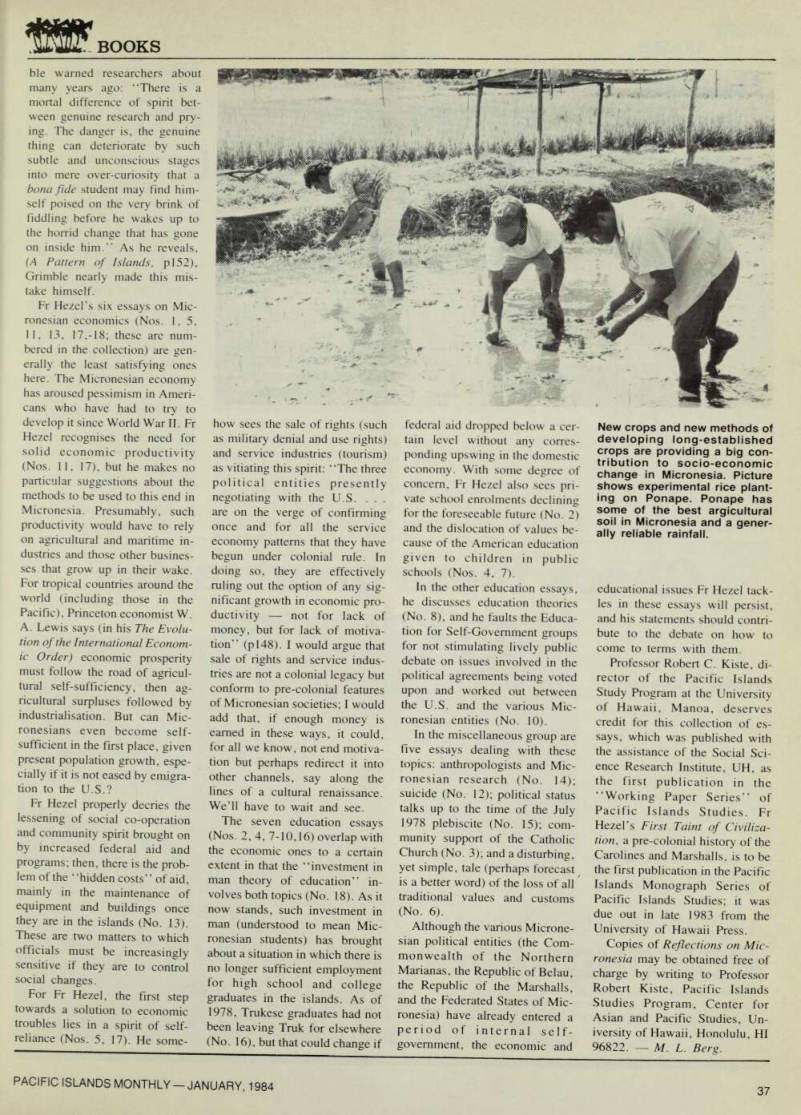
Micronesia
Wide-ranging reflections of Father Hezel
Reflections on Micronesia: Collected Papers of Father Francis X. Bezel, S. J. Publish ed by the Center for Asian and Pacific Studies, in collaboration with the Social science Research Institute, University of Hawaii, Manoa, Honolulu, Hawaii.
Working Paper Series, Pacific Islands Studies, 1983. No charge.
Father Francis X. Bezel, S. J., has been writing about Mic ronesia and its problems since the late 19605, when he took up residence in Truk. It is a fact of life for a person who has lived in Micronesia as long as he has that researchers and visitors regard him as an expert in whatever field of inquiry they happen to be pursuing as they pass through the islands looking for information.
Unlike most of them, Father Bezel has in fact come to be an expert in a number of dissimilar fields, ranging from history (his strong point) to anthropology, from suicide among Microne sians (to which he devotes most of his time at present) to educa tion. He achieved this position as a result of both personal interest and the demands made upon him by his Jesuit Superiors, who in
sisted that he be involved in Xavier High School and in local community concerns.
Reflections on Micronesia wit nesses to his facility in diversity.
Its 18 essays span the years 1968-80 and fall into the three broad categories of education (seven essays), economics (six) and miscellaneous topics (five).
Twelve of the essays have been published before. Since only se ven of them have statistics or footnotes, this collection makes for easy reading for those who want to follow the course of development in Micronesian education and economics, espe cially for the decade before the July 1978 plebiscite, when the various groups in the Marshalls and Carolines voted either to join a Federated States of Micronesia (Kosrae, Ponape, Truk and Yap joined) or to drop out (Palau and the Marshalls dropped out); 16 of the 18 essays were written before this crucial vote.
By and large, Fr Bezel’s es says are reflections upon the character of the social changes occurring in Micronesia after the U.S. substantially increased the amount of money it gave to the islands (which it still administers for the United Nations as the
Trust Territory of the Pacific Islands) in the early 19605, and then substantially reduced the amount of money but not the number of federal programs in the mid-19705. It should be re marked, however, that the level of U.S. aid to the islands before the early 1960 s had already been high relative to what other met ropolitan countries were spend ing on their Pacific territories.
Xavier High School on the island of Moen overlooks the Truk Lagoon from a hilltop.
From an office in a former Japan ese communications station, Fr Bezel has written about and con sidered the matters dealt with in these essays. But Xavier has not been an ivory tower for him, since Fr Bezel has kept abreast of the latest economic and educa tional theories affecting Mic ronesians, and he has delved more deeply into some contem porary social issues than anyone else. At the same time, he has kept free of the tendency Grim-
Traditional fishing with a throw net in Palau, in the far west of Micronesia. Francis Hezel’s book tells of the social and economic changes as tradition al and modern lifestyles come face to face.
ble warned researchers about many years ago; “There is a mortal difference of spirit bet ween genuine research and pry ing. The danger is, the genuine thing can deteriorate by such subtle and unconscious stages into mere over-curiosity that a bona fide student may find him self poised on the very brink of fiddling before he wakes up to the horrid change that has gone on inside him.” As he reveals, (A Pattern of Islands, pi 52), Grimble nearly made this mis take himself.
Fr Hezel’s six essays on Mic ronesian economics (Nos. 1,5, 11, 13, 17,-18; these are num bered in the collection) are gen erally the least satisfying ones here. The Micronesian economy has aroused pessimism in Ameri cans who have had to try to develop it since World War 11. Fr Hezel recognises the need for solid economic productivity (Nos. 11, 17), but he makes no particular suggestions about the methods to be used to this end in Micronesia. Presumably, such productivity would have to rely on agricultural and maritime in dustries and those other busines ses that grow up in their wake.
For tropical countries around the world (including those in the Pacific), Princeton economist W.
A. Lewis says (in his The Evolu tion of the International Econom ic Order) economic prosperity must follow the road of agricul tural self-sufficiency, then ag ricultural surpluses followed by industrialisation. But can Mic ronesians even become self sufficient in the first place, given present population growth, espe cially if it is not eased by emigra tion to the U.S.?
Fr Hezel properly decries the lessening of social co-operation and community spirit brought on by increased federal aid and programs; then, there is the prob lem of the “hidden costs” of aid, mainly in the maintenance of equipment and buildings once they are in the islands (No. 13).
These are two matters to which officials must be increasingly sensitive if they are to control social changes.
For Fr Hezel, the first step towards a solution to economic troubles lies in a spirit of self reliance (Nos. 5, 17). He some-
how sees the sale of rights (such as military denial and use rights) and service industries (tourism) as vitiating this spirit; “The three political entities presently negotiating with the U.S. . . . are on the verge of confirming once and for all the service economy patterns that they have begun under colonial rule. In doing so, they are effectively ruling out the option of any sig nificant growth in economic pro ductivity not for lack of money, but for lack of motiva tion” (pi4B). I would argue that sale of rights and service indus tries are not a colonial legacy but conform to pre-colonial features of Micronesian societies; I would add that, if enough money is earned in these ways, it could, for all we know, not end motiva tion but perhaps redirect it into other channels, say along the lines of a cultural renaissance.
We’ll have to wait and see.
The seven education essays (Nos. 2,4, 7-10,16) overlap with the economic ones to a certain extent in that the “investment in man theory of education” in volves both topics (No. 18). As it now stands, such investment in man (understood to mean Mic ronesian students) has brought about a situation in which there is no longer sufficient employment for high school and college graduates in the islands. As of 1978, Trukese graduates had not been leaving Truk for elsewhere (No. 16), but that could change if
federal aid dropped below a cer tain level without any corres ponding upswing in the domestic economy. With some degree of concern, Fr Hezel also sees pri vate school enrolments declining for the foreseeable future (No. 2) and the dislocation of values be cause of the American education given to children in public schools (Nos. 4,7).
In the other education essays, he discusses education theories (No. 8), and he faults the Educa tion for Self-Government groups for not stimulating lively public debate on issues involved in the political agreements being voted upon and worked out between the U.S. and the various Mic ronesian entities (No. 10).
In the miscellaneous group are five essays dealing with these topics: anthropologists and Mic ronesian research (No. 14); suicide (No. 12); political status talks up to the time of the July 1978 plebiscite (No. 15); com munity support of the Catholic Church (No. 3); and a disturbing, yet simple, tale (perhaps forecast is a better word) of the loss of all traditional values and customs (No. 6).
Although the various Microne sian political entities (the Com monwealth of the Northern Marianas, the Republic of Belau, the Republic of the Marshalls, and the Federated States of Mic ronesia) have already entered a period of internal self government, the economic and
educational issues Fr Hezel tack les in these essays will persist, and his statements should contri bute to the debate on how to come to terms with them.
Professor Robert C. Kiste, di rector of the Pacific Islands Study Program at the University of Hawaii, Manoa, deserves credit for this collection of es says, which was published with the assistance of the Social Sci ence Research Institute, UH, as the first publication in the “Working Paper Series” of Pacific Islands Studies. Fr Bezel’s First Taint of Civiliza tion, a pre-colonial history of the Carolines and Marshalls, is to be the first publication in the Pacific Islands Monograph Series of Pacific Islands Studies; it was due out in late 1983 from the University of Hawaii Press.
Copies of Reflections on Mic ronesia may be obtained free of charge by writing to Professor Robert Kiste, Pacific Islands Studies Program, Center for Asian and Pacific Studies, Un iversity of Hawaii, Honolulu, HI
96822.
M. L. Berg.
New crops and new methods of developing long-established crops are providing a big con tribution to socio-economic change in Micronesia. Picture shows experimental rice plant ing on Ponape. Ponape has some of the best argicultural soil in Micronesia and a gener ally reliable rainfall.
Advertisements & other items, p. 36 (1 item)
ppirnlif^
..-til.
GOLD
CREST
t
SAUCE
"'Nr SAU<
eedy to freeze ► prr I GOLD I
GOLD
CREST
JSS*
at •2^3/U ar
£SSr
GOLD
S&o
CREST
&K
Ff*UT JUtCE CORDIAL 2L.tre
—. t
* »MH 00*94* >0 KXJ* >Mnt
Ofc.n«xou»«o "diKi'*! »oao WCM oa<MU )*u>< Art! o'»r *c* n«e»ui« ccxoo« W*r
ULUt I
jUUj NET
2
A selection of
Quality Australian Products
manufactured by R.M. Gow & Co Ltd 30 Gow Street, Moorooka, Queensland. Postal address: PO Box 111, Moorooka, Queensland 4105, Australia. Cables: GOWCO Telex GOWCO AA42839 Phone; (07) 48 5061
Order from your local wholesaler, export
merchant or directly from R.M. Gow & Co Ltd.
TCAT
Recipe book, and work

work of record
Breadfruit Bread and Papaya Pie. Recipes of Micronesia and the Outer Pacific. Collected by Nancy Rody. Published 1982 by Pacific Writers Corporation, PO Box 1042, Honolulu, Hawaii 96808. Library of Congress Catalog Card No. 81-86590.
Price SUSIO.OO.
For anyone interested in cook ing, and in particular traditional dishes, Breadfruit Bread and Papaya Pie will be an enjoyable addition to their cookery book collection. Although they are de scribed as being from “Mic ronesia and the Outer Pacific”, most recipes in the book could be followed by anyone with access to tropical fruits and vegetables.
The book grew out of a recipe pamphlet written by Nancy Rody when she was living in Mic ronesia working in public health among the villagers. She became aware that the move away from
traditional foods in favor of “more prestigious” Western style fare was not only resulting in declining health standards among the islanders, but that traditional recipes, usually pass ed on by word of mouth from generation to generation, were being lost. She began collecting recipes for her own use as “it was such delicious food, I want ed to know how to make it”.
Then, after Dr George Seberg of the Pacific Writers Corporation saw her initial recipe pamphlet, she was persuaded to write a full fledged recipe book.
The original idea behind Breadfruit Bread and Papaya Pie was to create a book that would preserve traditional Mic ronesian recipes and teach the islanders about the nutritional value of their local foods. The recipes are straightforward and take into account the basic cook
ing arrangements of island peo ple at whom the book is funda mentally aimed. Since few of the recipes had ever been written down, Nancy Rody had to follow the women around as they were preparing their meals, carefully measuring each ingredient as it was used and noting the preparation.
The book is divided into sec tions covering seafoods, meat and poultry, fruit, vegetables and starch foods. There are 325 pages of recipes, illustrated with line drawings and black and white photographs. There is also an index and an introduction de scribing Micronesia, its tradi tional way of life, and traditional ways of growing and gathering food. With the recipes, Nancy Rody provides descriptions of the main ingredients, and, in the case of such foods as crabs, sea cucumbers and sea urchins, how to recognise, catch and prepare them. She includes humorous anecdotes about her own experi ences, relating, for example, how once she fled her kitchen pursued by an angry mangrove
crab after an unsuccessful at tempt to introduce it to her cook
ing pot.
Some recipes are not as ver satile as others, for instance, the one entitled “Bat soup with coconut milk” which begins “Clean and wash three fruit bats.
Do not eviscerate. Cook in boil ing water for three hours ...”
However, the vast majority of recipes are not so exotic and could easily be prepared and cooked by anyone living in a
tropical region.
The cover of Breadfruit Bread and Papaya Pie is appropriately enough a painting by Rechucher Charlie Gibbons, a high chief of the Republic of Belau.
This is not only a good recipe book, it is important because it is a recipe book which will encour age islanders to rely more upon their traditional, nutritious foods.
Most importantly of all, it en sures that the traditional methods of preparing and cooking foods are not forgotten with the passing of time, so helping to preserve the culture of the people of Mic
ronesia.
Amanda Bicknell.
Advertisements & other items, p. 38 (1 item)
Check these great tastes
from Edmonds*
Serving the Pacific for over 100 years
Products Available
Baking Powder Custard Jelly Pancake Mix Pikelet Mix Beef Stock Chicken Stock Scone Mix Pastry Mix Donut Mix Sponge Mix Bun Mix Soups Pickles Preserves Pkt Cake Mixes Mixed Fruit for Baking Cheesecake Peanut Butter Sandwich Spreads Rice Risotto Quick Snacks Imitation Cherries Glace Cherries Cocktail Cherries in maraschino oil Canned Mushrooms Curry Powder Breadcrumbs Glucose D Vita Crunch Breakfast Cereals Fla-vor-ice (liquid ice block) Flour Icing Sugar Mix n Bake Pastries Peanuts Coconut Rice packs Sugar Sachets Soya Oil Honey Cordials Cornflour Cut Peel Crystallised Ginger Pet Food Detergent Disinfectant Ant Killer vW Our Famous Brands Betty Crocker Sunshine St Clements (peel ginger cherries and mixed fruit) Chellies (artificial cherries) Country Kitchen Sure to Rise Acto Edmonds Colonial Lite Lunch Sun-up Oxo Mansells
DYC
inrou9 h ° U '
n N' ue ’
W e .. idan ds A..inea< Y
A' /a '! a !?prica n
° k 'ft*
Co
paP U Ca
No* C
ledo* 1 ' 3
Proudly manufactured in New Zealand by
EDMONDS FOOD INDUSTRIES LTD.
PC Box 27-249 Mt Roskill
AUCKLAND NZ
Brochure Factory 83
Telephone 698-167
Cable Address Sunshine Telex Address 21690
*Ask for our
Illustrated product catalogue
and export price list.
Bankers National Bank Year Established 1881 Export Manager Tony Babbage incl W F Tucker & Company Limited
The political testament of
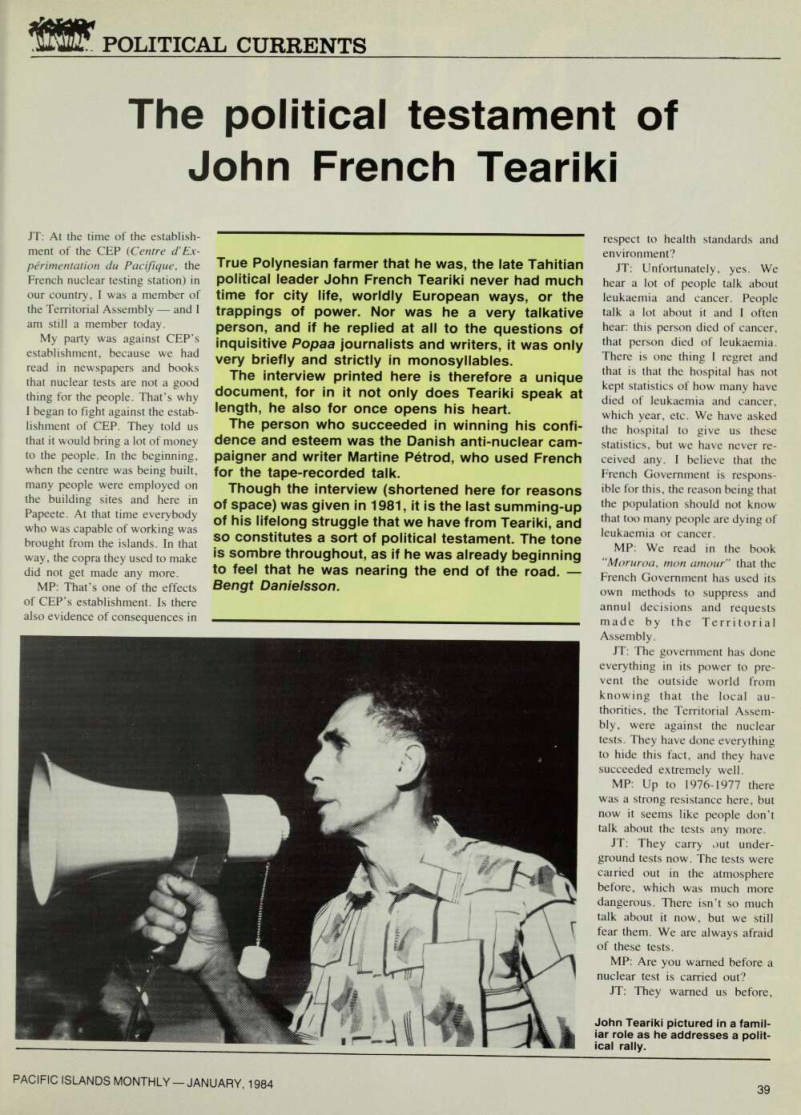
Political Currents
The political testament of John French Teariki
True Polynesian farmer that he was, the late Tahitian political leader John French Teariki never had much time for city life, worldly European ways, or the trappings of power. Nor was he a very talkative person, and if he replied at all to the questions of inquisitive Popaa journalists and writers, it was only very briefly and strictly in monosyllables.
The interview printed here is therefore a unique document, for in it not only does Teariki speak at length, he also for once opens his heart.
The person who succeeded in winning his confi dence and esteem was the Danish anti-nuclear cam paigner and writer Martine Pétrod, who used French for the tape-recorded talk.
Though the interview (shortened here for reasons of space) was given in 1981, it is the last summing-up of his lifelong struggle that we have from Teariki, and so constitutes a sort of political testament. The tone is sombre throughout, as if he was already beginning to feel that he was nearing the end of the road.
Bengt Danielsson.
JT: At the time of the establish ment of the CEP (Centre d’Ex périmentation du Pacifique, the French nuclear testing station) in our country, I was a member of the Territorial Assembly and I am still a member today.
My party was against CEP’s establishment, because we had read in newspapers and books that nuclear tests are not a good
thing for the people. That’s why
I began to fight against the estab lishment of CEP. They told us that it would bring a lot of money to the people. In the beginning, when the centre was being built, many people were employed on the building sites and here in Papeete. At that time everybody who was capable of working was brought from the islands. In that way, the copra they used to make did not get made any more.
MP: That’s one of the effects of CEP’s establishment. Is there also evidence of consequences in
respect to health standards and environment?
JT: Unfortunately, yes. We hear a lot of people talk about leukaemia and cancer. People talk a lot about it and I often hear: this person died of cancer, that person died of leukaemia.
There is one thing I regret and that is that the hospital has not kept statistics of how many have died of leukaemia and cancer, which year, etc. We have asked the hospital to give us these statistics, but we have never re ceived any. I believe that the French Government is respons ible for this, the reason being that the population should not know that too many people are dying of leukaemia or cancer.
MP; We read in the book “Moruroa, mon amour” that the French Government has used its own methods to suppress and annul decisions and requests made by the Territorial
Assembly.
JT: The government has done everything in its power to pre vent the outside world from knowing that the local au thorities, the Territorial Assem bly, were against the nuclear tests. They have done everything to hide this fact, and they have succeeded extremely well.
MP: Up to 1976-1977 there was a strong resistance here, but now it seems like people don’t talk about the tests any more.
JT; They carry out under ground tests now. The tests were cairied out in the atmosphere before, which was much more dangerous. There isn’t so much talk about it now, but we still fear them. We are always afraid of these tests.
MP: Are you warned before a nuclear test is carried out?
JT: They warned us before.
John Teariki pictured in a famil iar role as he addresses a polit
ical rally.
Advertisements & other items, p. 40 (1 item)
Anchor - premium quality dairy produce, packed with
all the goodness of the finest pasture in the world.
Fresh to you from the world’s number one dairy producer, New Zealand Dairy Board.
NEW
ZEALAND
DAIRY
BOARD
Enquiries to: PO Box 417 Wellington, New Zealand
Telex: NZ3348 DAPMARK
Telephone: 724-399
but not any more. We don’t even
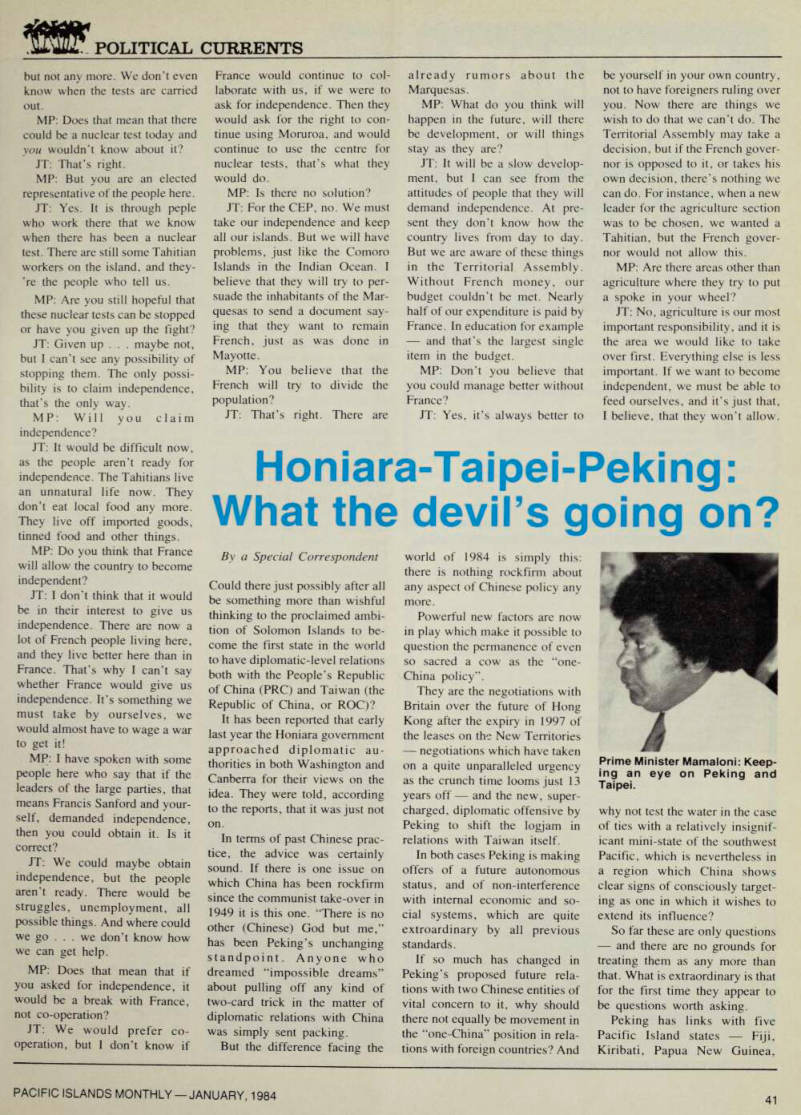
know when the tests are carried out.
MP: Does that mean that there could be a nuclear test today and you wouldn’t know about it?
JT: That’s right.
MP; But you are an elected representative of the people here.
JT: Yes. It is through peple who work there that we know when there has been a nuclear test. There are still some Tahitian workers on the island, and they ’re the people who tell us.
MP: Are you still hopeful that these nuclear tests can be stopped or have you given up the fight?
JT: Given up . . . maybe not, but I can’t see any possibility of
stopping them. The only possi
bility is to claim independence, that’s the only way.
MP: Will you claim
independence?
JT: It would be difficult now, as the people aren’t ready for independence. The Tahitians live an unnatural life now. They don’t eat local food any more.
They live off imported goods, tinned food and other things.
MP: Do you think that France will allow the country to become
independent?
JT: I don’t think that it would be in their interest to give us independence. There are now a lot of French people living here, and they live better here than in France. That’s why I can’t say whether France would give us
independence. It’s something we
must take by ourselves, we would almost have to wage a war to get it!
MP: I have spoken with some people here who say that if the leaders of the large parties, that means Francis Sanford and your self, demanded independence, then you could obtain it. Is it correct?
JT: We could maybe obtain
independence, but the people
aren’t ready. There would be
struggles, unemployment, all
possible things. And where could we go ... we don’t know how we can get help.
MP; Does that mean that if you asked for independence, it would be a break with France, not co-operation?
JT: We would prefer co operation, but I don’t know if
France would continue to col laborate with us, if we were to ask for independence. Then they would ask for the right to con tinue using Moruroa, and would continue to use the centre for nuclear tests, that’s what they would do.
MP: Is there no solution?
JT: For the CEP, no. We must take our independence and keep all our islands. But we will have problems, just like the Comoro Islands in the Indian Ocean. I believe that they will try to per suade the inhabitants of the Mar quesas to send a document say ing that they want to remain French, just as was done in
Mayotte.
MP: You believe that the French will try to divide the
population?
JT; That’s right. There are
already rumors about the Marquesas.
MP; What do you think will happen in the future, will there be development, or will things stay as they are?
JT: It will be a slow develop ment, but I can see from the attitudes of people that they will demand independence. At pre sent they don’t know how the country lives from day to day.
But we are aware of these things in the Territorial Assembly.
Without French money, our budget couldn’t be met. Nearly half of our expenditure is paid by France. In education for example and that’s the largest single item in the budget.
MP: Don’t you believe that you could manage better without France?
JT: Yes, it’s always better to
be yourself in your own country, not to have foreigners ruling over you. Now there are things we wish to do that we can’t do. The Territorial Assembly may take a decision, but if the French gover nor is opposed to it, or takes his own decision, there’s nothing we can do. For instance, when a new leader for the agriculture section was to be chosen, we wanted a Tahitian, but the French gover nor would not allow this.
MP: Are there areas other than agriculture where they try to put a spoke in your wheel?
JT: No, agriculture is our most important responsibility, and it is the area we would like to take over first. Everything else is less important. If we want to become independent, we must be able to feed ourselves, and it’s just that, I believe, that they won’t allow.
Honiara-Taipei-Peking:
What the devil’s going on?
By a Special Correspondent
Could there just possibly after all be something more than wishful thinking to the proclaimed ambi tion of Solomon Islands to be come the first state in the world to have diplomatic-level relations both with the People’s Republic of China (PRC) and Taiwan (the Republic of China, or ROC)?
It has been reported that early last year the Honiara government approached diplomatic au thorities in both Washington and Canberra for their views on the idea. They were told, according to the reports, that it was just not on.
In terms of past Chinese prac tice, the advice was certainly sound. If there is one issue on which China has been rockfirm since the communist take-over in 1949 it is this one. “There is no other (Chinese) God but me,” has been Peking’s unchanging standpoint. Anyone who dreamed “impossible dreams” about pulling off any kind of two-card trick in the matter of diplomatic relations with China was simply sent packing.
But the difference facing the
world of 1984 is simply this; there is nothing rockfirm about any aspect of Chinese policy any more.
Powerful new factors are now in play which make it possible to question the permanence of even so sacred a cow as the “one- China policy”.
They are the negotiations with Britain over the future of Hong Kong after the expiry in 1997 of the leases on the New Territories negotiations which have taken on a quite unparalleled urgency as the crunch time looms just 13 years off and the new, super charged, diplomatic offensive by Peking to shift the logjam in relations with Taiwan itself.
In both cases Peking is making offers of a future autonomous status, and of non-interference with internal economic and so cial systems, which are quite extroardinary by all previous standards.
If so much has changed in Peking’s proposed future rela tions with two Chinese entities of vital concern to it, why should there not equally be movement in the “one-China” position in rela tions with foreign countries? And
why not test the water in the case of ties with a relatively insignif icant mini-state of the southwest Pacific, which is nevertheless in a region which China shows clear signs of consciously target ing as one in which it wishes to extend its influence?
So far these are only questions and there are no grounds for treating them as any more than that. What is extraordinary is that for the first time they appear to be questions worth asking.
Peking has links with five Pacific Island states Fiji, Kiribati, Papua New Guinea,
Prime Minister Mamaloni: Keep ing an eye on Peking and Taipei.
Western Samoa and Vanuatu, and Mr Zhu Xue-fan, a vice chairman of the National Peo ple’s Congress (parliament), said in a recent statement that China wanted to extend this South Pacific network.
Mr Zhu last September met a delegation visiting China from the Solomons parliament led by Speaker Lloyd Gina.
This would have been unre markable enough if it were not for the fact that seven months earlier, in February, Solomon Islands had established consular level diplomatic relations with Taiwan. At the very least, in the past, this would have earned the Solomons representatives a stem lecture on the “one-China” poli cy. But as things turned out, Mr Zhu merely voiced hopes for diplomatic relations between the PRC and the Solomons.
Other Chinese officials have come out in favor of trade and economic ties. Indeed, such no tions appear to have moved bey ond the mere expression of hopes: in June a newspaper in China’s Guangdong province re ported that the provincial govern ment was planning a joint ven ture with the Solomons, with 20,000 hectares of forest land being made available to supply Guangdong with more than 3000 cubic metres of timber annually for 13 years.
In its fight against what it calls “the strategy of the ‘southward drive’ pursued by Moscow,” which is “casting a shadow” over the South Pacific, Peking has one undeniable advantage over the Russians; in almost all urban settlements in the South Pacific there are long-established, some times very powerful, Chinese communities. The Chinese are “known”, if they are not always loved, throughout the region.
The existence of this long standing Chinese presence no doubt has something to do with the fact that whereas China has a physical diplomatic presence in a spread of countries across the region, Moscow’s diplomats are accredited to only three - Fiji, Tonga, and Western Samoa and are resident in none.
Of course, the presence of
Chinese communities can be a two-edged sword.
Thus, late last year, we had Solomons Prime Minister Sol omon Mamaloni referring ex plicitly to “about 12 local Chin ese businessmen”, and threaten ing them with deportation if they did not stay within the Sol omon’s foreign investment laws.
He accused those concerned of “deviously” seeking help from other ministers, and highly placed government officials. One or two of them had been “marked down” for deportation, he said.
Whatever the episode had to do if it had anything to do with the complex, three-way dip
lomatic Honiara-Taipei-Peking
relationship, there is no doubt that more will be heard of this trio as 1984 goes on.
Fiji’s Finance
Minister
Walker resigns
Fiji’s Finance Minister Charles Walker resigned on December 7 in protest against a Cabinet deci sion to grant a $F300 annual pay increase to public servants.
Expressing “shock” at the re signation in a statement next day, Prime Minister Ratu Sir Kamis ese Mara nevertheless defended the cabinet decision, saying that the country could not afford a public service strike, and that government would have been go ing back on its word in failing to grant the increase, which it had promised several years ago.
Mr Walker is believed to have told Cabinet that the country could not afford the measure.
Borrowing funds from abroad to meet the cost (an estimated $3.5 million a year) would simply be mortgaging Fiji’s independence to the International Monetary Fund.
Earlier on December 7, the parliament in Suva, after two weeks of debate, had passed the budget, which provides for major tax increases (PIM Dec. p 5).
Mr Walker, 55, had been minister of finance since 1979.
Foreign Affairs Minister Mosese Qionibaravi was appointed act ing finance minister following the resignation.
Advertisements & other items, p. 42 (1 item)
Houses’
'INSTANT
and Commercial Buildings with Therma-Panel®, the
fully insulated inter-locking
Building System
Cyclone rated George Hudson Homes (Aust.) Pty. Ltd. 186 Hume Highway Cabramatta NSW 2166 Australia. Tel: (02) 727 9066. Telex: AA25800 Post coupon for details and prices.
Tel:.
NORTH QUEENSLAND ENGINEERS
& AGENTS PTY. LTD.
Shipbuilding and Repair are our Business We have full facilities for repair or refitting SLIPPING to 750 tonne DOCKING to 200 feet The shipbuilding division can construct a vessel to your design, or design one to suit your needs.
Barges, Tugs, Workboats, Catamarans, Landing Craft and Patrol Boats are all within our scope.
CALL US TODAY
N.Q.E.A.
36 Buchan Street, Cairns 4870 P.O. Box 1105, Cairns Telephone (070) 51 6600. Telex 48087
CONTRACTORS TO THE ROYAL AUSTRALIAN NAVY
“Little short
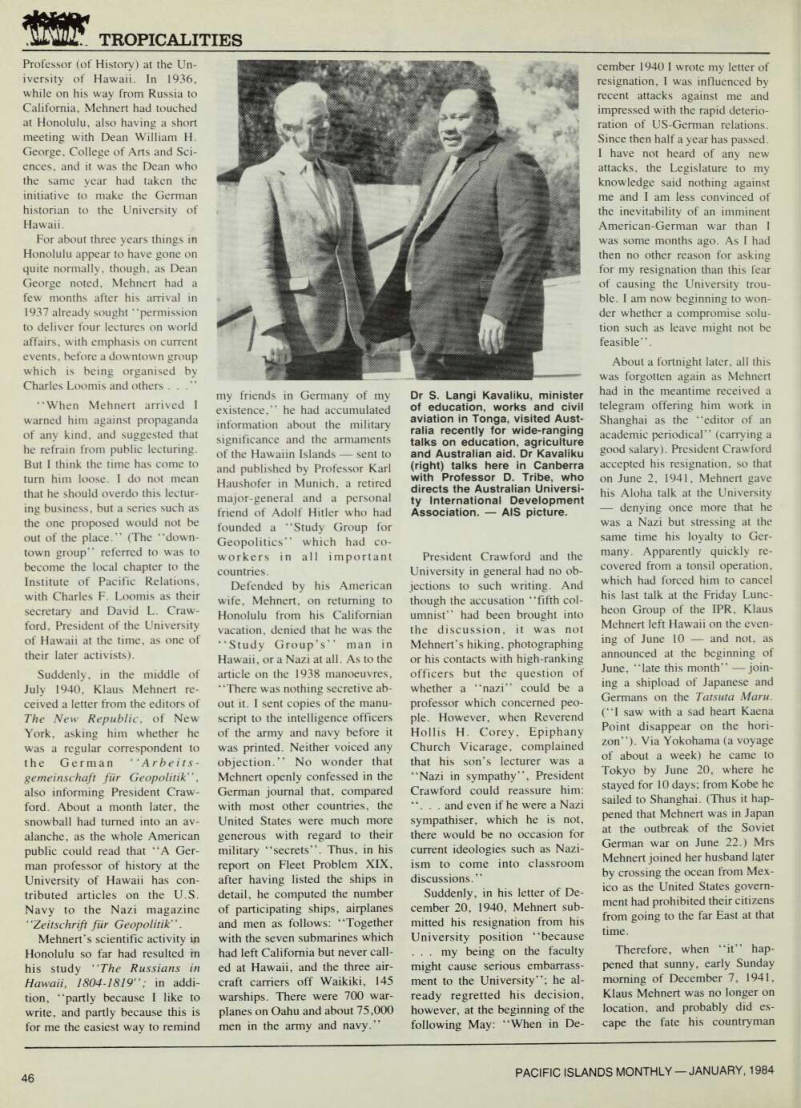
Tropicalities
“Little short of a tragedy..."
The Solomon Islands National Archives - SINA - stands in a grove of trees about 150 metres from Mendaña Avenue, in the heart of Honiara.
SINA is a quietly imposing, two-storey, white concrete build ing with a floor area of almost 600 square metres, a structure intended as a worthy successor to the Western Pacific Archives (WPA) in Suva.
For eight years (1970-78) the WPA - an unassuming, wooden structure of wartime provenance in the Government House grounds - housed what one archivist called ”... one of the
largest organised assemblages of
original source materials in exist ence relating . . .” to British colonial policy in the South Pacific, and to Pacific Islands history in general. The last per manent director of the WPA, Bruce Bume, was a meticulous and dedicated official who work ed tirelessly to develop the arc hive’s holdings and to assist re searchers working in Pacific studies.
Realising the physical and en vironmental limitations of the WPA, its acute vulnerability to fire, and the anomaly involved in housing the files of tropical de
pendencies in an independent
dominion, Bume worked hard to promote the establishment of SI NA. However, before SINA was completed, Bume’s period in of fice came to an end, and the WPA was disbanded. I can well remember standing in the hall way of the WPA in August, 1978, watching in a state of growing dismay while the files of the Western Pacific High Com mission (WPHC), relating primarily to the Solomons, Kiribati, Tuvalu, Vanuatu, Ton ga, and the Samoas, for the period 1874-1941 - were packed into crates destined for
England.
For more than five years now those files have been lost to the world, lying on shelves in a Public Record Office repository in Hayes, Middlesex. So far as I can determine the Foreign and
Commonwealth Office lacks the staff and the resolve to deal with the WPHC materials, and until this is done the files - and/or microfilms of same - will not be deposited in the National Arc hives in Honiara.
The transfer of the WPHC files not only flew in the face of accepted archival convention that, whenever possible, files
Dr JIM BOUTILIER tells the story of SINA, the Solomon Islands National Archives, and of how it came about that what should be the core of its holdings is lying virtually forgotten in an official records repository in the United Kingdom.
should be housed in the area to which they relate - but robbed SINA of 80 per cent of its intend ed collection.
What is more, SINA lacks another key element in its archiv al collection, microfilm of the WHPC files. Before the closure of the WPA, Bume’s staff under took the massive project - with Australian and Islands - aid of microfilming all the WHPC files down to 1927.
They did so not only as a
hedge against the possible loss of
the originals, but as a way of providing universities in the reg ion, interested in Pacific studies, with an invaluable news resource.
Unfortunately, SINA does not have a copy of those microfilms, and the master negative mic rofilm copy of WPHC records, comprising 315 reels, was re mitted to the United Kingdom
without the consent of the par
ticipants in the project.
Nevertheless, SINA did re ceive several cartons of mic rofilm - principally Pacific Islands Monthly and assorted mis sionary papers (microfilm relat ing to the Battle for Guadalcanal was presented to SINA at a later date by the United States Marine Corps) - from the WPA, as well
as all of the archive’s microfilm ing and processing equipment.
However, the microfilm auto processor has never worked, and Benjamin Piri, the senior techn ical officer and cameraman, with 17 years of experience behind him in Lands and Surveys, has been able to undertake only the smallest assignments, painstak ingly developing them by hand.
A new processor is on order, but until it arrives some time this year SINA is not equipped to
begin large-scale microfilming
projects of its own, or to meet readers’ requests for microfilm.
The first SINA archivist was R. G. Chesterman who had serv ed previously (among other ap pointments) in the India Office Archives in London. He took up his appointment in June, 1979, and the following year engaged as his assistant a serious, articu late, young graduate from the
University of the South Pacific, Joseph Wale. While at USP Wale had volunteered for two weeks “in-service” training at the WPA, and, encouraged by Bruce Bume, went on to do a two month archival course, funded by British Commonwealth tech nical aid, at the Malaysian Na tional Archives in Petaling Chaya, Selangor. Two years la ter he completed a nine-month course in archives administration at University College, London, and in 1983 was confirmed in his post as Solomon Islands Govern ment Archivist.
Wale is at present wrestling with a number of problems, and doing so with good-natured pro fessionalism. Hitherto, there has been no national policy with re spect to the deposition of public documents in SINA. Wale and his staff have been obliged to tour the islands recovering files from the Auki, Gizo,and Makira provincial headquarters, and with a National Archives Bill now before the legal draftsmen he faces the prospect of a vast number of government files be ing transferred to his charge.
Interestingly enough, some of the files relating to the Solomons were, in fact, sent to Honiara in 1978. Those British Solomon Is-
Government offices, Honiara, at the time of Independence in 1978. Records from here and from the Western Pacific Arc hives in Fiji were transferred about that time to the U.K.
There’s a growing movement to have the records available in the Pacific for today’s researchers.
lands Protectorate (BSIP) papers consisted of some resident com missioners’ files (until the termi nation of that office in 1952), some district records, which, apart from those for Malaita, were fragmentary, and an assort ment of miscellaneous files.
As a consquence of wartime destruction, the BSIP materials are incomplete, and Wale has discovered that the files, which fill four bays of metal shelving, have not been weeded properly.
When I asked him what his big gest task was he replied with a smile, “Over there,” gesturing towards the boxes that needed to be gone through.
In addition, there are the inter connected and perennial prob lems of staffing and finance.
Wale’s staff consists of a cameraman, messenger, two ar chival assistants, a search room supervisor, a typist, and a con servator. He is understandably anxious to ensure that each of them has an opportunity to up grade his or her qualifications.
He needs new equipment for
binding documents, and conser vation measures are a constant necessity, particularly in a trop ical setting, where cockroaches, silverfish, rodents, and damp menace his collection.
But overshadowing all of these concerns is the one basic and
increasingly forgotten problem,
that SINA is an archives almost bereft of records. Years ago Bruce Bume observed that it would be “. . . little short of a tragedy” if the WPA holdings were broken up and dispersed.
Sadly, that is exactly what hap pened, and now, more than half a decade later, bureaucratic indif ference and dithering have de nied SINA and the people of the Pacific islands the records which SINA was originally built to house.
It is a tragic state of affairs that as Solomon Islanders convene workshops at the USP Centre in Honiara to prepare a history of their nation, many of the records they require lie virtually forgot ten on the other side of the globe.
Jim Boutilier.
Big blast opens
Aitutaki lagoon
Blasts of water and sand were seen from up to 13 km away when Don Dorrell, a New Zealander who has lived in the Cook Islands for 17 years, used explosives to widen the entrance to Aitutaki lagoon. The work was carried out as part of the production of a New Zealand feature film The Silent One, so that the 30-metre sailing scow Owhiti could sail into the lagoon.
Production on location ended in December, but without the wide ning of the lagoon entrance it would have been impossible for the sailing boat to enter.
Dorrell shifted sand, coral and rock at a number of sites as part of the widening and deepening operation. Blasting work was carried out at the end of the clearing project and left hun dreds of cubic metres of new material to be cleared. The work was done in about two weeks as a high-speed operation because of the time schedule set by the film company.
According to Mr Harold Browne, Aitutaki chief adminis trative officer, there’s been a generally good reception to the work by people living in the area
and using the lagoon.
Nearby Foot Island, a popular place for tourists, is now more easily accessible, and fishing boats are finding passage into and out of the lagoon less of a problem. Large visiting yachts have been anchoring in the la goon instead of outside the reef.
Mr Browne said that the film company had saved the govern ment an expenditure which had been projected on the works program for several years.
Professor, hiker,
Nazi spy?
When the man had climbed up Rocky Hill behind the house at 2219 Halulu Way, where he lived in Honolulu, that early morning of April 21, 1938, and turned around, the sea was covered with ships. It was the time of the U.S. Pacific Fleet manoeuvres, which had started on March 15, and he was able to observe that the three aircraft carriers had already left Waikiki during the night. Also the de stroyers, minesweepers, and sub marines stationed at Pearl Harbor had put to sea to secure, support ed by numerous planes, the mov ing-out of the Purple Fleet. In the first beams of the morning sun, the destroyers and cruisers push ed through the Channel, to be followed in full daylight by the battleships. The man who was watching the movements of the Pacific Fleet was Klaus Mehnert, to become “the most controver sial figure in the Territory of Hawaii” in 1940 and 1941 (and again in 1945).
The German had come to Ber keley as an exchange student already at the end of the twen ties, after having graduated from the University of Berlin in 1928.
In 1932, having returned to Ber lin, on the basis of a thesis on the influence of the Russo-Japanese War (1904-1905) upon major power politics, Mr Mehnert be came Dr Mehnert. From 1933 to 1936 he worked as a foreign correspondent for German news papers in Moscow, his birth place. Then, in 1936, Klaus Mehnert visited California again, teaching at the summer session of the University of California at Berkeley. A year later, he moved farther west, becoming Assistant
Explosives expert Don Dorrell and the big blast which he en gineered so that a sailing boat could enter Aitutaki lagoon in the Cook Islands. The 30-metre sailing boat Owhiti was wanted in the lagoon for part of a film shoot.
Professor (of History) at the Un iversity of Hawaii. In 1936, while on his way from Russia to California. Mehnert had touched at Honolulu, also having a short meeting with Dean William H.
George, College of Arts and Sci ences, and it was the Dean who the same year had taken the initiative to make the German historian to the University of Hawaii.
For about three years things in Honolulu appear to have gone on
quite normally, though, as Dean
George noted. Mehnert had a few months after his arrival in
1937 already sought “permission
to deliver four lectures on world affairs, with emphasis on current events, before a downtown group
which is being organised by
Charles Loomis and others ...”
“When Mehnert arrived I
warned him against propaganda
of any kind, and suggested that he refrain from public lecturing.
But I think the time has come to turn him loose. I do not mean that he should overdo this lectur ing business, but a series such as the one proposed would not be out of the place.” (The “down town group” referred to was to become the local chapter to the Institute of Pacific Relations, with Charles F. Loomis as their secretary and David L. Craw ford, President of the University of Hawaii at the time, as one of their later activists).
Suddenly, in the middle of July 1940, Klaus Mehnert re ceived a letter from the editors of The New Republic, of New York, asking him whether he was a regular correspondent to the German ‘ ‘Arbeits
gemeinschaft fur Geopolitik’’,
also informing President Craw ford. About a month later, the snowball had turned into an av alanche, as the whole American public could read that “A Ger man professor of history at the University of Hawaii has con tributed articles on the U.S.
Navy to the Nazi magazine
‘ ‘Zeitschrift fur Geopolitik’ ’.
Mehnert’s scientific activity in Honolulu so far had resulted in his study “The Russians in Hawaii, 1804-1819’’; in addi tion, “partly because I like to write, and partly because this is for me the easiest way to remind
my friends in Germany of my existence,” he had accumulated information about the military significance and the armaments of the Hawaiin Islands sent to and published by Professor Karl Haushofer in Munich, a retired
major-general and a personal
friend of Adolf Hitler who had founded a “Study Group for Geopolitics” which had co workers in all important countries.
Defended by his American wife, Mehnert, on returning to Honolulu from his Californian vacation, denied that he was the
“Study Group’s’’ man in
Hawaii, or a Nazi at all. As to the article on the 1938 manoeuvres, “There was nothing secretive ab out it. I sent copies of the manu script to the intelligence officers of the army and navy before it was printed. Neither voiced any objection.” No wonder that Mehnert openly confessed in the
German journal that, compared
with most other countries, the United States were much more generous with regard to their military “secrets”. Thus, in his report on Fleet Problem XIX, after having listed the ships in detail, he computed the number
of participating ships, airplanes
and men as follows: “Together with the seven submarines which had left California but never call ed at Hawaii, and the three air craft carriers off Waikiki, 145 warships. There were 700 war planes on Oahu and about 75,000 men in the army and navy.”
President Crawford and the University in general had no ob jections to such writing. And though the accusation “fifth col umnist” had been brought into the discussion, it was not
Mehnert’s hiking, photographing
or his contacts with high-ranking officers but the question of whether a “nazi” could be a professor which concerned peo ple. However, when Reverend
Hollis H. Corey, Epiphany
Church Vicarage, complained
that his son’s lecturer was a “Nazi in sympathy”, President Crawford could reassure him; ”... and even if he were a Nazi sympathiser, which he is not, there would be no occasion for current ideologies such as Nazi ism to come into classroom discussions.”
Suddenly, in his letter of De cember 20, 1940, Mehnert sub mitted his resignation from his
University position “because
. . . my being on the faculty might cause serious embarrass ment to the University”; he al
ready regretted his decision,
however, at the beginning of the following May: “When in De
cember 1940 I wrote my letter of resignation, I was influenced by recent attacks against me and impressed with the rapid deterio ration of US-German relations.
Since then half a year has passed.
I have not heard of any new attacks, the Legislature to my
knowledge said nothing against
me and I am less convinced of the inevitability of an imminent American-German war than I was some months ago. As I had then no other reason for asking for my resignation than this fear of causing the University trou ble. I am now beginning to won der whether a compromise solu tion such as leave might not be feasible”.
About a fortnight later, all this was forgotten again as Mehnert had in the meantime received a telegram offering him work in Shanghai as the “editor of an
academic periodical” (carrying a
good salary). President Crawford
accepted his resignation, so that on June 2, 1941, Mehnert gave his Aloha talk at the University denying once more that he was a Nazi but stressing at the same time his loyalty to Ger
many. Apparently quickly re
covered from a tonsil operation, which had forced him to cancel his last talk at the Friday Lunc heon Group of the IPR, Klaus Mehnert left Hawaii on the even ing of June 10 and not, as announced at the beginning of June, “late this month” —join
ing a shipload of Japanese and
Germans on the Tatsuta Maru. (“I saw with a sad heart Kaena Point disappear on the hori zon”). Via Yokohama (a voyage of about a week) he came to Tokyo by June 20, where he stayed for 10 days; from Kobe he sailed to Shanghai. (Thus it hap pened that Mehnert was in Japan at the outbreak of the Soviet German war on June 22.) Mrs Mehnert joined her husband later by crossing the ocean from Mex ico as the United States govern ment had prohibited their citizens from going to the far East at that time.
Therefore, when “it” hap pened that sunny, early Sunday morning of December 7, 1941, Klaus Mehnert was no longer on location, and probably did es cape the fate his countryman
Dr S. Langi Kavaliku, minister of education, works and civil aviation in Tonga, visited Aust ralia recently for wide-ranging talks on education, agriculture and Australian aid. Dr Kavaliku (right) talks here in Canberra with Professor D. Tribe, who directs the Australian Universi ty International Development
Association. - AIS picture.
Bernard Julius Otto (“Friedel”) Kuhn had to suffer: being con victed of espionage in Hawaii during the war. People in Hawaii had not, however, forgotten Klaus Mehnert, maybe “Pearl Harbor’’ had sharpened their memory. After World War 11, when his arrest in Shanghai be came known, the Mehnert Case was raised again, and this time it was his possible part in the plan ning of the Japanese attack on the U.S. Pacific Fleet which was under debate. Fulton Lewis, Jr., in a broadcast, pointed to the “Pearl Harbor’’ connection re ferring to Mehnert’s hiking, photographing, interest in maps, getting together with military people, etc. Again it was the President of the University of Hawaii who followed the princi ple giving Mehnert the benefit of the doubt. Though calling Mehnert “the most controversial figure in the Territory of Hawaii’’ and feeling “that the Nazi knew he was the ideal per son to have in a place like Hon olulu’’, President Gregg M.
Sinclair, when asked for his tes timony, referred to the words of a retired general; “If Mehnert was a spy, he fooled the best people in Honolulu. But I don’t think he was a spy”.
In June 1946, Klaus Mehnert returned to Germany from China in the first possible war transport of Germans from east Asia: “He was screened for possible Nazi activism and shortly thereafter released from the repatriation centre at Ludwigsburg” in the American Zone; in 1948, he worked as a Russian expert in the “German peace office” at Stutt gart. Klaus Mehnert became editor and co-publisher of the conservative weekly “Christ und Welt”, and in 1961 he entered the (West) German academic scene again, being appointed professor of political science at the Aachen Institute of Technol ogy. It was not until March 1965 that Klaus Mehnert, a holder of the West German Grand Disting uished Service Cross and a mem ber of the national PEN centre, reappeared in the headlines of the Honolulu newspapers because of his calling again at the place where he had once been under fire. A widower since 1955, and
professor emeritus since 1973, the early 1980 s saw him if not hiking the world living in the Black Forest, West Germany climbing the mountains behind his residence at Blumenhof?
W. Wilfried Schuhmacher. Re printed with permission from the collection ' ‘Essays in Honour of Aarne A. Koskinen”, published by the Finnish Anthropological Society.
Solomons art on
show in Honolulu
Solomon Islands art by Kuai Maueha (1933-1981) (PIM Aug. ’B3 p 37) was on display in November-December at Hon olulu’s East-West Center Bums Hall foyer. The exhibit was free and open to the public.
The expressive and imagina tive style of the late Solomon Islander was demonstrated through his detailed work in wood sculpture and copper bas relief. Twenty-six wood carvings and two works in copper were presented, along with about 20 photographs of the artist’s work.
Kuai was from Bellona, a Polynesian outlier in the Sol omons. Although he did not be come a serious artist until 1969, his talent was soon recognised.
He was twice an artist in resi dence at the University of the South Pacific, first at the Laucala campus in Fiji and again at USP’s Solomon Islands Center in
Honiara. He died in May 1981 after a fall from a tree.
The exhibit was presented at the E-WC by the Culture Learn ing Institute. It was organised in Honiara by Anna Craven Tuhanuku and Ann Stevenson, with support from the Australian South Pacific Cultures Fund and Air Pacific.
After the display at the E-WC, the exhibit was to travel to Fiji, Australia and Papua New Guinea before returning to the Solomons.
An exhibition of contemporary prints by Papua New Guinean artist David Lasisi was also on display at the E-WC during the same period.
Marginal Farm
in the mainstream
The play The Marginal Farm (PIM Nov ’B3 p3l) opened at the Russell Street Theatre, Mel bourne, on November 2, and not one critic protested that “kava” should be pronounced “yanngo na” (written “yaqona”).
The cast of Australian dramat ist Alexander Buzo’s play were immensely cheered by this, as they were by the announcement that the play’s season was to be extended to December 17.
The Melbourne Theatre Com pany, which presented the play, were pleased to hear that Neil Jillett of The Age thought The
Marginal Farm “a warm-hearted comedy that is always ati'active and entertaining”. Another critic, Anee Crawford, saw it in a more sombre light, however. “Don’t expect a play full of happy na tives,” she warned.
Geoffrey Hutton in The Aust ralian had a rare complaint.
Diane Craig, who plays the lead ing role, is “almost too attrac tive”, he protested. Of all the blunders . . .
Members of the Samoan com munity in Brisbane, capital of the Australian state of Queens land, have opened their own church. It is the Bardon church of the Congregational Christian Church of Samoa. Its minister, the Rev Urika Saifoloi (lower picture) has served in parishes in Western Samoa, PNG and Fiji. He conducts services in the
Samoan language. - Greg Nos
worthy picture.
Advertisements & other items, p. 44 (1 item)
Starting & Staying
■ Jy f i
AMP
POWER
**/ t7**J / coNywwx's <jse 71 f oe^cnxsßArrßw -mr* rm<jj
MARIUS
now
£ «L
Amy
0227 can?
Power Boats Need Different Batteries
There is a big difference between a car battery and a marine battery.
A car battery, for example, is never really discharged, as it is only used for a few seconds each day and promptly re-charged. Not so your cruiser or sportsfisherman.
Starting the engine is only the beginning. During the day, weekend or cruise, how often will you run the live bait tank, the depth sounder, the nav. lights or maintain a listening watch on your radio transceiver?
As well as cranking power, boats need staying power. Boats need Besco’s Marine Batteries, deep cycle, heavy duty marine batteries. * If your boat is getting a little flat in the electrics department, write or phone BESCO today and ask' for more information, more facts about
BESCO MARINE BATTERIES.
BESCO
Batteries Division Of Sims Products Pry. Ltd. [_ A Peko Wall send Group Member Papua New Guinea; Lae, Automarine Industries, P.O. Box 785, Ph. 42-1125; Rabaul, Automarine Industries, P.O. Box 248, Ph. 92-2574; Port Moresby, Par Sales, P.O. Box 1680, Boroko, Ph. 25-6266. Fiji: Suva, Fiji Bandag, 23 Sinoma Street, Walu Bay, Ph. 31-1200. New Caledonia: Noumea, Andre Thuilier, BP 889, Ph. 27-4906. Solomon Islands: Honiara Guadalcanal Electrics Ltd., P.O. Box 521. Hongkong: Kowloon, T. L Knight &Co PO. Box 95585 TST, Ph. 366-5341. New Zealand: Auckland, Battery Services {(nd.) Ltd., P.O. Box 27- 375 Ph. 69-4111; Wellington, Gould Batteries, 58 Hautana Street, Lower Hurt, TLX: NZ3714 Australia: Sydney, Besco Batteries, P.O. Box 1, Villawood 632-0251 TLX 21886; Jarwil International Pty. Ltd., 410 Kent Street, Sydney, Ph. 264-3477, TLX 72102.
/ FAHFRS IN BATTERY TECHNOLOGY—
From Regent of Fiji
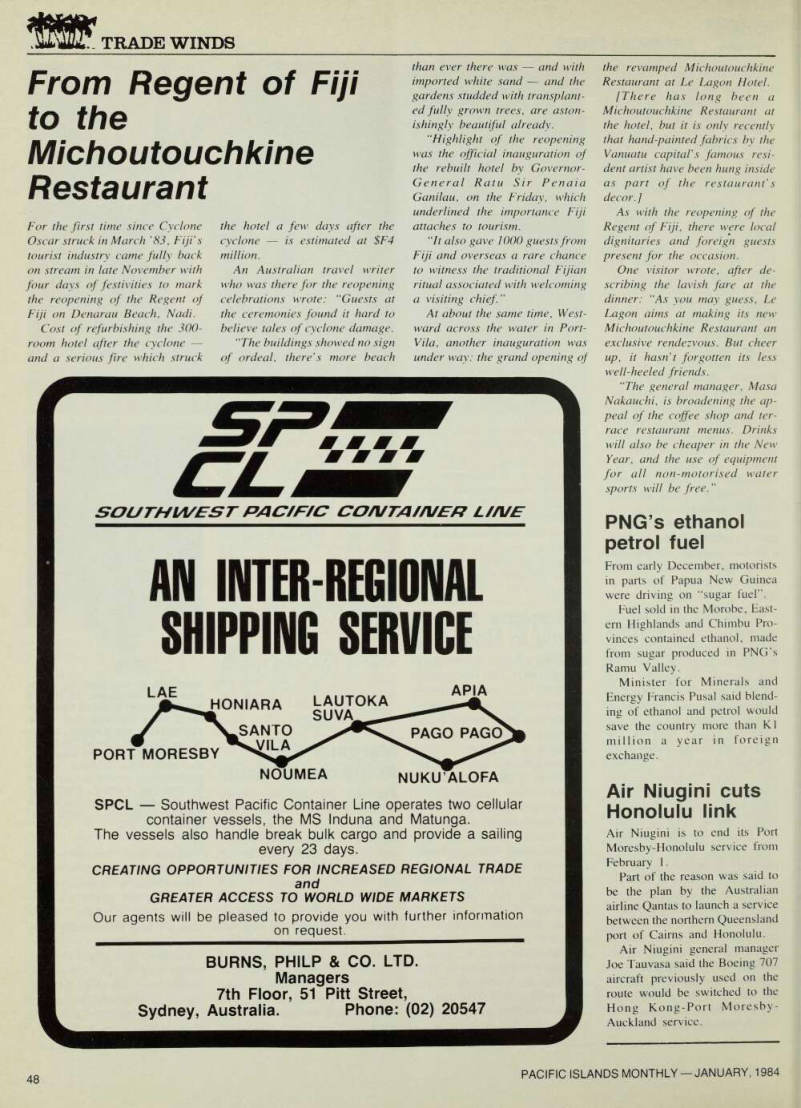
Trade Winds
From Regent of Fiji to the Michoutouchkine Restaurant
For the first time since Cyclone Oscar struck in March ’B3, Fiji’s tourist industry came fully back on stream in late November with four days of festivities to mark the reopening of the Regent of Fiji on Denarau Beach, Nadi.
Cost of refurbishing the 300room hotel after the cyclone and a serious fire which struck
the hotel a few days after the cyclone is estimated at SF4 million.
An Australian travel writer who was there for the reopening celebrations wrote: “Guests at the ceremonies found it hard to believe tales of cyclone damage.
“The buildings showed no sign of ordeal, there’s more beach
than ever there was and with imported white sand and the gardens studded with transplant ed fully grown trees, are aston ishingly beautiful already.
“Highlight of the reopening was the official inauguration of the rebuilt hotel by Governor- General Ratu Sir Penaia Ganilau, on the Friday, which underlined the importance Fiji attaches to tourism.
“It also gave WOO guests from Fiji and overseas a rare chance to witness the traditional Fijian ritual associated with welcoming a visiting chief.”
At about the same time, West ward across the water in Port- Vila, another inauguration was under way: the grand opening of
the revamped Michoutouchkine Restaurant at Le Lagan Hotel. [There has long been a Michoutouchkine Restaurant at the hotel, but it is only recently that hand-painted fabrics by the Vanuatu capital’s famous resi dent artist have been hung inside as part of the restaurant’s decor.] As with the reopening of the Regent of Fiji, there were local dignitaries and foreign guests present for the occasion.
One visitor wrote, after de scribing the lavish fare at the dinner: “As you may guess, Le Lagon aims at making its new Michoutouchkine Restaurant an exclusive rendezvous. But cheer up, it hasn’t forgotten its less well-heeled friends.
“The general manager, Masa Nakauchi, is broadening the ap peal of the coffee shop and ter race restaurant menus. Drinks will also be cheaper in the New Year, and the use of equipment for all non-motorised water sports will be free."
PNG’s ethanol
petrol fuel
From early December, motorists in parts of Papua New Guinea were driving on “sugar fuel”.
Fuel sold in the Morobe, East ern Highlands and Chimbu Pro vinces contained ethanol, made from sugar produced in PNG’s Ramu Valley.
Minister for Minerals and Energy Francis Pusal said blend ing of ethanol and petrol would save the country more than K 1 million a year in foreign exchange.
Air Niugini cuts
Honolulu link
Air Niugini is to end its Port Moresby-Honolulu service from February 1.
Part of the reason was said to be the plan by the Australian airline Qantas to launch a service between the northern Queensland port of Cairns and Honolulu.
Air Niugini general manager Joe Tauvasa said the Boeing 707 aircraft previously used on the route would be switched to the Hong Kong-Port Moresby- Auckland service.
Advertisements & other items, p. 48 (1 item)
Shipping Service
SOUTHWEST RAC/E/C 00/UTA//UER L/fVE
AN INTER REGIONAL
HONIARA LAUTOKA
SANTO
PORT MORESBY — VILA
NOUMEA
SPCL Southwest Pacific Container Line operates two cellular container vessels, the MS Induna and Matunga.
The vessels also handle break bulk cargo and provide a sailing every 23 days.
CREATING OPPORTUNITIES FOR INCREASED REGIONAL TRADE
and
GREATER ACCESS TO WORLD WIDE MARKETS
Our agents will be pleased to provide you with further information on request.
BURNS, PHILP & CO. LTD.
Managers
7th Floor, 51 Pitt Street, Sydney, Australia. Phone: (02) 20547
Shipping, air services: SPEC
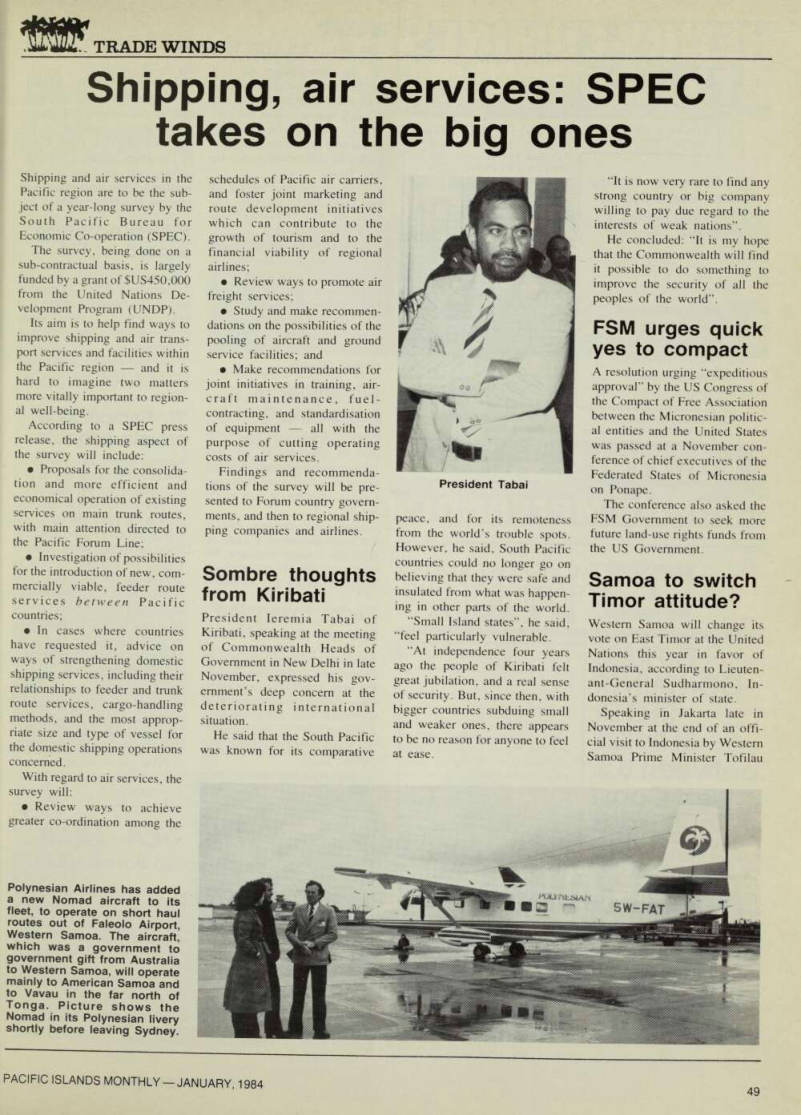
takes on the big ones
Shipping and air services in the Pacific region are to be the sub ject of a year-long survey by the South Pacific Bureau for Economic Co-operation (SPEC).
The survey, being done on a sub-contractual basis, is largely funded by a grant of $U5450,000 from the United Nations De velopment Program (UNDP).
Its aim is to help find ways to improve shipping and air trans port services and facilities within the Pacific region and it is hard to imagine two matters more vitally important to region
al well-being.
According to a SPEC press release, the shipping aspect of the survey will include: • Proposals for the consolida tion and more efficient and economical operation of existing services on main trunk routes, with main attention directed to the Pacific Forum Line; • Investigation of possibilities for the introduction of new, com mercially viable, feeder route services between Pacific countries; • In cases where countries have requested it, advice on ways of strengthening domestic
shipping services, including their
relationships to feeder and trunk route services, cargo-handling methods, and the most approp riate size and type of vessel for the domestic shipping operations concerned.
With regard to air services, the survey will: • Review ways to achieve greater co-ordination among the
schedules of Pacific air carriers, and foster joint marketing and route development initiatives which can contribute to the growth of tourism and to the financial viability of regional airlines; • Review ways to promote air freight services; • Study and make recommen dations on the possibilities of the pooling of aircraft and ground service facilities; and • Make recommendations for joint initiatives in training, air craft maintenance, fuel contracting, and standardisation of equipment all with the purpose of cutting operating costs of air services.
Findings and recommenda tions of the survey will be pre sented to Forum country govern ments, and then to regional ship ping companies and airlines.
Sombre thoughts
from Kiribati
President leremia Tabai of Kiribati, speaking at the meeting of Commonwealth Heads of Government in New Delhi in late November, expressed his gov ernment’s deep concern at the
deteriorating international
situation.
He said that the South Pacific was known for its comparative
peace, and for its remoteness from the world’s trouble spots.
However, he said. South Pacific countries could no longer go on believing that they were safe and insulated from what was happen ing in other parts of the world.
“Small Island states”, he said, “feel particularly vulnerable.
“At independence four years ago the people of Kiribati felt great jubilation, and a real sense of security. But, since then, with bigger countries subduing small and weaker ones, there appears to be no reason for anyone to feel at ease.
“It is now very rare to find any strong country or big company willing to pay due regard to the interests of weak nations”.
He concluded: “It is my hope that the Commonwealth will find it possible to do something to improve the security of all the peoples of the world”.
FSM urges quick
yes to compact
A resolution urging “expeditious approval” by the US Congress of the Compact of Free Association between the Micronesian politic al entities and the United States was passed at a November con ference of chief executives of the Federated States of Micronesia on Ponape.
The conference also asked the FSM Government to seek more future land-use rights funds from the US Government.
Samoa to switch
Timor attitude?
Western Samoa will change its vote on East Timor at the United Nations this year in favor of Indonesia, according to Lieuten ant-General Sudharmono, In donesia’s minister of state.
Speaking in Jakarta late in November at the end of an offi cial visit to Indonesia by Western Samoa Prime Minister Tofilau
Polynesian Airlines has added a new Nomad aircraft to its fleet, to operate on short haul routes out of Faleolo Airport, Western Samoa. The aircraft, which was a government to government gift from Australia to Western Samoa, will operate mainly to American Samoa and to Vavau in the far north of Tonga. Picture shows the Nomad in its Polynesian livery
shortly before leaving Sydney.
President Tabai
Pine-processing
Eti, the lieutenant-general said the PM had given assurances in talks with President Suharto that Western Samoa, which had pre viously abstained from voting, would vote against the resolution calling for self-determination for East Timor.
Voting on the issue was put off until this year by the 1983 ses sion of the UN General Assembly.
Sudharmono said Indonesia had declared its readiness to as sist Western Samoa in the techn ical field, especially in civil avia tion. Western Samoa also expre ssed interst in importing oil di rectly from Indonesia, which has recently stepped up its oil refinery capacity.
Fiji ginger is
hot property
Ginger farmers in Fiji are to be paid an additional 5c for each kilogram of fresh mature ginger exported to the United States and Canada, bringing the price to 35c per kg.
Ginger has become one of Fiji’s top agricultural exports. In 1982 the country exported 293 tonnes of mature green ginger valued at almost SF3 million.
Pago: Extension
for an extension
Van Camp Seafood Company of Pago Pago, American Samoa, has been granted a five-year ex tension on its permit to construct a concrete dock extension along the north shore of the inner har bor which will carry a new cold storage facility.
“Unfavorable economic condi tions” were cited as the reason
for the delay in acting on the original permit, which was grant ed in May 1981 with an expiry date of December 31, 1986.
Announcing approval of the extension, the U.S. Army Corps of Engineers, Pacific Ocean Di vision, said the company had indicated “that the project will proceed at a future date”.
Pine-processing
accord in Fiji
The Fiji Government has given the country’s Pine Commission almost SF3 million to enable it to take part in a joint pine processing operation with British Petroleum.
The two parties are expected to sign an agreement early this year.
W. Samoa aids
private schools
Western Samoa this year is to provide government aid to pri vate schools for the first time.
Commenting on a $W563,000 grant in the 1984 education vote to help private schools lift educa tional standards, Prime Minister Tofilau Eti said the aid was in recognition of the substantial savings in government spending on schools made possible by the existence of the private system.
Reviving forests
of Savaii
A major tree-planting operation has started on Western Samoa’s island of Savaii, following the ravages of last year’s bushfires (PIM Oct. ’B3 p 5).
Plans call for the replanting of 400 hectares a year over the next six years.
Advertisements & other items, p. 50 (1 item)
Tahiti Samoa Str-
LOCAL AGENTS AND
REPRESENTATION
428 George St., Sydney.
Cables: Henco Sydney.
G.P.O. Box 3949.
Telephone: 232 5377.
For specialised and
personalised buying
service throughout
the Pacific Islands
and the East.
Resident Agents in other Pacific Territories.
PAPUA NEW GUINEA
RABAUL; M. & C. Seeto, P.O. Box 131, Rabaul.
Telephone 92 2919.
MADANG: W. Double, P.O. Box 22, Madang.
Telephone 82 2696.
FIJI
K. Witherington Ltd., P.O. Box 293, Suva.
Telephone 22 356.
VANUATU
John Lum & Associates, P.O. Box 65, Santo.
Telephone 329.
SOLOMON ISLANDS
Mr. Tom Lo, P.O. Box 327, Honiara.
Telephone 399
ill
EXPRESS
CONTAINER
•REEFER
SERVICE
between U.S.
West Coast ports and
TAHITI SAMOA str-
xot Qeqeral SteaiTfship General Agents 400 California Street, San Francisco, CA, USA PAPEETE: Agence Maritime Internationale, Tahiti PAGO PAGO: Polynesia Shipping Services, Inc.
APIA: Burns Philp (South Sea) Company, Ltd
FOR SALE: THE SEA TREK
18 METRE KETCH-RIGGED MOTOR SAILER
Professionally constructed in Sydney 1971. Steel hull. Interior fitted out in mahogany. Twin 38 BHP Lister diesels. Auxiliary generator.
Fuel capacity of 200 gals. Water of 300 gals. Sleeps 10 passengers in 4 separate cabins. Separate master’s quarters. SSB and CB radios, radar, auto pilot, 2 depth sounders, wind instruments. Inflatable and safety equipment, 8 sails, anchors and chain.
Presently lying in Port Vila, Vanuatu.
Presently has charter licence for Vanuatu, renewable in Jan., 1984.
For immediate sale to highest offer.
All enquiries to: Wayne J. McKeague & Associates, Solicitors, PO Box 140, Port Vila, VANUATU.
Phone 3355. Telex No. 1066.
yachts
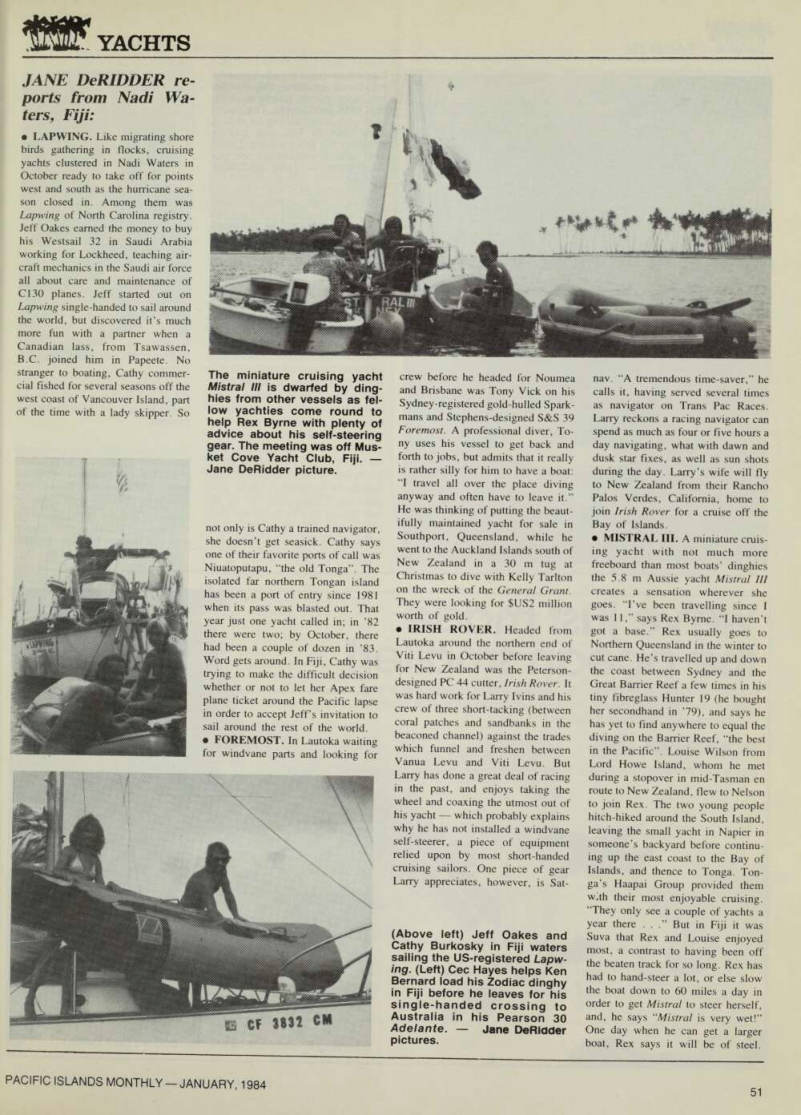
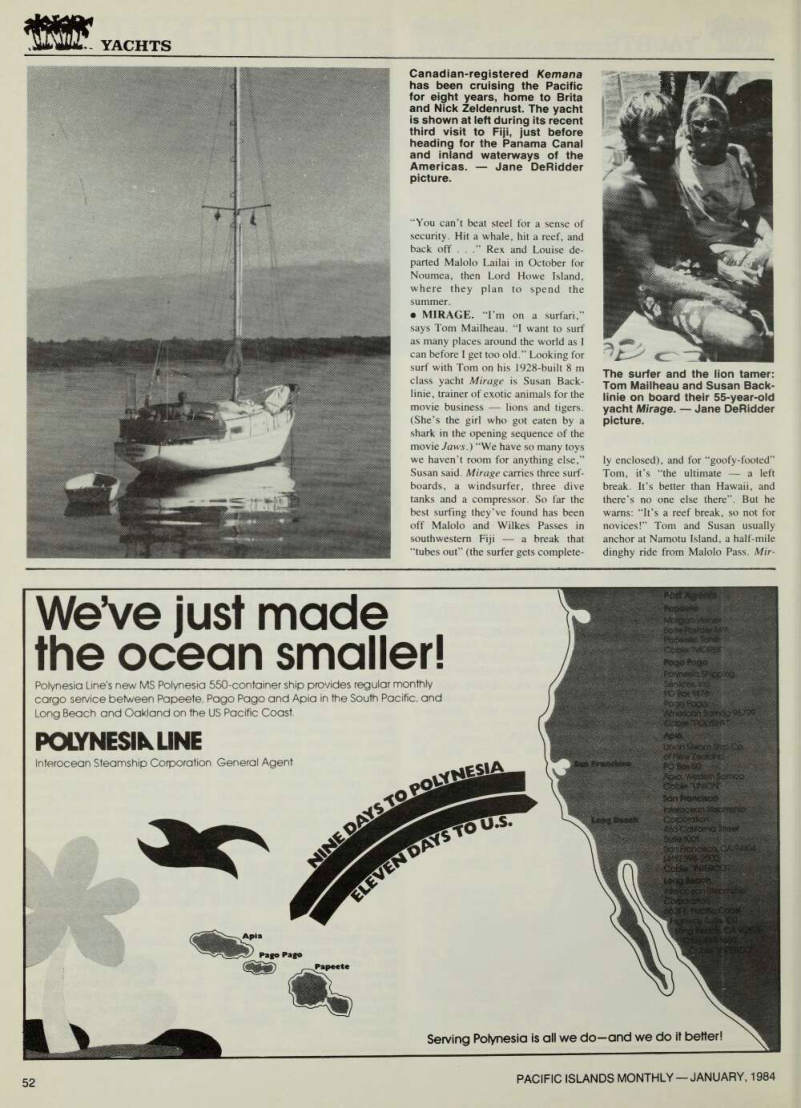
Jane Deridder Re
ports from Nadi Wa
ters, Fiji:
• LAPWING. Like migrating shore birds gathering in flocks, cruising yachts clustered in Nadi Waters in October ready to take off for points west and south as the hurricane sea son closed in. Among them was Lapwing of North Carolina registry.
Jeff Oakes earned the money to buy his Westsail 32 in Saudi Arabia working for Lockheed, teaching air craft mechanics in the Saudi air force all about care and maintenance of Cl3o planes. Jeff started out on Lapwing single-handed to sail around the world, but discovered it’s much more fun with a partner when a Canadian lass, from Tsawassen, B.C. joined him in Papeete. No stranger to boating, Cathy commer cial fished for several seasons off the west coast of Vancouver Island, part of the time with a lady skipper. So
not only is Cathy a trained navigator, she doesn’t get seasick. Cathy says one of their favorite ports of call was Niuatoputapu, “the old Tonga”. The isolated far northern Tongan island has been a port of entry since 1981 when its pass was blasted out. That year just one yacht called in; in ’B2 there were two; by October, there had been a couple of dozen in ’B3.
Word gets around. In Fiji, Cathy was trying to make the difficult decision whether or not to let her Apex fare plane ticket around the Pacific lapse in order to accept Jeff’s invitation to sail around the rest of the world. • FOREMOST. In Lautoka waiting for windvane parts and looking for
crew before he headed for Noumea and Brisbane was Tony Vick on his Sydney-registered gold-hulled Spark mans and Stephens-designed S&S 39 Foremost. A professional diver, To ny uses his vessel to get back and forth to jobs, but admits that it really is rather silly for him to have a boat; “I travel all over the place diving anyway and often have to leave it.”
He was thinking of putting the beaut ifully maintained yacht for sale in Southport, Queensland, while he went to the Auckland Islands south of New Zealand in a 30 m tug at Christmas to dive with Kelly Tarlton on the wreck of the General Grant.
They were looking for SUS 2 million worth of gold. • IRISH ROVER. Headed from Lautoka around the northern end of Viti Levu in October before leaving for New Zealand was the Peterson designed PC 44 cutter, Irish Rover. It was hard work for Larry Ivins and his crew of three short-tacking (between coral patches and sandbanks in the beaconed channel) against the trades which funnel and freshen between Vanua Levu and Viti Levu. But Larry has done a great deal of racing in the past, and enjoys taking the wheel and coaxing the utmost out of his yacht which probably explains why he has not installed a windvane self-steerer, a piece of equipment relied upon by most short-handed cruising sailors. One piece of gear Larry appreciates, however, is Sat
nav. “A tremendous time-saver,” he calls it, having served several times as navigator on Trans Pac Races.
Larry reckons a racing navigator can
spend as much as four or five hours a day navigating, what with dawn and dusk star fixes, as well as sun shots during the day. Larry’s wife will fly to New Zealand from their Rancho Palos Verdes, California, home to join Irish Rover for a cruise off the Bay of Islands. • MISTRAL 111. A miniature cruis ing yacht with not much more freeboard than most boats’ dinghies the 5.8 m Aussie yacht Mistral 111 creates a sensation wherever she goes. “I’ve been travelling since I was 11,” says Rex Byme. “I haven’t got a base.” Rex usually goes to Northern Queensland in the winter to cut cane. He’s travelled up and down the coast between Sydney and the Great Barrier Reef a few times in his
tiny fibreglass Hunter 19 (he bought
her secondhand in ’79), and says he has yet to find anywhere to equal the diving on the Barrier Reef, “the best in the Pacific”. Louise Wilson from Lord Howe Island, whom he met during a stopover in mid-Tasman en route to New Zealand, flew to Nelson to join Rex. The two young people hitch-hiked around the South Island, leaving the small yacht in Napier in someone’s backyard before continu ing up the east coast to the Bay of Islands, and thence to Tonga. Ton
ga’s Haapai Group provided them
with their most enjoyable cruising.
“They only see a couple of yachts a year there ...” But in Fiji it was Suva that Rex and Louise enjoyed most, a contrast to having been off the beaten track for so long. Rex has had to hand-steer a lot, or else slow the boat down to 60 miles a day in order to get Mistral to steer herself, and, he says “ Mistral is very wet!”
One day when he can get a larger boat, Rex says it will be of steel.
The miniature cruising yacht
Mistral ill is dwarfed by ding
hies from other vessels as fel low yachties come round to help Rex Byrne with plenty of advice about his self-steering gear. The meeting was off Mus ket Cove Yacht Club, Fiji. - Jane DeRidder picture.
(Above left) Jeff Oakes and Cathy Burkosky in Fiji waters sailing the US-registered Lapw ing. (Left) Cec Hayes helps Ken Bernard load his Zodiac dinghy in Fiji before he leaves for his single-handed crossing to Australia in his Pearson 30 Adelante. - Jane DeRidder pictures.
“You can’t beat steel for a sense of security. Hit a whale, hit a reef, and back off ...” Rex and Louise de parted Malolo Lailai in October for Noumea, then Lord Howe Island,
where they plan to spend the
summer. • MIRAGE. “I’m on a surfari,” says Tom Mailheau. “I want to surf as many places around the world as I can before I get too old.” Looking for surf with Tom on his 1928-built 8 m class yacht Mirage is Susan Back linie, trainer of exotic animals for the movie business lions and tigers. (She’s the girl who got eaten by a shark in the opening sequence of the movie Jaws.) “We have so many toys we haven’t room for anything else,”
Susan said. Mirage carries three surf boards, a windsurfer, three dive tanks and a compressor. So far the best surfing they’ve found has been off Malolo and Wilkes Passes in southwestern Fiji a break that “tubes out” (the surfer gets complete-
ly enclosed), and for “goofy-footed”
Tom, it’s “the ultimate a left break. It’s better than Hawaii, and there’s no one else there”. But he warns: “It’s a reef break, so not for novices!” Tom and Susan usually anchor at Namotu Island, a half-mile dinghy ride from Malolo Pass. Mir-
Canadian-registered Kemana has been cruising the Pacific for eight years, home to Brita and Nick Zeldenrust. The yacht is shown at left during its recent third visit to Fiji, just before heading for the Panama Canal and inland waterways of the Americas. - Jane DeRidder picture.
The surfer and the lion tamer: Tom Mailheau and Susan Back linie on board their 55-year-old
yacht Mirage. - Jane DeRidder
picture.
Advertisements & other items, p. 52 (1 item)
We’ve just made
the ocean smaller!
Polynesia Line's new MS Polynesia 550-container ship provides regular monthly cargo service between Papeete, Pago Pago and Apia in the South Pacific, and Long Beach and Oakland on the US Pacific Coast,
POLYNESIA LINE
Interocean Steamship Corporation General Agent Apia
vHtSIA
V K U o. 3* £ 3 5* Pago Pago ,_^Pap«ete Serving Polynesia is all we do—and we do it better!
age heads next for Coffs Harbour,
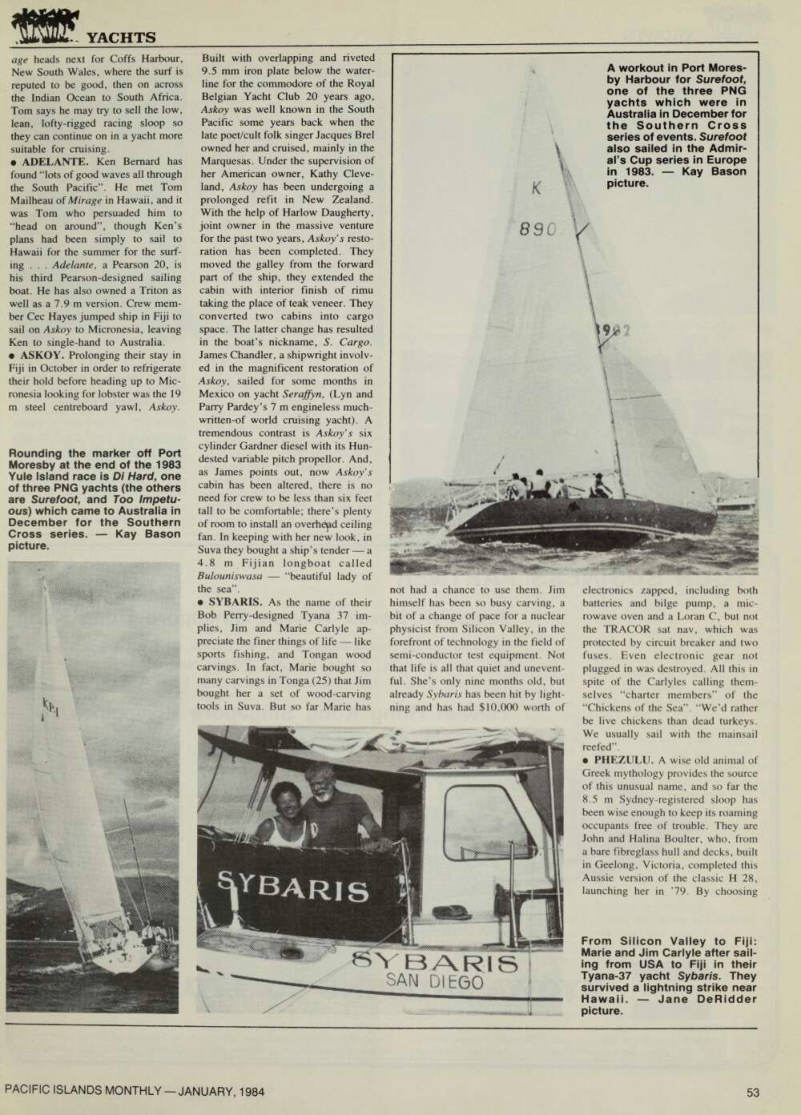
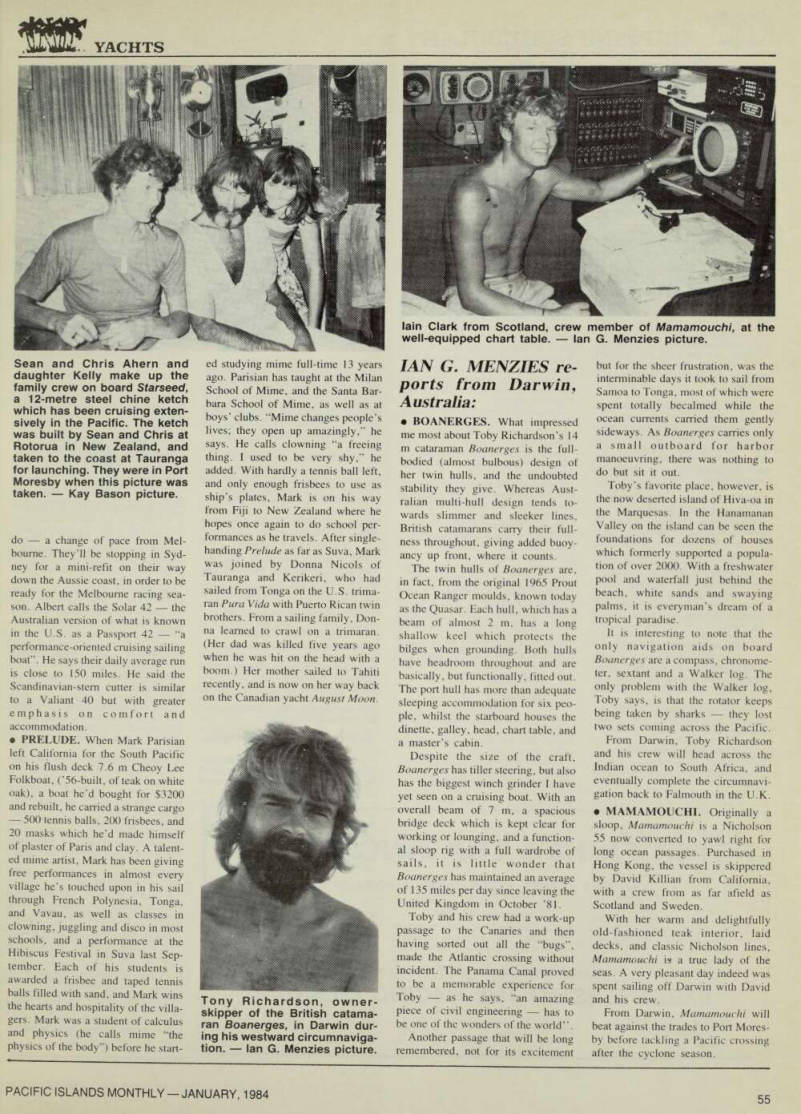
New South Wales, where the surf is reputed to be good, then on across the Indian Ocean to South Africa.
Tom says he may try to sell the low, lean, lofty-rigged racing sloop so they can continue on in a yacht more suitable for cruising. • ADELANTE. Ken Bernard has found “lots of good waves all through the South Pacific”. He met Tom Mailheau of Mirage in Hawaii, and it was Tom who persuaded him to “head on around”, though Ken’s plans had been simply to sail to Hawaii for the summer for the surf ing . . . Adelante, a Pearson 20, is his third Pearson-designed sailing boat. He has also owned a Triton as well as a 7.9 m version. Crew mem ber Cec Hayes jumped ship in Fiji to sail on Askoy to Micronesia, leaving Ken to single-hand to Australia. • ASKOY. Prolonging their stay in Fiji in October in order to refrigerate their hold before heading up to Mic ronesia looking for lobster was the 19 m steel centreboard yawl, Askoy.
Built with overlapping and riveted 9.5 mm iron plate below the water line for the commodore of the Royal Belgian Yacht Club 20 years ago, Askoy was well known in the South Pacific some years back when the late poet/cult folk singer Jacques Brel owned her and cruised, mainly in the Marquesas. Under the supervision of her American owner, Kathy Cleve land, Askoy has been undergoing a prolonged refit in New Zealand.
With the help of Harlow Daugherty, joint owner in the massive venture for the past two years, Askoy’s resto ration has been completed. They moved the galley from the forward part of the ship, they extended the cabin with interior finish of rimu taking the place of teak veneer. They converted two cabins into cargo space. The latter change has resulted in the boat’s nickname, S. Cargo.
James Chandler, a shipwright involv ed in the magnificent restoration of Askoy, sailed for some months in Mexico on yacht Serajfyn, (Lyn and Parry Pardey’s 7 m engineless much written-of world cruising yacht). A tremendous contrast is Askoy’s six cylinder Gardner diesel with its Hun dested variable pitch propeller. And, as James points out, now Askoy’s cabin has been altered, there is no need for crew to be less than six feet tall to be comfortable; there’s plenty of room to install an overhdpd ceiling fan. In keeping with her new look, in Suva they bought a ship’s tender a 4.8 m Fijian longboat called Bulouniswasa “beautiful lady of the sea”. • SYBARIS. As the name of their Bob Perry-designed Tyana 37 im plies, Jim and Marie Carlyle ap preciate the finer things of life like sports fishing, and Tongan wood carvings. In fact, Marie bought so many carvings in Tonga (25) that Jim bought her a set of wood-carving tools in Suva. But so far Marie has
not had a chance to use them. Jim himself has been so busy carving, a bit of a change of pace for a nuclear physicist from Silicon Valley, in the forefront of technology in the field of semi-conductor test equipment. Not that life is all that quiet and unevent ful. She’s only nine months old, but already Sybaris has been hit by light ning and has had $lO,OOO worth of
electronics zapped, including both
batteries and bilge pump, a mic rowave oven and a Loran C, but not the TRACOR sat nav, which was protected by circuit breaker and two fuses. Even electronic gear not plugged in was destroyed. All this in spite of the Carlyles calling them selves “charter members” of the “Chickens of the Sea”. “We’d rather be live chickens than dead turkeys.
We usually sail with the mainsail reefed”. • PHEZULU. A wise old animal of Greek mythology provides the source of this unusual name, and so far the 8.5 m Sydney-registered sloop has been wise enough to keep its roaming occupants free of trouble. They are John and Halina Boulter, who, from a bare fibreglass hull and decks, built in Geelong, Victoria, completed this Aussie version of the classic H 28, launching her in ’79. By choosing
Rounding the marker off Port Moresby at the end of the 1983 Yule Island race is Di Hard, one of three PNG yachts (the others are Surefoot, and Too Impetu ous) which came to Australia in December for the Southern Cross series. - Kay Bason picture.
A workout in Port Mores by Harbour for Surefoot, one of the three PNG yachts which were in Australia in December for the Southern Cross series of events. Surefoot also sailed in the Admir al’s Cup series in Europe in 1983.- Kay Bason picture.
From Silicon Valley to Fiji: Marie and Jim Carlyle after sail ing from USA to Fiji in their Tyana-37 yacht Sybaris. They survived a lightning strike near Hawaii. - Jane DeRidder picture.
sloop rather than the usual H 28 ketch rig, John reckons he saved at least $l5OO on extra mast, rigging and sails. John and Halina cruised Vic toria and the Great Barrier Reef, spent six months in New Zealand and another six months in Tonga and Fiji.
They planned to go back to New Zealand for the February birth of a crew member, then return to cruise sheltered Nadi Waters and the Yasawas while Baby Boulter gets his/her sealegs. Phezulu is almost sure to win the prize for the youngest crew member in the Musket Cove Yacht Club annual cruising yacht race from Dick’s Place in Malolo Lailai to Port-Vila starting on Sep tember 9, 1984. John and Halina
tentatively plan on returning a year
from now to Australia to build a larger cruising home a 10.5 to 11.5 m aluminium or steel craft and to study for their ham licences. • SHENANIGANS. Albert Dyk,
professional captain and delivery
skipper for the past 10 years, is
delivering this 12.8 m Taiwan-built
Stan Huntingford-designed yacht to
Melbourne from Tahiti for her own er. With him is Tommy Clark, surfer from Hawaii, and Karenne Hall, who
joined Shenanigans in Pago for
something different and interesting to
Magician, clown and mime ar tist Mark Parisian shows Donna Nicol how to fly a kite from the deck of his yacht Prelude in Nadi Waters, Fiji (see opposite page). - Jane DeRidder picture.
Laura and Charlie Ciszek on their Atkins cutter African Star in Fiji. They are sailing out of USA on a long Pacific cruise. - Jane DeRidder picture.
do a change of pace from Mel bourne. They’ll be stopping in Syd ney for a mini-refit on their way down the Aussie coast, in order to be ready for the Melbourne racing sea son. Albert calls the Solar 42 the Australian version of what is known in the U.S. as a Passport 42 “a
performance-oriented cruising sailing
boat”. He says their daily average run is close to 150 miles. He said the Scandinavian-stem cutter is similar to a Valiant 40 but with greater emphasis on comfort and accommodation. • PRELUDE. When Mark Parisian left California for the South Pacific on his flush deck 7.6 m Cheoy Lee Folkboat, (’56-built, of teak on white oak), a boat he’d bought for $3200 and rebuilt, he carried a strange cargo 500 tennis balls, 200 frisbees, and 20 masks which he’d made himself of plaster of Paris and clay. A talent ed mime artist, Mark has been giving free performances in almost every village he’s touched upon in his sail
through French Polynesia, Tonga,
and Vavau, as well as classes in clowning, juggling and disco in most schools, and a performance at the Hibiscus Festival in Suva last Sep tember. Each of his students is awarded a frisbee and taped tennis balls filled with sand, and Mark wins the hearts and hospitality of the villa gers. Mark was a student of calculus and physics (he calls mime “the physics of the body”) before he start
ed studying mime full-time 13 years ago. Parisian has taught at the Milan School of Mime, and the Santa Bar bara School of Mime, as well as at boys’ clubs. “Mime changes people’s lives; they open up amazingly,” he says. He calls clowning “a freeing thing. I used to be very shy,” he added. With hardly a tennis ball left, and only enough frisbees to use as ship’s plates, Mark is on his way from Fiji to New Zealand where he hopes once again to do school per formances as he travels. After single handing Prelude as far as Suva, Mark was joined by Donna Nicols of Tauranga and Kerikeri, who had sailed from Tonga on the U.S. trima ran Pura Vida with Puerto Rican twin brothers. From a sailing family, Don na learned to crawl on a trimaran. (Her dad was killed five years ago when he was hit on the head with a boom.) Her mother sailed to Tahiti recently, and is now on her way back on the Canadian yacht August Moon.
Lan G. Menzies Re
ports from Darwin,
Australia:
• BOANERGES. What impressed me most about Toby Richardson’s 14 m cataraman Boanerges is the full bodied (almost bulbous) design of her twin hulls, and the undoubted stability they give. Whereas Aust ralian multi-hull design tends to wards slimmer and sleeker lines, British catamarans carry their full ness throughout, giving added buoy ancy up front, where it counts.
The twin hulls of Boanerges are, in fact, from the original 1965 Prout Ocean Ranger moulds, known today as the Quasar. Each hull, which has a beam of almost 2 m, has a long shallow keel which protects the bilges when grounding. Both hulls have headroom throughout and are basically, but functionally, fitted out.
The port hull has more than adequate sleeping accommodation for six peo ple, whilst the starboard houses the dinette, galley, head, chart table, and a master’s cabin.
Despite the size of the craft, Boanerges has tiller steering, but also has the biggest winch grinder I have yet seen on a cruising boat. With an overall beam of 7 m, a spacious bridge deck which is kept clear for working or lounging, and a function al sloop rig with a full wardrobe of sails, it is little wonder that Boanerges has maintained an average of 135 miles per day since leaving the United Kingdom in October ’Bl.
Toby and his crew had a work-up passage to the Canaries and then having sorted out all the “bugs”, made the Atlantic crossing without incident. The Panama Canal proved to be a memorable experience for Toby as he says, “an amazing piece of civil engineering has to be one of the wonders of the world”.
Another passage that will be long remembered, not for its excitement
but for the sheer frustration, was the interminable days it took to sail from Samoa to Tonga, most of which were spent totally becalmed while the ocean currents carried them gently sideways. As Boanerges carries only a small outboard for harbor manoeuvring, there was nothing to do but sit it out.
Toby’s favorite place, however, is the now deserted island of Hiva-oa in the Marquesas. In the Hanamanan Valley on the island can be seen the foundations for dozens of houses which formerly supported a popula tion of over 2000. With a freshwater pool and waterfall just behind the beach, white sands and swaying palms, it is everyman’s dream of a tropical paradise.
It is interesting to note that the only navigation aids on board Boanerges are a compass, chronome ter, sextant and a Walker log. The only problem with the Walker log, Toby says, is that the rotator keeps being taken by sharks they lost two sets coming across the Pacific.
From Darwin, Toby Richardson and his crew will head across the Indian ocean to South Africa, and eventually complete the circumnavi gation back to Falmouth in the U.K. • MAMAMOUCHI. Originally a sloop, Mamamouchi is a Nicholson 55 now converted to yawl right for long ocean passages. Purchased in Hong Kong, the vessel is skippered by David Killian from California, with a crew from as far afield as Scotland and Sweden.
With her warm and delightfully old-fashioned teak interior, laid decks, and classic Nicholson lines, Mamamouchi is a true lady of the seas. A very pleasant day indeed was spent sailing off Darwin with David and his crew.
From Darwin, Mamamouchi will beat against the trades to Port Mores by before tackling a Pacific crossing after the cyclone season.
Sean and Chris Ahern and daughter Kelly make up the family crew on board Starseed, a 12-metre steel chine ketch which has been cruising exten sively in the Pacific. The ketch was built by Sean and Chris at Rotorua in New Zealand, and taken to the coast at Tauranga for launching. They were in Port Moresby when this picture was taken. - Kay Bason picture.
Tony Richardson, owner skipper of the British catama ran Boanerges, in Darwin dur ing his westward circumnaviga tion. - lan G. Menzies picture.
lain Clark from Scotland, crew member of Mamamouchi, at the well-equipped chart table. - lan G. Menzies picture.
Advertisements & other items, p. 54 (1 item)
Kyowa Shipping Co., Ltd.
YOUR BUSINESS PARTNER
Japan S. Korea Taiwan Singapore Hong Kong To: Solomon Is., New Caledonia, Fiji, W. Samoa, A. Samoa, Tahiti, Cook Is., Tonga, Vanuatu, Tuvalu. Nauru To: Guam, Saipan, Truk, Ponape, Majuro, Yap, Koror
Taiwan Hong Kong Singapore Philippines
To: Papua New Guinea, Pacific Islands. $ * I ••• a
KYOWA
KYOWA SHIPPING CO., LTD.
HEAD OFFICE: OSAKA OFFICE:
sth FI., Suzumaru Bldg. 39-8, 2-chome, Nishi-Shinbashi, Minato-ku. Tokyo, Japan. Okajima Bldg., 7th Floor, 2-14, hhsh,-ku Osaka Japan Phone: 03(437)2885 (Rep.) Cables: "MARIQUEEN" Tokyo. Telex : 242-4651 Kyowa J. Phone: 06(533)5821 (Rep.) Cables: MARIQUEEN Osaka Telex . 525 6271 Ss o
Shipping Schedules
Should any shipping company wish to have its services cargo and passen ger included in these listings they should contact PIM.
Australia - Fiji
KKL (Kangaroo Line) Pty. Ltd., oper ates a 4/5 weekly cargo service from Sydney and Melbourne to Suva and Lautoka.
Details from KKL (Kangaroo Line) Pty. Ltd., 4th Floor, 19-31 Pitt Street, Sydney (235-0322), Dalgety Shipping, World Trade Centre, Melbourne (616- 6700), Burns Philp (SS) Co. Ltd., Suva and Lautoka.
Sofrana-Unilines (Fiji Express Line) operates to Suva and Lautoka every two weeks from the main ports on the east coast of Australia and monthly to Lautoka from Melbourne and Sydney, Details from Sofrana-Unilines, 19 Pitt Street, Sydney (27-9851), Trans- Austral Shipping Pty.Ltd., 570 Bourke Street, Melbourne (67-9162); ACTA Pty. Ltd., Brisbane (221-3116): Elders- ANL Pty. Ltd., Port Adelaide (47-5688): Newcastle, Sofrana Sydney (27-9851); Clements and Marshall, Burnie, Tas mania (31-1833), Carpenters Shipping, 100 Thomson St., Suva, Fiji (312-244), Tlx 2199 FJ.
Australia - Samoas - Tonga
Warner Pacific Lines operates a re gular cargo service from Sydney, Bris bane and Melbourne to Nukualofa, Pago Pago, Apia and Vavau.
Details from Hetherington Wesfar mers Shipping Agency, 37-49 Pitt Street, Sydney (27-1671).
Australia - New Caledonia -
Fiji - Samoas - Tonga
Pacific Forum Line operates a fully containerised service (general, reefer and ro-ro) from Sydney to Noumea, Lautoka, Suva, Apia, Pago Pago, Nukualofa, Sydney. Cargo centralised from Adelaide, Melbourne, Brisbane.
Details from; Union Bulkships, Syd ney, Brisbane and Melbourne; SATO, Noumea, Union Company, Lautoka, Suva and Nukualofa; Pacific Forum Line, Apia.
Australia - Lord Howe Is -
Norfolk Is
Compagnie des Chargeurs Caledo niens operates four-weekly cargo ser vice Sydney - Lord Howe Island and Norfolk Island.
Details: Hetherington Wesfarmers Shipping Agency, 37-49 Pitt Street,
Sydney (27-1671).
Australia - Kiribati
KKL operates a 5/6 weekly service from Melbourne and Sydney to Kiribati (Tarawa).
Details: KKL (Kangaroo Line) Pty.
Ltd., 4th Floor, 19-31 Pitt Street, Sydney (235-0322) and Dalgety Ship ping, World Trade Centre, Melbourne (616-6700).
Australia - Nauru - Marshall
Is. - Kiribati
Nauru Pacific Line operates regular cargo service from Melbourne to Nauru, Majuro and Tarawa. Passenger service to Nauru only.
Details: Nauru Pacific Line (Aust.) Pty. Ltd., Nauru House, 80 Collins Street, Melbourne (653-5709). Nedl loyd Swire, 8 Spring Street, Sydney (2- 0522).
Australia - New Caledonia
And/Or Vanuatu
Sofrana-Unilines ships serve Noumea every two weeks from the main ports along the east Australian coast.
Details from Sofrana-Unilines, 19 Pitt Street, Sydney (27-9851), Trans- Austral Shipping Pty. Ltd., 570 Bourke Street, Melbourne (67-9162), ACTA Pty. Ltd., Brisbane (221-3116), Elders- ANL Pty. Ltd., Port Adelaide (47-5688), Newcastle, Sofrana Sydney (27-9851); Clements & Marshall, Burnie, Tas mania (31-1833).
Compagnie des Chargeurs Caledo niens operates a three-weekly con tainerised cargo service from Sydney to Noumea.
Details Hetherington Wesfarmers Shipping Agency, 37-49 Pitt Street, Sydney (27-1671).
Compagnie Generale Maritime oper ates a monthly service from Sydney to Noumea, Port Vila and Santo, for con tainerised and break bulk cargo.
Details Compagnie Generale Maritime, 12 Castlereagh Street, Syd ney (231-3700).
Australia New Zealand
The Australian National Line (ANL) and the Shipping Corporation of New Zealand operate a 21 day container service between Sydney and Mel bourne to Auckland, Wellington, Lyttel ton and Port Chalmers.
Details from ANL, 20 Bond Street, Sydney (232-0444) and Shipping Cor poration of New Zealand Ltd., PO Box 3420, Auckland, (797-210).
Australia - Nz - Fiji -
Hawaii - Us
P & O liners call at Auckland, Suva, Pago Pago and Honolulu on east bound and westbound voyages bet ween Sydney and the US.
Details from P & O Booking Centre, World Travel Headquarters Pty.Ltd., 33 Bligh Street, Sydney (237-0333).
AUSTRALIA - NZ - FIJI - TONGA -
Vanuatu - New Caledonia -
Solomons - New Guinea
Sitmar Cruises operates a year round cruise program to include the above countries.
Details from Sitmar Cruises, 39 Martin Place, Sydney (239-9000); NSW, reservations & enquiries (008) 42-2277; Rest of Australia, reserva tions & enquiries (008) 22-2277.
AUSTRALIA - NZ - FIJI - TONGA -
Vanuatu - New Caledonia -
Solomons - Samoas - Tahiti
P & O liners call at Auckland, Bay of Islands, Honiara, Lautoka, Noumea, Nukualofa, Pago Pago, Papeete, Port Moresby, Santo, Savusavu, Suva, Vavau and Vila on cruises from Australia.
Details from P & O Booking Centre, World Travel Headquarters Pty. Ltd., 33 Bligh Street, Sydney (237-0333).
Australia - Nz - Solomons -
Png
Pacific Forum Line operates con tainerised and general cargo service from Lyttelton, Napier and Auckland to Honiara, Lae, Port Moresby, Brisbane.
Details from Pacific Forum Line, Au ckland: Steamships Shipping, Port Moresby: Sullivans Ltd., Honiara; Un ion Bulkships, Brisbane.
Australia - Micronesia
Nauru Pacific Line operates a regu lar container service from Melbourne to Ponape, Truk, Guam and Saipan.
Details: N.P.L. (Australia) Pty. Ltd., Nauru House, 80 Collins Street, Mel bourne, (653-5709), Nedlloyd Swire, 8 Spring Street, Sydney (2-0522).
Australia - Tuvalu
KKL operates a three monthly ser vice from Sydney and Melbourne to Tuvalu (Funafuti).
Details from KKL (Kangaroo Line) Pty. Ltd., 4th Floor, 19-31 Pitt Street, Sydney (235-0322).
Australia - Png
K. Asia Pacific’s cargo vessels call at Melbourne, Sydney, Port Moresby, Lae, Madang, Wewak, Manus, Kimbe, Rabaul, Popondetta.
Details from K. Asia Pacific Pty. Ltd., 19-31 Pitt Street, Sydney (232-2277), Dalgety Shipping, World Trade Centre, Melbourne (616-6700).
Australia - Png - Solomons -
Vanuatu
A consortium of NGAL/PNGL and CONPAC/NEL have four vessels operating a joint service from east
coast Australian ports to Port Moresby, Lae, Alotau, Madang, Wewak, Rabaul, Kavieng-Kimbe, Kieta, Honiara, Vila, Santo.
Details from Burns, Philp & Co. Ltd., 51 Pitt Street, Sydney, (2-0547); In terocean Swire, 8 Spring Street, Syd ney (2-0522); New Guinea Express Lines, 37 Pitt Street, Sydney, (241- 3991); Vila Agents, PO Box 971, Port- Vila (2490) Tlx. NH1044.
New Guinea Express Lines operates a weekly container service from Mel bourne, Sydney, Brisbane to Port Moresby, Lae, Alotau, Kimbe, Rabaul, Kieta, Honiara, Kavieng, Madang, Wewak, Santo, Vila.
Details from New Guinea Express Lines, PO Box R 73, Royal Exchange, Sydney (241-3991); New Guinea Ex press Lines, 127 Creek Street, Bris bane (221-9333); New Guinea Express Lines, 327 Collins Street, Melbourne (61-3053); Niugini Express Lines, Port Moresby (21-4572); Lae (42-1536); Rabtrad Niugini Pty. Ltd., Rabaul (92- 2911) and Kieta (95-6185); Alotau Stevedoring & Transport, Alotau (61- 1318); Ngatia Wholesalers Pty. Ltd., Kimbe (93-5102); and Trading Com pany, Mendana Avenue, Honiara (588); Nila Agents Ltd., PO Box 971, Vila, Vanuatu (2490); John Lum & Associates, PO Box 65, Santo, Vanuatu.
Australia - Tahiti
Compagnie Generale Maritime oper ates a monthly service from Sydney to Papeete for containerised and break bulk cargo.
Details Compagnie Generale Maritime, 12 Castlereagh Street, Syd ney (231-3700).
Australia - Tahiti - Us
KKL operates a 4/5 weekly cargo service from Melbourne and Sydney to Papeete, and a fortnightly service to US west coast.
Details: KKL (Kangaroo Line) Pty.
Ltd., 4th Floor, 19-31 Pitt Street, Syd ney (235-0322) and Dalgety Shipping, World Trade Centre, Melbourne (616- 6700).
Australia - Nz - West Coast
South America
South Pacific Seaboard Service of fers a regular cargo service from Bris bane, Sydney, Adelaide and Mel bourne to New Zealand ports Lyttelton and Tauranga and to the west coast of South America, calling at Beu’ventura, Guayaquil, Cailao and other ports on inducement.
Details from South Pacific Seaboard Service agents, Meridian Shipping & Transport Agencies, 50 Clarence Street, Sydney (290-1633), Tlx 25970; Melbourne (67-5907); Brisbane (267- 6355); Adelaide (47-6600); Ocean bridge Shipping Ltd., 22 Emily Place, Auckland (33-279). Tlx 60523; lan Tay lor Y Cia Ltd a, Prat 827 Of. 301, Valparaiso, Chile (59096), Tlx. 30331.
SINGAPORE - HONG KONG - FIJI -
Islands Ports
Kyowa Shipping Co. Ltd. operates a monthly service from Singapore, Hong Kong to Lautoka, Suva and then to island ports.
Details from Carpenters Shipping, 100 Thompson Street, Suva, (312- 244), Tlx FJ2199.
Far East - Fiji - New
Zealand
New Zealand Unit Express (NZUE) operates a monthly palletised cargo service from Manila, Keelung, Ka oshiung and Hongkong to Lautoka, Suva and thence to NZ.
Details from Carpenters Shipping, 100 Thompson Street, Suva (312-244), Tlx Fj2199, Burns Philp, Suva (311- 777) P&O S.N. Co. Wellington (736- 477) or Nedlloyd Swire Pty. Ltd., Syd ney (20-522).
Nedlloyd operates bi-weekly cargo service with four ships from Sourabaya, Jakarta, Bangkok, Port Kelang and Singapore to Suva, Lauto ka and NZ ports.
Details from Nedlloyd (Aust.) Pty.
Ltd., 8 Spring St., Sydney (27-3801), Burns Philp (SS) Co. Ltd., Suva and Lautoka.
Far East - Mid-S. Pacific
China Navigation’s New Guinea Pacific Line operates a regular contain er service from Hong Kong, Taiwan, Manila, Port Kelang and Singapore to Port Moresby, Lae, Rabaul and Honia ra monthly and to Wewak, Madang and Kieta every three months. Cargo from the same Far Eastern ports to the South Pacific ports of Noumea, Santo, Vila, Papeete, Pago Pago, Apia, Rarotonga and Tarawa will be shipped via Japan on the monthly Bali Hai service.
Details from Steamships Trading Co.
Ltd., P.O. Box 1, Port Moresby (22- 0222).
Kyowa Shipping Ltd., operates monthly services from Japan to Guam, Saipan, Solomons, New Caledonia, Fiji, Western and American Samoa, Tahiti, Cook Is. Tonga and Vanuatu.
Details; Hetherington Wesfarmers Shipping Agency, 37-49 Pitt Street, Sydney (27-1671); Carpenters Ship ping, Suva (312-244), Tlx FJ2199.
Guam - Northern Marianas
Saipan Shipping Co. Inc. operate a weekly service via barge carrying con tainers and conventional cargo bet ween Guam and Saipan and Tinian.
Details from Saipan Shipping Co.
Inc., P.O. Box 8, Saipan, CM 96950 (Tel: 9707) Tlx 783619; Guam agents Maritime Agencies of the Pacific Ltd.
Japan - Fiji - Island Ports
Kyowa Shipping Co. Ltd., operates a monthly service from main ports of Japan to Suva and Lautoka and thence to island ports.
Details from Carpenters Shipping, 100 Thompson St., Suva (312-244), Tlx FJ2199.
Japan - Fiji - Island Ports
Bali Hai service operates a monthly service from main ports of Japan to Suva and Lautoka and thence to island ports.
Details from Carpenters Shipping, 100 Thompson St., Suva (312-244), Tlx FJ2199 and Burns Philp, Suva (311-777).
Japan - Micronesia
The NYK Shipping Line operates a monthly cargo service from Japan to Micronesia, calling at Yoko, Nagoya, Kobe, Guam, Saipan, Truk, Ponape and Majuro, returning via Yoko, Nagoya and Kobe.
Details from Burns, Philp & Co. Ltd., 51 Pitt Street, Sydney (2-0547).
Japan - Micronesia
Saipan Shipping Co. Inc. operate a monthly service from Japan to Saipan, Guam, Truk, Ponape, Majuro (Kosrae and Ebeye on inducement).
Details from Saipan Shipping Co.
Inc., P.O. Box 8, Saipan, CM 96950 (Tel: 9707) Tlx 783619; Japan agents Kyowa Shipping Company Ltd; Guam Agents Maritime Agencies of the Pacif ic Ltd.
Japan - Png
Mitsui O.S.K. Lines operates a
monthly service from main ports Japan and Port Moresby, Rabaul, Lae, Madang, Kieta and Kimbe.
Details from Robert Laurie (PNG) Pty. Ltd., PO Box 922, Port Moresby (21-2466/21-1898).
New Caledonia - Fiji - West
Coast North America
PAD Line operates an approx. 3weekly ro-ro service from Noumea and Suva to Honolulu and West Coast USA and Canadian ports.
Details from Sofrana-Unilines SA, BP 1602, Noumea (27-51-91), Tlx NMO4B; Carpenters Shipping, 100 Thompson St., Suva (312-244), Tlx FJ2199.
Png - Inter - Mainport
Papua New Guinea Line offers scheduled 10-20 day coastal liner ser vices linking all PNG major ports with containerisation, reefer, heavy lift and transhipment facilities.
Details from PNG Line, Box 543, Port Moresby, PNG (21-1174), Tlx 22269.
Png - Uk/Continent
The Bank Line & Columbus Line operate a regular joint service from Port Moresby, Oro Bay, Kieta, Rabaul, Kimbe, Madang and Lae to Hull, Ham burg, Rotterdam, Antwerp and Le Havre.
Details from The Bank Line (A’asia) Pty. Ltd., 51 Pitt Street, Sydney (27- 2041); Tlx AA 24063; Columbus Line, Lae (423466) Tlx NE 44171; or lines’ local agents.
Solomons - Uk/Continent
The Bank Line & Columbus Line operate a regular joint cargo service from Honiara to Hull, Hamburg, Rotter dam, Antwerp and Le Havre.
Details from The Bank Line (A’asia) Pty. Ltd., 51 Pitt Street, Sydney (27- 2041); Tlx AA 24063; Columbus Line, Lae (423466) Tlx NE 44171; or the lines’ local agents.
New Zealand - Vanuatu -
Solomon Islands - Papua New
Guinea - Australia
Pacific Forum Line operates a 28 day cycle container shipping service from New Zealand direct to Vila, then on to Honiara, Lae, Port Moresby, Brisbane, back to Lyttelton, Napier and Auckland.
Details from Pacific Forum Line, PO Box 796, Auckland (790-050) Tlx 60480; PO Box 971, Vila, Vanuatu (2490) Tlx 1044.
NZ - COOK IS - NIUE - TAHITI Shipping Corporation of NZ Ltd. op erates cargo services based on pallets and similar units from Auckland to Niue, Cook Islands and Tahiti.
Details from the Shipping Corp. of NZ Ltd., PO Box 3420, Auckland (797- 210). Waterfront Commission, PO Box 61, Rarotonga: Cook Islands; Niue Govt. Offices, Niue Island Compagnie Maritime Polynesienne, BP 368, Papeete, Tahiti.
Nz - Fiji
Reef operates a regular 18-day ser vice from Auckland to Suva and Lautoka.
Details from Reef Shipping Agen cies, PO Box 3382, Auckland, NZ (77- 1221-3); M.V. Fijian Shipping Agencies Ltd., Private Bag, Suva, Fiji (31-1056).
Pacific Line with one ship operates fortnightly ro-ro cargo service New Zealand, Lautoka, Suva.
Details: Sofrana Unilines, 18 Cus toms Street, Auckland (773-279) PO Box 3614, Telex: NZ2313; Carpenters Shipping, 100 Thompson Street, Suva (312-244), Tlx FJ2199.
NZ - FIJI - NORTH AMERICA (WC) Blue Star Line Ltd. Pacific Coast container services. Only direct service to and from New Zealand. Blue Star vessels call at Suva and Honolulu on NZ-US-West Coast voyages.
Details from Blueport ACT (NZ) Ltd., PO Box 192, Wellington (739-029).
Burns Philp (SS) Co. Ltd., GPO Box 355, Suva, Fiji (311-777), Tlx. FJ2168 Burship.
NZ - FIJI - SAMOAS - TONGA Pacific Forum Line operates a fully containerised three-weekly service (Gen/Reefer) from Auckland to Lauto ka, Suva, Apia, Pago Pago and Nuku’alofa.
Details from Pacific Forum Line, Auckland; Union Co. Auckland, Lauto ka, Suva and Nuku’alofa; Pacific Forum Line, Apia.
NZ - N. CALEDONIA - VANUATU -
Png - Solomons
Sofrana Unilines with three ships operates to Vila and Santo, to Honiara and Papua New Guinea and to Norfolk Island and Noumea (No passengers).
Details from Sofrana Unilines, 18 Customs Street, Auckland (773-279), PO Box 3614, Tlx. NZ2313.
Nz Tahiti
Compagnie Tahitienne Maritime SA (as CTM-Tahiti Line) operates one ship, MV Bounty 111, monthly Papeete New Zealand. (No passengers).
Details from Sofrana Unilines, PO Box 3614, 18 Customs St., Auckland Tlx NZ2313; Agence Maritime Cowan, PO Box 9012, Papeete (39042), Tlx Tahitlin 322 FP Tahiti).
Nz - Tonga - Samoas
Warner Pacific Line services Auck land, Nukualofa, Vavau, Apia, Pago Pago fortnightly carrying general and freezer cargoes.
Details from McKay Shipping Ltd., Downtown House, 21 Queen St., Auck land, PO Box 1372 (30-299). Cables MACSHIP, Telex NZ2554, Warner Pacific Line, Box 93, Nuku’alofa, Ton ga; Mealelei (Western Samoa) Ltd.
Box 4171, Apia, Western Samoa, Kneubuhl Maritime Services, Box 39, Pago Pago, American Samoa, 96799.
Nz - New Caledonia
CP Line operates a monthly cargo service from Auckland, Napier and Mt.
Maunganui to Noumea.
Details from McKay Shipping Ltd., PO Box 1372, Auckland (9-30229); Tlx 2554 NZ.
Europe - Tahiti -
New Caledonia
Compagnie Generale Maritime oper ates services from Europe and Mediterranean ports to Papeete and Noumea using three ro-ro and multi purpose vessels thus ensuring a bi monthly sailing to and from.
Details Compagnie Generale Maritime, 12 Castlereagh Street, Syd ney (231-3700).
Europe - Tahiti - New
Caledonia - New Zealand -
Solomons - Png - Europe
Polish Ocean Lines offers regular monthly sailings for containerised and breakbulk cargo and reefer space, con ventional and in reefer containers, from Hamburg, Antwerp, Dunkirk and Rouen to Papeete, Noumea, New Zea land, Honiara, Lae, Manila and Singa pore, returning to Europe via Suez.
Other ports in the South Pacific can be served with inducement.
Details from Sotama, BP 9170 Papeete (27805), Tlx. 296; SATO, BP C 2, Noumea (272094), Tlx. 163 NM SATO: Union Steamship Co of NZ, PO
Box 50, Apia, Tlx. 25; Williams and Gosling, PO Box 79, Suva (312633), Tlx. 2163; Warner Pacific Line, PO Box 93, Nukualofa (21089), Tlx. 66219; Universal Shipping Agencies, PO Box 2282, Auckland (30930), Tlx. 21517.
EUROPE - TAHITI - W. SAMOA -
Fiji - N. Caledonia
Nedlloyd offers regular cargo ser vices from Northern Europe and U.K. to Papeete, Apia, Fiji and New Caledonia.
Details Nedlloyd (Aust.) Pty. Ltd., 8 Spring Street, Sydney (27-3801); Car penters Shipping, 100 Thomson St., Suva (312-244), Tlx. 2199 FJ and Vetari Street, Lautoka (63988), Tlx. 5215FJ.
UK - N. CONTINENT - W. SAMOA -
Tonga - Fiji
The Bank Line & Columbus Line operate a regular joint cargo service from Hull, Hamburg, Bremen, Antwerp, Rotterdam and Le Havre to Apia, Nukualofa, Suva and Lautoka.
Details from The Bank Line (A’asia) Pty. Ltd., 51 Pitt Street, Sydney (27- 2041); Tlx AA 24063; Columbus Line, Lae (423466) Tlx NE 44171; or lines’ local agents.
UK - N. CONTINENT - PNG -
Solomons
The Bank Line & Columbus Line operate a regular joint cargo service from Hull, Hamburg, Bremen, Antwerp, Rotterdam and Le Havre to Port Moresby, Lae, Madang, Kimbe, Rabaul, Kieta and Honiara and on inducement to Yandina.
Details from The Bank Line (A’sia) Pty. Ltd., 51 Pitt Street, Sydney (27- 2041); Tlx AA 24063; Columbus Line, Lae (423466) Tlx NE 44171; or lines’ local agents.
Uk/N. Continent - Tahiti -
N. Caledonia - Vanuatu
The Bank Line & Columbus Line operate a regular joint cargo service from Hull, Hamburg, Bremen, Antwerp, Rotterdam and Le Havre to Papeete, Noumea, Port-Vila and Santo.
Details from The Bank Line (A’asia) Pty. Ltd., 51 Pitt Street, Sydney (27- 2041); Tlx AA 24063; Columbus Line, Lae (42-3466) Tlx NE 44171; Ets AM.
Fare UTE, Papeete; Ets. Ballande, Noumea and other local agents.
US - FIJI - TAHITI - NZ -
Australia
The Bank Savill Line Ltd. operates regular cargo services from U.S. Gulf ports to Australia and N.Z. Calls at Suva, Lautoka and Papeete on demand.
Details from The Bank and Savill Line Ltd., 51 Pitt Street, Sydney (27- 2041) or Orient Shipping Services, 32 Bridge Street, Sydney (241-2753).
US - HAWAII - MICRONESIA - E.
Malaysia - Brunei
PM & O Lines operates two fully self sustained container vessels monthly from San Francisco, Los Angeles and Honolulu (via transshipment at Majuro) to Ebeye, Kosrae, Ponape, Truk, Saipan, Yap, Koror, Kota Kinabalu, Labuan and Brunei. Note: service to Majuro from Hawaii is not offered.
Details; PM & O Lines, 181 Fremont Street, San Francisco, California 94- 105, USA. (415) 543-7430, Tlx
278016, Cable Pmonav. Pm & O
Owner’s Rep. P.O. Box 803, Saipan,
N.M.I. 96950, Cable Commontime
Saipan. Tlx 783605.
Us - Hawaii - Nauru -
Micronesia
Nauru Pacific Line operates regular conventional and container services
from San Francisco and Honolulu to Majuro, Ponape, Truk and Saipan.
Cargo is accepted for Nauru and Kos rae with transhipment at Majuro and Ponape.
Details from N.P.L. (Australia) Pty.
Ltd., Nauru House, 80 Collins Street, Melbourne (653-5709); Nauru Air and Shipping Agency, Suite 2803, 185 Ber ry Street, San Francisco, California 54107 (415-543-1737); Nauru Air and
Shipping Agency, Suite 506, 841 Bishop St., Honolulu, HI 96813 (808- 523-0441).
Hawaii - Tahiti - Samoas
Marshall Islands Maritime Co oper ates a service every 32 days between Honolulu, Papeete, Pago Pago and Apia.
Details from the Maritime Co. of the Pacific, 567 South King Street, Suite 310, Honolulu, Hawaii, Morris Hed strom, Box 189, Apia, Western Samoa and the Marshall Islands Maritime Co., Box 679, Majuro, Marshall Islands.
Us - Noumea - Fiji
PAD Line operates an approx. 3weekly ro-ro service from West coast USA and Canada to Noumea, Suva and Lautoka.
Details from Sofrana-Unilines SA, BP 1602, Noumea (27-51-91), Tlx.
NMO4B; Carpenters Shipping, Harbour Centre, 100 Thompson Street, Suva (31-2244), Tlx. FJ2199; Trans-Austral Shipping Pty. Ltd., PO Box R 232, Roy al Exchange, 2000 (231-8411), Tlx.
AA21204.
Us - Tahiti - Samoa
Pacific Islands Transport operates a five weekly cargo service from North America west coast ports to Papeete, Pago Pago, Apia.
Details from Polynesia Shipping Ser vices Inc. PO Box 1478, Pago Pago 96799.
Polynesia Line operates container and general cargo service from US west coast ports to Papeete and Pago Pago.
Details from Polynesia Shipping Ser vices Inc., PO Box 1478, Pago Pago 96799.
Advertisements & other items, p. 56 (1 item)
Peter Fisher Trading Pty.Ltd.
381 PITT STREET, SYDNEY, 2000, AUSTRALIA
Telephone: 264 5395
TELEX: AUSTAS AA20149 ATT. PETER FISHER
EXPORTERS TO THE PACIFIC ISLANDS
Advertising
Aggie Grey’s 58 Amatil 59 Aust Maritime College 26 Aust Trade Commissioner.. 34 Bank Line 28 Berjak 58 Besco Jarwil 44 Citizen Watches 60 Columbus Line 28 Edmonds 38 Fisher 56 God’s Way 58 Henry Cumines 50 Hitachi 2 Hudson Homes 42 Kyowa Shipping 54 New Zealand Dairy 40 Nissan 12, 13, 24
Nqea 42
Papua Hotel 58 Pioneer 16 P.I.T. Line 50 Polynesian Airlines 8 Polynesia Line 52 QBE Insurance 4 R.M.Gow 36 Roncaglia 20 Southern Pacific Hotels 22 SPC Line 48 Toyota 30,31 Vanua Navigation 26
Deaths
Sir John Maynard Hedstrom In Suva in November, aged 75.
The father of Sir John May nard Hedstrom whose three names he inherited was one of the founders of the Morris Hed strom Ltd chain of stores in the South Pacific.
Bom in Levuka, and educated at Geelong Grammar School and the University of Melbourne (where he took a law degree), Sir John joined the family company as a junior clerk in 1934. He retired as general manager in 1958.
He was until recently chair man of W.R. Carpenter (South Pacific) Ltd. which had taken over the Hedstrom group.
Shortly before his death he was appointed a director of Grif fin East, an Australian company which in its turn had taken over W.R. Carpenter (South Pacific) Ltd.
Sir John sat on a number of
public committees, including the
Fiji Coconut Pests and Diseases Board, and the Board of Trustees of the Fiji Museum.
Robert Hunter In Tacoma, Seattle, USA, in October, aged 49.
Mr Hunter, an American, went to Fiji in the early 19605, and became involved in many land dealings there. Among the most important was the acquisi tion of Wakaya Island by his family company. South Sea Lands Ltd.
He was among the founders of the domestic airline, Fiji Air.
His widow is the former An nette Lepper of Savusavu, Vanua Levu.
Robert August Howlett In Sydney on May 28, 1983,
aged 72.
New Zealand-born, Robert Hewlett went to London in 1930 to train as a journalist on The
Evening Standard.
In 1937 he went to Fiji to work as advertising manager for Mor ris Hedstrom Ltd, beginning a long and creative association with that country.
At the outbreak of war in 1939 he joined the Fiji First Battalion.
Attached to the US Army, the battalion saw intensive action at Guadalcanal and Bougainville, among other places.
At the end of the war, he
stayed on to compile The Official
History of the Fiji Military
Forces 1939-45, and then joined the Fiji Government’s public re
lations department, hosting visit
ing dignitaries on their visits to
Fiji.
He was instrumental in the establishment of the Fiji Visitors Bureau, formed to develop the
country’s tourist industry.
In 1958 he left Fiji to take up the post of director of tourism for the Singapore Government.
In 1959 he settled with his family in Sydney and worked as a travel writer for The Australian Women s Weekly.
In the early 1960s he formed the travel public relations com pany, Hewlett, Keeling & Associates, and began publishing the popular travel industry news letters, Travel Talk, and Boomerangs from Bob Howlett.
In the early 1970s, he col laborated with the noted photo grapher, the late Bruce Adams, on the book Battleground — South Pacific, a look at the after math of World War II in the
region.
In 1976, at the Pacific Area Travel Association convention in Hawaii, he was awarded the ac colade “Pioneer of the Pacific”, in recognition of his contribution to regional tourism.
Never really retiring, he spent his last years on the shores of the Pacific at Manly in New South Wales, where he died leaving a legion of friends and associates who remember him primarily for his conviviality and humor — a man who enjoyed life to the full at a time of development and in a social climate we are unlikely to
see again.
Janferie M.
Howlett.
Advertisements & other items, pp. 58-60 (3 items)
Freely
Stay at Aggie Grey’s . . . the South Pacific’s
legendary hotel.
Situated right in the heart of Western Samoa. Enjoy Polynesian-style friendliness and service, in cool surroundings, superb entertainment and food.
Magnificent white sand beaches only a short drive away. Airconditioned rooms, swimming pool and full bar facilities.
Bookings through Union Steamship Company of NZ, Pan Am, Air New Zealand or direct to Aggie Grey’s, Apia, Western Sampa. Cables: ‘AGGIES’Apia.
PORT MOB
♦ Right in business cep
comfort andjfine |p|
food * All rdoms airconditioned * Restaurant * Ba ♦ Banquet hall
A. C. NEUMANN
manager Phone 21-2622 cable 'mnmm
gh
Freely
Given
A true understanding of God's Word.
If you have been search ing for the true meaning, of the Scriptures this free monthly booklet is for you.
Write to God's Way P.O. Box 41, North Ryde, Australia 2113
FV *ssss®»
» M W)»w. •%’ a# ' > mmf.
neither time nor place..
«w "*l \ “T: «•. &■; a* L / *v ►r Jwpfr WS < ■<r<t <& p ft w s^pr * V'fe'S: 3*t M /
FV *ssss®»
if V L , ' *' ‘ ‘ ' ‘ V
SMOOTH, MILD CIGARS
jiF *“ Jp Corona • Commodore Panatella • Lancers .‘Tipped
Panatella
W 754
O Citizen
Citizen introduce the
wodds thinnest analog alarm
with a remarkable new
alarm system
9 The Citizen Quartz Analog Alarm Watch, the World’s slimmest and smallest Analog Alarm.
Its alarm is music. A soft harmonious melody that perfectly matches the slim and tasteful design of this timepiece.
There is no alarm-setting pointer. The hour and minute hands are used for alarm setting. Citizen Quartz technology makes the Analog Alarm accurate to within seconds per month.
O CITIZEN
AHEAD OF THEIR TIME
Citizen Watches Australia Pty Ltd, 122 Old Pittwater Rd, Brookvale, NSW 2100. Telephone: 9397077. Cable: Citizen Sydney. Telex: AA26633