Islands

Pacific
Monthly
«B
Pf Ember, 1953
... American Samqa _*US$l.75 *Asl.so Cbok Islands , NZ$l.5O Fiji . -X_i F 51.50 Hawaii US$l.95 Kiribati . . A 51.75 Naiirii - - Asl 75 New r Cateflonia CFPI9O Netw Zealand NZ$2.OO nw;; . fa nzsi.so Norfolk Island ASI 50 Pdpua New Guinea K 1.50 Sotplnon - 551.50 Tahiti - CFP22O Tong* - -PI .50
R Tuvhk~- A 51.75
m . U 552.25 t USIT and Guam i ,'sz yS$l.95 W m'VTl-.50 Western Samoa T 1 95 ► •‘commended retail price only.
Registered by Australia Post.
Publication No NBPI2IO
mmmsai: S»y®ut,MVJSiN
PTOOMrtSi-fllßi ’ -I **l *:r A ♦«
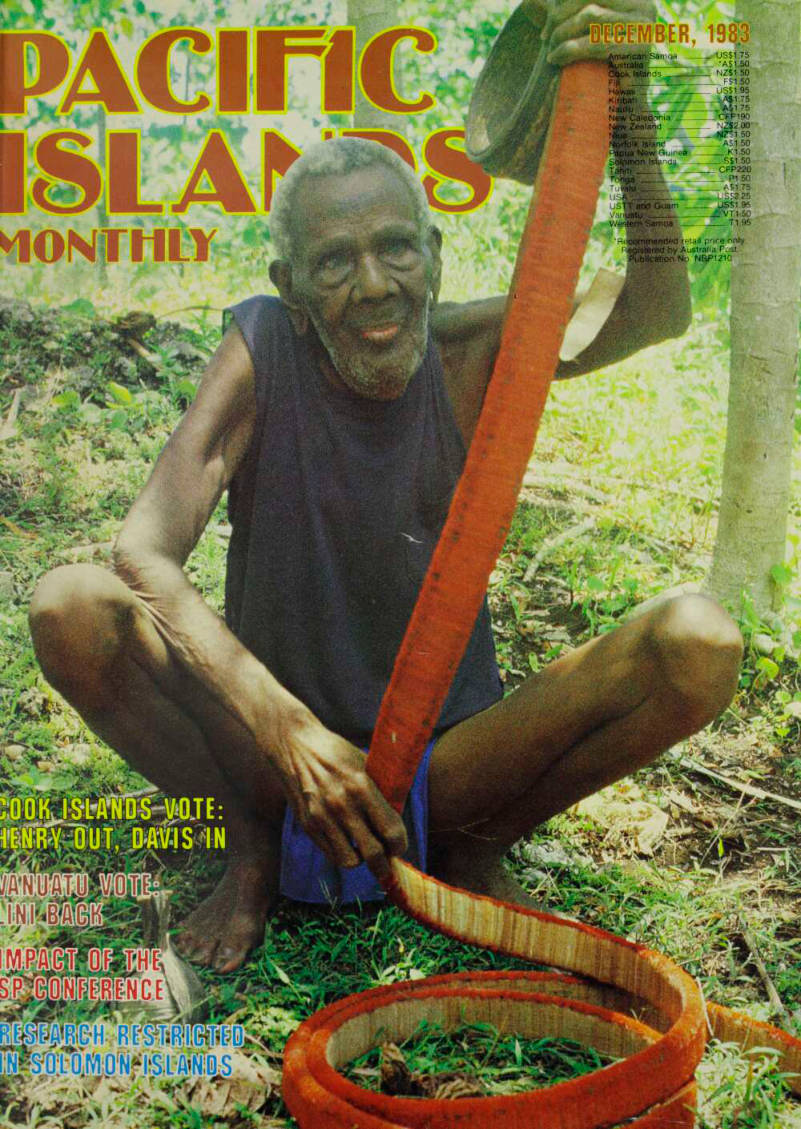
Cover. Melobo, a Solomon Islands village elder, displays a length of traditional feather money which retains a high status value, despite the general use of modern coins. Photo on Santa Cruz Island by Roberto Pettini.
Advertisements & other items, p. 2 (1 item)
A new legend begins.
iS - = = an
Photo: Equipment may vary in some countries.
The 1984 Civic 2-door Hatchback, combining innovative technologies with the great Civic tradition, is a very special car. For this new Civic is destined to become the model on which other cars in this class will be based.
Distinguished by a long roofline and rear appearance, the 2-door Hatchback’s flush-surface aerodynamic design gives superb stability at high speeds, improves fuel economy, and provides a truly spacious interior.
Interior space is also expanded by the Honda concept of making all mechanical parts as small as possible, leaving more room for people. High-tech components include an ultra-compact, economical-yet-powerful OHC, 12-valve engine, and space-saving Sportec suspension that really smooths out the road.
The Civic 2-door Hatchback. Its new technology confirms that a new legend has begun.
2-door Hatchback
i® AUSTRALIA: Honda Australia Pty., Ltd. Lot 95 Sharps Road. Tullamarine, Victoria 3043; Bennett Honda Pty.. Ltd. 260 Victoria Road. Wetherill Park, N S W 2164 /NEW ZEALAND: NZMC : L Limited Manners Plaza, 57-65 Manners St.. Wellington/ PAPUA NEW GUINEA: Toba Pty., Ltd. P.O. Box 503. Port Moresby /'TAHITI: Honda Distribution S.A.R.L. B P 1665, Papeete/ . LTD. TOKYO, JAPAN KIRIBATI: Atoll Motor & Marino Services P.O. Box 49, Bairiki Tarawa. Repubt.c of Kiribati /U.S. TRUST TERRITORY: United Micronesia Development Association P.O, Box 235, CHRB I Saipan CM 96950/COOK ISLANDS: Cook Islands Motor Centre Ltd. P.O. Box 74, Rarotonga/GUAM: Mark s Motor Co., Inc. P.O. Box OV. Agana/ WESTERN SAMOA: Motor Distributors (Samoa) Ltd. P.O. Box 576. Apia/SOLOMON ISLANDS: Guadalcanal Garage Limited P.O. Box 537, Honiara/ NEW CALEDONIA: Societe Du Chalandage 8. Rue de la somme-8 P 97, Noumea/NAURU: Nauru Cooperation Republic of Nauru/ FIJI: Carpenters Motors Private Mail Bag, Suva, Fiji/AMERICAN SAMOA: Holiday Motors, Parts and Service P.O. Box 968,; Pago Pago, American Samoa 96799: Hateck s Service Center Ltd. P O. Box 1138, Pago Pago, Amencan Samoa 96799 /TONGA: Tonga Industrial Traders P.O. Box 1035. Nukualofa. Tonga:
Pacific Islands Monthly
Vol. 54 No. 12
December 1983
AUSTRALIA: Distribution: The Herald and Weekly Times Ltd., 44-74 Flinders St., Melbourne, Vic., 3000, Advertis ing Reps Brisbane D. Wood, Anday Agency, Box 1918, GPO Brisbane, 4001, telephone 44-3485, 44-1546; Adelaide Hastwell Williamson Rouse Pty. Ltd., PO Box 419, Norwood, SA, 5067; 59 Kensington Road, Norwood; telephone (08) 332-3322, telex 87113; Perth Allen & Associates, Suite 2, 284 Stirling St., Perth, WA, 6000, telephone (09) 328-9593 or (09) 328-9363.
FIJI: Distribution and subscriptions Desai Book shops, P.O. Box 160, Suva, Fiji, telephone Suva 23036.
Advertising Fiji Times & Herald Ltd., 20 Gordon St., Suva, telephone 31-2111, telex FJ2124.
FRENCH POLYNESIA: Distribution Hachette Pacifi que, 10 Ave Bruat, Papeete, telephone 25610.
HAWAII, UNITED STATES: Distribution PIM, Hawaii, PO Box 22250, Honolulu, Hawaii, 96822. Advertising Brian C. Asgill, Apt. 1308, 1676 Ala Moana Blvd., Honolulu, Hawaii, 96815, telephone (808) 955-9718.
JAPAN: Advertising and subscriptions Universal Media Corporation, GPO Box 46, Tokyo, telephone 666- 3036, cables UNIMEDIA Tokyo, telex 2524665.
KOREA: Advertising and subscriptions World Mar keting, Inc, Box 4010, Seoul; phone 776-5291-3, telex K 23232.
MALAYSIA: Advertising and subscriptions Worldwide Media Services, 57-B Komplex Damai, Jin Dato Haji Eusoff, Kuala Lumpur, telephone 63-9340, cables WORLDMEDIA Kuala Lumpur, telex 31533.
NEW CALEDONIA: Distribution Depot Centre de Presse Michel Pentecost, CBP2, Noumea, telephone 27- 2434, 27-4729.
NEW ZEALAND: Distribution Gordon & Gotch, PO Box 584, 2 Carr Road, Mt. Roskill, Auckland 4. Advertising International Media Representatives Ltd., PO Box 2313, Auckland, telephone 79-5487; 49-3389, cables Intereps, Auckland. Subscriptions Ross Haines & Son Ltd., PO Box 1289, Auckland, telephone 76-9042.
PAPUA NEW GUINEA: Distribution Gordon & Gotch, PO Box 3395, Port Moresby, telephone 25-4551,25-4855.
Advertising PNG Post-Courier, PO Box 85, Port Mores by, telephone 21-2577, telex 22120.
PHILIPPINES: Advertising The GF Group, 12 San Ignacio St., Uroaneta Village, Makati, Metro Manila, tele phone 817-7299, telex 45950 and 4233.
UNITED KINGDOM: The Herald & Weekly Times Ltd., No 1 Maltravers Street,London WC2R 3DZ, England, telephone 01 836 5162, telex London 21989.
UNITED STATES MAINLAND: Advertising Joshua B.
Powers Jr., Powers International Inc., 551 Fifth Ave., New York, New York 10 017, telephone 867-9580, telex 236514.
Subscriptions PIM, Hawaii, PO Box 22250, Honolulu, Hawaii. 96822.
(Usps 952480)
Payments by personal cheque are only acceptable in Australian (from a branch in Australia), U.S. and New Zealand currency. For all other remittances please send an international bank draft in Australian dollars.
Published monthly by Pacific Publications (Aust.) Pty.
Ltd. and printed in Australia by Quadricolor Industries Pty. Ltd., Mulgrave, Vic.
Australian cover price is recommended retail only.
Registered by Australia Post, publication No. NBPI2IO.
Second class postage paid at Honolulu, Hawaii. Copy right Pacific Publications (Aust.) Pty. Ltd.
Postmaster Honolulu: Send address changes to PIM Hawaii, PO Box 22250, Honolulu. Hawaii, 96822.
Subscriptions
Local Aust.
American Samoa
Sus21
$18 Australia $A18 $18 Canada $US27 $25 Cook Islands $19 Fiji $18 French Polynesia $22 Guam
Sus23
$20 Hawaii $US23 $20 Japan $20 Kiribati $19 Micronesia $US23 $20 Nauru $21 New Caledonia $22 New Zealand $NZ24 $18 Niue $19 Norfolk Island $15 Northern Marianas $US23 $20 Papua New Guinea $23 Solomon Islands $19 Tonga $19 Tuvalu $19 United Kingdom Stg 15 $25 U.S. Mainland $US27 $25 Vanuatu $19 Western Samoa $18 Elsewhere $A25
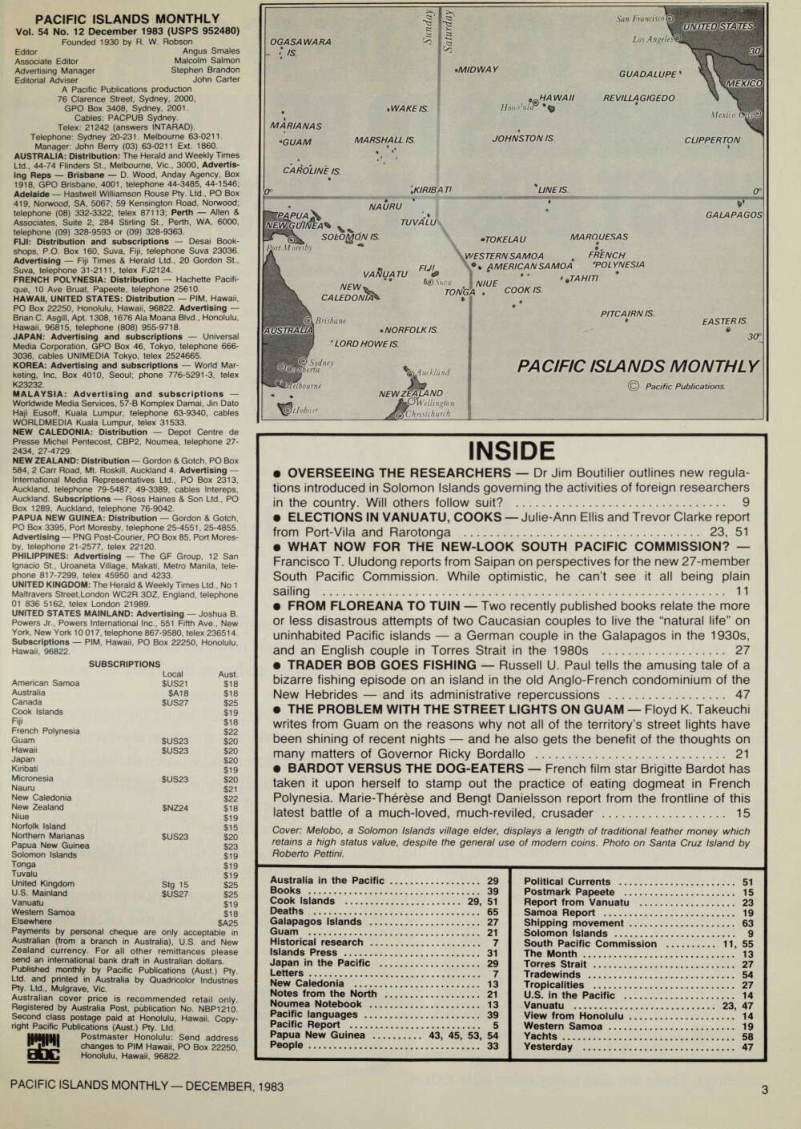
Inside
• OVERSEEING THE RESEARCHERS Dr Jim Boutilier outlines new regula tions introduced in Solomon Islands governing the activities of foreign researchers in the country. Will others follow suit? 9 • ELECTIONS IN VANUATU, COOKS Julie-Ann Ellis and Trevor Clarke report from Port-Vila and Rarotonga 23, 51 • WHAT NOW FOR THE NEW-LOOK SOUTH PACIFIC COMMISSION?
Francisco T. Uludong reports from Saipan on perspectives for the new 27-member South Pacific Commission. While optimistic, he can’t see it all being plain sailing 11 • FROM FLOREANA TO TUIN Two recently published books relate the more or less disastrous attempts of two Caucasian couples to live the “natural life” on uninhabited Pacific islands a German couple in the Galapagos in the 19305, and an English couple in Torres Strait in the 1980 s 27 • TRADER 808 GOES FISHING Russell U. Paul tells the amusing tale of a bizarre fishing episode on an island in the old Anglo-French condominium of the New Hebrides and its administrative repercussions 47 • THE PROBLEM WITH THE STREET LIGHTS ON GUAM Floyd K. Takeuchi writes from Guam on the reasons why not all of the territory’s street lights have been shining of recent nights and he also gets the benefit of the thoughts on many matters of Governor Ricky Bordallo 21 • BARDOT VERSUS THE DOG-EATERS French film star Brigitte Bardot has taken it upon herself to stamp out the practice of eating dogmeat in French Polynesia. Marie-Therese and Bengt Danielsson report from the frontline of this latest battle of a much-loved, much-reviled, crusader 15
Australia in the Pacific 29 Books 39 Cook Islands 29, 51 Deaths 65 Galapagos Islands 27 Guam 21 Historical research 7 Islands Press 31 Japan in the Pacific 29 Letters 7 New Caledonia 13 Notes from the North 21 Noumea Notebook 13 Pacific languages 39 Pacific Report 5 Papua New Guinea 43, 45, 53, 54 People 33
Political Currents 51 Postmark Papeete 15 Report from Vanuatu 23 Samoa Report 19 Shipping movement 63 Solomon Islands 9 South Pacific Commission 11, 55 The Month 13 Torres Strait 27 Tradewinds 54 Tropicalities 27 U.S. in the Pacific 14 Vanuatu 23, 47 View from Honolulu 14 Western Samoa 19 Yachts 58 Yesterday 47
Advertisements & other items, pp. 3-4 (2 items)
3
PACIFIC ISLANDS MONTHLY DECEMBER, 1983
Founded 1930 by R. W. Robson Editor Angus Smales Associate Editor Malcolm Salmon Advertising Manager Stephen Brandon Editorial Adviser John Carter A Pacific Publications production 76 Clarence Street, Sydney, 2000, GPO Box 3408, Sydney, 2001.
Cables: PACPUB Sydney.
Telex: 21242 (answers INTARAD).
Telephone: Sydney 20-231. Melbourne 63-0211.
Manager: John Berry (03) 63-0211 Ext. 1860.
Business To Be Where
WE’VE MADE HOUR
MOST BUSINESS IS DONE
l
PERTH
DARWIN
ADELAIDE
I I
RABAUL
PORT MORESBY
TOWNSVILLE
NADI
I
NOUMEA
;!; TAMWORTH
I
AUCKLAND
NEWCASTLE
j>\ ROTORUA
SYDNEY
MELBOURNE
P I*
WELLINGTON
CHRISTCHURCH
QUEENSTOWN
J
TAHITI
No matter how comfortable a hotel is and how good its facilities are, it’s to no avail if that same hotel isn’t near where you want it to be.
At Travelodge our aim is to attract people in business, which, quite simply, is why you can find us in so many business centres.
Not surprisingly, more and more people, particularly with business to transact, are choosing to stay at Travelodge.
The one hotel group that offers excellent service and facilities at a realistic price. Plus the distinct advantage of being ideally located in or near the business centre of major metropolitan and provincial cities.
Since your hotel often has to serve as an office too, we provide you with first class business facilities.
Dictation and transcription, photocopying, telex, national and international courier services, business breakfasts and rooms for large or small meetings. There are also many other little extras.
Like a newspaper every morning and fresh fruit in your room on arrival. There’s also complimentary coffee in the lobby for you and your guests.
Another thing that won’t go unnoticed is the millions of dollars spent on the facilities today’s businessmen and women demand. Large, tastefully decorated rooms, excellent restaurants and intimate bars.
Stay at Travelodge. You’ll not only find us conveniently located, you’ll also find that a warm reception is just the beginning.
For reservations world-wide please phone Sydney (02) 267 2144. Melbourne (03) 690 6111.
Brisbane (07) 2218586.
Adelaide (08)
223 6288. Canberra (062) 491424. Perth (09) 3253811. Or your travel agent.
Pacific Report
ELECTION I: “AS YOU WERE” IN VANUATU Final results of the November 2 elections in Vanuatu announced in mid-month by electoral officials show the Vanuaaku Party with 24 seats in the 39-member Representative Assembly (com pared with 26 in the previous assembly), and the opposition Union of Moderate Parties with 12. The remaining three seats went one each to Na-Griamel, Namake Auti and Fren Melanesia. These three small groups, representing various “bush” interests on the islands of Santo and Malakula, can be expected to side with the opposition rather than the Vanuaaku Party which nevertheless remains in power with a comfortable if reduced majority. A feature of the election was the complete rout of the ex-Vanuaaku breakaway party, the Vanuatu Independence Alliance party, which lost all three seats it previously held in the assembly. (See report by Julie-Ann Ellis in The Month.) ELECTION II: “AS YOU WEREN’T” IN THE COOKS The November 2 election in the Cook Islands the country’s second this year resulted in a mirror-image change of government. The previous Cook Islands Party government, which held a 13-11 majority, has been replaced by a Democratic Party government, also with a 13-11 majority. Sir Thomas Davis has returned as the country’s prime minister-designate. (See report by Trevor Clarke in Political Currents.)
Somare’S Sweeping Win In Confidence Vote
By a 70-0 vote, the National Parliament in Port Moresby on November 15 affirmed its confidence in Papua New Guinea Prime Minister Michael Somare, putting an abrupt end to a weeks-long campaign of threats by Opposition Leader lam bakey Okuk to put a motion of no-confidence in the prime minister. In the event, Mr Okuk withdrew his motion at the last minute. He quit the chamber with his supporters rather than stay to witness the voting on Mr Somare’s counter-motion of confi dence in his own leadership. Opposition members departed amid jeers from the government benches, leaving the way clear for the unanimous assertion by remaining members of the 109member House of confidence in Mr Somare. Speaking after the adoption of his confidence motion, Mr Somare accused Mr Okuk of “making a mockery” of parliament with his no-confidence threats. The prime minister foreshadowed a constitutional amendment which would provide for the holding of new elec tions following any successful no-confidence motion. Under the present constitution a no-confidence motion must name an alternative prime minister, who automatically takes office if the motion succeeds.
New Caledonia: Independent By ’B6?
A draft plan for New Caledonian independence by 1986 was to be put before French Minister for Overseas Territories Georges Lemoine during his projected late-November visit to the territory.
The plan, drawn up by the Union Caledonienne, largest party in the Independence Front, includes proposals for a new system of voting in territorial elections. One clause in the proposed new system provides that voting rights should be restricted to people who were not only born in New Caledonia but also had one parent born in the territory. (See Helen Fraser’s report in The Month.)
Tough Measures In Fiji Budget
Fiji’s 1984 Budget, brought down in parliament in Suva by Finance Minister Charles Walker on November 11, provides for heavier government imposts on tobacco, beer, spirits, TV sets, video recorders, and petrol, and an array of new taxes on tourist-related activities. Spending on public works is to be increased, with the Budget providing SFB4 million for projects aimed chiefly at job-creation and the saving or generation of foreign exchange. Mr Walker said that while 1983 had been a tough year, 1984 didn’t look much better, with sugar production still affected by the long drought. While economic growth rates would decline this year, Mr Walker said there were grounds for hopes of a modest growth of about 4 per cent next year.
ISLAND NATIONS DIG DEEP FOR FORUM LINE Since the August meeting in Canberra of the South Pacific Forum, the Pacific Forum Line has received financial assistance
totalling nearly SA2 million from the Cook Islands, Fiji, Kiribati, Tonga, Tavalu, Vanuatu and Western Samoa. Australia’s refus al to help bail out the loss-making line was a bone of contention, especially between Australia and New Zealand, at the Canberra meeting. Further funds for the line are also being sought from the European Economic Community (RIM Nov. p 5).
Tahiti Hotel Strike Hits Tourism
Tourist authorities in Tahiti in mid-November estimated that a continuing strike by hotel employees on the island had resulted in a loss of 1500 tourists and about $A750,000 so far. The strike, which closed the island’s three biggest hotels, is over an employees’ claim for a five-day, 40-hour week. Previous condi tions provided for a 48-hour week with one day off. The strike began late in October and was continuing at press time. The Australian airline Qantas announced that it was removing Tahiti from the itinerary of its luxury 16-day round-the-world tour, due to begin on November 19, and would fly to Honolulu instead.
MORUROA TEAM S FINDINGS ON THE WAY Dr Hugh Atkinson, director of New Zealand’s National Radiation Laboratory, who headed the October mission of New Zealand, Australian and Papua New Guinean scientists to France’s nuclear testing site at Moruroa Atoll, said in November it would be five or six months before the team could analyse the samples and study the data it collected there. He said the mission had found no obvious environmental or structural damage to the atoll, but added that such things could not readily be seen. The scientists spent four days on Moruroa and seven days taking samples in Tahiti.
U.S.P.: NO OFFICIAL STAND IN NUCLEAR DEBATE The council of the University of the South Pacific has rejected a demand by the university’s student association that it declare an official stand on nuclear testing and the dumping of nuclear waste in the Pacific. The student body had made the demand in a submission to a meeting of the council. In its response, the council said it was not proper for the university to state an official position on controversial matters of this kind. It said govern ments and individuals held widely different views on the matters concerned, and for the university to take an official stand might have a constraining effect on the freedom of staff and students to express their views. It said this freedom was an essential part of any democratic university.
Fiji’S Monasavu Dam Is Opened
Fiji’s biggest engineering project, the Monasavu hydro electricity scheme, has been officially opened. The scheme, centred on the Nadrau plateau in the centre of the country’s main island Viti Levu, was declared open on October 27 by Fiji’s Governor-General Ratu Sir Penaia Ganilau. Addressing hun dreds of guests from all over Fiji who attended the opening ceremony, Ratu Sir Penaia said the scheme would have a far reaching influence on Fiji’s future. It is expected to reduce Fiji’s demand for oil imports by more than 60 per cent and to save the country about $lB million a year.
“School Funds For Faleolo” Teachers
Teachers in Western Samoa, through their trade union, have accused the government of Prime Minister Tofilau Eti of using Australian aid funds destined for curriculum development to work on the national Faleolo Airport. (See Sano Malifa’s report in The Month.)
Png Minister Calls For North-South Road
Papua New Guinea’s Minister for Industrial Development Karl Stack has called for the building of a north-south road from Vanimo in the north to a point opposite Daru in the south. The road would skirt the Irian Jaya border, on the other side of which the Indonesians are already in the process of building a highway from Jayapura to Merauke. Mr Stack said funds should be sought from overseas for the building of the road, which would promote PNG’s security and defence interests, and encourage economic development in the border area.
Png Vice-Chairman Of “Committee Of 24”
Papua New Guinea has been elected to fill the post of vice chairman of the Decolonisation Committee of the United Nations General Assembly, the so-called “committee of 24”. It is the
most senior post yet held by a PNG representative on a UN General Assembly committee.
Png Survey Team Has Military Escort
Papua New Guinea in late October sent soldiers to the Irian Jaya border to guard a survey team from possible attack by Free West Papua rebels. The 94 soldiers included infantry, en gineers, and support staff, and were posted mainly to the Ok Tedi project port town of Kiunga. A defence spokesman in Port Moresby said Indonesia had survey teams on the other side of the border involved in a joint operation with PNG. The new survey was agreed upon after Indonesia had built a road which was later found to have crossed into PNG at several points
Sea Treasure For Fisheries Blacklist?
An American fishing boat could be the first vessel to be blacklisted by the South Pacific Forum Fisheries Agency. The blacklist was created at the beginning of September when the agency introduced its register of ships allowed to fish in the economic zones of 15 Pacific Island nations and territories.
Within days an American fishing boat, the Sea Treasure, refused to stop when challenged by a patrol boat from the Federated States of Micronesia. The vessel, of 1200 tonnes, is believed to be worth about SUSIO million. A Japanese vessel arrested a few days earlier by the FSM was released only after its Japanese owners posted a bond of $4 million. The agency, which is based in Honiara, is processing an application that the Sea Treasure be blacklisted from fishing in the region. It is understood that introduction of the fishing register has led to a significant increase in the number of foreign fishing boats paying lirpnrp fppQ
U.S.P. Faces Big Change Of Direction
A major change of direction confronts the University of the South Pacific, according to Dr G. R. Teasedale, who is acting as consultant to a major regional conference on the university’s future to be held in Fiji in December. Speaking in Apia, Western Samoa, in November, Dr Teasedale said the trend by a number of countries to strengthen their own institutions of higher education was bringing a substantial change in the USP’s role.
Enumerating recent developments in this direction, Dr Teasedale noted that Solomon Islands had established a college of higher education, Fiji was reviewing the role of its Institute of Technology with a view to expanding it, Tonga was moving slowly towards establishment of a community college to draw together a number of post-secondary programs, and Western Samoa was planning the establishment of its own national university.
France Won’T Sign For N-Free Zone
France’s Minister for External Relations Claude Cheysson said in Canberra in November that his country is not ready to sign an agreement for a nuclear-free zone in the Pacific. He told journalists that France was not prepared to sign when it knew others would sign in bad faith. Mr Cheysson also said France’s nuclear tests were being carried out on French territory in the only available area which was geologically suitable. Mr Cheys son was the first minister of the Mitterrand government to have visited Australia. He also visited New Zealand and Indonesia.
Solomons Helps Png Flood Victims
Solomon Islands has made a gift of more than $25,000 to help relief efforts for victims of floods in Papua New Guinea’s Morobe Province (PIM Nov. p 5).
Health Officials Rapped In Fiji Report
A report prepared for the Fiji Public Service Commission has accused some officials in the country’s health ministry of trying to undermine the medical degree program at the Fiji School of Medicine. The report, prepared by a two-man Australian team, said there appeared to have been a move among sections of the ministry to create difficulties for two recently introduced prog rams, one for a bachelor of medicine degree and the other for a bachelor of surgery. It recommended that the ministry take no part in the school’s academic affairs, and concern itself solely with administrative and financial support.
New Caledonia Tightens Up On Imports
New Caledonia’s Government Council in November announced new regulations which will affect the territory’s imports from Australia and New Zealand. They provide that all imports of milk,
cheese and wheat from countries outside the European Economic Community will be subject to import quotas, and to the prior issue of an import licence. The territory gets about 10 per cent of its imports from Australia, and five per cent from New Zealand, with dairy products being the main imported items. The regulations will require that all food products carry in French, a contents description and expiry date. This last regulation will not come into effect for six months.
FIJI: HELP FOR FIJIANS IN TRADE, INDUSTRY The Fiji Government has approved a special loan scheme designed to boost the participation of Fijians in the country’s commerce and industry, at present predominantly run by Indians. The loans would be for joint ventures between Fijians and members of other racial groups. Involvement of the Fiji Development Bank is limited under the proposal to $200,000.
The bank will be authorised to finance up to 80 per cent of the cost of any venture, and it will ensure that the Fijian partner holds at least a 25 per cent interest in the project.
Moves To Revive Niue’S Traditional Arts
The Niue Government is seeking to revive traditional handcrafts on the island. According to a report from Radio Australia, the government’s Cultural Officer, Young Vivian, is collecting photo graphs of pieces of Niuean handcrafts from museums and private collections throughout the world. The materials will be used to encourage craftspeople to revive traditional skills and techniques.
U.S.P. Drops Exchanges With U.P.N.G.
The University of the South Pacific has cancelled its student exchange scheme with the University of Papua New Guinea because of a lack of funds. The USP Vice-Chancellor, Geoffrey Caston, announcing the decision, said a review would be made next year to see if the scheme could be revived.
Fiji Looks To Germany
The Fiji Government is considering a number of ideas for purchasing equipment and borrowing expertise from West Germany, following an October visit to Germany by Prime Minister Ratu Sir Kamisese Mara. Two West German forestry experts were due to visit Fiji in November to study possible projects.
Kiribati: Too Many Don’T Come Back
The Marine and Search Unit of Kiribati reports that 10 out of 14 canoes and outboard craft reported missing this year to the end of October had disappeared without trace, with the apparent loss of more than 20 lives. The unit says the men who went missing and survived some of whom were rescued as far away as Papua New Guinea and Marshall Islands were mostly Tarawa-based fishermen.
Six-Day Shoot-Out On Guam
On Guam in late October, two men wanted in connection with a spate of shooting incidents surrendered to authorities after a 10hour siege. A third man was found dead in the grounds of a hotel where the two had taken refuge. A police officer was seriously wounded during one exchange of fire. Earlier, the three men had been hunted in connection with a shooting spree which had lasted six days and left six people dead and seven injured. The incidents began when a man was shot dead following an argument over a game at a pool hall. Another two people were killed outside a bar the following night after an argument. On the next night, a police officer was shot and killed while pursuing a suspect vehicle. On the same night, masked gunmen walked into a social club and opened fire, killing two people.
Solomons Say “No” To P.I.D.P.
Solomon Islands has declined an invitation to join the Hawaii based Pacific Islands Development Program because, it says, there are already too many similar organisations covering the Pacific. Fiji and Papua New Guinea are among the PIDP’s members.
Kiribati Says “No,” Sil Vous Plait
The Kiribati Language Board has rejected proposals to include three new letters in the 13-letter alphabet at present in use. The letters proposed were s, v and p. The board said it took particular account of opposition from local people to the change, and felt that chaos would result if the changes were adopted, especially in the written form of the language.
‘the people’
Letters
Role of
in Samoa
In criticising my article on Dr Solf (PIM Jul p 52), Peter Hem penstall (PIM Sep p 7) maintains that Samoans were not politically disorganised in those days, and that “the people” played an ac tive role in “the creation of colo nial Samoa.”
This was not so. Functioning under the ali (chiefly) system, Samoans enjoyed many benefits, but a political voice was not one of them. They had no say in decisions of state, but were use ful as “cannon fodder” to defend or extend the interests of various warring chiefs.
This is not a “presumption” of a “casual observer” but a state ment of fact. “The people” had no negotiating power with the German administration, or with the chiefs themselves except in extreme circumstances. We are not discussing a democracy here, despite the claims of vari ous Samoan upper-class intellec tuals and politicians.
As far as the suggestion of Samoan leaders bringing pre ssure to bear on the German administration is concerned, this is just wishful thinking. Lauaki, as powerful a man as he was, was simply removed when he flexed his muscles, and no resist ance was offered. Solf was so successful as an authoritarian be cause he fitted himself into an authoritarian system.
It was exactly because the Samoans divided themselves along clan lines that they were weak, disorganised, and vulner able to exploitation. It is mere romanticism to suggest that “the people” were given a hand (by the Germans or the chiefs) in steering their own destiny, or that they had some kind of vote or veto power, or that they were partners in political planning.
They were not then and are not now.
Finally, the chiefs involved in the 1906 land reform were those Fono Faipule members hand picked by Solf himself, not the traditional Tumua and Pule, whom Solf had come to distrust and had summarily disbanded.
Peter Hempenstall, like Derek Freeman, tends to equate the pronouncements of Samoan chiefs with the feelings and be liefs of the average, untitled per son. That’s Ike accepting un questioningly press releases from Canberra or Washington.
I look forward with great inter est to his biography of Dr Solf.
Joseph Theroux
Pago Pago American Samoa
A puzzle
solved
Your correspondent Tui Garnett asked for the name of the author who used the pen name “Sun downer” (PIM Oct. p 9). He was H. C. Tichbome, though unfor tunately I have nothing to add to what Mr Garnett has already de duced about him.
One other book which may be of interest, however, is Told by the Tajfrail (London, 1901), a collection of stories set in Fiji and Queensland.
Rod Ewins
Hobart, Tas.
Australia
Magazine prices
in Tahiti
You are no doubt aware of the dramatic rise in the price of your magazine here in Tahiti. For the October issue it jumped from CFP 190 (the official cover price) to CFP43S. Following readers’ protests, one of our dailies in Papeete ran an article on the matter which criticised the dis tributors, Hachette Pacifique, who have a monopoly on the distribution of newspapers and magazines in the territory.
Hachette representatives ex plained that without the price rise they would be selling the magazine at a loss.
On top of the monopoly held by the airline UTA, which charges like a wounded bull, making travel from Tahiti almost prohibitively expensive, Hachet te’s is another one which puts the reading of newspapers and magazines beyond the reach of Polynesians, even those on mid dle incomes. This is not to speak of the prices charged for books, which are completely out of this
world. It certainly doesn’t seem the best way to foster the growth of French culture here!
Up to now the English language press PIM, New Pacific, Time, Newsweek has been spared these excesses, and it has been cheaper to read English than to read French however paradoxical that may seem in a territory of the French
Republic.
French magazines which come in by air are charged for by weight you can imagine the price of some of the fat glossy numbers. Those coming by sea are sold for the French-franc price multiplied by 30, whereas the exchange rate between the French franc and the CFP is
Cfpib To Ffi.
On small, isolated islands such as those in French Polynesia, distractions are not a luxury but a necessity. First, travel has be come virtually impossible, in view of the recent restrictive and draconian measures regarding foreign currency. (This is leaving aside the matter of having to pay
the world’s highest airfares, mentioned above.
Polynesians like to spend their holidays in Hawaii or New Zea land. Only in very few cases do they holiday in France.
There’s not much can be done about it. It’s a question of taste, distances and especially of costs.
Now, with physical travel practically out of the question, the pricing policies of our book shops are putting “travel of the mind” beyond our reach as well.
Rest assured that PIM is not the only English-language magazine to suffer this cruel blow of fate. Time and News week have also been hit, though not to the same extent. New Pacific from Honolulu probably has its turn coming.
True, there is the option of taking out a subscription. But with the present foreign ex change controls, how are we going to get the necessary sum to you?
The final solution is that we give up reading altogether (as we’ve already given up travel ling), and retire completely into our shells.
Name And Address
Supplied
Papeete Tahiti
Bravo for Robert,
Erich
A rather belated comment on the letter by Dr Matthew Spriggs of the university of Hawaii (PIM Aug. p 7).
I, for one, am convinced that writers like Robert Langdon and Erich von Daniken have done something for us all to leam from. They have aroused a spirit of inquiry in relation to the his tory of the Pacific.
Perhaps the proofs that Messrs Langdon and von Daniken are seeking may soon emerge. Who knows?
If it were not for these people we would still be emerging from the dim dark ages. Or should we be like ostriches, and bury our heads in the sand, ignoring all these fascinating points of the past which are being brought to light?
Norton C. Redsell
Gymea, NSW Australia
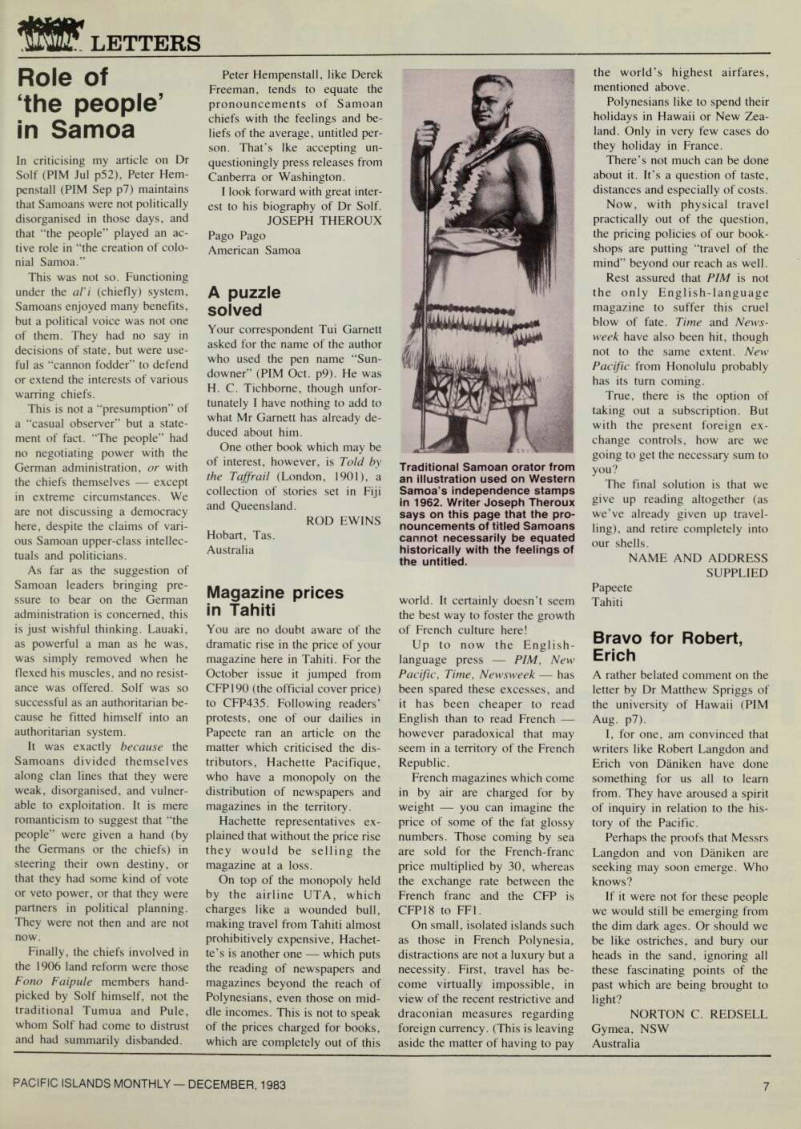
Traditional Samoan orator from an illustration used on Western Samoa’s independence stamps in 1962. Writer Joseph Theroux says on this page that the pro nouncements of titled Samoans cannot necessarily be equated historically with the feelings of the untitled.
Advertisements & other items, p. 8 (1 item)
OmScm
■ . iwi a
CK-7T
Portable Component System
I’d rather Carry Com!
Why? Because it packs like a portable, yet unpacks like a true home hi-fi component system.
So I have the best of both worlds—a home hi-fi and a portable hi-fi, and the sound is great no matter where I play it. And because each of the components is separable, I can place the speakers where they sound best.
Carry Com is also powerful. The CK-11T has 220 watts of peak music power. All three models have good power though, and they all have a beautiful and deep bass sound thanks to the unique Pioneer FLAT
WOOFER design.
Carry Com has many other features, including a 5-band graphic equalizer, that add up to great sound, and along with the convenience of it all, I really don’t see the need for any other stereo system. Now that’s sensible. And that’s why I’d rather Carry Com.
Hi
CK-11T
11 !!!
CK-5F
fl!) PIONEER
For further information, please contact: Australia: Pioneer Electronics Australia Pty. Ltd. (Incorporated in Victoria), RO. Box 295, Mordialloc, Victoria, 3195 Tel: 580-9911 Fiji Islands: Brijlal & Company, G.P.O. Box No. 362, Suva, Fiji Islands Tel: 22258 New Zealand: Monaco Distributors Ltd., 2 Poland Road, Glenfield, Auckland, New Zealand Tel: (09) 444-9144 Norfolk Island; Burns Philp (Norfolk Island) Ltd., P.O. Box 21, Norfolk Island Vanuatu: Burns Philp (Vanuatu) Ltd., Vila, Vanuatu Nauru Island: Jacob Enterprises, P.O. Box No. 4, Republic of Nauru Tahiti; Tahiti Hi-Fi, P.O. Box 848, Papeete, Tahiti New Caledonia: Menard Pacifique Sari, B.P. 3899, Noumea, New Caledonia Tel: 27.62*23 American Samoa: Transpac Corporation, P.O. Box 1477, Pago Pago, American Samoa 96799 Tel: 633-5224 „ . TI ,„ OT Rarotonga: South Seas International Ltd., P.O. Box 49, Rarotonga, Cook Islands Tel. 2327 Papua New Guinea: Bali Merchants Pty. Ltd., P.O. Box 6103, Boroko Tel: 254887
How the Solomons plans to keep
tabs on foreign researchers
Over the past 20 years the Pacific has become a major arena for research. Thousands of resear chers have descended on Oceania to measure stone statues on Eas ter Island, record languages in the New Guinea Highlands, tag migratory fish in the Solomons, and conduct anthropological studies on Ponape. The value of that research to the islands, its impact on local communities, and the conduct of researchers are issues that have been the source of increasing concern to island governments.
The Solomon Islands Govern ment is no exception in this regard, and on July 28, 1982, it enacted a law entitled The Research Act 1982 “to control and administer the conduct of research in Solomon Islands and connected matters”.
The monitoring and control of research has been the subject of considerable misunderstanding in the Solomons and elsewhere.
Island governments not infre quently see research by outsiders as a new form of intellectual imperialism in which knowledge is the natural resource being ex tracted to the advantage of the visitors. What is more, those same governments argue with justification that they and their people seldom enjoy a return from the research conducted in their nations. Researchers, on the other hand, frequently maintain that islanders do not understand the demands of academe, the enormous costs involved in re search, and the fact that while they, the researchers, may be “rich” by islands standards, they are not necessarily rich by the standards of the outside world.
Nor, they are quick to add, are they ever likely to be much richer by virtue of their research. If anything they are likely to be poorer, research being for most a vocation rather than merely a job.
Some of them see payment of deposits for proper conduct of research as the last straw in a costly undertaking, not to men tion an affront to their character.
They point to research regula-
Professor ROGER M. KEESING has written (PIM Nov. p 7) of how the book Lightning Meets The West Wind, which he wrote in collaboration with PETER CORRIS, has become a hot political issue in Solomon Islands, with a provincial premier demanding that it be banned from sale in the country. Here Canadian academic Dr JIM BOUTILIER describes how the Solomon Islands Govern ment plans to regulate the activities of foreign resear chers in the country. It is a move which will be followed with close interest by governments throughout the region.
tions that have clearly been bur densome and unrealistic. But, in the final analysis, they do not have a constituency to whom they are answerable in the way that island governments do.
Complicating matters still further for both parties is the way in which research becomes so readily politicised: the way in which governments, rightly or wrongly, interpret a researcher’s involvement in local affairs as being somehow political, and the way in which researchers find themselves caught between the aspirations of “their” people and the demands of the central government.
Concern about such real or imaginary involvement led the Solomon Islands Government to stop issuing research permits for some time in the early 1980 s.
Now, fortunately, the Minister of Education, Training, and Cultur al Affairs, Michael Evo, has ap pointed Henry Isa as research officer to streamline the issuing of permits and the monitoring of research. The minister is to be congratulated on the wisdom of his choice. Isa’s background at the University of Papua New Guinea and the Solomon Islands Museum, his exposure to foreign researchers, and his sympathetic and accommodating nature fit him ideally for the post.
In some respects it is not an enviable position since Isa must reconcile the expectations and demands of researchers with the needs and well-being of the is landers. Working from a modest little office in the ministry, Hen ry Isa has set about putting the Solomon Islands research
business back on the tracks.
He kindly spent an hour with me explaining in detail the Re search Act and the government’s research policy which will put flesh on the bare bones of the legislation.
While the policy has not yet been issued in its final form at time of writing, the main provi sions are already in place. When a letter is received from a resear cher requesting permission to conduct research Isa sends back a “Research Application Form A” which asks, among other things, for a curriculum vitae or resume, a description of the research pro posal, and a statement of the benefits that will accrue to the people of the Solomons from the research. When this blue form is completed and returned a re search committee is convened to assess the worth and practicabili ty of the proposal.
The assessment process can be a lengthy one, and Isa mentioned the dismay expressed by resear chers when they learned that re search applications should be lodged not less than nine months prior to the date when research is scheduled to commence. He as sured me that this provision was designed to meet a “worst poss ible situation”. In the case, for example, of someone wishing to do research on Sikaiana the re quest would move from the re search officer’s desk (with the research committee’s recommen dations attachedjto the ministry of home affairs, and thence, via the provincial office in Auki, to the village elders on Sikaiana.
There might very well be delays at each stage as the committees
involved in vetting the applica tions at each stage meet infrequently.
In addition, the government has drawn up a priority list over and against which the request is evaluated.
If a request is received to work in the field of education a top priority area in terms of its value to Solomon Islanders it is probably more likely to be viewed with favor than a request to do ethnomusicology. But each case, Isa pointed out, will be judged on its own merits, and researchers may be requested to reshape their proposals to take into account local needs and sen sitivities. He cited several cases where the local political climate was not conducive to research at present, and described how re searchers had been placed else where to the satisfaction of all.
When a research permit has been granted researchers are re quired to pay two fees: A re search fee and a deposit fee. The research fee is designed to cover the administrative costs involved in processing the research re quest, while the deposit fee is intended to ensure that the re search is carried out in accord ance with the terms and condi tions of the permit. The deposit fee is recoverable if those terms and conditions have been met.
The scale of fees has not been laid down yet and will, I am told, vary depending on the nature and geographical scope of the research.
It is Henry Isa’s intention to circulate these new research guidelines as widely as possible to academics and institutions in terested in Solomon Islands research.
Inquiries should be made to: Research Officer, Ministry of Education, Training and Cultural Affairs, P.O. Box 584, Honiara, Solomon Islands.
It is to be hoped that publica tion of the long awaited guidelines will bring to an end a period of considerable uncertain ty and apprehension in the minds of researchers about the conduct of their work in the Solomons.
Advertisements & other items, p. 10 (1 item)
that already
MM £ ■a =3 3 i i i V ». •r W! i
the
widebody fleet
that already
has the best
bottom line.
Right now, both the new 36-passenger Shorts 360 and the 30-passenger Shorts 330 are making money for over 40 regional and commuter airlines around the world. So take your choice.
Pick our new 360, the first of a new generation of regional aircraft that beats everything within 250 miles. Or choose the 330, and you have an aircraft that's already carried over 17 million passengers in 7 years of service.
Whichever suits your routes, either aircraft is easy to maintain, very fuel efficient, equipped with PT-6 turboprops and a combination of state-of-the art and proven technology.
Each is more appealing to your passengers, too, because of Shorts unique widebody design for big-plane comfort.
And here's the clincher. Both the 330 and the new 360 can start making money for you at load factors of around 40%.
One way or the other. Shorts can help keep your bookkeeper's ink black.
SlhoiftsSSO
Slh®ifts33o
SHORT BROTHERS LIMITED
Short Bros. Ltd., Airport Road, Belfast BT3 9DZ, Northern Ireland Short Bros. Ltd., Berkley Square House, Berkley Square, London WIX 6DY Short Bros. (Australia) Pty. Ltd., 20 Loftus Street. Sydney 2000 Short Brothers (USA) Inc., 1725 Jefferson Davis Highway, Suite 510, Arlington, VA 22202 Short Brothers (USA) Inc., 2222 Martin Drive, Suite 255, Irvine. California 92715
Pacific Commission?
What now for the new-look South Pacific Commission?
The South Pacific Commission has finally come of age 36 years after it was created by metropolitan rulers of Pacific Is lands, and 18 years after Western Samoa, which achieved inde pendence in 1962, became the first Pacific Island country to join as a full member.
This political maturing of the once white-only club was sig nalled by the 23rd South Pacific Conference on Saipan in October when the commission opened its doors to all Pacific island gov ernments regardless of their political status (PIM Nov. pll).
The net result of the Saipan decision is that SPC now has 27 members five metropolitan countries, nine independent Pacific island countries, and 13 dependent island governments, 11 of whom became full mem bers during the Saipan confer ence. The 11 new members are American Samoa, Federated States of Micronesia, French Polynesia, Guam, Republic of the Marshalls, New Caledonia, the Northern Marianas, Republic of Palau, Pitcairn Islands, To kelau, and Wallis and Futuna.
Political implications of this historic decision are immense. It is certain to have a deep influ ence on the future of the region, and especially perhaps on the course of events in some of the dependent Island territories. It must also have a strong impact on the role of the region in international affairs. Exactly how things will work out after Saipan remains an open ques tion. But even now some broad outlines can be ascertained.
First, with the outnumbered metropolitan countries taking a backseat role, the SPC should begin more effectively to reflect Island views, rather than those of the metropolitan countries, in its programs and activities.
Second, despite moves to merge the SPC and the South Pacific Forum into a Single Reg ional Organisation (SRO), such an organisation may not come into being in the near future, or for at least another five years, in part because of Micronesian
Saipan-based Journalist FRANCISCO T. ULUDONG writes here exclusively for RIM on the perspectives opened up by the historic decision of the 23rd South Pacific Conference to grant full membership to dependent Island territories, including the five Micronesian entities.
fears of Melanesian domination of the SRO.
Third, when defence and sec urity matters come before the SPC, division rather than unity may result among Island mem bers. Metropolitan countries with strong strategic interests in the region, such as the United States and France, are likely to prevail on their Island “proxies” to take postitions more or less in line with their views.
Fourth, on emotional issues which unite the Islanders such as fisheries and nuclear-waste dumping the SPC will provide the forum for Pacific Island gov ernments to present their position more vigorously to the met ropolitan countries.
Fifth, domination of the SPC by Melanesian and Polynesian members, and by Australia and New Zealand interests, is likely to wane, with the inclusion of the five Micronesian governments (Palau, Guam, FSM, the North ern Marianas and the Marshalls).
Finally, although metropolitan countries insist on the SPC being a non-political organisation, Pacific Islanders whose political status remains unresolved may find the SPC an appropriate vehi cle to press their metropolitan rulers for greater self government, if not total independence.
The move to include non independent Island governments as full members of the SPC was not without opposition. Papua New Guinea, which wanted the status quo to remain, preferred to move decisively “towards the establishment of a single com prehensive and cost-effective re gional organisation”.
Paulias N. Matane, PNG’s foreign affairs secretary, made a spirited argument for his coun try’s proposal.
Solomon Islands and Vanuatu, PNG’s strong Melanesian allies in the SPC, argued in support of an SRO, but, like PNG, in the end gave in to the “Pacific Way”, the consensus-decision making process of SPC, by join ing the rest of the SPC in a unanimous vote to drop the SRO question and agree to the expan sion of the SPC to include depen dent territories.
The PNG move was doomed from the start of the eight-day conference, held at Saipan’s Capitol Hill, once a nerve centre of the U.S. Central Intelligence Agency’s counter-intelligence training program for Asia in the 19505.
SPC Secretary-General Fran cis Bugotu had said in his open ing address: “(My) experience over the past year has confirmed in my mind the need for realism and honest thinking. The com mission’s structure and future operations must reflect the winds of change in the region and the world at large.
“It is to this end that I took on myself the task of carrying out an internal review of the South Pacific Commission. Although it was a personal initiative it has gained the blessing of many peo ple in the region as a move in the right direction towards removing duplication of effort and minimising costs, and which was subsequently endorsed by the Pago Pago Conference last year.
It is now in document form and will be discussed, and I pray approved, by this Saipan conference.”
The expanded membership proposal was included in Bugotu’s recommendations, but was not taken up until the second day. By that time Australia had circulated a resolution formalis ing the proposal, despite the fact
that in August Australia had ap proved the appointment of a ministerial committee of the South Pacific Forum to study the SRO matter, and make a recom mendation to the next meeting of the Forum.
When debate began on Bugotu’s recommendation, PNG found itself in the embarrassing and ironic position of opposing an idea supported not only by all non-Melanesian Island members but the metropolitan countries as well. Even Solomon Islands and Vanuatu began to soft-pedal their support for an SRO.
Overnight, Matane had appa rently reconsidered the PNG pos ition after private consultations with other Island members, and next day offered no floor objec tions to Bugotu’s recommenda tion. This led to the adoption of the Australian resolution.
The expanded membership question posed another problem for metropolitan countries who are parties to the 1947 Canberra Agreement which gave birth to SPC. The Canberra Agreement is a treaty among its original sig natories, and any substantive change in it technically must obtain the consent of the parlia ments of the countries concerned.
The Bugotu study recognized this problem, which was discuss ed at length by the conference.
At one point, the U.S. delegation received word from Washington that “some young lawyer in the State Department” was raising the issue, but, in the end, it was agreed that as long as none of the metropolitan countries rased serious objections the Saipan de cision will stand despite the Can berra agreement.
With the Saipan meeting, the metropolitan countries may have taken seats further back. But, in the final analysis, they still con trol the organisation through the purse strings.
The five metropolitan coun tries still contribute the bulk of the SPC’s budget, in 1984, for example, their contribution amounts to 92.2 per cent.
Francisco T. Uludong.
Advertisements & other items, p. 12 (1 item)
Expert
Insurance Service
throughout the islands
Queensland Insurance (Fiji) Limited
Office: Queensland Insurance Centre, Victoria Parade SUVA. General Manager: R. Jackson Assistant Manager: Vijay Lai. Phone 23 851.
LAUTOKA OFFICE; Burns Philp Bldg., Naviti St. District Manager: R. Sharma. Phone 60 642 LABASA OFFICE: Burns Philp Bldg. Phone: 8 2139
Queensland Insurance (PNG) Limited
PAPUA NEW GUINEA
Head Office, B.N.G Building, Musgrave St PORT MORESBY. General Manager T. H. Sarti Phone: 21 2144.
LAE. 4th St & Coronation Drive. District Manager: C. D. Hillier Phone: 423873.
MOUNT HAGEN: Hagen Drive District Manager: R. Shelbourn Phone: 521002.
ARAWA: Chebu St., District Manager; B. Bowers Phone: 95 1555 MADANG: Kasagten St., District Manager: J. Longbut Phone: 82 2020 RABAUL: Wirraway St. District Managerß. McManus Phone: 921014
QBE Insurance (International) Limited
VANUATU, PORT VILA: Rue de Pans, Suite 19, Oceania Bldg. Manager: I. R. Martin, Phone: 2299.
SANTO: Burns Philp (Vanuatu) Ltd. Phone: 230.
PACIFIC AGENCIES
NEW CALEDONIA: Ste. W. A. Johnston, S.A.R.L. 5 Rue Anatole France, NOUMEA Phone. 272083.
TAHITI: Arthur Chung. Immeuble BIS., Front de Mer, PAPEETE . Phone: 2.86.19 NIUE: Burns Philp (South Sea) Company Ltd.
NORFOLK ISLAND: Burns Philp ('N I) Company Ltd. Phone: 2191 SAMOA: APIA, Burns Philp (South Sea) Company Ltd. Phone: 22611 TONGA Burns Philp (South Sea) Company Ltd. NUKUALOFA Phone 21500 HAAPAI, VAVAU S
MEMBERS OF THE
QBE INSURANCE GROUP LIMITED
its own thing
The Month
The U.C. does its own thing
By mid-November there were few signs that the divisions among the five parties of New Caledonia’s Independence Front would be healed before the visit of Overseas Departments and Territories Minister Georges Lemoine late in the month. It was planned that Mr Lemoine would spend four days in New Caledonia to present local polit ical leaders with France’s pro positions for the future of the territory. The French Parliament will vote an autonomy statute for New Caledonia next April.
However, leaders of the largest part in the IF, the Union Caledonienne, have got the go ahead from their party to present a UC draft statute to the minister, along with ideas for a substantial electoral reform. The UC statute won approval at the recent annu al conference of the party, held on Ouvea Island in the Loyalty group.
Overturning the party’s pre vious demands for independence in 1984, the new UC statute envisages a timetable leading to wards independence, with self determination in 1984, and Kanak independence in 1986.
The UC conference had as its main themes the importance of economic power for the Kanaks, and the need for them to master the economic structures of society.
The two “dissident” parties of the Front, the LKS and UPM, both launched calls for unity and cohesion within the IF. LKS leader Nidoish Naisseline ap
pealed to the IF to hold a conven tion to work out a coherent economic and political program.
Mr Naisseline said that the IF lacked well-formed policies on economic planning, agriculture, housing, education, tourism, and culture.
He pointed out that each party in the Front had its own policies and economic plans, but that to go further they needed to work together.
He also accused the Mitterrand government of causing divisions within the Front by “playing favorites” with some parties.
Calling for a major get together of the five parties, Mr Naisseline said: “We can always agree on demonstrations and land occupations, but face problems every time there is an election we have a basic need for policy.”
For its part, the UPM has called for the Front to re-activate its co-ordinating committee and to give it more decision-making power. UPM spokesman Ed mond Nekiriai told a news con ference that the present structure of the IF was no longer viable.
He cited the recent Senate elec tions (PIM Nov. pi 5), when the IF split over candidates, as mark ing the height of dissensions within the IF. At present most decisions are made by individual parties, presenting the others with a fait accompli, he added.
One of the major European supporters of New Caledonian independence, Jacques Violette, has been forced to send his two younger children (aged five and
11) to their grandmother in France following a bomb attack on his car. Mr Violette, a leader of the Caledonian Socialist Party (PSC), and a member of the Territorial Assembly, was at his suburban apartment when the blast went off at 8.45 p.m. on November 3. The bomb, thought to have been detonated by remote control, destroyed the Renault 4L, and blew out a dozen win dows in Mr Violette’s apartment block. No one was injured.
Mr Violette blamed the attack on “fascist commandos”, and said it followed a newspaper arti cle alleging that he had called for armed struggle in New Caledonia. Mr Violette said the article was a distortion of his party’s call for the IF to establish
a people’s militia in the event of a Rightwing coup. • The French Government is to give CFPI3S million (about SAI million) for the newly created Office of Kanak Culture.
Some of the money will be used for next year’s Festival of Pacific Arts, of which New Caledonia is host.
France will also give CFP233,725,000 (about SAI.7 million) for the festival.
France’s Minister for Culture, Jack Lang, hopes to attend the festival, which is to be held in December 1984. • The Paita team won the Caledonian Soccer Cup against Blue Cross, a team from Ponerihouen on the east coast.
Paita won 2-0, after the score had been nil all at halftime.
Paita will now go on to play the French Polynesian champ ions, with the winner then enter ing the French Cup.
In a practice match, Paita lost 7-0 to Green Gully, an Aust ralian side from Melbourne, Helen Fraser.
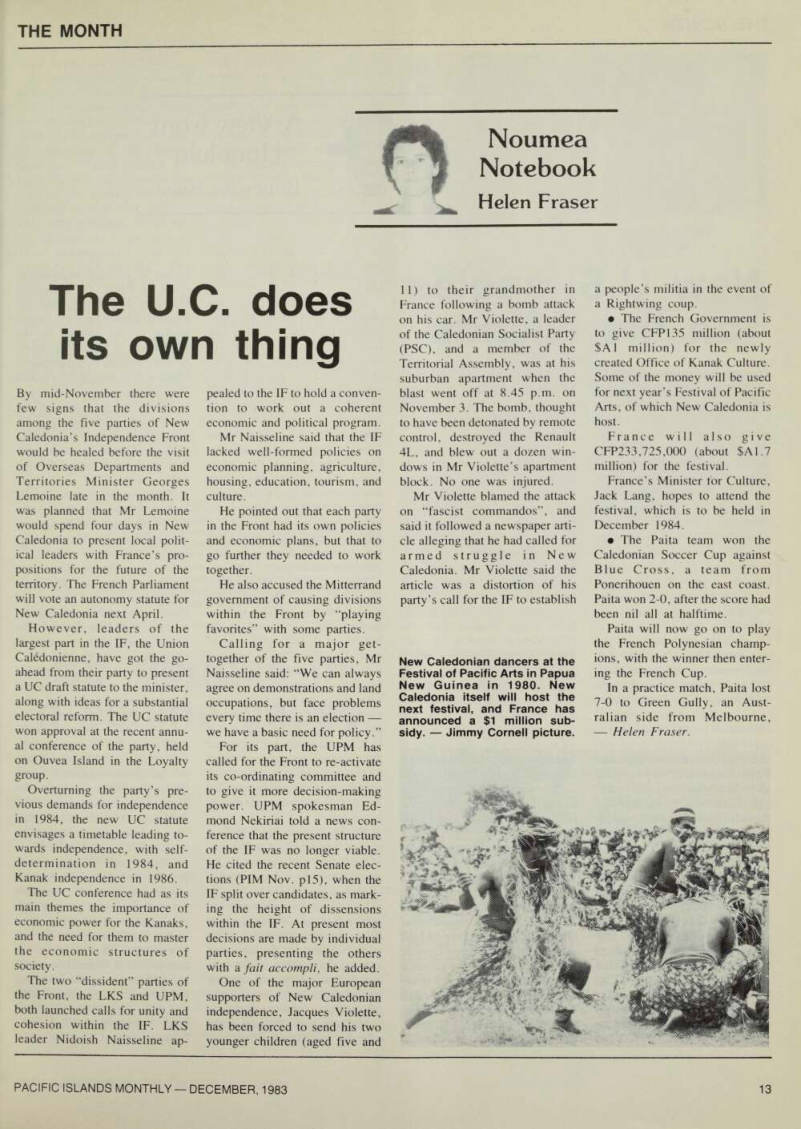
Noumea Notebook Helen Fraser
New Caledonian dancers at the Festival of Pacific Arts in Papua New Guinea in 1980. New Caledonia itself will host the next festival, and France has announced a $1 million sub sidy. Jimmy Cornell picture.
New U.S. angles
on the islands
That American concerns in the Pacific Islands have increased in recent years is clearly reflected in a number of recent develop ments. The interest groups in volved include the academic world, the private sector, and, of course, the federal government.
In the academic arena, the University of California, San Diego, La Jolla, California, has established a Melanesian Studies Resource Center, and the U.S.
Department of Education has provided a grant of a little over SIOO,OOO to assist with its de velopment. Apparently, a Melanesian Archive already ex ists, and the main thrust of the new project is to acquire, pro cess, preserve, and make avail able to the international scholarly community unpublished mate rials in the subject area of Melanesian studies. The scope of unpublished materials to be col lected is broad, and includes: dissertations and theses; field notes and other research mate rials from both living and de ceased Melanesianists; scarce mission accounts and govern ment documents.
Materials will be indexed by author, subject, and keywords.
Both the original documents and microform masters of the same materials will be preserved. The centre plans to provide free copies of microfiche products and acquisitions lists to the academic institutions of Melanesia. The latter move re presents a conscious attempt to improve what are described as “deteriorating relations between
the indigenous scholars of Melanesia and their colleagues around the world”. University librarian Millicent D. Abell heads the project.
The East-West Center’s Pacif ic Islands Development Program has become increasingly visible in Honolulu, the wider Pacific and Europe and there have been several recent changes at the top level of its administra tion. In September, EWC Presi dent Victor Hao Li named Fiji’s former permanent representative to the United Nations, and then current secretary for foreign af fairs, Filipe Nagera Bole, as PIDP’s new director. Former SPC Secretary-General Macu Salato had been serving as in terim director since March of this year, and was scheduled to con tinue until Bole arrived from Fiji.
A couple of months earlier, John Sablan of the Northern Marianas was named special as sistant to PIDP’s director, and has assumed many administra tive responsibilities. Sablan was formerly the deputy high com missioner of the ULSL Trust Territory. Sablan represented the EWC at the South Pacific Con ference at his old stomping grounds on Saipan in early Oc tober, and he tended the shop in Honolulu for the remainder of the month. Director Bole had not yet arrived, and interim director Salato was off to Europe on a fund-raising mission. He was ac companied by PIDP’s Research Co-ordinator, Dr Michael Ham nett, and they visited London, Paris, Geneva, Frankfurt, Brus
sels, Stockholm, Bergen and Oslo.
It is no secret that Bole’s ap pointment does create an image problem for PIDP. As many will recall, the program’s first direc tor, James Makasiale, is a citizen of Fiji, and he stepped down when he returned home to take up the position of permanent secretary for agriculture and fisheries. The fact that Salato and Bole also hail from Fiji, and that Fiji’s Prime Minister Ratu Mara chairs the standing committee which provides the overall direc tion for PIDP, has caused some island observers to view it as a Fijian program. Such sentiments were commonly heard at the SPC gathering on Saipan.
The newsletter Washington Pacific Report (PIM Jun p 25), marked its first birthday in Sep tember and is reported to be healthy as it begins its second year. The June 1 issue reported that U.S. Senator James A.
McClure (Republican, Idaho), who chairs major congressional panels which consider substan tive and financial legislation for U.S. insular areas, has requested the General Accounting Office (GAO) to conduct a comprehen sive study of federal policies for the U.S. territories and insular possessions.
The study will include four areas: (1) background and history of territorial and insular policy since 1787; (2) the relationship of that policy to U.S. foreign policy; (3) the relevance and ap plication of stateside standards in federal programs extended to the territories; and (4) the adequacy and appropriateness of the cur rent federal policy and adminis trative structures to co-ordinate delivery of services to the area.
McClure may be concerned over the transfer of affairs per
taining to the new Micronesian states of Palau, the Federated States of Micronesia, and the Marshall Islands from the Depar tament of the Interior to the Department of State. It is report ed that a number of old territorial hands in Washington believe that State may not be well equipped to handle the provisions of the agreements delineating self government in free association with the United States because they go beyond normal foreign policy areas.
Whatever the reasons for the study, a three-man GAO team was at the South Pacific Confer ence in Saipan interviewing dele gates and observers about U.S. policy in the Pacific. They were particularly interested in learning about the Cook Islands and Niue’s relationships of free as sociation with New Zealand. The study may take a year to complete.
A previous study completed by the GAO at McClure’s insti gation appeared earlier this year.
Entitled The Challenge of En hancing Micronesian Self- Sufficiency, this 78-page publica tion reports that the governments of the above-mentioned island groups are making progress to wards self-government but will need substantial technical assist ance to enhance their institution al capabilities and to achieve self-sufficiency. It reviews ef forts at economic development, capital improvement programs, demands for social services, ad ministrative structures, and makes recommendations for fu ture actions. (The report is avail able from U.S. General Account ing Office, Document Handling and Information Services Facili ty, P.O. Box 6015, Gaithers burg, Maryland 20760, U.S.A.
First five copies are free; addi
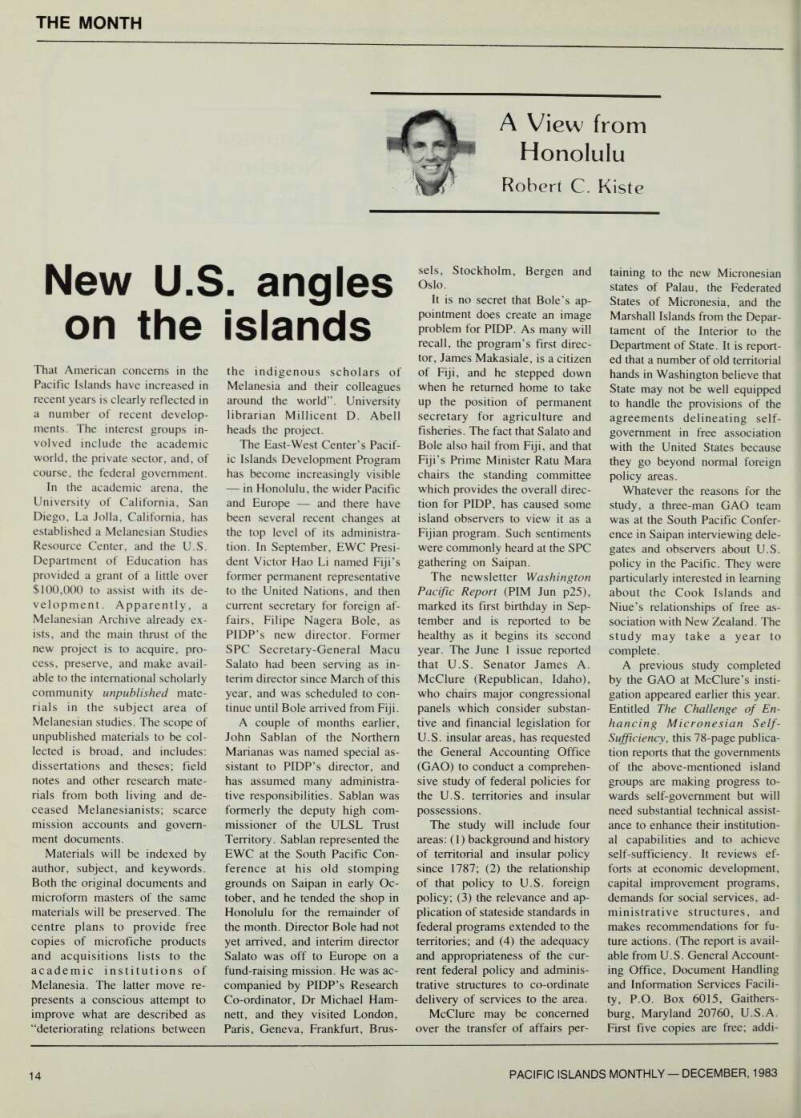
A View from Honolulu Robert C. Kiste
tional copies are $3.25 each.) Meanwhile, word has reached Honolulu of an effort to form a new organisation on the main land, the Pan-Pacific Alliance for Trade and Development. An ear ly publication of the alliance notes that: “Trade between the Pacific Islands region and larger nations has historically been frustrated by extremely difficult and costly problems: infrastruc ture inadequacies in communica tions, transportation, financial institutions and the like.” The alliance is attempting to bring together “a group of companies well experienced in Pacific Is land trade and investment”, and “governments and commercial interests in the region”, to solve such problems.
The alliance has several goals: (a) to foster trade between Pacif ic nations and the private sector of the more industrialised na
tions, especially the U.S.; (b) provide representation for Pacific governments and promote island products in the U.S.; (c) help American business firms develop contacts in the islands; (d) de velop an information service.
The alliance’s promotional lit erature reports that the U.S.
Agency for International De velopment will be sponsoring a regional conference on U.S.- Pacific Trade Through Private Sector Development in Hon olulu, March 18-23, 1984. Ap parently, support for the confer ence is also pledged by the al liance and the Asia Foundation. (Information about the alliance may be obtained from its office at 21 Sutter Street, San Francis co, California 94104. Other de tails about this new organisation or the March conference are not known in Honolulu at this time.)
Robert C. Kiste.
BB dogged in


a canine cause
The old gag about a man biting a dog being newsworthy (as dis tinct from the reverse situation) seems to have had some weird sort of confirmation in Tahiti over recent weeks.
Indeed, practically the whole month of October appears to have been given over to debating the pros and cons of eating dogmeat.
It’s by no means a new debate, and, as usual when it comes to discussing old Polynesian cus toms, we do best to go back to Captain Cook. During his first stay in Tahiti in 1769 he made the following entry in his log book: “For tame animals they have hogs, fowls and dogs, the
latter of which we learned to eat from them, and few were there of us but who allowed that a South Sea dog was next to an English lamb, and one thing in their favor is that it lives entirely upon vegetables.” We should only add that dogs destined for the Tahitian earth ovens were invari ably strangled.
Captain Cook was a remark ably unprejudiced person, espe cially in culinary matters. He actually made a hobby of tasting all sorts of animals, from pen guins to kangaroos. On the other hand, the European missionaries, governors, and military men who came to Tahiti later on usually abhorred dogmeat. The few who
liked the stuff did so because they were never told what they had eaten.
On the other hand, the thousands of Chinese who settled
in Tahiti brought with them from their homeland a pronounced taste for tender puppies, cooked and seasoned in the inimitable Chinese manner.
Caught between these two conflicting attitudes, the Tahi tians at first tried to hide their traditional preference for baked dog. Then, as they became in creasingly urbanised over recent decades, they gave up the custom altogether. Today, the only in habitants of French Polynesia who regularly eat dogmeat are to be found in the Tuamotu Islands, for the simple reason that no other animals can be raised on these barren atolls. Most Tuamo tuan dogs, by the way, can fend for themselves by catching fish in the shallow waters on the outer reef platforms.
For a long time the problem remained a purely culinary one; some liked, others disliked, dogmeat.
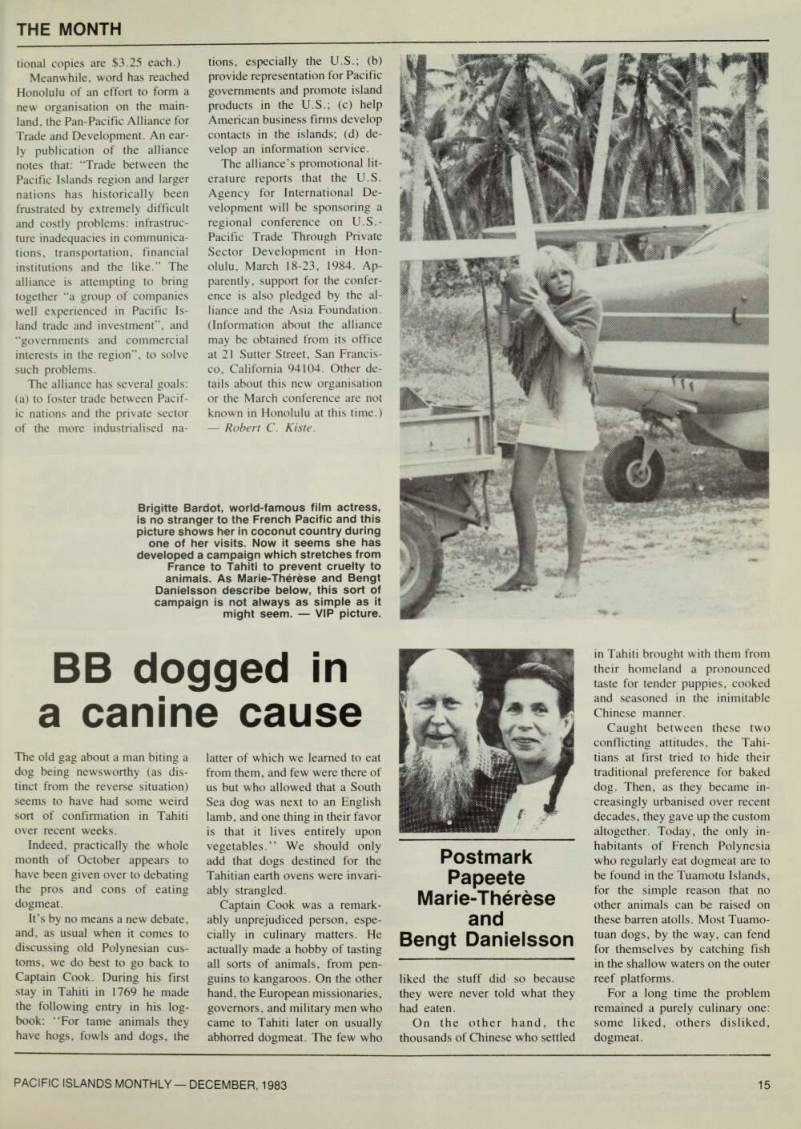
Brigitte Bardot, world-famous film actress, is no stranger to the French Pacific and this picture shows her in coconut country during one of her visits. Now it seems she has developed a campaign which stretches from France to Tahiti to prevent cruelty to animals. As Marie-Therese and Bengt Danielsson describe below, this sort of campaign is not always as simple as it
might seem. - VIP picture.
Postmark Papeete Marie-Therese and Bengt Danielsson
But all this changed a few months back when Brigitte Bar dot, famous French movie star and sex goddess, began attacking the problem from a completely new angle. She has for years been a vigorous and outspoken protector of animals, especially dogs and baby seals, and if her campaigns have enjoyed consid erable success it is largely due to the strong support given to the still very popular star by the mass media.
BB as the French media are fond of calling her listened with great compassion when the president of the Tahitian Society for the Protection of Animals, a group made up of a few expat riate Frenchmen, called on her in August at her home in Saint Tropez, France, and described in hair-raising terms the pitiless slaughter of dogs which is still going on in this overseas territory of France.
Outraged, BB immediately shot off an angry letter to the French High Commissioner in Papeete not forgetting to sup ply the local press with copies.
In the letter her fiercest protest was directed against the exist ence in this earthy paradise, moulded by the presence of French civilisation, of “illegal dog butcheries supplying meat for the highly sophisticated dishes served in Chinese restaur ants”. If this abominable practice was not stopped forthwith, BB threatened to create a scandal that would reverberate around the world.
The letter caused only a mod erate stir. It didn’t seem that BB was saying much more than that it is highly uncivilised to eat dogmeat. This is exactly what French missionaries and officials have been saying for generations and with very small success.
And, to be frank, how can we Europeans justify a prohibition on the eating of dogmeat on cultural, moral and religious grounds, while we ourselves cheerfully continue to eat cows, sheep, horses and frogs? The only sustainable position would be for us all to become vegetarians.
It is this argument, of course, that the High Commissioner should have used in replying to BB at the same time inviting
the famous lady to spend a cou ple of weeks in the islands to see for herself that her accusations were groundless. The visit would have been covered by a small army of journalists and photo graphers, giving the tourist in dustry a windfall of valuable free publicity.
Unfortunately, however, the High Commissioner never got around to replying to the letter at all. In consequence of this, the irate star who has never had to beg to be taken notice of began to put her threat into effect.
First, she wrote another, even angrier letter to the mass circula tion French weekly Paris-Match, which specialises in the woes and the wonders in the lives of film stars and royal persons. Next she graciously consented to be inter viewed on French TV. This time she concentrated particularly on the barbarous methods used in killing dogs destined for Tahitian tables: they were either drowned, hanged, beaten to death, or cut to pieces while still alive. To prove her point, she produced horror pictures of Polynesians butcher ing dogs for their Chinese cus tomers. Her punchline was terrif ic; as the French High Commis sioner was unable or unwilling to put a stop to this cruelty, BB herself would organise a worldwide tourist boycott of Tahiti.
The local travel industry re
sponded by telling BB she was barking up the wrong tree: why penalise the tourist industry, which had no responsibility whatever in the matter? Such a boycott would mean thousands of Tahitians losing their jobs, and the image of Tahiti would be tarnished for years.
In the ensuing storm of pro tests from a long list of com panies, associations, trade un ions, and private citizens, one voice was conspicuous by its absence. That was the voice of the Chinese community which, after all, was being branded as the prime culprit by both the local SPA and 88. When finally pushed up against a wall by a reporter, the territorial assembly man representing the Chinese electorate offered some extreme ly tortuous explanations which only succeeded in indicating that he was dog tired of the whole affair . . .
BB’s case was weakened somewhat when local newspap ers desclosed that the president of the SPA had mainly enlisted her help in order to boost his efforts to blackmail the territorial government into giving him a CFPI million subsidy to be used on feeding the large num bers of stray dogs crowded into the SPA’s pound.
This disclosure prompted do zens of people to write to the newspapers pointing out that the real problem is that there are too
many dogs in Tahiti, especially strays. There are perhaps as many as 30,000 of them, roam ing the streets of Papeete and the countryside in search of food, and becoming savage and ag gressive when they fail to find any. Instead of collecting them and feeding them, many of the letter-writers argued, they should be put down.
At various times in the past that are well within our memory, this was in fact the policy fol lowed by the local authorities.
The method used to kill them, it must be said, was in the line of the methods denounced by BB; the poor creatures were hanged.
What brought an end to their problems at various times was not any campaign by the SPA, but the fact that the territory ran out of funds to support the spe cial police squad employed on the work.
In the present controversy, Vice-President Gaston Flosse was for once very happy to dis cover that only the French Gov ernment had the legal power to intervene effectively. The High
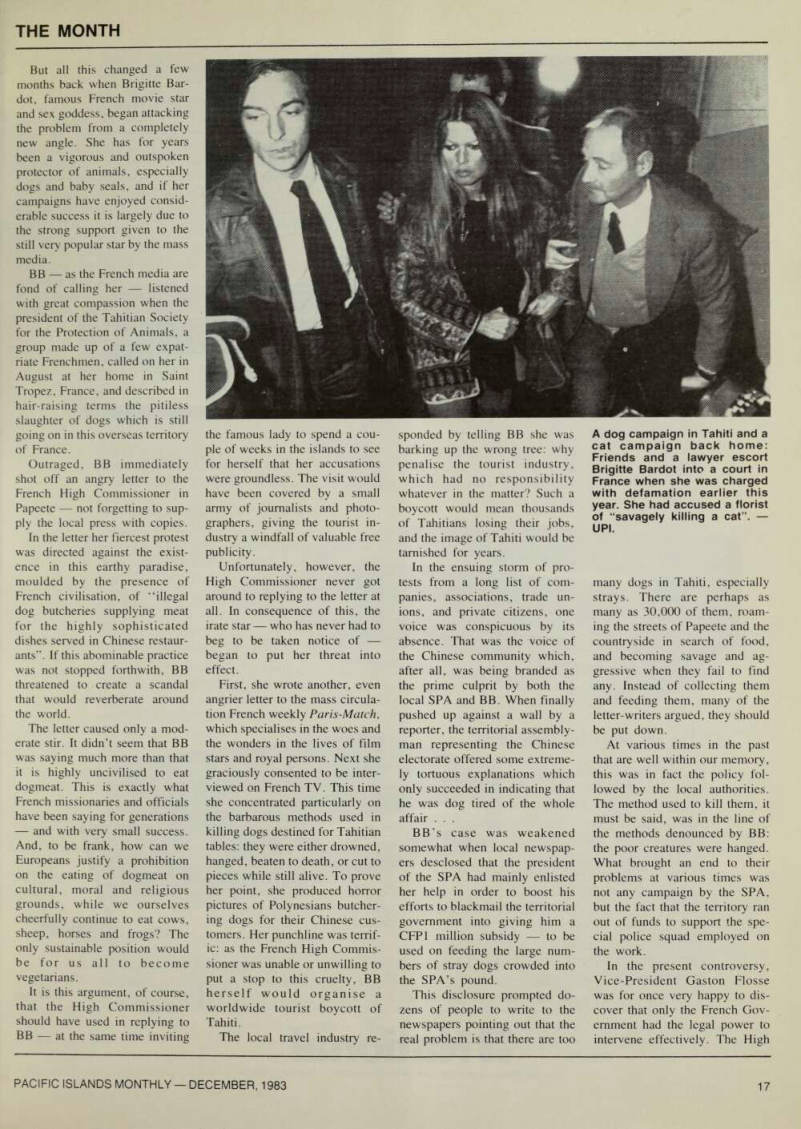
A dog campaign in Tahiti and a cat campaign back home: Friends and a lawyer escort Brigitte Bardot into a court in France when she was charged with defamation earlier this year. She had accused a florist of “savagely killing a cat”.
Upi.
Commissioner, for his part, pro mised to crank up the bureaucrat ic machinery for further, un specified, actions. In the end, the most sensible proposal came from the Papu here aia party which, having an almost 100 per cent Polynesian electorate, defi nitely represents the largest num ber of devotees of dogmeat in the colony. Its simple proposal was that existing legislation govern ing the slaughter of other animals should be extended to include dogs. At the same time, of course, it proposed the setting-up of a Tahitian Society for the Promotion of Eating Dogmeat.
What most defenders of the Tahitian underdogs seem to have forgotten, however, is that all sorts of other innocent creatures including men, women and children are being killed in Tahiti by methods just as cruel as those used in despatching dogs.
On the coastal road, for instance, few drivers respect the speed limit. Nobody knows how many dogs and cats are run over and left to die in agony on the road each year.
But the statistics show that last year 31 people were killed and 518 injured by motor vehicles.
Many of the injured will be in
valids for the rest of their lives.
Counting either per head of population, or per number of motor vehicles on the island, these figures are the highest in the world. Particularly abomin able is the large number of chil dren killed or maimed by speed ing and/or drunken drivers. Last year the number of small chil dren killed was eight, while 166 were injured. Already at the end of October this year, the 1983 tally stood at nine children dead, and 110 injured.
And what about the radio active poison spread by the 100 bombs exploded since 1966 at
Moruroa and Fangataufa? They, too, have killed people and anim als alike only in a slower and more insidious way.
Over all these years, Polyne sian leaders like Pouvanaa, Teariki, and Sanford, represent ing the vast majority of the popu lation, have tried in vain to enlist support in France in their strug gle against these lethal tests.
It will be interesting to see if, from now on, BB will use her tremendous prestige and mass media appeal to combat this most horrible form of cruelty.
Marie-Therese and Bengt Danielsson.
Advertisements & other items, pp. 16-18 (1 item)
Toughness.
Nissan Cabstar Nissan Sunny Nissan Vanette Nissan Urvan «
" SSAN PATROL
I Nissan Patrol Datsun Pickup 4WD That’s why Nissan means higher performance. Toughness is total. Every member of the widerange lineup has extra strength and durability built-in along with superior maneuverability. These high performers deliver penny-pinching fuel economy and tough reliability. Once you discover how great the ride and handling ease are, you will understand what makes Nissan commercial and passenger vehicles worldwide favorites.
There’s more to a Nissan than meets the eye.
NISSAN
American Samoa Max Haleck Inc., Pago Pago Cook Islands Cook Islands Motor Centre Ltd., Rarotonga Fiji Carpenters Motors, Suva Kiribati Atoll Auto Stores, Bairiki Nauru Jacob Enterprises New Caledonia Agence Alma S.A., Noumea Norfolk Island Sirius Motors Papua New Guinea Boroko Motors, Port Moresby Solomon Islands United Enterprises Ltd., Honiara Tahiti Tahitibull S.A.R.L., Papeete Vanuatu Pentecost Vanua Trading Ltd., Port Vila Western Samoa Morris Hedstrom Samoa Ltd., Apia
If people were all the same,
we would only make one VTR model.
At National, we are constantly developing the technology to make our video cassette recorders even more advanced. Original design features such as one-piece aluminium die-cast chassis and quartz-locked, direct drive head cylinder motors are incorporated into all our video cassette recorders for long-lasting, high quality performance. But we make each of our wide range of VTR models with its own unique differences. Because people aren’t all the same.
The NV-370.
Less complication —more enjoyment.
Your complicated lifestyle needs simplification? National has the video cassette recorder for you! Just a glance at the NV-370’s large multifunction display lets you check operation. Single touch instant or automatic timer recording and a palm-size remote control unit give you the ultimate in video tape recording convenience. «ssa* The NV-600. Cost efficient high performance.
NV-600 The NV-788. 8-hour recording.
The NV-600 is just right for the careful shopper who explores all the options before making a purchase. Super Still and Still Advance,an 11-mode infrared remote control and a 14day, 4-Programme Timer are just some of the sophisticated features that you will be surprised to find on such an affordable video cassette recorder.
A perfect match for the videophile. Our top-ofthe-line video cassette recorder has a 5-head system that makes possible the LP [Long Play) mode.
Eight hours of recording/playback on a single cassetteCNV-E240). Super Still, Super Still Advance,and Variable Super Fine Siow-Motion allow for crystal-clear recording in the SP(Standard Play)mode. And features such as Auto Programme Search CA.P.S.) and a versatile LCD information centre with remaining tape time indicator make this our finest video cassette recorder. ei
VMS
Unauthorized recording of TV programs and other materials may infringe the nghts of others
i National
National, Panasonic and Technics are the brandnames of Matsushita Electric.
first year

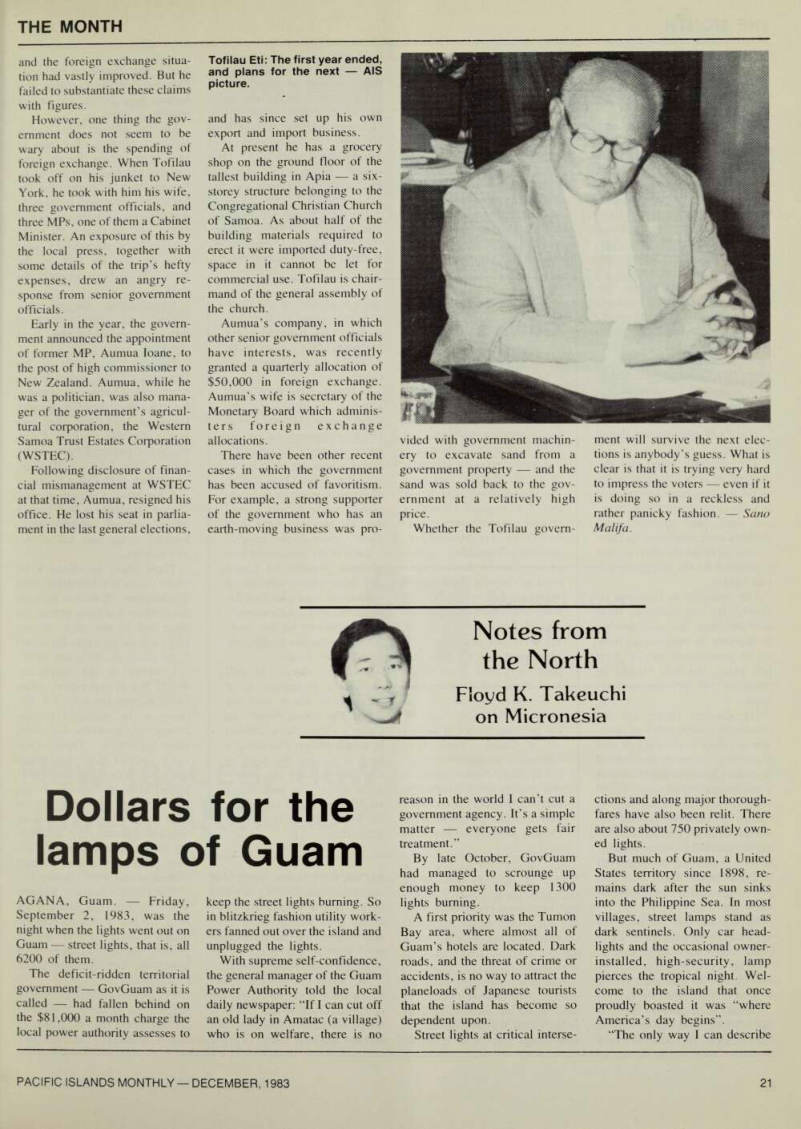
Tofilau Eti’s first year
When he took command about a year ago, Western Samoa’s Prime Minister Tofilau Eti Alesana was seen as a dedicated man, who insisted he would “put the house in order.” He had dignity, and looked like a man of great wisdom. An MP since in dependence in 1962, and with a record of service under two prime ministers until the estab lishment of party politics in 1979 which saw him emerge as one of the leaders of the Human Rights Protection Party (HRPP) Tofilau, many were saying, was just the man to steer the country away from balance of payments problems and indebtedness.
But becoming PM was not all that easy for Tofilau. He moved from the position of deputy lead er of the HRPP to leader when the party’s former chief, Vaai Kolone, lost his seat in an elec tion petition. Vaai was later re elected to parliament, but by that
time Tofilau had the leader’s job.
At the time Tofilau got to the top in the HRPP, Tupuola Efi, the former PM, although beaten, had still not gone under, and still held the post of Prime Minister.
He was fighting to delay a vote on the Prime Ministership until Vaai was returned to parliament (as everyone knew he would be).
But Tofilau would have none of it. He badly wanted to be PM.
His attitude at that time is now returning to haunt him. He is being seen as having made it to the top as Vaai’s deputy, and on the strenght of the HRPP.
That strength is now in de cline. The party is in the process of splitting into two, one headed by Tofilau, the other by Vaai.
Symptomatic of this develop ment is the fact that HRPP caucus meetings, which used to be held at Vaai’s residence even after Tofilau became PM have now been moved to To filau’s home. More than a year
before general elections are due in early 1985, the Tofilau gov ernment is showing visible signs of panic.
On top of the inner-party prob lems, there is fairly widespread public questioning of the wisdom of Tofilau which, it was hoped, would enable him to solve the country’s economic problems.
Business people are accusing the government of allowing itself to be strong-armed by the Interna tional Monetary Fund (IMF). It was the IMF, early in the year, which advised the government to impose austere economic mea sures if it wanted the IMF to continue giving assistance.
Those tough measures, which included a public service wage freeze throughout 1983, higher import duties, limitation of im ports, discouragement of bor rowing, higher fuel and electrici ty charges, and so on, are still being sorely felt.
The government’s promise that things would be better by the year’s end has yet to be delivered on. For the majority of the peo ple who rallied behind the gov ernment in the beginning, and went out of their way to ensure that the 7th South Pacific Games held here in September were a
success, Christmas promises to be distressingly bleak.
Meantime, in some other re spects, the government is behav ing in a reckless manner. Four months ago, it announced its intention of taking over the Un iversity of the South Pacific School of Agriculture, situated near Apia, for Western Samoa’s own national university. This proposal is creating a storm among member countries of the
Usp.
In October, the government officially opened the $lO million extension of the national Faleolo Airport without disclosing where the funds for the project would be coming from. It said that Australia would provide part of the funds, but when this report was written, Australia had made no commitment.
At that time, returning from New York where he delivered his maiden speech to the General Assembly of the United Nations, and where he also attended an IMF meeting, Tofilau said UN and IMF officials were delighted with the tough economic line the Western Samoan government
was following.
He said that the government’s overdraft had been much reduced
Samoa Report
Sano Malifa on Western Samoa
and the foreign exchange situa tion had vastly improved. But he failed to substantiate these claims
with figures.
However, one thing the gov ernment does not seem to be wary about is the spending of
foreign exchange. When Tofilau
took off on his junket to New York, he took with him his wife, three government officials, and three MPs, one of them a Cabinet Minister. An exposure of this by the local press, together with some details of the trip’s hefty expenses, drew an angry re sponse from senior government officials.
Early in the year, the govern ment announced the appointment of former MP, Aumua loane, to the post of high commissioner to New Zealand. Aumua, while he was a politician, was also mana ger of the government’s agricul tural corporation, the Western Samoa Trust Estates Corporation
(Wstec).
Following disclosure of finan cial mismanagement at WSTEC at that time, Aumua, resigned his office. He lost his seat in parlia ment in the last general elections.
and has since set up his own export and import business.
At present he has a grocery shop on the ground floor of the tallest building in Apia a six storey structure belonging to the Congregational Christian Church of Samoa. As about half of the
building materials required to
erect it were imported duty-free, space in it cannot be let for commercial use. Tofilau is chair mand of the general assembly of the church.
Aumua’s company, in which other senior government officials have interests, was recently granted a quarterly allocation of
$50,000 in foreign exchange.
Aumua’s wife is secretary of the Monetary Board which adminis
ters foreign exchange
allocations.
There have been other recent cases in which the government has been accused of favoritism.
For example, a strong supporter of the government who has an earth-moving business was pro-
vided with government machin ery to excavate sand from a government property and the sand was sold back to the gov ernment at a relatively high price.
Whether the Tofilau govem
ment will survive the next elec tions is anybody’s guess. What is clear is that it is trying very hard to impress the voters even if it is doing so in a reckless and rather panicky fashion. Sana Mai if a.
Tofilau Eti: The first year ended, and plans for the next AIS picture.
Advertisements & other items, p. 20 (1 item)
Starting & Staying
M -1 *r * rs
AMP
V:
POWER
**/ j?«xj / coftmuuoususe
*1 f DPEPCYCLF BATTERY
.:.r rrm-i ■ r«v
fIPMf
GS27 cas?
Power Boats Need Different Batteries
There is a big difference between a car battery and a marine battery.
A car battery, for example, is never really discharged, as it is only used for a few seconds each day and promptly re-charged. Not so your cruiser or sportsfisherman.
Starting the engine is only the beginning. During the day, weekend or cruise, how often will you run the live bait tank, the depth sounder, the nav. lights or maintain a listening watch on your radio transceiver?
As well as cranking power, boats need staying power. Boats need Besco's Marine Batteries, deep cycle, heavy duty marine batteries. * If your boat is getting a little flat in the electrics department, write or phone BESCO today and ask for more information, more facts about
BESCO MARINE BA TTERIES .
BESCO
/ Batteries Division Of Sims Products Pty. L td. / A Peko Wall send Group Member Papua New Guinea: Lae, Automarine Industries, P.O. Box 785, Ph. 42-1125; Rabaul, Automarine Industries, P.O. Box 248, Ph. 92-2574; Port Moresby, Par Sales, P.O. Box 1680, Boroko, Ph. 25-6266. Fiji: Suva, Fiji Bandag, 23 Sinoma Street, Walu Bay, Ph. 31-1200. New Caledonia: Noumea, Andre Thuilier, BP 889, Ph. 27-4906. Solomon Islands; Honiara, Guadalcanal Electrics Ltd., P.O. Box 521. Hongkong: Kowloon, T. L. Knight & Co., P.O. Box 95585 TST, Ph. 366-5341. New Zealand: Auckland, Battery Services (Ind.) Ltd., P.O. Box 27- 375, Ph. 69-4111; Wellington, Gould Batteries, 58 Hautana Street, Lower Hurt, TLX NZ3714.
Australia: Sydney, Besco Batteries, P.O. Box 1, Villawood, Ph. 632-0251, TLX 21886; Jarwil International Pty. Ltd., 410 Kent Street, Sydney, Ph. 264-3477, TLX 72102.
LEADERS IN BATTERY TECHNOLOGY
Dollars for the lamps
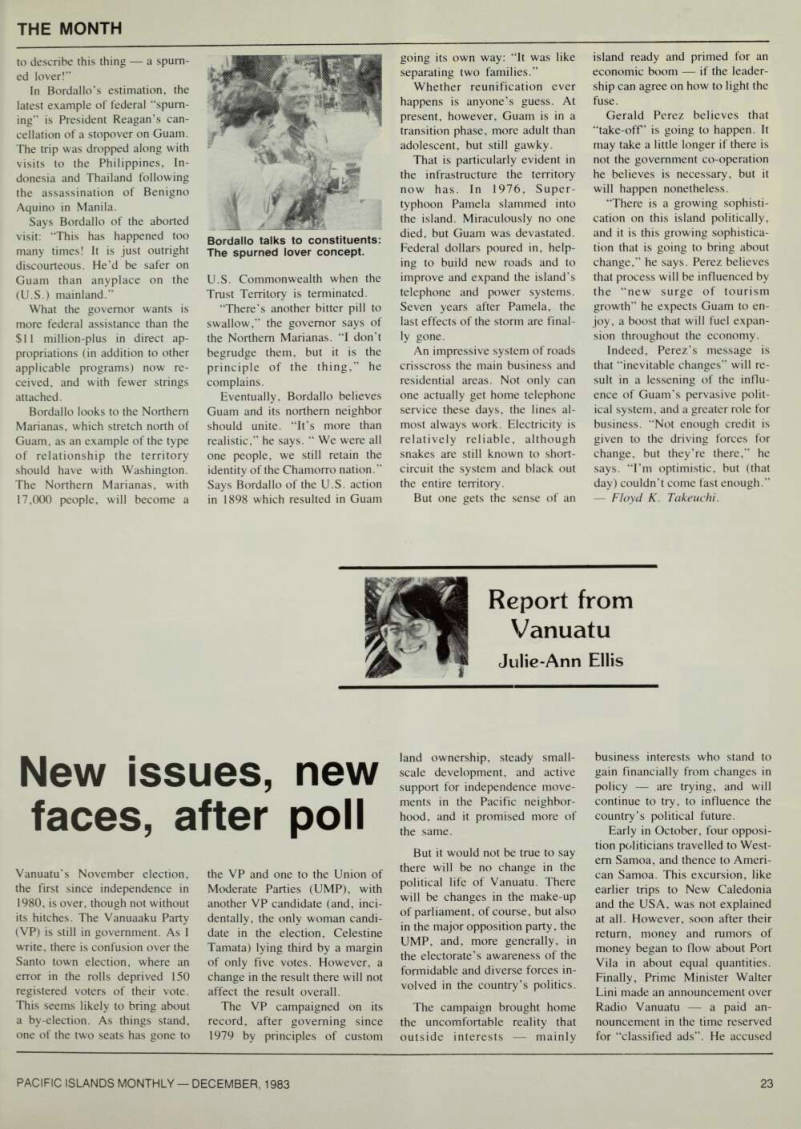
lamps of Guam
AGANA, Guam. Friday, September 2, 1983, was the night when the lights went out on Guam street lights, that is, all 6200 of them.
The deficit-ridden territorial government Gov Guam as it is called had fallen behind on the $Bl,OOO a month charge the local power authority assesses to
keep the street lights burning. So in blitzkrieg fashion utility work ers fanned out over the island and unplugged the lights.
With supreme self-confidence, the general manager of the Guam Power Authority told the local daily newspaper: “If I can cut off an old lady in Amatac (a village) who is on welfare, there is no
reason in the world I can’t cut a government agency. It’s a simple matter everyone gets fair treatment.”
By late October, Gov Guam had managed to scrounge up enough money to keep 1300
lights burning.
A first priority was the Turnon Bay area, where almost all of Guam’s hotels are located. Dark roads, and the threat of crime or accidents, is no way to attract the planeloads of Japanese tourists that the island has become so dependent upon.
Street lights at critical interse
ctions and along major thorough fares have also been relit. There are also about 750 privately own ed lights.
But much of Guam, a United States territory since 1898, re mains dark after the sun sinks into the Philippine Sea. In most villages, street lamps stand as dark sentinels. Only car head lights and the occasional owner installed, high-security, lamp pierces the tropical night. Wel come to the island that once proudly boasted it was “where America’s day begins”.
“The only way I can describe
Notes from the North Floyd K. Takeuchi on Micronesia
it is ‘incredible’,” That’s what Gerald S.A. Perez, one of Guam’s top business executives, thinks of the street light “crisis”.
However, it is more than dark roads that worries Perez, Duty Free Shoppers’ vice-president for retail operations on Guam. He believes the situation is symp tomatic of poorly managed gov ernment that has made it difficult for Guam’s businesses to expand as fast as they could. Duty Free, an international firm which man ages concessions at airports, is the island’s largest private em ployer, with about 400 workers.
“We pay our taxes and expect certain government services in return, and we don’t get them,”
Perez says. On top of that, he adds: “We continue unabated to have a bloated government that saps the vigor out of the private sector.”
Perez’s frustrations are shared by many.
The territory long ago de veloped an unhealthy dependen cy on the American federal dole to keep government functioning, and since, until recently, most workers were employed by Gov- Guam, its fiscal ills often proved contagious for the struggling pri vate sector.
The situation is changing, if slowly. By one estimate, there now are about the same number of workers in business as there are in government service. In a few years, the ratio should be more in the private sector’s favor.
On Guam, there are no municipal governments as such.
The governor is the only elected executive (save a figurehead lieutenant governor), and there is a unicameral legislature.
Perez says there has been a change in political attitude to wards business, perhaps reflect ing the fact that more people now have a stake in an improved business climate rather than sim ply being assured cushy govern ment jobs.
During the last election, for instance, Perez says more legis lative candidates were saying: “We’ve got to develop the pri vate sector. At least the rhetoric is now in the right direction”.
Despite such changes, there is still a strong tendency to look to Washington for nearly every
conceivable local need. One stark example: on an island that was in traditional times self sufficient in food, about 25 per cent of the 110,000 residents receive federal welfare food stamps.
Perez believes there are things Washington could do to help improve Guam’s business cli mate. They include changing the island’s status from foreign to domestic for U.S. trade pur poses, giving Guam more control
over airline services, and freeing the territory from federal minimum wage regulations. That last one would surely meet stiff opposition here, even if unions are not much of a force to con tend with.
But he is emphatic that Guam must become more self reliant: “I don’t think we ought to be con fusing (what Washington can do) with things that Guam could do
on its own.” Indeed, Perez, who once worked in government, looks askance at the territory’s overt dependency on federal aid.
“It’s one thing to ask for what you deserve,” Perez says of Washington assistance. “It’s something else to ask when you can’t even handle your own fis
cal integrity.”
Not surprisingly, Guam’s gov ernor takes a very different view.
On the subject of street lights, Ricardo Bordallo believes the is
sue has been blown “way, way out of proportion”. “We’re trying to get people to pay for those things that benefit them,” he says, suggesting that individuals may have to pay extra to get lights lit outside their homes.
Anyway, the governor be lieves some good has come out of the darkened streets. He says his public safety department has actually reported a drop in crime
since the lights went out.
Perhaps, Bordallo suggests, it is because more people are staying indoors at night.
On the subject of Guam’s business climate, Bordallo is even more upbeat. Pacing from his desk to a bookcase and back, he says with assurance that the business environment is “as posi tive as can be with the realities of facing life” on Guam. “It is the businessmen themselves who have to take the bull by the horns. They have to take the risks.”
Businessmen, the governor claims, “are very ignorant of how government works. It is shocking.”
Bordallo, a member of the Democratic Party, comes from a prominent Guamanian family.
He first moved into Government House in 1974. But after four years, Republican Paul Calvo swept the former Toyota dealer out of office. Last fall, Bordallo in his turn sent Calvo packing.
A handsome and intense man, “Ricky” Bordallo is best known for his visionary and philosophic thinking rather than administra tive acumen.
These days, he thinks a lot about Guam’s relationship with Washington. Bordallo believes the territory has been getting the short end of the stick for too long, and he says that the island is not going to take it any more.
Looking at the traumatic World War II experience, when Guam became the only U.S. ter ritory to be occupied by the enemy, the governor says with clear bitterness: “Japan, Ger many and all those half-baked allies got help (from the United States) after the Second World War.” Then, referring to the large tracts of land the American military claimed after recaptur ing Guam, Bordallo says; “We were people in our own country robbed of our own country.”
The island’s postwar history, which the governor believes has been marked by heavy-handed federal influence, has resulted in growing anti-Americanism. This despite the fact Guamanians are U.S. citizens.
“Yes, especially the young people,” he believes. “There is nothing worse than to give love and be spumed. That’s the way
to describe this thing a spum ed lover!”
In Bordallo’s estimation, the latest example of federal “spum ing” is President Reagan’s can cellation of a stopover on Guam.
The trip was dropped along with visits to the Philippines, In donesia and Thailand following the assassination of Benigno Aquino in Manila.
Says Bordallo of the aborted visit: “This has happened too many times! It is just outright discourteous. He’d be safer on Guam than anyplace on the (U.S.) mainland.”
What the governor wants is more federal assistance than the $ll million-plus in direct ap propriations (in addition to other applicable programs) now re ceived, and with fewer strings attached.
Bordallo looks to the Northern Marianas, which stretch north of Guam, as an example of the type of relationship the territory should have with Washington.
The Northern Marianas, with 17,000 people, will become a
U.S. Commonwealth when the Trust Territory is terminated.
“There’s another bitter pill to swallow,” the governor says of the Northern Marianas. “I don’t begrudge them, but it is the principle of the thing,” he complains.
Eventually, Bordallo believes Guam and its northern neighbor should unite. “It’s more than realistic,” he says. “ We were all one people, we still retain the identity of the Chamorro nation.”
Says Bordallo of the U.S. action in 1898 which resulted in Guam
going its own way: “It was like separating two families.”
Whether reunification ever happens is anyone’s guess. At present, however, Guam is in a transition phase, more adult than adolescent, but still gawky.
That is particularly evident in the infrastructure the territory now has. In 1976, Super typhoon Pamela slammed into the island. Miraculously no one died, but Guam was devastated.
Federal dollars poured in, help ing to build new roads and to improve and expand the island’s telephone and power systems.
Seven years after Pamela, the last effects of the storm are final ly gone.
An impressive system of roads crisscross the main business and residential areas. Not only can one actually get home telephone service these days, the lines al most always work. Electricity is relatively reliable, although snakes are still known to short circuit the system and black out the entire territory.
But one gets the sense of an
island ready and primed for an economic boom if the leader ship can agree on how to light the fuse.
Gerald Perez believes that “take-off’ is going to happen. It may take a little longer if there is not the government co-operation he believes is necessary, but it will happen nonetheless.
“There is a growing sophisti cation on this island politically, and it is this growing sophistica tion that is going to bring about change,” he says. Perez believes that process will be influenced by the “new surge of tourism growth” he expects Guam to en joy, a boost that will fuel expan sion throughout the economy.
Indeed, Perez’s message is that “inevitable changes” will re sult in a lessening of the influ ence of Guam’s pervasive polit ical system, and a greater role for business. “Not enough credit is given to the driving forces for change, but they’re there,” he says. “I’m optimistic, but (that day) couldn’t come fast enough.”
Floyd K. Takeuchi.
Bordallo talks to constituents: The spurned lover concept.
Pope
Sad tale of Guam’s Rota- Pope
Nobody could accuse Guama nians of not trying. They’ve turned this once sleepy island into a bustling metropolis, at least by Pacific standards.
Signs of growing prosperi ty are everywhere: four- and six- lane highways cut across this 5,413-square-kilometres island; new commercial buildings are appearing; tourism is expanding quickly along Turnon Bay, where most of Guam’s major resort hotels are located; and every where, it seems, busloads of Japanese tourists are spend ing their yen with glee. But sometimes even the best laid plans turn, well, if not into a bust, then embarrassments.
Consider the fate of the statue of Pope John Paul 11, the spiritual leader of almost all of Guam’s indigenous Chamorro people.
The Holy Father came to this outpost of Christianity in early 1981 as part of an Asian and Pacific pastoral trip.
Crowds jammed the streets to
catch a glimpse of the Pope or to hear one of his homilies.
It may well have been the highpoint of the history of the Roman Catholic Church on Guam.
In honor of the Pope’s pil grimage, a particularly de voted Roman Catholic took a second mortgage out on his house to finance the construc tion of a near life-sized statue of John Paul. The statue, along with a motor to com pletely rotate it, was placed near the spot where the Holy Father spoke to the faithful.
Such is the occasional fate of such projects on Guam that, in an unfortunate turn of events, the man who paid for the statue was unable to make the repayments on the loan.
He had to declare bankruptcy and lost his house.
And the statue? It still stands, a monument to a great event. But it does not move. The “Rota-Pope”, as Guam’s cynics have dubbed it, stands frozen. The statue’s back is toward the Legisla ture and it faces the gover nor’s office. No one seems sure if there is any symbolism
in that.
— Floyd K.
Takeuchi.
faces, after poll

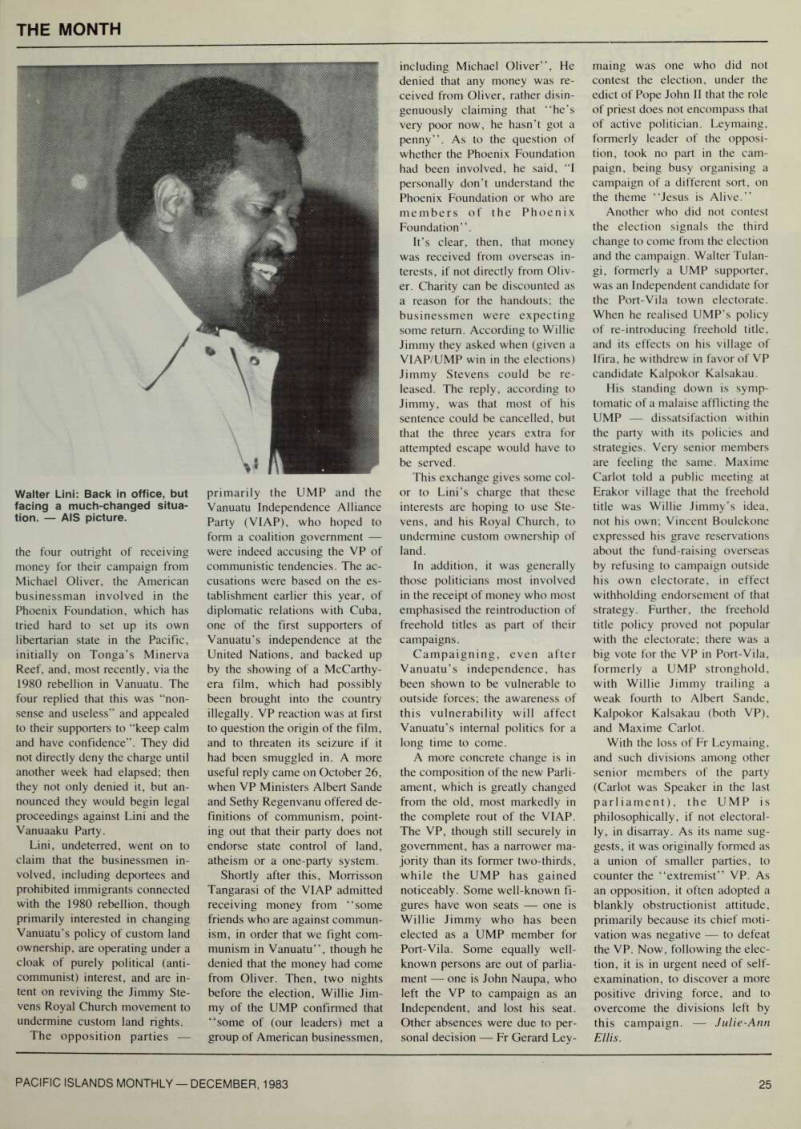
New issues, new faces, after poll
Vanuatu’s November election, the first since independence in 1980, is over, though not without its hitches. The Vanuaaku Party (VP) is still in government. As I write, there is confusion over the Santo town election, where an error in the rolls deprived 150 registered voters of their vote.
This seems likely to bring about a by-election. As things stand, one of the two seats has gone to
the VP and one to the Union of Moderate Parties (UMP), with another VP candidate (and, inci dentally, the only woman candi date in the election, Celestine Tamata) lying third by a margin of only five votes. However, a change in the result there will not affect the result overall.
The VP campaigned on its record, after governing since 1979 by principles of custom
land ownership, steady small scale development, and active support for independence move ments in the Pacific neighbor hood, and it promised more of the same.
But it would not be true to say there will be no change in the political life of Vanuatu. There will be changes in the make-up of parliament, of course, but also in the major opposition party, the UMP, and, more generally, in the electorate’s awareness of the formidable and diverse forces in volved in the country’s politics.
The campaign brought home the uncomfortable reality that outside interests mainly
business interests who stand to gain financially from changes in policy are trying, and will continue to try, to influence the country’s political future.
Early in October, four opposi tion politicians travelled to West ern Samoa, and thence to Ameri can Samoa. This excursion, like earlier trips to New Caledonia and the USA, was not explained at all. However, soon after their return, money and rumors of money began to flow about Port Vila in about equal quantities.
Finally, Prime Minister Walter Lini made an announcement over Radio Vanuatu a paid an nouncement in the time reserved for “classified ads’’. He accused
Report from Vanuatu Julie-Ann Ellis
the four outright of receiving money for their campaign from Michael Oliver, the American businessman involved in the Phoenix Foundation, which has tried hard to set up its own libertarian state in the Pacific, initially on Tonga’s Minerva Reef, and, most recently, via the 1980 rebellion in Vanuatu. The four replied that this was “non sense and useless” and appealed to their supporters to “keep calm and have confidence”. They did not directly deny the charge until another week had elapsed; then they not only denied it, but an nounced they would begin legal proceedings against Lini and the Vanuaaku Party.
Lini, undeterred, went on to claim that the businessmen in volved, including deportees and prohibited immigrants connected with the 1980 rebellion, though primarily interested in changing Vanuatu’s policy of custom land ownership, are operating under a cloak of purely political (anti communist) interest, and are in tent on reviving the Jimmy Ste vens Royal Church movement to undermine custom land rights.
The opposition parties
primarily the UMP and the Vanuatu Independence Alliance Party (VIAP), who hoped to form a coalition government were indeed accusing the VP of communistic tendencies. The ac cusations were based on the es tablishment earlier this year, of diplomatic relations with Cuba, one of the first supporters of Vanuatu’s independence at the United Nations, and backed up by the showing of a McCarthy era film, which had possibly been brought into the country illegally. VP reaction was at first to question the origin of the film, and to threaten its seizure if it had been smuggled in. A more useful reply came on October 26, when VP Ministers Albert Sande and Sethy Regenvanu offered de finitions of communism, point ing out that their party does not endorse state control of land, atheism or a one-party system.
Shortly after this, Morrisson Tangarasi of the VIAP admitted receiving money from “some friends who are against commun ism, in order that we fight com munism in Vanuatu”, though he denied that the money had come from Oliver. Then, two nights before the election, Willie Jim my of the UMP confirmed that “some of (our leaders) met a group of American businessmen,
including Michael Oliver”, He denied that any money was re ceived from Oliver, rather disin genuously claiming that “he’s very poor now, he hasn’t got a penny”. As to the question of whether the Phoenix Foundation had been involved, he said, “I personally don’t understand the Phoenix Foundation or who are members of the Phoenix Foundation”.
It’s clear, then, that money was received from overseas in terests, if not directly from Oliv er. Charity can be discounted as a reason for the handouts; the businessmen were expecting some return. According to Willie Jimmy they asked when (given a VIAP/UMP win in the elections) Jimmy Stevens could be re leased. The reply, according to Jimmy, was that most of his sentence could be cancelled, but that the three years extra for attempted escape would have to be served.
This exchange gives some col or to Lini’s charge that these interests are hoping to use Ste vens, and his Royal Church, to undermine custom ownership of land.
In addition, it was generally those politicians most involved in the receipt of money who most emphasised the reintroduction of freehold titles as part of their campaigns.
Campaigning, even after Vanuatu’s independence, has been shown to be vulnerable to outside forces; the awareness of this vulnerability will affect Vanuatu’s internal politics for a long time to come.
A more concrete change is in the composition of the new Parli ament, which is greatly changed from the old, most markedly in the complete rout of the VIAP.
The VP, though still securely in government, has a narrower ma jority than its former two-thirds, while the UMP has gained noticeably. Some well-known fi gures have won seats one is Willie Jimmy who has been elected as a UMP member for Port-Vila. Some equally well known persons are out of parlia ment one is John Naupa, who left the VP to campaign as an Independent, and lost his seat.
Other absences were due to per sonal decision Fr Gerard Ley
maing was one who did not contest the election, under the edict of Pope John II that the role of priest does not encompass that of active politician. Ley maing, formerly leader of the opposi tion, took no part in the cam paign, being busy organising a campaign of a different sort, on the theme “Jesus is Alive.”
Another who did not contest the election signals the third change to come from the election and the campaign. Walter Tulan gi, formerly a UMP supporter, was an Independent candidate for the Port-Vila town electorate.
When he realised UMP’s policy of re-introducing freehold title, and its effects on his village of Ifira, he withdrew in favor of VP candidate Kalpokor Kalsakau.
His standing down is symp tomatic of a malaise afflicting the UMP dissatsifaction within the party with its policies and strategies. Very senior members are feeling the same. Maxime Carlot told a public meeting at Erakor village that the freehold title was Willie Jimmy’s idea, not his own; Vincent Boulekone expressed his grave reservations about the fund-raising overseas by refusing to campaign outside his own electorate, in effect withholding endorsement of that strategy. Further, the freehold title policy proved not popular with the electorate; there was a big vote for the VP in Port-Vila, formerly a UMP stronghold, with Willie Jimmy trailing a weak fourth to Albert Sande, Kalpokor Kalsakau (both VP), and Maxime Carlot.
With the loss of Fr Leymaing, and such divisions among other senior members of the party (Carlot was Speaker in the last parliament), the UMP is philosophically, if not electoral ly, in disarray. As its name sug gests, it was originally formed as a union of smaller parties, to counter the “extremist” VP. As an opposition, it often adopted a blankly obstructionist attitude, primarily because its chief moti vation was negative to defeat the VP. Now, following the elec tion, it is in urgent need of self examination, to discover a more positive driving force, and to overcome the divisions left by this campaign. Julie-Ann Ellis.
Walter Lini: Back in office, but facing a much-changed situa tion. AIS picture.
Advertisements & other items, pp. 24-26 (1 item)
video enjoyment in the [li ;«(if? Rfil ll 1111 l
8 hours of continuous video enjoyment in the [li ;«(if? Rfil ll 1111 l LP mode. Superb stereo ijjjm reduction circuitry. Convenient, streamlined front-loading tape transport mechanism. Five-program/two-week preset timer recording facility. Instant Recording Timer for fuss-free program setting. A 13-mode wireless remote control unit. A taperemaining time indicator. They are all in one video tape recorder —the VT-19E (AU), only from Hitachi.
HITACHI
n r "3 <9 •J
vns
•AUSTRALIA: Hitachi Sales Australia Pty., Ltd., 153 Keys Road, Moorabbin, Victoria 3189; Phone: (555) 8722 •NEW ZEALAND: AWA New Zealand Limited, Wi-neera Drive, P.O. Box 50-248, Porirua; Phone; PRO 75-069 •PAPUA NEW GUINEA: S.o. Svensson (N.G.) Ltd., P.O. Box 705, Port Moresby; Phone: 21-2111 •FIJI ISLANDS; AWA New Zealand Limited, 47 Foster Road (P.O. Box 858) Suva Fiji; Phone: 312070 •NEW CALEDONIA: Caldis, B.P. Ml, Noumea; Phone: 26.23.50 •TAHITI: Ets Chene Alain, P.O. Box 272, Papeete; Phone: 2.88.68 •SOLOMON ISLANDS; Technique Radios Centre Ltd., P.O. Box 465, Honiara; Phone: 416
Citizen introduce the
worlds thinnest analog alarm
with a remarkable new
alarm system
iC
TIME
Pull the crown out two notches and set as you would any watch
ALARM
Pull the crown out one notch Hands automatically move to the last alarm setting, and a Chime tells you that the alarm is ready to be reset.
U ET
Pushing the crown back in automatically returns the hands to the correct time with another beep to tell you that ordinary operation has resumed.
ON/OFF alarm button.
Pull to set, push to stop.
The Citizen Quartz Analog Alarm Watch, the World’s slimmest and
smallest Analog Alarm.
Its alarm is music. A soft harmonious melody that perfectly matches the slim and tasteful design of this timepiece.
There is no alarm-setting pointer. The hour and minute hands are used for alarm setting. Citizen Quartz technology makes the Analog Alarm
accurate to within seconds per month.
•CITIZEN
AHEAD OF THEIR TIME
Citizen Watches Australia Pty Ltd, 122 Old Pittwater Rd, Brookvale, NSW 2100. Telephone: 9397077. Cable: Citizen Sydney, Telex: AA26633
endless quest
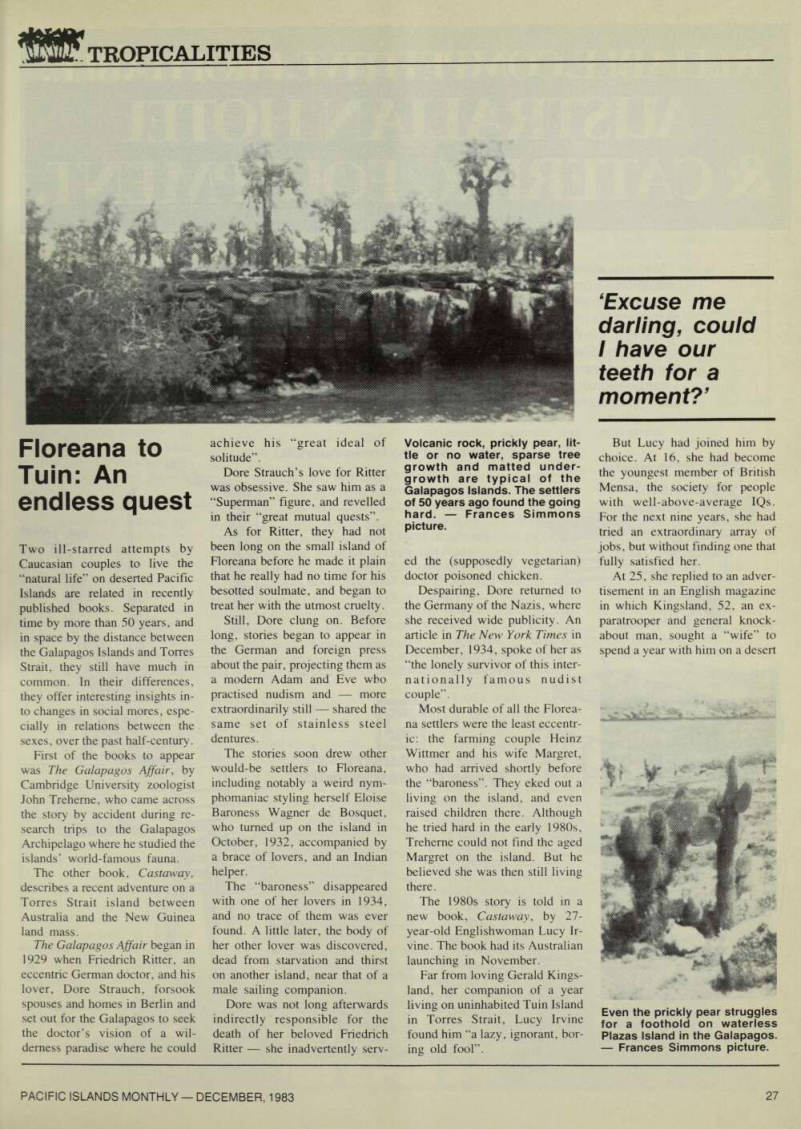

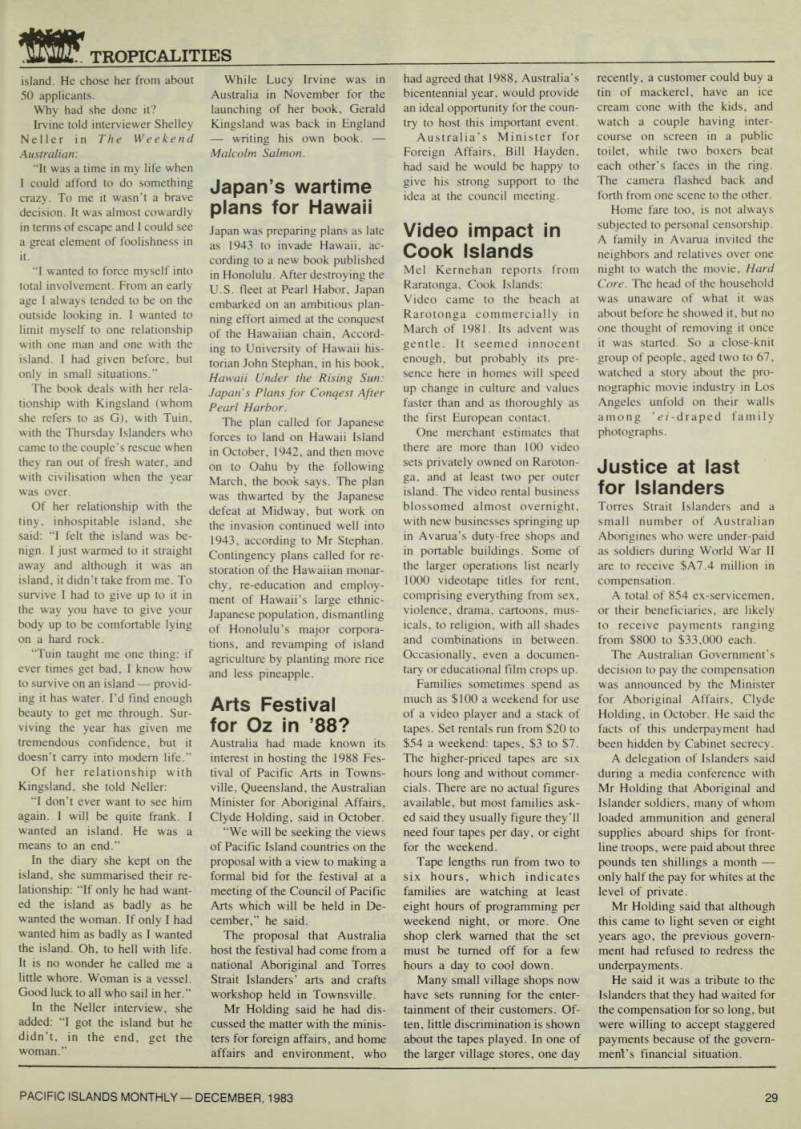
Tropicalities
Floreana to Tuin: An endless quest
‘Excuse me darling, could I have our teeth for a moment?’
Two ill-starred attempts by Caucasian couples to live the “natural life” on deserted Pacific Islands are related in recently published books. Separated in time by more than 50 years, and in space by the distance between the Galapagos Islands and Torres Strait, they still have much in common. In their differences, they offer interesting insights in to changes in social mores, espe cially in relations between the sexes, over the past half-century.
First of the books to appear was The Galapagos Affair , by Cambridge University zoologist John Treheme, who came across the story by accident during re search trips to the Galapagos Archipelago where he studied the islands’ world-famous fauna.
The other book, Castaway, describes a recent adventure on a Torres Strait island between Australia and the New Guinea land mass.
The Galapagos Affair began in 1929 when Friedrich Ritter, an eccentric German doctor, and his lover, Dore Strauch, forsook spouses and homes in Berlin and set out for the Galapagos to seek the doctor’s vision of a wil derness paradise where he could
achieve his “great ideal of solitude”.
Dore Strauch’s love for Ritter was obsessive. She saw him as a “Superman” figure, and revelled in their “great mutual quests”.
As for Ritter, they had not been long on the small island of Floreana before he made it plain that he really had no time for his besotted soulmate, and began to treat her with the utmost cruelty.
Still, Dore clung on. Before long, stories began to appear in the German and foreign press about the pair, projecting them as a modem Adam and Eve who practised nudism and more extraordinarily still shared the same set of stainless steel dentures.
The stories soon drew other would-be settlers to Floreana, including notably a weird nym phomaniac styling herself Eloise Baroness Wagner de Bosquet, who turned up on the island in October, 1932, accompanied by a brace of lovers, and an Indian
helper.
The “baroness” disappeared with one of her lovers in 1934, and no trace of them was ever found. A little later, the body of her other lover was discovered, dead from starvation and thirst on another island, near that of a male sailing companion.
Dore was not long afterwards indirectly responsible for the death of her beloved Friedrich Ritter she inadvertently serv
ed the (supposedly vegetarian) doctor poisoned chicken.
Despairing, Dore returned to the Germany of the Nazis, where she received wide publicity. An article in The New York Times in December, 1934, spoke of her as “the lonely survivor of this inter nationally famous nudist couple”.
Most durable of all the Florea na settlers were the least eccentr ic: the farming couple Heinz Wittmer and his wife Margret, who had arrived shortly before the “baroness”. They eked out a living on the island, and even raised children there. Although he tried hard in the early 1980 s, Treheme could not find the aged Margret on the island. But he believed she was then still living there.
The 1980 s story is told in a new book, Castaway, by 27year-old Englishwoman Lucy Ir vine. The book had its Australian launching in November.
Far from loving Gerald Kings land, her companion of a year living on uninhabited Tuin Island in Torres Strait, Lucy Irvine found him “a lazy, ignorant, bor ing old fool”.
But Lucy had joined him by choice. At 16, she had become the youngest member of British Mensa, the society for people with well-above-average IQs.
For the next nine years, she had tried an extraordinary array of jobs, but without finding one that fully satisfied her.
At 25, she replied to an adver tisement in an English magazine in which Kingsland, 52, an ex paratrooper and general knock about man, sought a “wife” to spend a year with him on a desert
Volcanic rock, prickly pear, lit tle or no water, sparse tree growth and matted under growth are typical of the Galapagos Islands. The settlers of 50 years ago found the going hard. Frances Simmons picture.
Even the prickly pear struggles for a foothold on waterless Plazas Island in the Galapagos. - Frances Simmons picture.
island. He chose her from about 50 applicants.
Why had she done it?
Irvine told interviewer Shelley Neller in The Weekend Australian ; “It was a time in my life when I could afford to do something crazy. To me it wasn’t a brave decision. It was almost cowardly in terms of escape and I could see a great element of foolishness in it.
“I wanted to force myself into total involvement. From an early age I always tended to be on the outside looking in. I wanted to limit myself to one relationship with one man and one with the island. I had given before, but only in small situations.”
The book deals with her rela tionship with Kingsland (whom she refers to as G), with Tuin, with the Thursday Islanders who came to the couple’s rescue when they ran out of fresh water, and with civilisation when the year was over.
Of her relationship with the tiny, inhospitable island, she said: “I felt the island was be nign. I just warmed to it straight away and although it was an island, it didn’t take from me. To survive I had to give up to it in the way you have to give your body up to be comfortable lying on a hard rock.
“Tuin taught me one thing: if ever times get bad, I know how to survive on an island provid ing it has water. I’d find enough beauty to get me through. Sur viving the year has given me tremendous confidence, but it doesn’t carry into modem life.”
Of her relationship with Kingsland, she told Neller: “I don’t ever want to see him again. I will be quite frank. I wanted an island. He was a means to an end.”
In the diary she kept on the island, she summarised their re lationship: “If only he had want ed the island as badly as he wanted the woman. If only I had wanted him as badly as I wanted the island. Oh, to hell with life.
It is no wonder he called me a little whore. Woman is a vessel.
Good luck to all who sail in her.”
In the Neller interview, she added: “I got the island but he didn’t, in the end, get the woman.”
While Lucy Irvine was in Australia in November for the launching of her book, Gerald Kingsland was back in England writing his own book.
Malcolm Salmon.
Japan’s wartime
plans for Hawaii
Japan was preparing plans as late as 1943 to invade Hawaii, ac cording to a new book published in Honolulu. After destroying the U.S. fleet at Pearl Habor, Japan embarked on an ambitious plan ning effort aimed at the conquest of the Hawaiian chain. Accord ing to University of Hawaii his torian John Stephan, in his book, Hawaii Under the Rising Sun: Japan’s Plans for Conqest After Pearl Harbor.
The plan called for Japanese forces to land on Hawaii Island in October, 1942, and then move on to Oahu by the following March, the book says. The plan was thwarted by the Japanese defeat at Midway, but work on the invasion continued well into 1943, according to Mr Stephan.
Contingency plans called for re storation of the Hawaiian monar chy, re-education and employ ment of Hawaii’s large ethnic- Japanese population, dismantling of Honolulu’s major corpora tions, and revamping of island agriculture by planting more rice and less pineapple.
Arts Festival
for Oz in ’88?
Australia had made known its interest in hosting the 1988 Fes tival of Pacific Arts in Towns ville, Queensland, the Australian Minister for Aboriginal Affairs, Clyde Holding, said in October.
“We will be seeking the views of Pacific Island countries on the proposal with a view to making a formal bid for the festival at a meeting of the Council of Pacific Arts which will be held in De cember,” he said.
The proposal that Australia host the festival had come from a national Aboriginal and Torres Strait Islanders’ arts and crafts workshop held in Townsville.
Mr Holding said he had dis cussed the matter with the minis ters for foreign affairs, and home affairs and environment, who
had agreed that 1988, Australia’s bicentennial year, would provide an ideal opportunity for the coun try to host this important event.
Australia’s Minister for Foreign Affairs, Bill Hayden, had said he would be happy to give his strong support to the idea at the council meeting.
Video impact in
Cook Islands
Mel Kernehan reports from Raratonga, Cook Islands: Video came to the beach at Rarotonga commercially in March of 1981. Its advent was gentle. It seemed innocent enough, but probably its pre sence here in homes will speed up change in culture and values faster than and as thoroughly as the first European contact.
One merchant estimates that there are more than 100 video sets privately owned on Raroton ga, and at least two per outer island. The video rental business blossomed almost overnight, with new businesses springing up in Avarua’s duty-free shops and in portable buildings. Some of the larger operations list nearly 1000 videotape titles for rent, comprising everything from sex, violence, drama, cartoons, mus icals, to religion, with all shades and combinations in between.
Occasionally, even a documen tary or educational film crops up.
Families sometimes spend as much as $lOO a weekend for use of a video player and a stack of tapes. Set rentals run from $2O to $54 a weekend: tapes, $3 to $7.
The higher-priced tapes are six hours long and without commer cials. There are no actual figures available, but most families ask ed said they usually figure they’ll need four tapes per day, or eight for the weekend.
Tape lengths run from two to six hours, which indicates families are watching at least eight hours of programming per weekend night, or more. One shop clerk warned that the set must be turned off for a few hours a day to cool down.
Many small village shops now have sets running for the enter tainment of their customers. Of ten, little discrimination is shown about the tapes played. In one of the larger village stores, one day
recently, a customer could buy a tin of mackerel, have an ice cream cone with the kids, and watch a couple having inter course on screen in a public toilet, while two boxers beat each other’s faces in the ring.
The camera flashed back and forth from one scene to the other.
Home fare too, is not always subjected to personal censorship.
A family in Avarua invited the neighbors and relatives over one night to watch the movie, Hard Core. The head of the household was unaware of what it was about before he showed it, but no one thought of removing it once it was started. So a close-knit group of people, aged two to 67, watched a story about the pro nographic movie industry in Los Angeles unfold on their walls among family photographs.
Justice at last
for Islanders
Torres Strait Islanders and a small number of Australian Aborigines who were under-paid as soldiers during World War II are to receive $A7.4 million in compensation.
A total of 854 ex-servicemen, or their beneficiaries, are likely to receive payments ranging from $BOO to $33,000 each.
The Australian Government’s decision to pay the compensation was announced by the Minister for Aboriginal Affairs, Clyde Holding, in October. He said the facts of this underpayment had been hidden by Cabinet secrecy.
A delegation of Islanders said during a media conference with Mr Holding that Aboriginal and Islander soldiers, many of whom loaded ammunition and general supplies aboard ships for front line troops, were paid about three pounds ten shillings a month only half the pay for whites at the level of private.
Mr Holding said that although this came to light seven or eight years ago, the previous govern ment had refused to redress the underpayments.
He said it was a tribute to the Islanders that they had waited for the compensation for so long, but were willing to accept staggered payments because of the govern ment’s financial situation.
Advertisements & other items, pp. 28-30 (1 item)
Australian Hotel
REUABLEXmiPETITIVE. PROFITABLE.
& CATERING EQUIPMEN T.
Australia makes first class, reliable hotel and catering equipment for use in every situation - from self-serve or take-away food outlet to the plushest of international hotels. Australia’s products have proven competitive world-wide. They cover most requirements in food preparation and service, furniture, furnishings and fittings. You name it, most likely Australia can supply it. Commercial and domestic cookers.
Dishwashers. Glass-washing machines. Refrigeration. Cold Rooms. Icemakers. Mixers.
Fryers. Food warmers. Urns. Drink dispensers. Tableware. Plates and trays. Self-service merchandisers. Contract furniture. Mattresses. Carpet. Curtains. Towels. Sheets.
Blankets. Cleaning equipment. Bathroom and kitchen fittings. Find out how Australia can fulfil your requirements.
■OiHS)
Ask the expert who knows Australia For details of Australian suppliers phone or telex the Australian Trade Commissioner at FIJI; P.O. Box 1252, Suva.
Phone: 31 2844 Telex; FJ 2126
PAPUA NEW GUINEA:
P.O. Box 9129, Hohola Phone: 25 9333 Telex; NE22109
NEW CALEDONIA;
P.O. Box 22, Noumea Phone: 27 2414 Telex: 087 HAWAII: Australian Consulate 1000 Bishop St, Honolulu, 96813. USA.
Phone; (808) 524 5050 Telex: 633128
Ask the Australian
IVade Commissioner
30 days unlimited
use of a business jet.
m 1
SUS 999.
✓ <f? (\ r l^ *ojs r *% dK"^ Should you be Hying to and around the Pacific Islands on business this year, Polynesian Airlines have an attractive business proposition for you We call it the Polypass.
With a ‘ “ 30 days of unlimited travel to any or all of 4®
the nine tropical (®J~
destinations Polynesian Airlines visit. All tor only US$999 These destinations include all the major Pacific business centres. Western Samoa, Fiji, / BS&< \ New Zealand, American Samoa, \ Tonga, Tahiti, Rarotonga, Vanuatu, Vavau and, in conjunction with Air Vanuatu, Sydney, are all serviced by Polynesian Airlines.
Your business jet awaits you.
Contact your travel agent or phone Polynesian Airlines now on Sydney 2681431, 70 Elizabeth Street, Sydney, or Melbourne 3421277, 330 Collins Street, yfii Melbourne. (The Polypass is f \ for sale in French Pacific Territories.)
POLYNESIAN
AIRLINES (g
s m % rill O \ I 'u°^ Stewart Roache Watson PALO2O.
Islands
From the
Press
Extracts from an article in The Times of Papua New Guinea in which lawyer Bernard Narokobi examines the role of Father John Momis, a priest in parliament Much has been said about priests and politics. Should they or should they not be in active elective political office? The Pope at best is somewhat ambivalent about it. His public remarks are against priests in politics. In PNG a priest must be free to answer to the inner strings of his conscience and to the call of his people of God. It must be left to the priest, his bishop and their people to decide whether a priest should or should not be in elective office in politics. In the case of John L. Momis, that is a matter for Bishop Gregory Sinaki, for John L. Momis himself and for their people. In my view the intervention of John L. Momis in the political history of PNG is not being fully appreciated now, but will be so by impartial historians in years to come.
The Fiji Times, Suva Tom Christian of Pitcairn Island hitched a 5000-kilometre boat ride across the Pacific recently on his way to get a medal from the British Government representative in Wellington, New Zealand. Christian, radio operator for Pitcairn Island, flagged a passing chemical carrier for the nine-day trip to New Zealand enroute to receiving his Member of the Order of the British Empire (MBE) medal at a ceremony in Wellington. Tom Christian of Pitcairn is descended from another expert at diverting ships Fletcher Christian, leader of the 1790 Bounty mutiny.
The Marshall Islands Journal reporting the first flight it was made in September from Guam to the new Yap State Airport Flight 522 of Air Micronesia inaugurated the $l3 million airfield. Leis were presented to the flight crew and a special lei about 200 feet long was placed around the plane’s nose, wings and tail to commemorate the first landing. A temporary terminal, a 76 ft shed, greeted the passengers on the flight. A sign on the building dubbed it “State of Yap’s Teeny Tiny Temporary Terminal”. A more permanent temporary terminal will be built soon, and construction of a permanent terminal will begin next year.
An Australian, Mr Terry Robinson, comments in The Fiji Times, Suva, about community problems reported in Fiji I have just returned from a visit to your country, and as far as I am concerned if you think Fiji has troubles you should ask your writer to visit Australia for a while. There were six deaths on the road during the weekend just ended and four criminals escaped from a maximum security prison. White collar crime exists everywhere, there are protection rackets, the list is endless. As far as I am concerned, Fiji is a paradise compared to Australia.
The Times of Papua New Guinea, Port Moresby, quoting 33-year-old Makena Geno after his appointment as Auditor-General “I like my job very much. I planned 15 years ago to become the first Papua New Guinean to be appointed Auditor-General in his own country and I did it in 13 years. I’m very proud of myself.”
Extracts from an editorial in The Samoa Times, Apia, about runway extensions being carried out at Faleolo, Western Samoa’s main airport Is the present government’s desire for an international airport the result of some sort of idealism, or the result of pragmatic realities? Is the project well-meaning but a dream, or is it based on realistic projections of future needs and expectations? On what was cabinet’s decision based to push ahead with the project at a time of severe financial crisis? The government has set its eyes on more tourists, more exports and more revenues, but for the government scheme to work some solution will have to be found outside the normal range of airline route arrangements. If the airport must be upgraded then a proper plan for its future use, at minimum cost, will have to be prepared right now.
The Vanuatu government newspaper Tam-Tam, reporting a visit to Futuna by Vanuatu Prime Minister Walter Lini The prime minister was amazed during his visit when he was shown a cliff about 100 metres high where a small boy had seemingly jumped to his death in an attempt to catch a bird in the treetops below. The report said the boy was sitting on a rock at the edge of the cliff when he suddenly saw the bird fly over and perch on a branch below. Without thinking of the drop the boy leapt into the air after the bird and somehow landed on the branch. People rushed down to the bottom of the cliff believing he was dead, only to find him alive and well climbing down out of the tree. > A reader’s letter in the Post-Courier, Port Moresby, comments on one aspect of Papua New Guinea’s
recently-established sugar industry.
Malnutrition is a serious problem in this country too many people suffer from it. Many health workers, nutritionists and teachers work hard to alleviate the problem. Sugar, eaten in excess, causes serious malnutrition diseases, for instance obesity and dental caries. The latest series of Ramu Sugar advertisements in your paper advocate the use of sugar in excess. I believe that anyone who supports or who allows these advertisements to be widely published to be insensitive to the health and well being of a large proportion of people in this country.
From a reader’s letter in The Fiji Times, Suva When reading news about accidents one is amazed to notice how often automobiles “have lost their control” or “rushed off the road” before killing people. This makes one query whether the vehicles were without drivers at the time of the accidents. Have the cars behaved independently and taken their own decisions to kill people?
The Papua New Guinea Post-Courier, Port Moresby A Shell petrol tanker was parked on the top of Three Mile Hill yesterday. It had run out of petrol.
Editor’s note published on the letters page of the Marshall Islands Journal, Majuro Notice to Mr Kiti L. Dear Mr L. We received a letter via U.S.
Post Office with your name typed on the letter as sender. Your letter is quite interesting and inflammatory, as all good letters should be. However we need evidence that you are not writing under a phony name, leaving us with the mud on our face so to speak. Please write again, giving box number and signature so that we can verify the validity of your letter.
The Fiji Times, Suva A government department that has recently installed word processors in its offices is wondering what to do about a rodent or a family of rodents that has made a home in the electronic machine. Officials are puzzled how the creature avoids getting electrocuted. All efforts to flush the mouse out have failed. What is worse, the mouse is fighting back. It has gnawed through the machine’s wiring twice, knocking it out of commission each time.
Advertisements & other items, p. 32 (1 item)
SajtsuL
When Sansui mates computers with
high performance component systems
you get convenience. Like "Compu
Edit.," a feature that allows automatic
edit recording of songs from disc to
tape in any programmed order. And
the "Compu-Selector System" for one-
touch synchronized play. And memory
station selection. Intelligent Super
Compo—the smartest hi-fi systems
ever designed.
n Minin
m-
Ilf
- II
TIiTIT
P-L5O
Linear-Tracking Turntable ! T-909 FM/AM Tuner A-909 Integrated Amp D-99D Double Cassette Deck AT-202 Audio Program Timer S-950 Speaker Systems GX-909
SajtsuL
mm Also available in Black finish.
SANSUI ELECTRIC CO., LTD. 14-1 Izumi 2-chome, Suginami-ku, Tokyo 168, Japan.
For further information please contact: • Australia VANFI (Aust.) PTY. LTD. 297, City Road, South Melbourne, Victoria 3205, Australia Phone: 690-6200/283 Alfred Place, North Sydney, N.S.W. 2060, Australia Phone: 929-0293 • Fiji PRABHU BROTHERS LTD. P.O. Box 183, Nadi Phone: 71122 • Papua New Guinea OCEANIS INDENT AGENCY (P.N.G.) PTY. LTD. Box 5518, Boroko, Port Moresby Phone: 256411 • New Zealand DAVID REID ELECTRONICS LTD. P.O. Box 2630, Auckland, Phone: 488-049 • New Caledonia HI-FI VICTOIRE, ETS. M. MERCIER B.P 1123, Noumea Phone: 27.59.11 • Central Pacific NAURU CO-OPERATIVE SOCIETY Republic of Nauru • Vanuatu THE SOUND CENTRE LTD. P.O. Box 434, Vila Phone: 2035 • Tahiti DIMECO SIMEL B.P Box 3338 Papeete Phone: 26979
People
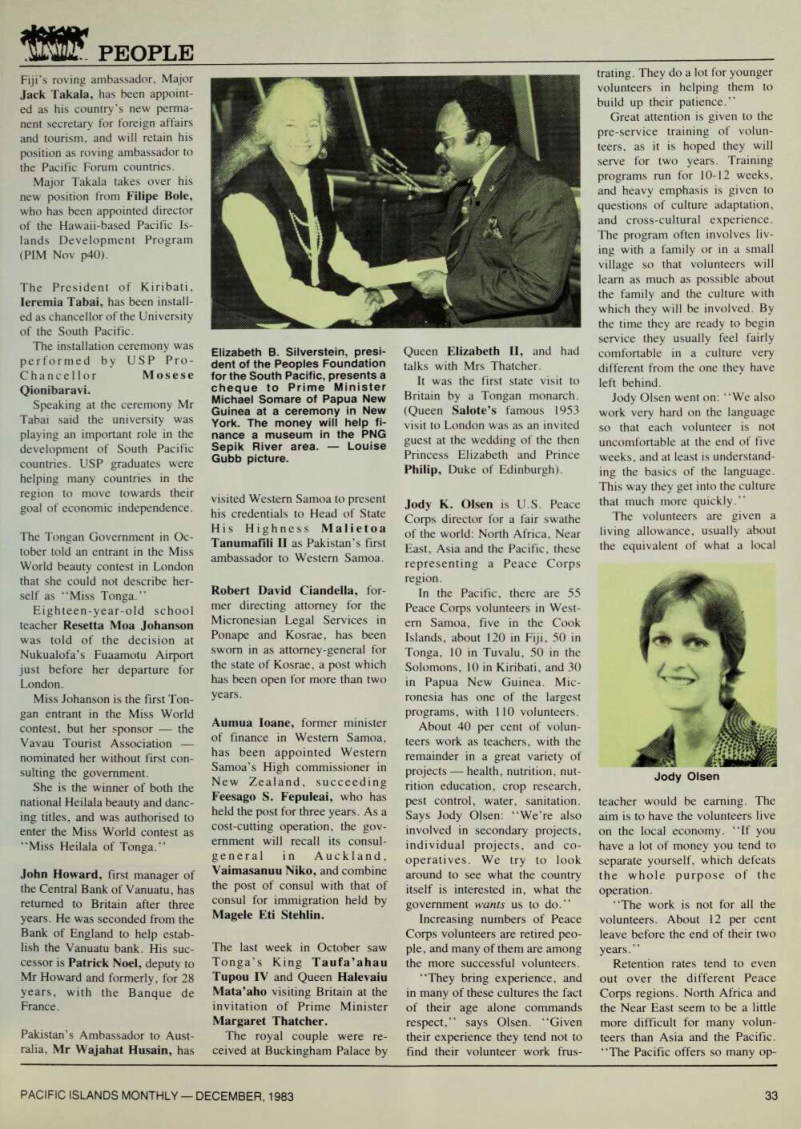
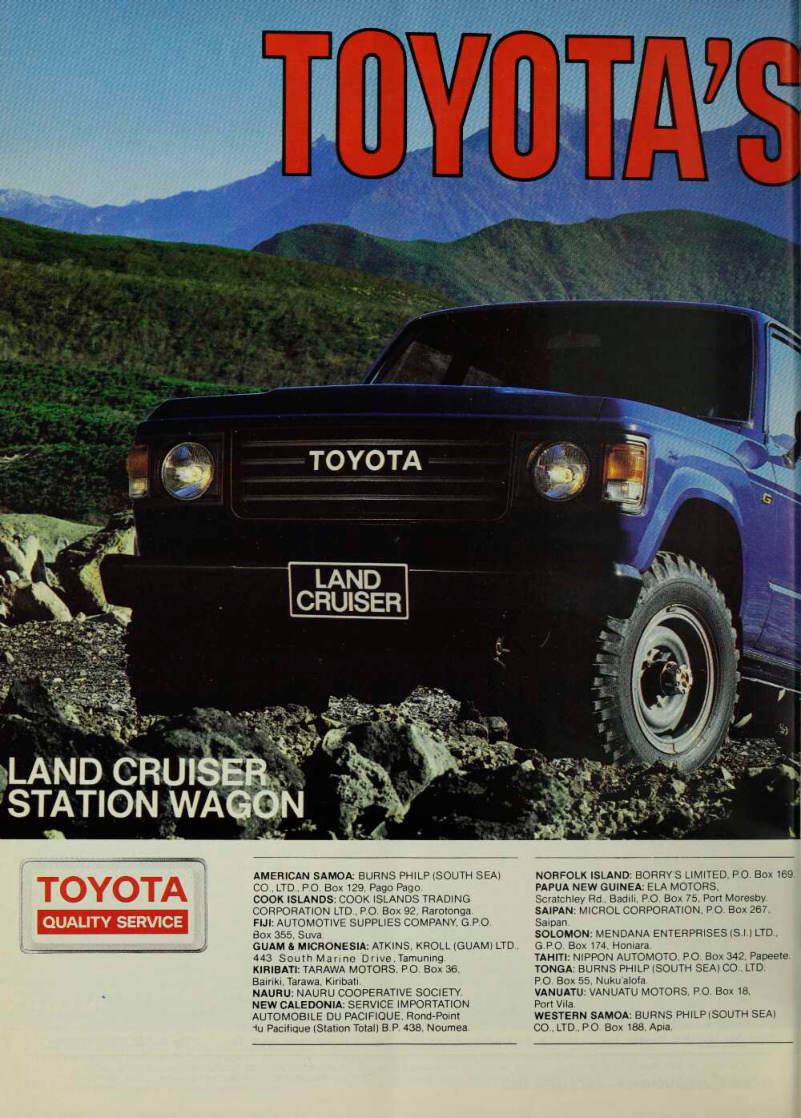

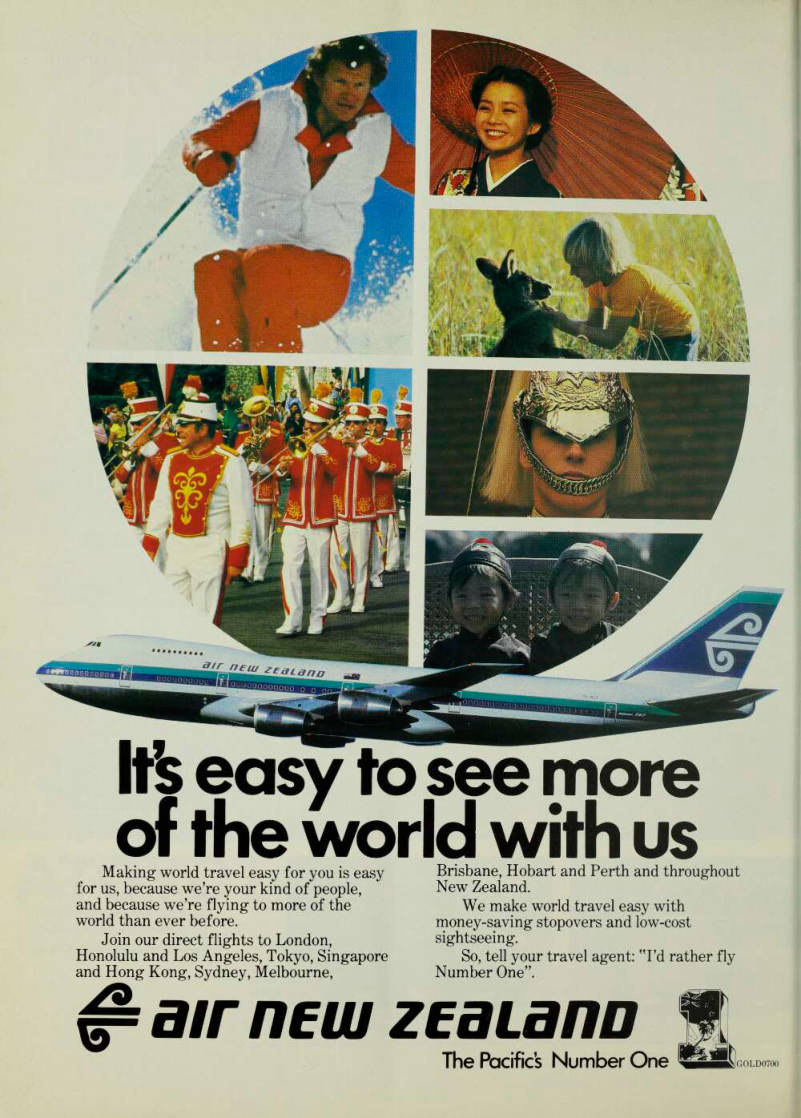
Fiji’s roving ambassador. Major Jack Takala, has been appoint ed as his country’s new perma nent secretary for foreign affairs and tourism, and will retain his position as roving ambassador to the Pacific Forum countries.
Major Takala takes over his new position from Filipe Bole, who has been appointed director of the Hawaii-based Pacific Is lands Development Program (PIM Nov p4O).
The President of Kiribati, leremia Tabai, has been install ed as chancellor of the University of the South Pacific.
The installation ceremony was performed by USP Pro- Chancellor Mosese Qionibaravi.
Speaking at the ceremony Mr Tabai said the university was playing an important role in the development of South Pacific countries. USP graduates were helping many countries in the region to move towards their goal of economic independence.
The Tongan Government in Oc tober told an entrant in the Miss World beauty contest in London that she could not describe her self as “Miss Tonga.”
Eighteen-year-old school teacher Resetta Moa Johanson was told of the decision at Nukualofa’s Fuaamotu Airport just before her departure for London.
Miss Johanson is the first Ton gan entrant in the Miss World contest, but her sponsor the Vavau Tourist Association nominated her without first con sulting the government.
She is the winner of both the national Heilala beauty and danc ing titles, and was authorised to enter the Miss World contest as “Miss Heilala of Tonga.”
John Howard, first manager of the Central Bank of Vanuatu, has returned to Britain after three years. He was seconded from the Bank of England to help estab lish the Vanuatu bank. His suc cessor is Patrick Noel, deputy to Mr Howard and formerly, for 28 years, with the Banque de France.
Pakistan’s Ambassador to Aust ralia, Mr Wajahat Husain, has
visited Western Samoa to present his credentials to Head of State His Highness Malietoa Tanumafili II as Pakistan’s first ambassador to Western Samoa.
Robert David Ciandella, for mer directing attorney for the Micronesian Legal Services in Ponape and Kosrae, has been sworn in as attorney-general for the state of Kosrae, a post which has been open for more than two years.
Aumua loane, former minister of finance in Western Samoa, has been appointed Western Samoa’s High commissioner in New Zealand, succeeding Feesago S. Fepuleai, who has held the post for three years. As a
cost-cutting operation, the gov
ernment will recall its consul general in Auckland, Vaimasanuu Niko, and combine the post of consul with that of consul for immigration held by Magele Eti Stehlin.
The last week in October saw Tonga’s King Taufa’ahau Tupou IV and Queen Halevaiu Mata'aho visiting Britain at the invitation of Prime Minister Margaret Thatcher.
The royal couple were re ceived at Buckingham Palace by
Queen Elizabeth 11, and had talks with Mrs Thatcher.
It was the first state visit to Britain by a Tongan monarch. (Queen Salote’s famous 1953 visit to London was as an invited guest at the wedding of the then Princess Elizabeth and Prince Philip, Duke of Edinburgh).
Jody K. Olsen is U .S. Peace Corps director for a fair swathe of the world: North Africa, Near East, Asia and the Pacific, these representing a Peace Corps region.
In the Pacific, there are 55 Peace Corps volunteers in West ern Samoa, five in the Cook Islands, about 120 in Fiji, 50 in Tonga, 10 in Tuvalu, 50 in the Solomons, 10 in Kiribati, and 30 in Papua New Guinea. Mic ronesia has one of the largest programs, with 110 volunteers.
About 40 per cent of volun teers work as teachers, with the remainder in a great variety of projects health, nutrition, nut rition education, crop research, pest control, water, sanitation.
Says Jody Olsen: “WeTe also involved in secondary projects, individual projects, and co operatives. We try to look around to see what the country itself is interested in, what the government wants us to do.”
Increasing numbers of Peace Corps volunteers are retired peo ple, and many of them are among the more successful volunteers.
“They bring experience, and in many of these cultures the fact of their age alone commands respect,” says Olsen. “Given their experience they tend not to find their volunteer work frus
trating. They do a lot for younger volunteers in helping them to build up their patience.”
Great attention is given to the pre-service training of volun teers, as it is hoped they will serve for two years. Training programs run for 10-12 weeks, and heavy emphasis is given to questions of culture adaptation, and cross-cultural experience.
The program often involves liv ing with a family or in a small village so that volunteers will learn as much as possible about the family and the culture with which they will be involved. By the time they are ready to begin service they usually feel fairly comfortable in a culture very different from the one they have left behind.
Jody Olsen went on: “We also work very hard on the language so that each volunteer is not uncomfortable at the end of five weeks, and at least is understand ing the basics of the language.
This way they get into the culture that much more quickly.”
The volunteers are given a living allowance, usually about the equivalent of what a local
teacher would be earning. The aim is to have the volunteers live on the local economy. “If you have a lot of money you tend to separate yourself, which defeats the whole purpose of the
operation.
“The work is not for all the volunteers. About 12 per cent leave before the end of their two years.”
Retention rates tend to even out over the different Peace Corps regions. North Africa and the Near East seem to be a little more difficult for many volun teers than Asia and the Pacific.
“The Pacific offers so many op-
Elizabeth B. Silverstein, presi dent of the Peoples Foundation for the South Pacific, presents a cheque to Prime Minister Michael Somare of Papua New Guinea at a ceremony in New York. The money will help fi nance a museum in the PNG Sepik River area. Louise Gubb picture.
Jody Olsen
portunities and such a good ex perience for volunteers they usu ally feel comfortable quite quickly.”
It has become quite common throughout the world for volun teers to spend their two years, and then decide that they want to spend more time in the countries they have worked in. About 10 per cent either come back for a lengthy stay or never leave. “In this respect the Pacific is no different than any part of the world,” according to Jody Olsen. “At the East-West Center in Hawaii some of the staff were Peace Corps volunteers in Pacific Island countries, and have turned their work into dissertations and lifetime research.”
The Peace Corps program has always been popular, and is par ticularly so at present. There is a tight screening process, and only about one in 10 applicants actual ly become volunteers. “We would like to be able to provide more opportunities. But at the same time it is important that the people who go overseas are the best prepared,” Jody Olsen says.
The Peace Corps has a policy of seeking to work its volunteers out of jobs. “As much as poss ible we want to have counterparts in programs, and to be giving training so that in a two, three, or five years time frame we can see other people taking over our jobs.” Volunteer morale has been found to be not as high “if they feel they are not working in an area needed by the people”.
Jody Olsen in her talks with Peace Corps volunteers in Tonga realised how much they ap preciated working with volun teers from other countries.
“Most of them are outside the United States for the first time, and have never had close contact with people of another nationali ty. Many volunteers grow up
very quickly.
“We sometimes have prob lems with volunteers returning to the United States and having reverse cultural shock, because they have become so involved in working with the language and the people that they go home and bring back ‘the Tongan way’, much to the surprise of their friends.”
Many returning Peace Corps volunteers find that their expert-
ences make them sought after in the job market. The U.S. AID Program now employs 500 for mer Peace Corps volunteers, and the State Department also has former volunteers on its staff.
“We see Peace Corps very much as a training ground for interna tional organisations,” Jody Olsen says.
Jody Olsen was a Peace Corps volunteer herself, working in Tunisia in the late 19605. “Even though it is a difficult part of the world, I have a real soft spot for North Africa. I taught English, and they were the best years of my life. It’s amazing how ‘your country’ becomes the best coun try in the world. Volunteers in each country can’t imagine them selves being anyplace else. In the Peace Corps, we have 62 favorite countries.” W. G. Coppell.
Ron Malcolm has been ap pointed Norfolk Island’s chief administrative officer, the Aust ralian-run island’s top public ser vice position.
An Australian-born accoun tant, Mr Malcolm has spent the past several years in Papua New Guinea working on the organisa
tion of government services in Port Moresby and surrounding areas.
A Radio Australia correspon dent on Norfolk Island reports that Mr Malcolm is credited with rescuing the Port Moresby City Council from near-bankruptcy following the suspension of the 27 elected councillors in 1980.
The PNG Government ap pointed Mr Malcolm in their place.
Aggie Grey of Western Samoa, the South Pacific’s hotelierere * extraordinaire, has been present ed with the Queen’s Service Or der for Community Service which she was awarded in this year’s Queen’s Birthday Honors (PIM Sep. p4l).
The presentation was made in Apia by New Zealand High Commissioner Michael Mans field on October 31, Mrs Grey’s 86th birthday.
The month of December will be marked by the presentation of three honorary doctorates by the University of the South Pacific.
Those honored will be: Dr James Maraj, a former vice chancellor of the USP, in recog nition of his outstanding service to higher education and regional development; Dr Mahe Tupouniua, director of the South Pacific Bureau for Economic Co-operation, for his services to the region in his pre sent position, and in a number of earlier leadership roles; and the Rev John Garrett, in recogni
tion of his academic contribution to knowledge of the religious history of the Pacific islands, a subject on which he has written four books.
Two port officials from Papua New Guinea and Fiji have been awarded scholarships for further training with Auckland, New Zealand, harbor authorities.
The two are Logea Dura, act ing port manager at Madang, PNG, and Herbert Hazelmand, wharf manager at Lautoka, Fiji.
The five-weeks scholarship covers instruction in port opera tions, administration, and the planning and unloading of cargo.
The two are the first to receive the scholarships through the Un ited Nations Economic and So cial Commission for Asia and the Pacific (ESCAP).
The Chancellor of the Papua New Guinea University of Tech nology, Dr Alkan Tololo who is also PNG High Commissioner to Australia has announced the appointment of Moseley Moramoro as the university’s new vice-chancellor.
Born near Kokopo in East New Britain, Mr Moramoro read accountancy and business studies at the PNG University of Tech nology, and became one of the first three teaching fellows in the university’s accountancy and business studies department.
In 1978 he was invited by the Federation of Savings and Loan Societies Ltd. to be their person nel and training manager, a post in which he remained until June 1980 when he returned to the university as deputy vice chancellor.
He has a long association with the PNG Institute of Manage ment, and with its counterpart bodies in the United Kingdom.
He has a long-standing and active involvement with the YM
Ca In Png.
Dr Tetaua Taitai, principal medical officer (curative) in the Kiribati Ministry of Health, has just completed a course for ad ministrators of family health and family planning at the Johns Hopkins Program for Interna tional Education in Gynecology and Obstetrics in Baltimore, Maryland, USA.
The Australian Development Assistance Bureau financed a course in November for the specialised training of customs officers from 15 Pacific Island, Asian and African countries.
Shown at the course in Canber ra (from left) are Simon Lako, PNG: Simon Kaitara, Kiribati; the director of studies, lan Ross; Muni Reddy, Fiji. Nor man Plant for AIS.
Advertisements & other items, pp. 34-38 (1 item)
Toyot/T
TOYOTA
LAND
CRUISER
IE
suites
V
LAND GRUISI
STATION WA
TOYOT/T
QUALITY SERVICE
AMERICAN SAMOA: BURNS PHILP (SOUTH SEA)
CO., LTD., P.O. Box 129, Pago Pago.
COOK ISLANDS: COOK ISLANDS TRADING
CORPORATION LTD., P.O. Box 92, Rarotonga.
FIJI; AUTOMOTIVE SUPPLIES COMPANY, G.P.O.
Box 355, Suva.
GUAM & MICRONESIA: ATKINS. KROLL (GUAM) LTD., 443 South Marine Drive,Tamuning.
KIRIBATI: TARAWA MOTORS, P.O. Box 36,
Bairiki, Tarawa, Kiribati.
NAURU: NAURU COOPERATIVE SOCIETY.
NEW CALEDONIA: SERVICE IMPORTATION
AUTOMOBILE DU PACIFIQUE, Rond-Point
du Pacifique (Station Total) B.P. 438, Noumea.
NORFOLK ISLAND: BORRY’S LIMITED, P.O. Box 169.
PAPUA NEW GUINEA: ELA MOTORS,
Scratchley Rd., Badili, P.O. Box 75, Port Moresby.
SAIPAN: MICROL CORPORATION, P.O. Box 267,
Saipan.
SOLOMON: MENDANA ENTERPRISES (5.1.) LTD..
G.P.O. Box 174, Honiara.
TAHITI: NIPPON AUTOMOTO, P.O, Box 342, Papeete.
TONGA: BURNS PHILP (SOUTH SEA) CO.. LTD.
P.O. Box 55, Nukualofa.
VANUATU: VANUATU MOTORS, P.O. Box 18.
Port Vila.
WESTERN SAMOA: BURNS PHILP (SOUTH SEA)
CO., LTD., P.O. Box 188, Apia.
y Hi
No matter how tough the work, how rough the road, Toyota commercial vehicles ride easy. That’s because every one, from the sleek Land Cruiser to our heavy duty trucks, is built to be rugged, reliable and comfortable. And there’s a Toyota to tackle any job, from offthe-road recreation to heavy-duty hauling. While your Toyota is doing the heavy work, you can ride easy, too.
That’s because you know every Toyota is backed up by our fast, reliable worldwide service system. Let Toyota make it easy for you.
The Toyota range includes: COROLLA, STARLET CORONA. CRESSIDA. HI-LUX. STOUT
HI ACE. DYNA, COASTER and LANDCRUISER
HI-LUX 4WD
AM
HI ACE
mm
DYNA
TOYOTA
■A 1 / m X ; A a/r /jell, tJLpLano u
Its easy to see more
of the world with us
Making world travel easy for you is easy for us, because we’re your kind of people, and because we’re flying to more of the world than ever before.
Join our direct flights to London, Honolulu and Los Angeles, Tokyo, Singapore and Hong Kong, Sydney, Melbourne, Brisbane, Hobart and Perth and throughout New Zealand.
We make world travel easy with money-saving stopovers and low-cost sightseeing.
So, tell your travel agent: "I’d rather fly Number One’’.
air new
The Pacific’s Number One
GOLDO7OO
New Kenwood stereo component systems
Your "window" to the worlds
\ I
(dreading audio
specialists,
thanpleasing
rexlbility apd easy operatkjftrThey'
yotMheifeest'possible irhajjdio
foTogyAnd §oqnd that’s asjTj
as tM world arouni Syst* -71 Stereo Integrated Ampljjii •KT-51 Quartz
•KX-71R
SyMEtfSsNR and DPSS Quartz PLL DirecrQrive Full-Auto Turntable' •SRQ-51W Audio System Racl ‘TM Dolby Laboj3*£Kfe?§Ticensing Corp.
KENWOOD
r New corporate symbol
TRIO-KENWOOD CORPORATION
Shionogi Shibuya Building, 17-5, 2-chome, Shibuya, Shibuya-ku, Tokyo 150, Japan TRIO-KENWOOD (AUSTRALIA) PTY LTD. (incorporated in nswi 4E Woodcock Place, Lane Cove, N.S.W. 2066, Australia. Tel: 428-1455 NEW ZEALAND JOHN GILBERT & CO., LTD. Auckland Tel.ooll-64-9-30839 FIJI PEPE’S DUTY FREE CENTRE LTD. Tel. 25496, 25497 PAPUA NEW GUINEA S.O. SVENSSON (N.G.) LTD. Port Moresby Tel. 212158, 212111 SOLOMON ISLANDS TECHNIQUE RADIOS CENTRE LTD. Honiara Tel. 416 NEW CALEDONIA HI-FI VOX Noumea Tel. 27-2466, 28-2931 VANUATU FUNG CHOI LUEN. Port-Vila Tel. 2556
TAHITI MAISON AURORE Papeete Tel. 29703
AMERICAN SAMOA ISLAND PACIFIC AGENCIES, INC. Pago Pago Tel. 633-4687
REPUBLIC OF NAURU NAURU CO-OPERATIVE SOCIETY
MARIANA ISLANDS J.C. TENORIO ENTERPRISES Saipan Tel. 6445
Guide to the world’s
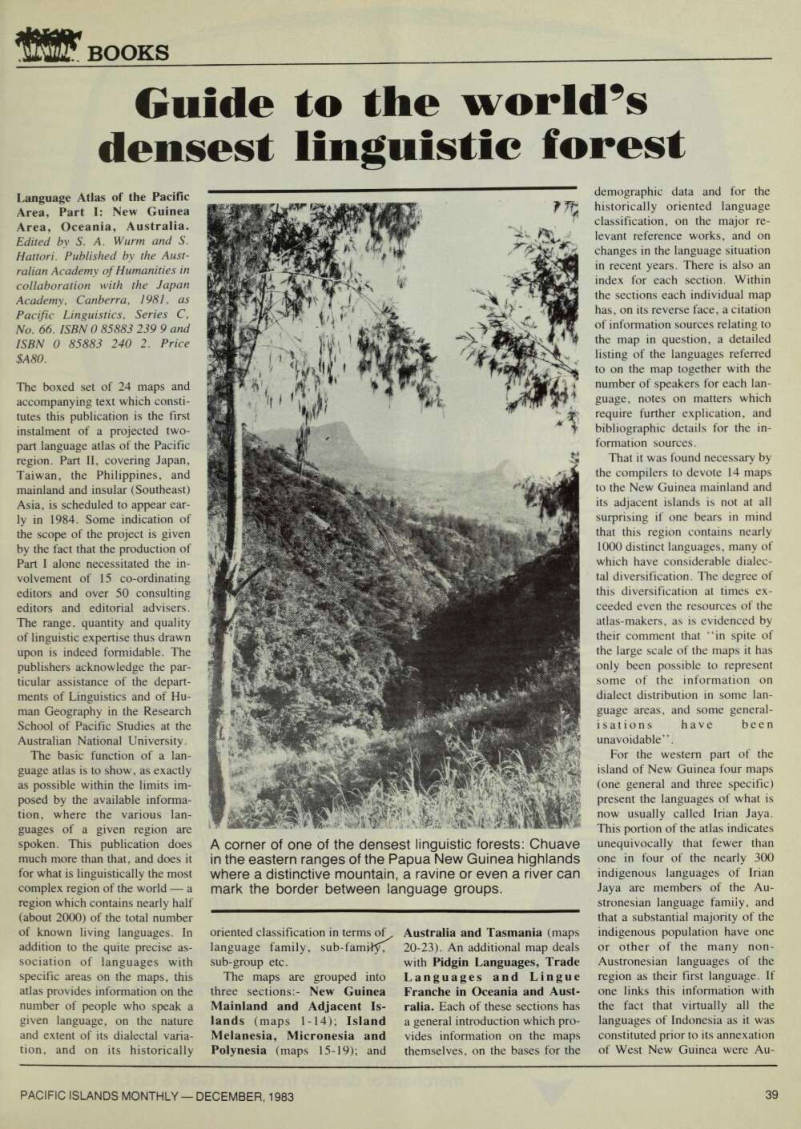

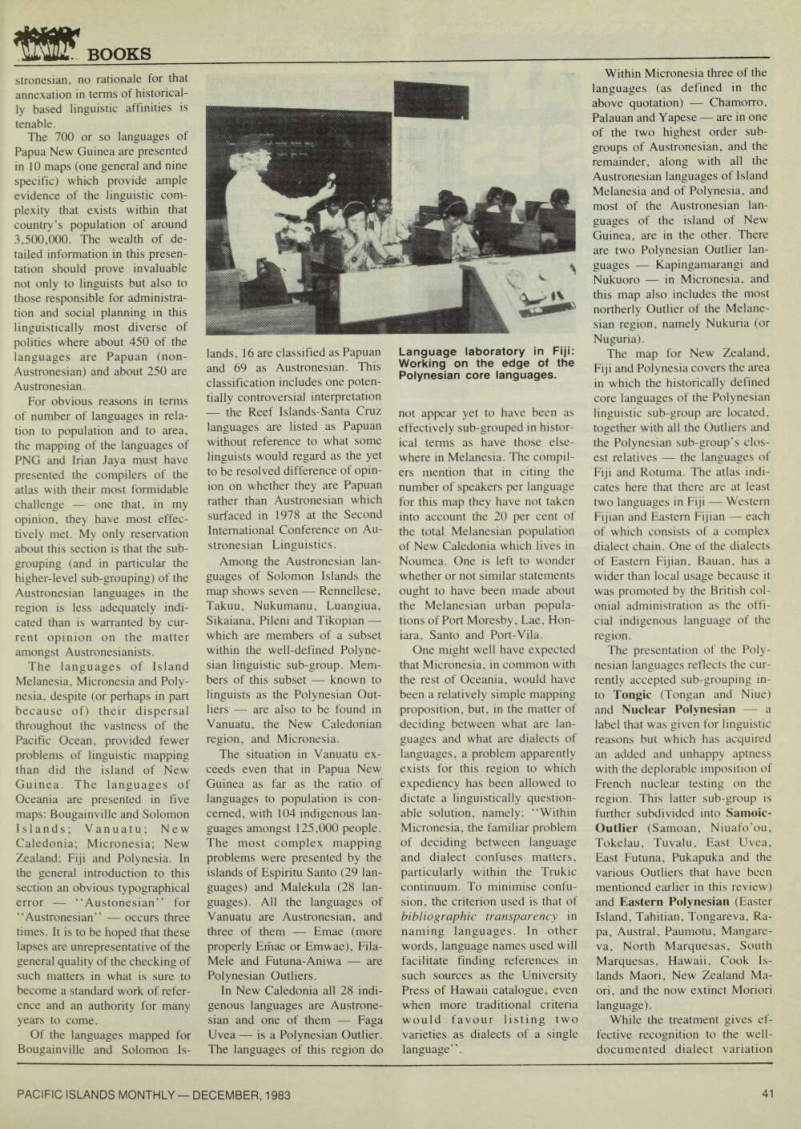
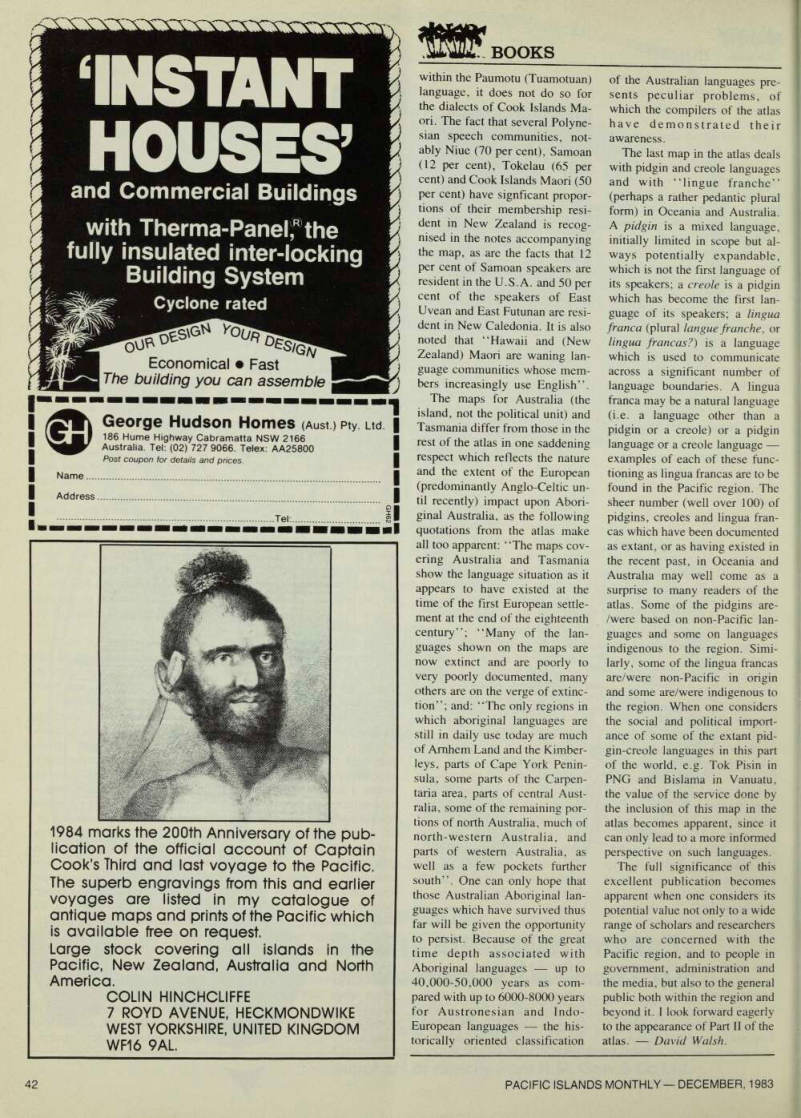
Books
Guide to the world’s densest linguistic forest
Language Atlas of the Pacific Area, Part I: New Guinea Area, Oceania, Australia.
Edited by S. A. Wurm and S.
Hattori. Published by the Aust ralian Academy of Humanities in collaboration with the Japan Academy, Canberra, 1981, as Pacific Linguistics, Series C, No. 66. ISBN 0 85883 239 9 and ISBN 0 85883 240 2. Price
Sabo.
The boxed set of 24 maps and accompanying text which consti tutes this publication is the first instalment of a projected two part language atlas of the Pacific region. Part 11, covering Japan, Taiwan, the Philippines, and mainland and insular (Southeast) Asia, is scheduled to appear ear ly in 1984. Some indication of the scope of the project is given by the fact that the production of Part I alone necessitated the in volvement of 15 co-ordinating editors and over 50 consulting editors and editorial advisers.
The range, quantity and quality of linguistic expertise thus drawn upon is indeed formidable. The publishers acknowledge the par ticular assistance of the depart ments of Linguistics and of Hu man Geography in the Research School of Pacific Studies at the Australian National University.
The basic function of a lan guage atlas is to show, as exactly as possible within the limits im posed by the available informa tion, where the various lan guages of a given region are spoken. This publication does much more than that, and does it for what is linguistically the most complex region of the world a region which contains nearly half (about 2000) of the total number of known living languages. In addition to the quite precise as sociation of languages with specific areas on the maps, this atlas provides information on the number of people who speak a given language, on the nature and extent of its dialectal varia tion, and on its historically
oriented classification in terms of, language family, sub-group etc.
The maps are grouped into three sections:- New Guinea Mainland and Adjacent Is lands (maps 1-14); Island Melanesia, Micronesia and Polynesia (maps 15-19); and
Australia and Tasmania (maps 20-23). An additional map deals with Pidgin Languages, Trade Languages and Lingue Franche in Oceania and Aust ralia. Each of these sections has a general introduction which pro vides information on the maps themselves, on the bases for the
demographic data and for the historically oriented language classification, on the major re levant reference works, and on changes in the language situation in recent years. There is also an index for each section. Within the sections each individual map has, on its reverse face, a citation of information sources relating to the map in question, a detailed listing of the languages referred to on the map together with the number of speakers for each lan guage, notes on matters which require further explication, and bibliographic details for the in formation sources.
That it was found necessary by the compilers to devote 14 maps to the New Guinea mainland and its adjacent islands is not at all surprising if one bears in mind that this region contains nearly 1000 distinct languages, many of which have considerable dialec tal diversification. The degree of this diversification at times ex ceeded even the resources of the atlas-makers, as is evidenced by their comment that “in spite of the large scale of the maps it has only been possible to represent some of the information on dialect distribution in some lan guage areas, and some general isations have been unavoidable”.
For the western part of the island of New Guinea four maps (one general and three specific) present the languages of what is now usually called Irian Jaya.
This portion of the atlas indicates unequivocally that fewer than one in four of the nearly 300 indigenous languages of Irian Jaya are members of the Au stronesian language family, and that a substantial majority of the indigenous population have one or other of the many non- Austronesian languages of the region as their first language. If one links this information with the fact that virtually all the languages of Indonesia as it was constituted prior to its annexation of West New Guinea were Au-
A corner of one of the densest linguistic forests: Chuave in the eastern ranges of the Papua New Guinea highlands where a distinctive mountain, a ravine or even a river can mark the border between language groups.
stronesian, no rationale for that annexation in terms of historical ly based linguistic affinities is tenable.
The 700 or so languages of Papua New Guinea are presented in 10 maps (one general and nine specific) which provide ample evidence of the linguistic com plexity that exists within that country’s population of around 3,500,000. The wealth of de tailed information in this presen tation should prove invaluable not only to linguists but also to those responsible for administra tion and social planning in this linguistically most diverse of polities where about 450 of the languages are Papuan (non- Austronesian) and about 250 are Austronesian.
For obvious reasons in terms of number of languages in rela tion to population and to area, the mapping of the languages of PNG and Irian Jay a must have presented the compilers of the atlas with their most formidable challenge one that, in my opinion, they have most effec tively met. My only reservation about this section is that the sub grouping (and in particular the higher-level sub-grouping) of the Austronesian languages in the region is less adequately indi cated than is warranted by cur rent opinion on the matter amongst Austronesianists.
The languages of Island Melanesia, Micronesia and Poly nesia, despite (or perhaps in part because of) their dispersal throughout the vastness of the Pacific Ocean, provided fewer problems of linguistic mapping than did the island of New Guinea. The languages of Oceania are presented in five maps: Bougainville and Solomon Islands; Vanuatu; New Caledonia; Micronesia; New Zealand; Fiji and Polynesia. In the general introduction to this section an obvious typographical error “Austonesian” for “Austronesian” occurs three times. It is to be hoped that these lapses are unrepresentative of the general quality of the checking of such matters in what is sure to become a standard work of refer ence and an authority for many years to come.
Of the languages mapped for Bougainville and Solomon Is-
lands, 16 are classified as Papuan and 69 as Austronesian. This classification includes one poten tially controversial interpretation the Reef Islands-Santa Cruz languages are listed as Papuan without reference to what some linguists would regard as the yet to be resolved difference of opin ion on whether they are Papuan rather than Austronesian which surfaced in 1978 at the Second International Conference on Au stronesian Linguistics.
Among the Austronesian lan guages of Solomon Islands the map shows seven Rennellese, Takuu, Nukumanu, Luangiua, Sikaiana, Pileni and Tikopian which are members of a subset within the well-defined Polyne sian linguistic sub-group. Mem bers of this subset known to linguists as the Polynesian Out liers are also to be found in Vanuatu, the New Caledonian region, and Micronesia.
The situation in Vanuatu ex ceeds even that in Papua New Guinea as far as the ratio of languages to population is con cerned, with 104 indigenous lan guages amongst 125,000 people.
The most complex mapping problems were presented by the islands of Espiritu Santo (29 lan guages) and Malekula (28 lan guages). All the languages of Vanuatu are Austronesian, and three of them Emae (more properly Emae or Emwae), Fila- Mele and Futuna-Aniwa are Polynesian Outliers.
In New Caledonia all 28 indi genous languages are Austrone sian and one of them Faga Uvea is a Polynesian Outlier.
The languages of this region do
not appear yet to have been as effectively sub-grouped in histor ical terms as have those else where in Melanesia. The compil ers mention that in citing the number of speakers per language for this map they have not taken into account the 20 per cent of the total Melanesian population of New Caledonia which lives in Noumea. One is left to wonder whether or not similar statements ought to have been made about the Melanesian urban popula tions of Port Moresby, Lae, Hon iara, Santo and Port-Vila.
One might well have expected that Micronesia, in common with the rest of Oceania, would have been a relatively simple mapping proposition, but, in the matter of deciding between what are lan guages and what are dialects of languages, a problem apparently exists for this region to which expediency has been allowed to dictate a linguistically question able solution, namely; “Within Micronesia, the familiar problem of deciding between language and dialect confuses matters, particularly within the Trukic continuum. To minimise confu sion, the criterion used is that of bibliographic transparency in naming languages. In other words, language names used will facilitate finding references in such sources as the University Press of Hawaii catalogue, even when more traditional criteria would favour listing two varieties as dialects of a single language”.
Within Micronesia three of the languages (as defined in the above quotation) Chamorro, Palauan and Yapese are in one of the two highest order sub groups of Austronesian, and the remainder, along with all the Austronesian languages of Island Melanesia and of Polynesia, and most of the Austronesian lan guages of the island of New Guinea, are in the other. There are two Polynesian Outlier lan guages Kapingamarangi and Nukuoro in Micronesia, and this map also includes the most northerly Outlier of the Melane sian region, namely Nukuria (or Nuguria).
The map for New Zealand, Fiji and Polynesia covers the area in which the historically defined core languages of the Polynesian linguistic sub-group are located, together with all the Outliers and the Polynesian sub-group’s clos est relatives the languages of Fiji and Rotuma. The atlas indi cates here that there are at least two languages in Fiji Western Fijian and Eastern Fijian each of which consists of a complex dialect chain. One of the dialects of Eastern Fijian, Bauan, has a wider than local usage because it was promoted by the British col onial administration as the offi cial indigenous language of the region.
The presentation of the Poly nesian languages reflects the cur
rently accepted sub-grouping in
to Tongic (Tongan and Niue) and Nuclear Polynesian a label that was given for linguistic reasons but which has acquired an added and unhappy aptness with the deplorable imposition of French nuclear testing on the region. This latter sub-group is further subdivided into Samoic- Outlier (Samoan, Niuafo’ou, Tokelau, Tuvalu, East Uvea, East Futuna, Pukapuka and the various Outliers that have been mentioned earlier in this review) and Eastern Polynesian (Easter Island, Tahitian, Tongareva, Ra pa, Austral, Paumotu, Mangare va, North Marquesas, South Marquesas, Hawaii, Cook Is lands Maori, New Zealand Ma ori, and the now extinct Moriori language).
While the treatment gives ef fective recognition to the well documented dialect variation
Language laboratory in Fiji: Working on the edge of the Polynesian core languages.
within the Paumotu (Tuamotuan) language, it does not do so for the dialects of Cook Islands Ma ori. The fact that several Polyne sian speech communities, not ably Niue (70 per cent), Samoan (12 per cent), Tokelau (65 per cent) and Cook Islands Maori (50 per cent) have signficant propor tions of their membership resi dent in New Zealand is recog nised in the notes accompanying the map, as are the facts that 12 per cent of Samoan speakers are resident in the U.S.A. and 50 per cent of the speakers of East Uvean and East Futunan are resi dent in New Caledonia. It is also noted that “Hawaii and (New Zealand) Maori are waning lan guage communities whose mem bers increasingly use English”.
The maps for Australia (the island, not the political unit) and Tasmania differ from those in the rest of the atlas in one saddening respect which reflects the nature and the extent of the European (predominantly Anglo-Celtic un til recently) impact upon Abori ginal Australia, as the following quotations from the atlas make all too apparent: “The maps cov ering Australia and Tasmania show the language situation as it appears to have existed at the time of the first European settle ment at the end of the eighteenth century”; “Many of the lan guages shown on the maps are now extinct and are poorly to very poorly documented, many others are on the verge of extinc tion”; and: “The only regions in which aboriginal languages are still in daily use today are much of Arnhem Land and the Kimber ley s, parts of Cape York Penin sula, some parts of the Carpen taria area, parts of central Aust ralia, some of the remaining por tions of north Australia, much of north-western Australia, and parts of western Australia, as well as a few pockets further south”. One can only hope that those Australian Aboriginal lan guages which have survived thus far will be given the opportunity to persist. Because of the great time depth associated with Aboriginal languages up to 40,000-50,000 years as com pared with up to 6000-8000 years for Austronesian and Indo- European languages the his torically oriented classification
of the Australian languages pre sents peculiar problems, of which the compilers of the atlas have demonstrated their awareness.
The last map in the atlas deals with pidgin and creole languages and with “lingue franche” (perhaps a rather pedantic plural form) in Oceania and Australia.
A pidgin is a mixed language, initially limited in scope but al ways potentially expandable, which is not the first language of its speakers; a creole is a pidgin which has become the first lan guage of its speakers; a lingua franca (plural langue franche, or lingua francas?) is a language which is used to communicate across a significant number of language boundaries. A lingua franca may be a natural language (i.e. a language other than a pidgin or a creole) or a pidgin language or a creole language examples of each of these func tioning as lingua francas are to be found in the Pacific region. The sheer number (well over 100) of pidgins, creoles and lingua fran cas which have been documented as extant, or as having existed in the recent past, in Oceania and Australia may well come as a surprise to many readers of the atlas. Some of the pidgins are /were based on non-Pacific lan guages and some on languages indigenous to the region. Simi larly, some of the lingua francas are/were non-Pacific in origin and some are/were indigenous to the region. When one considers the social and political import ance of some of the extant pid gin-creole languages in this part of the world, e.g. Tok Pisin in PNG and Bislama in Vanuatu, the value of the service done by the inclusion of this map in the atlas becomes apparent, since it can only lead to a more informed perspective on such languages.
The full significance of this excellent publication becomes apparent when one considers its potential value not only to a wide range of scholars and researchers who are concerned with the Pacific region, and to people in government, administration and the media, but also to the general public both within the region and beyond it. I look forward eagerly to the appearance of Part II of the atlas. David Walsh.
Advertisements & other items, pp. 40-42 (1 item)
ppMl^
WBH
K 3
GOLD
CREST
-UiW^v'
x.
Hr SAUI
I
SAUCt
eady to freeze ?•>(* ► I
SOLD \rJ:
»y£
GOLD
CREST
ENGLISH
TEACAKE
Cake mi\J §olo gp 2^v<?o
GOLD
<4 ‘' - Withcmnamon loppi
CREST
S&>
vAWC
FhUT fUtCE CORDIAL 2 Litre S^nOf
SONNET
/o\
A selection of
Quality Australian Products
manufactured by R.M. Gow & Co Ltd 30 Gow Street, Moorooka, Queensland. Postal address: PO Box 111, Moorooka, Queensland 4105, Australia. Cables: GOWCO Telex GOWCO AA42839 Phone: (07) 48 5061 Order from your local wholesaler, export merchant or directly from R.M. Gow & Co Ltd.
TCAI€)
INSTANT
HOUSES’
and Commercial Buildings with Therma-Panel, R the fully insulated inter-locking
Building System
Cyclone rated George Hudson Homes (Aust.) pty Ltd 186 Hume Highway Cabramatta NSW 2166 Australia. Tel: (02) 727 9066. Telex: AA25800 Post coupon for details and prices.
Address
1984 marks the 200th Anniversary of the publication of the official account of Captain Cook’s Third and last voyage to the Pacific.
The superb engravings from this and earlier voyages are listed in my catalogue of antique maps and prints of the Pacific which is available free on request.
Large stock covering all islands in the Pacific, New Zealand, Australia and North America.
COLIN HINCHCLIFFE
7 ROYD AVENUE, HECKMONDWIKE
WEST YORKSHIRE, UNITED KINGDOM
WFI6 9AL
story from 1930s Papua
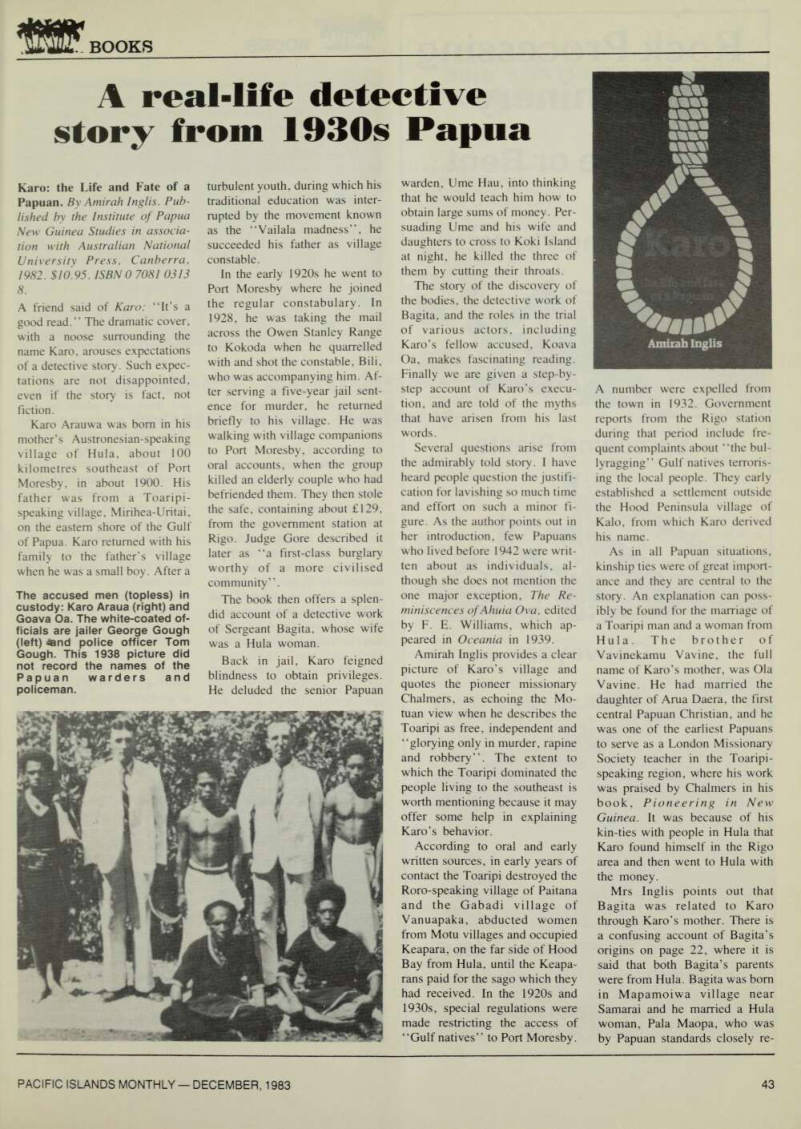

A real-life detective story from 1930s Papua
Karo: the Life and Fate of a Papuan. By Amirah Inglis. Pub lished by the Institute of Papua New Guinea Studies in associa tion with Australian National University Press, Canberra,
1982. $10.95. Isbno 7081 0313
8.
A friend said of Karo: “It’s a good read.” The dramatic cover, with a noose surrounding the name Karo, arouses expectations of a detective story. Such expec tations are not disappointed, even if the story is fact, not fiction.
Karo Arauwa was bom in his mother’s Austronesian-speaking village of Hula, about 100 kilometres southeast of Port Moresby, in about 1900. His father was from a Toaripi speaking village, Mirihea-Uritai, on the eastern shore of the Gulf of Papua. Karo returned with his family to the father’s village when he was a small boy. After a
turbulent youth, during which his traditional education was inter rupted by the movement known as the “Vailala madness”, he succeeded his father as village constable.
In the early 1920 s he went to Port Moresby where he joined the regular constabulary. In 1928, he was taking the mail across the Owen Stanley Range to Kokoda when he quarrelled with and shot the constable, Bili, who was accompanying him. Af ter serving a five-year jail sent ence for murder, he returned briefly to his village. He was walking with village companions to Port Moresby, according to oral accounts, when the group killed an elderly couple who had befriended them. They then stole the safe, containing about £129, from the government station at Rigo. Judge Gore described it later as “a first-class burglary worthy of a more civilised community”.
The book then offers a splen did account of a detective work of Sergeant Bagita, whose wife was a Hula woman.
Back in jail, Karo feigned blindness to obtain privileges.
He deluded the senior Papuan
warden, Ume Hau, into thinking that he would teach him how to obtain large sums of money. Per suading Ume and his wife and daughters to cross to Koki Island at night, he killed the three of them by cutting their throats.
The story of the discovery of the bodies, the detective work of Bagita, and the roles in the trial of various actors, including Karo’s fellow accused, Koava Oa, makes fascinating reading.
Finally we are given a step-by step account of Karo’s execu tion, and are told of the myths that have arisen from his last words.
Several questions arise from the admirably told story. I have heard people question the justifi cation for lavishing so much time and effort on such a minor fi gure. As the author points out in her introduction, few Papuans who lived before 1942 were writ ten about as individuals, al though she does not mention the one major exception. The Re miniscences of Ahuia Ova, edited by F. E. Williams, which ap peared in Oceania in 1939.
Amirah Inglis provides a clear picture of Karo’s village and quotes the pioneer missionary Chalmers, as echoing the Mo tuan view when he describes the Toaripi as free, independent and “glorying only in murder, rapine and robbery”. The extent to which the Toaripi dominated the people living to the southeast is worth mentioning because it may offer some help in explaining Karo’s behavior.
According to oral and early written sources, in early years of contact the Toaripi destroyed the Roro-speaking village of Paitana and the Gabadi village of Vanuapaka, abducted women from Motu villages and occupied Keapara, on the far side of Hood Bay from Hula, until the Keapa rans paid for the sago which they had received. In the 1920 s and 19305, special regulations were made restricting the access of “Gulf natives” to Port Moresby.
A number were expelled from the town in 1932. Government reports from the Rigo station during that period include fre quent complaints about “the bul lyragging” Gulf natives terroris ing the local people. They early established a settlement outside the Hood Peninsula village of Kalo, from which Karo derived his name.
As in all Papuan situations, kinship ties were of great import ance and they are central to the story. An explanation can poss ibly be found for the marriage of a Toaripi man and a woman from Hula. The brother of Vavinekamu Vavine, the full name of Karo’s mother, was Ola Vavine. He had married the daughter of Arua Daera, the first central Papuan Christian, and he was one of the earliest Papuans to serve as a London Missionary Society teacher in the Toaripi speaking region, where his work was praised by Chalmers in his book, Pioneering in New Guinea. It was because of his kin-ties with people in Hula that Karo found himself in the Rigo area and then went to Hula with the money.
Mrs Inglis points out that Bagita was related to Karo through Karo’s mother. There is a confusing account of Bagita’s origins on page 22, where it is said that both Bagita’s parents were from Hula. Bagita was bom in Mapamoiwa village near Samarai and he married a Hula woman, Pala Maopa, who was by Papuan standards closely re-
The accused men (topless) in custody; Karo Araua (right) and Goava Oa. The white-coated of ficials are jailer George Gough (left) police officer Tom Gough. This 1938 picture did not record the names of the Papuan warders and policeman.
lated to Karo’s mother. Pala’s grandfather was Vavine Kamu’s brother. These kinship ties would have helped Bagita in his
investigations.
The book makes a serious at tempt to see events through Pa puan eyes and is especially valu able in its account of how colo nial institutions such as prisons and courts worked in practice. A few points arise from the account of the trial. It was not “unusual in the British Empire” that indi genous people were tried without jury. I doubt whether the “white man’s ritual” was “alien” and “not easily comprehended” by Papuans who had been under colonial rule for 50 years. My own experience of such courts is that all concerned tried to manipulate the proceedings to their own ends as is clear from the evidence given by witnesses during Karo’s trial.
When the author repeats criti cism of the appointment of a defending counsel for Karo’s al leged accomplice, Koava, and not for Karo, I would like to have known how he came to be ap pointed. Presumably, as Karo had confessed, it was considered unnecessary to provide for his defence. More important is Mrs Inglis’ conclusion that “it seems clear that Goava was an acces sory; his lying evidence convicts him in retrospect”. The evidence against him was given by witnes ses who are admitted to have been biased. The only lie that Koava may have told was that he was friendly with Ume while, if he was away at the time of the murders as judge Gore accepted, several witnesses who gave evi dence against him were lying.
Surely at worst, we echo what was Judge Gore’s actual verdict “not proven”. It seems un likely that Karo would murder merely to please an acquaint ance, and, according to some oral evidence, Karo had a grudge against Ume. This is probable given Karo’s hatred of restraint, and the man who was the effec tive boss of the prison would have been an obvious target for his resentment.
Karo is shown to have been regarded, especially by his own people, as a Papuan Ned Kelly.
The author offers no explanation
for his behavior, possibly for fear of appearing ethnocentric. In brief, he murdered a Lala couple who had befriended him; shot a colleague whom the Reverend H.
A. Brown says was a senior constable, and who may have been considerably older than Karo; stole the Rigo safe; and murdered three people. He could only have had what appears to be no more than a minor grudge against the man and none at all against the woman and child. On more than one occasion he “dobbed in” his kinsmen and fellow villagers.
One can seek an explanation for his behavior in cultural terms.
In traditional Papuan societies, a man was only expected to behave ethically towards his kinsmen, and those with whom he ack
nowledged a relationship. All
others were fair game, the only limitation being fear of retaliation.
Prestige accrued from all homicides, whether of man, wo man or child.
The book reads like a novel, sometimes brilliantly.
I have one criticism. For the benefit of future generations the book could have been more fully referenced and a bibliography provided. This could have been done with very little trouble. It is irritating not to be able to find where Hobsbawm made his re marks, or to what “Chatterton 1974” refers. While there would be no need to litter the text with references or footnotes, a fuller account of oral sources, includ ing brief biographies and espe cially the ages of informants, would have been most helpful.
There is a list of ‘The principal characters” but it is incomplete.
A glossary of indigenous terms would also have been helpful.
The book contains a number of valuable photographs which bring to life a number of people mentioned in the text. It includes a map and is adequately pro duced for a book designed to reach a wide, including a Papua New Guinean, public.
It is recommended reading for all who are interested in the history of Papua between the two world wars and also and cer tainly for those who enjoy ‘‘a good read”. Nigel Oram.
Advertisements & other items, p. 44 (1 item)
Rock Processing
Machinery
For Sale or Rent
Crushing Plants
>ll 4 lift w
Screening Plants
r, BC
Conveyors
Rock Systems, Inc 1600 Kapiolani Blvd. Suite 1300 Honolulu, HI 96814 Phone (808) 944-5562 Telex# 7431987
A brewery founded where
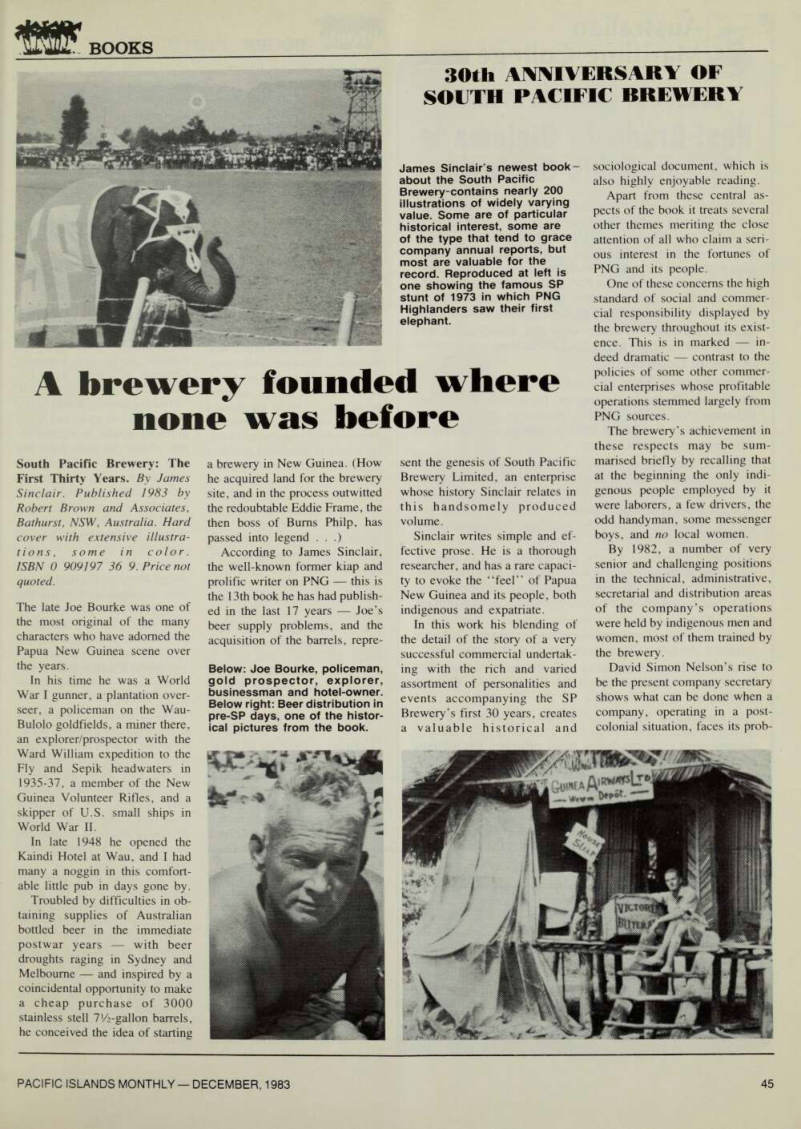
30Th Anniversary Of
South Pacific Brewery
A brewery founded where none was before
South Pacific Brewery: The First Thirty Years. By James Sinclair. Published 1983 by Robert Brown and Associates, Bathurst, NSW, Australia. Hard cover with extensive illustra tions, some in color.
ISBN 0 909197 36 9. Price not quoted.
The late Joe Bourke was one of the most original of the many characters who have adorned the Papua New Guinea scene over the years.
In his time he was a World War I gunner, a plantation over seer, a policeman on the Wau- Bulolo goldfields, a miner there, an explorer/prospector with the Ward William expedition to the Fly and Sepik headwaters in 1935-37, a member of the New Guinea Volunteer Rifles, and a skipper of U.S. small ships in World War 11.
In late 1948 he opened the Kaindi Hotel at Wau, and I had many a noggin in this comfort able little pub in days gone by.
Troubled by difficulties in ob taining supplies of Australian bottled beer in the immediate postwar years with beer droughts raging in Sydney and Melbourne and inspired by a coincidental opportunity to make a cheap purchase of 3000 stainless stell barrels, he conceived the idea of starting
a brewery in New Guinea. (How he acquired land for the brewery site, and in the process outwitted the redoubtable Eddie Frame, the then boss of Bums Philp, has
passed into legend . . .)
According to James Sinclair, the well-known former kiap and prolific writer on PNG this is the 13th book he has had publish ed in the last 17 years Joe’s beer supply problems, and the acquisition of the barrels, repre-
sent the genesis of South Pacific Brewery Limited, an enterprise whose history Sinclair relates in this handsomely produced volume.
Sinclair writes simple and ef fective prose. He is a thorough researcher, and has a rare capaci ty to evoke the “feel” of Papua New Guinea and its people, both indigenous and expatriate.
In this work his blending of the detail of the story of a very successful commercial undertak ing with the rich and varied assortment of personalities and events accompanying the SP Brewery’s first 30 years, creates a valuable historical and
sociological document, which is also highly enjoyable reading.
Apart from these central as pects of the book it treats several other themes meriting the close attention of all who claim a seri ous interest in the fortunes of PNG and its people.
One of these concerns the high standard of social and commer cial responsibility displayed by the brewery throughout its exist ence. This is in marked in deed dramatic contrast to the policies of some other commer cial enterprises whose profitable operations stemmed largely from PNG sources.
The brewery’s achievement in these respects may be sum marised briefly by recalling that at the beginning the only indi genous people employed by it were laborers, a few drivers, the odd handyman, some messenger boys, and no local women.
By 1982, a number of very senior and challenging positions in the technical, administrative, secretarial and distribution areas of the company’s operations were held by indigenous men and women, most of them trained by the brewery.
David Simon Nelson’s rise to be the present company secretary shows what can be done when a company, operating in a post colonial situation, faces its prob-
Below: Joe Bourke, policeman, gold prospector, explorer, businessman and hotel-owner.
Below right: Beer distribution in pre-SP days, one of the histor ical pictures from the book.
James Sinclair’s newest book about the South Pacific Brewery-contains nearly 200 illustrations of widely varying value. Some are of particular historical interest, some are of the type that tend to grace company annual reports, but most are valuable for the record. Reproduced at left is one showing the famous SP stunt of 1973 in which PNG Highlanders saw their first elephant.
lems with imagination and courage.
The late Bill Johns, general manager from 1957 to 1973; Bruce Flynn, who has been gen eral manager since John’s retire ment and Jim Cromie, chairman of directors from 1956 to 1980, all deserve high praise for their part in planning and implement ing this approach.
A second important theme of Sinclair’s work treats the subject of the opposition to the lifting of the prohibition laws which pre vented local people from drink
ing alcohol.
When the brewery was launch ed in 1952, there was already a growing public realisation that this ban, however well inten tioned, would have to be lifted.
Apart from the savage penalties prevailing I recall the shame I felt as I watched an outstanding Tolai medical practitioner swing ing a sarif (a sharpened length of hoop iron used for cutting grass) in Rabaul’s Queen Elizabeth Park, with his hair cropped and wearing a laplap with broad ar rows, as he served his six months sentence for drinking beer the overwhelming major ity of the local people, not all of whom were drinkers, saw the ban as just another form of racial discrimination against them.
It is not generally appreciated, for example, that it was the com bined Missions conference in 1961 which passed the resolution “marking the decisive turning point in the move to abolish prohibition”, as Sinclair puts it.
When “D” day dawned on November 3, 1962, the SP Brew ery received a bonus in the form of a greatly increased market potential. Joe Bourke, for all his fertile imagination, would never have dreamed of it when he was planning his local brewery back in 1948. As it happened, Joe and his wife Billie “went finish” only a few weeks before the great change.
No business enterprise could afford to ignore the new market now available. But it is a fact that the brewery showed great re straint, particularly in framing its various advertising campaigns which, in my recollection, made no specific effort to cultivate the indigenous market.
A further important theme
flows directly from the last: how has the drinking of alcohol af fected life in PNG since the legislation was introduced?
Financially, the liquor indus try, and the SP Brewery in par ticular, has provided an impor tant source of revenue for the government, and a wide variety of jobs for many people, both directly and indirectly. In the period 1972-81, excise on liquor amounted to the equivalent of $A130 million. In the same period the brewery paid company tax of about $6 million.
In terms of social effects, however, the picture is more depressing. The PNG Institute of Applied Social and Economic Research, in a report dated Oc tober 15, 1981, concluded: “PNG is presently poised on the brink of serious social and health problems related to alcohol ab use”. There can be no doubt that
over-indulgence in drinking has
contributed to the increase in serious crime, growing neglect of family and group obligations, and a deterioration in the health of those who habitually drink to excess.
It would be unjust and un reasonable to saddle the brewery with responsibility for this sad state of affairs. However, the book shows that the brewery is aware of the problem, and is co operating fully with all agencies — government and non government — seeking to al leviate the problem.
The publishers, Robert Brown & Associates of Bathurst, NSW, Australia, merit a brief mention.
Before this book appeared I must confess they were unknown to me. But just as SP Beer is justifi ably described as “a bloody good beer”, the manner of pro duction of this book justifies the description ‘‘a bloody good book”.
I can detect only two very minor blemishes: in the index Tom Ellis is listed as being men tioned on p 62 when it should be p 102, and, in the text, Lloyd Hurrell is described as winning the Military Medal when it should have been the Military Cross. And I think he won the decoration later than 1942, as stated, but I cannot be quite sure
of this.
— Max Or ken.
Advertisements & other items, p. 46 (1 item)
Hydrographic Surveying
bil
Australian
Maritime College
SCHOOL OF NAUTICAL STUDIES
Post-Graduate Diploma In
Hydrographic Surveying
A new course, unique in Australia, providing theoretical and practical tuition in hydrographic surveying for experienced mariners and land surveyors.
The training covers offshore, coastal, estuarine, river and port surveying, exploiting the variety of excellent survey situations near the AMC. The course is designed to meet the internationally accepted standards of competence for hydrographic surveyors Category A.
Career Options: Include offshore exploration and survey work in port and allied industries.
Duration: One year.
Commencing Date: February 1984.
Entrance Requirements: A Diploma of Applied Science (Nautical Science), Bachelor of Surveying, Master Class I or other appropriate qualifications as determined by the College.
Special Entrance: Special consideration may be given to applicants, including mature age applicants, who do not meet normal entry requirements.
Advanced Standing: Graduates of other formal surveying courses may be granted advanced standing for relevant parts of the AMC course.
Bridging Studies: These will be offered in mathematics and measurement science, and may be undertaken before the course commences or concurrent with the course depending on individual circumstances.
Fees: There are no full time course fees. Approval is being sought for Tertiary Education Assistance Scheme support. An annual facilities fee of $52 is payable.
Further Information: May be obtained from Mr Stan Horscroft, telephone (003) 26 0712, or Mr George Goldsteen, (003) 26 0770.
The Australian Maritime College is Australia’s only tertiary educational institution providing certificate to degree and post-graduate level courses exclusively for the shipping, fishing, port and off-shore industries.
The College’s main campus is at Newnham, Launceston.
The training vessels are adjacent to the Seamanship Centre at Beauty Point, near the mouth of the Tamar River.
Please send me more information on the Post-Graduate Diploma in Hydrographic Surveying.
Name: Address: Postcode: Send to:The Admissions Office, Australian Maritime College, P.O. Box 986, Launceston, Tas. 7250. i p Telephone; (003) 26 0731. §
A fisherman’s
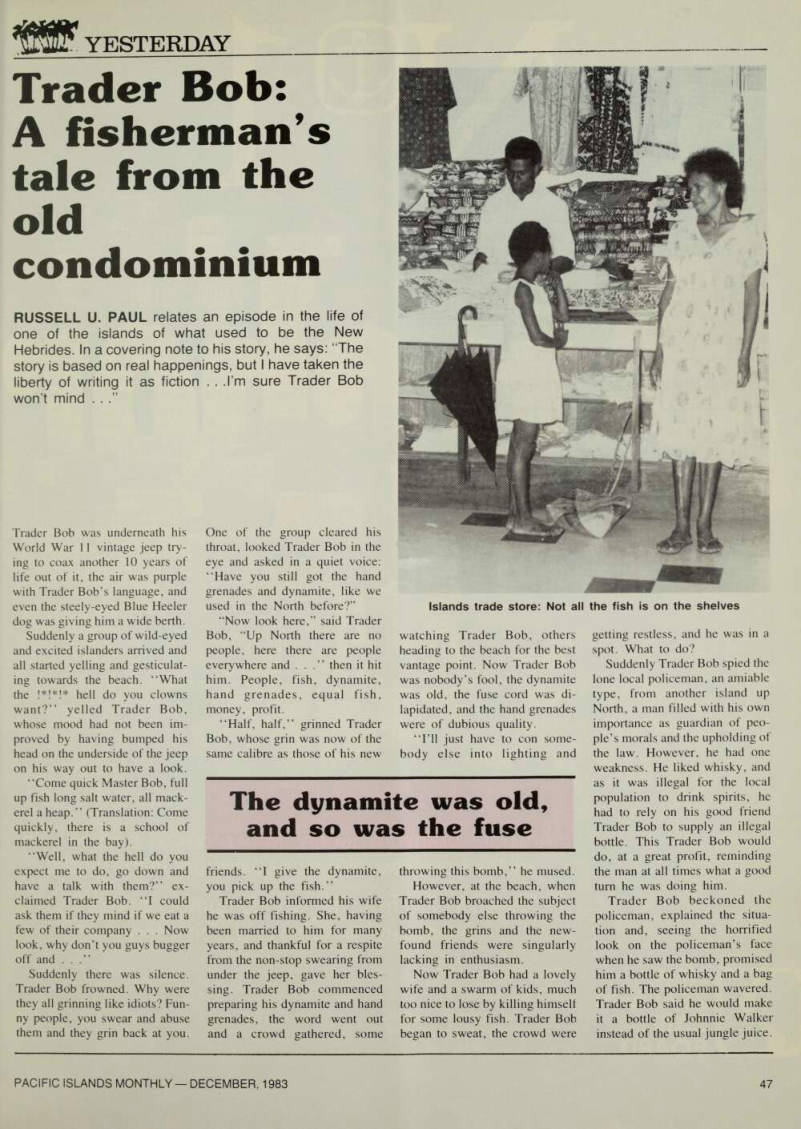
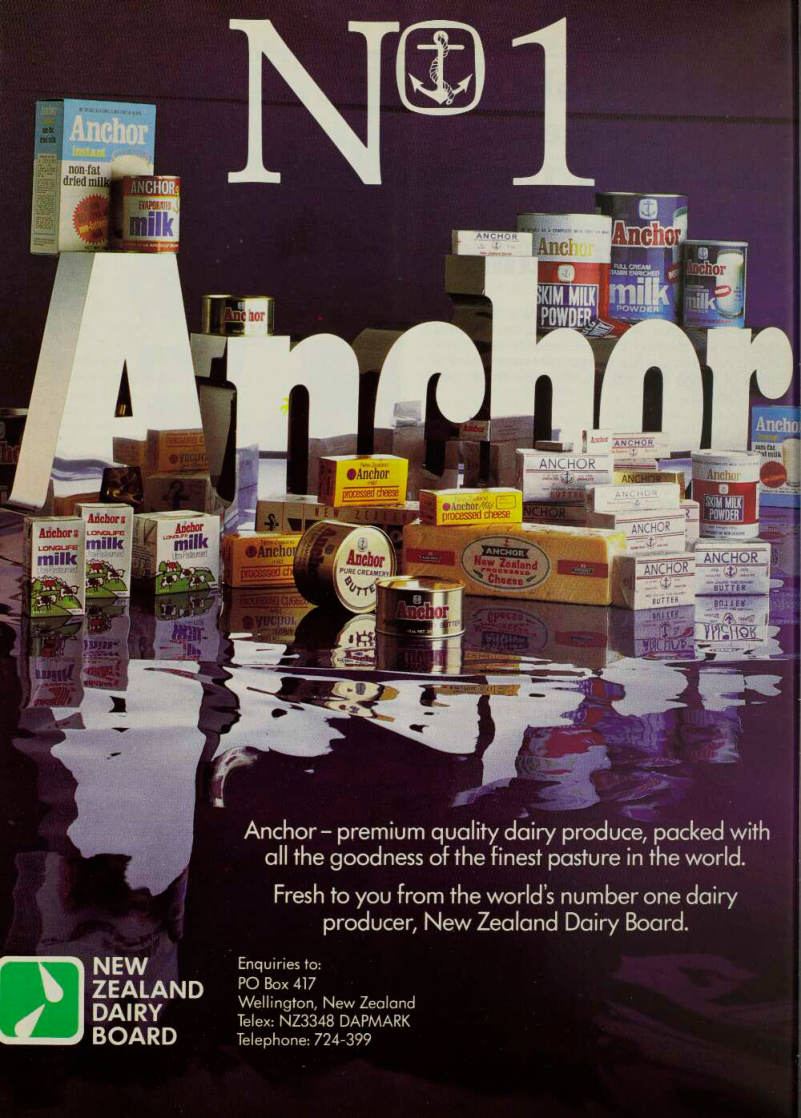
Yesterday
Trader Bob: A fisherman’s tale from the old condominium
RUSSELL U. PAUL relates an episode in the life of one of the islands of what used to be the New Hebrides. In a covering note to his story, he says: “The story is based on real happenings, but I have taken the liberty of writing it as fiction . . .I’m sure Trader Bob won’t mind . .
Trader Bob was underneath his World War 11 vintage jeep try ing to coax another 10 years of life out of it, the air was purple with Trader Bob’s language, and even the steely-eyed Blue Heeler dog was giving him a wide berth.
Suddenly a group of wild-eyed and excited islanders arrived and all started yelling and gesticulat ing towards the beach. “What the !*!*!* hell do you clowns want?” yelled Trader Bob, whose mood had not been im proved by having bumped his head on the underside of the jeep on his way out to have a look.
“Come quick Master Bob, full up fish long salt water, all mack erel a heap.” (Translation: Come quickly, there is a school of mackerel in the bay).
“Well, what the hell do you expect me to do, go down and have a talk with them?” ex claimed Trader Bob. “I could ask them if they mind if we eat a few of their company . . . Now look, why don’t you guys bugger off and ...”
Suddenly there was silence.
Trader Bob frowned. Why were they all grinning like idiots? Fun ny people, you swear and abuse them and they grin back at you.
One of the group cleared his throat, looked Trader Bob in the eye and asked in a quiet voice: “Have you still got the hand grenades and dynamite, like we used in the North before?”
“Now look here,” said Trader Bob, “Up North there are no people, here there are people everywhere and ...” then it hit him. People, fish, dynamite, hand grenades, equal fish,
money, profit.
“Half, half,” grinned Trader Bob, whose grin was now of the same calibre as those of his new
The dynamite was old, and so was the fuse
friends. “I give the dynamite, you pick up the fish.”
Trader Bob informed his wife he was off fishing. She, having been married to him for many years, and thankful for a respite from the non-stop swearing from under the jeep, gave her bles sing. Trader Bob commenced preparing his dynamite and hand grenades, the word went out and a crowd gathered, some
watching Trader Bob, others heading to the beach for the best vantage point. Now Trader Bob was nobody’s fool, the dynamite was old, the fuse cord was di lapidated, and the hand grenades were of dubious quality.
“I’ll just have to con some body else into lighting and
throwing this bomb,” he mused.
However, at the beach, when Trader Bob broached the subject of somebody else throwing the bomb, the grins and the new found friends were singularly lacking in enthusiasm.
Now Trader Bob had a lovely wife and a swarm of kids, much too nice to lose by killing himself for some lousy fish. Trader Bob began to sweat, the crowd were
getting restless, and he was in a spot. What to do?
Suddenly Trader Bob spied the lone local policeman, an amiable type, from another island up North, a man filled with his own importance as guardian of peo ple’s morals and the upholding of the law. However, he had one weakness. He liked whisky, and as it was illegal for the local population to drink spirits, he had to rely on his good friend Trader Bob to supply an illegal bottle. This Trader Bob would do, at a great profit, reminding: the man at all times what a good turn he was doing him.
Trader Bob beckoned the
policeman, explained the situa
tion and, seeing the horrified look on the policeman’s face when he saw the bomb, promised him a bottle of whisky and a bag; of fish. The policeman wavered.
Trader Bob said he would make it a bottle of Johnnie Walker instead of the usual jungle juice.
Islands trade store: Not all the fish is on the shelves
The policeman licked his lips, rolled his eyes and finally caved in.
Trader Bob explained the workings of the rather lethal bomb, patted his friend on the shoulder and discreetly put as much distance as possible bet ween himself and his mate. Even Trader Bob’s vicious Blue Heel er dog headed for the safety of the bush, knowing his master to be a fool but not anybody’s fool.
The hapless policeman stood in his moment of glory, praying to his ancestors and any gods who happened to be listening, lit the bomb and threw it. Now the man had a good throwing arm, and a fast pair of legs. The crowd, bunkered down in the surrounding reef and in the trees, roared their approval as he took off up the beach in a mad sprint.
The policeman threw himself in to a long shallow dive in the general direction of an old boat, which was the nearest shelter.
Trader Bob’s mad Blue Heeler, now caught up in the excitement, followed in similar fashion and the bomb went off.
And what a bomb. A great spout of water shot a hundred metres into the air, half the reef was blown up, and what seemed to be millions of dead fish were floating around. Trader Bob swears to this day that in the excitement the policeman even bit the dog.
The crowd took off to the water, swimming around gather ing the dead and stunned fish.
The piles of fish on the beach were getting bigger and more numerous. Trader Bob was doing a roaring business, a shilling for five fish, and no likelihood of ever finishing them all. Trader
'There’s 30 quid In it’
Bob cast a practised eye over the heaps of fish, did a quick calcu lation, subtracted the price of the promised bottle, and reckoned he would make at least 30 quid.
Now the little group of islands where Trader Bob lived were unusual in that they were ad ministered by both the British and French colonial govern ments. On Trader Bob’s island
there was a French District Agent, a short dapper little Fren chman, and an English District Agent, a pompous fool whose legacies in ineptitude were strewn across Africa and the Far East. It was these gentlemen’s job to know everything that went on around the place and to report on it, in triplicate if possible.
Trader Bob, it seems had sadly under-estimated the power of his bomb, and the noise of its explo sion travelled the three kilometres to the District Agency grounds. The French District Agent was the first to arrive at the beach, but he was a good chap and Trader Bob had enjoy ed many a social drink with him.
“What are you doing Bob,” asked the Frenchman, “a little bit of spearfishing?”
“That’s right,” said Trader Bob, “would you like some to take home?” Trader Bob filled a sack full of fish, had somebody put it in his car, shook hands with the Frenchman and pro mised to drop by for a drink.
Shortly after the British District Agent arrived, and he was not amused at what he saw.
“What the hell is going on here, you’ve gone too far this time Bob.”
“Belt up you pompous prick,” replied Trader Bob, who had no time for authority and feared no man. “I’ll give you a bag and you can go back to your siesta.”
The Englishman felt that his was a dignified post, and could never understand mad Aust ralians like Trader Bob who would not respect him and made him look an ass in front of the locals.
Gathering what remained of
his dignity, and having spied his
policeman in the crowd, the Dis trict Agent instructed the hapless man to take four fish as evidence and to immediately begin investi gations as to who threw the dyna mite. The District Agent then
departed.
Trader Bob and the crowd roared with laughter: The fool had instructed the very man who
threw the dynamite to conduct investigations.
“What the hell am I going to do now?” asked the policeman.
“Tell you what,” said Trader Bob, “tell him you have con ducted investigations and found out that it was George Rolland who threw the dynamite.”
George Rolland was Trader Bob’s friendly opposition trader, and Trader Bob reckoned he would appreciate the joke.
George Rolland was a Fren chman, and therefore under French law, and could not be touched by the British District Agent. The District Agent wrote a stiff note to his French collea-
An evasive policeman
gue demanding the arrest of the criminal Rolland. The French man, realising that his British counterpart had been had by Trader Bob, replied that he was investigating the matter and would be in touch. He hoped in the meantime that the matter would die.
The British District Agent de cided that something, apart from the millions of fish, was fishy about the whole affair, and his normally diligent policeman was being rather evasive about the matter.
In the meantime, there being no electricity, the District Agent had put the evidence in his kerosene ice box. Being still an noyed with Trader Bob he had instructed his wife not to shop at Trader Bob’s store and his chil dren not to play with Trader Bob’s children. As a result the fridge ran out of kerosene, the fish went bad, and his wife had to throw out all of their precious freezer goods. His wife burst into tears, accused him of being “a stupid old bore” and a blazing row ensued with threats of di vorce and “I'm going home to mother”. The District Agent muttered dire threats about what he was going to do to Trader Bob.
However, Trader Bob’s island was a lovely place, the matter was put in the “too hard” file, and life returned to normal.
Years later, Trader Bob went
for a business trip to the capital, where the District Agent was now stationed. After a busy day
of buying and selling produce,
Trader Bob sought a beer at the “club” to slake his thirst, catch up on gossip, and meet old friends.
The only other man at the bar was his old friend the District Agent, who still harbored suspi cion of Trader Bob over the fish
episode.
Trader Bob, always a
straightforward chap, strode up
to him and said; “Listen Richard, let’s forget the past. I’ll buy you a drink.” The District
Agent reluctantly agreed and
they began to put away the drinks. Several hours later, by now the very best of friends and well on their way to what pro mised to be a memorable night, the District Agent brought up the matter of the fish.
“Tell me Bob, I know every body was laughing at me and that Frenchman wouldn’t prosecute Rolland, who threw the dyna mite, was it you or him?”
“Neither,” said Trader Bob, “It was your policeman!” There was an incredulous silence, the man’s lips began to move, he clenched and unclenched his fists, sweat broke out on his brow, and Trader Bob thought that the man might be about to hit him.
“You !*!*!*”, bellowed the District Agent and they both roared with laughter. He called Trader Bob every name in the book, and they both roared with laughter again.
“You must come home right now and have dinner with the family,” insisted the District Agent. T'll ring the wife and tell her, she’s always felt bad about this.”
When they arrived at his home, and after Trader Bob had said hello to the wife and kids, the District Agent asked his wife what was for dinner.
“Fish,” she said and she never could understand why they just stood there and laughed until they cried.
Advertisements & other items, pp. 48-52 (1 item)
Anchor - premium quality dairy produce, packed with
ANCHOR
Lil
RMJL CREAM
TAMIN ENRICHED f : .
KIM
ilk P owo
POW
E", Anck |t>WM mm
ANCHOR
ANCHOR
Wm ’ »>•* E Z 5 v$ I Jr C -f: F ■
NEW
ZEALAND
DAIRY
BOARD
Anchor - premium quality dairy produce, packed with all the goodness of the finest pasture in the world.
Fresh to you from the world’s number one dairy
producer, New Zealand Dairy Board.
Enquiries to: PO Box 417 Wellington, New Zealand
Telex: NZ3348 DAPMARK
Telephone: 724-399
Five minutes after reading the instructions,
Betty produced the best recording
she ever made in her life.
She did it because AlWA’s V-700 system is simply the “smartest,” most automated highperformance component ensemble ever created.
Not only does it dub automatically from disc to cassette at the touch of a single “Synchro Recording” control; its fully programmable turntable and exclusive “Auto Editing” facility will record up to seven tracks on the disc in any desired order, automatically.
An optional “plug-in” rack even lets Betty install this versatile 45 Watt per channel system without the bother of struggling with complicated wiring connections.
The V-700 system from AIWA: no faster, easier way to make great, “original label” recordings!
B
AIWA
AIWA Co., Ltd. 11-9, Ueno 1-chome, Taito-ku, Tokyo, Japan.
Distributors: Australia AIWA Australia Pty., Ltd./Cook Islands Island Merchants Ltd./Fiji P. Hargovind & Co., D. Ranchhod & Co./Guam Micropac Audio, Inc./New Caledonia hifivox/New Zealand Milaw Trading Co., Ltd./P.N.G. Oceania Indent Agency (P.N.G.) Pty, Ltd./Solomon Islands Harvest Pacific Ltd./Tahiti Fare Hi-Fi Stereo/Vanuatu (New Hebrides)The Sound Centre Ltd.
NORTH QUEENSLAND ENGINEERS
& AGENTS PTY. LTD.
tm.
Shipbuilding and Repair are our Business We have full facilities for repair or refitting SLIPPING to 750 tonne DOCKING to 200 feet The shipbuilding division can construct a vessel to your design, or design one to suit your needs.
Barges, Tugs, Workboats, Catamarans, Landing Craft and Patrol Boats are all within our scope.
CALL
TODAY
N.Q.E.A.
36 Buchan Street, Cairns 4870 P.O. Box 1105, Cairns Telephone (070) 51 6600. Telex 48087 )
CONTRACTORS TO THE ROYAL AUSTRALIAN NAVY
Mirror image change of government
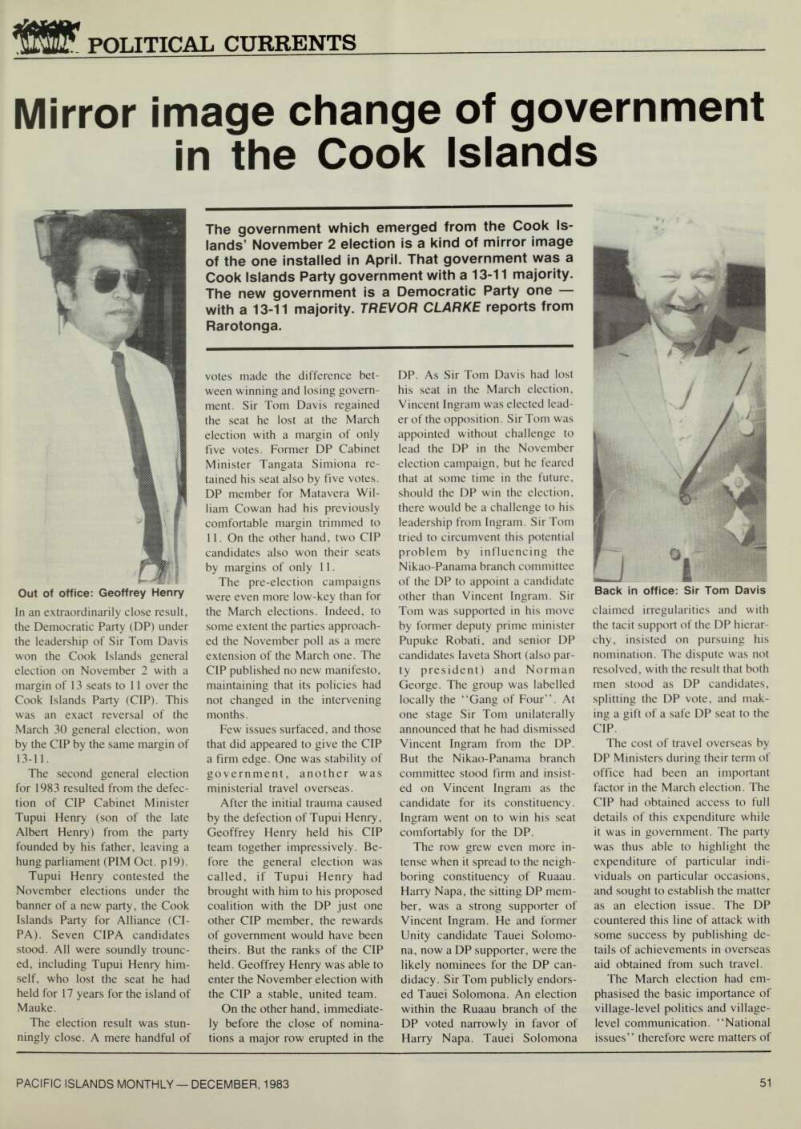
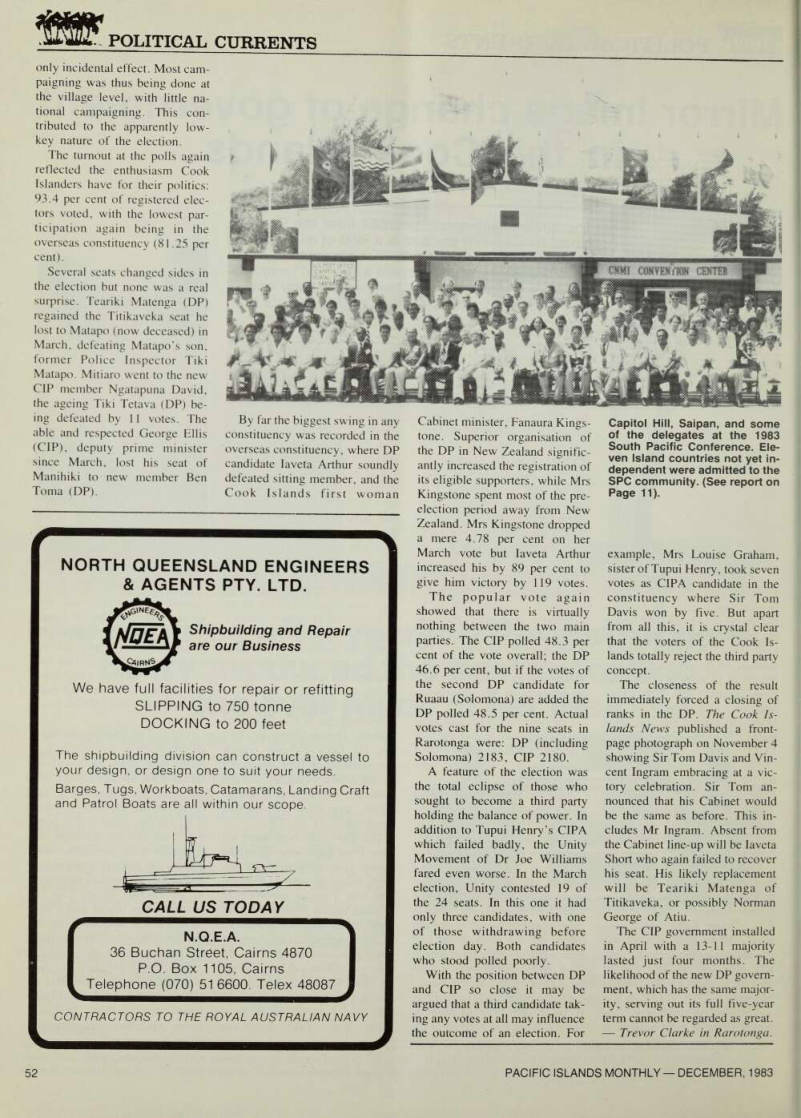
Political Currents
Mirror image change of government in the Cook Islands
The government which emerged from the Cook Is lands’ November 2 election is a kind of mirror image of the one installed in April. That government was a Cook Islands Party government with a 13-11 majority.
The new government is a Democratic Party one with a 13-11 majority. TREVOR CLARKE reports from Rarotonga.
In an extraordinarily close result, the Democratic Party (DP) under the leadership of Sir Tom Davis won the Cook Islands general election on November 2 with a margin of 13 seats to 11 over the Cook Islands Party (CIP). This was an exact reversal of the March 30 general election, won by the CIP by the same margin of 13-11.
The second general election for 1983 resulted from the defec tion of CIP Cabinet Minister Tupui Henry (son of the late Albert Henry) from the party founded by his father, leaving a hung parliament (PIM Oct. pi 9).
Tupui Henry contested the November elections under the banner of a new party, the Cook Islands Party for Alliance (CI PA). Seven CIPA candidates stood. All were soundly trounc ed, including Tupui Henry him self, who lost the seat he had held for 17 years for the island of Mauke.
The election result was stun ningly close. A mere handful of
votes made the difference bet ween winning and losing govern ment. Sir Tom Davis regained the seat he lost at the March election with a margin of only five votes. Former DP Cabinet Minister Tangata Simiona re tained his seat also by five votes.
DP member for Matavera Wil liam Cowan had his previously comfortable margin trimmed to 11. On the other hand, two CIP candidates also won their seats by margins of only 11.
The pre-election campaigns were even more low-key than for the March elections. Indeed, to some extent the parties approach ed the November poll as a mere extension of the March one. The CIP published no new manifesto, maintaining that its policies had not changed in the intervening months.
Few issues surfaced, and those that did appeared to give the CIP a firm edge. One was stability of government, another was ministerial travel overseas.
After the initial trauma caused by the defection of Tupui Henry, Geoffrey Henry held his CIP team together impressively. Be fore the general election was called, if Tupui Henry had brought with him to his proposed coalition with the DP just one other CIP member, the rewards of government would have been theirs. But the ranks of the CIP held. Geoffrey Henry was able to enter the November election with the CIP a stable, united team.
On the other hand, immediate ly before the close of nomina tions a major row erupted in the
DP. As Sir Tom Davis had lost his seat in the March election, Vincent Ingram was elected lead er of the opposition. Sir Tom was appointed without challenge to lead the DP in the November election campaign, but he feared that at some time in the future, should the DP win the election, there would be a challenge to his leadership from Ingram. Sir Tom tried to circumvent this potential problem by influencing the Nikao-Panama branch committee of the DP to appoint a candidate other than Vincent Ingram. Sir Tom was supported in his move by former deputy prime minister Pupuke Robati, and senior DP candidates laveta Short (also par ty president) and Norman George. The group was labelled locally the “Gang of Four”. At one stage Sir Tom unilaterally announced that he had dismissed Vincent Ingram from the DP.
But the Nikao-Panama branch committee stood firm and insist ed on Vincent Ingram as the candidate for its constituency.
Ingram went on to win his seat comfortably for the DP.
The row grew even more in tense when it spread to the neigh boring constituency of Ruaau.
Harry Napa, the sitting DP mem ber, was a strong supporter of Vincent Ingram. He and former Unity candidate Tauei Solomo na, now a DP supporter, were the likely nominees for the DP can didacy. Sir Tom publicly endors ed Tauei Solomona. An election within the Ruaau branch of the DP voted narrowly in favor of Harry Napa. Tauei Solomona
claimed irregularities and with the tacit support of the DP hierar chy, insisted on pursuing his nomination. The dispute was not resolved, with the result that both men stood as DP candidates, splitting the DP vote, and mak ing a gift of a safe DP seat to the
Cip.
The cost of travel overseas by DP Ministers during their term of office had been an important factor in the March election. The CIP had obtained access to full details of this expenditure while it was in government. The party was thus able to highlight the expenditure of particular indi viduals on particular occasions, and sought to establish the matter as an election issue. The DP countered this line of attack with some success by publishing de tails of achievements in overseas aid obtained from such travel.
The March election had em phasised the basic importance of village-level politics and village level communication. “National issues” therefore were matters of
Out of office; Geoffrey Henry
Back in office: Sir Tom Davis
only incidental effect. Most cam paigning was thus being done at the village level, with little na tional campaigning. This con tributed to the apparently low key nature of the election.
The turnout at the polls again reflected the enthusiasm Cook Islanders have for their politics: 93.4 per cent of registered elec tors voted, with the lowest par ticipation again being in the overseas constituency (81.25 per cent).
Several seats changed sides in the election but none was a real surprise. Teariki Matenga (DP) regained the Titikaveka seat he lost to Matapo (now deceased) in March, defeating Matapo’s son, former Police Inspector Tiki Matapo. Mitiaro went to the new CIP member Ngatapuna David, the ageing Tiki Tetava (DP) be ing defeated by 11 votes. The able and respected George Ellis (CIP), deputy prime minister since March, lost his seat of Manihiki to new member Ben Toma (DP).
By far the biggest swing in any constituency was recorded in the overseas constituency, where DP candidate laveta Arthur soundly defeated sitting member, and the Cook Islands first woman
Cabinet minister, Fanaura Kings tone. Superior organisation of the DP in New Zealand signific antly increased the registration of its eligible supporters, while Mrs Kingstone spent most of the pre election period away from New Zealand. Mrs Kingstone dropped a mere 4.78 per cent on her March vote but laveta Arthur increased his by 89 per cent to give him victory by 119 votes.
The popular vote again showed that there is virtually nothing between the two main parties. The CIP polled 48.3 per cent of the vote overall; the DP 46.6 per cent, but if the votes of the second DP candidate for Ruaau (Solomona) are added the DP polled 48.5 per cent. Actual votes cast for the nine seats in Rarotonga were: DP (including Solomona) 2183, CIP 2180.
A feature of the election was the total eclipse of those who sought to become a third party holding the balance of power. In addition to Tupui Henry’s CIPA which failed badly, the Unity Movement of Dr Joe Williams fared even worse. In the March election, Unity contested 19 of the 24 seats. In this one it had only three candidates, with one of those withdrawing before election day. Both candidates who stood polled poorly.
With the position between DP and CIP so close it may be argued that a third candidate tak ing any votes at all may influence the outcome of an election. For
example, Mrs Louise Graham, sister of Tupui Henry, took seven votes as CIPA candidate in the constituency where Sir Tom Davis won by five. But apart from all this, it is crystal clear that the voters of the Cook Is lands totally reject the third party concept.
The closeness of the result immediately forced a closing of ranks in the DP. The Cook Is lands News published a front page photograph on November 4 showing Sir Tom Davis and Vin cent Ingram embracing at a vic tory celebration. Sir Tom an nounced that his Cabinet would be the same as before. This in cludes Mr Ingram. Absent from the Cabinet line-up will be laveta Short who again failed to recover his seat. His likely replacement will be Teariki Matenga of Titikaveka, or possibly Norman George of Atiu.
The CIP government installed in April with a 13-11 majority lasted just four months. The likelihood of the new DP govern ment, which has the same major ity, serving out its full five-year term cannot be regarded as great.
Trevor Clarke in Rarotonga.
Capitol Hill, Saipan, and some of the delegates at the 1983 South Pacific Conference. Ele ven Island countries not yet in dependent were admitted to the SPC community. (See report on
Page 11).
Somare, Pacific Man of the Year,
speaks out in New York
Prime Minister Michael Thomas Somare of Papua New Guinea became the first “South Pacific Man of the Year” (PIM, Oct. p 5) at an October ceremony honoring his achievements. The ceremony was in New York’s famous Met ropolitian Museum of Art.
“This is an historic occasion,” said Lelei Lelaulu, director of the Pacific Islands Association, at the opening ceremonies. “It marks the first time an American institution has focused on the Island nations of the North and South Pacific to honor one of the Island leaders in this kind of way.
“We believe it signals a new consciousness of the importance of the Oceanic nations in a world which every day grows smaller.”
Elizabeth B. Silverstein, presi dent of The Foundation for the Peoples of the South Pacific (FSP), and initiator of the award proudly presented a beautiful en graved gold plaque to the prime minister.
“Prime Minister Michael Thomas Somare was chosen for the 1983 Award in recognition of his remarkable success in build ing a nation peacefully from more than 800 disparate lan guage groups, and for his un swerving dedication to the strengthening of the neighboring nations of the South Pacific reg ion,” said Mrs Silverstein.
Mr Somare, who, accom panied by his Minister for Foreign Affairs and Trade, Rab bie Namaliu, and other dig nitaries, had flown to New York to be named “South Pacific Man of the Year,” and to address the United Nations General Assem bly, was overcome with emotion as he accepted the award in the appropriate setting of the Michael C. Rockefeller wing of the museum, which houses the world’s largest collection of Oceanic art.
But his sense of humor pre vailed when he admitted “to
NICKY HOLFORD reports to RIM from New York on the ceremony at which Papua New Guinea Prime Minister MICHAEL SOMARE was awarded the Pacific Man of the Year Award, and on his remarks during his acceptance
speech.
some small inner misgivings” on first hearing of his nomination for the award, and later that the presentation was to take place in the Rockefeller wing amongst the famous PNG collection.
“I wondered if the curator had designs on me,” he joked. Then he added; “There are, back in Papua New Guinea, certain gent lemen who are called the opposition to my government who would be only too happy to see me permanently locked away in a glass case in the Metropolit can Museum.”
“If the award is meant to be an acknowledgment of any achieve ment of mine,” said Mr Somare, “my greatest pride in receiving it is the recognition it gives to the energy and determination with which the people of Papua New Guinea have responded to the challenge of independence.”
More than 100 distinguished guests representing all Island na tions and many institutions of the United States Government and the U.S. business and banking community attended the cere mony, which will now become a yearly event. State Department officials included Robert Brand, deputy assistant secretary of state for East Asian and Pacific Af fairs, and Richard Dols, director of the Pacific Islands Affairs Office of the U.S. Department of State.
Also present was Mary Rock efeller Morgan, twin sister of the late Michael C. Rockefeller, who collected many of the museum’s traditional artefacts when he was in PNG.
“I was very happy to be in
vited,” Mrs Morgan said. “This is the sort of thing the museum should be used for.”
The prime minister was also presented with a cheque by FSP for a project of his choice.
Mr Somare said the money will help to preserve his coun try’s traditional cultures. “For some time I have been consider ing ways of strengthening and perpetuating the cultures of the Sepik River area. This cheque will give me an opportunity to establish a museum in the Sepik dedicated to just such a task.”
Following the presentation Prime Minister Somare gave the Elizabeth B. Silverstein Address and spoke out about his country’s commitment to make political independence an “economic reality.”
“We welcome help when it is sincere,” he said. “But, member ship of the modem world brings its own problems.
“When Americans hold their breath, Papua New Guinean hearts beat faster. Without any choice in the matter we, and all other Pacific Island nations, are part of the great strategic game,” he said.
Quoting a statement of Elizabeth Silverstein, the prime minister continued: “The Pacific basin has become a new focal point of world attention. Its vast maritime resources in food and its potential in seabed mining are being eyed with much specula tion by the powerful nations that crowd its rim.”
Mr Somare stressed that he believes America must set the tone in the Pacific.
“The United States, with its massive military might, can do virtually anything it pleases.
“It is America’s commitment to right that concerns me.
“Since its foundations the great republic has shown a com mitment to democracy, freedom and the rights of others unparal leled in history.”
The prime minister continued: “Too often the United States has abandoned her role of moral leadership and merely flexed its military muscles.
“We recognise that America cannot ignore its strategic inter ests in the Pacific. But at the same time we, who suffered grievously in the Second World War, do not want to once again become a battlefield.
“Nor do we wish to continue our present odious role of being a nuclear testing field.”
Mr Somare praised FSP not only for helping the peoples of the South Pacific to keep up with the changing world, but for also holding on to the cultural herit age which distinguishes all Pacif ic Island nations.
FSP has put special emphasis on establishing “self-help” prog rams and projects at the grass roots level. Established in 1965, FSP is now recognised as the
largest non-profit organisation
working in the Pacific to set up programs that help promote edu cational, medical and light in dustrial projects, and to assist the inhabitants of the region to fulfill the potential of the areas in which they live.
“True self-sufficiency lies in a nation’s people, not in its nation al accounts,” said Mr Somare.
“The foundation’s bottom line deals with people not digits: with motivation, aptitude, initiative with providing the encourage ment for small people to survive and thrive with dignity, inde pendence, and no loss of identity in a changing and competitive world.”
cargo ships
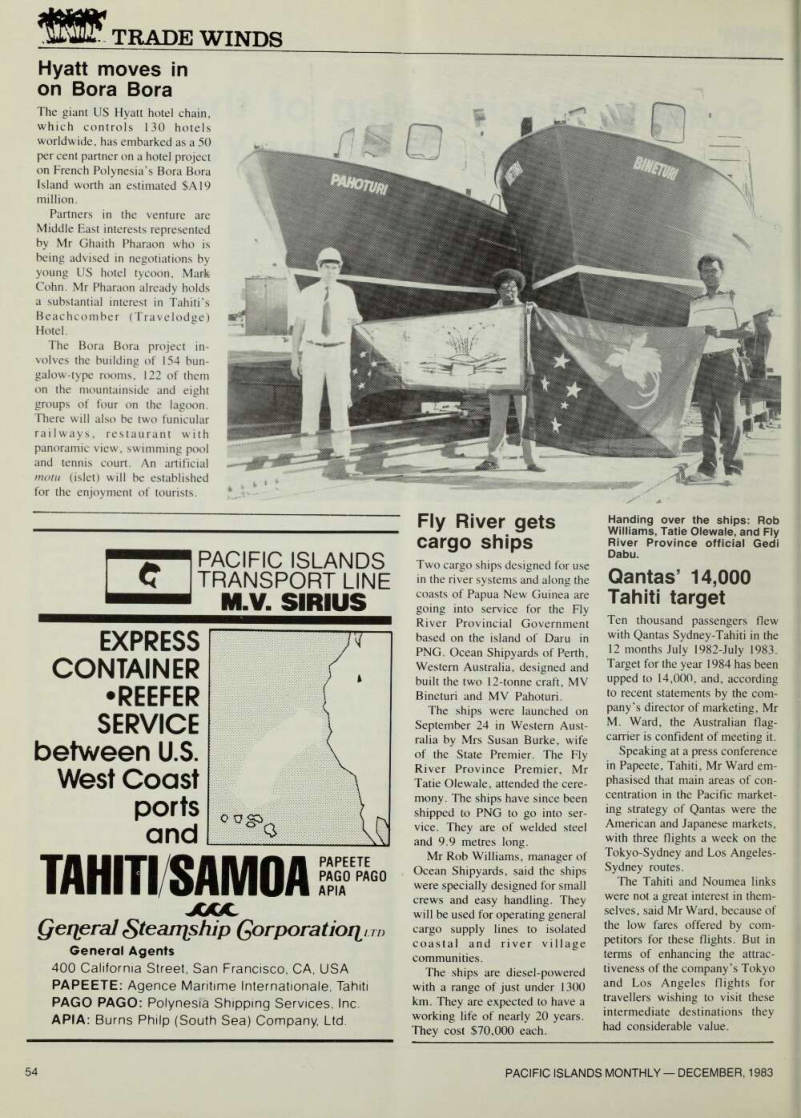
Trade Winds
Hyatt moves in
on Bora Bora
The giant US Hyatt hotel chain, which controls 130 hotels worldwide, has embarked as a 50 per cent partner on a hotel project on French Polynesia’s Bora Bora Island worth an estimated SAI9 million.
Partners in the venture are Middle East interests represented by Mr Ghaith Pharaon who is being advised in negotiations by young US hotel tycoon, Mark Cohn. Mr Pharaon already holds a substantial interest in Tahiti’s
Beachcomber (Travelodge)
Hotel.
The Bora Bora project in volves the building of 154 bun galow-type rooms, 122 of them on the mountainside and eight groups of four on the lagoon.
There will also be two funicular railways, restaurant with panoramic view, swimming pool and tennis court. An artificial motu (islet) will be established for the enjoyment of tourists.
Fly River gets
cargo ships
Two cargo ships designed for use in the river systems and along the coasts of Papua New Guinea are going into service for the Fly River Provincial Government based on the island of Daru in PNG. Ocean Shipyards of Perth, Western Australia, designed and built the two 12-tonne craft, MV Bineturi and MV Pahoturi.
The ships were launched on September 24 in Western Aust ralia by Mrs Susan Burke, wife of the State Premier. The Fly River Province Premier, Mr Tatie Olewale, attended the cere mony. The ships have since been shipped to PNG to go into ser vice. They are of welded steel and 9.9 metres long.
Mr Rob Williams, manager of Ocean Shipyards, said the ships were specially designed for small crews and easy handling. They will be used for operating general cargo supply lines to isolated coastal and river village communities.
The ships are diesel-powered with a range of just under 1300 km. They are expected to have a working life of nearly 20 years.
They cost $70,000 each.
Qantas’ 14,000
Tahiti target
Ten thousand passengers flew with Qantas Sydney-Tahiti in the 12 months July 1982-July 1983.
Target for the year 1984 has been upped to 14,000, and, according to recent statements by the com pany’s director of marketing, Mr M. Ward, the Australian flag carrier is confident of meeting it.
Speaking at a press conference in Papeete, Tahiti, Mr Ward em phasised that main areas of con centration in the Pacific market ing strategy of Qantas were the American and Japanese markets, with three flights a week on the Tokyo-Sydney and Los Angeles-
Sydney routes.
The Tahiti and Noumea links were not a great interest in them selves, said Mr Ward, because of the low fares offered by com petitors for these flights. But in terms of enhancing the attrac tiveness of the company’s Tokyo and Los Angeles flights for travellers wishing to visit these intermediate destinations they had considerable value.
Handing over the ships: Rob Williams, Tatie Olewale, and Fly River Province official Gedi Dabu.
Advertisements & other items, p. 54 (1 item)
Tahiti Samoa ™
c
PACIFIC ISLANDS
TRANSPORT LINE
M.V. SIRIUS
EXPRESS
CONTAINER
•REEFER
SERVICE
between U.S.
West Coast
ports
and mm* o y
TAHITI SAMOA ™
JO oc QeqeraJ Steanishjp Qorporatioriuo General Agents 400 California Street, San Francisco, CA, USA PAPEETE: Agence Maritime Internationale, Tahiti PAGO PAGO: Polynesia Shipping Services, Inc.
APIA: Burns Philp (South Sea) Company, Ltd.
tells Pacific governments
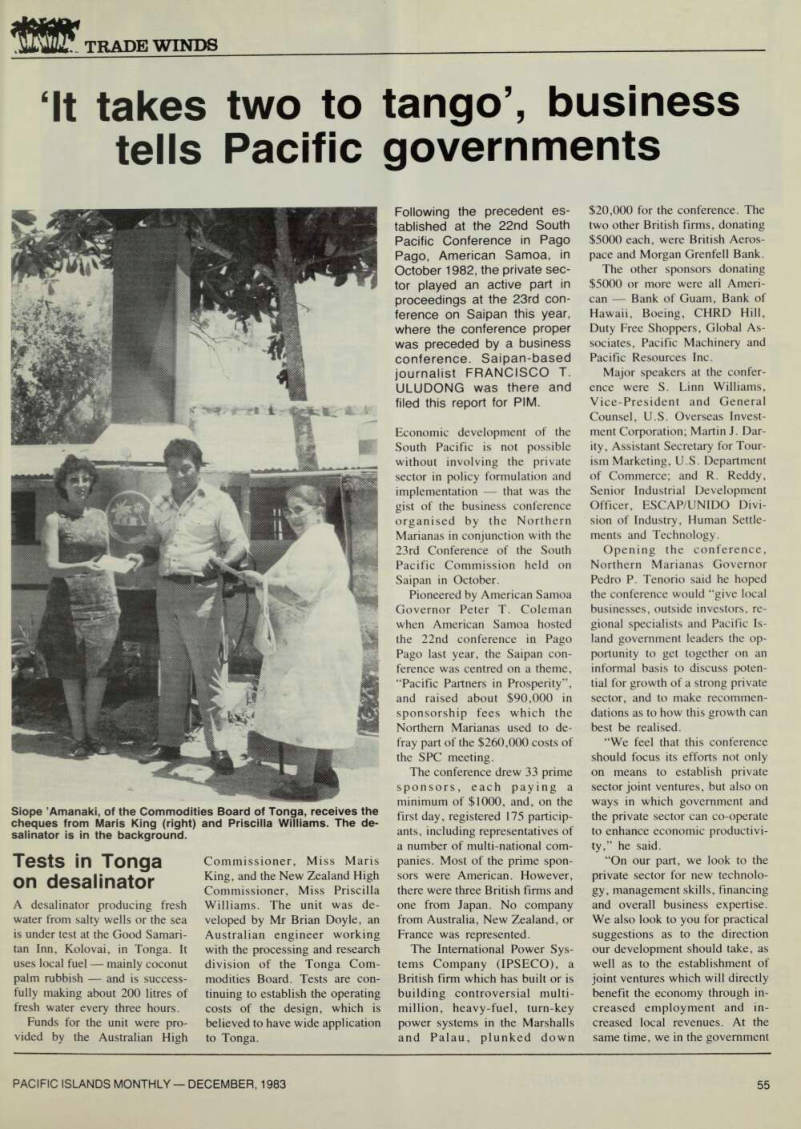
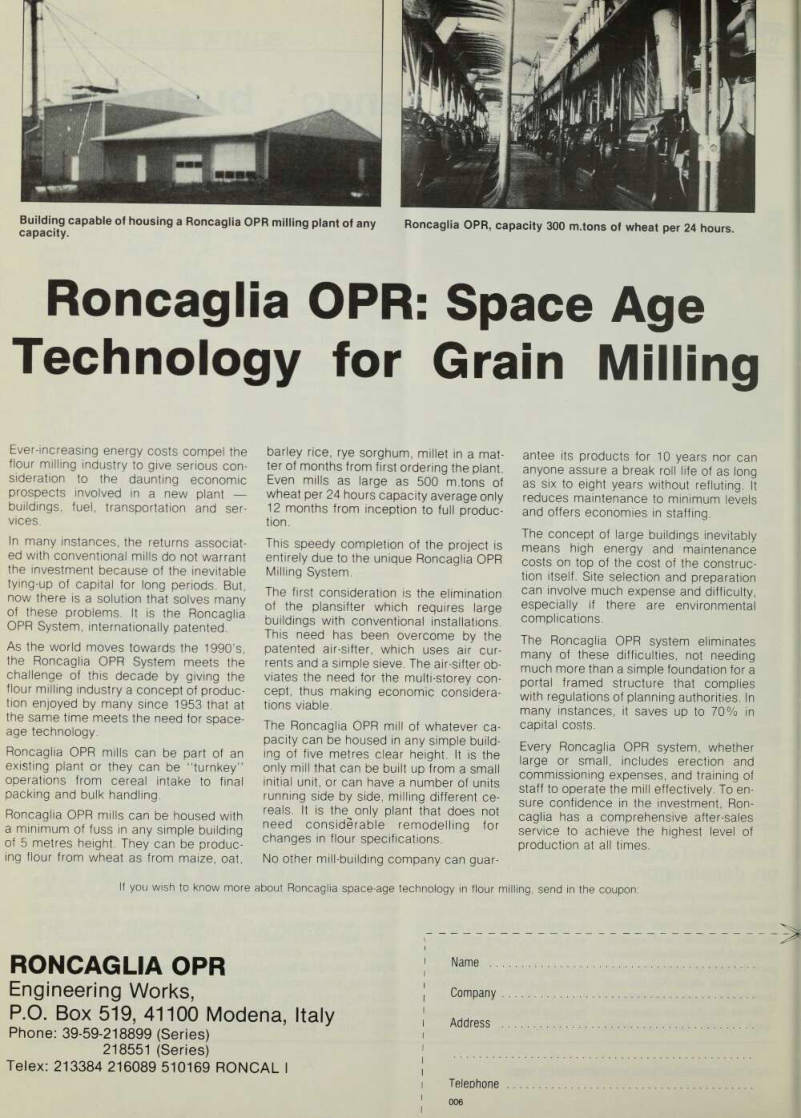
‘lt takes two to tango’, business tells Pacific governments
Tests in Tonga
on desalinator
A desalinator producing fresh water from salty wells or the sea is under test at the Good Samari tan Inn, Kolovai, in Tonga. It uses local fuel mainly coconut palm rubbish and is success fully making about 200 litres of fresh water every three hours.
Funds for the unit were pro vided by the Australian High
Commissioner, Miss Maris King, and the New Zealand High Commissioner, Miss Priscilla Williams. The unit was de veloped by Mr Brian Doyle, an Australian engineer working with the processing and research division of the Tonga Com modities Board. Tests are con tinuing to establish the operating costs of the design, which is believed to have wide application to Tonga.
Following the precedent es
tablished at the 22nd South Pacific Conference in Pago Pago, American Samoa, in October 1982, the private sec tor played an active part in proceedings at the 23rd con ference on Saipan this year, where the conference proper was preceded by a business
conference. Saipan-based
journalist FRANCISCO T.
ULUDONG was there and filed this report for PIM.
Economic development of the South Pacific is not possible without involving the private sector in policy formulation and implementation that was the gist of the business conference organised by the Northern Marianas in conjunction with the 23rd Conference of the South Pacific Commission held on Saipan in October.
Pioneered by American Samoa Governor Peter T. Coleman when American Samoa hosted the 22nd conference in Pago Pago last year, the Saipan con ference was centred on a theme, “Pacific Partners in Prosperity”, and raised about $90,000 in sponsorship fees which the Northern Marianas used to de fray part of the $260,000 costs of the SPC meeting.
The conference drew 33 prime sponsors, each paying a minimum of $lOOO, and, on the first day, registered 175 particip ants, including representatives of a number of multi-national com panies. Most of the prime spon sors were American. However, there were three British firms and one from Japan. No company from Australia, New Zealand, or France was represented.
The International Power Sys tems Company (IPSECO), a British firm which has built or is building controversial multi million, heavy-fuel, turn-key power systems in the Marshalls and Palau, plunked down
$20,000 for the conference. The two other British firms, donating $5OOO each, were British Aeros pace and Morgan Grenfell Bank.
The other sponsors donating $5OOO or more were all Ameri can Bank of Guam, Bank of Hawaii, Boeing, CHRD Hill, Duty Free Shoppers, Global As sociates, Pacific Machinery and Pacific Resources Inc.
Major speakers at the confer ence were S. Linn Williams, Vice-President and General Counsel, U.S. Overseas Invest ment Corporation; Martin J. Dar ity, Assistant Secretary for Tour ism Marketing, U.S. Department of Commerce; and R. Reddy, Senior Industrial Development Officer, ESCAP/UNIDO Divi sion of Industry, Human Settle ments and Technology.
Opening the conference, Northern Marianas Governor Pedro P. Tenorio said he hoped the conference would “give local businesses, outside investors, re gional specialists and Pacific Is land government leaders the op portunity to get together on an informal basis to discuss poten tial for growth of a strong private sector, and to make recommen dations as to how this growth can best be realised.
“We feel that this conference should focus its efforts not only on means to establish private sector joint ventures, but also on ways in which government and the private sector can co-operate to enhance economic productivi ty,” he said.
“On our part, we look to the private sector for new technolo gy, management skills, financing and overall business expertise.
We also look to you for practical suggestions as to the direction our development should take, as well as to the establishment of joint ventures which will directly benefit the economy through in creased employment and in creased local revenues. At the same time, we in the government
Slope Amanaki, of the Commodities Board of Tonga, receives the cheques from Maris King (right) and Priscilla Williams. The de salinator is in the background.
Building capable of housing a Roncaglia OPR milling plant of any capacity.
Roncaglia OPR, capacity 300 m.tons of wheat per 24 hours.
Roncaglia OPR: Space Age
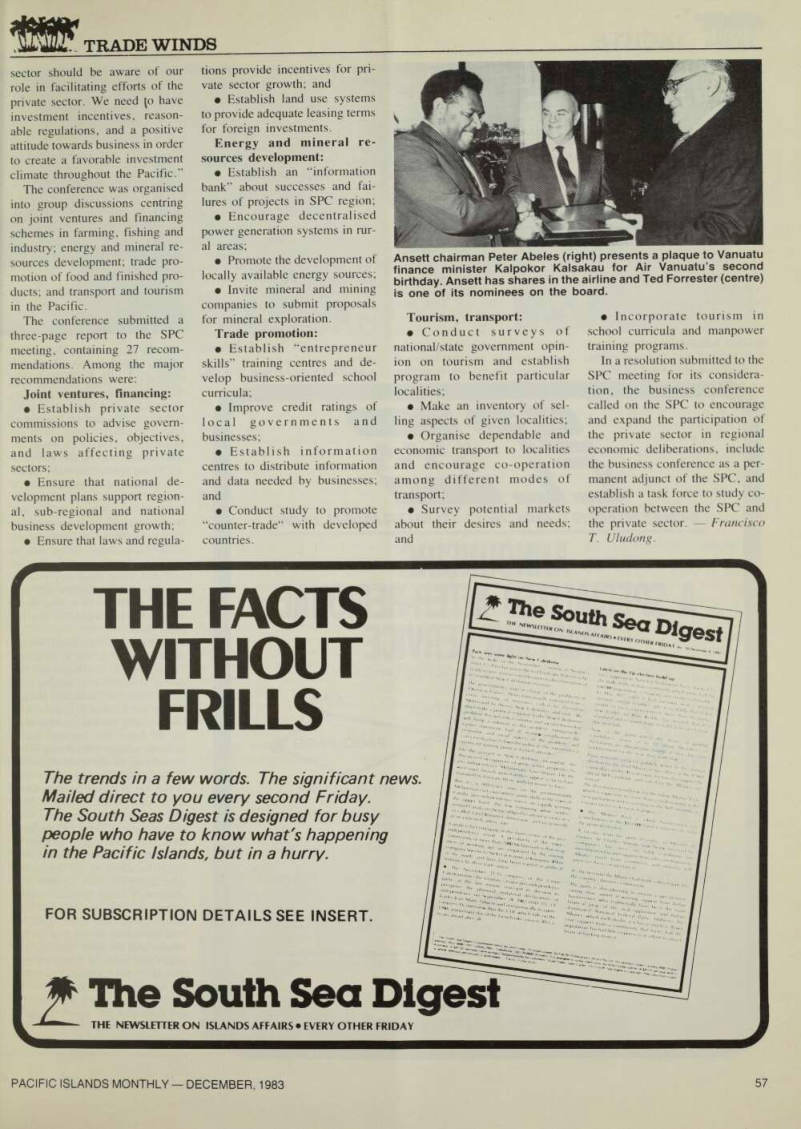
Technology for Grain Milling
Ever-increasing energy costs compel the flour milling industry to give serious con sideration to the daunting economic prospects involved in a new plant buildings, fuel, transportation and ser vices.
In many instances, the returns associat ed with conventional mills do not warrant the investment because of the inevitable tying-up of capital for long periods. But, now there is a solution that solves many of these problems. It is the Roncaglia OPR System, internationally patented.
As the world moves towards the 1990’5, the Roncaglia OPR System meets the challenge of this decade by giving the flour milling industry a concept of produc tion enjoyed by many since 1953 that at the same time meets the need for space age technology.
Roncaglia OPR mills can be part of an existing plant or they can be “turnkey” operations from cereal intake to final packing and bulk handling.
Roncaglia OPR mills can be housed with a minimum of fuss in any simple building of 5 metres height. They can be produc ing flour from wheat as from maize, oat,
barley rice, rye sorghum, millet in a mat ter of months from first ordering the plant.
Even mills as large as 500 m.tons of wheat per 24 hours capacity average only 12 months from inception to full produc tion.
This speedy completion of the project is entirely due to the unique Roncaglia OPR Milling System.
The first consideration is the elimination of the plansifter which requires large buildings with conventional installations.
This need has been overcome by the patented air-sifter, which uses air cur rents and a simple sieve. The air-sifter ob viates the need for the multi-storey con cept, thus making economic considera tions viable.
The Roncaglia OPR mill of whatever ca pacity can be housed in any simple build ing of five metres clear height. It is the only mill that can be built up from a small initial unit, or can have a number of units running side by side, milling different ce reals. It is plant that does not need considerable remodelling for changes in flour specifications.
No other mill-building company can guar
antee its products for 10 years nor can anyone assure a break roll life of as long as six to eight years without refluting. It reduces maintenance to minimum levels and offers economies in staffing.
The concept of large buildings inevitably means high energy and maintenance costs on top of the cost of the construc tion itself. Site selection and preparation can involve much expense and difficulty, especially if there are environmental complications.
The Roncaglia OPR system eliminates many of these difficulties, not needing much more than a simple foundation for a portal framed structure that complies with regulations of planning authorities. In many instances, it saves up to 70% in capital costs.
Every Roncaglia OPR system, whether large or small, includes erection and commissioning expenses, and training of staff to operate the mill effectively. To en sure confidence in the investment, Ron caglia has a comprehensive after-sales service to achieve the highest level of production at all times.
If you wish to know more about Roncaglia space-age technology in flour milling, send in the coupon:
sector should be aware of our role in facilitating efforts of the private sector. We need (o have investment incentives, reason able regulations, and a positive attitude towards business in order to create a favorable investment climate throughout the Pacific.”
The conference was organised into group discussions centring on joint ventures and financing schemes in farming, fishing and industry; energy and mineral re sources development; trade pro motion of food and finished pro ducts; and transport and tourism in the Pacific.
The conference submitted a three-page report to the SPC meeting, containing 27 recom mendations. Among the major recommendations were: Joint ventures, financing: • Establish private sector commissions to advise govern ments on policies, objectives, and laws affecting private sectors; • Ensure that national de velopment plans support region al, sub-regional and national business development growth; • Ensure that laws and regula
tions provide incentives for pri vate sector growth; and • Establish land use systems to provide adequate leasing terms for foreign investments.
Energy and mineral re sources development: • Establish an “information bank” about successes and fai lures of projects in SPC region; • Encourage decentralised power generation systems in rur al areas; • Promote the development of locally available energy sources; • Invite mineral and mining companies to submit proposals for mineral exploration.
Trade promotion:
• Establish “entrepreneur skills” training centres and de velop business-oriented school curricula; • Improve credit ratings of local governments and businesses; • Establish information centres to distribute information and data needed by businesses; and • Conduct study to promote “counter-trade” with developed countries.
Tourism, transport: • Conduct surveys of national/state government opin ion on tourism and establish program to benefit particular localities; • Make an inventory of sel ling aspects of given localities;
• Organise dependable and
economic transport to localities and encourage co-operation among different modes of transport; • Survey potential markets about their desires and needs; and
• Incorporate tourism in school curricula and manpower training programs.
In a resolution submitted to the SPC meeting for its considera tion, the business conference called on the SPC to encourage and expand the participation of the private sector in regional economic deliberations, include the business conference as a per manent adjunct of the SPC, and establish a task force to study co operation between the SPC and the private sector. Francisco T. Uludong.
Ansett chairman Peter Abeles (right) presents a plaque to Vanuatu finance minister Kalpokor Kalsakau for Air Vanuatu’s second birthday. Ansett has shares in the airline and Ted Forrester (centre) is one of its nominees on the board.
Advertisements & other items, pp. 56-57 (1 item)
Engineering Works,
RONCAGLIA OPR
P.O. Box 519, 41100 Modena, Italy
Phone: 39-59-218899 (Series) 218551 (Series) Telex: 213384 216089 510169 RONCAL I Name ..
Company Address Teleohone 006
THE FACTS
WITHOUT
FRILLS
The trends in a few words. The significant news Mailed direct to you every second Friday.
The South Seas Digest is designed for busy people who have to know what's happening in the Pacific Islands, but in a hurry.
FOR SUBSCRIPTION DETAILS SEE INSERT.
f The South Sea Digest
“ THE NEWSLETTER ON ISLANDS AFFAIRS • EVERY OTHER FRIDAY Di 9est
Yachts
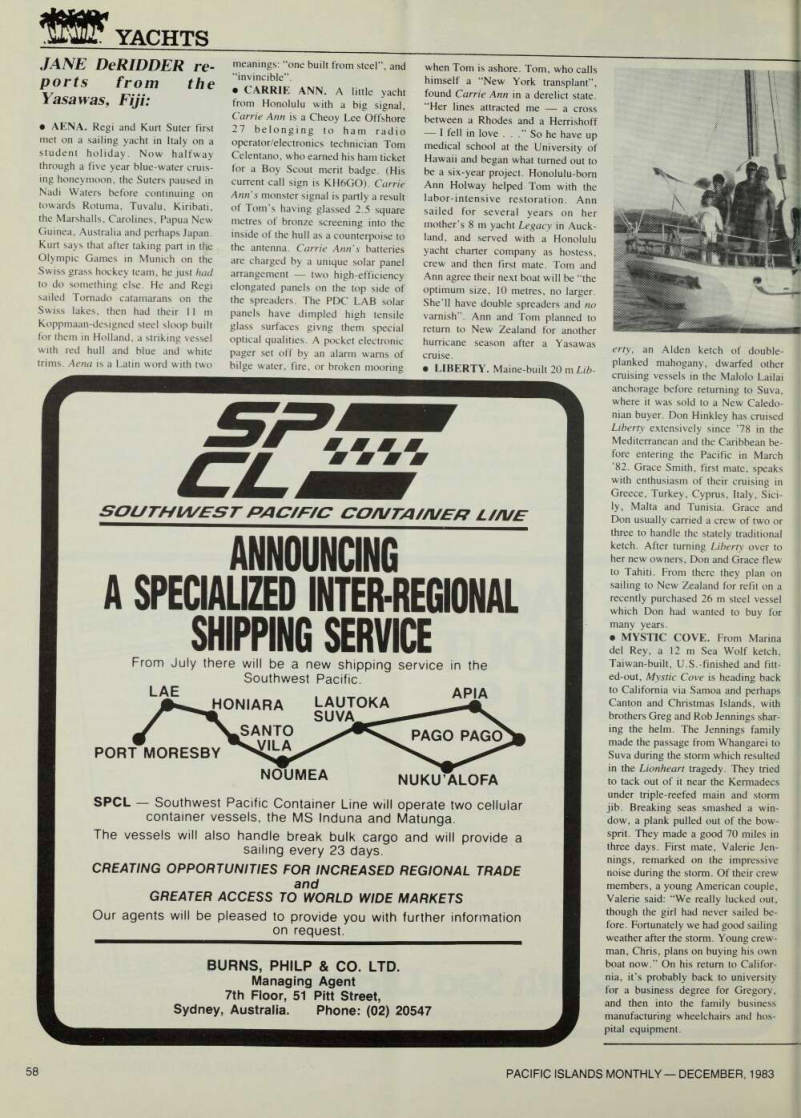
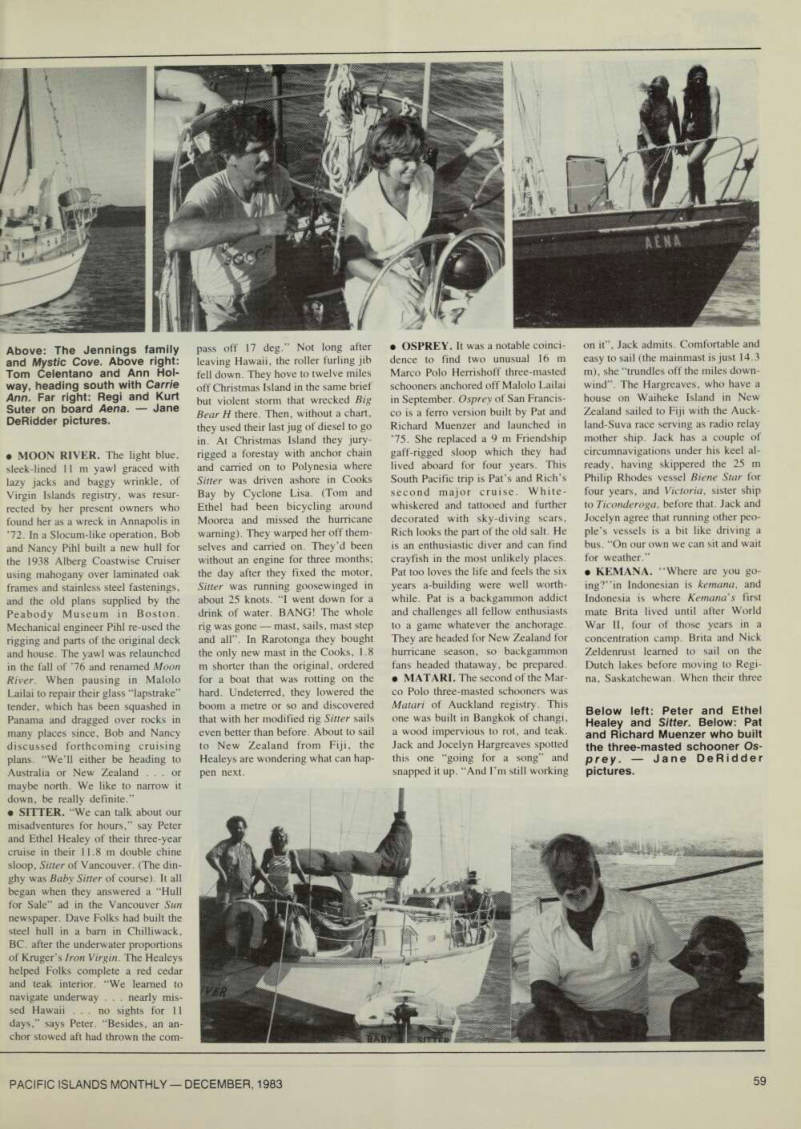
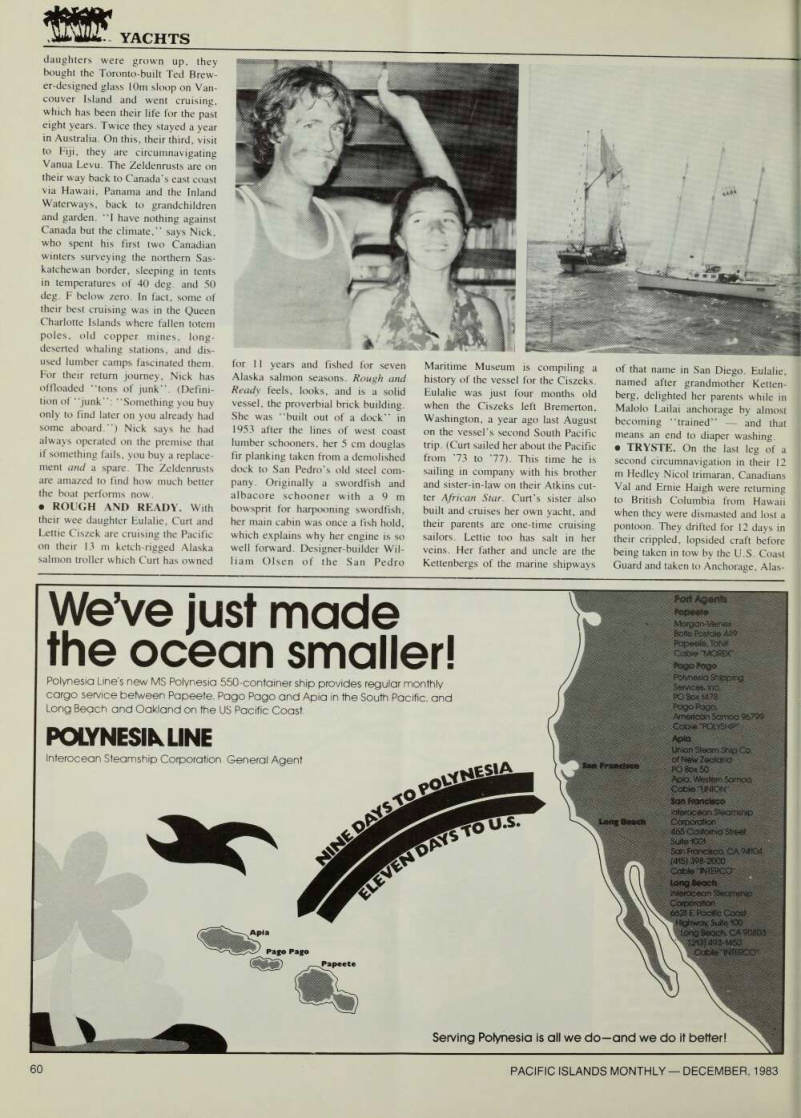
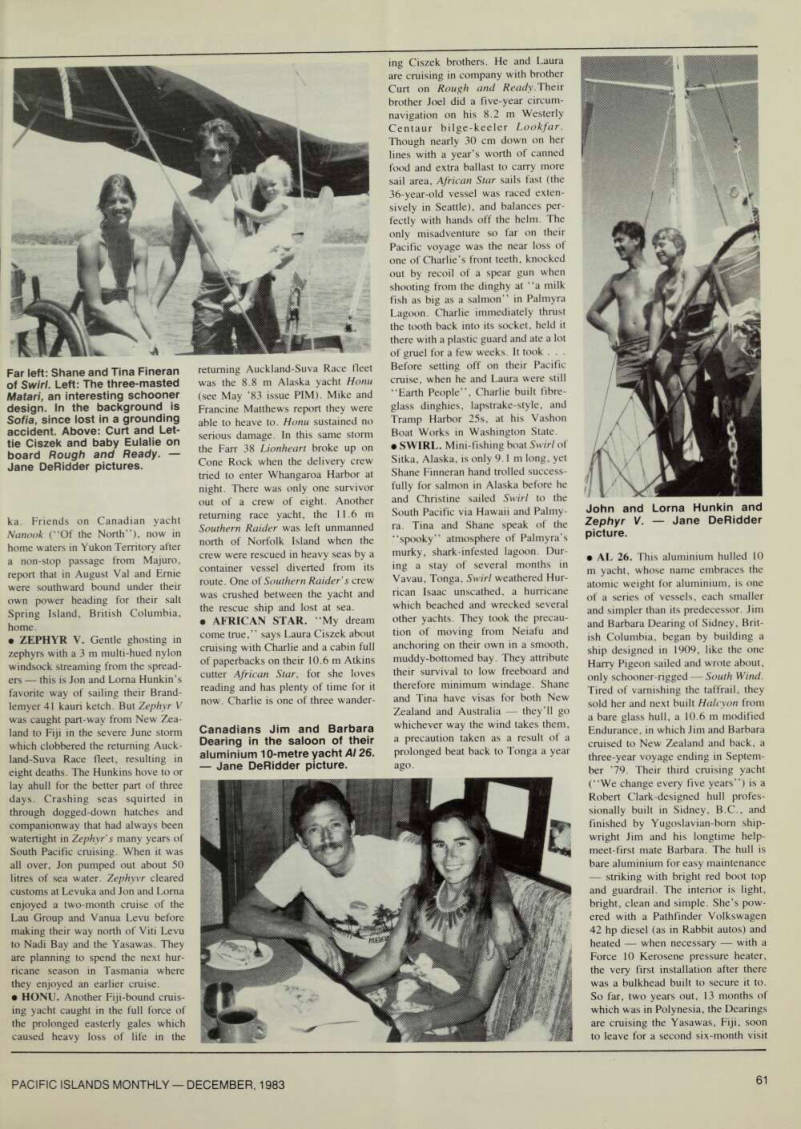
Jane Deridder
ports front the
I BS3W3S, tijl ,
• AENA. Regi and Kurt Suter first met on a sailing yacht in Italy on a student holiday. Now halfway through a five year blue-water cruising honeymoon, the Suters paused in Nadi Waters before continuing on towards Rotuma, Tuvalu, Kiribati, the Marshalls, Carolines, Papua New Guinea, Australia and perhaps Japan.
Kurt says that after taking part in the Olympic Games in Munich on the Swiss grass hockey team, he just had to do something else. He and Regi sailed Tornado catamarans on the Swiss lakes, then had their 11 m
Koppmaan-designed steel sloop built
for them in Holland, a striking vessel with red hull and blue and white trims. Aena is a Latin word with two
meanings: “one built from steel” and ANN . A little yacht from Honolulu with a big signal, Carrie Ann is a Cheoy Lee Offshore 27 belonging to ham radio operator/electronics technician Tom Celentano, who earned his ham ticket for a Boy Scout merit badge. (His current call sign is KH6GO). Carrie Ann’s monster signal is partly a result of Tom’s having glassed 2.5 square metres of bronze screening into the inside of the hull as a counterpoise to the antenna. Carrie Ann’s batteries are charged by a unique solar panel arrangement two high-efficiency elongated panels on the top side of the spreaders. The PDC LAB solar panels have dimpled high tensile glass surfaces givng them special optical qualities. A pocket electronic pager set off by an alarm warns of bilge water, fire, or broken mooring
when Tom is ashore. Tom, who calls himself a “New York transplant”, found Carrie Ann in a derelict state.
“Her lines attracted me a cross between a Rhodes and a Herrishoff I fell in love . . .” So he have up medical school at the University of Hawaii and began what turned out to be a six-year project. Honolulu-bom Ann Holway helped Tom with the labor-intensive restoration. Ann sailed for several years on her mother’s 8 m yacht Legacy in Auck land, and served with a Honolulu yacht charter company as hostess, crew and then first mate. Tom and Ann agree their next boat will be “the optimum size, 10 metres, no larger.
She’ll have double spreaders and no varnish”. Ann and Tom planned to return to New Zealand for another hurricane season after a Yasawas cruise. • LIBERTY. Maine-built 20 m Lib-
erty, an Alden ketch of double
planked mahogany, dwarfed other
cruising vessels in the Malolo Lailai anchorage before returning to Suva, where it was sold to a New Caledo nian buyer. Don Hinkley has cruised Liberty extensively since ’7B in the Mediterranean and the Caribbean be fore entering the Pacific in March ’B2. Grace Smith, first mate, speaks with enthusiasm of their cruising in
Greece, Turkey, Cyprus, Italy, Sici
ly, Malta and Tunisia. Grace and Don usually carried a crew of two or three to handle the stately traditional ketch. After turning Liberty over to her new owners, Don and Grace flew to Tahiti. From there they plan on sailing to New Zealand for refit on a recently purchased 26 m steel vessel which Don had wanted to buy for many years. • MYSTIC COVE. From Marina del Rey, a 12 m Sea Wolf ketch, Taiwan-built, U.S.-finished and fitt ed-out, Mystic Cove is heading back to California via Samoa and perhaps Canton and Christmas Islands, with brothers Greg and Rob Jennings shar
ing the helm. The Jennings family
made the passage from Whangarei to Suva during the storm which resulted in the Lionheart tragedy. They tried to tack out of it near the Kermadecs under triple-reefed main and storm jib. Breaking seas smashed a win dow, a plank pulled out of the bow sprit. They made a good 70 miles in three days. First mate, Valerie Jen nings, remarked on the impressive noise during the storm. Of their crew members, a young American couple, Valerie said: “We really lucked out, though the girl had never sailed be
fore. Fortunately we had good sailing
weather after the storm. Young crew man, Chris, plans on buying his own boat now.” On his return to Califor nia, it’s probably back to university for a business degree for Gregory, and then into the family business manufacturing wheelchairs and hos
pital equipment.
• MOON RIVER. The light blue, sleek-lined 11 m yawl graced with lazy jacks and baggy wrinkle, of Virgin Islands registry, was resur rected by her present owners who found her as a wreck in Annapolis in ’72. In a Slocum-like operation, Bob and Nancy Pihl built a new hull for the 1938 Alberg Coastwise Cruiser using mahogany over laminated oak frames and stainless steel fastenings, and the old plans supplied by the Peabody Museum in Boston.
Mechanical engineer Pihl re-used the rigging and parts of the original deck and house. The yawl was relaunched in the fall of ’76 and renamed Moon River. When pausing in Malolo
Lailai to repair their glass “lapstrake”
tender, which has been squashed in Panama and dragged over rocks in many places since. Bob and Nancy discussed forthcoming cruising plans. “We’ll either be heading to Australia or New Zealand ... or maybe north. We like to narrow it down, be really definite.” • SITTER. “We can talk about our misadventures for hours,” say Peter and Ethel Healey of their three-year cruise in their 11.8 m double chine sloop. Sitter of Vancouver. (The din ghy was Baby Sitter of course). It all began when they answered a “Hull for Sale” ad in the Vancouver Sun newspaper. Dave Folks had built the steel hull in a bam in Chilliwack, BC. after the underwater proportions of Kruger’s Iron Virgin. The Healeys helped Folks complete a red cedar and teak interior. “We learned to navigate underway . . . nearly mis sed Hawaii ... no sights for 11 days,” says Peter. “Besides, an an chor stowed aft had thrown the com
pass off 17 deg.” Not long after leaving Hawaii, the roller furling jib fell down. They hove to twelve miles off Christmas Island in the same brief but violent storm that wrecked Big Bear H there. Then, without a chart, they used their last jug of diesel to go in. At Christmas Island they jury rigged a forestay with anchor chain and carried on to Polynesia where Sitter was driven ashore in Cooks
Bay by Cyclone Lisa. (Tom and
Ethel had been bicycling around Moorea and missed the hurricane warning). They warped her off them selves and carried on. They’d been without an engine for three months; the day after they fixed the motor, Sitter was running goosewinged in about 25 knots. “I went down for a drink of water. BANG! The whole rig was gone mast, sails, mast step and all”. In Rarotonga they bought the only new mast in the Cooks, 1.8 m shorter than the original, ordered for a boat that was rotting on the hard. Undeterred, they lowered the boom a metre or so and discovered that with her modified rig Sitter sails even better than before. About to sail to New Zealand from Fiji, the
Healeys are wondering what can hap
pen next.
• OSPREY. It was a notable coinci dence to find two unusual 16 m Marco Polo Herrishoff three-masted schooners anchored off Malolo Lailai in September. Osprey of San Francis co is a ferro version built by Pat and Richard Muenzer and launched in ’75. She replaced a 9 m Friendship gaff-rigged sloop which they had lived aboard for four years. This South Pacific trip is Pat’s and Rich’s second major cruise. White whiskered and tattooed and further decorated with sky-diving scars, Rich looks the part of the old salt. He is an enthusiastic diver and can find crayfish in the most unlikely places.
Pat too loves the life and feels the six years a-building were well worth while. Pat is a backgammon addict and challenges all fellow enthusiasts to a game whatever the anchorage.
They are headed for New Zealand for hurricane season, so backgammon fans headed thataway, be prepared. • MAT ARE The second of the Mar co Polo three-masted schooners was Matari of Auckland registry. This one was built in Bangkok of changi, a wood impervious to rot, and teak.
Jack and Jocelyn Hargreaves spotted
this one “going for a song” and snapped it up. “And I’m still working
on it”. Jack admits. Comfortable and easy to sail (the mainmast is just 14.3 m), she “trundles off the miles down wind”. The Hargreaves, who have a house on Waiheke Island in New Zealand sailed to Fiji with the Auck land-Suva race serving as radio relay mother ship. Jack has a couple of circumnavigations under his keel al ready, having skippered the 25 m Philip Rhodes vessel Biene Star for four years, and Victoria, sister ship to Ticonderoga, before that. Jack and Jocelyn agree that running other peo ple’s vessels is a bit like driving a bus. “On our own we can sit and wait for weather.” • KEMANA. “Where are you go ing?” in Indonesian is kemana, and Indonesia is where Kemana’s first mate Brita lived until after World War 11, four of those years in a concentration camp. Brita and Nick Zeldenrust learned to sail on the Dutch lakes before moving to Regi na, Saskatchewan. When their three
Above: The Jennings family and Mystic Cove. Above right: Tom Celentano and Ann Hol way, heading south with Carrie Ann. Far right: Regi and Kurt Suter on board Aena. - Jan`e DeRidder pictures.
Below left: Peter and Ethel Healey and Sitter. Below: Pat and Richard Muenzer who built the three-masted schooner Os prey. Jane DeRidder pictures.
daughters were grown up, they bought the Toronto-built Ted Brew er-designed glass 10m sloop on Van couver Island and went cruising, which has been their life for the past eight years. Twice they stayed a year in Australia. On this, their third, visit to Fiji, they are circumnavigating Vanua Levu. The Zeldenrusts are on their way back to Canada’s east coast via Hawaii, Panama and the Inland Waterways, back to grandchildren and garden. “I have nothing against Canada but the climate,” says Nick, who spent his first two Canadian winters surveying the northern Sas katchewan border, sleeping in tents in temperatures of 40 deg. and 50 deg. F below zero. In fact, some of their best cruising was in the Queen Charlotte Islands where fallen totem poles, old copper mines, long deserted whaling stations, and dis used lumber camps fascinated them.
For their return journey, Nick has offloaded “tons of junk”. (Defini tion of “junk”: “Something you buy only to find later on you already had some aboard.”) Nick says he had always operated on the premise that if something fails, you buy a replace ment and a spare. The Zeldenrusts are amazed to find how much better the boat performs now.
• Rough And Ready. With
their wee daughter Eulalie, Curt and Lettie Ciszek are cruising the Pacific on their 13 m ketch-rigged Alaska salmon trailer which Curt has owned
for 11 years and fished for seven Alaska salmon seasons. Rough and Ready feels, looks, and is a solid vessel, the proverbial brick building.
She was “built out of a dock” in 1953 after the lines of west coast lumber schooners, her 5 cm douglas fir planking taken from a demolished dock to San Pedro’s old steel com pany. Originally a swordfish and albacore schooner with a 9 m
bowsprit for harpooning swordfish,
her main cabin was once a fish hold, which explains why her engine is so well forward. Designer-builder Wil liam Olsen of the San Pedro
Maritime Museum is compiling a history of the vessel for the Ciszeks.
Eulalie was just four months old when the Ciszeks left Bremerton, Washington, a year ago last August on the vessel’s second South Pacific trip. (Curt sailed her about the Pacific from ’73 to 'll). This time he is sailing in company with his brother and sister-in-law on their Atkins cut ter African Star. Curt’s sister also built and cruises her own yacht, and their parents are one-time cruising sailors. Lettie too has salt in her veins. Her father and uncle are the Kettenbergs of the marine shipways
of that name in San Diego. Eulalie, named after grandmother Ketten berg, delighted her parents while in Malolo Lailai anchorage by almost becoming “trained” and that means an end to diaper washing. • TRYSTE. On the last leg of a second circumnavigation in their 12 m Hedley Nicol trimaran, Canadians Val and Ernie Haigh were returning to British Columbia from Hawaii when they were dismasted and lost a pontoon. They drifted for 12 days in their crippled, lopsided craft before being taken in tow by the U.S. Coast Guard and taken to Anchorage, Alas-
ka. Friends on Canadian yacht Nanook (“Of the North”), now in home waters in Yukon Territory after a non-stop passage from Majuro, report that in August Val and Ernie were southward bound under their own power heading for their salt Spring Island, British Columbia, home. • ZEPHYR V, Gentle ghosting in zephyrs with a 3 m multi-hued nylon windsock streaming from the spread ers this is Jon and Loma Hunkin’s favorite way of sailing their Brand lemyer 41 kauri ketch. But Zephyr V was caught part-way from New Zea land to Fiji in the severe June storm which clobbered the returning Auck land-Suva Race fleet, resulting in eight deaths. The Hunkins hove to or lay ahull for the better part of three days. Crashing seas squirted in
through dogged-down hatches and
companionway that had always been watertight in Zephyr’s many years of South Pacific cruising. When it was all over, Jon pumped out about 50 litres of sea water. Zephyvr cleared customs at Levuka and Jon and Loma enjoyed a two-month cruise of the Lau Group and Vanua Levu before making their way north of Viti Levu to Nadi Bay and the Yasawas. They are planning to spend the next hur ricane season in Tasmania where they enjoyed an earlier cruise. • HONU. Another Fiji-bound cruis ing yacht caught in the full force of
the prolonged easterly gales which
caused heavy loss of life in the
returning Auckland-Suva Race fleet was the 8.8 m Alaska yacht Honu (see May ’B3 issue PIM). Mike and Francine Matthews report they were able to heave to. Honu sustained no serious damage. In this same storm the Farr 38 Lionheart broke up on Cone Rock when the delivery crew tried to enter Whangaroa Harbor at night. There was only one survivor out of a crew of eight. Another returning race yacht, the 11.6 m Southern Raider was left unmanned north of Norfolk Island when the crew were rescued in heavy seas by a container vessel diverted from its route. One of Southern Raider’s crew was crushed between the yacht and the rescue ship and lost at sea. • AFRICAN STAR. My dream come true,” says Laura Ciszek about cruising with Charlie and a cabin full of paperbacks on their 10.6 m Atkins cutter African Star, for she loves reading and has plenty of time for it now. Charlie is one of three wander-
ing Ciszek brothers. He and Laura are cruising in company with brother Curt on Rough and Ready. Their brother Joel did a five-year circum navigation on his 8.2 m Westerly
Centaur bilge-keeler Lookfar.
Though nearly 30 cm down on her lines with a year’s worth of canned food and extra ballast to carry more sail area, African Star sails fast (the 36-year-old vessel was raced exten sively in Seattle), and balances per fectly with hands off the helm. The only misadventure so far on their Pacific voyage was the near loss of one of Charlie’s front teeth, knocked out by recoil of a spear gun when shooting from the dinghy at “a milk fish as big as a salmon’’ in Palmyra Lagoon. Charlie immediately thrust the tooth back into its socket, held it there with a plastic guard and ate a lot of gruel for a few weeks. It took . . .
Before setting off on their Pacific cruise, when he and Laura were still “Earth People’’, Charlie built fibre
glass dinghies, lapstrake-style, and
Tramp Harbor 255, at his Vashon Boat Works in Washington State. • SWIRL. Mini-fishing boat Swirl of Sitka, Alaska, is only 9.1 m long, yet Shane Finneran hand trolled success fully for salmon in Alaska before he and Christine sailed Swirl to the South Pacific via Hawaii and Palmy ra. Tina and Shane speak of the
“spooky” atmosphere of Palmyra’s
murky, shark-infested lagoon. Dur
ing a stay of several months in Vavau, Tonga, Swirl weathered Hur rican Isaac unscathed, a hurricane which beached and wrecked several other yachts. They took the precau tion of moving from Neiafu and anchoring on their own in a smooth,
muddy-bottomed bay. They attribute
their survival to low freeboard and therefore minimum windage. Shane and Tina have visas for both New Zealand and Australia they’ll go whichever way the wind takes them, a precaution taken as a result of a prolonged beat back to Tonga a year ago.
• AL 26. This aluminium hulled 10 m yacht, whose name embraces the atomic weight for aluminium, is one of a series of vessels, each smaller and simpler than its predecessor. Jim and Barbara Dearing of Sidney, Brit ish Columbia, began by building a ship designed in 1909, like the one Harry Pigeon sailed and wrote about, only schooner-rigged South Wind.
Tired of varnishing the taffrail, they sold her and next built Halcyon from a bare glass hull, a 10.6 m modified Endurance, in which Jim and Barbara cruised to New Zealand and back, a three-year voyage ending in Septem ber ’79. Their third cruising yacht (“We change every five years”) is a Robert Clark-designed hull profes sionally built in Sidney, 8.C., and finished by Yugoslavian-bom ship wright Jim and his longtime help meet-first mate Barbara. The hull is bare aluminium for easy maintenance striking with bright red boot top and guardrail. The interior is light, bright, clean and simple. She’s pow ered with a Pathfinder Volkswagen 42 hp diesel (as in Rabbit autos) and heated when necessary with a Force 10 Kerosene pressure heater, the very first installation after there was a bulkhead built to secure it to.
So far, two years out, 13 months of which was in Polynesia, the Dealings are cruising the Yasawas, Fiji, soon to leave for a second six-month visit
Far left: Shane and Tina Fineran of Swirl. Left; The three-masted Matari, an interesting schooner design. In the background is Sofia, since lost in a grounding accident. Above: Curt and Let tie Ciszek and baby Eulalie on board Rough and Ready.
Jane DeRidder pictures.
Canadians Jim and Barbara Dearing in the saloon of their aluminium 10-metre yacht Al 26.
Jane Deßidder picture.
John and Lorna Hunkln and Zephyr V. - Jane DeRidder picture.
to New Zealand. Diving, shelling and spear-fishing are their major in terests, and the Tuamotus their favo rite cruising grounds. Another not able stopover: Al 26 carried her hef ty, more than 2 m, draft into Niuatoputapu in the north of Tonga where a pass into the lagoon was blasted a couple of years back. • A’STRY’N. What do you do when you know exactly the boat you’d like, but can’t find anything like it?
Bruce Atkinson, Sydney air condi tioning engineer and draughtsman, solved the problem by designing and building his own ship inspired by French steel boat designs and incor porating ideas he and Lesley had gleaned on Kombi van camping and sightseeing around U.S., U K. and Europe, and on an extended blue water cruise from the U.K. to the Caribbean. “She was pretty, but she leaked . . and she got too small ...” Lesley says of the ’54 built Buchanan 25 which they bought in England, cruised for three years, and sold in Martinique. A’stry’n (“We wanted an Australian name”), an 11.7 m multi-chine centre-cockpit steel sloop, the result of the Atkin sons’ observations, experience and workmanship, has had a two-and-a half-year trial around the South Pacific, has weathered a couple of hurricanes in Polynesia (at anchor) and has proved to be all that Bruce and Lesley hoped. Bruce will make his Atkinson 38 plans available early next year. • TARA II: Wrecked in late August near Nanuku Pass in northeastern Fiji waters, an area renowned for strong and tricky currents, was Vancouver yacht Tara 11. Longtime blue-water voyagers, George and Suzanne Hart ley, on their way to Samoa, were lying ahull in 25-knot south easterlies awaiting daylight to exit from the pass. Just before dawn Tara II struck the reef. Suzanne was wash ed overboard but managed to make her way back to the stricken vessel, badly cut, clothing tom off. The fibreglass Bob Harris-designed Van couver 27 sank, coming to rest with the top of the mast above water. The Hartleys and their cat Pippin stayed in an inflatable Avon Redstar dinghy tethered to the mast for eight days before a change in wind direction enabled them to attempt to reach safety. As they made their way downwind, with Hartley standing up holding a sail he had dived to re trieve, they were spotted by the manager of Fiji Forbes Laucala in his game fishing boat. Tara II was too badly holed to refloat. Rigging, sails, anchor tackle, engine and other pieces of gear were salvaged with local help. The shipwrecked couple, with Pippin in a rented pet travelling box, flew to Hawaii.
KA Y BASON reports
from Port Moresby ,
Papua New Guinea:
• BALANCELLE. Yves and Dominique Perrin with daughter Marie and son Pierre are here after a rough passage from Vanuatu. With two big rips in their mainsail they were pleased to arrive.
Yves and Dominique sailed to gether in earlier days in the Mediter ranean. They cruised from Cannes in an old wooden boat through the canals to Quimper near Brest, where they sold the boat and flew to Noumea.
They had always wanted to build their own boat and fitted out a Lange vin steel hull. Within two years they moved on board after launching in Numbo in 1980. The interior of their 10.5 m yacht is very comfortable and homely, and has lots of cupboard space with a 3.5 m beam.
Passage against the wind from Noumea to New Zealand was made in 1981. After exploring the superb cruising grounds in the Bay of Is lands, Balancelle spent three months in Whangarei. The children attended school, which improved their English, and gave them a chance to meet other children. In ordinary times, Dominique conducts her own education program, buying suitable textbooks and planning the children’s lessons.
After a cruise to Auckland the family returned to Whangarei to pre pare for a passage to Fiji. From Fiji they returned to their home port of Noumea. A very pleasant trip.
Balancelle has been lucky to ob tain a permit to cruise to Bali where they will have a warm reunion with grandparents. Their future plans are to sail to Singapore. • SANPOI. Steve “Flash” Janney from West Virginia, U.S.A., bought this 20-tonne steel multi-chine yacht in New Zealand. She’s a Boden design, very solid 12 m cutter sloop, built in 1977. Steve is pleased with
her performance, especially down wind, and that she handles big seas comfortably. After six years in the U.S. Navy, underwater in sub marines, Steve is entusiastic about cruising. Since July 14 he’s covered over 3000 miles.
The passage from New Zealand to Port-Vila was completed in 11 days, and from Port-Vila to Port Moresby, 12 days. The best average was 170 miles in 24 hours, creaming along.
Sanpoi is heading for Bali where she will undergo a major refit. Steve would like to have the interior fitted out in teak. With a new suit of sails, he plans cruising back to the States.
The all-male crew are from New
Zealand and although they all deny
doing “housework” the boat looks quite tidy well, with four bachelors, it’s certainly not bad.
Andrew Turner has thoroughly en joyed his first sailing experience. He says the diving in Port-Vila is excel lent. While the boat is being over hauled in Bali, Andrew intends to visit Australia and return to complete the voyage to the States.
Malcolm Poole, who’s from Auck land, had previously only sailed in dinghies and found the ocean pas sages tremendous. He would now like to own a yacht. From Bali Malcolm is heading for Nepal and the
Himalayas.
Richard Brown also hails from Auckland. He’s the galley slave, producing mean steaks! This was also Richard’s first long passage and he’s hooked. He plans to be onboard for the cruise back to the States. • STARSEED. Sean Ahem worked as a fisherman, and for him it was a natural progression to build his own boat. He and his wife Chris spent three years building their 12 m steel chine ketch in Rotorua.
Star seed was launched in Tauran ga on the east coast of New Zealand’s
north island, and they promptly moved onboard to finish the interior.
After sea trials along the coast they set sail for Fiji, enjoying a pleasant cruise. Sean, Chris and daughter Kel ly were delighted with the people of Fiji, who made them very welcome.
Next port of call was Noumea where they not only improved their knowledge of the French language but met many cosmopolitan people.
It was hard to weigh anchor and leave. Arriving in Brisbane they were very impressed with the visitor’s berths at the Botanical Gardens. Al though they are in the heart of the city, the gardens provide peaceful and charming surroundings.
They cruised unhurriedly along the east Australian coast to the Whitsun day Islands where they discovered superb anchorages. From Townsville Star seed set sail for Samarai, but strong winds made Port Moresby an easier landfall.
From Port Moresby the family intend to sail through the Torres Strait to Thursday Island and coast hop to Sydney. Future plans are to cruise for as long as possible in the Pacific. As they say, “It’s so beaut iful, why go elsewhere?”
Here is a brief follow-up on cruis ing yachts reported in previous columns. • TEVAKE. Good to know that the McLarens arrived safely in Hawaii.
Tevake suffered damage to one of her wings bit nasty on a beam of 8 m.
She’s a pretty unusual tri, very fast.
Hope the damage wasn’t too severe. • BELLE STAR. Peter and Wendy Robinson with son David are staying for a while in New Ireland. Peter has secured a job so hopes to replenish cruising funds. How we lesser mor tals yearn for Sat Nav! The family really enjoyed their cruise from Port Moresby to New Ireland. PNG offers so much for the cruisers.
The Perrin family on board Balancelle. - Kay Bason picture.
Sanpoi in Port Moresby Har bour. - Kay Bason picture.
Advertisements & other items, pp. 58-60 (1 item)
Announcing
SOUTHWEST PAC/E/C CO/VTA//VEP L//VE
A SPECIALIZED INTER-REGIONAL
SHIPPING SERVICE
From July there will be a new shipping service in the Southwest Pacific.
HONIARA LAUTOKA APIA
SUVA.
SANTO
PORT MORESBY VILA
PAGO PAGO
NOUMEA
NUKUALOFA
SPCL Southwest Pacific Container Line will operate two cellular container vessels, the MS Induna and Matunga.
The vessels will also handle break bulk cargo and will provide a sailing every 23 days.
CREATING OPPORTUNITIES FOR INCREASED REGIONAL TRADE
and
GREATER ACCESS TO WORLD WIDE MARKETS
Our agents will be pleased to provide you with further information on request.
BURNS, PHILP & CO. LTD.
Managing Agent 7th Floor, 51 Pitt Street, Sydney, Australia. Phone: (02) 20547
We’ve just made
the ocean smaller!
Polynesia Line's new MS Polynesia 550-container ship provides regular monthly cargo service between Papeete, Pago Pago and Apia in the South Pacific, and Long Beach and Oakland on the US Pacific Coast.
POLYNESIMINE
Interocean Steamship Corporation General Agent
NflilSs
oOli
K O <a TO R* 3 s*- V Apia Pago Pago Papeete Port Agents ‘ MorgarvVeme* 8o»e Postal© M 9 Papeete. Tahiti Cable "WORST Pago Pago Polynesia Shipping Services, lac; FO Box 1478 Pago Pago.
American Samoa 967 W Cable TOIVSHr Apia Union Steam Ship Co. of New Zealand
SSL*™
Cable "WOT San Francisco m Corporation Syte ■ Serving Polynesia is all we do—and we do it better!
Shipping Schedules
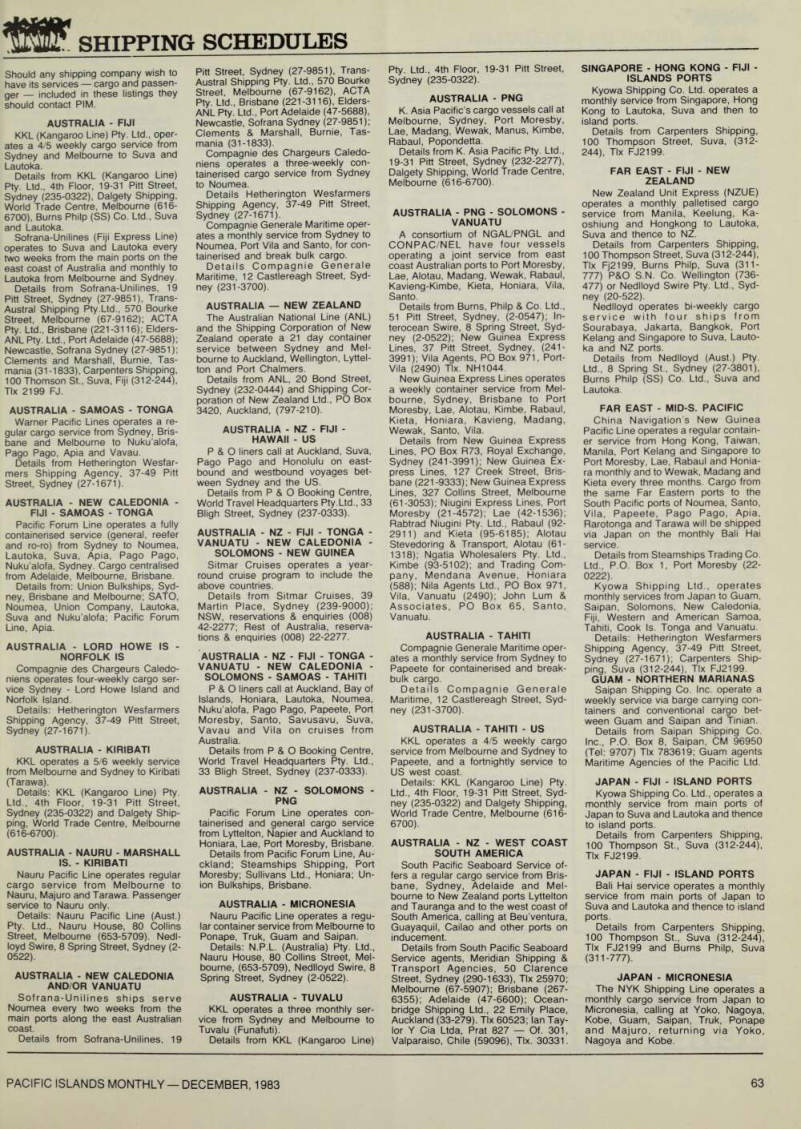
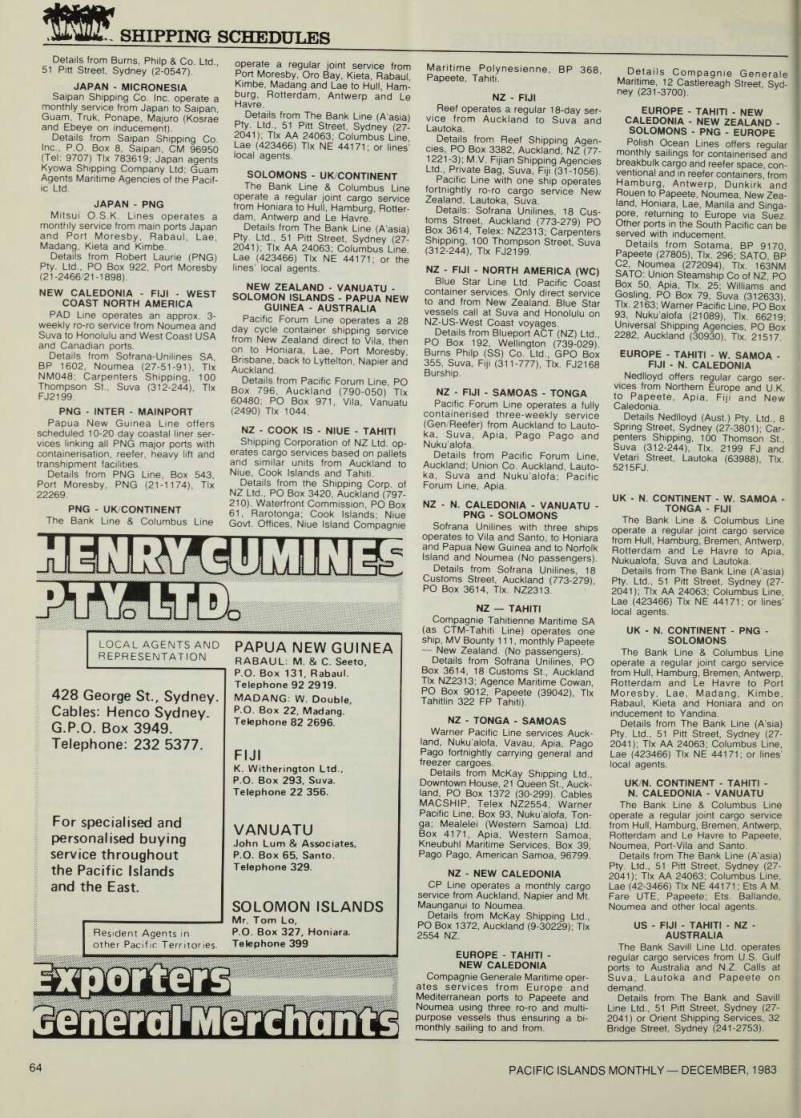
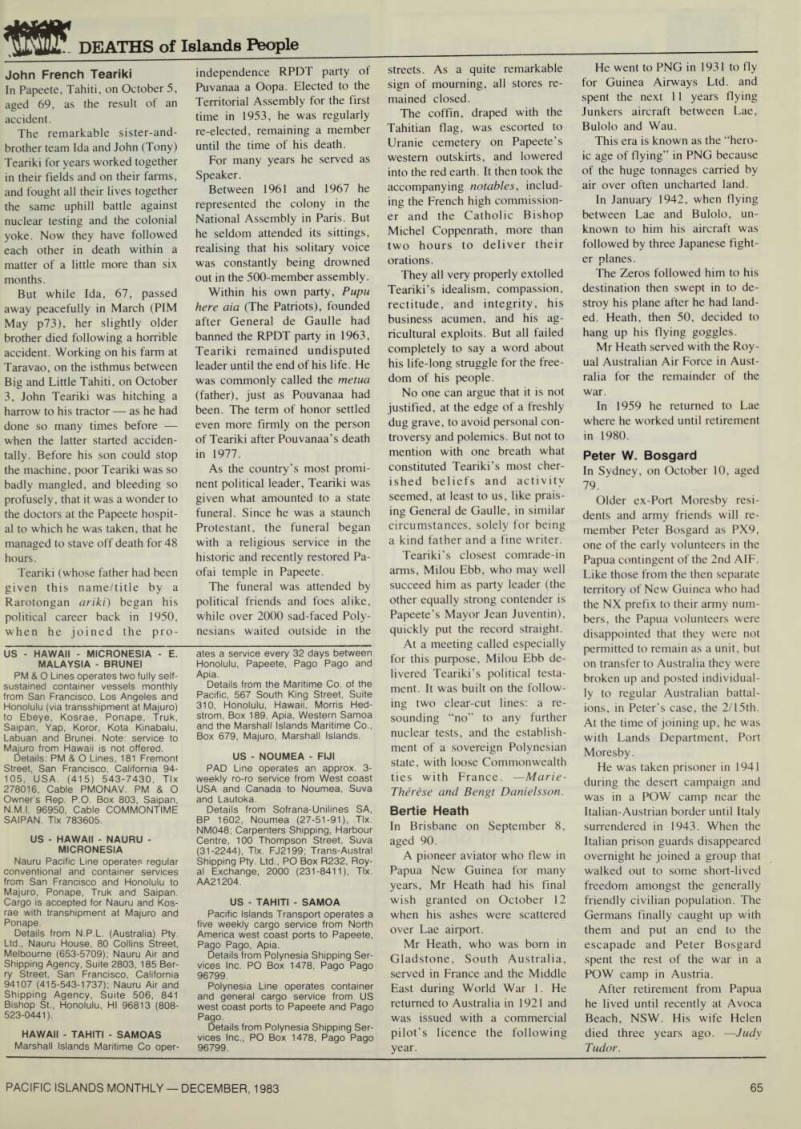
Should any shipping company wish to have its services cargo and passen ger included in these listings they should contact PIM.
Australia - Fiji
KKL (Kangaroo Line) Pty. Ltd., oper ates a 4/5 weekly cargo service from Sydney and Melbourne to Suva and Lautoka.
Details from KKL (Kangaroo Line) Pty. Ltd., 4th Floor, 19-31 Pitt Street, Sydney (235-0322), Dalgety Shipping, World Trade Centre, Melbourne (616- 6700), Burns Philp (SS) Co. Ltd., Suva and Lautoka.
Sofrana-Unilines (Fiji Express Line) operates to Suva and Lautoka every two weeks from the main ports on the east coast of Australia and monthly to Lautoka from Melbourne and Sydney.
Details from Sofrana-Unilines, 19 Pitt Street, Sydney (27-9851), Trans- Austral Shipping Pty.Ltd., 570 Bourke Street, Melbourne (67-9162); ACTA Pty. Ltd., Brisbane (221-3116); Elders- ANL Pty. Ltd., Port Adelaide (47-5688); Newcastle, Sofrana Sydney (27-9851); Clements and Marshall, Burnie, Tas mania (31-1833), Carpenters Shipping, 100 Thomson St., Suva, Fiji (312-244), Tlx 2199 FJ.
Australia - Samoas - Tonga
Warner Pacific Lines operates a re gular cargo service from Sydney, Bris bane and Melbourne to Nuku’alofa, Pago Pago, Apia and Vavau.
Details from Hetherington Wesfar mers Shipping Agency, 37-49 Pitt Street. Sydney (27-1671).
Australia - New Caledonia -
Fiji - Samoas - Tonga
Pacific Forum Line operates a fully containerised service (general, reefer and ro-ro) from Sydney to Noumea, Lautoka, Suva, Apia, Pago Pago, Nuku’alofa, Sydney. Cargo centralised from Adelaide, Melbourne, Brisbane.
Details from: Union Bulkships, Syd ney, Brisbane and Melbourne; SATO, Noumea, Union Company, Lautoka, Suva and Nuku’alofa: Pacific Forum Line, Apia.
Australia - Lord Howe Is -
Norfolk Is
Compagnie des Chargeurs Caledo niens operates four-weekly cargo ser vice Sydney - Lord Howe Island and Norfolk Island.
Details: Hetherington Wesfarmers Shipping Agency, 37-49 Pitt Street, Sydney (27-1671).
Australia - Kiribati
KKL operates a 5/6 weekly service from Melbourne and Sydney to Kiribati (Tarawa).
Details: KKL (Kangaroo Line) Pty.
Ltd., 4th Floor, 19-31 Pitt Street, Sydney (235-0322) and Dalgety Ship ping, World Trade Centre, Melbourne (616-6700).
Australia - Nauru - Marshall
Is. - Kiribati
Nauru Pacific Line operates regular cargo service from Melbourne to Nauru, Majuro and Tarawa. Passenger service to Nauru only.
Details: Nauru Pacific Line (Aust.) Pty. Ltd., Nauru House, 80 Collins Street, Melbourne (653-5709). Nedl loyd Swire, 8 Spring Street, Sydney (2- 0522).
Australia - New Caledonia
And/Or Vanuatu
Sofrana-Unilines ships serve Noumea every two weeks from the main ports along the east Australian coast.
Details from Sofrana-Unilines. 19
Pitt Street, Sydney (27-9851), Trans- Austral Shipping Pty. Ltd., 570 Bourke Street, Melbourne (67-9162), ACTA Pty. Ltd., Brisbane (221-3116), Elders- ANL Pty. Ltd., Port Adelaide (47-5688), Newcastle, Sofrana Sydney (27-9851); Clements & Marshall, Burnie, Tas mania (31-1833).
Compagnie des Chargeurs Caledo niens operates a three-weekly con tainerised cargo service from Sydney to Noumea.
Details Hetherington Wesfarmers Shipping Agency, 37-49 Pitt Street, Sydney (27-1671).
Compagnie Generale Maritime oper ates a monthly service from Sydney to Noumea, Port Vila and Santo, for con tainerised and break bulk cargo.
Details Compagnie Generale Maritime, 12 Castlereagh Street, Syd ney (231-3700).
Australia New Zealand
The Australian National Line (ANL) and the Shipping Corporation of New Zealand operate a 21 day container service between Sydney and Mel bourne to Auckland, Wellington, Lyttel ton and Port Chalmers.
Details from ANL, 20 Bond Street, Sydney (232-0444) and Shipping Cor poration of New Zealand Ltd., PO Box 3420, Auckland, (797-210).
Australia - Nz - Fiji -
Hawaii - Us
P&O liners call at Auckland, Suva, Pago Pago and Honolulu on east bound and westbound voyages bet ween Sydney and the US.
Details from P&O Booking Centre, World Travel Headquarters Pty.Ltd., 33 Bligh Street, Sydney (237-0333).
AUSTRALIA - NZ - FIJI - TONGA -
Vanuatu - New Caledonia -
Solomons - New Guinea
Sitmar Cruises operates a year round cruise program to include the above countries.
Details from Sitmar Cruises, 39 Martin Place, Sydney (239-9000); NSW, reservations & enquiries (008) 42-2277; Rest of Australia, reserva tions & enquiries (008) 22-2277.
AUSTRALIA - NZ - FIJI - TONGA -
Vanuatu - New Caledonia -
Solomons - Samoas - Tahiti
P&O liners call at Auckland, Bay of Islands, Honiara, Lautoka, Noumea, Nukualofa, Pago Pago, Papeete, Port Moresby, Santo, Savusavu, Suva, Vavau and Vila on cruises from Australia.
Details from P&O Booking Centre, World Travel Headquarters Pty. Ltd., 33 Bligh Street, Sydney (237-0333).
Australia - Nz - Solomons -
Png
Pacific Forum Line operates con tainerised and general cargo service from Lyttelton, Napier and Auckland to Honiara, Lae, Port Moresby, Brisbane.
Details from Pacific Forum Line, Au ckland; Steamships Shipping, Port Moresby: Sullivans Ltd., Honiara; Un ion Bulkships, Brisbane.
Australia - Micronesia
Nauru Pacific Line operates a regu lar container service from Melbourne to Ponape, Truk, Guam and Saipan.
Details: N.P.L. (Australia) Pty. Ltd., Nauru House, 80 Collins Street, Mel bourne, (653-5709), Nedlloyd Swire, 8 Spring Street, Sydney (2-0522).
Australia - Tuvalu
KKL operates a three monthly ser vice from Sydney and Melbourne to Tuvalu (Funafuti).
Details from KKL (Kangaroo Line)
Pty. Ltd., 4th Floor, 19-31 Pitt Street, Sydney (235-0322).
Australia - Png
K. Asia Pacific’s cargo vessels call at Melbourne, Sydney, Port Moresby, Lae, Madang, Wewak, Manus, Kimbe, Rabaul, Popondetta.
Details from K. Asia Pacific Pty. Ltd., 19-31 Pitt Street, Sydney (232-2277), Dalgety Shipping, World Trade Centre, Melbourne (616-6700).
Australia - Png - Solomons -
Vanuatu
A consortium of NGAL/PNGL and CONPAC/NEL have four vessels operating a joint service from east coast Australian ports to Port Moresby, Lae, Alotau, Madang, Wewak, Rabaul, Kavieng-Kimbe, Kieta, Honiara, Vila, Santo.
Details from Burns, Philp & Co. Ltd., 51 Pitt Street, Sydney, (2-0547); In terocean Swire, 8 Spring Street, Syd ney (2-0522); New Guinea Express Lines, 37 Pitt Street, Sydney, (241- 3991); Vila Agents, PO Box 971, Port- Vila (2490) Tlx. NH1044.
New Guinea Express Lines operates a weekly container service from Mel bourne, Sydney, Brisbane to Port Moresby, Lae, Alotau, Kimbe, Rabaul, Kieta, Honiara, Kavieng, Madang, Wewak, Santo, Vila.
Details from New Guinea Express Lines, PO Box R 73, Royal Exchange, Sydney (241-3991); New Guinea Ex press Lines, 127 Creek Street, Bris bane (221 -9333); New Guinea Express Lines, 327 Collins Street, Melbourne (61-3053); Niugini Express Lines, Port Moresby (21-4572); Lae (42-1536); Rabtrad Niugini Pty. Ltd., Rabaul (92- 2911) and Kieta (95-6185); Alotau Stevedoring & Transport, Alotau (61- 1318); Ngatia Wholesalers Pty. Ltd., Kimbe (93-5102); and Trading Com pany, Mendana Avenue, Honiara (588); Nila Agents Ltd., PO Box 971, Vila, Vanuatu (2490); John Lum & Associates, PO Box 65, Santo, Vanuatu.
Australia - Tahiti
Compagnie Generale Maritime oper ates a monthly service from Sydney to Papeete for containerised and break bulk cargo.
Details Compagnie Generale Maritime, 12 Castlereagh Street, Syd ney (231-3700).
Australia - Tahiti - Us
KKL operates a 4/5 weekly cargo service from Melbourne and Sydney to Papeete, and a fortnightly service to US west coast.
Details: KKL (Kangaroo Line) Pty.
Ltd., 4th Floor, 19-31 Pitt Street, Syd ney (235-0322) and Dalgety Shipping, World Trade Centre, Melbourne (616- 6700).
Australia - Nz - West Coast
South America
South Pacific Seaboard Service of fers a regular cargo service from Bris bane, Sydney, Adelaide and Mel bourne to New Zealand ports Lyttelton and Tauranga and to the west coast of South America, calling at Beu’ventura, Guayaquil, Cailao and other ports on inducement.
Details from South Pacific Seaboard Service agents, Meridian Shipping & Transport Agencies, 50 Clarence Street, Sydney (290-1633), Tlx 25970; Melbourne (67-5907); Brisbane (267- 6355); Adelaide (47-6600); Ocean bridge Shipping Ltd., 22 Emily Place, Auckland (33-279). Tlx 60523; lan Tay lor Y Cia Ltda, Prat 827 Of. 301, Valparaiso, Chile (59096), Tlx. 30331.
SINGAPORE - HONG KONG - FIJI -
Islands Ports
Kyowa Shipping Co. Ltd. operates a monthly service from Singapore, Hong Kong to Lautoka, Suva and then to island ports.
Details from Carpenters Shipping, 100 Thompson Street, Suva, (312- 244), Tlx FJ2199.
Far East - Fiji - New
Zealand
New Zealand Unit Express (NZUE) operates a monthly, palletised cargo service from Manila, Keelung, Ka oshiung and Hongkong to Lautoka, Suva and thence to NZ.
Details from Carpenters Shipping, 100 Thompson Street, Suva (312-244), Tlx Fj2199, Burns Philp, Suva (311- 777) P&O S.N. Co. Wellington (736- 477) or Nedlloyd Swire Pty. Ltd., Syd ney (20-522).
Nedlloyd operates bi-weekly cargo service with four ships from Sourabaya, Jakarta, Bangkok, Port Kelang and Singapore to Suva, Lauto ka and NZ ports.
Details from Nedlloyd (Aust.) Pty.
Ltd., 8 Spring St., Sydney (27-3801), Burns Philp (SS) Co. Ltd., Suva and Lautoka.
Far East - Mid-S. Pacific
China Navigation's New Guinea Pacific Line operates a regular contain er service from Hong Kong, Taiwan, Manila, Port Kelang and Singapore to Port Moresby, Lae, Rabaul and Honia ra monthly and to Wewak, Madang and Kieta every three months. Cargo from the same Far Eastern ports to the South Pacific ports of Noumea, Santo, Vila, Papeete, Pago Pago, Apia, Rarotonga and Tarawa will be shipped via Japan on the monthly Bali Hai service.
Details from Steamships Trading Co.
Ltd., P.O. Box 1, Port Moresby (22- 0222).
Kyowa Shipping Ltd., operates monthly services from Japan to Guam, Saipan, Solomons, New Caledonia, Fiji, Western and American Samoa, Tahiti, Cook Is. Tonga and Vanuatu.
Details: Hetherington Wesfarmers Shipping Agency, 37-49 Pitt Street, Sydney (27-1671); Carpenters Ship ping, Suva (312-244), Tlx FJ2199.
Guam - Northern Marianas
Saipan Shipping Co. Inc. operate a weekly service via barge carrying con tainers and conventional cargo bet ween Guam and Saipan and Tinian.
Details from Saipan Shipping Co.
Inc., P.O. Box 8, Saipan, CM 96950 (Tel: 9707) Tlx 783619; Guam agents Maritime Agencies of the Pacific Ltd.
Japan - Fiji - Island Ports
Kyowa Shipping Co. Ltd., operates a monthly service from main ports of Japan to Suva and Lautoka and thence to island ports.
Details from Carpenters Shipping, 100 Thompson St., Suva (312-244), Tlx FJ2199.
Japan - Fiji - Island Ports
Bali Hai service operates a monthly service from main ports of Japan to Suva and Lautoka and thence to island ports.
Details from Carpenters Shipping, 100 Thompson St., Suva (312-244), Tlx FJ2199 and Burns Philp, Suva (311-777).
Japan - Micronesia
The NYK Shipping Line operates a monthly cargo service from Japan to Micronesia, calling at Yoko, Nagoya, Kobe, Guam, Saipan, Truk, Ponape and Majuro, returning via Yoko, Nagoya and Kobe.
51 D Pw St'r£T Lw "
bi Pitt Street, Sydney (2-0547).
Japan - Micronesia
Saipan Shipping Co. Inc. operate a monthly service from Japan to Saipan, Guam, Truk, Ponape, Majuro (Kosrae and Ebeye on inducement).
Details from Saipan Shippinq Co.
Inc., P.O. Box 8, Saipan, CM 96950 (Tel: 9707) Tlx 783619; Japan agents Kyowa Shipping Company Ltd; Guam Agents Maritime Agencies of the Pacific Ltd. iadam dm/-
Japan - Png
Mitsui O.S.K. Lines operates a monthly service from main ports Japan and Port Moresby, Rabaul, Lae, Madang, Kieta and Kimbe.
Details from Robert Laurie (PNG) Pty. Ltd., PO Box 922, Port Moresby (21-2466/21-1898).
New Pai Fnnnia Pi M Wpct
Coast North’America
o A S OAST NORTH america PAD Line operates an approx. 3weekly ro-ro service from Noumea and fnTcan H ad^nn a rt n . d W9St C ° aSt USA d fr^m P olf’ II T CA BP 1 M 2, Zmea ?27 51 Su TU Th^mn B c : nn Ca i Pe Q erS a I °° St., Suva (312-244), Tlx l " J " nyy
Png - Inter - Mainport
Papua New Guinea Line offers scheduled 10-20 day coastal liner services linking all PNG major ports with containerisation, reefer, heavy lift and transhipment facilities.
Details from PNG Line, Box 543, Port Moresby, PNG (21-1174), Tlx 22269.
PKir Nk'/rnM-riMCMT
Th D- Uk/Continent
The Bank Line & Columbus Line
S per ?‘. e a re 9 u * ar joint service from Port Moresby, Oro Bay, Kieta, Rabaul, Kimbe, Madang and Lae to Hull, Ham m9’ Rotterdam - Antwerp and Le Ha .y r ®-, 0 De . ta 'J s from The Bank Line (A’asia) *- td -- 31 Pitt Street, Sydney (27- 2041); Tlx AA 24063; Columbus Line, h ae ( 423466 ) Tlx NE 44171; or lines’ local a 9 ents - SOLOMONS i ik'/rnMT.MCMx
Solomons - Uk/Continent
' Ihe Bank Line & Columbus Line operate a regular joint cargo service from Honiara to Hull, Hamburg, Rotter dam, Antwerp and Le Havre, Details from The Bank Line (A’asia) Pty. Ltd., 51 Pitt Street Sydney (27- 2041); Tlx AA 24063; Columbus Line Lae (423466) Tlx NE 44171; or the lines’ local agents
New Zealan D - Vanuatu -
Solomon Islands - Papua New
Guinea - Australia
Pacific Forum Line operates a 28 dav cvde conta iner shinninn torviro fro ™ New Zealand direct Vila, then on to Honiara - Lae, Port Moresby, '*“*'° Lytte ' ,on ' NaP ‘ er Details from Pacific Forum Line. PO Box 796, Auckland (790-050) Tlx 60480; PO Box 971, Vila, Vanuatu (2490) Tlx 1044 NZ * COOK IS - NIUE - TAHITI Shipping Corporation of NZ Ltd. op erates cargo services based on pallets anc * similar units from Auckland to Niue - Cook Islands and Tahiti.
Details from the Shipping Corp. of NZ Ltd., PO Box 3420, Auckland (797- 21 °)- Waterfront Commission, PO Box 61 . Rarotonga; Cook Islands; Niue Govt. Offices, Niue Island Compagnie
Maritime Polynesienne, BP 368, Papeete, Tahiti.
Nz - Fiji
Reef operates a regular 18-day ser vice from Auckland to Suva and Lautoka.
Details from Reef Shipping Agen cies, PO Box 3382, Auckland, NZ (77- 1221-3); M.V. Fijian Shipping Agencies Ltd., Private Bag, Suva, Fiji (31-1056).
Pacific Line with one ship operates fortnightly ro-ro cargo service New Zealand, Lautoka, Suva.
Details: Sofrana Unilines, 18 Cus toms Street, Auckland (773-279) PO Box 3614, Telex; NZ2313; Carpenters Shipping, 100 Thompson Street, Suva (312-244), Tlx FJ2199.
NZ - FIJI - NORTH AMERICA (WC) Blue Star Line Ltd. Pacific Coast container services. Only direct service to and from New Zealand. Blue Star vessels call at Suva and Honolulu on NZ-US-West Coast voyages.
Details from Blueport ACT (NZ) Ltd., PO Box 192, Wellington (739-029).
Burns Philp (SS) Co. Ltd., GPO Box 355, Suva, Fiji (311-777), Tlx. FJ2168 Burship.
NZ - FIJI - SAMOAS - TONGA Pacific Forum Line operates a fully containerised three-weekly service (Gen/Reefer) from Auckland to Lauto ka, Suva, Apia, Pago Pago and Nukualofa.
Details from Pacific Forum Line, Auckland: Union Co. Auckland, Lauto ka, Suva and Nukualofa; Pacific Forum Line, Apia.
NZ - N. CALEDONIA - VANUATU -
Png - Solomons
Sofrana Unilines with three ships operates to Vila and Santo, to Honiara and Papua New Guinea and to Norfolk Island and Noumea (No passengers).
Details from Sofrana Unilines, 18 Customs Street, Auckland (773-279), PO Box 3614, Tlx. NZ2313.
Nz Tahiti
Compagnie Tahitienne Maritime SA (as CTM-Tahiti Line) operates one ship, MV Bounty 111, monthly Papeete New Zealand. (No passengers).
Details from Sofrana Unilines, PO Box 3614, 18 Customs St., Auckland Tlx NZ2313; Agence Maritime Cowan, PO Box 9012, Papeete (39042), Tlx Tahitlin 322 FP Tahiti).
Nz - Tonga - Samoas
Warner Pacific Line services Auck land, Nuku’alofa, Vavau, Apia, Pago Pago fortnightly carrying general and freezer cargoes.
Details from McKay Shipping Ltd., Downtown House, 21 Queen St., Auck land, PO Box 1372 (30-299). Cables MACSHIP, Telex NZ2554, Warner Pacific Line, Box 93, Nuku’alofa, Ton ga; Mealelei (Western Samoa) Ltd.
Box 4171, Apia, Western Samoa, Kneubuhl Maritime Services, Box 39, Pago Pago, American Samoa, 96799.
Nz - New Caledonia
CP Line operates a monthly cargo service from Auckland, Napier and Mt.
Maunganui to Noumea.
Details from McKay Shipping Ltd., PO Box 1372, Auckland (9-30229); Tlx 2554 NZ.
Europe - Tahiti -
New Caledonia
Compagnie Generale Maritime oper ates services from Europe and Mediterranean ports to Papeete and Noumea using three ro-ro and multi purpose vessels thus ensuring a bi monthly sailing to and from.
Details Compagnie Generale Maritime, 12 Castlereagh Street, Syd ney (231-3700).
Europe - Tahiti - New
Caledonia - New Zealand -
Solomons - Png - Europe
Polish Ocean Lines offers regular monthly sailings for containerised and breakbulk cargo and reefer space, con ventional and in reefer containers, from Hamburg, Antwerp, Dunkirk and Rouen to Papeete, Noumea, New Zea land, Honiara, Lae, Manila and Singa pore, returning to Europe via Suez.
Other ports in the South Pacific can be served with inducement.
Details from Sotama, BP 9170 Papeete (27805), Tlx. 296; SATO, BP C 2, Noumea (272094), Tlx. 163 NM SATO: Union Steamship Co of NZ, PO Box 50, Apia, Tlx. 25; Williams and Gosling, PO Box 79, Suva (312633), Tlx. 2163; Warner Pacific Line, PO Box 93, Nukualofa (21089), Tlx. 66219; Universal Shipping Agencies, PO Box 2282, Auckland (30930), Tlx. 21517.
EUROPE - TAHITI - W. SAMOA -
Fiji - N. Caledonia
Nedlloyd offers regular cargo ser vices from Northern Europe and U.K. to Papeete, Apia, Fiji and New Caledonia.
Details Nedlloyd (Aust.) Pty. Ltd., 8 Spring Street, Sydney (27-3801); Car penters Shipping, 100 Thomson St., Suva (312-244), Tlx. 2199 FJ and Vetari Street, Lautoka (63988), Tlx 5215FJ.
UK - N. CONTINENT - W. SAMOA -
Tonga - Fiji
The Bank Line & Columbus Line operate a regular joint cargo service from Hull, Hamburg, Bremen, Antwerp, Rotterdam and Le Havre to Apia, Nukualofa, Suva and Lautoka.
Details from The Bank Line (A’asia) Pty. Ltd., 51 Pitt Street, Sydney (27- 2041); Tlx AA 24063; Columbus Line, Lae (423466) Tlx NE 44171; or lines’ local agents.
UK - N. CONTINENT - PNG -
Solomons
The Bank Line & Columbus Line operate a regular joint cargo service from Hull, Hamburg, Bremen, Antwerp, Rotterdam and Le Havre to Port Moresby, Lae, Madang, Kimbe, Rabaul, Kieta and Honiara and on inducement to Yandina.
Details from The Bank Line (A’sia) Pty. Ltd., 51 Pitt Street, Sydney (27- 2041); Tlx AA 24063; Columbus Line, Lae (423466) Tlx NE 44171; or lines’ local agents.
Uk/N. Continent - Tahiti -
N. Caledonia - Vanuatu
The Bank Line & Columbus Line operate a regular joint cargo service from Hull, Hamburg, Bremen, Antwerp, Rotterdam and Le Havre to Papeete, Noumea, Port-Vila and Santo.
Details from The Bank Line (A’asia) Pty. Ltd., 51 Pitt Street, Sydney (27- 2041); Tlx AA 24063; Columbus Line, Lae (42-3466) Tlx NE 44171; Ets AM.
Fare UTE, Papeete; Ets. Ballande, Noumea and other local agents.
US - FIJI - TAHITI - NZ -
Australia
The Bank Savill Line Ltd. operates regular cargo services from U.S. Gulf ports to Australia and N.Z. Calls at Suva, Lautoka and Papeete on demand.
Details from The Bank and Savill Line Ltd., 51 Pitt Street, Sydney (27- 2041) or Orient Shipping Services, 32 Bridge Street, Sydney (241-2753).
US - HAWAII - MICRONESIA - E.
Malaysia - Brunei
PM & O Lines operates two fully self sustained container vessels monthly from San Francisco, Los Angeles and Honolulu (via transshipment at Majuro) to Ebeye, Kosrae, Ponape, Truk, Saipan, Yap, Koror, Kota Kinabalu, Labuan and Brunei. Note: service to Majuro from Hawaii is not offered.
Details: PM & O Lines, 181 Fremont Street, San Francisco, California 94- 105, USA. (415) 543-7430, Tlx
278016, Cable Pmonav. Pm & O
Owner’s Rep. P.O. Box 803, Saipan,
N.M.I. 96950, Cable Commontime
Saipan. Tlx 783605.
Us - Hawaii - Nauru -
Micronesia
Nauru Pacific Line operates regular conventional and container services from San Francisco and Honolulu to Majuro, Ponape, Truk and Saipan.
Cargo is accepted for Nauru and Kos rae with transhipment at Majuro and Ponape.
Details from N.P.L. (Australia) Pty.
Ltd., Nauru House, 80 Collins Street, Melbourne (653-5709); Nauru Air and Shipping Agency, Suite 2803, 185 Ber ry Street, San Francisco, California 94107 (415-543-1737); Nauru Air and Shipping Agency, Suite 506, 841 Bishop St., Honolulu, HI 96813 (808- 523-0441).
Hawaii - Tahiti - Samoas
Marshall Islands Maritime Co oper
ates a service every 32 days between Honolulu, Papeete, Pago Pago and Apia.
Details from the Maritime Co. of the Pacific, 567 South King Street, Suite 310, Honolulu, Hawaii, Morris Hed strom, Box 189, Apia, Western Samoa and the Marshall Islands Maritime Co., Box 679, Majuro, Marshall Islands.
Us - Noumea - Fiji
PAD Line operates an approx. 3weekly ro-ro service from West coast USA and Canada to Noumea, Suva and Lautoka.
Details from Sofrana-Unilines SA, BP 1602, Noumea (27-51-91), Tlx.
NMO4B; Carpenters Shipping, Harbour Centre, 100 Thompson Street, Suva (31-2244), Tlx. FJ2199; Trans-Austral Shipping Pty. Ltd., PO Box R 232, Roy al Exchange, 2000 (231-8411), Tlx.
AA21204.
Us - Tahiti - Samoa
Pacific Islands Transport operates a five weekly cargo service from North America west coast ports to Papeete, Pago Pago, Apia.
Details from Polynesia Shipping Ser vices Inc. PO Box 1478, Pago Pago 96799.
Polynesia Line operates container and general cargo service from US west coast ports to Papeete and Pago Pago.
Details from Polynesia Shipping Ser vices Inc., PO Box 1478, Pago Paqo 96799.
Advertisements & other items, p. 64 (1 item)
428 George St., Sydney.
LOCAL AGENTS AND
REPRESENTATION
Cables: Henco Sydney.
G.P.O. Box 3949.
Telephone: 232 5377.
For specialised and
personalised buying
service throughout
the Pacific Islands
and the East.
Resident Agents in other Pacific Territories.
PAPUA NEW GUINEA
RABAUL; M. & C. Seeto, P.O. Box 131, Rabaul.
Telephone 92 2919.
MADANG: W. Double, P.O. Box 22, Madang.
Telephone 82 2696.
FIJI
K. Witherington Ltd., P.O. Box 293, Suva.
Telephone 22 356.
VANUATU
John Lum & Associates, P.O. Box 65, Santo.
Telephone 329.
SOLOMON ISLANDS
Mr. Tom Lo, P.O. Box 327, Honiara.
Telephone 399
DEATHS of Islands People
John French Teariki In Papeete, Tahiti, on October 5, aged 69, as the result of an accident.
The remarkable sister-and brother team Ida and John (Tony) Teariki for years worked together in their fields and on their farms, and fought all their lives together the same uphill battle against nuclear testing and the colonial yoke. Now they have followed each other in death within a matter of a little more than six months.
But while Ida, 67, passed away peacefully in March (PIM May p 73), her slightly older brother died following a horrible accident. Working on his farm at Taravao, on the isthmus between Big and Little Tahiti, on October 3, John Teariki was hitching a harrow to his tractor as he had done so many times before when the latter started acciden tally. Before his son could stop the machine, poor Teariki was so badly mangled, and bleeding so profusely, that it was a wonder to the doctors at the Papeete hospit al to which he was taken, that he managed to stave off death for 48 hours.
Teariki (whose father had been given this name/title by a Rarotongan ariki) began his political career back in 1950, when he joined the pro
independence RPDT party of Puvanaa a Oopa. Elected to the Territorial Assembly for the first time in 1953, he was regularly re-elected, remaining a member until the time of his death.
For many years he served as Speaker.
Between 1961 and 1967 he represented the colony in the National Assembly in Paris. But he seldom attended its sittings, realising that his solitary voice was constantly being drowned out in the 500-member assembly.
Within his own party, Pupu here aia (The Patriots), founded after General de Gaulle had banned the RPDT party in 1963, Teariki remained undisputed leader until the end of his life. He was commonly called the metua (father), just as Pouvanaa had been. The term of honor settled even more firmly on the person of Teariki after Pouvanaa’s death in 1977.
As the country’s most promi nent political leader, Teariki was given what amounted to a state funeral. Since he was a staunch Protestant, the funeral began with a religious service in the historic and recently restored Pa ofai temple in Papeete.
The funeral was attended by political friends and foes alike, while over 2000 sad-faced Poly nesians waited outside in the
streets. As a quite remarkable sign of mourning, all stores re mained closed.
The coffin, draped with the Tahitian flag, was escorted to Uranie cemetery on Papeete’s western outskirts, and lowered into the red earth. It then took the accompanying notables, includ ing the French high commission er and the Catholic Bishop Michel Coppenrath, more than two hours to deliver their orations.
They all very properly extolled Teariki’s idealism, compassion, rectitude, and integrity, his business acumen, and his ag ricultural exploits. But all failed completely to say a word about his life-long struggle for the free dom of his people.
No one can argue that it is not justified, at the edge of a freshly dug grave, to avoid personal con troversy and polemics. But not to mention with one breath what constituted Teariki’s most cher ished beliefs and activity seemed, at least to us, like prais ing General de Gaulle, in similar circumstances, solely for being a kind father and a fine writer.
Teariki’s closest comrade-in arms, Milou Ebb, who may well succeed him as party leader (the other equally strong contender is Papeete’s Mayor Jean Juventin), quickly put the record straight.
At a meeting called especially for this purpose, Milou Ebb de livered Teariki’s political testa ment. It was built on the follow ing two clear-cut lines: a re sounding “no” to any further nuclear tests, and the establish ment of a sovereign Polynesian state, with loose Commonwealth ties with France. — Marie- Therese and Bengt Danielsson.
Bertie Heath In Brisbane on September 8, aged 90.
A pioneer aviator who flew in Papua New Guinea for many years, Mr Heath had his final wish granted on October 12 when his ashes were scattered over Lae airport.
Mr Heath, who was bom in Gladstone, South Australia, served in France and the Middle East during World War 1. He returned to Australia in 1921 and was issued with a commercial pilot’s licence the following year.
He went to PNG in 1931 to fly for Guinea Airways Ltd. and spent the next 11 years flying Junkers aircraft between Lae, Bulolo and Wau.
This era is known as the “hero ic age of flying” in PNG because of the huge tonnages carried by air over often uncharted land.
In January 1942, when flying between Lae and Bulolo, un known to him his aircraft was followed by three Japanese fight er planes.
The Zeros followed him to his destination then swept in to de stroy his plane after he had land ed. Heath, then 50, decided to hang up his flying goggles.
Mr Heath served with the Roy ual Australian Air Force in Aust ralia for the remainder of the war.
In 1959 he returned to Lae where he worked until retirement in 1980.
Peter W. Bosgard In Sydney, on October 10, aged 79.
Older ex-Port Moresby resi dents and army friends will re member Peter Bosgard as PX9, one of the early volunteers in the Papua contingent of the 2nd AIF.
Like those from the then separate territory of New Guinea who had the NX prefix to their army num bers, the Papua volunteers were disappointed that they were not permitted to remain as a unit, but on transfer to Australia they were broken up and posted individual ly to regular Australian battal ions, in Peter’s case, the 2/15th.
At the time of joining up, he was with Lands Department, Port Moresby.
He was taken prisoner in 1941 during the desert campaign and was in a POW camp near the Italian-Austrian border until Italy surrendered in 1943. When the Italian prison guards disappeared overnight he joined a group that walked out to some short-lived freedom amongst the generally friendly civilian population. The Germans finally caught up with them and put an end to the escapade and Peter Bosgard spent the rest of the war in a POW camp in Austria.
After retirement from Papua he lived until recently at Avoca Beach, NSW. His wife Helen died three years ago. — Judy Tudor.
Advertising
Index
Aggie Grey’s 66 Air New Zealand 36 Aiwa 50 Aust. Maritime College 40 Aust. Trade Commissioner 28 Atlantic Trading 66 Bennetts 66 Berjack 66 Besco Jarwil 20 Citizen Watches 26 Columbus Line 67 Eramboo 66 Henry Cumines 64 Hinchcliffe 42, 66 Hitachi 24 Honda Motors 2 Hudson Homes 42 Matsushita 18 New Zealand Dairy 48 Nissan Motors 16
Nqea 52
Papua Hotel 66 Pioneer 8 P.I.T Line 54 Polynesia Line 60 Polynesian Air Lines 30 QBE insurance 12 R. M. Gow 40 Rock Systems 44 Roncaglia 56 Saints Church 66 Sansui Electric 32 Short Brothers 10 Southern Pacific Hotels ... 4 SPC Line 58 SS Island Cruises 66 Toyota 34-35, 68 Trio Kenwood 38
Advertisements & other items, pp. 66-68 (2 items)
Beriak
SUPPLY: LEAD • SHEET PIPE
• EXTRUSIONS • WOOL
TYPE METALS • BEARING METALS
SOLDERS • FUSIBLE ALLOYS
BUY:
SCRAP • DROSS • RESIDUES
BERiAK
AND PARTNERS
492 St. Kilda Road. Melbourne, 3004, Australia Phone; (03) 261756 Telex; 30334 Cable: METJAK
PORT MOR
* Right in .. business cep * A traditio|f% v * comfort and fine food ♦ All rdoms airconditioned * Restaurant * Ba * Banquet hall
■A. C. NEUMANN
manager Phone 21-2622 cabi^mmam
Stay at Aggie Grey’s . . . the South Pacific’s
legendary hotel.
Situated right in the heart of Western Samoa. Enjoy Polyncsian-style friendliness and service, in cool surroundings, superb entertainment and food.
Magnificent white sand beaches only a short drive away. Airconditioned rooms, swimming pool and full bar facilities.
Bookings through Union Steam ship Company of NZ, Pan Am, Air New Zealand or direct to Aggie Grey’s, Apia, Western Samoa. Cables; ‘AGGIES'Apia.
WANTED
OLD PHOTOGRAPHS,
POSTCARDS, BOOKS,
MAPS, ENGRAVINGS
& ARTIFACTS FROM
THE PACIFIC.
SEND DETAILS OF ITEMS
AVAILABLE TO.
COLIN HINCHCLIFFE
7 ROYD AVENUE. HECKMONDWIKE.
WEST YORKSHIRE.
UNITED KINGDOM.
WFI6 SAL.
ATLANTIC TRADING CO.
Swiss Watches Cannon & Rotary Brands Divers, Dress, Fashion, etc.
Agents wanted Office: sth Floor, ANZ Bank Building 411 Kent Street, Sydney 2000, Australia
Phone 293777 Telex INTSY AAIOIOI BIRMINCO
Saints Church
We believe that the revealment of God is to be found in different cultures,
languages and
religions. Worship
and responses to God should reflect your culture. To learn more, contact:
JAI RAM & ELIZABETH RAM
Box 5022 Raiwaqa SUVA FIJI
DIPLOMA OF WORLD STUDIES
EXTERNAL STUDIES
FULL DIPLOMA SINGLE SUBJECTS
Courses begin March Year 1 Subjects from: World Literature. Intercultural Studies.
Systems of Government, War and Peace Studies, Human and International Relations.
Year 2 Subjects from: Great World Thinkers, The Third World, World Economics, Comparative Religion, Moral Problems of the World, Man on Earth, Major World Problems Today and Tomorrow.
Write: ERAMBOO WORLD STUDIES CENTRE
223 West Head Road, Terrey Hills, N.S.W. 2084, Australia
FOR SALE
Tourist Vessel
“Southsea Mana
From Jan 1984 an 87'x22'x8' twin screwed steel vessel in full Fiji Marine Board Survey.
Gross Tonnage 134 44. Built in USA 1955 converted to tourist vessel 1972. Engine: Twin G M -VB-71 with Alison 4.5:1 Alison Gearbones new in 1974. Generators 2xGM-2-71-25KVA, 1 new 1983. Aircontrols with 2 compressors. Double bottomed tanks, capacity 14,500 gals.
Licensed for 200 day passengers. Complete with 2x20 man inflatable life rafts, solid rafts and life jackets for 210.
Price: $F125,000
For further information contact: Mr. J. Pettitt South Sea Island Cruises Limited P.O. Box 718, Nadi, FIJI Telephone: (0014679) 72988 Telex: (701)5180
k,fe.asidi
TROPICAL AGRICULTURIST
Australian soon available for short or long-term contract. Twenty years experience in Papua New Guinea and Solomon Islands. Government and private contracts completed for large-scale land development. Also worked irrigation, large range of tropical crops, plantation establishments and management, including staff control. Appreciate detailed reply.
Keith Bennetts H.D.A.
P.O. Box 3252 Central Post Office Manila, Philippines
Europe.
BANK LINE and
COLUMBUS LINE
24 day service to
Europe.
Need we say more...
D G The Joint Service Partners offer facilities for shipment of; Containers (FCL/LCL) and Break-bulk Cargo plus reefer space and deeptanks for carriage of vegetable oils and other liquid bulk cargo.
Carriers also accept heavy lifts, overlength and cumbersome parcels.
Ports of Service: Loading: Papeete, Apia, Suva, Lautoka, Noumea, Port Vila, Santo, Honiara, Port Moresby, Lae, Madang, Kimbe, Rabaul, Kieta, Darwin. For: Rotterdam, Antwerp, Hamburg, Hull, Dunkirk, Le Havre.
Additional ports on enquiry.
Please contact our regional offices for further information: The Bank Line (Australasia) Pty Ltd Columbus Line Reederei GmbH Suite 801,51 Pitt St, P.O. Box 1 667, Lae/Papua New Guinea.
Sydney, NSW, Australia 2000 Phone: 423466/423487/AH. 422481 Phone 27 2041 Telex 24063 Telex: Colline NE 441 71 The South Pacific Specialists for over 75 years
i i a i *>iti 4/ m 'I
SDK6
The Toyota Skid Steer Loader means productivity on wheels. That's because it gets in and does the job where other vehicles
won't fast, efficiently and rehably
Manoeuvring Power Manoeuvring power means total control over speed, direction and turns in even the roughest terrains. Toyota make it possible with a unique skid steer system combined with 4-wheel drive, hydrostatic transmission and a hefty power plant. The result is a compact unit that fits into the tight spots the 2SDK4 is only 900 mm wide and turns on an outside radius of just 1300 mm. Yet it has the power to tackle the heaviest loads and steepest grades the 2.5-litre diesel engine on the SDKS packs an impressive 50ps/2500rpm.
Engineering Toyota engineering doesn't stop at the engine. This Skid Steer Loader features Sell Leveling, which reduces spillage by keeping the bucket level at all times automatically. And Sharp Dumping, for fast and easy unloading of the stickiest materials. It's thoughtful touches like these that make Toyota the leader in its held.
Versatility To match its performance and power, the Toyota Skid Steer Loader offers astounding versatility. Use it as a forklift. Or a backhoe. For grading. For agricultural work. In construction. There's an easy attachment for almost any job.
And, of course, Toyota reliability is built in. Push your productivity ahead with the Toyota Sldd Steer Loader.
Take the lead with
TOYOTA
■ AMERICAN SAMOA: BURNS PHILP (S.S.) CO., LTD. TEL: 633-4281 ■ AUSTRALIA: THIESS TOYOTA PTY, LTD. TEL: 526-0333
■ FIJI: AUTOMOTIVE SUPPLIES CO.,
A DIVISION OF BURNS PHILP (S.S.) CO., LTD. TEL: 383444 ■ GUAM: ATKINS, KROLL (GUAM) LTD. TEL: 646-1876 ■ NEW CALEDONIA: SERVICE IMPORTATION AUTOMOBILE DU PACIFIQUE
TEL: 27-41-44
■ PAPUA NEW GUINEA: ELA MOTORS,
A DIVISION OF BURNS PHILP (P.N.G.), LTD. TEL; 217036 I VANUATU: VANUATU MOTORS, A DIVISION OF BURNS PHILP (VANUATU) LTD.
TEL: VILA 2341
■ WESTERN SAMOA: BURNS PHILP (S.S.) CO., LTD. TEL: 22611 And distributors around the world.