Irian Java: Wide angle lens,
pp. 37-39 · Read in the full issue
Books
Irian Java: Wide angle lens, wide angle mind
The Lost World of Irian Jaya.
By Robert Mitton. Edited by Sue Galley, Colin C. Brooks, Jim Peterson, Malcolm Walker. Pub lished by Oxford University Press, Melbourne, 1983, ix, 235 pp. ISBN 0 10 554368 8. Price
Saso.
Robert Mitton’s study of Irian Jaya will surely come to be re garded as the definitive record of the fast-changing culture and landscape of this remote area.
His explorations will be ranked with the great individual expedi tions on the “other side” in Papua New Guinea decades before.
The sensitive juxtaposition of
this geographer-anthropologist’s
photographs with extracts from his perceptive letters and diaries was completed by colleagues af ter his premature death from leukemia. But for their dedica tion, this remarkable contribu tion to the limited literature of Indonesia’s 17th province the second largest Melanesian socie ty may never have seen the light of day.
Mitton first worked in Irian Jaya in 1971 when he joined the Indonesian subsidiary of the U.S. minerals giant, Kennecott, then carrying out widespread ex ploration. Soon describing him self as a “Newguineaphile”, Mit ton for the next six years un ashamedly used the mining com panies to explore, photograph, and document Irian Jaya. The companies were “very good vehicles for seeing the maximum area at maximum depth at minimal expense,” he wrote. Un doubtedly they saw the benefit too. The young camp manager was an able diplomat in negotiat ing the often tricky path between the local people, missionaries, and Indonesian authorities.
Thus Bob Mitton was able to prove two of New Guinea’s most fascinating physical features; the Balim Valley, and the icy moun tain spine peaking at the highest points on earth between the
Himalayas and the Andes.
In March 1971, Mitton and two geologists scaled the isolated Gunung Trikora (4730 metres), climbing to within 30 metres of the summit. Afterwards their treatise chronicled the recession of the permanent snowcap which, after lasting from the Ice Age, had vanished by the 19605.
Three years later, this time accompanied by two Dani friends and carriers, Mitton ex plored Puncak Jayakesuma (Car stenz Pyramid), at 4884 metres the highest New Guinea masiff and the source of several glaciers. In the process he traversed the mountain chain to the Freeport Copper Mine on
Gunung Bijih (Ertzberg) among
the richest and most inaccessible mines in the world. There, in the township Tembagapura which is
“pure American . . . complete
with supermarket and a Christ mas rush”, Mitton finds he be comes “an object of interest, and people from the mine want photographs of the explorer”.
Ever vigilant, Mitton observes the tragic chasm between intrud er and local villagers, predicting trouble. (In 1978 villagers led by OPM irredentists sabotaged the mine and access facilities, lead ing to savage bombing reprisals).
Shuttling back and forward ac ross the mountain chain by light plane and helicopter, Mitton compiled a spectacular photo graphic record, sometimes of landscapes quite unexpected for
the tropics: “The cloud base is at 4500 metres on the Carstensz, and the New Zealand Pass, with its top shrouded in clouds, looks like an open window in the sheer cliffs of the north wall. As it appears relatively clear within the Meren Valley, we fly through the ‘window’, a most incredible, spectacular experience: first with the massive peaks of Puncak Jayakesuma and Ngga Pulu looming into the mist above the plane, the ice hanging precari ously on their shoulders; then the passage through the pass with the rock and ice sweeping past in a confusion of swiftly moving shapes.”
Very early, Mitton’s romance with the Dani people began.
Ten years after the pioneering Harvard-Peabody expedition of 1961 the young Australian en tered the Grand Valley of the Balim, 16 kilometres wide, 60 kilometres long and 1600 metres high. He described it as “the only place in the world where man has improved on nature”.
He observed the Danis’ highly developed agriculture, chronicl ed their social mores and wit nessed, camera poised. Stone Age pageantry rarely seen by
Europeans.
On a path near Pyramid, the indefatigable traveller stumbled on a group of men watching something in the distance.
“When ... I could see what they were looking at, I dropped every thing but my camera and ran. A kilometre away there was a vic tory dance or etai, in progress, and almost everyone was dressed in traditional fur and feathers.
Both men and women were car rying bows and arrows and spears.”
In December 1973, Mitton or ganised an expedition down the Balim, ostensibly to take excess empty fuel drums to Wamena.
From the river, his party walked up the Wolsi Valley. He de scribed it as “the most traditional area of the Balim culture left: the people refuse to allow the mis
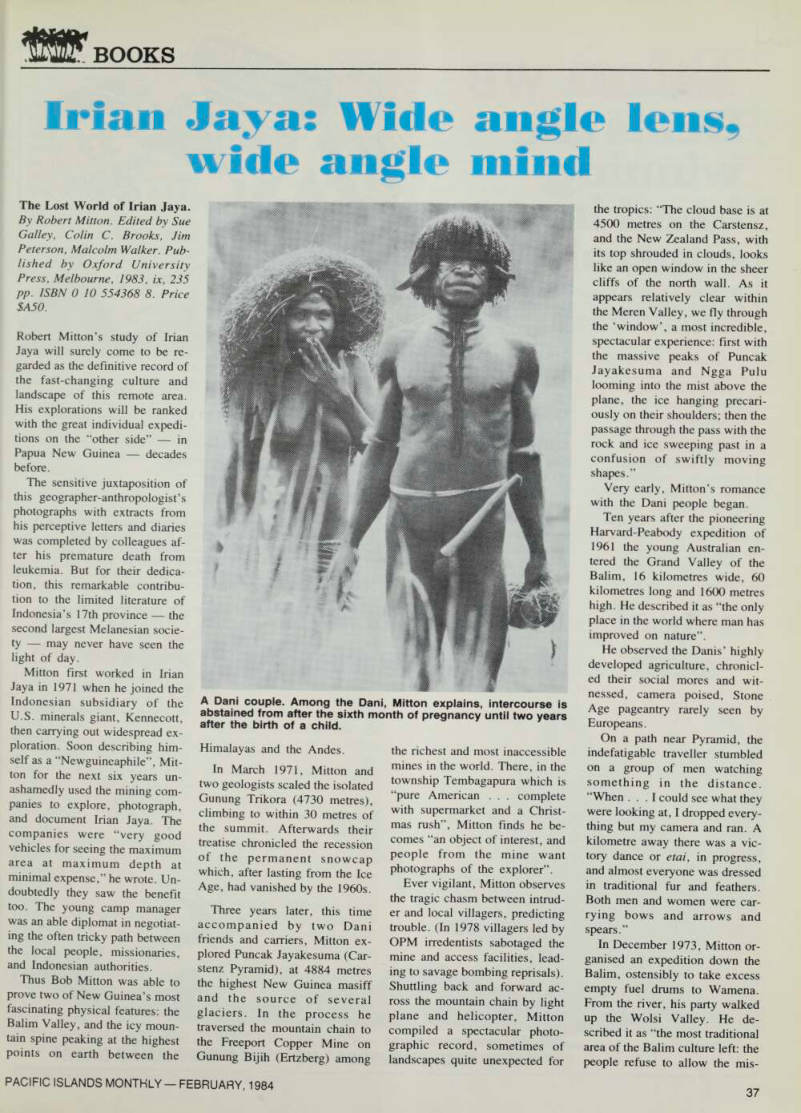
A Dani couple. Among the Dani, Mitton explains, intercourse is abstained from after the sixth month of pregnancy until two years after the birth of a child.
sionaries in and are relatively untouched by the government.
The area is exceptionally beautiful; limestone karst country with small groves of gnarled trees sheltering springs of crystal water. There are large garden areas, whichwereaconfustionofactivity as we passed, and, apart from ourselves, not an element of Western culture was to be seen.
Thts is one of the rare places where the locals are afraid of the camera.
Leaving the Grand Valley, M.tton found h.s way south to the Bahm Gorge, home of the Yah and the Kim-Yal people.
Hardly explored, rarely visited except by heavily armed troops, home of practising cannibals (two Protestant missionaries met their maker in 1968), the landscape is dominated by the river plunging 1500 metres in less than 50 kilometres through ranges regularly shaken loose by earthquakes.
In 1974, Mitton vividly chronicled the result of imprudent missionary behavior at Nipsan. “The locals decided that they had had enough of the Good Word, burned down the missio-
nary’s house, and ate his Biak preacher and 12 of his assistants.
Fortunately for them, the mis sionaries were on leave.” Mitton returned to the gorge several times, the last in May 1976 to assist a German research team, A|so jn |974 Mitton spent severa| months jn the u reaches of the Asmat ion where the Ba|im ills on (0 the si|ty coasta| p|ains jn an area with little or n 0 outside contact. Detail follows detail in Mitton . s Jouma |, which is re . printed at , ength as comm entary bes , de his s uperb Asmat jm Asmat coast, Mitton theorised on the origins of the
striking and highly developed art
forms. He concluded a connec tion with the Sepik Basin on New Guinea s north coast. Through warfare and population pressure, tribes were forced to the Asmat which is “ not reall y the most pleasant place ... all mangroves and mud > and as well as headhunters, there are also crocodiles and quicksand”, Not discouraged, Mitton par takes in an Asmat armada of some 80 canoes and delves into
the fate of Michael Rockerfeller in 1961.
From the Asmat comes a classic portfolio titled “Death and Mourning” in which Mitton, his presence seemingly un noticed, records the death of an old man. “During the pre-death wailing period, friends of the mourners take up strategic posi tions in the house, for at the moment of death all hell breaks loose, and the mourners are in
danger of doing themselves
grievious bodily harm. People
hurl themselves out of doorways and, as another sign of grief, wallow and almost drown them selves in mud. Rolling in the mud and washing is to disguise the body odor so that the spirit of the dead person cannot recognise a loved one . . . (with the) possi bility ... it will want that per son’s spirit to come along also.”
One of Milton’s great strengths is his thoughtful com mentary on “civilising” influ ences, notably the Catholic- Protestant rivalries, and, among the Protestants, the sometimes bizarre consequences of Chris tian fundamentalism. Of the In
donesians he notes their mail
tampering and systematic exclu
sion of Europeans. He writes: “The almost total lack of critical economic and social studies . . . is a reflection of government
policy . . . those researchers
who have obtained permits do so with the knowledge that any overt criticism will jeopardise future research projects for them selves or their peers. The mis sionaries are also well aware that any criticism of their hosts will endanger their continued pre sence, although, in a few cases, the missionaries themselves can only be thankful that there is no critical appraisal of their own
questionable policies,” Mitton
notes.
For pretty pictures. The Lost World of Irian Jay a belongs to any collector’s coffee table.
From 1977, before I visited Irian Jaya, I can recall The Sydney Morning Herald’s studious PNG
correspondent John Waugh be
moaning the fact that not even an accurate map of Irian Jaya was procurable.
Robert Milton’s memorial fills much more than this major gap.
Denis Reinhardt.