People
p. 36 · Read in the full issue
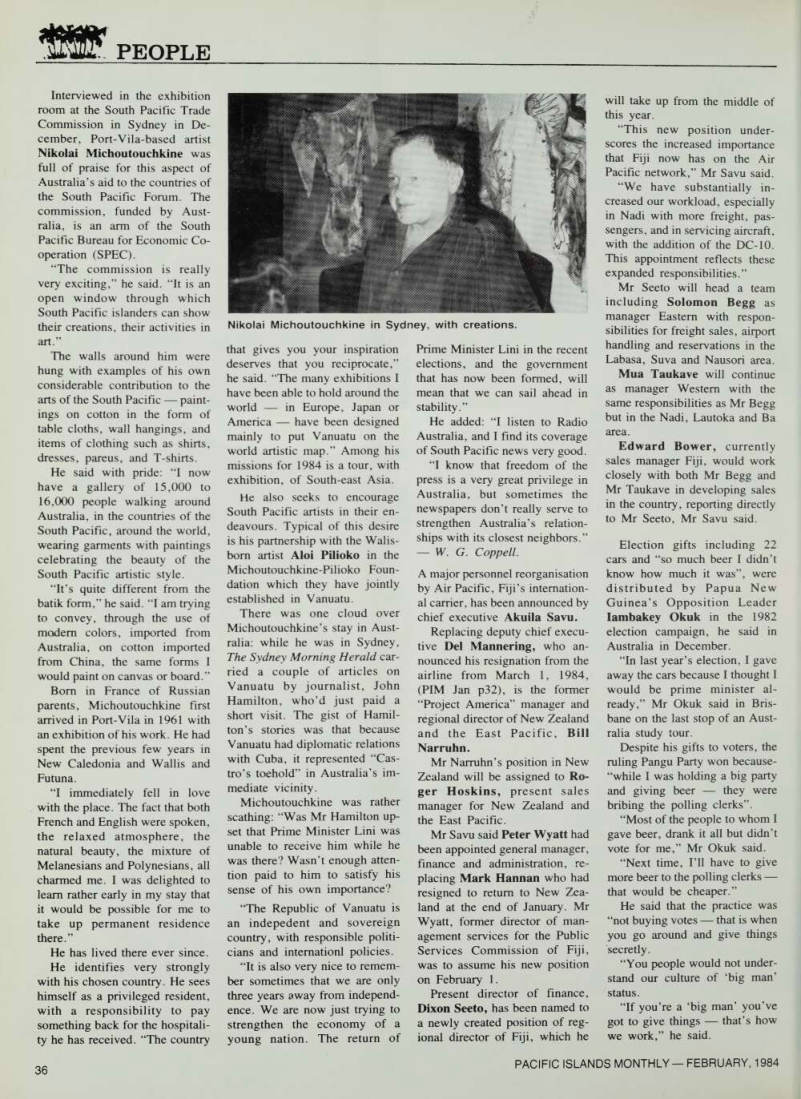
Interviewed in the exhibition room at the South Pacific Trade Commission in Sydney in De cember, Port-Vila-based artist Nikolai Michoutouchkine was full of praise for this aspect of Australia’s aid to the countries of the South Pacific Forum. The commission, funded by Aust ralia, is an arm of the South Pacific Bureau for Economic Co
operation (SPEC).
“The commission is really very exciting,” he said. “It is an open window through which South Pacific islanders can show their creations, their activities in art.”
The walls around him were hung with examples of his own considerable contribution to the arts of the South Pacific — paint ings on cotton in the form of table cloths, wall hangings, and items of clothing such as shirts, dresses, pareus, and T-shirts.
He said with pride: “I now have a gallery of 15,000 to
16,000 people walking around
Australia, in the countries of the South Pacific, around the world,
wearing garments with paintings
celebrating the beauty of the South Pacific artistic style.
“It’s quite different from the batik form,” he said. “I am trying to convey, through the use of modem colors, imported from Australia, on cotton imported from China, the same forms I would paint on canvas or board.”
Bom in France of Russian parents, Michoutouchkine first arrived in Port-Vila in 1961 with an exhibition of his work. He had spent the previous few years in New Caledonia and Wallis and Futuna.
“I immediately fell in love with the place. The fact that both French and English were spoken, the relaxed atmosphere, the natural beauty, the mixture of Melanesians and Polynesians, all charmed me. I was delighted to learn rather early in my stay that it would be possible for me to take up permanent residence there.”
He has lived there ever since.
He identifies very strongly with his chosen country. He sees himself as a privileged resident, with a responsibility to pay something back for the hospitali ty he has received. “The country
that gives you your inspiration deserves that you reciprocate,” he said. “The many exhibitions I have been able to hold around the world in Europe, Japan or America have been designed mainly to put Vanuatu on the world artistic map.” Among his missions for 1984 is a tour, with exhibition, of South-east Asia.
He also seeks to encourage South Pacific artists in their en deavours. Typical of this desire is his partnership with the Walis bom artist Aloi Pilioko in the Michoutouchkine-Pilioko Foun dation which they have jointly established in Vanuatu.
There was one cloud over Michoutouchkine’s stay in Aust ralia: while he was in Sydney, The Sydney Morning Herald car ried a couple of articles on
Vanuatu by journalist, John
Hamilton, who’d just paid a short visit. The gist of Hamil ton’s stories was that because Vanuatu had diplomatic relations with Cuba, it represented “Cas tro’s toehold” in Australia’s im
mediate vicinity.
Michoutouchkine was rather scathing: “Was Mr Hamilton up set that Prime Minister Lini was unable to receive him while he was there? Wasn’t enough atten tion paid to him to satisfy his sense of his own importance?
“The Republic of Vanuatu is
an indepedent and sovereign
country, with responsible politi
cians and intemationl policies.
“It is also very nice to remem ber sometimes that we are only three years away from independ ence. We are now just trying to strengthen the economy of a young nation. The return of
Prime Minister Lini in the recent elections, and the government that has now been formed, will mean that we can sail ahead in
stability.”
He added: “I listen to Radio Australia, and I find its coverage of South Pacific news very good.
“I know that freedom of the press is a very great privilege in Australia, but sometimes the newspapers don’t really serve to strengthen Australia’s relation ships with its closest neighbors.”
W. G. Coppell.
A major personnel reorganisation
by Air Pacific, Fiji’s internation al carrier, has been announced by chief executive Akuila Savu.
Replacing deputy chief execu
tive Del Mannering, who an nounced his resignation from the airline from March 1, 1984, (PIM Jan p 32), is the former “Project America” manager and regional director of New Zealand and the East Pacific, Bill Narruhn.
Mr Narruhn’s position in New Zealand will be assigned to Ro ger Hoskins, present sales manager for New Zealand and the East Pacific.
Mr Savu said Peter Wyatt had
been appointed general manager,
finance and administration, re placing Mark Hannan who had resigned to return to New Zea land at the end of January. Mr Wyatt, former director of man agement services for the Public Services Commission of Fiji, was to assume his new position on February 1.
Present director of finance, Dixon Seeto, has been named to a newly created position of reg ional director of Fiji, which he
will take up from the middle of this year.
“This new position under scores the increased importance that Fiji now has on the Air Pacific network,” Mr Savu said.
“We have substantially in creased our workload, especially in Nadi with more freight, pas sengers, and in servicing aircraft, with the addition of the DC-10.
This appointment reflects these
expanded responsibilities.”
Mr Seeto will head a team
including Solomon Begg as
manager Eastern with respon sibilities for freight sales, airport handling and reservations in the Labasa, Suva and Nausori area.
Mua Taukave will continue as manager Western with the same responsibilities as Mr Begg but in the Nadi, Lautoka and Ba area.
Edward Bower, currently sales manager Fiji, would work closely with both Mr Begg and Mr Taukave in developing sales in the country, reporting directly to Mr Seeto, Mr Savu said.
Election gifts including 22
cars and “so much beer I didn’t know how much it was”, were
distributed by Papua New
Guinea’s Opposition Leader lambakey Okuk in the 1982 election campaign, he said in Australia in December.
“In last year’s election, I gave away the cars because I thought I would be prime minister al ready,” Mr Okuk said in Bris bane on the last stop of an Aust ralia study tour.
Despite his gifts to voters, the ruling Pangu Party won because “while I was holding a big party and giving beer they were
bribing the polling clerks”.
“Most of the people to whom I gave beer, drank it all but didn’t vote for me,” Mr Okuk said.
“Next time, I’ll have to give more beer to the polling clerks that would be cheaper.”
He said that the practice was “not buying votes that is when you go around and give things
secretly.
“You people would not under stand our culture of ‘big man’ status.
“If you’re a ‘big man’ you’ve
got to give things that’s how we work,” he said.
Nikolai Michoutouchkine in Sydney, with creations.