Socialist Input
pp. 33-64 · Read in the full issue


On Independence
With a notable lack of that logic for which the French are justly famed, the French admirals and army engineers running the nuc lear testing program in Polynesia threw a glittering champagne party early in December to cele brate the explosion of the seventh and final bomb for 1983 (bring ing to 101 the number of bombs exploded in these islands since 1966).
The lack of logic lay in the fact that the party was in honor of a non-event, since it is still official French policy to pretend, when a bomb is exploded, that absolute ly nothing has happened. So whenever the New Zealand seis mological observatory at Rarotonga, with the utmost pre cision, records a new atomic blast at Moruroa or Fangataufa, the only official comment al lowed is: no comment.
On the other hand, the military and civil authorities never pass up an opportunity to laud to the heavens the qualities of the French nuclear force de frappe, and the wonderful nature of the various atomic bombs and weapons in the making. Not that they always express themselves with the greatest clarity.
A case in point is the latest official communique from N-test headquarters here. Quite cryptic to the uninitiated, the statement nevertheless permits the reader to draw theconclusion that nuclear testing is to continue in French Polynesia at least until the year 2000. The only change in the offing is that for reasons of economy the six to 10 tests will be packed into a few months of the year rather than being spread throughout it, as in the past.
It was announced at the same time that a big new navy trans port vessel is to be built to serve the testing program, and that more patrol ships, fixed-wing aircraft and helicopters will be assigned to it.
All this despite the fact that the Polynesians, through their elect ed representatives in the Territo rial Assembly, have time and
again opposed the tests, and have constantly asked the French bombers to go home and carry out their allegedly harmless tests in their own backyard. The last time such a formal protest was made was on December 21, 1981. The protest motion was introduced not by the erstwhile opponents of the bomb in the Autonomist parties of John Teraiki and Francis Sanford, but by the present majority leader, Vice-President Gaston Flosse, who is a member of the RPR Gaullist party led by the very conservative Jacques Chirac.
Since then opposition to the tests has been channelled mainly through the Evangelical Church of French Polynesia, to which most Polynesian inhabitants of the territory belong.
But all along the only reaction in Paris has been to tell the Polynesians that, according to the prevailing colonial system of government, they have no say whatsoever in matters of defence.
This French position seemed unassailable until it was attacked in November 1983 by a sort of Fifth Column, working from within the international socialist movement, to which the ruling French Socialist Party belongs.
The scene was the meeting of the Socialist International in Brussels on November 21-27, 1983. And the “fifth columnists” were the representatives of the local socialist party, la mana te nunaa (Power to the People), which won three seats in the Territorial Assembly in the May 1982 elections, and can probably count today on 15 per cent of the popular vote. Although la mana campaigned for Mitterrand in the presidential elections in May 1981, it is not affiliated with the French Socialist Party, and the party’s members have gradually become extremely critical of the total lack of support from their “big brothers” in France for their struggle for Polynesian inde pendence, and against the nuc lear tests.
Postmark Papeete
After their long experience of rebuffs in Paris, the la mana boys as everybody calls them here, because the three assemb lymen are all in their 30s decided to turn to their natural allies, the political leaders of the Pacific nations which have al
ready won independence.
This explains the presence of their representatives at the meet ing of the South Pacific Forum in Canberra in August, 1983, where they made contact with among other people a certain Chris Schacht, who is South Australian state secretary of the Australian Labor party, and also chairman of the party’s interna tional committee.
Mr Schacht wanged them an invitation to send an observer to
the Brussels meeting. Inciden tally, his contact with the la mana party almost made Mr Schacht persona non grata in French Polynesia (see “Pacific Report”, this issue). la mana sent its secretary-general, Jacqui Drollet, to Brussels where he distributed a four-page pamphlet to the 120 delegates present from 30 countries. The pamphlet told in moving terms of how General de Gaulle, “when France was chased out of Algeria by the victorious patriots of that coun try, forcibly installed in our Polynesian islands the nuclear testing centre to which his own people had refused house room in France”.
The leaflet ended with a to all socialist comrades gathered in Brussels for joint action either to persuade or to force President Mitterrand to hold a referendum in French Polynesia on the nuc lear testing issue.
Most seriously affected were the French delegates, who to begin with treated Jacqui Drollet almost as an outlaw or a terrorist.
On the other hand, a sufficient number of delegates from other countries were impressed to the point that the problem of French nuclear testing in the Pacific was placed on the agenda of the next meeting of the Socialist Interna tional in Copenhagen in April.
True to his usual defiant form, Jacqui Drollet came back to Papeete and held a press confer-
Continued on page 64
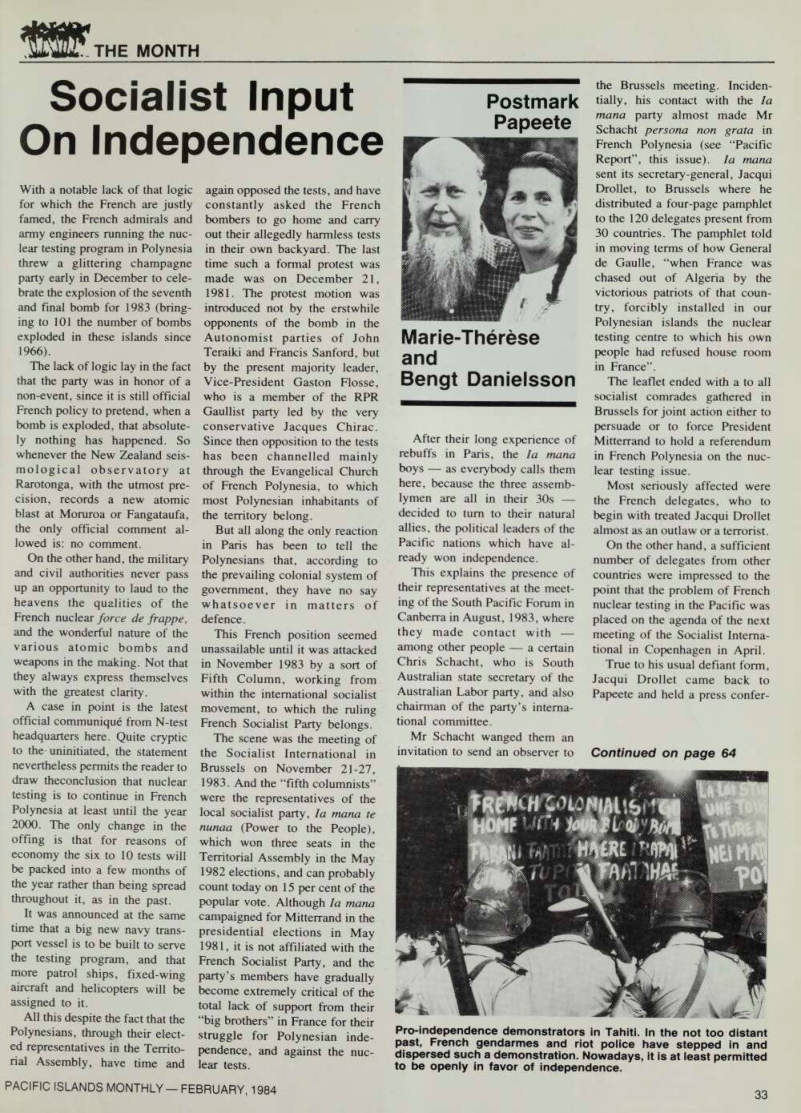
Pro-independence demonstrators in Tahiti. In the not too distant past, French gendarmes and riot police have stepped in and dispersed such a demonstration. Nowadays, it is at least permitted to be openly in favor of independence.
Marie-Thérèse and Bengt Danielsson
ence to publicise this victory for his party. He also announced that an association of “progressive political parties in the Pacific region” was in the offing . . .
It might have been pure coin cidence, but when the older and larger nationalist party, Pupu Here Aia, held its annual con vention a few days later, anti nuclear feeling was running more than usually high, and a resolu tion was unanimously adopted requesting an immediate end to nuclear testing. Seventeen speak ers gave it their support. Because independence has for so long been described as the main goal of the party, fewer speakers felt obliged to speak to the resolution calling for the creation of an independent Polynesian state, with some sort of commonwealth ties with France. This, too, was adopted unanimously. The party holds six seats in the Territorial Assembly, which corresponds to a 20 per cent slice of the electorate.
Still another highlight of the meeting was the election of a successor to party leader John Teariki, who died in an accident in early October last year (PIM Nov. p 6, Dec. p 65). The two main contenders were Milou Ebb, whose strongest appeal is to the rural electorate of Polynesian farmers and fishermen, and Jean Juventin, who as mayor of Papeete, has a large number of
uprooted Polynesian immigrants
and workers in his electorate.
Fortunately for the unity of the party, a deal had been worked out before the convention: Juven tin was elected chairman, and Ebb vice-chairman. The thing went off without a hitch.
Then, in the very next week, Teariki’s old comrade-in-arms in
the 20-year-long battle against
the bomb, Francis Sanford, mus tered his troops or rather what was left of them after the defeat of his Ea api party in the May 1982 elections. The defeat was due mostly to internal dissen
sions or, to put it more crude ly, to the personal ambition of some of Sanford’s lieutenants.
But here they all were again, the defectors, detractors, and de viationists, sitting in a neat row like schoolchildren at a gradua tion ceremony.
Naturally, the headmaster was Francis Sanford, now 70, and the party’s elder statesman. Mr San ford very wisely refused to ac cept any other position than the purely ceremonial one of honor ary chairman, 200 or so dele gates to the conference elected the mayor of Punaauia, Jacques Vii, as the party’s working chairman.
The party’s new program,
adopted by acclamation, declares
that independence for the Poly nesian people is “inscribed in the book of history”. At the same time, France is designated as the natural partner to turn to for support and assistance even after
independence a viewpoint
which corresponds fairly well to the thinking of most local politi cians. For the rest, the program is mainly concerned with fight ing the evils brought about by the
enforced militarisation and col onisation of the territory. The remedies proposed are in fact very much like those advocated by the la mana party.
During its past, when Ea api teamed with Pupu Here Aia to form the ruling majority the Front Uni as the combination was called the two parties often took as much as 60 per cent of the vote. What sort of vote could the reborn, but de capitated, Ea api party count on now? It’s hard to say, but our guess is 10 to 15 per cent.
Adding up the various percen tages of the electorate command by the three parties discussed here, one is tempted to the con clusion that December 1983 could well prove to be a turning point in the history of French Polynesia the moment when the pro-independence forces in the territory very discreetly pass ed the 50 per cent mark. As for the nuclear test issue, there is no doubt that a fairly conducted referendum on the matter would
produce an even larger majority
against. Marie-Therese
and Bengt Daniels son.