Statute plan
p. 31 · Read in the full issue
under fire
The statute of autonomy pro posed for New Caledonia by Overseas Territories Minister Georges Lemoine has been de scribed as “a treaty of occupa tion” by Independence Front par ties at the 14th annual conference of FULK, one of the five IF
parties.
Attended by representatives of
other parties in the front, the Kanak and Exploited Workers’
Union (USTKE), the Evangelical Church, and more than 100 dele gates, the conference was held at Mare Island in the Loyalty group.
The conference denounced the statute an.- said that the IF would maintain its demand for inde pendence in 1985, after one year of autonomy.
The conference also moved that the IF no longer refer to “the independence of New
Caledonia”, but to “the indpend ence of the Kanak people”.
Final decisions on a flag and an anthem were to be taken at the IF convention to be held on January 21. Work on the con stitution of an independent New Caledonia was also to be con tinued at the convention.
FULK leader and IF spokes man on foreign relations Yann Celene Uregei called on South Pacific Forum countries to take the initiative in getting New Caledonia listed with the United Nations Decolonisation Committee.
Mr Uregei left New Caledonia after the conference to visit Vanuatu, Fiji, Papua New Guinea, Australia, and Solomon Islands to explain the IP’s refusal tof the French Government’s aut onomy proposals.
The leader of the anti independence Republican Party has warned that if the next Ter ritorial Assembly elections do not take place as scheduled in July 1984 his party will prevent the South Pacific Conference in October, and the South Pacific Festival of Arts in December from taking place. Noumea is the planned venue for both events.
Jacques Lafleur told newsmen that the 35,000 people who de monstrated their anti independence feelings in May for the arrival of Mr Lemoine will physically prevent the two events from occurring, using cows, tractors and bulldozers.
Mr Lafleur said he would not accept that these meetings should be held and become demonstra tions of anti-French feelings. He said he had conveyed this warn ing to the Australian and New Zealand consuls in Noumea.
The Republicans and other anti-independence groups fear the five-yearly territorial elec tions are going to be postponed by the French Government in order to keep the present IF- Centre party coalition in power.
Mr Lafleur says Mr Lemoine has never replied to any of his questions on this matter.
Mr Lafleur’s paty, the RCPR, has present the French high com missioner with its commentary on the autonomy statue. The par ty rejects the bulk of the statute, describing it as “full of contradictions”.
The party calls for “a return to democracy” in New Caledonia, and for elections to be held with out electoral reform or
gerrymandering.
The anti-independence pre ssure group of Justin Guillemard has also denounced the statute, and renewed its call for a statute of regional decentralisation, such as prevails in Corsica.
Mr Guillemard said that New Caledonians need to remain “vigilant” to make sure the elec tions are held in July. His Caledonian Front rejections Mr Lemoine’s proposals for a re ferendum on self-determination for 1989, and wants to see it held
immediately.
If the territorial elections are not held in July, Mr Guillemard has warned that the Caledonian Front will mount a campaign of economic pressure and boycotts.
High Commissioner Jacques
Roynette flew to Paris in late December with the reactions of the various political groups to the French autonomy plans.
Mr Roynette planned to con sult with Mr Lemoine and his advisers before the statute is sent to the French Council of Minis ters, then to the Council of State, before coming to New Caledonia’s Territorial Assembly for its opinion.
Then, perhaps with some modifications desired by New Caledonia, the final text to be submitted again to the Council of Ministers, the Council of State,
and finally passed through the
French Parliament.
Ambush
• A group of 40 gendarmes and mobiles (specialised riot police) were ambushed in mid- December at a Melanesian vil lage on the east coast.
They had gone to Tieti, a tribe near the east coast administrative centre of Poindimie, to arrest several youths for thefts, burg lary, and assaults. They entered Tieti at 4 a.m., surrounded the village of 450 people, and were waiting for 6 a.m. (before which
Noumea Notebook
arrests may not be made under law) when they were attacked from behind.
Rocks and other missiles were thrown and one shot was fired by the Melanesians. The gendarmes fired two stun grenades and start ed to pull out. One gendarme fired in the air to disengage him self from an assault by a group of six young Melanesians.
When the gendarmes reached their vehicles at the roadside, further fighting broke out, with rock-throwing and several shots fired by the Melanesians. The gendarmes replied with teargas and then left. Nine gendarmes were slightly injured by the stones.
In January 1983 two gen darmes were killed and six peo ple wounded when gendarmes entered a small Melanesian vil lage early in the morning to take back sawmill equipment that was being held hostage by the villa gers in a dispute over river pollu tion (PIM Feb ’B3 pi 5).
Black Brothers
• Visiting New Caledonia in December were the West Papuan musical group. Black Brothers.
They played three concerts to small but very enthusiastic audiences.
Some rather negative press from a Noumea daialy, plus the fact that they’re not widely known in New Caledonia, prob ably explained the small turnout.
After they return to Vanuatu from Holland in early ’B4, they plan to come back to Noumea to
give more concerts.
Fraser.
Helen
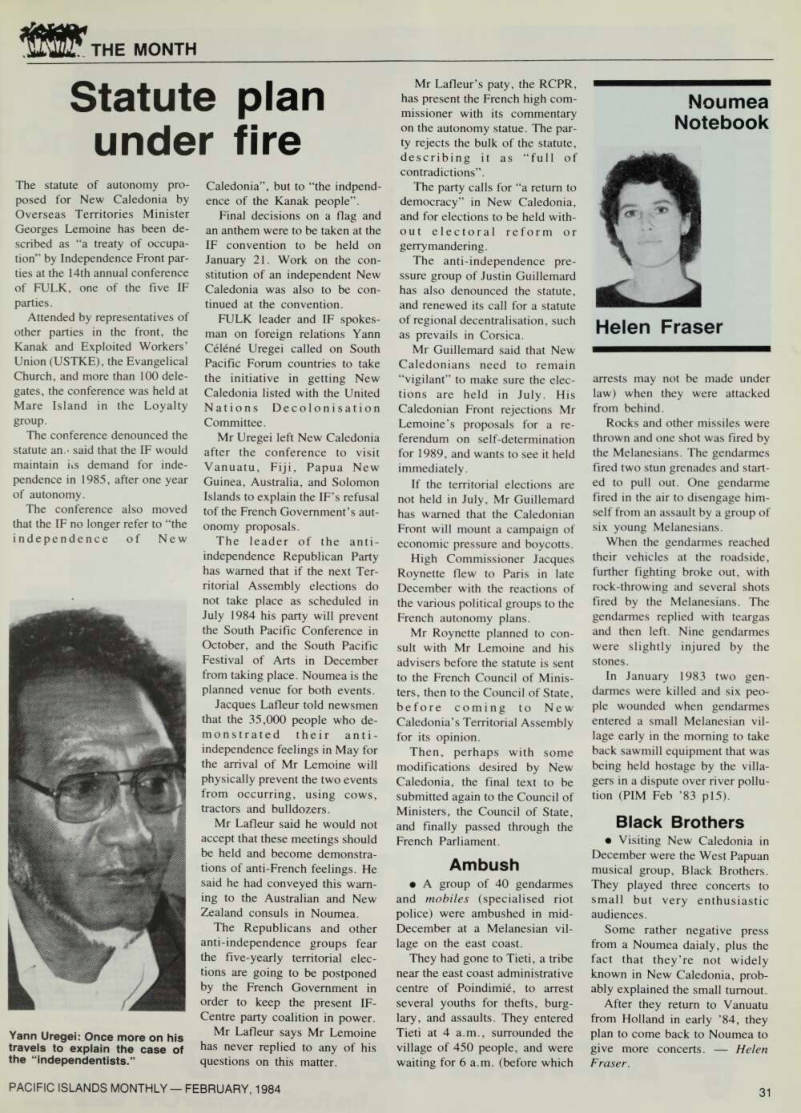
Yann Uregei: Once more on his travels to explain the case of the “independentists.”
Helen Fraser