Fiji Indians get
pp. 45-47 · Read in the full issue

their own version of 'Roots'
Girmitiyas: The Origins of the Fiji Indians. nn-'i/rinif.ii ; B\ Bnj V. Lai. Published b\ the , . .. ... ... • Journal of Pacific History, Can- . ,no 3 /c/ icDArn berra, 1983. vm. 151 pp. ISBN 0 0?0 r> 77 3ft c f ' 9595477 38. Soft cover. No price ... provided. . . . , G mnitivas: The Origins of the . tiji Indians is, m a sense, the 0 .
South Pacific equivalent of „ ... * ...
Roots. Where Alex Haley, a ... , . black American, wrote about the „. r . actual experiences of Africans , ... . . who were kidnapped for planta- . . . , , tions in North America, and the ... . generations of black families that , n.i i
they begot, Bnj Lai writes about
, ,' , .. . the backgrounds of Indians who ... , n. . were recruited for work m British . * , . ... colonies m Asia and the Pacific.
D * . , , Because Dr Lai is a descendant c , . r-... . of Indians in Fiji, his work, which is a condensation of his doctoral thesis at the Australian National University, entitled Leaves of the Banyan Tree: Origins and Background of Fiji’s North Indian Indentured Migrants, 1879-1916, exhibits a personal concern, and a marked respect for individuals, uncom-
mon in scholarly writing.
Girmitiyas means the ones who came on an agreement .., , , , ( ie > indenture), the word ag „. . . reement being rendered as gir ••, , , nut m Indian popular speech. ™ . . . ' . e 1 he book is a study ot the mtor , .c ™rv mation contained m over 45,000 . . passes issued for the migrants . _... . who came to rni from north , .. . , .
India (out of a total of more than , . 60,000 who came). Statistics .. . naturally play an important part , . JT. . , in such a study. This is also . , evident from an overview of the . book s contents; eight pages of ... & L , & illustrations, 25 tables, five . r chapters, four appendices, three . , maps, three diagrams, three .. , . graphs, and a conclusion all m , only 150 pages of text, v b But the patterns disclosed by the statistics, dramatically show
up popular misconceptions about
the Indians who came to Fiji.
Briefly, these misconceptions are
that a vast majority of those who emigrated were low caste, that the women were of shady charac ter, and that most of the families
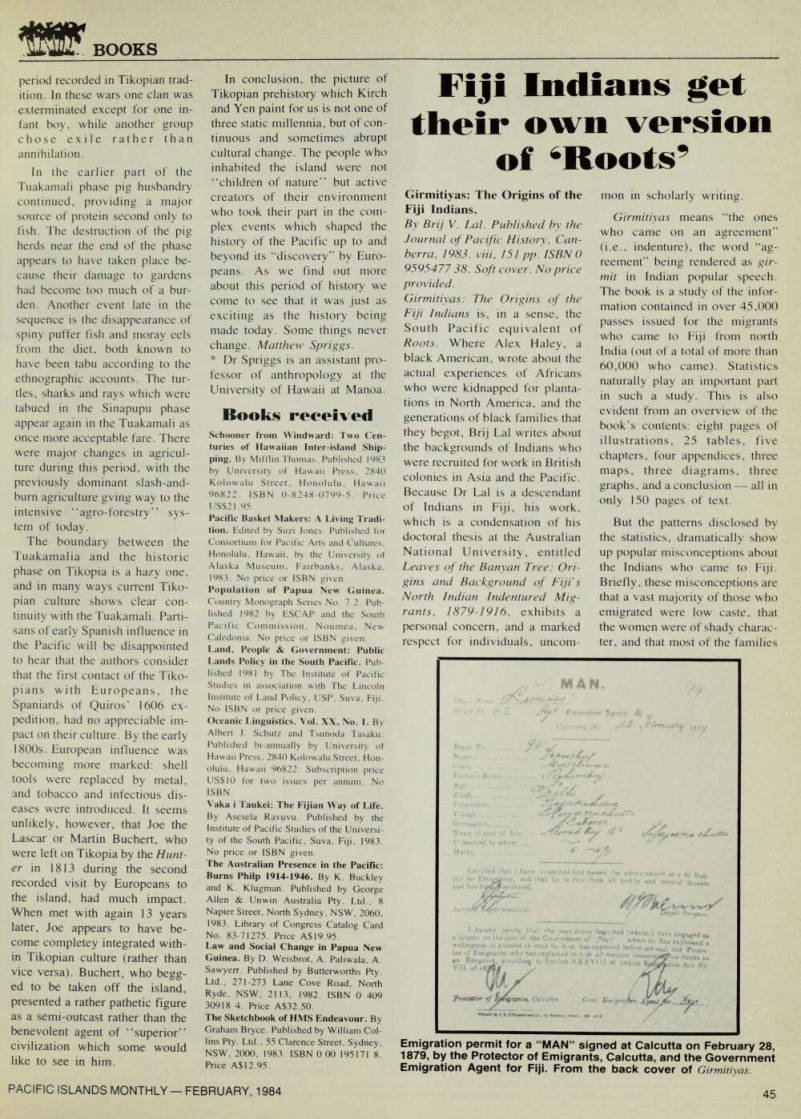
Emigration permit for a “MAN” signed at Calcutta on February 28, 1879, by the Protector of Emigrants, Calcutta, and the Government Emigration Agent for Fiji. From the back cover of Girmitiyas.
were formed in depots while men and women were waiting to leave India for the colony.
Lai’s material shows convinc ingly that none of these notions is true.
Most migrants were small ten ants or laborers without the money or crops they needed to pay their debts, and 48 per cent were of average social standing or higher; most families had left their villages as units before ar
riving at the depots.
Some attention is also paid to the geographical and social con ditions in 19th-century India which accounted to some extent for the exodus. Southern India was the greatest source of mig rant workers for Burma, Ceylon and Malaya. Down to the late 1930 s 5.3 million Indians went to settle in those three areas.
On the other hand, most In dians who went to the 14 British colonies came from northern In dia. From 1834 to 1916, 1.2 million served in those colonies; by 1969, their numbers had reached 2.1 million in the nine
colonies (including Fiji) where
they still resided. Most northern Indians came to Fiji from the Northwest and Oudh Provinces; together they formed the United Provinces, as well as Bihar Pro vince. All three together formed the northern and western boun daries of India with Nepal, and furnished 86 per cent of those who worked in Fiji.
The ' United Provinces were
especially important sources of
labor as they had a heavy popula tion, little employment opportun ity, and established habits of migration. Even so, they were only a microcosm of rural Indian society in the process of change as seen in the commercialisation of agriculture, the decline of loc al handicraft industries, the es tablishment of a cash economy, and in the mounting indebtedness of the agrarian middle class.
The problems involved in
reading this study mainly stem
from the proliferation of statist ics, and the need for at least a
rudimentary knowledge of the
geography and social structure of India in the late 19th century. A
glossary of foreign words would have been most helpful.
Even so, the perspective of fered by the book on the charac ter of Indian migrants and of late
19th-century Indian society and
social changes is easy to grasp from the contents of the first three chapters, and from the conclusion.
The last two chapters deal with women and families. They have been little studied, but they pro vided important components of
expatriate Indian society. The
families helped preserve cultural values and stabilise Indian societies abroad. Many of the women were “individuals of re
markable industry, enterprise
and self-respect” who had been cast out of households by hus bands who had themselves left for overseas employment.
The abuses of Indian women on plantations, combined with the demands of Indian national ists, helped to bring the indenture system to an end; the cases of two Indian women in Fiji are discussed in this context. The women’s laments recorded in Chapter 4, are among the most poignant passages in the book.
Dr Lai’s book will be of ser vice to all those wanting to know about the character of Indians who emigrated to labor abroad, and about the social conditions that led them to do so from the 1830 s to the 19305. It ought to be of special interest to colonial
historians.
M. L. Berg.
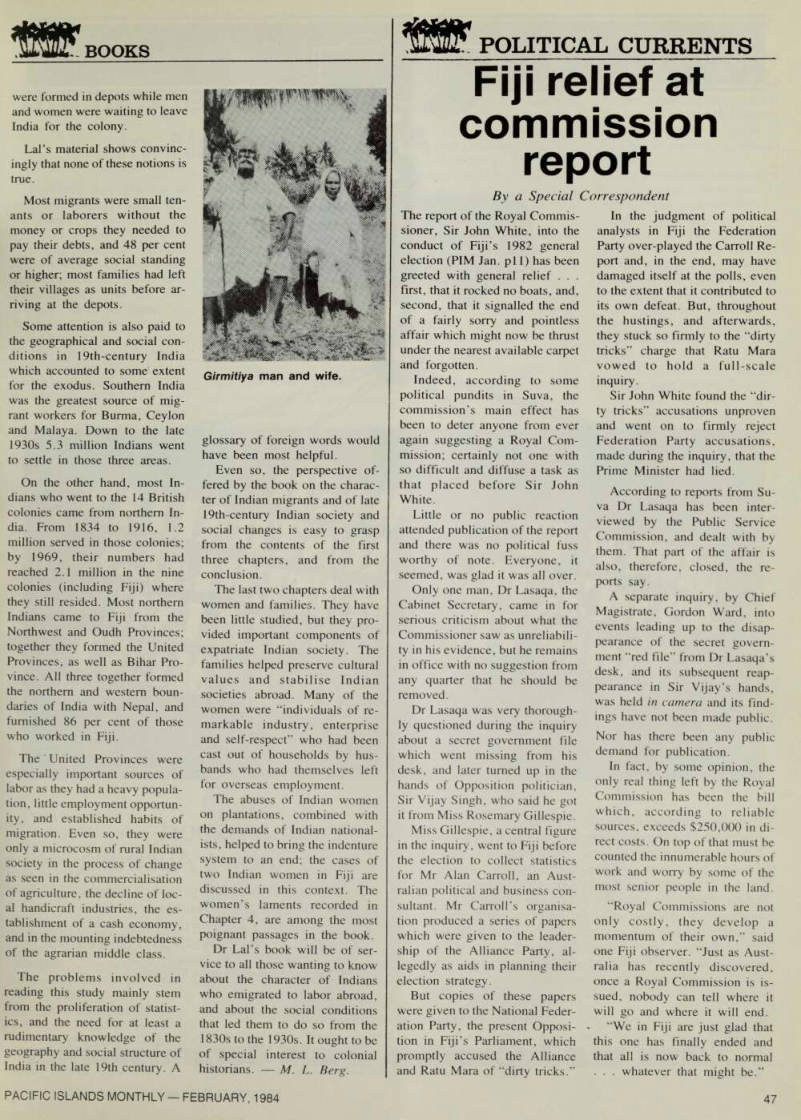
Girmitiya man and wife.