Looking at kava
pp. 27-28 · Read in the full issue
The Month
Looking at kava as an export crop
Kava, the khaki-colored, bitter extract of the roots of a perennial shrub, is many things to many people in Vanuatu: it is a soporif ic, a social drink, a traditional gift, a medicine, a part of pagan religion, a way to honor a guest, a fund-raiser, and, soon, if pre sent plans work out, it will be come a big export earner.
Custom use of kava is impor tant, but a proper discussion of it would run to many books. All I will say here is that it differs from place to place, and that sometimes two different under standings of kava flourish side by side, without apparent upset. In Tanna, for example, custom as cribes to women a mysterious power which can destroy the potency of kava, and the men are strictly secluded as they drink it.
But Tannese women drink it medicinally, and give it to their children (a one-teaspoon dose, I was told, cures whooping cough) and its power then seems
unimpaired.
Kava is a political matter, and has always been so. (Think, for example, of the sexual politics involved in the Tannese example just mentioned). To many mis sionaries, and notably the power
ful Presbyterians, kava-drinking
was a part of ancestor worship, or devil worship; they forbade it to their converts, and to others under their control. This was conceived as an act of pious paternalism; inevitably it was perceived as a political move to crush local identity. The prohibi
tion by Europeans strengthened
the association of kava with self
determination, and indirectly
helped foster the present boom in kava drinking, in line with the post-independence mood of nationalism. But though there are political overtones, kava is gen
erally drunk simply as a soothing
drink at the end of the day, more calming and more sociable than beer, and not as commiting drin kers to the rigors of a full return to custom.
Both men and women drink it in this informal way, though re
latively few women, and more of them expatriates than locals, have drunk it ceremonially. Port Vila and Santo now have several flourishing commercial nakam als clubhouses in which to drink kava, though most custom ers buy to take away. Kava is often on sale, too, at fund-raising events, such as school bazaars, or sports club nights, and is sold in root form in stores and private ly around the towns Vila alone consumes 12Vi tonnes of fresh kava monthly.
This small but steady internal trade is about to blossom into
something bigger: Vanuatu’s na
tional development plan has as one of its objectives the diversifi cation of the country’s export crops. Kava, along with garlic, pepper, cardamom, vanilla, gin ger and turmeric, is being ex amined for its potential as a supplementary export earner.
The major export crops will con tinue to be copra, coffee and cocoa. But kava has clearly emerged as the most promising of the small-scale export crops.
First investigations have point
ed out its many advantages. As it is a traditional crop, farmers are already expert in growing techni ques and in varietal distinctions.
Processing for export for use as a drink can be very simple; the rootstock is carefully cut into pieces, dried and bagged. The returns from kava are very high,
in terms of the time spent in labor to produce it 2000vt per work er per day, compared to 800vt per worker per day for coffee. In terms of land use, too, returns are acceptable, especially as ka va is well suited to inter cropping. It can be grown along with subsistence gardens, as well as with plantations under es tablished coconut trees, for ex ample, or during the establish ment phase of cocoa plantations. (Mature cocoa plants cast too much shade to be good compan ions for kava).
These are all agricultural mat ters. On the economic side things look equally favorable. Markets are strong. Fiji, the world’s ma jor kava trader, with a marketed output of nearly 2000 tonnes annually, is now (and has been since 1980) a net importer of kava. This seems the most obvi ous market for Vanuatu. Howev er, Tonga is another kava con sumer, and has informally expre ssed interest in importing Vanuatu’s high quality kava.
Other potential markets are in Western Samoa, in Auckland, and, surprisingly, in Fairbanks, Alaska, where about 100 Sa moans live, work and drink ka va. An Australian firm of ag riculture consultants, who re cently carried out a survey of non-traditional export crops for Vanuatu’s department of agricul ture predicted that within eight years Vanuatu will be able to export around 50 tonnes of dried kava annually to Fiji, which they suggested should be the main focus of export.
Director of Agriculture Barry Weightman is extremely confi-
Report from Vanuatu
dent that Vanuatu can and will exceed these figures. He points out that there are other markets barely tapped, that in addition to Pacific Islanders many Europe ans are beginning to leam the benefits, physical and psychological, of kava. Some of these are herabalists, and others simply pleasure-seekers. “Relax and enjoy our herbal highs, per fectly legal . . .’’ suggested an advertisement in the British magazine, Private Eye in June last year, and went on to offer “extraordinary psychoactive root drinks from Hawaii . . . Kava Kava root £3.50 1 oz.”
A small sample shipment has already been sent to another mar ket which utilises European in terest in kava, and which has great possibilities for Vanuatu.
This is the giant European phar maceutical industry, based in France and Germany, which has a steady demand for 45 tonnes of dried kava a year. This industry uses some of the many medicinal properties of kava it is anti septic, anti-bacterial, fungicidal, anaesthetic, a muscle relaxant (to the point of temporary paralysis after over-indulgence!), a decon gestant, a diuretic and a soporif ic. Medically, it is still very under-exploited, but preparations such as Kavaise, for infections of the urinary-genital system, have been produced and sold in Europe for about 20 years.
Fiji and Tonga, hitherto the suppliers for this industry, did not sell direct to Europe, but to brokers in Singapore, who in turn sold to extractors in Ameri ca, who sold the extract to
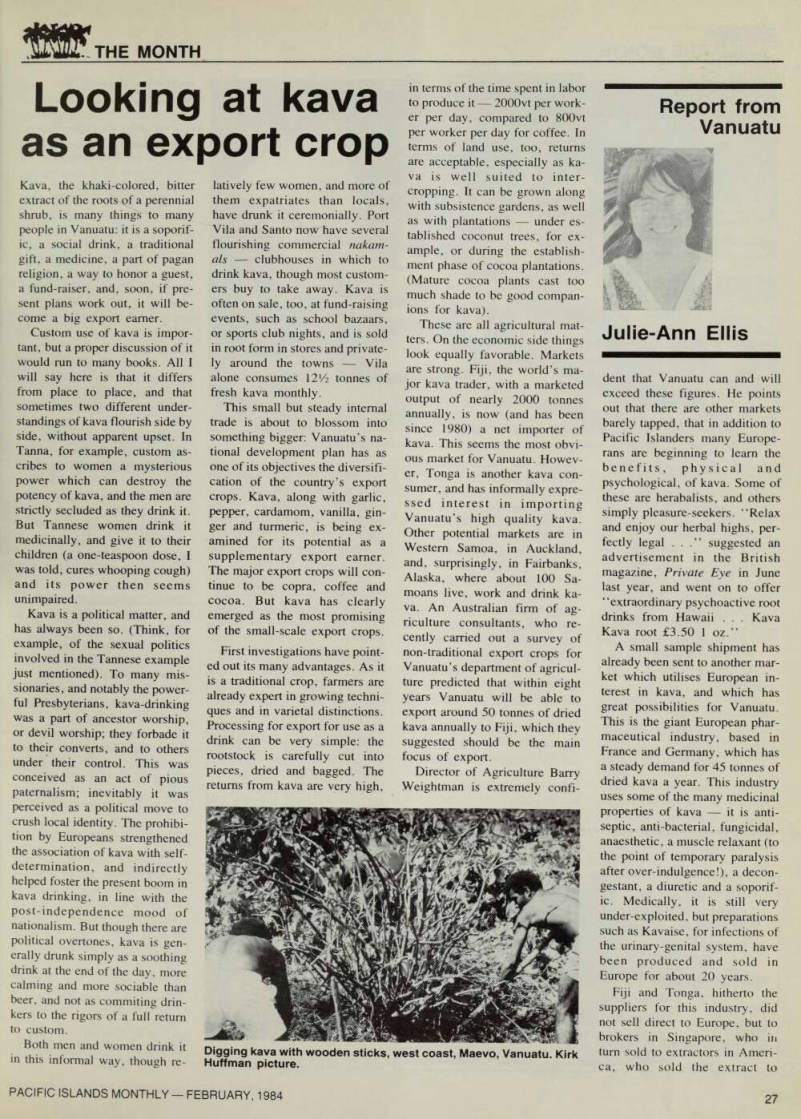
Digging kava with wooden sticks, west coast, Maevo, Vanuatu. Kirk Huffman picture.
Julie-Ann Ellis
Europe. This tortuous trade left a good deal of the profit in the hands of the middlemen, and also drove up the price for the European consumers. One ex tractor has given notice of with drawal from the trade. Industrial ists in Europe have complained that is is difficult to get stable quality kava at a stable price.
However, the preparations on sale are in steady demand, and the makers are interested in a more direct marketing connection.
Vanuatu is in an excellent pos ition to step into this market. The consultants suggested that after extensive planting, 20 tonnes could be sent annually to Europe.
Again, Mr Weightman thinks
these are conservative estimates, and that the market has the po tential to open out a great deal more. He is supported in this view by the activities of Vincent
Lebot, an agronomist working (courtesy of French aid) at
Vanuatu’s Tagabe Agriculture
School, as technical assistant.
M. Lebot has been directing kava research there, and has sent sam ples of Vanuatu’s kava to Euro pean laboratories for analysis.
This has shown that local varieties have the highest con centration of kavalactones (the active chemical element in kava) of any kava varieties so far test ed. Dry powder from Vanuatu showed a concentration of 5.23 per cent kavalactones, compared with 2.3 per cent kavalactones in
dry powder from Fiji kava. This
presumably makes the local kava the most suitable for extraction for medical purposes, and to M.
Lebot, this is where the future of the crop lies.
He points out that there is a big market for homeopathic medicines in Germany, and that
companies involved are interest ed in selling kava in a less pro cessed form, perhaps as a drink.
He is also interested in exploring
the burgeoning Japanese and
Southeast Asian pharmaceutical industry within the country.
However, all of these plans are for the long term. Vanuatu’s pre sent aim is to establish a steady strong supply of kava for export, initially for the Pacific market.
Although it will be an important supplementary trade for the
country, agricultural planners en
visage taking only a very small share of the overall market, and even that will mean extensive planting must be carried out. It is difficult to calculate exactly the present production of kava, as so much is grown for personal use, but estimates begin at around 250 tonnes of fresh kava, roughly equivalent to 50 tonnes dried.
The agriculture department
has begun a program of public information about kava growing for export, about the possibilities of inter-cropping it with planta tion crops, and about processing for export. In this work it is aided by private exporters, who want to see the growing of kava put on a more businesslike footing.
Charles Long Wah, the most active of these, has organised a great deal of the non-govemment material available to the public concerning kava as a cash crop, and has even supplied free kava
shoots for planting. Mr Long Wah is in personal contact with many of the ni-Vanuatu currently planting kava for future export.
He speaks confidently of their ability to produce enough to fill what he sees as a growing de mand, and thoughtfully points out the advantages to the small producer of a quick-growing (30 kilos of usable plant after 18 months), high-paying crop.
“Now even the smallest village farmer is the master, not the boy on the plantation,” he says.
Much planting has already ta ken place, and slowly, through the next few years, the returns should begin to flow in. The most conservative estimates sug gest that by 1991 Vanuatu will have a steady annual return of (at 1983 prices) 30 million vatu from kava. This is little enough in terms of the country’s overall budget, but nevertheless would
be an important supplementary
trade.
Meanwhile the research con tinues. Tagabe’s students and staff have put together an ex haustive bibliography of kava, beginning with the first western scientific research in 1860. They have identified 72 different varieties known inside Vanuatu, each of course being known to traditional growers by vernacular names, and known to have diffe rent properties. They have car ried out agronomic research on techniques of cultivation, and are
presently testing different
varieties and making inter varietal trials for yield, pest and disease resistance, and so on.
They are the latest contributors in a long history of scientific re search into the “intoxicating
pepper” piper methysticum
was the name given to kava by a botanist travelling with Cook.
Their research is on behalf of
the department of agriculture,
and directed to agricultural ends, but it is also research for its own sake, to increase the available body of knowledge. Kava is many things to many people a custom drink, an export crop, a medicine. Perhaps as a result of their work, it will appear in a
new guise again. “We hope,”
begins Vincent Lebot, and then amends it, “we believe there is something new to discover.”
Julie-Ann Ellis.
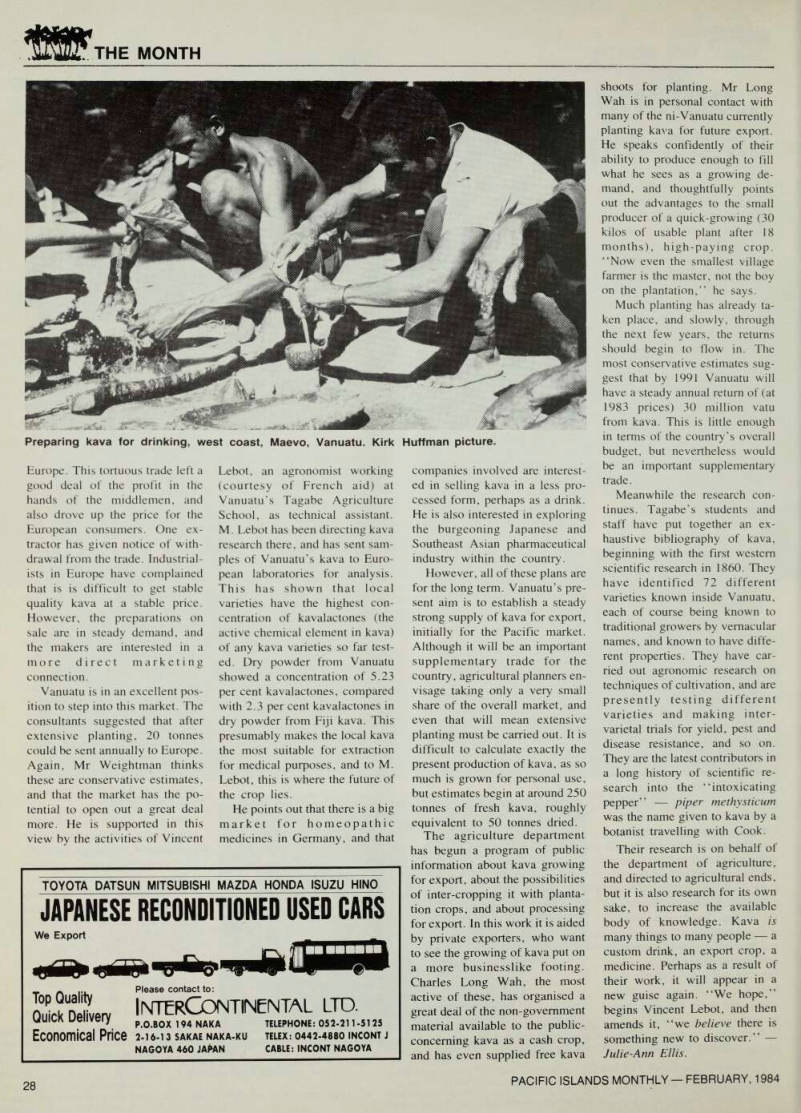
Preparing kava for drinking, west coast, Maevo, Vanuatu. Kirk Huffman picture.