Rossel island’s welcome mat is
pp. 23-25 · Read in the full issue
out for its Italian ’twins’
MARCO and ROBERTO PETTINI are young men with a mission.
The Rome-born brothers, Marco, 30, and Roberto, 28, have taken up a life of practically permanent travel not travel for its own sake, but travel for the purpose of human discovery.
In Roberto’s words: “I wanted to look for the most isolated groups of people I could find In the countries I visited. I felt that by looking for them I would have the opportunity of getting to know, in my own way, truly different ways of being human ..
Roberto had already found such groups in many places, including India, Nepal, Borneo (where he stayed for some time with a Dayak tribe still living a nomadic life) and the Philip pines, before setting out, accompanied by Mar co, on a new voyage of human discovery in the Pacific Islands.
PIM publishes here the first in a series of extracts from the remarkable travel diary kept by the Pettini brothers, this one dealing with a visit to Rossel Island, in the Louisiade Group in Papua New Guinea’s Milne Bay Province.
December 30, 1980: The tiny mail plane lands on Rossel Island on a thin green strip between two tall lines of coconut palms.
The first person to greet us is Michael, a lad of barely 16, his head covered with orange-tipped curls, and his teeth stained by betel.
Here in Rossel he represents the government, is responsible for the maintenance of the air strip, running the radio, and even co-ordinating the census of the
island’s population.
We know that there is a Catholic Mission on the other side of the island. Hearing that we come from Rome (!), Michael does not hesitate: he immediately gets on the radio and informs the missionary of our arrival.
December 31: We are coasting round the island on the mission’s small motor boat. Rossel looks stupendous. Circled by a wide coral reef it is covered with mountains and forests, from which every now and then we see columns of smoke ascending it’s the time of year when areas of bush are burned off to prepare new gardens.
Arriving at the mission settle ment of Ginger, Father Kevin English is waiting for us at the wharf. He wears a wide straw
hat, small round glasses, and a wide paternal smile, He has already prepared a beautiful hut for us, between two tall mango trees, with beds al ready made, complete with mos quito nets, and two jugs of drink ing water ready on the table, Later, as we celebrate New
Year’s Eve with him, he tells us that he has been here for 10 years, and that his days are filled with things to be done and mat ters to be kept strictly under
control. Apart from spreading
the Gospel, he co-ordinates the work of the primary school and the hospital, runs the best sup
plied “store” on the island, plus a bank micro-branch and the post office. He also makes a nightly broadcast of the weather forecast for the next day . . .
January 3, 1981: Each with a small pack on our shoulders, a “bilum” (stringbag) between us, and wearing only shorts, we leave the mission late in the morning to start our tour of the island on foot.
Along the track taking us to East Point, we are never alone.
There is always a group of chil dren with us, yet the girls run away scared and hide when they see us coming. One frightened little girl even finds refuge up a coconut palm. Then, the novelty gone, they are the first to offer us pawpaw, boiled banana and pumpkin, and to explain to us in
good English the right direction
to follow.
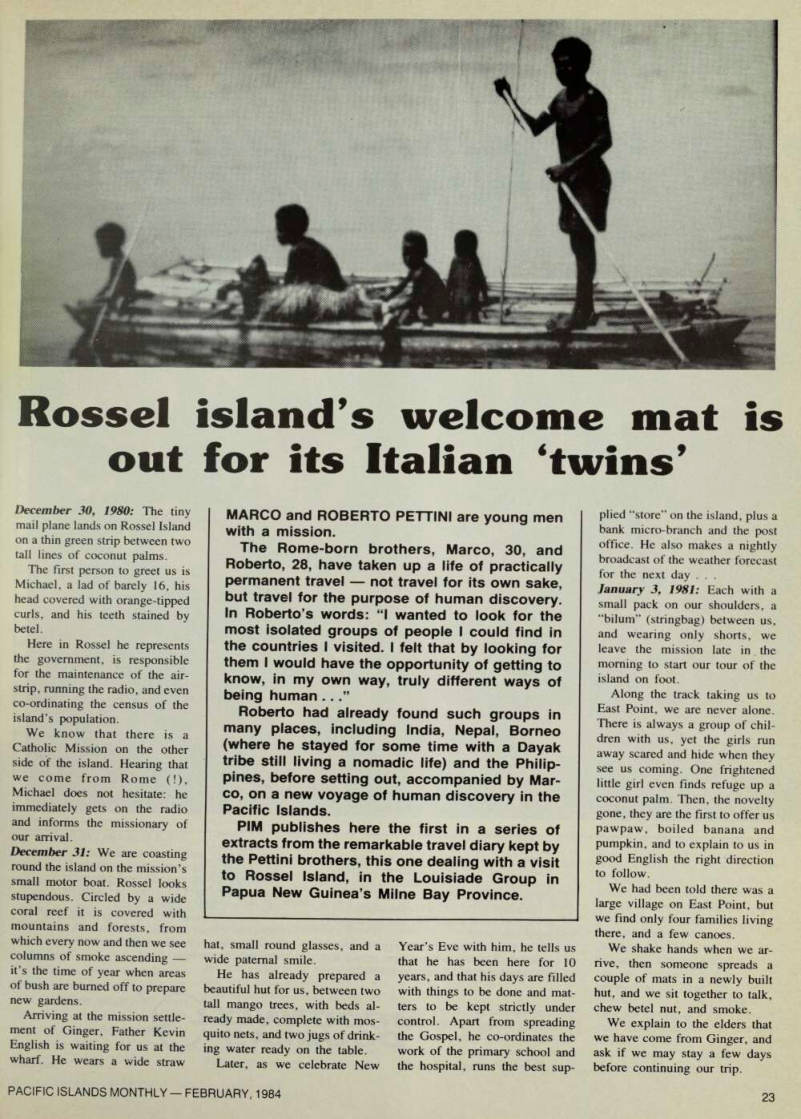
We had been told there was a large village on East Point, but we find only four families living there, and a few canoes.
We shake hands when we ar rive, then someone spreads a couple of mats in a newly built hut, and we sit together to talk, chew betel nut, and smoke.
We explain to the elders that we have come from Ginger, and ask if we may stay a few days
before continuing our trip.
We are not asked many ques tions. The general interest is focused on us and our family. To all and sundry, we are twins, and we have fun questioning them as to which one of us (according to them) was bom first. (This is a game we will continue to play throughout our stay in Melanesia.) They listen with great interest to details of the number of members in our fami ly, ask how many of us are married, and how many have children. They ask us if our parents are still alive. And the day ends like that, with much “Sorry . . . sorry” for the long distance we have had to travel to get here.
January 5: We were hoping to go fishing at least today, since it rained all day yesterday, and there really should be a lot of fish here. Yet the village people ha ven’t moved. The men stay sit ting on the verandahs all day, chewing betel nut and smoking, while the women cook taro, bananas, and sago.
We’ve noticed that whoever receives a piece of tobacco, a stick of sugar cane, or something else, divides it into as many parts as there are people present, and gives a piece to each. This is done naturally, and is taken for granted, just as elsewhere one will use a part of something and keep the rest for oneself.
In the afternoon Marco sat down under the coconut trees and started sketching the hut where we are staying. A few children stood silently observing him, but as soon as the little house started to take shape on the paper and rumor spread and a real pilgrim age started, accompanied by a chorus of “Oh! Oh!”, and ending only when there wasn’t a ray of light left by which to see.
Here they can never have seen
anyone drawing.
January 7: Abeleta Village. It’s raining heavily, and as if it will never stop. Under the huts built on stilts, only a few pigs, enorm ous and sleepy, remain, while streaks of smoke rise from the leaf roofs of the houses. Today everybody is at home. Only a few children run past, skylarking in the mud.
Sitting on the verandah, we open the book Father English left with us before we set off from the mission Rossel Island: An
Anthropological Study, by W. E.
Armstrong M. A., Cambridge
University Press, 1928.
Rossel Island, or Yela, was first discovered about 215 years ago, but it passed into oblivion until 30th September 1858 when the ship St Paul, bound from Hong Kong to Sydney with 327 Chinese coolies on board who were seeking their for tunes in the gold mines of Australia, was wrecked on Rossel Island.
The captain and eight of the crew left in a boat to obtain assistance, abandoning everybody to their own fate . . . The Chinese apparently scrambled along the reef a matter of a few hundred yards to the little island known as Heron Island, a place of two or three acres in extent and quite devoid of food, other than birds eggs and shell-fish.
The distance of about a mile which separates this island from the main land prevented most of the Chinese from swimming across, and the few who tried were killed as soon as they reached the shore. Those who in spite of thirst and hunger remained on Heron Island, were eventually visited by some of the natives who brought them food and water. Some were
induced to return with the natives to the mainland, where they were speared or had their legs broken.
It seems possible that a steadily diminishing group of Chinese were kept on Heron Island by the natives, who provided them with food and removed one or two to the mainland whenever they were required for a cannibal feast.
When the French steamer Styx arrived on the spot from New Caledonia in January 1859, it was found that the whole of the passen gers and crew, with the exception of one Chinese, had been horribly mas sacred by the natives. The survivor stated that the natives feasted upon the bodies of their victims . . .
Here in Abeleta, Lawrence Weta is a “big man”. He is very old, and speaks slowly and almost in a whis per. The people in the village talk of him with great respect. Today, as soon as he learns of our arrival, he sends for us and invites us to stay with him.
Weta wasn’t even bom when the massacre of the Chinese happened on Heron, but he knows the story per
fectly. He talks about it with a certain compassion. Tonight he wants to add many details to those written in the book . . .
“At that time here in Rossel there was a big man known as Muwo, son of one of the most powerful chiefs of the island. My grandfather told me that one day, when Muwo was still a boy, another boy he was playing with accidentally threw mud in Muwo’s eye. Muwo intimated that, in spite of apologies and the payment of shell money as compensation, his father killed and ate the culprit.
“Subsequently, Muwo became an extremely rich, powerful and feared chief. It is said that he had 10 wives, 10 houses, 10 canoes, a great variety of fishing nets and a great quantity of shell-money. Of these wives, many were girls abducted at feasts, though the correct payment was said to have been made in these cases. Many of his canoes were virtually stolen.
“Muwo didn’t kill people by ‘em bo’ (breaking of bones at night) or by ‘Ngwivi’ (the commonest method of sorcery), for in such cases the victim
couldn’t be eaten. Muwo’s victims were, instead, taken and speared and cooked, with only the flimsiest ex cuse being given, and sometimes no excuse at all.
“If Muwo was badly bitten by mosquitoes, or if his gardens were damaged by a big wind or rooted up by bush pigs, he would send his men out to kill someone as compensation, and in such cases would not pay the relatives.
“Fortunately for the locals, the St Paul was wrecked on Rossel early in Muwo’s career, and so most of his victims were the Chinese.
“Some time later, Muwo succumb ed to sorcery, which had been direct ed against him from all sides; and then the relatives of his victims gave vent to the emotions they had former ly had to suppress, by destroying his gardens, killing his pigs, raping his widows, and so on . .
January 9: Today people came from neighboring villages to complete a hut for a young village man, Ngu.
Everyone was very busy all day long.
While the women cooked a great
quantity of food which served as payment for the work done, men constructed the roof sections from leaves and then assembled them.
Lawrence Weta taught us too, how to do it, and tonight he told that this roof “i no olsem ruf istap long pies ia” (is different from all other roofs) . . . because it will certainly last longer for the simple reason that we helped build it.
January 10: This morning we left Abeleta in a canoe. Ngu and his brother Kebe offered to take us, so as to save us from crossing a thick swampy area which is particularly infested with mosquitoes.
Before leaving, when the whole village population gathered on the beach to say goodbye, Lawrence approached and told us solemnly: “As from today, my name and that of my brother Peter will be yours, just as your names will become ours. In this way you will always remember us and we will remember you. When you return home, tell your parents that these are the names that we gave you here in Rossel.”
We arrive in Yam, certainly one of the largest villages on the island.
Bordered by the beach, by a coconut plantation, and by the river mouth, it seems to be perfectly “planned”.
Two long rows of parallel huts line up in an orderly way on the two sides of a lane that crosses the village, a lane complete with well looked-after edges.
It is explained to us that Yam is a “new” village, and that traditionally the villages in Rossel were small clan-villages hidden in the bush.
With a semi-permanent state of war between rival clans, it was risky to live along the coast or in too access ible areas. Today the bush is in
habited almost exclusively by pigs
and other wild animals, and, apart from the little “clean areas” turned into gardens, there are only the nar row tracks that reduce considerably the distance between the two coasts.
As to the village buildings, the actual dwellings are only the fully enclosed huts built on stilts. The other structures, those without walls and built directly on the ground, are the places where the islanders spend a great part of those days when they don’t go fishing or to the gardens. As these huts are built on the ground they are more accessible, open in all senses open to the numerous visits of people coming to have a chat, to smoke, to chew betel; and also open to cook in, and play host in, when people come from other villages, and a feast is organised.
January 11: Here, once the first impact and embarrassment of meet ing are overcome, women started approaching to touch my (Rober to’s)hair ... a very slow gesture, a long soft caress, as if I had the soft hair of a Siamese cat on my head . . . • Next month: Acceptance, and a "death feast", on Rossel.
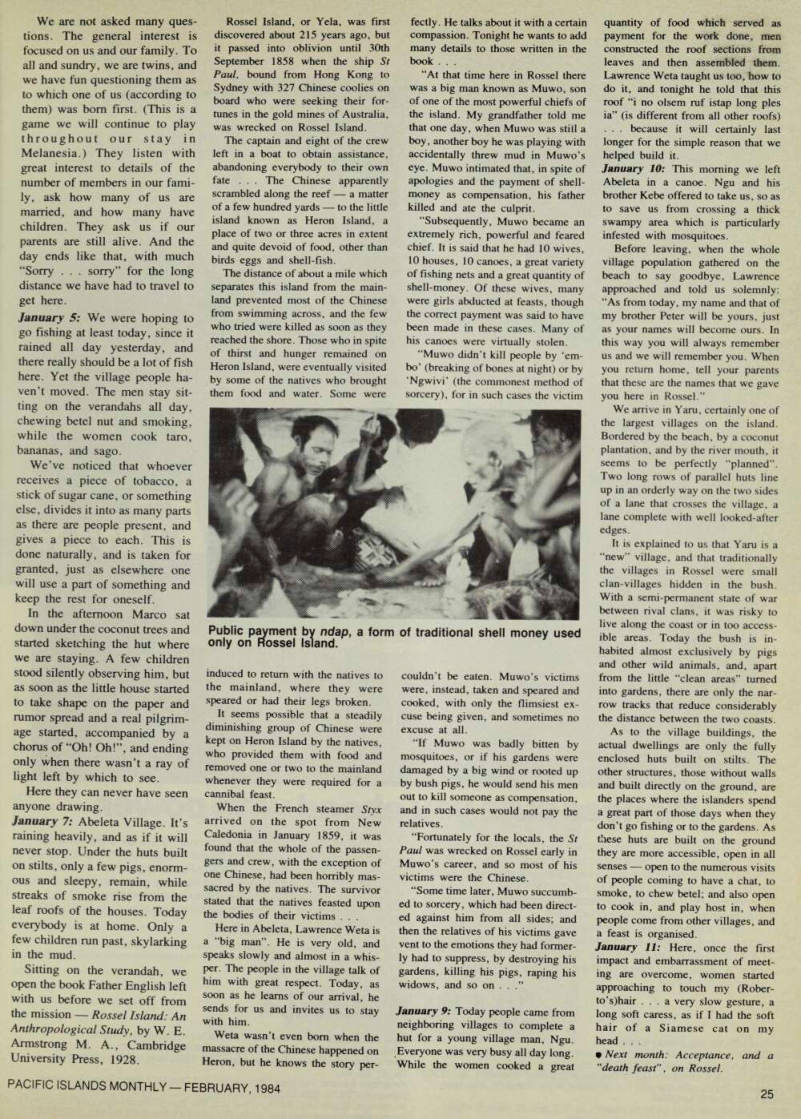
Public payment by ndap, a form of traditional shell money used only on Rossel Island.