Calling all
pp. 19-21 · Read in the full issue

Letters
traditional
money buffs
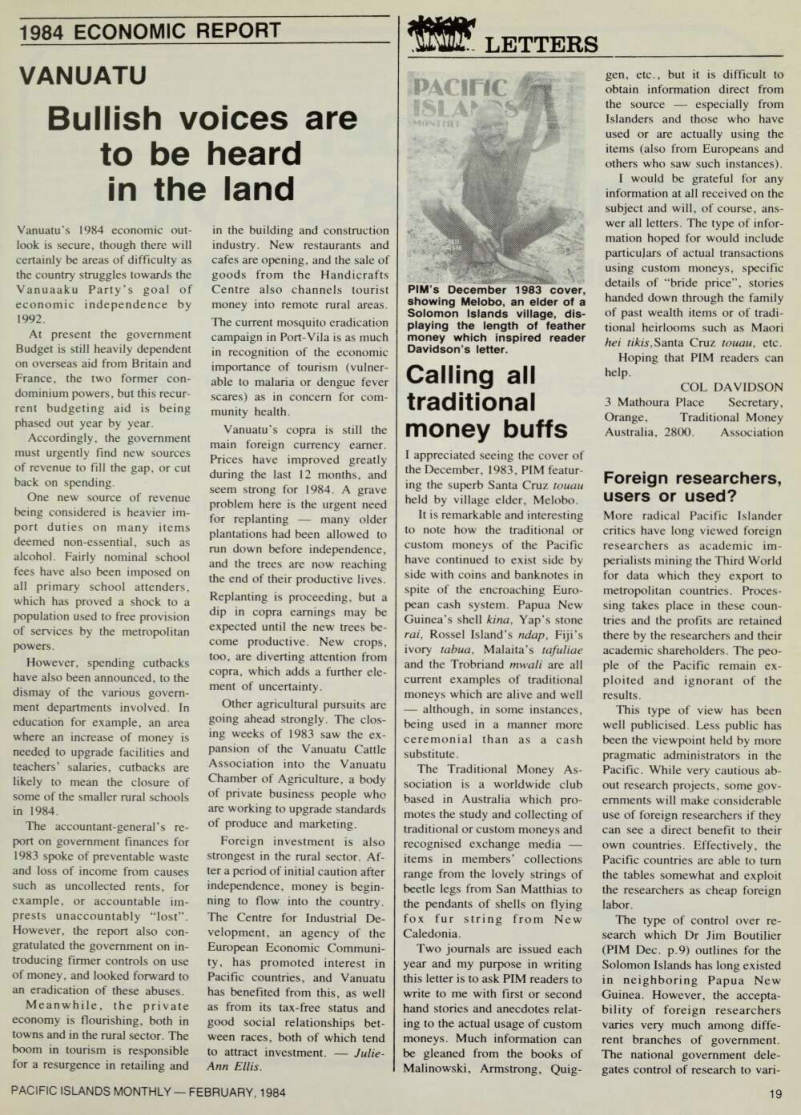
I appreciated seeing the cover of the December, 1983, PIM featur ing the superb Santa Cruz touau held by village elder, Melobo.
It is remarkable and interesting to note how the traditional or custom moneys of the Pacific have continued to exist side by side with coins and banknotes in spite of the encroaching Euro pean cash system. Papua New Guinea’s shell kina. Yap’s stone rai, Rossel Island’s ndap, Fiji’s
ivory tabua, Malaita’s tafuliae
and the Trobriand mwali are all current examples of traditional moneys which are alive and well although, in some instances, being used in a manner more ceremonial than as a cash substitute.
The Traditional Money As sociation is a worldwide club based in Australia which pro motes the study and collecting of traditional or custom moneys and
recognised exchange media
items in members’ collections range from the lovely strings of beetle legs from San Matthias to the pendants of shells on flying fox fur string from New Caledonia.
Two journals are issued each year and my purpose in writing this letter is to ask PIM readers to write to me with first or second hand stories and anecdotes relat ing to the actual usage of custom moneys. Much information can be gleaned from the books of
Malinowski, Armstrong, Quig
gen, etc., but it is difficult to obtain information direct from the source especially from Islanders and those who have used or are actually using the items (also from Europeans and others who saw such instances).
I would be grateful for any information at all received on the subject and will, of course, ans wer all letters. The type of infor mation hoped for would include particulars of actual transactions
using custom moneys, specific
details of “bride price”, stories handed down through the family of past wealth items or of tradi tional heirlooms such as Maori hei tikis, Santa Cruz touau, etc.
Hoping that PIM readers can
help.
Col Davidson
3 Mathoura Place Secretary,
Orange, Traditional Money
Australia, 2800. Association
Foreign researchers,
users or used?
More radical Pacific Islander critics have long viewed foreign researchers as academic im perialists mining the Third World for data which they export to metropolitan countries. Proces sing takes place in these coun tries and the profits are retained there by the researchers and their academic shareholders. The peo ple of the Pacific remain ex ploited and ignorant of the results.
This type of view has been well publicised. Less public has been the viewpoint held by more pragmatic administrators in the Pacific. While very cautious ab out research projects, some gov ernments will make considerable use of foreign researchers if they can see a direct benefit to their own countries. Effectively, the Pacific countries are able to turn the tables somewhat and exploit the researchers as cheap foreign labor.
The type of control over re search which Dr Jim Boutilier (PIM Dec. p. 9) outlines for the Solomon Islands has long existed
in neighboring Papua New
Guinea. However, the accepta
bility of foreign researchers
varies very much among diffe rent branches of government.
The national government dele gates control of research to vari
PIM’s December 1983 cover, showing Melobo, an elder of a Solomon Islands village, dis playing the length of feather money which inspired reader Davidson’s letter.
ous government departments and
government-funded organisa
tions. Provincial governments vary greatly in their sensitivities, and politicians may or may not be involved in deciding if resear chers can come to their
provinces.
The acceptability of resear chers depends also on the type of research. Anthropologists in gen eral are not popular, nor are psychologists. In some pro vinces, such as Milne Bay, marine biologists have been re garded with suspicion.
One area where researchers are welcome under strictly controlled conditions is edu cation. The demands adminis trators place on research are very practical, however. At a 1982 conference organised by the Un iversity of PNG’s Education Fa culty, the acting secretary of edu cation, Geno Roakeina, had this to say: “We want to improve education in Papua New Guinea.
From my point of view, that is the only reason we should have education research.” Over 60 people researcher and non researcher, national and expat riate attended this two-day conference in Port Moresby. It was clear that education research is valued in many parts of the education system.
The national department of education has long had a princip al research officer responsible for
administering research policy.
The Educational Research Unit at UPNG has been established for over 10 years and is interna tionally known for its applied research work. At the University of Technology in Lae, the Mathematics Education Centre undertakes research as well. The ERU has co-operated with a number of provincial govern ments, and two have set up col laborative research programs.
The North Solomons Education Research Project has been par ticularly successful over the last five years.
Foreign researchers’ projects
have to be approved by the de partment of education, vetted by the ERU and accepted by the province. This is a cumbersome procedure and, as in the Solomon Islands, can take several months.
However, education research projects in PNG are not based on
a one-way flow of proposals from overseas. The majority of projects arise within the country usually from consultation bet ween the department of educa tion and the ERU. To a consider able extent the ERU acts as a research sub-contractor to the de partment. The ERU may analyse long-standing educational prac tices, assist in planning new ones
or, increasingly, evaluate long
standing educational practices,
assist in planning new ones or,
increasingly, evaluate depart
mental initiatives. Often the de partment or other branches of government fund such work. Be cause its regular establishment is small, the ERU may use such funds to employ researchers from overseas or to fund research by
visiting academics.
Flexible and adaptable over seas researchers willing to fit in
with locally established priorities
will often find their paths smoothed and will be provided with much practical assistance, including limited funding. In re turn they will be expected to hold seminars and discussions before leaving, to provide reports and to write for educational publica tions in PNG.
One result of all this is that PNG now has a body of research findings which are substantial by the standards of most developing countries. The ERU has publish ed over 50 reports since 1972.
The Papua New Guinea Journal
of Education has long been pla
gued by production problems,
but manages two issues a year.
The UPNG faculty of education
also publishes proceedings from
its semi-annual conferences. In 1982 over 900 pages of research related publications were pro duced from these three sources.
Not all is sweetness and light, of course. The quality of re
search varies enormously. Many
projects take too long. Shortages
of time, staff and money continu ally occur. More Papua New Guineans are being trained in research, but most researchers are expatriates. Often reports are difficult to read and busy ad ministrators may not have the time to read them, or the research training to understand them
properly.
Nonetheless the demand for education research is growing in
PNG and this is because it is
perceived as useful by Papua
New Guinean decision makers.
The UPNG conference on direc tions for education research ag reed that research is a necessity not a luxury, but that it should be policy and action-oriented. Over seas researchers prepared to op erate within that framework could well find projects to be involved in. As Geno Roakeina put it, “educational research must not only be done for the benefit of education researchers.
Every researcher must ask him self or herself: What good will my research be to the citizens of
this country?”
Gerard Guthrie
Newcastle, NSW, Australia. (Dr Guthrie is supervisor of the curriculum resources and re search centre at the University of Newcastle. He was formerly a senior lecturer in the Education Research Unit at the University of Papua New Guinea and editor of the Papua New Guinea Jour nal of Education
Australia-Samoa
book in the works
Could I seek assistance through your columns concerning a book I am writing on historical con nections between Australia and Samoa (both Western and American Samoa). I should be greatly appreciative if any of
your readers, possessing family
letters, papers, diaries, records, journals, or indeed, material of any description, relating to past links between Australia and Samoa, would be prepared to contact me. The confidentiality
or privacy of any material would be totally respected.
Allan Deacon
88 Dunstan Street, Curtin, A.C.T., 2605, Australia.
More news from
Havila School
The students from Havila School at We, Lifou Island, New Caledonia, who told of their visit to Fiji in PIM (Oct. ’B3 p. 21)
very much appreciated publica
tion of their story. It satisfied them after they had complained that PlM’s original report of their trip (Jul. ’B3, p. 5) was “too short”. Now their teacher Anne Quehen has written again to ex press their appreciation:
Many thanks for your good long
article in PIM October, 1983, about our trip to Fiji. This time the kids were thrilled and the whole school and the whole island too, for that matter read
the magazine through!
This is now the end of the school year and all the kids have gone back to their respective tribes.
We’re hoping for another trip in 1984, but before that we’re hoping to welcome a few Fijian and a few Australian kids here in Havila. That should be a great experience and a cheaper one too!
Many thanks and lots of joy for Christmas and this new year to come.
Best wishes from all the children.
Anne Quehen
Havila Lifou Island New Caledonia
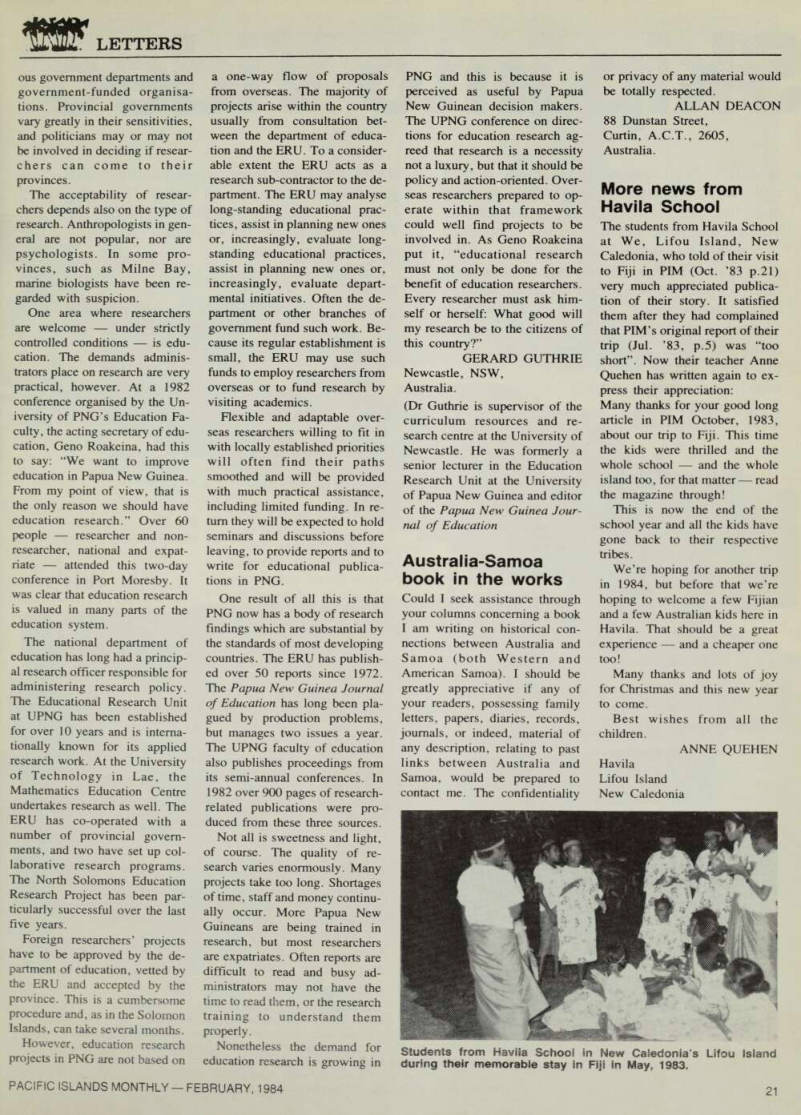
Students from Havila School in New Caledonia's Lifou Island during their memorable stay in Fiji in May, 1983.