for principles?
p. 29 · Read in the full issue
Palau: A role for principles?
“The future does not belong to those who are content with to day, those who are apathetic to wards common problems and their fellow men alike, those who are timid and fearful in the face of new ideas and bold adven tures. Rather, it will belong to those who can blend passion, reason, and courage in a personal commitment to the ideals of Mic ronesian society. It will belong to those who can see that the polit ical future of Micronesia can only emerge from the clash of
contending views, the passionate
expression of deep and often hostile beliefs. The passion for freedom and self-determination for Micronesia and her citizens is the ultimate weapon in the Mic ronesians ’ struggle for human
dignity.”
Those words were written a decade ago by Carl Heine in Micronesia at the Crossroads: A Reappraisal of the Micronesian Political Dilemma. The Marshall Islander, then a graduate student at the University of Hawaii, was the first Micronesian to publish in book form a major piece of
political analysis.
While Heine’s book was a
heartfelt plea for political unity
among Micronesians a con cept which was dead within three years of the publishing of Cros sroads it still has applicability
today, particularly in Palau.
Just a few years ago, before the end was in sight for the political status negotiations, it was the conventional wisdom that Palauans were the best pre pared to get on with self government. That small island group there are only about 16,000 Palauans had a dispro portionate number of leaders in the Trust Territory administra tion. The people are articulate and skilful, and are quick to put a Palauan stamp on new concepts.
Of all the Micronesian people, it is the Palauans who seem the most eager to better their lot.
Five years ago, only an incur able pessimist would have pre dicted that the Palauans would be
the last to conclude the status talks. But that is just what has happened. For a number of reasons, most of which have to do with the Byzantine nature of local politics, Palauans seem un able to come to consensus on their post-trusteeship status.
Those who admire the Palauans cannot but be saddened by the internecine political war fare which has left them strand ed, able only to bob helplessly in the wake of their passing Mic ronesian kinsfolk.
As was the case a year ago, a number of issues overlap in Palau. There is the so-called nuc lear question, which is signific ant for symbolic reasons and there are some Palauans who truly believe they can make their islands a nuclear-free Nirvana.
There is also the issue of what military presence, if any, the United States will have. This is a more substantive question, for it involves land for a possible train ing base. As is the case else where in Micronesia, land in Palau is a most precious
commodity.
However, the underlying issue is who will control Palau’s polit ical structure. There are two
primary groups vying for posi
tion. One centres around the pre sent president, Haruo Remeliik.
The others support Roman Tmetuchl, a former senator in the old Congress of Micronesia, and a very successful businessman with strong ties to Japan. There are other players, major and minor, and affiliations are as flexible as a coconut palm in a strong wind. Any issue which can further their cause is fair game, and for the past two years at least the major battleground has been the US-Palauan Compact of Free Association.
Besides the prestige of being in power, what so strongly moti vates the politicians and their hangers-on? It is the lucrative nature of free association. As had been agreed, Palauans would get SUSI billion over 50 years.
Now, in the latest phase of the
Notes from the North
reopened negotiations, they re portedly are asking for even more.
The figures are truly mind boggling. More than $1 billion for 15,000 people! It is no won der some Americans who support free association worry that con gressmen and senators from economically hard-hit regions of the USA are going to raise their voices in indignant protest when these figures sink in.
Micronesians should also be worrying, but for different reasons. It is possible to justify the high assistance figures on US national security grounds, and even as a way to fulfil trusteeship obligations.
But no American should re main silent if the kind of waste of aid that goes on now continues into the free association period.
The bureaucracy in all the new governments is bloated. Ineffi
ciency is rampant. All this results in the squandering of American appropriated funds. The kind of slovenly behavior that character ises most government operations in Micronesia would simply not be tolerated in the USA. And it is
Washington, representing
American taxpayers, that keeps the Micronesian governments afloat.
This is where the nascent Palauan independence movement can have some impact. The group is small, and almost cer tainly does not represent the ma jority view. But with time, and with the continued in-fighting that has stalemated Palauan polit ics, the independence faction could begin to appeal to more
people, perhaps even Americans.
If it can present itself as the group that is concerned more with the political integrity of Palau than with the self-interest of politicians; if it can show that its vision of Palau includes a place for all rather than those lucky enough to be of the right clan then perhaps it can cap ture the imagination of the
majority.
That is, to be sure, a tall order for Palau, perhaps even an im possible one. But if the present leadership cannot lead as seems to be the case then the “unthinkable” may become all the more likely.
As Carl Heine said a decade ago: “The passion for freedom and self-determination for Mic ronesia and her citizens is the ultimate weapon in the Microne sians’ struggle for human digni
ty.”
Floyd K. Takeuchi.
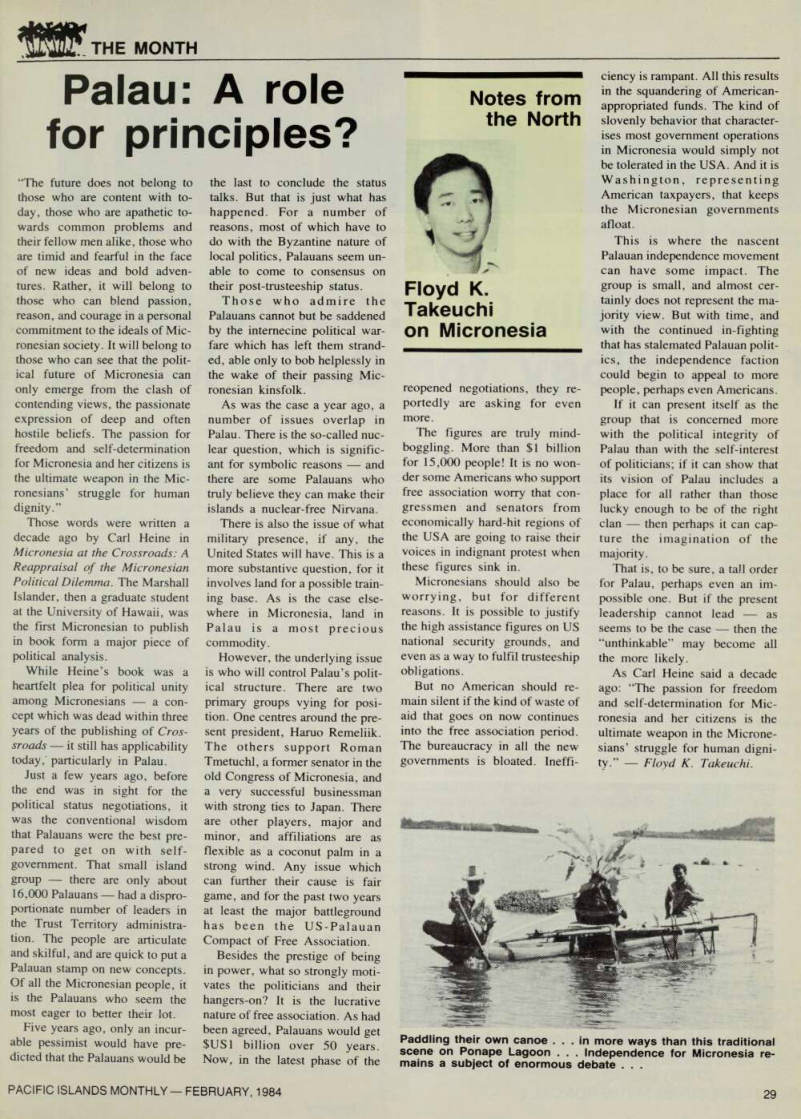
Paddling their own canoe ... in more ways than this traditional scene on Ponape Lagoon . . . Independence for Micronesia re mains a subject of enormous debate . . .
Floyd K.
Takeuchi on Micronesia