Electoral reform
pp. 26-27 · Read in the full issue
is ‘the big one’
France’s Minister for Overseas Territories Georges Lemoine made his second visit to New Caledonia in November. He had previously been in the territory in May, 1983.
Purpose of his recent visit was to bring to the population details of the proposed statute of internal autonomy (self-government).
In many ways the visit was a success. Mr Lemoine was warm ly welcomed throughout New Caledonia, and particularly by Kanaks on the islands of Lifou (in the Loyalty Group), and the Isle of Pines (70 kilometres south of Noumea).
But when he came to address the Territorial Assembly in Noumea to outline the autonomy plans, he found that only the small Centre party, FNSC, was there to listen along with the Government Council, and ad ministrative and consular officials.
Jacques Lafleur, president of the anti-independence party RCPR, and one of the territory’s deputies to the French Parlia ment, explained to newsmen why his party was boycotting all talks and receptions for the minister: “We don’t think talks with him will serve any pur pose,” he said. “Since the Round Table discussions (in France) in July he has refused all dialogue with us he has not even
replied to our questions . . . The more one tries to be constructive and moderate in New Caledonia, the less one is listened to. This is a situation we can’t tolerate.
We’ll study his autonomy pro posals, but we’ll not take part in the farce which his visit will surely be.”
However, Mr Lafleur did not take up the call of the more hardline Caledonian Front for a general strike and demonstra tions during the minister’s visit; “There is no logic in demonstrat ing against what we don’t know,” he said.
The Independence Front (IF) lodged with the Territorial As sembly a draft of a program which would lead to an act of self-determination (referendum) in September 1984, then a year’s autonomy, and independence on September 24, 1985 (132nd an niversary of France’s taking pos session of New Caledonia).
The key to this timetable is electoral reform before the act of self-determination reform which would ensure that only Kanaks, and non-Kanak New Caledonians with at least one parent bom in the territory, could vote on its future.
What Mr Lemoine presented to the assembly on November 24 was a different timetable aut onomy to start in 1984 after the
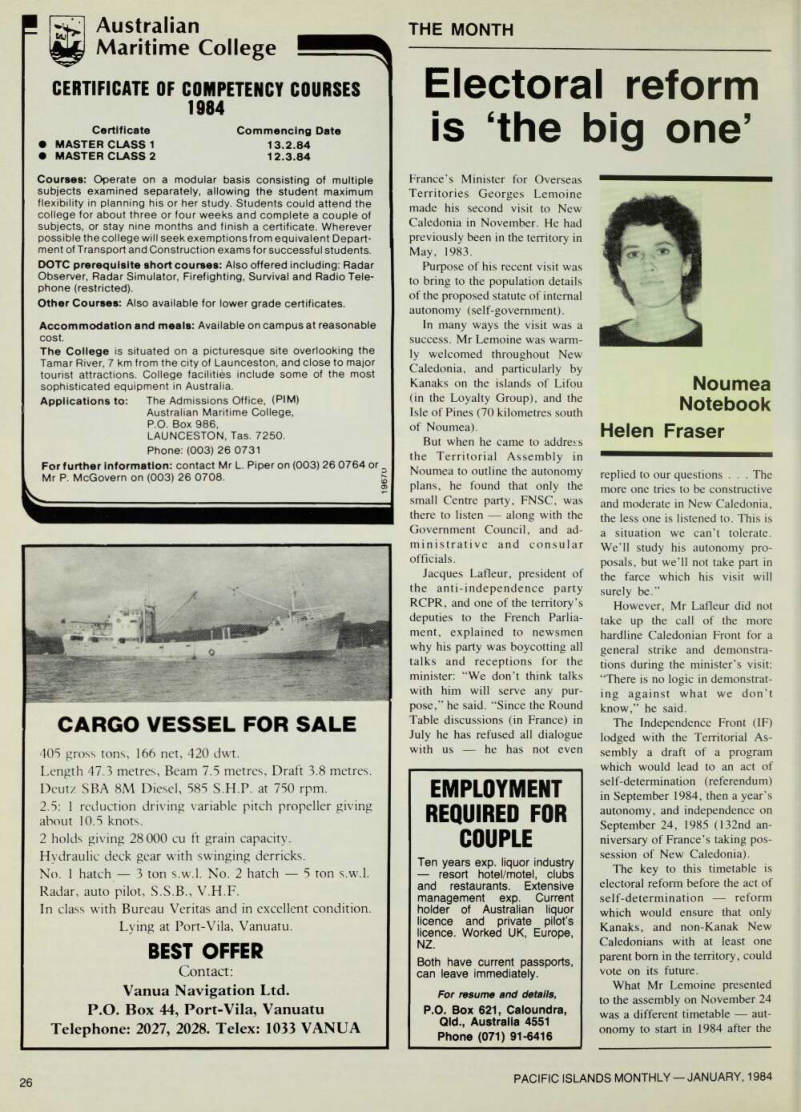
Noumea Notebook Helen Fraser
assembly elections, and an act of self-determination in 1989, with independence being one of the options.
The statute of autonomy vests considerable power in an elected executive, with at its head the president of a ministerial coun cil, who would have some of the powers of a head of state. How ever, the French Government, represented in the territory by the High Commissioner, would re tain control of defence, law and order, foreign relations, immig ration, etc.
The country would be divided into six regions, each having a regional council comprising Kanak representatives (three quarters), and representatives of the various social and economic interests in the region (one quarter).
Autonomous New Caledonia would also have a second cham ber, a sort of mini-senate, to be called the regional assembly. It would comprise Custom repre sentatives, representatives of town councils, and leaders of various social and professional interests.
But what Mr Lemoine was unclear about was the all important electoral reform. It is clearly in the interests of the French socialist government to keep the Independence Front in power in New Caledonia. But
without electoral reform there is every probability that the RPCR will regain control in next year’s assembly elections.
In June 1982 the FNSC quit the coalition with the RCPR to form a government with the IF an action often referred to here as “a marriage of convenience”.
Results of recent municipal and senate elections show that much of the FNSC’s support has been eroded by the RPCR. Be cause the Kanaks are outnum bered by French settlers, and the more recent immigrants from Wallis/Futuna and French Poly nesia, there is not likely to be a vote in favor of independence while “all the Caledonia people” vote.
The IF say they will not back down on these two major points electoral reform, and the date of 1985 for independence. Since the contents of Mr Lemoine’s proposals were already known to them after their discussions with the minister, they wanted to address the assembly to explain to their supporters the IF position on the minister’s speech. The FNSC speaker of the assembly refused them permission, and they walked out of the chamber.
Nor were the IF at the airport to farewell Mr Lemoine.
A spokesman for the IF, Yann Uregei, told newsmen they would maintain dialogue with the French Government until the de finitive statute has been passed by the French Parliament. In the meantime, two IF members are in Paris to lobby Left-wing par ties to gain support for the IF independence timetable. Pre ssure will also be maintained to achieve the listing of New Caledonia’s case with the United Nations Decolonisation Committee.
Mr Uregei warned that if the IF was not satisfied with the final statute, they would consider the creation of a new organisation, possibly a provisional govern ment, to lead the country to independence.
Mr Lemoine spent several of his five days in the territory travelling.
At Lifou Island he was very warmly welcomed, although he also encountered a hard-hitting speech from the pro independence Mayor, Edouard Wapae, and a demonstration by the IF party LKS outside their co-operative. Flying above the
minister at Lifou was the pro
posed Kanak independence flag,
an example of which had been presented to him on his arrival in New Caledonia.
At the Isle of Pines Mr Lemoine also received a warm welcome. He held talks with the Council of Great Chiefs, opened the new town hall, and sailed on a pirogue (Kanak-style canoe).
Mr Lemoine also visited Sar ramea, where he lunched with the Association of Mayors, in cluding RPCR mayors of rural towns.
Whatever their political differ ences with him, most people who encountered the minister during his visit were impressed by his warmth and spontaneity.
Helen Fraser.
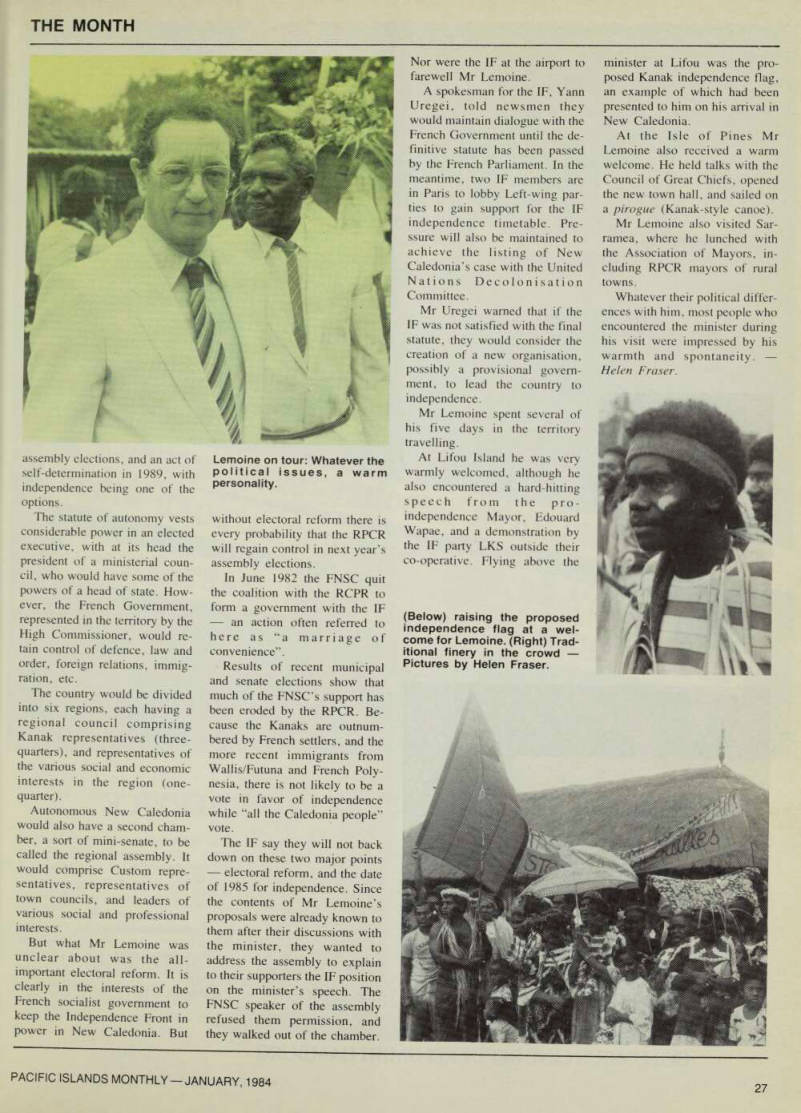
Lemoine on tour: Whatever the political issues, a warm personality.
(Below) raising the proposed independence flag at a wel come for Lemoine. (Right) Trad itional finery in the crowd - Pictures by Helen Fraser.