Smooth talking,
pp. 23-25 · Read in the full issue

rough times
“I don’t know of any country in the world where there’s so much corruption in the government hierarchy, and nobody’s doing anything about it,” says Western Samoa’s former Prime Minister and present Opposition Leader Tupuola Efi of the government of Prime Minister Tofilau Eti.
Tupuola’s administrations (1966-81) were certainly not free from scandals either— in fact, it was heaps of scandals that result ed in him being ousted from the country’s top Job.
But while not denying past problems, and making no claim to being a saint himself, Tupuola insists that he was never person ally involved in any improper activities. “I might have tried to cover up for some of my fellows, but I was never involved,” he says.
Tupuola’s comments came af ter the government’s 1984 budget was tabled in parliament on November 22.
Attacking the budget as “blat antly misleading”, Tupuola said he was aghast that the govern ment had the nerve to claim that the country’s economy had im proved. Said he: “If the economy has indeed improved, why has the government been so vague on a number of economic issues which it should have been happy to be able to tell the public about?”
The budget was estimated at SWSSB.I million compared with $43.9 million in 1983.
It discreetly didn’t say that the government would fulfil its pro mises of early in 1983 that the government’s tough economic policies would be relaxed by the end of the year because things would have improved so much.
Instead Tofilau said, in introduc ing the budget in his capacity as a Cabinet minister, that it was “a further step in what must be an on-going program for national economic recovery leading to a
path of sustained economic growth”. He added: “The extent of the nation’s economic prob lems was such that they could not be solved in a single year. We have never pretended that they could. There remains much to be done.”
In early ’B3, the government introduced a tender system for imports which, it claimed, would limit imports to essential goods, thus cutting back on foreign ex change spending. Tofilau
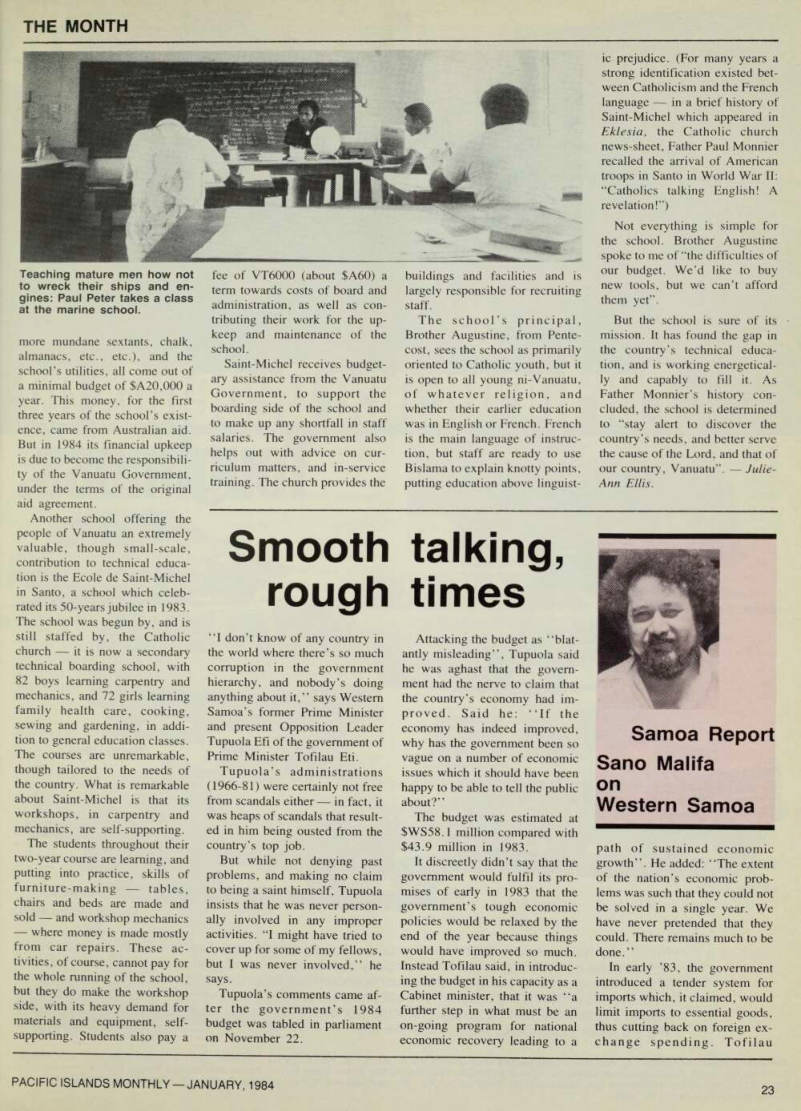
Samoa Report Sano Malifa on Western Samoa
claimed that the effect of the move would be realised by the end of the year, as the cost of living would be greatly reduced.
But the cost of living has not been reduced, and the tender system has been scrapped be cause it was not working. It has been handed over to the Chamber of Commerce, and it is not clear how it is now being administered.
What is clear is that favoritism has been rampant in awarding
import tenders. For exampl
there is one high official of the system (who is also an MP) who gets a free lunch and a free dinner every day from a local restaurant which is alleged to have been “benefiting” from the system.
Tofilau said in his budget speech that the effectiveness of his government’s efforts “con tinues to depend on the people of Western Samoa”. “With your continued support you can be confident that the future is bright for you as individuals, and for our country as a whole.”
But most people are not inter ested in how “bright” the future will be: they are concerned with the here and now of the high cost of living the government’s tough line of action has created.
High import duties and shor tages of goods have pushed prices up to the point that they can no longer be controlled by the government’s prices tribunal.
Different stores have different prices, depending on demand. It
is not uncommon that the price of an item one day is increased the next.
Asked why the cost of a tyre had risen from $7l to $95 in the space of a month, a tyre retailer said: “There are new prices with
every shipment.”
The constant price rises are so frustrating that members of the public are in no mood to be swayed by Tofilau’s smooth talk.
Nor is his rhetoric made to sound any more convincing by the fact, which is public know ledge, that the board of the De velopment Bank of Western Samoa, of which Tofilau is chairman, recently authorised a loan of $130,000 to his family.
People are also aware that, on his official duties, Tofilau uses a car owned by the Congregational Christian Church of Samoa, of whose general assembly he is deputy chairman. The car, which cost about $19,000, was one of two bought by the church with a bank loan granted on the under standing that repayment would be made from church members’ contributions.
Tupuola Efi is unimpressed
with the Tofilau government’s
two big development projects
the idea of establishing a national university, and the upgrading of Faleolo Airport to enable it to
take the biggest jets.
On the university project, for which “a nominal provision” is made in the budget, Tupuola accuses the government of “a lack of strong commitment”.
He says: “Setting up a nation al university would take millions of dollars, but the government is
allowing it only this ‘nominal provision’. Does this bespeak strong commitment? What is this ‘nominal provision’ ? Would it be enough to set up the foundation curricula, foundation courses, staffing, and so on?
“As far as I know not one country would give a sene (cent) to set up this university.”
Tupuola describes the airport project as “that balloon”. “It sounds a bit hollow,” he says, “to say in the budget that lack of funds would not hold up the project when the government has already launched it some time ago.”
The source of foreign funds for the airport project remains as vague as ever, with Australian High Commissioner Ric Fraser saying that his government has not yet decided whether to assist the project or not.
On government spending, Tupuola claims it would be inter esting to compare the costs of government members’ overseas travel for 1981 (his last year in office) and 1983.
Three days after the budget
was tabled, Tofilau took off for the Commonwealth Heads of Government meeting in New De lhi. With him went his wife, a Cabinet minister, the secretary to government, and a foreign affairs officer.
In August, Tofilau had travell ed to New York General Assem bly and an International Monet ary Fund meeting. He was ac companied by his wife, three MPs, and three government offi cials. Earlier in August, he had attended the South Pacific Forum meeting in Canberra. He was accompanied on that trip by his wife, government MPs, and gov ernment officials.
Tupuola’s comment? “At least I don’t need anyone to hold my hand when I travel overseas.”
Tofilau may find he needs more than one person to hold his hand at the general elections in 1985.
For 1984, he’s going to need moie than smooth talk to con vince the public that he really has not just been taking very good care of himself, while everyone else groaned under the weight of
his economic policies.
Sano
Malifa.
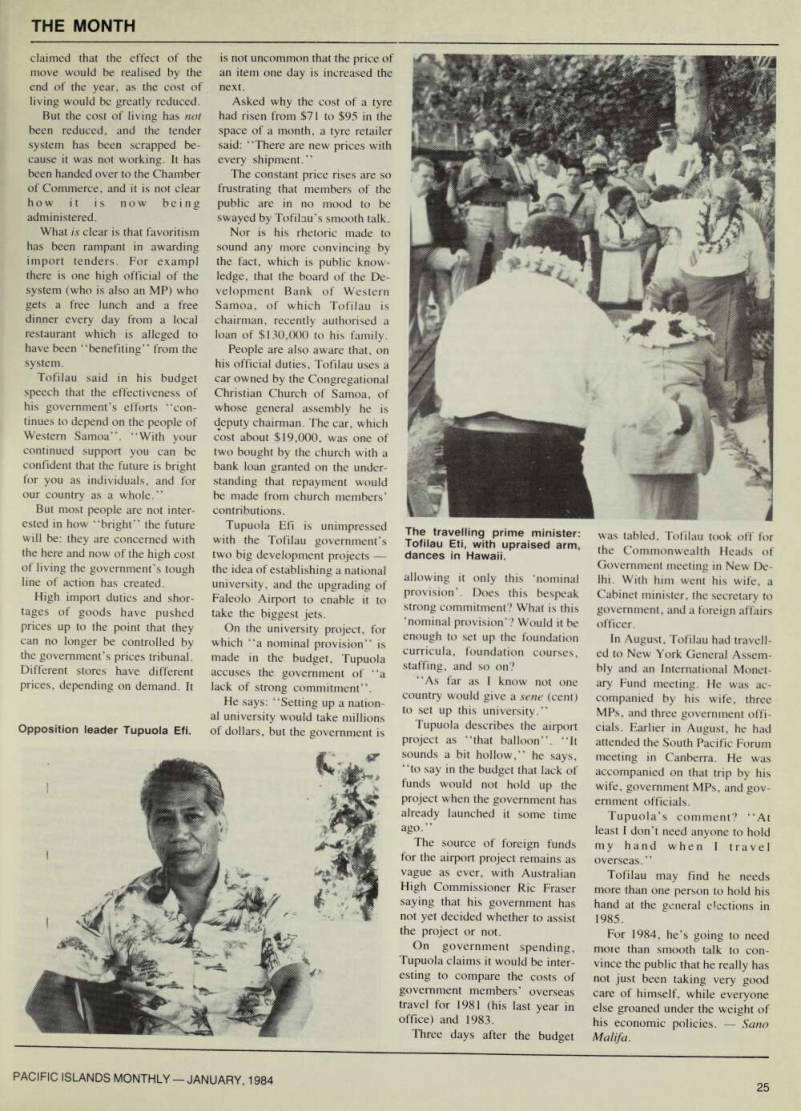
Opposition leader Tupuola Efi.
The travelling prime minister: Tofilau Eti, with upraised arm, dances in Hawaii.