Small, practical,
pp. 21-23 · Read in the full issue
equals beautiful
Technical education is vitally needed in Vanuatu for the coun try’s development no country can make 20th century progress without 20th century skills.
However, of approximately 280 students who will be study ing outside the country in 1984, only about 60 (the numbers are not yet finally determined) will be studying to become the na tion’s future aircraft mechanics, electricians, plumbers, marine engineers and so on. What is more, the number of technical students outside the country is falling, with the number at Hon iara Tech, the largest single taker of Vanuatu’s technical students, declining each year.
Students are instead being ab sorbed into the Institut National de Technologic de Vanuatu. This was established by the French Government, in the pre- Independence rush to provide metropolitan-influenced higher secondary education. (The equi valent British contribution, Malapoa College, has little technical education its aim is to get students past the British General Certificate of Education.) The INT is lavishly equipped to equal any school in France, with millions of francs’ worth of sophisticated machinery. Unfor tunately, the equipment is more sophisticated than is to be found anywhere else in the country.
The students, though impecc ably taught and capable of excel lent work, are poorly equipped to face their actual job situations.
Also, the teaching at the school, however effective, is only ac cessible to French-speaking students.
Teaching is entirely and rigid ly in French, with instructors refusing to use any Bislama or English, in spite of a recommen dation from the 1982 Internation al Commission on Education to the contrary. The INT offers, it is true, a one-year introductory course for English-speaking stu dents, with special emphasis on
leaming French, but this cannot possibly bridge the gap, as un happy students testify.
These facts that the INT is increasingly responsible for technical education, and that it educates only in French raise the intriguing picture of a future Vanuatu society built like a lay er-cake, with English-speaking bureaucrats and politicians, French-speaking technocrats and tradesmen, and an English speaking working class!
But both British and French aid have been involved in financ ing the multi-lingual senior train ing centre at Walarano, on Malakula. British money began it, establishing the carpentry and mechanics workshops and dor mitories, and providing the ini tial budget. French aid then took over the financing, and will con tinue until mid-1984. The centre provides five-month courses for boys over 17, for boarders and non-boarders.
This kind of school, small and specifically directed at the needs of the country, is apparently the most successful, as is shown by the example of the Marine Train ing School at Port-Vila, set up at independence by Mike Bailes, a retired British naval officer, self
described as “somewhat moth eaten”. Captain Bailes is well known around the Pacific as a teacher of marine matters, hav ing trained many Pacific islan ders and others, both formally and informally.
The school he started reflects his philosophies: it is a small scale operation, intensely prag matic and directed precisely at the needs of its clientele. These needs are startlingly urgent: the commercial fleet of Vanuatu has many ships now running with insufficiently trained, or un trained, engineers and captains.
Nor are there enough en gineers ashore capable of advis ing sea-going engineers. When one ship came off the slip recent ly after servicing, her engine could not be re-started, and the ship’s engineer could not identify the fault. This was at last found to be due to a mistake by the shore engineer who had been helping out while the ship was on the slip. The situation is made worse by a lack of instruction manuals, and by the language difficulties which prevent full understanding of even those manuals that are available.
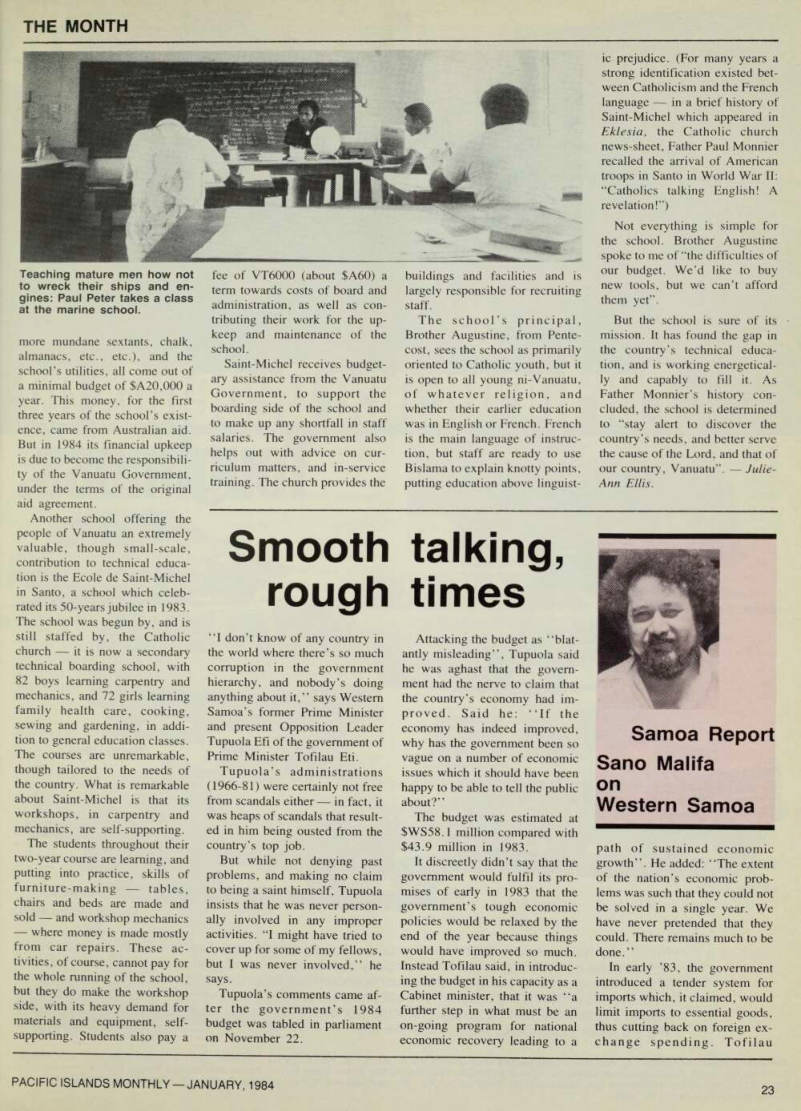
The small school does not, and cannot, completely fill high-level training needs, but it does, in Captain Bailes’ words, “teach the mature seamen and engineers of the inter-island fleet how not to wreck their engines or their ships”. It offers short, six- to 10week courses to working sea men, intensively covering as
pects of marine work naviga tion, dealing with emergencies, meteorology and marine safety, as well as engine maintenance.
Teaching is in Bislama, and the school has been responsible for translating into Bislama syllab uses for the Grade Five Master’s Certificate and the Grade Five Engineer’s Certificate.
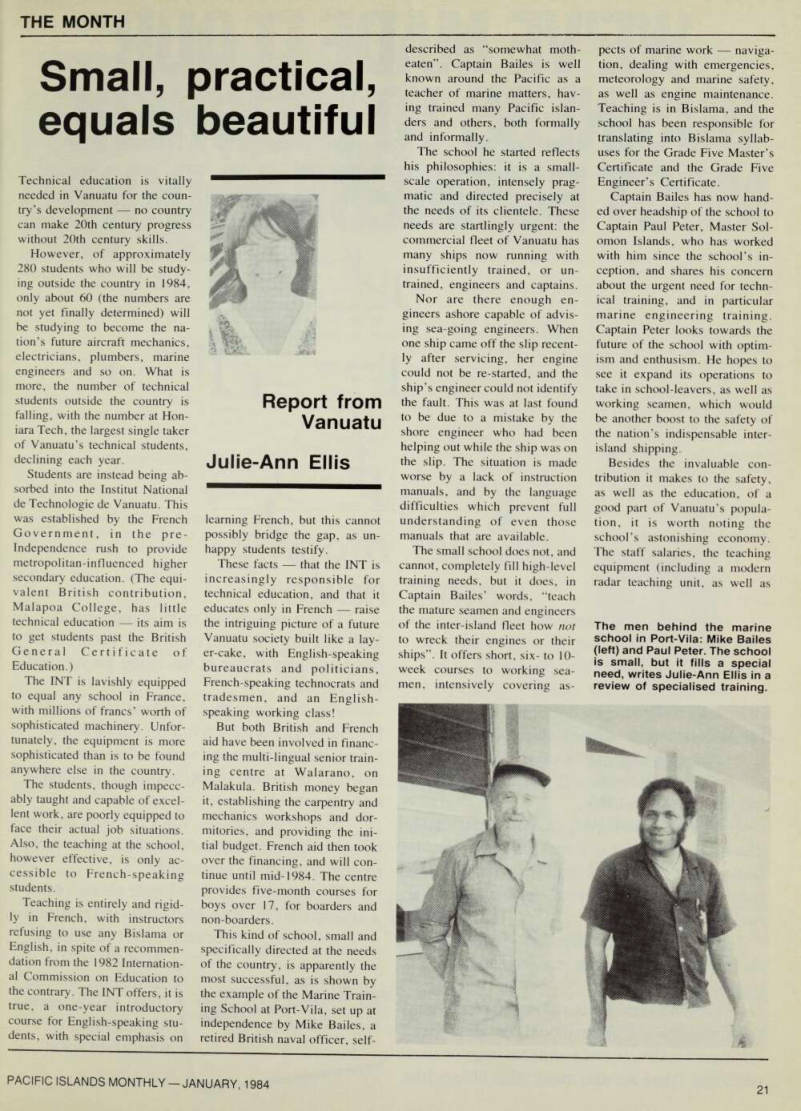
Captain Bailes has now hand ed over headship of the school to Captain Paul Peter, Master Sol omon Islands, who has worked with him since the school’s in ception, and shares his concern about the urgent need for techn ical training, and in particular marine engineering training.
Captain Peter looks towards the future of the school with optim ism and enthusism. He hopes to see it expand its operations to take in school-leavers, as well as working seamen, which would be another boost to the safety of the nation’s indispensable inter island shipping.
Besides the invaluable con tribution it makes to the safety, as well as the education, of a good part of Vanuatu’s popula tion, it is worth noting the school’s astonishing economy.
The staff salaries, the teaching equipment (including a modem radar teaching unit, as well as
Report from Vanuatu Julie-Ann Ellis
The men behind the marine school in Port-Vila: Mike Bailes (left) and Paul Peter. The school is small, but it fills a special need, writes Julie-Ann Ellis in a review of specialised training.
more mundane sextants, chalk, almanacs, etc., etc.), and the school’s utilities, all come out of a minimal budget of $A20,000 a year. This money, for the first three years of the school’s exist ence, came from Australian aid.
But in 1984 its financial upkeep is due to become the responsibili ty of the Vanuatu Government, under the terms of the original aid agreement.
Another school offering the people of Vanuatu an extremely valuable, though small-scale, contribution to technical educa tion is the Ecole de Saint-Michel in Santo, a school which celeb rated its 50-years jubilee in 1983.
The school was begun by, and is still staffed by, the Catholic church it is now a secondary technical boarding school, with 82 boys learning carpentry and mechanics, and 72 girls learning family health care, cooking, sewing and gardening, in addi tion to general education classes.
The courses are unremarkable, though tailored to the needs of the country. What is remarkable about Saint-Michel is that its workshops, in carpentry and mechanics, are self-supporting.
The students throughout their two-year course are learning, and putting into practice, skills of
furniture-making tables,
chairs and beds are made and sold and workshop mechanics where money is made mostly from car repairs. These ac tivities, of course, cannot pay for the whole running of the school, but they do make the workshop side, with its heavy demand for materials and equipment, self supporting. Students also pay a
fee of VT6OOO (about SA6O) a term towards costs of board and administration, as well as con tributing their work for the up keep and maintenance of the school.
Saint-Michel receives budget ary assistance from the Vanuatu Government, to support the boarding side of the school and to make up any shortfall in staff salaries. The government also helps out with advice on cur riculum matters, and in-service training. The church provides the
buildings and facilities and is
largely responsible for recruiting
staff.
The school’s principal, Brother Augustine, from Pente cost, sees the school as primarily oriented to Catholic youth, but it is open to all young ni-Vanuatu, of whatever religion, and whether their earlier education was in English or French. French is the main language of instruc tion, but staff are ready to use
Bislama to explain knotty points,
putting education above linguist
ic prejudice. (For many years a strong identification existed bet ween Catholicism and the French language in a brief history of Saint-Michel which appeared in Eklesia, the Catholic church news-sheet. Father Paul Monnier recalled the arrival of American troops in Santo in World War II:
“Catholics talking English! A
revelation!”) Not everything is simple for the school. Brother Augustine spoke to me of “the difficulties of our budget. We’d like to buy new tools, but we can’t afford
them yet”.
But the school is sure of its mission. It has found the gap in the country’s technical educa tion, and is working energetical ly and capably to fill it. As Father Monnier’s history con cluded, the school is determined to “stay alert to discover the country’s needs, and better serve the cause of the Lord, and that of
our country, Vanuatu”.
Julie-
Ann Ellis.
Teaching mature men how not to wreck their ships and en gines: Paul Peter takes a class at the marine school.