Coming of age
pp. 17-19 · Read in the full issue
in Tahiti
If October in Tahiti was the month in which the island’s big hoteliers did battle with the formidable Brigette Bardot over her campaign for a worldwide tourist boycott of Tahiti on the issue of the eating of dogmeat there (PIM Dec p 15), November was the month in which they fought a battle of another kind against their own workers, over pay and conditions.
In true Tahitian style, the local hotel workers have traditionally been sweet, kind, cheerful, and so little interested in money as to reject the demeaning European custom of tipping. In fact, they are still that way in the smaller, locally owned hotels, with their relaxed, informal atmosphere.
But the four big foreign-
owned hotels on the island the Maeva Beach, the Beachcomber, the Taharaa, and the Matavai, each with more than 200 rooms must, in the nature of things, be run with the same impersonal efficiency as a European factory.
Significantly, these were the on ly hotels hit by the strike launch ed by hotel workers on October 27.
Far from keeping pace with recent developments in the tour ist industry, French Polynesia’s labor legislation dates from 1952 back in the colonial Stone Age, when there were no tourist hotels at all.
The key feature of the legisla tion is of the catch-22 type; you cannot go on strike against this legislation, because the legisla
tion forbids you to go on strike!
Just as the legislation is out of date, wages too have fallen be hind the spiralling cost of living.
So it was no surprise, not long ago, when the hotel workers formed themselves into a trade union, on the French model.
It was only then that the public at large learned that hotel em ployees in Tahiti work a 48-hour week or six full days but are paid for only 40 hours. The rationale behind this arrangement is that three hours are deducted for six half-hour periods in which the lucky employees may con sume a free lunch, and then a further period of five hours which is counted as “idle time’’.
All this is in sharp contrast to the hours worked by government officials. This is a maximum of 39 which, incidentally, is the legal limit in France for employ ees in all callings.
The present wage is CFP6O,OOO a month. Compared with wages paid in other Pacific Island countries, it looks fine
it’s equal to about SUS3BB, or $A425, at December 1983 ex change rates.
But it must be realised that it is quite impossible for a Tahitian worker, with a family to support and no other source of income, to
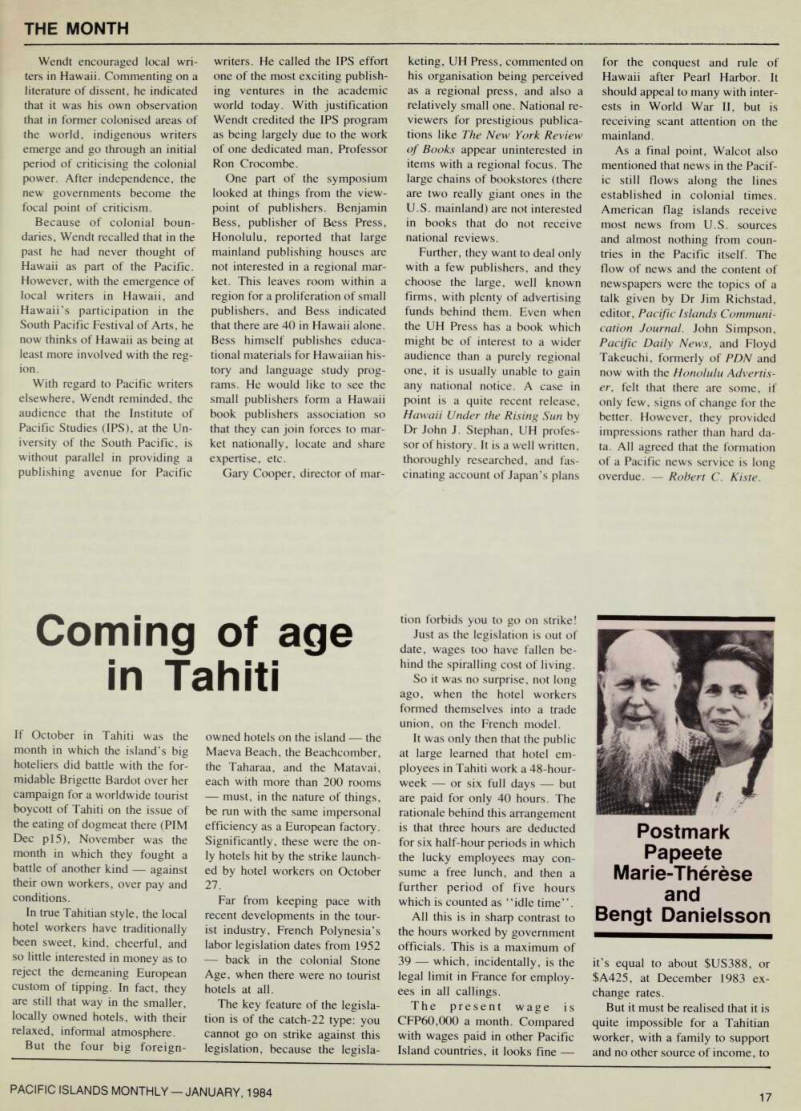
Postmark Papeete Marie-Therese and Bengt Danielsson
live on this amount. Most Euro peans earn from three to five times as much, and those holding top jobs like hotel managers up to 10 times.
All attempts by the hotel em ployees to get a better deal have met with a flat rejection by the owners, who have argued without ever quoting figures to prove it that any wage in crease would force them out of business, with dire results for the
tourist industry (which employs
more than 4000 people).
When Gaston Flosse organised a broad collective bargaining ses sion in July 1983, the hotel workers were practically the only ones not to receive some satisfac tion. But they waited patiently for several months before they struck.
In the first days, strike com mittee meetings had a carnival atmosphere about them, with the hotel grounds filled with flower decked men and women, sitting
around singing and strumming
guitars.
But when managements began hiring scabs, the music stopped and picket lines were formed.
Strikers’ attitudes soon hardened to the point that, using ropes and nail mats, they started preventing tourist buses and delivery vans
from entering hotel grounds.
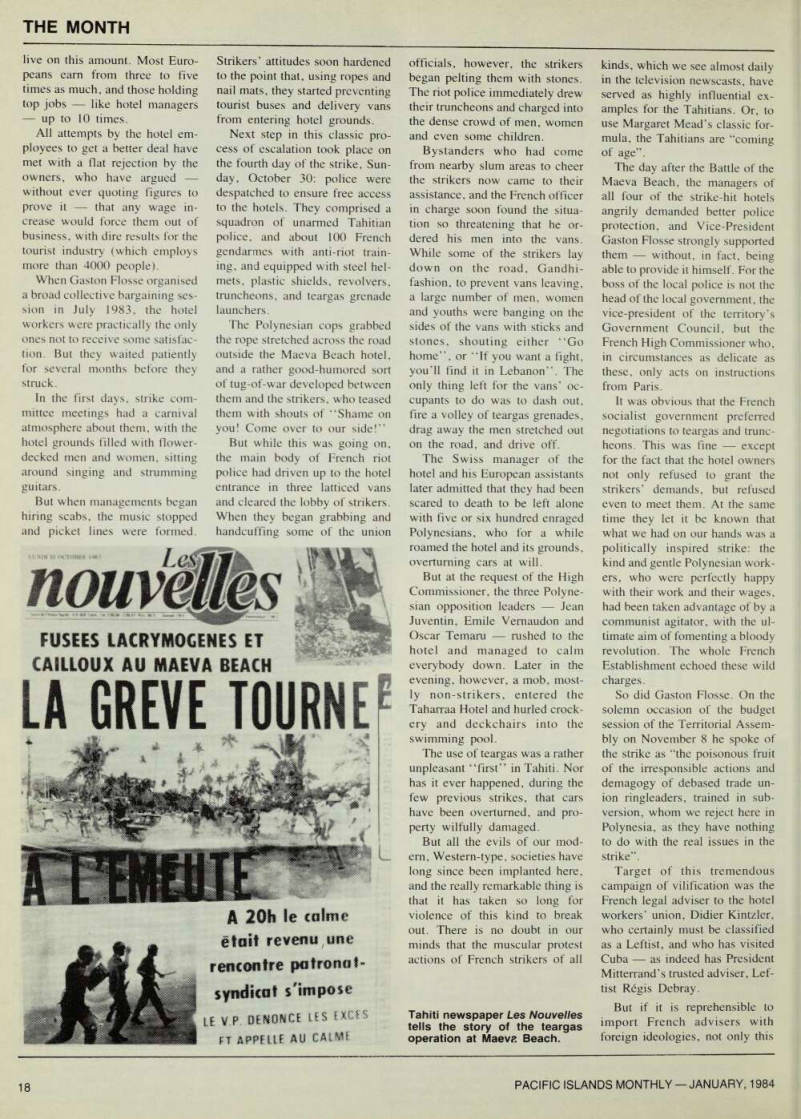
Next step in this classic pro cess of escalation took place on the fourth day of the strike, Sun day, October 30: police were despatched to ensure free access to the hotels. They comprised a squadron of unarmed Tahitian police, and about 100 French gendarmes with anti-riot train ing, and equipped with steel hel mets, plastic shields, revolvers, truncheons, and teargas grenade launchers.
The Polynesian cops grabbed
the rope stretched across the road outside the Maeva Beach hotel, and a rather good-humored sort
of tug-of-war developed between
them and the strikers, who teased them with shouts of “Shame on you! Come over to our side!’’
But while this was going on, the main body of French riot police had driven up to the hotel entrance in three latticed vans and cleared the lobby of strikers.
When they began grabbing and
handcuffing some of the union
officials, however, the strikers began pelting them with stones.
The riot police immediately drew their truncheons and charged into the dense crowd of men, women and even some children.
Bystanders who had come from nearby slum areas to cheer the strikers now came to their assistance, and the French officer in charge soon found the situa tion so threatening that he or dered his men into the vans.
While some of the strikers lay down on the road, Gandhi fashion, to prevent vans leaving, a large number of men, women and youths were banging on the sides of the vans with sticks and stones, shouting either “Go home’’, or “If you want a fight, you’ll find it in Lebanon’’. The only thing left for the vans’ oc cupants to do was to dash out, fire a volley of teargas grenades, drag away the men stretched out on the road, and drive off.
The Swiss manager of the hotel and his European assistants later admitted that they had been scared to death to be left alone with five or six hundred enraged Polynesians, who for a while roamed the hotel and its grounds, overturning cars at will.
But at the request of the High Commissioner, the three Polyne sian opposition leaders Jean Juventin, Emile Vemaudon and Oscar Temaru rushed to the hotel and managed to calm everybody down. Later in the evening, however, a mob, most ly non-strikers, entered the Taharraa Hotel and hurled crock ery and deckchairs into the
swimming pool.
The use of teargas was a rather unpleasant “first’’ in Tahiti. Nor has it ever happened, during the few previous strikes, that cars have been overturned, and pro
perty wilfully damaged.
But all the evils of our mod em, Western-type, societies have long since been implanted here, and the really remarkable thing is that it has taken so long for violence of this kind to break out. There is no doubt in our minds that the muscular protest actions of French strikers of all
kinds, which we see almost daily in the television newscasts, have served as highly influential ex amples for the Tahitians. Or, to use Margaret Mead’s classic for mula, the Tahitians are “coming
of age”.
The day after the Battle of the Maeva Beach, the managers of all four of the strike-hit hotels
angrily demanded better police
protection, and Vice-President Gaston Flosse strongly supported them without, in fact, being able to provide it himself. For the boss of the local police is not the head of the local government, the
vice-president of the territory’s
Government Council, but the French High Commissioner who, in circumstances as delicate as these, only acts on instructions from Paris.
It was obvious that the French socialist government preferred negotiations to teargas and trunc heons. This was fine except for the fact that the hotel owners not only refused to grant the strikers’ demands, but refused even to meet them. At the same time they let it be known that what we had on our hands was a
politically inspired strike; the
kind and gentle Polynesian work ers, who were perfectly happy with their work and their wages, had been taken advantage of by a communist agitator, with the ul timate aim of fomenting a bloody revolution. The whole French Establishment echoed these wild
charges.
So did Gaston Flosse. On the solemn occasion of the budget session of the Territorial Assem bly on November 8 he spoke of the strike as “the poisonous fruit of the irresponsible actions and demagogy of debased trade un ion ringleaders, trained in sub version, whom we reject here in
Polynesia, as they have nothing
to do with the real issues in the strike”.
Target of this tremendous campaign of vilification was the French legal adviser to the hotel workers’ union, Didier Kintzler, who certainly must be classified as a Leftist, and who has visited Cuba as indeed has President Mitterrand’s trusted adviser, Lef
tist Regis Debray.
But if it is reprehensible to import French advisers with
foreign ideologies, not only this
Tahiti newspaper Les Nouvelles tells the story of the teargas operation at Maeva Beach.
minor official, but thousands of other French advisers, techni cians and experts who work in the local administration, or for local businesses, should also be
sent packing.
Mr Flosse himself employs ab out 15 expatriate assistants, whereas the only Frenchman em ployed by the unions is Didier Kintzler.
What can and should be criticised is that the present sys tem of government in Tahiti is patterned on the European model to such an outrageous extent that it is impossible for the poor
Polynesians to manipulate it
without French help.
When the hotels closed their doors to avoid more pitched bat tles on their premises, another
cleverly orchestrated campaign
was mounted in the mass media.
This time the theme was that the whole economy of the colony was on the brink of collapse.
Even if the strike ceased forth with, the argument ran, Tahiti’s “sales image” as a languorous paradise was tarnished for good.
There would be no more foreign tourists for years to come. As for the prospect of more hotels being built in Tahiti, no foreign inves tor in his right mind would dream of taking the risk. It was hard not to share the view of the leaders of the la mana party, who had the impudence to suggest that it was a most refreshing change to hear that the territory’s principal in dustry was tourism, and no lon ger the exploding of atomic bombs at Moruroa . . .
Having been effectively lock
ed out of the hotels, the strikers set up camp in Papeete outside the offices of French High Com missioner Ohrel and Vice- President Flosse. With the con
sent of the mayor, Jean Juventin, who is de facto leader of the main opposition party, Pupu Here Aia, since the death of its founder John Teariki (PIM Dec p 65), they quickly replaced their tent with a more solid Tahitian thatched hut, which they bap tised “The People’s House”.
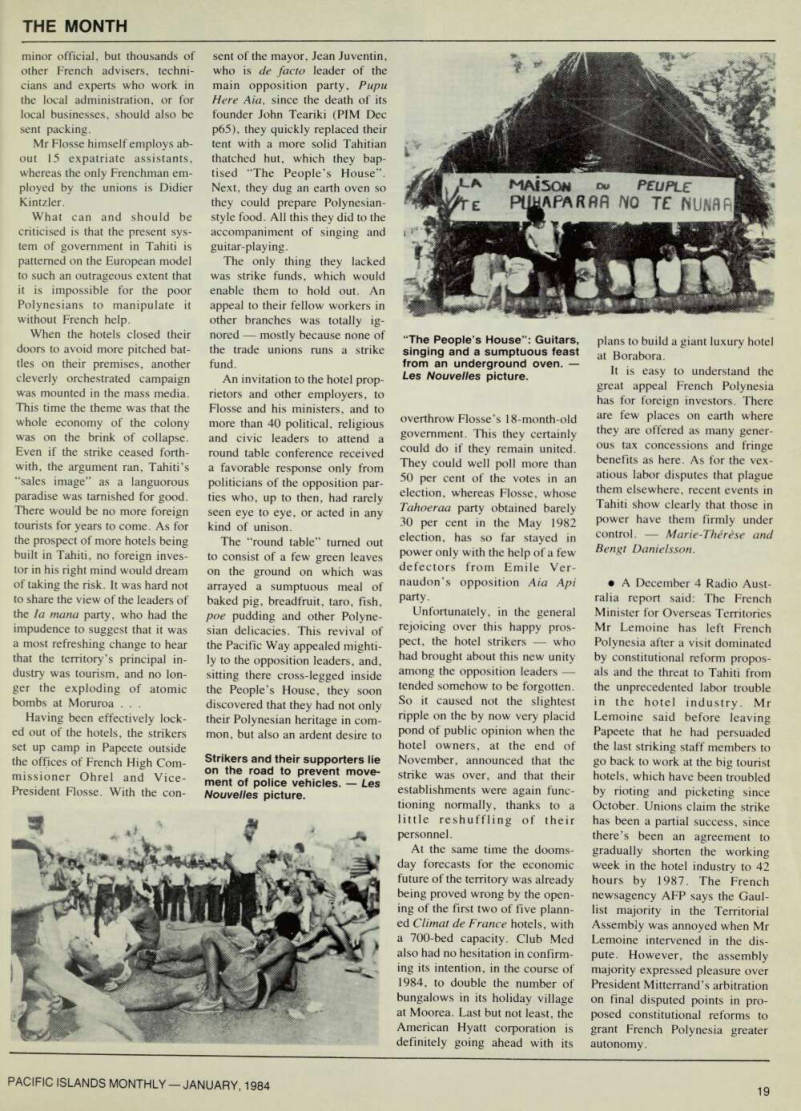
Next, they dug an earth oven so they could prepare Polynesian style food. All this they did to the accompaniment of singing and guitar-playing.
The only thing they lacked was strike funds, which would enable them to hold out. An appeal to their fellow workers in other branches was totally ig nored mostly because none of the trade unions runs a strike fund.
An invitation to the hotel prop rietors and other employers, to Flosse and his ministers, and to more than 40 political, religious and civic leaders to attend a round table conference received a favorable response only from politicians of the opposition par ties who, up to then, had rarely seen eye to eye, or acted in any kind of unison.
The “round table” turned out to consist of a few green leaves on the ground on which was arrayed a sumptuous meal of baked pig, breadfruit, taro, fish, poe pudding and other Polyne sian delicacies. This revival of the Pacific Way appealed mighti ly to the opposition leaders, and, sitting there cross-legged inside the People’s House, they soon discovered that they had not only their Polynesian heritage in com mon, but also an ardent desire to
overthrow Flosse’s 18-month-old government. This they certainly could do if they remain united.
They could well poll more than 50 per cent of the votes in an election, whereas Flosse, whose Tahoeraa party obtained barely 30 per cent in the May 1982 election, has so far stayed in power only with the help of a few defectors from Emile Ver naudon’s opposition Aia Api party.
Unfortunately, in the general rejoicing over this happy pros pect, the hotel strikers who had brought about this new unity among the opposition leaders tended somehow to be forgotten.
So it caused not the slightest ripple on the by now very placid pond of public opinion when the hotel owners, at the end of November, announced that the strike was over, and that their establishments were again func tioning normally, thanks to a little reshuffling of their personnel.
At the same time the dooms day forecasts for the economic future of the territory was already being proved wrong by the open ing of the first two of five plann ed Climat de France hotels, with a 700-bed capacity. Club Med also had no hesitation in confirm ing its intention, in the course of 1984, to double the number of bungalows in its holiday village at Moorea. Last but not least, the American Hyatt corporation is definitely going ahead with its
plans to build a giant luxury hotel at Borabora.
It is easy to understand the great appeal French Polynesia has for foreign investors. There are few places on earth where they are offered as many gener ous tax concessions and fringe benefits as here. As for the vex atious labor disputes that plague them elsewhere, recent events in Tahiti show clearly that those in power have them firmly under control. Marie-Therese and Bengt Danielsson. • A December 4 Radio Aust ralia report said: The French Minister for Overseas Territories Mr Lemoine has left French Polynesia after a visit dominated by constitutional reform propos als and the threat to Tahiti from the unprecedented labor trouble in the hotel industry. Mr Lemoine said before leaving Papeete that he had persuaded the last striking staff members to go back to work at the big tourist hotels, which have been troubled by rioting and picketing since October. Unions claim the strike has been a partial success, since there’s been an agreement to gradually shorten the working week in the hotel industry to 42 hours by 1987. The French newsagency AFP says the Gaul list majority in the Territorial Assembly was annoyed when Mr Lemoine intervened in the dis pute. However, the assembly majority expressed pleasure over President Mitterrand’s arbitration on final disputed points in pro posed constitutional reforms to grant French Polynesia greater autonomy.
Strikers and their supporters lie on the road to prevent move ment of police vehicles. - Les Nouvelles picture.
“The People’s House”: Guitars, singing and a sumptuous feast from an underground oven.- Les Nouvelles picture.