People
pp. 29-32 · Read in the full issue


Papua New Guinea’s Health Minister Martin Tovadek is one politician who cannot be accused of being “all talk and no action”.
Having branded the nation’s
capital Port Moresby “a filthy
city” late last year, Mr Tovadek took the problem into his own hands.
For several mornings running
he went in his ministerial car to the Port Moresby General Hos pital with his houseboy and per sonally hosed down the footpaths and gutters.
The minister drove off squat ters who had taken up near permanent residence in front of
the hospital.
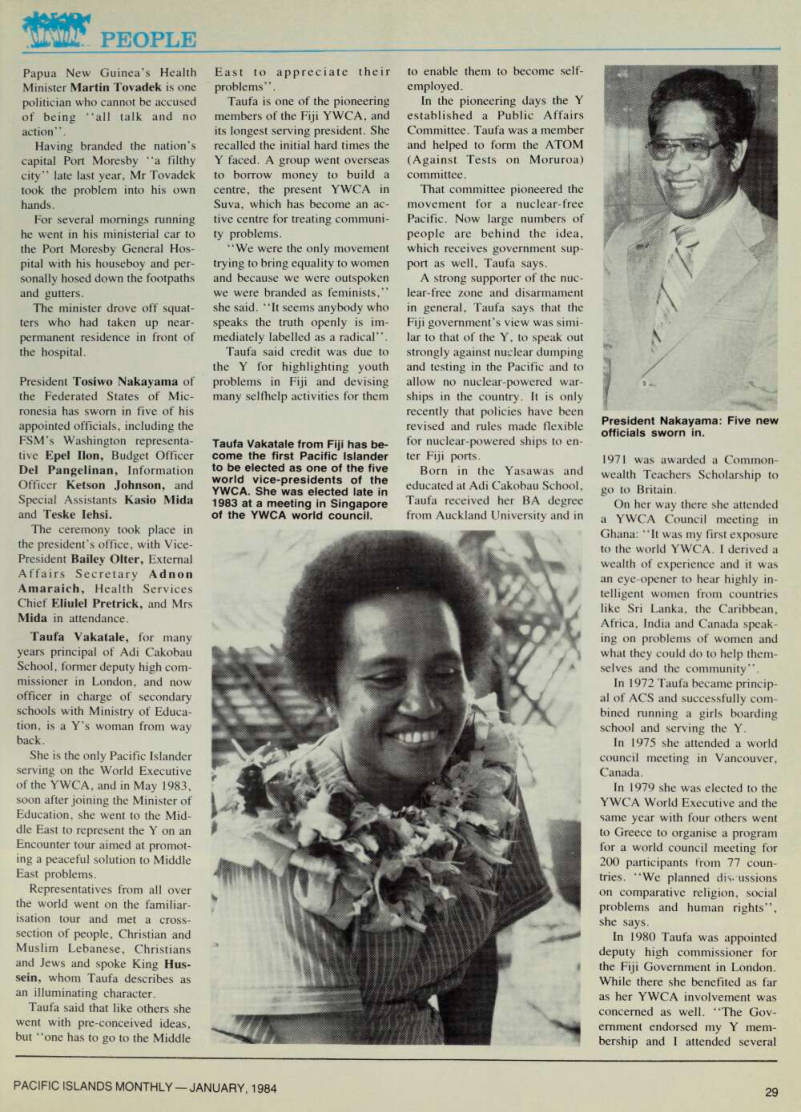
President Tosiwo Nakayama of the Federated States of Mic ronesia has sworn in five of his
appointed officials, including the
FSM’s Washington representa tive Epel Hon, Budget Officer Del Pangelinan, Information Officer Ketson Johnson, and Special Assistants Kasio Mida and Teske lehsi.
The ceremony took place in the president’s office, with Vice- President Bailey Olter, External Affairs Secretary Adnon Amaraich, Health Services Chief Eliulel Pretrick, and Mrs Mida in attendance.
Taufa Vakatale, for many years principal of Adi Cakobau School, former deputy high com missioner in London, and now officer in charge of secondary schools with Ministry of Educa tion, is a Y’s woman from way back.
She is the only Pacific Islander serving on the World Executive of the YWCA, and in May 1983, soon after joining the Minister of Education, she went to the Mid dle East to represent the Y on an Encounter tour aimed at promot ing a peaceful solution to Middle
East problems.
Representatives from all over the world went on the familiar isation tour and met a cross section of people, Christian and Muslim Lebanese, Christians and Jews and spoke King Hus sein, whom Taufa describes as an illuminating character.
Taufa said that like others she went with pre-conceived ideas, but “one has to go to the Middle
East to appreciate their
problems”.
Taufa is one of the pioneering members of the Fiji YWCA, and
its longest serving president. She
recalled the initial hard times the Y faced. A group went overseas to borrow money to build a centre, the present YWCA in Suva, which has become an ac tive centre for treating communi
ty problems.
“We were the only movement
trying to bring equality to women
and because we were outspoken we were branded as feminists,” she said. “It seems anybody who speaks the truth openly is im mediately labelled as a radical”.
Taufa said credit was due to the Y for highlighting youth
problems in Fiji and devising
many selfhelp activities for them
to enable them to become self
employed.
In the pioneering days the Y established a Public Affairs Committee. Taufa was a member and helped to form the ATOM (Against Tests on Moruroa) committee.
That committee pioneered the movement for a nuclear-free Pacific. Now large numbers of people are behind the idea, which receives government sup port as well, Taufa says.
A strong supporter of the nuc lear-free zone and disarmament in general, Taufa says that the Fiji government’s view was simi lar to that of the Y, to speak out
strongly against nuclear dumping
and testing in the Pacific and to allow no nuclear-powered war ships in the country. It is only recently that policies have been revised and rules made flexible for nuclear-powered ships to en ter Fiji ports.
Born in the Yasawas and educated at Adi Cakobau School, Taufa received her BA degree from Auckland University and in
1971 was awarded a Common wealth Teachers Scholarship to go to Britain.
On her way there she attended a YWCA Council meeting in Ghana: “It was my first exposure to the world YWCA. I derived a wealth of experience and it was an eye-opener to hear highly in telligent women from countries like Sri Lanka, the Caribbean, Africa, India and Canada speak ing on problems of women and what they could do to help them selves and the community”.
In 1972 Taufa became princip al of ACS and successfully com bined running a girls boarding school and serving the Y.
In 1975 she attended a world council meeting in Vancouver, Canada.
In 1979 she was elected to the YWCA World Executive and the same year with four others went to Greece to organise a program for a world council meeting for 200 participants from 77 coun tries. “We planned discussions on comparative religion, social problems and human rights”, she says.
In 1980 Taufa was appointed deputy high commissioner for the Fiji Government in London.
While there she benefited as far as her YWCA involvement was concerned as well. “The Gov ernment endorsed my Y mem bership and I attended several
Taufa Vakatale from Fiji has be come the first Pacific Islander to be elected as one of the five world vice-presidents of the YWCA. She was elected late in 1983 at a meeting in Singapore of the YWCA world council.
President Nakayama: Five new officials sworn in.
meetings in Geneva and repre sented Fiji at a meeting in
Japan”.
Taufa lived in London for three years with her two
daughters.
Now back in Fiji and back to education, Taufa deals with 141
secondary schools in Fiji.
She says there are enough sec ondary schools for all students.
Some are even under-used espe cially in the upper forms. “The community now should leam to share facilities. Where there are two or more schools in the same area one can specialise in techn ical training and the other in science subjects,” she said.
Sumitra Gokal in The Fiji Times.
Del Mannering and Mark Han nan resigned in November from their positions with Fiji’s nation al airline. Air Pacific.
Mr Mannering, an Australian, was deputy chief executive and director of marketing, and Mr Hannan, a New Zealander, was the company’s financial director.
They handed their letters of resignation to the airline’s chief executive, Akuila Savu.
The resignations came in the wake of reports of conflicts bet ween the executives and the Air Pacific board chairman. John Hill.
The Fiji Times reported that Mr Hill had come under criticism from some board members over his decision and dealings to ac
quire a multi-storey building for
the airline in Sydney.
The paper said that other board members had balked at a sudden demand for $F 150,000 as the airline’s first instalment payment for it’s $1.5 million one-third share in the $4.5 million
building.
In his memoirs reproduced in serial form in PIM (Jan-Jun ’B3) the late the Venerable CHARLES
William Whonsbon
ASTON, Archdeacon Emeritus of
Polynesia, produced a fine por
trait gallery of the Apia charac ters of the 1940 s who served on the various committees as sociated with the building of that
town’s Anglican Church. Unfor
tunately, for space reasons, that “portrait gallery” had to be omitted from the memoirs as
printed in PIM. We hope by presenting them below to remedy the injustice thus done to these
“People of the Past”.
The great project, the building of the Church, was still a very live issue. An appeal had been launched and brought in quite good results. It has over the centuries been proper to “orien tate” a church, that is, with the altar actually in the east and the main entrance doors on the west.
Even if this is not possible through location difficulties, there is no “front door” to a church; it is the west end and the sanctuary is always referred to as the east end. In this case, with three and a half acres of green lawns and shrubberies, it is poss ible to position the Church in accordance with ancient tradi tion. It was a pleasing prospect, for the east aspect would show the projected stained glass to perfection to the road two or three chains away, while wor shippers would file out to the restful view of the wooded Mt.
Vaea, on the top of which R.L.S.’s remains rested.
The Building and Finance Committees consisted of some of the leading businessmen in Apia.
There was Gussie Betham, member of the vestry, whose father was a descendant of one of Queen Anne’s admirals and his mother of Samoan chiefly fami ly. His name was August da
Silva Betham, by the way, just ’Gussie” for short, and he and
his wife Mary were greatly gi
ven to hospitality, Mary being a
great cook.
Then came Harold Gow, manager of one of the “Big Firms”, Bums Philp, who had spent more than half of his long life in various places in the South Pacific.
There was the architect, Herr Alfred Schaffhausen, tall and erect, able with fine Teuton pre cision to bend from the waist, with heels clicked together, in polite greeting a great old man. As a young man he had
joined the French Foreign Legion
and served in China. He slipped overboard from the transport in the Suez Canal and landed at
Ismailia in Egypt, eventually
reaching Levuka in Fiji, where there was a number of German merchants. Later in Samoa he became major domo to the estab lishment of Baron von Self, the Governor, then Chief of Police, later again Director of Public Works.
Schaffhausen’s plans and
specifications were in the meticulous detail of German
thoroughness and he supervised
the building of the Church with the same persistence. He was for most of his life an Old Catholic.
When I raised the matter of fees for his work his answer was “No, I do it because I love you”.
Then there was “George” (John George) Miedecke, who must have had a difficult ac couchement in Australia, for I am sure he must have been bom spanner in hand, because of his dedication to engineering. The next part of his childhood must have been adventurous for it was spent with his parents away in Paraguay as part of Lane’s strange and ill-fated New Aust
ralia colony.
Kurt Meyer zu Schwabedis sen was a relic of the old Ger man colonial days and one of the last remnants of the old “long handled firm” (short for a longer title, Deutsche Handels und Plantagen-Gesellschaft) who had come out before 1914 and spent over 60 years in the country.
Like Alfred Schaffhausen he had been interned twice during two World Wars, but having married into the country was able to retain and purchase his excellent
ly run plantation Siusega.
He was Lutheran in back ground, but with no German Lutheran pastor to minister to that flock, many of them were assimilated into and became very loyal adherents of the Anglican Church, cemented greatly by the efforts we made to help them during their term in internment and our efforts for their return.
Then there was Harry Moors, later to take the Samoan title of Afoafouvale Misimoa, son of an American merchant, who was a friend of Robert Louis Steven son’s and who built Vailima for him, married into a Samoan
chiefly family. The marriage of
his sister to O. F. Nelson, well to-do merchant and political
leader, sufficiently accepted to
have been given the important title Taisi, added to his influence in the community, as did his election to the legislature. He had all the elements of a good
leader, marred sadly by the depth
to which he carried his enmities.
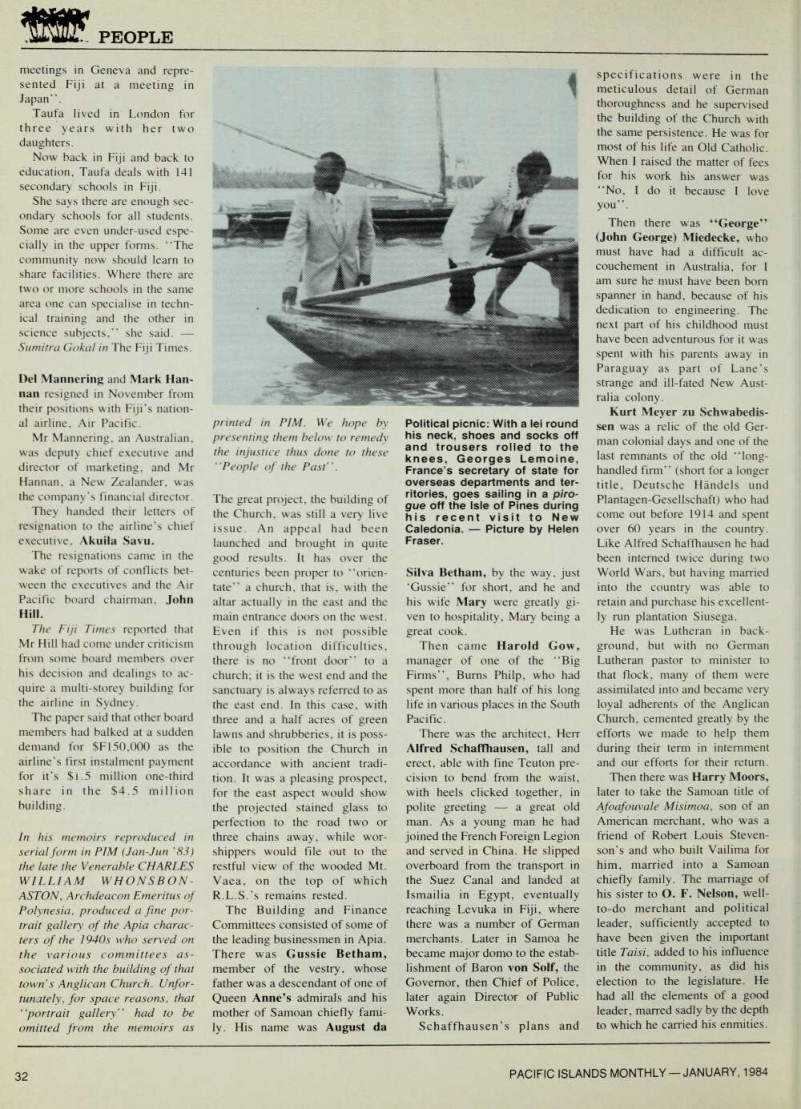
Political picnic: With a lei round his neck, shoes and socks off and trousers rolled to the knees, Georges Lemoine, France’s secretary of state for overseas departments and ter ritories, goes sailing in a piro gue off the Isle of Pines during his recent visit to New Caledonia. - Picture by Helen Fraser.