Roncaglia OPR: Space Age
pp. 56-57 · Read in the full issue
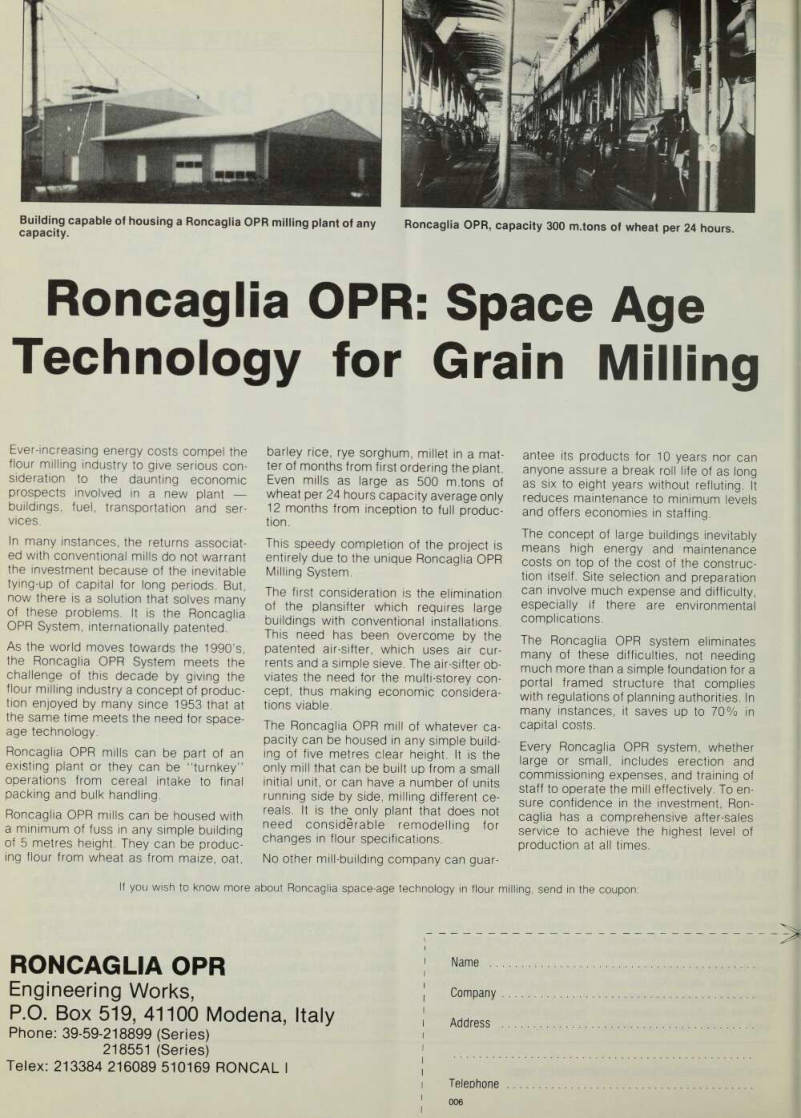
Technology for Grain Milling
Ever-increasing energy costs compel the flour milling industry to give serious con sideration to the daunting economic prospects involved in a new plant buildings, fuel, transportation and ser vices.
In many instances, the returns associat ed with conventional mills do not warrant the investment because of the inevitable tying-up of capital for long periods. But, now there is a solution that solves many of these problems. It is the Roncaglia OPR System, internationally patented.
As the world moves towards the 1990’5, the Roncaglia OPR System meets the challenge of this decade by giving the flour milling industry a concept of produc tion enjoyed by many since 1953 that at the same time meets the need for space age technology.
Roncaglia OPR mills can be part of an existing plant or they can be “turnkey” operations from cereal intake to final packing and bulk handling.
Roncaglia OPR mills can be housed with a minimum of fuss in any simple building of 5 metres height. They can be produc ing flour from wheat as from maize, oat,
barley rice, rye sorghum, millet in a mat ter of months from first ordering the plant.
Even mills as large as 500 m.tons of wheat per 24 hours capacity average only 12 months from inception to full produc tion.
This speedy completion of the project is entirely due to the unique Roncaglia OPR Milling System.
The first consideration is the elimination of the plansifter which requires large buildings with conventional installations.
This need has been overcome by the patented air-sifter, which uses air cur rents and a simple sieve. The air-sifter ob viates the need for the multi-storey con cept, thus making economic considera tions viable.
The Roncaglia OPR mill of whatever ca pacity can be housed in any simple build ing of five metres clear height. It is the only mill that can be built up from a small initial unit, or can have a number of units running side by side, milling different ce reals. It is plant that does not need considerable remodelling for changes in flour specifications.
No other mill-building company can guar
antee its products for 10 years nor can anyone assure a break roll life of as long as six to eight years without refluting. It reduces maintenance to minimum levels and offers economies in staffing.
The concept of large buildings inevitably means high energy and maintenance costs on top of the cost of the construc tion itself. Site selection and preparation can involve much expense and difficulty, especially if there are environmental complications.
The Roncaglia OPR system eliminates many of these difficulties, not needing much more than a simple foundation for a portal framed structure that complies with regulations of planning authorities. In many instances, it saves up to 70% in capital costs.
Every Roncaglia OPR system, whether large or small, includes erection and commissioning expenses, and training of staff to operate the mill effectively. To en sure confidence in the investment, Ron caglia has a comprehensive after-sales service to achieve the highest level of production at all times.
If you wish to know more about Roncaglia space-age technology in flour milling, send in the coupon:
sector should be aware of our role in facilitating efforts of the private sector. We need (o have investment incentives, reason able regulations, and a positive attitude towards business in order to create a favorable investment climate throughout the Pacific.”
The conference was organised into group discussions centring on joint ventures and financing schemes in farming, fishing and industry; energy and mineral re sources development; trade pro motion of food and finished pro ducts; and transport and tourism in the Pacific.
The conference submitted a three-page report to the SPC meeting, containing 27 recom mendations. Among the major recommendations were: Joint ventures, financing: • Establish private sector commissions to advise govern ments on policies, objectives, and laws affecting private sectors; • Ensure that national de velopment plans support region al, sub-regional and national business development growth; • Ensure that laws and regula
tions provide incentives for pri vate sector growth; and • Establish land use systems to provide adequate leasing terms for foreign investments.
Energy and mineral re sources development: • Establish an “information bank” about successes and fai lures of projects in SPC region; • Encourage decentralised power generation systems in rur al areas; • Promote the development of locally available energy sources; • Invite mineral and mining companies to submit proposals for mineral exploration.
Trade promotion:
• Establish “entrepreneur skills” training centres and de velop business-oriented school curricula; • Improve credit ratings of local governments and businesses; • Establish information centres to distribute information and data needed by businesses; and • Conduct study to promote “counter-trade” with developed countries.
Tourism, transport: • Conduct surveys of national/state government opin ion on tourism and establish program to benefit particular localities; • Make an inventory of sel ling aspects of given localities;
• Organise dependable and
economic transport to localities and encourage co-operation among different modes of transport; • Survey potential markets about their desires and needs; and
• Incorporate tourism in school curricula and manpower training programs.
In a resolution submitted to the SPC meeting for its considera tion, the business conference called on the SPC to encourage and expand the participation of the private sector in regional economic deliberations, include the business conference as a per manent adjunct of the SPC, and establish a task force to study co operation between the SPC and the private sector. Francisco T. Uludong.
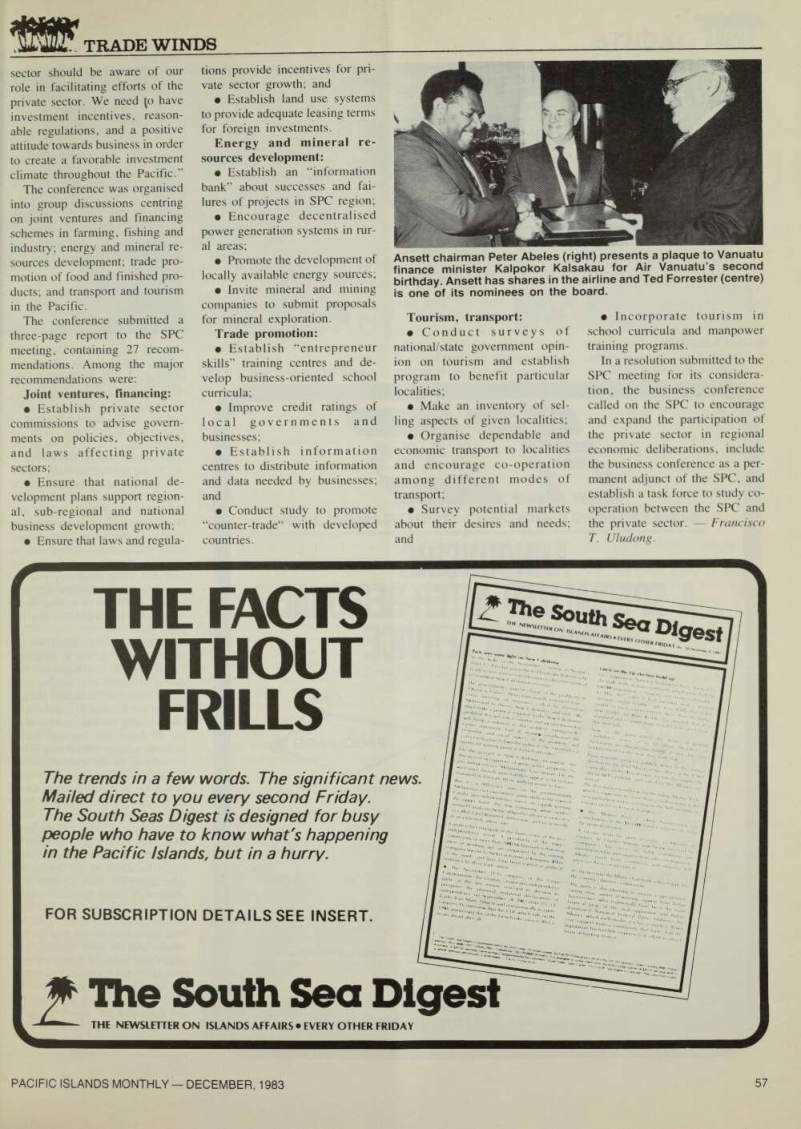
Ansett chairman Peter Abeles (right) presents a plaque to Vanuatu finance minister Kalpokor Kalsakau for Air Vanuatu’s second birthday. Ansett has shares in the airline and Ted Forrester (centre) is one of its nominees on the board.