tells Pacific governments
pp. 55-56 · Read in the full issue
‘lt takes two to tango’, business tells Pacific governments
Tests in Tonga
on desalinator
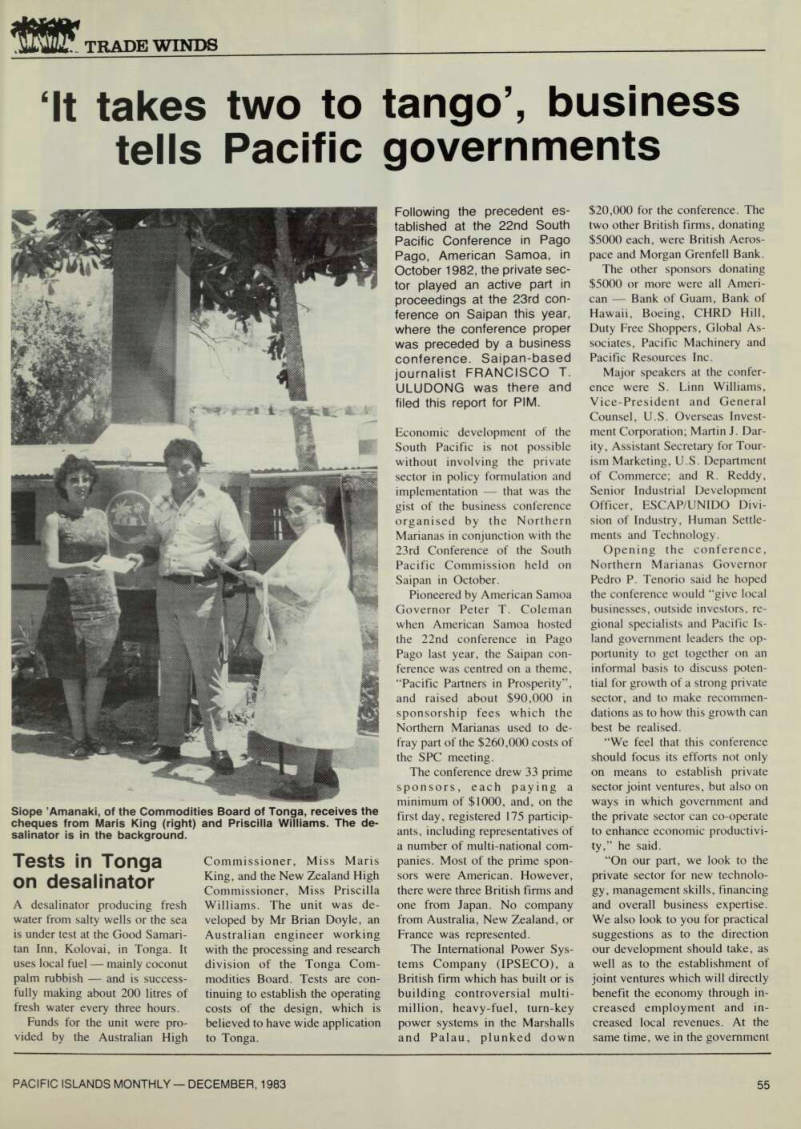
A desalinator producing fresh water from salty wells or the sea is under test at the Good Samari tan Inn, Kolovai, in Tonga. It uses local fuel mainly coconut palm rubbish and is success fully making about 200 litres of fresh water every three hours.
Funds for the unit were pro vided by the Australian High
Commissioner, Miss Maris King, and the New Zealand High Commissioner, Miss Priscilla Williams. The unit was de veloped by Mr Brian Doyle, an Australian engineer working with the processing and research division of the Tonga Com modities Board. Tests are con tinuing to establish the operating costs of the design, which is believed to have wide application to Tonga.
Following the precedent es
tablished at the 22nd South Pacific Conference in Pago Pago, American Samoa, in October 1982, the private sec tor played an active part in proceedings at the 23rd con ference on Saipan this year, where the conference proper was preceded by a business
conference. Saipan-based
journalist FRANCISCO T.
ULUDONG was there and filed this report for PIM.
Economic development of the South Pacific is not possible without involving the private sector in policy formulation and implementation that was the gist of the business conference organised by the Northern Marianas in conjunction with the 23rd Conference of the South Pacific Commission held on Saipan in October.
Pioneered by American Samoa Governor Peter T. Coleman when American Samoa hosted the 22nd conference in Pago Pago last year, the Saipan con ference was centred on a theme, “Pacific Partners in Prosperity”, and raised about $90,000 in sponsorship fees which the Northern Marianas used to de fray part of the $260,000 costs of the SPC meeting.
The conference drew 33 prime sponsors, each paying a minimum of $lOOO, and, on the first day, registered 175 particip ants, including representatives of a number of multi-national com panies. Most of the prime spon sors were American. However, there were three British firms and one from Japan. No company from Australia, New Zealand, or France was represented.
The International Power Sys tems Company (IPSECO), a British firm which has built or is building controversial multi million, heavy-fuel, turn-key power systems in the Marshalls and Palau, plunked down
$20,000 for the conference. The two other British firms, donating $5OOO each, were British Aeros pace and Morgan Grenfell Bank.
The other sponsors donating $5OOO or more were all Ameri can Bank of Guam, Bank of Hawaii, Boeing, CHRD Hill, Duty Free Shoppers, Global As sociates, Pacific Machinery and Pacific Resources Inc.
Major speakers at the confer ence were S. Linn Williams, Vice-President and General Counsel, U.S. Overseas Invest ment Corporation; Martin J. Dar ity, Assistant Secretary for Tour ism Marketing, U.S. Department of Commerce; and R. Reddy, Senior Industrial Development Officer, ESCAP/UNIDO Divi sion of Industry, Human Settle ments and Technology.
Opening the conference, Northern Marianas Governor Pedro P. Tenorio said he hoped the conference would “give local businesses, outside investors, re gional specialists and Pacific Is land government leaders the op portunity to get together on an informal basis to discuss poten tial for growth of a strong private sector, and to make recommen dations as to how this growth can best be realised.
“We feel that this conference should focus its efforts not only on means to establish private sector joint ventures, but also on ways in which government and the private sector can co-operate to enhance economic productivi ty,” he said.
“On our part, we look to the private sector for new technolo gy, management skills, financing and overall business expertise.
We also look to you for practical suggestions as to the direction our development should take, as well as to the establishment of joint ventures which will directly benefit the economy through in creased employment and in creased local revenues. At the same time, we in the government
Slope Amanaki, of the Commodities Board of Tonga, receives the cheques from Maris King (right) and Priscilla Williams. The de salinator is in the background.
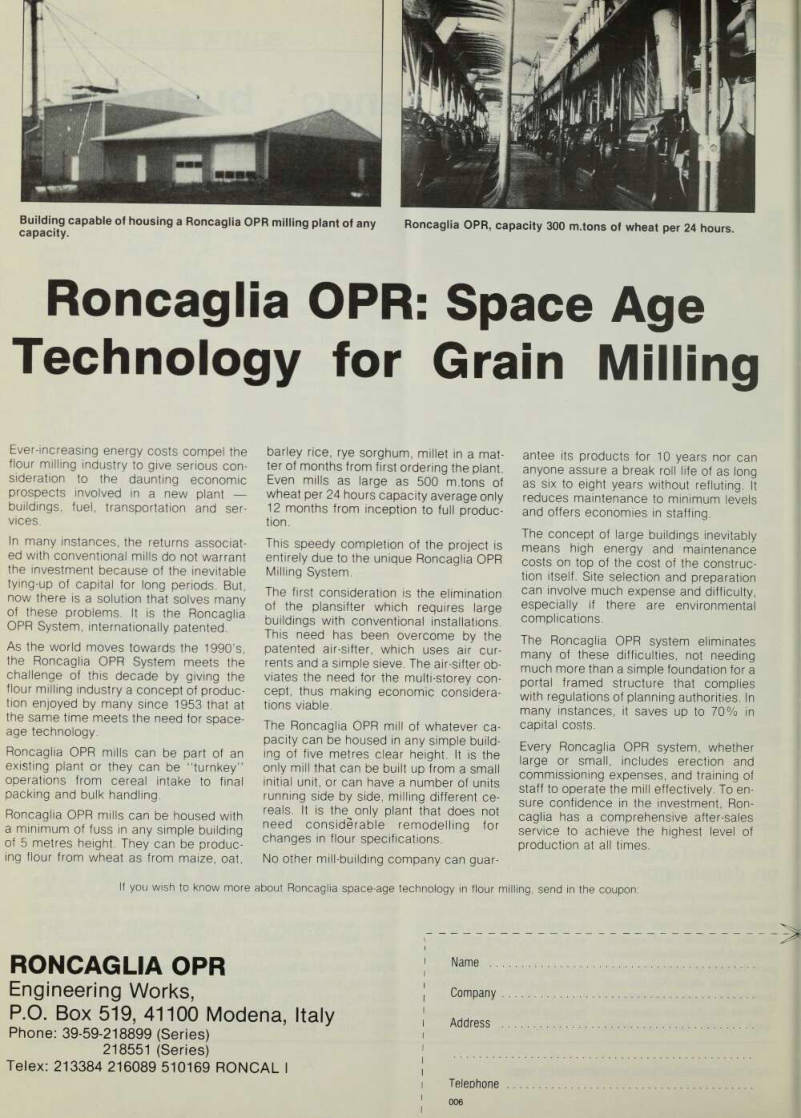
Building capable of housing a Roncaglia OPR milling plant of any capacity.
Roncaglia OPR, capacity 300 m.tons of wheat per 24 hours.