Yachts
pp. 58-62 · Read in the full issue
Jane Deridder
ports front the
I BS3W3S, tijl ,
• AENA. Regi and Kurt Suter first met on a sailing yacht in Italy on a student holiday. Now halfway through a five year blue-water cruising honeymoon, the Suters paused in Nadi Waters before continuing on towards Rotuma, Tuvalu, Kiribati, the Marshalls, Carolines, Papua New Guinea, Australia and perhaps Japan.
Kurt says that after taking part in the Olympic Games in Munich on the Swiss grass hockey team, he just had to do something else. He and Regi sailed Tornado catamarans on the Swiss lakes, then had their 11 m
Koppmaan-designed steel sloop built
for them in Holland, a striking vessel with red hull and blue and white trims. Aena is a Latin word with two
meanings: “one built from steel” and ANN . A little yacht from Honolulu with a big signal, Carrie Ann is a Cheoy Lee Offshore 27 belonging to ham radio operator/electronics technician Tom Celentano, who earned his ham ticket for a Boy Scout merit badge. (His current call sign is KH6GO). Carrie Ann’s monster signal is partly a result of Tom’s having glassed 2.5 square metres of bronze screening into the inside of the hull as a counterpoise to the antenna. Carrie Ann’s batteries are charged by a unique solar panel arrangement two high-efficiency elongated panels on the top side of the spreaders. The PDC LAB solar panels have dimpled high tensile glass surfaces givng them special optical qualities. A pocket electronic pager set off by an alarm warns of bilge water, fire, or broken mooring
when Tom is ashore. Tom, who calls himself a “New York transplant”, found Carrie Ann in a derelict state.
“Her lines attracted me a cross between a Rhodes and a Herrishoff I fell in love . . .” So he have up medical school at the University of Hawaii and began what turned out to be a six-year project. Honolulu-bom Ann Holway helped Tom with the labor-intensive restoration. Ann sailed for several years on her mother’s 8 m yacht Legacy in Auck land, and served with a Honolulu yacht charter company as hostess, crew and then first mate. Tom and Ann agree their next boat will be “the optimum size, 10 metres, no larger.
She’ll have double spreaders and no varnish”. Ann and Tom planned to return to New Zealand for another hurricane season after a Yasawas cruise. • LIBERTY. Maine-built 20 m Lib-
erty, an Alden ketch of double
planked mahogany, dwarfed other
cruising vessels in the Malolo Lailai anchorage before returning to Suva, where it was sold to a New Caledo nian buyer. Don Hinkley has cruised Liberty extensively since ’7B in the Mediterranean and the Caribbean be fore entering the Pacific in March ’B2. Grace Smith, first mate, speaks with enthusiasm of their cruising in
Greece, Turkey, Cyprus, Italy, Sici
ly, Malta and Tunisia. Grace and Don usually carried a crew of two or three to handle the stately traditional ketch. After turning Liberty over to her new owners, Don and Grace flew to Tahiti. From there they plan on sailing to New Zealand for refit on a recently purchased 26 m steel vessel which Don had wanted to buy for many years. • MYSTIC COVE. From Marina del Rey, a 12 m Sea Wolf ketch, Taiwan-built, U.S.-finished and fitt ed-out, Mystic Cove is heading back to California via Samoa and perhaps Canton and Christmas Islands, with brothers Greg and Rob Jennings shar
ing the helm. The Jennings family
made the passage from Whangarei to Suva during the storm which resulted in the Lionheart tragedy. They tried to tack out of it near the Kermadecs under triple-reefed main and storm jib. Breaking seas smashed a win dow, a plank pulled out of the bow sprit. They made a good 70 miles in three days. First mate, Valerie Jen nings, remarked on the impressive noise during the storm. Of their crew members, a young American couple, Valerie said: “We really lucked out, though the girl had never sailed be
fore. Fortunately we had good sailing
weather after the storm. Young crew man, Chris, plans on buying his own boat now.” On his return to Califor nia, it’s probably back to university for a business degree for Gregory, and then into the family business manufacturing wheelchairs and hos
pital equipment.
• MOON RIVER. The light blue, sleek-lined 11 m yawl graced with lazy jacks and baggy wrinkle, of Virgin Islands registry, was resur rected by her present owners who found her as a wreck in Annapolis in ’72. In a Slocum-like operation, Bob and Nancy Pihl built a new hull for the 1938 Alberg Coastwise Cruiser using mahogany over laminated oak frames and stainless steel fastenings, and the old plans supplied by the Peabody Museum in Boston.
Mechanical engineer Pihl re-used the rigging and parts of the original deck and house. The yawl was relaunched in the fall of ’76 and renamed Moon River. When pausing in Malolo
Lailai to repair their glass “lapstrake”
tender, which has been squashed in Panama and dragged over rocks in many places since. Bob and Nancy discussed forthcoming cruising plans. “We’ll either be heading to Australia or New Zealand ... or maybe north. We like to narrow it down, be really definite.” • SITTER. “We can talk about our misadventures for hours,” say Peter and Ethel Healey of their three-year cruise in their 11.8 m double chine sloop. Sitter of Vancouver. (The din ghy was Baby Sitter of course). It all began when they answered a “Hull for Sale” ad in the Vancouver Sun newspaper. Dave Folks had built the steel hull in a bam in Chilliwack, BC. after the underwater proportions of Kruger’s Iron Virgin. The Healeys helped Folks complete a red cedar and teak interior. “We learned to navigate underway . . . nearly mis sed Hawaii ... no sights for 11 days,” says Peter. “Besides, an an chor stowed aft had thrown the com
pass off 17 deg.” Not long after leaving Hawaii, the roller furling jib fell down. They hove to twelve miles off Christmas Island in the same brief but violent storm that wrecked Big Bear H there. Then, without a chart, they used their last jug of diesel to go in. At Christmas Island they jury rigged a forestay with anchor chain and carried on to Polynesia where Sitter was driven ashore in Cooks
Bay by Cyclone Lisa. (Tom and
Ethel had been bicycling around Moorea and missed the hurricane warning). They warped her off them selves and carried on. They’d been without an engine for three months; the day after they fixed the motor, Sitter was running goosewinged in about 25 knots. “I went down for a drink of water. BANG! The whole rig was gone mast, sails, mast step and all”. In Rarotonga they bought the only new mast in the Cooks, 1.8 m shorter than the original, ordered for a boat that was rotting on the hard. Undeterred, they lowered the boom a metre or so and discovered that with her modified rig Sitter sails even better than before. About to sail to New Zealand from Fiji, the
Healeys are wondering what can hap
pen next.
• OSPREY. It was a notable coinci dence to find two unusual 16 m Marco Polo Herrishoff three-masted schooners anchored off Malolo Lailai in September. Osprey of San Francis co is a ferro version built by Pat and Richard Muenzer and launched in ’75. She replaced a 9 m Friendship gaff-rigged sloop which they had lived aboard for four years. This South Pacific trip is Pat’s and Rich’s second major cruise. White whiskered and tattooed and further decorated with sky-diving scars, Rich looks the part of the old salt. He is an enthusiastic diver and can find crayfish in the most unlikely places.
Pat too loves the life and feels the six years a-building were well worth while. Pat is a backgammon addict and challenges all fellow enthusiasts to a game whatever the anchorage.
They are headed for New Zealand for hurricane season, so backgammon fans headed thataway, be prepared. • MAT ARE The second of the Mar co Polo three-masted schooners was Matari of Auckland registry. This one was built in Bangkok of changi, a wood impervious to rot, and teak.
Jack and Jocelyn Hargreaves spotted
this one “going for a song” and snapped it up. “And I’m still working
on it”. Jack admits. Comfortable and easy to sail (the mainmast is just 14.3 m), she “trundles off the miles down wind”. The Hargreaves, who have a house on Waiheke Island in New Zealand sailed to Fiji with the Auck land-Suva race serving as radio relay mother ship. Jack has a couple of circumnavigations under his keel al ready, having skippered the 25 m Philip Rhodes vessel Biene Star for four years, and Victoria, sister ship to Ticonderoga, before that. Jack and Jocelyn agree that running other peo ple’s vessels is a bit like driving a bus. “On our own we can sit and wait for weather.” • KEMANA. “Where are you go ing?” in Indonesian is kemana, and Indonesia is where Kemana’s first mate Brita lived until after World War 11, four of those years in a concentration camp. Brita and Nick Zeldenrust learned to sail on the Dutch lakes before moving to Regi na, Saskatchewan. When their three
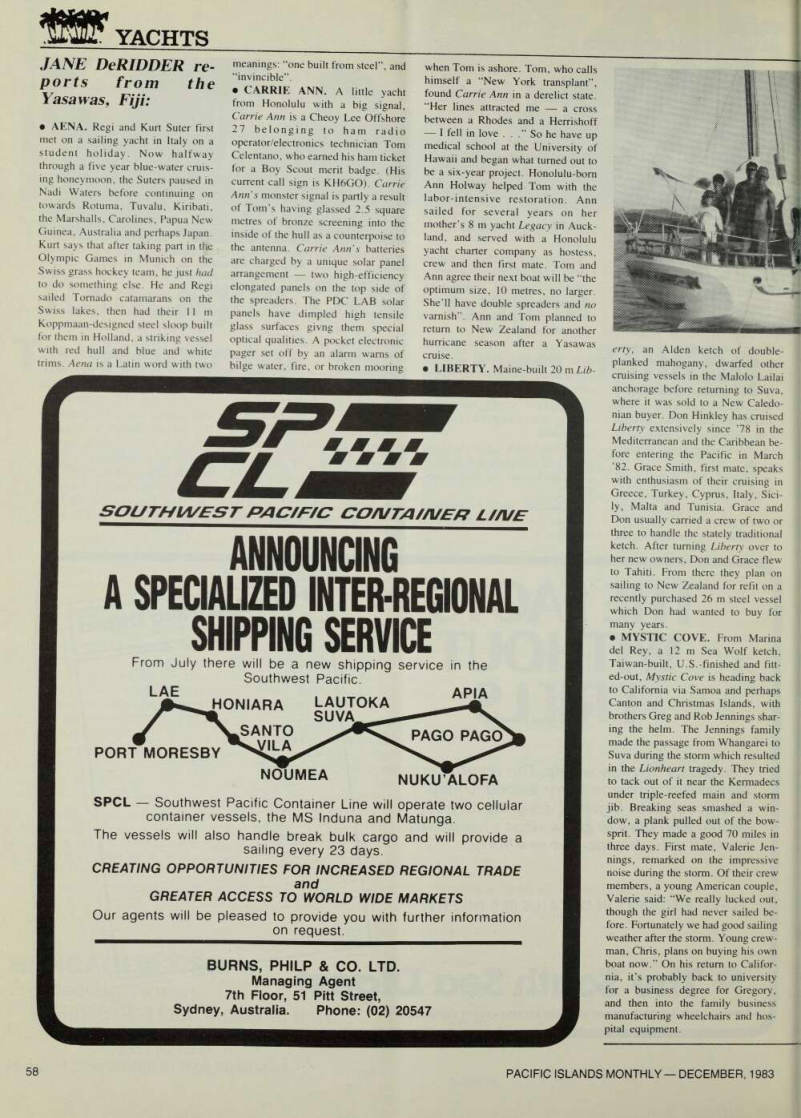
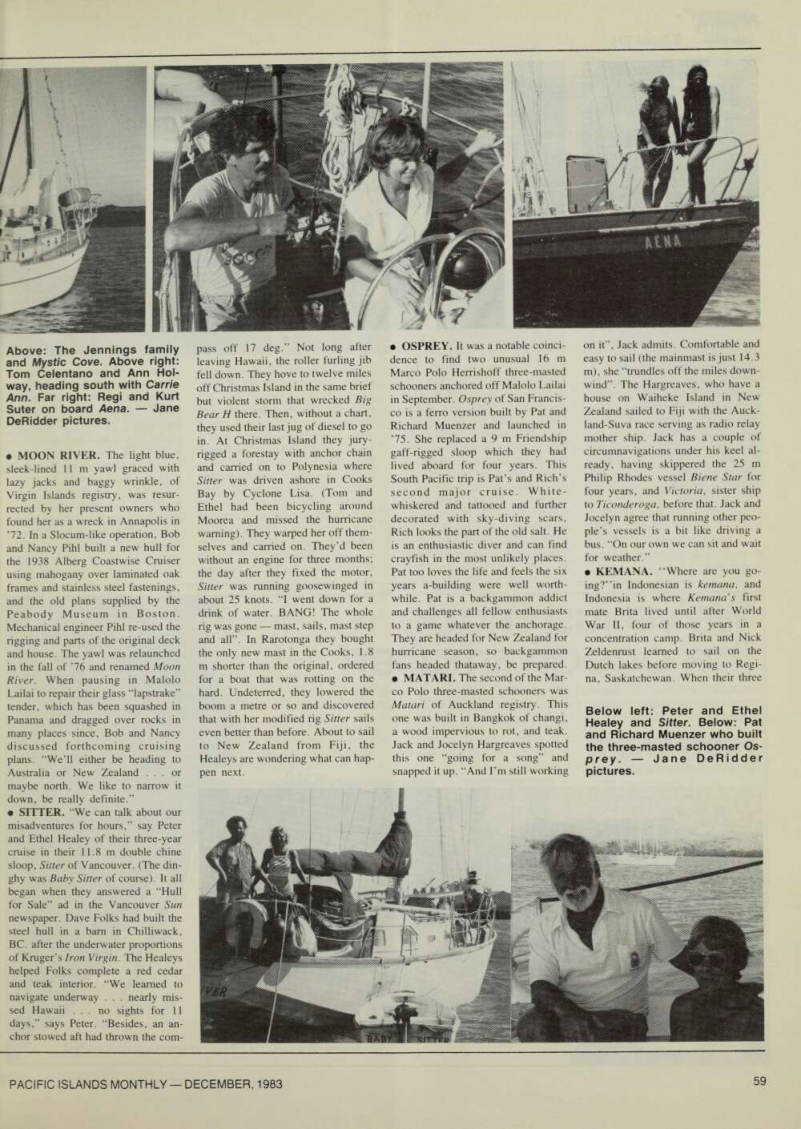
Above: The Jennings family and Mystic Cove. Above right: Tom Celentano and Ann Hol way, heading south with Carrie Ann. Far right: Regi and Kurt Suter on board Aena. - Jan`e DeRidder pictures.
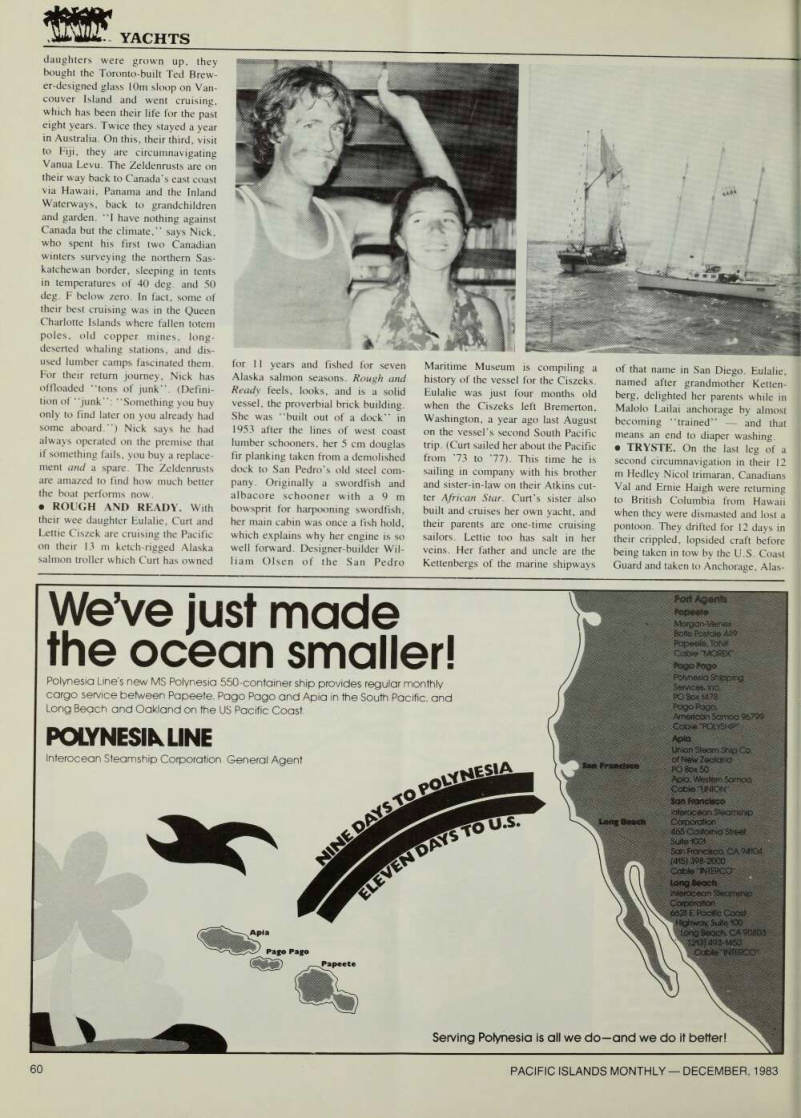
Below left: Peter and Ethel Healey and Sitter. Below: Pat and Richard Muenzer who built the three-masted schooner Os prey. Jane DeRidder pictures.
daughters were grown up, they bought the Toronto-built Ted Brew er-designed glass 10m sloop on Van couver Island and went cruising, which has been their life for the past eight years. Twice they stayed a year in Australia. On this, their third, visit to Fiji, they are circumnavigating Vanua Levu. The Zeldenrusts are on their way back to Canada’s east coast via Hawaii, Panama and the Inland Waterways, back to grandchildren and garden. “I have nothing against Canada but the climate,” says Nick, who spent his first two Canadian winters surveying the northern Sas katchewan border, sleeping in tents in temperatures of 40 deg. and 50 deg. F below zero. In fact, some of their best cruising was in the Queen Charlotte Islands where fallen totem poles, old copper mines, long deserted whaling stations, and dis used lumber camps fascinated them.
For their return journey, Nick has offloaded “tons of junk”. (Defini tion of “junk”: “Something you buy only to find later on you already had some aboard.”) Nick says he had always operated on the premise that if something fails, you buy a replace ment and a spare. The Zeldenrusts are amazed to find how much better the boat performs now.
• Rough And Ready. With
their wee daughter Eulalie, Curt and Lettie Ciszek are cruising the Pacific on their 13 m ketch-rigged Alaska salmon trailer which Curt has owned
for 11 years and fished for seven Alaska salmon seasons. Rough and Ready feels, looks, and is a solid vessel, the proverbial brick building.
She was “built out of a dock” in 1953 after the lines of west coast lumber schooners, her 5 cm douglas fir planking taken from a demolished dock to San Pedro’s old steel com pany. Originally a swordfish and albacore schooner with a 9 m
bowsprit for harpooning swordfish,
her main cabin was once a fish hold, which explains why her engine is so well forward. Designer-builder Wil liam Olsen of the San Pedro
Maritime Museum is compiling a history of the vessel for the Ciszeks.
Eulalie was just four months old when the Ciszeks left Bremerton, Washington, a year ago last August on the vessel’s second South Pacific trip. (Curt sailed her about the Pacific from ’73 to 'll). This time he is sailing in company with his brother and sister-in-law on their Atkins cut ter African Star. Curt’s sister also built and cruises her own yacht, and their parents are one-time cruising sailors. Lettie too has salt in her veins. Her father and uncle are the Kettenbergs of the marine shipways
of that name in San Diego. Eulalie, named after grandmother Ketten berg, delighted her parents while in Malolo Lailai anchorage by almost becoming “trained” and that means an end to diaper washing. • TRYSTE. On the last leg of a second circumnavigation in their 12 m Hedley Nicol trimaran, Canadians Val and Ernie Haigh were returning to British Columbia from Hawaii when they were dismasted and lost a pontoon. They drifted for 12 days in their crippled, lopsided craft before being taken in tow by the U.S. Coast Guard and taken to Anchorage, Alas-
ka. Friends on Canadian yacht Nanook (“Of the North”), now in home waters in Yukon Territory after a non-stop passage from Majuro, report that in August Val and Ernie were southward bound under their own power heading for their salt Spring Island, British Columbia, home. • ZEPHYR V, Gentle ghosting in zephyrs with a 3 m multi-hued nylon windsock streaming from the spread ers this is Jon and Loma Hunkin’s favorite way of sailing their Brand lemyer 41 kauri ketch. But Zephyr V was caught part-way from New Zea land to Fiji in the severe June storm which clobbered the returning Auck land-Suva Race fleet, resulting in eight deaths. The Hunkins hove to or lay ahull for the better part of three days. Crashing seas squirted in
through dogged-down hatches and
companionway that had always been watertight in Zephyr’s many years of South Pacific cruising. When it was all over, Jon pumped out about 50 litres of sea water. Zephyvr cleared customs at Levuka and Jon and Loma enjoyed a two-month cruise of the Lau Group and Vanua Levu before making their way north of Viti Levu to Nadi Bay and the Yasawas. They are planning to spend the next hur ricane season in Tasmania where they enjoyed an earlier cruise. • HONU. Another Fiji-bound cruis ing yacht caught in the full force of
the prolonged easterly gales which
caused heavy loss of life in the
returning Auckland-Suva Race fleet was the 8.8 m Alaska yacht Honu (see May ’B3 issue PIM). Mike and Francine Matthews report they were able to heave to. Honu sustained no serious damage. In this same storm the Farr 38 Lionheart broke up on Cone Rock when the delivery crew tried to enter Whangaroa Harbor at night. There was only one survivor out of a crew of eight. Another returning race yacht, the 11.6 m Southern Raider was left unmanned north of Norfolk Island when the crew were rescued in heavy seas by a container vessel diverted from its route. One of Southern Raider’s crew was crushed between the yacht and the rescue ship and lost at sea. • AFRICAN STAR. My dream come true,” says Laura Ciszek about cruising with Charlie and a cabin full of paperbacks on their 10.6 m Atkins cutter African Star, for she loves reading and has plenty of time for it now. Charlie is one of three wander-
ing Ciszek brothers. He and Laura are cruising in company with brother Curt on Rough and Ready. Their brother Joel did a five-year circum navigation on his 8.2 m Westerly
Centaur bilge-keeler Lookfar.
Though nearly 30 cm down on her lines with a year’s worth of canned food and extra ballast to carry more sail area, African Star sails fast (the 36-year-old vessel was raced exten sively in Seattle), and balances per fectly with hands off the helm. The only misadventure so far on their Pacific voyage was the near loss of one of Charlie’s front teeth, knocked out by recoil of a spear gun when shooting from the dinghy at “a milk fish as big as a salmon’’ in Palmyra Lagoon. Charlie immediately thrust the tooth back into its socket, held it there with a plastic guard and ate a lot of gruel for a few weeks. It took . . .
Before setting off on their Pacific cruise, when he and Laura were still “Earth People’’, Charlie built fibre
glass dinghies, lapstrake-style, and
Tramp Harbor 255, at his Vashon Boat Works in Washington State. • SWIRL. Mini-fishing boat Swirl of Sitka, Alaska, is only 9.1 m long, yet Shane Finneran hand trolled success fully for salmon in Alaska before he and Christine sailed Swirl to the South Pacific via Hawaii and Palmy ra. Tina and Shane speak of the
“spooky” atmosphere of Palmyra’s
murky, shark-infested lagoon. Dur
ing a stay of several months in Vavau, Tonga, Swirl weathered Hur rican Isaac unscathed, a hurricane which beached and wrecked several other yachts. They took the precau tion of moving from Neiafu and anchoring on their own in a smooth,
muddy-bottomed bay. They attribute
their survival to low freeboard and therefore minimum windage. Shane and Tina have visas for both New Zealand and Australia they’ll go whichever way the wind takes them, a precaution taken as a result of a prolonged beat back to Tonga a year ago.
• AL 26. This aluminium hulled 10 m yacht, whose name embraces the atomic weight for aluminium, is one of a series of vessels, each smaller and simpler than its predecessor. Jim and Barbara Dearing of Sidney, Brit ish Columbia, began by building a ship designed in 1909, like the one Harry Pigeon sailed and wrote about, only schooner-rigged South Wind.
Tired of varnishing the taffrail, they sold her and next built Halcyon from a bare glass hull, a 10.6 m modified Endurance, in which Jim and Barbara cruised to New Zealand and back, a three-year voyage ending in Septem ber ’79. Their third cruising yacht (“We change every five years”) is a Robert Clark-designed hull profes sionally built in Sidney, 8.C., and finished by Yugoslavian-bom ship wright Jim and his longtime help meet-first mate Barbara. The hull is bare aluminium for easy maintenance striking with bright red boot top and guardrail. The interior is light, bright, clean and simple. She’s pow ered with a Pathfinder Volkswagen 42 hp diesel (as in Rabbit autos) and heated when necessary with a Force 10 Kerosene pressure heater, the very first installation after there was a bulkhead built to secure it to.
So far, two years out, 13 months of which was in Polynesia, the Dealings are cruising the Yasawas, Fiji, soon to leave for a second six-month visit
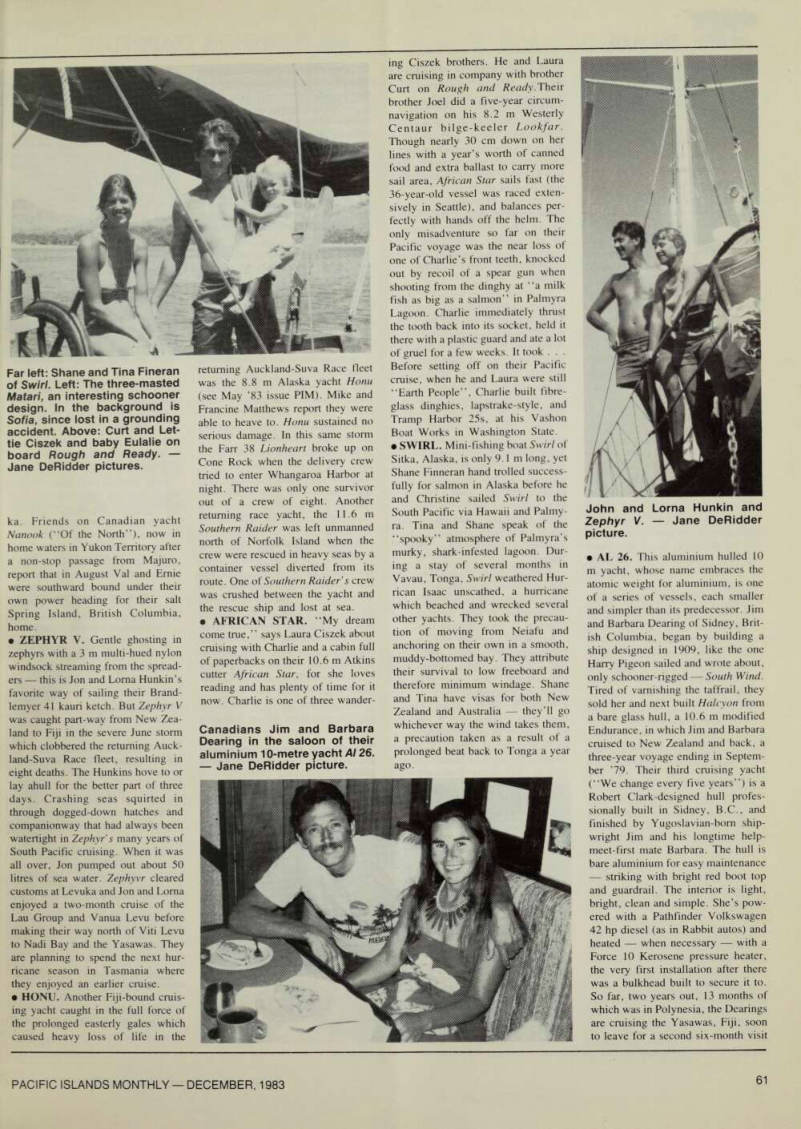
Far left: Shane and Tina Fineran of Swirl. Left; The three-masted Matari, an interesting schooner design. In the background is Sofia, since lost in a grounding accident. Above: Curt and Let tie Ciszek and baby Eulalie on board Rough and Ready.
Jane DeRidder pictures.
Canadians Jim and Barbara Dearing in the saloon of their aluminium 10-metre yacht Al 26.
Jane Deßidder picture.
John and Lorna Hunkln and Zephyr V. - Jane DeRidder picture.
to New Zealand. Diving, shelling and spear-fishing are their major in terests, and the Tuamotus their favo rite cruising grounds. Another not able stopover: Al 26 carried her hef ty, more than 2 m, draft into Niuatoputapu in the north of Tonga where a pass into the lagoon was blasted a couple of years back. • A’STRY’N. What do you do when you know exactly the boat you’d like, but can’t find anything like it?
Bruce Atkinson, Sydney air condi tioning engineer and draughtsman, solved the problem by designing and building his own ship inspired by French steel boat designs and incor porating ideas he and Lesley had gleaned on Kombi van camping and sightseeing around U.S., U K. and Europe, and on an extended blue water cruise from the U.K. to the Caribbean. “She was pretty, but she leaked . . and she got too small ...” Lesley says of the ’54 built Buchanan 25 which they bought in England, cruised for three years, and sold in Martinique. A’stry’n (“We wanted an Australian name”), an 11.7 m multi-chine centre-cockpit steel sloop, the result of the Atkin sons’ observations, experience and workmanship, has had a two-and-a half-year trial around the South Pacific, has weathered a couple of hurricanes in Polynesia (at anchor) and has proved to be all that Bruce and Lesley hoped. Bruce will make his Atkinson 38 plans available early next year. • TARA II: Wrecked in late August near Nanuku Pass in northeastern Fiji waters, an area renowned for strong and tricky currents, was Vancouver yacht Tara 11. Longtime blue-water voyagers, George and Suzanne Hart ley, on their way to Samoa, were lying ahull in 25-knot south easterlies awaiting daylight to exit from the pass. Just before dawn Tara II struck the reef. Suzanne was wash ed overboard but managed to make her way back to the stricken vessel, badly cut, clothing tom off. The fibreglass Bob Harris-designed Van couver 27 sank, coming to rest with the top of the mast above water. The Hartleys and their cat Pippin stayed in an inflatable Avon Redstar dinghy tethered to the mast for eight days before a change in wind direction enabled them to attempt to reach safety. As they made their way downwind, with Hartley standing up holding a sail he had dived to re trieve, they were spotted by the manager of Fiji Forbes Laucala in his game fishing boat. Tara II was too badly holed to refloat. Rigging, sails, anchor tackle, engine and other pieces of gear were salvaged with local help. The shipwrecked couple, with Pippin in a rented pet travelling box, flew to Hawaii.
KA Y BASON reports
from Port Moresby ,
Papua New Guinea:
• BALANCELLE. Yves and Dominique Perrin with daughter Marie and son Pierre are here after a rough passage from Vanuatu. With two big rips in their mainsail they were pleased to arrive.
Yves and Dominique sailed to gether in earlier days in the Mediter ranean. They cruised from Cannes in an old wooden boat through the canals to Quimper near Brest, where they sold the boat and flew to Noumea.
They had always wanted to build their own boat and fitted out a Lange vin steel hull. Within two years they moved on board after launching in Numbo in 1980. The interior of their 10.5 m yacht is very comfortable and homely, and has lots of cupboard space with a 3.5 m beam.
Passage against the wind from Noumea to New Zealand was made in 1981. After exploring the superb cruising grounds in the Bay of Is lands, Balancelle spent three months in Whangarei. The children attended school, which improved their English, and gave them a chance to meet other children. In ordinary times, Dominique conducts her own education program, buying suitable textbooks and planning the children’s lessons.
After a cruise to Auckland the family returned to Whangarei to pre pare for a passage to Fiji. From Fiji they returned to their home port of Noumea. A very pleasant trip.
Balancelle has been lucky to ob tain a permit to cruise to Bali where they will have a warm reunion with grandparents. Their future plans are to sail to Singapore. • SANPOI. Steve “Flash” Janney from West Virginia, U.S.A., bought this 20-tonne steel multi-chine yacht in New Zealand. She’s a Boden design, very solid 12 m cutter sloop, built in 1977. Steve is pleased with
her performance, especially down wind, and that she handles big seas comfortably. After six years in the U.S. Navy, underwater in sub marines, Steve is entusiastic about cruising. Since July 14 he’s covered over 3000 miles.
The passage from New Zealand to Port-Vila was completed in 11 days, and from Port-Vila to Port Moresby, 12 days. The best average was 170 miles in 24 hours, creaming along.
Sanpoi is heading for Bali where she will undergo a major refit. Steve would like to have the interior fitted out in teak. With a new suit of sails, he plans cruising back to the States.
The all-male crew are from New
Zealand and although they all deny
doing “housework” the boat looks quite tidy well, with four bachelors, it’s certainly not bad.
Andrew Turner has thoroughly en joyed his first sailing experience. He says the diving in Port-Vila is excel lent. While the boat is being over hauled in Bali, Andrew intends to visit Australia and return to complete the voyage to the States.
Malcolm Poole, who’s from Auck land, had previously only sailed in dinghies and found the ocean pas sages tremendous. He would now like to own a yacht. From Bali Malcolm is heading for Nepal and the
Himalayas.
Richard Brown also hails from Auckland. He’s the galley slave, producing mean steaks! This was also Richard’s first long passage and he’s hooked. He plans to be onboard for the cruise back to the States. • STARSEED. Sean Ahem worked as a fisherman, and for him it was a natural progression to build his own boat. He and his wife Chris spent three years building their 12 m steel chine ketch in Rotorua.
Star seed was launched in Tauran ga on the east coast of New Zealand’s
north island, and they promptly moved onboard to finish the interior.
After sea trials along the coast they set sail for Fiji, enjoying a pleasant cruise. Sean, Chris and daughter Kel ly were delighted with the people of Fiji, who made them very welcome.
Next port of call was Noumea where they not only improved their knowledge of the French language but met many cosmopolitan people.
It was hard to weigh anchor and leave. Arriving in Brisbane they were very impressed with the visitor’s berths at the Botanical Gardens. Al though they are in the heart of the city, the gardens provide peaceful and charming surroundings.
They cruised unhurriedly along the east Australian coast to the Whitsun day Islands where they discovered superb anchorages. From Townsville Star seed set sail for Samarai, but strong winds made Port Moresby an easier landfall.
From Port Moresby the family intend to sail through the Torres Strait to Thursday Island and coast hop to Sydney. Future plans are to cruise for as long as possible in the Pacific. As they say, “It’s so beaut iful, why go elsewhere?”
Here is a brief follow-up on cruis ing yachts reported in previous columns. • TEVAKE. Good to know that the McLarens arrived safely in Hawaii.
Tevake suffered damage to one of her wings bit nasty on a beam of 8 m.
She’s a pretty unusual tri, very fast.
Hope the damage wasn’t too severe. • BELLE STAR. Peter and Wendy Robinson with son David are staying for a while in New Ireland. Peter has secured a job so hopes to replenish cruising funds. How we lesser mor tals yearn for Sat Nav! The family really enjoyed their cruise from Port Moresby to New Ireland. PNG offers so much for the cruisers.
The Perrin family on board Balancelle. - Kay Bason picture.
Sanpoi in Port Moresby Har bour. - Kay Bason picture.