story from 1930s Papua
pp. 43-44 · Read in the full issue

A real-life detective story from 1930s Papua
Karo: the Life and Fate of a Papuan. By Amirah Inglis. Pub lished by the Institute of Papua New Guinea Studies in associa tion with Australian National University Press, Canberra,
1982. $10.95. Isbno 7081 0313
8.
A friend said of Karo: “It’s a good read.” The dramatic cover, with a noose surrounding the name Karo, arouses expectations of a detective story. Such expec tations are not disappointed, even if the story is fact, not fiction.
Karo Arauwa was bom in his mother’s Austronesian-speaking village of Hula, about 100 kilometres southeast of Port Moresby, in about 1900. His father was from a Toaripi speaking village, Mirihea-Uritai, on the eastern shore of the Gulf of Papua. Karo returned with his family to the father’s village when he was a small boy. After a
turbulent youth, during which his traditional education was inter rupted by the movement known as the “Vailala madness”, he succeeded his father as village constable.
In the early 1920 s he went to Port Moresby where he joined the regular constabulary. In 1928, he was taking the mail across the Owen Stanley Range to Kokoda when he quarrelled with and shot the constable, Bili, who was accompanying him. Af ter serving a five-year jail sent ence for murder, he returned briefly to his village. He was walking with village companions to Port Moresby, according to oral accounts, when the group killed an elderly couple who had befriended them. They then stole the safe, containing about £129, from the government station at Rigo. Judge Gore described it later as “a first-class burglary worthy of a more civilised community”.
The book then offers a splen did account of a detective work of Sergeant Bagita, whose wife was a Hula woman.
Back in jail, Karo feigned blindness to obtain privileges.
He deluded the senior Papuan
warden, Ume Hau, into thinking that he would teach him how to obtain large sums of money. Per suading Ume and his wife and daughters to cross to Koki Island at night, he killed the three of them by cutting their throats.
The story of the discovery of the bodies, the detective work of Bagita, and the roles in the trial of various actors, including Karo’s fellow accused, Koava Oa, makes fascinating reading.
Finally we are given a step-by step account of Karo’s execu tion, and are told of the myths that have arisen from his last words.
Several questions arise from the admirably told story. I have heard people question the justifi cation for lavishing so much time and effort on such a minor fi gure. As the author points out in her introduction, few Papuans who lived before 1942 were writ ten about as individuals, al though she does not mention the one major exception. The Re miniscences of Ahuia Ova, edited by F. E. Williams, which ap peared in Oceania in 1939.
Amirah Inglis provides a clear picture of Karo’s village and quotes the pioneer missionary Chalmers, as echoing the Mo tuan view when he describes the Toaripi as free, independent and “glorying only in murder, rapine and robbery”. The extent to which the Toaripi dominated the people living to the southeast is worth mentioning because it may offer some help in explaining Karo’s behavior.
According to oral and early written sources, in early years of contact the Toaripi destroyed the Roro-speaking village of Paitana and the Gabadi village of Vanuapaka, abducted women from Motu villages and occupied Keapara, on the far side of Hood Bay from Hula, until the Keapa rans paid for the sago which they had received. In the 1920 s and 19305, special regulations were made restricting the access of “Gulf natives” to Port Moresby.
A number were expelled from the town in 1932. Government reports from the Rigo station during that period include fre quent complaints about “the bul lyragging” Gulf natives terroris ing the local people. They early established a settlement outside the Hood Peninsula village of Kalo, from which Karo derived his name.
As in all Papuan situations, kinship ties were of great import ance and they are central to the story. An explanation can poss ibly be found for the marriage of a Toaripi man and a woman from Hula. The brother of Vavinekamu Vavine, the full name of Karo’s mother, was Ola Vavine. He had married the daughter of Arua Daera, the first central Papuan Christian, and he was one of the earliest Papuans to serve as a London Missionary Society teacher in the Toaripi speaking region, where his work was praised by Chalmers in his book, Pioneering in New Guinea. It was because of his kin-ties with people in Hula that Karo found himself in the Rigo area and then went to Hula with the money.
Mrs Inglis points out that Bagita was related to Karo through Karo’s mother. There is a confusing account of Bagita’s origins on page 22, where it is said that both Bagita’s parents were from Hula. Bagita was bom in Mapamoiwa village near Samarai and he married a Hula woman, Pala Maopa, who was by Papuan standards closely re-
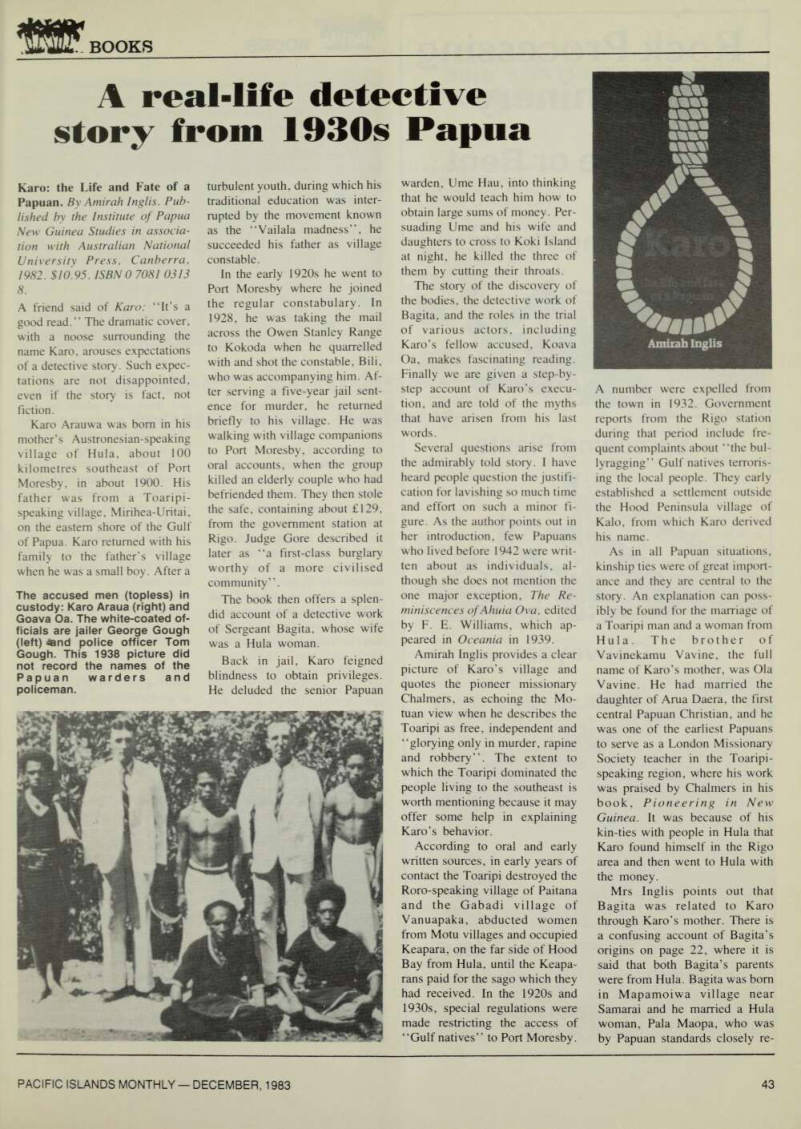
The accused men (topless) in custody; Karo Araua (right) and Goava Oa. The white-coated of ficials are jailer George Gough (left) police officer Tom Gough. This 1938 picture did not record the names of the Papuan warders and policeman.
lated to Karo’s mother. Pala’s grandfather was Vavine Kamu’s brother. These kinship ties would have helped Bagita in his
investigations.
The book makes a serious at tempt to see events through Pa puan eyes and is especially valu able in its account of how colo nial institutions such as prisons and courts worked in practice. A few points arise from the account of the trial. It was not “unusual in the British Empire” that indi genous people were tried without jury. I doubt whether the “white man’s ritual” was “alien” and “not easily comprehended” by Papuans who had been under colonial rule for 50 years. My own experience of such courts is that all concerned tried to manipulate the proceedings to their own ends as is clear from the evidence given by witnesses during Karo’s trial.
When the author repeats criti cism of the appointment of a defending counsel for Karo’s al leged accomplice, Koava, and not for Karo, I would like to have known how he came to be ap pointed. Presumably, as Karo had confessed, it was considered unnecessary to provide for his defence. More important is Mrs Inglis’ conclusion that “it seems clear that Goava was an acces sory; his lying evidence convicts him in retrospect”. The evidence against him was given by witnes ses who are admitted to have been biased. The only lie that Koava may have told was that he was friendly with Ume while, if he was away at the time of the murders as judge Gore accepted, several witnesses who gave evi dence against him were lying.
Surely at worst, we echo what was Judge Gore’s actual verdict “not proven”. It seems un likely that Karo would murder merely to please an acquaint ance, and, according to some oral evidence, Karo had a grudge against Ume. This is probable given Karo’s hatred of restraint, and the man who was the effec tive boss of the prison would have been an obvious target for his resentment.
Karo is shown to have been regarded, especially by his own people, as a Papuan Ned Kelly.
The author offers no explanation
for his behavior, possibly for fear of appearing ethnocentric. In brief, he murdered a Lala couple who had befriended him; shot a colleague whom the Reverend H.
A. Brown says was a senior constable, and who may have been considerably older than Karo; stole the Rigo safe; and murdered three people. He could only have had what appears to be no more than a minor grudge against the man and none at all against the woman and child. On more than one occasion he “dobbed in” his kinsmen and fellow villagers.
One can seek an explanation for his behavior in cultural terms.
In traditional Papuan societies, a man was only expected to behave ethically towards his kinsmen, and those with whom he ack
nowledged a relationship. All
others were fair game, the only limitation being fear of retaliation.
Prestige accrued from all homicides, whether of man, wo man or child.
The book reads like a novel, sometimes brilliantly.
I have one criticism. For the benefit of future generations the book could have been more fully referenced and a bibliography provided. This could have been done with very little trouble. It is irritating not to be able to find where Hobsbawm made his re marks, or to what “Chatterton 1974” refers. While there would be no need to litter the text with references or footnotes, a fuller account of oral sources, includ ing brief biographies and espe cially the ages of informants, would have been most helpful.
There is a list of ‘The principal characters” but it is incomplete.
A glossary of indigenous terms would also have been helpful.
The book contains a number of valuable photographs which bring to life a number of people mentioned in the text. It includes a map and is adequately pro duced for a book designed to reach a wide, including a Papua New Guinean, public.
It is recommended reading for all who are interested in the history of Papua between the two world wars and also and cer tainly for those who enjoy ‘‘a good read”. Nigel Oram.