Guide to the world’s
pp. 39-42 · Read in the full issue

Books
Guide to the world’s densest linguistic forest
Language Atlas of the Pacific Area, Part I: New Guinea Area, Oceania, Australia.
Edited by S. A. Wurm and S.
Hattori. Published by the Aust ralian Academy of Humanities in collaboration with the Japan Academy, Canberra, 1981, as Pacific Linguistics, Series C, No. 66. ISBN 0 85883 239 9 and ISBN 0 85883 240 2. Price
Sabo.
The boxed set of 24 maps and accompanying text which consti tutes this publication is the first instalment of a projected two part language atlas of the Pacific region. Part 11, covering Japan, Taiwan, the Philippines, and mainland and insular (Southeast) Asia, is scheduled to appear ear ly in 1984. Some indication of the scope of the project is given by the fact that the production of Part I alone necessitated the in volvement of 15 co-ordinating editors and over 50 consulting editors and editorial advisers.
The range, quantity and quality of linguistic expertise thus drawn upon is indeed formidable. The publishers acknowledge the par ticular assistance of the depart ments of Linguistics and of Hu man Geography in the Research School of Pacific Studies at the Australian National University.
The basic function of a lan guage atlas is to show, as exactly as possible within the limits im posed by the available informa tion, where the various lan guages of a given region are spoken. This publication does much more than that, and does it for what is linguistically the most complex region of the world a region which contains nearly half (about 2000) of the total number of known living languages. In addition to the quite precise as sociation of languages with specific areas on the maps, this atlas provides information on the number of people who speak a given language, on the nature and extent of its dialectal varia tion, and on its historically
oriented classification in terms of, language family, sub-group etc.
The maps are grouped into three sections:- New Guinea Mainland and Adjacent Is lands (maps 1-14); Island Melanesia, Micronesia and Polynesia (maps 15-19); and
Australia and Tasmania (maps 20-23). An additional map deals with Pidgin Languages, Trade Languages and Lingue Franche in Oceania and Aust ralia. Each of these sections has a general introduction which pro vides information on the maps themselves, on the bases for the
demographic data and for the historically oriented language classification, on the major re levant reference works, and on changes in the language situation in recent years. There is also an index for each section. Within the sections each individual map has, on its reverse face, a citation of information sources relating to the map in question, a detailed listing of the languages referred to on the map together with the number of speakers for each lan guage, notes on matters which require further explication, and bibliographic details for the in formation sources.
That it was found necessary by the compilers to devote 14 maps to the New Guinea mainland and its adjacent islands is not at all surprising if one bears in mind that this region contains nearly 1000 distinct languages, many of which have considerable dialec tal diversification. The degree of this diversification at times ex ceeded even the resources of the atlas-makers, as is evidenced by their comment that “in spite of the large scale of the maps it has only been possible to represent some of the information on dialect distribution in some lan guage areas, and some general isations have been unavoidable”.
For the western part of the island of New Guinea four maps (one general and three specific) present the languages of what is now usually called Irian Jaya.
This portion of the atlas indicates unequivocally that fewer than one in four of the nearly 300 indigenous languages of Irian Jaya are members of the Au stronesian language family, and that a substantial majority of the indigenous population have one or other of the many non- Austronesian languages of the region as their first language. If one links this information with the fact that virtually all the languages of Indonesia as it was constituted prior to its annexation of West New Guinea were Au-
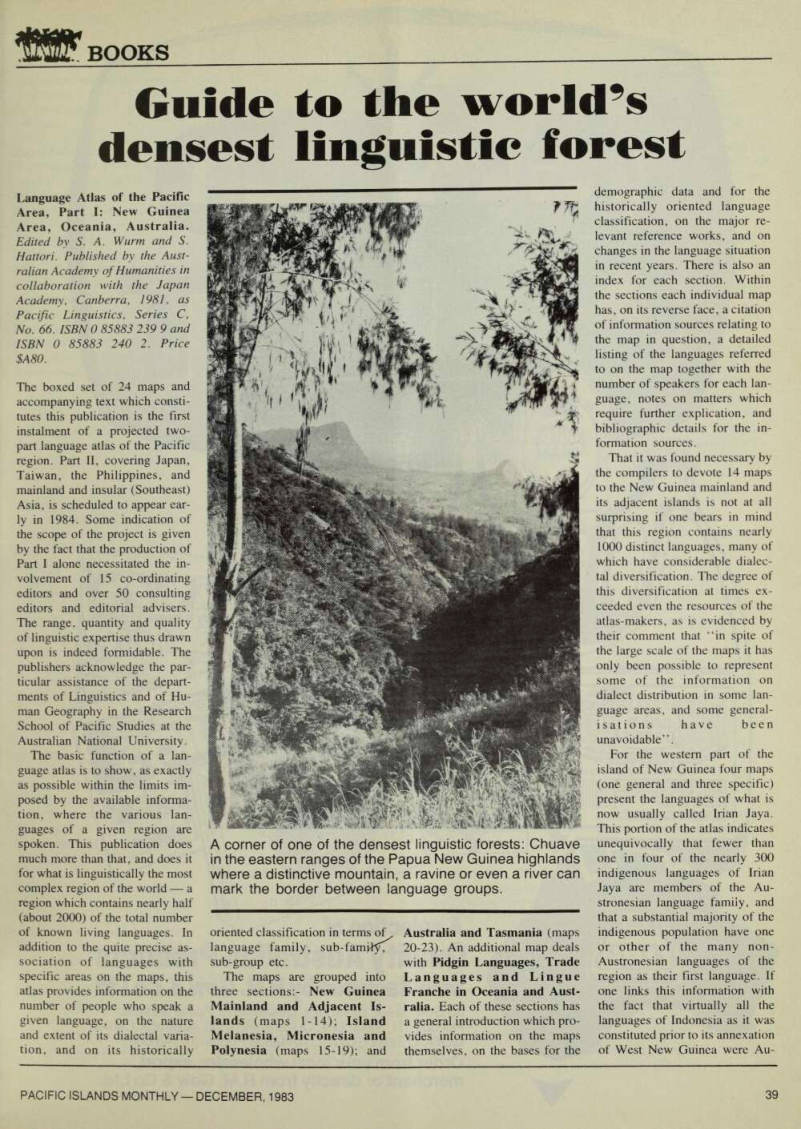
A corner of one of the densest linguistic forests: Chuave in the eastern ranges of the Papua New Guinea highlands where a distinctive mountain, a ravine or even a river can mark the border between language groups.
stronesian, no rationale for that annexation in terms of historical ly based linguistic affinities is tenable.
The 700 or so languages of Papua New Guinea are presented in 10 maps (one general and nine specific) which provide ample evidence of the linguistic com plexity that exists within that country’s population of around 3,500,000. The wealth of de tailed information in this presen tation should prove invaluable not only to linguists but also to those responsible for administra tion and social planning in this linguistically most diverse of polities where about 450 of the languages are Papuan (non- Austronesian) and about 250 are Austronesian.
For obvious reasons in terms of number of languages in rela tion to population and to area, the mapping of the languages of PNG and Irian Jay a must have presented the compilers of the atlas with their most formidable challenge one that, in my opinion, they have most effec tively met. My only reservation about this section is that the sub grouping (and in particular the higher-level sub-grouping) of the Austronesian languages in the region is less adequately indi cated than is warranted by cur rent opinion on the matter amongst Austronesianists.
The languages of Island Melanesia, Micronesia and Poly nesia, despite (or perhaps in part because of) their dispersal throughout the vastness of the Pacific Ocean, provided fewer problems of linguistic mapping than did the island of New Guinea. The languages of Oceania are presented in five maps: Bougainville and Solomon Islands; Vanuatu; New Caledonia; Micronesia; New Zealand; Fiji and Polynesia. In the general introduction to this section an obvious typographical error “Austonesian” for “Austronesian” occurs three times. It is to be hoped that these lapses are unrepresentative of the general quality of the checking of such matters in what is sure to become a standard work of refer ence and an authority for many years to come.
Of the languages mapped for Bougainville and Solomon Is-
lands, 16 are classified as Papuan and 69 as Austronesian. This classification includes one poten tially controversial interpretation the Reef Islands-Santa Cruz languages are listed as Papuan without reference to what some linguists would regard as the yet to be resolved difference of opin ion on whether they are Papuan rather than Austronesian which surfaced in 1978 at the Second International Conference on Au stronesian Linguistics.
Among the Austronesian lan guages of Solomon Islands the map shows seven Rennellese, Takuu, Nukumanu, Luangiua, Sikaiana, Pileni and Tikopian which are members of a subset within the well-defined Polyne sian linguistic sub-group. Mem bers of this subset known to linguists as the Polynesian Out liers are also to be found in Vanuatu, the New Caledonian region, and Micronesia.
The situation in Vanuatu ex ceeds even that in Papua New Guinea as far as the ratio of languages to population is con cerned, with 104 indigenous lan guages amongst 125,000 people.
The most complex mapping problems were presented by the islands of Espiritu Santo (29 lan guages) and Malekula (28 lan guages). All the languages of Vanuatu are Austronesian, and three of them Emae (more properly Emae or Emwae), Fila- Mele and Futuna-Aniwa are Polynesian Outliers.
In New Caledonia all 28 indi genous languages are Austrone sian and one of them Faga Uvea is a Polynesian Outlier.
The languages of this region do
not appear yet to have been as effectively sub-grouped in histor ical terms as have those else where in Melanesia. The compil ers mention that in citing the number of speakers per language for this map they have not taken into account the 20 per cent of the total Melanesian population of New Caledonia which lives in Noumea. One is left to wonder whether or not similar statements ought to have been made about the Melanesian urban popula tions of Port Moresby, Lae, Hon iara, Santo and Port-Vila.
One might well have expected that Micronesia, in common with the rest of Oceania, would have been a relatively simple mapping proposition, but, in the matter of deciding between what are lan guages and what are dialects of languages, a problem apparently exists for this region to which expediency has been allowed to dictate a linguistically question able solution, namely; “Within Micronesia, the familiar problem of deciding between language and dialect confuses matters, particularly within the Trukic continuum. To minimise confu sion, the criterion used is that of bibliographic transparency in naming languages. In other words, language names used will facilitate finding references in such sources as the University Press of Hawaii catalogue, even when more traditional criteria would favour listing two varieties as dialects of a single language”.
Within Micronesia three of the languages (as defined in the above quotation) Chamorro, Palauan and Yapese are in one of the two highest order sub groups of Austronesian, and the remainder, along with all the Austronesian languages of Island Melanesia and of Polynesia, and most of the Austronesian lan guages of the island of New Guinea, are in the other. There are two Polynesian Outlier lan guages Kapingamarangi and Nukuoro in Micronesia, and this map also includes the most northerly Outlier of the Melane sian region, namely Nukuria (or Nuguria).
The map for New Zealand, Fiji and Polynesia covers the area in which the historically defined core languages of the Polynesian linguistic sub-group are located, together with all the Outliers and the Polynesian sub-group’s clos est relatives the languages of Fiji and Rotuma. The atlas indi cates here that there are at least two languages in Fiji Western Fijian and Eastern Fijian each of which consists of a complex dialect chain. One of the dialects of Eastern Fijian, Bauan, has a wider than local usage because it was promoted by the British col onial administration as the offi cial indigenous language of the region.
The presentation of the Poly nesian languages reflects the cur
rently accepted sub-grouping in
to Tongic (Tongan and Niue) and Nuclear Polynesian a label that was given for linguistic reasons but which has acquired an added and unhappy aptness with the deplorable imposition of French nuclear testing on the region. This latter sub-group is further subdivided into Samoic- Outlier (Samoan, Niuafo’ou, Tokelau, Tuvalu, East Uvea, East Futuna, Pukapuka and the various Outliers that have been mentioned earlier in this review) and Eastern Polynesian (Easter Island, Tahitian, Tongareva, Ra pa, Austral, Paumotu, Mangare va, North Marquesas, South Marquesas, Hawaii, Cook Is lands Maori, New Zealand Ma ori, and the now extinct Moriori language).
While the treatment gives ef fective recognition to the well documented dialect variation
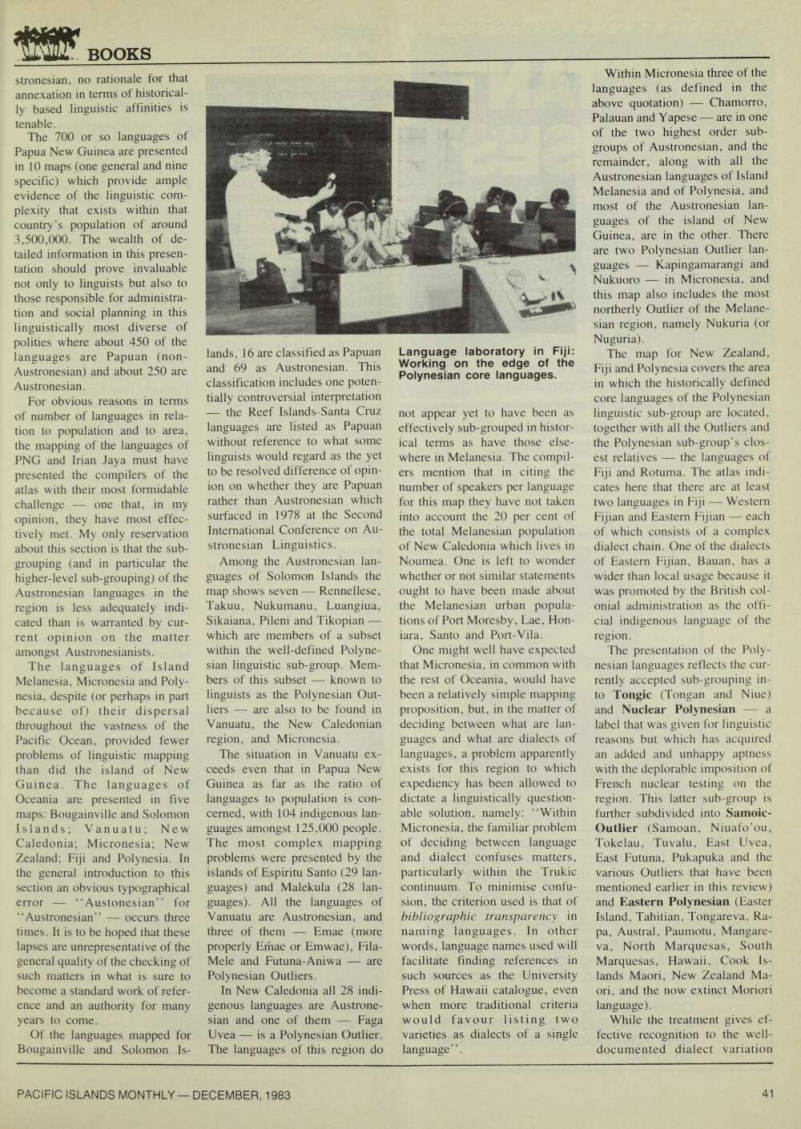
Language laboratory in Fiji: Working on the edge of the Polynesian core languages.
within the Paumotu (Tuamotuan) language, it does not do so for the dialects of Cook Islands Ma ori. The fact that several Polyne sian speech communities, not ably Niue (70 per cent), Samoan (12 per cent), Tokelau (65 per cent) and Cook Islands Maori (50 per cent) have signficant propor tions of their membership resi dent in New Zealand is recog nised in the notes accompanying the map, as are the facts that 12 per cent of Samoan speakers are resident in the U.S.A. and 50 per cent of the speakers of East Uvean and East Futunan are resi dent in New Caledonia. It is also noted that “Hawaii and (New Zealand) Maori are waning lan guage communities whose mem bers increasingly use English”.
The maps for Australia (the island, not the political unit) and Tasmania differ from those in the rest of the atlas in one saddening respect which reflects the nature and the extent of the European (predominantly Anglo-Celtic un til recently) impact upon Abori ginal Australia, as the following quotations from the atlas make all too apparent: “The maps cov ering Australia and Tasmania show the language situation as it appears to have existed at the time of the first European settle ment at the end of the eighteenth century”; “Many of the lan guages shown on the maps are now extinct and are poorly to very poorly documented, many others are on the verge of extinc tion”; and: “The only regions in which aboriginal languages are still in daily use today are much of Arnhem Land and the Kimber ley s, parts of Cape York Penin sula, some parts of the Carpen taria area, parts of central Aust ralia, some of the remaining por tions of north Australia, much of north-western Australia, and parts of western Australia, as well as a few pockets further south”. One can only hope that those Australian Aboriginal lan guages which have survived thus far will be given the opportunity to persist. Because of the great time depth associated with Aboriginal languages up to 40,000-50,000 years as com pared with up to 6000-8000 years for Austronesian and Indo- European languages the his torically oriented classification
of the Australian languages pre sents peculiar problems, of which the compilers of the atlas have demonstrated their awareness.
The last map in the atlas deals with pidgin and creole languages and with “lingue franche” (perhaps a rather pedantic plural form) in Oceania and Australia.
A pidgin is a mixed language, initially limited in scope but al ways potentially expandable, which is not the first language of its speakers; a creole is a pidgin which has become the first lan guage of its speakers; a lingua franca (plural langue franche, or lingua francas?) is a language which is used to communicate across a significant number of language boundaries. A lingua franca may be a natural language (i.e. a language other than a pidgin or a creole) or a pidgin language or a creole language examples of each of these func tioning as lingua francas are to be found in the Pacific region. The sheer number (well over 100) of pidgins, creoles and lingua fran cas which have been documented as extant, or as having existed in the recent past, in Oceania and Australia may well come as a surprise to many readers of the atlas. Some of the pidgins are /were based on non-Pacific lan guages and some on languages indigenous to the region. Simi larly, some of the lingua francas are/were non-Pacific in origin and some are/were indigenous to the region. When one considers the social and political import ance of some of the extant pid gin-creole languages in this part of the world, e.g. Tok Pisin in PNG and Bislama in Vanuatu, the value of the service done by the inclusion of this map in the atlas becomes apparent, since it can only lead to a more informed perspective on such languages.
The full significance of this excellent publication becomes apparent when one considers its potential value not only to a wide range of scholars and researchers who are concerned with the Pacific region, and to people in government, administration and the media, but also to the general public both within the region and beyond it. I look forward eagerly to the appearance of Part II of the atlas. David Walsh.