People
pp. 33-37 · Read in the full issue



Fiji’s roving ambassador. Major Jack Takala, has been appoint ed as his country’s new perma nent secretary for foreign affairs and tourism, and will retain his position as roving ambassador to the Pacific Forum countries.
Major Takala takes over his new position from Filipe Bole, who has been appointed director of the Hawaii-based Pacific Is lands Development Program (PIM Nov p4O).
The President of Kiribati, leremia Tabai, has been install ed as chancellor of the University of the South Pacific.
The installation ceremony was performed by USP Pro- Chancellor Mosese Qionibaravi.
Speaking at the ceremony Mr Tabai said the university was playing an important role in the development of South Pacific countries. USP graduates were helping many countries in the region to move towards their goal of economic independence.
The Tongan Government in Oc tober told an entrant in the Miss World beauty contest in London that she could not describe her self as “Miss Tonga.”
Eighteen-year-old school teacher Resetta Moa Johanson was told of the decision at Nukualofa’s Fuaamotu Airport just before her departure for London.
Miss Johanson is the first Ton gan entrant in the Miss World contest, but her sponsor the Vavau Tourist Association nominated her without first con sulting the government.
She is the winner of both the national Heilala beauty and danc ing titles, and was authorised to enter the Miss World contest as “Miss Heilala of Tonga.”
John Howard, first manager of the Central Bank of Vanuatu, has returned to Britain after three years. He was seconded from the Bank of England to help estab lish the Vanuatu bank. His suc cessor is Patrick Noel, deputy to Mr Howard and formerly, for 28 years, with the Banque de France.
Pakistan’s Ambassador to Aust ralia, Mr Wajahat Husain, has
visited Western Samoa to present his credentials to Head of State His Highness Malietoa Tanumafili II as Pakistan’s first ambassador to Western Samoa.
Robert David Ciandella, for mer directing attorney for the Micronesian Legal Services in Ponape and Kosrae, has been sworn in as attorney-general for the state of Kosrae, a post which has been open for more than two years.
Aumua loane, former minister of finance in Western Samoa, has been appointed Western Samoa’s High commissioner in New Zealand, succeeding Feesago S. Fepuleai, who has held the post for three years. As a
cost-cutting operation, the gov
ernment will recall its consul general in Auckland, Vaimasanuu Niko, and combine the post of consul with that of consul for immigration held by Magele Eti Stehlin.
The last week in October saw Tonga’s King Taufa’ahau Tupou IV and Queen Halevaiu Mata'aho visiting Britain at the invitation of Prime Minister Margaret Thatcher.
The royal couple were re ceived at Buckingham Palace by
Queen Elizabeth 11, and had talks with Mrs Thatcher.
It was the first state visit to Britain by a Tongan monarch. (Queen Salote’s famous 1953 visit to London was as an invited guest at the wedding of the then Princess Elizabeth and Prince Philip, Duke of Edinburgh).
Jody K. Olsen is U .S. Peace Corps director for a fair swathe of the world: North Africa, Near East, Asia and the Pacific, these representing a Peace Corps region.
In the Pacific, there are 55 Peace Corps volunteers in West ern Samoa, five in the Cook Islands, about 120 in Fiji, 50 in Tonga, 10 in Tuvalu, 50 in the Solomons, 10 in Kiribati, and 30 in Papua New Guinea. Mic ronesia has one of the largest programs, with 110 volunteers.
About 40 per cent of volun teers work as teachers, with the remainder in a great variety of projects health, nutrition, nut rition education, crop research, pest control, water, sanitation.
Says Jody Olsen: “WeTe also involved in secondary projects, individual projects, and co operatives. We try to look around to see what the country itself is interested in, what the government wants us to do.”
Increasing numbers of Peace Corps volunteers are retired peo ple, and many of them are among the more successful volunteers.
“They bring experience, and in many of these cultures the fact of their age alone commands respect,” says Olsen. “Given their experience they tend not to find their volunteer work frus
trating. They do a lot for younger volunteers in helping them to build up their patience.”
Great attention is given to the pre-service training of volun teers, as it is hoped they will serve for two years. Training programs run for 10-12 weeks, and heavy emphasis is given to questions of culture adaptation, and cross-cultural experience.
The program often involves liv ing with a family or in a small village so that volunteers will learn as much as possible about the family and the culture with which they will be involved. By the time they are ready to begin service they usually feel fairly comfortable in a culture very different from the one they have left behind.
Jody Olsen went on: “We also work very hard on the language so that each volunteer is not uncomfortable at the end of five weeks, and at least is understand ing the basics of the language.
This way they get into the culture that much more quickly.”
The volunteers are given a living allowance, usually about the equivalent of what a local
teacher would be earning. The aim is to have the volunteers live on the local economy. “If you have a lot of money you tend to separate yourself, which defeats the whole purpose of the
operation.
“The work is not for all the volunteers. About 12 per cent leave before the end of their two years.”
Retention rates tend to even out over the different Peace Corps regions. North Africa and the Near East seem to be a little more difficult for many volun teers than Asia and the Pacific.
“The Pacific offers so many op-
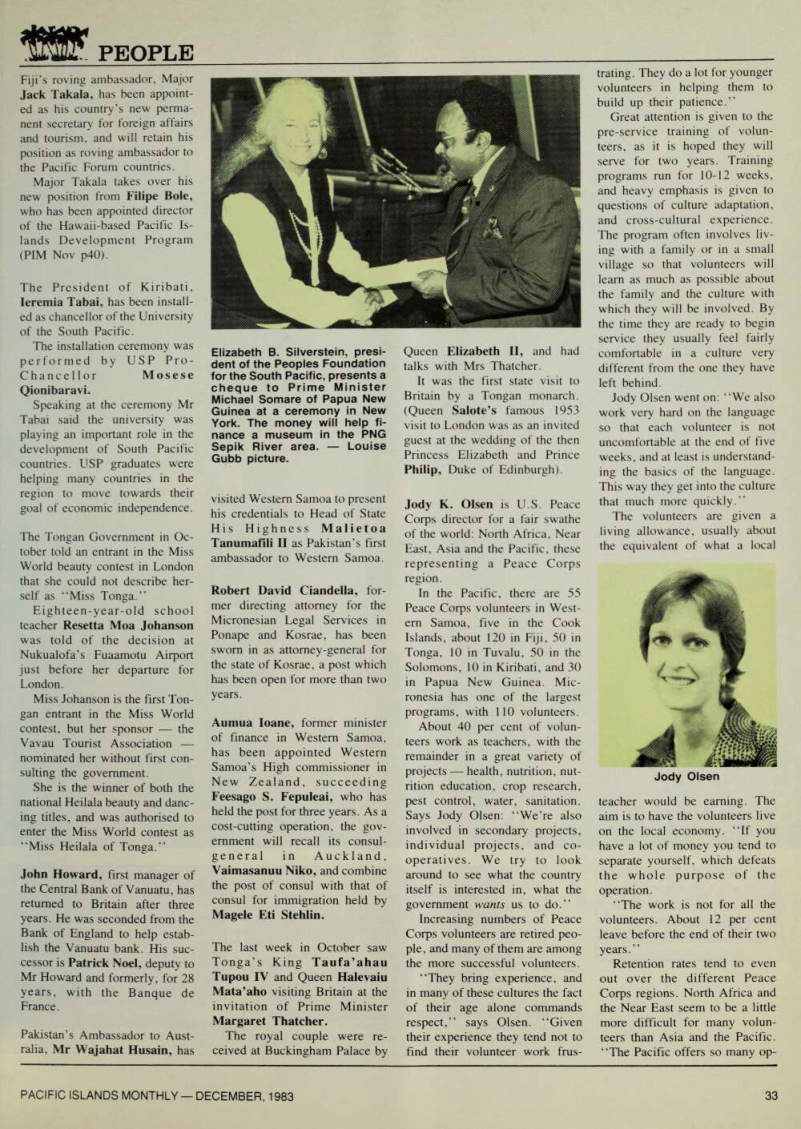
Elizabeth B. Silverstein, presi dent of the Peoples Foundation for the South Pacific, presents a cheque to Prime Minister Michael Somare of Papua New Guinea at a ceremony in New York. The money will help fi nance a museum in the PNG Sepik River area. Louise Gubb picture.
Jody Olsen
portunities and such a good ex perience for volunteers they usu ally feel comfortable quite quickly.”
It has become quite common throughout the world for volun teers to spend their two years, and then decide that they want to spend more time in the countries they have worked in. About 10 per cent either come back for a lengthy stay or never leave. “In this respect the Pacific is no different than any part of the world,” according to Jody Olsen. “At the East-West Center in Hawaii some of the staff were Peace Corps volunteers in Pacific Island countries, and have turned their work into dissertations and lifetime research.”
The Peace Corps program has always been popular, and is par ticularly so at present. There is a tight screening process, and only about one in 10 applicants actual ly become volunteers. “We would like to be able to provide more opportunities. But at the same time it is important that the people who go overseas are the best prepared,” Jody Olsen says.
The Peace Corps has a policy of seeking to work its volunteers out of jobs. “As much as poss ible we want to have counterparts in programs, and to be giving training so that in a two, three, or five years time frame we can see other people taking over our jobs.” Volunteer morale has been found to be not as high “if they feel they are not working in an area needed by the people”.
Jody Olsen in her talks with Peace Corps volunteers in Tonga realised how much they ap preciated working with volun teers from other countries.
“Most of them are outside the United States for the first time, and have never had close contact with people of another nationali ty. Many volunteers grow up
very quickly.
“We sometimes have prob lems with volunteers returning to the United States and having reverse cultural shock, because they have become so involved in working with the language and the people that they go home and bring back ‘the Tongan way’, much to the surprise of their friends.”
Many returning Peace Corps volunteers find that their expert-
ences make them sought after in the job market. The U.S. AID Program now employs 500 for mer Peace Corps volunteers, and the State Department also has former volunteers on its staff.
“We see Peace Corps very much as a training ground for interna tional organisations,” Jody Olsen says.
Jody Olsen was a Peace Corps volunteer herself, working in Tunisia in the late 19605. “Even though it is a difficult part of the world, I have a real soft spot for North Africa. I taught English, and they were the best years of my life. It’s amazing how ‘your country’ becomes the best coun try in the world. Volunteers in each country can’t imagine them selves being anyplace else. In the Peace Corps, we have 62 favorite countries.” W. G. Coppell.
Ron Malcolm has been ap pointed Norfolk Island’s chief administrative officer, the Aust ralian-run island’s top public ser vice position.
An Australian-born accoun tant, Mr Malcolm has spent the past several years in Papua New Guinea working on the organisa
tion of government services in Port Moresby and surrounding areas.
A Radio Australia correspon dent on Norfolk Island reports that Mr Malcolm is credited with rescuing the Port Moresby City Council from near-bankruptcy following the suspension of the 27 elected councillors in 1980.
The PNG Government ap pointed Mr Malcolm in their place.
Aggie Grey of Western Samoa, the South Pacific’s hotelierere * extraordinaire, has been present ed with the Queen’s Service Or der for Community Service which she was awarded in this year’s Queen’s Birthday Honors (PIM Sep. p4l).
The presentation was made in Apia by New Zealand High Commissioner Michael Mans field on October 31, Mrs Grey’s 86th birthday.
The month of December will be marked by the presentation of three honorary doctorates by the University of the South Pacific.
Those honored will be: Dr James Maraj, a former vice chancellor of the USP, in recog nition of his outstanding service to higher education and regional development; Dr Mahe Tupouniua, director of the South Pacific Bureau for Economic Co-operation, for his services to the region in his pre sent position, and in a number of earlier leadership roles; and the Rev John Garrett, in recogni
tion of his academic contribution to knowledge of the religious history of the Pacific islands, a subject on which he has written four books.
Two port officials from Papua New Guinea and Fiji have been awarded scholarships for further training with Auckland, New Zealand, harbor authorities.
The two are Logea Dura, act ing port manager at Madang, PNG, and Herbert Hazelmand, wharf manager at Lautoka, Fiji.
The five-weeks scholarship covers instruction in port opera tions, administration, and the planning and unloading of cargo.
The two are the first to receive the scholarships through the Un ited Nations Economic and So cial Commission for Asia and the Pacific (ESCAP).
The Chancellor of the Papua New Guinea University of Tech nology, Dr Alkan Tololo who is also PNG High Commissioner to Australia has announced the appointment of Moseley Moramoro as the university’s new vice-chancellor.
Born near Kokopo in East New Britain, Mr Moramoro read accountancy and business studies at the PNG University of Tech nology, and became one of the first three teaching fellows in the university’s accountancy and business studies department.
In 1978 he was invited by the Federation of Savings and Loan Societies Ltd. to be their person nel and training manager, a post in which he remained until June 1980 when he returned to the university as deputy vice chancellor.
He has a long association with the PNG Institute of Manage ment, and with its counterpart bodies in the United Kingdom.
He has a long-standing and active involvement with the YM
Ca In Png.
Dr Tetaua Taitai, principal medical officer (curative) in the Kiribati Ministry of Health, has just completed a course for ad ministrators of family health and family planning at the Johns Hopkins Program for Interna tional Education in Gynecology and Obstetrics in Baltimore, Maryland, USA.
The Australian Development Assistance Bureau financed a course in November for the specialised training of customs officers from 15 Pacific Island, Asian and African countries.
Shown at the course in Canber ra (from left) are Simon Lako, PNG: Simon Kaitara, Kiribati; the director of studies, lan Ross; Muni Reddy, Fiji. Nor man Plant for AIS.