A brewery founded where
pp. 45-46 · Read in the full issue
30Th Anniversary Of
South Pacific Brewery
A brewery founded where none was before
South Pacific Brewery: The First Thirty Years. By James Sinclair. Published 1983 by Robert Brown and Associates, Bathurst, NSW, Australia. Hard cover with extensive illustra tions, some in color.
ISBN 0 909197 36 9. Price not quoted.
The late Joe Bourke was one of the most original of the many characters who have adorned the Papua New Guinea scene over the years.
In his time he was a World War I gunner, a plantation over seer, a policeman on the Wau- Bulolo goldfields, a miner there, an explorer/prospector with the Ward William expedition to the Fly and Sepik headwaters in 1935-37, a member of the New Guinea Volunteer Rifles, and a skipper of U.S. small ships in World War 11.
In late 1948 he opened the Kaindi Hotel at Wau, and I had many a noggin in this comfort able little pub in days gone by.
Troubled by difficulties in ob taining supplies of Australian bottled beer in the immediate postwar years with beer droughts raging in Sydney and Melbourne and inspired by a coincidental opportunity to make a cheap purchase of 3000 stainless stell barrels, he conceived the idea of starting
a brewery in New Guinea. (How he acquired land for the brewery site, and in the process outwitted the redoubtable Eddie Frame, the then boss of Bums Philp, has
passed into legend . . .)
According to James Sinclair, the well-known former kiap and prolific writer on PNG this is the 13th book he has had publish ed in the last 17 years Joe’s beer supply problems, and the acquisition of the barrels, repre-
sent the genesis of South Pacific Brewery Limited, an enterprise whose history Sinclair relates in this handsomely produced volume.
Sinclair writes simple and ef fective prose. He is a thorough researcher, and has a rare capaci ty to evoke the “feel” of Papua New Guinea and its people, both indigenous and expatriate.
In this work his blending of the detail of the story of a very successful commercial undertak ing with the rich and varied assortment of personalities and events accompanying the SP Brewery’s first 30 years, creates a valuable historical and
sociological document, which is also highly enjoyable reading.
Apart from these central as pects of the book it treats several other themes meriting the close attention of all who claim a seri ous interest in the fortunes of PNG and its people.
One of these concerns the high standard of social and commer cial responsibility displayed by the brewery throughout its exist ence. This is in marked in deed dramatic contrast to the policies of some other commer cial enterprises whose profitable operations stemmed largely from PNG sources.
The brewery’s achievement in these respects may be sum marised briefly by recalling that at the beginning the only indi genous people employed by it were laborers, a few drivers, the odd handyman, some messenger boys, and no local women.
By 1982, a number of very senior and challenging positions in the technical, administrative, secretarial and distribution areas of the company’s operations were held by indigenous men and women, most of them trained by the brewery.
David Simon Nelson’s rise to be the present company secretary shows what can be done when a company, operating in a post colonial situation, faces its prob-
Below: Joe Bourke, policeman, gold prospector, explorer, businessman and hotel-owner.
Below right: Beer distribution in pre-SP days, one of the histor ical pictures from the book.
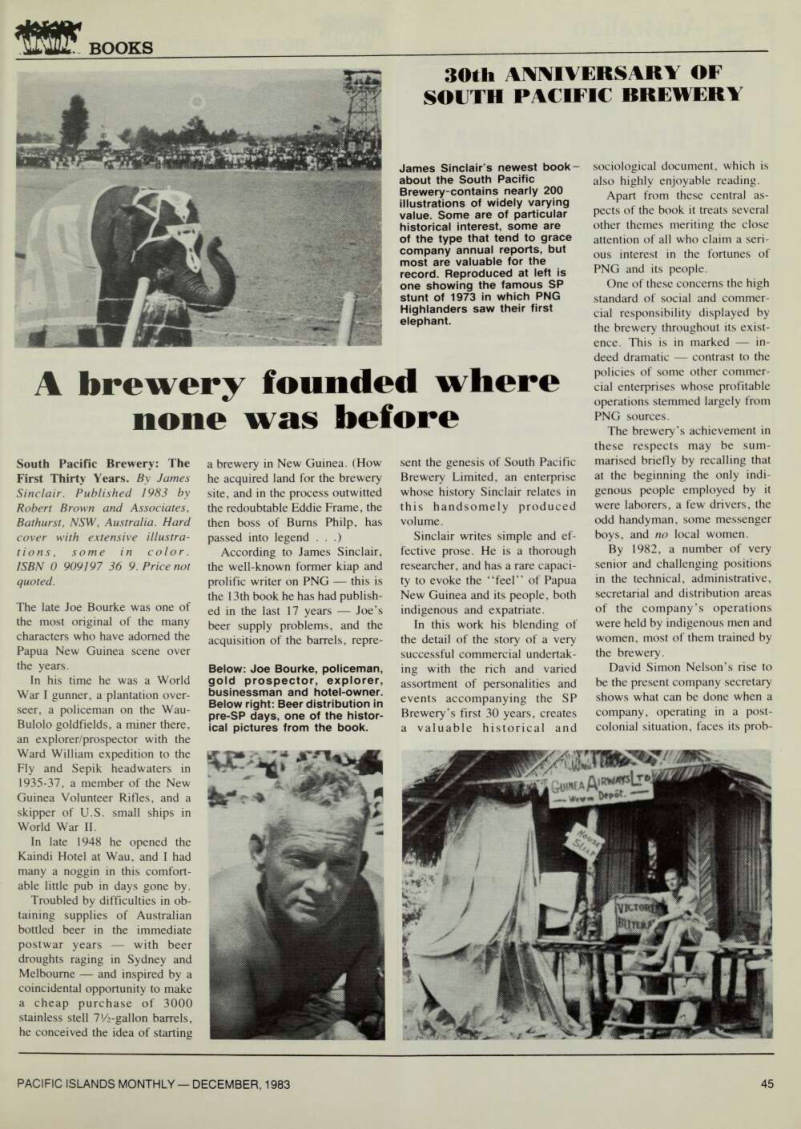
James Sinclair’s newest book about the South Pacific Brewery-contains nearly 200 illustrations of widely varying value. Some are of particular historical interest, some are of the type that tend to grace company annual reports, but most are valuable for the record. Reproduced at left is one showing the famous SP stunt of 1973 in which PNG Highlanders saw their first elephant.
lems with imagination and courage.
The late Bill Johns, general manager from 1957 to 1973; Bruce Flynn, who has been gen eral manager since John’s retire ment and Jim Cromie, chairman of directors from 1956 to 1980, all deserve high praise for their part in planning and implement ing this approach.
A second important theme of Sinclair’s work treats the subject of the opposition to the lifting of the prohibition laws which pre vented local people from drink
ing alcohol.
When the brewery was launch ed in 1952, there was already a growing public realisation that this ban, however well inten tioned, would have to be lifted.
Apart from the savage penalties prevailing I recall the shame I felt as I watched an outstanding Tolai medical practitioner swing ing a sarif (a sharpened length of hoop iron used for cutting grass) in Rabaul’s Queen Elizabeth Park, with his hair cropped and wearing a laplap with broad ar rows, as he served his six months sentence for drinking beer the overwhelming major ity of the local people, not all of whom were drinkers, saw the ban as just another form of racial discrimination against them.
It is not generally appreciated, for example, that it was the com bined Missions conference in 1961 which passed the resolution “marking the decisive turning point in the move to abolish prohibition”, as Sinclair puts it.
When “D” day dawned on November 3, 1962, the SP Brew ery received a bonus in the form of a greatly increased market potential. Joe Bourke, for all his fertile imagination, would never have dreamed of it when he was planning his local brewery back in 1948. As it happened, Joe and his wife Billie “went finish” only a few weeks before the great change.
No business enterprise could afford to ignore the new market now available. But it is a fact that the brewery showed great re straint, particularly in framing its various advertising campaigns which, in my recollection, made no specific effort to cultivate the indigenous market.
A further important theme
flows directly from the last: how has the drinking of alcohol af fected life in PNG since the legislation was introduced?
Financially, the liquor indus try, and the SP Brewery in par ticular, has provided an impor tant source of revenue for the government, and a wide variety of jobs for many people, both directly and indirectly. In the period 1972-81, excise on liquor amounted to the equivalent of $A130 million. In the same period the brewery paid company tax of about $6 million.
In terms of social effects, however, the picture is more depressing. The PNG Institute of Applied Social and Economic Research, in a report dated Oc tober 15, 1981, concluded: “PNG is presently poised on the brink of serious social and health problems related to alcohol ab use”. There can be no doubt that
over-indulgence in drinking has
contributed to the increase in serious crime, growing neglect of family and group obligations, and a deterioration in the health of those who habitually drink to excess.
It would be unjust and un reasonable to saddle the brewery with responsibility for this sad state of affairs. However, the book shows that the brewery is aware of the problem, and is co operating fully with all agencies — government and non government — seeking to al leviate the problem.
The publishers, Robert Brown & Associates of Bathurst, NSW, Australia, merit a brief mention.
Before this book appeared I must confess they were unknown to me. But just as SP Beer is justifi ably described as “a bloody good beer”, the manner of pro duction of this book justifies the description ‘‘a bloody good book”.
I can detect only two very minor blemishes: in the index Tom Ellis is listed as being men tioned on p 62 when it should be p 102, and, in the text, Lloyd Hurrell is described as winning the Military Medal when it should have been the Military Cross. And I think he won the decoration later than 1942, as stated, but I cannot be quite sure
of this.
— Max Or ken.