first year
pp. 19-21 · Read in the full issue

Tofilau Eti’s first year
When he took command about a year ago, Western Samoa’s Prime Minister Tofilau Eti Alesana was seen as a dedicated man, who insisted he would “put the house in order.” He had dignity, and looked like a man of great wisdom. An MP since in dependence in 1962, and with a record of service under two prime ministers until the estab lishment of party politics in 1979 which saw him emerge as one of the leaders of the Human Rights Protection Party (HRPP) Tofilau, many were saying, was just the man to steer the country away from balance of payments problems and indebtedness.
But becoming PM was not all that easy for Tofilau. He moved from the position of deputy lead er of the HRPP to leader when the party’s former chief, Vaai Kolone, lost his seat in an elec tion petition. Vaai was later re elected to parliament, but by that
time Tofilau had the leader’s job.
At the time Tofilau got to the top in the HRPP, Tupuola Efi, the former PM, although beaten, had still not gone under, and still held the post of Prime Minister.
He was fighting to delay a vote on the Prime Ministership until Vaai was returned to parliament (as everyone knew he would be).
But Tofilau would have none of it. He badly wanted to be PM.
His attitude at that time is now returning to haunt him. He is being seen as having made it to the top as Vaai’s deputy, and on the strenght of the HRPP.
That strength is now in de cline. The party is in the process of splitting into two, one headed by Tofilau, the other by Vaai.
Symptomatic of this develop ment is the fact that HRPP caucus meetings, which used to be held at Vaai’s residence even after Tofilau became PM have now been moved to To filau’s home. More than a year
before general elections are due in early 1985, the Tofilau gov ernment is showing visible signs of panic.
On top of the inner-party prob lems, there is fairly widespread public questioning of the wisdom of Tofilau which, it was hoped, would enable him to solve the country’s economic problems.
Business people are accusing the government of allowing itself to be strong-armed by the Interna tional Monetary Fund (IMF). It was the IMF, early in the year, which advised the government to impose austere economic mea sures if it wanted the IMF to continue giving assistance.
Those tough measures, which included a public service wage freeze throughout 1983, higher import duties, limitation of im ports, discouragement of bor rowing, higher fuel and electrici ty charges, and so on, are still being sorely felt.
The government’s promise that things would be better by the year’s end has yet to be delivered on. For the majority of the peo ple who rallied behind the gov ernment in the beginning, and went out of their way to ensure that the 7th South Pacific Games held here in September were a
success, Christmas promises to be distressingly bleak.
Meantime, in some other re spects, the government is behav ing in a reckless manner. Four months ago, it announced its intention of taking over the Un iversity of the South Pacific School of Agriculture, situated near Apia, for Western Samoa’s own national university. This proposal is creating a storm among member countries of the
Usp.
In October, the government officially opened the $lO million extension of the national Faleolo Airport without disclosing where the funds for the project would be coming from. It said that Australia would provide part of the funds, but when this report was written, Australia had made no commitment.
At that time, returning from New York where he delivered his maiden speech to the General Assembly of the United Nations, and where he also attended an IMF meeting, Tofilau said UN and IMF officials were delighted with the tough economic line the Western Samoan government
was following.
He said that the government’s overdraft had been much reduced
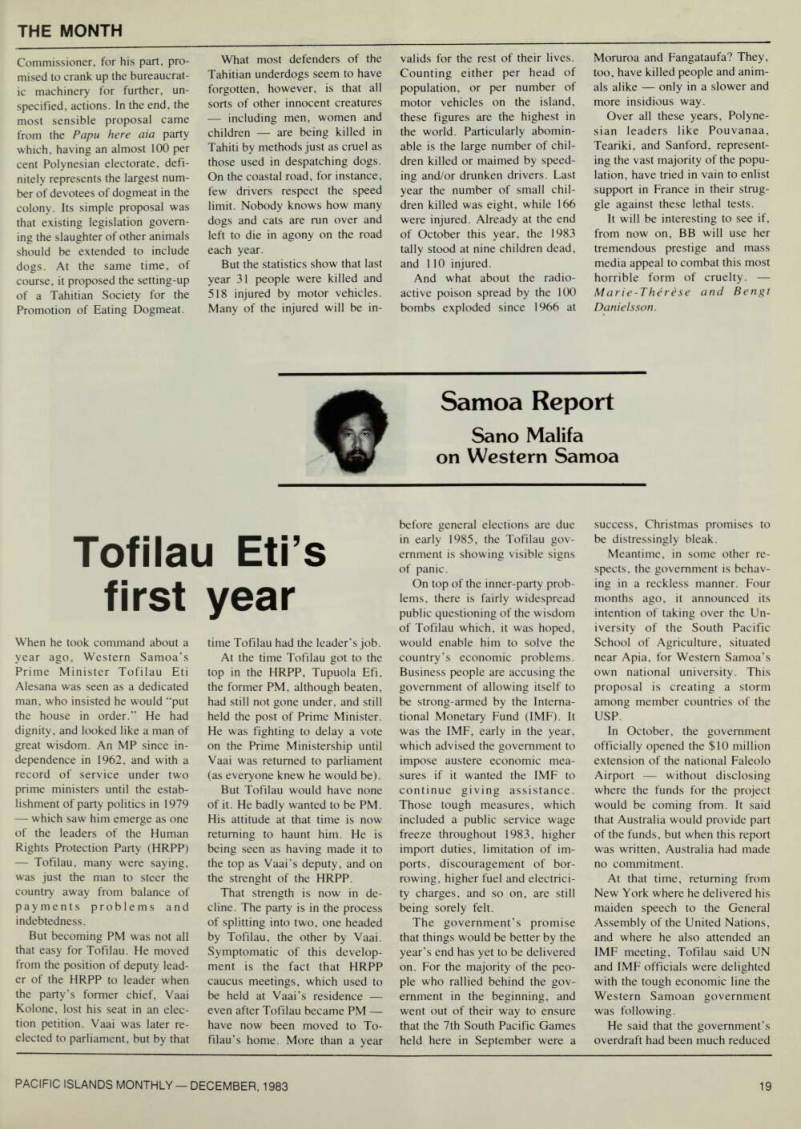
Samoa Report
Sano Malifa on Western Samoa
and the foreign exchange situa tion had vastly improved. But he failed to substantiate these claims
with figures.
However, one thing the gov ernment does not seem to be wary about is the spending of
foreign exchange. When Tofilau
took off on his junket to New York, he took with him his wife, three government officials, and three MPs, one of them a Cabinet Minister. An exposure of this by the local press, together with some details of the trip’s hefty expenses, drew an angry re sponse from senior government officials.
Early in the year, the govern ment announced the appointment of former MP, Aumua loane, to the post of high commissioner to New Zealand. Aumua, while he was a politician, was also mana ger of the government’s agricul tural corporation, the Western Samoa Trust Estates Corporation
(Wstec).
Following disclosure of finan cial mismanagement at WSTEC at that time, Aumua, resigned his office. He lost his seat in parlia ment in the last general elections.
and has since set up his own export and import business.
At present he has a grocery shop on the ground floor of the tallest building in Apia a six storey structure belonging to the Congregational Christian Church of Samoa. As about half of the
building materials required to
erect it were imported duty-free, space in it cannot be let for commercial use. Tofilau is chair mand of the general assembly of the church.
Aumua’s company, in which other senior government officials have interests, was recently granted a quarterly allocation of
$50,000 in foreign exchange.
Aumua’s wife is secretary of the Monetary Board which adminis
ters foreign exchange
allocations.
There have been other recent cases in which the government has been accused of favoritism.
For example, a strong supporter of the government who has an earth-moving business was pro-
vided with government machin ery to excavate sand from a government property and the sand was sold back to the gov ernment at a relatively high price.
Whether the Tofilau govem
ment will survive the next elec tions is anybody’s guess. What is clear is that it is trying very hard to impress the voters even if it is doing so in a reckless and rather panicky fashion. Sana Mai if a.
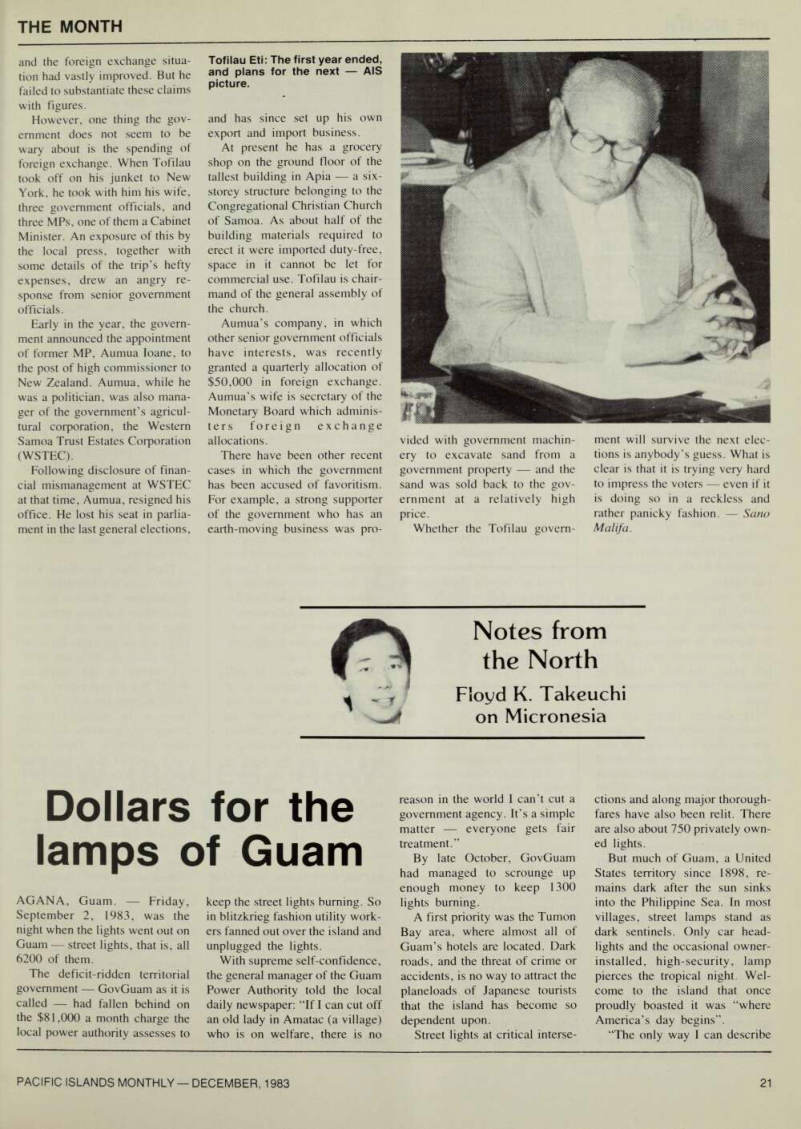
Tofilau Eti: The first year ended, and plans for the next AIS picture.