BB dogged in
pp. 15-19 · Read in the full issue



a canine cause
The old gag about a man biting a dog being newsworthy (as dis tinct from the reverse situation) seems to have had some weird sort of confirmation in Tahiti over recent weeks.
Indeed, practically the whole month of October appears to have been given over to debating the pros and cons of eating dogmeat.
It’s by no means a new debate, and, as usual when it comes to discussing old Polynesian cus toms, we do best to go back to Captain Cook. During his first stay in Tahiti in 1769 he made the following entry in his log book: “For tame animals they have hogs, fowls and dogs, the
latter of which we learned to eat from them, and few were there of us but who allowed that a South Sea dog was next to an English lamb, and one thing in their favor is that it lives entirely upon vegetables.” We should only add that dogs destined for the Tahitian earth ovens were invari ably strangled.
Captain Cook was a remark ably unprejudiced person, espe cially in culinary matters. He actually made a hobby of tasting all sorts of animals, from pen guins to kangaroos. On the other hand, the European missionaries, governors, and military men who came to Tahiti later on usually abhorred dogmeat. The few who
liked the stuff did so because they were never told what they had eaten.
On the other hand, the thousands of Chinese who settled
in Tahiti brought with them from their homeland a pronounced taste for tender puppies, cooked and seasoned in the inimitable Chinese manner.
Caught between these two conflicting attitudes, the Tahi tians at first tried to hide their traditional preference for baked dog. Then, as they became in creasingly urbanised over recent decades, they gave up the custom altogether. Today, the only in habitants of French Polynesia who regularly eat dogmeat are to be found in the Tuamotu Islands, for the simple reason that no other animals can be raised on these barren atolls. Most Tuamo tuan dogs, by the way, can fend for themselves by catching fish in the shallow waters on the outer reef platforms.
For a long time the problem remained a purely culinary one; some liked, others disliked, dogmeat.
Brigitte Bardot, world-famous film actress, is no stranger to the French Pacific and this picture shows her in coconut country during one of her visits. Now it seems she has developed a campaign which stretches from France to Tahiti to prevent cruelty to animals. As Marie-Therese and Bengt Danielsson describe below, this sort of campaign is not always as simple as it
might seem. - VIP picture.
Postmark Papeete Marie-Therese and Bengt Danielsson
But all this changed a few months back when Brigitte Bar dot, famous French movie star and sex goddess, began attacking the problem from a completely new angle. She has for years been a vigorous and outspoken protector of animals, especially dogs and baby seals, and if her campaigns have enjoyed consid erable success it is largely due to the strong support given to the still very popular star by the mass media.
BB as the French media are fond of calling her listened with great compassion when the president of the Tahitian Society for the Protection of Animals, a group made up of a few expat riate Frenchmen, called on her in August at her home in Saint Tropez, France, and described in hair-raising terms the pitiless slaughter of dogs which is still going on in this overseas territory of France.
Outraged, BB immediately shot off an angry letter to the French High Commissioner in Papeete not forgetting to sup ply the local press with copies.
In the letter her fiercest protest was directed against the exist ence in this earthy paradise, moulded by the presence of French civilisation, of “illegal dog butcheries supplying meat for the highly sophisticated dishes served in Chinese restaur ants”. If this abominable practice was not stopped forthwith, BB threatened to create a scandal that would reverberate around the world.
The letter caused only a mod erate stir. It didn’t seem that BB was saying much more than that it is highly uncivilised to eat dogmeat. This is exactly what French missionaries and officials have been saying for generations and with very small success.
And, to be frank, how can we Europeans justify a prohibition on the eating of dogmeat on cultural, moral and religious grounds, while we ourselves cheerfully continue to eat cows, sheep, horses and frogs? The only sustainable position would be for us all to become vegetarians.
It is this argument, of course, that the High Commissioner should have used in replying to BB at the same time inviting
the famous lady to spend a cou ple of weeks in the islands to see for herself that her accusations were groundless. The visit would have been covered by a small army of journalists and photo graphers, giving the tourist in dustry a windfall of valuable free publicity.
Unfortunately, however, the High Commissioner never got around to replying to the letter at all. In consequence of this, the irate star who has never had to beg to be taken notice of began to put her threat into effect.
First, she wrote another, even angrier letter to the mass circula tion French weekly Paris-Match, which specialises in the woes and the wonders in the lives of film stars and royal persons. Next she graciously consented to be inter viewed on French TV. This time she concentrated particularly on the barbarous methods used in killing dogs destined for Tahitian tables: they were either drowned, hanged, beaten to death, or cut to pieces while still alive. To prove her point, she produced horror pictures of Polynesians butcher ing dogs for their Chinese cus tomers. Her punchline was terrif ic; as the French High Commis sioner was unable or unwilling to put a stop to this cruelty, BB herself would organise a worldwide tourist boycott of Tahiti.
The local travel industry re
sponded by telling BB she was barking up the wrong tree: why penalise the tourist industry, which had no responsibility whatever in the matter? Such a boycott would mean thousands of Tahitians losing their jobs, and the image of Tahiti would be tarnished for years.
In the ensuing storm of pro tests from a long list of com panies, associations, trade un ions, and private citizens, one voice was conspicuous by its absence. That was the voice of the Chinese community which, after all, was being branded as the prime culprit by both the local SPA and 88. When finally pushed up against a wall by a reporter, the territorial assembly man representing the Chinese electorate offered some extreme ly tortuous explanations which only succeeded in indicating that he was dog tired of the whole affair . . .
BB’s case was weakened somewhat when local newspap ers desclosed that the president of the SPA had mainly enlisted her help in order to boost his efforts to blackmail the territorial government into giving him a CFPI million subsidy to be used on feeding the large num bers of stray dogs crowded into the SPA’s pound.
This disclosure prompted do zens of people to write to the newspapers pointing out that the real problem is that there are too
many dogs in Tahiti, especially strays. There are perhaps as many as 30,000 of them, roam ing the streets of Papeete and the countryside in search of food, and becoming savage and ag gressive when they fail to find any. Instead of collecting them and feeding them, many of the letter-writers argued, they should be put down.
At various times in the past that are well within our memory, this was in fact the policy fol lowed by the local authorities.
The method used to kill them, it must be said, was in the line of the methods denounced by BB; the poor creatures were hanged.
What brought an end to their problems at various times was not any campaign by the SPA, but the fact that the territory ran out of funds to support the spe cial police squad employed on the work.
In the present controversy, Vice-President Gaston Flosse was for once very happy to dis cover that only the French Gov ernment had the legal power to intervene effectively. The High
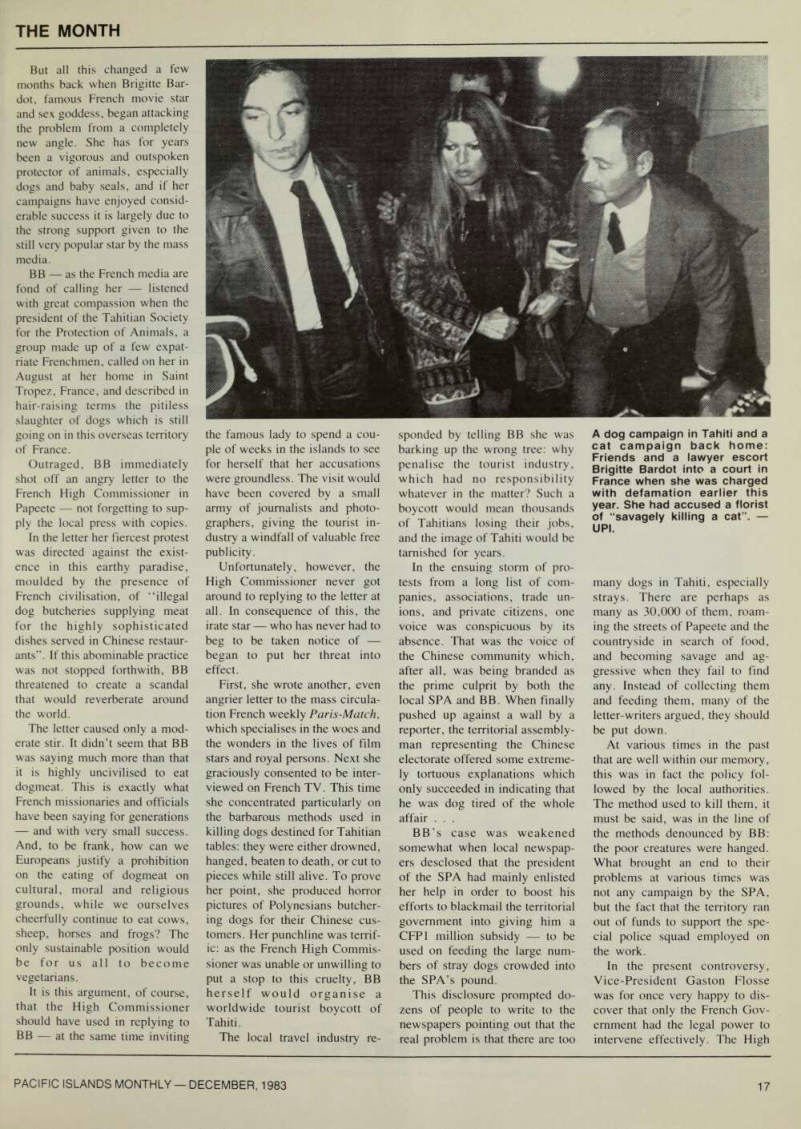
A dog campaign in Tahiti and a cat campaign back home: Friends and a lawyer escort Brigitte Bardot into a court in France when she was charged with defamation earlier this year. She had accused a florist of “savagely killing a cat”.
Upi.
Commissioner, for his part, pro mised to crank up the bureaucrat ic machinery for further, un specified, actions. In the end, the most sensible proposal came from the Papu here aia party which, having an almost 100 per cent Polynesian electorate, defi nitely represents the largest num ber of devotees of dogmeat in the colony. Its simple proposal was that existing legislation govern ing the slaughter of other animals should be extended to include dogs. At the same time, of course, it proposed the setting-up of a Tahitian Society for the Promotion of Eating Dogmeat.
What most defenders of the Tahitian underdogs seem to have forgotten, however, is that all sorts of other innocent creatures including men, women and children are being killed in Tahiti by methods just as cruel as those used in despatching dogs.
On the coastal road, for instance, few drivers respect the speed limit. Nobody knows how many dogs and cats are run over and left to die in agony on the road each year.
But the statistics show that last year 31 people were killed and 518 injured by motor vehicles.
Many of the injured will be in
valids for the rest of their lives.
Counting either per head of population, or per number of motor vehicles on the island, these figures are the highest in the world. Particularly abomin able is the large number of chil dren killed or maimed by speed ing and/or drunken drivers. Last year the number of small chil dren killed was eight, while 166 were injured. Already at the end of October this year, the 1983 tally stood at nine children dead, and 110 injured.
And what about the radio active poison spread by the 100 bombs exploded since 1966 at
Moruroa and Fangataufa? They, too, have killed people and anim als alike only in a slower and more insidious way.
Over all these years, Polyne sian leaders like Pouvanaa, Teariki, and Sanford, represent ing the vast majority of the popu lation, have tried in vain to enlist support in France in their strug gle against these lethal tests.
It will be interesting to see if, from now on, BB will use her tremendous prestige and mass media appeal to combat this most horrible form of cruelty.
Marie-Therese and Bengt Danielsson.