Dollars for the lamps
pp. 21-23 · Read in the full issue
lamps of Guam
AGANA, Guam. Friday, September 2, 1983, was the night when the lights went out on Guam street lights, that is, all 6200 of them.
The deficit-ridden territorial government Gov Guam as it is called had fallen behind on the $Bl,OOO a month charge the local power authority assesses to
keep the street lights burning. So in blitzkrieg fashion utility work ers fanned out over the island and unplugged the lights.
With supreme self-confidence, the general manager of the Guam Power Authority told the local daily newspaper: “If I can cut off an old lady in Amatac (a village) who is on welfare, there is no
reason in the world I can’t cut a government agency. It’s a simple matter everyone gets fair treatment.”
By late October, Gov Guam had managed to scrounge up enough money to keep 1300
lights burning.
A first priority was the Turnon Bay area, where almost all of Guam’s hotels are located. Dark roads, and the threat of crime or accidents, is no way to attract the planeloads of Japanese tourists that the island has become so dependent upon.
Street lights at critical interse
ctions and along major thorough fares have also been relit. There are also about 750 privately own ed lights.
But much of Guam, a United States territory since 1898, re mains dark after the sun sinks into the Philippine Sea. In most villages, street lamps stand as dark sentinels. Only car head lights and the occasional owner installed, high-security, lamp pierces the tropical night. Wel come to the island that once proudly boasted it was “where America’s day begins”.
“The only way I can describe
Notes from the North Floyd K. Takeuchi on Micronesia
it is ‘incredible’,” That’s what Gerald S.A. Perez, one of Guam’s top business executives, thinks of the street light “crisis”.
However, it is more than dark roads that worries Perez, Duty Free Shoppers’ vice-president for retail operations on Guam. He believes the situation is symp tomatic of poorly managed gov ernment that has made it difficult for Guam’s businesses to expand as fast as they could. Duty Free, an international firm which man ages concessions at airports, is the island’s largest private em ployer, with about 400 workers.
“We pay our taxes and expect certain government services in return, and we don’t get them,”
Perez says. On top of that, he adds: “We continue unabated to have a bloated government that saps the vigor out of the private sector.”
Perez’s frustrations are shared by many.
The territory long ago de veloped an unhealthy dependen cy on the American federal dole to keep government functioning, and since, until recently, most workers were employed by Gov- Guam, its fiscal ills often proved contagious for the struggling pri vate sector.
The situation is changing, if slowly. By one estimate, there now are about the same number of workers in business as there are in government service. In a few years, the ratio should be more in the private sector’s favor.
On Guam, there are no municipal governments as such.
The governor is the only elected executive (save a figurehead lieutenant governor), and there is a unicameral legislature.
Perez says there has been a change in political attitude to wards business, perhaps reflect ing the fact that more people now have a stake in an improved business climate rather than sim ply being assured cushy govern ment jobs.
During the last election, for instance, Perez says more legis lative candidates were saying: “We’ve got to develop the pri vate sector. At least the rhetoric is now in the right direction”.
Despite such changes, there is still a strong tendency to look to Washington for nearly every
conceivable local need. One stark example: on an island that was in traditional times self sufficient in food, about 25 per cent of the 110,000 residents receive federal welfare food stamps.
Perez believes there are things Washington could do to help improve Guam’s business cli mate. They include changing the island’s status from foreign to domestic for U.S. trade pur poses, giving Guam more control
over airline services, and freeing the territory from federal minimum wage regulations. That last one would surely meet stiff opposition here, even if unions are not much of a force to con tend with.
But he is emphatic that Guam must become more self reliant: “I don’t think we ought to be con fusing (what Washington can do) with things that Guam could do
on its own.” Indeed, Perez, who once worked in government, looks askance at the territory’s overt dependency on federal aid.
“It’s one thing to ask for what you deserve,” Perez says of Washington assistance. “It’s something else to ask when you can’t even handle your own fis
cal integrity.”
Not surprisingly, Guam’s gov ernor takes a very different view.
On the subject of street lights, Ricardo Bordallo believes the is
sue has been blown “way, way out of proportion”. “We’re trying to get people to pay for those things that benefit them,” he says, suggesting that individuals may have to pay extra to get lights lit outside their homes.
Anyway, the governor be lieves some good has come out of the darkened streets. He says his public safety department has actually reported a drop in crime
since the lights went out.
Perhaps, Bordallo suggests, it is because more people are staying indoors at night.
On the subject of Guam’s business climate, Bordallo is even more upbeat. Pacing from his desk to a bookcase and back, he says with assurance that the business environment is “as posi tive as can be with the realities of facing life” on Guam. “It is the businessmen themselves who have to take the bull by the horns. They have to take the risks.”
Businessmen, the governor claims, “are very ignorant of how government works. It is shocking.”
Bordallo, a member of the Democratic Party, comes from a prominent Guamanian family.
He first moved into Government House in 1974. But after four years, Republican Paul Calvo swept the former Toyota dealer out of office. Last fall, Bordallo in his turn sent Calvo packing.
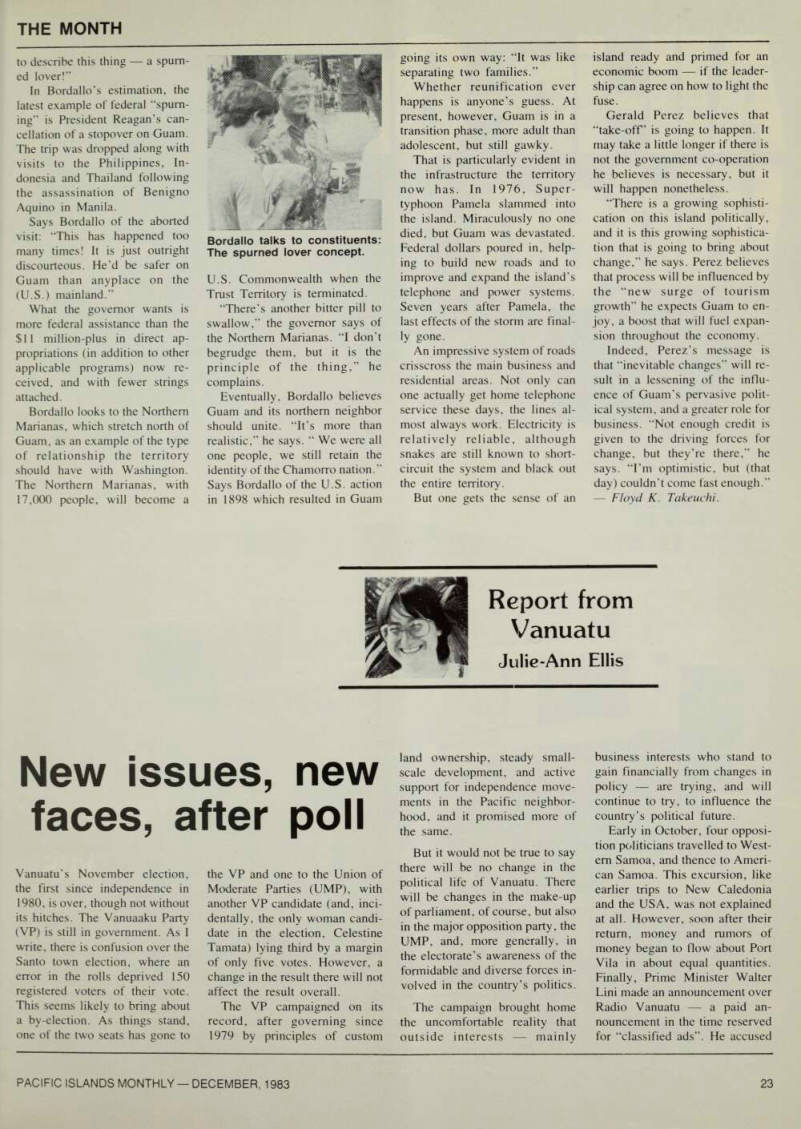
A handsome and intense man, “Ricky” Bordallo is best known for his visionary and philosophic thinking rather than administra tive acumen.
These days, he thinks a lot about Guam’s relationship with Washington. Bordallo believes the territory has been getting the short end of the stick for too long, and he says that the island is not going to take it any more.
Looking at the traumatic World War II experience, when Guam became the only U.S. ter ritory to be occupied by the enemy, the governor says with clear bitterness: “Japan, Ger many and all those half-baked allies got help (from the United States) after the Second World War.” Then, referring to the large tracts of land the American military claimed after recaptur ing Guam, Bordallo says; “We were people in our own country robbed of our own country.”
The island’s postwar history, which the governor believes has been marked by heavy-handed federal influence, has resulted in growing anti-Americanism. This despite the fact Guamanians are U.S. citizens.
“Yes, especially the young people,” he believes. “There is nothing worse than to give love and be spumed. That’s the way
to describe this thing a spum ed lover!”
In Bordallo’s estimation, the latest example of federal “spum ing” is President Reagan’s can cellation of a stopover on Guam.
The trip was dropped along with visits to the Philippines, In donesia and Thailand following the assassination of Benigno Aquino in Manila.
Says Bordallo of the aborted visit: “This has happened too many times! It is just outright discourteous. He’d be safer on Guam than anyplace on the (U.S.) mainland.”
What the governor wants is more federal assistance than the $ll million-plus in direct ap propriations (in addition to other applicable programs) now re ceived, and with fewer strings attached.
Bordallo looks to the Northern Marianas, which stretch north of Guam, as an example of the type of relationship the territory should have with Washington.
The Northern Marianas, with 17,000 people, will become a
U.S. Commonwealth when the Trust Territory is terminated.
“There’s another bitter pill to swallow,” the governor says of the Northern Marianas. “I don’t begrudge them, but it is the principle of the thing,” he complains.
Eventually, Bordallo believes Guam and its northern neighbor should unite. “It’s more than realistic,” he says. “ We were all one people, we still retain the identity of the Chamorro nation.”
Says Bordallo of the U.S. action in 1898 which resulted in Guam
going its own way: “It was like separating two families.”
Whether reunification ever happens is anyone’s guess. At present, however, Guam is in a transition phase, more adult than adolescent, but still gawky.
That is particularly evident in the infrastructure the territory now has. In 1976, Super typhoon Pamela slammed into the island. Miraculously no one died, but Guam was devastated.
Federal dollars poured in, help ing to build new roads and to improve and expand the island’s telephone and power systems.
Seven years after Pamela, the last effects of the storm are final ly gone.
An impressive system of roads crisscross the main business and residential areas. Not only can one actually get home telephone service these days, the lines al most always work. Electricity is relatively reliable, although snakes are still known to short circuit the system and black out the entire territory.
But one gets the sense of an
island ready and primed for an economic boom if the leader ship can agree on how to light the fuse.
Gerald Perez believes that “take-off’ is going to happen. It may take a little longer if there is not the government co-operation he believes is necessary, but it will happen nonetheless.
“There is a growing sophisti cation on this island politically, and it is this growing sophistica tion that is going to bring about change,” he says. Perez believes that process will be influenced by the “new surge of tourism growth” he expects Guam to en joy, a boost that will fuel expan sion throughout the economy.
Indeed, Perez’s message is that “inevitable changes” will re sult in a lessening of the influ ence of Guam’s pervasive polit ical system, and a greater role for business. “Not enough credit is given to the driving forces for change, but they’re there,” he says. “I’m optimistic, but (that day) couldn’t come fast enough.”
Floyd K. Takeuchi.
Bordallo talks to constituents: The spurned lover concept.