Male dominance alive and well
pp. 45-48 · Read in the full issue


well in the PNG Highlands
Inequality in New Guinea Highlands Societies. Edited by Andrew Strathem. Published by Cambridge University Press, Cambridge, UK, 1982. 190 pp.
Price K 22 hardback.
This is a little gem of a book, and a rare one. It should become a collectors’ item, and much re ferred to by anthropologists, economists, sociologists and others interested in diversity and change in Papua New Guinea societies. Andrew Strathem, the director of the Institute of Papua New Guinea Studies, formerly professor of anthropology at the University of Papua New Guinea and London University, is to be commended for assembling and
making available this collection.
There are two essays by Strathem, the first on the rele vance of African models in an thropological theory to PNG, and the second on the question: are rural Papua New Guineans tribesmen or peasants? We also have here three selections never published before, one by Maruice Godelier, the noted French Marxist anthropologist, on social hierarchies among the Baruya who are part of the Anga grouping in the Eastern High lands and Morobe; the second by Jack Golson, the Australian Na
tional University archeologist
who is famous for his work at Kuk in the Western Highlands, on the evolution of societies in
relation to the introduction of sweet potato (kaukau) in the highlands; and Nicholas Modjes ka’s long chapter, the most sig nificant in the volume, on pro duction and inequality.
Modjeska carried out research for his Ph.D. among the Duna in the Lake Kopiago area of the Southern Highlands between 1969 and 1979. The nine pages of footnotes that accompany his contribution are a tome in them
selves, requiring careful reading
and contemplation. In these foot notes are recorded comments and
criticism by Roger Kessing and
Andrew Strathem, with Modjes ka’s responses.
Modjeska explains in detail in his terse (and at times humorous)
account the relations of produc tion among the Duna. He de scribes wealthy men of power, men who can influence others with words, men who are follow ers who help other men of pow er, and women whose labor creates the basis of the power of
men, through producing kaukau,
raising pigs and participating in
and making possible exchanges
of pigs, shells and themselves which are of value to men.
Modjeska goes well beyond
his study of the Duna to compare and contrast them with studies by other anthropologists of other highlands societies to the west and east of the Duna. He sug
gests an ascending relationship
between the size of a linguistic group, population density, inten sity of subsistence cultivation, and the number of pigs per person.
No study of the means of production in traditional society can avoid considering in detail the relationship between men and women. In most of the New Guinea Highlands men have the authority to deal with the spirits, kill pigs, clear and fence gar dens, build homes, make fires, and fight enemies; women could not normally do these things.
Men were defined as indepen dent, women as dependent. But there was a rule of gerontocracy, the rule of senior men with attri butes of wealth and power who
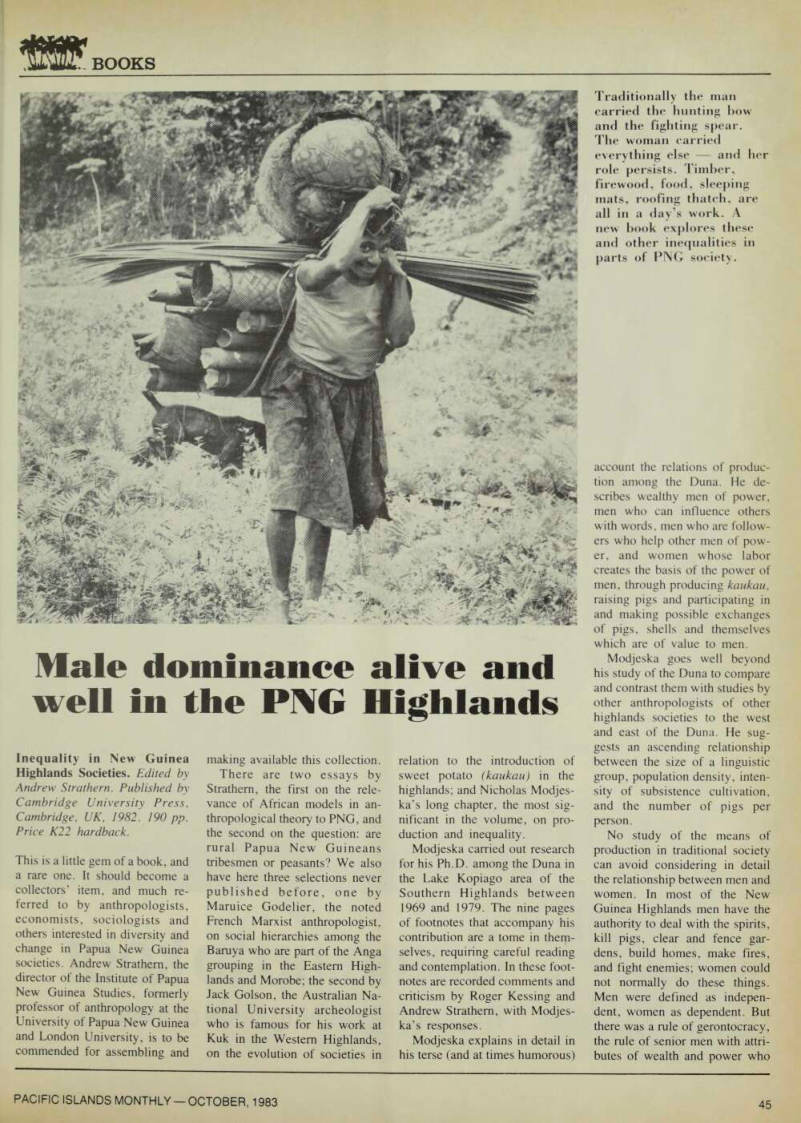
Traditionally the man carried the hunting how and the fighting spear.
The woman carried
everything else - and her
role persists. Timber, firewood, food, sleeping mats, roofing thatch, are all in a day’s work. A new book explores these and other inequalities in parts of PNG society.
have authority over junior men.
Bride wealth was controlled by elders, as was the obedience of juniors and the destiny of wo men. Men could appropriate the surplus; pigs were the creation of this surplus, a prestige item de stined to be consumed. Elders, by controlling the secrets of the rituals associated with exchange,
kept juniors and women in ignor
ance. By maintaining that wo men polluted men, men could manipulate women, and more easily appropriate their labor.
Modjeska explores in some detail variations in the produc tion of subsistence and pigs.
Contrary to the received truth that women do all the work, he demonstrates a division of labor where each sex is involved but at times in different activities (the men hunt, search for lost pigs, collect pandanus and spend more time on civic activities than the women). In his survey gardening and pigs took 44 per cent of the men’s time compared to 56 per cent of the women’s.
Modjeska goes on to show how “the quality of relationship between husband and wife, pa rents and child, and between brother and sister, must bear heavily on the success or other wise of the domestic enterprise’ ’, (p. 79). The productivity of gar dens and the number of pigs, is not related just to male leader ship, but to the number of labor
ers (parents, siblings, adolescent
children, friends and wives). The wealthy man is mobilising the labor of more than just his wife or wives, as the more labor, the more intensive the gardens, the more pigs can be reared. Modjes ka suggests that the change from shifting cultivation to the use of the same mounds for decades is the result of an increase in the number of pigs, not people.
Where women participate in and make possible the increase in the number of pigs they may still not have equal rights in the allo cation of pigs as the ways in which pigs are circulated are
determined by men. “Lineages are structures made and per petuated by the circulation of pigs under male control”, (p. 83). Among the Duna Mod jeska claims that women accept exchanges because they expect to receive as much in consumption as they gave up in exchange. But he notes that among other groups in the highlands the pigs women might have eaten are taken and changed into “inedible male prestige. . .”
In some societies where the exchanges seem to go against the women the men claim they ha ven’t really given the pigs away, but to the wives’ brothers. But the Duna do not have the recip rocal exchange in pigs found among the Melpa and Enga. The
productive systems Modjeska
draws examples from range from the low-range productive sys tems of Irian Jaya and the Ok to the middle-range systems of the Duna and Papuan Plateau, to the
high-productive societies of the Enga and Melpa. Inequalities between men and women also increase along this dimension.
But among the Duna inequalities between men are based on men maintaining a united front against women.
Golson’s paper is a reassess ment of the significance of the archeological findings at Kuk.
He documents six phases of swamp use and gives a history of agriculture in the highlands.
There is a link between crops grown, altitude, soil fertility, use of hillsides, use of swamps, drainage technology, malaria, population and the role of pigs.
Man’s relation to pigs can vary from places where there are no domestic pigs (they hunt feral pigs) to one pig for every 10 people through to 30 pigs for every 10 people, as in parts of Enga.
Kaukau was first introduced approximately 250 years ago. It enabled moves to higher al titudes, poorer soil, and could be grown more intensively using mounding and mulching but the major attraction of kaukau was as a fodder for pigs.
Godelier reports on 2100 peo ple in 17 villages, the 15 Baruya clans of the Anga. There you have men over women, and great
Shared labor in the new cash economy has changed society, but complex patterns of status still affect the relationships between men and women and between men of differing substance.
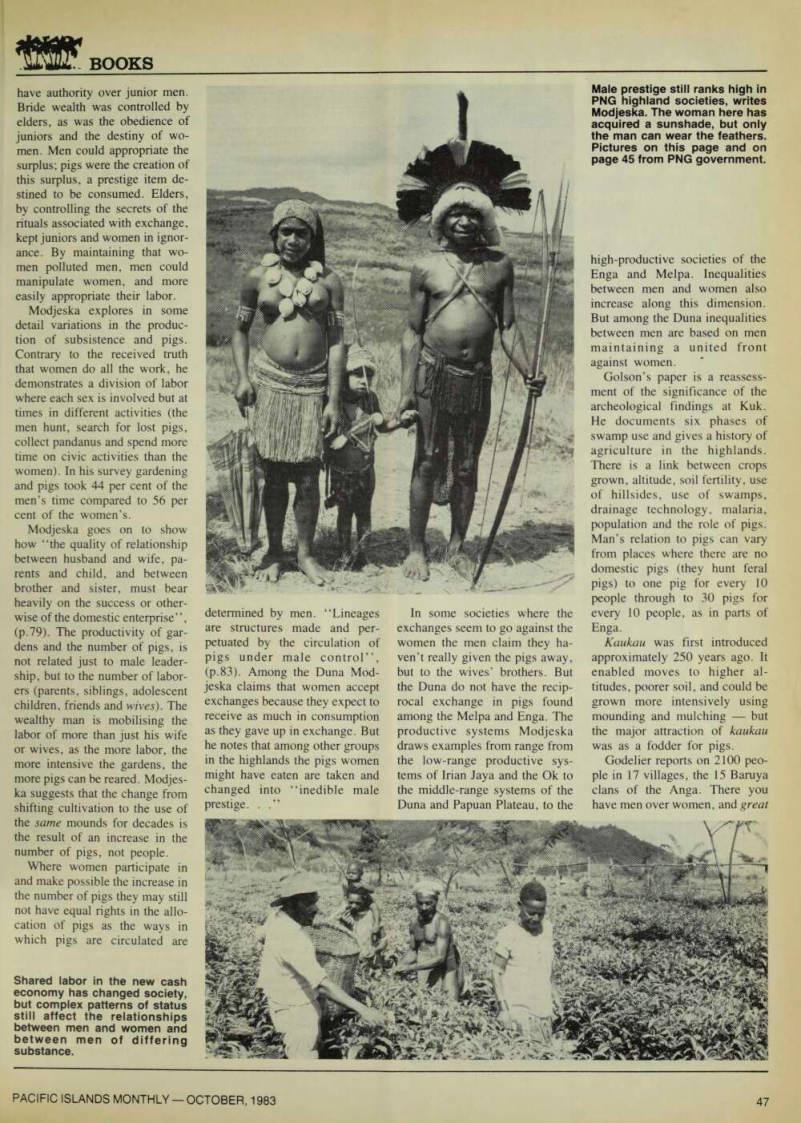
Male prestige still ranks high in PNG highland societies, writes Modjeska. The woman here has acquired a sunshade, but only the man can wear the feathers.
Pictures on this page and on page 45 from PNG government.
men over others. Men are the more beautiful sex: only men are permitted to wear feathers. Men maintained a monopoly over the main means of production and destruction: only men can make and exchange salt, only men can make and play musical instru ments. Salt production and ex change were central to the Baruya economy as through it they obtained axe stones, black palm wood, pigs’ teeth, feathers, and magic.
Among the Baruya male and female initiation produced peo ple who could marry, but there were states of initiation. To be come an adult male took four stages, and men must have at least four children. To Baruya men the act of creation was based on the interaction of the men and the sun, and following concep tion male sperm was required to make the body while the sun made the eyes, nose, mouth, hands and feet.
Among the Baruya only a few men were great, those who be came salt makers, great sha mans, great warriors or great cassowary hunters. Shamans helped spirits return to their bodies before dawn while the cassowary was the wild woman of the forest whom only men could eat. Here status was based on greatness not on bigmen who accumulated and distributed wealth. There were great men and ordinary men, who were called sweet potatoes, but at the bottom were some good-for nothing men who were not fit for
war, hunting or agriculture.
Godelier observes that in spite of social change “male dominance remains the primordial basis of social organisation and cultural identity”, (p. 34). Since PNG’s independence the Baruya have revived the stages of initiations.
Andrew Strathem’s two essays
complement the three major
pieces in this collection. He sug gests that the persistence of cere monial exchanges helps men to maintin their superiority over women, but he sees cash cropping as leading to the eman cipation of juniors, and business making it possible for women to be equal to men. He mentions the impact of major changes that have come from outside: pacifi cation, missions, local govern
ment councils, cash crops and politics to which I would add formal education, health ser vices, communications, wage labor and occupational diversification.
In his second chapter Strath em’s discussion of some of the unintended consequences of the success of major clan associa tions is fascinating: a few are too large, too rich, causing conflict with their poorer neighbors, and an increase in inequalities across new lines.
This is a book well worth reading and re-reading. As with many UK productions now, it would have received wider circu lation in PNG if available in paperback at a lower price. Its value would be enhanced by photographs and more maps.
Some readers will still wonder where are the Baruya, Duna, Kapauku, Guro, Wiru, or other groups frequently referred to but not included in the map on page
110.
Sheldon Weeks.
Books received
A Natural History of the Coral Reef. By Charles R. C. Sheppard. Published 1983 by Blandford Books Ltd., England. Dis tributed by Australia & New Zealand Book Co. Pty. Ltd., P.O. Box 459, Brookvale, Australia 2100. ISBN 0 7137 1268 6. Price $17.95.
The Lost World of Irian Jaya. By Robert Mitton. Published 1983 by Oxford Univer sity Press, 7 Bowen Crescent, Melbourne, Australia, 3000. ISBN 0 19 554368 8.
Price $A50.
Art and Artists of Oceania. By S. Mead and B. Kemot. Published by the Dunmore Press Ltd., P.O. Box 5115, Palmerston North, New Zealand. ISBN 0 9611006 0 5. Price $NZ29.95.
The Tongan Past. By Patricia Ledyard.
Published 1982 by Government Printing Office. Nukualofa, Tonga, and distributed by Matheson, P.O. Box 46, Vavau, Ton ga. No ISBN, no price provided.
The Crying Baby and Coconut Wish.
By Dianne Mclnnes. Published 1983 by Web Books, P.O. Box 1385, Port Mores by, Papua New Guinea. No ISBN. No
price given.
Arek’s Terrible Day, and Other Stories.
By Dianne Mclnnes. Published 1983 by Web Books, P.O. Box 1385, Port Mores by, Papua New Guinea. No ISBN. No
price given.
Mogundi and Eka Run Away. By Dian ne Mclnnes. Published 1983 by Web Books, P.O. Box 1385, Port Moresby, Papua New Guinea. No ISBN. No price
given.
Tourism and Underdevelopment in Fiji.
By Stephen G. Britton. Published by
Australian National University Press, P.O.
Box 4, Canberra, A.C.T., 2600, Aust ralia. ISBN 0 909150 931. Price $A12.00.