Advertisements & other items, pp. 1-3 (2 items)
jlhjl
PACIFIC
ISLANDS
MONTHLY
OCTOBER, 1983
American Samoa US$l.75 Australia *A$l.5O Cook Islands NZ$l.5O Fiji F 51.50 Hawaii US$l.95 Kiribati A 51.75 Nauru A 51.75 New Caledonia CFPI9O New Zealand NZ$2.OO Niue NZ$l.5O Norfolk Island A 51.50 Papua New Guinea K 1.50 Solomon Islands 551.50 Tahiti ... CFPI9O Tonga PI .50 Tuvalu A 51.75
USA US$2 25
USTT and Guam US$l.95 Vanuatu VT1.50 Western Samoa T 1.95 •Recommended retail price only.
Registered by Australia Post Publication No. NBPI2IO
jlhjl
WWBS is ¥6lll MB [fi®yiS $1111111?
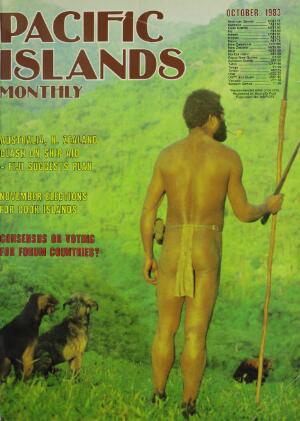
Cover Bushman Kray is ready for a new day’s work hunting boar on the island of Santo, Vanuatu.
Roberto Pettini picture.
The Miracle Workers
Making The World An Exciting Place
mm? ■1 M ■ fti W&* •*» ,4- * »- >■ • * «PB f r. 4 i ATC.The go-anywhere, do-anything All Terrain Cycles that play as hard as they work, are simple for all to ride and cheap and easy to maintain.
ATC. Honda invented them. Can you or your business do without one?
WORLD’S LARGEST MOTORCYCLE MANUFACTURER
HONDA MOTOR CO.. LTD. TOKYO, JAPAN
f- i
ATCIIO
ATCIBSS
ATC2OOE
AUSTRALIA: Honda Australia Pty. Ltd. Lot 95 Sharps Road, Tullamarine, Vic., 3043/Bennett Honda Pty. Ltd. 250 Victoria Road, Wetherill Park, N.S.W. 2164/NEW ZEALAND: Blue Wing Honda Ltd. 99-101 Carbine Road ML Wellington, Auckland/PAPUA NEW GUINEA; Steamships Trading Company Ltd. P.O. Box 1, Port Moresby/TAHITI: Honda Distribution S.A.R.L B.P 1665, Papeete/FIJI ISLANDS: Carpenters Motors Private Mail Bag Suva, Fiji/KIRIBATI: Atoll Motor & Marine Services PC. Box 49 Bairiki Tarawa/U.S. TRUST TERRITORY: United Micronesia Development Association P.O. Box 238, Saipan Mariana Islands 96950/COOK ISLANDS: Cook Islands Motor Centre Ltd. P.O. Box 74, Rarotonga/AMERICAN SAMOA; Holiday Motors, Parts and Service P.O. Box 968 Pago Pago, American Samoa 96799/Haleck's Service Centre Ltd. P.O. Box 1138, Pago Pago, American Samoa 96799/GUAM: Mark’s Motor Co., Inc. P.O. Box DV, Agana/WESTERN SAMOA: Motor Distributors (Samoa) Ltd. P.O, Box 576, Apia/SOLOMON ISLANDS; Guadalcanal Garage Limited PO. Box 537 Honiara/NEW CALEDONIA: Establissements Ballande Boite* Postale No. C 4 Noumea Cedex/NAURU: Nauru Cooperation Republic of Nauru/TONGA: Tonga Industrial Traders P.O. Box 1035, Nukualofa Tonga
Pacific Islands Monthly
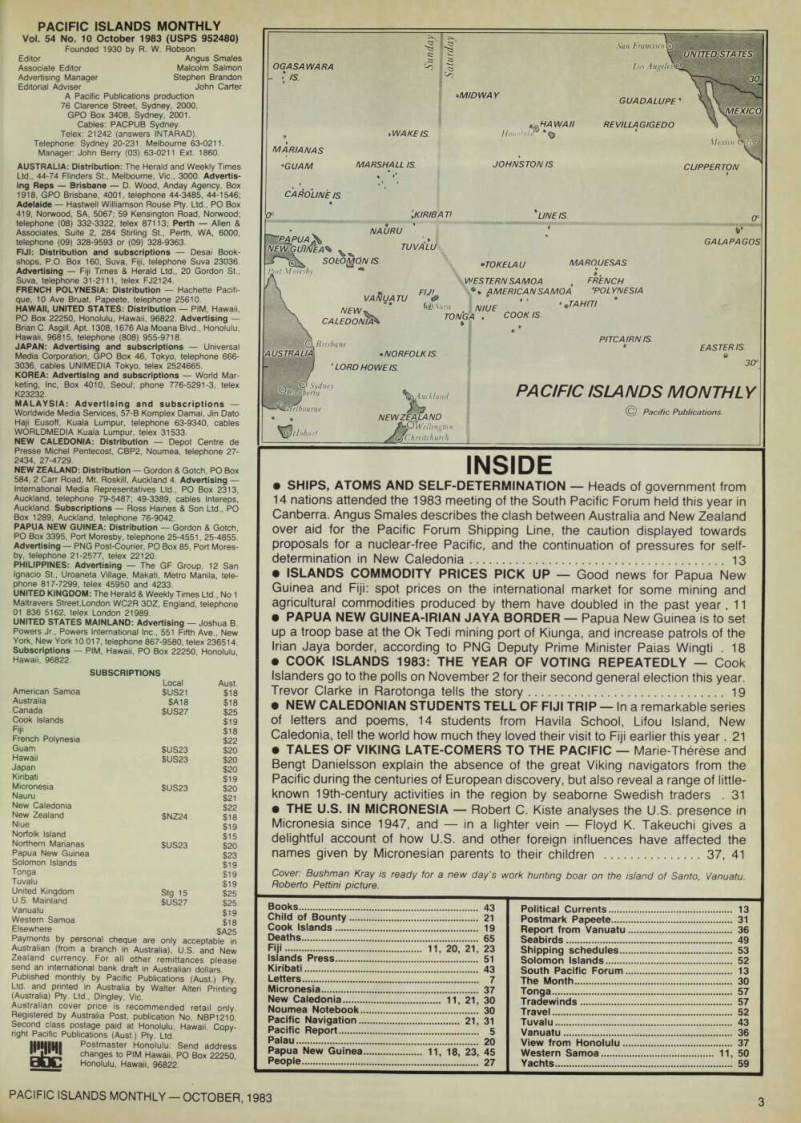
Vol. 54 No. 10 October 1983 (USPS 952480)
AUSTRALIA: Distribution: The Herald and Weekly Times Ltd., 44-74 Flinders St., Melbourne, Vic., 3000. Advertis ing Reps Brisbane D. Wood, Anday Agency, Box 1918, GPO Brisbane, 4001, telephone 44-3485, 44-1546; Adelaide Hastwell Williamson Rouse Pty. Ltd., PO Box 419, Norwood, SA, 5067; 59 Kensington Road, Norwood; telephone (08) 332-3322, telex 87113; Perth Allen & Associates, Suite 2, 284 Stirling St., Perth, WA, 6000, telephone (09) 328-9593 or (09) 328-9363.
FIJI: Distribution and subscriptions Desai Book shops, P.O. Box 160, Suva, Fiji, telephone Suva 23036.
Advertising Fiji Times & Herald Ltd., 20 Gordon St., Suva, telephone 31-2111, telex FJ2124.
FRENCH POLYNESIA: Distribution Hachette Pacifi que, 10 Ave Bruat, Papeete, telephone 25610.
HAWAII, UNITED STATES: Distribution PIM, Hawaii, PO Box 22250, Honolulu, Hawaii, 96822. Advertising Brian C. Asgill, Apt. 1308,1676 Ala Moana Blvd., Honolulu, Hawaii. 96815, telephone (808) 955-9718.
JAPAN: Advertising and subscriptions Universal Media Corporation, GPO Box 46, Tokyo, telephone 666- 3036, cables UNIMEDIA Tokyo, telex 2524665.
KOREA: Advertising and subscriptions World Mar keting, Inc, Box 4010, Seoul; phone 776-5291-3, telex K 23232.
MALAYSIA: Advertising and subscriptions Worldwide Media Services, 57-B Komplex Damai, Jin Dato Haji Eusoff, Kuala Lumpur, telephone 63-9340, cables WORLDMEDIA Kuala Lumpur, telex 31533.
NEW CALEDONIA: Distribution Depot Centre de Presse Michel Pentecost, CBP2, Noumea, telephone 27- 2434. 27-4729.
NEW ZEALAND: Distribution Gordon & Gotch, PO Box 584, 2 Carr Road, Mt. Roskill, Auckland 4 Advertising International Media Representatives Ltd., PO Box 2313, Auckland, telephone 79-5487; 49-3389, cables Intereps, Auckland. Subscriptions Ross Haines & Son Ltd., PO Box 1289, Auckland, telephone 76-9042.
PAPUA NEW GUINEA; Distribution Gordon & Gotch, PO Box 3395, Port Moresby, telephone 25-4551,25-4855.
Advertising PNG Post-Courier, PO Box 85, Port Mores by, telephone 21-2577, telex 22120.
PHILIPPINES: Advertising The GF Group, 12 San Ignacio St., Uroaneta Village, Makati, Metro Manila, tele phone 817-7299, telex 45950 and 4233.
UNITED KINGDOM: The Herald & Weekly Times Ltd., No 1 Maltravers Street,London WC2R 3DZ, England, telephone 01 836 5162, telex London 21989.
UNITED STATES MAINLAND: Advertising Joshua B Powers Jr., Powers International Inc., 551 Fifth Ave., New York, New York 10 017, telephone 867-9580, telex 236514.
Subscriptions PIM, Hawaii, PO Box 22250, Honolulu, Hawaii, 96822.
Payments by personal cheque are only acceptable in Australian (from a branch in Australia), U.S. and New Zealand currency. For all other remittances please send an international bank draft in Australian dollars.
Published monthly by Pacific Publications (Aust.) Pty.
Ltd. and printed in Australia by Walter Alteri Printing (Australia) Pty. Ltd., Dingley, Vic.
Australian cover price is recommended retail only.
Registered by Australia Post, publication No. NBPI2IO.
Second class postage paid at Honolulu, Hawaii. Copy right Pacific Publications (Aust.) Pty. Ltd.
Postmaster Honolulu: Send address changes to PIM Hawaii, PO Box 22250, Honolulu, Hawaii, 96822.
Subscriptions
Local Aust.
American Samoa $US21 $18 Australia $A18 $18 Canada
Sus27
$25 Cook Islands $19 Fiji $18 French Polynesia $22 Guam $US23 $20 Hawaii
Sus23
$20 Japan $20 Kiribati $19 Micronesia
Sus23
$20 Nauru $21 New Caledonia $22 New Zealand
Snz24
$18 Niue $19 Norfolk Island $15 Northern Marianas $US23 $20 Papua New Guinea $23 Solomon Islands $19 Tonga $19 Tuvalu $19 United Kingdom Stg 15 $25 U.S. Mainland
Sus27
$25 Vanuatu $19 Western Samoa $18 Elsewhere $A25
Inside
• SHIPS, ATOMS AND SELF-DETERMINATION Heads of government from 14 nations attended the 1983 meeting of the South Pacific Forum held this year in Canberra. Angus Smales describes the clash between Australia and New Zealand over aid for the Pacific Forum Shipping Line, the caution displayed towards proposals for a nuclear-free Pacific, and the continuation of pressures for self determination in New Caledonia 13 • ISLANDS COMMODITY PRICES PICK UP Good news for Papua New Guinea and Fiji: spot prices on the international market for some mining and agricultural commodities produced by them have doubled in the past year. 11 • PAPUA NEW GUINEA-IRIAN JAVA BORDER Papua New Guinea is to set up a troop base at the Ok Tedi mining port of Kiunga, and increase patrols of the Irian Jaya border, according to PNG Deputy Prime Minister Paias Wingti . 18 • COOK ISLANDS 1983: THE YEAR OF VOTING REPEATEDLY Cook Islanders go to the polls on November 2 for their second general election this year.
Trevor Clarke in Rarotonga tells the story 19 • NEW CALEDONIAN STUDENTS TELL OF FIJI TRIP In a remarkable series of letters and poems, 14 students from Havila School, Lifou Island, New Caledonia, tell the world how much they loved their visit to Fiji earlier this year. 21 • TALES OF VIKING LATE-COMERS TO THE PACIFIC Marie-Therese and Bengt Danielsson explain the absence of the great Viking navigators from the Pacific during the centuries of European discovery, but also reveal a range of little known 19th-century activities in the region by seaborne Swedish traders . 31 • THE U.S. IN MICRONESIA Robert C. Kiste analyses the U.S. presence in Micronesia since 1947, and in a lighter vein Floyd K. Takeuchi gives a delightful account of how U.S. and other foreign influences have affected the names given by Micronesian parents to their children 37, 41
Books 43 Child of Bounty 21 Cook Islands 19 Deaths 65 Fiji 11, 20, 21, 23 Islands Press 51 Kiribati 43 Letters 7 Micronesia 37 New Caledonia 11, 21, 30 Noumea Notebook 30 Pacific Navigation 21, 31 Pacific Report 5 Palau 20 Papua New Guinea 11, 18, 23, 45 People 27
Political Currents 13 Postmark Papeete 31 Report from Vanuatu 36 Seabirds 49 Shipping schedules 53 Solomon Islands 52 South Pacific Forum 13 The Month 30 Tonga 57 Tradewinds 57 Travel 52 Tuvalu 43 Vanuatu 36 View from Honolulu 37 Western Samoa 11, 50 Yachts 59
Advertisements & other items, pp. 3-4 (2 items)
Founded 1930 by R. W. Robson
Editor Angus Smales Associate Editor Malcolm Salmon Advertising Manager Stephen Brandon Editorial Adviser John Carter A Pacific Publications production 76 Clarence Street, Sydney, 2000, GPO Box 3408, Sydney, 2001.
Cables: PACPUB Sydney.
Telex: 21242 (answers INTARAD).
Telephone: Sydney 20-231. Melbourne 63-0211.
Manager: John Berry (03) 63-0211 Ext. 1860.
Fid Pioneer*
Pioneer Avante A 9. Every hi-fi advantage
an integrated component system
can offer—and more power too!
Come to Avante for real music power—26s watts of it per channel. Hear Avante and listen to your music bigger and brighter than ever before. Really listen closely to Avante and marvel at how true and realistic the sound is, with so little distortion thanks to Pioneer’s unique Dynamic Power Non-Switching™ amp.
Avante A 9. It has more of the power you want and more of the features you need for modern, hi-technology hi-fi, such as a double cassette deck for easy taping, quartz-PLL synthesizer tuning and a ribbon supertweeter.
Avante A 9. The best friend a music collection can have.
Note; Graphic equalizer, audio timer, audio lamp, cassette case and headphones are all optional.
fID PIONEER*
-or further information, please contact: Nauru Island: Jacob Enterprises, P.O. Box No. 4, Republic of Nauru Australia: Pioneer Electronics Australia Pty. Ltd. (Incorporated in Victoria), Tahiti: Tahiti Hi-Fi, P.O. Box 848, Papeete, Tahiti 3 .0. Box 295, Mordialloc, Victoria, 3195 Tel: 580-9911 New Caledonia: Menard Pacifique Sari, B.P. 3899, Noumea, New Caledonia -iji Islands: Brijlal & Company, G.P.O. Box No. 362, Suva, Fiji Islands Tel: 22258 Tel; 27»62»23 Slew Zealand: Monaco Distributors Ltd., 2 Poland Road, Glenfield, Auckland, American Samoa: Transpac Corporation, P.O. Box 1477, Pago Pago, American Mew Zealand Tel: (09) 444-9144 Samoa 96799 Tel: 633-5224 ... . T .
Norfolk Island: Burns Philp (Norfolk Island) Ltd., P.O. Box 21, Norfolk Island Rarotonga: South Seas International Ltd., P.O. Box 49, Rarotonga Cook Islands lei. /anuatu: Burns Philp (Vanuatu) Ltd., Vila, Vanuatu Papua New Guinea: Bali Merchants Pty. Ltd., P.O. Box 6103, Boroko Tel. 254887
Pacific Report
Marshalls Yes’ To Compact
With almost 95 per cent of ballots counted, voters in the Marshall Islands had accepted the Compact of Free Association with the United States by just over 5000 votes to 3500, according to a September 14 Radio Australia report. The compact establishes a trust fund of SUSISO million to compen sate Marshall Islanders displaced or exposed to radiation during U.S. nuclear testing in.the archipelago from 1946 to 1958. The compact also provides about $750 million in aid over a 15-year period, and gives the U.S. the use of Kwajalein Atoll missiles testing range for up to 30 years. The radio quotes United Press International reports saying that voters from atolls affected by nuclear testing tended to vote against the compact in the September 7 poll, whereas islanders on Majuro, the republic’s main population centre, were heavily in favor.
76 Long Days In Fiji
From Suva, Robert Keith-Reid reports: Former Fiji Opposition Leader Siddiq Koya couldn’t be blamed for thinking that he’s had the last telling word: at the end of August, after 76 days of evidence about the conduct of the 1982 general election heard by New Zealand judge Sir John White, sitting as a one-man Royal Commission, the ruling Alliance Party seemed to have virtually surrendered. It had admitted that it could not produce or obtain evidence to prove allegations by its leader, Prime Minister Ratu Sir Kamisese Mara, that Koya had signed a letter in which his National Federation Party was said to have agreed to grant facilities in Fiji to the Soviet Union if it became the government after the election. According to Mara, the NFP received about SAI million in Soviet funds in return for the undertaking. The Alliance has also declared that for what it said were reasons of national security and “delicate diplomatic considerations” it could not produce evidence to support other aspects of Mara’s allegations. Koya, who had assured the nation that his soul was “not for sale”, had his case backed up by John Rabone, an independent New Zealand lawyer brought in to assist the inquiry. The only evidence shown by the Alliance, a photostat of a letter purporting to bear Koya’s signature, was of “no intrinsic value”, and “quite unsafe” to accept as evidence, he told White. But Alliance counsel, Sir John Falvey, QC, infuriated Koya in the final moments of the inquiry by assuring all that the supposition that the Alliance had abandoned its case “could not be further from the truth”. Falvey maintained that for the present it was impossible to publish evidence held by Mara without imperilling the safety of the people who supplied it. The issue was “by no means closed”, he said. Falvey said that contrary to what the NFP claimed, Mara had been under strong opposition pressure to cut the inquiry short. But the Prime Minister was satisfied that certain documents in his possession were genuine. “The Alliance maintains that the Koya letter is authentic, that the original was in fact signed by Mr Koya, and that money was paid to or for the benefit of the National Federation Party in exchange for the promises made to the USSR in that letter,” he said. When evidence could be released without endangering the suppliers, it would be published, he promised. Sir John White has a number of other issues to decide. One is the NFP charge that the Alliance hired Australian and American consultants to prepare for it, for use against the opposition, a “dirty tricks” campaign strategy. This advised such pressure as threats, bribes, denigration of the character of opponents, and exploitation of tensions between the Fijian and Indian communities, and of religious tensions between Muslims and Hindus within the Indian community. The Alliance counter charged that the NFP colluded with Left-wing Australian groups to prepare a television documentary about the election deliber ately slanted to damage the Alliance. Mara accused Australian Broadcasting Commission TV producer, Peter Manning, of the Four Corners program, of being involved in this. White said in closing the public hearings that he could not say when his report would be ready to go to the Governor-General Ratu Sir Penaia Ganilau. But throughout Fiji, it seemed to be the general consensus that what emerged from the hearings was more damaging to the Alliance than to the NFP.
Hotel Arson Shocks New Caledonia
Optimism aroused in New Caledonia by recent political develop ments, especially the July “round table” between the different political factions held in France, received a rude setback in late August with the destruction by arson of a resort hotel on the island of Ouvea, in the Loyalty group. Opened only in April, the Ouvea Village cost CFPI7O million (about SAI.4 million) to build. Although no arrests had been made by press time, it was widely assumed that those responsible were elements of the Melanesian Ouassadieu tribe, unhappy with aspects of the deal struck with the hotel proprietors for the erection of the buildings on their land. The Noumea daily Les Nouvelles commented: ’’Let us make no mistake. It’s not only a hotel that’s been destroyed, but also, and more importantly, many hopes and many illusions.
Presumably, the event is not of a kind (such as the assassina tion of Pierre Declercq, for example) to threaten a race war. It is in fact even more serious, and it affects us all, Melanesians in the first place: up in smoke went confidence in the good sense of people, and in the ashes lies the bitter realisation of the powerlessness of mere goodwill, whether it be the goodwill of the independentists or not.”
Somare, Pacific Man Of The Year
Papua New Guinea’s Prime Minister, Michael Somare, is to go to New York in October to receive the Pacific Man of the Year Award. The award is to be presented by the Foundation for the Peoples of the South Pacific.
Australia Offers Surveillance Aid
Australia has offered to conduct joint air patrols with a number of nations of the southwest Pacific in an effort to tighten up surveillance of their exclusive economic zones. Senior Aust ralian defence officials said in September that a Royal Aust ralian Air Force Orion aircraft is at present flying patrols from Fiji about once a month. Under new proposals, the Orion would extend its patrols to cover the offshore economic zones of Solomon Islands, Vanuatu and Western Samoa. However, the officials said that for the present the Orion could only land on a regular basis at Nadi, Fiji, as other airfields in the region were not strong enough to take the big plane. The officials said it was proposed to carry personnel from the island nations on the patrols of their zones. In a related development, Papua New Guinea’s Prime Minister Michael Somare said it was obvious that PNG needed faster patrol boats if its economic zone was to be effectively policed. He said the government was also considering increased use of maritime patrol aircraft. Mr Somare welcomed Australia’s offer to supply patrol boats to Pacific Island countries. The offer was made by Australian Prime Minister Bob Hawke at the meeting of the South Pacific Forum in Canberra early in September.
Savaai Ravaged By Bushfire
Western Samoa’s Prime Minister Tofilau Eti in September declared a disaster area about 4000 hectares of burning forest land on the island of Savaai. The fire, in some of the country’s most valuable agricultural and timber land, was being fought with the assistance of portable pumps, hoses, flame-throwers and personnel flown in by the New Zealand Government. A spokesman for the U.S. forestry service in Honolulu said a group of his men were ready to leave for Western Samoa if requested.
Riot Police On Troubled Lae Campus
Riot police in September took control of the campus at the University of Technology, Lae, Papua New Guinea, following a student occupation. The students had barricaded entrances to the campus and refused to attend lectures in protest against the dismissal of a Papua New Guinean lecturer. They stoned the house of the vice-chancellor, and smashed windows of the registrar’s car. About 60 riot police broke down the barricades and took up positions around the university’s administration buildings. A university spokesman said the students left the area quietly when the police arrived.
Fsm Congress Ratifies Compact
The Congress of the Federated States of Micronesia in early September ratified the Compact of Free Association with the United States. It had been approved by three of the four states
Truk, Yap and Kosrae but was rejected by the Ponape legislature. In the June plebiscite, 70 per cent of voters in the FSM approved the compact, but the vote in Ponape went 51 per cent against it.
Vanuatu Parliament Is Dissolved
Dissolving Vanuatu’s first parliament since independence, Pre sident Ati George Sokomanu has thanked members for their contributions to Vanuatu’s development, making particular men tion of Speaker Maxime Carlot, whom he congratulated on his handling of the parliament’s often stormy sessions. President Sokomanu cited as examples of the parliament’s achievements the passage of 116 bills which had allowed such things as the negotiation of 71 land leases with traditional landowners, and the launching of Vanuatu’s currency, the vatu. Vanuatu’s second parliament is to convene on November 16, a fortnight after the November 2 elections.
W. R. Carpenter Changes Hands
The Sydney-based islands trader W. R. Carpenter Ltd. has changed hands following a successful August take-over bid by Griffin East Holdings Pty. Ltd., of Perth, Western Australia. The Carpenter board had unanimously recommended that sharehol ders accept Griffin’s offer, based on a price of $A2.70 a share for the company’s issued capital of 43.6 million fully-paid shares.
The offer valued the company at about sll7 million. Griffin is an investment company with its major interest in coal. Chief executive of the two groups, Messrs W. R. Carpenter and R.
Stowe, were reported as saying the takeover agreement would “ensure continuity and stability of management in the Carpenter group”. The statement added: “It will enable the Carpenter group to continue its service fully to its customers in Australia, the Pacific and elsewhere and to maintain existing relationships with the communities in which it operates, its principals and its other trading partners. Griffin directors have assured the Carpenter board that subject to pursuance of existing Carpenter policies, it is the intention of Griffin to continue the employment of the present employees of Carpenter.” Commenting on the reassur ance of “continuity and stability of management in the Carpenter group” given by the chief executives, an editorial in The Fiji Times has expressed “some concern that, sooner or later, the new owners may want to re-assess their priorities to the possible detriment of Fiji and its Pacific neighbors”.
Australia Raises Png Aid
Australia will increase its aid to Papua New Guinea by 10 per cent to SA2BB million this financial year. In his Budget speech in the Australian Federal Parliament, Treasurer Paul Keating said the increase reflected recent special aid and a revision of Australia’s five-year aid agreement with PNG. This is in line with PNG’s wishes for suspension of the five per cent reduction in Australian aid each year agreed to by PNG before the economic downturn. Mr Keating added that Australia would continue to give priority to assisting countries in the region.
U.S. PAYS OUT $250,000 FOR PAGO CRASH The United States Government has paid $U5250,000 to Ameri can Samoa in settlement of a damges claim against the U.S.
Navy. A naval Orion aircraft crashed into the Rainmaker Hotel in Pago Pago in April, 1980, killing three hotel guests and the aircraft crew of six, and badly damaging the hotel. The Orion struck the overhead railway cable across the harbor. The settlement is for damage to public utilities and facilities.
Break Soviet Ties’ Fiji Senator
Fiji Senator Jone Banuve has urged the Fiji Government to break all links with the Soviet Union because of the shooting down of a Korean Air Lines Boeing 747 on September 1 with the loss of 269 lives. Senator Banuve, a government nominee to the Senate, and a senior official of the ruling Alliance Party, said the Soviet Union should be boycotted for what he called its “inhuman” action. Although Fiji and the Soviet Union have diplomatic relations, the Soviet Ambassador to Fiji is based in Canberra.
Top Png Politicos Want Republic
Papua New Guinea’s leading politicians, Prime Minister Michael Somare, Deputy Prime Minister Paias Wingti, Opposition Lead er lambakey Okuk and his deputy Fr John Momis are all in favor of replacing its head of State, Queen Elizabeth 11, with a
president. They all spoke in favor of the change during a parliamentary debate on the General Constitutional Commis sion’s final report which recommended that a president be elected by a simple majority vote in parliament in an exhaustive secret ballot. Mr Somare said he would contest the presidency if the system was similar to the United States’ system where the president has executive powers in government.
Png Defence Minister Faces Reprimand
Papua New Guinea Prime Minister Michael Somare said in mid- September that the country’s Defence Minister Epel Tito would be reprimanded for remarks he had made earlier in the month during a visit to Australia. Mr Tito told a Radio Australia correspondent in Canberra that Indonesia posed a threat to his country, and would probably invade it within 10 to 20 years. He also called on Australia to help PNG set up military posts along the Irian Jaya border. Mr Somare said his government believed relations with Indonesia were good, and were based on each nation’s respect for the other’s independence and integrity.
Mutual understanding between the two countries allowed a speedy settlement of any problem, he said. (See earlier report, Political Currents.)
Kiribati To Develop Christmas Island
The Kiribati Government has begun to settle citizens on land on Christmas Island in the Line Islands. The government plans to develop the island, which has more than half the total land area of Kiribati, making it an alternative economic centre to South Tarawa. Pilot leases, of half an acre each, and costing SA72 a year, have been granted to 63 families on land near London village, regarded as the island’s “capital.” The island, the largest island of purely coral formation in the world, has potential as a tourist resort, being linked by air with Honolulu, and has large copra plantations and many small lakes, some several kilometres in diameter, suitable for fish farming. A vegetable production process, using hydroponics, has recently been reported a success. Production of some crops, notably cab bage, has been found to be more than 60 per cent greater than from crops grown in soil.
40 Islands Companies Display Wares
Forty companies from nine South Pacific Islands countries took part in a trade display in Melbourne (Australia) in September under the auspices of the South Pacific Trade Commission.
Manufactured goods exhibited included shell and other jewel lery, handcrafts, plastic homeware, shoes, garments, aluminium and stainless steel utensils, jams, coconut cream, cane furni ture, copperware, toys, biscuits, saddles and harnesses, soccer, rugby and netballs, sportswear, wines and, from Tonga, a mini excavator. There were 316 visitors over the three days of the exhibition; 164 trade inquiries; actual sales $A151,848; sales under negotiation $237,724; estimates of sales in the next 12 months $1,047,000. The display was also mounted briefly in Brisbane and Sydney.
Png Lager On Sale In California
Export lager made by Papua New Guinea’s South Pacific Brewery went on sale in California early in September. The first shipment consisted of 12,000 cartons (12 cans to a carton) and a second shipment of 20,000 cartons was soon on its way to the brewery’s new market. The brewery’s general manager, Bruce Flynn, said the company expected to sell between 150,000 and 180,000 cartons a year in America.
Fiji Shipowners Oppose Hovercraft
Local shipowners in Fiji have asked their government to block an Australian company’s plan to run an experimental hovercraft service carrying passengers between Suva and larger outlying islands. The company, Vosper Marine, plans to introduce the service shortly. But the Fiji Inter-Island Shipowners’ Association says that many shipping services were heavily dependent on revenues from passenger fares, and could not afford to lose business to the hovercraft.
Raymond Burr’S Island Fetches $2.8 M
The American actor Raymond Burr has sold an island he has owned in Fiji for 15 years for SA2.B million. The Fiji Government also bid for the 780 ha island, Naitauba, about 150 nautical miles northeast of Suva, but could not match the offer from a church group based in USA, Johannine Daist Communion.
Keep an eye

Letters
Keep an eye out for EI Nino effects
During 1982-83 anomalous weather conditions have existed throughout the Pacific Ocean (PIM Aug. p 29). This Southern Oscillation-El Nino has been ex
tremely severe and widespread,
and considerable effort is going into studying the effects in the atmosphere and the ocean sys tems. We are especially interest ed in the birds, the flying fish and squid they eat, and the vegetation on islands throughout the Pacific.
We are concentrating our re search on Christmas Island, Line Islands, Republic of Kiribati, but since the “warm event” is a glob al phenomenon and our funds and time are limited, we are unable to gather data elsewhere.
We want very much to com municate with persons who have been in the region and have observations on what they con sider unusual events: many birds present, no birds seen, dry or lush vegetation, absence of fish, etc.
Please write and tell us what you have observed in as much detail as possible, but especially concentrating on the unusual events occurring at a specific place and date. We promise to answer your questions as best we can.
Your information will be con
tributing importantly to our
understanding of the biological
processes in the Pacific Ocean.
Thanks.
Ralph And Betty Anne
Schreiber
Los Angeles County Museum of Natural History, 900 Exposition Boulevard, Los Angeles CA 90007
Usa
Counting cancer
cases The June PIM carried a statement issued by the French Embassy in Canberra. Many of the points raised in this statement are ident ical to those made in an interview
with Robert Puissant, France’s ambassador in Fiji, which was in the June issue of Islands Business. Curiously enough, a latter from the French Embassy in Wellington, which appeared simultaneously in the New Zea land magazine, New Outlook, further parrots Puissant’s apologia for French nuclear
testing.
Such synchronised white washing is of course a character istic reaction to Pacific-wide pro test against the French nuclear testing program. However, this latest public relations manoeuvre is exceptionally pernicious in its presentation of meaningless and biased statistical data. I refer in particular to the figures concern ing cancer cases in French Polynesia.
The article in PIM states: “Mortality rates in French Poly nesia are not a secret in any way.
They are in fact regularly brought to the attention of the relevant authorities, and publish ed in the local press. The main conclusion to be drawn from the statistics is that the number of cancer cases in French Poly nesia, while subject as elsewhere to variations, is in no way higher than in other areas.”
The “authoritative” Public Health service in Tahiti did in deed publish a report in the local press in 1978, entitled “Cancer in French Polynesia”. It dealt
specifically with morbidity rates
for malignant cancers from 1958- 1977, that is the annual incidence of new cases of cancer, and not the number of deaths from can cer. Ironically, one does not find causes of death listed in French Polynesian health records, though these are provided in New Caledonia. For future credi bility, the French authorities would do well to agree on ter minology distinctions bet ween mortality and morbidity are
important.
Equally disturbing is the fact that both the figures cited in the article in PIM, and the aforemen tioned report, are not evaluated on the basis of cancer rates per given age groups. The statement in PIM alleges that there is an annual average of 50 deaths from cancer per 100,000 inhabitants in French Polynesia. In the absence of age-related data, this infers a
uniform distribution of cancer deaths across the population.
New Zealand experience con tradicts that assumption. For in stance, according to the World Health Statistics Annual for 1981, published by the World Health Organisation, in 1977 80 per cent of all cancer deaths in New Zealand occurred in people over 65. The population in French Polynesia is relatively younger than in New Zealand the 1977 census figures for the territory show that more than 62 per cent of the population was under 25, whereas the 1976 New Zealand census figure was 48 per cent under 25.
In the article in PIM, the annu al 50 cancer deaths in French Polynesia are compared with rates in other countries, so as to “prove” that the incidence of cancer is significantly lower. Un less age-grouping data is pro vided such comparisons are not only nonsensical but a dangerous manipulation of public opinion.
A pertinent example of the importance of age structure in any statistical comparison of can cer mortalities, is the situation of the Maori people. Raw figures for cancer deaths, even when adjusted for the smaller Maori population within New Zealand, are lower than the comparable Pakeha figures. However, when these figures are readjusted with regard to age distribution (the Maori population is significantly younger overall), cancer rates are found to be twice those of the Pakeha. This finding was turned up by the New Zealand Depart ment of Health, and is recorded in the publication Maori/Euro pean Standards of Health (Spe cial Series, No. 1, April 1960).
There are further misleading factors in the French statements cited. Firstly, the Public Health Service report refers only to malignant cancers that have been positively identified by the local
pathology laboratory. This con
sequently fails to account for unidentified cancer victims scat tered throughout the sprawling island territory. The health ser vice does recognise in its report that a margin of error exists and in order to rectify it, an extra 15 per cent is added on. This figure
is presumably arbitrary and
hence questionable.
The article in PIM from the French embassy makes no refer ence to such corrections, and furthermore does not list a single case of leukemia. The health service report deliberately lists leukemias on a separate table, admitting that such illness can be radiation-induced, but inferring that the small number recorded makes any correlation with the testing program improbable.
In fact the report concludes that, “while the statistical analy sis of cancer in French Polynesia is an imperfect reflection of the situation, it is nonetheless reas suring with regard to the sup posed effects of radiation.”
The respected American bio statistician, Dr Rosalie Bertell, has pointed out: “Cancer deaths are a very crude measure of the health status of a population ran domly exposed to a mutagen in the form of radio-active chemic als. One could have a cancer epidemic without its impacting death statistics for 10 years.”
From 1966 to 1975, the French Government detonated 41 nuclear devices in the atmos phere. The resultant effects on the health of the population may not as yet be apparent in the selective data published by the French Public Health Service.
By the end of the decade the situation could be vastly diffe rent, but then again statistics have a nasty habit of distorting the truth.
Name And Address
Supplied
Wellington,
New Zealand
The politics of
race and culture
The biology of heredity contri butes to personality, character, while environment is, in varying degrees, the determinant of cul ture. If this were not so, then the infinite variety in man, his varied cultures, would be non-existent.
Planet Earth would be Planet Clone the nightmare world of science fiction.
To regard either biology or environment as the predetermin ant factor in assessing human or cultural development is, howev er, an attractive proposition in the politics of biology and eth-
nology. Racists from pseudo- Mendelists to Nazis have flour ished on the possibilities of biological isolationism, while Marxists, rejecting heredity as the key to almost all social and political problems, have pros pered on the simple thesis that human environment is the most critical area. In short, change the environment and you change man, as against modify biology and you have the New Man in the science of the New Biology.
In the “nature versus nurture” controversy revolving around the “extreme cultural determinism” of Margaret Mead in her classic study Coming of Age in Samoa, Mead is under attack by Profes sor Derek Freeman in his recent book Margaret Mead and Samoa: The Making and Unmak ing of an Anthropological Myth, a work that is creating heated discussion. But it is throwing little light on the realities of the human condition in (again), its infinite variety. For Freeman is a determined supporter of the heredity thesis as Mead (less aggressively, however) was an environment enthusiast, neither author striking a balance between nature and social nurture. This, unfortunately, cancels out both books as altogether worthwhile studies in anthropology as life is simply a matter of adapt or perish for biological man. It has been so from his earliest beginnings.
Mendel, Marx and Mead are dead. However, man is not free from fear of the reality of his limitations: in nature, in nurture.
Until such time as he is, he will continue to conspire against his limitations with increasing de structiveness to life and environ ment. Exclusiveness is just another word for disaster.
Alan Taylor
Auckland, New Zealand.
First contact with
the R.A.A.F.
During a recent visit to Sydney I had the opportunity to view the recently produced film First Contact. I was interested to see what they had done with the clips from film shot by my old friend Mick Leahy during the Leahy- Taylor expedition into the then
unexplored Wahgi Valley.
Seeing these old clips, linked together with recent film shot in the Wahgi, took me back 40 years to 1943, and to a phase in Mick’s life I don’t think many people are aware of.
The Japanese were sweeping all before them, and the “Bris bane Line” was being discussed.
I was serving in the Royal Aust ralian Air Force as 0.1. C. En gineer Intelligence, in liaison with U.S. army and Dutch army intelligence sections, and was at Victoria Barracks, Melbourne, when I heard through a member of my staff (ex-New Guinea) that Mick was in town. Knowing that he and his family had been evacuated in those desperate days with little more than the clothes they were wearing, I im mediately phoned him, and ask ed him what he was doing.
He said: “I’ve been in Mel bourne for the last three months trying to get a job in the army.
They offered me a job as a sergeant-major, but that’s not much good to me as I have a wife and five kids. I’m arranging to go back to Queensland in a few days time to grcn wheat.”
So I said: “Mick, you better come and see me at the Barracks.
I think I could fit you in here, or with the Americans.”
He was in my office within the hour. In the meantime I had phoned General Casey, C. 0., U.S. Army Intelligence, and told him about Mick, his habit of carrying an aneroid with him on his prospecting trips, his keenly developed powers of observa tion, and his superb knowledge of the country. As one of my duties was selecting ex-islands residents for interview by Gener al Casey’s staff and mine, it was easy to get an appointment.
We had a two-hour session with the U.S. and Dutch generals and they were delighted with the information Mick was able to give them. The altitude of air strips and mountain peaks were just two of the aspects of vital information he imparted.
As the session closed I said to General Casey: “Mr Leahy has come along this morning with the idea of offering his services to your unit.” The general said; “We would be delighted to have him, but how do we get him?” I
said: “That’s easy. 1 will enlist him in the R.A.A.F. and you give me a letter to the air vice marshal requesting his posting to your unit. You will have him within 24 hours.
“There is one matter though that will need to be looked after.
The Australian rates of pay are way below those of the U.S.
Army. Mr Leahy should be ap pointed at a rank not less than squadron-leader.” A squadron leader he was from the day he enlisted.
I had a number of official sessions with Mick during the next few months, when he was attached to General Mac Arthur’s HQ, then in Melbourne. It was during one of these sessions he turned up with a projector and some films in a suitcase. With typical generosity he said: “If you would like to look at these I will lend them to you, keep them as long as you like.” The films were the ones made by Mick during the Wahgi Expedition and now shown in First Contact. I had them in my possession 1943- 45, when they were finally hand ed back to Mick.
He served with distinction with General Mac Arthur’s HQ staff, going right through with them to the signing of the peace treaty in Tokyo Bay.
I visited him at General Mac Arthur’s HQ in Brisbane and found him, as one would expect, immensely popular with the staff. As far as I know he was the only member of the R.A.A.F. attached to U.S. Army HQ for the duration.
J. A. Davidson
East Ivanhoe, Vic.
Australia
Calling Orange
County, Calif.
I am trying to catch the attention of a PIM reader who lives in Orange County, California,
Usa.
This gentleman wrote to me at my former address in Sarina, Queensland, Australia, seeking information concerning Queens land in connection with real es tate, etc. He would not have been aware that before writing I had moved from Sarina to Mareeba, Queensland.
He forwarded me a copy of a
Sunday issue of The Los Angeles
Times (Orange County edition).
Unfortunately the paper and his letter were not forwarded on to me after my move, and I have just heard of their existence.
I write in the hope that this unknown correspondent will contact me again at my new address.
I know little of him, except that he reads PIM because he wrote to me after having seen my name on a letter of mine publish ed by you in 1980 in which I asked for copies of newspapers published in the South Pacific area. Incidentally, I had a good response.
A. R. Webb
66 Rankin St., Mareeba, Qld., 4880 Australia.
Who wrote these
books?
Being fortunate enough to inherit a number of rare books written during the latter part of last cen tury and dealing with life in the Pacific, I found amongst them one entitled Rambles in Poly nesia, a delightful collection of tales about the South Pacific reg ion. The author had an intimate knowledge of the whole area, particularly Fiji, its people, lan guage and customs. This book of over 200 pages was published in London by European Mail Ltd., in 1897 (price four shillings) and was dedicated to Thomas Robert Dewar, Sheriff of London.
A list of books by the same author included; Above the Clouds in Ecuador, On the Wal laby in Maoriland, From Kos ciusko to Chimborazo, Wild Life in the Pacific, Snakes, Noqu Talanoa.
The author’s use of “Sundow ner” as a nom de plume has aroused my curiosity as to his identity. That he was a “kai wai” or seafarer is obvious; he was also well-educated and very ob servant, with a keen sense of humor.
Can any of PlM’s readers tell me the author’s name?
Tui Garnett
56 Godden Cres, Mission Bay Auckland 5 New Zealand
Advertisements & other items, pp. 8-10 (1 item)
Europe.
BANK LINE and
COLUMBUS LINE
24 day service to
Europe.
Need we say more...
D G The Joint Service Partners offer facilities for shipment of: Containers (FCL/LCL) and Break-bulk Cargo plus reefer space and deeptanks for carriage of vegetable oils and other liquid bulk cargo.
Carriers also accept heavy lifts, overlength and cumbersome parcels.
Ports of Service: Loading; Papeete, Apia, Suva, Lautoka, Noumea, Port Vila, Santo, Honiara, Port Moresby, Lae, Madang, Kimbe, Rabaul, Kieta, Darwin. For: Rotterdam, Antwerp, Hamburg, Hull, Dunkirk, Le Havre.
Additional ports on enquiry.
Please contact our regional offices for further information: The Bank Line (Australasia) Pty Ltd Columbus Line Reederei GmbH Suite 801,51 Pitt St, P.O. Box 1 667, Lae/Papua New Guinea.
Sydney, NSW, Australia 2000 Phone; 423466/423487/AH. 422481 Phone 27 2041 Telex 24063 Telex: Colline NE 441 71 The South Pacific Specialists for over 75 years
❖ 5b V V :v
Look
listen
«S*
nd learn with
Australian
educational
equipment
& ik n vSI « i r* Australia has great experience and technical skill in most forms of audio visual and general educational equipment. So it has a great deal to offer in the field of teaching and in providing information. Film strips, projectors, books, charts, stationery products, teaching aids and equipment, prerecorded cassettes, slides, scientific equipment and anatomical models are typical of the large number of Australian educational items available. With strong emphasis being placed on advancing the educational system, there will be considerable demand for educational equipment of this high standard. Australian suppliers can help, their proximity will speed delivery too. Check what they have to offer.
Ask the expert who knows Australia The Australian Trade Commissioner can give you details of suppliers and also advise you on ways to research or develop markets in Australia. You can contact an Australian Trade Commissioner at:
FIJI
PO. Box 1252, Suva.
Phone: 31 2844 Telex: FJ2126
PAPUA NEWGUINEA
PO. Box 9129, Flohola, Phone: 25 9333 Telex. NE22109
NEW CALEDONIA
PO. Box 22, Noumea.
Phone: 27 2414 Telex: 087
HAWAII
Australian Consulate. 1000 Bishop Street, Hawaii, 96813, USA.
Phone: (808) 524 5050 Telex: 633128
LLjJ
Ask the Australian Ttade Commissioner
Ok Tedi project is
PACIFIC ROUNDUP: THE ECONOMY, THE GAMES - AND A NEW DIPLOMAT
Ok Tedi project is good news for locals
“Whether or not the Ok Tedi
gold/copper mining project will
brighten its promoters’ and
the Papua New Guinea Govern ment’s recent gloomy pasts will very much depend on there being no further delays in the building schedule and on the price of gold in the three years from July 1984.”
So writes Professor Richard Jackson of the University of Papua New Guinea in a Sydney newspaper.
Professor Jackson was one of three academics who in 1980, at the request of the PNG Govern ment, prepared a report on the probable major impacts of the project on the country’s economy, and on the people liv ing in the mining area. He re cently revisited Ok Tedi and found that while its benefits to participating companies and the government are “somewhat less attractive than they were back in 1980, the local people have done better than could reasonably have been expected three years ago.”
He lists the benefits as follows: • Twelve hundred local peo ple are employed on the project, a relatively high proportion of them in skilled and semi-skilled
jobs;
• Local business development has been encouraged, with Ok Tedi Mining Ltd (OTML) having a hand in the establishment of
companies in trucking, heavy
equipment, earth-moving, gravel
mining, timber milling, and
accommodation; • Most impressive of all, ac cording to Professor Jackson, has been OTML’s organisation of vegetable production and mar keting in the project area. He writes: This year, vegetables worth $500,000 will be bought by the pro ject from local suppliers who, with one exception, had previously almost no source of cash income.
The exception, the people of Ok sapmin, previously sold one tonne of vegetables a week to the north coast towns of Wewak and Vanimo. Today that figure has increased 10-fold. All
produce is collected and flown into Tabubil by light aircraft which be long to Cloudlands Aviation De velopments, 40 per cent of which is owned by local, village-based business groups.
Overall, with wages from project employment, compensation for land development, land rental payments, investment income, vegetable sales, timber sales, and income from other employment it can be estimated that in 1983 the Ok Tedi project will have added a minimum of $250 to the per capita income of the people of the area. While villagers living in the immediate vicinity of the mine will have done very much better than this average, in general the spread of this
new income will have been reason ably wide.
There are very few people at all in the Kiunga/Telefomin area who have not benefited financially from the project.
When one considers that the only previous sources of income were from growing rubber (tapping of which has now virtually ceased) and migration, which together did not add up to a per capita income of more than $5O a year, this improvement is, clearly, quite dramatic.
There are still many things to be wary of in the Ok Tedi project environmental issues remain very much alive, the business develop ment program has yet to mature, training programs have yet to be tested things may still go very sour locally. The whole project’s profitability remains in the balance, but generally, it is not going badly, particularly so as far as local interests are concerned.
commodity prices
Dramatic recovery in commodity prices
Spot prices for many mining and agricultural commodities on the international market have doubl ed in the past year this is good news for many countries in the Pacific, especially Fiji and Papua New Guinea.
The latter may expect, for ex ample, that better returns for agricultural commodities will be accompanied by the prospect that Bougainville Copper will resume paying supertax this year on cop per and gold.
Despite its present problems,
Fiji can perhaps take some com fort from the fact that the prob lems of sugar-producing coun tries are worldwide.
As one industry expert writes: “On the world scene, the latest year’s total raw sugar output of nearly 100 million tonnes is ex pected to drop to about 95 mill ion tonnes in 1983-84. This should tend to work down stocks which stood at a high level of more than 36 million tonnes at the end of the 1982-83 season.”
Sir Roderick Proctor of the
Bundaberg Sugar Co., Queens land, told the company’s share holders last month; “The prediction of a better balance in the supply and de mand position and the positive tone in the market have arisen in part because of poor weather which delayed and reduced beet plantings in Europe, droughts in South Africa, Fiji, the Philip pines, Thailand, Indonesia and until March, Australia, and floods in Cuba.”
The London daily price of sugar, which reached a trough in September 1982, had by last month recovered all its losses since the end of 1981.
Due to the relative failure of the Philippines copra crop (PIM Sep. p 55), and other factors, the price of copra moved as high as SUS66O a long ton in August (cif Rotterdam price). In October 1982, it had hit a low point of $265.
London cocoa futures were 1593 pounds sterling a tonne in August, compared with 916 pounds sterling in August 1982 (cif North European ports).
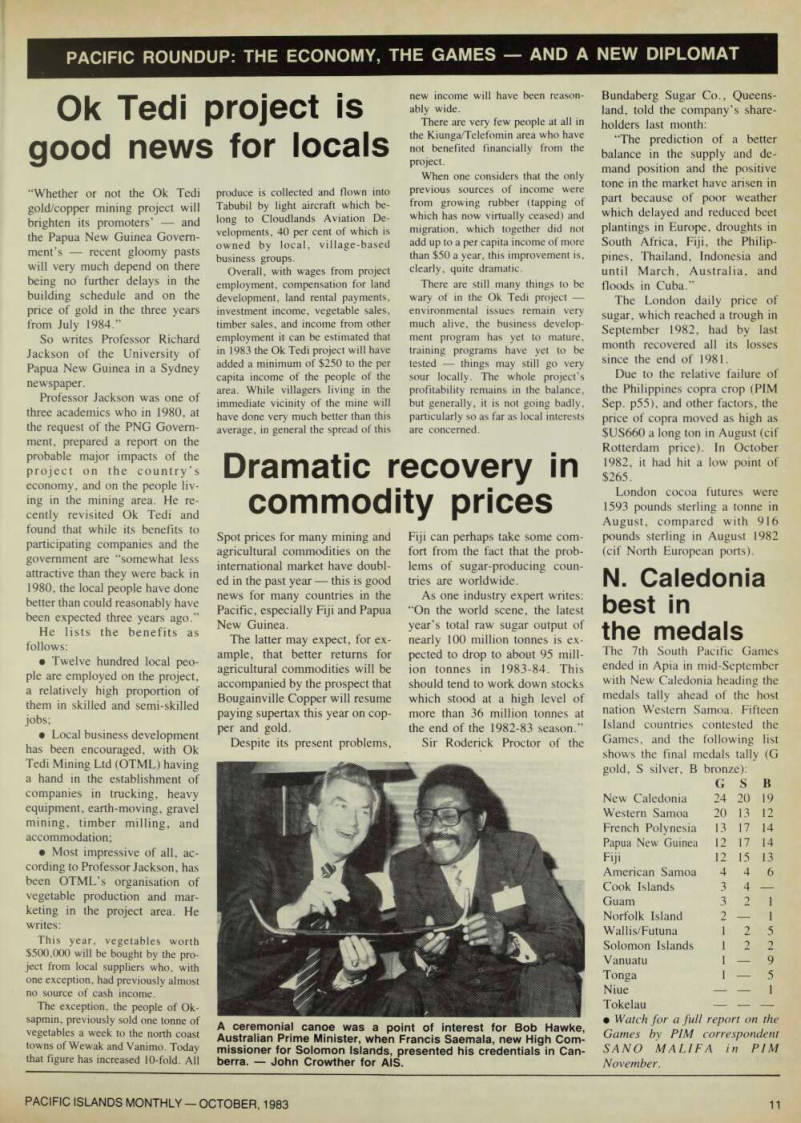
A ceremonial canoe was a point of interest for Bob Hawke, Australian Prime Minister, when Francis Saemala, new High Com missioner for Solomon Islands, presented his credentials in Can berra. - John Crowther for AIS.
N. Caledonia
best in the medals
The 7th South Pacific Games ended in Apia in mid-September with New Caledonia heading the medals tally ahead of the host nation Western Samoa. Fifteen Island countries contested the Games, and the following list shows the final medals tally (G gold, S silver, B bronze):
• Watch for a full report on the Games by PIM correspondent
Sano Malifa In Pim
November.
New Caledonia G 24 S 20 B 19 Western Samoa 20 13 12
French Polynesia
13 17 14 Papua New Guinea 12 17 14 Fiji 12 15 13 American Samoa 4 4 6 Cook Islands 3 4 — Guam 3 2 1 Norfolk Island 2 — 1 Wallis/Futuna 1 2 5 Solomon Islands 1 2 2 Vanuatu 1 — 9
Tonga
1 — 5 Niue — — 1 Tokelau — — —
Advertisements & other items, p. 12 (1 item)
Aiwa 9
Five minutes after reading the instructions,
Betty produced the best recording
she ever made in her life.
She did it because AlWA’s V-700 system is simply the “smartest,” most automated highperformance component ensemble ever created.
Not only does it dub automatically from disc to cassette at the touch of a single “Synchro Recording” control; its fully programmable turntable and exclusive “Auto Editing” facility will record up to seven tracks on the disc in any desired order, automatically.
An optional “plug-in” rack even lets Betty install this versatile 45 Watt per channel system without the bother of struggling with complicated wiring connections.
The V-700 system from AIWA: no faster, easier way to make great, “original label” recordings!
AIWA 9
AIWA Co., Ltd. 11-9, Ueno 1-chome, Taito-ku, Tokyo, Japan.
Distributors: Australia AIWA Australia Pty., Ltd./Cook Islands Island Merchants Ltd./Fiji P. Hargovind & Co., D. Ranchhod & Co./Guam Micropac Audio, Inc./New Caledonia hifivox/New Zealand Milaw Trading Co., Ltd./P.N.G. Oceania Indent Agency (P.N.G.) Pty, Ltd./Solomon Islands Harvest Pacific Ltd./Tahiti Fare Hi-Fi Stereo/Vanuatu (New Hebrides)The Sound Centre Ltd.
How much longer can
Political Currents
South Pacific Forum
How much longer can consensus rule?
The Pacific way, the Melanesian way, the Islands way and a string of other names to describe the same thing have always had a
clear-cut meaning. Simply they
mean that group attitudes are expressed by consensus. There’s no voting, no coercion, and a gentle give and take determines
inter-government regional
policies. That’s the way the South Pacific Forum countries have worked since their organ isation was formed in 1971.
But the 14th meeting of Forum countries, held a few weeks ago in the Australian capital, Canber ra, saw the emergence of a new attitude which suggests that con sensus may not last forever as a
working policy. Something har
der in the form of voting may well become necessary, accord ing to some of the bolder dele gates and officials.
New Zealand Prime Minister Robert Muldoon, who emerged as perhaps the most outspoken and controversial figure at the talks, went on public record con cerning consensus. At a press briefing towards the end of the talks (the talks themselves are held in camera) he said “There’s
no doubt that consensus is get ting harder to achieve”.
Part of this difficulty is clearly caused by the type of subject now coming before the heads of government who make up the
Forum delegates. Although the
Forum was created as a political organisation, free of the con straints affecting the South Pacif ic Conference, a large part of its involvement has been in subjects
The 14th conference of the South Pacific Forum countries, held this year in Australia, urged a peace ful move towards self-determination in New Caledonia* decided to hold later discussions on nuclear issues, and included a clash between Aust ralia and New Zealand over the Forum Shipping Line.
ANGUS SMALES reports on the talks.
which were not inherently con troversial. Consensus worked fine to adopt a uniform attitude to these issues.
Recent Forum meetings how ever, and the Canberra one was no exception, have delved more deeply into controversial issues.
Even where apparent consensus was achieved it is obvious that the different countries, their offi
cials and even their newspapers have different views on what they believe emerged from the conference.
Although the general attitudes of the talks are encapsulated in
an official communique (see page 17), varying constructions are already being put on the wording.
The three major issues which came before the Forum were the financial straits of the Pacific Forum Shipping Line, the matter of self-determination for French administered New Caledonia and the nuclear controversy involv
ing nuclear testing, nuclear waste dumping, nuclear power and
nuclear military applications.
The shipping debate de veloped into a clash between New Zealand and Australia, and despite a move by Fiji it is still indefinite whether the shipping line will get the money it needs to continue operating. The nuc lear debate failed to endorse a suggestion by the comparatively young Labor government of Australia that the Pacific should be declared a nuclear-free zone, although the steady pressure of nuclear awareness remained evi dent. The attitudes towards what was defined as French colonial ism in the Pacific followed fairly predictable lines and did not push as hard as many lobbyists had
hoped.
The Forum Shipping Line op erates three ships under a service sponsored by the Forum coun tries. The principal role of the line is to bring sea transport to
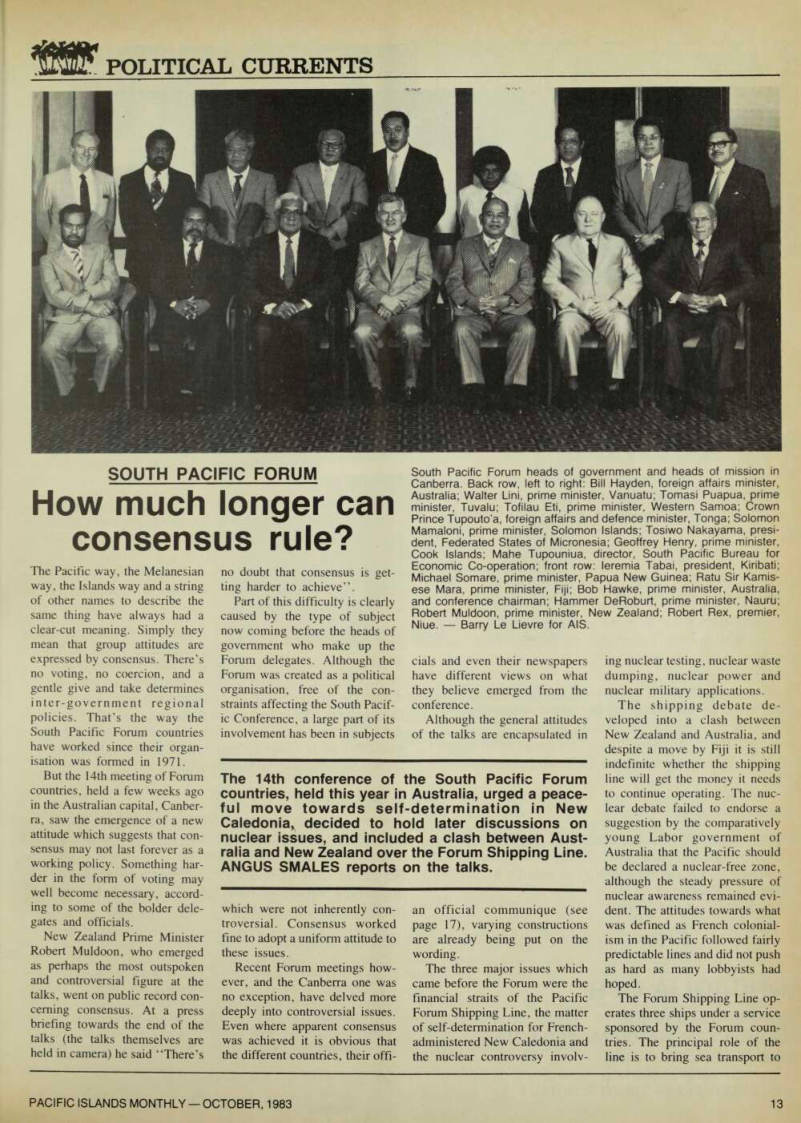
South Pacific Forum heads of government and heads of mission in Canberra. Back row, left to right: Bill Hayden, foreign affairs minister, Australia; Walter Uni, prime minister, Vanuatu: Tomasi Puapua, prime minister, Tuvalu; Tofilau Eti, prime minister, Western Samoa; Crown Prince Tupouto’a, foreign affairs and defence minister, Tonga; Solomon Mamaloni, prime minister, Solomon Islands; Tosiwo Nakayama, presi dent, Federated States of Micronesia: Geoffrey Henry, prime minister, Cook Islands; Mahe Tupouniua, director, South Pacific Bureau for Economic Co-operation; front row: leremia Tabai, president, Kiribati; Michael Somare, prime minister, Papua New Guinea; Ratu Sir Kamis ese Mara, prime minister, Fiji; Bob Hawke, prime minister, Australia, and conference chairman; Hammer DeRoburt, prime minister, Nauru; Robert Muldoon, prime minister, New Zealand; Robert Rex, premier, Niue. - Barry Le Lievre for AIS.
remote areas which have ship ping problems, but the line has been losing money. Australia has refused to give further aid in what is effectively an attitude of not wanting to send good money after bad, but New Zealand (and the management of the line) be lieves that the line will be over the hump if it can receive further immediate aid.
Mr Muldoon was angered by Australian attitudes. He claimed that Australians had alleged that the line was supported by New Zealand only because it helped New Zealand exports. Mr Mul doon accused the Australian De velopment Assistance Bureau of giving “Pacific ignorant” advice to the Australian government ab out the viability of the line. He would not be drawn into criti cism of the new Australian gov ernment, but said the govern ment was being fed incorrect information and advice. As a result, he claimed, the Pacific Forum line was being destroyed and Australia carried much of the blame for refusing further aid.
He said the Australian bureaucrats had no conception of the need for regular and assured shipping transport to remote Pacific island countries. All the bureaucrats understood about transport, he said, was getting in a car and driving out of Canberra.
He refused to concede that the Australian decision to stop furth er aid might be soundly based. “I know more about the Pacific than they do,” he said. “Now the line is dying. The lack of further aid is killing it” he said.
The Australian delegate to the Forum conference, Foreign Minister Bill Hayden, rejected Mr Muldoon’s accusation that Australian politicians were act ing on incorrect advice from the public service. Mr Hayden said “I make the decisions. No bureaucrat makes decisions for me.” He said he had been given a huge range of documentary evidence about the viability of the line. Australia had claimed from the start, he said, that the line was uneconomic and now New Zealand which had strongly endorsed the line was looking for
someone to blame because the line was failing. Mr Hayden said Australia was not completely abandoning the line. The govern ment would permit Island gov ernments to divert their Aust ralian aid to the line if they so wished. Mr Muldoon countered later with a statement which said the line had “come to the end of the road”.
Shortly before the Forum dele gates began returning to their countries there was a new de velopment in the bid to save the shipping line. The Fiji Prime Minister, Ratu Sir Kamisese Ma ra, called a meeting of Pacific countries which belong to the Africa-Caribbean-Pacific group, a collection of developing coun tries receiving European Economic Community aid. The Pacific members of the group are Papua New Guinea, Fiji. Sol omon Islands, Vanuatu, Western
Samoa, Tonga, Kiribati and Tuvalu. The ACP Pacific group decided to seek permission from the European Community to di vert their unused aid to the ship
ping line.
The Chairman of the Forum Line, Mr Harry Julian, was jubil ant at the decision and claimed that the line “is back in business again”. But Mr Muldoon re mained pessimistic and said he believed the line was still in trouble.
On nuclear issues the Forum rejected an Australian proposal to declare a nuclear free zone in the Pacific. Although the Forum
discussions were in camera and
despite an acknowledged general
objection to French nuclear test ing, there is clearly a lack of general agreement on the overall nuclear situation. One of the is sues which caused a failure to reach agreement concerned the operation of nuclear-powered ships and nuclear-armed aircraft.
Some delegates wanted to de clare a nuclear-free zone, but did not object to nuclear-powered ships and nuclear-armed aircraft in the zone a situation which was untenable to the hard-line countries.
The main indication which emerged from the talks was that a nuclear-weapon-free zone was a possibility for the future, even if nuclear power and nuclear pro
pulsion were permitted.
The meeting decided that it needed more time to consider the full implications of the Aust ralian proposal and to carry out wide-ranging consultations aris ing from it. Mr Hayden, as dele gate for Australia, undertook to provide Forum countries with re ports on how nuclear-free pro posals and practices were con stituted in other parts of the world. Further discussion on nuclear issues was listed for next year’s meeting of Forum coun tries which will be held in Tuvalu.
In its attitude to France’s in volvement in New Caledonia the Forum countries labelled France’s involvement there as “a colonial situation” and made a series of general declarations ab out the legitimacy of the Kanak people’s moves for self determination and independence.
However the import of the deci sions was not as strong as lobby ists of whom there were many at the meeting had hoped.
The main impression which emerged from the conference at titude towards France was that the situation is far more sensitive than many of the lobbyists and activists acknowledge, and that finesse rather than hard cam paigning is needed. The Forum meeting welcomed moves al ready made by France to break down the colonial relationship, and urged both sides to approach
political change by peaceful
means.
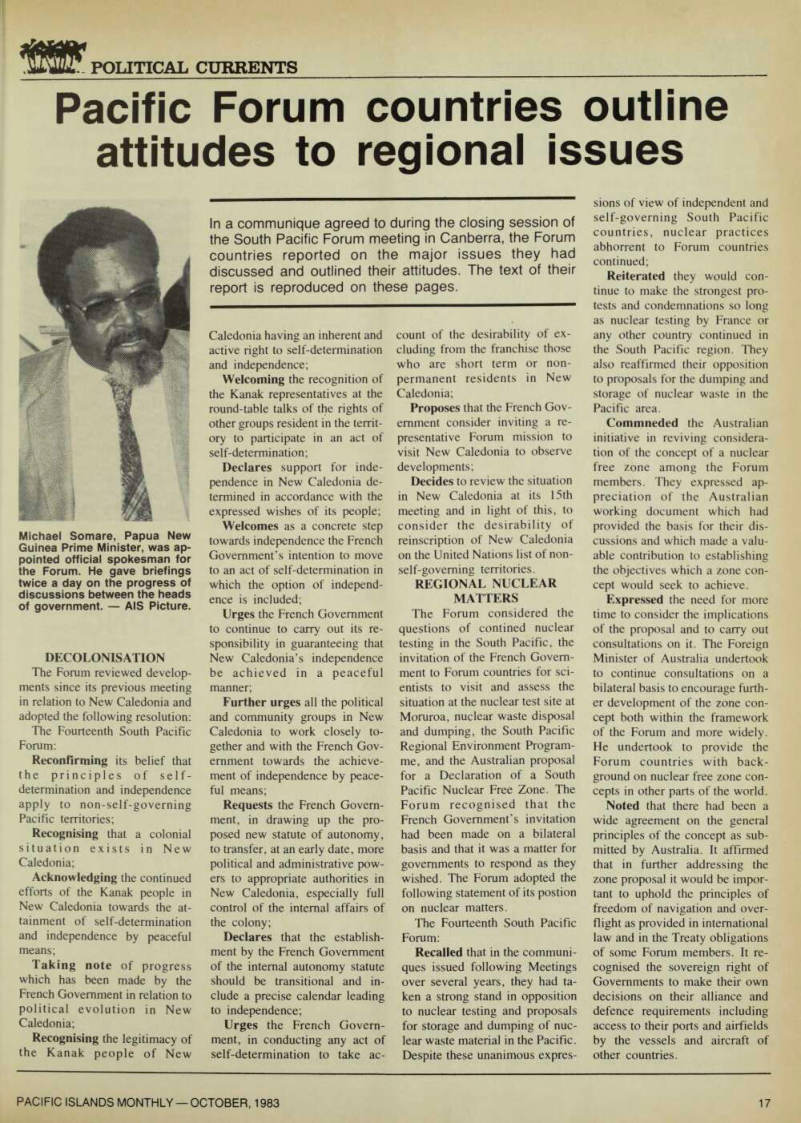
It wasn’t all hard work at the Forum meeting. Here Bob Hawke, Australian Prime Minis ter, who chaired the confer ence, meets Solomon Mama loni, Solomon Islands Prime Minister, on the tennis court.
AIS picture.
Advertisements & other items, pp. 14-16 (1 item)
Light Investment Costs
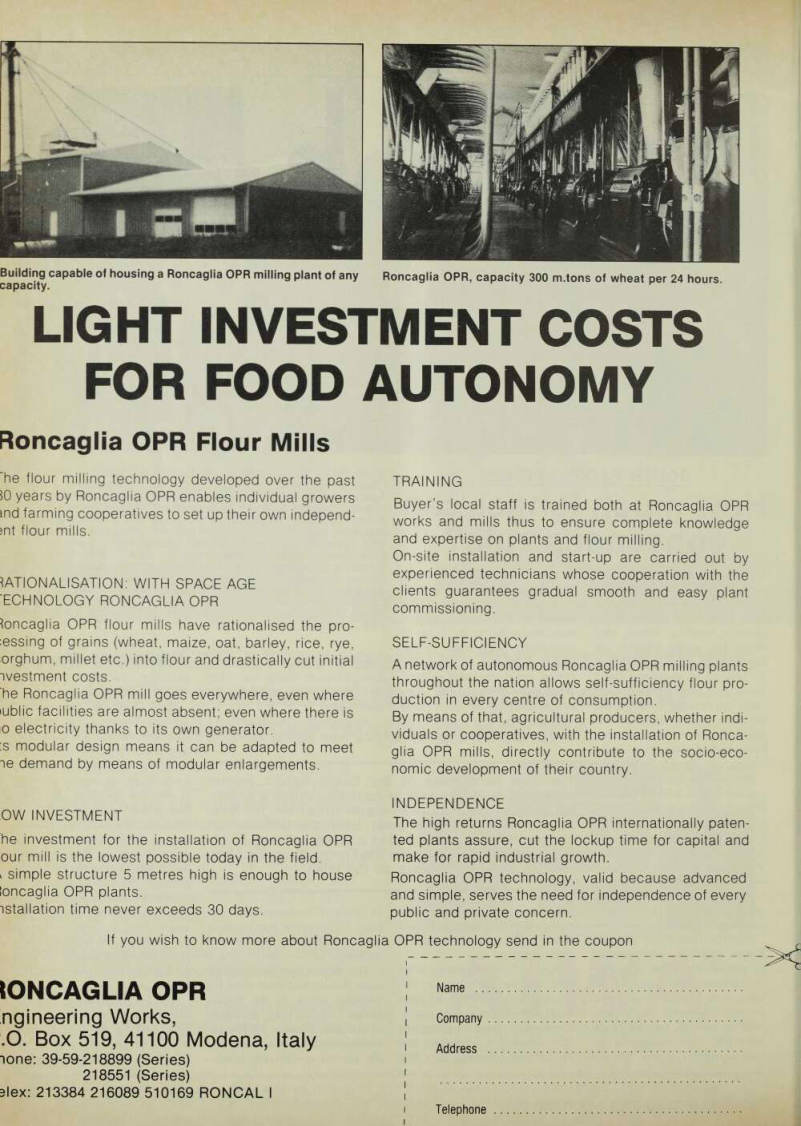
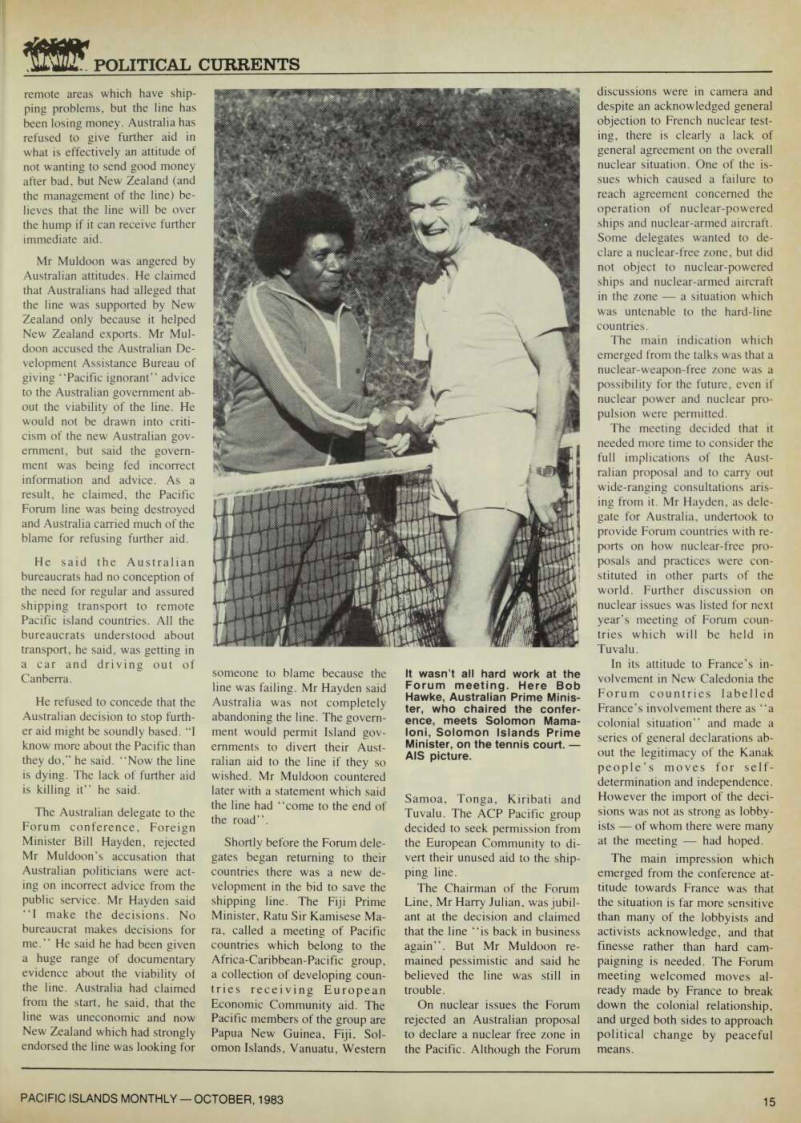
Building capable of housing a Roncaglia OPR milling plant of any Roncaglia OPR, capacity 300 m.tons of wheat per 24 hours capacity.
FOR FOOD AUTONOMY
Roncaglia OPR Flour Mills
"he flour milling technology developed over the past 50 years by Roncaglia OPR enables individual growers md farming cooperatives to set up their own independmt flour mills.
NATIONALISATION: WITH SPACE AGE
’ECHNOLOGY RONCAGLIA OPR
Noncaglia OPR flour mills have rationalised the pressing of grains (wheat, maize, oat, barley, rice, rye, orghum, millet etc.) into flour and drastically cut initial westment costs. he Roncaglia OPR mill goes everywhere, even where iublic facilities are almost absent; even where there is o electricity thanks to its own generator. :s modular design means it can be adapted to meet le demand by means of modular enlargements.
TRAINING
Buyer’s local staff is trained both at Roncaglia OPR works and mills thus to ensure complete knowledge and expertise on plants and flour milling.
On-site installation and start-up are carried out by experienced technicians whose cooperation with the clients guarantees gradual smooth and easy plant commissioning.
SELF-SUFFICIENCY
A network of autonomous Roncaglia OPR milling plants throughout the nation allows self-sufficiency flour production in every centre of consumption.
By means of that, agricultural producers, whether individuals or cooperatives, with the installation of Roncaglia OPR mills, directly contribute to the socio-economic development of their country.
OW INVESTMENT
he investment for the installation of Roncaglia OPR our mill is the lowest possible today in the field. simple structure 5 metres high is enough to house loncaglia OPR plants. istallation time never exceeds 30 days.
INDEPENDENCE
The high returns Roncaglia OPR internationally patented plants assure, cut the lockup time for capital and make for rapid industrial growth.
Roncaglia OPR technology, valid because advanced and simple, serves the need for independence of every public and private concern.
If you wish to know more about Roncaglia OPR technology send in the coupon
lONCAGLIA OPR
ngineering Works,
.0. Box 519, 41100 Modena, Italy
none: 39-59-218899 (Series) 218551 (Series)
3lex: 213384 216089 510169 RONCAL I
Name ..
Company Address Telephone
m \ -i w Ay OL I SIT nEU * ZFF!i^r, n
HEHBW.m.
M
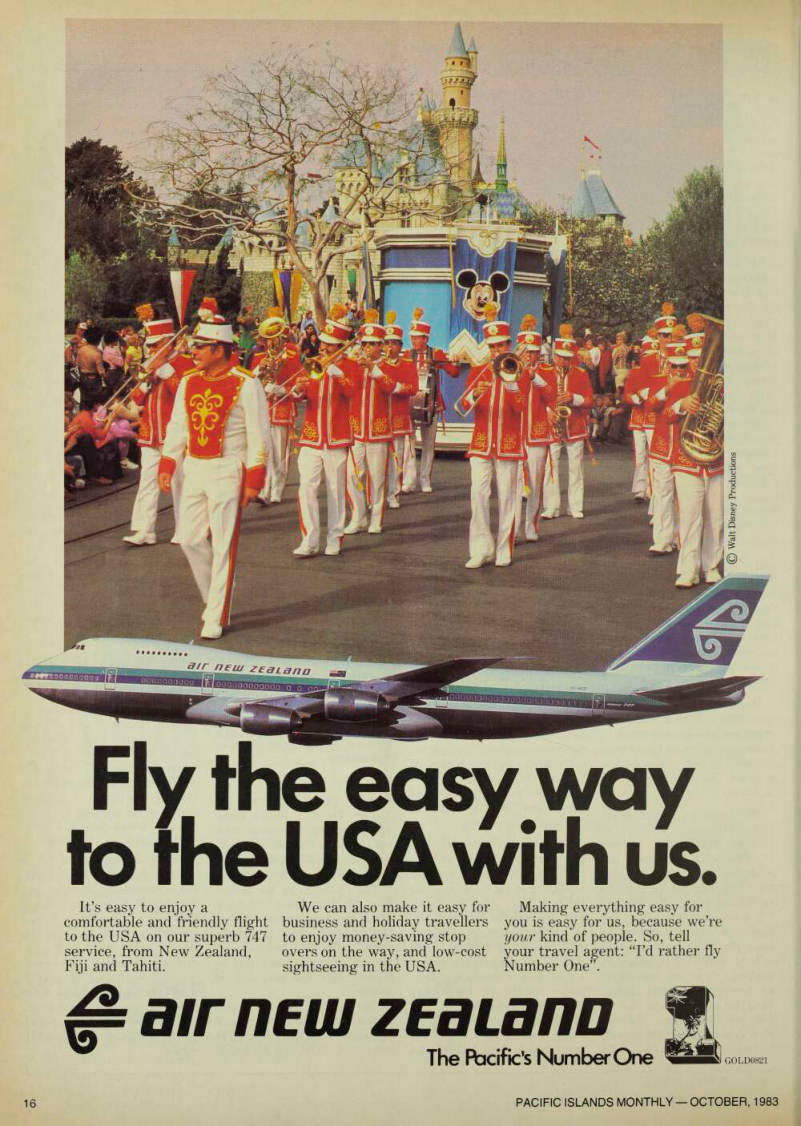
Fly the easy way
to the USA with us.
It’s easy to enjoy a We can also make it easy for Making everything easy for comfortable and friendly flight business and holiday travellers you is easy for us, because we’re to the USA on our superb 747 to enjoy money-saving stop your kind of people. So, tell service, from New Zealand, overs on the way, and low-cost your travel agent: “I’d rather fly Fiji and Tahiti. sightseeing in the USA. Number One”.
air new zeaLann
The Pacific’s Number One
m
Pacific Forum countries outline
attitudes to regional issues
Decolonisation
The Forum reviewed develop ments since its previous meeting in relation to New Caledonia and adopted the following resolution: The Fourteenth South Pacific Forum; Reconfirming its belief that the principles of self determination and independence apply to non-self-governing Pacific territories; Recognising that a colonial situation exists in New Caledonia; Acknowledging the continued efforts of the Kanak people in New Caledonia towards the at tainment of self-determination and independence by peaceful means; Taking note of progress which has been made by the French Government in relation to political evolution in New Caledonia; Recognising the legitimacy of the Kanak people of New
In a communique agreed to during the closing session of the South Pacific Forum meeting in Canberra, the Forum countries reported on the major issues they had discussed and outlined their attitudes. The text of their report is reproduced on these pages.
Caledonia having an inherent and active right to self-determination
and independence;
Welcoming the recognition of the Kanak representatives at the round-table talks of the rights of other groups resident in the territ ory to participate in an act of self-determination; Declares support for inde pendence in New Caledonia de termined in accordance with the expressed wishes of its people; Welcomes as a concrete step towards independence the French Government’s intention to move to an act of self-determination in which the option of independ ence is included; Urges the French Government to continue to carry out its re
sponsibility in guaranteeing that
New Caledonia’s independence be achieved in a peaceful manner; Further urges all the political and community groups in New Caledonia to work closely to gether and with the French Gov ernment towards the achieve ment of independence by peace ful means; Requests the French Govern ment, in drawing up the pro posed new statute of autonomy, to transfer, at an early date, more political and administrative pow ers to appropriate authorities in New Caledonia, especially full control of the internal affairs of
the colony;
Declares that the establish ment by the French Government of the internal autonomy statute should be transitional and in clude a precise calendar leading
to independence;
Urges the French Govern ment, in conducting any act of self-determination to take ac
count of the desirability of ex cluding from the franchise those who are short term or non permanent residents in New Caledonia; Proposes that the French Gov ernment consider inviting a re presentative Forum mission to visit New Caledonia to observe developments; Decides to review the situation in New Caledonia at its 15th meeting and in light of this, to consider the desirability of reinscription of New Caledonia on the United Nations list of non self-goveming territories.
Regional Nuclear
Matters
The Forum considered the questions of contined nuclear testing in the South Pacific, the invitation of the French Govern ment to Forum countries for sci entists to visit and assess the situation at the nuclear test site at Moruroa, nuclear waste disposal and dumping, the South Pacific Regional Environment Program me, and the Australian proposal for a Declaration of a South Pacific Nuclear Free Zone. The Forum recognised that the French Government’s invitation had been made on a bilateral basis and that it was a matter for governments to respond as they wished. The Forum adopted the following statement of its postion on nuclear matters.
The Fourteenth South Pacific Forum: Recalled that in the communi ques issued following Meetings over several years, they had ta ken a strong stand in opposition to nuclear testing and proposals for storage and dumping of nuc lear waste material in the Pacific.
Despite these unanimous expres
sions of view of independent and self-governing South Pacific countries, nuclear practices abhorrent to Forum countries continued; Reiterated they would con tinue to make the strongest pro tests and condemnations so long as nuclear testing by France or any other country continued in the South Pacific region. They also reaffirmed their opposition to proposals for the dumping and storage of nuclear waste in the Pacific area.
Commneded the Australian initiative in reviving considera tion of the concept of a nuclear free zone among the Forum members. They expressed ap preciation of the Australian working document which had provided the basis for their dis cussions and which made a valu able contribution to establishing the objectives which a zone con cept would seek to achieve.
Expressed the need for more time to consider the implications of the proposal and to carry out consultations on it. The Foreign Minister of Australia undertook to continue consultations on a bilateral basis to encourage furth er development of the zone con cept both within the framework of the Forum and more widely.
He undertook to provide the Forum countries with back ground on nuclear free zone con cepts in other parts of the world.
Noted that there had been a wide agreement on the general principles of the concept as sub mitted by Australia. It affirmed that in further addressing the zone proposal it would be impor tant to uphold the principles of freedom of navigation and over flight as provided in international law and in the Treaty obligations of some Forum members. It re cognised the sovereign right of Governments to make their own decisions on their alliance and defence requirements including access to their ports and airfields by the vessels and aircraft of other countries.
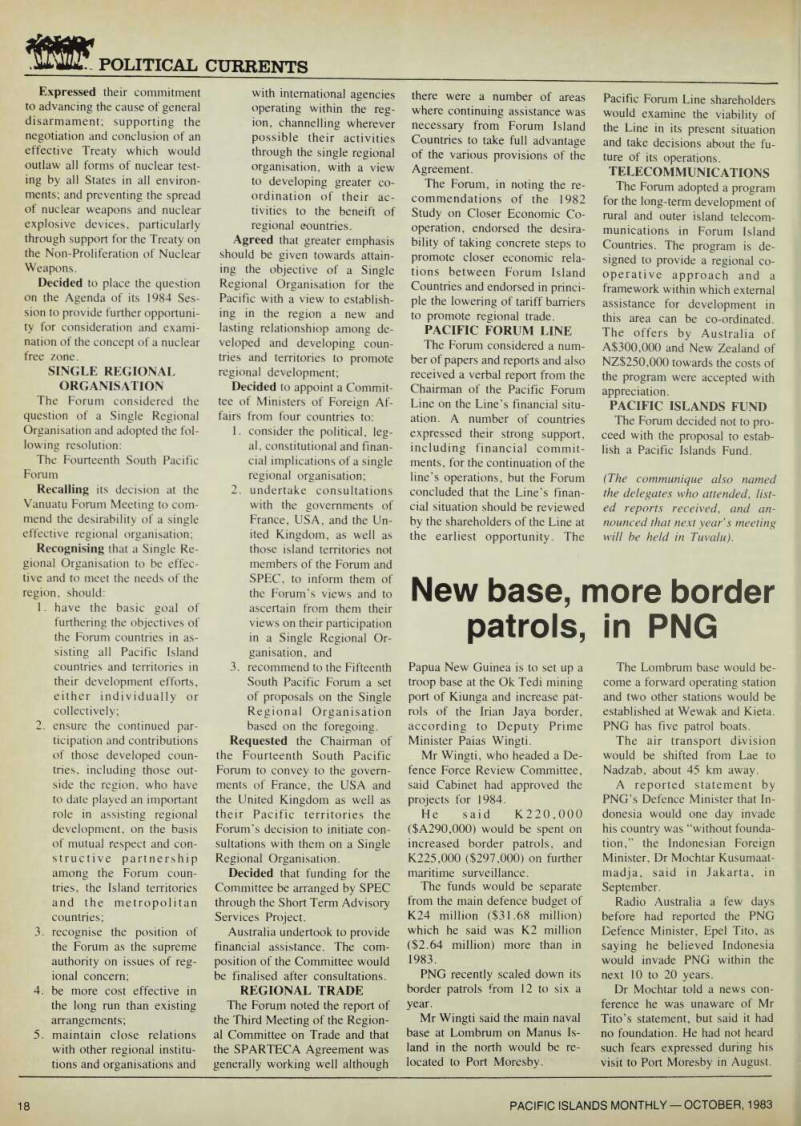
Michael Somare, Papua New Guinea Prime Minister, was ap pointed official spokesman for the Forum. He gave briefings twice a day on the progress of discussions between the heads
of government. - AIS Picture.
Expressed their commitment to advancing the cause of general disarmament; supporting the negotiation and conclusion of an effective Treaty which would outlaw all forms of nuclear test ing by all States in all environ ments; and preventing the spread of nuclear weapons and nuclear explosive devices, particularly through support for the Treaty on the Non-Proliferation of Nuclear Weapons.
Decided to place the question on the Agenda of its 1984 Ses sion to provide further opportuni ty for consideration and exami nation of the concept of a nuclear free zone.
Single Regional
Organisation
The Forum considered the question of a Single Regional Organisation and adopted the fol
lowing resolution:
The Fourteenth South Pacific Forum Recalling its decision at the Vanuatu Forum Meeting to com mend the desirability of a single effective regional organisation; Recognising that a Single Re gional Organisation to be effec tive and to meet the needs of the region, should: 1. have the basic goal of furthering the objectives of the Forum countries in as sisting all Pacific Island countries and territories in their development efforts, either individually or collectively; 2. ensure the continued par ticipation and contributions of those developed coun tries, including those out side the region, who have to date played an important role in assisting regional development, on the basis of mutual respect and con structive partnership among the Forum coun tries, the Island territories and the metropolitan countries; 3. recognise the position of the Forum as the supreme authority on issues of reg ional concern; 4. be more cost effective in the long run than existing arrangements; 5. maintain close relations with other regional institu tions and organisations and
with international agencies operating within the reg ion, channelling wherever possible their activities through the single regional organisation, with a view to developing greater co ordination of their ac tivities to the beneift of regional countries.
Agreed that greater emphasis should be given towards attain ing the objective of a Single Regional Organisation for the Pacific with a view to establish ing in the region a new and lasting relationshiop among de veloped and developing coun tries and territories to promote regional development; Decided to appoint a Commit tee of Ministers of Foreign Af fairs from four countries to; 1. consider the political, leg al, constitutional and finan cial implications of a single regional organisation; 2. undertake consultations with the governments of France, USA, and the Un ited Kingdom, as well as those island territories not members of the Forum and SPEC, to inform them of the Forum’s views and to ascertain from them their views on their participation in a Single Regional Or ganisation, and 3. recommend to the Fifteenth South Pacific Forum a set of proposals on the Single Regional Organisation based on the foregoing.
Requested the Chairman of the Fourteenth South Pacific Forum to convey to the govern ments of France, the USA and the United Kingdom as well as their Pacific territories the Forum’s decision to initiate con sultations with them on a Single Regional Organisation.
Decided that funding for the Committee be arranged by SPEC through the Short Term Advisory Services Project.
Australia undertook to provide financial assistance. The com position of the Committee would be finalised after consultations.
Regional Trade
The Forum noted the report of the Third Meeting of the Region al Committee on Trade and that the SPARTECA Agreement was generally working well although
there were a number of areas where continuing assistance was necessary from Forum Island Countries to take full advantage of the various provisions of the Agreement.
The Forum, in noting the re commendations of the 1982 Study on Closer Economic Co operation, endorsed the desira bility of taking concrete steps to promote closer economic rela tions between Forum Island Countries and endorsed in princi ple the lowering of tariff barriers to promote regional trade.
Pacific Forum Line
The Forum considered a num ber of papers and reports and also received a verbal report from the Chairman of the Pacific Forum Line on the Line’s financial situ ation. A number of countries expressed their strong support, including financial commit ments, for the continuation of the line’s operations, but the Forum concluded that the Line’s finan cial situation should be reviewed by the shareholders of the Line at the earliest opportunity. The
Pacific Forum Line shareholders would examine the viability of the Line in its present situation and take decisions about the fu ture of its operations.
Telecommunications
The Forum adopted a program for the long-term development of rural and outer island telecom munications in Forum Island Countries. The program is de signed to provide a regional co operative approach and a framework within which external assistance for development in this area can be co-ordinated.
The offers by Australia of A 5300,000 and New Zealand of NZ5250,000 towards the costs of the program were accepted with appreciation.
Pacific Islands Fund
The Forum decided not to pro ceed with the proposal to estab lish a Pacific Islands Fund. (The communique also named the delegates who attended, list ed reports received, and an nounced that next year’s meeting will be held in Tuvalu).
patrols, in PNG
New base, more border patrols, in PNG
Papua New Guinea is to set up a troop base at the Ok Tedi mining port of Kiunga and increase pat rols of the Irian Jaya border,
according to Deputy Prime
Minister Paias Wingti.
Mr Wingti, who headed a De fence Force Review Committee, said Cabinet had approved the projects for 1984.
He said K 220,000 ($A290,000) would be spent on increased border patrols, and K 225,000 ($297,000) on further maritime surveillance.
The funds would be separate from the main defence budget of K 24 million ($31.68 million) which he said was K 2 million ($2.64 million) more than in 1983.
PNG recently scaled down its border patrols from 12 to six a year.
Mr Wingti said the main naval base at Lombrum on Manus Is land in the north would be re located to Port Moresby.
The Lombrum base would be come a forward operating station and two other stations would be established at Wewak and Kieta.
PNG has five patrol boats.
The air transport di-vision would be shifted from Lae to Nadzab, about 45 km away.
A reported statement by PNG’s Defence Minister that In donesia would one day invade his country was “without founda tion,” the Indonesian Foreign Minister, Dr Mochtar Kusumaat madja, said in Jakarta, in
September.
Radio Australia a few days before had reported the PNG Defence Minister, Epel Tito, as saying he believed Indonesia would invade PNG within the next 10 to 20 years.
Dr Mochtar told a news con ference he was unaware of Mr Tito’s statement, but said it had no foundation. He had not heard such fears expressed during his visit to Port Moresby in August.
voting repeatedly
Cook Islands 1983: The year of voting repeatedly
Just 20 weeks after the March 30 1983 general elections in the Cook Islands, the Cook Islands Parliament was dissolved on Au gust 17, and new general elec tions ordered for November 2.
The strange sequence of events left the Cook Islands Par liament without any member able to command the support of a majority and thus win appoint ment as prime minister.
No sign of the potential dead lock existed in the early days of the Cook Islands Party (CIP) government under the prime ministership of Geoffrey Henry, who held a narrow but workable majority of 13-10 over the De mocratic Party (DP). The DP had lost a seat after the general elec tion in an election petition, but even if the DP were to regain it, the CIP Government was be lieved still to have an effective majority.
The events originated in a machinery provision of the Cook Islands constitution which re quires the person holding office as prime minister at the opening of a new parliament to resign as prime minister before the end of the seventh day of the session.
This provision, included in the constitution since 1965, was par ticularly designed to provide for a non-party system where there may be a number of independent members of parliament. It had been given scant regard since 1965, successive prime ministers merely going through the mo tions of resigning and being reap pointed the same day.
But Geoffrey Henry took the view immediately after his ap pointment as prime minister that this provision was no longer operative, that with the evolving Cook Islands constitution the provision could be regarded as void. Advice to this effect was tendered to the Queen’s Repre sentative, Sir Gaven Donne, by the prime minister, backed by an opinion from a New Zealand lawyer. However, conflicting ad vice was tendered by government legal officers.
To resolve the matter the Queen’s Representative in stituted proceedings in the High Court of the Cook Islands for a declaratory order. The High Court moved the matter into the Court of Appeal.
The case aroused little interest in the Cook Islands at the time of its hearing, June 30, as it ap peared to be a pure technicality.
The Court of Appeal reserved its decision.
But two events then occurred which transformed the ruling of the court into one of great politic al consequence.
The first was the sudden death of CIP Member of Parliament for Titikaveka, Matapo Matapo, on July 25. This trimmed Geoffrey Henry’s CIP majority to 12-10.
Now two by-elections were outstanding.
The second event was the de cision of CIP Cabinet member Tupui Henry to withdraw his support for the appointment of Geoffrey Henry as prime minister.
The DP had always en couraged dissension in the CIP camp over the leadership issue, and had publicly supported Tupui Henry over Geoffrey Hen ry. That support was now reach ing new proportions: Tupui Hen ry announced in the Cook Islands News he had been “made an offer” by the DP.
The withdrawal of Tupui Hen ry’s support meant that Geoffrey Henry no longer had a majority in Parliament. He commanded only 11 seats. Tupui Henry, with the support of the DP, also com manded 11. Two by-elections were due to be held, and there was speculation that Tupui Hen ry had the tacit support of other
Cip Mps.
The Court of Appeal’s deci sion on July 29, upheld the letter of the constitution and confirmed that Geoffrey Henry was re quired to resign by the end of the seventh day of the session, Au gust 2.
Immediately Tupui Henry and the DP confirmed their position
as supporting a coalition govern ment with Tupui Henry as prime minister.
Geoffrey Henry resigned on August 2, his Cabinet being dis solved with his resignation. The Queen’s Representative, as ex ecutive authority, took over the reins of government.
Speculation was rife for sever al days, as Tupui Henry an nounced that three other CIP Members of Parliament would join him in a coalition govern ment. Geoffrey Henry announed that none would join Tupui Hen ry: the ranks of the CIP were closed.
While the contest for numbers continued a new dimension was emerging: the role of the Queen’s Representative.
In the first instance that role was merely to determine the numbers: to ascertain whether any one MP commanded the sup port of the majority of the mem bers. To do this Sir Gaven ar ranged for a series of votes to be taken among the members over a number of days, the voting for each prospective leader (Geof frey Henry CIP, Vincent Ingram DP, and Tupui Henry coalition) being taken on separate days.
As at August 10, the position was Geoffrey Henry 11, Tupui Henry 11.
Sir Gaven’s role at this point became something more than merely determining the numbers.
In a matter of two days, on August 12, a by-election was to be held which would end the numbers game one leader would have a majority, and a government could be appointed.
But Sir Gaven saw the situation as demanding recognition of other factors.
The DP was favored to win the Atiu seat. Its candidate had held it since before self-government in 1965. A DP victory would mean that the DP would come back to power with the one CIP member (Tupui Henry) in the coalition government.
As opposed to this, Sir Gaven Donne was faced with the clear
victory the CIP had had in the March 30 general election. The CIP had held the other seat (Titikaveka) which was to have a by-election in November. If that by-election were to be held be fore the Atiu one, and the CIP were to retain the seat, then the CIP would have been able to remain in government under Geoffrey Henry as prime minister.
A DP victory in the Atiu by election could have meant the Tupui Henry-DP Government being in power for up to a year, for even if the CIP retained the Titikaveka seat a budget could have been passed by the parlia ment then in session before the Titikaveka by-election, and par liament not called together until the need to pass another.
The dissolution of parliament before the Atiu by-election seemed the likely course. In this way the voters would again have their say. But the prospect of an early general election was not one to be welcomed.
Sir Gaven sought a possible compromise by inviting the lead ers to await the outcome of both the Atiu and Titikaveka by elections before the step of ap pointment of a government or dissolution would be taken.
Tupui Henry and Vincent In gram (as Leader of the Oppos tion), believing there were good prospects that the DP would win both seats, agreed to this. The DP had previously held the Titikaveka seat and lost it in the March 30 general election to the CIP candidate, who held a strong personal following in his village.
His death would increase the chances of the DP candidate.
Geoffrey Henry, apparently for similar reasons, declined Sir Ga ven’s invitation.
The decision was thus taken on August 17, to dissolve parlia ment. Geoffrey Henry was ap pointed caretaker prime minister, with restricted powers in policy areas, until a general election on November 2. Trevor Clarke in Rarotonga.
that became
“The scandal that became a bore”
Under the headline “The scandal that has become a bore”, jour nalist Stephen Rice wrote in The Sydney Morning Herald of Sep tember 9: “Almost everyone in Fiji will heave a sigh of relief later this month when Sir John White hands down his report on allega tions of outside interference in the country’s last elections.”
Rice noted that the relief will undoubtedly be shared by the Australian Broadcasting Com mission producer Peter Manning, whose Four Comers programs sparked both the Fiji inquiry and another Royal Commission held in Sydney earlier this year into suggestions on a Four Comers program that the Premier of New South Wales, Neville Wran, may have acted to pervert the course of justice in a 1977 court case in
Sydney. The Sydney inquiry
completely vindicated Mr Wran, but Rice adds: “ ... it seems unlikely that Fiji’s Prime Minis ter Ratu Sir Kamisese Mara will emerge from his Royal Commis sion with as little evident damage as Mr Wran.
“The Wran Royal Commis sion undoubtedly left some bit terness in its wake, but the Fiji inquiry has been forced to ex amine allegations which go to the heart of racial policy in that country.”
After canvassing the issues in the Fiji inquiry, including the alleged involvement of Aust ralians Alan Carroll and Clive Speed in devising the election campaign strategy of Ratu Mara’s Alliance Party, and Ratu Mara’s allegations of Soviet political and financial involve ment in supporting the Opposi tion National Federation Party, Rice writes: “Ratu Mara has claimed the Russians wanted him to lose the 1982 election because they re garded him as an obstacle to their efforts to win influence in the South Pacific Islands . . .
“Many people in Fiji have become bored by the examina tion and re-examination of the
Carroll-Speed allegations and
consider the Royal Commission
an unjustified waste of time and money (about $lOOO a day).
“The inquiry was promised by the government (and supported by the oppostion) in the highly charged atmosphere of last year’s election campaign.
“But neither side has emerged well from the inquiry, and both will probably be happy when it is well behind them.’’
judge rules
Palau defeat, judge rules
The Compact of Free Associa tion between Palau and the Un ited States which was voted on last February was defeated, ruled Judge Robert A. Hefner of the Palau Supreme Court, in August.
In the plebiscite, the Palau people approved one part of the ballot but a majority voted against the nuclear section on the second section of the ballot.
The Pacific Daily News quoted Palau Ambassador Lazarus E. Salii as saying Judge Hefner ruled the two parts of the ballot were inseparable.
Thus when a majority of vo ters rejected the section of the ballot which would allow nuclear and toxic substances in Palau, they rejected the entire compact, the ruling said.
The suit was filed in May by Palau High Chief Ibedul Yutaka Gibbons and six senators asking that the Compact be declared not approved. The suit also alleges Palau President Haruo I. Re meliik, Vice-President Alfonso Oiterong, Salii and Minister of Administration Haruo Wilter misspent $230,000 in public funds to “wrongfully influence
the plebiscite.”
The senators who joined Gib bons in the lawsuit are Moses Uludong, Kuniwo Nakamura, Johnson Toribiong, Edobo Temengiil, Joshua Koshiba and
Peter Sugiyama.
With Hefner’s ruling, the trea ty signed in July by Salii and Zeder in an attempt to resolve the nuclear dilemma when the voters rejected the nuclear section in the plebiscite is now moot, said Salii and Smith.
The second part of the suit, which alleges that money was misspent, was not addressed in the ruling. It will be resolved in a later hearing, PDN said.
Advertisements & other items, p. 20 (1 item)
AslBo,ooo
11
CARGO VESSEL FOR SALE
405 gross tons, 166 net, 420 dwt.
Length 47.3 metres, Beam 7.5 metres. Draft 3.8 metres.
Dcutz SBA 8M Diesel, 585 S.H.P. at 750 rpm. 2.5: 1 reduction driving variable pitch propeller giving about 10.5 knots. 2 holds giving 28 000 cu ft grain capacity.
Hydraulic deck gear with swinging derricks.
No. 1 hatch 3 ton s.w.l. No. 2 hatch 5 ton s.w.l.
Radar, auto pilot, 5.5.8., V.H.F.
In class with Bureau Veritas and in excellent condition.
Lying at Port-Vila, Vanuatu.
AslBo,ooo
Contact: Vanua Navigation Ltd.
P.O. Box 44, Port-Vila, Vanuatu Telephone: 2027, 2028. Telex: 1033 VANUA
The International Marketing Institute of Australia
offers
A MARKETING FELLOWSHIP
with tuition and accommodation paid at top Australian marketing programme The R. N. McDonald Fellowship entitles the successful nominee to free attendance at the Institute’s Intermediate Programme for Development in Marketing with 50 Australian marketing executives.
To be held: January 15-28, 1984 Mitchell College of Advanced Education. Bathurst. NSW Australia The course is taught by leading American and Australian instructors. Preference in awarding this Fellowship will be given to applicants of Polynesian or Melanesian birth.
Complete and mail coupon below for further details and nomination form.
The International Marketing Institute of Australia 35-43 Clarence St., Sydney, NSW 2000, Australia Please send me details of the R. N. McDonald Fellowship: Name: Organisation: Address: Country
Havila School
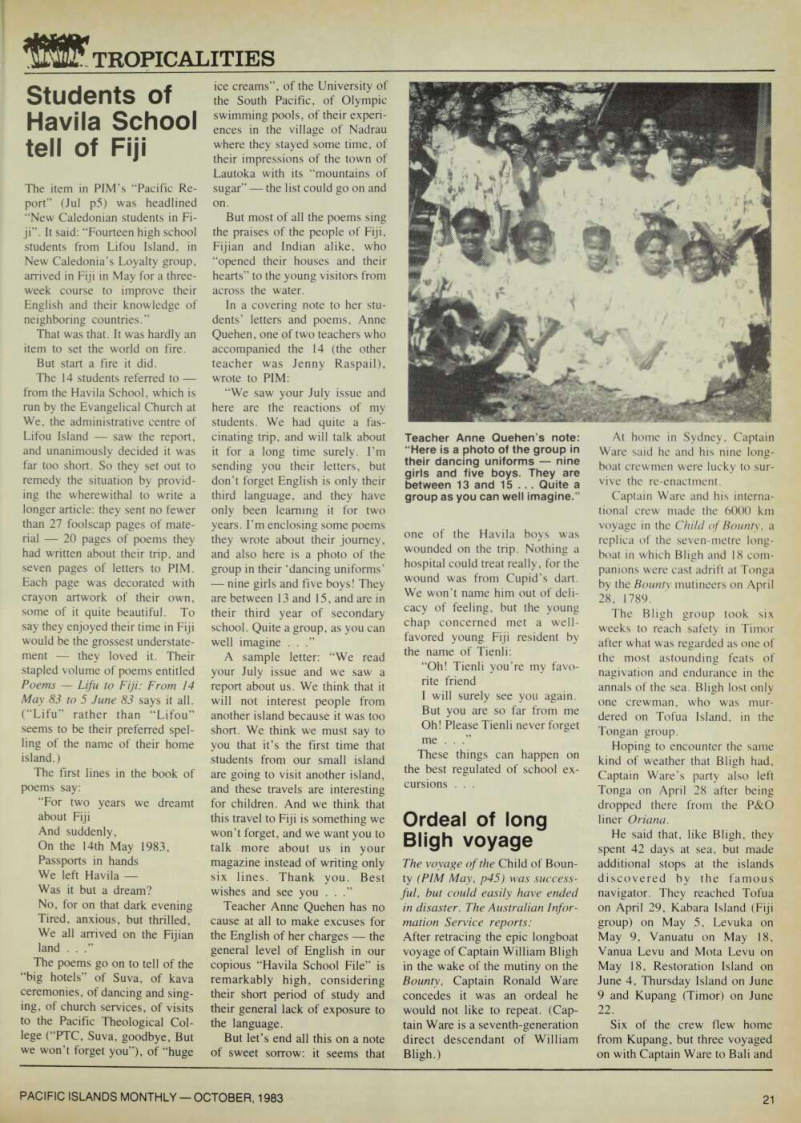

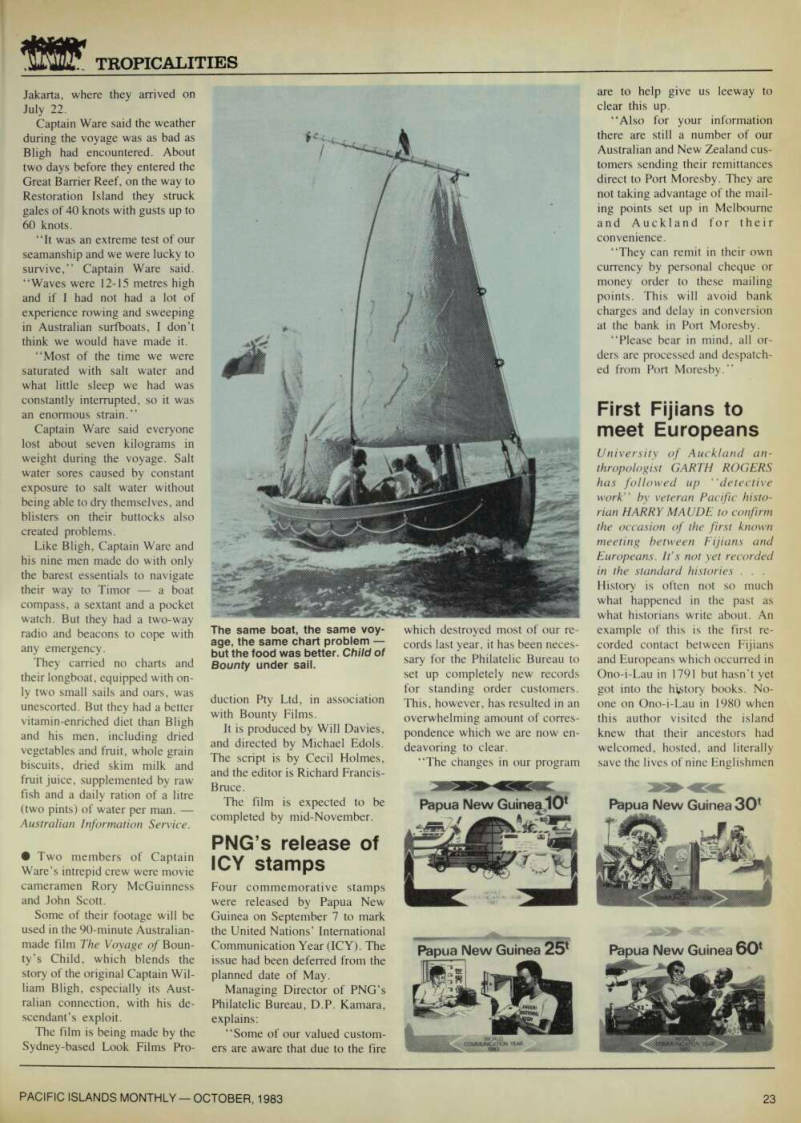
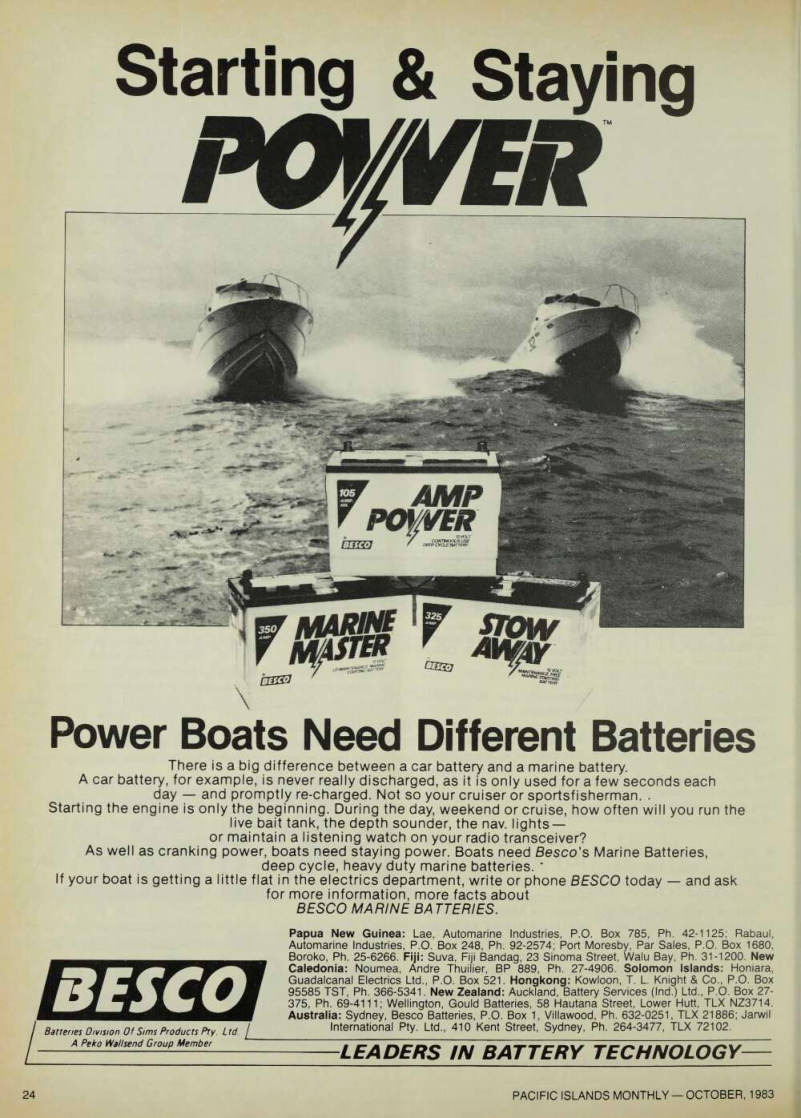
Tropicalities
Students of Havila School tell of Fiji
The item in PIM’s “Pacific Re port” (Jul p5) was headlined “New Caledonian students in Fi ji”. It said: “Fourteen high school students from Lifou Island, in New Caledonia’s Loyalty group, arrived in Fiji in May for a three week course to improve their English and their knowledge of
neighboring countries.”
That was that. It was hardly an item to set the world on fire.
But start a fire it did.
The 14 students referred to — from the Havila School, which is run by the Evangelical Church at We, the administrative centre of Lifou Island — saw the report, and unanimously decided it was far too short. So they set out to
remedy the situation by provid
ing the wherewithal to write a longer article: they sent no fewer than 27 foolscap pages of mate rial — 20 pages of poems they had written about their trip, and seven pages of letters to PIM.
Each page was decorated with crayon artwork of their own, some of it quite beautiful. To say they enjoyed their time in Fiji would be the grossest understate ment — they loved it. Their stapled volume of poems entitled Poems — Lifu to Fiji: From 14 May 83 to 5 June 83 says it all. (“Lifu” rather than “Lifou” seems to be their preferred spel ling of the name of their home island.) The first lines in the book of poems say; “For two years we dreamt
about Fiji
And suddenly,
On the 14th May 1983, Passports in hands We left Havila — Was it but a dream?
No, for on that dark evening Tired, anxious, but thrilled, We all arrived on the Fijian land ...”
The poems go on to tell of the “big hotels” of Suva, of kava ceremonies, of dancing and sing ing, of church services, of visits to the Pacific Theological Col lege (“PTC, Suva, goodbye, But we won’t forget you”), of “huge
ice creams”, of the University of the South Pacific, of Olympic swimming pools, of their experi ences in the village of Nadrau where they stayed some time, of their impressions of the town of Lautoka with its “mountains of sugar” the list could go on and on.
But most of all the poems sing the praises of the people of Fiji, Fijian and Indian alike, who “opened their houses and their hearts” to the young visitors from across the water.
In a covering note to her stu dents’ letters and poems, Anne Quehen, one of two teachers who accompanied the 14 (the other teacher was Jenny Raspail), wrote to PIM; “We saw your July issue and here are the reactions of my students. We had quite a fas cinating trip, and will talk about it for a long time surely. I’m sending you their letters, but don’t forget English is only their third language, and they have only been learning it for two years. I’m enclosing some poems they wrote about their journey, and also here is a photo of the group in their ‘dancing uniforms’ nine girls and five boys! They are between 13 and 15, and are in their third year of secondary school. Quite a group, as you can well imagine ...”
A sample letter; “We read your July issue and we saw a report about us. We think that it will not interest people from another island because it was too short. We think we must say to you that it’s the first time that students from our small island are going to visit another island, and these travels are interesting for children. And we think that this travel to Fiji is something we won’t forget, and we want you to talk more about us in your magazine instead of writing only six lines. Thank you. Best wishes and see you ...”
Teacher Anne Quehen has no cause at all to make excuses for the English of her charges the general level of English in our copious “Havila School File” is
remarkably high, considering
their short period of study and their general lack of exposure to
the language.
But let’s end all this on a note of sweet sorrow: it seems that
At home in Sydney, Captain Ware said he and his nine long boat crewmen were lucky to sur vive the re-enactment.
Captain Ware and his interna tional crew made the 6000 km voyage in the Child of Bounty, a replica of the seven-metre long boat in which Bligh and 18 com panions were cast adrift at Tonga by the Bounty mutineers on April 28, 1789.
The Bligh group took six weeks to reach safety in Timor after what was regarded as one of the most astounding feats of nagivation and endurance in the annals of the sea. Bligh lost only one crewman, who was mur dered on Tofua Island, in the Tongan group.
Hoping to encounter the same kind of weather that Bligh had.
Captain Ware’s party also left Tonga on April 28 after being dropped there from the P&O liner Ohana.
He said that, like Bligh, they spent 42 days at sea, but made additional stops at the islands discovered by the famous navigator. They reached Tofua on April 29, Kabara Island (Fiji group) on May 5, Levuka on May 9, Vanuatu on May 18, Vanua Levu and Mota Levu on May 18, Restoration Island on June 4, Thursday Island on June 9 and Kupang (Timor) on June 22.
Six of the crew flew home from Kupang, but three voyaged on with Captain Ware to Bali and
one of the Havila boys was wounded on the trip. Nothing a hospital could treat really, for the wound was from Cupid’s dart.
We won’t name him out of deli cacy of feeling, but the young chap concerned met a well favored young Fiji resident by the name of Tienli: “Oh! Tienli you’re my favo rite friend I will surely see you again.
But you are so far from me Oh! Please Tienli never forget me . .
These things can happen on the best regulated of school ex cursions . . .
Ordeal of long
Bligh voyage
The voyage of the Child of Boun ty (PIM May, p 45) was success ful, but could easily have ended in disaster. The Australian Infor mation Service reports: After retracing the epic longboat voyage of Captain William Bligh in the wake of the mutiny on the Bounty, Captain Ronald Ware concedes it was an ordeal he would not like to repeat. (Cap tain Ware is a seventh-generation direct descendant of William Bligh.)
Teacher Anne Quehen’s note: “Here is a photo of the group in
their dancing uniforms - nine
girls and five boys. They are between 13 and 15 . . . Quite a group as you can well imagine.”
Jakarta, where they arrived on July 22.
Captain Ware said the weather during the voyage was as bad as Bligh had encountered. About two days before they entered the Great Barrier Reef, on the way to Restoration Island they struck gales of 40 knots with gusts up to 60 knots.
“It was an extreme test of our seamanship and we were lucky to survive,” Captain Ware said.
“Waves were 12-15 metres high and if I had not had a lot of
experience rowing and sweeping
in Australian surfboats, I don’t think we would have made it.
“Most of the time we were saturated with salt water and what little sleep we had was constantly interrupted, so it was an enormous strain.”
Captain Ware said everyone lost about seven kilograms in weight during the voyage. Salt water sores caused by constant exposure to salt water without being able to dry themselves, and blisters on their buttocks also created problems.
Like Bligh, Captain Ware and his nine men made do with only the barest essentials to navigate their way to Timor a boat compass, a sextant and a pocket watch. But they had a two-way radio and beacons to cope with any emergency.
They carried no charts and their longboat, equipped with on ly two small sails and oars, was unescorted. But they had a better vitamin-enriched diet than Bligh and his men, including dried vegetables and fruit, whole grain biscuits, dried skim milk and fruit juice, supplemented by raw fish and a daily ration of a litre (two pints) of water per man.
Australian Information Service. • Two members of Captain Ware’s intrepid crew were movie cameramen Rory McGuinness and John Scott.
Some of their footage will be used in the 90-minute Australian made film The Voyage of Boun ty’s Child, which blends the story of the original Captain Wil liam Bligh, especially its Aust ralian connection, with his de
scendant’s exploit.
The film is being made by the Sydney-based Look Films Pro-
duction Pty Ltd, in association with Bounty Films.
It is produced by Will Davies, and directed by Michael Edols.
The script is by Cecil Holmes, and the editor is Richard Francis- Bruce.
The film is expected to be completed by mid-November.
PNG’s release of
ICY stamps
Four commemorative stamps were released by Papua New Guinea on September 7 to mark the United Nations’ International Communication Year (ICY). The issue had been deferred from the planned date of May.
Managing Director of PNG’s Philatelic Bureau, D.P. Kamara, explains: “Some of our valued custom ers are aware that due to the fire
which destroyed most of our re cords last year, it has been neces sary for the Philatelic Bureau to set up completely new records for standing order customers.
This, however, has resulted in an overwhelming amount of corres pondence which we are now en deavoring to clear.
“The changes in our program
are to help give us leeway to clear this up.
“Also for your information there are still a number of our Australian and New Zealand cus tomers sending their remittances direct to Port Moresby. They are not taking advantage of the mail ing points set up in Melbourne and Auckland for their convenience.
“They can remit in their own currency by personal cheque or money order to these mailing points. This will avoid bank charges and delay in conversion at the bank in Port Moresby.
“Please bear in mind, all or ders are processed and despatch ed from Port Moresby.”
First Fijians to
meet Europeans
University of Auckland an thropologist GARTH ROGERS has followed up “detective work ” by veteran Pacific histo rian HARRY MAUDE to confirm the occasion of the first known meeting between Fijians and Europeans. It’s not yet recorded in the standard histories . . .
History is often not so much what happened in the past as what historians write about. An example of this is the first re corded contact between Fijians and Europeans which occurred in Ono-i-Lau in 1791 but hasn’t yet got into the history books. No one on Ono-i-Lau in 1980 when this author visited the island knew that their ancestors had welcomed, hosted, and literally save the lives of nine Englishmen
The same boat, the same voy age, the same chart problem but the food was better. Child of Bounty under sail.
who stayed nearly five weeks off their island, before any other recorded contact in Fiji between Fijian and European. Captain
Stanley Brown obviously didn’t
know about it when he wrote Men from Under the Sky in 1973, and Kim Gravelle didn’t metion it in his Fiji’s Times: A History of Fiji (1979).
The men, as pointed out by Robert Langdon in an article in PIM in August 1961 (p. 29), were William Oliver (vessel comman der, aged 21), David Renouard (midshipman aged 16, and au thor of the only extant record of the voyage), and seven others, who were sailing the Matavy from Tahiti to Java as a tender to H.M.S. Pandora, captain Edwards.
Having lost contact with their captain in the Pandora these nine men ran out of food, then water, and were nearly dead with expo sure and weakness when they discovered and hove-to off “Three Islands” to the south west of Tutuila believing them to be the southern Tongan islands where they were supposed to rendezvous with the Pan dora. The problem is, and it has taxed historians from Basil Thomson to Robert Langdon, where did these mariners sojourn for nearly five weeks in close and peaceful contact with South Sea Islanders?
The answer has come from veteran Pacific historian Harry Maude who published his results in The Mariner’s Mirror, vol. 50, 1964. Working sleuth-like from Renouard’s journal (which
he reproduced in his article), old chants, and obscure 19th-century writings, Maude came to the conclusion that the mystery is land was Ono-i-Lau in Fiji, that the Matavy’s crew were the “first Europeans to have any intercourse with the Fijian peo ple, and the first to land on Fijian soil.”
In June 1980 this author visited Ono-i-Lau with the ex press purpose of trying to vali date or disprove Maude’s claim from local evidence, and came to the conclusion that Maude is correct and that future historians will have to change the story of Fiji. My evidence is all from geography and from discussion with Ono people.
Maude deduced that the vessel was running due west when Re nouard sighted “land ahead in the form of two sugar loaves.”
And, sure enough, viewed from the east, the high point on Onolevu called Delailoa (113 m), and the highest peak of Doi called Naisoyaga (85m), both ash-cones, appear side by side on the horizon, like two clenched fists (see photo), with no other prominent peak in the vicinity.
Renouard described how, on June 27, 1791, the Matavy closed with the eastern reef about 4 pm, how canoes unsuccessfully attempted to come off through the heavy surf, and how both parties met later when the canoes came out of a “bay” and pulled
alongside with life-giving
coconuts.
Maude’s identification of the Mana islets as the original land
fall is fully borne out by my
investigations. People were visit
ing uninhabited Marra in June and July 1980 to fish and to gather coconuts, and there is a barrier reef running north from that point to the northeast pas sage which appears from the east to be a large bay or indentation in the northern reef.
Renouard declares they dis covered three islands, whereas to any Fijian speaker, Ono-i-Lau obviously denotes six. But as Maude astutely points out there are just three central volcanic islands and three limestone reef islets. Anyone knowing the Pacific would agree that it is often difficult to decide just what constitutes an island. Moreover, as Robert Langdon observes (PIM Aug ’6l p. 33), Renouard probably wrote up his narrative several years after his return to England when the memory of their search for Tonga’s “three islands’’ was stronger than the reality of the number of islands, islets, and sandbanks at Ono-i- Lau.
Renouard claims they took in water at “A small island situated about five leagues from Toofoa (i.e., Ono-i-Lau) ... a business rendered very tedious by the na tives who brought it off in very small quantities ... in calabashes and cocoa nut shells’’.
Two sand bays known as the Tuvanas are situated about 22 sea miles south of Ono-i-Lau and are clearly visible from the summit of Delailoa. Both islets have a permanent supply of fresh water
in a well (Tuvana-i-Colo) and a limestone cave (Tuvana-i-Ra) and either islet could have watered the Matavy.
On leaving their mystery is land, the Matavy crew took on a supply of yams “to last on an average near three months, be sides, a number of hogs and provender for them, with sundry other necessaries’’.
Ono-i-Lau is well known in Fiji for its fine yams and Ono farmers still take great pride in their yam patches and yam stores. June is the principal har vest month and July would prob ably see the greatest number in storage, thus neatly coinciding with the Matavy’s visit.
There is no doubt whatever that Maude is correct in designat ing Ono-i-Lau as the rendezvous island of the Matavy, and that this was the first recorded meet ing of Fijians with Europeans in Fiji. Maude has thus done a service to both history and to Fijians by demonstrating the un stinting generosity and lack of hostility afforded the Englishmen over so long a period for what must have been a very poor material return. In so preserving the Matavy crew, the ancient warriors of Ono-i-Lau made it possible for one Englishman to bequeath this valuable document
to their heirs.
Garth Rogers.
The island of Ono-i-Lau photo graphed from the east. The two “sugar loaves" are clearly vis ible in the generally flat ex panse of the horseshoe-shaped island. Garth Rogers picture.
Advertisements & other items, pp. 22-26 (1 item)
0 Hitachi
Flawless concert reproduction is now within reach If you are still wondering what all the cheering is about concerning digital audio, you probably haven’t heard the DA-1000 or DA-800. Two compact disc digital audio players from a recognized leader in the field Hitachi.
Compact disc digital audio players utilize an ultra-thin laser beam to “read” digitally encoded compact discs (CDs). This allows performance levels that surpass even the finest analogue turntable. And with results that are nothing short of spectacular.
They produce crisp, pure sound, preserving every ounce of the original performance’s spine-tingling realism.
The wonders of the DA-1000 and DA-800 do not end with flawless sound reproduction. They also include amazing playback versatility.
With fingertip simplicity you can execute an entire series of playback options, such as a programming feature that allows you to play up to 15 selections, in any sequence, automatically.
Words cannot accurately describe this remarkable experience.
You’re simply going to have to listen and judge for yourself.
Do it soon. But hold your applause until the end. You won’t want to miss a single note.
DA-1000 • Compact audio component size (W XHX D: 320 X 145 X 234 mm) • Vertical front-loading system • Multiple programming options: Repeat, Random Memory Programming, SPSS, Manual Search, Memory Stop • Location Indicator DA-800 • Standard component size (WXHX D; 435 X 110 X 264 mm) • Horizontal frontloading system • Multiple programming options: 4-way Repeat, Random Memory Programming, Auto DRPS, SPSS, Index Search, Manual Search
Hitachi
Compact Disc
Digital Audio Players
Kifiwarnjtn)
0 HITACHI
A World Leader in Technology • AUSTRALIA: Hitachi Sales Australia Pty., Ltd., 153 Keys Road, Moorabbin, Victoria 3189 Phone: (555) 8722 • PAPUA NEW GUINEA: S.O. Svensson (N.G.) Ltd., P.O. Box 705, Port Moresby Phone: 21-2111 • FIJI ISLANDS: Burns Philp(South Sea)Company Ltd., G.P.O. Box 355, Suva Phone: 311777 • NEW CALEDONIA: Caldis, B P Ml, Noumea Phone; 26. 23. 50 •TAHITI: Ets Chene Alain, P.O. Box 272, Papeete Phone: 2. 88 68. • SOLOMON ISLANDS : Technique Radios Centre Ltd., P.O. Box 465, Honiara Phone: 416
Starting & Staying
MS & F,
AMP
POfftfEß
~m / cofmNuoususe
fl f DEEP CVCLS BATTER*
rm**
CURD
a p'
MARJNI
new
CZ& (JS&
Power Boats Need Different Batteries
There is a big difference between a car battery and a marine battery.
A car battery, for example, is never really discharged, as it is only used for a few seconds each day and promptly re-charged. Not so your cruiser or sportsfisherman. .
Starting the engine is only the beginning. During the day, weekend or cruise, how often will you run the live bait tank, the depth sounder, the nav. lights or maintain a listening watch on your radio transceiver?
As well as cranking power, boats need staying power. Boats need Besco’s Marine Batteries, deep cycle, heavy duty marine batteries. * If your boat is getting a little flat in the electrics department, write or phone BESCO today and ask for more information, more facts about
BESCO MARINE BA TTERIES.
BESCO
Batteries Division Of Sims Products Pry. L td. j_ A Peko hVa/lsend Group Member Papua New Guinea: Lae, Automarine Industries, P.O. Box 785, Ph. 42-1125; Rabaul, Automarine Industries, P.O. Box 248, Ph. 92-2574; Port Moresby, Par Sales, P.O. Box 1680, Boroko, Ph. 25-6266. Fiji: Suva, Fiji Bandag, 23 Sinoma Street, Walu Bay, Ph. 31-1200. New Caledonia: Noumea, Andre Thuilier, BP 889, Ph. 27-4906. Solomon Islands: Honiara, Guadalcanal Electrics Ltd., P.O. Box 521. Hongkong: Kowloon, T. L. Knight & Co., P.O. Box 95585 IST, Ph. 366-5341. New Zealand: Auckland, Battery Services (Ind.) Ltd., P.O. Box 27- 375, Ph. 69-4111; Wellington, Gould Batteries, 58 Hautana Street, Lower Hurt, TLX NZ3714.
Australia: Sydney, Besco Batteries, P.O. Box 1, Villawood, Ph. 632-0251, TLX 21886; Jarwil International Pty. Ltd., 410 Kent Street, Sydney, Ph. 264-3477, TLX 72102.
LEADERS IN BATTERY TECHNOLOGY
I m v- * '~3 ST" 4 V
The portable party
It's light. It’s compact. Its 3-way power supply (AC/battery/car] lets you take it anywhere. And anywhere you take it, it’s bound to start a party. Simply because it sounds so good.
It’s the RX-C 45 3-piece portable stereo system by National.
And when the party gets hot, the RX-C4s’s got the right stuff to handle it. A big 40 watts peak music power output- perfect for the highenergy sound of Earth, Wind and Fire (the superstar group that gives us the pro’s pointof-view on all our portable designs]. And a 5-band graphic equalizer that lets you shape the sound to the acoustics of your listening area indoors or put.
The metal tape compatible cassette deck features a long life AX amorphous record/playback head (usually found only in the very best hi-fi cassette decks] that delivers startlingly crisp sound with an exceptionally wide frequency response through the detachable 2-way/ 4-speaker system. The MW/SWI/SW2/FM stereo receiver offers accurate tuning and an LED indicator for FM stations broadcasting in stereo.
The RX-C 45. Go for it! Then get ready to party.
National V:
National
National, Panasonic and Technics are the brandnames of Matsushita Electric.
People
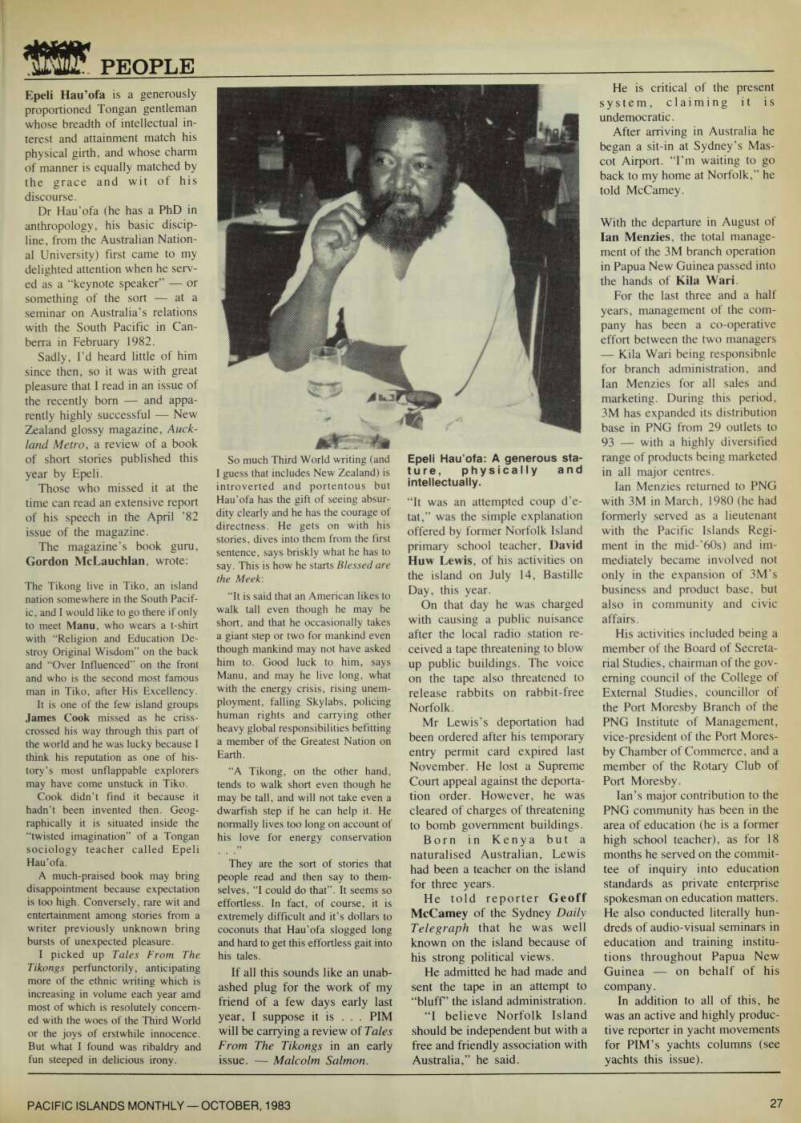

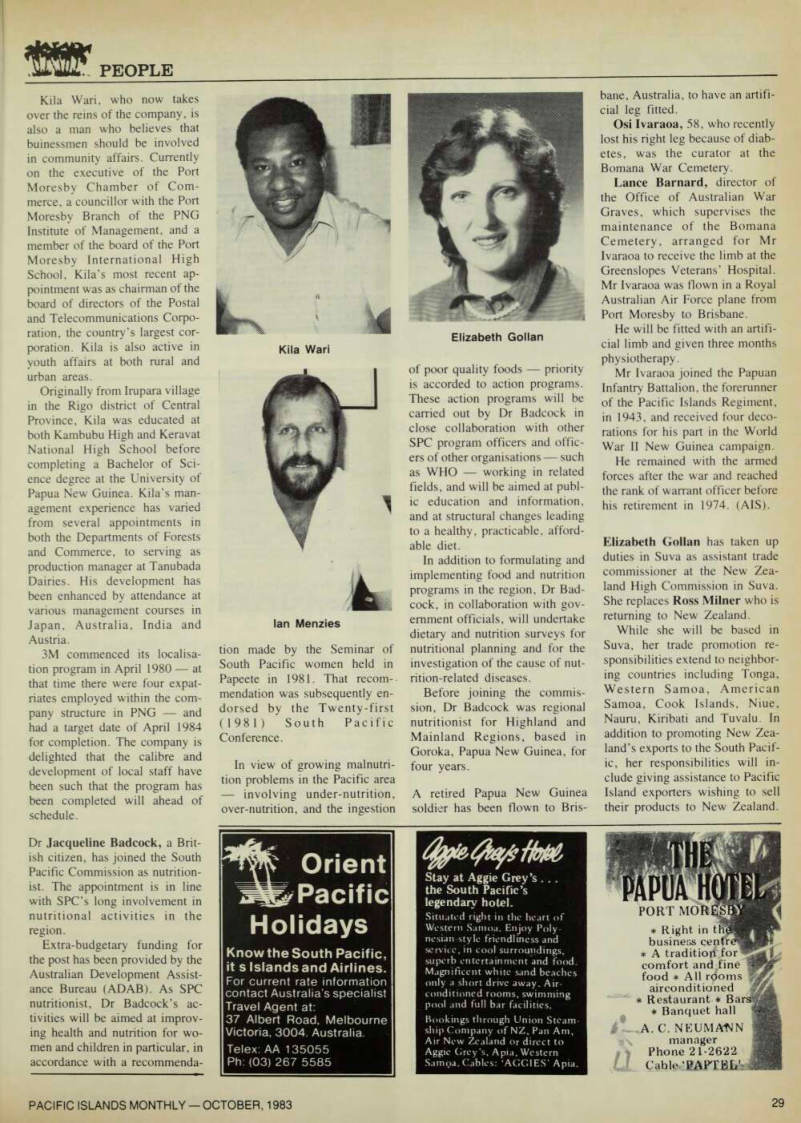
Epeli Hau’ofa is a generously
proportioned Tongan gentleman
whose breadth of intellectual in terest and attainment match his physical girth, and whose charm of manner is equally matched by the grace and wit of his discourse.
Dr Hau’ofa (he has a PhD in anthropology, his basic discip line, from the Australian Nation al University) first came to my delighted attention when he serv ed as a “keynote speaker” or something of the sort at a seminar on Australia’s relations with the South Pacific in Can berra in February 1982.
Sadly, I’d heard little of him since then, so it was with great pleasure that I read in an issue of the recently bom and appa rently highly successful New Zealand glossy magazine, Auck land Metro, a review of a book of short stories published this
year by Epeli.
Those who missed it at the time can read an extensive report of his speech in the April ’B2 issue of the magazine.
The magazine’s book gum, Gordon McLauchlan, wrote: The Tikong live in Tiko, an island nation somewhere in the South Pacif ic, and I would like to go there if only to meet Manu, who wears a t-shirt with “Religion and Education De stroy Original Wisdom” on the back and “Over Influenced” on the front and who is the second most famous man in Tiko, after His Excellency.
It is one of the few island groups James Cook missed as he criss crossed his way through this part of the world and he was lucky because I think his reputation as one of his tory’s most unflappable explorers may have come unstuck in Tiko.
Cook didn’t find it because it hadn’t been invented then. Geog raphically it is situated inside the “twisted imagination” of a Tongan sociology teacher called Epeli Hau’ofa.
A much-praised book may bring disappointment because expectation is too high. Conversely, rare wit and entertainment among stories from a writer previously unknown bring bursts of unexpected pleasure.
I picked up Tales From The Tikongs perfunctorily, anticipating more of the ethnic writing which is increasing in volume each year amd most of which is resolutely concern ed with the woes of the Third World or the joys of erstwhile innocence.
But what I found was ribaldry and fun steeped in delicious irony.
So much Third World writing (and I guess that includes New Zealand) is introverted and portentous but Hau’ofa has the gift of seeing absur dity clearly and he has the courage of directness. He gets on with his stories, dives into them from the first sentence, says briskly what he has to say. This is how he starts Blessed are the Meek: “It is said that an American likes to walk tall even though he may be short, and that he occasionally takes a giant step or two for mankind even though mankind may not have asked him to. Good luck to him, says Manu, and may he live long, what with the energy crisis, rising unem ployment, falling Skylabs, policing human rights and carrying other
heavy global responsibilities befitting
a member of the Greatest Nation on Earth.
“A Tikong, on the other hand, tends to walk short even though he may be tall, and will not take even a dwarfish step if he can help it. He normally lives too long on account of his love for energy conservation They are the sort of stories that people read and then say to them selves, “I could do that”. It seems so effortless. In fact, of course, it is extremely difficult and it’s dollars to coconuts that Hau’ofa slogged long and hard to get this effortless gait into his tales.
If all this sounds like an unab ashed plug for the work of my friend of a few days early last year, I suppose it is . . . PIM will be carrying a review of Tales From The Tikongs in an early issue. Malcolm Salmon.
“It was an attempted coup d’e tat,” was the simple explanation offered by former Norfolk Island primary school teacher, David Huw Lewis, of his activities on the island on July 14, Bastille Day, this year.
On that day he was charged with causing a public nuisance after the local radio station re ceived a tape threatening to blow up public buildings. The voice on the tape also threatened to release rabbits on rabbit-free Norfolk.
Mr Lewis’s deportation had been ordered after his temporary entry permit card expired last November. He lost a Supreme Court appeal against the deporta tion order. However, he was cleared of charges of threatening to bomb government buildings.
Born in Kenya but a naturalised Australian, Lewis had been a teacher on the island for three years.
He told reporter Geoff McCamey of the Sydney Daily Telegraph that he was well known on the island because of his strong political views.
He admitted he had made and sent the tape in an attempt to “bluff’ the island administration.
“I believe Norfolk Island should be independent but with a free and friendly association with Australia,” he said.
He is critical of the present system, claiming it is undemocratic.
After arriving in Australia he began a sit-in at Sydney’s Mas cot Airport. “I’m waiting to go back to my home at Norfolk,” he told McCamey.
With the departure in August of lan Menzies, the total manage ment of the 3M branch operation in Papua New Guinea passed into the hands of Kila Wari.
For the last three and a half years, management of the com pany has been a co-operative effort between the two managers Kila Wari being responsibnle for branch administration, and lan Menzies for all sales and marketing. During this period, 3M has expanded its distribution base in PNG from 29 outlets to 93 with a highly diversified range of products being marketed in all major centres. lan Menzies returned to PNG with 3M in March, 1980 (he had formerly served as a lieutenant with the Pacific Islands Regi ment in the mid-’6os) and im mediately became involved not only in the expansion of 3M’s business and product base, but also in community and civic affairs.
His activities included being a member of the Board of Secreta rial Studies, chairman of the gov erning council of the College of External Studies, councillor of the Port Moresby Branch of the PNG Institute of Management, vice-president of the Port Mores by Chamber of Commerce, and a member of the Rotary Club of Port Moresby. lan’s major contribution to the PNG community has been in the area of education (he is a former high school teacher), as for 18 months he served on the commit tee of inquiry into education standards as private enterprise spokesman on education matters.
He also conducted literally hun dreds of audio-visual seminars in education and training institu tions throughout Papua New Guinea on behalf of his company.
In addition to all of this, he was an active and highly produc tive reporter in yacht movements for PlM’s yachts columns (see yachts this issue).
Epeli Hau’ofa: A generous sta ture, physically and intellectually.
Kila Wari, who now takes over the reins of the company, is also a man who believes that buinessmen should be involved in community affairs. Currently on the executive of the Port Moresby Chamber of Com merce, a councillor with the Port Moresby Branch of the PNG Institute of Management, and a member of the board of the Port Moresby International High School, Kila’s most recent ap pointment was as chairman of the board of directors of the Postal and Telecommunications Corpo ration, the country’s largest cor poration. Kila is also active in youth affairs at both rural and urban areas.
Originally from Irupara village
in the Rigo district of Central Province, Kila was educated at both Kambubu High and Keravat National High School before completing a Bachelor of Sci ence degree at the University of Papua New Guinea. Kila’s man agement experience has varied from several appointments in both the Departments of Forests and Commerce, to serving as production manager at Tanubada Dairies. His development has been enhanced by attendance at various management courses in Japan, Australia, India and Austria. 3M commenced its localisa tion program in April 1980 at that time there were four expat riates employed within the com pany structure in PNG and had a target date of April 1984 for completion. The company is delighted that the calibre and development of local staff have been such that the program has been completed will ahead of schedule.
Dr Jacqueline Badcock, a Brit ish citizen, has joined the South Pacific Commission as nutrition ist. The appointment is in line with SPC’s long involvement in nutritional activities in the
region.
Extra-budgetary funding for
the post has been provided by the Australian Development Assist ance Bureau (ADAB). As SPC nutritionist, Dr Badcock’s ac tivities will be aimed at improv ing health and nutrition for wo men and children in particular, in accordance with a recommenda-
tion made by the Seminar of South Pacific women held in Papeete in 1981. That recom mendation was subsequently en dorsed by the Twenty-first (1981) South Pacific Conference.
In view of growing malnutri tion problems in the Pacific area
involving under-nutrition,
over-nutrition, and the ingestion
of poor quality foods priority is accorded to action programs.
These action programs will be carried out by Dr Badcock in close collaboration with other SPC program officers and offic ers of other organisations such as WHO working in related fields, and will be aimed at publ ic education and information, and at structural changes leading to a healthy, practicable, afford able diet.
In addition to formulating and implementing food and nutrition programs in the region, Dr Bad cock, in collaboration with gov ernment officials, will undertake dietary and nutrition surveys for nutritional planning and for the investigation of the cause of nut rition-related diseases.
Before joining the commis sion, Dr Badcock was regional nutritionist for Highland and Mainland Regions, based in Goroka, Papua New Guinea, for four years.
A retired Papua New Guinea soldier has been flown to Bris
bane, Australia, to have an artifi cial leg fitted.
Osi Ivaraoa, 58, who recently lost his right leg because of diab etes, was the curator at the Bomana War Cemetery.
Lance Barnard, director of the Office of Australian War Graves, which supervises the maintenance of the Bomana Cemetery, arranged for Mr Ivaraoa to receive the limb at the
Greenslopes Veterans’ Hospital.
Mr Ivaraoa was flown in a Royal Australian Air Force plane from Port Moresby to Brisbane.
He will be fitted with an artifi cial limb and given three months
physiotherapy.
Mr Ivaraoa joined the Papuan Infantry Battalion, the forerunner of the Pacific Islands Regiment, in 1943, and received four deco rations for his part in the World War II New Guinea campaign.
He remained with the armed forces after the war and reached the rank of warrant officer before his retirement in 1974. (AIS).
Elizabeth Gollan has taken up duties in Suva as assistant trade commissioner at the New Zea land High Commission in Suva.
She replaces Ross Milner who is returning to New Zealand.
While she will be based in Suva, her trade promotion re
sponsibilities extend to neighbor
ing countries including Tonga, Western Samoa, American Samoa, Cook Islands, Niue, Nauru, Kiribati and Tuvalu. In addition to promoting New Zea land’s exports to the South Pacif ic, her responsibilities will in clude giving assistance to Pacific Island exporters wishing to sell their products to New Zealand.
Kila War!
Ian Menzies
Elizabeth Gollan
Advertisements & other items, pp. 28-30 (1 item)
Expert
Insurance Service
throughout the islands
■ „ a
Queensland Insurance (Fiji) Limited
Head Office: Queensland Insurance Centre, Victoria Parade SUVA. General Manager: R. Jackson Assistant Manager: Vijay Lai. Phone 23 851.
LAUTOKA OFFICE; Burns Philp Bldg., Naviti St. District Manager: R. Sharma. Phone 60 642 LABASA OFFICE: Burns Philp Bldg. Phone: 8 2139
Queensland Insurance (PNG) Limited
PAPUA NEW GUINEA
Head Office. B.N.G. Building, Musgrave St.PORT MORESBY. General Manager T. H. Sarti Phone: 21 2144 LAE. 4th St. & Coronation Drive District Manager: C. D Hillier Phone: 423873.
MOUNT HAGEN Hagen Drive District Manager G. Hayes Phone: 521002 ARAWA: Chebu St., District Manager; B. Bowers Phone: 95 1555 MADANG: Kasagten St., District Manager: J. Longbut Phone: 82 2020 RABAUL Wirraway St District Manager R. McManus Phone: 921014.
QBE Insurance (International) Limited
VANUATU. PORT VILA Rue de Pans, Suite 19, Oceania Bldg. Manager: I. R Martin.
Phone 2299 SANTO: Burns Philp ( Vanuatu) Ltd Phone: 230.
PACIFIC AGENCIES
NEW CALEDONIA Ste. W. A. Johnston, S A R L. 5 Rue Anatole France, NOUMEA Phone: 272083.
TAHITI Arthur Chung. Immeuble 8.1.5., Front de Men PAPEETE . Phone: 2.86 19 NIUE Burns Philp (South Sea) Company Ltd.
NORFOLK ISLAND Burns Philp ('N I ) Company Ltd Phone: 2191 SAMOA APIA, Burns Philp (South Sea) Company Ltd. Phone: 22611 TONGA Burns Philp (South Sea) Company Ltd NUKU ALOFA Phone 21500 HAAPAI. VAVAU
MEMBERS OF THE
INSURANCE GROUP UMITED
Orient
Pacific
Holidays
Know the South Pacific, it s Islands and Airlines.
For current rate information contact Australia’s specialist Travel Agent at: 37 Albert Road, Melbourne Victoria, 3004. Australia.
Telex: AA 135055 Ph: (03) 267 5585 Stay at Aggie Grey’s . . . the South Pacific’s legendary hotel.
Situated right in the heart of Western Samoa. Enjoy Poly nesian-style friendliness and service, in cool surroundings, superb entertainment and food.
Magnificent white sand beaches only a short drive away. Airconditioned rooms, swimming pool and full bar facilities.
Bookings through Union Steamship Company of NZ, Pan Am, Air New Zealand or direct to Aggie Grey’s, Apia. Western Samoa. Cables; ‘AGGIES' Apia.
I
PORT MORI
♦ Right in t
business cepfr
* A traditiori for
comfort and/ine
food * All rdoms
airconditioned \
* Restaurant * Bard ♦ Banquet hall
A. C. NEUMANN
manager Phone 21-2622
CabIe‘HAPTW ? I
NEW ZEALAND
Stamp Pack 1983 In attractive wallet format contains all Commemorative and Special Issue stamps issued between December 1982 and October 1983.
Contents: Commemorative, Commonwealth Day, Rita Angus Traditional Paintings, Scenic, Health and Christmas Issue + M/S. 29 attractive Mint Issues with face value of $9.92. Supplied for Aslo.oo (or US$10.00) (banknote or cheque), postpaid from British Stamp Bureau Ltd, P.O. Box 7001, Sydenham, Christchurch, New Zealand.
SUPPLY: LEAD • SHEET PIPE
• EXTRUSIONS • WOOL
TYPE METALS • BEARING METALS
SOLDERS • FUSIBLE ALLOYS
BUY:
SCRAP • DROSS • RESIDUES
BERJAK
AND PARTNERS
492 St. Kilda Road, Melbourne, 3004, Australia Phone: (03) 261756 Telex; 30334 Cable: METJAK
DIPLOMA OF WORLD STUDIES
EXTERNAL STUDIES
FULL DIPLOMA SINGLE SUBJECTS
Courses begin September 1983
Year 1 Subjects from: World Literature, Intercultural Studies, Systems of Government, War and Peace Studies, Human and International Relations.
Year 2 Subjects from: Great World Thinkers, The Third World, World Economics, Comparative Religion, Moral Problems of the World, Man on Earth, Major World Problems Today and Tomorrow.
Write: ERAMBOO WORLD STUDIES CENTRE
223 West Head Road, Terrey Hills, N.S.W. 2084, Australia
in regional skies
The Month
A new airline in regional skies
New Caledonia’s governing co alition of the Independence Front and the centre party, FNSC, is to be continued for another year, when the next legislative elec tions are due. At their annual party congress in early August the FNSC voted unanimously to renew their contract with the
Independence Front.
The two groups came to power in the government council (a form of cabinet, elected by the territorial assembly) on June 18 last year, after the FNSC quit their former coalition partners, the anti-independence RPCR.
Their majority in New Caledonia’s principal political institution is contested by the RPCR who claim the IF-FNSC union does not represent majority opinion. The terms of the new contract have not yet been negotiated.
In a related development the IP’s Jean-Marie Tjibaou was reelected vice-president of the govemment council by unanimous vote of the six other members.
Mr Tjibaou was at the time on a six-day visit to Hong Kong where he met potential investors in various projects in New Caledonia.
The president of Nauru, Mr Hammer Deßoburt, spent three days in New Caledonia on an
official visit to negotiate an ag reement between Air Caledonie International and Air Nauru. Mr Deßoburt is also president of Air Nauru.
Mr Deßoburt, the first foreign head of state to be invited to the territory by the government council of Mr Tjibaou, was ac companied by Mr Moses, Nauru Consul in Melbourne. The visit marked the first round in negotia tions for New Caledonia’s use of Air Nauru planes on the routes between Brisbane-Noumea, Noumea-Port Vila, and Noumea- Nadi-Wallis. The agreements were signed later in Nauru with Dannys Famin, director of Air Cadedonie International.
Also in Noumea was a delega tion of transport and finance off icals from Vanuatu, headed by Minister of Transport, Albert Sandy. They met Mr Deßoburt and Air Caledonie International officials to discuss co-operation on the air routes. The new reg ional airline hopes to start flights to Vanuatu on January 3, 1984, with a service five times a week.
Agreements have also been signed with the Australian airline Qantas in relation to the weekly Melboume-Noumea run.
Under the agreement, Qantas and Air Caledonie International will each have 117 seats for
Noumea-bound passengers on the 433-seat plane, and 199 seats will be reserved for passengers going through to Nadi. This ser vice is scheduled to start on December 2, 1983.
Birth of the new airline has not been without difficulties. Talks between the various governments and their aviation officials have been slow, and in mid-August New Caledonia’s Territorial As sembly asked for some modifica tions. The assembly had been asked to increase the capital in the domestic carrrier Air Caledonie by CFP23 million ($A 190,000) to equal their par ticipation in the regional airline.
Air Caledonie is 76 per cent
government-owned. Independ
ence Front spokesman in the ass embly, Mr Yeiwene, said they wanted to see the two airline companies dissociated and a “controlled tourist
development”.
The assembly voted that Mr Famin could not maintain his post as director of Air Caledonie because he is now director of Air Caledonie International. • December 8-22, 1984, are the dates for the 4th Festival of Pacific Arts, of which New Caledonia is host. The dates were chosen taking into account school holidays and the availabil ity of accommodation in the
territory.
Preparations for the festival are being undertaken by the re cently created Office of Kanak Culture.
A first step was the holding of a mini-festival in Noumea, Au gust 19-21. The festival featured traditional Kanak dancing and singing, and will be followed by other similar events. During the same period delegates from 22 South Pacific countries attended the meeting of the Council of Pacific Arts, held at the South Pacific Commission’s Noumea headquarters. The council met to choose an anthem for the festival and discuss preparations.
Noumea Notebook Helen Fraser
Tales of Viking
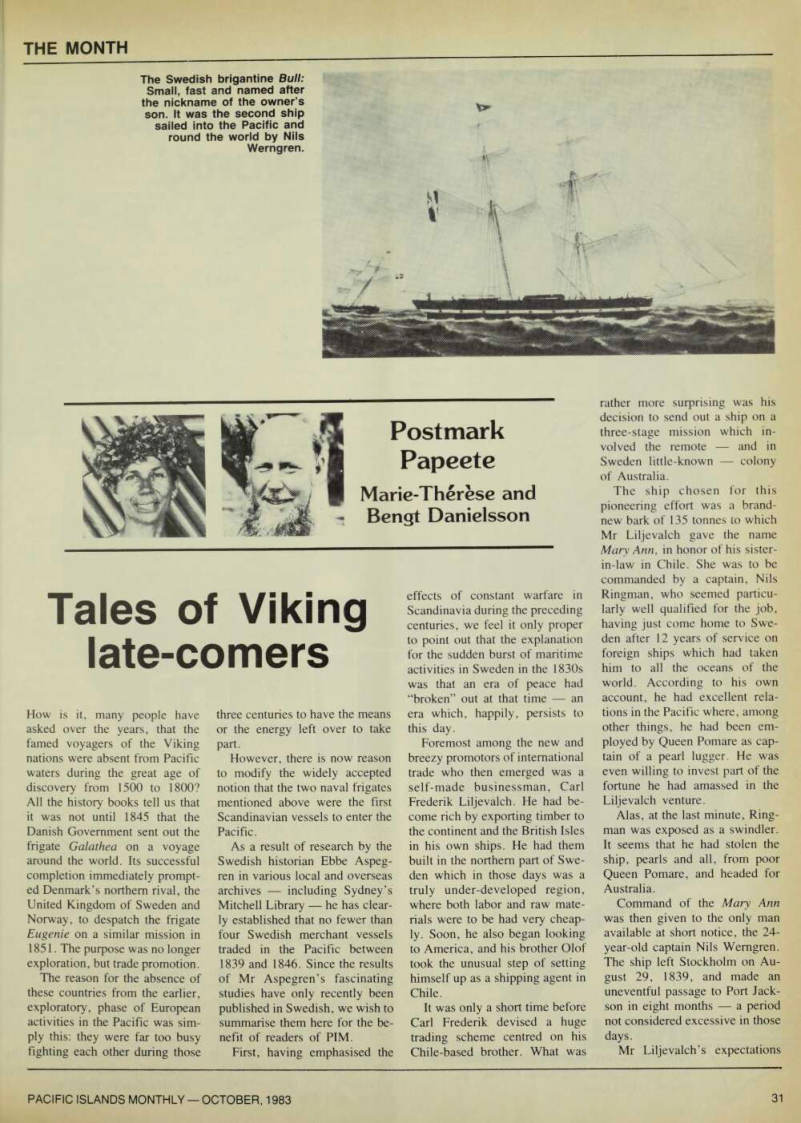
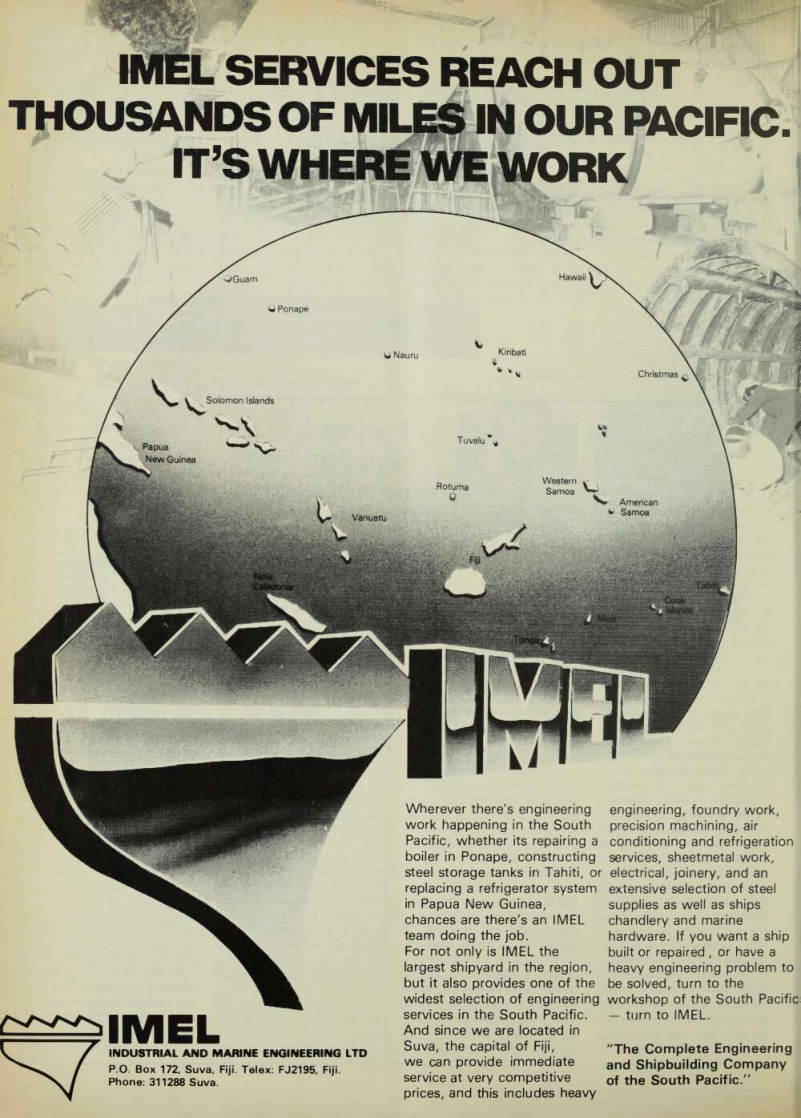
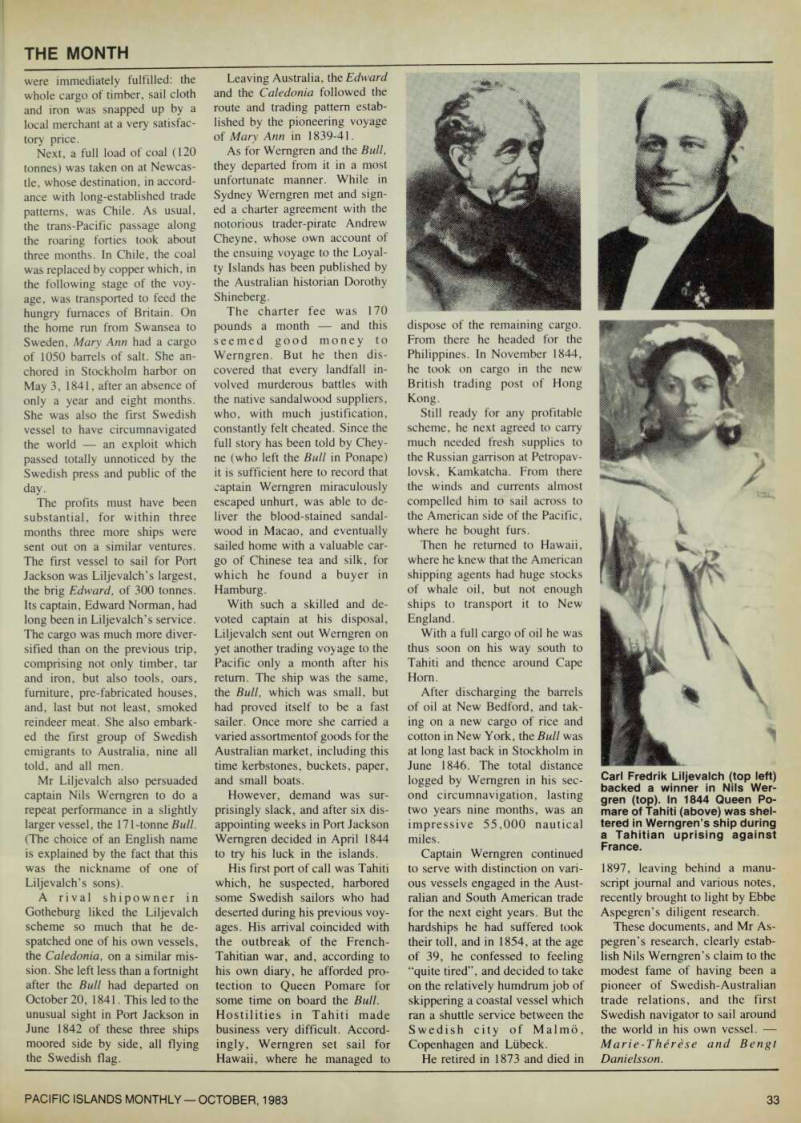
late-comers
How is it, many people have asked over the years, that the famed voyagers of the Viking nations were absent from Pacific waters during the great age of discovery from 1500 to 1800?
All the history books tell us that it was not until 1845 that the Danish Government sent out the frigate Galathea on a voyage around the world. Its successful completion immediately prompt ed Denmark’s northern rival, the United Kingdom of Sweden and Norway, to despatch the frigate Eugenie on a similar mission in 1851. The purpose was no longer exploration, but trade promotion.
The reason for the absence of these countries from the earlier,
exploratory, phase of European
activities in the Pacific was sim ply this: they were far too busy fighting each other during those
three centuries to have the means or the energy left over to take part.
However, there is now reason to modify the widely accepted notion that the two naval frigates mentioned above were the first Scandinavian vessels to enter the Pacific.
As a result of research by the Swedish historian Ebbe Aspeg ren in various local and overseas archives including Sydney’s Mitchell Library he has clear ly established that no fewer than four Swedish merchant vessels traded in the Pacific between 1839 and 1846. Since the results of Mr Aspegren’s fascinating studies have only recently been published in Swedish, we wish to summarise them here for the be nefit of readers of PIM.
First, having emphasised the
effects of constant warfare in Scandinavia during the preceding centuries, we feel it only proper to point out that the explanation for the sudden burst of maritime activities in Sweden in the 1830 s was that an era of peace had “broken” out at that time an era which, happily, persists to
this day.
Foremost among the new and breezy promotors of international trade who then emerged was a self-made businessman, Carl Frederik Liljevalch. He had be come rich by exporting timber to the continent and the British Isles in his own ships. He had them built in the northern part of Swe den which in those days was a
truly under-developed region,
where both labor and raw mate rials were to be had very cheap ly. Soon, he also began looking to America, and his brother Olof took the unusual step of setting himself up as a shipping agent in Chile.
It was only a short time before Carl Frederik devised a huge trading scheme centred on his Chile-based brother. What was
rather more surprising was his decision to send out a ship on a three-stage mission which in volved the remote and in Sweden little-known colony of Australia.
The ship chosen for this pioneering effort was a brand new bark of 135 tonnes to which Mr Liljevalch gave the name Mary Ann, in honor of his sister in-law in Chile. She was to be commanded by a captain. Nils Ringman, who seemed particu larly well qualified for the job, having just come home to Swe den after 12 years of service on foreign ships which had taken him to all the oceans of the world. According to his own account, he had excellent rela tions in the Pacific where, among other things, he had been em ployed by Queen Pomare as cap tain of a pearl lugger. He was even willing to invest part of the fortune he had amassed in the
Liljevalch venture.
Alas, at the last minute, Ring man was exposed as a swindler.
It seems that he had stolen the ship, pearls and all, from poor Queen Pomare, and headed for Australia.
Command of the Mary Ann was then given to the only man available at short notice, the 24-
year-old captain Nils Wemgren.
The ship left Stockholm on Au gust 29, 1839, and made an uneventful passage to Port Jack son in eight months a period not considered excessive in those
days.
Mr Liljevalch’s expectations
The Swedish brigantine Bull: Small, fast and named after the nickname of the owner’s son. It was the second ship sailed into the Pacific and round the world by Nils Werngren.
Postmark Papeete Maric-Thérèse and Bengt Danielsson
were immediately fulfilled: the whole cargo of timber, sail cloth and iron was snapped up by a local merchant at a very satisfac tory price.
Next, a full load of coal (120 tonnes) was taken on at Newcas tle, whose destination, in accord ance with long-established trade patterns, was Chile. As usual, the trans-Pacific passage along the roaring forties took about three months. In Chile, the coal was replaced by copper which, in the following stage of the voy age, was transported to feed the hungry furnaces of Britain. On the home run from Swansea to Sweden, Mary Ann had a cargo of 1050 barrels of salt. She an chored in Stockholm harbor on May 3, 1841, after an absence of only a year and eight months.
She was also the first Swedish vessel to have circumnavigated the world an exploit which passed totally unnoticed by the Swedish press and public of the day.
The profits must have been substantial, for within three months three more ships were sent out on a similar ventures.
The first vessel to sail for Port Jackson was Liljevalch’s largest, the brig Edward, of 300 tonnes.
Its captain, Edward Norman, had long been in Liljevalch’s service.
The cargo was much more diver sified than on the previous trip, comprising not only timber, tar and iron, but also tools, oars, furniture, pre-fabricated houses, and, last but not least, smoked reindeer meat. She also embark ed the first group of Swedish emigrants to Australia, nine all told, and all men.
Mr Liljevalch also persuaded captain Nils Wemgren to do a repeat performance in a slightly larger vessel, the 171-tonne Bull. (The choice of an English name is explained by the fact that this was the nickname of one of Liljevalch’s sons).
A rival shipowner in Gotheburg liked the Liljevalch scheme so much that he de spatched one of his own vessels, the Caledonia, on a similar mis sion. She left less than a fortnight after the Bull had departed on October 20, 1841. This led to the unusual sight in Port Jackson in June 1842 of these three ships moored side by side, all flying the Swedish flag.
Leaving Australia, the Edward and the Caledonia followed the route and trading pattern estab lished by the pioneering voyage of Mary Ann in 1839-41.
As for Wemgren and the Bull, they departed from it in a most unfortunate manner. While in Sydney Wemgren met and sign ed a charter agreement with the notorious trader-pirate Andrew Cheyne, whose own account of the ensuing voyage to the Loyal ty Islands has been published by the Australian historian Dorothy Shineberg.
The charter fee was 170 pounds a month and this seemed good money to Wemgren. But he then dis covered that every landfall in volved murderous battles with the native sandalwood suppliers, who, with much justification, constantly felt cheated. Since the full story has been told by Chey ne (who left the Bull in Ponape) it is sufficient here to record that captain Wemgren miraculously escaped unhurt, was able to de liver the blood-stained sandal wood in Macao, and eventually sailed home with a valuable car go of Chinese tea and silk, for which he found a buyer in Hamburg.
With such a skilled and de voted captain at his disposal, Liljevalch sent out Wemgren on yet another trading voyage to the Pacific only a month after his return. The ship was the same, the Bull, which was small, but had proved itself to be a fast sailer. Once more she carried a varied assortmentof goods for the Australian market, including this time kerbstones, buckets, paper, and small boats.
However, demand was sur prisingly slack, and after six dis appointing weeks in Port Jackson Wemgren decided in April 1844 to try his luck in the islands.
His first port of call was Tahiti which, he suspected, harbored some Swedish sailors who had deserted during his previous voy ages. His arrival coincided with the outbreak of the French- Tahitian war, and, according to his own diary, he afforded pro tection to Queen Pomare for some time on board the Bull.
Hostilities in Tahiti made business very difficult. Accord ingly, Wemgren set sail for Hawaii, where he managed to
dispose of the remaining cargo.
From there he headed for the Philippines. In November 1844, he took on cargo in the new British trading post of Hong
Kong.
Still ready for any profitable scheme, he next agreed to carry much needed fresh supplies to the Russian garrison at Petropav lovsk, Kamkatcha. From there the winds and currents almost compelled him to sail across to the American side of the Pacific, where he bought furs.
Then he returned to Hawaii, where he knew that the American shipping agents had huge stocks of whale oil, but not enough ships to transport it to New England.
With a full cargo of oil he was thus soon on his way south to Tahiti and thence around Cape Horn.
After discharging the barrels of oil at New Bedford, and tak ing on a new cargo of rice and cotton in New York, the Bull was at long last back in Stockholm in June 1846. The total distance
logged by Wemgren in his sec
ond circumnavigation, lasting two years nine months, was an impressive 55,000 nautical miles.
Captain Wemgren continued to serve with distinction on vari ous vessels engaged in the Aust ralian and South American trade for the next eight years. But the hardships he had suffered took their toll, and in 1854, at the age of 39, he confessed to feeling “quite tired”, and decided to take on the relatively humdrum job of skippering a coastal vessel which ran a shuttle service between the Swedish city of Malmo, Copenhagen and Liibeck.
He retired in 1873 and died in
1897, leaving behind a manu script journal and various notes, recently brought to light by Ebbe
Aspegren’s diligent research.
These documents, and Mr As pegren’s research, clearly estab lish Nils Wemgren’s claim to the modest fame of having been a pioneer of Swedish-Australian trade relations, and the first Swedish navigator to sail around the world in his own vessel. —
Marie-Thérèse and Bengt Danielsson.
Carl Fredrik Liljevalch (top left) backed a winner in Nils Wer gren (top). In 1844 Queen Po mare of Tahiti (above) was shel tered in Werngren’s ship during a Tahitian uprising against France.
Advertisements & other items, pp. 32-35 (1 item)
L Services Reach Out
■■Mil
THOUSANDS OF IN OUR PACIFIC.
11 S WHERE wE«WORI
I I Ponape Kiribati w Nauru m m Christmas Solomon Islands W W Tuvalu * Papua Western .
Samoa '"*■ Vr American v Samoa Rotuma Q Vanuatu / V/W , i ■ ▼ m
Q^JMEL
INDUSTRIAL AND MARINE ENGINEERING LTD
P.O. Box 172, Suva, Fiji. Telex: FJ2195, Fiji.
Phone: 311288 Suva.
Wherever there's engineering work happening in the South Pacific, whether its repairing a boiler in Ponape, constructing steel storage tanks in Tahiti, or replacing a refrigerator system in Papua New Guinea, chances are there's an IMEL team doing the job.
For not only is IMEL the largest shipyard in the region, but it also provides one of the widest selection of engineering services in the South Pacific.
And since we are located in Suva, the capital of Fiji, we can provide immediate service at very competitive prices, and this includes heavy engineering, foundry work, precision machining, air conditioning and refrigeration services, sheetmetal work, electrical, joinery, and an extensive selection of steel supplies as well as ships chandlery and marine hardware. If you want a ship built or repaired , or have a heavy engineering problem to be solved, turn to the workshop of the South Pacific turn to IMEL.
"The Complete Engineering and Shipbuilding Company of the South Pacific.''
mSM
TOYOTA
LAND
CRUISER
imm
E mm
LAND CRUISER
STATION WAGON
1
TOYOTA
QUALITY SERVICE
AMERICAN SAMOA: BURNS PHILP (SOUTH SEA)
CO., LTD., P.O. Box 129, Pago Pago.
COOK ISLANDS: COOK ISLANDS TRADING
CORPORATION LTD., P.O. Box 92, Rarotonga.
FIJI; AUTOMOTIVE SUPPLIES COMPANY, G.P.O.
Box 355, Suva.
GUAM & MICRONESIA: ATKINS, KROLL (GUAM) LTD., 443 South Marine Drive.Tamuning.
KIRIBATI: TARAWA MOTORS, P.O. Box 36,
Bairiki, Tarawa, Kiribati.
NAURU; NAURU COOPERATIVE SOCIETY.
NEW CALEDONIA: SERVICE IMPORTATION
AUTOMOBILE DU PACIFIQUE, Rond-Point
Hu Pacifique (Station Total) B.P. 438, Noumea.
NORFOLK ISLAND: BORRY’S LIMITED, P.O. Box 169.
PAPUA NEW GUINEA: ELA MOTORS,
Scratchley Rd., Badili, P.O. Box 75, Port Moresby.
SAIPAN: MICROL CORPORATION, P.O. Box 267,
Saipan.
SOLOMON: MENDANA ENTERPRISES (5.1.) LTD.,
G.P.O. Box 174, Honiara.
TAHITI: NIPPON AUTOMOTO, P.O. Box 342, Papeete.
TONGA; BURNS PHILP (SOUTH SEA) CO., LTD.
P.O. Box 55, Nukualofa.
VANUATU: VANUATU MOTORS, P.O. Box 18.
Port Vila.
WESTERN SAMOA: BURNS PHILP (SOUTH SEA)
CO., LTD., P.O. Box 188, Apia.
No matter how tough the work, how rough the road, Toyota commercial vehicles ride easy. That’s because every one, from the sleek Land Cruiser to our heavy duty trucks, is built to be rugged, reliable and comfortable. And there’s a Toyota to tackle any job, from offthe-road recreation to heavy-duty hauling. While your Toyota is doing the heavy work, you can ride easy, too.
That’s because you know every Toyota is backed up by our fast, reliable worldwide service system. Let Toyota make it easy for you.
The Toyota range includes: COROLLA, STARLET CORONA, CRESSIDA. HI-LUX, STOUT,
HI ACE, DYNA, COASTER and LANDCRUISER
mL
DYNA
"I
HEAVY DUTyIRUCK
TOYOTA
A world waiting
for string band?
Music is not the province of a few professionals in Vanuatu it is something people generally make for themselves. There are string bands in almost every vil
lage, performing songs written
by the local people. The music is popular, and the songs reflect, in the immediacy of their lyrics, their grassroots origins.
“Taem mi wok abaot long Vila, mi lukim plante bikbik haos Mo stoa blong waet man long Vila taon Taem mi luk long pablik rod, mi lukim plante truk i ron Samting ia i mekem mi sip
raes tumas.’’ (Noisy Boys,
First Tour of Vila).
But for all the general self reliance in the matter of enter tainment, one highly successful overseas band has managed to capture the attention of even re mote villages, with a mixture of
professionalism and genuine par
ticipation in their own music.
This is the Black Brothers, tem porarily in Vanuatu before begin ning a Pacific tour. The group, originally from West Irian though Hengky Mirontoneng (lead vocals/guitar) and Jochie
Pattipeiluhu (vocals/keyboard)
are of Celeban and Moluccan parentage, respectively have been performing not only in the larger urban areas,,Port-Vila and Santo, but on the more rural islands, such as Malekula.
The group was formed in Jay apura in 1974, and after moving to Jakarta in 1976 became one of
the top three groups in the coun try, selling over a million copies of each cassette released, and
winning golden records and
trophies as evidence of their
popularity. This all changed
when the Black Brothers decided to tour Port Moresby in 1979.
Their music, with its strong flavor of Melanesian rhythms, and their traditional West Irian ese costumes, stirred feelings of across-the-border brotherhood amongst Papua New Guineans, and also gained the group a fol lowing amongst West Irianese refugees. It wasn’t the reaction the Indonesian Government had anticipated, and their displeasure was perhaps more marked be cause of it. Indonesia’s Ministry of Foreign Affairs wrote cancel
ling the group’s permission to
tour and a copy of the letter was sent to BAKIN, Indonesia’s internal security force. The group decided not to return to Indonesia they sought and
received political asylum in
Holland.
Their career was launched again in 1982, after two years waiting for work permits. They produced two records and won a contract with EMI Records Hol land. But they felt that the Pacif ic, and in particular Melanesia, was closer to home, and as soon as they had travel documents they came to Vanuatu, in time for the third independence an niversary celebrations this year.
They gave their first public con cert at Port-Vila’s Stade, draw ing a crowd of over 2500, and have followed it up with a series
of indoor concerts and perform ances as a dance band at the
lorana nightclub.
Their music has been an eye opener for Vanuatu musicians. It is explorative as well as enter
taining, taking each instrument,
and much of their material, to their limits, as they test capabilities and reshape rhythms.
Benny Betay, for example, gives a series of almost elegant elab orations of musical themes on bass guitar Agust Rumwaro pen’s sustained solo in “Sum mertime” stretches and embel lishes Gershwin’s original.
But if Vanuatu’s musicians have been assessing Black Brothers’ music, the compliment is returned. They take a keen interest in string band music, and some songs from their PNG days, such as “Wan Pela Meri” or “Nogat mani (nogat kaikai)”, show this influence. Manager
Andy Ayamiseba, pondering the
appeal of string band music, noted: “It’s all over Melanesia.
In my country there’s Mam besak, a string student band . . . they’ve got the same instru ments, the same basic sound. It’s a unique sound . . . you only get it in Melanesia.” The Black Brothers see string band music as eminently marketable, on an in ternational scale, and compare it with reggae in its origins and
style.
There is much in common it is popular music, genuinely springing from the people. Vil lage bands, sometimes formed especially for the occasion, will play until daylight for big inter village dances. Fatuana band, one of the biggest and most popular, began as such a band, in a village on the southern island of Futuna. Schools, churches and clubs will all form bands for occasions as required. Bands
have been formed from political
origins Noisy Boys, from
Tanna, began as a fund-raising effort for the People’s Provision al Government set up by Vanuaaku Party in 1977. Even so, and unlike reggae, the music is seldom concerned with politic al controversy. The bands lend themselves to communication of ideas, but at the moment the ideas are generally part of ac
cepted social and agricultural
wisdom: “Nambawan economic i mekem yu yu rich tumas, Bambae i kam wan bikfela expot long Vanuatu Hernia nao economic inde
pendence yumi lukaot . . .
Koffee!” (Fatuana, Koffee, Koffee Project). and are used frequently by the government as part of its prog rams of community education for example to introduce the new vatu currency in 1982.
The music is a medium for the expression of a strong national ism. The band Mother Hubbard named themselves after the usual women’s dress, adapted from the old mission dresses, and their theme song “Mother Hubbard emi nembawan” was lauding is land-style living as much as their own music. Huarere, a group from Pentecost, expressed the national pride in South Seas Champion boxer, Philip Rating; “Oh Kating, yu yes, yu no makas, Yu winim plante ovasis champion Mo mekem gud nius long Vanuatu ...”
Women’s groups, in particu lar, seem ready to move be yond this to sharp social observa
Report from Vanuatu Julie-Ann Ellis
vation.Fatuana Girls gave as their first number at the 1981 National String Band Competi tion “Tin Fis mo Raes”, a wry and knowing expression of the futility sensed by workers in Port-Vila, living at a lower stan dard than those in the village.
The same group the next year offered commentary on urban
unemployment.
‘ 7 fulap man tedei, i no gat job long taon.
Yu askem job olbaot, but no . . . but no . . .”
But for the directly political, flinging themselves headlong in to controversy, probably no band could beat the children’s group, Fatuana Sisi, with their blunt approach to a Pacific-wide problem:
“Yumi mas joen long ol narafala kaontri Agenst nuclear testing we France i mekem.
Life is more important than powerful bombs! . . .
Oh please, please, please Franis, no mas testem bomb In all, the Black Brothers’ comparison of string band music
with reggae has some justifica tion. The music is changing and developing Black Brothers themselves are bound to be an influence on it and the next few years could see this region of the Pacific become important musically in the way both the Caribbean and the American Deep South have been in their time. Julie-Ann Ellis.
The policies that

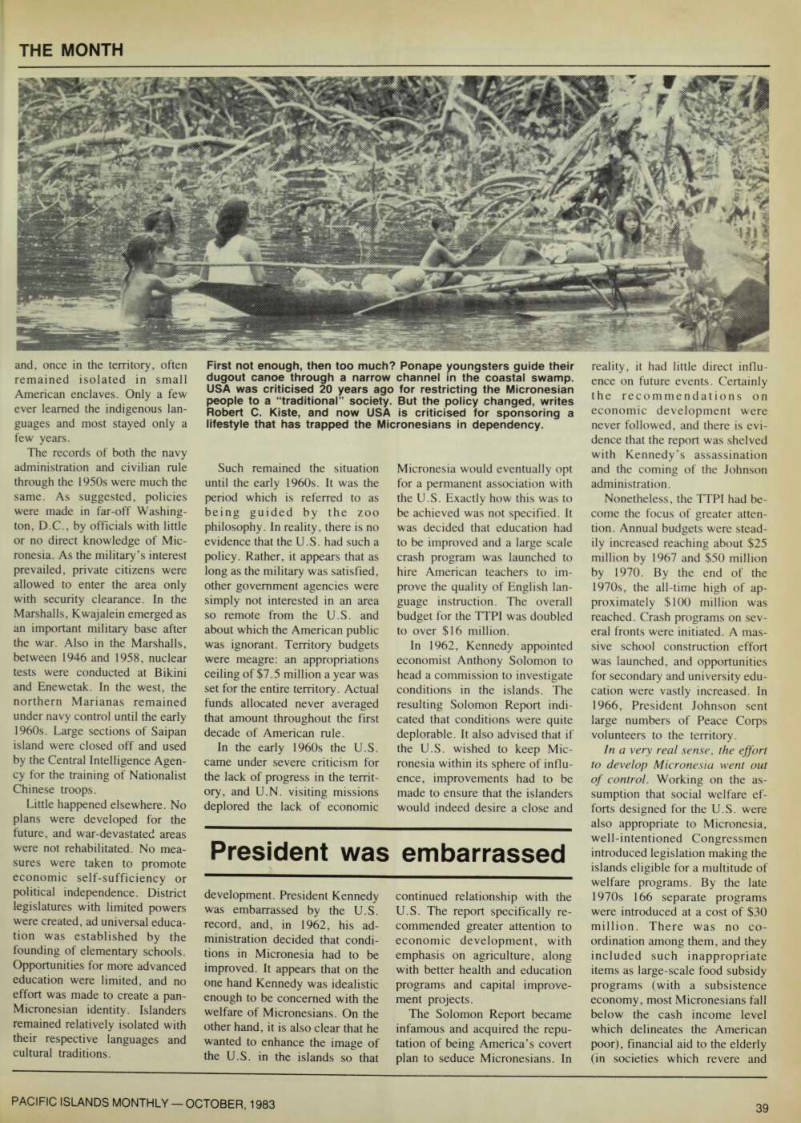
hid a non-policy
As the termination of the U.S.
Trust Territory of the Pacific Islands (TTPI) appears to be drawing near, one hears a good bit of talk about the territory in Honolulu nowadays. One thing is generally agreed: the record of the U.S. administration in the TTPI has left much to be desired, and many observers describe it as a failure. Such an opinion was voiced by John Condon, America’s first ambassador to Fiji. At the end of his term of office, and after much travel south of the equator, the former envoy toured Micronesia. Soon after, addressing a group in Hon olulu, Condon commented: “It is beyond my ability to either exp lain or understand the failures of our Trust Territory administra tion.” (Honolulu Advertiser, August 13, 1980).
One also hears explanations which purportedly account for the poor American record in Micronesia. Two are especially common, and relate to different periods of American rule. First, it is maintained that for the first decade and a half after World War 11, the U.S. pursued an “ethnographic zoo” policy which was designed to preserve
indigenous cultures and keep the islanders out of the mainstream of the modem world. Second, it is suggested that in the early
1960 s the “zoo” policy was
abandoned and the U.S. adopted a strategy calculated to entrap Micronesians in a web of economic dependency which would keep them firmly within the sphere of American influence for the indefinite future.
There is no doubt that 1) Mic ronesians have become accus tomed to a lifestyle which they cannot maintain, and 2) the fi nancial subsidies which the U.S. will provide to them are the envy of perhaps most other Pacific states. It is also true that the U.S. is getting what it wants out of the arrangement: a guarantee of military access to the area while the same is denied to others.
What is not accurate is the charge that all this is the result of a well planned, long term, and conscious policy. Similarly, in the early years of the American administration, there was never a “zoo” policy.
In fact, the U.S. has never had a clearly formulated or coherent policy towards Micronesia. As one Department of State official
has commented: “To suggest that we ever had an overall poli cy for Micronesia is to give us (the federal government) credit for being better organised than we are.”
In reality, the history of the U.S. administration of Mic ronesia is much more com plicated than critics would sug gest, and while many factors have shaped America’s involve ment in the islands, six are most salient: 1) the TTPI is quite dis tant from Washington, D.C., and major decisions affecting the ter ritory have often been made in the nation’s capital by individu als with little familiarity with the islands; 2) the vast majority of Americans are completely una ware that the TTPI exists, and, as a result, there is no significant political lobby to look after Mic ronesian interests; 3) in the last analysis, the needs of the Depart ment of Defense have always been served; 4) American ideolo gy about the U.S. as a democrat ic nation has precluded Ameri cans from thinking of themselves as a colonial power; 5) Ameri cans commonly assume that money, especially large sums of money, can solve practically any problem; 6) the TTPI’s 150,000 people are divided into nine separate ethno-linguistic groups, and unity has always been an artifice of colonial powers.
Immediately after World War 11, Micronesia was administered by the U.S. Navy. Within the
U.S., there was considerable de bate about the area’s future. Un like classical “colonies,” Mic ronesia did not have economic resources of interest to the U.S.
The military, however, ad vocated annexation because of its
strategic location. The Depart
ment of State was opposed to the acquisition of a new colony be cause such an action would have been difficult to defend in the newly formed U.N. However, the concept of a strategic U.N.
Trust Territory satisfied the military and allowed the U.S. to control the islands without actual annexation. Under the strategic trust agreement, the U.S. was entitled to establish military bases, but it also had an obliga tion to guide the islanders to self government or independence, to protect their health and welfare, to promote economic self sufficiency, and to further educa tion achievement.
In 1951, the Department of Interior became the administer ing agency. Looking back, this foreshadowed the territory’s fu ture. Interior had responsibility for managing national forests, parks, and other natural re sources. However, it was not equipped to deal with human beings, as evidenced by its re cord with the Bureau of Indian affairs. Interior was not a colo nial service, did not conceive of itself as such, and saw no reason to train personnel to serve ab road. Officials posted to Mic ronesia received no training,
A View from Honolulu Robert C. Kiste
and, once in the territory, often remained isolated in small American enclaves. Only a few ever learned the indigenous lan guages and most stayed only a few years.
The records of both the navy administration and civilian rule through the 1950 s were much the
same. As suggested, policies
were made in far-off Washing ton, D.C., by officials with little or no direct knowledge of Mic ronesia. As the military’s interest prevailed, private citizens were allowed to enter the area only with security clearance. In the Marshalls, Kwajalein emerged as an important military base after the war. Also in the Marshalls, between 1946 and 1958, nuclear tests were conducted at Bikini and Enewetak. In the west, the northern Marianas remained under navy control until the early 19605. Large sections of Saipan island were closed off and used by the Central Intelligence Agen cy for the training of Nationalist Chinese troops.
Little happened elsewhere. No plans were developed for the future, and war-devastated areas were not rehabilitated. No mea sures were taken to promote economic self-sufficiency or political independence. District legislatures with limited powers were created, ad universal educa tion was established by the
founding of elementary schools.
Opportunities for more advanced education were limited, and no effort was made to create a pan- Micronesian identity. Islanders remained relatively isolated with their respective languages and cultural traditions.
Such remained the situation until the early 19605. It was the period which is referred to as being guided by the zoo philosophy. In reality, there is no evidence that the U.S. had such a policy. Rather, it appears that as long as the military was satisfied, other government agencies were simply not interested in an area so remote from the U.S. and about which the American public was ignorant. Territory budgets were meagre: an appropriations ceiling of $7.5 million a year was set for the entire territory. Actual funds allocated never averaged that amount throughout the first decade of American rule.
In the early 1960 s the U.S. came under severe criticism for the lack of progress in the territ ory, and U.N. visiting missions deplored the lack of economic
President was embarrassed
development. President Kennedy
was embarrassed by the U.S. record, and, in 1962, his ad ministration decided that condi tions in Micronesia had to be improved. It appears that on the one hand Kennedy was idealistic enough to be concerned with the welfare of Micronesians. On the other hand, it is also clear that he wanted to enhance the image of the U.S. in the islands so that
Micronesia would eventually opt for a permanent association with the U.S. Exactly how this was to be achieved was not specified. It was decided that education had to be improved and a large scale crash program was launched to hire American teachers to im prove the quality of English lan guage instruction. The overall budget for the TTPI was doubled to over $l6 million.
In 1962, Kennedy appointed
economist Anthony Solomon to head a commission to investigate conditions in the islands. The
resulting Solomon Report indi
cated that conditions were quite deplorable. It also advised that if the U.S. wished to keep Mic ronesia within its sphere of influ ence, improvements had to be made to ensure that the islanders would indeed desire a close and
continued relationship with the U.S. The report specifically re commended greater attention to economic development, with
emphasis on agriculture, along
with better health and education programs and capital improve ment projects.
The Solomon Report became infamous and acquired the repu tation of being America’s covert plan to seduce Micronesians. In
reality, it had little direct influ ence on future events. Certainly the recommendations on economic development were never followed, and there is evi dence that the report was shelved with Kennedy’s assassination and the coming of the Johnson administration.
Nonetheless, the TTPI had be come the focus of greater atten tion. Annual budgets were stead ily increased reaching about $25 million by 1967 and $5O million by 1970. By the end of the 19705, the all-time high of ap proximately $lOO million was reached. Crash programs on sev eral fronts were initiated. A mas sive school construction effort was launched, and opportunities for secondary and university edu cation were vastly increased. In 1966, President Johnson sent large numbers of Peace Corps volunteers to the territory.
In a very real sense, the effort to develop Micronesia went out of control. Working on the as sumption that social welfare ef forts designed for the U.S. were also appropriate to Micronesia,
well-intentioned Congressmen
introduced legislation making the islands eligible for a multitude of welfare programs. By the late
1970 s 166 separate programs
were introduced at a cost of $3O million. There was no co ordination among them, and they included such inappropriate items as large-scale food subsidy programs (with a subsistence economy, most Micronesians fall below the cash income level which delineates the American poor), financial aid to the elderly (in societies which revere and
First not enough, then too much? Ponape youngsters guide their dugout canoe through a narrow channel in the coastal swamp.
USA was criticised 20 years ago for restricting the Micronesian people to a “traditional” society. But the policy changed, writes Robert C. Kiste, and now USA is criticised for sponsoring a lifestyle that has trapped the Micronesians in dependency.
provide for elders), and job train ing programs designed for the disadvantaged in urban America.
All the above measures were accompanied by a continued neg lect of economic development which would allow Micronesians
any degree of self-sufficiency.
Indeed, the territory’s crash programs and the federal welfare efforts had the opposite effect: Micronesians flocked to the ad ministrative centres to gain em ployment with government agen cies, and to take advantage of welfare programs, and today’s urban centers are the lasting re sult. The educational effort, while massive, has been general ly poor in quality. It produced a plethora of liberal arts majors, but few individuals with the technical skills to maintain publ ic services.
In the political arena, signific ant change began early in this period of artificial affluence. A long promised Congress of Mic ronesia became a reality in 1965.
Impatient with the slowness of American response to Microne sian desires for self determination, it created a com
mission to explore possible polit
ical arrangements suitable for Micronesia.
Negotiations with the U.S. be gan in 1969. Initially, three po tential options for the territory as a whole were considered by the commission: independence, in tegration with the U.S., and a status of free association with the U.S (a status suggested by the already existing arrangement bet ween the Cook Islands and New Zealand).
Independence was never seri ously considered by most Mic ronesians because of the absence of a viable economy. Initially, the Americans rejected free as sociation and proposed common wealth status, which was tan tamount to incorporation within the U.S. The latter was rejected by the Micronesians with the exception of the Marianas. Be cause of their long contact with Western powers dating back to the Spanish era, the people of the Marianas are the most accul turated of all Micronesians, and they desired permanent affilia tion with the U.S. Americans
encouraged separatist sentiments
by opening separate negotiations
with the Marianas. The inten tions of the U.S. were clear.
With the withdrawal of troops from Vietnam, the Marianas of fered the U.S. a defence perime ter in the western Pacific.
Reflecting cultural and ling
uistic differences, and disparities in resources, other divisions soon occurred. The Marshalls had the largest copra industry in the TTPI. It combined with tax and wages revenues from the Kwaja lein military base to give the Marshalls a larger financial base than other districts. Reluctant to share their wealth, the Marshalls opted for separate negotiations, and the U.S. agreed to consider free association.
Palau followed suit. Multi national oil industries have long viewed Palau as an ideal site for a superport storage facility, and the U.S. military has interest in a potential base there. Sensing po tential financial windfalls from these sources, Palau began sepa rate talks with the U.S.
All of this brings us to the contemporary scene. The Marianas have voted for and are impatient to implement their commonwealth status. The Federated States of Micronesia (Yap, Truk, Ponape, and Kos rae) seem to be moving fairly easily towards free association.
Palau’s movement towards that same status is clouded by nuclear issues, and the plebiscite in the Marshalls on future political status has recently occurred.
It cannot be said that all this has occurred in an orderly or planned way. As suggested, and as in the case of the welfare programs, events snow-balled and were out of control. There were no well formulated policies which were implemented and followed. At the time, some parts of officialdom in Washing ton, D.C. simply had to be aware that Micronesians were slipping into a state of great economic dependency. However, no one blew the whistle and attempted to arrest this development. The is lands will be closely linked to the U.S. for foreseeable future, and U.S. defence interests will be served as they have been served since World War 11. In this re spect at least, there has been continuity in the territory.
Robert C. Kiste.
Advertisements & other items, pp. 38-40 (1 item)
Sonsui Integrate
•V
Convenience
If you're looking for a component system that sounds great, operates with fingertip ease, yet doesn't cost a bundle, then take a look at Sansui's compact new Integrated Component Systems.
System M 77, for instance, gives you a programmable linear-tracking turntable. Compu Edit, for automatic recording. The Compu-Selector System for one-touch operation. And even an optional graphic equalizer with a built-in spectrum analyzer so your music sounds just the way you like it best.
See and hear the newest idea in sound today at your nearest
vSretoms
s Sansui dealer m.. i i ■=) n ¥ (* p
SojistllL
For further information please contact: D , • Australia VANFI (Aust.) PTY. LTD. 297, City Road, South Melbourne, Victona 3205, Australia Phone: 690-6200/283 Alfred Place, North Sydney, N.S.W. 2060, Australia Phone: 929-0293 • Fiji PRABHU BROTHERS LTD. PO. Box 183, Nadi Phone: 71122 • Papua New Guinea OCEANIA INDENT AGENCY (P.N.G.) PTY. LTD.P.O Box 5518, Boroko, Port Moresby Phone: 256411 • New Zealand DAVID REID ELECTRONICS LTD. PO. Box 2630, Auckland, Phone. 488-049 • New Caledonia HI-FI VICTOIRE, ETS. M. MERCIER B.P. 1123, Noumea Phone: 27.59.11 • Central Pacific NAURU CO-OPERATIVE SOCIETY Republic of Nauru • Vanuatu THE SOUND CENTRE LTD. PO. Box 434, Vila Phone: 2035 • Tahiti DIMECO SIMEL B.P. Box 3333 Papeete Phone: 26979
m
BARCLAY
BUKD6B ft QVH.
ON SITE MONASAVU, FIJI, SOUTH W. PACIFIC
PAUCTION
PRELIMINARY AND PROVISIONAL AUCTION NOTICE
TUE.ISTH WED.I6TH NOVEMBER
TOTAL DISPOSAL TUNNELLING PLANT &
SUPPORT EQUIPMENT, VEHICLES,
BUILDINGS AND STORES, DUE TO PROJECT
COMPLETION
TUNNELLING PLANT & EQUIPMENT (600 mm Gauge) “Gemco” 10, 8, 3 & IV2 ton battery/electric locomotives “Hitachi” 5 Ton Diesel locomotive, Hagglund CHRST 90C & HRST 90CL shuttle cars, “Moore” & “Fowlerex” 4 & 6m 3 concrete transporters, “Eimco” 21 & 911 & “Haggloader” Bhr air loaders, 72m Horseshoe tunnel formwork and carrier, 45m 2.5 m circular formwork and carrier, “Alimak” raise climber system with “Alitrolly” & 800 m rail.
“Tamrock” A2oom drill jumbo, headframes, covers, hoists, cages, lamps, detectors, laser and general survey equipment.
CONCRETING AND TRANSIT EQUIPMENT
“Hyway” 7m 3 batch plant and 100 ton silo, “Nissan” diesel truck mount 5m 3 “Fowlerex” transit mixers, “Putzmeister” concrete pump, “Cemix” 175 grouters, “Mono” grout pumps, “Meyo” shotcrete machine, kibbles, conveyors, guns, air tools, etc.
EARTHMOVING PLANT, CRANES, COMPRESSORS
“Caterpillar” 130 grader S/No. 74V1081, “Caterpillar” 920 loaders, S/Nos. 75J3413 and 75J3417 “Caterpillar” 930 loader S/No 73V02745 “DJB” 250 articulated dump truck, “P&H” Omega 20 ton rough terrain crane, “8.H.8.” 8 ton mobile crane, “Atlas Copco” & “Ingersoll” Rand mobile 250-1100 cfm air compressors.
SKID MOUNT GENERATORS & TRANSFORMERS
“Caterpillar” 288kva, lOOkv & 62.5 kw, 1 “Ford” powered 35kva and 1 “Yanmar” 13hp generators, 4 single head 150kva transformers, 11kv-415v low voltage distribution transformer distribution panels, circuit breakers.
“TOYOTA” & “NISSAN” TRUCKS, “TOYOTA” & “DATSUN” 4WDS & UTILITIES, 2 “TOYOTA” 19 SEAT BUSES, FIELD & WORKSHOP PLANT & EQUIPMENT, SERVICES (AIR WATER &
ELECTRICITY) RETICULATION SYSTEMS, STORES ETC. TRANS-
PORTABLE & DEMOUNTABLE 2 & 3 BEDROOM HOUSES. BUILD-
INGS. OFFICES & WORKSHOPS.
DETAILED CATALOGUE & CONFIRMED LISTINGS
AVAILABLE EARLY OCTOBER
Alex Overett Pty Ltd 99 Leichhardt St. Spring Hill Q 4000 Ph; (07)221 3577 Australia. Telex. Overett AA41717 Auctioneers to Commerce & Industry throughout Australia
Micronesia-style
Naming your kid, Micronesia-style
Earlier this year a delegation of traditional and elected leaders from Kili in the Marshall Islands travelled to Washington, D.C.
While there they met with a number of high-ranking officials, but none made as big an impres sion as the Vice-President of the United States, George Bush.
The residents of Kili, of course, originally hail from Bi kini, the atoll where America tested nuclear weapons in the 1940 s and 19505. For years simi lar groups of islanders have gone to Washington to plead for more financial support, or just to re mind federal bureaucrats that the Bikinians are alive and, if not well, still in need of U.S. assistance.
But this time, meeting the vice-president, the islanders truly felt as if they had gotten their message across to someone who
mattered. They were impressed
by the meeting arranged by
U.S. Ambassador Fred M. Zeder 11, a friend and political associate of the vice-president and when they returned to Kili they told others of their accomplishment.
How big a deal was the session with Bush? Zeder found out re cently when he visited Kili.
While on that tiny speck of coral, the ambassador was introduced to a newborn baby. The tot’s name? George Bush.
The honor given Bush has been repeated a number of times over the years in Micronesia.
There are young men named Kennedy, Nixon and Truman.
There have even been babies named after the various high commissioners. In the Eastern Carolines, some parents have named their children Lincoln Ab raham, Hamilton Alexander and Jefferson Thomsin. At least one toddler has grown up with the name Hitler.
What does it all mean? I have a theory by no means pecul iarly my own that these names and others are a healthy indica
tion of the flexibility and strength of the various cultures in Mic ronesia. They have faced consid erable pressure from the outside world indeed, colonial rule has spanned hundreds of years and has brought Spanish, Ger man, Japanese and Americans.
With such a history, adaptability is not only a desirable cultural characteristic, it may well be an absolutely necessary one.
However, assimilating outside influences (in this case names) does not mean the indigenous cultures have capitulated to foreign forces. That has hardly been the case. The islanders of Micronesia have managed to meld the larger world with theirs in a smooth manner, and at times with a sense of humor.
Consider the warm thoughts that must have been behind nam ing newborns Lovely, Honey, Rejoice, Dearly, Smilling, Sin cerli and Sweety. Then there are Dearful, Truelove, Loveme, Lucky mis, Memory and Har money. One of my favorites is Rain, a wonderfully evocative name.
Popular culture, particularly cinema and television, has in spired many parents in recent years. McGarrett, named after the television hero of “Hawaii 5- 0”, has become a familiar name.
Others are Zorro, Brucelee, Mannix, Tarzan, Starsky and Hutch (given to one person), Sinbat and Shaft.
An older source of inspiration is the Bible, and in that regard Micronesians are definitely no different from other Christians.
But besides the “usual” biblical names, Micronesians have also called their children Redsea, Praise, Brother, Goodnews and Believe (though that may not necessarily be religiously oriented).
Occasionally one comes ac ross names which may be sym bolic of a number of events or occasions. Consider Suffer, Full, Request, Stormy, Joyluck, Late,
Question or Lost. A potentially
disconcerting history is behind
the name Almost. And what is the history behind Chesty is any one’s guess.
I first became interested in names and what they might mean a half dozen years ago after talking with Rokucho Billy of Truk. At the time he was work ing in the Trust Territory’s Health Services Department, and had compiled many of the more unusual names from the copies of birth certificates that went across his desk.
Billy, still as debonair now as he was then, had a few theories of his own on some of the names.
Sometimes, he said, a child might be named after a father’s girlfriend! In other times, a name
measured in a number of ways.
Anglicised given names appear
to be gaining in popularity, and there certainly has been an infu sion of new genes into the Mic ronesian pool. That is resulting, in some cases, not only in new names but a new understanding of what “kind” of person consti tutes a Trukese or Palauan or
Ponapean.
Some of the same influences can been seen in Hawaii where many immigrants have settled to form a rich and varied cultural scene. Asian and Pacific Island settlers have, by the second and third generations, adopted names from their new home. It is not uncommon to find Japanese with an Anglicised first name and a Hawaiian middle name. The
might be given to commemorate a special event or person or thing. For instance, there is a youngster named Airmike after the airline (Air Micronesia which everyone calls “Air Mike”) that serves the area.
Sometimes names change, for convenience or perhaps out of a lark. Another factor that has in fluenced name-giving is the American-imposed system of birth certificates which require a child, in effect, to have a first and last name. In some cases without birth certificates, that would not necessarily have been done.
Many family and given names also reflect the long colonial his tory of Micronesia. In the North ern Marianas, for instance, one finds names like Juan, Francisco, Jose and Cabrerra, all indicative of Spanish influence.
German monikers are also pre valent, particularly in the Eastern Carolines and in the Marshall Islands. Thus, one finds Helgen bergers and Heines along with traditional Ponapean and Mar shallese names.
America’s impact can be
same can be said for many Caucasian newcomers who have taken to giving their children Polynesian middle names, And last year, for the first time, a majority of the births in Hawaii were of mixed parentage.
That will undoubtedly have an impact on the names given to those children and probably their children.
In Micronesia the cultural swapping will continue. And perhaps within one or two gener ations there will be a movement to revert to more traditional names. On the whole, however, the present attitude is a positive indication of the dynamic nature of Micronesian cultures, In a sense, this willingness to draw from others recalls the thoughts of the English author Roger Ascham who said: “Each new form of human speech in traduces one into a new world of thought and life. So in some degree is it in traversing other continents and mingling with other races. As a hawk flieth not high with one wing, even so a man reacheth not to excellence with one tongue.”
Notes from the North Floyd K. Takeuchi on Micronesia
Advertisements & other items, p. 42 (1 item)
nm milk
nonfat dried nr
ANCHOR
m U!
IF Mnfe FUa CREAM
-TAWN ENRICHED \
nm milk
m Ik
POW DEW
ROW
BL
SKIM MILK
i
W ANCHOR
ANCHOR
131 Fit •* ‘ill £ iw
NEW
ZEALAND
DAIRY
BOARD
Anchor - premium quality dairy produce, packed with all the goodness of the finest pasture in the world.
Fresh to you from the world’s number one dairy
producer, New Zealand Dairy Board.
Enquiries to: PO Box 417 Wellington, New Zealand
Telex: NZ3348 DAPMARK
Telephone: 724-399
from rags to . . .?
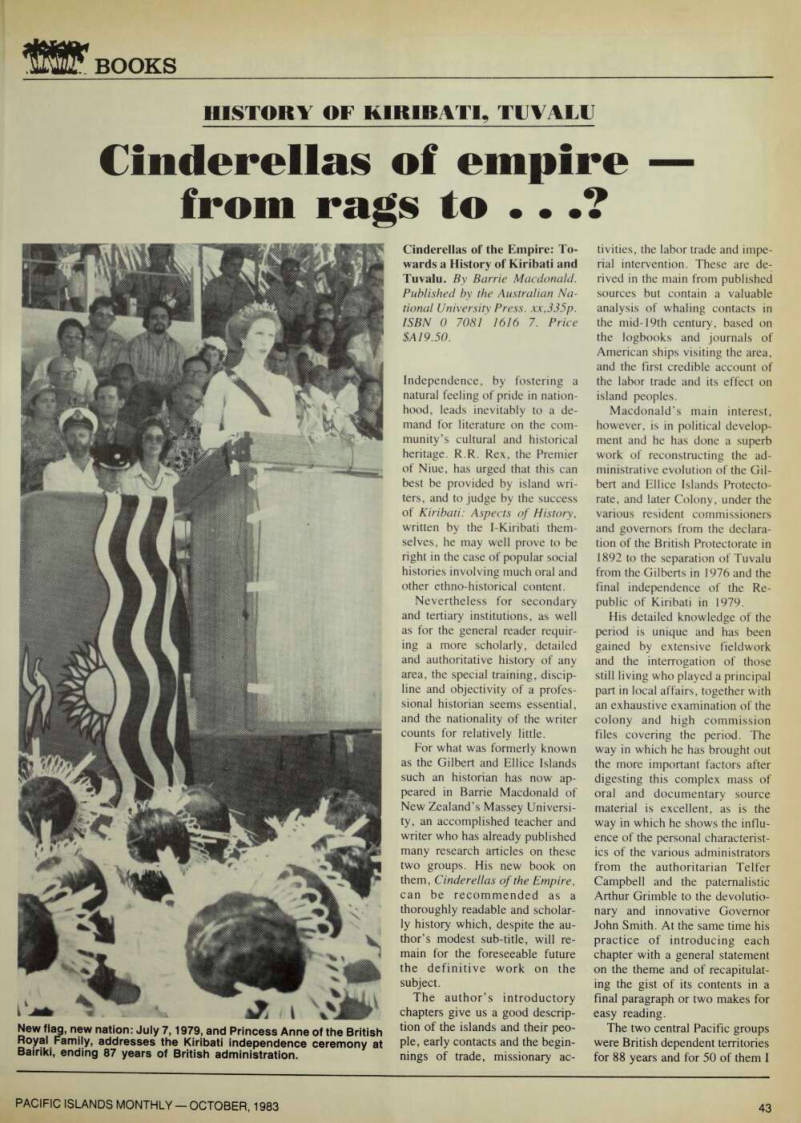

Books
History Of Kiribati, Tuvalu
Cinderellas of empirefrom rags to . . .?
Cinderellas of the Empire: To wards a History of Kiribati and Tuvalu. By Barrie Macdonald.
Published by the Australian Na tional University Press. xx,335p.
ISBN 0 7081 1616 7. Price 5A19.50.
Independence, by fostering a
natural feeling of pride in nation hood, leads inevitably to a de mand for literature on the com munity’s cultural and historical heritage. R.R. Rex, the Premier of Niue, has urged that this can best be provided by island wri ters, and to judge by the success of Kiribati: Aspects of History, written by the I-Kiribati them selves, he may well prove to be right in the case of popular social histories involving much oral and other ethno-historical content.
Nevertheless for secondary and tertiary institutions, as well as for the general reader requir ing a more scholarly, detailed and authoritative history of any area, the special training, discip line and objectivity of a profes sional historian seems essential, and the nationality of the writer counts for relatively little.
For what was formerly known as the Gilbert and Ellice Islands such an historian has now ap peared in Barrie Macdonald of New Zealand’s Massey Universi ty, an accomplished teacher and writer who has already published many research articles on these two groups. His new book on them, Cinderellas of the Empire, can be recommended as a thoroughly readable and scholar
ly history which, despite the au
thor’s modest sub-title, will re main for the foreseeable future the definitive work on the subject.
The author’s introductory
chapters give us a good descrip
tion of the islands and their peo ple, early contacts and the begin nings of trade, missionary ac
tivities, the labor trade and impe rial intervention. These are de rived in the main from published sources but contain a valuable analysis of whaling contacts in the mid-19th century, based on the logbooks and journals of American ships visiting the area, and the first credible account of the labor trade and its effect on
island peoples.
Macdonald’s main interest, however, is in political develop ment and he has done a superb work of reconstructing the ad ministrative evolution of the Gil bert and Ellice Islands Protecto rate, and later Colony, under the various resident commissioners and governors from the declara tion of the British Protectorate in 1892 to the separation of Tuvalu from the Gilberts in 1976 and the final independence of the Re public of Kiribati in 1979.
His detailed knowledge of the period is unique and has been
gained by extensive fieldwork
and the interrogation of those
still living who played a principal
part in local affairs, together with an exhaustive examination of the
colony and high commission
files covering the period. The way in which he has brought out the more important factors after digesting this complex mass of oral and documentary source material is excellent, as is the way in which he shows the influ ence of the personal characterist ics of the various administrators from the authoritarian Telfer Campbell and the paternalistic Arthur Grimble to the devolutio nary and innovative Governor John Smith. At the same time his
practice of introducing each
chapter with a general statement on the theme and of recapitulat ing the gist of its contents in a final paragraph or two makes for
easy reading.
The two central Pacific groups were British dependent territories for 88 years and for 50 of them I
New flag, new nation: July 7,1979, and Princess Anne of the British Royal Family, addresses the Kiribati independence ceremony at Bairiki, ending 87 years of British administration.
was connected directly or indi rectly with their affairs. A great many of the events narrated and discussed by Macdonald are therefore familiar to me. Yet I have been unable to fault him in any significant factual statement; on one or two evaluations or matters of opinion perhaps, but even there I am conscious that my memory is fallible and my
judgment not always unclouded
by personal bias.
Inevitably the Ellice Islands takes a back seat in much of Macdonald’s narrative, since during all but four of the depen dent years the group was merely one of the six administrative dis tricts of a colony centred on Ocean Island or Tarawa. It is arguable, however, that more at tention could have been paid to the influence of the Western Pacific High Commission on the formation of policies applied in
the colony.
High Commissioners admit tedly came and went and few of them, Sir Arthur Richards and Sir Harry Luke being notable exceptions, regarded commis sion affairs as more than an
annoying interruption to their
concentration on Fiji. But at least from 1929 to 1946 the capable and industrious back-room operator supreme, that grey emi nence Henry Harrison Vaskess, exerted through them, as the per manent secretary to the commis sion, a quiet and unobtrusive oversight, and, when considered necessary, direction, over territo rial policies and their implemen tation which has never been fully recognised. Unlike governors, the resident commissioners held only semi-independent commands.
On the other hand Macdonald has recorded at least part of the hitherto unwritten story of how a small group of colonial service administrative cadets, labelled by their detractors the “Young Turks”, fought for the rights of the indigenous population against the missions (on religious intolerance, particularly towards non-Christians, and secular re creations), the trading companies (on price discrimination and the co-operative movement), the ad ministration (on political and leg al discrimination) and other Europeans (on racial intoler
ance). By the time they had left much had been won, self government was on the way and the islanders themselves were ready and willing to carry on the battle for freedom and equality to
eventual victory.
To me the high-water mark of the old paternal administration was represented by Grimble’s 1930 Island Regulations, de scribed by the Chief Judicial Commissioner as “Spartan in character and Draconian in sev erity”, by which all islanders were confined to their villages from sunset to sunrise and to their small huts from 9 p.m. to 5.30 a.m., and so on for 120 injunctions until, as a Nikunau elder told Sir Arthur Richards, “we Gilbertese are serving life sentences in a large jail from which there is no escape”.
I am glad that an account of the somewhat unorthodox methods by which this iniquitous enactment was repealed is given in the book, for Jack Barley, the new Resident, asked me to find out “who was responsible for spilling the beans in London”.
As the culprit in question, this rather took me aback. But I managed to reply “no doubt time will tell”: and now, after 50 years, it has.
The Gilbert and Ellice Islands were once the remotest and al most the smallest territory in the Pacific, even though their area did double at low tide. Today the Gilberts, with the Phoenix and Line Islands, form the Republic of Kiribati, an independent coun try which is now, thanks largely to the Law of the Sea, the largest in the South Seas and one which is courted by the great powers for its potential fishing and seabed resources; while the Ellice have evolved into a mini-dominion of
eight villages, complete with
governor-general and the trap pings of a centralised bureaucra cy, but, it may be hoped, also with great riches concealed in its maritime zone.
Cinderellas of the Empire is a must for everyone interested in reading the fascinating story of how these two lovely groups of atolls, the true South Sea islands of romance, have developed, like Cinderella herself, from rags to at least the hope of riches to
come.
Harry E. Maude.
Advertisements & other items, p. 44 (1 item)
Machinery
Rock Processing
For Sale or Rent
Crushing Plants
Screening Plants
m k&ai mu & Conveyors
SM*;L
mL Rock Systems, Inc 1600 Kapiolani Blvd. Suite 1300 Honolulu, HI 96814 Phone (808) 944-5562 Telex# 7431987
Male dominance alive and well
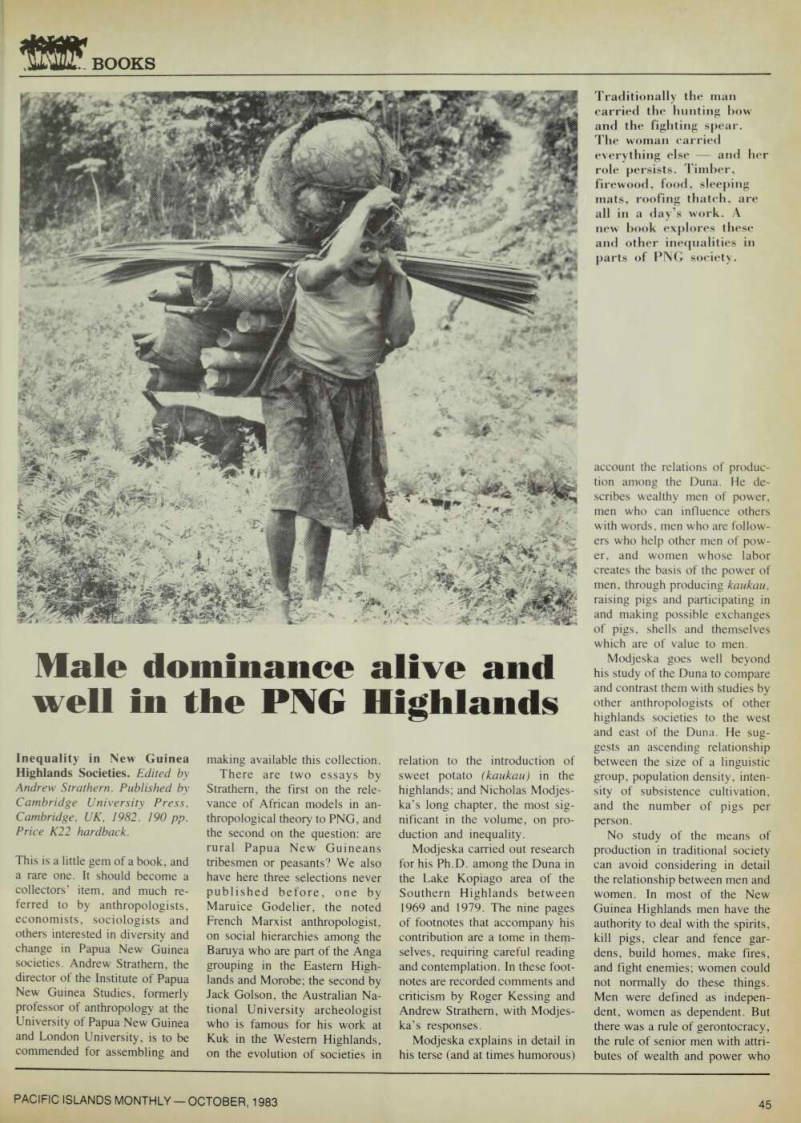

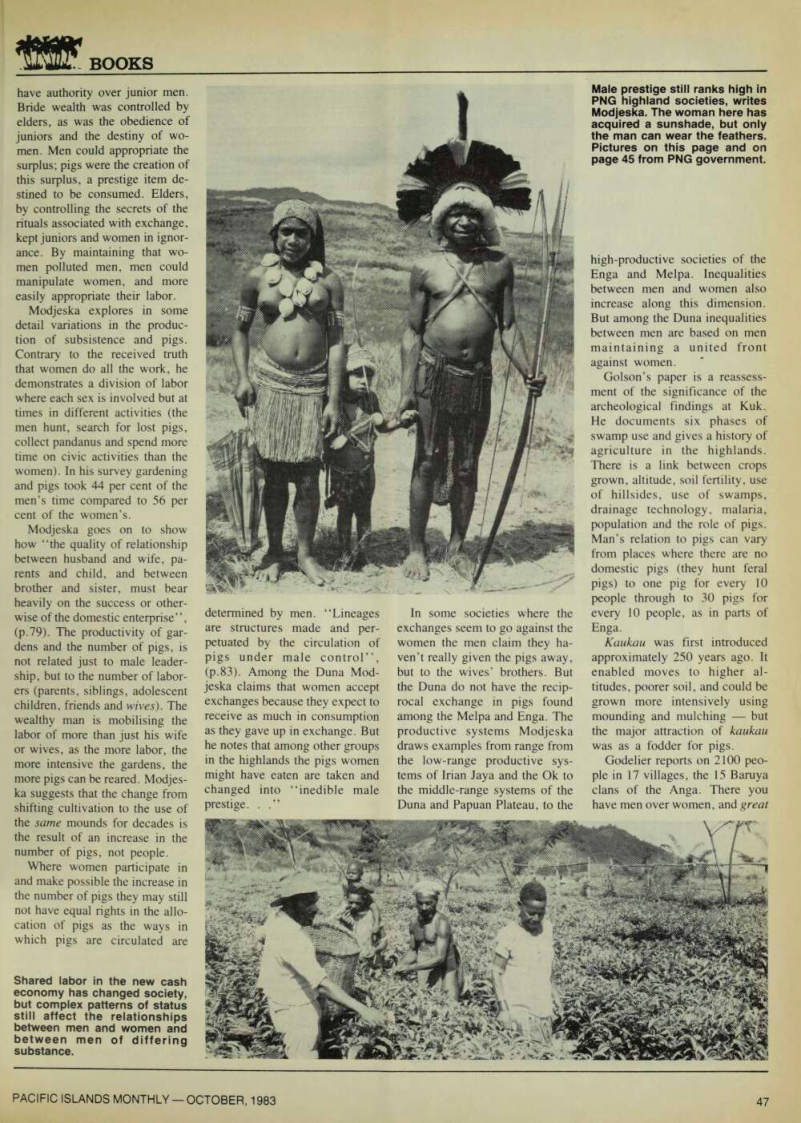
well in the PNG Highlands
Inequality in New Guinea Highlands Societies. Edited by Andrew Strathem. Published by Cambridge University Press, Cambridge, UK, 1982. 190 pp.
Price K 22 hardback.
This is a little gem of a book, and a rare one. It should become a collectors’ item, and much re ferred to by anthropologists, economists, sociologists and others interested in diversity and change in Papua New Guinea societies. Andrew Strathem, the director of the Institute of Papua New Guinea Studies, formerly professor of anthropology at the University of Papua New Guinea and London University, is to be commended for assembling and
making available this collection.
There are two essays by Strathem, the first on the rele vance of African models in an thropological theory to PNG, and the second on the question: are rural Papua New Guineans tribesmen or peasants? We also have here three selections never published before, one by Maruice Godelier, the noted French Marxist anthropologist, on social hierarchies among the Baruya who are part of the Anga grouping in the Eastern High lands and Morobe; the second by Jack Golson, the Australian Na
tional University archeologist
who is famous for his work at Kuk in the Western Highlands, on the evolution of societies in
relation to the introduction of sweet potato (kaukau) in the highlands; and Nicholas Modjes ka’s long chapter, the most sig nificant in the volume, on pro duction and inequality.
Modjeska carried out research for his Ph.D. among the Duna in the Lake Kopiago area of the Southern Highlands between 1969 and 1979. The nine pages of footnotes that accompany his contribution are a tome in them
selves, requiring careful reading
and contemplation. In these foot notes are recorded comments and
criticism by Roger Kessing and
Andrew Strathem, with Modjes ka’s responses.
Modjeska explains in detail in his terse (and at times humorous)
account the relations of produc tion among the Duna. He de scribes wealthy men of power, men who can influence others with words, men who are follow ers who help other men of pow er, and women whose labor creates the basis of the power of
men, through producing kaukau,
raising pigs and participating in
and making possible exchanges
of pigs, shells and themselves which are of value to men.
Modjeska goes well beyond
his study of the Duna to compare and contrast them with studies by other anthropologists of other highlands societies to the west and east of the Duna. He sug
gests an ascending relationship
between the size of a linguistic group, population density, inten sity of subsistence cultivation, and the number of pigs per person.
No study of the means of production in traditional society can avoid considering in detail the relationship between men and women. In most of the New Guinea Highlands men have the authority to deal with the spirits, kill pigs, clear and fence gar dens, build homes, make fires, and fight enemies; women could not normally do these things.
Men were defined as indepen dent, women as dependent. But there was a rule of gerontocracy, the rule of senior men with attri butes of wealth and power who
Traditionally the man carried the hunting how and the fighting spear.
The woman carried
everything else - and her
role persists. Timber, firewood, food, sleeping mats, roofing thatch, are all in a day’s work. A new book explores these and other inequalities in parts of PNG society.
have authority over junior men.
Bride wealth was controlled by elders, as was the obedience of juniors and the destiny of wo men. Men could appropriate the surplus; pigs were the creation of this surplus, a prestige item de stined to be consumed. Elders, by controlling the secrets of the rituals associated with exchange,
kept juniors and women in ignor
ance. By maintaining that wo men polluted men, men could manipulate women, and more easily appropriate their labor.
Modjeska explores in some detail variations in the produc tion of subsistence and pigs.
Contrary to the received truth that women do all the work, he demonstrates a division of labor where each sex is involved but at times in different activities (the men hunt, search for lost pigs, collect pandanus and spend more time on civic activities than the women). In his survey gardening and pigs took 44 per cent of the men’s time compared to 56 per cent of the women’s.
Modjeska goes on to show how “the quality of relationship between husband and wife, pa rents and child, and between brother and sister, must bear heavily on the success or other wise of the domestic enterprise’ ’, (p. 79). The productivity of gar dens and the number of pigs, is not related just to male leader ship, but to the number of labor
ers (parents, siblings, adolescent
children, friends and wives). The wealthy man is mobilising the labor of more than just his wife or wives, as the more labor, the more intensive the gardens, the more pigs can be reared. Modjes ka suggests that the change from shifting cultivation to the use of the same mounds for decades is the result of an increase in the number of pigs, not people.
Where women participate in and make possible the increase in the number of pigs they may still not have equal rights in the allo cation of pigs as the ways in which pigs are circulated are
determined by men. “Lineages are structures made and per petuated by the circulation of pigs under male control”, (p. 83). Among the Duna Mod jeska claims that women accept exchanges because they expect to receive as much in consumption as they gave up in exchange. But he notes that among other groups in the highlands the pigs women might have eaten are taken and changed into “inedible male prestige. . .”
In some societies where the exchanges seem to go against the women the men claim they ha ven’t really given the pigs away, but to the wives’ brothers. But the Duna do not have the recip rocal exchange in pigs found among the Melpa and Enga. The
productive systems Modjeska
draws examples from range from the low-range productive sys tems of Irian Jaya and the Ok to the middle-range systems of the Duna and Papuan Plateau, to the
high-productive societies of the Enga and Melpa. Inequalities between men and women also increase along this dimension.
But among the Duna inequalities between men are based on men maintaining a united front against women.
Golson’s paper is a reassess ment of the significance of the archeological findings at Kuk.
He documents six phases of swamp use and gives a history of agriculture in the highlands.
There is a link between crops grown, altitude, soil fertility, use of hillsides, use of swamps, drainage technology, malaria, population and the role of pigs.
Man’s relation to pigs can vary from places where there are no domestic pigs (they hunt feral pigs) to one pig for every 10 people through to 30 pigs for every 10 people, as in parts of Enga.
Kaukau was first introduced approximately 250 years ago. It enabled moves to higher al titudes, poorer soil, and could be grown more intensively using mounding and mulching but the major attraction of kaukau was as a fodder for pigs.
Godelier reports on 2100 peo ple in 17 villages, the 15 Baruya clans of the Anga. There you have men over women, and great
Shared labor in the new cash economy has changed society, but complex patterns of status still affect the relationships between men and women and between men of differing substance.
Male prestige still ranks high in PNG highland societies, writes Modjeska. The woman here has acquired a sunshade, but only the man can wear the feathers.
Pictures on this page and on page 45 from PNG government.
men over others. Men are the more beautiful sex: only men are permitted to wear feathers. Men maintained a monopoly over the main means of production and destruction: only men can make and exchange salt, only men can make and play musical instru ments. Salt production and ex change were central to the Baruya economy as through it they obtained axe stones, black palm wood, pigs’ teeth, feathers, and magic.
Among the Baruya male and female initiation produced peo ple who could marry, but there were states of initiation. To be come an adult male took four stages, and men must have at least four children. To Baruya men the act of creation was based on the interaction of the men and the sun, and following concep tion male sperm was required to make the body while the sun made the eyes, nose, mouth, hands and feet.
Among the Baruya only a few men were great, those who be came salt makers, great sha mans, great warriors or great cassowary hunters. Shamans helped spirits return to their bodies before dawn while the cassowary was the wild woman of the forest whom only men could eat. Here status was based on greatness not on bigmen who accumulated and distributed wealth. There were great men and ordinary men, who were called sweet potatoes, but at the bottom were some good-for nothing men who were not fit for
war, hunting or agriculture.
Godelier observes that in spite of social change “male dominance remains the primordial basis of social organisation and cultural identity”, (p. 34). Since PNG’s independence the Baruya have revived the stages of initiations.
Andrew Strathem’s two essays
complement the three major
pieces in this collection. He sug gests that the persistence of cere monial exchanges helps men to maintin their superiority over women, but he sees cash cropping as leading to the eman cipation of juniors, and business making it possible for women to be equal to men. He mentions the impact of major changes that have come from outside: pacifi cation, missions, local govern
ment councils, cash crops and politics to which I would add formal education, health ser vices, communications, wage labor and occupational diversification.
In his second chapter Strath em’s discussion of some of the unintended consequences of the success of major clan associa tions is fascinating: a few are too large, too rich, causing conflict with their poorer neighbors, and an increase in inequalities across new lines.
This is a book well worth reading and re-reading. As with many UK productions now, it would have received wider circu lation in PNG if available in paperback at a lower price. Its value would be enhanced by photographs and more maps.
Some readers will still wonder where are the Baruya, Duna, Kapauku, Guro, Wiru, or other groups frequently referred to but not included in the map on page
110.
Sheldon Weeks.
Books received
A Natural History of the Coral Reef. By Charles R. C. Sheppard. Published 1983 by Blandford Books Ltd., England. Dis tributed by Australia & New Zealand Book Co. Pty. Ltd., P.O. Box 459, Brookvale, Australia 2100. ISBN 0 7137 1268 6. Price $17.95.
The Lost World of Irian Jaya. By Robert Mitton. Published 1983 by Oxford Univer sity Press, 7 Bowen Crescent, Melbourne, Australia, 3000. ISBN 0 19 554368 8.
Price $A50.
Art and Artists of Oceania. By S. Mead and B. Kemot. Published by the Dunmore Press Ltd., P.O. Box 5115, Palmerston North, New Zealand. ISBN 0 9611006 0 5. Price $NZ29.95.
The Tongan Past. By Patricia Ledyard.
Published 1982 by Government Printing Office. Nukualofa, Tonga, and distributed by Matheson, P.O. Box 46, Vavau, Ton ga. No ISBN, no price provided.
The Crying Baby and Coconut Wish.
By Dianne Mclnnes. Published 1983 by Web Books, P.O. Box 1385, Port Mores by, Papua New Guinea. No ISBN. No
price given.
Arek’s Terrible Day, and Other Stories.
By Dianne Mclnnes. Published 1983 by Web Books, P.O. Box 1385, Port Mores by, Papua New Guinea. No ISBN. No
price given.
Mogundi and Eka Run Away. By Dian ne Mclnnes. Published 1983 by Web Books, P.O. Box 1385, Port Moresby, Papua New Guinea. No ISBN. No price
given.
Tourism and Underdevelopment in Fiji.
By Stephen G. Britton. Published by
Australian National University Press, P.O.
Box 4, Canberra, A.C.T., 2600, Aust ralia. ISBN 0 909150 931. Price $A12.00.
Advertisements & other items, pp. 46-48 (1 item)
Come up to kool
The cool refreshing taste of menthol.
INSTANT
HOUSES’
and Commercial Buildings v . t
with Therma-Panelfthe
I fully insulated inter-locking
J Building System
i-INISIiP Cyclone rated I i I George Hudson Homes (Aust ) pty. Ltd 186 Hume Highway Cabramatta NSW 2166 Australia. Tel: (02) 727 9066. Telex: AA25800 Post coupon for details and prices.
Tel:
NORTH QUEENSLAND ENGINEERS
& AGENTS PTY. LTD.
[tMK
Shipbuilding and Repair are our Business We have full facilities for repair or refitting SLIPPING to 750 tonne DOCKING to 200 feet The shipbuilding division can construct a vessel to your design, or design one to suit your needs.
Barges, Tugs, Workboats, Catamarans, Landing Craft and Patrol Boats are all within our scope.
CALL US TODAY
N.Q.E.A.
36 Buchan Street, Cairns 4870 P.O. Box 1105, Cairns Telephone (070) 51 6600. Telex 48087 ]
CONTRACTORS TO THE ROYAL AUSTRALIAN NAVY
!• Best yet guide
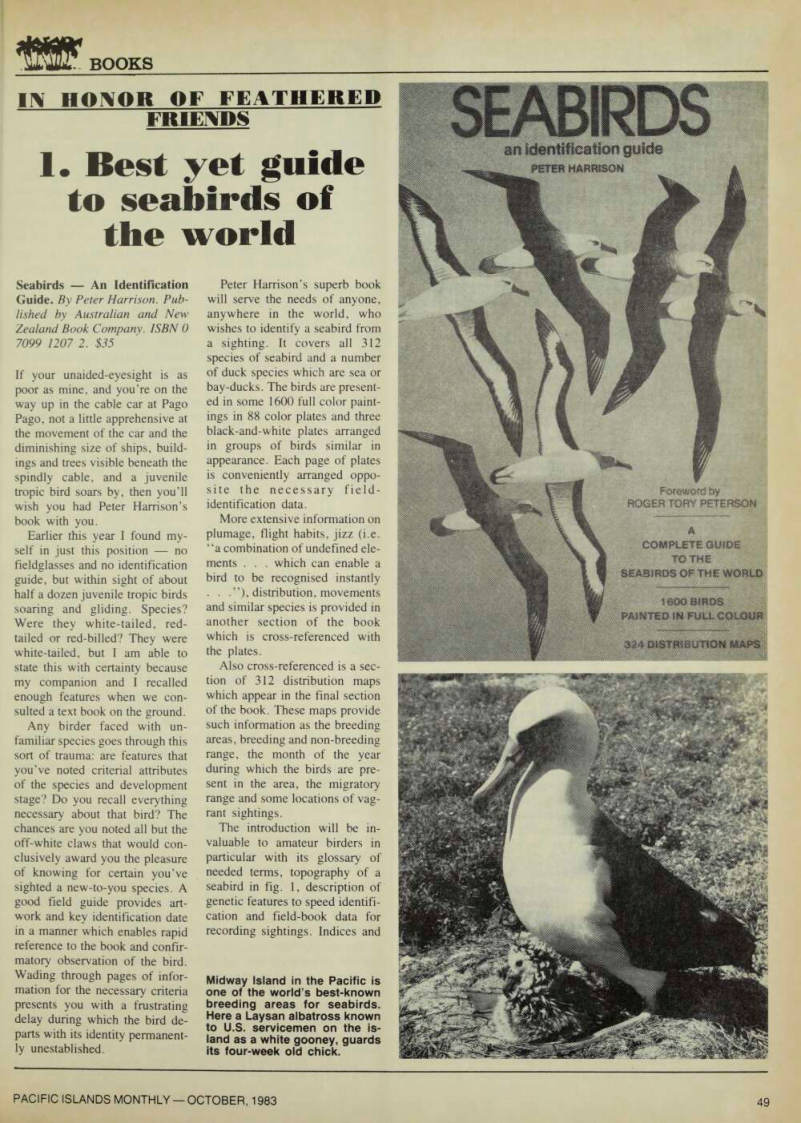
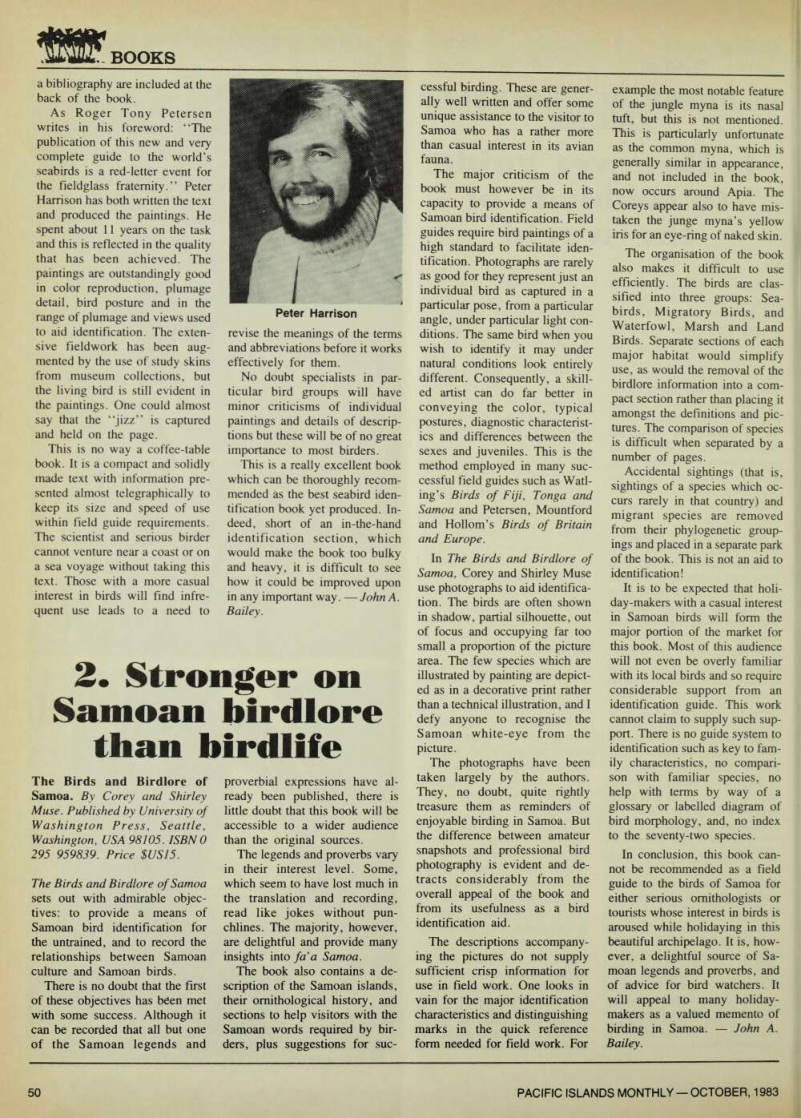
In Honor Of Feathered
Friends
!• Best yet guide to seabirds of the world
Seabirds An Identification Guide. By Peter Harrison. Pub lished by Australian and New Zealand Book Company. ISBN 0 7099 1207 2. $35 If your unaided-eyesight is as poor as mine, and you’re on the way up in the cable car at Pago Pago, not a little apprehensive at the movement of the car and the diminishing size of ships, build ings and trees visible beneath the spindly cable, and a juvenile
tropic bird soars by, then you’ll
wish you had Peter Harrison’s book with you.
Earlier this year I found my self in just this position no fieldglasses and no identification guide, but within sight of about half a dozen juvenile tropic birds
soaring and gliding. Species?
Were they white-tailed, red tailed or red-billed? They were white-tailed, but I am able to state this with certainty because my companion and I recalled enough features when we con sulted a text book on the ground.
Any birder faced with un familiar species goes through this sort of trauma: are features that you’ve noted criterial attributes of the species and development stage? Do you recall everything necessary about that bird? The chances are you noted all but the off-white claws that would con clusively award you the pleasure of knowing for certain you’ve sighted a new-to-you species. A good field guide provides art work and key identification date in a manner which enables rapid reference to the book and confir matory observation of the bird.
Wading through pages of infor mation for the necessary criteria presents you with a frustrating delay during which the bird de parts with its identity permanent
ly unestablished.
Peter Harrison’s superb book will serve the needs of anyone, anywhere in the world, who wishes to identify a seabird from a sighting. It covers all 312 species of seabird and a number of duck species which are sea or bay-ducks. The birds are present ed in some 1600 full color paint ings in 88 color plates and three
black-and-white plates arranged
in groups of birds similar in appearance. Each page of plates is conveniently arranged oppo site the necessary field identification data.
More extensive information on plumage, flight habits, jizz (i.e.
“a combination of undefined ele ments . . . which can enable a bird to be recognised instantly . . .”), distribution, movements and similar species is provided in another section of the book which is cross-referenced with
the plates.
Also cross-referenced is a sec tion of 312 distribution maps which appear in the final section of the book. These maps provide such information as the breeding
areas, breeding and non-breeding
range, the month of the year during which the birds are pre sent in the area, the migratory range and some locations of vag
rant sightings.
The introduction will be in valuable to amateur birders in particular with its glossary of needed terms, topography of a seabird in fig. 1, description of genetic features to speed identifi cation and field-book data for
recording sightings. Indices and
Midway Island in the Pacific is one of the world’s best-known breeding areas for seabirds.
Here a Laysan albatross known to U.S. servicemen on the is land as a white gooney, guards its four-week old chick.
a bibliography are included at the back of the book.
As Roger Tony Petersen
writes in his foreword: “The publication of this new and very complete guide to the world’s seabirds is a red-letter event for
the fieldglass fraternity.’’ Peter
Harrison has both written the text and produced the paintings. He spent about 11 years on the task and this is reflected in the quality that has been achieved. The paintings are outstandingly good in color reproduction, plumage detail, bird posture and in the range of plumage and views used to aid identification. The exten sive fieldwork has been aug mented by the use of study skins from museum collections, but the living bird is still evident in the paintings. One could almost say that the “jizz” is captured and held on the page.
This is no way a coffee-table book. It is a compact and solidly made text with information pre sented almost telegraphically to keep its size and speed of use
within field guide requirements.
The scientist and serious birder cannot venture near a coast or on a sea voyage without taking this text. Those with a more casual interest in birds will find infre quent use leads to a need to
revise the meanings of the terms and abbreviations before it works effectively for them.
No doubt specialists in par ticular bird groups will have minor criticisms of individual paintings and details of descrip tions but these will be of no great importance to most birders.
This is a really excellent book which can be thoroughly recom mended as the best seabird iden tification book yet produced. In deed, short of an in-the-hand identification section, which would make the book too bulky and heavy, it is difficult to see how it could be improved upon
in any important way.
John A.
Bailey.
2. Stronger on Samoan birdlore than birdllfe
The Birds and Birdlore of Samoa. By Corey and Shirley Muse. Published by University of Washington Press, Seattle, Washington, USA 98105. ISBN 0 295 959839. Price SUSIS.
The Birds and Birdlore of Samoa sets out with admirable objec tives: to provide a means of Samoan bird identification for the untrained, and to record the relationships between Samoan culture and Samoan birds.
There is no doubt that the first of these objectives has been met with some success. Although it can be recorded that all but one of the Samoan legends and
proverbial expressions have al ready been published, there is little doubt that this book will be accessible to a wider audience than the original sources.
The legends and proverbs vary in their interest level. Some, which seem to have lost much in the translation and recording, read like jokes without pun chlines. The majority, however, are delightful and provide many
insights into fa’a Samoa.
The book also contains a de scription of the Samoan islands, their ornithological history, and sections to help visitors with the Samoan words required by bir ders, plus suggestions for suc
cessful birding. These are gener ally well written and offer some unique assistance to the visitor to Samoa who has a rather more than casual interest in its avian fauna.
The major criticism of the book must however be in its capacity to provide a means of Samoan bird identification. Field guides require bird paintings of a high standard to facilitate iden tification. Photographs are rarely as good for they represent just an individual bird as captured in a particular pose, from a particular angle, under particular light con ditions. The same bird when you wish to identify it may under natural conditions look entirely different. Consequently, a skill ed artist can do far better in conveying the color, typical postures, diagnostic characterist ics and differences between the sexes and juveniles. This is the method employed in many suc cessful field guides such as Wall ing’s Birds of Fiji, Tonga and Samoa and Petersen, Mountford and Hollom’s Birds of Britain and Europe.
In The Birds and Birdlore of Samoa, Corey and Shirley Muse use photographs to aid identifica tion. The birds are often shown in shadow, partial silhouette, out of focus and occupying far too small a proportion of the picture area. The few species which are illustrated by painting are depict ed as in a decorative print rather than a technical illustration, and I defy anyone to recognise the Samoan white-eye from the picture.
The photographs have been taken largely by the authors.
They, no doubt, quite rightly treasure them as reminders of enjoyable birding in Samoa. But the difference between amateur snapshots and professional bird photography is evident and de tracts considerably from the overall appeal of the book and from its usefulness as a bird identification aid.
The descriptions accompany ing the pictures do not supply sufficient crisp information for use in field work. One looks in vain for the major identification characteristics and distinguishing marks in the quick reference form needed for field work. For
example the most notable feature of the jungle myna is its nasal tuft, but this is not mentioned.
This is particularly unfortunate as the common myna, which is generally similar in appearance, and not included in the book, now occurs around Apia. The Coreys appear also to have mis taken the junge myna’s yellow iris for an eye-ring of naked skin.
The organisation of the book also makes it difficult to use efficiently. The birds are clas sified into three groups: Sea birds, Migratory Birds, and Waterfowl, Marsh and Land Birds. Separate sections of each
major habitat would simplify
use, as would the removal of the birdlore information into a com pact section rather than placing it amongst the definitions and pic tures. The comparison of species is difficult when separated by a number of pages.
Accidental sightings (that is, sightings of a species which oc curs rarely in that country) and migrant species are removed from their phylogenetic group ings and placed in a separate park of the book. This is not an aid to identification!
It is to be expected that holi day-makers with a casual interest in Samoan birds will form the major portion of the market for this book. Most of this audience will not even be overly familiar with its local birds and so require considerable support from an identification guide. This work cannot claim to supply such sup port. There is no guide system to identification such as key to fam
ily characteristics, no compari
son with familiar species, no help with terms by way of a glossary or labelled diagram of bird morphology, and, no index to the seventy-two species.
In conclusion, this book can not be recommended as a field guide to the birds of Samoa for either serious ornithologists or tourists whose interest in birds is aroused while holidaying in this beautiful archipelago. It is, how ever, a delightful source of Sa moan legends and proverbs, and of advice for bird watchers. It will appeal to many holiday makers as a valued memento of
birding in Samoa.
John A.
Bailey.
Peter Harrison
Islands
From the
Press
Part of an editorial from the Marianas Variety News and
Views, Saipan
Though Abraham Lincoln abolished slavery in the United States in 1864 almost 120 years ago some individuals in this American flag territory still practice this ancient form of inhu manity. It’s called hiring a Filipino as a maid or a farmer for $l5O a month. Some folk here on Saipan claim to be liberating the Filipinos by bringing them here to do their dirty laundry.
But in reality one group of people is taking advantage of another by paying less than the minimum wage.
From Hahine’s column in The Times of Papua New Guinea describing the reaction of readers to published material about “women and power”
I heard from a male friend that this particular topic was the subject of a heated debate in a certain bar last week. It is the confirmed opinion of some males that no matter how far women go in education they will never attain the same top levels that men do simply because they were bom women. I’m glad to be able to note that there was an opposing view at this debate, but we will never know the outcome of the argument. Apparent ly it got out of hand and ended in a brawl, fam Tam, Port-Vila, Vanuatu, describing the construc tion of the first road link to a remote village At Metun in North Malekula, Village Chief Paul was so happy at seeing the Public Works Department bulldozer entering his village that he halted construction of the road so that the villa gers could celebrate the breakthrough. According to the foreman, Mr John Mafau, the chief was told that the eight-kilometre road had still to be completed but he ignored the information and said “Never mind we can do the work later. The fact is that you have reached our village and we are so happy. So let’s celebrate.”
The Cook Island News, Rarotonga Yesterday’s Cook Island News reported that a man had appeared before the High Court charged with the theft of $2OOO from the National Bank. The reference to Mr P . . . was not correct . He was not charged with any criminal offence, but with a traffic offence. We apologise for any embarrassment or inconvenience The Papua New Guinea Post-Courier, Port Moresby A murder trial at Waigani had to be delayed for a couple of hours earlier this week because the Chief Justice, Sir Buri Kidu, had to dash off to Government House to be sworn in for his new term. His first term expired the day before.
A piece of community advice from the Marshall Islands
Journal, Majuro
Elson says: There is nothing like planning ahead. Family plan ning is very important, even if you are not married. Find a nice quiet place this weekend and share your dreams with that some one special.
From the Flotsam and Jetsam column in The Fiji Times, Suva Once upon a time the Posts and Telecommunications Department looked up their account books to see who hadn’t paid up, and found no less than the Fiji Electricity Authority was one of the defaulters. So they took steps. They cut off the FEA’s phones
which, if you think about it, wasn’t such a very clever thing to do. After all, if you were the big energetic FEA and you became provoked like that, what would you do? Look up your books for P & T sections which were behind in their electricity bills? You guessed it, and . . . blam . . . without warning, the P & T lights went out.
From Akio Heine s column in the Marshall Islands Jour
nal, Majuro
The U.S. House of Representatives has approved the hiring of a House Chaplain who will open the meeting each day with pray ers and will be paid $50,000 a year. Just think how they could have saved the taxpayers’ money by adopting Nitijela’s system of silent prayer. One prays for himself. And the good thing about it, too, is that you have only yourself to blame if your prayers go unanswered.
The Times of Papua New Guinea, quoting parliamentary Opposition leader lambakey Okuk after his return to
parliament from a by-election
While there are some who are pleased to see me in parliament, there are others are who are wishing that I had never come.
These are the ones who view me as a threat to their positions of power and glory. These are the very people who did not know what one penny looked like before they entered parliament. They entered parliament with the notion that such entry was a licence for them to trade, in order to acquire wealth. There are too many greedy souls in parliament, using an honorable institution as if it were the New York Stock Exchange.
Tohi Tala Niue, Niue Early morning saw a French cargo container vessel steaming offshore along the Alofi roadstead, apparently taking a look at the island. The Friendship Whistle had diverted enroute from New Caledonia to French Polynesia to gander at the island.
What an amazing inter-island container carrier it is, compared with the current vessels that serve us. I wonder what they thought of our little island? Another dumping ground perhaps?
Advertisements & other items, p. 51 (1 item)
Landing Barge For Sale
FOR SALE
General Purpose
Cargo Vessel
Twin Screw. Dimensions 33.3 m x 7.1 m x 2.7 m. Built of steel 1967, 2 x 235 hp Caterpillar D 343 Diesels, plus 2 x Caterpillar D 330 Diesels driving 26 kVA alternators. Displacement at mean draft 292 tons, total shell capacity 113 t. Seawater, Lloyds +IOOAI Class, Accom. for 22 persons, Auto Pilot, 2 x Radar, Depth Sounder, excellent condition throughout.
Price: AUD 290,000.00 For further information contact: Capt. W. L. Kennedy Pty. Ltd.
P.O. Box 225, CREMORNE, NSW 2090.
PHONE: (02) 908 1805 TELEX AA22333
LANDING BARGE FOR SALE
All steel construction. Twin screw G. M. engines 165 h.p. each.
Ideally suitable for harbours and river operations.
Length 56 ft. (17 metres), beam 14 ft. 1 in. (4.3 m), draft unladen 2 ft. 7 ins. (.82m).
Carrying capacity as is approx. 25 tonnes.
Would suit new vessel buyer. Will deliver.
Details available from:
BALLINA SLIPWAY and ENGINEERING CO.
P.O. Box 23, Ballina, NSW 2478 Phone (066) 86-2577. Telex AA 66222.
around, on Rennell Island
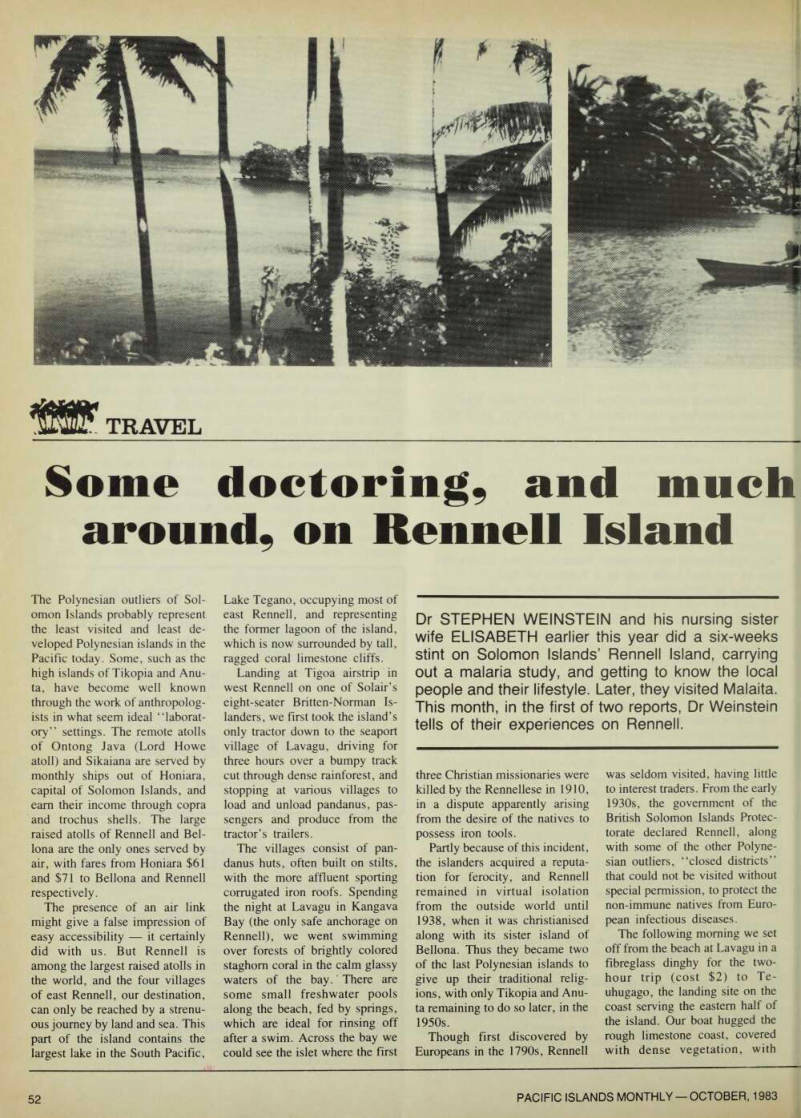
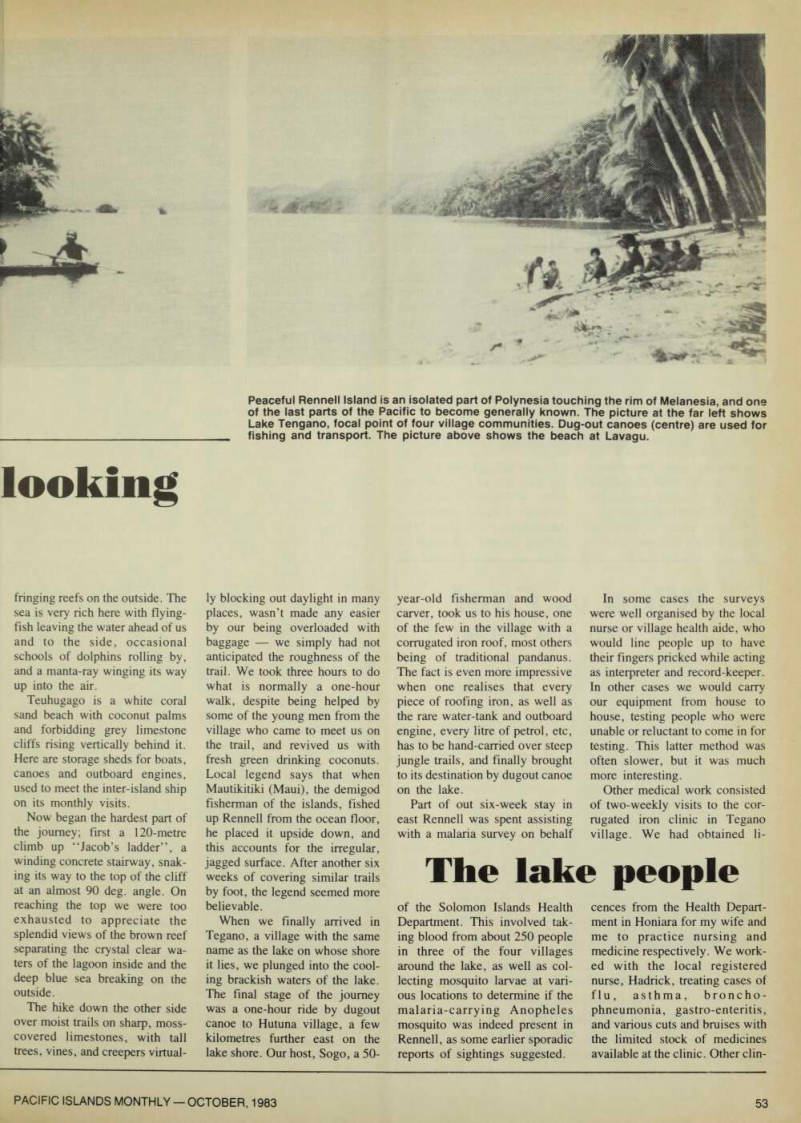
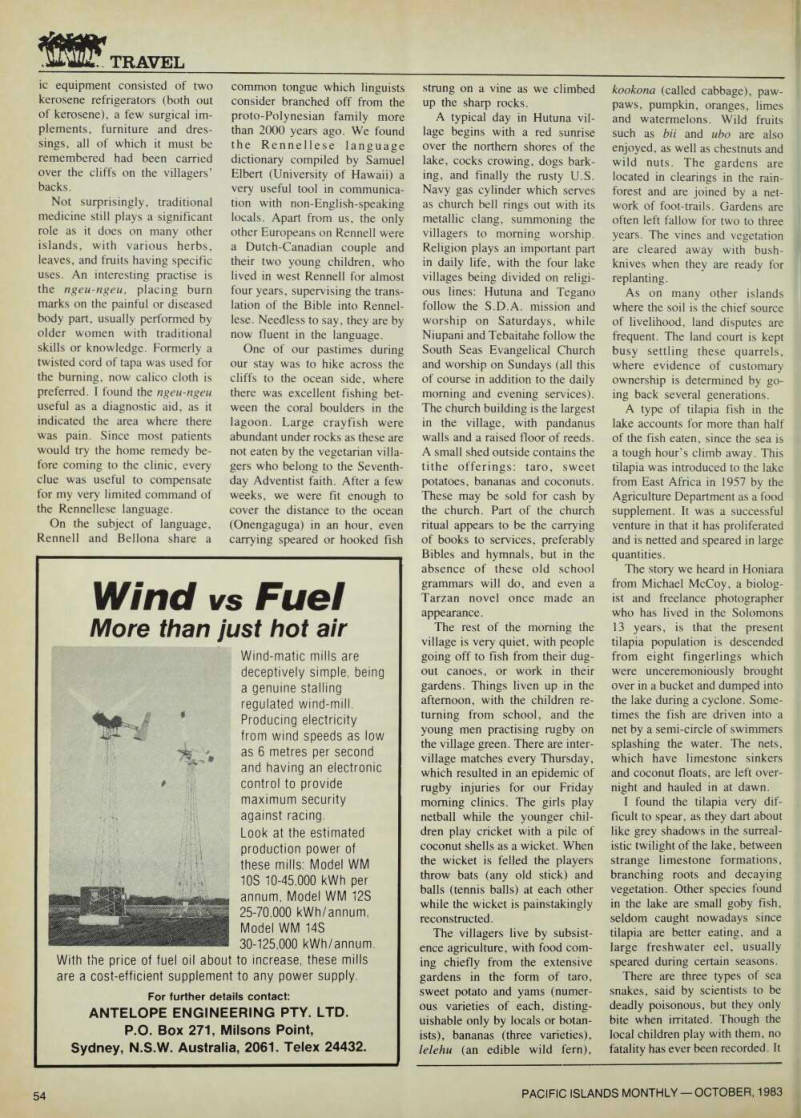
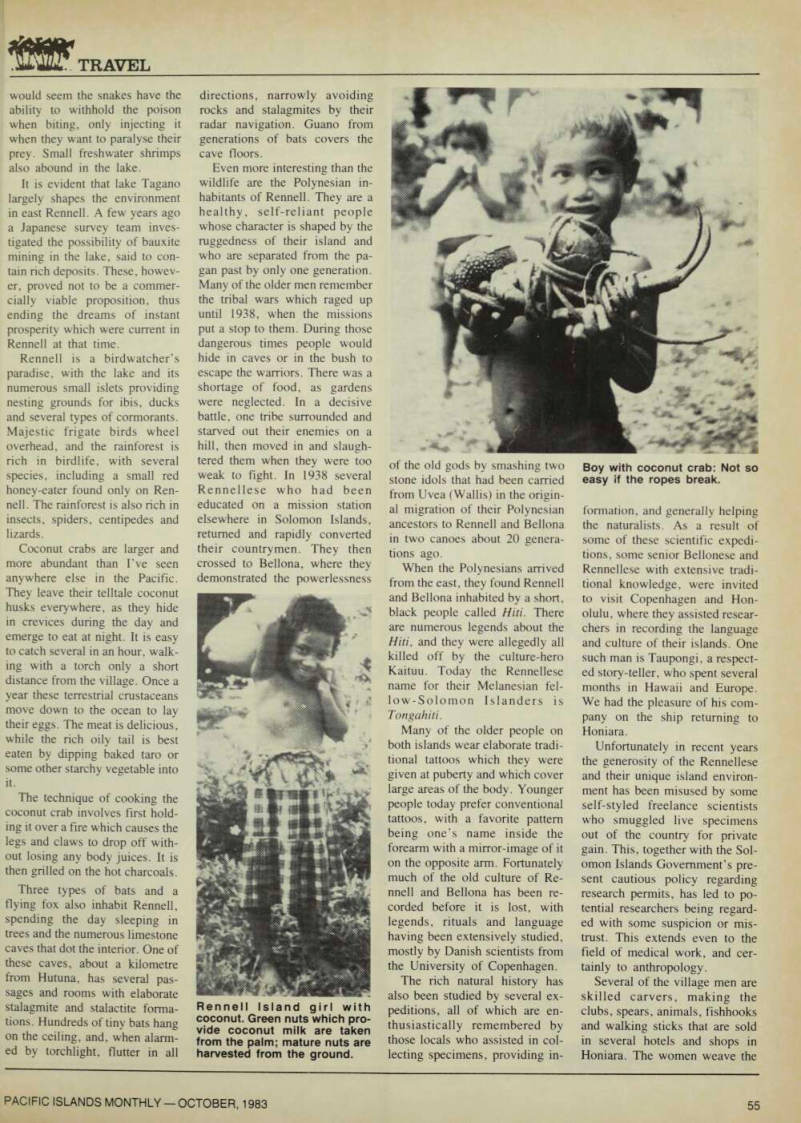
Travel
Some doctoring, and much around, on Rennell Island
The Polynesian outliers of Sol omon Islands probably represent the least visited and least de veloped Polynesian islands in the Pacific today. Some, such as the high islands of Tikopia and Anu ta, have become well known through the work of anthropolog ists in what seem ideal “laborat ory” settings. The remote atolls of Ontong Java (Lord Howe atoll) and Sikaiana are served by monthly ships out of Honiara, capital of Solomon Islands, and earn their income through copra and trochus shells. The large raised atolls of Rennell and Bel lona are the only ones served by air, with fares from Honiara $6l and $7l to Bellona and Rennell respectively.
The presence of an air link might give a false impression of easy accessibility it certainly did with us. But Rennell is among the largest raised atolls in the world, and the four villages of east Rennell, our destination, can only be reached by a strenu ous journey by land and sea. This part of the island contains the largest lake in the South Pacific,
Lake Tegano, occupying most of east Rennell, and representing the former lagoon of the island, which is now surrounded by tall, ragged coral limestone cliffs.
Landing at Tigoa airstrip in west Rennell on one of Solair’s eight-seater Britten-Norman Is landers, we first took the island’s only tractor down to the seaport village of Lavagu, driving for three hours over a bumpy track cut through dense rainforest, and stopping at various villages to load and unload pandanus, pas sengers and produce from the tractor’s trailers.
The villages consist of pan danus huts, often built on stilts, with the more affluent sporting corrugated iron roofs. Spending the night at Lavagu in Kangava Bay (the only safe anchorage on Rennell), we went swimming over forests of brightly colored staghorn coral in the calm glassy waters of the bay. ‘ There are some small freshwater pools along the beach, fed by springs, which are ideal for rinsing off after a swim. Across the bay we could see the islet where the first
Dr STEPHEN WEINSTEIN and his nursing sister wife ELISABETH earlier this year did a six-weeks stint on Solomon Islands’ Rennell Island, carrying out a malaria study, and getting to know the local people and their lifestyle. Later, they visited Malaita.
This month, in the first of two reports, Dr Weinstein tells of their experiences on Rennell.
three Christian missionaries were killed by the Rennellese in 1910,
in a dispute apparently arising
from the desire of the natives to possess iron tools.
Partly because of this incident, the islanders acquired a reputa tion for ferocity, and Rennell remained in virtual isolation from the outside world until 1938, when it was christianised along with its sister island of Bellona. Thus they became two of the last Polynesian islands to give up their traditional relig ions, with only Tikopia and Anu ta remaining to do so later, in the 19505.
Though first discovered by Europeans in the 17905, Rennell
was seldom visited, having little to interest traders. From the early 19305, the government of the British Solomon Islands Protec torate declared Rennell, along with some of the other Polyne sian outliers, “closed districts” that could not be visited without special permission, to protect the non-immune natives from Euro pean infectious diseases.
The following morning we set off from the beach at Lavagu in a fibreglass dinghy for the two hour trip (cost $2) to Te uhugago, the landing site on the coast serving the eastern half of the island. Our boat hugged the rough limestone coast, covered with dense vegetation, with
fringing reefs on the outside. The sea is very rich here with flying fish leaving the water ahead of us and to the side, occasional schools of dolphins rolling by, and a manta-ray winging its way up into the air.
Teuhugago is a white coral sand beach with coconut palms and forbidding grey limestone cliffs rising vertically behind it.
Here are storage sheds for boats, canoes and outboard engines, used to meet the inter-island ship on its monthly visits.
Now began the hardest part of the journey; first a 120-metre climb up “Jacob’s ladder’’, a winding concrete stairway, snak ing its way to the top of the cliff at an almost 90 deg. angle. On reaching the top we were too exhausted to appreciate the splendid views of the brown reef separating the crystal clear wa ters of the lagoon inside and the deep blue sea breaking on the outside.
The hike down the other side over moist trails on sharp, moss covered limestones, with tall trees, vines, and creepers virtual
ly blocking out daylight in many places, wasn’t made any easier by our being overloaded with baggage we simply had not anticipated the roughness of the trail. We took three hours to do what is normally a one-hour walk, despite being helped by some of the young men from the village who came to meet us on the trail, and revived us with fresh green drinking coconuts.
Local legend says that when Mautikitiki (Maui), the demigod fisherman of the islands, fished up Rennell from the ocean floor, he placed it upside down, and this accounts for the irregular, jagged surface. After another six weeks of covering similar trails by foot, the legend seemed more believable.
When we finally arrived in Tegano, a village with the same name as the lake on whose shore it lies, we plunged into the cool ing brackish waters of the lake.
The final stage of the journey was a one-hour ride by dugout canoe to Hutuna village, a few kilometres further east on the lake shore. Our host, Sogo, a 50-
year-old fisherman and wood carver, took us to his house, one of the few in the village with a corrugated iron roof, most others being of traditional pandanus.
The fact is even more impressive when one realises that every piece of roofing iron, as well as the rare water-tank and outboard engine, every litre of petrol, etc, has to be hand-carried over steep
jungle trails, and finally brought
to its destination by dugout canoe on the lake.
Part of out six-week stay in east Rennell was spent assisting with a malaria survey on behalf
The lake people
of the Solomon Islands Health Department. This involved tak ing blood from about 250 people in three of the four villages around the lake, as well as col lecting mosquito larvae at vari ous locations to determine if the malaria-carrying Anopheles mosquito was indeed present in Rennell, as some earlier sporadic reports of sightings suggested.
In some cases the surveys were well organised by the local nurse or village health aide, who would line people up to have their fingers pricked while acting as interpreter and record-keeper.
In other cases we would carry our equipment from house to house, testing people who were unable or reluctant to come in for testing. This latter method was often slower, but it was much more interesting.
Other medical work consisted of two-weekly visits to the cor rugated iron clinic in Tegano village. We had obtained li
cences from the Health Depart ment in Honiara for my wife and me to practice nursing and medicine respectively. We work ed with the local registered nurse, Hadrick, treating cases of flu, asthma, broncho
phneumonia, gastro-enteritis,
and various cuts and bruises with the limited stock of medicines available at the clinic. Other clin-
Peaceful Rennell Island is an isolated part of Polynesia touching the rim of Melanesia, and one of the last parts of the Pacific to become generally known. The picture at the far left shows Lake Tengano, focal point of four village communities. Dug-out canoes (centre) are used for fishing and transport. The picture above shows the beach at Lavagu.
ic equipment consisted of two kerosene refrigerators (both out of kerosene), a few surgical im plements, furniture and dres sings, all of which it must be remembered had been carried over the cliffs on the villagers’ backs.
Not surprisingly, traditional medicine still plays a significant role as it does on many other islands, with various herbs, leaves, and fruits having specific uses. An interesting practise is the ngeu-ngeu, placing burn marks on the painful or diseased body part, usually performed by older women with traditional skills or knowledge. Formerly a twisted cord of tapa was used for the burning, now calico cloth is preferred. I found the ngeu-ngeu useful as a diagnostic aid, as it indicated the area where there was pain. Since most patients would try the home remedy be fore coming to the clinic, every clue was useful to compensate for my very limited command of the Rennellese language.
On the subject of language, Rennell and Bellona share a
common tongue which linguists consider branched off from the proto-Polynesian family more than 2000 years ago. We found the Rennellese language dictionary compiled by Samuel Elbert (University of Hawaii) a very useful tool in communica tion with non-English-speaking locals. Apart from us, the only other Europeans on Rennell were a Dutch-Canadian couple and their two young children, who lived in west Rennell for almost four years, supervising the trans lation of the Bible into Rennel lese. Needless to say, they are by now fluent in the language.
One of our pastimes during our stay was to hike across the cliffs to the ocean side, where there was excellent fishing bet ween the coral boulders in the lagoon. Large crayfish were abundant under rocks as these are not eaten by the vegetarian villa gers who belong to the Seventh day Adventist faith. After a few weeks, we were fit enough to cover the distance to the ocean (Onengaguga) in an hour, even carrying speared or hooked fish
strung on a vine as we climbed up the sharp rocks.
A typical day in Hutuna vil lage begins with a red sunrise over the northern shores of the lake, cocks crowing, dogs bark ing, and finally the rusty U.S.
Navy gas cylinder which serves as church bell rings out with its
metallic clang, summoning the
villagers to morning worship.
Religion plays an important part in daily life, with the four lake villages being divided on religi ous lines: Hutuna and Tegano follow the S.D.A. mission and
worship on Saturdays, while
Niupani and Tebaitahe follow the South Seas Evangelical Church and worship on Sundays (all this of course in addition to the daily
morning and evening services).
The church building is the largest in the village, with pandanus walls and a raised floor of reeds.
A small shed outside contains the tithe offerings: taro, sweet potatoes, bananas and coconuts.
These may be sold for cash by the church. Part of the church ritual appears to be the carrying of books to services, preferably Bibles and hymnals, but in the absence of these old school grammars will do, and even a Tarzan novel once made an appearance.
The rest of the morning the village is very quiet, with people going off to fish from their dug out canoes, or work in their gardens. Things liven up in the afternoon, with the children re turning from school, and the young men practising rugby on the village green. There are inter village matches every Thursday, which resulted in an epidemic of
rugby injuries for our Friday
morning clinics. The girls play
netball while the younger chil dren play cricket with a pile of coconut shells as a wicket. When the wicket is felled the players throw bats (any old stick) and balls (tennis balls) at each other while the wicket is painstakingly reconstructed.
The villagers live by subsist ence agriculture, with food com ing chiefly from the extensive gardens in the form of taro, sweet potato and yams (numer ous varieties of each, disting uishable only by locals or botan ists), bananas (three varieties), lelehu (an edible wild fern),
kookona (called cabbage), paw paws, pumpkin, oranges, limes and watermelons. Wild fruits such as bii and übo are also enjoyed, as well as chestnuts and wild nuts. The gardens are located in clearings in the rain forest and are joined by a net work of foot-trails. Gardens are often left fallow for two to three years. The vines and vegetation are cleared away with bush knives when they are ready for replanting.
As on many other islands where the soil is the chief source of livelihood, land disputes are frequent. The land court is kept busy settling these quarrels, where evidence of customary ownership is determined by go ing back several generations.
A type of tilapia fish in the lake accounts for more than half of the fish eaten, since the sea is a tough hour’s climb away. This tilapia was introduced to the lake from East Africa in 1957 by the Agriculture Department as a food supplement. It was a successful venture in that it has proliferated and is netted and speared in large quantities.
The story we heard in Honiara from Michael McCoy, a biolog ist and freelance photographer who has lived in the Solomons 13 years, is that the present tilapia population is descended from eight fingerlings which were unceremoniously brought over in a bucket and dumped into the lake during a cyclone. Some times the fish are driven into a net by a semi-circle of swimmers splashing the water. The nets, which have limestone sinkers and coconut floats, are left over night and hauled in at dawn.
I found the tilapia very dif ficult to spear, as they dart about like grey shadows in the surreal istic twilight of the lake, between strange limestone formations, branching roots and decaying vegetation. Other species found in the lake are small goby fish, seldom caught nowadays since tilapia are better eating, and a large freshwater eel, usually speared during certain seasons.
There are three types of sea snakes, said by scientists to be deadly poisonous, but they only bite when irritated. Though the local children play with them, no fatality has ever been recorded. It
would seem the snakes have the ability to withhold the poison when biting, only injecting it when they want to paralyse their prey. Small freshwater shrimps also abound in the lake.
It is evident that lake Tagano largely shapes the environment in east Rennell. A few years ago a Japanese survey team inves tigated the possibility of bauxite mining in the lake, said to con tain rich deposits. These, howev er, proved not to be a commer cially viable proposition, thus ending the dreams of instant prosperity which were current in Rennell at that time.
Rennell is a birdwatcher’s paradise, with the lake and its numerous small islets providing nesting grounds for ibis, ducks and several types of cormorants.
Majestic frigate birds wheel
overhead, and the rainforest is rich in birdlife, with several species, including a small red honey-eater found only on Ren nell. The rainforest is also rich in
insects, spiders, centipedes and
lizards.
Coconut crabs are larger and more abundant than I’ve seen anywhere else in the Pacific.
They leave their telltale coconut husks everywhere, as they hide in crevices during the day and emerge to eat at night. It is easy to catch several in an hour, walk ing with a torch only a short distance from the village. Once a year these terrestrial crustaceans move down to the ocean to lay their eggs. The meat is delicious, while the rich oily tail is best eaten by dipping baked taro or some other starchy vegetable into it.
The technique of cooking the coconut crab involves first hold ing it over a fire which causes the legs and claws to drop off with out losing any body juices. It is then grilled on the hot charcoals.
Three types of bats and a flying fox also inhabit Rennell,
spending the day sleeping in
trees and the numerous limestone caves that dot the interior. One of these caves, about a kilometre from Hutuna, has several pas sages and rooms with elaborate stalagmite and stalactite forma tions. Hundreds of tiny bats hang on the ceiling, and, when alarm ed by torchlight, flutter in all
directions, narrowly avoiding rocks and stalagmites by their radar navigation. Guano from generations of bats covers the cave floors.
Even more interesting than the wildlife are the Polynesian in habitants of Rennell. They are a healthy, self-reliant people whose character is shaped by the ruggedness of their island and who are separated from the pa gan past by only one generation.
Many of the older men remember the tribal wars which raged up until 1938, when the missions put a stop to them. During those dangerous times people would hide in caves or in the bush to escape the warriors. There was a shortage of food, as gardens were neglected. In a decisive battle, one tribe surrounded and starved out their enemies on a hill, then moved in and slaugh tered them when they were too weak to fight. In 1938 several Rennellese who had been educated on a mission station elsewhere in Solomon Islands, returned and rapidly converted their countrymen. They then crossed to Bellona, where they demonstrated the powerlessness
of the old gods by smashing two stone idols that had been carried from Uvea (Wallis) in the origin al migration of their Polynesian ancestors to Rennell and Bellona in two canoes about 20 genera tions ago.
When the Polynesians arrived from the east, they found Rennell and Bellona inhabited by a short, black people called Hiti. There are numerous legends about the Hiti, and they were allegedly all killed off by the culture-hero Kaituu. Today the Rennellese name for their Melanesian fel low-Solomon Islanders is Tongahiti.
Many of the older people on both islands wear elaborate tradi tional tattoos which they were given at puberty and which cover large areas of the body. Younger people today prefer conventional tattoos, with a favorite pattern being one’s name inside the forearm with a mirror-image of it on the opposite arm. Fortunately much of the old culture of Re nnell and Bellona has been re corded before it is lost, with legends, rituals and language having been extensively studied, mostly by Danish scientists from the University of Copenhagen.
The rich natural history has also been studied by several ex peditions, all of which are en thusiastically remembered by those locals who assisted in col lecting specimens, providing in
formation, and generally helping the naturalists. As a result of some of these scientific expedi tions, some senior Bellonese and Rennellese with extensive tradi tional knowledge, were invited to visit Copenhagen and Hon olulu, where they assisted resear chers in recording the language and culture of their islands. One such man is Taupongi, a respect ed story-teller, who spent several months in Hawaii and Europe.
We had the pleasure of his com pany on the ship returning to Honiara.
Unfortunately in recent years the generosity of the Rennellese and their unique island environ ment has been misused by some self-styled freelance scientists who smuggled live specimens out of the country for private gain. This, together with the Sol omon Islands Government’s pre sent cautious policy regarding research permits, has led to po tential researchers being regard ed with some suspicion or mis trust. This extends even to the field of medical work, and cer tainly to anthropology.
Several of the village men are skilled carvers, making the clubs, spears, animals, fishhooks and walking sticks that are sold in several hotels and shops in Honiara. The women weave the
Rennell Island girl with coconut. Green nuts which pro vide coconut milk are taken from the palm; mature nuts are harvested from the ground.
Boy with coconut crab: Not so easy if the ropes break.
square handbags of pandanus that are seen all over the Sol omons, and fine sleeping mats.
The handicrafts represent one of the few sources of income for Rennell and Bellona, together with occasional fish, crayfish, coconut crabs and taro sent to Honiara by the monthly ship.
There is a small shop in Niupani (in a room of a private home) stocking small quantities of soap, razor blades, diving goggles, corned beef, chewing gum and tobacco. The latter, in the form of twisted sticks of sticky black tobacco, we found to be a more useful medium of exchange than cash in a place where the money economy has just begun to scratch the surface.
An interesting local phenome non is that of Kagobai (PIM Dec. ’79 p 27), a deaf mute who lives on an islet in the lake just outside Hutuna village. This old man has a unique sign language used only by him and understood by all his fellow Rennellese, enabling him to be a functioning member of the community. His sign lan guage has been recorded photo graphically by a Danish resear cher, Rolf Kuschefwho lived
with Kagobai on his island to learn his language.
Despite the air link in far away west Rennell, “boat day’’ at the beach of Teuhugago remains the major event of the month. School is cancelled, Hutuna practically becomes a ghost town with the
whole population having moved
to Tegano the night before, so as to be able to get on the trail over the cliffs to the sea early on the morning of the great day.
Though we arrived in west Re nnell by air, we chose to leave east Rennell six weeks later by ship, and so participated in the great migration of canoes con verging on Tegano the previous
day.
That night Tegano was a hive of activity, with every house occupied and people cooking on the grass outside. The following morning the village was awake early, and all morning people with heavy loads of taro, bag gage, strings of fish and coconuts were making their way alone or in groups over the steep, jagged cliffs and down to the beach.
Some had even spent the night on the beach. The inter-island ship, the Leili built in 1982 and
given to Solomon Islands as compensation/aid/gift from Ja pan, was seen coming over from Lavagu where it had been an chored for the night.
A small market was set up on the beach with taro and other produce being sold to the ship’s crew and passengers, while ar
riving and departing passengers
and their luggage were ferried out across the coral reef all morn ing by the ship’s dinghy and shore boats. After all departing passengers had boarded and said goodbye, we weighed anchor and headed for Lavagu.
Trawling lines were towed be hind the ship and we were lucky enough to steam through a school of skipjack tuna, hooking two.
Our last night in Rennell like so many others with a bright moon and clear, starry skies was spent at anchor at Lavagu, from where we had set off for east Rennell six weeks before.
The next morning we were at Bellona, where more passengers boarded, including a local rugby team, so that every inch of deck space was crowded with people, coconuts, baggage, chickens and even a pig tied to a pole. The
Melanesian crew of nine hardly had room to move about, but got us safely to Guadalcanal the fol
lowing morning. Everyone put
on their best clothes and crowded excitedly to the rails when Hon iara came into view at 9 am.
Though tourism in the Sol omon Islands is expanding, very few visitors go to Rennell Island, perhaps due to lack of facilities.
A cruise ship, the Lindblad Ex plorer, stopped briefly at the landing at Teuhugago last year, where the passengers were enter tained by local dances and songs.
Their last stop had been Tikopia, so they had retraced the route of a drift voyage by a Tikopian canoe in which three people reached Rennell in the early part of the century.
For the visitor who does not mind living in pandanus houses and doing his or her share of paddling in dugout canoes, Re nnell Island offers an opportunity to share the lifestyle of a unique Polynesian culture in the rugged but beautiful environment by the shores of Lake Tegano. • Next month: To Malaita for “rest and recreation
Advertisements & other items, pp. 54-56 (1 item)
Wind VS Fuel
More than just hot air
Wind-matic mills are deceptively simple, being a genuine stalling regulated wind-mill.
Producing electricity from wind speeds as low as 6 metres per second and having an electronic control to provide maximum security against racing.
Look at the estimated production power of these mills: Model WM 10S 10-45,000 kWh per annum, Model WM 12S 25-70,000 kWh/annum, Model WM 14S 30-125,000 kWh/annum.
With the price of fuel oil about to increase, these mills are a cost-efficient supplement to any power supply.
For further details contact:
ANTELOPE ENGINEERING PTY. LTD.
P.O. Box 271, Milsons Point, Sydney, N.S.W. Australia, 2061. Telex 24432.
We’ve just made
the ocean smaller!
Polynesia Line's new MS Polynesia 550-container ship provides regular monthly cargo service between Papeete, Pago Pago and Apia in the South Pacific, and Long Beach and Oakland on the US Pacific Coast.
POLYNESIMINE
Interocean Steamship Corporation General Agent
oO h
Cable "UNOT K O Q =vo 5* sS & 9 V Interbcean Steamship Corporation 663 £ Pacific Coast Highway, Suite 100 , Long Beach. ■ \ t213f493-1450 Apia 1 Cotte Pago Pago .^Papeete * ■ Serving Polynesia is all we do and we do it better!
Port Agetm Pforgan-Vernex Boste Postal© 449 Papeete, Tar#;
CatJ^-MCMT
Pago Pago, American Samoa 96799 Catte “POLYSHEP" ik3n Steam Ship Co. ofFtewZeatanct
POBoxSO
Apfci, Western &87KK3 Interocean Steamship Corporation 465 Californio Street Suite 1001 Son Francisco. CA.94104
development’, F.S.P.-style
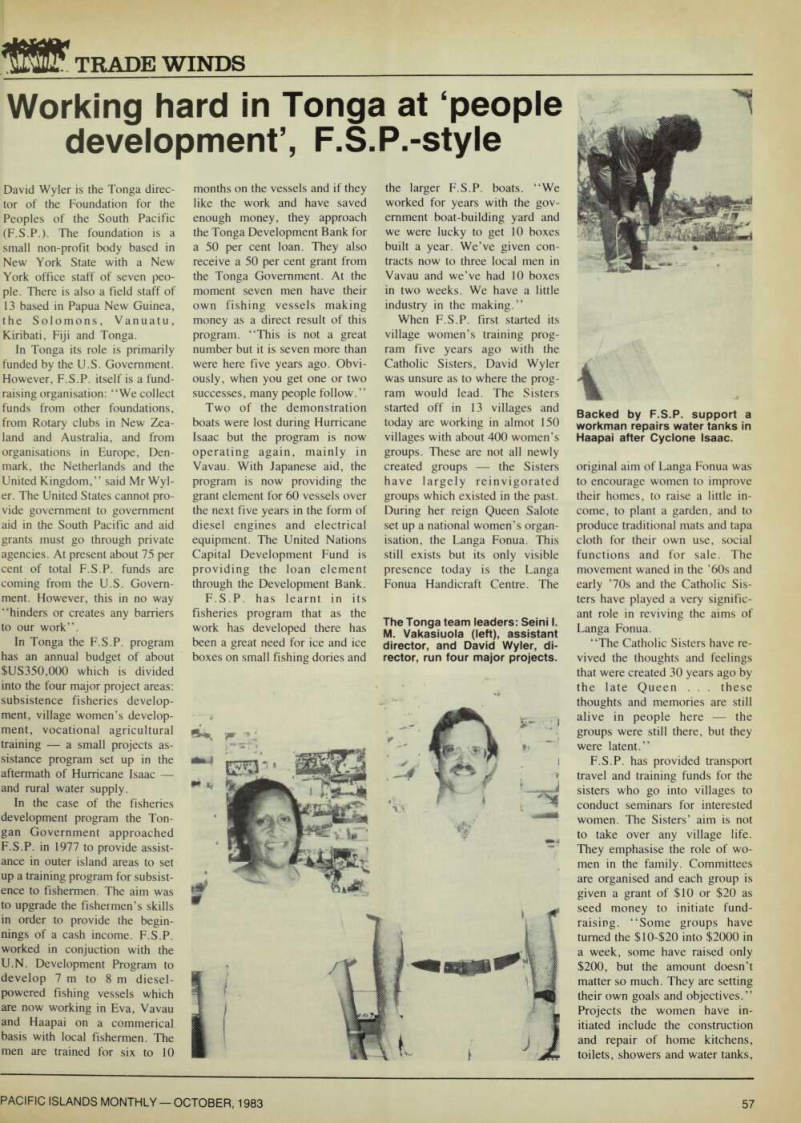
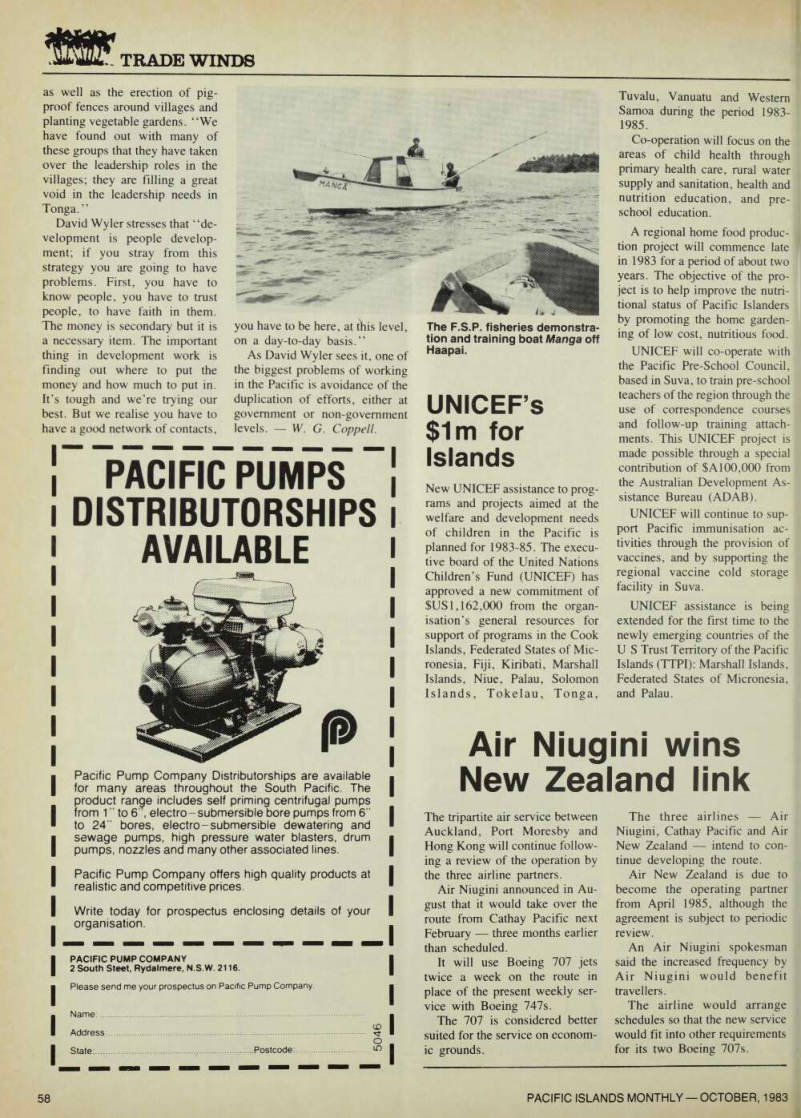
Trade Winds
Working hard in Tonga at ‘people development’, F.S.P.-style
David Wyler is the Tonga direc tor of the Foundation for the Peoples of the South Pacific (F.S.P.). The foundation is a small non-profit body based in New York State with a New York office staff of seven peo ple. There is also a field staff of 13 based in Papua New Guinea, the Solomons, Vanuatu, Kiribati, Fiji and Tonga.
In Tonga its role is primarily funded by the U.S. Government.
However, F.S.P. itself is a fund raising organisation: “We collect funds from other foundations, from Rotary clubs in New Zea land and Australia, and from organisations in Europe, Den mark, the Netherlands and the United Kingdom,” said Mr Wyl er. The United States cannot pro vide government to government aid in the South Pacific and aid grants must go through private agencies. At present about 75 per cent of total F.S.P. funds are coming from the U.S. Govern ment. However, this in no way “hinders or creates any barriers to our work”.
In Tonga the F.S.P. program has an annual budget of about $U5350,000 which is divided into the four major project areas: subsistence fisheries develop ment, village women’s develop ment, vocational agricultural training a small projects as sistance program set up in the aftermath of Hurricane Isaac and rural water supply.
In the case of the fisheries development program the Ton gan Government approached F.S.P. in 1977 to provide assist ance in outer island areas to set up a training program for subsist ence to fishermen. The aim was to upgrade the fishermen’s skills in order to provide the begin nings of a cash income. F.S.P. worked in conjuction with the
U.N. Development Program to
develop 7 m to 8 m diesel powered fishing vessels which are now working in Eva, Vavau and Haapai on a commerical basis with local fishermen. The men are trained for six to 10
months on the vessels and if they like the work and have saved enough money, they approach the Tonga Development Bank for a 50 per cent loan. They also receive a 50 per cent grant from the Tonga Government. At the moment seven men have their own fishing vessels making money as a direct result of this program. “This is not a great number but it is seven more than were here five years ago. Obvi ously, when you get one or two successes, many people follow.”
Two of the demonstration boats were lost during Hurricane Isaac but the program is now
operating again, mainly in
Vavau. With Japanese aid, the program is now providing the grant element for 60 vessels over the next five years in the form of diesel engines and electrical equipment. The United Nations
Capital Development Fund is
providing the loan element through the Development Bank.
F.S.P. has learnt in its fisheries program that as the work has developed there has been a great need for ice and ice boxes on small fishing dories and
the larger F.S.P. boats. “We worked for years with the gov ernment boat-building yard and we were lucky to get 10 boxes built a year. We’ve given con tracts now to three local men in Vavau and we’ve had 10 boxes in two weeks. We have a little industry in the making.”
When F.S.P. first started its village women’s training prog ram five years ago with the Catholic Sisters, David Wyler was unsure as to where the prog ram would lead. The Sisters started off in 13 villages and today are working in almot 150 villages with about 400 women’s groups. These are not all newly created groups the Sisters have largely reinvigorated groups which existed in the past.
During her reign Queen Salote set up a national women’s organ isation, the Langa Fonua. This still exists but its only visible presence today is the Langa Fonua Handicraft Centre. The
original aim of Langa Fonua was to encourage women to improve their homes, to raise a little in come, to plant a garden, and to produce traditional mats and tapa cloth for their own use, social functions and for sale. The movement waned in the ’6os and early ’7os and the Catholic Sis ters have played a very signific ant role in reviving the aims of Langa Fonua.
“The Catholic Sisters have re vived the thoughts and feelings that were created 30 years ago by the late Queen . . . these thoughts and memories are still alive in people here the groups were still there, but they were latent.”
F.S.P. has provided transport travel and training funds for the sisters who go into villages to conduct seminars for interested women. The Sisters’ aim is not to take over any village life.
They emphasise the role of wo men in the family. Committees are organised and each group is given a grant of $lO or $2O as seed money to initiate fund raising. “Some groups have turned the $lO-$2O into $2OOO in a week, some have raised only $2OO, but the amount doesn’t matter so much. They are setting their own goals and objectives.”
Projects the women have in itiated include the construction and repair of home kitchens, toilets, showers and water tanks.
The Tonga team leaders: Seini I.
M. Vakasiuola (left), assistant director, and David Wyler, di rector, run four major projects.
Backed by F.S.P. support a workman repairs water tanks in Haapai after Cyclone Isaac.
as well as the erection of pig proof fences around villages and
planting vegetable gardens. “We
have found out with many of these groups that they have taken over the leadership roles in the villages; they are filling a great void in the leadership needs in
Tonga.”
David Wyler stresses that “de
velopment is people develop
ment; if you stray from this strategy you are going to have problems. First, you have to know people, you have to trust people, to have faith in them.
The money is secondary but it is a necessary item. The important thing in development work is finding out where to put the money and how much to put in.
It’s tough and we’re trying our best. But we realise you have to have a good network of contacts,
you have to be here, at this level, on a day-to-day basis.”
As David Wyler sees it, one of the biggest problems of working in the Pacific is avoidance of the duplication of efforts, either at government or non-govemment
levels.
W. G. Coppell.
The F.S.P. fisheries demonstra tion and training boat Manga off Haapai.
$1m for
Unicef’S
$1m for Islands
New UNICEF assistance to prog rams and projects aimed at the welfare and development needs of children in the Pacific is planned for 1983-85. The execu tive board of the United Nations Children’s Fund (UNICEF) has approved a new commitment of SUS 1,162,000 from the organ isation’s general resources for support of programs in the Cook Islands, Federated States of Mic ronesia, Fiji, Kiribati, Marshall Islands, Niue, Palau, Solomon Islands, Tokelau, Tonga,
Tuvalu, Vanuatu and Western Samoa during the period 1983- 1985.
Co-operation will focus on the areas of child health through primary health care, rural water supply and sanitation, health and nutrition education, and pre school education.
A regional home food produc tion project will commence late in 1983 for a period of about two years. The objective of the pro ject is to help improve the nutri tional status of Pacific Islanders by promoting the home garden ing of low cost, nutritious food.
UNICEF will co-operate with the Pacific Pre-School Council, based in Suva, to train pre-school teachers of the region through the use of correspondence courses and follow-up training attach ments. This UNICEF project is made possible through a special contribution of $A 100,000 from the Australian Development As sistance Bureau (ADAB).
UNICEF will continue to sup port Pacific immunisation ac tivities through the provision of vaccines, and by supporting the regional vaccine cold storage facility in Suva.
UNICEF assistance is being extended for the first time to the newly emerging countries of the U S Trust Territory of the Pacific Islands (TTPI): Marshall Islands, Federated States of Micronesia, and Palau.
Air Niugini wins
New Zealand link
The tripartite air service between Auckland, Port Moresby and Hong Kong will continue follow ing a review of the operation by the three airline partners.
Air Niugini announced in Au gust that it would take over the route from Cathay Pacific next February three months earlier than scheduled.
It will use Boeing 707 jets twice a week on the route in place of the present weekly ser vice with Boeing 7475.
The 707 is considered better suited for the service on econom ic grounds.
The three airlines Air Niugini, Cathay Pacific and Air New Zealand intend to con tinue developing the route.
Air New Zealand is due to become the operating partner from April 1985, although the agreement is subject to periodic review.
An Air Niugini spokesman said the increased frequency by Air Niugini would benefit travellers.
The airline would arrange schedules so that the new service would fit into other requirements for its two Boeing 7075.
Advertisements & other items, p. 58 (1 item)
Pacific Pumps
DISTRIBUTORSHIPS
AVAILABLE
Pacific Pump Company Distributorships are available for many areas throughout the South Pacific. The product range includes self priming centrifugal pumps from 1 ” to 6 , electro-submersible bore pumps from 6” to 24" bores, electro-submersible dewatering and sewage pumps, high pressure water blasters, drum pumps, nozzles and many other associated lines.
Pacific Pump Company offers high quality products at realistic and competitive prices.
Write today for prospectus enclosing details of your organisation.
PACIFIC PUMP COMPANY
2 South Steel, Rydalmere, N.S.W. 2116.
Please send me your prospectus on Pacific Pump Company jm>L_ Name: Address: State:.
Postcode CD o ID
Yachts
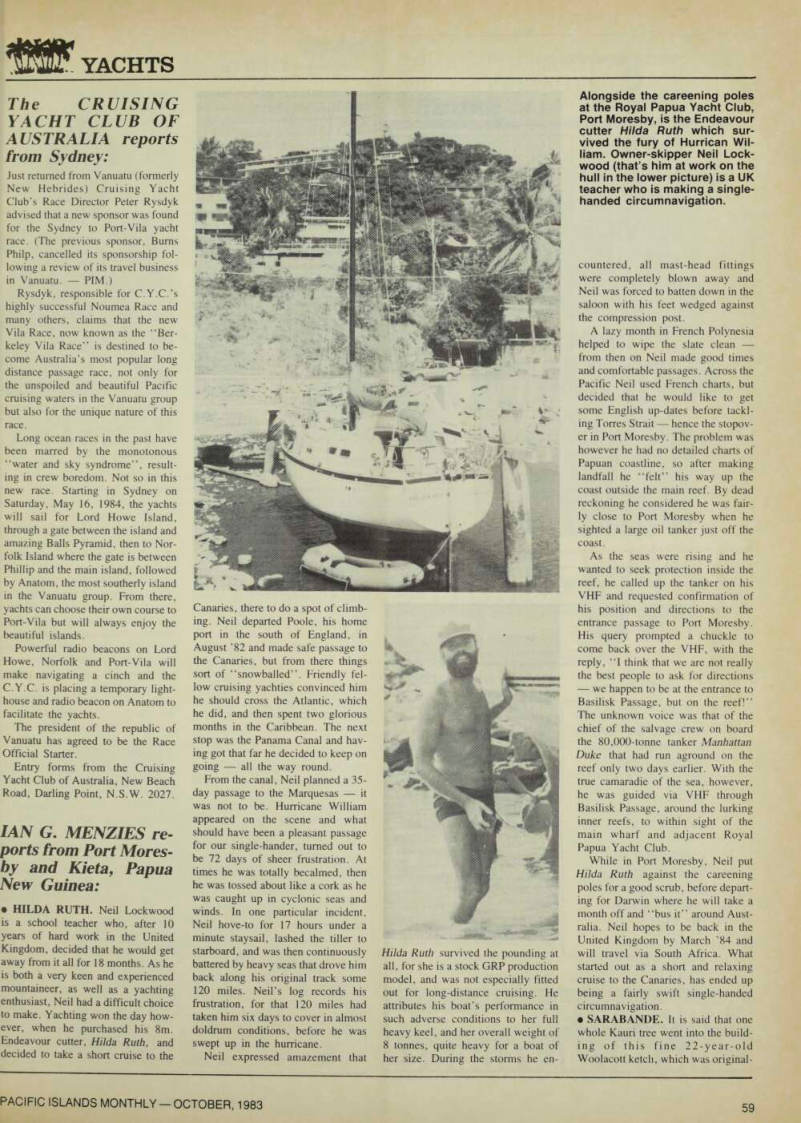
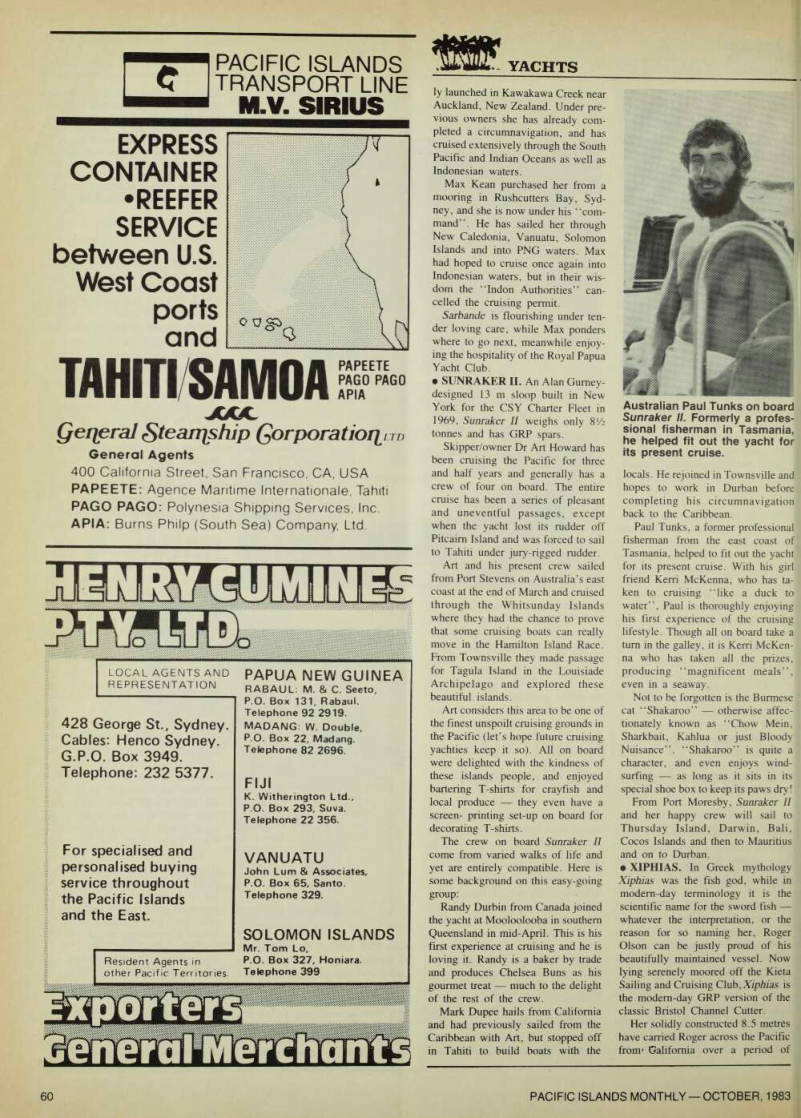
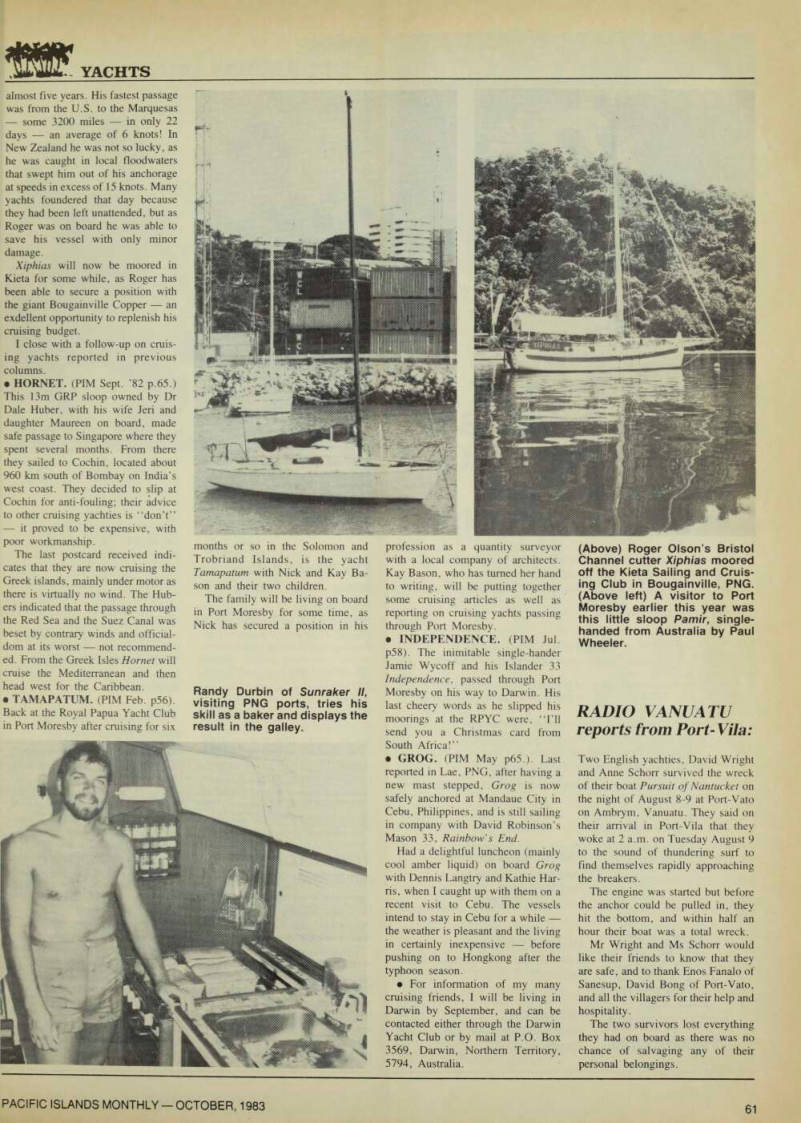
The Cruising
Yacht Club Of
AUSTRALIA reports
from Sydney:
Just returned from Vanuatu (formerly New Hebrides) Cruising Yacht Club’s Race Director Peter Rysdyk advised that a new sponsor was found for the Sydney to Port-Vila yacht race. (The previous sponsor. Bums Philp, cancelled its sponsorship fol lowing a review of its travel business in Vanuatu. PIM.)
Rysdyk, responsible for C.Y.C.’s
highly successful Noumea Race and many others, claims that the new Vila Race, now known as the “Ber keley Vila Race” is destined to be come Australia’s most popular long distance passage race, not only for the unspoiled and beautiful Pacific cruising waters in the Vanuatu group but also for the unique nature of this race.
Long ocean races in the past have been marred by the monotonous “water and sky syndrome”, result ing in crew boredom. Not so in this new race. Starting in Sydney on Saturday, May 16, 1984, the yachts will sail for Lord Howe Island, through a gate between the island and amazing Balls Pyramid, then to Nor folk Island where the gate is between Phillip and the main island, followed by Anatom, the most southerly island in the Vanuatu group. From there, yachts can choose their own course to Port-Vila but will always enjoy the beautiful islands.
Powerful radio beacons on Lord Howe, Norfolk and Port-Vila will make navigating a cinch and the C.Y.C. is placing a temporary light house and radio beacon on Anatom to facilitate the yachts.
The president of the republic of Vanuatu has agreed to be the Race Official Starter.
Entry forms from the Cruising Yacht Club of Australia, New Beach Road, Darling Point, N.S.W. 2027.
Lan G. Menzies Re
ports from Port Mores
by and Kieta, Papua
New Guinea:
• HILDA RUTH. Neil Lockwood is a school teacher who, after 10 years of hard work in the United Kingdom, decided that he would get away from it all for 18 months. As he is both a very keen and experienced mountaineer, as well as a yachting enthusiast, Neil had a difficult choice to make. Yachting won the day how ever, when he purchased his Bm.
Endeavour cutter, Hilda Ruth, and decided to take a short cruise to the
Canaries, there to do a spot of climb ing. Neil departed Poole, his home port in the south of England, in August ’B2 and made safe passage to the Canaries, but from there things sort of “snowballed”. Friendly fel low cruising yachties convinced him he should cross the Atlantic, which he did, and then spent two glorious months in the Caribbean. The next stop was the Panama Canal and hav ing got that far he decided to keep on going all the way round.
From the canal, Neil planned a 35day passage to the Marquesas it was not to be. Hurricane William appeared on the scene and what should have been a pleasant passage for our single-hander, turned out to be 72 days of sheer frustration. At times he was totally becalmed, then he was tossed about like a cork as he was caught up in cyclonic seas and winds. In one particular incident, Neil hove-to for 17 hours under a minute staysail, lashed the tiller to starboard, and was then continuously battered by heavy seas that drove him back along his original track some 120 miles. Neil’s log records his frustration, for that 120 miles had taken him six days to cover in almost doldrum conditions, before he was swept up in the hurricane.
Neil expressed amazement that
Hilda Ruth survived the pounding at all, for she is a stock GRP production model, and was not especially fitted out for long-distance cruising. He attributes his boat’s performance in such adverse conditions to her full heavy keel, and her overall weight of 8 tonnes, quite heavy for a boat of her size. During the storms he en
countered, all mast-head fittings were completely blown away and Neil was forced to batten down in the saloon with his feet wedged against the compression post.
A lazy month in French Polynesia helped to wipe the slate clean from then on Neil made good times and comfortable passages. Across the Pacific Neil used French charts, but decided that he would like to get some English up-dates before tackl ing Torres Strait hence the stopov er in Port Moresby. The problem was however he had no detailed charts of Papuan coastline, so after making landfall he “felt” his way up the coast outside the main reef. By dead reckoning he considered he was fair ly close to Port Moresby when he sighted a large oil tanker just off the coast.
As the seas were rising and he wanted to seek protection inside the reef, he called up the tanker on his VHF and requested confirmation of his position and directions to the entrance passage to Port Moresby.
His query prompted a chuckle to come back over the VHF, with the reply, “I think that we are not really the best people to ask for directions we happen to be at the entrance to Basilisk Passage, but on the reef!”
The unknown voice was that of the chief of the salvage crew on board the 80,000-tonne tanker Manhattan Duke that had run aground on the reef only two days earlier. With the true camaradie of the sea, however, he was guided via VHF through Basilisk Passage, around the lurking inner reefs, to within sight of the main wharf and adjacent Royal Papua Yacht Club.
While in Port Moresby, Neil put Hilda Ruth against the careening poles for a good scrub, before depart ing for Darwin where he will take a month off and “bus it” around Aust ralia. Neil hopes to be back in the United Kingdom by March ’B4 and will travel via South Africa. What started out as a short and relaxing cruise to the Canaries, has ended up being a fairly swift single-handed
circumnavigation.
• SARABANDE. It is said that one whole Kauri tree went into the build ing of this fine 22-year-old Woolacott ketch, which was original -
Alongside the careening poles at the Royal Papua Yacht Club, Port Moresby, is the Endeavour cutter Hilda Ruth which sur vived the fury of Hurrican Wil liam. Owner-skipper Neil Lock wood (that’s him at work on the hull in the lower picture) is a UK teacher who is making a single handed circumnavigation.
ly launched in Kawakawa Creek near Auckland, New Zealand. Under pre vious owners she has already com pleted a circumnavigation, and has cruised extensively through the South Pacific and Indian Oceans as well as Indonesian waters.
Max Kean purchased her from a mooring in Rushcutters Bay, Syd ney, and she is now under his “com mand”. He has sailed her through New Caledonia, Vanuatu, Solomon Islands and into PNG waters. Max had hoped to cruise once again into Indonesian waters, but in their wis dom the “Indon Authorities” can celled the cruising permit.
Sarbande is flourishing under ten der loving care, while Max ponders where to go next, meanwhile enjoy ing the hospitality of the Royal Papua Yacht Club. • SUNRAKER 11. An Alan Gurney designed 13 m sloop built in New York for the CSY Charter Fleet in 1969, Sunraker II weighs only SVi tonnes and has GRP spars.
Skipper/owner Dr Art Howard has been cruising the Pacific for three and half years and generally has a crew of four on board. The entire cruise has been a series of pleasant and uneventful passages, except when the yacht lost its rudder off Pitcairn Island and was forced to sail to Tahiti under jury-rigged rudder.
Art and his present crew sailed from Port Stevens on Australia’s east coast at the end of March and cruised through the Whitsunday Islands where they had the chance to prove that some cruising boats can really move in the Hamilton Island Race.
From Townsville they made passage for Tagula Island in the Louisiade Archipelago and explored these beautiful islands.
Art considers this area to be one of the finest unspoilt cruising grounds in the Pacific (let’s hope future cruising yachties keep it so). All on board were delighted with the kindness of these islands people, and enjoyed bartering T-shirts for crayfish and local produce they even have a screen- printing set-up on board for
decorating T-shirts.
The crew on board Sunraker II come from varied walks of life and yet are entirely compatible. Here is some background on this easy-going group: Randy Durbin from Canada joined the yacht at Mooloolooba in southern Queensland in mid-April. This is his first experience at cruising and he is loving it. Randy is a baker by trade and produces Chelsea Buns as his gourmet treat much to the delight of the rest of the crew.
Mark Dupee hails from California and had previously sailed from the Caribbean with Art, but stopped off in Tahiti to build boats with the
locals. He rejoined in Townsville and hopes to work in Durban before completing his circumnavigation back to the Caribbean.
Paul Tunks, a former professional fisherman from the east coast of Tasmania, helped to fit out the yacht for its present cruise. With his girl friend Kerri McKenna, who has ta ken to cruising “like a duck to water”, Paul is thoroughly enjoying his first experience of the cruising lifestyle. Though all on board take a turn in the galley, it is Kerri McKen na who has taken all the prizes,
producing “magnificent meals”,
even in a seaway.
Not to be forgotten is the Burmese cat “Shakaroo” otherwise affec tionately known as “Chow Mein, Sharkbait, Kahlua or just Bloody Nuisance”. “Shakaroo” is quite a character, and even enjoys wind surfing as long as it sits in its special shoe box to keep its paws dry!
From Port Moresby, Sunraker II and her happy crew will sail to Thursday Island, Darwin, Bali, Cocos Islands and then to Mauritius and on to Durban. • XIPHIAS. In Greek mythology Xiphias was the fish god, while in modem-day terminology it is the scientific name for the sword fish whatever the interpretation, or the reason for so naming her, Roger Olson can be justly proud of his beautifully maintained vessel. Now lying serenely moored off the Kieta Sailing and Cruising Club, Xiphias is the modern-day GRP version of the classic Bristol Channel Cutter.
Her solidly constructed 8.5 metres have carried Roger across the Pacific from* California over a period of
Australian Paul Tunks on board Sunraker II. Formerly a profes sional fisherman in Tasmania, he helped fit out the yacht for its present cruise.
almost five years. His fastest passage was from the U.S. to the Marquesas some 3200 miles in only 22 days an average of 6 knots! In New Zealand he was not so lucky, as he was caught in local floodwaters that swept him out of his anchorage at speeds in excess of 15 knots. Many yachts foundered that day because they had been left unattended, but as Roger was on board he was able to save his vessel with only minor
damage.
Xiphias will now be moored in Kieta for some while, as Roger has been able to secure a position with
the giant Bougainville Copper an
exdellent opportunity to replenish his cruising budget.
I close with a follow-up on cruis
ing yachts reported in previous
columns. • HORNET. (PIM Sept. ’B2 p. 65.) This 13m GRP sloop owned by Dr Dale Huber, with his wife Jeri and daughter Maureen on board, made safe passage to Singapore where they spent several months. From there they sailed to Cochin, located about 960 km south of Bombay on India’s west coast. They decided to slip at Cochin for anti-fouling; their advice to other cruising yachties is “don’t” it proved to be expensive, with
poor workmanship.
The last postcard received indi cates that they are now cruising the Greek islands, mainly under motor as there is virtually no wind. The Hub ers indicated that the passage through the Red Sea and the Suez Canal was beset by contrary winds and official dom at its worst not recommend ed. From the Greek Isles Hornet will cruise the Mediterranean and then head west for the Caribbean.
• Tamapatum. (Pim Feb P 56).
Back at the Royal Papua Yacht Club in Port Moresby after cruising for six
months or so in the Solomon and Trobriand Islands, is the yacht Tamapatum with Nick and Kay Ba son and their two children.
The family will be living on board in Port Moresby for some time, as Nick has secured a position in his
profession as a quantity surveyor with a local company of architects.
Kay Bason, who has turned her hand to writing, will be putting together some cruising articles as well as
reporting on cruising yachts passing
through Port Moresby.
• Independence. (Pim Jul
p5B). The inimitable single-hander Jamie Wycoff and his Islander 33 Independence, passed through Port Moresby on his way to Darwin. His last cheery words as he slipped his moorings at the RPYC were, “I’ll send you a Christmas card from South Africa!” • GROG. (PIM May p 65.). Last reported in Lae, PNG, after having a new mast stepped. Grog is now safely anchored at Mandaue City in Cebu, Philippines, and is still sailing in company with David Robinson’s Mason 33, Rainbow’s End.
Had a delightful luncheon (mainly cool amber liquid) on board Grog with Dennis Langtry and Kathie Har ris, when I caught up with them on a recent visit to Cebu. The vessels intend to stay in Cebu for a while the weather is pleasant and the living in certainly inexpensive before pushing on to Hongkong after the typhoon season. • For information of my many cruising friends, I will be living in Darwin by September, and can be contacted either through the Darwin Yacht Club or by mail at P.O. Box 3569, Darwin, Northern Territory, 5794, Australia.
Radio Vanuatu
reports from Port-Vila:
Two English yachties, David Wright and Anne Schorr survived the wreck of their boat Pursuit of Nantucket on the night of August 8-9 at Port-Vato on Ambrym, Vanuatu. They said on their arrival in Port-Vila that they woke at 2 a.m. on Tuesday August 9 to the sound of thundering surf to find themselves rapidly approaching the breakers.
The engine was started but before the anchor could be pulled in, they hit the bottom, and within half an hour their boat was a total wreck.
Mr Wright and Ms Schorr would like their friends to know that they are safe, and to thank Enos Fanalo of Sanesup, David Bong of Port-Vato, and all the villagers for their help and
hospitality.
The two survivors lost everything they had on board as there was no chance of salvaging any of their personal belongings.
Randy Durbin of Sunraker II, visiting PNG ports, tries his skill as a baker and displays the result in the galley.
(Above) Roger Olson’s Bristol Channel cutter Xiphias moored off the Kieta Sailing and Cruis ing Club in Bougainville, PNG. (Above left) A visitor to Port Moresby earlier this year was this little sloop Pamir, single handed from Australia by Paul Wheeler.
The Nauru Bulletin re
ports from Nauru:
Mike Hopross, 8.A., B.Sc., an Irishman living in Trinidad, started out on a sailing trip around the Pacific from Trinidad two years ago in his 9 m long and 5 m wide catamaran, Angel .Angel has a sail of approximately 46 square metres and, with good winds, is able to cruise at a maximum speed of 15-16 knots. It is an American design which took Mike and his father three years to build.
Mr Hopross arrived in Nauru on August 12, having sailed from the Caribbean islands, French Polynesia, Samoa, Tonga, Fiji and Ocean Is land. From here, Mr Hopross will sail to Solomon Islands and Papua New Guinea.
Tohi Tala Niue Re
ports from Alofi, Niue:
The yacht Extravagance which we have been hearing a lot about has now arrived and is anchored at the Alofi roadstead.
The Extravagance will be a base vessel for Brian and Margret Sayers’ tourist venture called Adventure Holidays. These will include bush walks, scuba diving, snorkelling and whatever a customer may fancy, within reason.
Mr Sayers says he’s been interest ed in enhancing Niue’s clear blue
waters as a tourist attraction. He adds that he’ll stay on Niue for at least 12 months, and if nothing comes of his venture he will go back to New Zealand.
The Extravagance is designed so it can be lifted out of the water during the hurricane season, Mr Sayers is having a cradle built because he wants to lift the yacht out soon to do some minor repairs after running into some strong fronts near the Ker madec Islands.
Mr Sayers is one of New Zealand’s most experienced diving instructors, and is currently technical adviser to the New Zealand Diving Association.
The Fiji Times Re
ports from Suva:
An Austrian mermaid, Florimell, is visiting our waters before continuing a four-year world cruise.
The 11 m catamaran, which was built in 1970, belongs to Mr and Mrs Waltraud Klarner, from Vienna, Austria.
Florimell was built in England and belonged to an Englishman who sold it to the Klarners five years ago.
The Klarners sail the catamaran mainly in the Mediterranean and keep her in a marina in Italy.
They embarked on their world cruise from Italy in 1981 and sailed to Gibraltar, Canary Islands, the Caribbean where they spent six months, and then to Venezuela, Panama, Ecuador and, for another six months, French Polynesia, Samoa, and Tonga.
Florimell arrived in Suva with Mr and Mrs Klamer and their daughter, Tanja, 12.
Kay Bason, from the yacht Tamapatum, interviews Mark Du pee of Sunraker II. Kay Ba son will write future reports for PIM on cruising yachts in Port Moresby.
Advertisements & other items, pp. 60-62 (1 item)
aßcnraEaEiE
PACIFIC ISLANDS
TRANSPORT LINE
M.V. SIRIUS
1 OUSO N
and Q
TAHITI SAMOA EF"
xoc
Qeqeral Steamship Qorporatioq^
General Agents 400 California Street, San Francisco, CA, USA PAPEETE: Agence Maritime Internationale, Tahiti PAGO PAGO: Polynesia Shipping Services, Inc.
APIA: Burns Philp (South Sea) Company, Ltd.
aßcnraEaEiE
LOCAL AGENTS AND
REPRESENTATION
428 George St., Sydney.
Cables: Henco Sydney.
G.P.O. Box 3949.
Telephone: 232 5377.
For specialised and
personalised buying
service throughout
the Pacific Islands
and the East.
Resident Agents in other Pacific Territories.
PAPUA NEW GUINEA
RABAUL: M. & C. Seeto, P.O. Box 131, Rabaul.
Telephone 92 2919.
MADANG: W. Double, P.O. Box 22, Madang.
Telephone 82 2696,
FIJI
K. Witherington Ltd., P.O. Box 293, Suva.
Telephone 22 356.
VANUATU
John Lum & Associates, P.O. Box 65, Santo.
Telephone 329.
SOLOMON ISLANDS
Mr. Tom Lo, P.O. Box 327, Honiara.
Telephone 399
.-5 2 rs» j < * s =^
Only our Dragon Boat
visits more ports,
more often,
in the South Pacific.
The New Guinea Pacific Line offers the quality handling you're used to, through its exclusive containerised service to Papua New Guinea and the Solomon Islands.
Rely on us all the way. • Fast transit times to all ports. • A guaranteed schedule every 30 days, thanks to berths in Papua New Guinea and Honiara reserved for N.G.P.L. use. • Safe, secure transport of goods in containers, both L.C.L., and F.C.L. no more damage or pilferage of cargo. • A wide coverage of all ports with the monthly container service from Hong Kong, Singapore, Taiwan, the Philippines, Malaysia and Bangkok to all Papua New Guinea ports and Honiara.
For further details on our reliable Dragon Boat service contact:
PAPUA NEW GUINEA
Steamship Trading Co., Ltd.
Port Moresby Telephone: 212000
NEW GUINEA
PACIFIC UNE
HONG KONG
Swire Shipping (Agencies) Ltd.
Telephone: 5-264311
SINGAPORE §
Straits Shipping Re. Ltd.
Telephone: 436071
Shipping Schedules
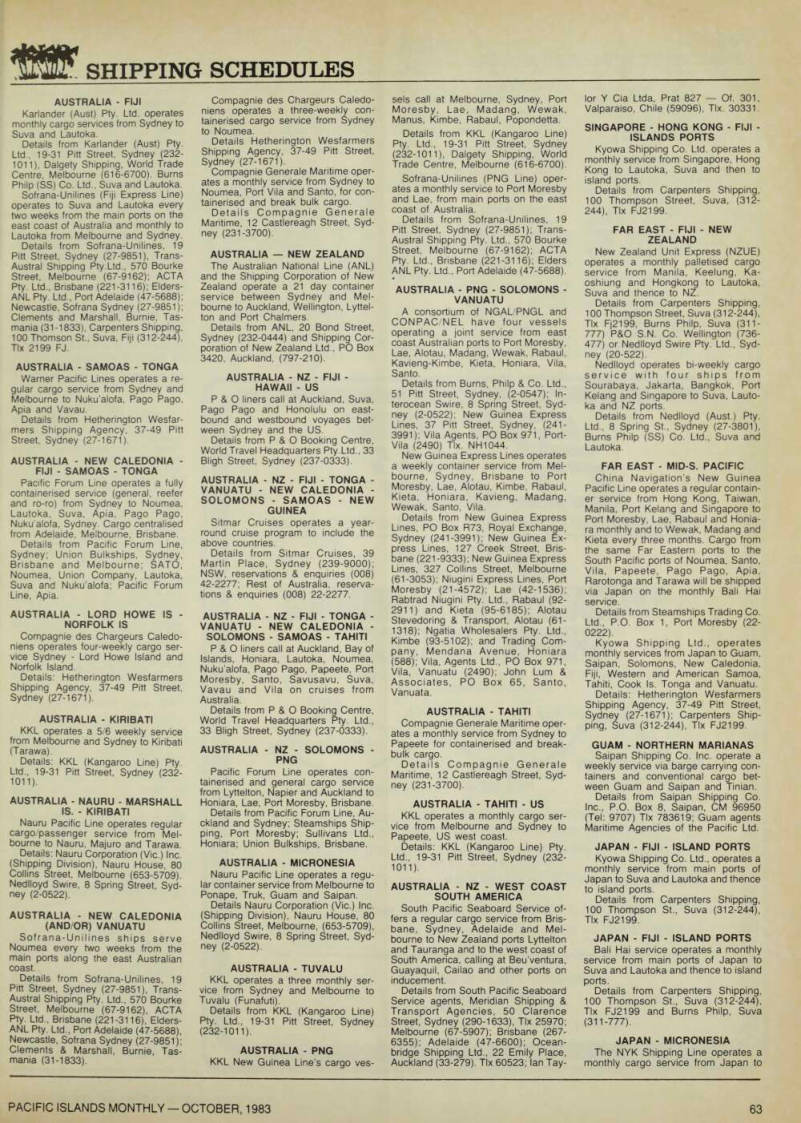
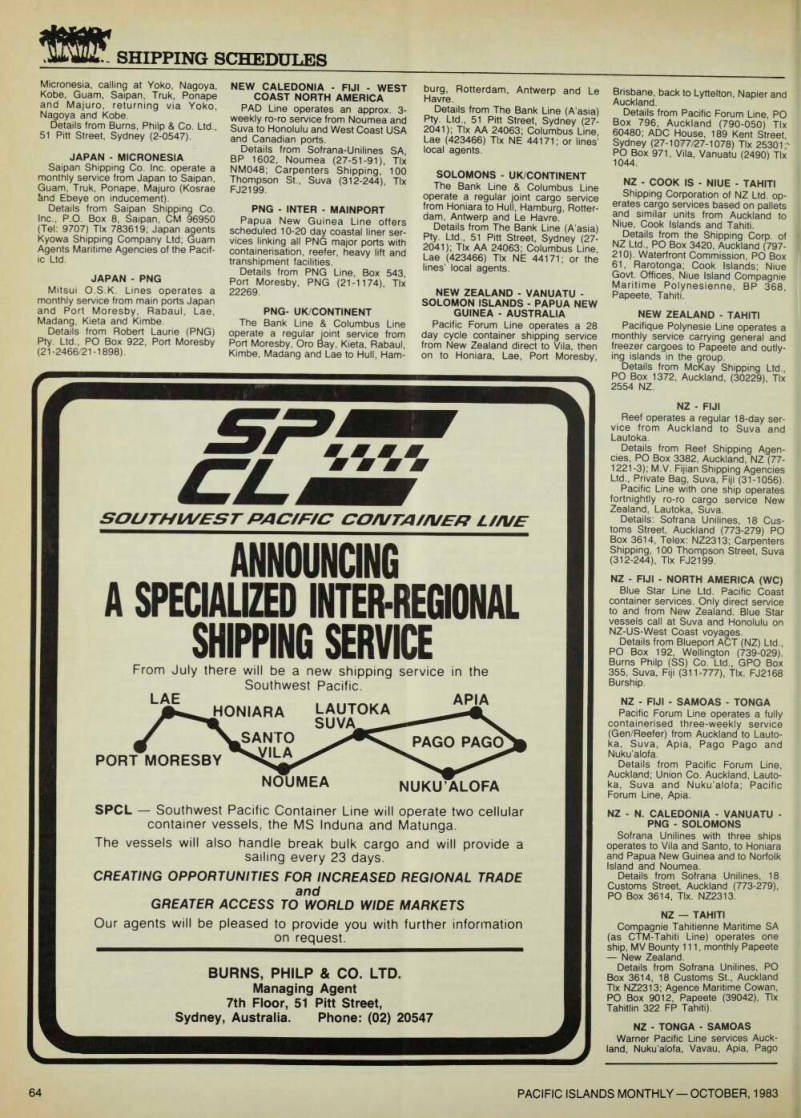
Australia - Fiji
Karlander (Aust) Pty. Ltd. operates monthly cargo services from Sydney to Suva and Lautoka.
Details from Karlander (Aust) Pty.
Ltd,, 19-31 Pitt Street, Sydney (232- 1011), Dalgety Shipping, World Trade Centre, Melbourne (616-6700). Burns Philp (SS) Co. Ltd., Suva and Lautoka.
Sofrana-Unilines (Fiji Express Line) operates to Suva and Lautoka every two weeks from the main ports on the east coast of Australia and monthly to Lautoka from Melbourne and Sydney.
Details from Sofrana-Unilines, 19 Pitt Street, Sydney (27-9851), Trans- Austral Shipping Pty.Ltd., 570 Bourke Street, Melbourne (67-9162); ACTA Pty. Ltd., Brisbane (221-3116); Elders- ANL Pty. Ltd., Port Adelaide (47-5688); Newcastle, Sofrana Sydney (27-9851); Clements and Marshall, Burnie, Tas mania (31-1833), Carpenters Shipping, 100 Thomson St., Suva, Fiji (312-244), Tlx 2199 FJ.
Australia - Samoas - Tonga
Warner Pacific Lines operates a re gular cargo service from Sydney and Melbourne to Nukualofa, Pago Pago, Apia and Vavau.
Details from Hetherington Wesfar mers Shipping Agency, 37-49 Pitt Street, Sydney (27-1671).
Australia - New Caledonia -
Fiji - Samoas - Tonga
Pacific Forum Line operates a fully containerised service (general, reefer and ro-ro) from Sydney to Noumea, Lautoka, Suva, Apia, Pago Pago, Nukualofa, Sydney. Cargo centralised from Adelaide, Melbourne, Brisbane.
Details from Pacific Forum Line, Sydney: Union Bulkships, Sydney, Brisbane and Melbourne: SATO, Noumea, Union Company, Lautoka, Suva and Nukualofa; Pacific Forum Line, Apia.
Australia - Lord Howe Is -
Norfolk Is
Compagnie des Chargeurs Caledo niens operates four-weekly cargo ser vice Sydney - Lord Howe Island and Norfolk Island.
Details: Hetherington Wesfarmers Shipping Agency, 37-49 Pitt Street, Sydney (27-1671).
Australia - Kiribati
KKL operates a 5/6 weekly service from Melbourne and Sydney to Kiribati (Tarawa).
Details: KKL (Kangaroo Line) Pty.
Ltd., 19-31 Pitt Street, Sydney (232- 1011).
Australia - Nauru - Marshall
Is. - Kiribati
Nauru Pacific Line operates regular cargo/passenger service from Mel bourne to Nauru, Majuro and Tarawa.
Details: Nauru Corporation (Vic.) Inc. (Shipping Division), Nauru House, 80 Collins Street, Melbourne (653-5709).
Nedlloyd Swire, 8 Spring Street, Syd ney (2-0522).
Australia - New Caledonia
(And/Or) Vanuatu
Sofrana-Unilines ships serve Noumea every two weeks from the main ports along the east Australian coast.
Details from Sofrana-Unilines, 19 Pitt Street, Sydney (27-9851), Trans- Austral Shipping Pty. Ltd., 570 Bourke Street, Melbourne (67-9162), ACTA Pty. Ltd., Brisbane (221-3116), Elders- ANL Pty. Ltd., Port Adelaide (47-5688), Newcastle, Sofrana Sydney (27-9851); Clements & Marshall, Burnie, Tas mania (31-1833).
Compagnie des Chargeurs Caledo niens operates a three-weekly con tainerised cargo service from Sydney to Noumea.
Details Hetherington Wesfarmers Shipping Agency, 37-49 Pitt Street, Sydney (27-1671).
Compagnie Generale Maritime oper ates a monthly service from Sydney to Noumea, Port Vila and Santo, for con tainerised and break bulk cargo.
Details Compagnie Generale Maritime, 12 Castlereagh Street, Syd ney (231-3700).
Australia New Zealand
The Australian National Line (ANL) and the Shipping Corporation of New Zealand operate a 21 day container service between Sydney and Mel bourne to Auckland, Wellington, Lyttel ton and Port Chalmers.
Details from ANL, 20 Bond Street, Sydney (232-0444) and Shipping Cor poration of New Zealand Ltd., PO Box 3420, Auckland, (797-210).
Australia - Nz - Fiji -
Hawaii - Us
P&O liners call at Auckland, Suva, Pago Pago and Honolulu on east bound and westbound voyages bet ween Sydney and the US.
Details from P&O Booking Centre, World Travel Headquarters Pty.Ltd., 33 Bligh Street, Sydney (237-0333).
AUSTRALIA - NZ - FIJI - TONGA -
Vanuatu - New Caledonia -
Solomons - Samoas - New
Guinea
Sitmar Cruises operates a year round cruise program to include the above countries.
Details from Sitmar Cruises, 39 Martin Place, Sydney (239-9000); NSW, reservations & enquiries (008) 42-2277; Rest of Australia, reserva tions & enquiries (008) 22-2277.
AUSTRALIA - NZ - FIJI - TONGA -
Vanuatu - New Caledonia -
Solomons - Samoas - Tahiti
P&O liners call at Auckland, Bay of Islands, Honiara, Lautoka, Noumea, Nukualofa, Pago Pago, Papeete, Port Moresby, Santo, Savusavu, Suva, Vavau and Vila on cruises from Australia.
Details from P&O Booking Centre, World Travel Headquarters Pty. Ltd., 33 Bligh Street, Sydney (237-0333).
Australia - Nz - Solomons -
Png
Pacific Forum Line operates con tainerised and general cargo service from Lyttelton, Napier and Auckland to Honiara, Lae, Port Moresby, Brisbane.
Details from Pacific Forum Line, Au ckland and Sydney; Steamships Ship ping, Port Moresby: Sullivans Ltd., Honiara; Union Bulkships, Brisbane.
Australia - Micronesia
Nauru Pacific Line operates a regu lar container service from Melbourne to Ponape, Truk, Guam and Saipan.
Details Nauru Corporation (Vic.) Inc. (Shipping Division), Nauru House, 80 Collins Street, Melbourne, (653-5709), Nedlloyd Swire, 8 Spring Street, Syd ney (2-0522).
Australia - Tuvalu
KKL operates a three monthly ser vice from Sydney and Melbourne to Tuvalu (Funafuti).
Details from KKL (Kangaroo Line) Pty. Ltd., 19-31 Pitt Street, Sydney (232-1011).
Australia - Png
KKL New Guinea Line’s cargo ves
sels call at Melbourne, Sydney, Port Moresby, Lae, Madang, Wewak, Manus, Kimbe, Rabaul, Popondetta.
Details from KKL (Kangaroo Line) Pty. Ltd., 19-31 Pitt Street, Sydney (232-1011), Dalgety Shipping, World Trade Centre, Melbourne (616-6700).
Sofrana-Unilines (PNG Line) oper ates a monthly service to Port Moresby and Lae, from main ports on the east coast of Australia.
Details from Sofrana-Unilines, 19 Pitt Street, Sydney (27-9851); Trans- Austral Shipping Pty. Ltd., 570 Bourke Street, Melbourne (67-9162); ACTA Pty. Ltd., Brisbane (221-3116); Elders ANL Pty. Ltd., Port Adelaide (47-5688).
Australia - Png - Solomons -
Vanuatu
A consortium of NGAL/PNGL and CONPACNEL have four vessels operating a joint service from east coast Australian ports to Port Moresby, Lae, Alotau, Madang, Wewak, Rabaul, Kavieng-Kimbe, Kieta, Honiara, Vila, Santo.
Details from Burns, Philp & Co. Ltd., 51 Pitt Street, Sydney, (2-0547); In terocean Swire, 8 Spring Street, Syd ney (2-0522); New Guinea Express Lines, 37 Pitt Street, Sydney, (241- 3991); Vila Agents, PO Box 971, Port- Vila (2490) Tlx. NH1044.
New Guinea Express Lines operates a weekly container service from Mel bourne, Sydney, Brisbane to Port Moresby, Lae, Alotau, Kimbe, Rabaul, Kieta, Honiara, Kavieng, Madang.
Wewak, Santo, Vila.
Details from New Guinea Express Lines, PO Box R 73, Royal Exchange, Sydney (241-3991); New Guinea Ex press Lines, 127 Creek Street, Bris bane (221-9333) ; New Guinea Express Lines, 327 Collins Street, Melbourne (61-3053); Niugini Express Lines, Port Moresby (21-4572); Lae (42-1536); Rabtrad Niugini Pty. Ltd., Rabaul (92- 2911) and Kieta (95-6185); Alotau Stevedoring & Transport, Alotau (61- 1318): Ngatia Wholesalers Pty. Ltd., Kimbe (93-5102); and Trading Com pany, Mendana Avenue, Honiara (588); Vila, Agents Ltd., PO Box 971, Vila, Vanuatu (2490); John Lum & Associates, PO Box 65, Santo, Vanuata.
Australia - Tahiti
Compagnie Generale Maritime oper ates a monthly service from Sydney to Papeete for containerised and break bulk cargo.
Details Compagnie Generale Maritime, 12 Castlereagh Street, Syd ney (231-3700).
Australia - Tahiti - Us
KKL operates a monthly cargo ser vice from Melbourne and Sydney to Papeete, US west coast.
Details: KKL (Kangaroo Line) Pty.
Ltd., 19-31 Pitt Street, Sydney (232- 1011).
Australia - Nz - West Coast
South America
South Pacific Seaboard Service of fers a regular cargo service from Bris bane, Sydney, Adelaide and Mel bourne to New Zealand ports Lyttelton and Tauranga and to the west coast of South America, calling at Beu’ventura, Guayaquil, Cailao and other ports on inducement.
Details from South Pacific Seaboard Service agents, Meridian Shipping & Transport Agencies, 50 Clarence Street, Sydney (290-1633), Tlx 25970; Melbourne (67-5907); Brisbane (267- 6355); Adelaide (47-6600); Ocean bridge Shipping Ltd., 22 Emily Place, Auckland (33-279). Tlx 60523; lan Tay
lor Y Cia Ltda, Prat 827 Of. 301, Valparaiso, Chile (59096), Tlx. 30331.
SINGAPORE - HONG KONG - FIJI -
Islands Ports
Kyowa Shipping Co. Ltd. operates a monthly service from Singapore, Hong Kong to Lautoka, Suva and then to island ports.
Details from Carpenters Shipping, 100 Thompson Street, Suva, (312- 244), Tlx FJ2199.
Far East - Fiji - New
Zealand
New Zealand Unit Express (NZUE) operates a monthly palletised cargo service from Manila, Keelung, Ka oshiung and Hongkong to Lautoka, Suva and thence to NZ.
Details from Carpenters Shipping, 100 Thompson Street, Suva (312-244), Tlx Fj2199, Burns Philp, Suva (311- 777) P&O S.N. Co. Wellington (736- 477) or Nedlloyd Swire Pty. Ltd., Syd ney (20-522).
Nedlloyd operates bi-weekly cargo service with four ships from Sourabaya, Jakarta, Bangkok, Port Kelang and Singapore to Suva, Lauto ka and NZ ports.
Details from Nedlloyd (Aust.) Pty.
Ltd., 8 Spring St., Sydney (27-3801), Burns Philp (SS) Co. Ltd., Suva and Lautoka.
Far East - Mid-S. Pacific
China Navigation’s New Guinea Pacific Line operates a regular contain er service from Hong Kong, Taiwan, Manila, Port Kelang and Singapore to Port Moresby, Lae, Rabaul and Honia ra monthly and to Wewak, Madang and Kieta every three months. Cargo from the same Far Eastern ports to the South Pacific ports of Noumea, Santo, Vila, Papeete, Pago Pago, Apia, Rarotonga and Tarawa will be shipped via Japan on the monthly Bali Hai service.
Details from Steamships Trading Co.
Ltd., P.O. Box 1, Port Moresby (22- 0222).
Kyowa Shipping Ltd., operates monthly services from Japan to Guam, Saipan, Solomons, New Caledonia, Fiji, Western and American Samoa, Tahiti, Cook Is. Tonga and Vanuatu.
Details: Hetherington Wesfarmers Shipping Agency, 37-49 Pitt Street, Sydney (27-1671); Carpenters Ship ping, Suva (312-244), Tlx FJ2199.
Guam - Northern Marianas
Saipan Shipping Co. Inc. operate a weekly service via barge carrying con tainers and conventional cargo bet ween Guam and Saipan and Tinian.
Details from Saipan Shipping Co.
Inc., P.O. Box 8, Saipan, CM 96950 (Tel: 9707) Tlx 783619; Guam agents Maritime Agencies of the Pacific Ltd.
Japan - Fiji - Island Ports
Kyowa Shipping Co. Ltd., operates a monthly service from main ports of Japan to Suva and Lautoka and thence to island ports.
Details from Carpenters Shipping, 100 Thompson St., Suva (312-244), Tlx FJ2199.
Japan - Fiji - Island Ports
Bali Hai service operates a monthly service from main ports of Japan to Suva and Lautoka and thence to island ports.
Details from Carpenters Shipping, 100 Thompson St., Suva (312-244), Tlx FJ2199 and Burns Philp, Suva (311-777).
Japan - Micronesia
The NYK Shipping Line operates a monthly cargo service from Japan to
Micronesia, calling at Yoko, Nagoya, Kobe, Guam, Saipan, Truk, Ponape and Majuro, returning via Yoko, Nagoya and Kobe.
Details from Burns, Philp & Co. Ltd., 51 Pitt Street, Sydney (2-0547).
Japan - Micronesia
Saipan Shipping Co. Inc. operate a monthly service from Japan to Saipan, Guam, Truk, Ponape, Majuro (Kosrae &nd Ebeye on inducement).
Details from Saipan Shipping Co.
Inc., P.O. Box 8, Saipan, CM 96950 (Tel: 9707) Tlx 783619; Japan agents Kyowa Shipping Company Ltd; Guam Agents Maritime Agencies of the Pacif ic Ltd.
Japan - Png
Mitsui O.S.K. Lines operates a monthly service from main ports Japan and Port Moresby, Rabaul, Lae, Madang, Kieta and Kimbe.
Details from Robert Laurie (PNG) Pty. Ltd., PO Box 922, Port Moresby (21-2466/21-1898).
New Caledonia - Fiji - West
Coast North America
PAD Line operates an approx. 3weekly ro-ro service from Noumea and Suva to Honolulu and West Coast USA and Canadian ports.
Details from Sofrana-Unilines SA, BP 1602, Noumea (27-51-91), Tlx NMO4B; Carpenters Shipping, 100 Thompson St., Suva (312-244), Tlx FJ2199.
Png - Inter - Mainport
Papua New Guinea Line offers scheduled 10-20 day coastal liner ser vices linking all PNG major ports with containerisation, reefer, heavy lift and transhipment facilities.
Details from PNG Line, Box 543 Port Moresby, PNG (21-1174), Tlx 22269.
Png- Uk/Continent
The Bank Line & Columbus Line operate a regular joint service from Port Moresby, Oro Bay, Kieta, Rabaul, Kimbe, Madang and Lae to Hull, Ham
burg, Rotterdam, Antwerp and Le Havre.
Details from The Bank Line (A’asia) Pty. Ltd., 51 Pitt Street, Sydney (27- 2041); Tlx AA 24063; Columbus Line, Lae (423466) Tlx NE 44171; or lines’ local agents.
Solomons - Uk/Continent
The Bank Line & Columbus Line operate a regular joint cargo service from Honiara to Hull, Hamburg, Rotter dam, Antwerp and Le Havre.
Details from The Bank Line (A’asia) Pty. Ltd., 51 Pitt Street, Sydney (27- 2041); Tlx AA 24063; Columbus Line, Lae (423466) Tlx NE 44171; or the lines’ local agents.
New Zealand - Vanuatu -
Solomon Islands - Papua New
Guinea - Australia
Pacific Forum Line operates a 28 day cycle container shipping service from New Zealand direct to Vila, then on to Honiara, Lae, Port Moresby,
Brisbane, back to Lyttelton, Napier and Auckland.
Details from Pacific Forum Line, PO Box 796, Auckland (790-050) Tlx 60480; ADC House, 189 Kent Street
Sydney (27-1077/27-1078) Tlx 25301;'
PO Box 971, Vila, Vanuatu (2490) Tlx 1044.
NZ - COOK IS - NIUE - TAHITI Shipping Corporation of NZ Ltd. op erates cargo services based on pallets and similar units from Auckland to Niue, Cook Islands and Tahiti.
Details from the Shipping Corp. of NZ Ltd., PO Box 3420, Auckland (797- 210). Waterfront Commission, PO Box 61, Rarotonga; Cook Islands; Niue Govt. Offices, Niue Island Compagnie Maritime Polynesienne, BP 368, Papeete, Tahiti.
New Zealand - Tahiti
Pacifique Polynesie Line operates a monthly service carrying general and freezer cargoes to Papeete and outly ing islands in the group.
Details from McKay Shipping Ltd., PO Box 1372, Auckland, (30229), Tlx 2554 NZ.
Nz - Fiji
Reef operates a regular 18-day ser vice from Auckland to Suva and Lautoka.
Details from Reef Shipping Agen cies, PO Box 3382, Auckland, NZ (77- 1221-3); M.V. Fijian Shipping Agencies Ltd., Private Bag, Suva, Fiji (31-1056).
Pacific Line with one ship operates fortnightly ro-ro cargo service New Zealand, Lautoka, Suva.
Details; Sofrana Unilines, 18 Cus toms Street, Auckland (773-279) PO Box 3614, Telex: NZ2313; Carpenters Shipping, 100 Thompson Street, Suva (312-244), Tlx FJ2199.
NZ - FIJI - NORTH AMERICA (WC) Blue Star Line Ltd. Pacific Coast container services. Only direct service to and from New Zealand. Blue Star vessels call at Suva and Honolulu on NZ-US-West Coast voyages.
Details from Blueport ACT (NZ) Ltd., PO Box 192, Wellington (739-029).
Burns Philp (SS) Co. Ltd., GPO Box 355, Suva, Fiji (311-777), Tlx. FJ2168 Burship.
NZ - FIJI - SAMOAS - TONGA Pacific Forum Line operates a fully containerised three-weekly service (Gen/Reefer) from Auckland to Lauto ka, Suva, Apia, Pago Pago and Nukualofa.
Details from Pacific Forum Line, Auckland: Union Co. Auckland, Lauto ka, Suva and Nukualofa; Pacific Forum Line, Apia.
NZ - N. CALEDONIA - VANUATU -
Png - Solomons
Sofrana Unilines with three ships operates to Vila and Santo, to Honiara and Papua New Guinea and to Norfolk Island and Noumea.
Details from Sofrana Unilines, 18 Customs Street, Auckland (773-279), PO Box 3614, Tlx. NZ2313.
Nz Tahiti
Compagnie Tahitienne Maritime SA (as CTM-Tahiti Line) operates one ship, MV Bounty 111, monthly Papeete New Zealand.
Details from Sofrana Unilines, PO Box 3614, 18 Customs St., Auckland Tlx NZ2313; Agence Maritime Cowan, PO Box 9012, Papeete (39042), Tlx Tahitlin 322 FP Tahiti).
Nz - Tonga - Samoas
Warner Pacific Line services Auck land, Nukualofa, Vavau, Apia, Pago
Pago fortnightly carrying general and freezer cargoes.
Details from McKay Shipping Ltd., Downtown House, 21 Queen St., Auck land, PO Box 1372 (30-299). Cables MACSHIP, Telex NZ2554, Warner Pacific Line, Box 93, Nukualofa, Ton ga; Mealelei (Western Samoa) Ltd.
Box 4171, Apia, Western Samoa, Kneubuhl Maritime Services, Box 39, Pago Pago, American Samoa, 96799.
Nz - New Caledonia
CP Line operates a monthly cargo service from Auckland, Lyttelton, Napier and Mt. Maunganui to Noumea.
Details from McKay Shipping Ltd., PO Box 1372, Auckland (9-30229); Tlx 2554 NZ.
Europe - Tahiti -
New Caledonia
Compagnie Generale Maritime oper ates services from Europe and Mediterranean ports to Papeete and Noumea using three ro-ro and multi purpose vessels thus ensuring a bi monthly sailing to and from.
Details Compagnie Generale Maritime, 12 Castlereagh Street, Syd ney (231-3700).
Europe - Tahiti - New
Caledonia - New Zealand -
Solomons - Png - Europe
Polish Ocean Lines offers regular monthly sailings for containerised and breakbulk cargo and reefer space, con ventional and in reefer containers, from Hamburg, Antwerp, Dunkirk and Rouen to Papeete, Noumea, New Zea land, Honiara, Lae, Manila and Singa pore, returning to Europe via Suez.
Other ports in the South Pacific can be served with inducement.
Details from Sotama, BP 9170, Papeete (27805), Tlx. 296; SATO, BP C 2, Noumea (272094), Tlx. 163 NM SATO: Union Steamship Co of NZ, PO Box 50, Apia, Tlx. 25; Williams and Gosling, PO Box 79, Suva (312633), Tlx. 2163; Warner Pacific Line, PO Box 93, Nukualofa (21089), Tlx. 66219; Universal Shipping Agencies, PO Box 2282, Auckland (30930), Tlx. 21517.
EUROPE - TAHITI - W. SAMOA -
Fiji - N. Caledonia
Nedlloyd offers regular cargo ser vices from Northern Europe and U.K. to Papeete, Apia, Fiji and New Caledonia.
Details Nedlloyd (Aust.) Pty. Ltd., 8 Spring Street, Sydney (27-3801); Car penters Shipping, 100 Thomson St., Suva (312-244), Tlx. 2199 FJ and Vetari Street, Lautoka (63988), Tlx. 5215FJ.
UK - N. CONTINENT - W. SAMOA -
Tonga - Fiji
The Bank Line & Columbus Line operate a regular joint cargo service from Hull, Hamburg, Bremen, Antwerp, Rotterdam and Le Havre to Apia, Nukualofa, Suva and Lautoka.
Details from The Bank Line (A’asia) Pty. Ltd., 51 Pitt Street, Sydney (27- 2041); Tlx AA 24063; Columbus Line, Lae (423466) Tlx NE 44171; or lines’ local agents.
UK - N. CONTINENT - PNG -
Solomons
The Bank Line & Columbus Line operate a regular joint cargo service from Hull, Hamburg, Bremen, Antwerp, Rotterdam and Le Havre to Port Moresby, Lae, Madang, Kimbe, Rabaul, Kieta and Honiara and on inducement to Yandina.
Details from The Bank Line (A’sia) Pty. Ltd., 51 Pitt Street, Sydney (27- 2041); Tlx AA 24063; Columbus Line, Lae (423466) Tlx NE 44171; or lines’ local agents
Uk/N. Continent - Tahiti -
N. Caledonia - Vanuatu
The Bank Line & Columbus Line operate a regular joint cargo service from Hull, Hamburg, Bremen, Antwerp, Rotterdam and Le Havre to Papeete, Noumea, Port-Vila and Santo.
Details from The Bank Line (A’asia) Pty. Ltd., 51 Pitt Street, Sydney (27- 2041); Tlx AA 24063; Columbus Line, Lae (42-3466) Tlx NE 44171; Ets A M.
Fare UTE, Papeete; Ets. Ballande, Noumea and other local agents.
US - FIJI - TAHITI - NZ -
Australia
The Bank Savill Line Ltd. operates regular cargo services from U.S. Gulf ports to Australia and N.Z. Calls at Suva, Lautoka and Papeete on demand.
Details from The Bank and Savill Line Ltd., 51 Pitt Street, Sydney (27- 2041) or Orient Shipping Services, 32 Bridge Street, Sydney (241-2753).
U.S. - Hawaii - Kiribati -
Micronesia
Philippines, Micronesia & Orient Navigation Co. (PM&O Lines) operates regular container service on selfsus tained ship with ro-ro capabilities from Oakland, Portland and Honolulu to Tarawa, Ebeye, Majuro, Kosrae, Ponape, Truk, Saipan, Yap and Koror.
Details for Micronesia can be ob tained from Larry Guerrero, PM&O Owners Rep. PO Box 803, Saipan, Ml 96950, Cable COMMONTIME, Tlx 783605; PM&O: PM&O Lines, 181 Fremont St., San Francisco, California 94-105, Cable PMONAV.
US - HAWAII - MICRONESIA - E.
Malaysia - Brunei
PM & O Lines operates two fully self sustained container vessels monthly from San Francisco, Los Angeles and Honolulu (via transshipment at Majuro) to Ebeye, Kosrae, Ponape, Truk, Saipan, Yap, Koror, Kota Kinabalu, Labuan and Muara. Note: service to Majuro from Hawaii is not offered.
Details: PM & O Lines, 181 Fremont Street, San Francisco, California 94- 105, USA. (543-7430) Tlx 278016/CABLE PMONAV; Larry Guer rero, PM & O Owners Rep. P.O. Box 803, Saipan, Ml 96950. Cable COM
Montime. Tlx 783605.
Us - Hawaii - Nauru -
Micronesia
Nauru Pacific Line operates regular conventional container and passenger service from San Francisco and Hon olulu to Majuro, Ponape, Truk and Saipan. Cargo'is accepted for Nauru and Kosrae with transhipment at Maj uro and Ponape.
Details from Nauru Corporation (Vic.) Inc. (Shipping Division), Nauru House, 80 Collins Street, Melbourne (653-5709); Nauru Air and Shipping Agency, Suite 2803, 185 Berry Street, San Fransisco, California 94107 (415- 543-1737); Nauru Air and Shipping Agency, Suite 506, 841 Bishop St., Honolulu, HI 96813 (808-523-0441).
Hawaii - Tahiti - Samoas
Marshall Islands Maritime Co oper ates a service every 32 days between Honolulu, Papeete, Pago Pago and Apia.
Details from the Maritime Co. of the Pacific, 567 South King Street, Suite 310, Honolulu, Hawaii, Morris Hed strom, Box 189, Apia, Western Samoa and the Marshall Islands Maritime Co., Box 679, Majuro, Marshall Islands.
Us - Noumea - Fiji
PAD Line operates an approx. 3weekly ro-ro service from West coast
USA and Canada to Noumea, Suva and Lautoka.
Details from Sofrana-Unilines SA, BP 1602, Noumea (27-51-91), Tlx.
NMO4B; Carpenters Shipping, Harbour Centre, Thompson Street, Suva (31- 2244), Tlx. FJ2199; Trans-Austral Shipping Pty. Ltd., PO Box R 232, Roy al Exchange, 2000 (231-8411), Tlx.
AA21204.
Us - Tahiti - Samoa
Pacific Islands Transport operates a five weekly cargo service from North America west coast ports to Papeete, Pago Pago, Apia.
Details from Polynesia Shipping Ser vices Inc. PO Box 1478, Pago Pago 96799.
Polynesia Line operates container and general cargo service from US west coast ports to Papeete and Pago Pago.
Details from Polynesia Shipping Ser vices Inc., PO Box 1478, Pago Pago 96799.
Advertisements & other items, p. 64 (1 item)
Announcing
SOUTHWEST PAC/EiC CO/VTA//VEP L//VE
A SPECIALIZED INTER-REGIONAL
SHIPPING SERVICE
From July there will be a new shipping service in the Southwest Pacific.
LAE a . iTrti/ a APIA
HONIARA LAUTOKA
w U V
SANTO
PORT MORESBY ,LA
PAGO PAGO
NOUMEA
NUKUALOFA
SPCL Southwest Pacific Container Line will operate two cellular container vessels, the MS Induna and Matunga.
The vessels will also handle break bulk cargo and will provide a sailing every 23 days.
CREATING OPPORTUNITIES FOR INCREASED REGIONAL TRADE
and
GREATER ACCESS TO WORLD WIDE MARKETS
Our agents will be pleased to provide you with further information on request.
BURNS, PHILP & CO. LTD.
Managing Agent 7th Floor, 51 Pitt Street, Sydney, Australia. Phone: (02) 20547
DEATHS of Islands People
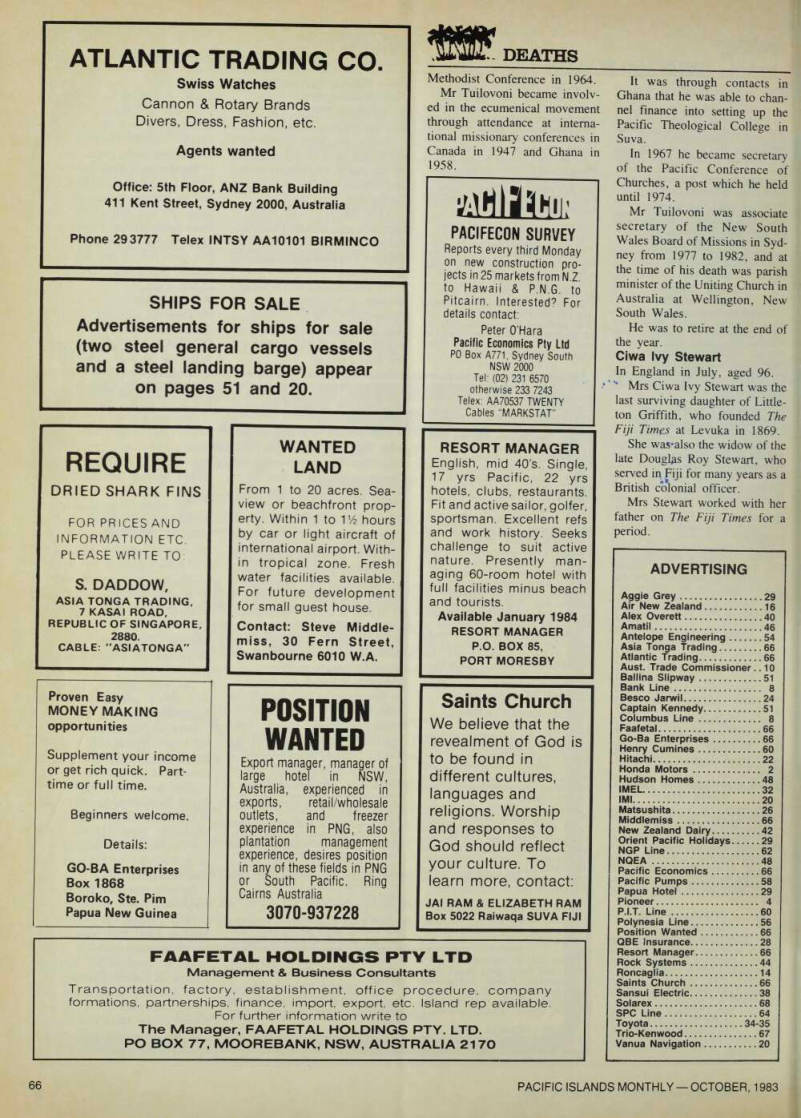
Ratu Marika Vukinamuaievu Ratoto Latianara At Sorokoba Village, Viti Levu, Fiji, on August 20, aged 70.
As Tui Ba, Ratu Marika was traditional chief of Fijian people on the east side of the Ba River, and headed one of the largest landowning units in Fiji.
Ratu Marika was born at Sorokoba on March 13, 1913, the son of the then Tui Ba, Ratu Kaliova Vukinamuaievu and Adi Luisa Matai.
He was installed as Tui Ba and became a member of the Ba Provincial Council in 1959, a year after the death of his elder brother, Ratu Filimone Naleya, the then Tui Ba.
In 1979 he was appointed to the Senate by the Great Council of Chiefs and remained a Senator until his death.
Ratu Marika was instrumental, with Ratu William Toganivalu, in introducing cane-farming to Fijians in Ba and Tavua.
After an early boxing career that saw him retire undefeated in Fiji’s middleweight, light heavy weight and heavyweight boxing titles, he went into sugarcane farming.
He began his professional box ing career in 1932 and retired in 1937 as the undefeated heavy weight champion of Fiji.
He was described by many as one of the most colorful and scientific boxers in Fiji.
Matapo Matapo In Rarotonga, Cook Islands, in July.
Elected in the March, 1983 poll as a representative of the Cook Islands Party for the Rarotonga parliamentary seat of Titikaveka, Mr Matapo was a
very popular man. There is no doubt this personal popularity was largely instrumental in his defeating Democratic Party can didate, Teariki Matenga, who also enjoys wide popularity.
Mr Matapo’s death has signifi cance for the Cook Islands bey ond the loss of a respected public figure. It was one of the chief factors precipitating the Cook Is lands’ second general elections this year, which are due to be held on November 2. (See report in this issue.) Wilisoni Inia At Tamavua Hospital, Suva, on August 25, aged 65.
Wilisoni Inia was nominated to the Fiji Senate by the Council of Rotuma in 1970, and re mained the Rotuman representa tive in the Senate until his death.
“He was a man of great com passion and understanding, pos sessed with much graciousness and dignity,” said the President of the Senate, Senator Wesley Barrett. ”His death will be a sad loss to the Senate. I can’t remember one occasion when Senator Inia was not seeking assistance on behalf of the Rotumans in the Senate.
“He used every opportunity to do so. His debates were always very reasoned and well constructed.”
Setareki Tuilovoni In Sydney on August 10, aged 66.
The Rev. Setareki Tuilovoni was twice president of the Methodist Church of Fiji.
Bom at Natokalau, Matuku, Mr Tuilovoni taught in Method ist schools before entering the ministry in 1944.
After recovering from a long illness he received his theologic al training at Drew University, Madison, New Jersey, from 1947 to 1950, when he graduated as a Bachelor of Divinity and was ordained.
He was appointed Director of Methodist Youth in 1951.
Mr Tuilovoni was awarded an MBE in 1960, then went to Un ion Seminary in New York, where he received his Master’s Degree in Sacred Theology.
In 1962 he became the first Fijian chairman of the United Synod of the Methodist Church and the first president of the church at the establisment of the
Methodist Conference in 1964.
Mr Tuilovoni became involv ed in the ecumenical movement through attendance at interna tional missionary conferences in Canada in 1947 and Ghana in 1958.
It was through contacts in Ghana that he was able to chan nel finance into setting up the Pacific Theological College in Suva.
In 1967 he became secretary of the Pacific Conference of Churches, a post which he held until 1974.
Mr Tuilovoni was associate secretary of the New South Wales Board of Missions in Syd ney from 1977 to 1982, and at the time of his death was parish minister of the Uniting Church in Australia at Wellington, New South Wales.
He was to retire at the end of the year.
Ciwa Ivy Stewart In England in July, aged 96.
Mrs Ciwa Ivy Stewart was the last surviving daughter of Little ton Griffith, who founded The Fiji Times at Levuka in 1869.
She was*also the widow of the late Douglas Roy Stewart, who served in Fiji for many years as a British colonial officer.
Mrs Stewart worked with her father on The Fiji Times for a period.
Advertising
Aggie Grey 29
Air New Zealand 16 Alex Overett 40 Amatil 46 Antelope Engineering 54
Asia Tonga Trading 66
Atlantic Trading 66 Aust. Trade Commissioner.. 10 Ballina Slipway 51 Bank Line 8 Besco Jarwil 24 Captain Kennedy 51 Columbus Line 8 Faafetal 66 Go-Ba Enterprises 66 Henry Cumines 60 Hitachi 22 Honda Motors 2 Hudson Homes 48
Imel 32
Imi 20
Matsushita 26 Middlemiss 66 New Zealand Dairy 42 Orient Pacific Holidays 29 NGP Line 62
Nqea 48
Pacific Economics 66 Pacific Pumps 58 Papua Hotel 29 Pioneer 4 P.l.T. Line 60 Polynesia Line 56 Position Wanted 66 QBE Insurance 28 Resort Manager 66 Rock Systems 44
Roncaglia 14
Saints Church 66 Sansui Electric 38 Solarex 68 SPC Line 64 Toyota 34-35 Trio-Ken wood 67 Vanua Navigation 20
Advertisements & other items, pp. 66-68 (2 items)
Position
ATLANTIC TRADING CO.
Swiss Watches Cannon & Rotary Brands Divers, Dress, Fashion, etc.
Agents wanted Office: sth Floor, ANZ Bank Building 411 Kent Street, Sydney 2000, Australia
Phone 293777 Telex INTSY AAIOIOI BIRMINCO
•jM3M
PACIFECON SURVEY
Reports every third Monday on new construction projects in 25 markets from N.Z. to Hawaii & P.N.G. to Pitcairn. Interested? For details contact; Peter O’Hara Pacific Economics Pty Ltd PO Box A 771, Sydney South
NSW 2000
Tel: (02) 231 6570 otherwise 233 7243 Telex: AA70537 TWENTY Cables "MARKSTAT”
SHIPS FOR SALE
Advertisements for ships for sale (two steel general cargo vessels and a steel landing barge) appear on pages 51 and 20.
WANTED
LAND
From 1 to 20 acres. Seaview or beachfront property. Within 1 to Vh hours by car or light aircraft of international airport. Within tropical zone. Fresh water facilities available.
For future development for small guest house.
Contact; Steve Middlemiss, 30 Fern Street, Swanbourne 6010 W.A.
RESORT MANAGER
English, mid 40’s. Single, 17 yrs Pacific, 22 yrs hotels, clubs, restaurants.
Fit and active sailor, golfer, sportsman. Excellent refs and work history. Seeks challenge to suit active nature. Presently managing 60-room hotel with full facilities minus beach and tourists.
Available January 1984
RESORT MANAGER
P.O. BOX 85,
PORT MORESBY
REQUIRE
DRIED SHARK FINS
FOR PRICES AND
INFORMATION ETC.
PLEASE WRITE TO:
S. DADDOW,
ASIA TONGA TRADING,
7 KASAI ROAD,
REPUBLIC OF SINGAPORE,
2880.
CABLE: "ASIATONGA"
Proven Easy
MONEYMAKING
opportunities Supplement your income or get rich quick. Parttime or full time.
Beginners welcome.
Details: GO-BA Enterprises Box 1868 Boroko, Ste. Pim Papua New Guinea
Saints Church
We believe that the revealment of God is to be found in different cultures,
languages and
religions. Worship
and responses to God should reflect your culture. To learn more, contact;
JAI RAM & ELIZABETH RAM
Box 5022 Raiwaqa SUVA FIJI
POSITION
WANTED
Export manager, manager of large hotel in NSW, Australia, experienced in exports, retail/wholesale outlets, and freezer experience in PNG, also plantation management experience, desires position in any of these fields in PNG or South Pacific. Ring Cairns Australia 3070-937228
FAAFETAL HOLDINGS PTY LTD
Management & Business Consultants Transportation, factory, establishment, office procedure, company formations, partnerships, finance, import, export, etc. Island rep available.
For further information write to
The Manager, FAAFETAL HOLDINGS PTY. LTD.
PO BOX 77, MOOREBANK, NSW, AUSTRALIA 2170
Kenwood
New Kenwood stereo component systems
four “window” to the world's
infinite store of music.
lesifloeo-py-worid-leading audio
specialists, KenwoocLstereo-sySfems
cfferyoumore tbarTpleasing
legibility and easy operation. They
v offer you the best-possible if) audio
iologyTAnd Sound that’s as ni
as the world aroum
Systs <-71 Stereo Integrated • KT-51 Quartz SyrHtesizer ryqer •KX-71R CassetteKJeck and DPSS Quartz PLL DirecbCMve Full-Auto Turntable" •SRC-51W Audio System Rad *TM Dolby Corp.
KENWOOD
• New corporate symbol
TRIO-KENWOOD CORPORATION
Shionogi Shibuya Building, 17-5, 2-chome, Shibuya, Shibuya-ku, Tokyo 150, Japan TRIO-KENWOOD (AUSTRALIA) PTY. LTD (incorporated in ns,wi 4E Woodcock Place, Lane Cove, N.S.W. 2066, Australia. Tel: 428-1455 NEW ZEALAND JOHN GILBERT & CO., LTD. Auckland Tel.ooll-64-9-30839 FIJI PEPE’S DUTY FREE CENTRE LTD. Tel. 25496, 25497 PAPUA NEW GUINEA S.O. SVENSSON (N.G.) LTD. Port Moresby Tel. 212158, 212111 SOLOMON ISLANDS TECHNIQUE RADIOS CENTRE LTD. Honiara Tel. 416 NEW CALEDONIA HI-FI VOX Noumea Tel. 27-2466, 28-2931 VANUATU FUNG CHOI LUEN. Port-Vila Tel. 2556
TAHITI MAISON AURORE Papeete Tel. 29703
AMERICAN SAMOA ISLAND PACIFIC AGENCIES, INC. Pago Pago Tel. 633-4687
REPUBLIC OF NAURU NAURU CO-OPERATIVE SOCIETY
MARIANA ISLANDS J.C. TENORIO ENTERPRISES Saipan Tel. 6445
'-'OTtIMM
VILLAGE POWER
HOUSE LIGHTING
REFRIGERATION
WATER PUMPING
COMMUNICATIONS
MILITARY
MARINE^.-
SOLAREX
5 BELLONA AVE., REGENTS PARK 2143 AUSTRALIA TELEPHONE (02) 644 5055 TELEX AA 21975
AUSTRALIAN
ELECTRICITY FROM SUNLIGHT