Pacific

Islands
Monthly
September, 1983
American Samoa US$l.75 Australia *A$l.5O Cook Islands NZ$l.5O Fiji F 51.50 Hawaii US$l.95 Kiribati A 51.75 Nauru A 51.75 New Caledonia CFPI9O New Zealand NZ$2.OO Niue NZ$l.5O Norfolk Island A 51.50 Papua New Guinea K 1.50 Solomon Islands Ssl 50 Tahiti CFPI9O Tonga PI 50 Tuvalu A 51.75
Usa U 552.25
USTT and Guam US$l.95 Vanuatu VT1.50 Western Samoa T 1.95 Recommended retail price only ■Registered by Australia Post. jk *»%Jblication No. NBPI2IO
■|»n||| !d¥n!ciH
y|Niy9
jk
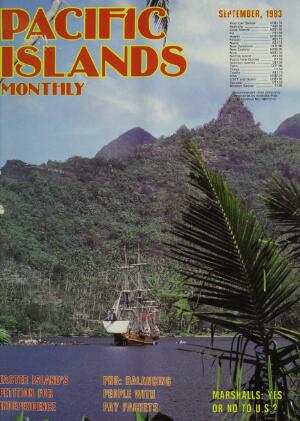
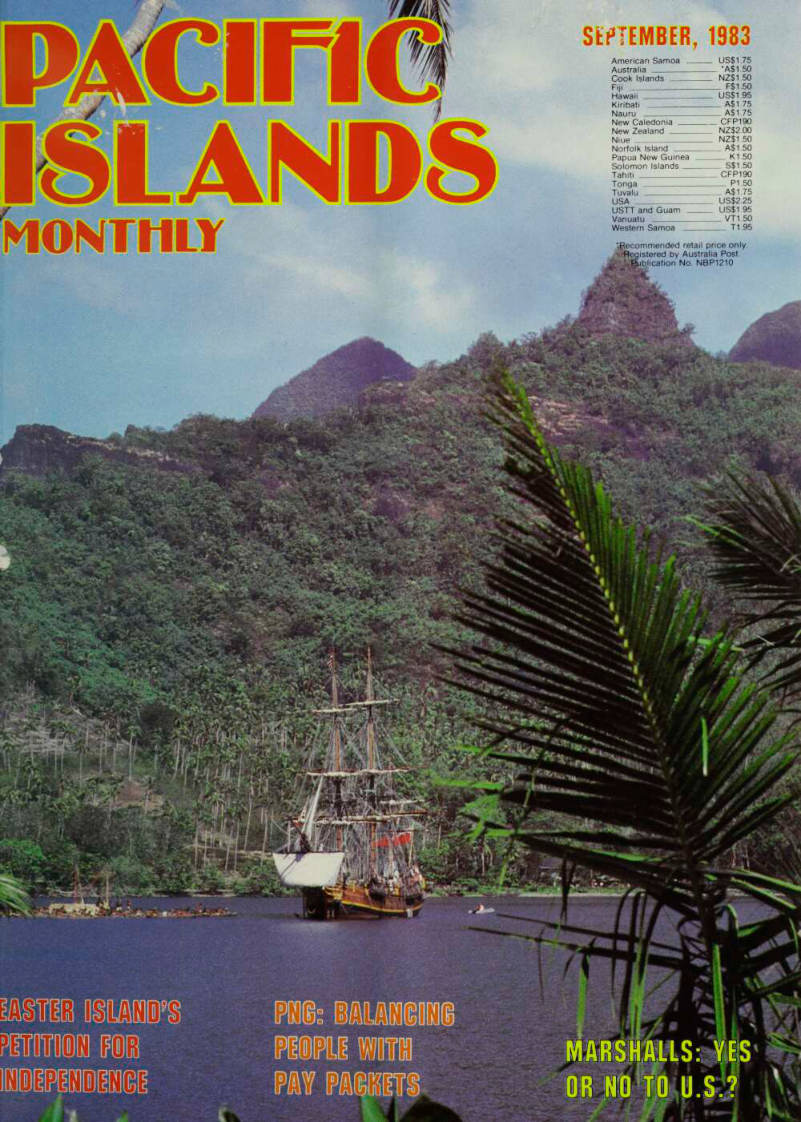
Cover: Lying at anchor off Moorea, French Polynesia, is the SUS 2 million replica of the Bounty, used in Dino di Laurentiis’ new film, Bounty. Photo Bengt Danielsson. (See also “People”, p4l).
Advertisements & other items, p. 2 (1 item)
0 Hitachi
f 1 * i f I i t
Key m ksy conlroi DA-1000 M
DIGITAL AUDIO
N VJtJitachi
Compact Disc
Digital Audio Player
□ini
a £ Hitachi has crossed the threshold of a music lover’s dream. Perfect concert reproduction is now a reality. It is all possible due to the new Hitachi DA-1000, one of the world’s first commercially available compact disc digital audio players. It is an exciting new form of sound system that relies on digital audio signal encoding, rather than an analog system. This allows performance levels that far exceed even the finest conventional turntable. The result is pure, clean sound, absolutely faithful to the original performance.
The Hitachi DA-1000 plays digital audio compact discs (CD), the disc format adopted by all of the major audio manufacturers. A compact disc is capable of storing an uninterrupted 60 minutes of beautiful music on a single side.
The compact disc is perfectly smooth. Its clear plastic protective surface eliminates the annoying effects of dust, scratches and wear.
The music you hear will sound exactly the same as when the artist originally recorded it, the first time you play the disc as well as the 1000th.
The DA-1000 was crafted to ensure superior performance as well as optimum convenience. The vertical design offers the space-saving benefits of component rack installation, as well as the ease of a cassettestyle front loading system.
The DA-1000 delivers a comprehensive playback control. With a simple touch of the fingertip, the user may elect to pick-up Forward or Reverse, Cue, Repeat, and Auto Search.
The DA-1000 also has Program Playback, a feature which allows the user to program up to 15 selections for playback in any sequence, automatically.
One listen is worth a thousand words. Come and witness for yourself the superior sound of the Hitachi DA-1000.
0 HITACHI
A World Leader in Technology • AUSTRALIA; Hitachi Sales Australia Pty., Ltd., 153 Keys Road, Moorabbin, Victoria 3189 Phone: (555) 8722 • PAPUA NEW GUINEA: S.O. Svensson (N.G.) Ltd., P.O. Box 705, Port Moresby Phone; 21-2111 • FIJI ISLANDS: Burns Philp(South Sea)Company Ltd., G.P.O. Box 355, Suva Phone: 311777 • NEW CALEDONIA: Caldis, B.P. Ml. Noumea Phone; 26. 23. 50 •TAHITI: Ets Chene Alain, P.O. Box 272, Papeete Phone: 2. 88. 68. •SOLOMON ISLANDS : Technique Radios Centre Ltd., P.O. Box 465, Honiara Phone: 416
Pacific Islands Monthly
Vol. 54 No. 9
September 1983
(Usps 952480)
AUSTRALIA: Distribution: The Herald and Weekly Times Ltd., 44-74 Flinders St., Melbourne, Vic., 3000. Advertis ing Reps Brisbane D. Wood, Anday Agency, Box 1918, GPO Brisbane, 4001, telephone 44-3485, 44-1546; Adelaide Hastwell Williamson Rouse Pty. Ltd., PO Box 419, Norwood, SA, 5067; 59 Kensington Road, Norwood; telephone (08) 332-3322, telex 87113: Perth Allen & Associates, Suite 2, 284 Stirling St., Perth, WA, 6000, telephone (09) 328-9593 or (09) 328-9363.
FIJI: Distribution and subscriptions Desai Book shops, P.O. Box 160, Suva, Fiji, telephone Suva 23036.
Advertising Fiji Times & Herald Ltd., 20 Gordon St., Suva, telephone 31-2111, telex FJ2124.
FRENCH POLYNESIA: Distribution Hachette Pacifi que, 10 Ave Bruat, Papeete, telephone 25610.
HAWAII, UNITED STATES: Distribution PIM, Hawaii, PO Box 22250, Honolulu, Hawaii, 96822. Advertising Brian C. Asgill, Apt. 1308,1676 Ala Moana Blvd., Honolulu, Hawaii, 96815, telephone (808) 955-9718.
JAPAN: Advertising and subscriptions Universal Media Corporation, GPO Box 46, Tokyo, telephone 666- 3036, cables UNIMEDIA Tokio, telex 2524665.
KOREA: Advertising and subscriptions World Mar keting, Inc, Box 4010, Seoul; phone 776-5291-3, telex K 23232.
MALAYSIA: Advertising and subscriptions Worldwide Media Services, 57-B Komplex Damai, Jin Dato Haji Eusoff, Kuala Lumpur, telephone 63-9340, cables WORLDMEDIA Kuala Lumpur, telex 31533.
NEW CALEDONIA: Distribution Depot Centre de Presse Michel Pentecost, CBP2, Noumea, telephone 27- 2434, 27-4729.
NEW ZEALAND: Distribution Gordon & Gotch, PO Box 584, 2 Carr Road, Mt. Roskill, Auckland 4. Advertising International Media Representatives Ltd., PO Box 2313, Auckland, telephone 79-5487; 49-3389, cables Intereps, Auckland. Subscriptions Ross Haines & Son Ltd., PO Box 1289, Auckland, telephone 76-9042.
PAPUA NEW GUINEA: Distribution Gordon & Gotch.
PO Box 3395, Port Moresby, telephone 25-4551, 25-4855.
Advertising PNG Post-Courier, PO Box 85, Port Mores by, telephone 21-2577, telex 22120.
PHILIPPINES: Advertising The GF Group, 12 San Ignacio St., Uroaneta Village, Makati, Metro Manila, tele phone 817-7299, telex 45950 and 4233.
UNITED KINGDOM: The Herald & Weekly Times Ltd., No 1 Maltravers Street,London WC2R 3DZ, England, telephone 01 836 5162, telex London 21989.
UNITED STATES MAINLAND: Advertising Joshua B.
Powers Jr., Powers International Inc., 551 Fifth Ave., New York, New York 10 017, telephone 867-9580, telex 236514.
Subscriptions PIM, Hawaii, PO Box 22250, Honolulu, Hawaii, 96822.
Payments by personal cheque are only acceptable in Australian (from a branch in Australia), U.S. and New Zealand currency. For all other remittances please send an international bank draft in Australian dollars.
Published monthly by Pacific Publications (Aust.) Pty.
Ltd. and printed in Australia by Walter Alteri Printing (Australia) Pty. Ltd., Dingley, Vic.
Australian cover price is recommended retail only.
Registered by Australia Post, publication No. NBPI2IO.
Second class postage paid at Honolulu, Hawaii. Copy right Pacific Publications (Aust.) Pty. Ltd.
Postmaster Honolulu; Send address changes to PIM Hawaii, PO Box 22250, Honolulu, Hawaii, 96822.
Subscriptions
Local Aust.
American Samoa $US21 $18 Australia $A18 $18 Canada
Sus27
$25 Cook Islands $19 Fiji $18 French Polynesia $22 Guam $US23 $20 Hawaii $US23 $20 Japan $20 Kiribati $19 Micronesia $US23 $20 Nauru $21 New Caledonia $22 New Zealand $NZ24 $18 Niue $19 Norfolk Island $15 Northern Marianas $US23 $20 Papua New Guinea $23 Solomon Islands $19 Tonga $19 Tuvalu $19 United Kingdom Stg 15 $25 U.S. Mainland $US27 $25 Vanuatu $19 Western Samoa $18 Elsewhere $A25
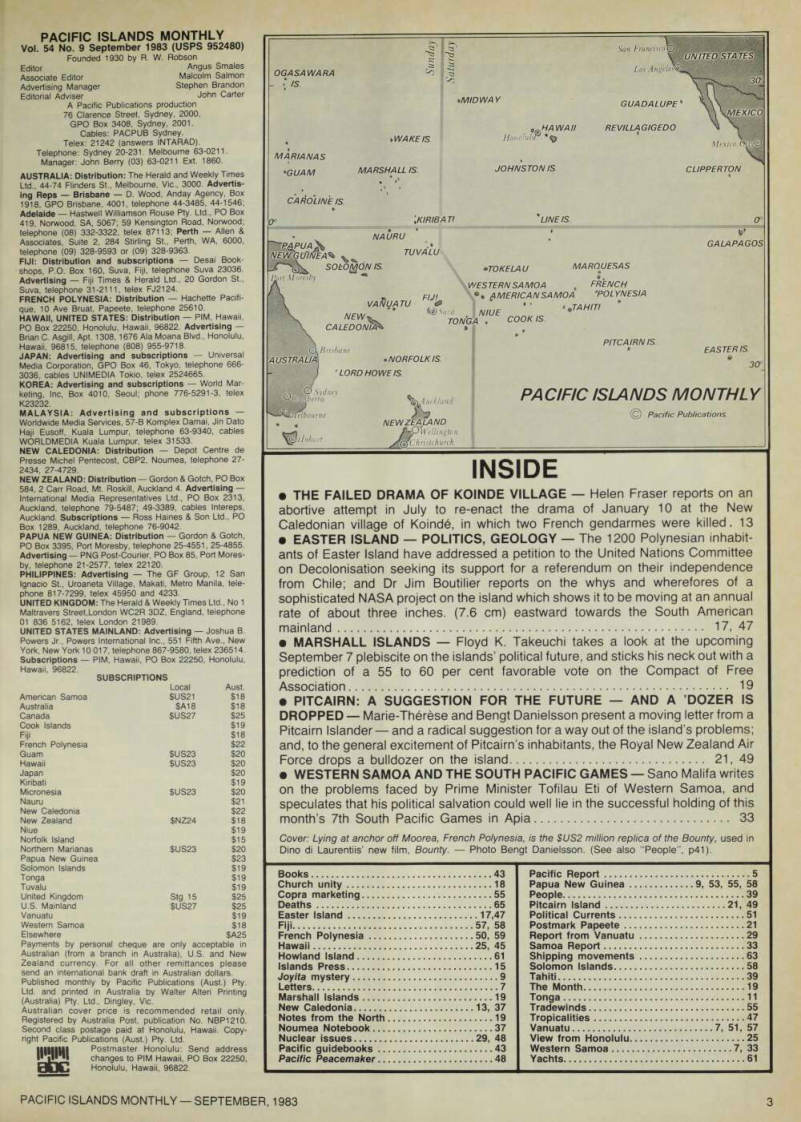
Inside
• THE FAILED DRAMA OF KOINDE VILLAGE Helen Fraser reports on an abortive attempt in July to re-enact the drama of January 10 at the New Caledonian village of Koinde, in which two French gendarmes were killed. 13 • EASTER ISLAND POLITICS, GEOLOGY The 1200 Polynesian inhabit ants of Easter Island have addressed a petition to the United Nations Committee on Decolonisation seeking its support for a referendum on their independence from Chile; and Dr Jim Boutilier reports on the whys and wherefores of a sophisticated NASA project on the island which shows it to be moving at an annual rate of about three inches. (7.6 cm) eastward towards the South American mainland 17, 47 • MARSHALL ISLANDS Floyd K. Takeuchi takes a look at the upcoming September 7 plebiscite on the islands’ political future, and sticks his neck out with a prediction of a 55 to 60 per cent favorable vote on the Compact of Free Association 19 • PITCAIRN: A SUGGESTION FOR THE FUTURE AND A DOZER IS DROPPED Marie-Therese and Bengt Danielsson present a moving letter from a Pitcairn Islander and a radical suggestion for a way out of the island’s problems; and, to the general excitement of Pitcairn’s inhabitants, the Royal New Zealand Air Force drops a bulldozer on the island 21, 49 • WESTERN SAMOA AND THE SOUTH PACIFIC GAMES Sano Malifa writes on the problems faced by Prime Minister Tofilau Eti of Western Samoa, and speculates that his political salvation could well lie in the successful holding of this month’s 7th South Pacific Games in Apia 33
Books 43 Church unity 18 Copra marketing 55 Deaths 65 Easter Island 17,47 Fiji 57, 58 French Polynesia 50, 59 Hawaii 25, 45 Howland Island 61 Islands Press 15 Joyita mystery 9 Letters 7 Marshall Islands 19 New Caledonia 13, 37 Notes from the North 19 Noumea Notebook 37 Nuclear issues 29, 48 Pacific guidebooks 43 Pacific Peacemaker 48
Pacific Report 5 Papua New Guinea 9, 53, 55, 58 People 39 Pitcairn Island 21, 49 Political Currents 51 Postmark Papeete 21 Report from Vanuatu 29 Samoa Report 33 Shipping movements 63 Solomon Islands 58 Tahiti 39 The Month 19 Tonga 11 Tradewinds 55 Tropicalities 47 Vanuatu 7, 51, 57 View from Honolulu 25 Western Samoa 7, 33 Yachts 61
Advertisements & other items, pp. 3-4 (2 items)
Founded 1930 by R. W. Robson
Editor Angus Smales Associate Editor Malcolm Salmon Advertising Manager Stephen Brandon Editorial Adviser John Carter A Pacific Publications production 76 Clarence Street, Sydney, 2000, GPO Box 3408, Sydney, 2001.
Cables: PACPUB Sydney.
Telex: 21242 (answers INTAR AD).
Telephone: Sydney 20-231. Melbourne 63-0211.
Manager: John Berry (03) 63-0211 Ext. 1860.
Our Pacific.
SERVICES REACH OUT
ORI
///' ■ * %'S/ Hawaii VGuam mPonape Kiribati W Nauru i Christmas Solomon Islands Tuvalu western . .
Samoa Vr- American v Samoa Rotuma U '
INDUSTRIAL AND MARINE ENGINEERING LTD
P.O. Box 172, Suva, Fiji. Telex: FJ2195, Fiji.
Phone: 311288 Suva.
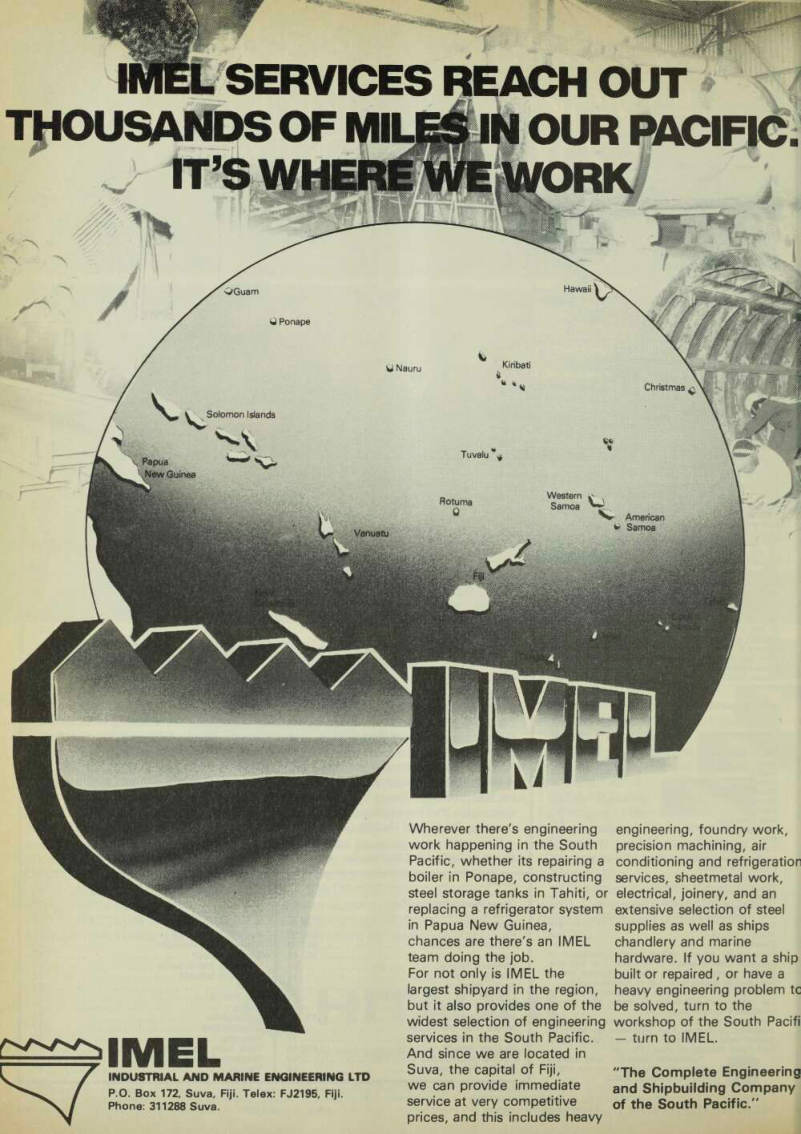
Wherever there's engineering work happening in the South Pacific, whether its repairing a boiler in Ponape, constructing steel storage tanks in Tahiti, or replacing a refrigerator system in Papua New Guinea, chances are there's an IMEL team doing the job.
For not only is IMEL the largest shipyard in the region, but it also provides one of the widest selection of engineering services in the South Pacific.
And since we are located in Suva, the capital of Fiji, we can provide immediate service at very competitive prices, and this includes heavy engineering, foundry work, precision machining, air conditioning and refrigeration services, sheetmetal work, electrical, joinery, and an extensive selection of steel supplies as well as ships chandlery and marine hardware. If you want a ship built or repaired , or have a heavy engineering problem tc be solved, turn to the workshop of the South Pacifi turn to IMEL.
"The Complete Engineering and Shipbuilding Company of the South Pacific."
Pacific Report
Soviet N-Sub Sunk In Pacific?
A Soviet nuclear-powered submarine sank in the North Pacific in June, United States intelligence officials said in August. New York Times reporter Philip Taubman wrote that the officials said the US did not know whether the submarine, which is built to carry cruise missiles, was armed with such missiles when it sank or whether there were any nuclear warheads aboard. They said that most, if not all, of the 90-man crew died in the accident. The Soviet Government, according to the officials, conducted an elaborate and difficult salvage job that ended in recent weeks when the submarine was floated to the surface. American intelligence agencies, according to the officials, inferred from the salvage effort that nuclear missiles might have been aboard.
They also concluded that the salvage operation was conducted in part to prevent the United States from trying to recover the submarine as it attempted to do with a sunken Soviet submarine in the early 19705. That effort, which was managed by the Central Intelligence Agency with the assistance of Howard Hughes, the financier, used a specially constructed salvage ship called the Glomar Explorer. Intelligence officials said they did not know the cause of the latest sinking. They said the Soviet submarine, which belonged to a class code-named Charlie by the Western allies, sank in the Pacific off the Kamchatka Peninsula. The Soviet Navy operates a base at Petropavlovsk on the peninsula.
Mochtar Confident Of Timor Support
The Indonesian Foreign Minister, Dr Mochtar Kusumaatmadja, said in Port Moresby in August he was confident South Pacific countries would vote the same way as they did last year when the East Timor question was raised in the United Nations. He was speaking before departing for Singapore at the end of a tour to Western Samoa, the Solomon Islands, Fiji and New Zealand.
Western Samoa abstained in the last vote and Vanuatu was the only South Pacific nation to vote against Indonesia. “Most of them voted for us, and Western Samoa abstained, because I think they were not sure of the facts,” Dr Mochtar said at an airport press conference. “To make sure of the real situation, I have asked the Foreign Minister (of Western Samoa) to come to Indonesia. The plan is that he comes in September.”
French N-Test Arrogant’ Namaliu
Papua New Guinea’s Foreign Affairs Minister, Mr Rabbie Namaliu, summoned the French Ambassador to his office on August 11 to protest against France’s latest nuclear blast in the South Pacific. “The French Government’s arrogant insensitivity threatens the health and environment of the people of the Pacific,” he said. The test had been detected on August 5.
Cooks Crisis: Queen’S Man Acts
The Queen’s Representative in the Cook Islands, Sir Gaven Donne, on August 14 gave local political leaders until August 17 to resolve the crisis which had left the country without a government since August 4. Prime Minister Geoffrey Henry on that date stepped down after the Appeal Court had ruled he had failed to abide by the constitution and get confirmation in parliament following the elections he won in April. Sir Gaven in his August 14 statement said he was proposing that Mr Henry remain as prime minister until two by-elections were held. One was due on August 19, and the other about two months later.
But, he said, if the leaders could not resolve the crisis by August 17, he would dissolve parliament, call a general election, and instal a caretaker government. The deputy leader of Mr Henry’s Cook Islands Party, his cousin Tupui Henry, had been trying to form a coalition government with the opposition Democratic Party. By August 17 the parliament was still deadlocked and Sir Gaven dissolved it. He installed Geoffrey Henry as caretaker Prime Minister pending a general election in November. Mr Henry and his caretaker ministry will have limited powers.
Fiji Inquiry: Alliance On The Run
The ruling Alliance Party in Fiji in August withdrew a claim that a former leader of the opposition, Siddiq Koya, signed an agree ment with the Soviet Union before last year’s general election.
The Alliance Party told a Royal Commission into the election that it had no evidence to prove the allegation made last May by
Prime Minister Ratu Sir Kamisese Mara. According to the allegation, Mr Koya had signed documents agreeing to grant the Soviet Union facilities in Fiji in return for financial aid to his National Federation Party in last year’s election campaign. Mr Koya was alleged to have agreed to allow the Russians to set up an embassy in Suva if his party won. A lawyer representing the Alliance Party told the Royal Commissioner, Sir John White, that he had been instructed to withdraw the claim. He also told the inquiry the Alliance Party was withdrawing an allegation that a former Indian High Commissioner to Fiji had actively supported the opposition party during her term. Sir John White adjourned the inquiry until August 16 when he was to hear final submis sions. Before the adjournment the inquiry had heard nearly 70 days of evidence on various allegations of Australian, American and Soviet interference in the election last July which was won by the Alliance Party with a reduced majority.
Russian Rifles’ Claim Sparks Png Probe
An investigation was launched in mid-August into a claim that Russian-made rifles were smuggled through Papua New Guinea to rebels in the Indonesian province of Irian Jaya. The Queensland Labor MP and former Opposition Leader, Ed Casey, has said he was told about the racket by PNG Foreign Affairs officials. A report in the Niugini Nius said Mr Casey was told three packages containing a total of 60 rifles had been seized near Dam in the Western Province. The Foreign Affairs and Trade Minister, Rabbie Namaliu, said an investigation had been ordered.
Irian Jaya: Geneva Group Hits Indonesia
The Geneva-based Anti-Slavery Society claimed in August that it has evidence of widespread human rights abuses by the Indonesian authorities in Irian Jaya. The society said it had received reports of as many as 200,000 murders of West Papuans since Indonesia annexed the territory in 1962, of aerial bombardment of civilians and large-scale arrests, and of deten tions and executions by the Indonesian security forces. It called on the United Nations to initiate an independent inquiry.
Fiji Policy Shift On N-Ship Visits
Fiji’s Prime Minister Ratu Sir Kamisese Mara has announced a major change of policy which will in future allow nuclear powered ships and ships carrying nuclear weapons to enter Fiji waters and call at Fiji ports. All relevant government authorities have been directed to prepare new regulations to control the visits of such ships. Entry will have to be applied for on an individual basis. Fiji banned the entry of nuclear-powered ships and those carrying nuclear weapons in 1980, but Ratu Mara said the change in policy was in line with international law, particularly the law of the sea convention and Fiji’s marine spaces law. He said it also took into account a number of important political and economic considerations, and the ques tion of national defence and security. Ratu Mara said his government was fully aware of the opposition by some regional governments to nuclear weapons testing and re-affirmed Fiji’s concern about the dangers of pollution from such tests and the dumping of nuclear waste in the Pacific.
SAIPAN SPC TO LOOK AT ’47 CHARTER?
The South Pacific Conference in Saipan in October is to discuss a proposal for revision of the 1947 agreement which established the South Pacific Commission. Last year’s conference in American Samoa directed the secretary-general of the commis sion to review the work of the organisation. This followed a campaign by some Melanesian countries to have the commis sion and the South Pacific Bureau for Economic Co-operation (SPEC) combined into one organisation. Secretary-General Francis Bugotu recently completed the review and has cir culated it to commission member countries. Among Mr Bugotu’s suggestions is believed to be one for the original agreement, signed in Australia in 1947, to be revised and brought up to date.
Vanuatu-Cuba Diplomatic Ties
The Vanuatu Government in late July established full diplomatic relations with Cuba. The Cuban ambassador in Tokyo, Jose Armado Guerra Menchero, presented his credentials to presi dent Ati George Sokomanu in Port-Vila. The two republics had
agreed to establish full diplomatic relations in discussions at this year’s summit of non-aligned nations in New Delhi. In presenting his credentials, Mr Menchero conveyed president Castro’s best wishes to the people of Vanuatu. He added that Cuba hoped to work more closely with Vanuatu in the future. President Sokomanu asked the ambassador to convey his greetings and those of the people of Vanuatu to Dr Castro.
Coming Up, A Samoan National University
Western Samoa has taken steps to establish its own national university. Education Minister Lemame Ropati has held talks on the matter with officials of the University of the South Pacific, Suva. Prime Minister Tofilau Eti said an ad hoc committee appointed to study the question had unanimously recommended the establishment of a fully-fledged national university. He added that his government was now dedicated to making the university a reality.
Home-Grown Parliament In Kiribati
The Kiribati Parliament began a new session on August 8, and for the first time all 37 members of the House were Kiribati nationals. This follows the swearing-in of new Attorney-General Michael Takabwebwe. Previously, responsibility for legal duties in the Kiribati Parliament has been held by someone from outside the country. Under the constitution of Kiribati, the attorney general is an ex-officio member of parliament.
Fiji Exporters Eye A U.S. Market
A study has begun in Fiji to find locally manufactured products having potential for export to markets on the American West Coast. The study is being made by a Canadian firm of marketing consultants and financed by the London-based Commonwealth Fund for Technical Co-operation. The consultants will also recommend ways to attract North American investment to Fiji.
Fiji: Uphill Fight With Drug Syndicates
A senior police officer in Fiji has said there is no doubt that the country’s international airports and seaports are being constant ly used by big-time drug-pushers as staging points for various markets around the world. The head of Fiji’s police narcotics bureau, Govind Raju, said his officers were doing their best to stamp out the problem. He said police were already seizing large amounts of drugs. A senior government lawyer, Suresh Chandra Maharaj, said that Fiji police officers did not have the manpower or the equipment to tackle the drug problem properly.
He called for the installation of more sophisticated detection equipment at airports.
Regional Information Centre At U.S.P.
A regional information centre has been set up at the University of the South Pacific in Suva. Called the Pacific Information Centre, it will be mainly concerned with collecting, recording and disseminating publicised material relating to the region. Em phasis will be on subjects related to development such as agriculture, rural developmental studies, marine science and public health. The centre will be run by an advisory committee which met recently for the first time in Suva to draw up a work program.
W. Samoa Vetoes Taiwan Rugby Tour
The Western Samoa Government has turned down a proposed tour by a Rugby team from Taiwan. Sources in Apia said the local embassy of the People’s Republic of China had opposed the Taiwan tour on the grounds that the team was said to be a national side. The Taiwan team had been in Western Samoa for three days in the course of a Rugby tour of South Pacific countries, including Fiji, Tonga and Solomon Islands.
Hayden Circumspect On New Caledonia
Australia’s Foreign Minister Bill Hayden has said that recent talks in France on the future of New Caledonia had reflected important gains for the Melanesian people. Mr Hayden said the outcome of the talks, called by the French Secretary of State for Overseas Departments and Territories, Georges Lemoine, had yet to be fully evaluated. He said the talks had recognised the colonial situation of New Caledonia and reflected the legitimacy of the claims of the Kanak people to independence. Mr Hayden said in a statement issued in Canberra that the talks had served to underline the determination of the French Government to promote the process of dialogue on the territory’s future. The foreign minister said that the Australian Government was fully
aware from recent talks, including those with French Govern ment ministers, of the complexity of the situation the socialist government of President Mitterrand had inherited in New Caledonia. He said the Australan Government supported inde pendence in New Caledonia, but the process would have to take into account the wishes of those living in the territory.
Loyalty Islanders Remember Monique
In the Loyalty Islands, off the east coast of New Caledonia, 400 people have attended a memorial service on the 30th anniver sary of the disappearance of the ferry Monique, with the loss of 126 lives. The ceremony was held at Tadine, on Mare Island, where there is a monument to the tragedy, in which no trace was ever found of the boat, passengers or crew. The ferry disap peared during the night of July 30-31, 1953.
Tuvalu Winds Up An Air Service
In Tuvalu, an internal seaplane service financed by an aid grant from Britain has been wound up after a trial period of two years.
Apart from internal flights, the 10-seater plane used for the service has also made charter flights between Tuvalu, Fiji and Kiribati, and monthly flights to Tokelau, Wallis and Western Samoa. However, the Tuvalu Government is reported to be unable to afford to continue the service, or to buy the seaplane, which belonged to a New Zealand firm.
Hammer Deroburt In Noumea
In what amounted to a landmark visit, the President of Nauru, Hammer Deßoburt, was in New Caledonia in August for close discussion with local authorities about collaboration between the soon-to-be-born Air Caledonie International regional airline and Air Nauru. Previously relations between Nauru and the French territory have been virtually nil, with all airline business being handled chiefly between Nauru authorites and UTA French Airlines. A high-level delegation from Vanuatu was also in New Caledonia at the time, and its spokesman expressed the wish that relations between the Nauru-New Caledonia-Vanuatu “triangle” would flourish.
Kiribati Takes Stand For Forum Line
The Kiribati Government has issued a directive that only ships of the Pacific Forum Line will be allowed to trade between Fiji and Kiribati. It warned that cargo arriving on other ships would not be landed. The directive was issued through the South Pacific Bureau for Economic Co-operation (SPEC) in Suva. It said the move reflected growing support among regional governments for the Forum Line. A Radio Australia correspondent in Suva says that this means that the Moanaraoi, now on charter to the Forum Line, will carry all Tarawa-bound cargo from Fiji.
Palmyra Murder Trial Delayed
A Honolulu court hearing to set the date of the murder trial of two people accused of murdering a woman on Palmyra Island has been delayed until October. Lawyers in the case said pre-trial motions by the defendants have caused the delay. The two, Buck Duane Walker and Stephanie Stearns, are accused of murdering Eleanor Graham. Graham and her husband disap peared from the Pacific atoll in 1974. Walker and Stearns have been convicted of the theft of the Grahams’ yacht, the Seawind.
They were charged with murder in the case when Mrs Graham’s remains were found on the island in 1981 (PIM Aug P4O).
Noumea Marathon To Alain Lazare
New Caledonia’s biggest sporting event ever took place on July 24 the first New Caledonian International Marathon. About 150 entrants from Japan, Australia, France, the Netherlands, Fiji, French Polynesia, Britain, La Reunion and New Caledonia competed in the 42 km race, and 1500 took part in the 14 km Friendship Race. The marathon was won by South Pacific champion Alain Lazare in 2 hrs. 20 mins., five minutes over his recent Auckland marathon figure. Lazare attributed the differ ence to unseasonably warm weather for the Noumea run.
Second was Bernard Bobes from France (2 hrs. 22 mins.), and third was Japanese entrant Eiji Matsuda (2 hrs. 23). Australian Colin Neave came fourth with 2 hrs. 23.59 mins. Dutchman Cor Vriend had to drop out after 26 km with a pulled leg muscle. The marathon, which brought 150 Japanese runners, spectators and officials to New Caledonia, was unanimously hailed as a big success. At almost all points of the course Noumeans lined the
streets to cheer on the contestants.
Helen Fraser.
Superman

Letters
Wilhelm Solf:
Good, but no
Superman
As a Pacific historian with a special interest in Samoan socie ty and in Germany’s under publicised role in the history of the islands, I would like to ap
plaud Joseph Theroux’s attempt
(PIM July) to bring the colonial governor, Wilhelm Solf, out of his dusty obscurity.
It is not that little has been written about this large personal ity over the years; indeed there are several journal articles and chapters in books which bring Solf to life in one way or other and analyse his role in Samoa.
But, as Theroux points out, there is as yet no major biography of him in the English language which, for people in the Pacific region, puts Solf in global con text as an administrator with a large humane vision within an aggressive imperial Germany.
However Theroux’s article on Solf falls into the same trap of
European presumption into
which most other casual obser vers of islands history have fallen over the years.
Theroux gives a remarkably small role to the Samoan people themselves in shaping their soci ety under Self’s paternalistic rule. The fact is that, despite Self’s unusual sensitivity to Sa moan politics and his undoubted shrewdness, he did not stride irresistibly across the Samoan
political and social landscape
dictating European political and land reforms to a grateful and
acquiescent people.
The German period in Samoa like the New Zealand period after it was a time of constant negotiation between the German administration and the Samoan elites and people about shared power and about how far along the road of European develop ment Samoans would allow themselves to be pushed.
Solf was challenged consis tently all along that road by one group or another who matched his authority and shrewdness with authority and political skills of their own. Thus the land re forms of 1906 were negotiated between Solf and the chiefs, not
thrust upon them. Similarly, the changes that were made to the political system had to take into account the strength of Samoan political movements all along the line. And, finally, Self’s politic al objectives were never fully realised either during his time or after he left because of the pre ssure Samoan leaders brought to bear on the German administration.
Solf deserves greater recogni tion, which I hope to further
myself by providing that missing
English language biography. But
he was no Übermensch who sim ply dominated weak, disor ganised and primitive Samoans.
They always shared in the crea tion of colonial Samoa through a century of political manipulation which ended in a new begin ning with Western Samoa in 1962 becoming the Pacific’s first independent island nation.
Peter Hempenstall
University of Newcastle Newcastle, NSW Australia
Knocking Smiley’s
Plan
In its issue of November 1982, PIM reported the plans of Mr Arthur (“Smiley”) Ratliff for Henderson and Pitcairn Islands.
I am a conservationist, and have visited Henderson Island. I was also a friend of the late Flight-Lieutenant Alf Fletcher,
who led a survey party and spent six weeks on Henderson Island in early 1944.
I am appalled at the plan to develop Henderson Island along the lines being suggested.
As pointed out in Rod Hay’s article enclosed herewith, Pit cairners themselves, with the help of professional advice, have the means to construct an airstrip on Pitcairn. This would enable the air service already establish ed between Tahiti and Mangare va to call at Pitcairn in an emergency.
Rod Hay has authorised me to submit his article and would be grateful if it were published in
Pim.
Nelson Dyett
Wellington New Zealand
The article by Rod Hay Hen derson Island Smiley’s Dream, Nature’s Demise will be published in a future issue of PIM. Mr Hay is South Pacific Project Officer, Royal Forest and Bird Protection Society, and International Council for Bird Preservation.
Not three, but four
film-makers ...
I was pleased with Dr W. G.
Coppell’s film review on Namaki (PIM Mar p2l). I share his opin ion that Namaki is an ethnog
raphic film of major signifi
cance. However I would like to correct some of his information on the making of the film. The film was actually made by a team of four people, the three former students of the Australian School of Film and Television whom he named and Gilles Artur, the di rector of the Gauguin Museum in Tahiti.
Gilles Artur is not an an
thropologist as stated by Dr Cop
pell, but a former film-maker, museum director and specialist on Paul Gauguin. It is easy to assume that he might be an an
thropologist, particularly since
Artur was one of the first Euro peans to live for several months with the Big Nambas in Amok and to speak their dialect. Artur first stayed with the Big Nambas in June 1953, and it was at this time that he began filming their culture. He returned to shoot
more footage in 1954 and reaf firm his friendship with the peo ple. His film was shown private ly and shared with interested colleagues and anthropologists.
After a number of years Artur returned to visit the Big Nambas, who by 1979 had firmly stated that they did not want to be studied, filmed or photographed.
In short, the Big Nambas did not invite the Australian group to film their Namaki ceremony.
The Big Nambas were initially reluctant, and it was because of the action taken by Artur, with the support of the Reverend Greig Fox, the Reverend Father Rodet, and Kirk Huffman, that the Australians were allowed to film. From June to September 1980 Artur took over 2000 photographs and prepared the way for the shooting of the 135 minutes of 16 mm rushes of the Namaki ceremony during five days in early September when the three Australians, Knaus, Cooksedge and Burstow joined him.
In 1981 Artur went twice to Sydney to work on the editing of the film’s new and old footage footage he provided. The four of them agreed to give their au thor’s copyright to the Big Nam bas, and they offered them a copy of the film, a graded copy of all the rushes, and a cinema projector. They also provided the
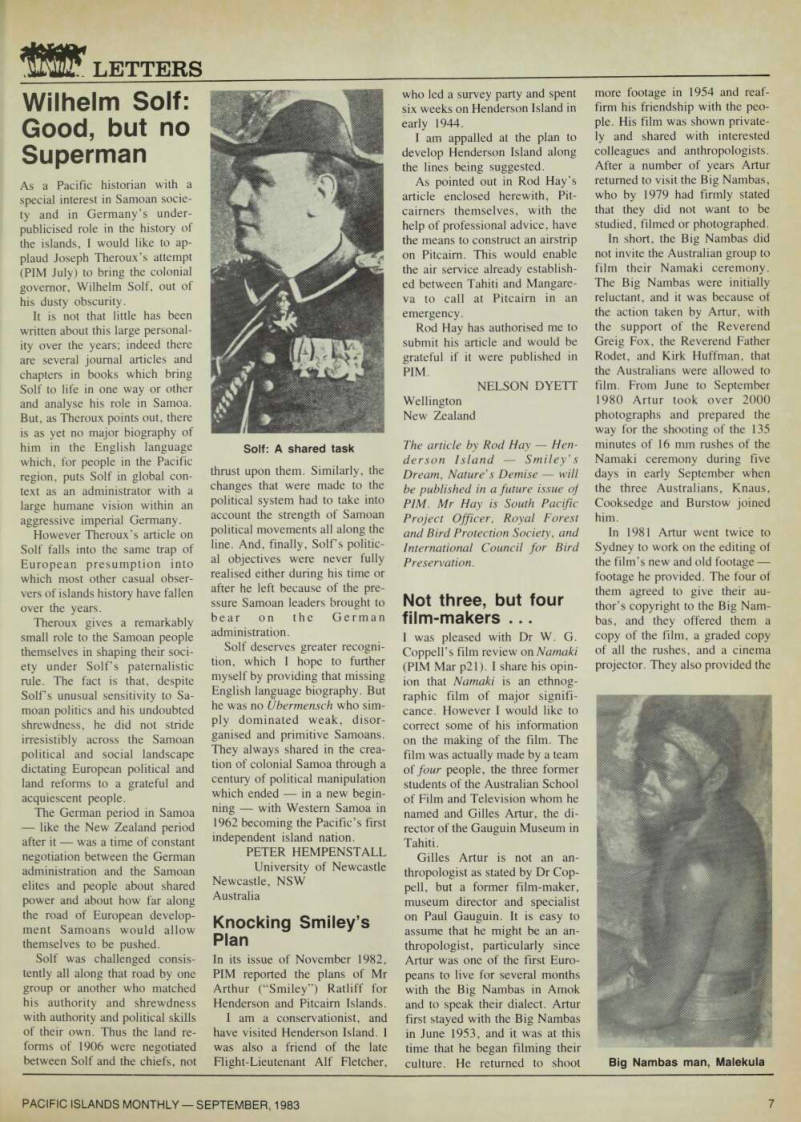
Solf: A shared task
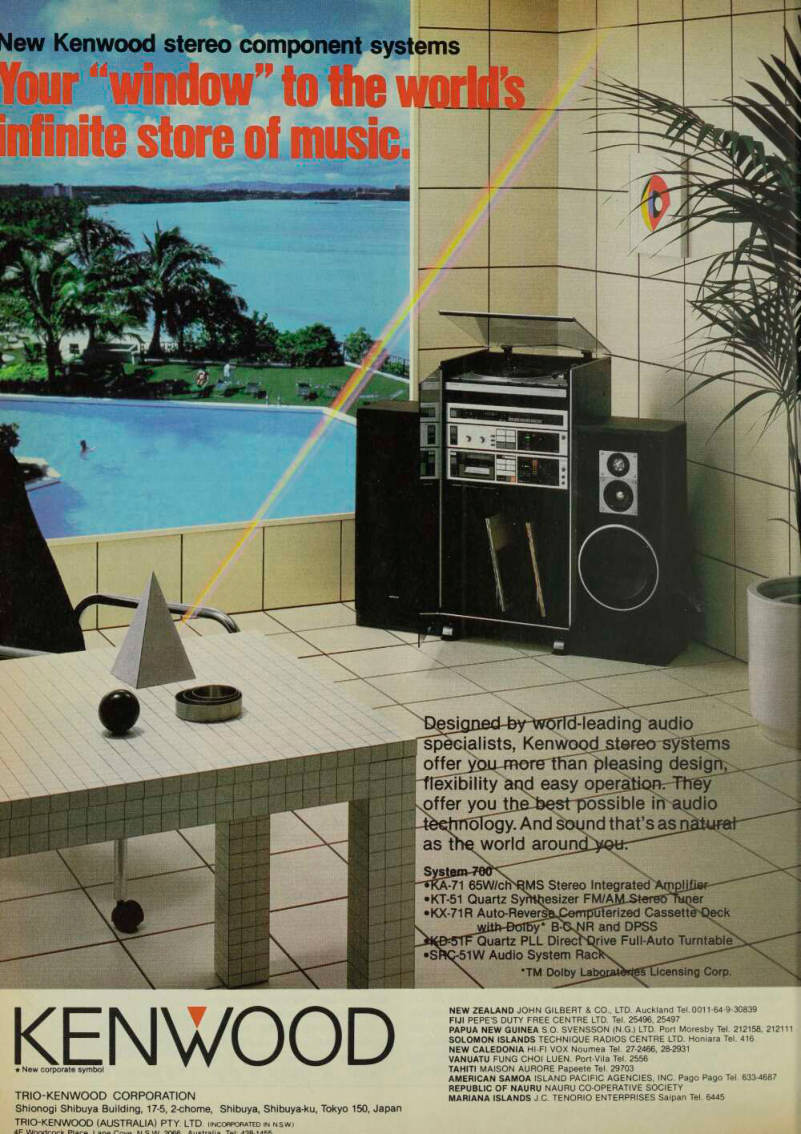
Big Nambas man, Malekula
necessary means for the training of Big Nambas in recording their own legends and customs.
It is not my intention to slight the brilliant work of Knaus, Cooksedge and Burs tow, they earned their recognition. Artur equally deserves credit for his important contribution to the making of the film Namaki. (As an old friend of Artur, I have had many opportunities to view and discuss with him his film footage and many photographs from Malekula.) Together they were a good team and that is in part what makes it a sensitive documentary as Dr Coppell wrote, it should be shown on television.
(Dr) Jehanne Teilhet-Fisk
Associate Professor of Art
History
University of California San Diego, Calif.
Usa
Clarifying the case
of Petrus Tun
Vice-President Petrus Tun of the Federated States of Micronesia chose not to stand for re-election to the FSM Congress in March.
Your statement in “Pacific Re port” (PIM Jul. p 5) that he was defeated by Senator Bailey Olter in the vice-presidential election among members of the Congress in May is thus incorrect.
Having worked closely with both gentlemen for four years, I am confident that Mr Tun’s re tirement from government was entirely voluntary and Mr Olter’s succession in no way constitutes a repudiation of Mr Tun’s de voted and highly competent public service.
Alan B. Burdick
Kailua, Hawaii
Usa
Joyita and
her drums
The Whonsbon-Aston papers published in PIM over recent months were of extreme interest to me, having been an old friend, and also having been closely associated with the Joyita episode.
Whonsbon-Aston writes: “Nor was there any sign of the 45 empty 44 gal. drums carried as cargo.” These drums were col-
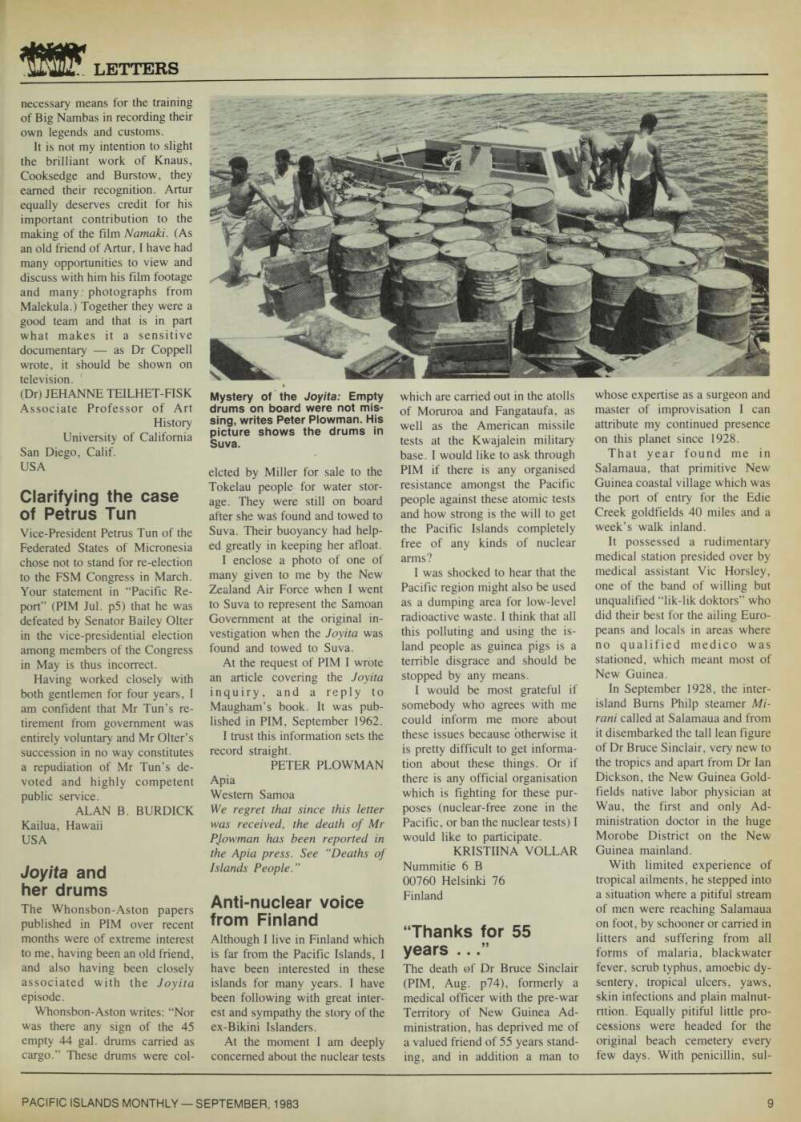
elcted by Miller for sale to the Tokelau people for water stor age. They were still on board after she was found and towed to Suva. Their buoyancy had help ed greatly in keeping her afloat.
I enclose a photo of one of many given to me by the New Zealand Air Force when I went to Suva to represent the Samoan Government at the original in vestigation when the Joyita was found and towed to Suva.
At the request of PIM I wrote an article covering the Joyita inquiry, and a reply to Maugham’s book. It was pub lished in PIM, September 1962.
I trust this information sets the
record straight.
Peter Plowman
Apia Western Samoa We regret that since this letter was received, the death of Mr Plowman has been reported in the Apia press. See “Deaths of Islands People."
Anti-nuclear voice
from Finland
Although I live in Finland which is far from the Pacific Islands, I have been interested in these islands for many years. I have been following with great inter est and sympathy the story of the ex-Bikini Islanders.
At the moment I am deeply concerned about the nuclear tests
which are carried out in the atolls of Moruroa and Fangataufa, as well as the American missile tests at the Kwajalein military base. I would like to ask through PIM if there is any organised resistance amongst the Pacific people against these atomic tests and how strong is the will to get the Pacific Islands completely free of any kinds of nuclear arms?
I was shocked to hear that the Pacific region might also be used as a dumping area for low-level radioactive waste. I think that all this polluting and using the is land people as guinea pigs is a terrible disgrace and should be stopped by any means.
I would be most grateful if somebody who agrees with me could inform me more about these issues because otherwise it is pretty difficult to get informa tion about these things. Or if there is any official organisation which is fighting for these pur poses (nuclear-free zone in the Pacific, or ban the nuclear tests) I would like to participate.
Kristiina Vollar
Nummitie 6 B 00760 Helsinki 76 Finland
“Thanks for 55
years ...”
The death of Dr Bruce Sinclair (PIM, Aug. p 74), formerly a medical officer with the pre-war Territory of New Guinea Ad ministration, has deprived me of a valued friend of 55 years stand ing, and in addition a man to
whose expertise as a surgeon and master of improvisation I can attribute my continued presence on this planet since 1928.
That year found me in Salamaua, that primitive New Guinea coastal village which was the port of entry for the Edie Creek goldfields 40 miles and a week’s walk inland.
It possessed a rudimentary medical station presided over by medical assistant Vic Horsley, one of the band of willing but unqualified “lik-lik doktors” who did their best for the ailing Euro peans and locals in areas where no qualified medico was stationed, which meant most of New Guinea.
In September 1928, the inter island Bums Philp steamer Mi rani called at Salamaua and from it disembarked the tall lean figure of Dr Bruce Sinclair, very new to the tropics and apart from Dr lan Dickson, the New Guinea Gold fields native labor physician at Wau, the first and only Ad ministration doctor in the huge Morobe District on the New Guinea mainland.
With limited experience of tropical ailments, he stepped into a situation where a pitiful stream of men were reaching Salamaua on foot, by schooner or carried in litters and suffering from all forms of malaria, blackwater fever, scrub typhus, amoebic dy sentery, tropical ulcers, yaws, skin infections and plain malnut rition. Equally pitiful little pro cessions were headed for the original beach cemetery every few days. With penicillin, sul-
Mystery of the Joyita: Empty drums on board were not mis sing, writes Peter Plowman. His picture shows the drums in Suva.
phas, antibiotics and other won der drugs yet to evolve, the doc tor carried on with quinine, aspi rin, iodine and hard work. His only chance for another opinion lay in the six-weekly visit of the Bums Philp passenger ship from Australia with its ship’s doctor.
Three days after his arrival in Salamaua I contracted acute ap pendicitis. By mid-aftemoon Dr Sinclair decided that surgery was imperative and told me that in the lack of most instruments, operat ing theatre, sterilising facilities and lighting he would do his best.
While I sat on the verandah of his small two-roomed timber re sidence watching several New Guineans swabbing down the walls of his bedroom with disin fectant he busied himself with boiling some sheets in a bucket, scrubbing down a kitchen table, sharpening several rusty old scal pels and cutting up and sterilising a catgut fishing line for sutures.
Finally, the four helpers were sent to the beach to scrub up with wet sand and sea water.
By nightfall all was ready and action commenced with the four helpers at each comer of the table holding aloft kerosene lamps.
The local barman was recruited as being the most suitable man to administer an anaesthetic and he did a stupefying job. Straight chloroform was used because of the risk of using ether in the presence of naked lights.
Suffice to say all went well. I left the “hospital” a week later in good shape thanks to luck in timing and the skill of the doctor in surgery and resourcefulness in a difficult situation.
Bert E. Weston
Wollstonecraft, NSW Australia
Guadalcanal
cassettes May I bring your attention to the report from the February issue of PIM concerning cassettes of the 40th anniversary observances of the Guadalcanal Campaign in August 1982.
It is a mystery here as to how the cassette information found its way into the pages of PIM. (Not that we are upset for the publicity rendered to Solomon Islands Broadcasting Corporation, or to our organisation, Guadalcanal Campaign Veterans.) We here have already received cassette orders from Australia and Fiji, cannot afford to reship cassettes already airshipped here from Solomon Islands for only SUSB, and so we have returned bank drafts received here.
Overseas cassette orders
should be directed to: Solomon Islands Broadcasting Corpora tion, Box 654, Honiara, Guadal canal, Solomon Islands. Attn: Mr Martin Hadlow, News/Prog ram Trainer.
Al Bonney
Executive Director, Guadalcanal Campaign Veterans Brunswick Maine
Usa
From the Palace
Office, Nukualofa
PIM has recently received a lengthy statement from the Palace Office of the Kingdom of Tonga objecting to a report head lined “Tonga’s King Sacks Fi nance Minister” and appearing in our issue of May 1982.
The statement says that it was incorrect to report that the minis ter concerned, Mahe Tupouniua, was “sacked”, because, it says, Mr Tupouniua resigned at his own request, and it quotes a statement by him to this effect appearing in The Tonga Chroni cle of March 26, 1982.
It was also incorrect, the state ment says, to suggest that the “sacking” was due to the minis ter’s refusal to provide extra public funds for the King’s travel. It goes on: “There were certainly discussions between the Palace Office and Treasury, but these were about the payment of expenses already incurred . . .
the accounts under discussion were not just for transport either, they were for other expenses as well. Such discussions are nor mal between any Treasury and all government departments.”
The statement adds: “That the amount required by the Palace office was above that allocated in the budget is quite correct. What the article failed to do, however, was to point out that it would be a rare exception indeed for any department not to require extra funds above its budget alloca tion. The extra funds approved by the government of Tonga above the budgets for the finan cial years July 1979 to June 1982 amounted to $10,051,749. Only $155,294 of this total was for the Palace office. The extra expenses for Their Majesties’ attendance at the wedding of Their Royal Highness Prince Charles and the Princess of Wales, July, 1981, as well as the hospitality for the visit of the Prime Minister of India, Indira Gandhi, October 1981, fell within this period.”
Not two, as claimed in the article, but one senior finance man had resigned at the time, the statement says, and the resigna tion had nothing to do with the “sacking”. This man has since been reappointed to a high gov ernment post.
The statement says that the PIM article’s suggestion that the incident would have important political repercussions in the post-cyclone conditions of the time was “ill-founded”. “No political repercussions have oc curred and Tonga’s recovery af ter the cyclone has been miracul ously rapid,” the statement says.
The statement makes two other substantial points, saying: “The only initiative taken by His Majesty concerned the timing of Mr Tupouniua’s resignation. Mr Tupouniua had mentioned Oc tober 1982. His Majesty brought this forward to March 1982 in order to allow the new minister of finance to prepare his own budget for the July 1982 to June 1983 financial year. Secondly, HRH Prince Tu’ipelehake, prime minister of Tonga and His Ma jesty’s brother, fully supported Mr Tupouniua’s nomination in August 1982 to return to SPEC, again as its director.”
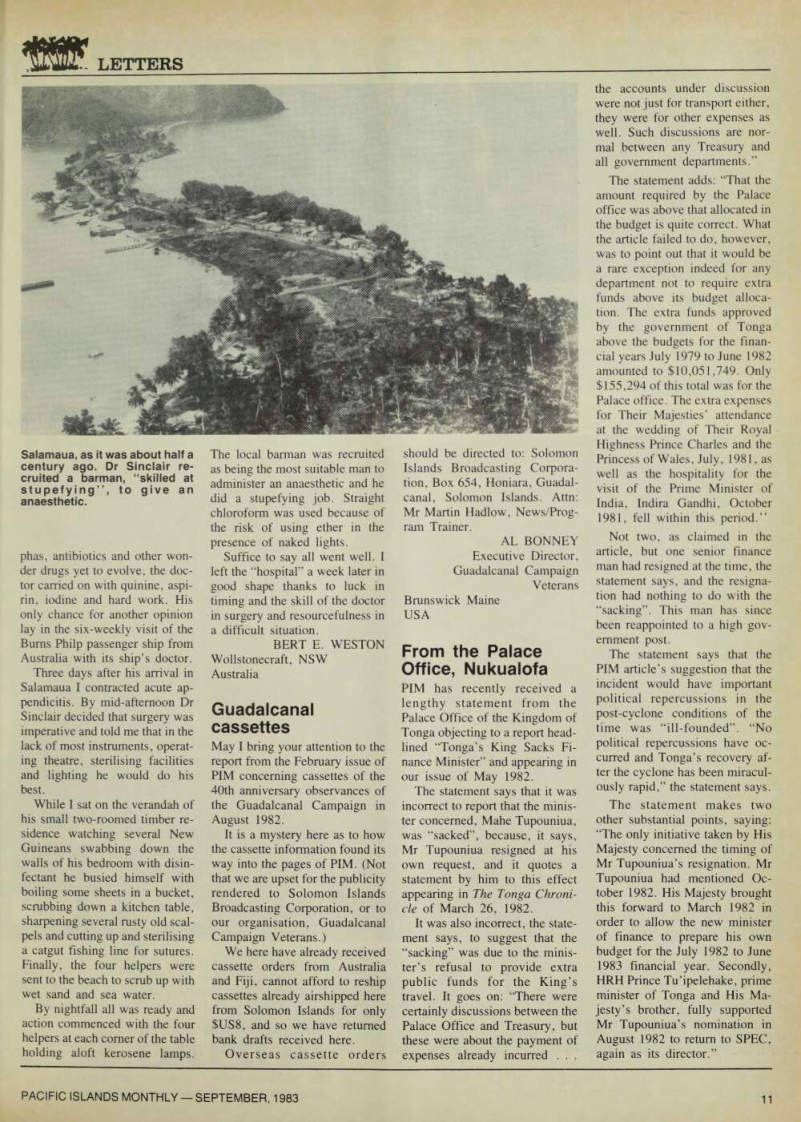
Salamaua, as it was about half a century ago. Dr Sinclair re cruited a barman, “skilled at
stupefying”, to give an
anaesthetic.
Advertisements & other items, pp. 8-12 (1 item)
Kenwood
Mew Kenwood stereo component systems
lar “window” to the world's
infinite store of music.
** Jr
(gsicjoeo-ey-woria-leading audio
specialists, Kenwood stereo systems
wore than pleasing
fexibility and easy operation; They
.offer you the best possible in audio
iolbgy; And soimd that’s as,
as the world arouni
<-71 65W/ch Stereo Integrated Ampijlii •KT-51 Quartz SyrHtesizer
•KX-71R Cassett&'Qeck
and DPSS Quartz PLL Full-Auto Turntable" •SRC-51 W Audio System Racl *TM Dolby Corp.
KENWOOD
★ New corporate symbol
TRIO-KENWOOD CORPORATION
Shionogi Shibuya Building, 17-5, 2-chome, Shibuya, Shibuya-ku, Tokyo 150, Japan TRIO-KENWOOD (AUSTRALIA) PTY. LTD. (incorporated in nswi NEW ZEALAND JOHN GILBERT & CO., LTD. Auckland Tel.ooll-64-9-30839 FIJI PEPE’S DUTY FREE CENTRE LTD. Tel. 25496, 25497 PAPUA NEW GUINEA S.O. SVENSSON (N.G.) LTD. Port Moresby Tel. 212158, 212111 SOLOMON ISLANDS TECHNIQUE RADIOS CENTRE LTD. Honiara Tel. 416 NEW CALEDONIA HI-FI VOX Noumea Tel. 27-2466, 28-2931 VANUATU FUNG CHOI LUEN. Port-Vila Tel. 2556
TAHITI MAISON AURORE Papeete Tel. 29703
AMERICAN SAMOA ISLAND PACIFIC AGENCIES, INC. Pago Pago Tel. 633-4687
REPUBLIC OF NAURU NAURU CO-OPERATIVE SOCIETY
MARIANA ISLANDS J.C. TENORIO ENTERPRISES Saipan Tel. 6445
.PS TO REDUCE
LDING COSTS
‘Paling Industries’ Malaysia’s first quality uP.V.C. pipe and fittings manufacturer. A name backed by modern technology, equipment and expertise one you can count on for quality and the highest standards of production. ‘Paling’ products are made according to British standards and approved by the local authority. ‘Paling’ uP.V.C. pipes and fittings are:- •cheaper than most conventional materials ♦resistant to chemicals * ♦easier to install ♦lighter
•durable I
m m
‘Paling uP.V.C. pipes & fittings for
♦ water supply system ♦electrical conduit ♦drainage and other purposes 6S 112?>
’WHALE’
High & low level flushing cisterns for sanitary use.
Manufactured by
PALING INDUSTRIES
SENDIRIAN BERHAD
Lot 12, Jafan Perusahaan Empat.Batu Caves, Selangor, Malaysia. Tel: 662034, 662098.664747, 664917
@mien »irmn a i!., *
SUZUKI
the name of performance.
5J410 Metal-Top
SUZUKI Vehicles are shipped to approximately 100 countries throughout the world and are well received by users in those countries. j Behind the high-quality of SUZUKI 4'wheelers is the in-depth research carried out from all aspects, rigorous tests and an extensive after-sales service network. Vehicles that are ready when you need them and which you can trust when driving. SUZUKI Vehicles.
Stripe tape and free-wheel-hubs are optional.
SSBO
4-Door 3 * a * 4 r Top^-- >hoto: Canvas-
>APUA NEW GUINEA PNG MOTORS
SUAM & SAIPAN ISLAND CYCLERY, INC.
: IJI NIRANJANS AUTOPORT LTD.
JOLOMON ISLANDS . . SOLOMON ISLAND SERVICE STATION LTD.
JEW CALEDONIA STE. SUPERCAL
rANUATU HENRI LEROUX
HUE ISLAND BURNS PHILP (SOUTH SEA) CO., LTD.
AHITI NIPPON AUTOMOTO
JORFOLK MARTIN’S AGENCIES LTD.
»AMOA PACIFIC PRODUCTS, INC.
TONGA PACIFIC PRODUCTS. INC.
NAURU EQUAPAC MOTORS
KIRIBATI KIRIBATI CO-OPERATIVE WHOLESALE SOCIETY LIMITED
RAROTONGA . . . AUTO HOLDINGS LTD.
SUZUKI MOTOR CO, LTD
SUZUKI
300 Takatsuka, Hamamatsu, Japan Sincel9ss, a world leader in mini-vehicles. a
SUZUKI
and smoke effects,
New Caledonia
Lack of sound and smoke effects, reluctant actors spoil the drama of Koindé
Koinde is a sleepy little Kanak village 130 km north of Noumea.
It is hidden in the mountain chain which runs through the centre of la Grande Terre. About 150 peo ple live there.
On January 10 this year, a convoy of gendarmes came through Koinde early in the morning to recover sawmill equipment belonging to Mr Bar bou, European owner of a saw mill operating in the locality.
The equipment had been taken and held by the villagers in the course of a dispute over pollution caused by the sawmill to the drinking water and yabbie supply of the village. As the gendarmes attempted to leave Koinde a fight occurred, two gendarmes were killed, and six other people wounded. (See report PIM Feb p!5).
The Kanaks claim that after
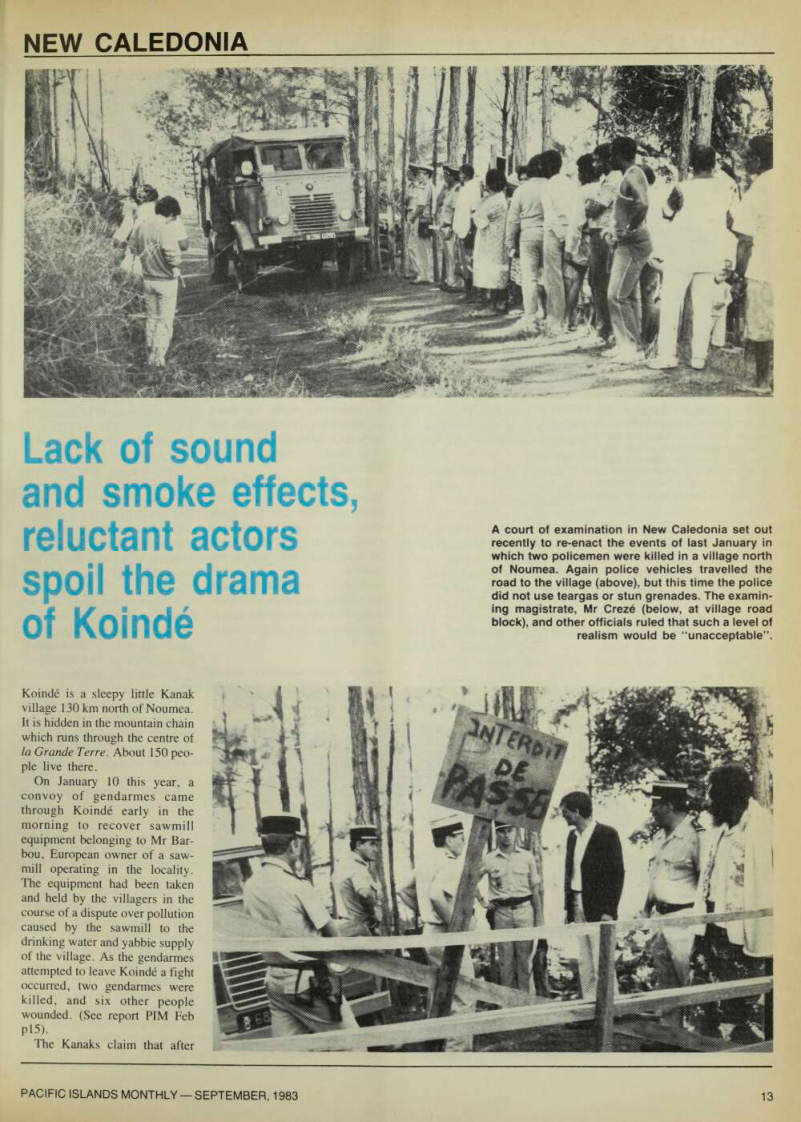
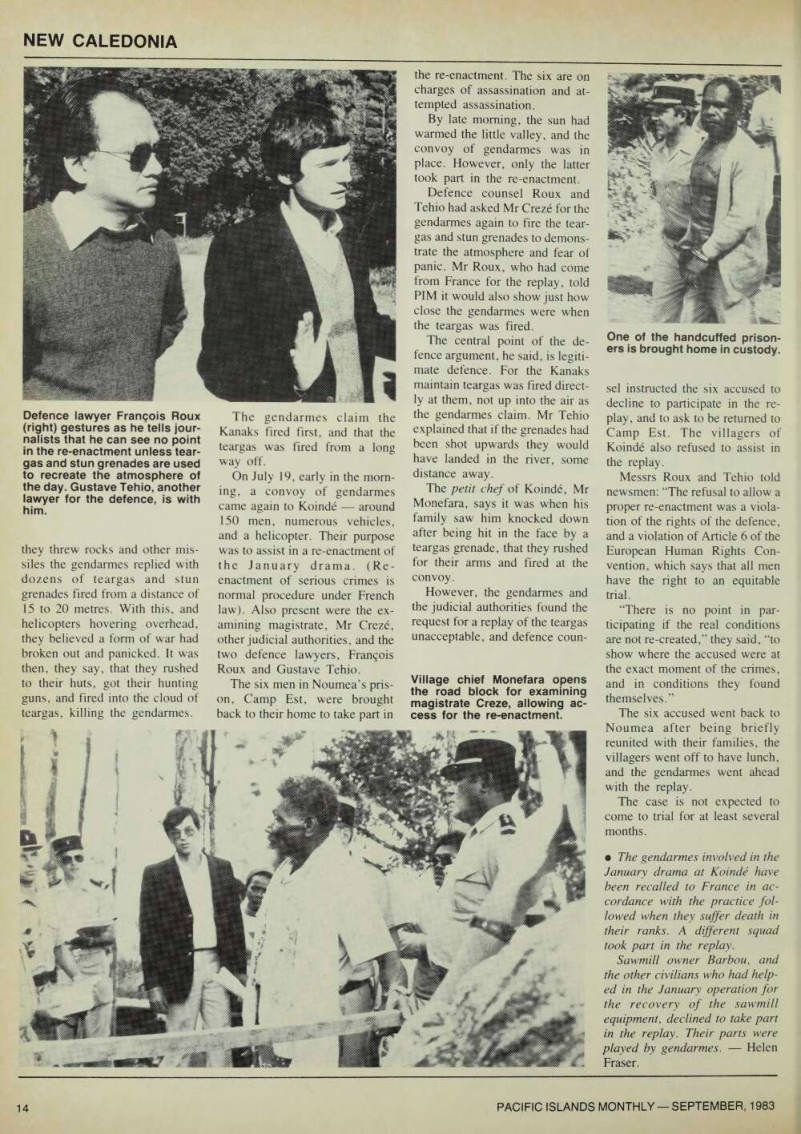
A court of examination in New Caledonia set out recently to re-enact the events of last January in which two policemen were killed in a village north of Noumea. Again police vehicles travelled the road to the village (above), but this time the police did not use teargas or stun grenades. The examin ing magistrate, Mr Creze (below, at village road block), and other officials ruled that such a level of realism would be “unacceptable".
they threw rocks and other mis siles the gendarmes replied with dozens of teargas and stun grenades fired from a distance of 15 to 20 metres. With this, and helicopters hovering overhead, they believed a form of war had broken out and panicked. It was then, they say, that they rushed to their huts, got their hunting guns, and fired into the cloud of teargas, killing the gendarmes.
The gendarmes claim the Kanaks fired first, and that the teargas was fired from a long way off.
On July 19, early in the morn ing, a convoy of gendarmes came again to Koinde around 150 men, numerous vehicles, and a helicopter. Their purpose was to assist in a re-enactment of the January drama. (Re enactment of serious crimes is normal procedure under French law). Also present were the ex amining magistrate, Mr Creze, other judicial authorities, and the two defence lawyers, Francois Roux and Gustave Tehio.
The six men in Noumea’s pris on, Camp Est, were brought back to their home to take part in
the re-enactment. The six are on charges of assassination and at tempted assassination.
By late morning, the sun had warmed the little valley, and the convoy of gendarmes was in place. However, only the latter took part in the re-enactment.
Defence counsel Roux and Tehio had asked Mr Creze for the gendarmes again to fire the tear gas and stun grenades to demons trate the atmosphere and fear of panic. Mr Roux, who had come from France for the replay, told PIM it would also show just how close the gendarmes were when the teargas was fired.
The central point of the de fence argument, he said, is legiti mate defence. For the Kanaks maintain teargas was fired direct ly at them, not up into the air as the gendarmes claim. Mr Tehio explained that if the grenades had been shot upwards they would have landed in the river, some distance away.
The petit chef of Koinde, Mr Monefara, says it was when his family saw him knocked down after being hit in the face by a teargas grenade, that they rushed for their arms and fired at the convoy.
However, the gendarmes and the judicial authorities found the request for a replay of the teargas unacceptable, and defence coun-
sel instructed the six accused to decline to participate in the re play, and to ask to be returned to Camp Est. The villagers of Koinde also refused to assist in
the replay.
Messrs Roux and Tehio told newsmen: “The refusal to allow a proper re-enactment was a viola tion of the rights of the defence, and a violation of Article 6 of the
European Human Rights Con
vention, which says that all men have the right to an equitable trial.
“There is no point in par ticipating if the real conditions are not re-created,” they said, “to show where the accused were at the exact moment of the crimes, and in conditions they found themselves.”
The six accused went back to Noumea after being briefly reunited with their families, the villagers went off to have lunch, and the gendarmes went ahead with the replay.
The case is not expected to come to trial for at least several months. • The gendarmes involved in the January drama at Koinde have been recalled to France in ac cordance with the practice fol lowed when they suffer death in their ranks. A different squad took part in the replay.
Sawmill owner Barbou, and the other civilians who had help ed in the January operation for the recovery of the sawmill equipment, declined to take part in the replay. Their parts were played by gendarmes. Helen Fraser.
Defence lawyer Francis Roux
(right) gestures as he tells jour nalists that he can see no point in the re-enactment unless tear gas and stun grenades are used to recreate the atmosphere of the day. Gustave Tehio, another lawyer for the defence, is with him.
Village chief Monefara opens the road block for examining magistrate Creze, allowing ac cess for the re-enactment.
One of the handcuffed prison ers is brought home in custody.
Islands
From the
Press
From The Fiji Times, Suva, Fiji Black Arrow Sports Club, whose members live around Ritova Street, decided to clear bush along the street after several women in the area said they had sighted a man, at times naked, in the bush during the day. President of the club, Mr Ambika Prasad, said some people believed that a spirit had been left behind in the area by a Solomon Islands clan who lived there long ago. Members of the club began clearing the bush with knives and also sprayed the area with chemicals. Mr Prasad said people would not have to fear “spirits” once the bush was cleared. He said if their clean-up campaign did not get rid of the “haunting spirit” it would at least drive out the mosquitoes. (Later a Solomon Islander living in Fiji protested to the paper over the suggestion that a “Solomon Island spirit” was said to be involved).
A letter to the Papua New Guinea Post-Courier, Port Moresby, about the habits of dogs As we lie in bed at night, fully awake and very conscious of man’s best friend at work, we have plenty of time to appreciate just what it is these dogs are doing for us. I don’t really mind the pek-pek all around the garden or the fact that the dogs don’t know the difference between the innocent and the guilty passers-by on the street. As I walk under the house through the pek-pek to the car next morning I know my house is well looked after. So why worry about the occasional stink in the car and the difficulty of looking for the cause while negotiating the Waigani morning rush hour. Remember it is only proof that your house was well guarded the night before.
Islands News, Rarotonga, Cook Islands, reporting criticism of safety measures during blasting in Avatiu harbor He said that internal organs might suffer damage from the concussion or be knocked unconscious and drown.
From a letter published in The Samoa Observer, Apia, in which loane Tomasi supports a police drive against crime No longer will our women and daughters have to fear the perverts who prowl around homes at night threatening any they find outside; no longer will our wives go to collect their washing and find all their bras and underwear stolen off the line, no more social hostesses hanging around Matautu annoying innocent men. Instead, Chief Inspector Falaniko has announced tough new measures to rid our streets of criminals. Anyone not saluting the “Freedom Flag’’ is to be punished to the full extent of the law. But is this enough? These criminals should be incarcerated, thrashed and publicly flogged.
Letter to the editor in the Papua New Guinea Post-Courier, Port Moresby, signed by “Miss Papuan”
I am concerned about the price of a Papuan bride. We Papuan girls cost too much it’s true. And it’s not just you New Guineans getting married to Papuans who are paying the big money, such as 8000 kina. No! It happens to us Papuans too.
We marry our own wantoks, and we pay perhaps 10,000 kina and other things such as armshells and feathers of birds of paradise etc. It has nothing to do with the government because
the bride price is not new to us Papuans or to New Guineans, either. It’s an old custom. Some people are still paying that much or more. But if you know that you can’t afford to pay that much, then leave us Papuan girls alone.
From the Flotsam and Jetsam column in The Fiji Times, Suva The Fiji electricity authority is no respecter of persons or government departments, for that matter, when it comes to non-payment of bills. It treats everybody alike: The high and the low, the rich and the poor, without distinction or favor. Its latest victim, whose offices at the Fiji Development Bank building were disconnected, was the government’s biggest money-earner the Inland Revenue Department. An electricity authority spokesman said that Inland Revenue had not paid its bills despite repeated reminders.
From a news bulletin of Radio Vanuatu, Port-Vila Amas-vengani is the new name for Liro School on Paama Island. The name was adopted at a meeting of the school council. The Headmaster, Mr Wenjio Tamau, explained that the new name is made up of two Paamese words amas, a place where there is an abundant supply of food; and vengani, meaning to feed. It is said that in the past everyone on Paama used to go to Amas, the present location of the school, to collect food. Mr Tamau said Amas-vengani should now mean a place where children go to be fed with new ideas in education.
From an article in The Times of Papua New Guinea on the changing role of women in PNG society and the problems of domestic violence When he hits her he is telling her how he feels with violence instead of expressing it in words, and of course he knows that nothing is more humiliating to a career woman in a responsible job than having to appear in the office with a bruised face. In a matrilineal society if a woman was bashed up her brothers would come to her defence. Now that people are operating as nuclear families, relatives are not supposed to interfere in a couple’s lives. The woman is cut off from the kind of support which she would get in the village and this gives the man more power to do what he wants with his wife. If the wife runs back to relatives it gets on the man’s nerves. After all, what would happen if the news gets back to the village.
A sad aspect of society from figures quoted in The Samoa Times, Apia There were 31 suicides in 1982, according to the annual report of the Police Department. Twenty-one of the suicides were by males. As in previous years the main weapon of death remained paraquat which was responsible for 22 of the cases of suicide.
There were five cases of shooting, three of hanging and one of
burning.
One of 29 methods to stop smoking advocated in an
anti-smoking campaign published by the Marianas
Variety News and Views, Saipan Spend a lot of time in libraries, churches and other places where smoking is not allowed.
The Papua New Guinea Post-Courier, Port Moresby A plague of warehouse rats paid the penalty for their expensive appetites in Mount Hagen recently. Staff at the Mendi Provincial government stores warehouse, tired of excessive stock losses, declared war on the rats. Aided by an eager dog the staff killed 89 rats in one afternoon. The dead rats drew quite a crowd of onlookers including the Western Highlands Premier, Mr Tegi Ebeial, who was driving past on his way to town when the rats were displayed outside the warehouse by the proud rat catchers.
The Pitcairn Miscellany, Pitcairn Island The Administration has agreed to have two hours public power every morning now that we have three large generators on the island. This is a tremendous advance, for it means that one will be able to run a freezer or refrigerator without needing a private plant to supplement the public power. It is also very convenient for using electric tools or to make a hot drink. We thank the Administration for their decision.
Advertisements & other items, p. 16 (1 item)
Ae nads
you drive on? ■—■
A ft K .^r ■ ■; ■f*
NISSAN PATROL
Who else but**
WWM Trough primitive roads, we designed Nissan builds vehicles '9 ■ * , nw ., nct o n, lightweight, ta s because Nissan builds vehicles .conditions they'll be driven under reas ot the world where driving is igh , we used all our technological nake the new Nissan Patrol as weralUturability, and to enhance trength and toughness, we spot- ; oth its strong, ladder-type frame slid unitary body. io improve its riding stability over whether we Cl it Nissan or Oatsun, the same kind of innovative technology aoes into every vehicle we build.
Specifications and egu,pmen. may van, according y
TEST
NISSAN/DATSUN: ONE AND THE SAME
NISSAN
nATCMKI Max Haleck Inc. Pago Pago, American Samoa Cook Islands Motor Centre Ltd. Rarotonga, Cook Islands Carpenters Motors mru Suva, Fiji Atoll Auto Stores Tarawa, Kiribati Jacob Enterprises Nauru Agence Alma S.A. Noumea, New Caledonia Sirius Motors Norfolk Island Boroko Motors Port Moresby, Papua New Guinea United Enterprises Ltd. Honiara, Solomon Islands Tahitibull S.A.R.L. Papeete, Tahiti Pentecost Vanua Trading Ltd. Port Vila, Vanuatu Morris Hedstrom Ltd. Apia, Western Samoa
Easter Islanders petition the U.N.
Followers Of The Spirit
Easter Islanders petition the U.N. for a vote on independence
The Followers of the Spirit of the Navel of the World the translated name of an Easter Island organisa tion have produced a petition asking for the independence of Easter Island from Chile. A RIM writer backgrounds the move which Chile has de scribed as the work of “foreign agitators”.
Stirrings of revolt among the inhabitants of Easter Island have surfaced with a petition address ed by them to the United Nations Committee of 24 the commit tee on decolonisation. The peti tion seeks the committee’s help in securing a referendum on the independence of Easter Island.
Sponsoring the petition is a committee known as Mana te Pukuraga o te Pito o te henua Rapa Nui. A very rough transla tion would be Followers of the Spirit of the Navel of the World (the Easter Islander’s old name for their island) Rapa Nui (a more recent name for the island).
Dismissed by authorities in Santiago as the work of “foreign agitators”, the petition never theless has a decidedly home grown tone to it.
It does not, for example, go in for Latin-style rhetoric about “Liberty or Death”, but soberly acknowledges the real relation ship of strength between the Chi lean authorities on the one hand and the Easter Islanders on the other, when it says: “We have hesitated a long time ... be cause we are afraid of reprisals”.
The preamble to the petition says: “In everything but name our island is a colony, and a
colony of the worst and most oppressive type, for we islanders have no say in our own affairs. In fact, the whole island was taken from us when the Chileans hoist ed their flag in 1888, and our land has since been used as a sheep station for the benefit of foreign companies.
“We are constantly being told that we are free Chilean citizens, and in fact we are citizens of Chile. But this works to our disadvantage because we are so few there are only 1200 of us.
So our votes carry no weight in national elections, and all deci sions are made over our heads on the mainland. We have no way of making our voice heard, for there is no democratically elected council on the island, which is
governed by a military comman der, aided by a local man called a “mayor”. But he is appointed by the military governor, and is no thing more than his errand boy. ”To help the governor rule us, the island is full of Chilean bureaucrats, soldiers and police about 800 altogether to see to it that we are kept ‘in our place’. Our youth must also serve in the Chilean army, and to mould them as good patriots, they are sent to Spanish-language schools. To increase our depend ence, the economy is controlled by the colonial power, and our only source of income is to make sculptures for the tourists, who have eyes only for the monu ments of our forefathers, and care nothing for us Easter Islan
ders who live on the island today.
“Since General Pinochet took over Chile and has been running it with his soldiers, it has become impossible for us to voice any protests in our own island. This is why we have sent the enclosed petition to the United Nations Committee on Decolonisation.
We have hesitated a long time before doing so, because we are afraid of reprisals. But here it is, and let our voice be heard. Why should we alone of all colonial peoples not be entitled to FREE
Dom And Independ
Ence?”
The petition addressed to the UN committee says in part: . .
The Chileans arrived in 1888.
They forbade our national flag, the flag of reimiro. They sent our forefathers to work from sunrise to sunset, without pay, only dol ing out some clothes to them like slaves. They threatened them and punished them. They took away their land and animals.
“Our land was rented out to foreign companies. The Rapa Nui were treated like aliens on their own soil, and had to seek permits to do the smallest thing.
The administrators treated them like children or inferiors, without any respect for their persons or
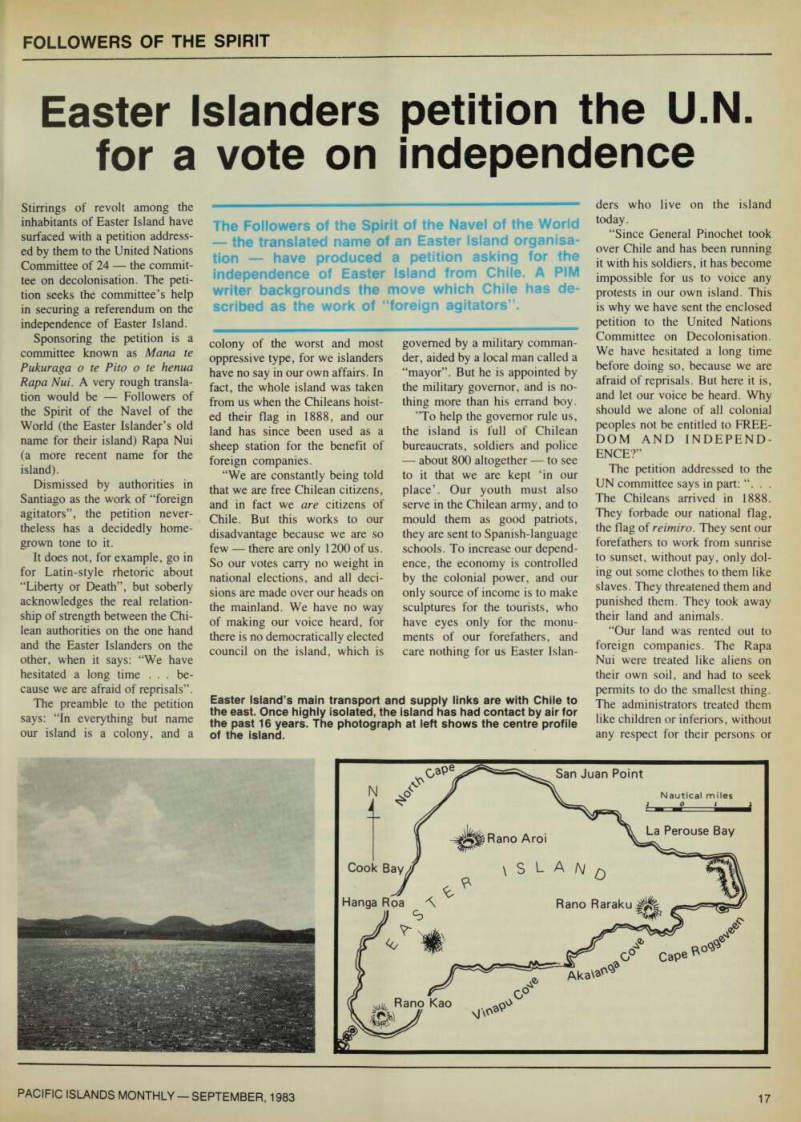
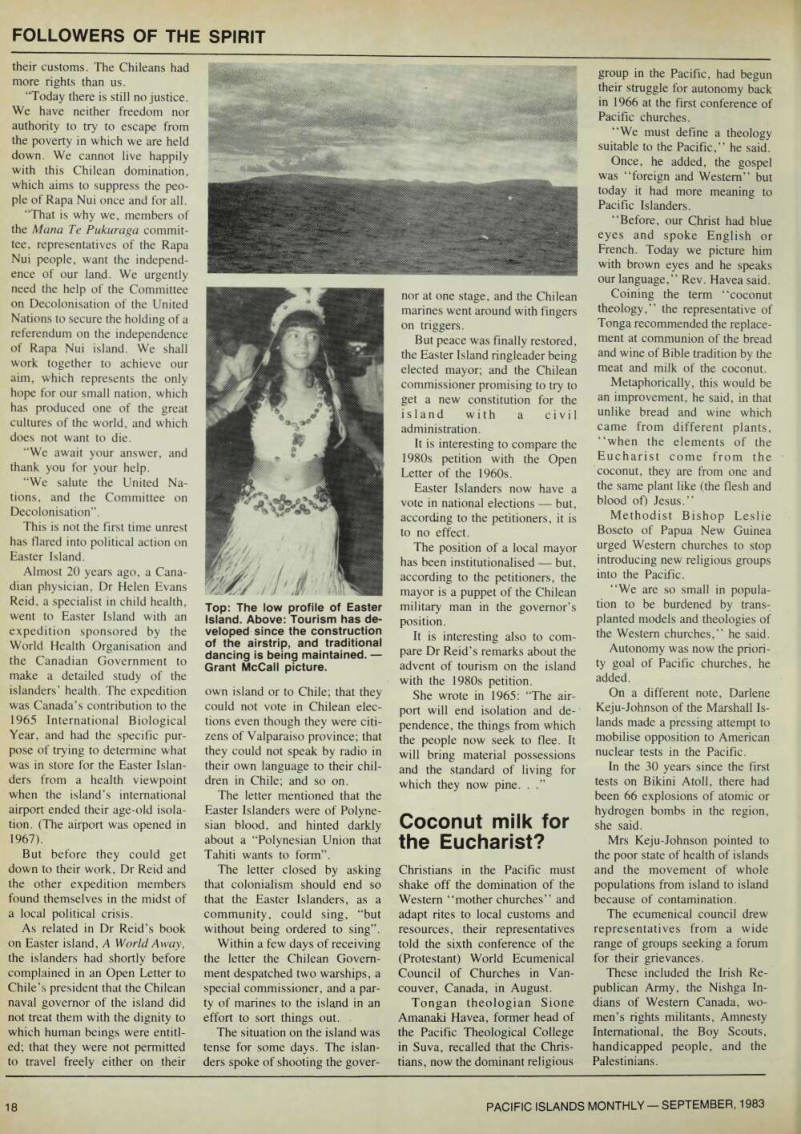
Easter Island’s main transport and supply links are with Chile to the east. Once highly isolated, the island has had contact by air for the past 16 years. The photograph at left shows the centre profile of the island.
their customs. The Chileans had more rights than us.
“Today there is still no justice.
We have neither freedom nor authority to try to escape from the poverty in which we are held down. We cannot live happily with this Chilean domination, which aims to suppress the peo ple of Rapa Nui once and for all.
“That is why we, members of the Mana Te Pukuraga commit tee, representatives of the Rapa Nui people, want the independ ence of our land. We urgently need the help of the Committee on Decolonisation of the United Nations to secure the holding of a referendum on the independence of Rapa Nui island. We shall work together to achieve our aim, which represents the only hope for our small nation, which has produced one of the great cultures of the world, and which does not want to die.
“We await your answer, and thank you for your help.
“We salute the United Na tions, and the Committee on Decolonisation”.
This is not the first time unrest has flared into political action on Easter Island.
Almost 20 years ago, a Cana dian physician, Dr Helen Evans Reid, a specialist in child health, went to Easter Island with an expedition sponsored by the World Health Organisation and the Canadian Government to make a detailed study of the islanders’ health. The expedition was Canada’s contribution to the 1965 International Biological Year, and had the specific pur pose of trying to determine what was in store for the Easter Islan ders from a health viewpoint when the island’s international airport ended their age-old isola tion. (The airport was opened in 1967).
But before they could get down to their work, Dr Reid and the other expedition members found themselves in the midst of a local political crisis.
As related in Dr Reid’s book on Easter island, A World Away, the islanders had shortly before complained in an Open Letter to Chile’s president that the Chilean naval governor of the island did not treat them with the dignity to which human beings were entitl ed; that they were not permitted to travel freely either on their
own island or to Chile; that they could not vote in Chilean elec tions even though they were citi zens of Valparaiso province; that they could not speak by radio in their own language to their chil dren in Chile; and so on.
The letter mentioned that the Easter Islanders were of Polyne sian blood, and hinted darkly about a “Polynesian Union that Tahiti wants to form”.
The letter closed by asking that colonialism should end so that the Easter Islanders, as a community, could sing, “but without being ordered to sing”.
Within a few days of receiving the letter the Chilean Govern ment despatched two warships, a special commissioner, and a par ty of marines to the island in an effort to sort things out.
The situation on the island was tense for some days. The islan ders spoke of shooting the gover
nor at one stage, and the Chilean marines went around with fingers on triggers.
But peace was finally restored, the Easter Island ringleader being elected mayor; and the Chilean commissioner promising to try to get a new constitution for the island with a civil administration.
It is interesting to compare the
1980 s petition with the Open
Letter of the 19605.
Easter Islanders now have a vote in national elections but, according to the petitioners, it is to no effect.
The position of a local mayor has been institutionalised but, according to the petitioners, the mayor is a puppet of the Chilean military man in the governor’s position.
It is interesting also to com pare Dr Reid’s remarks about the advent of tourism on the island with the 1980 s petition.
She wrote in 1965: “The air port will end isolation and de pendence, the things from which the people now seek to flee. It will bring material possessions and the standard of living for which they now pine. . .”
Coconut milk for
the Eucharist?
Christians in the Pacific must shake off the domination of the Western “mother churches” and adapt rites to local customs and resources, their representatives told the sixth conference of the (Protestant) World Ecumenical Council of Churches in Van couver, Canada, in August.
Tongan theologian Sione Amanaki Havea, former head of the Pacific Theological College in Suva, recalled that the Chris tians, now the dominant religious
group in the Pacific, had begun their struggle for autonomy back in 1966 at the first conference of Pacific churches.
“We must define a theology suitable to the Pacific,” he said.
Once, he added, the gospel was “foreign and Western” but today it had more meaning to Pacific Islanders.
“Before, our Qhrist had blue eyes and spoke English or French. Today we picture him with brown eyes and he speaks our language,” Rev. Havea said.
Coining the term “coconut theology,” the representative of Tonga recommended the replace ment at communion of the bread and wine of Bible tradition by the meat and milk of the coconut.
Metaphorically, this would be an improvement, he said, in that unlike bread and wine which came from different plants, “when the elements of the Eucharist come from the coconut, they are from one and the same plant like (the flesh and blood of) Jesus.”
Methodist Bishop Leslie Boseto of Papua New Guinea urged Western churches to stop introducing new religious groups into the Pacific.
“We are so small in popula tion to be burdened by trans planted models and theologies of the Western churches,” he said.
Autonomy was now the priori ty goal of Pacific churches, he added.
On a different note, Darlene Keju-Johnson of the Marshall Is lands made a pressing attempt to mobilise opposition to American nuclear tests in the Pacific.
In the 30 years since the first tests on Bikini Atoll, there had been 66 explosions of atomic or hydrogen bombs in the region, she said.
Mrs Keju-Johnson pointed to the poor state of health of islands and the movement of whole populations from island to island because of contamination.
The ecumenical council drew representatives from a wide range of groups seeking a forum for their grievances.
These included the Irish Re publican Army, the Nishga In dians of Western Canada, wo men’s rights militants, Amnesty International, the Boy Scouts, handicapped people, and the Palestinians.
Top: The low profile of Easter Island. Above: Tourism has de veloped since the construction of the airstrip, and traditional
dancing is being maintained. -
Grant McCall picture.
to Majuro
The Month
All eyes turn to Majuro
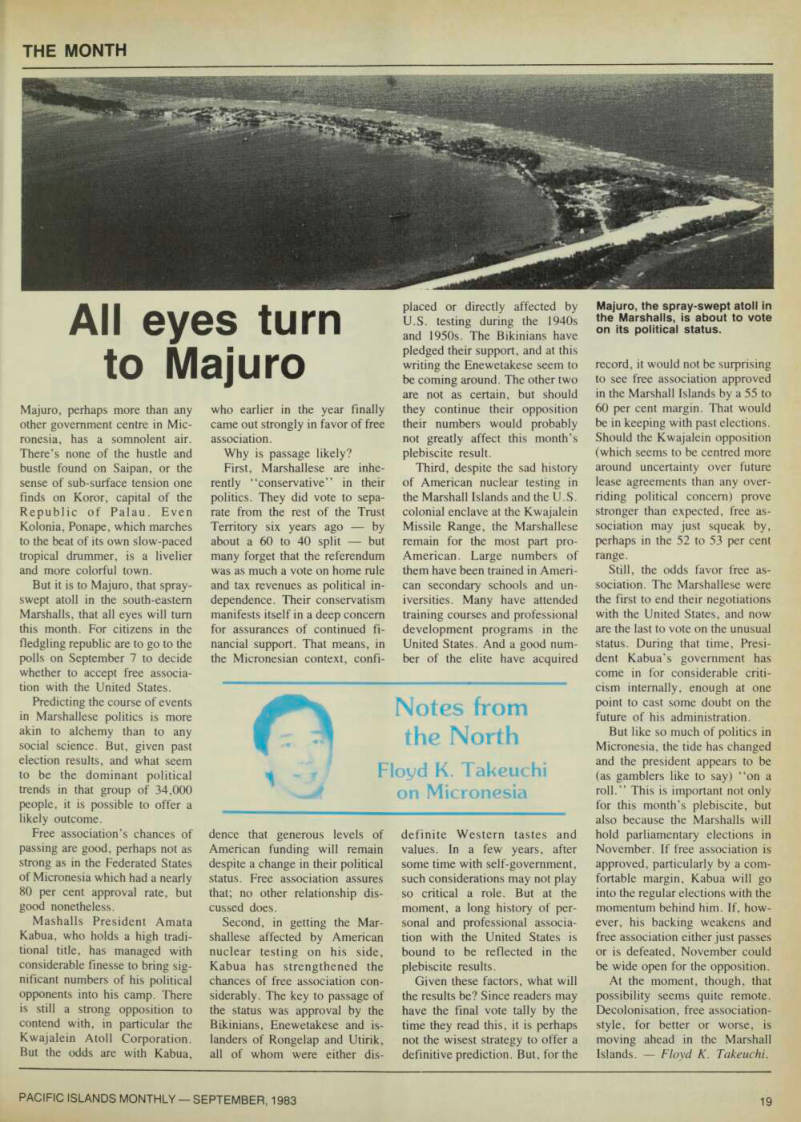
Majuro, perhaps more than any other government centre in Mic ronesia, has a somnolent air.
There’s none of the hustle and bustle found on Saipan, or the sense of sub-surface tension one finds on Koror, capital of the Republic of Palau. Even Kolonia, Ponape, which marches to the beat of its own slow-paced tropical drummer, is a livelier and more colorful town.
But it is to Majuro, that spray swept atoll in the south-eastern Marshalls, that all eyes will turn this month. For citizens in the fledgling republic are to go to the polls on September 7 to decide whether to accept free associa tion with the United States.
Predicting the course of events in Marshallese politics is more akin to alchemy than to any social science. But, given past election results, and what seem to be the dominant political trends in that group of 34,000 people, it is possible to offer a likely outcome.
Free association’s chances of passing are good, perhaps not as strong as in the Federated States of Micronesia which had a nearly 80 per cent approval rate, but good nonetheless.
Mashalls President Amata Kabua, who holds a high tradi tional title, has managed with considerable finesse to bring sig nificant numbers of his political opponents into his camp. There is still a strong opposition to contend with, in particular the Kwajalein Atoll Corporation.
But the odds are with Kabua,
who earlier in the year finally came out strongly in favor of free association.
Why is passage likely?
First, Marshallese are inhe rently “conservative’’ in their politics. They did vote to sepa rate from the rest of the Trust Territory six years ago by about a 60 to 40 split but many forget that the referendum was as much a vote on home rule and tax revenues as political in dependence. Their conservatism manifests itself in a deep concern for assurances of continued fi nancial support. That means, in the Micronesian context, confi-
dence that generous levels of American funding will remain despite a change in their political status. Free association assures that; no other relationship dis cussed does.
Second, in getting the Mar shallese affected by American nuclear testing on his side, Kabua has strengthened the chances of free association con siderably. The key to passage of the status was approval by the Bikinians, Enewetakese and is landers of Rongelap and Utirik, all of whom were either dis
placed or directly affected by U.S. testing during the 1940 s and 19505. The Bikinians have pledged their support, and at this writing the Enewetakese seem to be coming around. The other two are not as certain, but should they continue their opposition their numbers would probably not greatly affect this month’s plebiscite result.
Third, despite the sad history of American nuclear testing in the Marshall Islands and the U.S. colonial enclave at the Kwajalein Missile Range, the Marshallese remain for the most part pro- American. Large numbers of them have been trained in Ameri can secondary schools and un iversities. Many have attended training courses and professional development programs in the United States. And a good num ber of the elite have acquired
definite Western tastes and values. In a few years, after some time with self-government, such considerations may not play so critical a role. But at the moment, a long history of per sonal and professional associa tion with the United States is bound to be reflected in the plebiscite results.
Given these factors, what will the results be? Since readers may have the final vote tally by the time they read this, it is perhaps not the wisest strategy to offer a definitive prediction. But, for the
record, it would not be surprising to see free association approved in the Marshall Islands by a 55 to 60 per cent margin. That would be in keeping with past elections.
Should the Kwajalein opposition (which seems to be centred more around uncertainty over future lease agreements than any over riding political concern) prove stronger than expected, free as sociation may just squeak by, perhaps in the 52 to 53 per cent range.
Still, the odds favor free as sociation. The Marshallese were the first to end their negotiations with the United States, and now are the last to vote on the unusual status. During that time, Presi dent Kabua’s government has come in for considerable criti cism internally, enough at one point to cast some doubt on the future of his administration.
But like so much of politics in Micronesia, the tide has changed and the president appears to be (as gamblers like to say) “on a roll.” This is important not only for this month’s plebiscite, but also because the Marshalls will hold parliamentary elections in November. If free association is approved, particularly by a com fortable margin, Kabua will go into the regular elections with the momentum behind him. If, how ever, his backing weakens and free association either just passes or is defeated, November could be wide open for the opposition.
At the moment, though, that possibility seems quite remote.
Decolonisation, free association style, for better or worse, is moving ahead in the Marshall
Islands.
Floyd K. Takeuchi.
Majuro, the spray-swept atoll in the Marshalls, is about to vote on its political status.
Notes from the North Floyd K. Takeuchi on Micronesia
Roncaglia OPR: Space Age
technology for Grain Milling
/er-increasing energy costs compel the )ur milling industry to give serious con deration to the daunting economic ospects involved in a new plant jildings, fuel, transportation and ser ces. many instances, the returns associat i with conventional mills do not warrant e investment because of the inevitable ing-up of capital for long periods. But, )w there is a solution that solves many these problems. It is the Roncaglia PR System, internationally patented. 5 the world moves towards the 1990’5, e Roncaglia OPR System meets the lallenge of this decade by giving the )ur milling industry a concept of produc >n enjoyed by many since 1953 that at e same time meets the need for space je technology.
Dncaglia OPR mills can be part of an listing plant or they can be ‘‘turnkey’’ )erations from cereal intake to final icking and bulk handling.
Dncaglia OPR mills can be housed with minimum of fuss in any simple building 5 metres height. They can be produc g flour from wheat as from maize, oat,
barley rice, rye sorghum, millet in a mat ter of months from first ordering the plant.
Even mills as large as 500 m.tons of wheat per 24 hours capacity average only 12 months from inception to full produc tion.
This speedy completion of the project is entirely due to the unique Roncaglia OPR Milling System.
The first consideration is the elimination of the plansifter which requires large buildings with conventional installations.
This need has been overcome by the patented air-sifter, which uses air cur rents and a simple sieve. The air-sifter ob viates the need for the multi-storey con cept, thus making economic considera tions viable.
The Roncaglia OPR mill of whatever ca pacity can be housed in any simple build ing of five metres clear height. It is the only mill that can be built up from a-small initial unit, or can have a number of units running side by side, milling different ce reals. It is the only plant that does not need considerable remodelling for changes in flour specifications.
No other mill-building company can guar
antee its products for 10 years nor can anyone assure a break roll life of as long as six to eight years without refluting. It reduces maintenance to minimum levels and offers economies in staffing, The concept of large buildings inevitably means high energy and maintenance costs on top of the cost of the construc tion itself. Site selection and preparation can involve much expense and difficulty, especially if there are environmental complications.
The RoncagNa opR system e minates many of these difficulties, not needing much more than a simple foundation for a portal framed structure that complies w regulations of planning authorities. In many instances, it saves up to 70% in capital costs.
Every Roncaglia OPR system, whether arqe or sma j nc ( uc |es erection and commissioning expenses, and training of sta ff t 0 operate the mill effectively To en sure con fidence in the investment, Ron caglia has a comprehensive after-sales serv j ce t 0 achieve the highest level of production at all times.
Building capable of housing a Roncaglia OPR milling plant of any Capacity.
Roncaglia OPR, capacity 300 m.tons of wheat per 24 hours.
Advertisements & other items, p. 20 (1 item)
Engineering Works,
If you wish to know more about Roncaglia space-age technology in flour milling, send in the coupon:
RONCAGLIA OPR
3 .0. Box 519, 41100 Modena, Italy ’hone: 39-59-218899 (Series) 218551 (Series) elex: 213384 216089 510169 RONCAL I > Name Company Address Telephone
the Pitcairners?
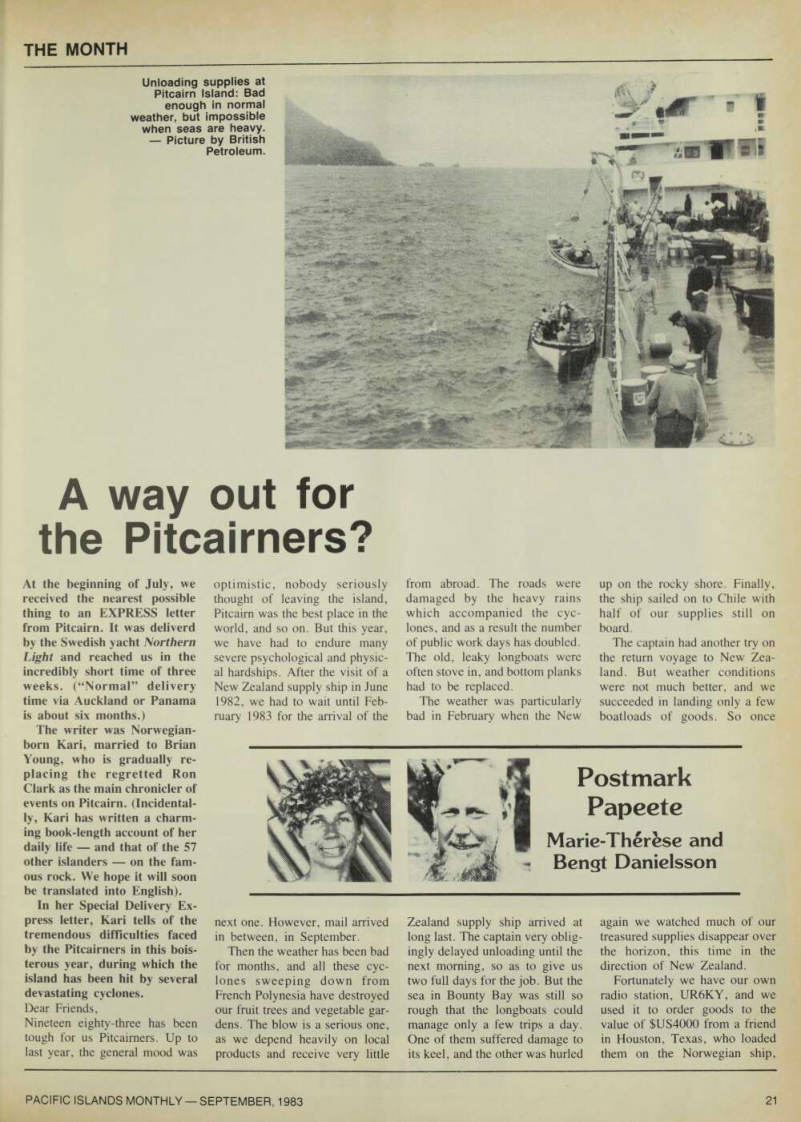
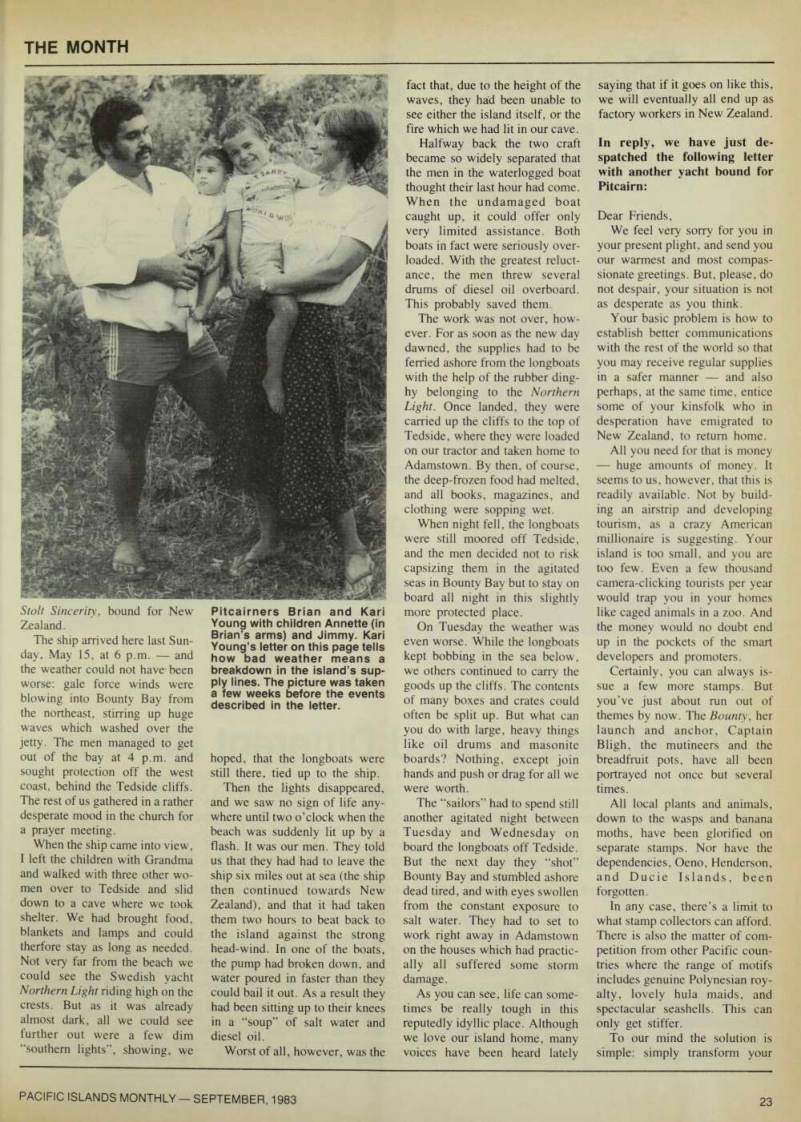
A way out for the Pitcairners?
At the beginning of July, we received the nearest possible thing to an EXPRESS letter from Pitcairn. It was deliverd by the Swedish yacht Northern Light and reached us in the incredibly short time of three weeks. (“Normal” delivery time via Auckland or Panama is about six months.) The writer was Norwegian born Kari, married to Brian Young, who is gradually re placing the regretted Ron Clark as the main chronicler of events on Pitcairn. (Incidental ly, Kari has written a charm ing book-length account of her daily life and that of the 57 other islanders on the fam ous rock. We hope it will soon be translated into English).
In her Special Delivery Ex press letter, Kari tells of the tremendous difficulties faced by the Pitcairners in this bois terous year, during which the island has been hit by several devastating cyclones.
Dear Friends, Nineteen eighty-three has been tough for us Pitcairners. Up to last year, the general mood was
optimistic, nobody seriously thought of leaving the island, Pitcairn was the best place in the world, and so on. But this year, we have had to endure many severe psychological and physic al hardships. After the visit of a New Zealand supply ship in June 1982, we had to wait until Feb ruary 1983 for the arrival of the
next one. However, mail arrived in between, in September, Then the weather has been bad for months, and all these eye lones sweeping down from French Polynesia have destroyed our fruit trees and vegetable gar dens. The blow is a serious one, as we depend heavily on local products and receive very little
from abroad. The roads were damaged by the heavy rains which accompanied the cyc lones, and as a result the number of public work days has doubled.
The old, leaky longboats were often stove in, and bottom planks had to be replaced.
The weather was particularly bad in February when the New
Zealand supply ship arrived at
long last. The captain very oblig
ingly delayed unloading until the next morning, so as to give us two full days for the job. But the sea in Bounty Bay was still so rough that the longboats could manage only a few trips a day.
One of them suffered damage to its keel, and the other was hurled
up on the rocky shore. Finally, the ship sailed on to Chile with half of our supplies still on board.
The captain had another try on the return voyage to New Zea land. But weather conditions were not much better, and we succeeded in landing only a few boatloads of goods. So once
again we watched much of our
treasured supplies disappear over
the horizon, this time in the direction of New Zealand.
Fortunately we have our own radio station, UR6KY, and we used it to order goods to the value of SUS4OOO from a friend in Houston, Texas, who loaded them on the Norwegian ship,
Unloading supplies at Pitcairn Island: Bad enough in normal weather, but impossible when seas are heavy. - Picture by British Petroleum.
Postmark Papeete Marie-Thérèse and Bengt Danielsson
Stolt Sincerity, bound for New Zealand.
The ship arrived here last Sun day, May 15, at 6 p.m. and the weather could not have been worse: gale force winds were
blowing into Bounty Bay from
the northeast, stirring up huge waves which washed over the jetty. The men managed to get out of the bay at 4 p.m. and sought protection off the west coast, behind the Tedside cliffs.
The rest of us gathered in a rather desperate mood in the church for a prayer meeting.
When the ship came into view, I left the children with Grandma and walked with three other wo men over to Tedside and slid down to a cave where we took shelter. We had brought food, blankets and lamps and could therfore stay as long as needed.
Not very far from the beach we could see the Swedish yacht Northern Light riding high on the crests. But as it was already almost dark, all we could see further out were a few dim
“southern lights”, showing, we
hoped, that the longboats were still there, tied up to the ship.
Then the lights disappeared, and we saw no sign of life any where until two o’clock when the beach was suddenly lit up by a flash. It was our men. They told us that they had had to leave the ship six miles out at sea (the ship then continued towards New Zealand), and that it had taken them two hours to beat back to the island against the strong head-wind. In one of the boats, the pump had broken down, and water poured in faster than they could bail it out. As a result they had been sitting up to their knees in a “soup” of salt water and diesel oil.
Worst of all, however, was the
fact that, due to the height of the waves, they had been unable to see either the island itself, or the fire which we had lit in our cave.
Halfway back the two craft became so widely separated that the men in the waterlogged boat thought their last hour had come.
When the undamaged boat caught up, it could offer only very limited assistance. Both boats in fact were seriously over loaded. With the greatest reluct ance, the men threw several drums of diesel oil overboard.
This probably saved them.
The work was not over, how ever. For as soon as the new day dawned, the supplies had to be ferried ashore from the longboats with the help of the rubber ding hy belonging to the Northern Light. Once landed, they were carried up the cliffs to the top of Tedside, where they were loaded on our tractor and taken home to Adamstown. By then, of course, the deep-frozen food had melted, and all books, magazines, and clothing were sopping wet.
When night fell, the longboats were still moored off Tedside, and the men decided not to risk capsizing them in the agitated seas in Bounty Bay but to stay on board all night in this slightly more protected place.
On Tuesday the weather was even worse. While the longboats kept bobbing in the sea below, we others continued to carry the goods up the cliffs. The contents of many boxes and crates could often be split up. But what can you do with large, heavy things like oil drums and masonite boards? Nothing, except join hands and push or drag for all we were worth.
The “sailors” had to spend still another agitated night between Tuesday and Wednesday on board the longboats off Tedside.
But the next day they “shot”
Bounty Bay and stumbled ashore dead tired, and with eyes swollen from the constant exposure to salt water. They had to set to work right away in Adamstown on the houses which had practic ally all suffered some storm damage.
As you can see, life can some times be really tough in this reputedly idyllic place. Although we love our island home, many voices have been heard lately
saying that if it goes on like this, we will eventually all end up as factory workers in New Zealand.
In reply, we have just de spatched the following letter with another yacht bound for Pitcairn: Dear Friends, We feel very sorry for you in your present plight, and send you our warmest and most compas sionate greetings. But, please, do not despair, your situation is not as desperate as you think.
Your basic problem is how to establish better communications with the rest of the world so that you may receive regular supplies in a safer manner and also perhaps, at the same time, entice some of your kinsfolk who in desperation have emigrated to New Zealand, to return home.
All you need for that is money huge amounts of money. It seems to us, however, that this is readily available. Not by build ing an airstrip and developing tourism, as a crazy American millionaire is suggesting. Your island is too small, and you are too few. Even a few thousand camera-clicking tourists per year would trap you in your homes like caged animals in a zoo. And the money would no doubt end up in the pockets of the smart developers and promoters.
Certainly, you can always is sue a few more stamps. But you’ve just about run out of themes by now. The Bounty, her launch and anchor, Captain Bligh, the mutineers and the breadfruit pots, have all been portrayed not once but several times.
All local plants and animals, down to the wasps and banana moths, have been glorified on separate stamps. Nor have the dependencies, Oeno, Henderson, and Ducie Islands, been forgotten.
In any case, there’s a limit to what stamp collectors can afford.
There is also the matter of com petition from other Pacific coun tries where the range of motifs includes genuine Polynesian roy alty, lovely hula maids, and spectacular seashells. This can only get stiffer.
To our mind the solution is simple: simply transform your
Pitcairners Brian and Kari Young with children Annette (in Brian’s arms) and Jimmy. Kari Young’s letter on this page tells how bad weather means a breakdown in the island’s sup ply lines. The picture was taken a few weeks before the events described in the letter.
greatest liability your loneliness out there in the vast Pacific Ocean into a glorious asset. All you have to do is declare independence, hoist the flag of Pitcairnia, and claim the wealth hidden in the sea within a 200-nautical-mile radius.
Dozens of foreign vessels are already fishing in your waters, and the ocean bed around Pit cairn is covered with nodules containing all sorts of valued
minerals. There may not be more fish and nodules in your chunk of the Pacific than around the al ready independent Island coun tries. But they have populations running into thousands and mill ions, whereas you are only 58 to share your slice.
By declaring independence
you will at once, without lifting a finger, enjoy an annual income of several million dollars from the sale of licences to the Ko
rean, Japanese and Taiwanese
fishing vessels already operating
in your waters.
With the money you first buy a gunboat to chase away pirates and collect arrears. Next you purchase a fine cargo ship to
bring you regular supplies of
everything you need and, eventually, to bring back lost members of the Pitcairn nation, fed up with factory work in New Zealand . . .
Last but not least, you will be able to build an all-weather har bor, where not only your own fleet but also numerous cruise ships will find protection and thus make contributions to your flourishing economy.
For a national anthem, we propose, of course: “Rule, Pit cairnia, Pitcairnia rules the waves!”
Your Pacific neighbors, Marie-Therese and Bengt.
Advertisements & other items, pp. 22-24 (1 item)
Works eight straight hours.
It has five heads.
And makes no noise.
Five heads? Yes, our new NV-788 video cassette recorder has five video heads on its cylinder motor. Three heads for the SR [Standard Play} mode and two heads for the exciting new LP [Long Play} mode. It may sound simple, but it’s not. This two-mode, five-head design demands the precision of a digital servocontrolled direct drive cylinder motor with an incredible 99.999% rotational accuracy.
Works eight straight hours? That’s what the new LP mode is all about.
It records at half the speed of the SP mode. This means you need half the number of cassettesso you save money and storage space. Use one of our great NV-E240 video cassettes, and the NV-788 can record 8 full hours-many programson a single cassette. And thanks to the advanced five-head design, LP mode picture quality is surprisingly good.
Makes no noise? In the SP mode, picture quality is always sensational. It’s completely free of noise [static, interference and blur} even during Super Still, Super Still Advance and Variable [l/sth to 1/30th normal speed} Super Fine Slow- Motion playback. In fact, these special effects are so clear, you can study the motion of a hummingbird’s wings in midflight.
This slim, compact, front-loading unit features every imaginable operating convenience, including 14-day/8-program unattended recording, a 31-mode infrared wireless remote control unit, Dolby *NR, and our new Auto Program Search [APS} system that records index signals each time recording begins. APS can locate nine different signals either forward or backward from current tape position. Playback starts automatically when the desired program is located.
The NV-788, Home video at its
BO MO HO
very best.
And longest. ’Trademark of Dolby Laboratories- MS TV picture simulated Unauthorised recording of TV programmes and other materials may infringe the rights of others SUDW IKMilllllllllHtMi AUDIO 008
National
National, Panasonic and Technics are the brandnames of Matsushita Electric
Starting & Staying
¥ER m m „ II r fi
AMP
POWER
X COW7»A*X/S OS£
#7 A DBSP C*CLE BATTERY
tm*i *m-T. #!*T m css?
BBASS 'V $3%
Power Boats Need Different Batteries
There is a big difference between a car battery and a marine battery.
A car battery, for example, is never really discharged, as it is only used for a few seconds each day and promptly re-charged. Not so your cruiser or sportsfisherman.
Starting the engine is only the beginning. During the day, weekend or cruise, how often will you run the live bait tank, the depth sounder, the nav. lights or maintain a listening watch on your radio transceiver?
As well as cranking power, boats need staying power. Boats need Besco's Marine Batteries, deep cycle, heavy duty marine batteries.
If your boat is getting a little flat in the electrics department, write or phone BESCO today and ask for more information, more facts about
BESCO MA RINE BA TTERIES.
Papua New Guinea: Lae, Automarine Industries, P.O. Box 785, Ph. 42-1125; Rabaul, Automarine Industries, P.O. Box 248, Ph. 92-2574; Port Moresby, Par Sales, P.O. Box 1680, Boroko, Ph. 25-6266. Fiji: Suva, Fiji Bandag, 23 Sinoma Street, Walu Bay, Ph. 31-1200. New Caledonia: Noumea, Andre Thuilier, BP 889, Ph. 27-4906. Solomon Islands: Honiara, Guadalcanal Electrics Ltd., P.O. Box 521. Hongkong: Kowloon, T. L. Knight & Co., P.O. Box 95585 IST, Ph. 366-5341. New Zealand: Auckland, Battery Services (Ind.) Ltd., P.O. Box 27- 375, Ph. 69-4111; Wellington, Gould Batteries, 58 Hautana Street, Lower Hutt, TLX NZ3714.
Australia: Sydney, Besco Batteries, P.O. Box 1, Villawood, Ph. 632-0251, TLX 21886; Jarwil International Pty. Ltd., 410 Kent Street, Sydney, Ph. 264-3477, TLX 72102.
LEADERS IN BATTERY TECHNOLOGY
BESCO
I Batteries Division Of Sims Products Pty. Ltd. j_ / A Peko Wall send Group Member
Bishop Museum

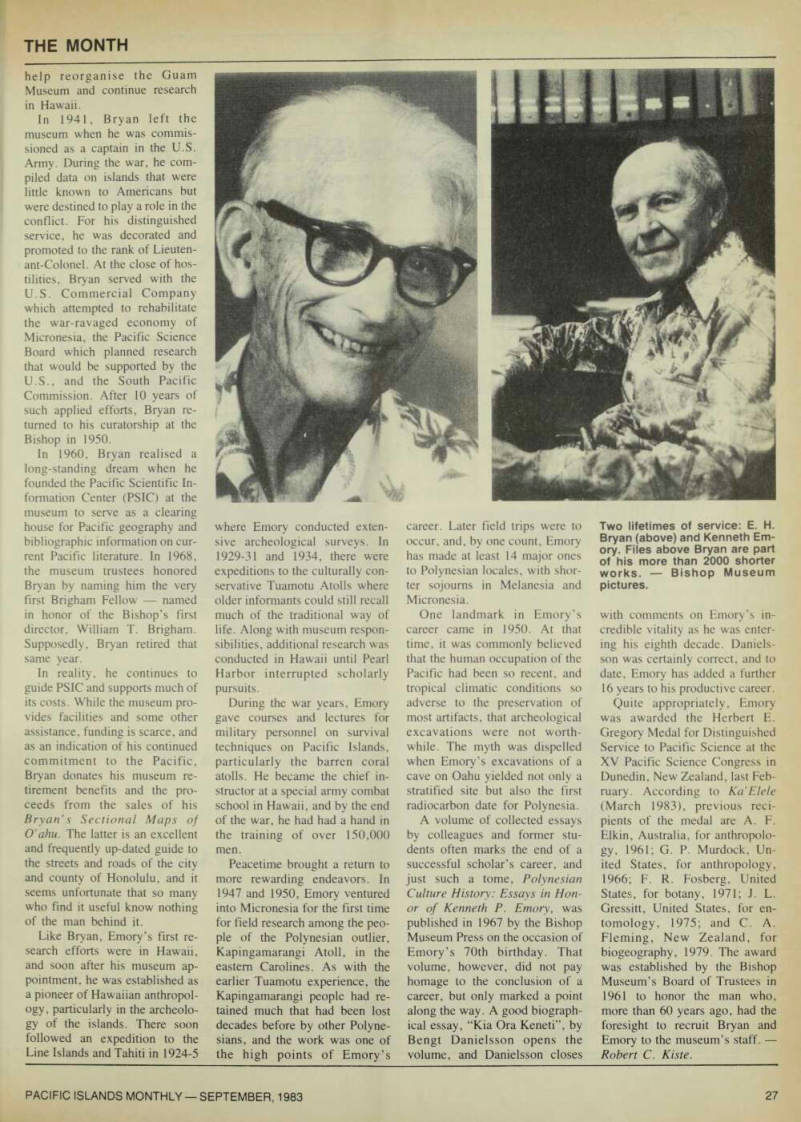
Bryan and Emory, Bishop Museum
E. H. Bryan Jr (christened Edwin Horace Bryan III), and Kenneth Pike Emory, are two of Hawaii’s most distinguished citizens.
They also have a remarkable number of things in common.
Both have devoted their entire professional lives to the Pacific together their careers at the Bernice Pauahi Bishop Museum add up to well over a century’s service to that institution.
Both were bom shortly before the turn of the century in the north-eastern United States Bryan in 1898 in Philadelphia, Pennsylvania, and Emory in 1897 in Fitchburn, Mas sachusetts. Emory was first of the two to arrive in Hawaii when his family moved to the islands in 1901. Bryan also moved west at an early age but stopped along the way to Hawaii. Before he was a year old, his family moved to California, and he spent his youth there and in the south-west before sailing to Honolulu on the
Matson liner Wilhelmina in 1916.
Both men earned their bachelor degrees in 1920.
In each case, an uncle was at least partially responsible for his nephew’s educational choice.
Bryan’s uncle was an educator in Hawaii, and he invited his young nephew to Honolulu to attend the College of Hawaii, the forerun ner of the University of Hawaii, and which Bryan’s uncle de scribed at the time as the “little cow college in our frontyard”.
Bryan took his degree in general science. An uncle of Emory’s lived near Dartmouth University in New Hampshire, and the young Kenneth returned to the American northeast and took what would today be called a degree in liberal arts.
Bryan and Emory were hired within a year of each other by Dr Herbert E. Gregory, the second director of the Bishop Museum.
Bryan was appointed as an assis
tant in entomology in 1919, and Emory was signed on as an assis tant ethnologist in 1920. Both were involved in the first Pacific Science Congress which was held in Honolulu in 1920. In fact, Bryan helped Gregory or ganise the conference, and Em ory attended as a delegate on August 2, 1920, his second day in his new job. In later years and on several occasions, Bryan and Emory have taught at the Univer sity of Hawaii, and during the years of World War 11, they both saw service in applied teaching and research capacities.
There are further similarities.
Bryan and Emory continued their educations after taking up their positions at the museum. Their dedication and commitment to the Bishop, however, often caused them to delay and sac rifice their own personal academ ic advancement. Bryan took a second B.A. degree at Yale in 1921, the M.A. in entomology at the University of Hawaii in 1924, and further graduate study in botany and zoology at Stan ford in 1929-30. Emory’s graduate work was entirely in anthropology, completing the M.A. degree at Harvard in 1923 and the Ph.D. at Yale in 1947.
According to the April 1983 Ka’Elele (the Bishop’s monthly newsletter) which celebrated Bryan’s 85th birthday, it was noted that one of director Greg ory’s first charges to Bryan in 1919 was to learn “all there is to know about the geography and natural history of the Pacific Is lands’’. The subsequent years indicate that he took the directive seriously. During the 19205, Bryan conducted extensive re search in Hawaii (including the far-flung and uninhabited north western isles) and Johnston and Wake Islands. Most of 1924 was spent on an expedition to Samoa, the Cooks, the Phoenix and To kelau Islands, and the Lau group in Fiji. In 1927 came a well deserved promotion to curator of collections, and Bryan also as sisted Margaret Mead in prepara tion for her first research in American Samoa which resulted in her famous book Coming of Age in Samoa the subject of much recent controversy. During the 19305, Bryan made several expeditions to the equatorial is lands in conjunction with the U.S. occupation of Baker, Jar vis, and Howland Islands. In addition to his administrative chores, Bryan also found time to
A View from Honolulu Robert C. Kiste
help reorganise the Guam Museum and continue research in Hawaii.
In 1941, Bryan left the museum when he was commis sioned as a captain in the U.S.
Army. During the war, he com piled data on islands that were little known to Americans but were destined to play a role in the conflict. For his distinguished service, he was decorated and promoted to the rank of Lieuten ant-Colonel. At the close of hos tilities, Bryan served with the U.S. Commercial Company which attempted to rehabilitate the war-ravaged economy of Micronesia, the Pacific Science Board which planned research that would be supported by the U.S., and the South Pacific Commission. After 10 years of such applied efforts, Bryan re turned to his curatorship at the Bishop in 1950.
In 1960, Bryan realised a long-standing dream when he founded the Pacific Scientific In formation Center (PSIC) at the museum to serve as a clearing house for Pacific geography and bibliographic information on cur rent Pacific literature. In 1968, the museum trustees honored Bryan by naming him the very first Brigham Fellow named in honor of the Bishop’s first director, William T. Brigham.
Supposedly, Bryan retired that
same year.
In reality, he continues to guide PSIC and supports much of its costs. While the museum pro vides facilities and some other assistance, funding is scarce, and as an indication of his continued commitment to the Pacific, Bryan donates his museum re tirement benefits and the pro ceeds from the sales of his Bryan’s Sectional Maps of O’ahu. The latter is an excellent and frequently up-dated guide to the streets and roads of the city and county of Honolulu, and it seems unfortunate that so many who find it useful know nothing of the man behind it.
Like Bryan, Emory’s first re search efforts were in Hawaii, and soon after his museum ap pointment, he was established as a pioneer of Hawaiian anthropol ogy, particularly in the archeolo gy of the islands. There soon followed an expedition to the Line Islands and Tahiti in 1924-5
where Emory conducted exten sive archeological surveys. In 1929-31 and 1934, there were expeditions to the culturally con servative Tuamotu Atolls where older informants could still recall much of the traditional way of life. Along with museum respon sibilities, additional research was conducted in Hawaii until Pearl
Harbor interrupted scholarly
pursuits.
During the war years, Emory gave courses and lectures for
military personnel on survival
techniques on Pacific Islands, particularly the barren coral atolls. He became the chief in structor at a special army combat school in Hawaii, and by the end of the war, he had had a hand in the training of over 150,000 men.
Peacetime brought a return to more rewarding endeavors. In 1947 and 1950, Emory ventured into Micronesia for the first time for field research among the peo ple of the Polynesian outlier, Kapingamarangi Atoll, in the eastern Carolines. As with the earlier Tuamotu experience, the
Kapingamarangi people had re
tained much that had been lost decades before by other Polyne sians, and the work was one of
the high points of Emory’s
career. Later field trips were to occur, and, by one count, Emory has made at least 14 major ones to Polynesian locales, with shor ter sojourns in Melanesia and Micronesia.
One landmark in Emory’s career came in 1950. At that time, it was commonly believed that the human occupation of the Pacific had been so recent, and tropical climatic conditions so adverse to the preservation of most artifacts, that archeological excavations were not worth while. The myth was dispelled when Emory’s excavations of a cave on Oahu yielded not only a stratified site but also the first radiocarbon date for Polynesia.
A volume of collected essays by colleagues and former stu dents often marks the end of a successful scholar’s career, and just such a tome, Polynesian Culture History: Essays in Hon or of Kenneth P. Emory, was published in 1967 by the Bishop Museum Press on the occasion of
Emory’s 70th birthday. That
volume, however, did not pay homage to the conclusion of a career, but only marked a point along the way. A good biograph ical essay, “Kia Ora Keneti”, by Bengt Danielsson opens the volume, and Danielsson closes
with comments on Emory’s in credible vitality as he was enter ing his eighth decade. Daniels son was certainly correct, and to date, Emory has added a further 16 years to his productive career.
Quite appropriately, Emory
was awarded the Herbert E.
Gregory Medal for Distinguished
Service to Pacific Science at the XV Pacific Science Congress in Dunedin, New Zealand, last Feb ruary. According to Ka'Elele (March 1983), previous reci pients of the medal are A. F.
Elkin, Australia, for anthropolo gy, 1961; G. P. Murdock, Un ited States, for anthropology, 1966; F. R. Fosberg, United States, for botany, 1971; J. L.
Gressitt, United States, for en tomology, 1975; and C. A.
Fleming, New Zealand, for biogeography, 1979. The award was established by the Bishop Museum’s Board of Trustees in 1961 to honor the man who, more than 60 years ago, had the foresight to recruit Bryan and Emory to the museum’s staff.
Robert C. Kiste.
Two lifetimes of service: E. H.
Bryan (above) and Kenneth Em ory. Files above Bryan are part of his more than 2000 shorter works. - Bishop Museum pictures.
Advertisements & other items, pp. 26-28 (1 item)
Qnwoi
1 as . mimi ii ii i i if- * ' i yj
CK-7T
Portable Component System
’d rather Carry Com!
Why? Because it packs like a portable, yet unpacks like a true home i-fi component system.
So I have the best of both worlds—a home hi-fi and a portable hi-fi, id the sound is great no matter where I play it. And because each of the Dmponents is separable, I can place the speakers where they sound best.
Carry Com is also powerful. The CK-11T has 220 watts of peak music Dwer. All three models have good power though, and they all have a sautiful and deep bass sound thanks to the unique Pioneer FLAT 'GOFER design.
Carry Com has many other features, including a 5-band graphic equaler, that add up to great sound, and along with the convenience of it all, eally don’t see the need for any other stereo system. Now that’s msible. And that’s why I’d rather Carry Com. nun!
CK-11T
i
CK-5F
CD PIONEER’
further information, please contact; Nauru Island: Jacob Enterprises, P.O. Box No. 4, Republic of Nauru tralia: Pioneer Electronics Australia Pty. Ltd. (Incorporated in Victoria), Tahiti: Tahiti Hi-Fi, P.O. Box 848, Papeete, Tahiti Box 295, Mordialloc, Victoria, 3195 Tel: 580-9911 New Caledonia: Menard Pacifique Sari, B.P. 3899, Noumea, New Caledonia Islands; Brijlal & Company, G.P.O. Box No. 362, Suva, Fiji Islands Tel: 22258 Tel; 27*62*23 f Zealand: Monaco Distributors Ltd., 2 Poland Road, Glenfield, Auckland, American Samoa: Transpac Corporation, P.O. Box 1477, Pago Pago, American ' Zealand Tel: (09) 444-9144 Samoa 96799 Tel: 633-5224 folk Island: Burns Philp (Norfolk Island) Ltd., P.O. Box 21, Norfolk Island Rarotonga: South Seas International Ltd., P.O. Box 49, Rarotonga, Cook Islands Tel: 2327 jatu: Burns Philp (Vanuatu) Ltd., Vila, Vanuatu Papua New Guinea: Bali Merchants Pty. Ltd., P.O. Box 6103, Boroko Tel: 254887
ALTERNATIVE ENERGY &
FUEL SAVING INSTALLATIONS
WIND TURBINES
1-1000 KW Grid connected Independent operation AC 50/60 Hz and DC
STEAM POWER STATIONS
100-10 000 KW Burning Plantation Waste
HYDRO POWER
10-15000 KW Heads of 1-1000 m 55 KW Wind Turbine Feasibility Studies Turn Key Projects Maintenance Contracts Leasing Contracts v rs L rr o * Eight cylinder steam motor set 2000 k VA
HEAT RECOVERY
Hot Water Process Steam Fresh Water
SOLAR WATER HEATERS
Domestic Industrial
PHOTOVOLTAIC PANELS
Lighting Solar Pumps Engineering Pty. Ltd. /5F P.O. Box 271, MILSONS POINT 2061 Australia Phone: 909 2199 Telex: 24432
The ‘powerless’
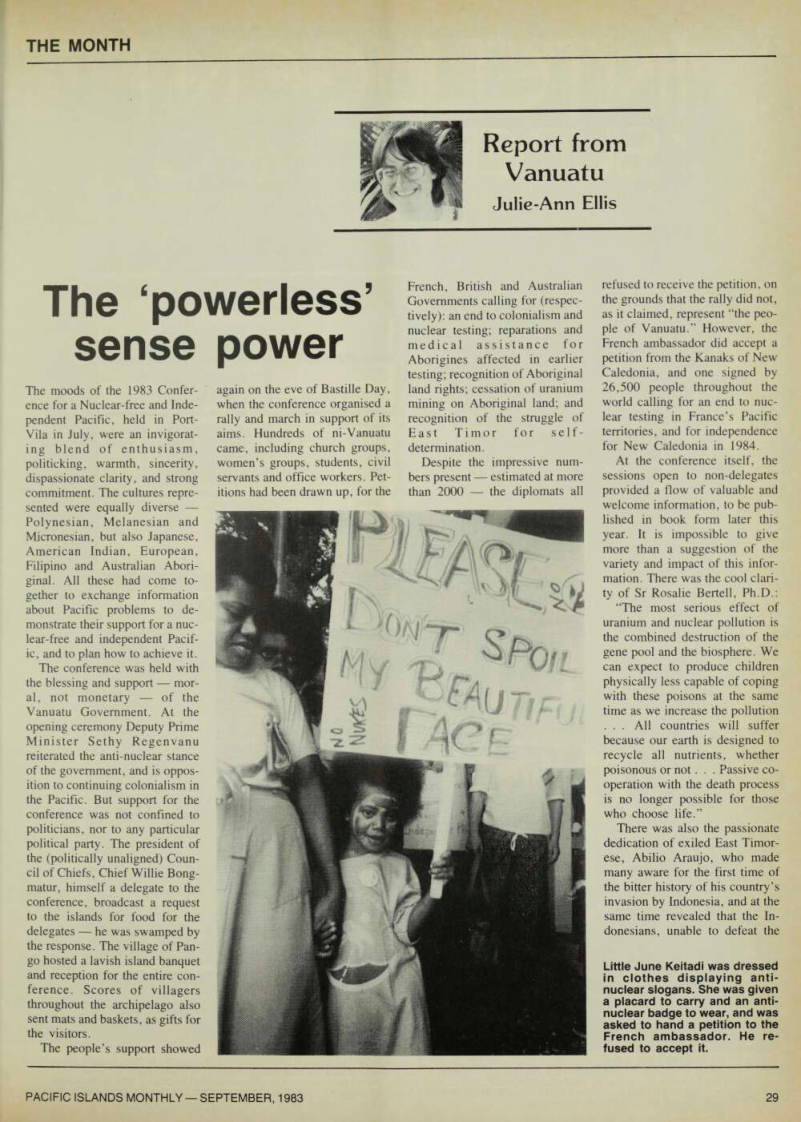

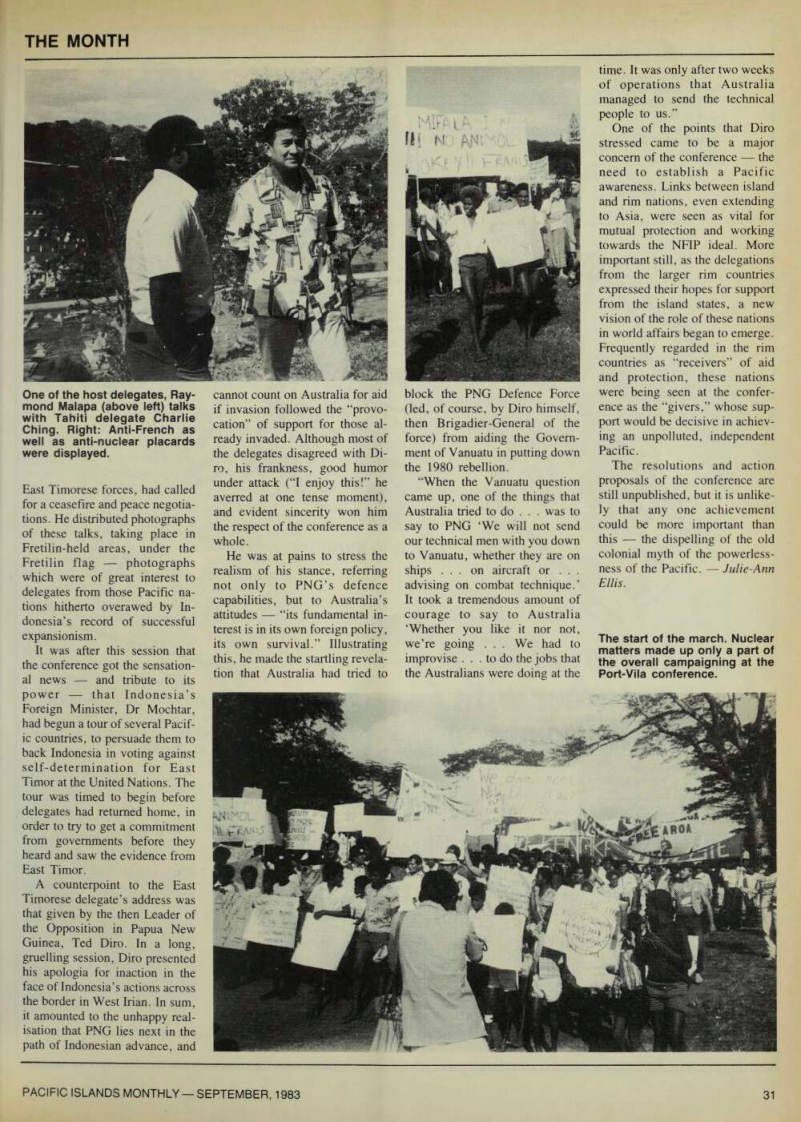
sense power
The moods of the 1983 Confer ence for a Nuclear-free and Inde pendent Pacific, held in Port- Vila in July, were an invigorat ing blend of enthusiasm, politicking, warmth, sincerity, dispassionate clarity, and strong commitment. The cultures repre sented were equally diverse Polynesian, Melanesian and Micronesian, but also Japanese, American Indian, European, Filipino and Australian Abori ginal. All these had come to gether to exchange information about Pacific problems to de monstrate their support for a nuc lear-free and independent Pacif ic, and to plan how to achieve it.
The conference was held with the blessing and support mor al, not monetary of the Vanuatu Government. At the opening ceremony Deputy Prime Minister Sethy Regenvanu reiterated the anti-nuclear stance of the government, and is oppos ition to continuing colonialism in the Pacific. But support for the conference was not confined to politicians, nor to any particular political party. The president of the (politically unaligned) Coun cil of Chiefs, Chief Willie Bong matur, himself a delegate to the conference, broadcast a request to the islands for food for the delegates he was swamped by the response. The village of Pan go hosted a lavish island banquet and reception for the entire con ference. Scores of villagers throughout the archipelago also sent mats and baskets, as gifts for the visitors.
The people’s support showed
again on the eve of Bastille Day, when the conference organised a rally and march in support of its aims. Hundreds of ni-Vanuatu came, including church groups, women’s groups, students, civil servants and office workers. Pet itions had been drawn up, for the
French, British and Australian Governments calling for (respec tively): an end to colonialism and nuclear testing; reparations and medical assistance for Aborigines affected in earlier testing; recognition of Aboriginal land rights; cessation of uranium mining on Aboriginal land; and recognition of the struggle of East Timor for self determination.
Despite the impressive num bers present estimated at more than 2000 the diplomats all
refused to receive the petition, on the grounds that the rally did not, as it claimed, represent “the peo ple of Vanuatu.” However, the French ambassador did accept a petition from the Kanaks of New Caledonia, and one signed by 26,500 people throughout the world calling for an end to nuc lear testing in France’s Pacific territories, and for independence for New Caledonia in 1984.
At the conference itself, the sessions open to non-delegates provided a flow of valuable and welcome information, to be pub lished in book form later this year. It is impossible to give more than a suggestion of the variety and impact of this infor mation. There was the cool clari ty of Sr Rosalie Bertell, Ph.D.; “The most serious effect of uranium and nuclear pollution is the combined destruction of the gene pool and the biosphere. We can expect to produce children physically less capable of coping with these poisons at the same time as we increase the pollution ... All countries will suffer because our earth is designed to recycle all nutrients, whether poisonous or not. . . Passive co operation with the death process is no longer possible for those who choose life.”
There was also the passionate dedication of exiled East Timor ese, Abilio Araujo, who made many aware for the first time of the bitter history of his country’s invasion by Indonesia, and at the same time revealed that the In donesians, unable to defeat the
Report from Vanuatu Julie-Ann Ellis
Little June Keitadi was dressed in clothes displaying anti nuclear slogans. She was given a placard to carry and an anti nuclear badge to wear, and was asked to hand a petition to the French ambassador. He re fused to accept it.
East Timorese forces, had called for a ceasefire and peace negotia tions. He distributed photographs of these talks, taking place in Fretilin-held areas, under the Fretilin flag photographs which were of great interest to delegates from those Pacific na tions hitherto overawed by In donesia’s record of successful expansionism.
It was after this session that the conference got the sensation al news and tribute to its power that Indonesia’s Foreign Minister, Dr Mochtar, had begun a tour of several Pacif ic countries, to persuade them to back Indonesia in voting against self-determination for East Timor at the United Nations. The tour was timed to begin before delegates had returned home, in order to try to get a commitment from governments before they heard and saw the evidence from East Timor.
A counterpoint to the East Timorese delegate’s address was that given by the then Leader of the Opposition in Papua New Guinea, Ted Diro. In a long, gruelling session, Diro presented his apologia for inaction in the face of Indonesia’s actions across the border in West Irian. In sum, it amounted to the unhappy real isation that PNG lies next in the path of Indonesian advance, and
cannot count on Australia for aid if invasion followed the “provo cation” of support for those al ready invaded. Although most of the delegates disagreed with Di re, his frankness, good humor under attack (“I enjoy this!” he averred at one tense moment), and evident sincerity won him the respect of the conference as a whole.
He was at pains to stress the realism of his stance, referring not only to PNG’s defence capabilities, but to Australia’s attitudes “its fundamental in terest is in its own foreign policy, its own survival.” Illustrating this, he made the startling revela tion that Australia had tried to
block the PNG Defence Force (led, of course, by Diro himself, then Brigadier-General of the force) from aiding the Govern ment of Vanuatu in putting down the 1980 rebellion.
“When the Vanuatu question came up, one of the things that Australia tried to do . . . was to say to PNG ‘We will not send our technical men with you down to Vanuatu, whether they are on ships ... on aircraft or . . . advising on combat technique.’
It took a tremendous amount of courage to say to Australia ‘Whether you like it nor not, we’re going . . . We had to improvise . . . to do the jobs that the Australians were doing at the
time. It was only after two weeks of operations that Australia managed to send the technical people to us.”
One of the points that Diro stressed came to be a major concern of the conference the need to establish a Pacific awareness. Links between island and rim nations, even extending to Asia, were seen as vital for
mutual protection and working
towards the NFIP ideal. More important still, as the delegations from the larger rim countries expressed their hopes for support from the island states, a new vision of the role of these nations in world affairs began to emerge.
Frequently regarded in the rim countries as “receivers” of aid and protection, these nations were being seen at the confer ence as the “givers,” whose sup port would be decisive in achiev ing an unpolluted, independent Pacific.
The resolutions and action proposals of the conference are still unpublished, but it is unlike ly that any one achievement could be more important than this the dispelling of the old colonial myth of the powerless
ness of the Pacific.
Julie-Ann
Ellis.
One of the host delegates, Ray mond Malapa (above left) talks with Tahiti delegate Charlie Ching. Right: Anti-French as well as anti-nuclear placards were displayed.
The start of the march. Nuclear matters made up only a part of the overall campaigning at the Port-Vila conference.
Advertisements & other items, pp. 30-32 (1 item)
niiTir
feSyyjy
CD . A .
A When Sansui mates computers with
high performance component systems
you get convenience. Like "Compu Edit.," a feature that allows automatic edit recording of songs from disc to tape in any programmed order. And the "Compu-Selector System" for onetouch synchronized play. And memory
station selection. Intelligent Super
Compo—the smartest hi-fi systems
ever designed.
n llujj »T
iXr-
P-L5O
Linear-Tracking Turntable *** -FT T-909 FM/AM Tuner A-909 Integrated Amp II n
niiTir
rag ras f S-950 Speaker Systems GX-909 Audio Cabinet Also available in Black finish.
SANSUI ELECTRIC CO., LTD. 14-1 Izumi 2-chome, Suginami-ku, Tokyo 168, Japan.
For further information please contact: • Australia VANFI (Aust.) PTY. LTD. 297, City Road, South Melbourne, Victoria 3205, Australia Phone: 690-6200/283 Alfred Place, North Sydney, N.S.W. 2060, Australia Phone: 929-0293 • Fiji PRABHU BROTHERS LTD. PO. Box 183, Nadi Phone: 71122 • Papua New Guinea OCEANIS INDENT AGENCY (P.N.G.) PTY LTD. Box 5518, Boroko, Port Moresby Phone: 256411 • New Zealand DAVID REID ELECTRONICS LTD. PO. Box 2630, Auckland, Phone: 488-049 • New Caledonia HI-FI VICTOIRE, ETS. M. MERCIER B P 1123, Noumea Phone: 27.59.11 • Central Pacific NAURU CO-OPERATIVE SOCIETY Republic of Nauru • Vanuatu THE SOUND CENTRE LTD. PO. Box 434, Vila Phone: 2035 • Tahiti DIMECO SIMEL B.P Box 3338 Papeete Phone; 26979
MANUFACTURED IN AUSTRALIA RY-
R. M. GOW & CO. LTD.
30-Gow Street, Moorooka Queensland, 4105. Australia.
P.0.80x 111, Cables: Fidelity Moorooka Telex: GOWCO AA42839 Queensland, 4105 Australia * a a f/. y & * *
The great thirst
quencher with
real fruit flavour.
0 Read ytof, yez e
QUALITY AUSTRALIAN
c *fs r *at er^\ »c e rruj cs ovq c*
ASSTD. FLAVOURS
rt'® *
GOLD
FUMM
WTWJIIHSECOinHJyL
2 LITRE CORDIALS
IE gold
m CREST
Fulfrute Fruit Juice Cordial really quenches the thirst.
Fulfrute is economical in the 2 litre Flagon, so Mums love it as much as the kids.
750 m CORDALS
*&lfrutb
orange wurr juice oonDUVL 8T Fulfrute - another R.M.Gow Group quality product.
Games salvation
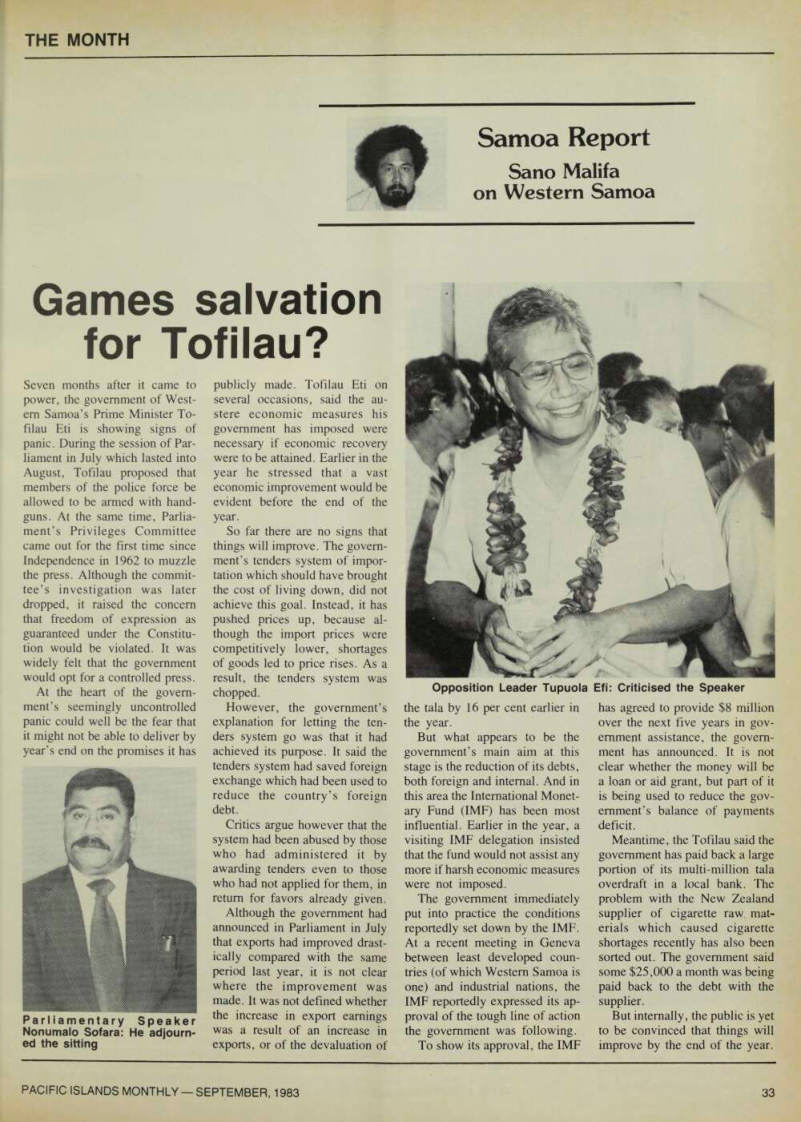


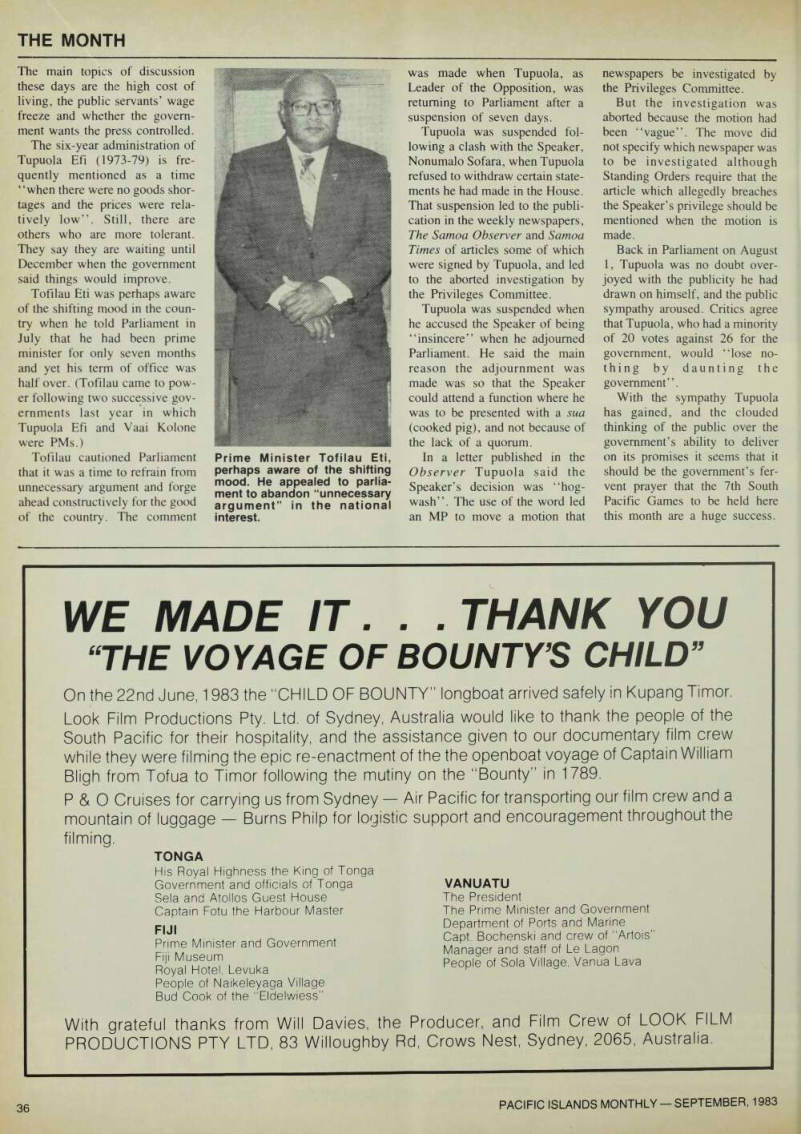
for Tofilau?
Seven months after it came to power, the government of West ern Samoa’s Prime Minister To filau Eti is showing signs of panic. During the session of Par liament in July which lasted into August, Tofilau proposed that members of the police force be allowed to be armed with hand guns. At the same time, Parlia ment’s Privileges Committee came out for the first time since Independence in 1962 to muzzle the press. Although the commit tee’s investigation was later dropped, it raised the concern that freedom of expression as guaranteed under the Constitu tion would be violated. It was widely felt that the government would opt for a controlled press.
At the heart of the govern ment’s seemingly uncontrolled panic could well be the fear that it might not be able to deliver by year’s end on the promises it has
publicly made. Tofilau Eti on several occasions, said the au stere economic measures his government has imposed were necessary if economic recovery were to be attained. Earlier in the year he stressed that a vast economic improvement would be evident before the end of the year.
So far there are no signs that things will improve. The govern ment’s tenders system of impor tation which should have brought the cost of living down, did not achieve this goal. Instead, it has pushed prices up, because al though the import prices were competitively lower, shortages of goods led to price rises. As a result, the tenders system was chopped.
However, the government’s explanation for letting the ten ders system go was that it had achieved its purpose. It said the tenders system had saved foreign exchange which had been used to reduce the country’s foreign debt.
Critics argue however that the system had been abused by those who had administered it by awarding tenders even to those who had not applied for them, in return for favors already given.
Although the government had announced in Parliament in July that exports had improved drast ically compared with the same period last year, it is not clear where the improvement was made. It was not defined whether the increase in export earnings was a result of an increase in exports, or of the devaluation of
the tala by 16 per cent earlier in the year.
But what appears to be the government’s main aim at this stage is the reduction of its debts, both foreign and internal. And in this area the International Monet ary Fund (IMF) has been most influential. Earlier in the year, a visiting IMF delegation insisted that the fund would not assist any more if harsh economic measures were not imposed.
The government immediately put into practice the conditions reportedly set down by the IMF.
At a recent meeting in Geneva between least developed coun tries (of which Western Samoa is one) and industrial nations, the IMF reportedly expressed its ap proval of the tough line of action the government was following.
To show its approval, the IMF
has agreed to provide $8 million over the next five years in gov ernment assistance, the govern ment has announced. It is not clear whether the money will be a loan or aid grant, but part of it is being used to reduce the gov ernment’s balance of payments deficit.
Meantime, the Tofilau said the government has paid back a large portion of its multi-million tala overdraft in a local bank. The problem with the New Zealand supplier of cigarette raw, mat erials which caused cigarette shortages recently has also been sorted out. The government said some $25,000 a month was being paid back to the debt with the supplier.
But internally, the public is yet to be convinced that things will improve by the end of the year.
Samoa Report
Sano Malifa on Western Samoa
Parliamentary Speaker Nonumalo Sofara: He adjourn ed the sitting
Opposition Leader Tupuola Efi: Criticised the Speaker
The main topics of discussion these days are the high cost of living, the public servants’ wage freeze and whether the govern ment wants the press controlled.
The six-year administration of Tupuola Efi (1973-79) is fre quently mentioned as a time “when there were no goods shor tages and the prices were rela tively low”. Still, there are others who are more tolerant.
They say they are waiting until December when the government said things would improve.
Tofilau Eti was perhaps aware of the shifting mood in the coun try when he told Parliament in July that he had been prime minister for only seven months and yet his term of office was half over. (Tofilau came to pow er following two successive gov ernments last year in which Tupuola Efi and Vaai Kolone were PMs.) Tofilau cautioned Parliament that it was a time to refrain from unnecessary argument and forge ahead constructively for the good of the country. The comment
was made when Tupuola, as Leader of the Opposition, was returning to Parliament after a suspension of seven days.
Tupuola was suspended fol
lowing a clash with the Speaker, Nonumalo Sofara, when Tupuola refused to withdraw certain state ments he had made in the House.
That suspension led to the publi cation in the weekly newspapers, The Samoa Observer and Samoa Times of articles some of which were signed by Tupuola, and led to the aborted investigation by the Privileges Committee.
Tupuola was suspended when
he accused the Speaker of being “insincere” when he adjourned Parliament. He said the main reason the adjournment was made was so that the Speaker could attend a function where he was to be presented with a sua (cooked pig), and not because of the lack of a quorum.
In a letter published in the Observer Tupuola said the
Speaker’s decision was “hog
wash”. The use of the word led an MP to move a motion that
newspapers be investigated by the Privileges Committee.
But the investigation was aborted because the motion had been “vague”. The move did not specify which newspaper was to be investigated although Standing Orders require that the article which allegedly breaches the Speaker’s privilege should be mentioned when the motion is made.
Back in Parliament on August 1, Tupuola was no doubt over joyed with the publicity he had drawn on himself, and the public sympathy aroused. Critics agree that Tupuola, who had a minority of 20 votes against 26 for the government, would “lose no thing by daunting the government”.
With the sympathy Tupuola has gained, and the clouded thinking of the public over the government’s ability to deliver on its promises it seems that it should be the government’s fer vent prayer that the 7th South Pacific Games to be held here this month are a huge success.
Prime Minister Tofilau Eti, perhaps aware of the shifting mood. He appealed to parlia ment to abandon “unnecessary argument” in the national interest.
Advertisements & other items, pp. 34-36 (1 item)
The Toyota Roadmasters:
READY TO TAKE
ON THE TOUGHEST OOBS.
Meet Toyota’s hard working commercial vehicles. Tough. Durable. Ready to meet the challenge of the worst roads and climates. Ready to do the job called for with ease. Rugged veterans, each one specifically designed to meet the different demands of the world’s businesses. One of them is just right for you. There are no vehicles more reliable. And if you need it, Toyota is ready with fast
backup service. Toyota’s roadmasters, M
they’re a winning team.
mm mm • ■
HI-LUX 4WD
TOYOTA
QUALITY SERVICE
AMERICAN SAMOA: BURNS PHILP (SOUTH SEA)
CO., LTD., P.O. Box 129, Pago Pago.
COOK ISLANDS: COOK ISLANDS TRADING
CORPORATION LTD., P.O. Box 92, Rarotonga.
FIJI: AUTOMOTIVE SUPPLIES COMPANY, G.P.O.
Box 355, Suva.
GUAM & MICRONESIA: ATKINS, KROLL (GUAM) LTD.
P.O. Box 6428, Tamuning.
KIRIBATI: TARAWA MOTORS, P.O. Box 36,
Bairiki, Tarawa, Kiribati.
NAURU: NAURU COOPERATIVE SOCIETY.
NEW CALEDONIA: SERVICE IMPORTATION
AUTOMOBILE DU PACIFIQUE, Rond-Point
du Pacifique (Station Total) B.P. 438, Noumea.
SJORFOLK ISLAND: BORRY’S LIMITED, P.O. Box 169
>APUA NEW GUINEA: ELA MOTORS,
Scratch ley Rd„ Badili, P.O. Box 675, Port Moresby.
SAIPAN: MICROL CORPORATION, P.O. Box 267,
Saipan.
SOLOMON: MENDANA ENTERPRISES (5.1.) LTD.,
3.P.0. Box 174, Honiara.
TAHITI: NIPPON AUTOMOTO, P.O. Box 342, Papeete.
TONGA: BURNS PHILP (SOUTH SEA) CO., LTD., P.O. Box 55, Nuku’alofa.
VANUATU: VANUATU MOTORS, P.O. Box 18,
Port Vila.
WESTERN SAMOA: BURNS PHILP (SOUTH SEA)
CO., LTD., P.O. Box 188, Apia.
TOYOTA
The Toyota range includes: COROLLA, STARLET, CORONA, CRESS ID A, HI-LUX.
STOUT, HI ACE, DYNA, COASTER and LAND CRUISER
WE MADE IT. . . THANK YOU
‘THE VOYAGE OF BOUNTY’S CHILD”
On the 22nd June, 1983 the “CHILD OF BOUNTY” longboat arrived safely in Kupang Timor.
Look Film Productions Pty. Ltd. of Sydney, Australia would like to thank the people of the South Pacific for their hospitality, and the assistance given to our documentary film crew while they were filming the epic re-enactment of the the openboat voyage of Captain William Bligh from Tofua to Timor following the mutiny on the “Bounty” in 1789.
P & O Cruises for carrying us from Sydney Air Pacific for transporting our film crew and a mountain of luggage Burns Philp for logistic support and encouragement throughout the
filming.
With grateful thanks from Will Davies, the Producer, and Film Crew of LOOK FILM PRODUCTIONS PTY LTD, 83 Willoughby Rd, Crows Nest, Sydney, 2065, Australia.
TONGA
His Royal Highness the King of Tonga Government and officials of Tonga Sela and Atollos Guest House Captain Fotu the Harbour Master
FIJI
Prime Minister and Government Fiji Museum Royal Hotel, Levuka People of Naikeleyaga Village Bud Cook of the "Eldelwiess"
VANUATU
The President The Prime Minister and Government Department of Ports and Marine Capt. Bochenski and crew of "Artois”
Manager and staff of Le Lagon People of Sola Village, Vanua Lava
France issuing
autonomy plan
The "Round Table’’ on New Caledonia’s future (PIM Aug. pi 5) wound up in mid-July with a document signed by Georges Lemoine, French Secretary of State for Overseas Departments and Territories, and representa tives of the territory’s Independ ence Front and Centre party,
Fnsc.
The delegation of the main anti-independence party, RPCR, led by Deputy Jacques Lafleur, declined to sign the document, which is to serve as a preamble to the forthcoming statute of autonomy.
The French Government had found it necessary to invite 20 of New Caledonia’s political lead ers to Nainville-les-Roches, a small town near Paris, for a four day round of talks on self determination for the territory.
Mr Lemoine had said that the meeting would "have neither winners nor losers” and, cer tainly, all parties to the talks praised the efforts of Mr Lemoine, and described the dialogue as useful.
The Independence Front dele gation returned to Noumea and said they were satisfied with the talks. The final statement expre sses the desire of all to abolish colonialism by recognising the quality of Melanesian civilisa tion, and by introducing "Cus tom” into future institutions with most likely a second assem bly, along the lines of a senate of customary chiefs.
The legitimacy of the Kanak people as first occupants of New Caledonia, with an "innate and active” right to independence, is
also recognised, a point that has been central to Independence Front demands. However, the exercise of this right, the state ment says, must be within the framework of the French con stitution. Self-determination is to be the concern, for historical reasons, of other races in the territory, and the move to self determination is to be en couraged by the French Govern ment, and to come about when the Caledonian people feel the
necessity.
In clearer terms, the minister is to bring the autonomy statute to New Caledonia in November, the French Parliament is to vote
The big question: Who will vote?
on it in April, next year, and it should be applicable to the territ ory by July, 1984. The autonomy statute is to be specific to New Caledonia, subject to evolution, and transitional.
The Independence Front de scribed the statement as meeting most of their claims, and said they were confident that inde pendence was on the way. They also explained that the eventual vote on self-determination would be open to the Kanak people and other New Caledonians bom in the territory, and with one parent also bom in the territory. Others, such as the large population of Wallisians and other Polyne sians, who are relatively recent immigrants, would be invited to take on Kanak nationality or stay as French nationals, Front spokesman Mr Yeiwene Yeiwene said.
But it is the question of just who will vote on New Caledonia’s future that is the core of political dispute in the territory. The RPCR delegation did not sign the statement, Mr Lafleur said, because they were not given answers to their queries on the possibility of electoral reform, and the date of the next elections. The RPCR claims that the present Independence Front- FNSC coalition is not representa tive of the majority will. The RPCR is also against any elector al reform, except the exemption of French military and contract public servants from a vote on self-determination.
RPCR spokesman Jean Leques told the press that independence “is not on the way because it is impossible to go against the will of such an immense majority”.
“New Caledonia is, and will remain, French,” he said. “We
are and we will remain intransi gent. There is no question of changing our position”.
Mr Leques added that there had been no question of the RCPR signing the “ambiguous declaration” from the Round Table talks.
The FNSC for its part has claimed that it will be the “guar dian of the spirit of Nainville” a spirit, it says, of “dialogue and consensus”.
But so far their task looks difficult, as both pro and anti independence forces did not take long after their return from France to resume their original positions. The FNSC said it viewed as a real achievement that everyone was brought together around a discussion table, some thing that had been a long standing FNSC aim.
FNSC spokesman Christian
Boissery told the press that the spirit his party wished to see preserved was one of “openness and constructiveness” about New Caledonia’s future. He added that already (late July) the FNSC felt that this spirit had been bet rayed by the major parties, the RPCR more than the Independ ence Front.
Early August saw the Inde pendence Front spokesman on foreign relations, Yann Celene Uregei, leave Noumea on a three-week tour of South Pacific Forum countries. Mr Uregei planned to meet leaders of each Forum country and put to them the Independence Front demand for the inclusion of New Caledonia on the list of the Un ited Nations’ decolonisation committee.
On the eve of his departure the Independence Front issued a press statement pointing out that
only the inclusion of New Caledonia on the UN list could guarantee that a process of decol onisation had really begun.
For the Independence Front, the Round Table statement has to be regarded as a “declaration of intent by the French Govern ment” until the exact contents of the autonomy statute are made known in November.
The Independence Front ex plained that they feared the French autonomy plans might lead to a statute which would block any transition to Kanak socialist independence. Their statement also said that now the French Government has recog nised the “innate and active” right of the Kanak people to independence, they should have the territory listed with the Un ited Nations committee. He len Fraser.
Noumea Notebook Helen Fraser
Advertisements & other items, p. 38 (1 item)
ni mi
Xfjpbn ■H non-fat I dried
pf MSM
'ULi CREAM
•taswemmcWßl #£’
ga TA^NENRH
ni mi
1 ilk
SUM MILK
POWDER
my
KWS
ANCHOR
ANCHOR
ANCHOR
m ,3S Vi M * Jl i
NEW
ZEALAND
DAIRY
BOARD
Anchor - premium quality dairy produce, packed with all the goodness of the finest pasture in the world.
Fresh to you from the world’s number one dairy
producer, New Zealand Dairy Board.
Enquiries to: PO Box 417 Wellington, New Zealand
Telex: NZ3348 DAPMARK
Telephone: 724-399
People
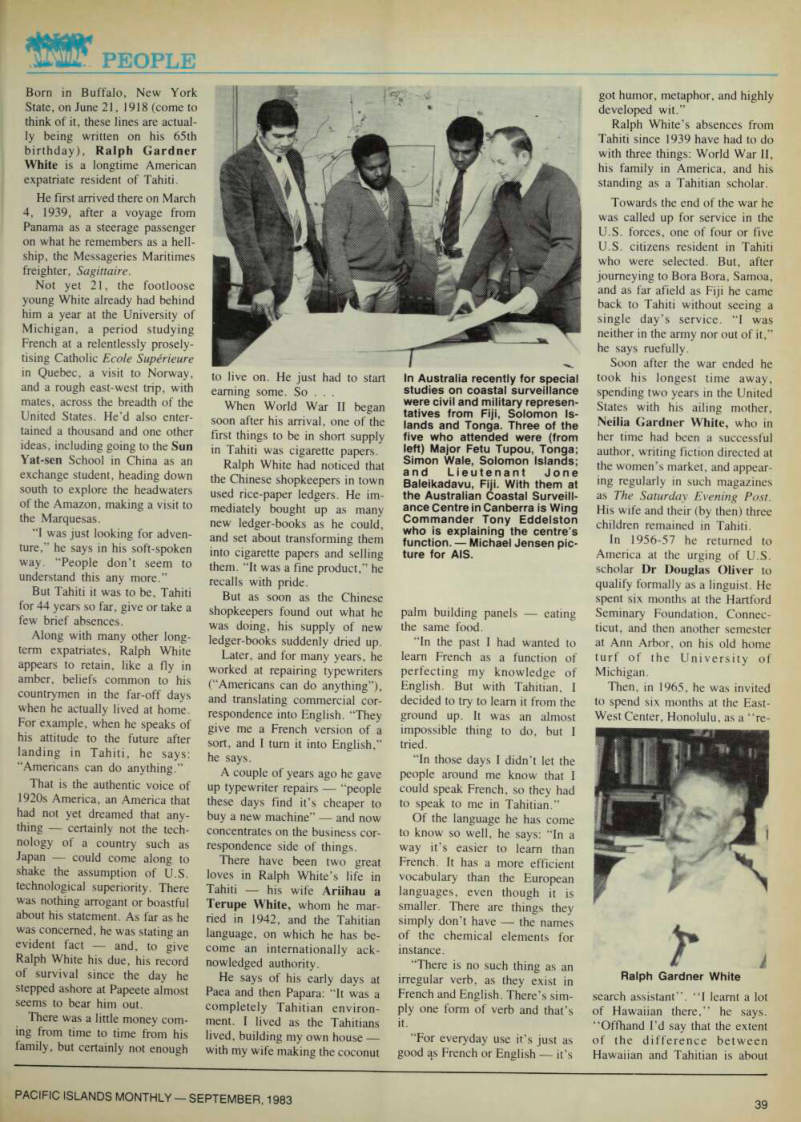

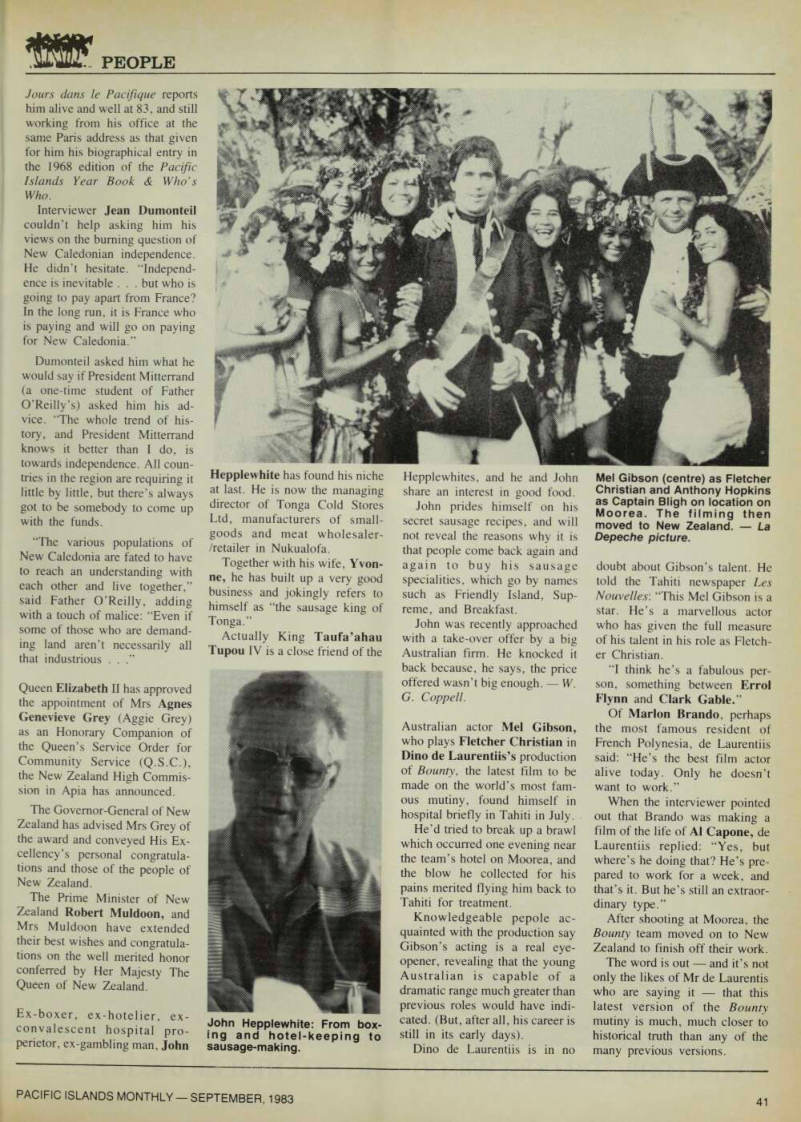
Born in Buffalo, New York State, on June 21, 1918 (come to think of it, these lines are actual ly being written on his 65th birthday), Ralph Gardner White is a longtime American expatriate resident of Tahiti.
He first arrived there on March 4, 1939, after a voyage from Panama as a steerage passenger on what he remembers as a hell ship, the Messageries Maritimes freighter, Sagittaire.
Not yet 21, the footloose young White already had behind him a year at the University of Michigan, a period studying French at a relentlessly prosely tising Catholic Ecole Superieure in Quebec, a visit to Norway, and a rough east-west trip, with mates, across the breadth of the United States. He’d also enter tained a thousand and one other ideas, including going to the Sun Yat-sen School in China as an exchange student, heading down south to explore the headwaters of the Amazon, making a visit to the Marquesas.
“I was just looking for adven ture,” he says in his soft-spoken way. “People don’t seem to understand this any more.”
But Tahiti it was to be, Tahiti for 44 years so far, give or take a few brief absences.
Along with many other long term expatriates, Ralph White appears to retain, like a fly in amber, beliefs common to his countrymen in the far-off days when he actually lived at home.
For example, when he speaks of his attitude to the future after landing in Tahiti, he says: “Americans can do anything.”
That is the authentic voice of 1920 s America, an America that had not yet dreamed that any thing certainly not the tech nology of a country such as Japan could come along to shake the assumption of U.S. technological superiority. There was nothing arrogant or boastful about his statement. As far as he was concerned, he was stating an evident fact and, to give Ralph White his due, his record of survival since the day he stepped ashore at Papeete almost seems to bear him out.
There was a little money com ing from time to time from his family, but certainly not enough
to live on. He just had to start earning some. So . . .
When World War II began soon after his arrival, one of the first things to be in short supply in Tahiti was cigarette papers.
Ralph White had noticed that the Chinese shopkeepers in town used rice-paper ledgers. He im mediately bought up as many new ledger-books as he could, and set about transforming them into cigarette papers and selling them. “It was a fine product,” he recalls with pride.
But as soon as the Chinese shopkeepers found out what he was doing, his supply of new ledger-books suddenly dried up.
Later, and for many years, he worked at repairing typewriters (“Americans can do anything”), and translating commercial cor respondence into English. “They give me a French version of a sort, and I turn it into English,” he says.
A couple of years ago he gave up typewriter repairs “people these days find it’s cheaper to buy a new machine” and now concentrates on the business cor respondence side of things.
There have been two great loves in Ralph White’s life in Tahiti his wife Ariihau a Terupe White, whom he mar ried in 1942, and the Tahitian language, on which he has be come an internationally ack nowledged authority.
He says of his early days at Paea and then Papara: “It was a completely Tahitian environ ment. I lived as the Tahitians lived, building my own house with my wife making the coconut
palm building panels eating the same food.
“In the past I had wanted to learn French as a function of
perfecting my knowledge of
English. But with Tahitian, I decided to try to learn it from the ground up. It was an almost impossible thing to do, but I tried.
“In those days I didn’t let the people around me know that I could speak French, so they had to speak to me in Tahitian.”
Of the language he has come to know so well, he says: “In a way it’s easier to learn than French. It has a more efficient vocabulary than the European languages, even though it is smaller. There are things they simply don’t have the names of the chemical elements for instance.
“There is no such thing as an irregular verb, as they exist in French and English. There’s sim ply one form of verb and that’s it.
“For everyday use it’s just as good as French or English it’s
got humor, metaphor, and highly developed wit.”
Ralph White’s absences from Tahiti since 1939 have had to do with three things; World War 11, his family in America, and his standing as a Tahitian scholar.
Towards the end of the war he was called up for service in the U.S. forces, one of four or five U.S. citizens resident in Tahiti who were selected. But, after journeying to Bora Bora, Samoa, and as far afield as Fiji he came back to Tahiti without seeing a single day’s service. “I was neither in the army nor out of it,” he says ruefully.
Soon after the war ended he took his longest time away, spending two years in the United States with his ailing mother, Neilia Gardner White, who in her time had been a successful author, writing fiction directed at the women’s market, and appear ing regularly in such magazines as The Saturday Evening Post.
His wife and their (by then) three children remained in Tahiti.
In 1956-57 he returned to America at the urging of U.S. scholar Dr Douglas Oliver to qualify formally as a linguist. He spent six months at the Hartford Seminary Foundation, Connec ticut, and then another semester at Ann Arbor, on his old home turf of the University of Michigan.
Then, in 1965, he was invited to spend six months at the East- West Center, Honolulu, as a “re-
search assistant”. “I leamt a lot of Hawaiian there,” he says.
“Offhand I’d say that the extent of the difference between Hawaiian and Tahitian is about
In Australia recently for special studies on coastal surveillance were civil and military represen tatives from Fiji, Solomon Is lands and Tonga. Three of the five who attended were (from left) Major Fetu Tupou, Tonga; Simon Wale, Solomon Islands; and Lieutenant Jone Baleikadavu, Fiji. With them at the Australian Coastal Surveill ance Centre in Canberra is Wing Commander Tony Eddelston who is explaining the centre’s
function. - Michael Jensen pic
ture for AIS.
Ralph Gardner White
the same as between Rarotongan and Tahitian.
“But Hawaiian is dying out.
There’s only about 20,000 peo ple who speak it now that’s the highest estimate I heard, and that was from a very pro- Hawaiian source.’’
Ralph White has had few pub lishing outlets. But his work is known to interested scholars from a number of articles in the Journal of the Polynesian Socie ty, his publications on Tahitian grammar, a contribution to the Festschrift honoring the eminent American Pacific scholar Ken neth P. Emory, and so on.
Says Ralph White’s good friend, and erstwhile opponent at the chessboard, Bengt Daniels son: “He is a devoted linguist, who seeks little public notice.
“He works mainly at home at night, devoting what spare time he has after earning his living to the subject he loves, the Tahitian language.” Perkin Warbeck.
Araipu Tutai Pukerua (above) from Manihiki in the Cook Is lands is lovingly known as “Wonder Woman’’ because of her undoubted skills as a dancer and entertainer. One of her spe cial acts is to husk a ripe coconut with her teeth while dancing to music and she does it in no more than a couple of minutes.
She is at Tereora College in Rarotonga where she teaches Maori language and culture to students from all parts of the Cook Islands. She took a promi nent part in the welcome given to Prince Edward of the British royal family during his recent visit to Cook Islands. W.G.
Coppell.
Many people in all parts of the Pacific will be glad to hear news of the famous Marist priest and Pacific scholar, Father O’Reilly: an interview in the July edition of the French-language monthly 30
Jours dans le Pacifique reports him alive and well at 83, and still working from his office at the same Paris address as that given for him his biographical entry in the 1968 edition of the Pacific Islands Year Book & Who’s Who.
Interviewer Jean Dumonteil couldn’t help asking him his views on the burning question of New Caledonian independence.
He didn’t hesitate. “Independ ence is inevitable . . . but who is going to pay apart from France?
In the long run, it is France who is paying and will go on paying for New Caledonia.”
Dumonteil asked him what he would say if President Mitterrand (a one-time student of Father O’Reilly’s) asked him his ad vice. “The whole trend of his tory, and President Mitterrand knows it better than I do, is towards independence. All coun tries in the region are requiring it little by little, but there’s always got to be somebody to come up with the funds.
“The various populations of New Caledonia are fated to have to reach an understanding with each other and live together,”
said Father O’Reilly, adding
with a touch of malice: “Even if some of those who are demand ing land aren’t necessarily all that industrious ...”
Queen Elizabeth II has approved the appointment of Mrs Agnes
Genevieve Grey (Aggie Grey)
as an Honorary Companion of the Queen’s Service Order for Community Service (Q.S.C.), the New Zealand High Commis sion in Apia has announced.
The Governor-General of New Zealand has advised Mrs Grey of the award and conveyed His Ex cellency’s personal congratula tions and those of the people of New Zealand.
The Prime Minister of New Zealand Robert Muldoon, and Mrs Muldoon have extended their best wishes and congratula tions on the well merited honor conferred by Her Majesty The Queen of New Zealand.
Ex-boxer, ex-hotelier, ex
convalescent hospital pro perietor, ex-gambling man, John
Hepplewhite has found his niche at last. He is now the managing director of Tonga Cold Stores Ltd, manufacturers of small goods and meat wholesaler /retailer in Nukualofa.
Together with his wife, Yvon ne, he has built up a very good business and jokingly refers to himself as “the sausage king of Tonga.”
Actually King Taufa’ahau Tupou IV is a close friend of the
Hepplewhites, and he and John share an interest in good food.
John prides himself on his secret sausage recipes, and will not reveal the reasons why it is that people come back again and again to buy his sausage specialities, which go by names such as Friendly Island, Sup reme, and Breakfast.
John was recently approached with a take-over offer by a big Australian firm. He knocked it back because, he says, the price offered wasn’t big enough. W.
G. Coppell.
Australian actor Mel Gibson, who plays Fletcher Christian in Dino de Laurentiis’s production of Bounty, the latest film to be made on the world’s most fam ous mutiny, found himself in
hospital briefly in Tahiti in July.
He’d tried to break up a brawl which occurred one evening near the team’s hotel on Moorea, and the blow he collected for his pains merited flying him back to Tahiti for treatment.
Knowledgeable pepole ac
quainted with the production say Gibson’s acting is a real eye opener, revealing that the young Australian is capable of a dramatic range much greater than previous roles would have indi cated. (But, after all, his career is still in its early days).
Dino de Laurentiis is in no
doubt about Gibson’s talent. He told the Tahiti newspaper Les Nouvelles : “This Mel Gibson is a star. He’s a marvellous actor who has given the full measure of his talent in his role as Fletch er Christian.
“I think he’s a fabulous per son, something between Errol Flynn and Clark Gable.’’
Of Marlon Brando, perhaps the most famous resident of French Polynesia, de Laurentiis said: “He’s the best film actor alive today. Only he doesn’t want to work.”
When the interviewer pointed out that Brando was making a film of the life of AI Capone, de Laurentiis replied: “Yes, but where’s he doing that? He’s pre pared to work for a week, and that’s it. But he’s still an extraor
dinary type.”
After shooting at Moorea, the Bounty team moved on to New Zealand to finish off their work.
The word is out and it’s not only the likes of Mr de Laurentis who are saying it that this latest version of the Bounty mutiny is much, much closer to historical truth than any of the many previous versions.
John Hepplewhite: From box ing and hotel-keeping to sausage-making.
Mel Gibson (centre) as Fletcher Christian and Anthony Hopkins as Captain Bligh on location on Moorea. The filming then moved to New Zealand. - La Depeche picture.
Advertisements & other items, pp. 40-42 (1 item)
Pay for power.
Weld free!
m
Two jobs for
the price of one
For about the price of most generator-only units, Weldanpower provides up to 175 amp arc welding and 240 volt power at the same time, in a single compact unit. weldanpower 175 P (petrol engine) and 175 D (diesel engine). Complete with carry frame for easy transportation. And easier still with optional wheeled undercarriage.
Or choose the optional electric-start 175 D with undercarriage as standard equipment the ultimate in compact portable power and welding. weldanpower. it’s a proven, highly successful design. Constructed to Lincoln’s exacting standards, For long life, low maintenance. And outstanding reliability.
Wise up to Weldanpower. where you get two functions for the price of one. it's at your Lincoln dealer now.
nEHHEI-y
ARCWELDINc]
The Lincoln Electric Company (Aust.) Pty. Ltd.
A subsidiary of the Lincoln Electric Co., U.S.A., and with plants in Australia, Canada and France 35 Bryant Street, Padstow, Sydney, N S W. 2211 Phone: (02) 772 7222. Telex: 22792.
Trade inquiries welcome
LE135.25/9. SAP
Vj X 4 m m m - - ■• ■ - :. mg: >'■ ?? t" twm. ,
WBM
A . «s., : ;v ... ■.
' • "• ; - :Y,. ‘ • > - v ■- V‘< ■• , " • SAmSSSjm When only the best will do-and isn’t that all the time?
W 651
So many guides to getting
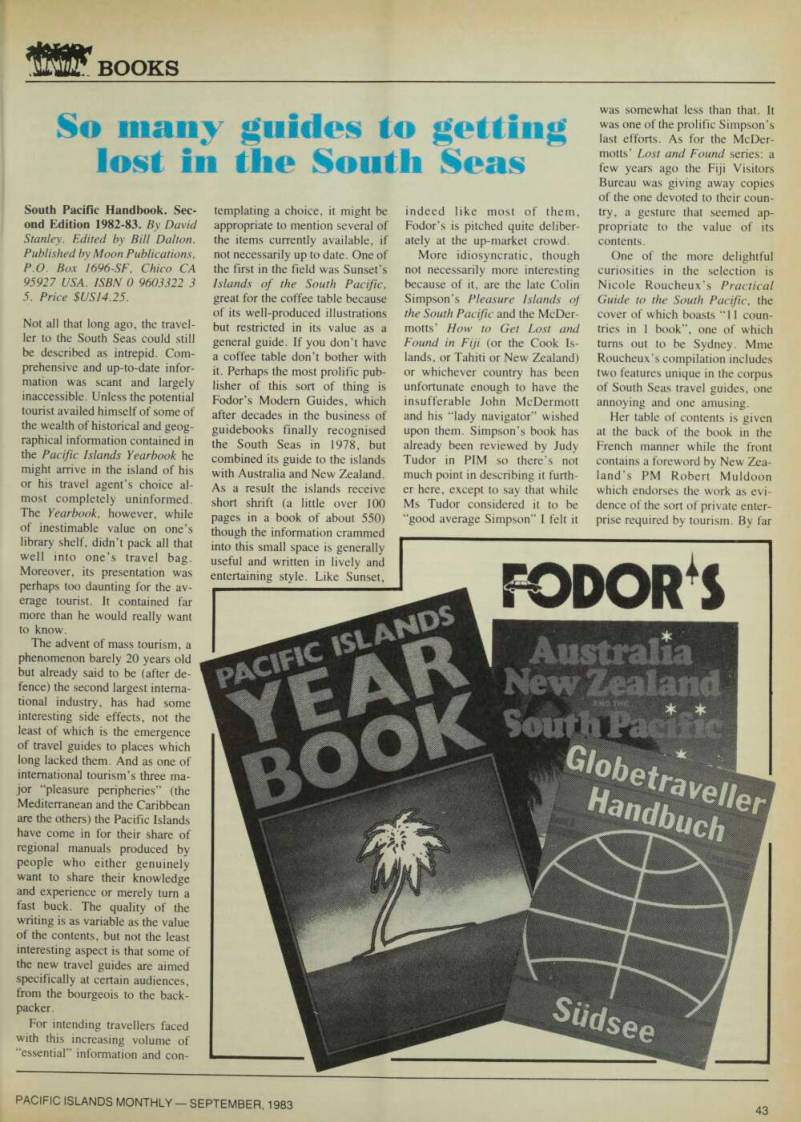
books
So many guides to getting lost in the South Seas
South Pacific Handbook. Sec ond Edition 1982-83. By David Stanley. Edited by Bill Dalton.
Published by Moon Publications, P.O. Box 1696-SF, Chico CA
95927 Usa. Isbn 0 9603322 3
5. Price SUSJ4.2S.
Not all that long ago, the travel ler to the South Seas could still be described as intrepid. Com prehensive and up-to-date infor mation was scant and largely inaccessible. Unless the potential tourist availed himself of some of the wealth of historical and geog raphical information contained in the Pacific Islands Yearbook he might arrive in the island of his or his travel agent’s choice al most completely uninformed.
The Yearbook, however, while of inestimable value on one’s library shelf, didn’t pack all that well into one’s travel bag.
Moreover, its presentation was perhaps too daunting for the av erage tourist. It contained far more than he would really want to know.
The advent of mass tourism, a phenomenon barely 20 years old but already said to be (after de fence) the second largest interna tional industry, has had some interesting side effects, not the least of which is the emergence of travel guides to places which long lacked them. And as one of international tourism’s three ma jor “pleasure peripheries” (the Mediterranean and the Caribbean are the others) the Pacific Islands have come in for their share of regional manuals produced by people who either genuinely want to share their knowledge and experience or merely turn a fast buck. The quality of the writing is as variable as the value of the contents, but not the least interesting aspect is that some of the new travel guides are aimed specifically at certain audiences, from the bourgeois to the back packer.
For intending travellers faced with this increasing volume of “essential” information and con
templating a choice, it might be appropriate to mention several of the items currently available, if not necessarily up to date. One of the first in the field was Sunset’s Islands of the South Pacific, great for the coffee table because of its well-produced illustrations but restricted in its value as a general guide. If you don’t have a coffee table don’t bother with it. Perhaps the most prolific pub lisher of this sort of thing is Fodor’s Modern Guides, which after decades in the business of guidebooks finally recognised the South Seas in 1978, but combined its guide to the islands with Australia and New Zealand.
As a result the islands receive short shrift (a little over 100 pages in a book of about 550) though the information crammed into this small space is generally useful and written in lively and entertaining style. Like Sunset,
indeed like most of them, Fodor’s is pitched quite deliber ately at the up-market crowd.
More idiosyncratic, though
not necessarily more interesting
because of it, are the late Colin Simpson’s Pleasure Islands of the South Pacific and the McDer motts’ How to Get Lost and Found in Fiji (or the Cook Is lands, or Tahiti or New Zealand) or whichever country has been unfortunate enough to have the insufferable John McDermott and his “lady navigator” wished upon them. Simpson’s book has already been reviewed by Judy Tudor in PIM so there’s not much point in describing it furth er here, except to say that while Ms Tudor considered it to be “good average Simpson” I felt it
was somewhat less than that. It was one of the prolific Simpson’s last efforts. As for the McDer motts’ Lost and Found series: a few years ago the Fiji Visitors Bureau was giving away copies of the one devoted to their coun try, a gesture that seemed ap propriate to the value of its contents.
One of the more delightful curiosities in the selection is Nicole Roucheux’s Practical Guide to the South Pacific, the cover of which boasts “11 coun tries in 1 book”, one of which turns out to be Sydney. Mme Roucheux’s compilation includes two features unique in the corpus of South Seas travel guides, one
annoying and one amusing.
Her table of contents is given at the back of the book in the French manner while the front contains a foreword by New Zea land’s PM Robert Muldoon which endorses the work as evi dence of the sort of private enter prise required by tourism. By far
the most interesting aspect of Mme Roucheux’s book, howev er, is her prose style which defies
excerpting.
Pacific Publications’ own South Seas Guide has two major virtues absent from most of the others. Its background detail is, as one might expect, accurate; it speaks for example of “European contacts” rather than “dis coveries”, and its price is cheap still only $3.50 in many parts of the Pacific. It also contains a couple of odd anomalies the maps are inconsistent in detail and the generally excellent black and white illustrations are all unidentified. “An island is an island is an island . . . ?” Surely not. Pacific Publications’ guide wisely avoids one of the quick routes to obsolescence by not
making qualitative pronounce
ments on available accommoda tion or specifying prices. Its pre sentation, indeed, might be re garded as democratic, aimed at no one class of traveller in
particular.
Even more democratic in its quite deliberate attempts to avoid
the standard bourgeois connota tions of tourism is David Stan ley’s South Pacific Handbook (2nd edition, ed. Bill Dalton).
Stanley, whose credentials as a travel writer include the publica tion of a painstakingly compiled handbook on Indonesia and the purchase of the longest ticket ever issued by Pan Am in Cana da, has produced what must sure ly be the densest (in terms of information contained) travel guide to the region, 560-plus pages containing an amount of words well in excess of a quarter of a million.
Missionaries
Stanley is pro-traveller but
anti-tourist and anti-expatriate, a position he demonstrates at vari ous parts of the book but rather piously in the introduction.
“White missionaries,” he writes, “anxious to maintain their hold over the islanders, generally dis courage tourism.” “Many resi dent expatriates . . . wish to pro tect their own privileges and status, which might be en
dangered by an increase in the number of visitors.”
Piety gives way occasionally
to sheer naivete. Only someone thoroughly unfamiliar with the hierarchical structure of its socie ty (and economy) could suggest that tourism in Tonga is more egalitarian than elsewhere, and only the most wishful of thinkers would insist that by buying canned food at village stores one is keeping the money in the villages. At other times Stanley is anxious to inform the reader not to pay $l.OO for a ride in a villager’s truck when bargaining may get it for less.
Fortunately, when he over comes these occasional tenden cies, Stanley provides the reader with solid and up-to-date infor mation on the geography, tradi tional and modem history, and contemporary trends of every part of the Pacific Islands in which even the most avid travel buff is likely to find himself.
Accommodation is listed for such places as Mauke (Cook Is lands), Malekula (in Vanuatu) and the Marquesas (French Poly nesia), islands all but ignored in other regional travel guides. In his accommodation recommen dations Stanley’s dedicated back packing nature obliges him to take a stance diametrically oppo site that of Sunset or Fodor’s.
“International” hotels and other non-budget facilities are usually
conspicuously omitted. (Though
if you can find them you can always use their swimming
pools.)
The maps, most of which were contributed by editor Bill Dalton, are well drawn and generously distributed throughout. The sec tion on Fiji alone has 14! Dalton also takes credit for the format which is conveniently small (perhaps too small in print size at times, or are there no myopic
back-packers?) if not quite pock
et-sized and makes maximum and intelligent use of all avail able space. Thus pages of text
are frequently graced with quite
delightful drawings of people,
places or objects, while the otherwise blank comers of map pages contain brief notes on items that perhaps would not fit conveniently into the text, from taro growing to Tongan stamps.
Photographs are plentiful and
generally well reproduced with one section in color, and thank fully all illustrations are iden tified. Curiously, this simple but necessary requirement seems to have been overlooked by most
other regional guides.
The first edition of South Pacific Handbook appeared in 1979, an illustration of the grow ing interest in the South Seas displayed by North American travellers. It contained 352 pages, making it quite easy to slip into one’s carry-on baggage.
The current edition contains another 200 pages, not all of which are put to good use. Forty five of them are occupied by a section which includes Australia, New Zealand and Hawaii, entitl
ed “Anglonesia”, a description
more cute than useful, since the five pages of text on Australia are of minimal value. Capsule vocabularies are an occasional feature of the handbook but the one devoted to “Aussie” contains expressions and usages only a North American visitor could have unearthed. Thus “Bob’s your mule (sic)” means every thing’s 0.K., while a car engine becomes a “donk”. Spare us the instant linguists. New Zealanders will doubtless be relieved to know that the 12 pages on their country contain no comparable list of words, and further relieved
by Stanley’s description of them
as “much gentler and more re served than their brash and bra zen Aussie cousins”.
Aspirations
Clearly, South Pacific Hand
book has aspirations beyond that of a mere travel guide (an Ameri can based counter-weight to the Pacific Islands Yearbook, perhaps?) and as such compels one to take its contents seriously.
Well, most of them anyway.
Despite its occasional peculiarities and at times almost
belligerent “budget travellers are
beautiful” stance (does Stanley know Niue was once considering banning back-packers because they contribute nothing to tour ism?) the handbook is probably the best value around and is likely to find a place in most budgeteers’ H-frames if not in most executives’ briefcases.
Norman Douglas.
Advertisements & other items, pp. 43-44 (1 item)
Rodors
llUJUgll 11JC llllUlllldliUll LX dllllllCU into this small space is generally useful and written in lively and entertaining style. Like Sunset, » A
THE JOURNAL OF
PACIFIC HISTORY
’ Volume XVIII - 1983 1 - 2 Special issue on the history and anthropology of the Massim, Papua New Guinea CONTENTS: The Massim: an introduction Michael Young: Warfare and the changing context of kune on Tubetube Martha Maclntyre: on the transformation of Muyuw into Woodlark Island Fred Damon: Goodenough Islanders and the labour trade. 1900-60 Michael Young: Selective adaptation to missionization in Wamira society Miriam Kahn: The colonial transformation of Rossel Island society John Liep: an 1856 manuscript account of Woodlark Islanders.
Current Developments The Fiji General Election 1982 Brij Lai.
Vol. XVIII 3-4 will contain articles on dysentery in Papua New Guinea; Queen Salote of Tonga: the State of Lau, Fiji: and a translation from Spanish of an early account of the Marianas.
Annual subscription, including Bibliography and Comment, SAI6 (SUS2O), from The Editors, Journal of Pacific History, Australian National University, GPO Box 4, Canberra, ACT 2601, Australia.
ALSO AVAILABLE:
The Cross of Lorraine in the South Pacific. Australia and the Free French Movement 1940-1942. by John LawreysAB.so Index to The Journal of Pacific History vols l-XVI 5A4.00
century Hawaii
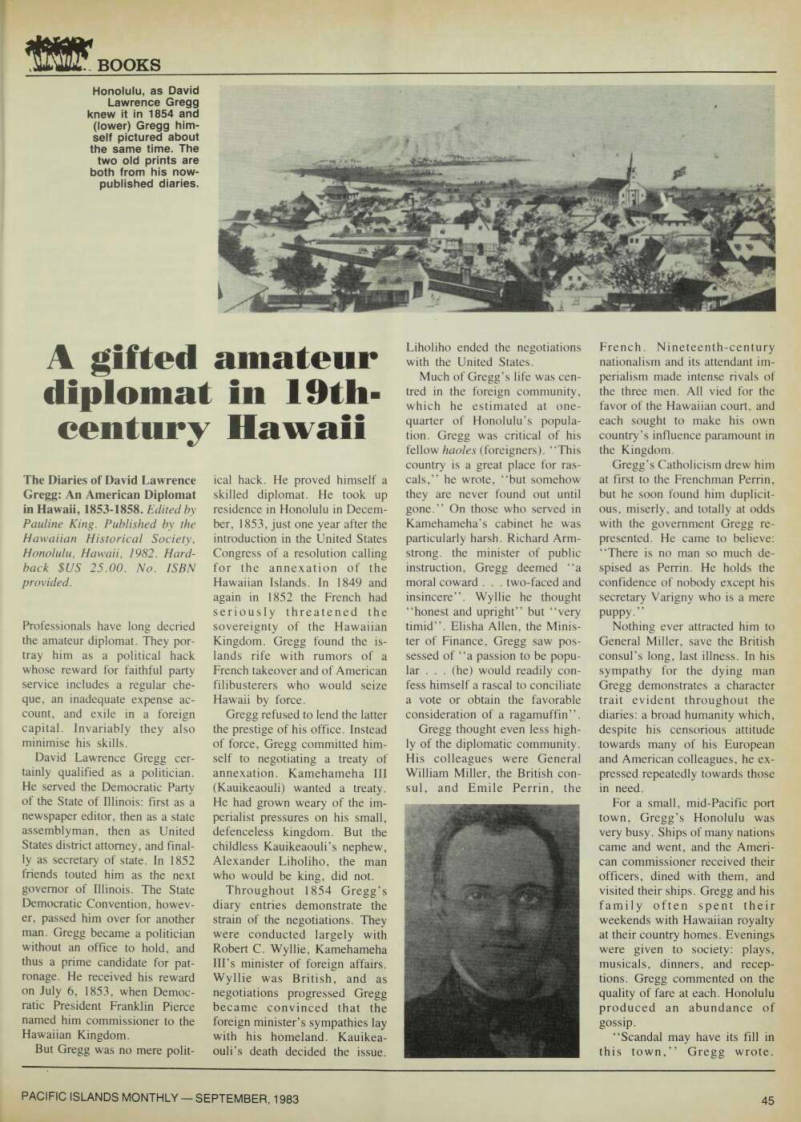
A gifted amateur diplomat in 19th century Hawaii
The Diaries of David Lawrence Gregg: An American Diplomat in Hawaii, 1853-1858. Edited by Pauline King. Published by the Hawaiian Historical Society, Honolulu, Hawaii, 1982. Hard back SUS 25.00. No. ISBN provided.
Professionals have long decried the amateur diplomat. They por tray him as a political hack whose reward for faithful party service includes a regular che que, an inadequate expense ac count, and exile in a foreign capital. Invariably they also minimise his skills.
David Lawrence Gregg cer tainly qualified as a politician.
He served the Democratic Party of the State of Illinois: first as a newspaper editor, then as a state assemblyman, then as United States district attorney, and final ly as secretary of state. In 1852 friends touted him as the next governor of Illinois. The State Democratic Convention, howev er, passed him over for another man. Gregg became a politician without an office to hold, and thus a prime candidate for pat ronage. He received his reward on July 6, 1853, when Democ ratic President Franklin Pierce named him commissioner to the Hawaiian Kingdom.
But Gregg was no mere polit
ical hack. He proved himself a skilled diplomat. He took up residence in Honolulu in Decem ber, 1853, just one year after the introduction in the United States Congress of a resolution calling for the annexation of the Hawaiian Islands. In 1849 and again in 1852 the French had seriously threatened the sovereignty of the Hawaiian Kingdom. Gregg found the is lands rife with rumors of a French takeover and of American filibusterers who would seize Hawaii by force.
Gregg refused to lend the latter the prestige of his office. Instead of force, Gregg committed him self to negotiating a treaty of annexation. Kamehameha 111 (Kauikeaouli) wanted a treaty.
He had grown weary of the im perialist pressures on his small, defenceless kingdom. But the childless Kauikeaouli’s nephew, Alexander Liholiho, the man who would be king, did not.
Throughout 1854 Gregg’s diary entries demonstrate the strain of the negotiations. They were conducted largely with Robert C. Wyllie, Kamehameha Ill’s minister of foreign affairs.
Wyllie was British, and as negotiations progressed Gregg became convinced that the foreign minister’s sympathies lay with his homeland. Kauikea ouli’s death decided the issue.
Liholiho ended the negotiations with the United States.
Much of Gregg’s life was cen tred in the foreign community, which he estimated at one quarter of Honolulu’s popula tion. Gregg was critical of his fellow haoles (foreigners). “This country is a great place for ras cals,” he wrote, “but somehow they are never found out until gone.” On those who served in Kamehameha’s cabinet he was particularly harsh. Richard Arm strong. the minister of public instruction, Gregg deemed “a moral coward . . . two-faced and insincere”. Wyllie he thought “honest and upright” but “very timid”. Elisha Allen, the Minis ter of Finance, Gregg saw pos sessed of “a passion to be popu lar .. . (he) would readily con fess himself a rascal to conciliate a vote or obtain the favorable consideration of a ragamuffin”.
Gregg thought even less high ly of the diplomatic community.
His colleagues were General William Miller, the British con sul, and Emile Perrin, the
French. Nineteenth-century nationalism and its attendant im perialism made intense rivals of the three men. All vied for the favor of the Hawaiian court, and each sought to make his own country’s influence paramount in the Kingdom.
Gregg’s Catholicism drew him at first to the Frenchman Perrin, but he soon found him duplicit ous, miserly, and totally at odds with the government Gregg re presented. He came to believe: “There is no man so much de spised as Perrin. He holds the confidence of nobody except his secretary Varigny who is a mere puppy.”
Nothing ever attracted him to General Miller, save the British consul’s long, last illness. In his sympathy for the dying man Gregg demonstrates a character trait evident throughout the diaries: a broad humanity which, despite his censorious attitude towards many of his European and American colleagues, he ex pressed repeatedly towards those in need.
For a small, mid-Pacific port town, Gregg’s Honolulu was very busy. Ships of many nations came and went, and the Ameri can commissioner received their officers, dined with them, and visited their ships. Gregg and his family often spent their weekends with Hawaiian royalty at their country homes. Evenings were given to society: plays, musicals, dinners, and recep tions. Gregg commented on the quality of fare at each. Honolulu produced an abundance of gossip.
“Scandal may have its fill in this town,” Gregg wrote.
Honolulu, as David
Lawrence Gregg
knew it in 1854 and (lower) Gregg him self pictured about the same time. The two old prints are both from his now
published diaries.
“There is nothing like it in the wide world. No place so bad in the countenance it gives slan der.” Always the American wrote his dispatches, often work ing late into the night to meet a ship’s departure time.
Like all of Honolulu’s foreig ners, Gregg complained of the Hawaiian’s lack of initiative. ‘They are indolent and generally inactive,” he wrote. But he also found much to be admired. He thought the Prince Royal, Liholiho, “too much cultivated and enlightened to be a Hawaiian subject, or even a Hawaiian King; he should be a citizen of the United States, and would distinguish himself in that capac
ity,” High praise from a
chauvinistic, patriotic American.
Gregg’s admiration was recip
rocated. In 1858 he ended his career in American diplomacy and entered the cabinet of Kamehameha IV as minister of finance.
The Diaries of David Lawr ence Gregg belong to the scholar
of Hawaiian history. Gregg
could be an acute observer of men and events. But he also recorded far too much of the minutiae of Honolulu life in the 1850 s to engage the general read er for long.
Dr Pauline King’s editing is judicious, and her endnotes pro vide a second book on the Hawaiian Kingdom well worth reading. One of the principal objectives of the Hawaiian His torical Society is the preparation
and publication of primary
source materials in Hawaiian his tory. The Society and Dr. King have done very well indeed in meeting that objective with The Diaries of David Lawrence
Gregg.
Dan Boylan.
Books received
Seabirds an identification guide. by Peter Harrison. Published 1983 by Croom Helm Ltd and A.H & A.W.
Reed Ltd. Distributed in Australia by ANZ Books Pty Ltd, PO Box 459, Brookvale, NSW 2100. ISBN 0 589 01472 2. Price $A35.00.
Tales of the Tikongs.By Epeli Hau’ofa. Published in 1983 by Long man Paul Ltd, 182-190 Wairau Road, Auckland 10, New Zealand.
No price given. ISBN 0 582 71789 2.
Blueprint for Paradise: How to live on a tropic island. By Ross Nor grove. Published 1983 by Intema
mown & 00/s
Pioneer Circus
tional Marine Company, 21 Elm Street, Camden, Maine 04843, USA.
Price $U514.95. ISBN 0 87742 154 4.
Modern Ocean Cruising: Boats, gear and crews surveyed. By Jim my Cornell. Published 1983 by Granada Publishing, PO Box 9, Frogmore, St Albans, Hertfordshire AL2 2NF, England. Price £8.95.
Isbn 0 229 11687 6.
Post-Independence Economic De velopment of Papua New Guinea.
By P.A.S. Dahanayake. Monograph
19, published 1982 by Institute of Applied Social and Economic re search, Boroko, Papua New Guinea.
No price. ISBN 07247 0907 X.
Losing control . . . Towards an Understanding of Transnational Corporations in the Pacific Islands Context. By James E. Winkler.
Published 1982 by Lotu Pasifika Pro ductions, PO Box 208, Suva, Fiji.
No ISBN. Price $F2.00.
Trickling Up A strategy for development where the people at the bottom matter most. By Dennis Oliver. Published 1983 by Lotu Pasifika Productions, PO Box 2401, Govt, buildings, Suva, Fiji. No price or ISBN.
Australia and the South Pacific.
Proceedings of the conference held at ANU, February 1982. Edited by Brendan O’Dwyer. Published by Centre for Continuing Education, Australian National University, PO Box 4, Canberra, ACT 2600. Nation al Library of Australia card ISBN 0
909850 81. JSIo price given.
A Call to a New Exodus An anti nuclear primer for Pacific people.
By Suliana Siwatibau and B. David Williams. Published 1982 by Lotu Pasifika Productions, PO Box 208, Suva, Fiji. Price $F4.00 No ISBN.
Reflections on Micronesia. Collect ed papers of Fr Francis X Hezel, S.J.
Published by Pacific Islands Studies Center for Asian and Pacific Studies, in collaboration with the Social Sci ence Research Institute, University of Hawaii at Manoa, Honolulu, Hawaii. No price or ISBN.
Section of an 1856 Honolulu newspaper advertisement, one of several reproduced in the historical society’s book. Ad mission to Rowe’s Circus rang ed up to $1.50 - an expensive show for the times.
Advertisements & other items, p. 46 (1 item)
Mstant
PORTABLE
SAWMILLS
i A
TRACTOR POWERED "VILLAGE SAWMILL
★ LOW MAINTENANCE AND RELIABLE
MACHINES PROVEN THROUGHOUT THE
PACIFIC.
★ WE MANUFACTURE COCONUT WOOD
SAWMILLS AND SAWMILLS FOR ALL
REQUIREMENTS BIG OR SMALL
★ ENQUIRE ABOUT OUR PROFESSIONAL
SAWMILLS WITH HIGH PRODUCTION.
TRACTOR POWERED OR DIESEL ENGINE
ALL MACHINES FULLY PORTABLE ON WHEELS AND COMPLY WITH
OVERSEAS SAFETY STANDARDS
NT. GATMAN LTD.
BOX 18, SILVERDALE, NEW ZEALAND
PHONE STAN GRIFFITHS AUCKLAND 732-181 OR HIBISCUS COAST 65-612
MSTANT
HOUSES’
and Commercial Buildings with Therma-Panel, R the
fully insulated inter-locking
Building System
Cyclone rated l George Hudson Homes (Aust.) pt y Ltd. 186 Hume Highway Cabramatta NSW 2166 Australia. Tel: (02) 727 9066. Telex: AA25800 Post coupon for details and prices. I Address Tel:.
but where Easter
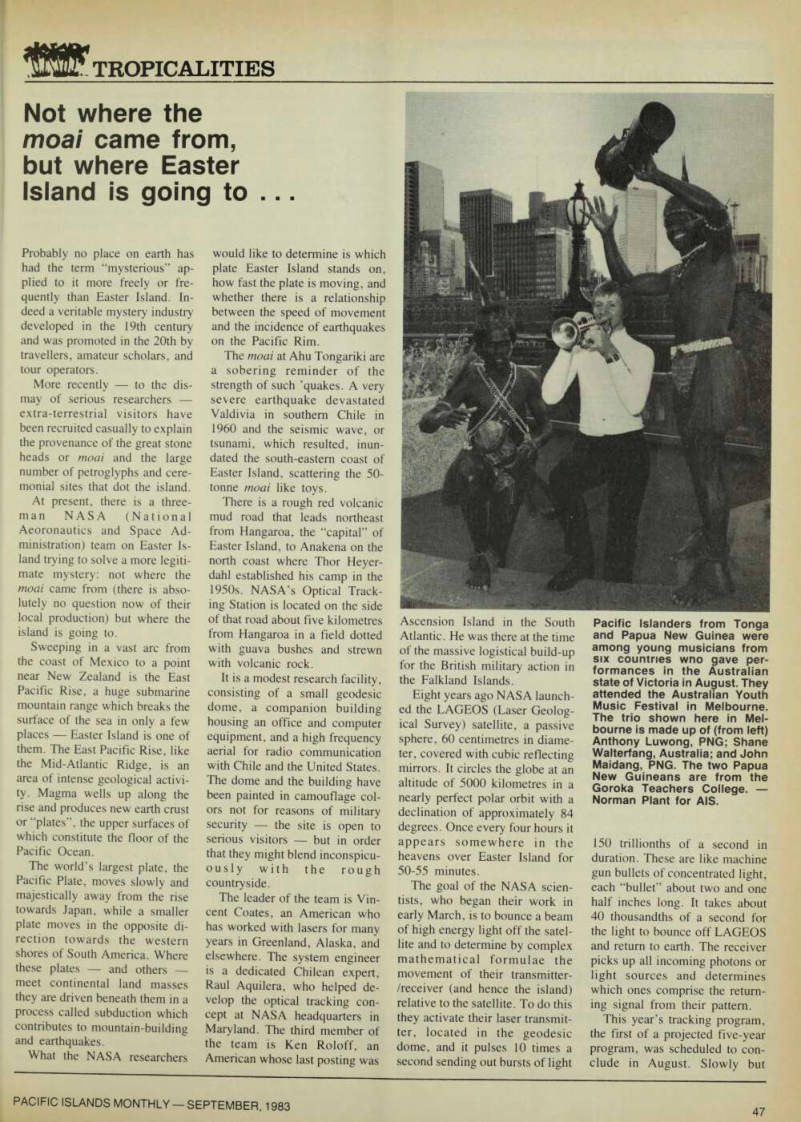
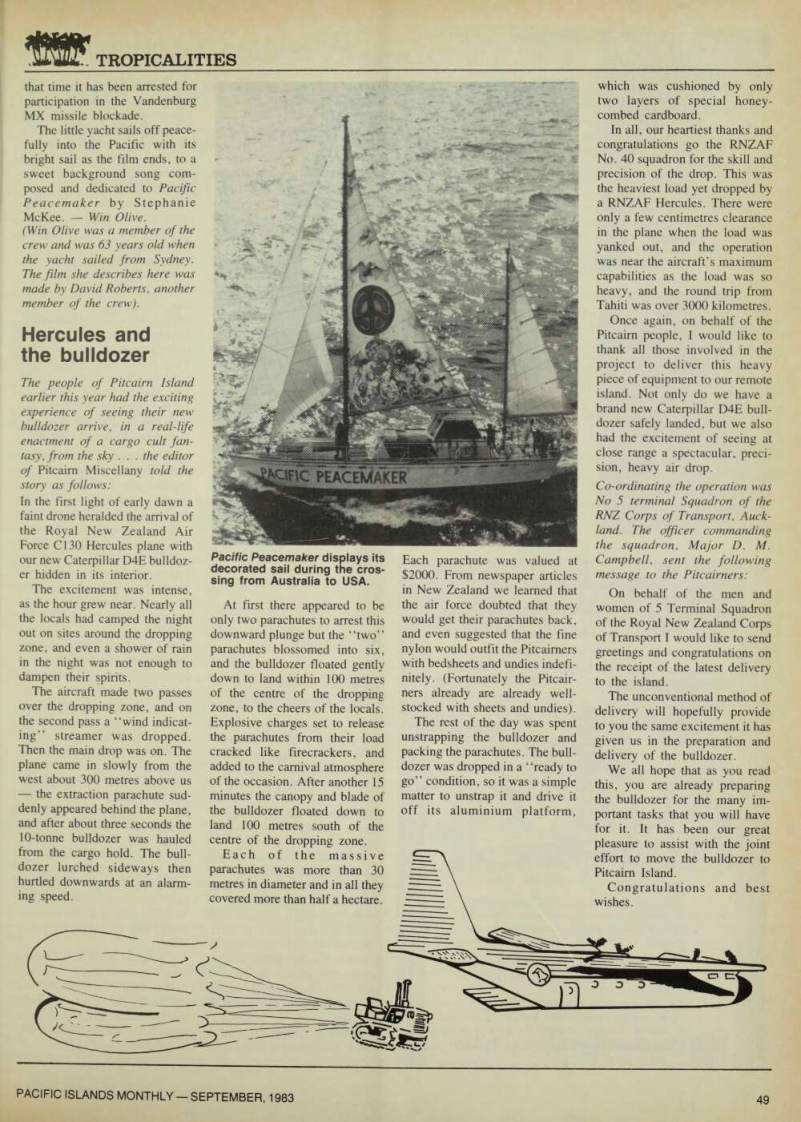
Tropicalities
Not where the moai came from, but where Easter Island is going to ...
Probably no place on earth has had the term “mysterious” ap plied to it more freely or fre quently than Easter Island. In deed a veritable mystery industry developed in the 19th century and was promoted in the 20th by travellers, amateur scholars, and tour operators.
More recently to the dis may of serious researchers extra-terrestrial visitors have been recruited casually to explain the provenance of the great stone heads or moai and the large number of petroglyphs and cere monial sites that dot the island.
At present, there is a three man NASA (National Aeoronautics and Space Ad ministration) team on Easter Is land trying to solve a more legiti mate mystery; not where the moai came from (there is abso lutely no question now of their local production) but where the island is going to.
Sweeping in a vast arc from the coast of Mexico to a point near New Zealand is the East Pacific Rise, a huge submarine mountain range which breaks the surface of the sea in only a few places Easter Island is one of them. The East Pacific Rise, like the Mid-Atlantic Ridge, is an area of intense geological activi ty. Magma wells up along the rise and produces new earth crust or “plates”, the upper surfaces of which constitute the floor of the Pacific Ocean.
The world’s largest plate, the Pacific Plate, moves slowly and majestically away from the rise towards Japan, while a smaller plate moves in the opposite di rection towards the western shores of South America. Where these plates and others meet continental land masses they are driven beneath them in a process called subduction which contributes to mountain-building
and earthquakes.
What the NASA researchers
would like to determine is which plate Easter Island stands on, how fast the plate is moving, and whether there is a relationship between the speed of movement and the incidence of earthquakes on the Pacific Rim.
The moai at Ahu Tongariki are a sobering reminder of the strength of such ’quakes. A very severe earthquake devastated Valdivia in southern Chile in 1960 and the seismic wave, or tsunami, which resulted, inun dated the south-eastern coast of Easter Island, scattering the 50tonne moai like toys.
There is a rough red volcanic mud road that leads northeast from Hangaroa, the “capital” of Easter Island, to Anakena on the north coast where Thor Heyer dahl established his camp in the 19505. NASA’s Optical Track ing Station is located on the side of that road about five kilometres from Hangaroa in a field dotted with guava bushes and strewn with volcanic rock.
It is a modest research facility, consisting of a small geodesic dome, a companion building housing an office and computer equipment, and a high frequency aerial for radio communication with Chile and the United States.
The dome and the building have been painted in camouflage col ors not for reasons of military security the site is open to serious visitors but in order that they might blend inconspicu ously with the rough countryside.
The leader of the team is Vin cent Coates, an American who has worked with lasers for many years in Greenland, Alaska, and elsewhere. The system engineer is a dedicated Chilean expert, Raul Aquilera, who helped de velop the optical tracking con cept at NASA headquarters in Maryland. The third member of the team is Ken Roloff, an American whose last posting was
Ascension Island in the South Atlantic. He was there at the time of the massive logistical build-up for the British military action in the Falkland Islands.
Eight years ago NASA launch ed the LAGEOS (Laser Geolog ical Survey) satellite, a passive sphere, 60 centimetres in diame ter, covered with cubic reflecting mirrors. It circles the globe at an altitude of 5000 kilometres in a nearly perfect polar orbit with a declination of approximately 84 degrees. Once every four hours it appears somewhere in the heavens over Easter Island for 50-55 minutes.
The goal of the NASA scien tists, who began their work in early March, is to bounce a beam of high energy light off the satel lite and to determine by complex mathematical formulae the movement of their transmitter /receiver (and hence the island) relative to the satellite. To do this they activate their laser transmit ter, located in the geodesic dome, and it pulses 10 times a second sending out bursts of light
150 trillionths of a second in duration. These are like machine gun bullets of concentrated light, each “bullet” about two and one half inches long. It takes about 40 thousandths of a second for the light to bounce off LAGEOS and return to earth. The receiver picks up all incoming photons or light sources and determines which ones comprise the return ing signal from their pattern.
This year’s tracking program, the first of a projected five-year program, was scheduled to con clude in August. Slowly but
Pacific Islanders from Tonga and Papua New Guinea were among young musicians from six countries wno gave per formances in the Australian state of Victoria in August. They attended the Australian Youth Music Festival in Melbourne.
The trio shown here in Mel bourne is made up of (from left)
Anthony Luwong, PNG; Shane
Walterfang, Australia; and John Maidang, PNG. The two Papua New Guineans are from the
Goroka Teachers College. -
Norman Plant for AIS.
surely, when the weather is good enough to allow transmission and reception, the NASA team is amassing the laser data needed to measure the movement of Easter Island. Their sightings are re markably accurate. They can cal culate the island’s movement to within one-third of an inch and their findings to date suggest that Easter Island is moving eastward at roughly three inches a year.
Further, their work suggests that a month or so before major earth quakes the movement of the
“plates” begins to slow.
The Easter Island sightings are, of course, only part of a global jigsaw puzzle. But even tually the work of the night watchers on the road to Anakena, when coupled with data from around the world, will help solve one of the grand mysteries of the Pacific, how that ocean basin was formed and what shape it is
likely to take.
Jim Boutilier.
The film of the
Peacemaker
Following the nine-month jour ney of the little 16-metre yacht, Pacific Peacemaker across the Pacific, comes the 50-minute film of the voyage, which had its premiere in Sydney at the end of June. Its title is The Voyage of the Pacific Peacemaker.
It opens with John Lennon’s
song “Imagine.”
The naming ceremony of the yacht took place in brilliant sun shine at the wharf at Sydney Opera House, it was to sail 17,000 km across the Pacific Ocean to participate in the block ade of the first Trident submarine.
Bill Ethell, the skipper, you meet in the film as a bricklayer, however, he had been nine years in the Royal Navy, and came from a long line of fishing people on the English west coast.
Superb in his seamanship, as in his empathy with Pacific victims of the nuclear testing, he com bined the two in The Voyage of the Pacific Peacemaker.
The film has scenes of the police boarding during the Maori protest at Waitangi, New Zea land, and the ramming and dis masting by the French navy at Moruroa. Afterwards, when it
was impounded at Tahiti, the film tells how Sydney wharfies responded by tying up a French vessel Kangarua, at Port Botany, saying: “You have our vessel, and we have yours.” Kangarua was released on the understand ing that Pacific Peacemaker and its skipper be allowed to proceed on its way. It worked like a charm.
The most remarkable scenes are of the blockade itself.
Forty-nine people mostly in
tiny wooden hand-made row' boats strung themselves out across Hood Canal to blockade the Trident. You see its menac
ing black shape looming up.
By this time special legislation had been passed with a penalty of $lO,OOO or 10 years imprison ment for being in Hood Canal when the Trident came.
There is a shot of many of the blockaders on the deck of Pacific Peacemaker as the Trident com es, and they are about to go over the side into the tiny row boats (affectionately called “duck lings”), then out into the path of the Trident. They are colorful and laughing, as they always were. More than half were wo men, including five nuns, two
paraplegics, and a 78-year-old
grandmother, all determined to confront the “might” of history.
Some had not been in a row boat before.
In order to stop these “terror ists” in their tiny hand-made row boats that cost $25 each, the U.S. brought out 99 coastguard and naval vessels armed with water-cannon and machine guns, military jets, helicopters, the whole Northwest Naval Reserve, the National Guard, State Troop ers and an 80-person anti terrorist team (flown in from New York), to say nothing of the Pan Am Special Security police.
Although we had been told it was impossible some of the little boats did get in front of the Trident, and there were a number of arrests.
So great was the mounting indignation and international support for the blockaders, that the charges were soon dropped.
The film ends by telling how the story goes on, as the Ameri can peace movement has bought the little yacht, which is sailing again into the Pacific. Even since
that time it has been arrested for participation in the Vandenburg MX missile blockade.
The little yacht sails off peace fully into the Pacific with its bright sail as the film ends, to a sweet background song com posed and dedicated to Pacific Peacemaker by Stephanie McKee. Win Olive. (Win Olive was a member of the crew and was 63 years old when the yacht sailed from Sydney.
The film she describes here was made by David Roberts, another member of the crew).
Hercules and
the bulldozer
The people of Pitcairn Island earlier this year had the exciting experience of seeing their new bulldozer arrive, in a real-life enactment of a cargo cult fan tasy, from the sky . . . the editor of Pitcairn Miscellany told the story as follows: In the first light of early dawn a faint drone heralded the arrival of the Royal New Zealand Air Force Cl3o Hercules plane with our new Caterpillar D4E bulldoz er hidden in its interior.
The excitement was intense, as the hour grew near. Nearly all the locals had camped the night out on sites around the dropping zone, and even a shower of rain in the night was not enough to dampen their spirits.
The aircraft made two passes over the dropping zone, and on the second pass a ‘‘wind indicat ing” streamer was dropped.
Then the main drop was on. The plane came in slowly from the west about 300 metres above us the extraction parachute sud denly appeared behind the plane, and after about three seconds the 10-tonne bulldozer was hauled from the cargo hold. The bull dozer lurched sideways then hurtled downwards at an alarm ing speed.
At first there appeared to be only two parachutes to arrest this downward plunge but the “two” parachutes blossomed into six, and the bulldozer floated gently down to land within 100 metres of the centre of the dropping zone, to the cheers of the locals.
Explosive charges set to release the parachutes from their load cracked like firecrackers, and added to the carnival atmosphere of the occasion. After another 15 minutes the canopy and blade of the bulldozer floated down to land 100 metres south of the centre of the dropping zone.
Each of the massive parachutes was more than 30 metres in diameter and in all they covered more than half a hectare.
Each parachute was valued at $2OOO. From newspaper articles in New Zealand we learned that the air force doubted that they would get their parachutes back, and even suggested that the fine nylon would outfit the Pitcairners with bedsheets and undies indefi nitely. (Fortunately the Pitcair ners already are already well stocked with sheets and undies).
The rest of the day was spent unstrapping the bulldozer and packing the parachutes. The bull dozer was dropped in a ‘ ‘ready to go” condition, so it was a simple matter to unstrap it and drive it off its aluminium platform,
which was cushioned by only two layers of special honey combed cardboard.
In all, our heartiest thanks and congratulations go the RNZAF No. 40 squadron for the skill and precision of the drop. This was the heaviest load yet dropped by a RNZAF Hercules. There were only a few centimetres clearance in the plane when the load was yanked out, and the operation was near the aircraft’s maximum capabilities as the load was so heavy, and the round trip from Tahiti was over 3000 kilometres.
Once again, on behalf of the Pitcairn people, I would like to thank all those involved in the project to deliver this heavy piece of equipment to our remote island. Not only do we have a brand new Caterpillar D4E bull dozer safely landed, but we also had the excitement of seeing at close range a spectacular, preci sion, heavy air drop.
Co-ordinating the operation was No 5 terminal Squadron of the RNZ Corps of Transport, Auck land. The officer commanding the squadron, Major D. M.
Campbell, sent the following message to the Pitcairners: On behalf of the men and women of 5 Terminal Squadron of the Royal New Zealand Corps of Transport I would like to send greetings and congratulations on the receipt of the latest delivery to the island.
The unconventional method of delivery will hopefully provide to you the same excitement it has given us in the preparation and delivery of the bulldozer.
We all hope that as you read this, you are already preparing the bulldozer for the many im portant tasks that you will have for it. It has been our great pleasure to assist with the joint effort to move the bulldozer to Pitcairn Island.
Congratulations and best wishes.
Pacific Peacemaker displays its decorated sail during the cros sing from Australia to USA.
PIM writers
vindicated
Recent decisions by the Govern ment Council in French Poly nesia have fully vindicated the stand of PIM correspondents in the territory, Marie-Therese and Bengt Danielsson, and of Profes sor Yosihiko Sinoto of Hon olulu’s Bernice P. Bishop Museum.
Writing in PIM under the headline “Cold shoulder for a 1000-year-old canoe” (Mar. ’B2 p2l), the Danielssons took the local French administration to task for the scant official interest shown in the remarkable ar cheological discoveries made over 10 years of work by Profes sor Sinoto at Huahine, French Polynesia.
In particular, they were critical of Marc Tevane, the government councillor in charge of scientific research, and posed some curly questions about the whereabouts of a sum of about CFP3.S million which had been officially ear marked for Professor Sinoto.
Their article was followed by
furious letters to PIM from the then vice-president of the Gov ernment Council, Francis San ford, and Mr Tevane (PIM June ’B2 p 7). They hotly denied that any money had gone astray.
The letters were in turn used as a peg for attacks on PIM in the
French-language monthly
magazine 30 Jours, and in daily newspapers in French Polynesia and New Caledonia.
Now, the new Government Council in the territory has in effect conceded that the Daniels sons and Professor Sinoto were right all along.
The 1983 territorial budget provides for restitution to the professor of the missing money CFP3,607,625 to be precise.
What is more, it has done just what the PIM correspondents urged that its predecessor should do in the first place: it has voted a further sum of CFP3,810,000 for the conservation of the unique wooden artefacts including the main portions of a pre historic canoe dug up by Professor Sinoto.
To top it all, a sum of CFP5,052,800 has been set aside to enable a team of French ar cheologists to pursue the excava tions at the important site of Huahine which, in all probabili ty, will yield up many more scientific treasures.
Latest news of
Paul Cousseran
In the palmy days before World War 11, when France had a far flung colonial empire, future governors were trained at a spe cial school in the gentle arts of handling unruly natives, and tap ping colonial natural resources for the benefit of the “mother country”.
But with nine-tenths of the colonies gone by 1965, the French Government found itself reduced to filling vacancies in the few remaining colonies with a strange assortment of met ropolitan officials who have rare ly seen a coconut palm, and, as regards the Pacific colonies at least, have no knowledge of any Polynesian or Melanesian language.
Among the unhappiest choices was a muscular top bureaucrat
named Paul Cousseran who, in 1977, was appointed French High Commissioner to French Polynesia. There, his first ac complishment was to quell a prison riot by having his police shoot one of the Polynesian ring leaders.
He showed his true colors even more glaringly by promot ing closer economic and cultural ties between the territory and Chile, lavishly entertaining Gen eral Pinochet at his official resi dence in Tahiti during the Chi lean dictator’s first (and only) farcical foray into the Pacific.
Pinochet’s tour ended abruptly somewhere in the skies over Fiji when his aircraft radio brought news that his next host Presi dent Marcos of the Philippines had changed his mind and cancelled his planned state visit to Manila (PIM May ’BO p 9).
Mr Cousseran also made a goodwill visit to Australia to combat the bad impression created in that country by French nuclear testing at Moruroa.
The new Socialist government which came to power in France in May 1981 first employed Cousseran’s special talents for pacification in Corsica, where, in that year alone, the fierce Corsi can nationalists made 700 bomb attacks.
In September 1982 Cousseran was promoted to the key post of commissioner for all metropoli tan French police forces.
Within a few months, howev er, he was being denounced by most of the police unions for his systematic sabotage of the de mocratic reforms of the police forces decided by the govern ment, as well as for his pamper ing of extreme Rightist and out right fascist elements among the police.
France’s Minister for the In terior Gaston Defferre inves tigated, found the complaints justified, and, at the beginning of June this year, took the unprece dented step of sacking his police boss.
Cousseran tried to soften the blow by tendering his own resig nation. But Defferre ignored him and made a public announcement that Cousseran had, in fact, been sacked. Marie-Therese and Bengt Daniels son.
Advertisements & other items, pp. 48-50 (1 item)
AslBo,ooo
NORTH QUEENSLAND ENGINEERS
& AGENTS PTY. LTD.
We have full facilities for repair or refitting SLIPPING to 750 tonne DOCKING to 200 feet The shipbuilding division can construct a vessel to your design, or design one to suit your needs.
Barges, Tugs, Workboats, Catamarans, Landing Craft and Patrol Boats are all within our scope.
CALL US TODAY
N.Q.E.A.
36 Buchan Street, Cairns 4870 P C. Box 1105, Cairns Telephone (070) 51 6600. Telex 48087
CONTRACTORS TO THE ROYAL AUSTRALIAN NAVY
fJnc\\ Shipbuilding and Repair /Yu/£ f\k are our Business
a / ■ •* 'MU 7 vs ,s ...
CARGO VESSEL FOR SALE
405 gross tons, 166 net, 420 dwt.
Length 47.3 metres, Beam 7.5 metres, Draft 3.8 metres.
Dcutz SBA 8M Diesel, 585 S.H.P. at 750 rpm. 2.5: 1 reduction driving variable pitch propeller giving about 10.5 knots. 2 holds giving 28 000 cu ft grain capacity.
Hydraulic deck gear with swinging derricks.
No. 1 hatch 3 ton s.w.l. No. 2 hatch 5 ton s.w.l.
Radar, auto pilot, 5.5.8., V.H.F.
In class with Bureau Veritas and in excellent condition.
Lying at Port-Vila, Vanuatu.
AslBo,ooo
Contact: Vanua Navigation Ltd.
P.O. Box 44, Port-Vila, Vanuatu Telephone: 2027, 2028. Telex: 1033 VANUA
PORT MO
or * Right in business ce * A traditional comfort food ♦ All airconditioned * Restaurant * Ba * Banquet hall
A. C. NEUMANN
t\ manager 1 1 Phone 21-2622
JUL Cable^JPXH
Stay at Aggie Grey’s . . . the South Pacific’s
legendary hotel.
Situated right in the heart of Western Samoa. Enjoy Polynesian style friendliness and service, in cool surroundings, superb entertainment and food.
Magnificent white sand beaches only a short drive away. Airconditioned rooms, swimming pool and full bar facilities.
Bookings through Union Steamship Company of NZ. Pan Am.
Air New Zealand or direct to Aggie Grey’s, Apia. Western Samoa. Cables: ‘AGGIES' Apia.
FORESTMIL
PORTABLE
SAWMILL
A Mini Self Contained Sawmill
complete with Diesel Engine or Electric Motor Forestmil produces any size accurate timber ready to use up to 12" x 9" x 24'.
Purchase price and operating cost of Forestmil is less than other sawing equipment with similar production capacity.
Forestmil reduces timber waste and also reduces log transport cost. Timber is sawn direct from the log in the forest.
Forestmil can be moved to a new location in one hour.
Forestmil will saw hardwood or softwood from logs of any diameter.
Over 1000 Forestmils are sawing timber in 23 countries.
Forestmil has been manufactured for 18 years.
For literature and prices please contact the manufacturers.
MacQuarrie Industries Pty.Ltd.
P.O. Box 20, Coburg 3058, Victoria, Australia.
Phone: 350-3411. Telex: 33729. Cables: Macbound, Melbourne.
Land, foreign policy, set
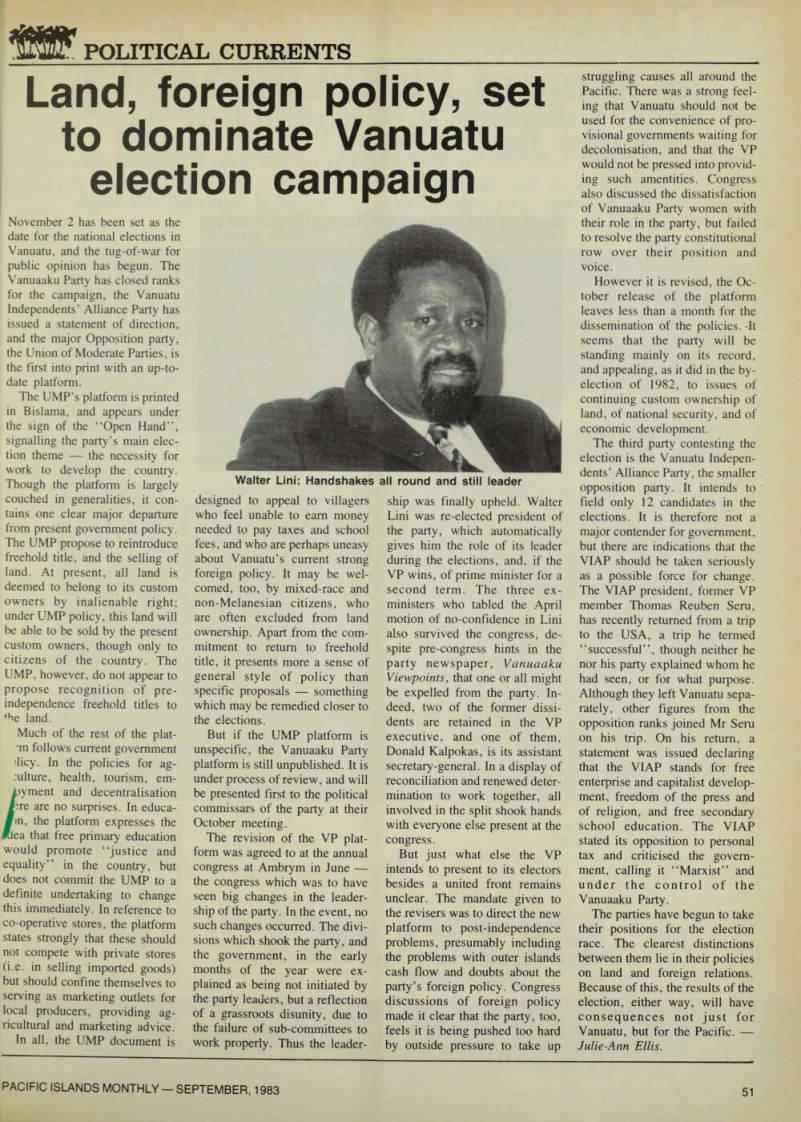
Political Currents
Land, foreign policy, set to dominate Vanuatu election campaign
November 2 has been set as the date for the national elections in Vanuatu, and the tug-of-war for public opinion has begun. The Vanuaaku Party has closed ranks for the campaign, the Vanuatu Independents’ Alliance Party has issued a statement of direction, and the major Opposition party, the Union of Moderate Parties, is the first into print with an up-to date platform.
The UMP’s platform is printed in Bislama, and appears under the sign of the “Open Hand”, signalling the party’s main elec tion theme the necessity for work to develop the country.
Though the platform is largely couched in generalities, it con tains one clear major departure from present government policy.
The UMP propose to reintroduce freehold title, and the selling of land. At present, all land is deemed to belong to its custom owners by inalienable right; under UMP policy, this land will be able to be sold by the present custom owners, though only to citizens of the country. The UMP, however, do not appear to propose recognition of pre independence freehold titles to f he land.
Much of the rest of the plat mi follows current government Jicy. In the policies for ag :ulture, health, tourism, em liyment and decentralisation /ire are no surprises. In educa- Mm, the platform expresses the Rlea that free primary education would promote “justice and equality” in the country, but does not commit the UMP to a definite undertaking to change this immediately. In reference to co-operative stores, the platform states strongly that these should not compete with private stores (i.e. in selling imported goods) but should confine themselves to serving as marketing outlets for local producers, providing ag ricultural and marketing advice.
In all, the UMP document is
designed to appeal to villagers who feel unable to earn money needed to pay taxes and school fees, and who are perhaps uneasy about Vanuatu’s current strong foreign policy. It may be wel comed, too, by mixed-race and non-Melanesian citizens, who are often excluded from land ownership. Apart from the com mitment to return to freehold title, it presents more a sense of general style of policy than specific proposals something which may be remedied closer to the elections.
But if the UMP platform is unspecific, the Vanuaaku Party platform is still unpublished. It is under process of review, and will be presented first to the political commissars of the party at their October meeting.
The revision of the VP plat form was agreed to at the annual congress at Ambrym in June the congress which was to have seen big changes in the leader ship of the party. In the event, no such changes occurred. The divi sions which shook the party, and the government, in the early months of the year were ex plained as being not initiated by the party leaders, but a reflection of a grassroots disunity, due to the failure of sub-committees to work properly. Thus the leader
ship was finally upheld. Walter Lini was re-elected president of the party, which automatically gives him the role of its leader during the elections, and, if the VP wins, of prime minister for a second term. The three ex ministers who tabled the April motion of no-confidence in Lini also survived the congress, de spite pre-congress hints in the party newspaper, Vanuaaku Viewpoints, that one or all might be expelled from the party. In deed, two of the former dissi dents are retained in the VP executive, and one of them, Donald Kalpokas, is its assistant secretary-general. In a display of reconciliation and renewed deter mination to work together, all involved in the split shook hands with everyone else present at the congress.
But just what else the VP intends to present to its electors besides a united front remains unclear. The mandate given to the revisers was to direct the new platform to post-independence problems, presumably including the problems with outer islands cash flow and doubts about the party’s foreign policy. Congress discussions of foreign policy made it clear that the party, too, feels it is being pushed too hard by outside pressure to take up
struggling causes all around the Pacific. There was a strong feel ing that Vanuatu should not be used for the convenience of pro visional governments waiting for decolonisation, and that the VP would not be pressed into provid ing such amentities. Congress also discussed the dissatisfaction of Vanuaaku Party women with their role in the party, but failed to resolve the party constitutional row over their position and voice.
However it is revised, the Oc tober release of the platform leaves less than a month for the dissemination of the policies. It seems that the party will be standing mainly on its record, and appealing, as it did in the by election of 1982, to issues of continuing custom ownership of land, of national security, and of economic development.
The third party contesting the election is the Vanuatu Indepen dents’ Alliance Party, the smaller opposition party. It intends to field only 12 candidates in the elections. It is therefore not a major contender for government, but there are indications that the VIAP should be taken seriously as a possible force for change.
The VIAP president, former VP member Thomas Reuben Seru, has recently returned from a trip to the USA, a trip he termed “successful”, though neither he nor his party explained whom he had seen, or for what purpose.
Although they left Vanuatu sepa rately, other figures from the opposition ranks joined Mr Seru on his trip. On his return, a statement was issued declaring that the VIAP stands for free enterprise and capitalist develop ment, freedom of the press and of religion, and free secondary school education. The VIAP stated its opposition to personal tax and criticised the govern ment, calling it “Marxist” and under the control of the Vanuaaku Party.
The parties have begun to take their positions for the election race. The clearest distinctions between them lie in their policies on land and foreign relations.
Because of this, the results of the election, either way, will have consequences not just for Vanuatu, but for the Pacific.
Julie-Ann Ellis.
Walter Lini: Handshakes all round and still leader
Advertisements & other items, p. 52 (1 item)
Suzuki 1
SUZUKI...
The name of PERFORMANCE
SUZUKI OUTBOARDS are truly ALL ROUND PERFORMER... reliable, durable and economical under any situation.
SUZUKI prepared outboards line up exclusively for the usage of professionals, and of course, also for the pleasure. Each has different construction respectively, so that you can choose your engine that is best suited to your boat and usage.
Get the fruitful life through SUZUKI OUTBOARDS. ■ V M
r- am £ m » 1
g) 7. \ V K y 16 types from 2ps to 140ps
SUZUKI 1
SUZUKI MOTOR CO., LTD. Hamamatsu, Japan SUZUKI GENERATOR SE2SOC »NEW ZEALAND SOUTH PACIFIC SUZUKI DISTRIBUTORS LTD. PHONE: 58-599 • PAPUA NEW GUINEA HI SPEED DIESEL SERVICE; PT TD. PHONE: 42-2679 • FIJI NIRANJANS AUTOPORT LTD. PHONE: 381555 •TAHITI NIPPON AUTOMOTO PHONE. 2-98-19 •SOLOMOI GUADALCANAL GARAGE LTD. PHONE: HONIARA 587 & 593 • VANUATU HENRI LEROUX •NEW CALEDONIA iSTE SUPERCAL ’HONE: 272068 • AMERICAN SAMOA PACIFIC PRODUCTS, INC. PHONE: 639-9140 • W^ TE RN SAMOA WTCO LTD, •GUAM BLAND CYCLERY, INC, PHONE: 565-2298 *NIUE BURNS PHILP CO„ LTD. • NAURU EQUIPAC'MOTORS PHONE;4OI9 •TONGA 'ONGA EQUIPMENT *YAP AMBROSE *KOROR BECHESRRAK T. COMPANY PHONE: 338 *TRUK KIOMASA STORE PHONE: 470
Pay packets and people - how
PNG has turned full circle
Fitting pay packets to people recruited from all parts of the world is a problem for the PNG public service.
ANGUS SMALES describes how the latest move is not as new as it might appear.
The Papua New Guinea public service is to discard its controv ersial dual salary structure under which imported whites and Asians have been getting higher basic salaries than Papua New Guineans. “Sweeping aside the last traces of colonialism” was how some outside newspapers and commentators saw the move.
But in fact the system which PNG is scrapping was not a legacy from the past. It was introduced by PNG’s own gov ernment about four years ago, and the system to which the country is returning is similar to the one which Australia in troduced before PNG became in dependent. In addition, the at traction loadings which will still be paid mean that the effective salaries of local public servants and imported public servants will still differ widely.
Far more significant than the so-called single line salary struc ture is a simultaneous announce ment by PNG that it is reclassify ing its public service jobs. This means there will be pay increases for highly-skilled and key people among Papua New Guineans, most of whom have been manif estly underpaid in the public ser vice. At the other end of the scale, inflated salaries for base level people are to be cut.
The decision to adopt a single line salary scale and to reclassify jobs was announced late in July by the finance minister, Mr Philip Bouraga, and the public service minister, Mr Tony Siag uru. They also announced that PNG would adopt a three-year wage indexation system, the first of its type in PNG.
The story of public service wage fixing before and after in dependence in PNG is studded with political, industrial and emotional developments. Until the early 1960 s Papua New Gui neans were classified only as “servants of the Australian ad ministration” and their pay rates were very low. They were not in the public service itself.
The theory was that when the Papua New Guineans were suffi ciently developed as a communi ty they would be admitted to the same positions as the Australians in PNG, and would presumably get similar pay rates. Even so, this was a theoretical develop ment in a far-distant future.
The change of pace in the 1960 s made it imperative to train and employ Papua New Gui neans as public servants, but the matter of pay rates became high ly controversial. Eventually a significant arbitration decision ruled that the Papua New Gui neans could not expect the same pay scales as the Australians be cause of the economic back ground of their own country.
This was a severe emotional and political blow to many youn ger Papua New Guineans, and undoubtedly contributed to the pressures which created real moves towards independence. In retrospect the decision was valu able because of the impetus it gave to national politics, but at the time it was seen as the effec tive end of all ambition.
Nearly a decade later, with PNG well on the path to inde pendence, the concept of public service pay scales was changed on anti-discrimination grounds.
Base levels of equal pay were set for all positions, but public ser vants brought in from outside were given allowances to com pensate for wage levels in the countries where they were recruited.
PNG retained this system in the early years of independence.
If there was any controversy it tended to be against the level of pay for the Papua New Guineans rather than against the system itself.
By 1978 PNG was recruiting
public servants from many parts of the world, including Aust ralia, UK, New Zealand and the Philippines. A new controversy arose because of the differing allowances paid to the recruited public servants. Although all were on the same basic salary, there was a world of difference in what they were receiving. PNG eventually scrapped the arrange ment and created two scales of pay one for Papua New Gui neans and the other for people brought in from outside. This is the scheme which is now being scrapped in turn, and which will be replaced by a single line sal ary scale with allowances.
As one government official said “the wheel has turned round full circle.”
For some time the PNG gov ernment has been under intense pressure to increase salaries for its own skilled people in the public service. Government doc tors and lawyers have held brief strikes in support of their claims.
Under the new job classifica tion system, which is generally believed to be a far more impor tant development than the single line salary, the biggest increases will go to doctors. Their increase will exceed 20 percent.
The government hired a team of consultants to examine the public service, and in general is following what the consultants recommend. The reclassification has upgraded 21 percent of the public service, and downgraded about 27 percent.
Okuk accepted
by opposition
Mr lambakey Okuk, the controv ersial Papua New Guinea politi cian who recently returned to parliament from a by-election
(PIM Aug. p 44) has become leader of the opposition again and claims that nothing will hold him back from national leadership.
In a series of surprise moves which followed his re-election he eventually received the full bles sing of the combined opposition parties. MrOkuk, a former depu ty prime minister who makes no secret of his goal to become prime minister, lost his seat in parliament at the last general election. But he stood at a by election and was returned from a different electorate, although legal doubts about his eligibility are still being debated.
Soon after Mr Okuk’s re election the then opposition lead er, Mr Ted Diro, handed over the leadership of the opposition par ties to him. The parties involved are Mr Okuk’s own National Party, the Papua Party led by Mr Galeva Kwarara, the Peoples Progress Party led by former prime minister Sir Julius Chan and the Melanesian Alliance led by Father John Momis. Mr Diro, whose own position in politics appears to be in a state of flux, said he saw Mr Okuk as the “natural leader” following the by-election.
The move angered the com bined opposition parties on the grounds that they had not been consulted. The controversy con tinued for nearly two weeks be fore a conference of the party leaders decided to accept Mr Okuk as leader.
Mr Okuk made a dramatic start to his return to office when he tried to attract the deputy prime minister, Mr Paias Wingti, into the opposition. He promised Mr Wingti the prime minister ship if the opposition was able to form a government. Mr Wingti laughed off the offer, but some sections of the opposition criticised Mr Okuk for making it.
“We should be the kings not the kingmakers” was the com ment of the National Party presi dent, Mr Michael Mel.
Advertisements & other items, p. 54 (1 item)
Expert
Insurance Service
throughout the islands
Queensland Insurance (Fiji) Limited
Head Office: Victoria Parade SUVA. General Manager: R. Jackson, Assistant Manager: Vijay Lai. Phone 23 851.
LAUTOKA OFFICE: Burns Philp Bldg., Naviti St. District Manager: R. Sharma. Phone 60 642 LABASA OFFICE Burns Philp Bldg. District Manager: R, Sharma Phone: 8 2139
Queensland Insurance (PNG) Limited
PAPUA NEW GUINEA
Head Office. B N.G Building, Musgrave St.PORT MORESBY. General Manager: T, Sarti Phone: 212144.
LAE 4th St. & Coronation Drive. District Manager: C. D. Hilher Phone: 423873.
MOUNT HAGEN Hagen Drive District Manager G. Hayes Phone: 521002.
ARAWA: Chebu St., District Manager: R. Bowers Phone: 95 1555 MADANG: Kasagten St., District Manager: J. Longbut Phone: 82 2020 RABAUL: Wirraway St District Manager R. McManus Phone. 921014
QBE Insurance (International) Limited
VANUATU PORT VILA: Rue de Pans, Suite 19, Oceania Bldg. Manager; I, R Martin, Phone: 2299.
SANTO: Burns Philp (Vanuatu) Ltd. Phone: 230.
PACIFIC AGENCIES
NEW CALEDONIA: Ste. W. A. Johnston, S.A.R.L. 5 Rue Anatole France, NOUMEA Phone: 272083 TAHITI Arthur Chung. Immeuble 8.1.5., Front de Mer, PAPEETE Phone: 2.86 19 NIUE: Burns Philp (South Sea) Company Ltd.
NORFOLK ISLAND: Burns Philp ('N I ) Company Ltd. Phone: 2191 SAMOA APIA, Burns Philp (South Sea) Company Ltd. Phone: 22611 TONGA Burns Philp (South Sea) Company Ltd. NUKUALOFA Phone 21500 HAAPAI. VAVAU
MEMBERS OF THE
INSURANCE GROUP LIMITED
blows nobody any good
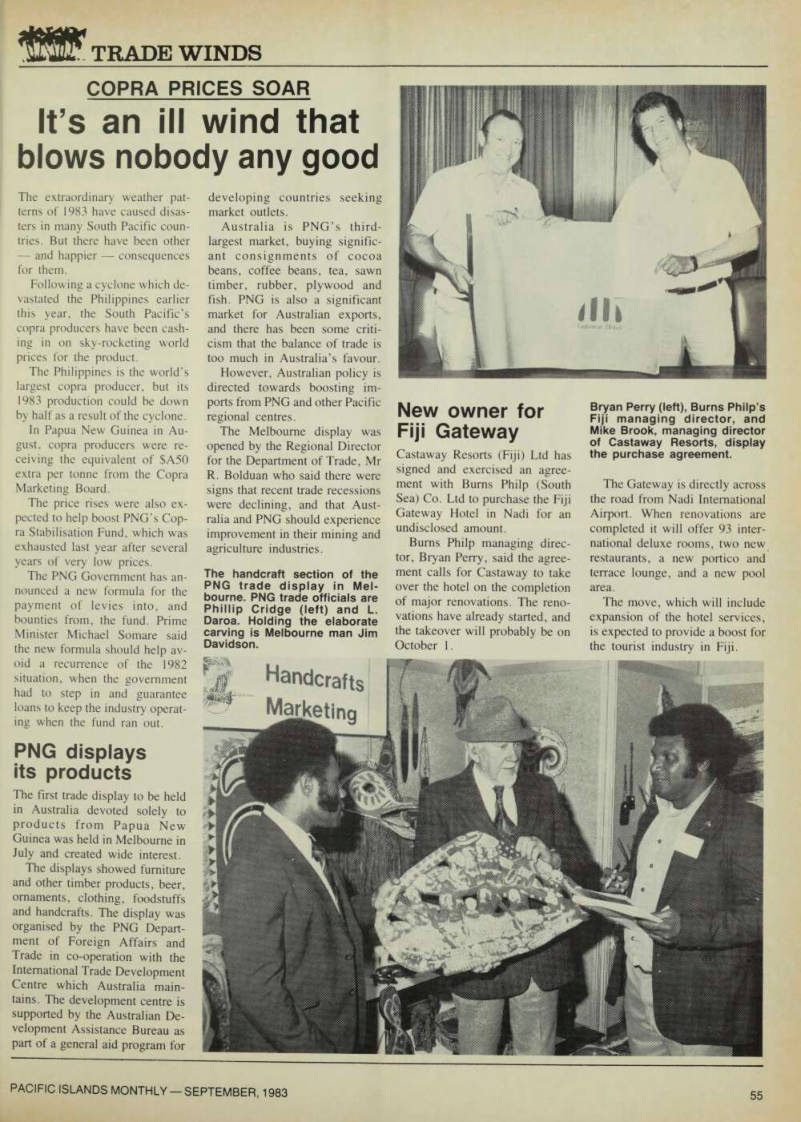
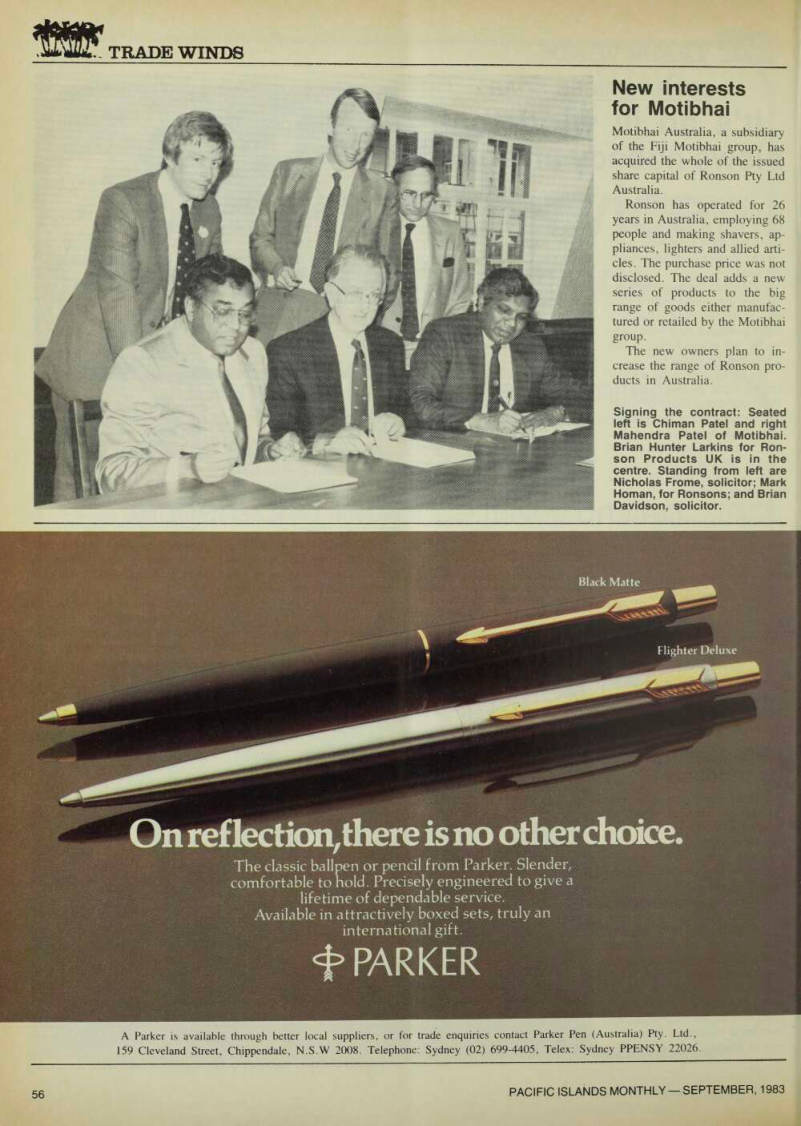
Trade Winds
Copra Prices Soar
It’s an ill wind that blows nobody any good
The extraordinary weather pat terns of 1983 have caused disas ters in many South Pacific coun tries. But there have been other and happier consequences for them.
Following a cyclone which de vastated the Philippines earlier this year, the South Pacific’s copra producers have been cash ing in on sky-rocketing world prices for the product.
The Philippines is the world’s largest copra producer, but its 1983 production could be down by half as a result of the cyclone.
In Papua New Guinea in Au gust, copra producers were re ceiving the equivalent of SASO extra per tonne from the Copra
Marketing Board.
The price rises were also ex pected to help boost PNG’s Cop ra Stabilisation Fund, which was exhausted last year after several years of very low prices.
The PNG Government has an nounced a new formula for the payment of levies into, and bounties from, the fund. Prime Minister Michael Somare said the new formula should help av oid a recurrence of the 1982 situation, when the government had to step in and guarantee loans to keep the industry operat ing when the fund ran out.
PNG displays
its products
The first trade display to be held in Australia devoted solely to products from Papua New Guinea was held in Melbourne in July and created wide interest.
The displays showed furniture and other timber products, beer, ornaments, clothing, foodstuffs and handcrafts. The display was organised by the PNG Depart ment of Foreign Affairs and Trade in co-operation with the International Trade Development Centre which Australia main tains. The development centre is supported by the Australian De velopment Assistance Bureau as part of a general aid program for
developing countries seeking market outlets.
Australia is PNG’s third largest market, buying signific ant consignments of cocoa beans, coffee beans, tea, sawn timber, rubber, plywood and fish. PNG is also a significant market for Australian exports, and there has been some criti cism that the balance of trade is too much in Australia’s favour.
However, Australian policy is directed towards boosting im ports from PNG and other Pacific regional centres.
The Melbourne display was opened by the Regional Director for the Department of Trade, Mr R. Bolduan who said there were signs that recent trade recessions were declining, and that Aust ralia and PNG should experience improvement in their mining and agriculture industries.
New owner for
Fiji Gateway
Castaway Resorts (Fiji) Ltd has signed and exercised an agree ment with Bums Philp (South Sea) Co. Ltd to purchase the Fiji Gateway Hotel in Nadi for an undisclosed amount.
Bums Philp managing direc
tor, Bryan Perry, said the agree ment calls for Castaway to take over the hotel on the completion of major renovations. The reno vations have already started, and the takeover will probably be on October 1.
The Gateway is directly across the road from Nadi International Airport. When renovations are completed it will offer 93 inter national deluxe rooms, two new restaurants, a new portico and terrace lounge, and a new pool area.
The move, which will include expansion of the hotel services, is expected to provide a boost for the tourist industry in Fiji.
Bryan Perry (left), Burns Philp’s Fiji managing director, and Mike Brook, managing director of Castaway Resorts, display the purchase agreement.
The handcraft section of the PNG trade display in Mel bourne. PNG trade officials are Phillip Cridge (left) and L.
Daroa. Holding the elaborate carving is Melbourne man Jim Davidson.
New interests
for Motibhai
Motibhai Australia, a subsidiary of the Fiji Motibhai group, has acquired the whole of the issued share capital of Ronson Pty Ltd Australia.
Ronson has operated for 26 years in Australia, employing 68 people and making shavers, ap pliances, lighters and allied arti cles. The purchase price was not disclosed. The deal adds a new series of products to the big range of goods either manufac tured or retailed by the Motibhai group.
The new owners plan to in crease the range of Ronson pro ducts in Australia.
Signing the contract: Seated left is Chiman Patel and right Mahendra Patel of Motibhai.
Brian Hunter Larkins for Ron son Products UK is in the centre. Standing from left are Nicholas Frome, solicitor; Mark Homan, for Ronsons; and Brian Davidson, solicitor.
Suva worries at
urban drift
The Suva City Council has re ported that an increasing drift to the city of people from rural areas is worsening the city’s housing, social and medical problems.
The council, in its annual re port released at the beginning of August, said that over the period 1976-82 Suva’s population rose by more than 10,000 people, to a total of 74,000.
Pressure on already over crowded sub-standard housing, schools, and other institutions, plus worsening unemployment, was contributing to low health standards and the spread of such communicable diseases as tuber culosis and meningitis.
The report said there had also been a noticeable increase in malnutrition among children aged from one to five.
‘Dealing with
Japan’ studied
Delegates from Australia, Fiji, India, Kiribati, Malaysia, New Zealand, Papua New Guinea, Sri Lanka, Tonga and Western Samoa attended a two-day work shop in Apia in August on trade negotiations with multi-national organisations.
A major topic at the workshop was how to negotiate with Japan ese business corporations.
The event was sponsored by the Commonwealth Regional Consultative Group on Trade.
Upbeat on Fiji’s
Ika Corp.
Fiji’s Minister of Fisheries and the board of the government owned Ika Corporation in July issued a joint statement expres sing the hope that recent reverses suffered by the corporation can be considered at an end.
The statement followed the re signation of the corporation’s general manager, Graham South wick, and reports in the Fiji media expressing serious con cern at the future of the corpora tion. The joint statement said the corporation had run into what it called a precarious financial situ ation because of rising operation
al costs, poor weather conditions for fishing, poor catches, and a general decline in world tuna prices.
The joint statement referred to investigations into alleged man agement irregularities, but said that most of the causes of com plaints had been rectified or were being rectified.
N.C. man shifts
Sydney office
Henri Maniquant, manager, Australia, of the New Caledonia Government Tourist Office, has shifted his Sydney office from 12 Castlereagh Street to the 13th Floor, Erskine House, 39 York Street, Sydney, 2000. New tele phone number is (Sydney) 29- 2573.
New NZ-Vanuatu
shipping service
An improved shipping service is now operating between Vanuatu and New Zealand. Sofrana Un ilines has re-scheduled its vessel, the Capitaine La Perouse, to call at Vanuatu every 30 days en route from New Zealand to Papua New Guinea. The new schedule will, it is claimed, en able cargo from New Zealand to reach Vanuatu in five days.
The Pacific Forum Line opened a new service between New Zealand and Vanuatu in June.
N.C. Vanuatu
new air links
The Noumea daily Les Nouvelles in late July announced the sign ing of an agreement between the government of Vanuatu and Air Caledonie International on rights to service routes between the territory and Vanuatu. The paper said the agreement meant that for five years the Caledonian region al carrier would hold exclusive rights to serve Vanuatu.
In return, Air Caledonie Inter national had undertaken to pro mote the development of tourism in Vanuatu, and to pay over to its government “royalties” to the amount of three per cent of its annual turnover. Vanuatu had not insisted on reciprocal service rights.
Les Nouvelles described the
breakdown of shareholdings in the new company as: Air Caledonie (the existing local company) 33.3%; Socomer 33%; Socalda 15%; Groupe Paribas et Caldew 7.14%; Sodetratour 11.41%.
‘Cautious hope’
in PNG
The economic outlook for Papua New Guinea in the next 18 months was one of cautious op timism, according to Finance
Minister Philip Bouraga.
“Things are getting better but they are getting better slowly,” he told Parliament in August.
Papua New Guinea’s balance of payments had steadied after restraint in Government and pri vate expenditure, he said.
At the bottom of the interna tional recession in 1982, foreign currency reserves fell by 18 mill ion kina ($A23.8 million).
He now expected a reasonable improvement in the balance of payments. This would lift foreign currency reserves com
fortably above danger levels.
“Our experience since inde pendence has shown us that in vestment does not pick up quick ly after a slump,” he said. “The business community takes time
to respond.
“We need to ensure that such a delay does not occur this time.
The Government has decided to
introduce immediately a package
of measures to boost income and create more jobs.”
Solomons crafts
show in Brisbane
From October 17 to 28 an exhibi tion and sale of Solomon Islands handicrafts will be staged in the fifth-floor gallery of David Jones’ Queen Street store in Bris bane, capital of Queensland, Australia.
Well-known Bellona-born Solomon Islands carver Frank Haikiu will be present, demon strating the skills that go into the distinctive carved handicrafts of the Solomons. Among Mr Haikiu’s works are a two-metre high crucifixion carving in the Holy Cross Cathedral, Honiara, and a carved bust of former
Solomon Islands prime minister and present Leader of the Oppos ition Sir Peter Kenilorea.
The exhibition is jointly spon sored by Bruce Saunders of BJS Agencies Ltd, Honiara, and Sol air/Air Pacific, national flag carriers of Solomon Islands and Fiji.
It aims both to promote Sol omon Islands handicrafts, and also the country itself as a tourist destination.
Fiji to boost
kava growing
Fiji farmers are likely to concen trate on growing the kava root (called yaqona in Fiji) which, according to a British economist, Dr Frank Ellis, could be de veloped into an important, easily tended cash crop, supplying the domestic market and markets in other island countries which use kava as a ceremonial and social drink. Income from sales in 1982 totalled nearly SFII million. Ka va, as the powdered root' mixed with water, is used in Fiji, Ton ga, the Samoas, Vanuatu and Micronesia.
Incensed over
incense imports
The import into Fiji of 432,000 incense sticks from India will put 60 women out of work, said the chairman of the Nadi Industrial
Co-operative Society, Ratu
Napolioni Dawai in August, in a protest against the import. The society, in partnership with an
Indian religious trust, employed
the women to make incense sticks. Since entry of the sticks from India, local production has dropped from 3000 dozen pack ets a week to 500. Narsi Raniga, secretary for economic planning and development, defended the granting of an import licence, saying the imported sticks were “dhoop sticks” and not incense sticks, and their use was con fined to the ritual ending Hindu
religious ceremonies.
Later, the Fiji Minister for Economic Planning and De velopment, Ratu David To ganivalu, said the ministry had made a mistake in allowing the incense sticks into the country. It would not happen again.
A big hydro
power success
story from
Tahiti
July 29 saw the inauguration of Tahiti’s third hydro-electric pow er station at Hitiaa O Tera on the island’s east coast.
The new Faatuita station, to gether with the existing west coast stations of Vaite (inau gurated in June 1981) and Vaihiria (November 1982), will bring Tahiti’s annual hydro electricity production to 20 mill ion kWh, or about 13 per cent of all electricity produced on the island. This represents a saving on fuel imports of about six million litres, worth about CFP3OO million ($A2.5 million).
Pioneering hydro-electricity production on the island is the local firm Marama Nui. Its direc tor-general, Dominique Auroy, speaking at the inauguration ceremony of the Faatuita plant, predicted that by 1985 electricity generated by the company’s hyd ro-electric plants will account for half of the island’s total electrici ty production. It has several other stations under construction.
The new station had been completed on schedule and under budget, Mr Auroy said. He told the gathering that representatives of the public power authority, Electricite de Tahiti (EDT), had estimated that the Faatuita pro ject would cost about CFPI bill ion. “We did it for 260 million,” he said, with obvious pride. “Not bad, eh?”
Local observers see part of the reason for Marama Nui’s success in the strong self-motivation of its workers. The company em ploys about 300 of its own share holders, one hundred of whom worked in extremely arduous physical conditions on the Faatuita project.
Fiji’s Garrick
Reserve
A large area of rainforest in Navua, Fiji, has been presented to the National Trust of Fiji by one of Fiji’s pioneering families.
The donation of 439 hectares (1055 acres) of hilly freehold land at Calia West, Navua, was
made in August on behalf of the Garrick Estate by Douglas Gar rick and his wife, Helen Garrick, at a ceremony in the Fiji Visitors Bureau boardroom in Suva.
It will be known as the J. H.
Garrick Reserve.
The Minister of State without Portfolio, Akariva Nabati, re ceived the title from Mr Garrick.
The title dates back to 1908 but it is not known how the land was initially acquired by the Garrick family. Mrs Garrick said the land had been bought from people who had been given Crown grants.
The area will be converted into a national park and native forest reserve.
“At a time when there is worldwide concern over the di minishing resources of rain for ests, and in particular, and more recently, the rapidly dwindling resources of our own forests here in Fiji, it is heartening to be able to set aside an area of our nation al heritage for the enjoyment of future generations,” the chair man of the National Trust of Fiji, Mr Robin Mercer, said when thanking the Garricks.
“The Garrick family has had a long association with Fiji and it is gratifying to see that Mr and Mrs Garrick are not only main taining that association but strengthening the bond.
“Too often we can cast our minds around to those who have benefited greatly from this won derful country of ours, but who in return have left little,” Mr Mercer said.
Drought slashes
Fiji sugar take
Drought is expected to cost Fiji’s sugar industry about SF7O mill ion this year in lost income.
Fiji’s cane-producing belt has been in the grip of drought since April. The country normally earns more than $l3O million annually from sugar sales.
The drought followed Cyclone Oscar, which had already devas tated most of the cane crop.
The Fiji Sugar Corporation said in a July statement that prospects for next year also look bleak because only about 11 per cent of the normal crop has been planted.
Bid for
Carpenters
Griffin East Pty. Ltd., an Aust ralian mining and oil group, in August launched a bid for control of the big islands’ trading firm of W.R. Carpenter Holdings Ltd., which is based in Sydney.
Griffin East was offering a cash price of $A2.35 a share for all the stock units in Carpenters, but the offer was conditional on acquisition of 90 per cent of Carpenter stock.
According to C.H. V. Carpent er, the company chairman, the offer terms were ridiculously low. The Carpenter family and associates are believed to own between 23 per cent and 25 per cent of the equity, and, without their co-operation, Griffin East appeared to have no chance of attaining its 90 per cent ceiling.
Weather skills to protect trade links: Solomon Islanders Fred die Ferrah, Chris Karau and Festus Ahikau in Melbourne with Australian weather official Bob Crowder after they graduated as weather observers.
Advertisements & other items, pp. 56-60 (1 item)
T Parker
Black Matte Flighter Deluxe On ref lection, there is no other choice.
The classic ballpen or pencil from Parker. Slender, comfortable to hold. Precisely engineered to give a lifetime of dependable service.
Available in attractively boxed sets, truly an international gift.
t PARKER
A Parker is available through better local suppliers, or for trade enquiries contact Parker Pen (Australia) Pty. Ltd., 159 Cleveland Street, Chippendale, N.S.W 2008. Telephone: Sydney (02) 699-4405, Telex: Sydney PPENSY 22026.
LU 8 Si £S CO c o CO LU =3 E E J_ o I o I— © 0) I— o o 03 CL LU DC 2 Z) DC o
PTC 84
TELECOMMUNICATIONS FOR
PACIFIC DEVELOPMENT
Basic Needs - Solutions Policies and Issues January 8-11, 1984 Sheraton-Waikiki Hotel Honolulu, Hawaii Pacific Telecommunications Council 1110 University Avenue, Suite #303 Honolulu. Hawaii 96826 USA Telephone (808) 949-5752 or 941-3789 Telex 7430550PTC
FOR SALE
Ready Mix Concrete Weight Batch Plant and 2 Peterbilt/Challenge Mixer Trucks.
Complete with spares.
All in going order Available late 1983.
Contact Mainzeal Construction Ltd.
P.O. Box 1124, Apia, Western Samoa.
Telex 281 Mainzeal SX.
Telephone 21239.
HULLO PACIFIC!
I would like to stay with a family or community, June-July 1984, somewhere out of Australia.
Reasonable rates.
Please reply: Laurie Douglas 43 Oakleigh Ave., Thornleigh NSW, Australia, 2120.
FOR PURCHASE
LEASE OR
CHARTER
STERN TRAWLER “DOLPHIN V”
Single screw. Dimensions 33.5 m x 6.9 m x 2.9 m. Built of steel in 1972 at Su-Au Shipbuilding Co. of Taiwan. Main engine is 600 hp ENTERPRISE also fitted with 2 KUBOTAS diesels 80 and 105bhp driving 60 and BOkVA alternators. 190 cubic metres of cold room with 2 x ammonia compressors driven by separate 25hp motors. Estimated capacity of 80 tonnes fuel and 20 tonnes freshwater. The vessel has an A' frame trawl rig and the winch is driven by the main engine. Accommodation facilities could require work to bring to Australian standards. Fitted with some navigation equipment.
The vessel is moored in Darwin Harbour.
Inquiries re Purchase. Lease or Charter should be directed to:
CAPTAIN W. L KENNEDY PTY. LTD.
Suite 14. Cremorne Plaza. 332 Military Rd. Cremorne. N.S.W. 2090.
Phone: (02) 908 1805. Telex: AA22333.
VESSELS FOR SALE
OR CHARTER
TUG twin screw conventional tug, 9 ton BP, 17m LOA, suitable for offshore and harbour and river work.
TUG twin screw pusher tug, 5 ton BP, 10.24 m LOA, suitablefor restricted waters work.
TUG/WORKBCAT - single screw, 3.6 ton BP, 11.38 m LOA, suitable for restricted waters work.
OCEANGOING GRAB HOPPER DREDGE -43.2 m LOA. Stable vessel also suitable for offshore salvage and diving tender work.
Full particulars available from:—
KOREVAAR MARINE GROUP
P.O. Box 94, Williamstown, Vic. 3016.
Telephone: (03) 397 6678 Telex: AA37169
COPRA CRUSHING MILL
The Government of The Republic of Vanuatu invites interested parties to submit proposals for the installation and operation of a mill with a minimum capacity to crush approximately 30,000 tonnes of copra per annum.
The mill will be built in Luganville in the island of Espiritu Santo and site work is expected to commence before the end of 1983.
Further details of the project may be obtained from Ministry of Land and Natural Resources P.O. Box 22, Port Vila, Vanuatu Telex 1040 Vangov NH Telephone 3105
ATLANTIC TRADING CO.
Fine Quality Swiss Watches Cannon & Rotary Brands.
Divers, Dress, Fashion watches available.
Agents inquiries welcome
ATLANTIC TRADING CO.
Office: sth Floor, ANZ Bank Building 411 Kent Street, Sydney Australia 2000 Phone 29 3777 Telex INTSY AAIOIOI BIRMINCO
FAAFETAL HOLDINGS PTY LTD
Management & Business Consultants Transportation, factory, establishment, office procedure, company formations, partnerships, finance, import, export, etc. Island rep available.
For further information write to
The Manager, FAAFETAL HOLDINGS PTY. LTD.
PO BOX 77, MOOREBANK, NSW, AUSTRALIA 2170
! i i 0 The complete freight handling service requires an organization Robert Laurie-Carpenters Pty encompassing a daunting assembly of expertise. Stevedoring, PO Box 922 through cargo handling, ancillary shipping and packaging services, Port Moresby road haulage, specialised freight handling equipment, complete Papua New Guinea container facilities, cold storage, full vessel agency are but some of the essential services required.
The Robert Laurie-Carpenters Group of Companies covers all these and more. In fact so comprehensive is the service offered that you are invited to send for the RLC information folio which describes in detail this complete freight handling service. Whether it’s sea, land or airfreight RLC have it all wrapped up . Ltd.
Telephone: 217324, Telex: NE22107 Branches throughout Papua New Guinea
Yachts
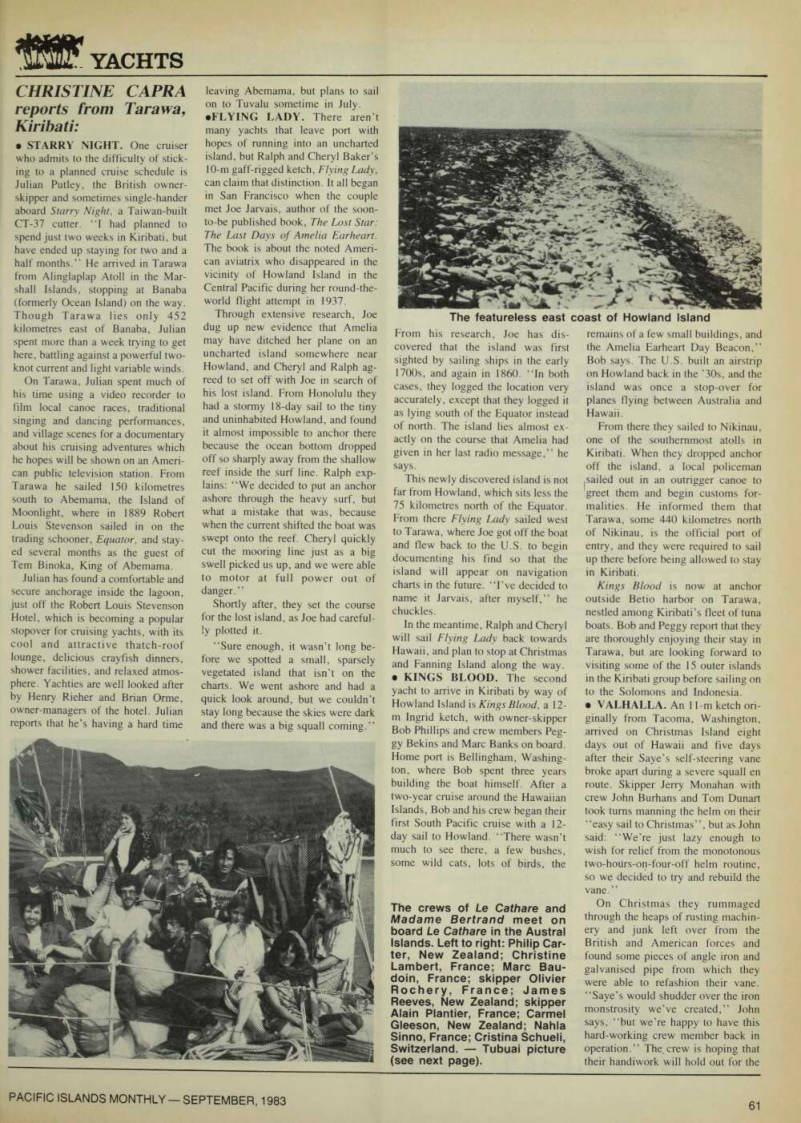
Christine Capra
reports from Tarawa,
Kiribati:
• STARRY NIGHT. One cruiser who admits to the difficulty of stick ing to a planned cruise schedule is Julian Pulley, the British owner skipper and sometimes single-hander aboard Starry Night, a Taiwan-built CT-37 cutter. “I had planned to spend just two weeks in Kiribati, but have ended up staying for two and a half months.” He arrived in Tarawa from Alinglaplap Atoll in the Mar shall Islands, stopping at Banaba (formerly Ocean Island) on the way.
Though Tarawa lies only 452 kilometres east of Banaba, Julian spent more than a week trying to get here, battling against a powerful two knot current and light variable winds.
On Tarawa, Julian spent much of his time using a video recorder to film local canoe races, traditional
singing and dancing performances,
and village scenes for a documentary about his cruising adventures which he hopes will be shown on an Ameri can public television station. From Tarawa he sailed 150 kilometres south to Abemama, the Island of Moonlight, where in 1889 Robert Louis Stevenson sailed in on the trading schooner, Equator, and stay ed several months as the guest of Tern Binoka, King of Abemama.
Julian has found a comfortable and secure anchorage inside the lagoon, just off the Robert Louis Stevenson Hotel, which is becoming a popular stopover for cruising yachts, with its cool and attractive thatch-roof lounge, delicious crayfish dinners, shower facilities, and relaxed atmos phere. Yachties are well looked after by Henry Richer and Brian Orme, owner-managers of the hotel. Julian reports that he’s having a hard time
leaving Abemama, but plans to sail on to Tuvalu sometime in July. •FLYING LADY. There aren’t many yachts that leave port with hopes of running into an uncharted island, but Ralph and Cheryl Baker’s 10-m gaff-rigged ketch, Flying Lady, can claim that distinction. It all began in San Francisco when the couple met Joe Jarvais, author of the soon to-be published book. The Lost Star: The Last Days of Amelia Earheart.
The book is about the noted Ameri can aviatrix who disappeared in the vicinity of Howland Island in the Central Pacific during her round-the world flight attempt in 1937.
Through extensive research, Joe dug up new evidence that Amelia may have ditched her plane on an uncharted island somewhere near Howland, and Cheryl and Ralph ag reed to set off with Joe in search of his lost island. From Honolulu they had a stormy 18-day sail to the tiny and uninhabited Howland, and found it almost impossible to anchor there because the ocean bottom dropped off so sharply away from the shallow reef inside the surf line. Ralph exp lains: “We decided to put an anchor ashore through the heavy surf, but what a mistake that was, because when the current shifted the boat was swept onto the reef. Cheryl quickly cut the mooring line just as a big swell picked us up, and we were able to motor at full power out of
danger. ’ ’
Shortly after, they set the course for the lost island, as Joe had careful ly plotted it.
“Sure enough, it wasn’t long be fore we spotted a small, sparsely vegetated island that isn’t on the charts. We went ashore and had a quick look around, but we couldn’t stay long because the skies were dark and there was a big squall coming.”
From his research, Joe has dis covered that the island was first sighted by sailing ships in the early 1700 s, and again in 1860. “In both cases, they logged the location very accurately, except that they logged it as lying south of the Equator instead of north. The island lies almost ex actly on the course that Amelia had given in her last radio message,” he says.
This newly discovered island is not far from Howland, which sits less the 75 kilometres north of the Equator.
From there Flying Lady sailed west to Tarawa, where Joe got off the boat and flew back to the U.S. to begin documenting his find so that the island will appear on navigation charts in the future. “I’ve decided to name it Jarvais, after myself,” he chuckles.
In the meantime, Ralph and Cheryl will sail Flying Lady back towards Hawaii, and plan to stop at Christmas and Fanning Island along the way. • KINGS BLOOD. The second yacht to arrive in Kiribati by way of Howland Island is Kings Blood, a 12m Ingrid ketch, with owner-skipper Bob Phillips and crew members Peg gy Bekins and Marc Banks on board.
Home port is Bellingham, Washing ton, where Bob spent three years building the boat himself. After a two-year cruise around the Hawaiian Islands, Bob and his crew began their first South Pacific cruise with a 12day sail to Howland. “There wasn’t much to see there, a few bushes, some wild cats, lots of birds, the
remains of a few small buildings, and the Amelia Earheart Day Beacon,”
Bob says. The U.S. built an airstrip on Howland back in the ’3os, and the island was once a stop-over for planes flying between Australia and Hawaii.
From there they sailed to Nikinau, one of the southernmost atolls in Kiribati. When they dropped anchor off the island, a local policeman jailed out in an outrigger canoe to greet them and begin customs for malities. He informed them that Tarawa, some 440 kilometres north of Nikinau, is the official port of entry, and they were required to sail up there before being allowed to stay in Kiribati.
Kings Blood is now at anchor outside Betio harbor on Tarawa, nestled among Kiribati’s fleet of tuna boats. Bob and Peggy report that they are thoroughly enjoying their stay in Tarawa, but are looking forward to visiting some of the 15 outer islands in the Kiribati group before sailing on to the Solomons and Indonesia. • VALHALLA. An 11-m ketch ori
ginally from Tacoma, Washington,
arrived on Christmas Island eight days out of Hawaii and five days after their Saye’s self-steering vane broke apart during a severe squall en route. Skipper Jerry Monahan with crew John Burhans and Tom Dunart took turns manning the helm on their ‘‘easy sail to Christmas”, but as John said: “We’re just lazy enough to wish for relief from the monotonous two-hoilrs-on-four-off helm routine, so we decided to try and rebuild the vane.”
On Christmas they rummaged
through the heaps of rusting machin
ery and junk left over from the British and American forces and found some pieces of angle iron and galvanised pipe from which they were able to refashion their vane.
“Saye’s would shudder over the iron monstrosity we’ve created,” John says, “but we’re happy to have this hard-working crew member back in operation.” The,crew is hoping that their handiwork will hold out for the
The crews of Le Cathare and Madame Bertrand meet on board Le Cathare in the Austral Islands. Left to right: Philip Car ter, New Zealand; Christine Lambert, France; Marc Bau doin, France; skipper Olivier Rochery, France; James Reeves, New Zealand; skipper Alain Plantier, France; Carmel Gleeson, New Zealand; Nahla Sinno, France; Cristina Schueli, Switzerland. - Tubuai picture (see next page).
The featureless east coast of Howland Island
sail to American Samoa, where re placement parts are waiting for them.
This is Jerry’s second Pacific cruise aboard Valhalla, having visited the Tuamotus, Marquesas, and Tahiti, in 1979. On this trip he hopes to include Tonga, Fiji and New Zealand in his cruising itinerary.
Don Travers
reports from Tubuai,
Austral Islands ,
French Polynesia:
• CONGO RED. A 13-m steel ketch from Sweden, Congo Red ar rived from Rarotonga in July with owners/builders Bengt Jacobsson, captain, and Brun Ulfhake, Lars Gollvik, Anders Martenson and Frank Wahmer, all of Sweden.
They left Stockholm on July 1, 1982, on a planned circumnaviga tion, calling at the Canary Islands, Barbados, West Indies, Panama, Galapagos, French Polynesia and the Cook Islands, where they decided to turn back, with plans to sell their yacht in the Virgin Islands. Their return voyage calls for stops at the Gambler Islands, Pitcairn, Easter Is land, Peru, Ecuador and Panama.
• Madame Bertrand. 10-M
plywood sloop of French registry, Madame Bertrand arrived from New Zealand in 16 days with skipper
Alain Plantier and Nahla Sinno, both French, and Cristina Schueli, Swiss.
The pink-painted yacht was built in La Rochelle, France, in 1977, and has since been cruising to Spain, Portugal, Morocco, Senegal, Brazil, West Indies, San Bias Islands, Pana ma, Las Perlas Islands, Galapagos,
Marquesas, Societies, Tonga, Fiji,
and New Zealand. • LE CATHARE. A 12.4-m steel ketch from France arrived from New Zealand with captain Olivier Rochery, and crew Marc Baudoin and Christine Lambert, all three French, and James Reeves, Phil Car ter, and Carmel Gleeson, all three of them from New Zealand. Le Cathare has cruised extensively in the South Pacific, and spent time in New Caledonia before visiting New Zealand.
Both French yachts were in Tubuai for the July 14 festivities, and stayed nearly a month. They left on the same day, in a race for Raiatea.
Neither yacht had firm plans for the future.
Crew of Congo Red visiting Tubuai on a circumnavigation which started from Sweden in July, 1982. Skipper Bengt Jacobsson is second from left.
The French-registered Le Cathare is in the background. - Tubuai picture.
Advertisements & other items, p. 62 (1 item)
Tahiti Samoa ™
PACIFIC ISLANDS
TRANSPORT LINE
M.V. SIRIUS
EXPRESS
CONTAINER
•REEFER
SERVICE
between U.S.
West Coast ports and
TAHITI SAMOA ™
JUO t
Qeqeral Stearqship (Corpora tiori ™ General Agents 400 California Street, San Francisco. CA. USA PAPEETE: Agence Maritime Internationale. Tahiti PAGO PAGO: Polynesia Shipping Services. Inc.
APIA: Burns Philp (South Sea) Company, Ltd.
PAPUA NEW GUINEA
RABAUL: M. & C. Seeto, P.O. Box 131, Rabaul.
Telephone 92 2919.
MADANG: W. Double, P.O. Box 22, Madang.
Telephone 82 2696.
FIJI
K. Witherington Ltd., P.O. Box 293, Suva.
Telephone 22 356.
VANUATU
John Lum & Associates, P.O. Box 65, Santo.
Telephone 329.
SOLOMON ISLANDS
Mr. Tom Lo, P.O. Box 327, Honiara.
Telephone 399
3SEOQaCB
LOCAL AGENTS AND
REPRESENTATION
428 George St., Sydney.
Cables: Henco Sydney.
G.P.O. Box 3949.
Telephone: 232 5377.
For specialised and
personalised buying
service throughout
the Pacific Islands
and the East.
Resident Agents in other Pacific Territories.
Shipping Schedules
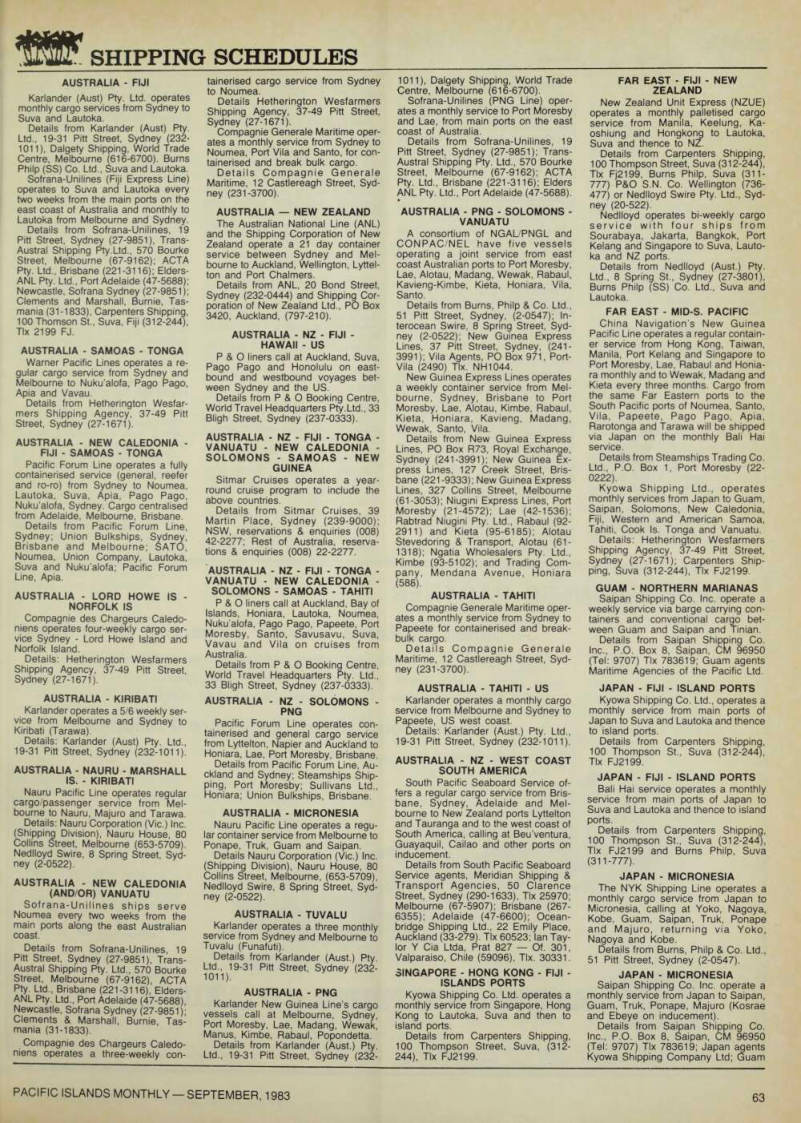
Australia - Fiji
Karlander (Aust) Pty. Ltd. operates monthly cargo services from Sydney to Suva and Lautoka.
Details from Karlander (Aust) Pty.
Ltd., 19-31 Pitt Street, Sydney (232- 1011), Dalgety Shipping, World Trade Centre, Melbourne (616-6700). Burns Philp (SS) Co. Ltd., Suva and Lautoka.
Sofrana-Unilines (Fiji Express Line) operates to Suva and Lautoka every two weeks from the main ports on the east coast of Australia and monthly to Lautoka from Melbourne and Sydney.
Details from Sofrana-Unilines, 19 Pitt Street, Sydney (27-9851), Trans- Austral Shipping Pty.Ltd., 570 Bourke Street, Melbourne (67-9162); ACTA Pty. Ltd., Brisbane (221-3116); Elders- ANL Pty. Ltd., Port Adelaide (47-5688); Newcastle, Sofrana Sydney (27-9851); Clements and Marshall, Burnie, Tas mania (31-1833), Carpenters Shipping, 100 Thomson St., Suva, Fiji (312-244), Tlx 2199 FJ.
Australia - Samoas - Tonga
Warner Pacific Lines operates a re gular cargo service from Sydney and Melbourne to Nukualofa, Pago Pago, Apia and Vavau.
Details from Hetherington Wesfar mers Shipping Agency, 37-49 Pitt Street, Sydney (27-1671).
Australia - New Caledonia -
Fiji - Samoas - Tonga
Pacific Forum Line operates a fully containerised service (general, reefer and ro-ro) from Sydney to Noumea, Lautoka, Suva, Apia, Pago Pago, Nukualofa, Sydney. Cargo centralised from Adelaide, Melbourne, Brisbane.
Details from Pacific Forum Line, Sydney: Union Bulkships, Sydney, Brisbane and Melbourne; SATO, Noumea, Union Company, Lautoka, Suva and Nukualofa; Pacific Forum Line, Apia.
Australia - Lord Howe Is -
Norfolk Is
Compagnie des Chargeurs Caledo niens operates four-weekly cargo ser vice Sydney - Lord Howe Island and Norfolk Island.
Details: Hetherington Wesfarmers Shipping Agency, 37-49 Pitt Street, Sydney (27-1671).
Australia ■ Kiribati
Karlander operates a 5/6 weekly ser vice from Melbourne and Sydney to Kiribati (Tarawa).
Details; Karlander (Aust) Pty. Ltd., 19-31 Pitt Street, Sydney (232-1011).
Australia - Nauru - Marshall
Is. - Kiribati
Nauru Pacific Line operates regular cargo/passenger service from Mel bourne to Nauru, Majuro and Tarawa.
Details: Nauru Corporation (Vic.) Inc. (Shipping Division), Nauru House, 80 Collins Street, Melbourne (653-5709).
Nedlloyd Swire, 8 Spring Street, Syd ney (2-0522).
Australia - New Caledonia
(And/Or) Vanuatu
Sofrana-Unilines ships serve Noumea every two weeks from the main ports along the east Australian coast.
Details from Sofrana-Unilines, 19 Pitt Street, Sydney (27-9851), Trans- Austral Shipping Pty. Ltd., 570 Bourke Street, Melbourne (67-9162), ACTA Pty. Ltd., Brisbane (221-3116), Elders- ANL Pty. Ltd., Port Adelaide (47-5688), Newcastle, Sofrana Sydney (27-9851); Clements & Marshall, Burnie, Tas mania (31-1833).
Compagnie des Chargeurs Caledo niens operates a three-weekly con
tainerised cargo service from Sydney to Noumea.
Details Hetherington Wesfarmers Shipping Agency, 37-49 Pitt Street, Sydney (27-1671).
Compagnie Generale Maritime oper ates a monthly service from Sydney to Noumea, Port Vila and Santo, for con tainerised and break bulk cargo.
Details Compagnie Generale Maritime, 12 Castlereagh Street, Syd ney (231-3700).
Australia New Zealand
The Australian National Line (ANL) and the Shipping Corporation of New Zealand operate a 21 day container service between Sydney and Mel bourne to Auckland, Wellington, Lyttel ton and Port Chalmers.
Details from ANL, 20 Bond Street, Sydney (232-0444) and Shipping Cor poration of New Zealand Ltd., PO Box 3420, Auckland, (797-210).
Australia - Nz - Fiji -
Hawaii - Us
P&O liners call at Auckland, Suva, Pago Pago and Honolulu on east bound and westbound voyages bet ween Sydney and the US.
Details from P&O Booking Centre, World Travel Headquarters Pty.Ltd., 33 Bligh Street, Sydney (237-0333).
AUSTRALIA - NZ - FIJI - TONGA -
Vanuatu - New Caledonia -
Solomons - Samoas - New
Guinea
Sitmar Cruises operates a year round cruise program to include the above countries.
Details from Sitmar Cruises, 39 Martin Place, Sydney (239-9000); NSW, reservations & enquiries (008) 42-2277; Rest of Australia, reserva tions & enquiries (008) 22-2277.
AUSTRALIA - NZ - FIJI - TONGA -
Vanuatu - New Caledonia -
Solomons - Samoas - Tahiti
P&O liners call at Auckland, Bay of Islands, Honiara, Lautoka, Noumea, Nukualofa, Pago Pago, Papeete, Port Moresby, Santo, Savusavu, Suva, Vavau and Vila on cruises from Australia.
Details from P&O Booking Centre, World Travel Headquarters Pty. Ltd., 33 Bligh Street, Sydney (237-0333).
Australia - Nz - Solomons -
Png
Pacific Forum Line operates con tainerised and general cargo service from Lyttelton, Napier and Auckland to Honiara, Lae, Port Moresby, Brisbane.
Details from Pacific Forum Line, Au ckland and Sydney; Steamships Ship ping, Port Moresby; Sullivans Ltd., Honiara; Union Bulkships, Brisbane.
Australia - Micronesia
Nauru Pacific Line operates a regu lar container service from Melbourne to Ponape, Truk, Guam and Saipan.
Details Nauru Corporation (Vic.) Inc. (Shipping Division), Nauru House, 80 Collins Street, Melbourne, (653-5709), Nedlloyd Swire, 8 Spring Street, Syd ney (2-0522).
Australia - Tuvalu
Karlander operates a three monthly service from Sydney and Melbourne to
Tuvalu (Funafuti).
Details from Karlander (Aust.) Pty.
Ltd., 19-31 Pitt Street, Sydney (232- 1011).
Australia - Png
Karlander New Guinea Line’s cargo vessels call at Melbourne, Sydney, Port Moresby, Lae, Madang, Wewak, Manus, Kimbe, Rabaul, Popondetta.
Details from Karlander (Aust.) Pty.
Ltd., 19-31 Pitt Street, Sydney (232-
1011), Dalgety Shipping, World Trade Centre, Melbourne (616-6700).
Sofrana-Unilines (PNG Line) oper ates a monthly service to Port Moresby and Lae, from main ports on the east coast of Australia.
Details from Sofrana-Unilines, 19 Pitt Street, Sydney (27-9851); Trans- Austral Shipping Pty. Ltd., 570 Bourke Street, Melbourne (67-9162); ACTA Pty. Ltd., Brisbane (221-3116); Elders ANL Pty. Ltd., Port Adelaide (47-5688).
Australia - Png - Solomons -
Vanuatu
A consortium of NGAL/PNGL and CONPAC/NEL have five vessels operating a joint service from east coast Australian ports to Port Moresby, Lae, Alotau, Madang, Wewak, Rabaul, Kavieng-Kimbe, Kieta, Honiara, Vila, Santo.
Details from Burns, Philp & Co. Ltd., 51 Pitt Street, Sydney, (2-0547); In terocean Swire, 8 Spring Street, Syd ney (2-0522); New Guinea Express Lines, 37 Pitt Street, Sydney, (241- 3991); Vila Agents, PO Box 971, Port- Vila (2490) Tlx. NH1044.
New Guinea Express Lines operates a weekly container service from Mel bourne, Sydney, Brisbane to Port Moresby, Lae, Alotau, Kimbe, Rabaul, Kieta, Honiara, Kavieng, Madang, Wewak, Santo, Vila.
Details from New Guinea Express Lines, PO Box R 73, Royal Exchange, Sydney (241-3991); New Guinea Ex press Lines, 127 Creek Street, Bris bane (221-9333); New Guinea Express Lines, 327 Collins Street, Melbourne (61-3053); Niugmi Express Lines, Port Moresby (21-4572); Lae (42-1536); Rabtrad Niugini Pty. Ltd., Rabaul (92- 2911) and Kieta (95-6185); Alotau Stevedoring & Transport, Alotau (61- 1318); Ngatia Wholesalers Pty. Ltd., Kimbe (93-5102); and Trading Com pany, Mendana Avenue, Honiara (588).
Australia - Tahiti
Compagnie Generale Maritime oper ates a monthly service from Sydney to Papeete for containerised and break bulk cargo.
Details Compagnie Generale Maritime, 12 Castlereagh Street, Syd ney (231-3700).
Australia - Tahiti - Us
Karlander operates a monthly cargo service from Melbourne and Sydney to Papeete, US west coast.
Details: Karlander (Aust.) Pty. Ltd., 19-31 Pitt Street, Sydney (232-1011).
Australia - Nz - West Coast
South America
South Pacific Seaboard Service of fers a regular cargo service from Bris bane, Sydney, Adelaide and Mel bourne to New Zealand ports Lyttelton and Tauranga and to the west coast of South America, calling at Beu’ventura, Guayaquil, Cailao and other ports on inducement.
Details from South Pacific Seaboard Service agents, Meridian Shipping & Transport Agencies, 50 Clarence Street, Sydney (290-1633), Tlx 25970; Melbourne (67-5907); Brisbane (267- 6355); Adelaide (47-6600); Ocean bridge Shipping Ltd., 22 Emily Place, Auckland (33-279). Tlx 60523; lan Tay lor Y Cia Ltda, Prat 827 Of. 301, Valparaiso, Chile (59096), Tlx. 30331.
SINGAPORE - HONG KONG - FIJI -
Islands Ports
Kyowa Shipping Co. Ltd. operates a monthly service from Singapore, Hong Kong to Lautoka, Suva and then to island ports.
Details from Carpenters Shipping, 100 Thompson Street, Suva, (312- 244), Tlx FJ2199.
Far East - Fiji - New
Zealand
New Zealand Unit Express (NZUE) operates a monthly palletised cargo service from Manila, Keelung, Ka oshiung and Hongkong to Lautoka, Suva and thence to NZ.
Details from Carpenters Shipping, 100 Thompson Street, Suva (312-244), Tlx Fj2199, Burns Philp, Suva (311- 777) P&O S.N. Co. Wellington (736- 477) or Nedlloyd Swire Pty. Ltd., Syd ney (20-522).
Nedlloyd operates bi-weekly cargo service with four ships from Sourabaya, Jakarta, Bangkok, Port Kelang and Singapore to Suva, Lauto ka and NZ ports.
Details from Nedlloyd (Aust.) Pty.
Ltd., 8 Spring St., Sydney (27-3801), Burns Philp (SS) Co. Ltd., Suva and Lautoka.
Far East - Mid-S. Pacific
China Navigation’s New Guinea Pacific Line operates a regular contain er service from Hong Kong, Taiwan, Manila, Port Kelang and Singapore to Port Moresby, Lae, Rabaul and Honia ra monthly and to Wewak, Madang and Kieta every three months. Cargo from the same Far Eastern ports to the South Pacific ports of Noumea, Santo, Vila, Papeete, Pago Pago, Apia, Rarotonga and Tarawa will be shipped via Japan on the monthly Bali Hai service.
Details from Steamships Trading Co.
Ltd., P.O. Box 1, Port Moresby (22- 0222).
Kyowa Shipping Ltd., operates monthly services from Japan to Guam, Saipan, Solomons, New Caledonia, Fiji, Western and American Samoa, Tahiti, Cook Is. Tonga and Vanuatu.
Details: Hetherington Wesfarmers Shipping Agency, 37-49 Pitt Street, Sydney (27-1671); Carpenters Ship ping, Suva (312-244), Tlx FJ2199.
Guam - Northern Marianas
Saipan Shipping Co. Inc. operate a weekly service via barge carrying con tainers and conventional cargo bet ween Guam and Saipan and Tinian.
Details from Saipan Shipping Co.
Inc., P.O. Box 8, Saipan, CM 96950 (Tel: 9707) Tlx 783619; Guam agents Maritime Agencies of the Pacific Ltd.
Japan - Fiji - Island Ports
Kyowa Shipping Co. Ltd., operates a monthly service from main ports of Japan to Suva and Lautoka and thence to island ports.
Details from Carpenters Shipping, 100 Thompson St., Suva (312-244), Tlx FJ2199.
Japan - Fiji - Island Ports
Bali Hai service operates a monthly service from main ports of Japan to Suva and Lautoka and thence to island ports.
Details from Carpenters Shipping, 100 Thompson St., Suva (312-244), Tlx FJ2199 and Burns Philp, Suva (311-777).
Japan - Micronesia
The NYK Shipping Line operates a monthly cargo service from Japan to Micronesia, calling at Yoko, Nagoya, Kobe, Guam, Saipan, Truk, Ponape and Majuro, returning via Yoko, Nagoya and Kobe.
Details from Burns, Philp & Co. Ltd., 51 Pitt Street, Sydney (2-0547).
Japan - Micronesia
Saipan Shipping Co. Inc. operate a monthly service from Japan to Saipan, Guam, Truk, Ponape, Majuro (Kosrae and Ebeye on inducement).
Details from Saipan Shipping Co.
Inc., P.O. Box 8, Saipan, CM 96950 (Tel: 9707) Tlx 783619; Japan agents Kyowa Shipping Company Ltd; Guam
Agents Maritime Agencies of the Pacif ic Ltd.
Japan - Png
Mitsui O.S.K. Lines operates a monthly service from main ports Japan and Port Moresby, Rabaul, Lae, Madang, Kieta and Kimbe.
Details from Robert Laurie (PNG) Pty. Ltd., PO Box 922, Port Moresby (21-2466/21-1898).
New Caledonia - Fiji - West
Coast North America
PAD Line operates an approx. 3weekly ro-ro service from Noumea and Suva to Honolulu and West Coast USA and Canadian ports.
Details from Sofrana-Unilines SA, BP 1602, Noumea (27-51-91), Tlx NMO4B; Carpenters Shipping, 100 Thompson St., Suva (312-244), Tlx FJ2199.
Png - Inter - Mainport
Papua New Guinea Line offers scheduled 10-20 day coastal liner ser vices linking all PNG major ports with containerisation, reefer, heavy lift and transhipment facilities.
Details from PNG Line, Box 543, Port Moresby, PNG (21-1174), Tlx 22269.
Png- Uk/Continent
The Bank Line & Columbus Line operate a regular joint service from Port Moresby, Oro Bay, Kieta, Rabaul, Kimbe, Madang and Lae to Hull, Ham burg, Rotterdam, Antwerp and Le Havre.
Details from The Bank Line (A'asia) Pty. Ltd., 51 Pitt Street, Sydney (27- 2041); Tlx AA 24063; Columbus Line, Lae (423466) Tlx NE 44171; or lines’ local agents.
Solomons - Uk/Continent
The Bank Line & Columbus Line operate a regular joint cargo service from Honiara to Hull, Hamburg, Rotter dam, Antwerp,and Le Havre.
Details from The Bank Line (A’asia) Pty. Ltd., 51 Pitt Street, Sydney (27- 2041); Tlx AA 24063; Columbus Line, Lae (423466) Tlx NE 44171; or the lines’ local agents.
New Zealand - Vanuatu -
Solomon Islands • Papua New
Guinea - Australia
Pacific Forum Line operates a 28 day cycle container shipping service from New Zealand direct to Vila, then on to Honiara, Lae, Port Moresby, Brisbane, back to Lyttelton, Napier and Auckland.
Details from Pacific Forum Line, PO Box 796, Auckland (790-050) Tlx 60480; ADC House, 189 Kent Street, Sydney (27-1077/27-1078) Tlx 25301; PO Box 971, Vila, Vanuatu (2490) Tlx 1044.
NZ - COOK IS - NIUE - TAHITI Shipping Corporation of NZ Ltd. op erates cargo services based on pallets and similar units from Auckland to Niue, Cook Islands and Tahiti.
Details from the Shipping Corp. of NZ Ltd., PO Box 3420, Auckland (797- 210). Waterfront Commission, PO Box 61, Rarotonga: Cook Islands: Niue Govt. Offices, Niue Island Compagnie Maritime Polynesienne, BP 368, Papeete, Tahiti.
New Zealand - Tahiti
Pacifique Polynesie Line operates a monthly service carrying general and freezer cargoes to Papeete and outly ing islands in the group.
Details from McKay Shipping Ltd.,
PO Box 1372. Auckland, (30229), Tlx 2554 NZ.
Nz - Fiji
Reef operates a regular 18-day ser vice from Auckland to Suva and Lautoka.
Details from Reef Shipping Agen cies, PO Box 3382, Auckland, NZ (77- 1221-3); M.V. Fijian Shipping Agencies Ltd., Private Bag, Suva, Fiji (31-1056).
Pacific Line with one ship operates fortnightly ro-ro cargo service New Zealand, Lautoka, Suva.
Details: Sofrana Unilines, 18 Cus toms Street, Auckland (773-279) PO Box 3614, Telex: NZ2313; Carpenters Shipping, 100 Thompson Street, Suva (312-244), Tlx FJ2199.
NZ - FIJI - NORTH AMERICA (WC) Blue Star Line Ltd. Pacific Coast container services. Only direct service to and from New Zealand. Blue Star vessels call at Suva and Honolulu on NZ-US-West Coast voyages.
Details from Blueport ACT (NZ) Ltd., PO Box 192, Wellington (739-029), Burns Philp (SS) Co. Ltd., GPO Box 355, Suva, Fiji (311-777), Tlx. FJ2168 Burship.
NZ - FIJI - SAMOAS - TONGA Pacific Forum Line operates a fully containerised three-weekly service (Gen/Reefer) from Auckland to Lauto ka, Suva, Apia, Pago Pago and Nuku'alofa.
Details from Pacific Forum Line, Auckland: Union Co. Auckland, Lauto ka, Suva and Nuku’alofa; Pacific Forum Line, Apia.
NZ - N. CALEDONIA - VANUATU -
Png - Solomons
Sofrana Unilines with three ships operates to Vila and Santo, to Honiara
and Papua New Guinea and to Norfolk Island and Noumea.
Details from Sofrana Unilines, 18 Customs Street, Auckland (773-279), PO Box 3614, Tlx. NZ2313.
Nz Tahiti
Compagnie Tahitienne Maritime SA (as CTM-Tahiti Line) operates one ship, MV Bounty 111, monthly Papeete New Zealand.
Details from Sofrana Unilines, PO Box 3614, 18 Customs St., Auckland Tlx NZ2313; Agence Maritime Cowan, PO Box 9012, Papeete (39042), Tlx Tahitlin 322 FP Tahiti).
Nz - Tonga - Samoas
Warner Pacific Line services Auck land, Nukualofa, Vavau, Apia, Pago Pago fortnightly carrying general and freezer cargoes.
Details from McKay Shipping Ltd., Downtown House, 21 Queen St., Auck land, PO Box 1372 (30-299). Cables MACSHIP, Telex NZ2554, Warner Pacific Line, Box 93, Nukualofa, Ton ga; Mealelei (Western Samoa) Ltd.
Box 4171, Apia, Western Samoa, Kneubuhl Maritime Services, Box 39, Pago Pago, American Samoa, 96799.
Nz - New Caledonia
CP Line operates a monthly cargo service from Auckland, Lyttelton, Napier and Mt. Maunganui to Noumea.
Details from McKay Shipping Ltd., PO Box 1372, Auckland (9-30229); Tlx 2554 NZ.
Europe - Tahiti -
New Caledonia
Compagnie Generale Maritime oper ates services from Europe and Mediterranean ports to Papeete and Noumea using three ro-ro and multi
purpose vessels thus ensuring a bi monthly sailing to and from.
Details Compagnie Generale Maritime, 12 Castlereagh Street, Syd ney (231-3700).
Europe - Tahiti - New
Caledonia - New Zealand -
Solomons - Png - Europe
Polish Ocean Lines offers regular monthly sailings for containerised and breakbulk cargo and reefer space, con ventional and in reefer containers, from Hamburg, Antwerp, Dunkirk and Rouen to Papeete, Noumea, New Zea land, Honiara, Lae, Manila and Singa pore, returning to Europe via Suez.
Other ports in the South Pacific can be served with inducement.
Details from Sotama, BP 9170, Papeete (27805), Tlx. 296; SATO, BP C 2, Noumea (272094), Tlx. 163 NM SATO; Union Steamship Co of NZ, PO Box 50, Apia, Tlx. 25; Williams and Gosling, PO Box 79, Suva (312633), Tlx. 2163; Warner Pacific Line, PO Box 93, Nukualofa (21089), Tlx. 66219; Universal Shipping Agencies, PO Box 2282, Auckland (30930), Tlx. 21517.
EUROPE - TAHITI - W. SAMOA -
Fiji - N. Caledonia
Nedlloyd offers regular cargo ser vices from Northern Europe and U.K. to Papeete, Apia, Fiji and New Caledonia.
Details Nedlloyd (Aust.) Pty. Ltd., 8 Spring Street, Sydney (27-3801); Car penters Shipping, 100 Thomson St., Suva (312-244), Tlx. 2199 FJ and Vetari Street, Lautoka (63988), Tlx. 5215FJ.
UK - N. CONTINENT - W. SAMOA -
Tonga - Fiji
The Bank Line & Columbus Line operate a regular joint cargo service from Hull, Hamburg, Bremen, Antwerp, Rotterdam and Le Havre to Apia, Nukualofa, Suva and Lautoka.
Details from The Bank Line (A’asia) Pty, Ltd., 51 Pitt Street, Sydney (27- 2041); Tlx AA 24063; Columbus Line, Lae (423466) Tlx NE 44171; or lines’ local agents.
UK ■ N. CONTINENT - PNG -
Solomons
The Bank Line & Columbus Line operate a regular joint cargo service from Hull, Hamburg, Bremen, Antwerp, Rotterdam and Le Havre to Port
Moresby, Lae, Madang, Kimbe,
Rabaul, Kieta and Honiara and on inducement to Yandina.
Details from The Bank Line (A’sia) Pty. Ltd., 51 Pitt Street, Sydney (27- 2041); Tlx AA 24063; Columbus Line, Lae (423466) Tlx NE 44171; or lines’ local agents
Uk/N. Continent -
Tahiti -
N. Caledonia - Vanuatu
The Bank Line & Columbus Line operate a regular joint cargo service from Hull, Hamburg, Bremen, Antwerp, Rotterdam and Le Havre to Papeete, Noumea, Port-Vila and Santo.
Details from The Bank Line (A’asia) Pty. Ltd., 51 Pitt Street, Sydney (27- 2041); Tlx AA 24063; Columbus Line, Lae (42-3466) Tlx NE 44171; Ets A M.
Fare UTE, Papeete; Ets. Ballande, Noumea and other local agents.
US - FIJI ■ TAHITI - NZ -
Australia
The Bank Savill Line Ltd. operates regular cargo services from U.S. Gulf ports to Australia and N.Z, Calls at Suva, Lautoka and Papeete on demand.
Details from The Bank and Savill Line Ltd., 51 Pitt Street, Sydney (27- 2041) or Orient Shipping Services, 32 Bridge Street, Sydney (241-2753).
U.S. - Hawaii - Kiribati -
Micronesia
Philippines, Micronesia & Orient Navigation Co. (PM&O Lines) operates regular container service on selfsus tained ship with ro-ro capabilities from Oakland, Portland and Honolulu to Tarawa, Ebeye, Majuro, Kosrae, Ponape, Truk, Saipan, Yap and Koror.
Details for Micronesia can be ob tained from Larry Guerrero, PM&O Owners Rep. PO Box 803, Saipan, Ml 96950, Cable COMMONTIME, Tlx 783605; PM&O; PM&O Lines, 181 Fremont St., San Francisco, California 94-105, Cable PMONAV.
US - HAWAII - MICRONESIA - E.
Malaysia - Brunei
PM&O Lines operates two fully self sustained container vessels monthly from San Francisco, Los Angeles and Honolulu (via transshipment at Majuro) to Ebeye, Kosrae, Ponape, Truk, Saipan, Yap, Koror, Kota Kinabalu, Labaun and Muara. Note: service to Majuro and Ebeye from Hawaii is not offered.
Details: PM & O Lines, 181 Fremont Street, San Francisco, California 94- 105, USA. (543-7430) Tlx 278016/CABLE PMONAV; Larry Guer rero, PM & O Owners Rep. P.O. Box 803, Saipan, Ml 96950. Cable COM
Montime. Tlx 783605.
Us - Hawaii - Nauru -
Micronesia
Nauru Pacific Line operates regular conventional container and passenger service from San Francisco and Hon olulu to Majuro, Ponape, Truk and Saipan. Cargo is accepted for Nauru and Kosrae with transhipment at Maj uro and Ponape.
Details from Nauru Corporation (Vic.) Inc. (Shipping Division), Nauru House, 80 Collins Street, Melbourne (653-5709); Nauru Air and Shipping Agency, Suite 2803, 185 Berry Street, San Fransisco, California 94107 (415- 543-1737); Nauru Air and Shipping Agency, Suite 506, 841 Bishop St., Honolulu, HI 96813 (808-523-0441).
Hawaii - Tahiti - Samoas
Marshall Islands Maritime Co oper ates a service every 32 days between Honolulu, Papeete, Pago Pago and Apia.
Details from the Maritime Co. of the Pacific, 567 South King Street, Suite 310, Honolulu, Hawaii, Morris Hed strom, Box 189, Apia, Western Samoa and the Marshall Islands Maritime Co., Box 679, Majuro, Marshall Islands.
Us - Noumea - Fiji
PAD Line operates an approx. 3weekly ro-ro service from west coast USA and Canada to Noumea, Suva and Lautoka.
Details from Sofrana-Unilines SA, BP 1602, Noumea (27-51-91), Tlx.
NMO4B; Carpenters Shipping, Harbour Centre, Thompson Street, Suva (31- 2244), Tlx. FJ2199; Trans-Austral Shipping Pty. Ltd., PO Box R 232, Roy al Exchange, 2000 (231-8411), Tlx.
AA21204.
Us - Tahiti - Samoa
Pacific Islands Transport operates a five weekly cargo service from North America west coast ports to Papeete, Pago Pago, Apia.
Details from Polynesia Shipping Ser vices Inc. PO Box 1478, Pago Pago 96799.
Polynesia Line operates container and general cargo service from US west coast ports to Papeete and Pago Pago.
Details from Polynesia Shipping Ser vices Inc., PO Box 1478, Pago Pago 96799.
Advertisements & other items, p. 64 (1 item)
Kyowa Shipping Co., Ltd.
YOUR BUSINESS PARTNER
Japan S. Korea Taiwan Singapore Hong Kong To: Solomon Is., New Caledonia, Fiji, W. Samoa, A. Samoa, Tahiti, Cook Is., Tonga, Vanuatu, Tuvalu. Nauru To: Guam, Saipan, Truk, Ponape, Majuro, Yap, Koror al
Taiwan Hong Kong Singapore Philippines
To: Papua New Guinea, Pacific Islands. * * Hi k * f* i. -r
KYOWA
KYOWA SHIPPING CO., LTD.
HEAD OFFICE: OSAKA OFFICE;
sth FI, Suzumaru Bldg. 39-8, 2-chome, Nishi-Shinbashi. Minato-ku, Tokyo, Japan Okajima Bldg., 7th Floor, 2-I 4 l-choma. ' ku - Ssjosa , Phone: 03(437)2885 (Rep ) Cables: “MARIQUEEN" Tokyo. Telex : 242-4651 Kyowa J. Phone: 06(533)5821 (Rep.) Cables: MARIQUEEN Osaka Telex . 525 6271 Ss
DEATHS of Islands People
Tupua Tamasese Lealofi IV At Matautu, Upolu Island, West ern Samoa, on July 9, aged 61.
Tupua, prime minister of Western Samoa from 1970 to 1973 and for a short spell in 1975 and 1976, was born in Apia on May 8, 1922. His father was the legendary Tamasese who was the leader of the Mau Movement against the New Zealand ad ministration of the 1920 s and who was imprisoned by the ad ministration for almost a year in New Zealand and subsequently killed by New Zealand police during the so-called Black Satur day incident in 1929.
Tupua was educated at the Marist Brothers School at Mulivai and at Malifa High School. He subsequently attend ed the Fiji School of Medicine from 1940 to 1945 from which he graduated as a medical practitioner.
After graduation, he served as a doctor with the Western Sa moan Health Department until 1969.
In 1965, Tupua succeeded to the Tupua Tamasese title, one of the four Tama Aiga (Royal Families) titles of Western Samoa, and as such was qual ified to be a member of the Council of Deputies. He was duly appointed a member in July 1968.
However, he resigned his pos ition to run for parliament in 1970 for the territorial consti tuency of Lufilufi and Falefa.
He easily won the seat and, in parliament, combined forces with his cousin Tupuola Efi to snatch the prime minister’s post from the legendary Mataafa.
However, in 1973 Tupua lost to Mataafa but Mataafa appoint ed Tupua as Minister of Justice, the position he held until Mataafa’s death in 1975. Tupua was then called upon by the Head of State to continue Mataafa’s term.
In 1976, Tupuola Efi decisive ly defeated Tupua in the par liamentary election for prime minister. Shortly after, Tupua resigned his parliamentary seat to once again become a member of the Council of Deputies, a posi tion greatly upgraded in pay and privilege by the new government.
In his last days, he made peace with all the members of his fami
ly, friends and acquaintances and gave instructions about family affairs and funeral arrangements.
For example, he wanted Western Samoa’s High Commissioner to New Zealand, Feesago S.
Fepuleai, to make the eulogy on his behalf.
On Sunday, July 10, a parade led by the chiefs and orators of the Tama Aiga’s families and police brought Tupua’s coffin to the Mulivai cathedral.
Police pallbearers carried the coffin followed by Tupua’s wife, Masiofo Rita, sister Suilolo A.
Leavasa, and relatives.
The route from Malaeomatagofie to Mulivai was lined by school children and members of organisations in their various uniforms.
Cardinal Pio Taofmuu con ducted the Mass. Prime Minister Tofilau, High Commissioner Feesago and Masiofo Rita made the eulogies.
After Mass, another slow pro cession headed for Tiafau to the burial ground of the Tupua Tamasese family where the final rites were performed.
Sir Philip Strong
In Wangaratta, Victoria, Aust ralia, in July, aged 83.
Sir Philip Strong was a former Bishop of New Guinea, and later the Anglican Primate of Australia.
He was consecrated and en throned as Bishop of New Guinea in 1936. He remained bishop of the diocese until his election to the archbishopric of Brisbane in 1962.
Sir Philip refused to tell his missionaries to leave the country during the Japanese invasion. As the Japanese troops landed, he told Anglican missionaries: “The histroy of the Church tells us that missionaries do not think of themselves in danger and crisis, but of the master who called them to give their all, and of the people whom he trusts them to serve and love to the uttermost. . .
“We shall not leave. We shall stay by our trust. We shall stand by our vocation. We do not know what it may mean to us. Many already think us fools and mad. what does that matter?”
Controversy over his stand at that time has continued over the years.
Peter Plowman In Apia in July, aged 80.
Tasmanian-bom Peter Plow man began his long association with the Pacific Islands when he
managed plantations in Solomon
Islands and the then New Heb rides in the 1920 s and ’3os.
After a period in Sydney in the late ’3os, he joined the Royal Australian Navy in 1940, and saw service both with that force and with the Royal Navy in many theatres during World War 11,
specialising in explosives
disposal.
He first went to Apia in 1947, as manager for A. G. Smyth & Co. Ltd., and later in business on his own account as importer and exporter, and Customs and ship
ping agent.
He was elected to the Legisla tive Assembly of Western Samoa in 1954, and served in various
capacities until retiring from
politics in 1966. During his polit
ical career he formed a close friendship with the first Prime Minister of Independent Western Samoa, Mataafa.
From 1966 he served as chair man of the Apia Harbor Board.
Among his many hobbies was an unusual and highly skilled
activity; building billiard tables.
0 Mr Plowman s last letter to PIM appears in “Letters”, this issue.
Ray Smith
At Bonriki, Kiribati, in June, drowned while swimming on the ocean reef.
A British technical co operation officer, Mr Smith had been training local plumbers in Kiribati since 1978.
Jack Bolton Bailey In Sydney in June, aged 73.
Mr Bailey began his working
life with W. R. Carpenter in Papua New Guinea, and in 1935 established Southern Pacific In surance Co. Ltd., which con ducted business extensively throughout Australia, PNG, and
Fiji.
In 1975, following his retire ment, he accepted an appoint ment as chief representative of the Zurich-based Union Reinsur ance Company in Australia and the Pacific Islands.
He will be greatly missed by
friends and colleagues who have known him over so many years.
Martin Palisi.
George A. Feigen
George A. Feigen, who wasrpro fessor of physiology at Stanford Medical School, died at Stan ford, California, USA, on May 22, 1983, aged 66. With his wife Priscilla he first came to Sol omon Islands in 1972 to visit a friend, Alistair Macbeth, who was then headmaster of the King George VI School in Honiara.
On that visit he met Father Nor man Arkwright who was stationed at Buma on Malaita.
After Mr Macbeth left to return home to England the Feigens made two more visits to the Solomons and kept in close touch with Father Norman and his col leagues at St Joseph’s School, Tenaru, where he now teaches.
George Feigen loved the Sol omons and the people he met there, many of them students at KG VI, and he will also be remembered by the staff at Bu ma. The Feigens were planning another trip to the Solomons in September of this year.
Advertising
Index
Aggie Grey’s 50 Amatil 42 Antelope Engineering 28 Asia Tonga Trading 66 Atlantic Trading 58 Bank Line 67 Besco Jarwil 24 British Aerospace 68 Captain Kennedy 58 Columbus Line 67 Faafetaal Holdings 59 Gatman 46 GO-BA Enterprises 66
God’s Way 66 Gow 32 Henry Cumines 62 Hitachi 2 Hudson Homes 46
Imel 4
Journal Pacific History 44 Korevaar Marine 58 Kyowa Shipping 64 Laurie Douglas 57 Lincoln Electric 40 Look Films 36 MacQuarrie Industries 50 Mainzeal 57 Matsushita 22 New Zealand Dairy 38 Nissan Datsun 16 NQEA Engineering 48
Pacific Economics 66 Papua Hotel 50 Paling Industries 10 Pacific Telecoms Council .. 57 Parker Pen 56 Pioneer 26 P.I.T. Line 62 QBE Insurance 54 Robert Laurie-Carpenters... 60 Roncaglia 20 Saints Church 66 Sansui Electric 30 Suzuki Marine 52 Suzuki Motor 12 Toyota 34, 35 Trio Kenwood 8 Vanua Navigation 48 Vanuatu Government 58
Advertisements & other items, pp. 66-68 (2 items)
Etandh
gaflilaai
PACIFECON SURVEY
Reports every third Monday on new construction projects in 25 markets from N.Z. to Hawaii & P N G. to Pitcairn. Interested? Per details contact: Peter O’Hara Pacific Economics Pty Ltd PO Box A 771, Sydney South
NSW 2000
Tel: (02) 231 6570 otherwise 233 7243 Telex: AA70537 TWENTY Cables “MARKSTAT”
Freely
Given
A true understanding of God's Word.
If you have been search ing for the true meaning, of the Scriptures this free monthly booklet is for you.
Write to God's Way P.O. Box 41, North Ryde, Australia 2113
REQUIRE
DRIED SHARK FINS
FOR PRICES AND
INFORMATION ETC.,
PLEASE WRITE TO;
S. DADDOW,
ASIA TONGA TRADING.
7 KASAI ROAD.
REPUBLIC OF SINGAPORE,
2880.
CABLE: "ASIATONGA"
MOTEL
PURCHASE
Australian interested to receive details of small motel for purchase in Fiji.
Contact Len Elliott, The Hill, Exeter,
NSW, 2580.
Phone (048) 83-4385.
Etandh
Our theme for the ’Bos is “Faith to Grow”. If you or your group would like to “grow your faith” in association with a world-wide fellowship of concerned Christians, share with us in exploring responses to the needs of today, and make preparation for the 21st century. Contact:
JOE POTTER
22 Plunket Avenue, Papatoetoe, Auckland, N.Z.
Proven Easy
MONEYMAKING
opportunities Supplement your income or get rich quick. Parttime or full time.
Beginners welcome.
Details: GO-BA Enterprises Box 1868 Boroko, Ste. Pim Papua New Guinea
gSsleljs
s » % 2 . * f IT ummmmt *•*' ®jmn .•* «• » 1 ■ tl M (ii i n
HATCH*
STOP
0630*®® 15TH
COP^S
"s.iiflg*gS
«ow*
TftiVST^-
taf®
gSsleljs
RGBS
EUROPE-SOUTH PACIFIC JOINT SERVICE
The South Pacific Specialists offer facilities for shipment of: Containers (FCL/LCL) and Breakbulk Cargo plus reefer space and deeptanks for carriage of vegetable oils and other liquid bulk cargo.
Carriers also accept heavy lifts, overlength and cumbersome parcels.
Ports of Service: Loading: Papeete, Apia, Suva, Lautoka, Noumea, Port Vila, Santo, Honiara, Port Moresby, Lae,Madang, Kimbe, Rabaul, Kieta, Darwin.
For: Rotterdam, Antwerp, Hamburg, Hull, Dunkirk, Le Havre.
Please contact our regional offices for further information: The Bank Line (Australasia) Pty. Ltd.
Suite 801,51 Pitt Street Sydney N.SW. 2000 Phone: 27 2041 Telex: 24063 Additional ports on enquiry.
P.O. Box 1667 Lae/Papua New Guinea Phone: 423 466/423 487 A.H. 422481 Telex: CollineNE 44171
THE BANK LINE LTD LONDON
COLUMBUS LINE REEDEREI GMBH HAMBURG
I— ... pn.„ ,-Jl proL. uf
experience with Super 148
Nearly 4 million hours of operating experience in just about every conceivable short-haul environment prove that Super 748 offers seat-mile costs as low as 10.65 cents per nautical mile. More than 350 earlier versions of 748 have built up this experience with some 80 operators in 50 different countries. Super 748 adds the latest flight-deck technology and other advances to this proven basic engine/airframe combination, with its known operating and maintenance costs, outstanding airfield performance, reliability and passenger appeal.
Even if projected new-technology turboprops in the 40/50seat category achieve their hoped-for economics and performance, the inevitable processes of escalation will ensure that, when they enter service, their seat-mile costs will still be higher than those of Super 748. And a Super 748 purchased now will be building traffic and putting profits in your bank well before the new-technology turboprops have proved themselves.
Super 748 the proven facts ■ less than 1 maintenance man-hour per flying hour, contributing to operating costs equivalent to only 10.65 cents per seat-nautical mile. ■ outstanding airfield performance. ■ ability to operate multi-stop routes without refuelling. ■ environmental noise levels already well below all existing and proposed international noise standards. ■ pressurised, air-conditioned cabin with full service amenities and reclining seats and ample leg-room for 48 passengers, overhead luggage bins and 6.6 cu ft of baggage-hold space per passenger. ■ worldwide technical support organisation proven over 20 years of 748 operation.
A
Super 74B
BRITISH AEROSPACE
unociLjjall&cr in its nan&& of pnoffnamm&s British Aerospace PLC, Kingston-upon-Thames, England