!• Best yet guide
pp. 49-50 · Read in the full issue
In Honor Of Feathered
Friends
!• Best yet guide to seabirds of the world
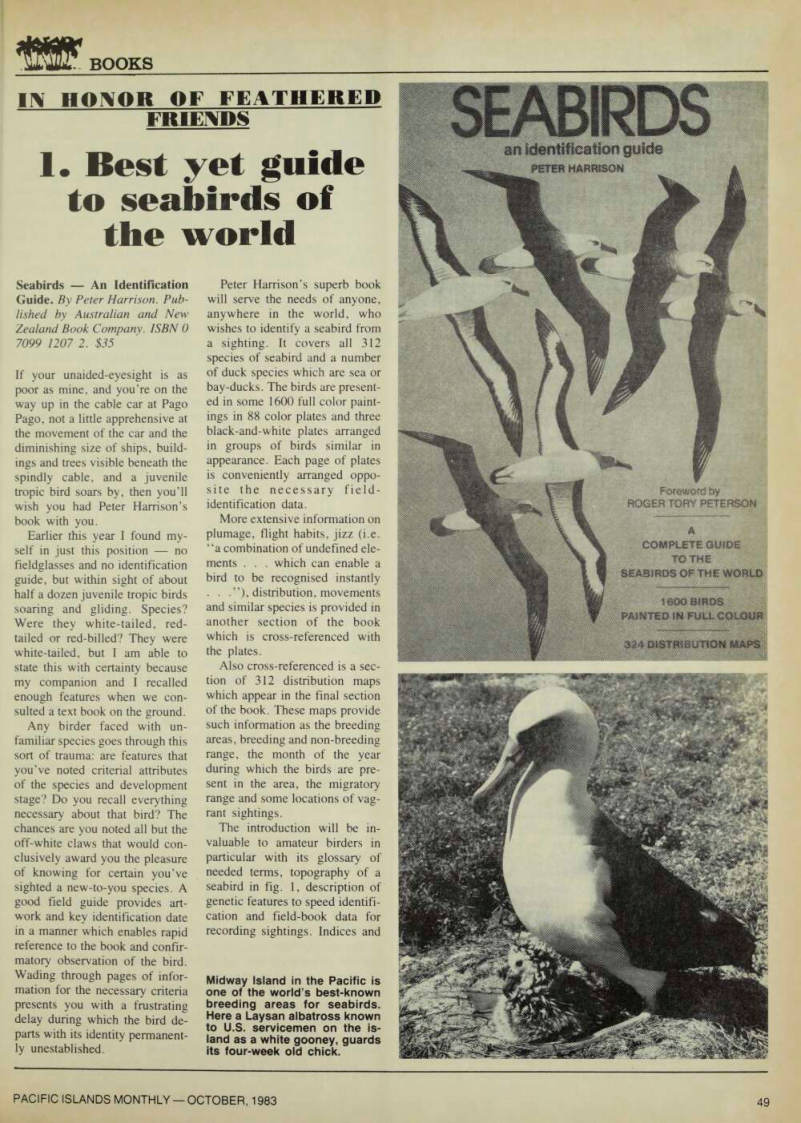
Seabirds An Identification Guide. By Peter Harrison. Pub lished by Australian and New Zealand Book Company. ISBN 0 7099 1207 2. $35 If your unaided-eyesight is as poor as mine, and you’re on the way up in the cable car at Pago Pago, not a little apprehensive at the movement of the car and the diminishing size of ships, build ings and trees visible beneath the spindly cable, and a juvenile
tropic bird soars by, then you’ll
wish you had Peter Harrison’s book with you.
Earlier this year I found my self in just this position no fieldglasses and no identification guide, but within sight of about half a dozen juvenile tropic birds
soaring and gliding. Species?
Were they white-tailed, red tailed or red-billed? They were white-tailed, but I am able to state this with certainty because my companion and I recalled enough features when we con sulted a text book on the ground.
Any birder faced with un familiar species goes through this sort of trauma: are features that you’ve noted criterial attributes of the species and development stage? Do you recall everything necessary about that bird? The chances are you noted all but the off-white claws that would con clusively award you the pleasure of knowing for certain you’ve sighted a new-to-you species. A good field guide provides art work and key identification date in a manner which enables rapid reference to the book and confir matory observation of the bird.
Wading through pages of infor mation for the necessary criteria presents you with a frustrating delay during which the bird de parts with its identity permanent
ly unestablished.
Peter Harrison’s superb book will serve the needs of anyone, anywhere in the world, who wishes to identify a seabird from a sighting. It covers all 312 species of seabird and a number of duck species which are sea or bay-ducks. The birds are present ed in some 1600 full color paint ings in 88 color plates and three
black-and-white plates arranged
in groups of birds similar in appearance. Each page of plates is conveniently arranged oppo site the necessary field identification data.
More extensive information on plumage, flight habits, jizz (i.e.
“a combination of undefined ele ments . . . which can enable a bird to be recognised instantly . . .”), distribution, movements and similar species is provided in another section of the book which is cross-referenced with
the plates.
Also cross-referenced is a sec tion of 312 distribution maps which appear in the final section of the book. These maps provide such information as the breeding
areas, breeding and non-breeding
range, the month of the year during which the birds are pre sent in the area, the migratory range and some locations of vag
rant sightings.
The introduction will be in valuable to amateur birders in particular with its glossary of needed terms, topography of a seabird in fig. 1, description of genetic features to speed identifi cation and field-book data for
recording sightings. Indices and
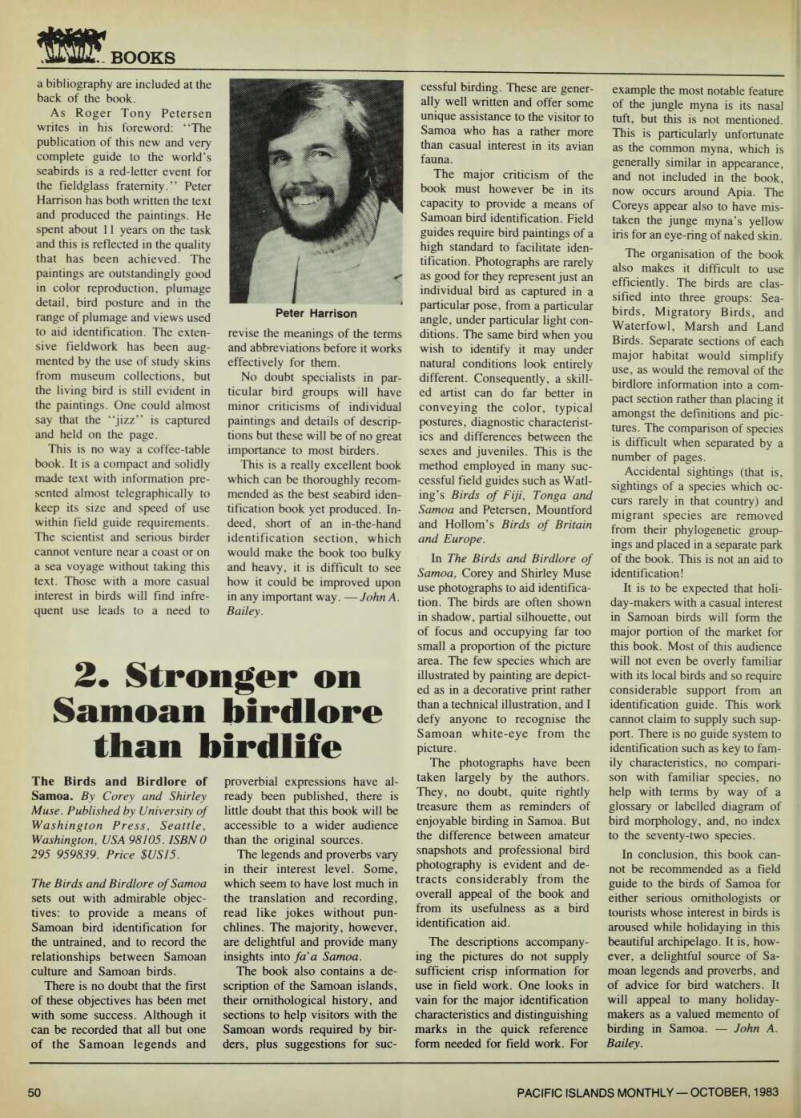
Midway Island in the Pacific is one of the world’s best-known breeding areas for seabirds.
Here a Laysan albatross known to U.S. servicemen on the is land as a white gooney, guards its four-week old chick.
a bibliography are included at the back of the book.
As Roger Tony Petersen
writes in his foreword: “The publication of this new and very complete guide to the world’s seabirds is a red-letter event for
the fieldglass fraternity.’’ Peter
Harrison has both written the text and produced the paintings. He spent about 11 years on the task and this is reflected in the quality that has been achieved. The paintings are outstandingly good in color reproduction, plumage detail, bird posture and in the range of plumage and views used to aid identification. The exten sive fieldwork has been aug mented by the use of study skins from museum collections, but the living bird is still evident in the paintings. One could almost say that the “jizz” is captured and held on the page.
This is no way a coffee-table book. It is a compact and solidly made text with information pre sented almost telegraphically to keep its size and speed of use
within field guide requirements.
The scientist and serious birder cannot venture near a coast or on a sea voyage without taking this text. Those with a more casual interest in birds will find infre quent use leads to a need to
revise the meanings of the terms and abbreviations before it works effectively for them.
No doubt specialists in par ticular bird groups will have minor criticisms of individual paintings and details of descrip tions but these will be of no great importance to most birders.
This is a really excellent book which can be thoroughly recom mended as the best seabird iden tification book yet produced. In deed, short of an in-the-hand identification section, which would make the book too bulky and heavy, it is difficult to see how it could be improved upon
in any important way.
John A.
Bailey.
2. Stronger on Samoan birdlore than birdllfe
The Birds and Birdlore of Samoa. By Corey and Shirley Muse. Published by University of Washington Press, Seattle, Washington, USA 98105. ISBN 0 295 959839. Price SUSIS.
The Birds and Birdlore of Samoa sets out with admirable objec tives: to provide a means of Samoan bird identification for the untrained, and to record the relationships between Samoan culture and Samoan birds.
There is no doubt that the first of these objectives has been met with some success. Although it can be recorded that all but one of the Samoan legends and
proverbial expressions have al ready been published, there is little doubt that this book will be accessible to a wider audience than the original sources.
The legends and proverbs vary in their interest level. Some, which seem to have lost much in the translation and recording, read like jokes without pun chlines. The majority, however, are delightful and provide many
insights into fa’a Samoa.
The book also contains a de scription of the Samoan islands, their ornithological history, and sections to help visitors with the Samoan words required by bir ders, plus suggestions for suc
cessful birding. These are gener ally well written and offer some unique assistance to the visitor to Samoa who has a rather more than casual interest in its avian fauna.
The major criticism of the book must however be in its capacity to provide a means of Samoan bird identification. Field guides require bird paintings of a high standard to facilitate iden tification. Photographs are rarely as good for they represent just an individual bird as captured in a particular pose, from a particular angle, under particular light con ditions. The same bird when you wish to identify it may under natural conditions look entirely different. Consequently, a skill ed artist can do far better in conveying the color, typical postures, diagnostic characterist ics and differences between the sexes and juveniles. This is the method employed in many suc cessful field guides such as Wall ing’s Birds of Fiji, Tonga and Samoa and Petersen, Mountford and Hollom’s Birds of Britain and Europe.
In The Birds and Birdlore of Samoa, Corey and Shirley Muse use photographs to aid identifica tion. The birds are often shown in shadow, partial silhouette, out of focus and occupying far too small a proportion of the picture area. The few species which are illustrated by painting are depict ed as in a decorative print rather than a technical illustration, and I defy anyone to recognise the Samoan white-eye from the picture.
The photographs have been taken largely by the authors.
They, no doubt, quite rightly treasure them as reminders of enjoyable birding in Samoa. But the difference between amateur snapshots and professional bird photography is evident and de tracts considerably from the overall appeal of the book and from its usefulness as a bird identification aid.
The descriptions accompany ing the pictures do not supply sufficient crisp information for use in field work. One looks in vain for the major identification characteristics and distinguishing marks in the quick reference form needed for field work. For
example the most notable feature of the jungle myna is its nasal tuft, but this is not mentioned.
This is particularly unfortunate as the common myna, which is generally similar in appearance, and not included in the book, now occurs around Apia. The Coreys appear also to have mis taken the junge myna’s yellow iris for an eye-ring of naked skin.
The organisation of the book also makes it difficult to use efficiently. The birds are clas sified into three groups: Sea birds, Migratory Birds, and Waterfowl, Marsh and Land Birds. Separate sections of each
major habitat would simplify
use, as would the removal of the birdlore information into a com pact section rather than placing it amongst the definitions and pic tures. The comparison of species is difficult when separated by a number of pages.
Accidental sightings (that is, sightings of a species which oc curs rarely in that country) and migrant species are removed from their phylogenetic group ings and placed in a separate park of the book. This is not an aid to identification!
It is to be expected that holi day-makers with a casual interest in Samoan birds will form the major portion of the market for this book. Most of this audience will not even be overly familiar with its local birds and so require considerable support from an identification guide. This work cannot claim to supply such sup port. There is no guide system to identification such as key to fam
ily characteristics, no compari
son with familiar species, no help with terms by way of a glossary or labelled diagram of bird morphology, and, no index to the seventy-two species.
In conclusion, this book can not be recommended as a field guide to the birds of Samoa for either serious ornithologists or tourists whose interest in birds is aroused while holidaying in this beautiful archipelago. It is, how ever, a delightful source of Sa moan legends and proverbs, and of advice for bird watchers. It will appeal to many holiday makers as a valued memento of
birding in Samoa.
John A.
Bailey.
Peter Harrison