from rags to . . .?
pp. 43-44 · Read in the full issue

Books
History Of Kiribati, Tuvalu
Cinderellas of empirefrom rags to . . .?
Cinderellas of the Empire: To wards a History of Kiribati and Tuvalu. By Barrie Macdonald.
Published by the Australian Na tional University Press. xx,335p.
ISBN 0 7081 1616 7. Price 5A19.50.
Independence, by fostering a
natural feeling of pride in nation hood, leads inevitably to a de mand for literature on the com munity’s cultural and historical heritage. R.R. Rex, the Premier of Niue, has urged that this can best be provided by island wri ters, and to judge by the success of Kiribati: Aspects of History, written by the I-Kiribati them selves, he may well prove to be right in the case of popular social histories involving much oral and other ethno-historical content.
Nevertheless for secondary and tertiary institutions, as well as for the general reader requir ing a more scholarly, detailed and authoritative history of any area, the special training, discip line and objectivity of a profes sional historian seems essential, and the nationality of the writer counts for relatively little.
For what was formerly known as the Gilbert and Ellice Islands such an historian has now ap peared in Barrie Macdonald of New Zealand’s Massey Universi ty, an accomplished teacher and writer who has already published many research articles on these two groups. His new book on them, Cinderellas of the Empire, can be recommended as a thoroughly readable and scholar
ly history which, despite the au
thor’s modest sub-title, will re main for the foreseeable future the definitive work on the subject.
The author’s introductory
chapters give us a good descrip
tion of the islands and their peo ple, early contacts and the begin nings of trade, missionary ac
tivities, the labor trade and impe rial intervention. These are de rived in the main from published sources but contain a valuable analysis of whaling contacts in the mid-19th century, based on the logbooks and journals of American ships visiting the area, and the first credible account of the labor trade and its effect on
island peoples.
Macdonald’s main interest, however, is in political develop ment and he has done a superb work of reconstructing the ad ministrative evolution of the Gil bert and Ellice Islands Protecto rate, and later Colony, under the various resident commissioners and governors from the declara tion of the British Protectorate in 1892 to the separation of Tuvalu from the Gilberts in 1976 and the final independence of the Re public of Kiribati in 1979.
His detailed knowledge of the period is unique and has been
gained by extensive fieldwork
and the interrogation of those
still living who played a principal
part in local affairs, together with an exhaustive examination of the
colony and high commission
files covering the period. The way in which he has brought out the more important factors after digesting this complex mass of oral and documentary source material is excellent, as is the way in which he shows the influ ence of the personal characterist ics of the various administrators from the authoritarian Telfer Campbell and the paternalistic Arthur Grimble to the devolutio nary and innovative Governor John Smith. At the same time his
practice of introducing each
chapter with a general statement on the theme and of recapitulat ing the gist of its contents in a final paragraph or two makes for
easy reading.
The two central Pacific groups were British dependent territories for 88 years and for 50 of them I
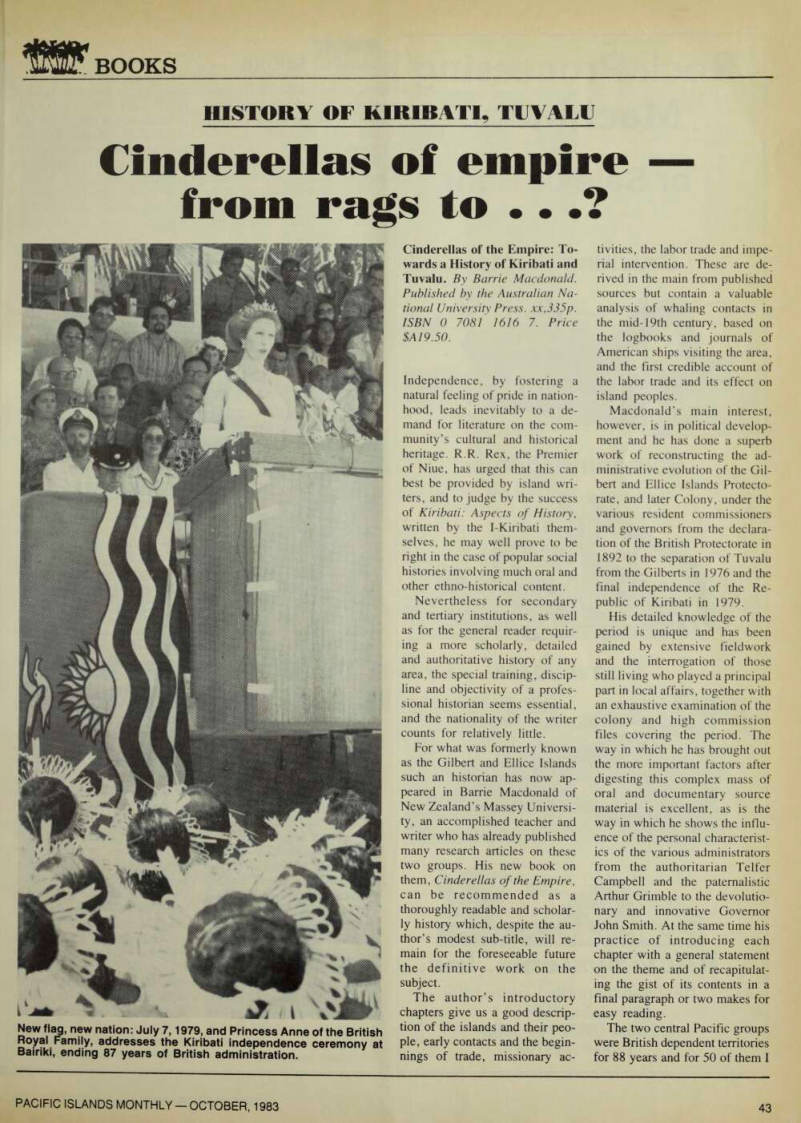
New flag, new nation: July 7,1979, and Princess Anne of the British Royal Family, addresses the Kiribati independence ceremony at Bairiki, ending 87 years of British administration.
was connected directly or indi rectly with their affairs. A great many of the events narrated and discussed by Macdonald are therefore familiar to me. Yet I have been unable to fault him in any significant factual statement; on one or two evaluations or matters of opinion perhaps, but even there I am conscious that my memory is fallible and my
judgment not always unclouded
by personal bias.
Inevitably the Ellice Islands takes a back seat in much of Macdonald’s narrative, since during all but four of the depen dent years the group was merely one of the six administrative dis tricts of a colony centred on Ocean Island or Tarawa. It is arguable, however, that more at tention could have been paid to the influence of the Western Pacific High Commission on the formation of policies applied in
the colony.
High Commissioners admit tedly came and went and few of them, Sir Arthur Richards and Sir Harry Luke being notable exceptions, regarded commis sion affairs as more than an
annoying interruption to their
concentration on Fiji. But at least from 1929 to 1946 the capable and industrious back-room operator supreme, that grey emi nence Henry Harrison Vaskess, exerted through them, as the per manent secretary to the commis sion, a quiet and unobtrusive oversight, and, when considered necessary, direction, over territo rial policies and their implemen tation which has never been fully recognised. Unlike governors, the resident commissioners held only semi-independent commands.
On the other hand Macdonald has recorded at least part of the hitherto unwritten story of how a small group of colonial service administrative cadets, labelled by their detractors the “Young Turks”, fought for the rights of the indigenous population against the missions (on religious intolerance, particularly towards non-Christians, and secular re creations), the trading companies (on price discrimination and the co-operative movement), the ad ministration (on political and leg al discrimination) and other Europeans (on racial intoler
ance). By the time they had left much had been won, self government was on the way and the islanders themselves were ready and willing to carry on the battle for freedom and equality to
eventual victory.
To me the high-water mark of the old paternal administration was represented by Grimble’s 1930 Island Regulations, de scribed by the Chief Judicial Commissioner as “Spartan in character and Draconian in sev erity”, by which all islanders were confined to their villages from sunset to sunrise and to their small huts from 9 p.m. to 5.30 a.m., and so on for 120 injunctions until, as a Nikunau elder told Sir Arthur Richards, “we Gilbertese are serving life sentences in a large jail from which there is no escape”.
I am glad that an account of the somewhat unorthodox methods by which this iniquitous enactment was repealed is given in the book, for Jack Barley, the new Resident, asked me to find out “who was responsible for spilling the beans in London”.
As the culprit in question, this rather took me aback. But I managed to reply “no doubt time will tell”: and now, after 50 years, it has.
The Gilbert and Ellice Islands were once the remotest and al most the smallest territory in the Pacific, even though their area did double at low tide. Today the Gilberts, with the Phoenix and Line Islands, form the Republic of Kiribati, an independent coun try which is now, thanks largely to the Law of the Sea, the largest in the South Seas and one which is courted by the great powers for its potential fishing and seabed resources; while the Ellice have evolved into a mini-dominion of
eight villages, complete with
governor-general and the trap pings of a centralised bureaucra cy, but, it may be hoped, also with great riches concealed in its maritime zone.
Cinderellas of the Empire is a must for everyone interested in reading the fascinating story of how these two lovely groups of atolls, the true South Sea islands of romance, have developed, like Cinderella herself, from rags to at least the hope of riches to
come.
Harry E. Maude.