but where Easter
pp. 47-50 · Read in the full issue
Tropicalities
Not where the moai came from, but where Easter Island is going to ...
Probably no place on earth has had the term “mysterious” ap plied to it more freely or fre quently than Easter Island. In deed a veritable mystery industry developed in the 19th century and was promoted in the 20th by travellers, amateur scholars, and tour operators.
More recently to the dis may of serious researchers extra-terrestrial visitors have been recruited casually to explain the provenance of the great stone heads or moai and the large number of petroglyphs and cere monial sites that dot the island.
At present, there is a three man NASA (National Aeoronautics and Space Ad ministration) team on Easter Is land trying to solve a more legiti mate mystery; not where the moai came from (there is abso lutely no question now of their local production) but where the island is going to.
Sweeping in a vast arc from the coast of Mexico to a point near New Zealand is the East Pacific Rise, a huge submarine mountain range which breaks the surface of the sea in only a few places Easter Island is one of them. The East Pacific Rise, like the Mid-Atlantic Ridge, is an area of intense geological activi ty. Magma wells up along the rise and produces new earth crust or “plates”, the upper surfaces of which constitute the floor of the Pacific Ocean.
The world’s largest plate, the Pacific Plate, moves slowly and majestically away from the rise towards Japan, while a smaller plate moves in the opposite di rection towards the western shores of South America. Where these plates and others meet continental land masses they are driven beneath them in a process called subduction which contributes to mountain-building
and earthquakes.
What the NASA researchers
would like to determine is which plate Easter Island stands on, how fast the plate is moving, and whether there is a relationship between the speed of movement and the incidence of earthquakes on the Pacific Rim.
The moai at Ahu Tongariki are a sobering reminder of the strength of such ’quakes. A very severe earthquake devastated Valdivia in southern Chile in 1960 and the seismic wave, or tsunami, which resulted, inun dated the south-eastern coast of Easter Island, scattering the 50tonne moai like toys.
There is a rough red volcanic mud road that leads northeast from Hangaroa, the “capital” of Easter Island, to Anakena on the north coast where Thor Heyer dahl established his camp in the 19505. NASA’s Optical Track ing Station is located on the side of that road about five kilometres from Hangaroa in a field dotted with guava bushes and strewn with volcanic rock.
It is a modest research facility, consisting of a small geodesic dome, a companion building housing an office and computer equipment, and a high frequency aerial for radio communication with Chile and the United States.
The dome and the building have been painted in camouflage col ors not for reasons of military security the site is open to serious visitors but in order that they might blend inconspicu ously with the rough countryside.
The leader of the team is Vin cent Coates, an American who has worked with lasers for many years in Greenland, Alaska, and elsewhere. The system engineer is a dedicated Chilean expert, Raul Aquilera, who helped de velop the optical tracking con cept at NASA headquarters in Maryland. The third member of the team is Ken Roloff, an American whose last posting was
Ascension Island in the South Atlantic. He was there at the time of the massive logistical build-up for the British military action in the Falkland Islands.
Eight years ago NASA launch ed the LAGEOS (Laser Geolog ical Survey) satellite, a passive sphere, 60 centimetres in diame ter, covered with cubic reflecting mirrors. It circles the globe at an altitude of 5000 kilometres in a nearly perfect polar orbit with a declination of approximately 84 degrees. Once every four hours it appears somewhere in the heavens over Easter Island for 50-55 minutes.
The goal of the NASA scien tists, who began their work in early March, is to bounce a beam of high energy light off the satel lite and to determine by complex mathematical formulae the movement of their transmitter /receiver (and hence the island) relative to the satellite. To do this they activate their laser transmit ter, located in the geodesic dome, and it pulses 10 times a second sending out bursts of light
150 trillionths of a second in duration. These are like machine gun bullets of concentrated light, each “bullet” about two and one half inches long. It takes about 40 thousandths of a second for the light to bounce off LAGEOS and return to earth. The receiver picks up all incoming photons or light sources and determines which ones comprise the return ing signal from their pattern.
This year’s tracking program, the first of a projected five-year program, was scheduled to con clude in August. Slowly but
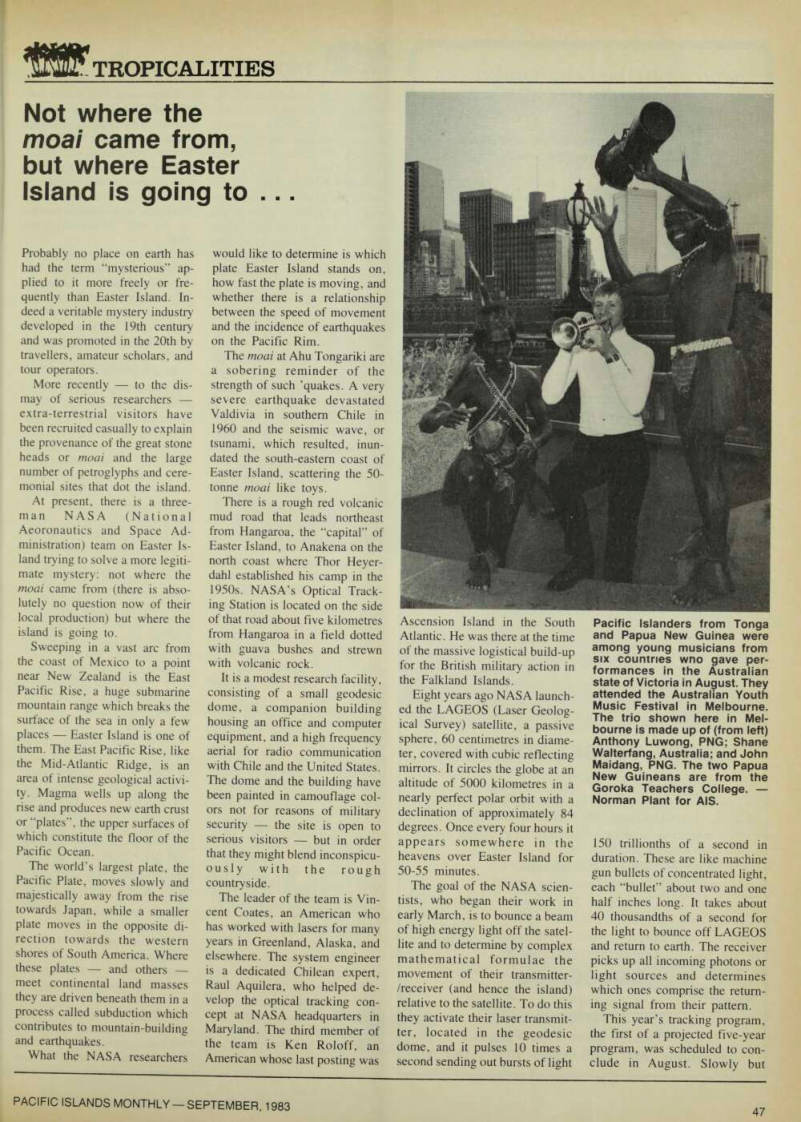
Pacific Islanders from Tonga and Papua New Guinea were among young musicians from six countries wno gave per formances in the Australian state of Victoria in August. They attended the Australian Youth Music Festival in Melbourne.
The trio shown here in Mel bourne is made up of (from left)
Anthony Luwong, PNG; Shane
Walterfang, Australia; and John Maidang, PNG. The two Papua New Guineans are from the
Goroka Teachers College. -
Norman Plant for AIS.
surely, when the weather is good enough to allow transmission and reception, the NASA team is amassing the laser data needed to measure the movement of Easter Island. Their sightings are re markably accurate. They can cal culate the island’s movement to within one-third of an inch and their findings to date suggest that Easter Island is moving eastward at roughly three inches a year.
Further, their work suggests that a month or so before major earth quakes the movement of the
“plates” begins to slow.
The Easter Island sightings are, of course, only part of a global jigsaw puzzle. But even tually the work of the night watchers on the road to Anakena, when coupled with data from around the world, will help solve one of the grand mysteries of the Pacific, how that ocean basin was formed and what shape it is
likely to take.
Jim Boutilier.
The film of the
Peacemaker
Following the nine-month jour ney of the little 16-metre yacht, Pacific Peacemaker across the Pacific, comes the 50-minute film of the voyage, which had its premiere in Sydney at the end of June. Its title is The Voyage of the Pacific Peacemaker.
It opens with John Lennon’s
song “Imagine.”
The naming ceremony of the yacht took place in brilliant sun shine at the wharf at Sydney Opera House, it was to sail 17,000 km across the Pacific Ocean to participate in the block ade of the first Trident submarine.
Bill Ethell, the skipper, you meet in the film as a bricklayer, however, he had been nine years in the Royal Navy, and came from a long line of fishing people on the English west coast.
Superb in his seamanship, as in his empathy with Pacific victims of the nuclear testing, he com bined the two in The Voyage of the Pacific Peacemaker.
The film has scenes of the police boarding during the Maori protest at Waitangi, New Zea land, and the ramming and dis masting by the French navy at Moruroa. Afterwards, when it
was impounded at Tahiti, the film tells how Sydney wharfies responded by tying up a French vessel Kangarua, at Port Botany, saying: “You have our vessel, and we have yours.” Kangarua was released on the understand ing that Pacific Peacemaker and its skipper be allowed to proceed on its way. It worked like a charm.
The most remarkable scenes are of the blockade itself.
Forty-nine people mostly in
tiny wooden hand-made row' boats strung themselves out across Hood Canal to blockade the Trident. You see its menac
ing black shape looming up.
By this time special legislation had been passed with a penalty of $lO,OOO or 10 years imprison ment for being in Hood Canal when the Trident came.
There is a shot of many of the blockaders on the deck of Pacific Peacemaker as the Trident com es, and they are about to go over the side into the tiny row boats (affectionately called “duck lings”), then out into the path of the Trident. They are colorful and laughing, as they always were. More than half were wo men, including five nuns, two
paraplegics, and a 78-year-old
grandmother, all determined to confront the “might” of history.
Some had not been in a row boat before.
In order to stop these “terror ists” in their tiny hand-made row boats that cost $25 each, the U.S. brought out 99 coastguard and naval vessels armed with water-cannon and machine guns, military jets, helicopters, the whole Northwest Naval Reserve, the National Guard, State Troop ers and an 80-person anti terrorist team (flown in from New York), to say nothing of the Pan Am Special Security police.
Although we had been told it was impossible some of the little boats did get in front of the Trident, and there were a number of arrests.
So great was the mounting indignation and international support for the blockaders, that the charges were soon dropped.
The film ends by telling how the story goes on, as the Ameri can peace movement has bought the little yacht, which is sailing again into the Pacific. Even since
that time it has been arrested for participation in the Vandenburg MX missile blockade.
The little yacht sails off peace fully into the Pacific with its bright sail as the film ends, to a sweet background song com posed and dedicated to Pacific Peacemaker by Stephanie McKee. Win Olive. (Win Olive was a member of the crew and was 63 years old when the yacht sailed from Sydney.
The film she describes here was made by David Roberts, another member of the crew).
Hercules and
the bulldozer
The people of Pitcairn Island earlier this year had the exciting experience of seeing their new bulldozer arrive, in a real-life enactment of a cargo cult fan tasy, from the sky . . . the editor of Pitcairn Miscellany told the story as follows: In the first light of early dawn a faint drone heralded the arrival of the Royal New Zealand Air Force Cl3o Hercules plane with our new Caterpillar D4E bulldoz er hidden in its interior.
The excitement was intense, as the hour grew near. Nearly all the locals had camped the night out on sites around the dropping zone, and even a shower of rain in the night was not enough to dampen their spirits.
The aircraft made two passes over the dropping zone, and on the second pass a ‘‘wind indicat ing” streamer was dropped.
Then the main drop was on. The plane came in slowly from the west about 300 metres above us the extraction parachute sud denly appeared behind the plane, and after about three seconds the 10-tonne bulldozer was hauled from the cargo hold. The bull dozer lurched sideways then hurtled downwards at an alarm ing speed.
At first there appeared to be only two parachutes to arrest this downward plunge but the “two” parachutes blossomed into six, and the bulldozer floated gently down to land within 100 metres of the centre of the dropping zone, to the cheers of the locals.
Explosive charges set to release the parachutes from their load cracked like firecrackers, and added to the carnival atmosphere of the occasion. After another 15 minutes the canopy and blade of the bulldozer floated down to land 100 metres south of the centre of the dropping zone.
Each of the massive parachutes was more than 30 metres in diameter and in all they covered more than half a hectare.
Each parachute was valued at $2OOO. From newspaper articles in New Zealand we learned that the air force doubted that they would get their parachutes back, and even suggested that the fine nylon would outfit the Pitcairners with bedsheets and undies indefi nitely. (Fortunately the Pitcair ners already are already well stocked with sheets and undies).
The rest of the day was spent unstrapping the bulldozer and packing the parachutes. The bull dozer was dropped in a ‘ ‘ready to go” condition, so it was a simple matter to unstrap it and drive it off its aluminium platform,
which was cushioned by only two layers of special honey combed cardboard.
In all, our heartiest thanks and congratulations go the RNZAF No. 40 squadron for the skill and precision of the drop. This was the heaviest load yet dropped by a RNZAF Hercules. There were only a few centimetres clearance in the plane when the load was yanked out, and the operation was near the aircraft’s maximum capabilities as the load was so heavy, and the round trip from Tahiti was over 3000 kilometres.
Once again, on behalf of the Pitcairn people, I would like to thank all those involved in the project to deliver this heavy piece of equipment to our remote island. Not only do we have a brand new Caterpillar D4E bull dozer safely landed, but we also had the excitement of seeing at close range a spectacular, preci sion, heavy air drop.
Co-ordinating the operation was No 5 terminal Squadron of the RNZ Corps of Transport, Auck land. The officer commanding the squadron, Major D. M.
Campbell, sent the following message to the Pitcairners: On behalf of the men and women of 5 Terminal Squadron of the Royal New Zealand Corps of Transport I would like to send greetings and congratulations on the receipt of the latest delivery to the island.
The unconventional method of delivery will hopefully provide to you the same excitement it has given us in the preparation and delivery of the bulldozer.
We all hope that as you read this, you are already preparing the bulldozer for the many im portant tasks that you will have for it. It has been our great pleasure to assist with the joint effort to move the bulldozer to Pitcairn Island.
Congratulations and best wishes.
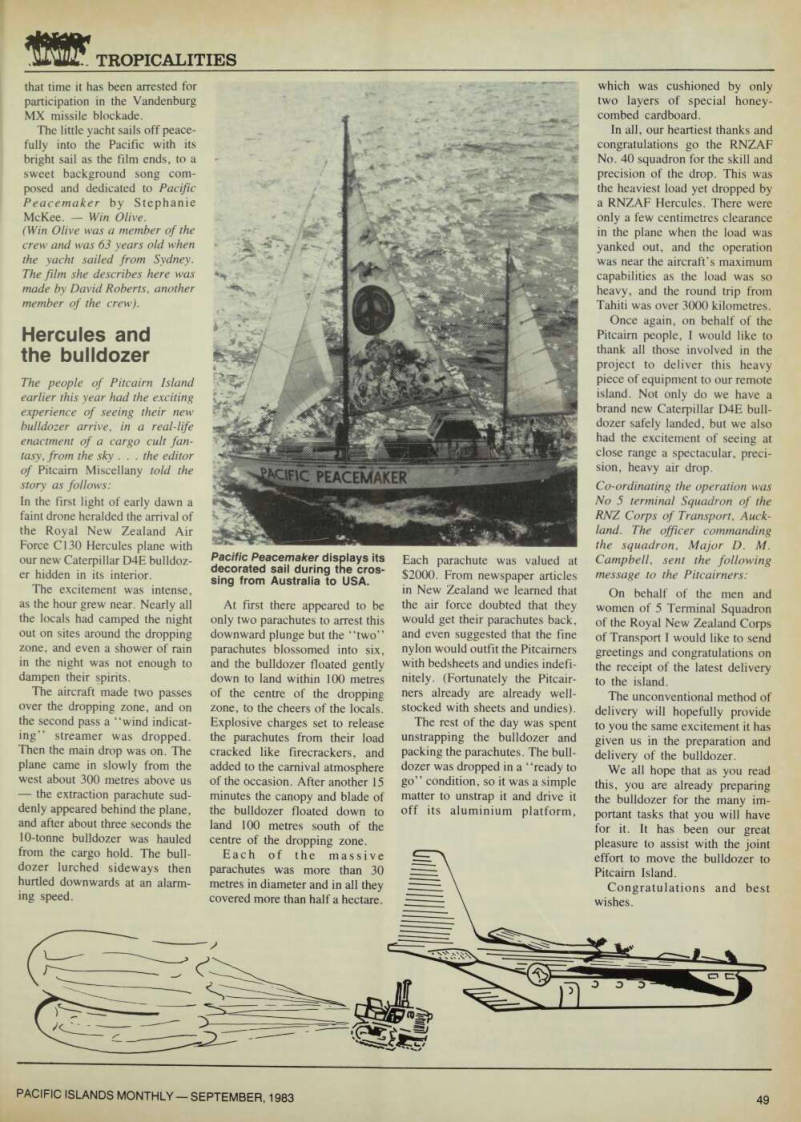
Pacific Peacemaker displays its decorated sail during the cros sing from Australia to USA.
PIM writers
vindicated
Recent decisions by the Govern ment Council in French Poly nesia have fully vindicated the stand of PIM correspondents in the territory, Marie-Therese and Bengt Danielsson, and of Profes sor Yosihiko Sinoto of Hon olulu’s Bernice P. Bishop Museum.
Writing in PIM under the headline “Cold shoulder for a 1000-year-old canoe” (Mar. ’B2 p2l), the Danielssons took the local French administration to task for the scant official interest shown in the remarkable ar cheological discoveries made over 10 years of work by Profes sor Sinoto at Huahine, French Polynesia.
In particular, they were critical of Marc Tevane, the government councillor in charge of scientific research, and posed some curly questions about the whereabouts of a sum of about CFP3.S million which had been officially ear marked for Professor Sinoto.
Their article was followed by
furious letters to PIM from the then vice-president of the Gov ernment Council, Francis San ford, and Mr Tevane (PIM June ’B2 p 7). They hotly denied that any money had gone astray.
The letters were in turn used as a peg for attacks on PIM in the
French-language monthly
magazine 30 Jours, and in daily newspapers in French Polynesia and New Caledonia.
Now, the new Government Council in the territory has in effect conceded that the Daniels sons and Professor Sinoto were right all along.
The 1983 territorial budget provides for restitution to the professor of the missing money CFP3,607,625 to be precise.
What is more, it has done just what the PIM correspondents urged that its predecessor should do in the first place: it has voted a further sum of CFP3,810,000 for the conservation of the unique wooden artefacts including the main portions of a pre historic canoe dug up by Professor Sinoto.
To top it all, a sum of CFP5,052,800 has been set aside to enable a team of French ar cheologists to pursue the excava tions at the important site of Huahine which, in all probabili ty, will yield up many more scientific treasures.
Latest news of
Paul Cousseran
In the palmy days before World War 11, when France had a far flung colonial empire, future governors were trained at a spe cial school in the gentle arts of handling unruly natives, and tap ping colonial natural resources for the benefit of the “mother country”.
But with nine-tenths of the colonies gone by 1965, the French Government found itself reduced to filling vacancies in the few remaining colonies with a strange assortment of met ropolitan officials who have rare ly seen a coconut palm, and, as regards the Pacific colonies at least, have no knowledge of any Polynesian or Melanesian language.
Among the unhappiest choices was a muscular top bureaucrat
named Paul Cousseran who, in 1977, was appointed French High Commissioner to French Polynesia. There, his first ac complishment was to quell a prison riot by having his police shoot one of the Polynesian ring leaders.
He showed his true colors even more glaringly by promot ing closer economic and cultural ties between the territory and Chile, lavishly entertaining Gen eral Pinochet at his official resi dence in Tahiti during the Chi lean dictator’s first (and only) farcical foray into the Pacific.
Pinochet’s tour ended abruptly somewhere in the skies over Fiji when his aircraft radio brought news that his next host Presi dent Marcos of the Philippines had changed his mind and cancelled his planned state visit to Manila (PIM May ’BO p 9).
Mr Cousseran also made a goodwill visit to Australia to combat the bad impression created in that country by French nuclear testing at Moruroa.
The new Socialist government which came to power in France in May 1981 first employed Cousseran’s special talents for pacification in Corsica, where, in that year alone, the fierce Corsi can nationalists made 700 bomb attacks.
In September 1982 Cousseran was promoted to the key post of commissioner for all metropoli tan French police forces.
Within a few months, howev er, he was being denounced by most of the police unions for his systematic sabotage of the de mocratic reforms of the police forces decided by the govern ment, as well as for his pamper ing of extreme Rightist and out right fascist elements among the police.
France’s Minister for the In terior Gaston Defferre inves tigated, found the complaints justified, and, at the beginning of June this year, took the unprece dented step of sacking his police boss.
Cousseran tried to soften the blow by tendering his own resig nation. But Defferre ignored him and made a public announcement that Cousseran had, in fact, been sacked. Marie-Therese and Bengt Daniels son.