century Hawaii
pp. 45-46 · Read in the full issue
A gifted amateur diplomat in 19th century Hawaii
The Diaries of David Lawrence Gregg: An American Diplomat in Hawaii, 1853-1858. Edited by Pauline King. Published by the Hawaiian Historical Society, Honolulu, Hawaii, 1982. Hard back SUS 25.00. No. ISBN provided.
Professionals have long decried the amateur diplomat. They por tray him as a political hack whose reward for faithful party service includes a regular che que, an inadequate expense ac count, and exile in a foreign capital. Invariably they also minimise his skills.
David Lawrence Gregg cer tainly qualified as a politician.
He served the Democratic Party of the State of Illinois: first as a newspaper editor, then as a state assemblyman, then as United States district attorney, and final ly as secretary of state. In 1852 friends touted him as the next governor of Illinois. The State Democratic Convention, howev er, passed him over for another man. Gregg became a politician without an office to hold, and thus a prime candidate for pat ronage. He received his reward on July 6, 1853, when Democ ratic President Franklin Pierce named him commissioner to the Hawaiian Kingdom.
But Gregg was no mere polit
ical hack. He proved himself a skilled diplomat. He took up residence in Honolulu in Decem ber, 1853, just one year after the introduction in the United States Congress of a resolution calling for the annexation of the Hawaiian Islands. In 1849 and again in 1852 the French had seriously threatened the sovereignty of the Hawaiian Kingdom. Gregg found the is lands rife with rumors of a French takeover and of American filibusterers who would seize Hawaii by force.
Gregg refused to lend the latter the prestige of his office. Instead of force, Gregg committed him self to negotiating a treaty of annexation. Kamehameha 111 (Kauikeaouli) wanted a treaty.
He had grown weary of the im perialist pressures on his small, defenceless kingdom. But the childless Kauikeaouli’s nephew, Alexander Liholiho, the man who would be king, did not.
Throughout 1854 Gregg’s diary entries demonstrate the strain of the negotiations. They were conducted largely with Robert C. Wyllie, Kamehameha Ill’s minister of foreign affairs.
Wyllie was British, and as negotiations progressed Gregg became convinced that the foreign minister’s sympathies lay with his homeland. Kauikea ouli’s death decided the issue.
Liholiho ended the negotiations with the United States.
Much of Gregg’s life was cen tred in the foreign community, which he estimated at one quarter of Honolulu’s popula tion. Gregg was critical of his fellow haoles (foreigners). “This country is a great place for ras cals,” he wrote, “but somehow they are never found out until gone.” On those who served in Kamehameha’s cabinet he was particularly harsh. Richard Arm strong. the minister of public instruction, Gregg deemed “a moral coward . . . two-faced and insincere”. Wyllie he thought “honest and upright” but “very timid”. Elisha Allen, the Minis ter of Finance, Gregg saw pos sessed of “a passion to be popu lar .. . (he) would readily con fess himself a rascal to conciliate a vote or obtain the favorable consideration of a ragamuffin”.
Gregg thought even less high ly of the diplomatic community.
His colleagues were General William Miller, the British con sul, and Emile Perrin, the
French. Nineteenth-century nationalism and its attendant im perialism made intense rivals of the three men. All vied for the favor of the Hawaiian court, and each sought to make his own country’s influence paramount in the Kingdom.
Gregg’s Catholicism drew him at first to the Frenchman Perrin, but he soon found him duplicit ous, miserly, and totally at odds with the government Gregg re presented. He came to believe: “There is no man so much de spised as Perrin. He holds the confidence of nobody except his secretary Varigny who is a mere puppy.”
Nothing ever attracted him to General Miller, save the British consul’s long, last illness. In his sympathy for the dying man Gregg demonstrates a character trait evident throughout the diaries: a broad humanity which, despite his censorious attitude towards many of his European and American colleagues, he ex pressed repeatedly towards those in need.
For a small, mid-Pacific port town, Gregg’s Honolulu was very busy. Ships of many nations came and went, and the Ameri can commissioner received their officers, dined with them, and visited their ships. Gregg and his family often spent their weekends with Hawaiian royalty at their country homes. Evenings were given to society: plays, musicals, dinners, and recep tions. Gregg commented on the quality of fare at each. Honolulu produced an abundance of gossip.
“Scandal may have its fill in this town,” Gregg wrote.
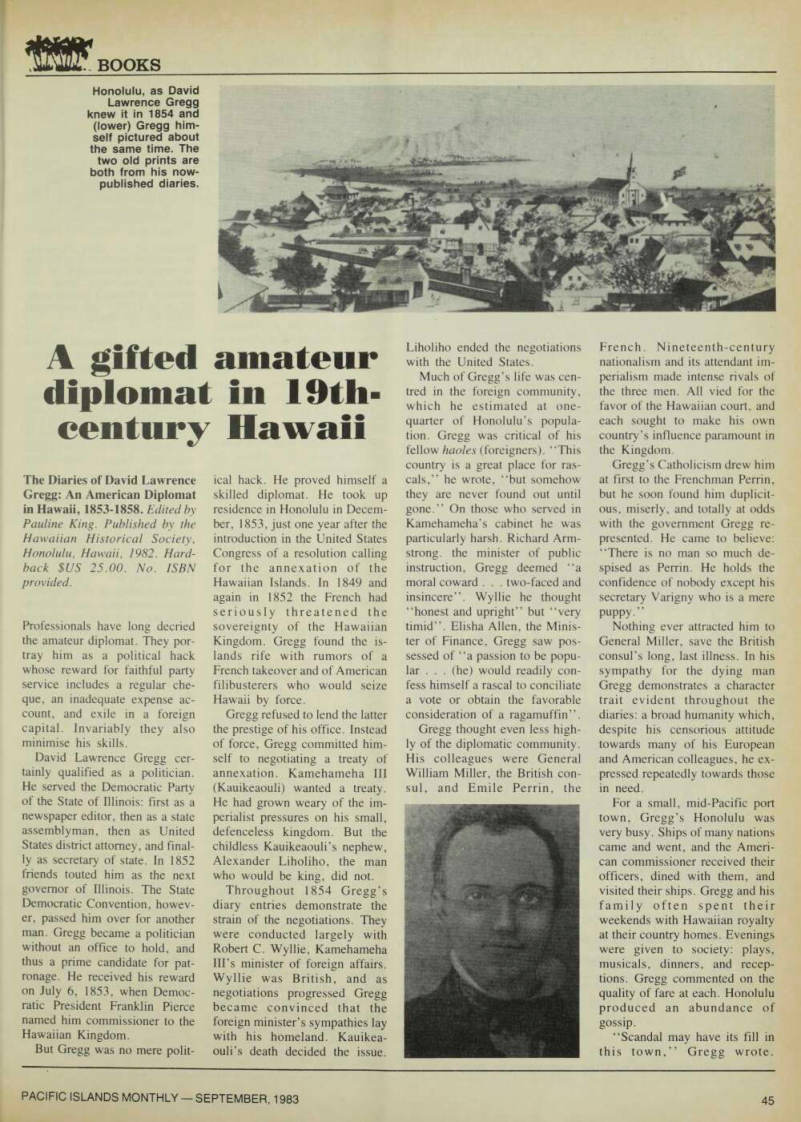
Honolulu, as David
Lawrence Gregg
knew it in 1854 and (lower) Gregg him self pictured about the same time. The two old prints are both from his now
published diaries.
“There is nothing like it in the wide world. No place so bad in the countenance it gives slan der.” Always the American wrote his dispatches, often work ing late into the night to meet a ship’s departure time.
Like all of Honolulu’s foreig ners, Gregg complained of the Hawaiian’s lack of initiative. ‘They are indolent and generally inactive,” he wrote. But he also found much to be admired. He thought the Prince Royal, Liholiho, “too much cultivated and enlightened to be a Hawaiian subject, or even a Hawaiian King; he should be a citizen of the United States, and would distinguish himself in that capac
ity,” High praise from a
chauvinistic, patriotic American.
Gregg’s admiration was recip
rocated. In 1858 he ended his career in American diplomacy and entered the cabinet of Kamehameha IV as minister of finance.
The Diaries of David Lawr ence Gregg belong to the scholar
of Hawaiian history. Gregg
could be an acute observer of men and events. But he also recorded far too much of the minutiae of Honolulu life in the 1850 s to engage the general read er for long.
Dr Pauline King’s editing is judicious, and her endnotes pro vide a second book on the Hawaiian Kingdom well worth reading. One of the principal objectives of the Hawaiian His torical Society is the preparation
and publication of primary
source materials in Hawaiian his tory. The Society and Dr. King have done very well indeed in meeting that objective with The Diaries of David Lawrence
Gregg.
Dan Boylan.
Books received
Seabirds an identification guide. by Peter Harrison. Published 1983 by Croom Helm Ltd and A.H & A.W.
Reed Ltd. Distributed in Australia by ANZ Books Pty Ltd, PO Box 459, Brookvale, NSW 2100. ISBN 0 589 01472 2. Price $A35.00.
Tales of the Tikongs.By Epeli Hau’ofa. Published in 1983 by Long man Paul Ltd, 182-190 Wairau Road, Auckland 10, New Zealand.
No price given. ISBN 0 582 71789 2.
Blueprint for Paradise: How to live on a tropic island. By Ross Nor grove. Published 1983 by Intema
mown & 00/s
Pioneer Circus
tional Marine Company, 21 Elm Street, Camden, Maine 04843, USA.
Price $U514.95. ISBN 0 87742 154 4.
Modern Ocean Cruising: Boats, gear and crews surveyed. By Jim my Cornell. Published 1983 by Granada Publishing, PO Box 9, Frogmore, St Albans, Hertfordshire AL2 2NF, England. Price £8.95.
Isbn 0 229 11687 6.
Post-Independence Economic De velopment of Papua New Guinea.
By P.A.S. Dahanayake. Monograph
19, published 1982 by Institute of Applied Social and Economic re search, Boroko, Papua New Guinea.
No price. ISBN 07247 0907 X.
Losing control . . . Towards an Understanding of Transnational Corporations in the Pacific Islands Context. By James E. Winkler.
Published 1982 by Lotu Pasifika Pro ductions, PO Box 208, Suva, Fiji.
No ISBN. Price $F2.00.
Trickling Up A strategy for development where the people at the bottom matter most. By Dennis Oliver. Published 1983 by Lotu Pasifika Productions, PO Box 2401, Govt, buildings, Suva, Fiji. No price or ISBN.
Australia and the South Pacific.
Proceedings of the conference held at ANU, February 1982. Edited by Brendan O’Dwyer. Published by Centre for Continuing Education, Australian National University, PO Box 4, Canberra, ACT 2600. Nation al Library of Australia card ISBN 0
909850 81. JSIo price given.
A Call to a New Exodus An anti nuclear primer for Pacific people.
By Suliana Siwatibau and B. David Williams. Published 1982 by Lotu Pasifika Productions, PO Box 208, Suva, Fiji. Price $F4.00 No ISBN.
Reflections on Micronesia. Collect ed papers of Fr Francis X Hezel, S.J.
Published by Pacific Islands Studies Center for Asian and Pacific Studies, in collaboration with the Social Sci ence Research Institute, University of Hawaii at Manoa, Honolulu, Hawaii. No price or ISBN.
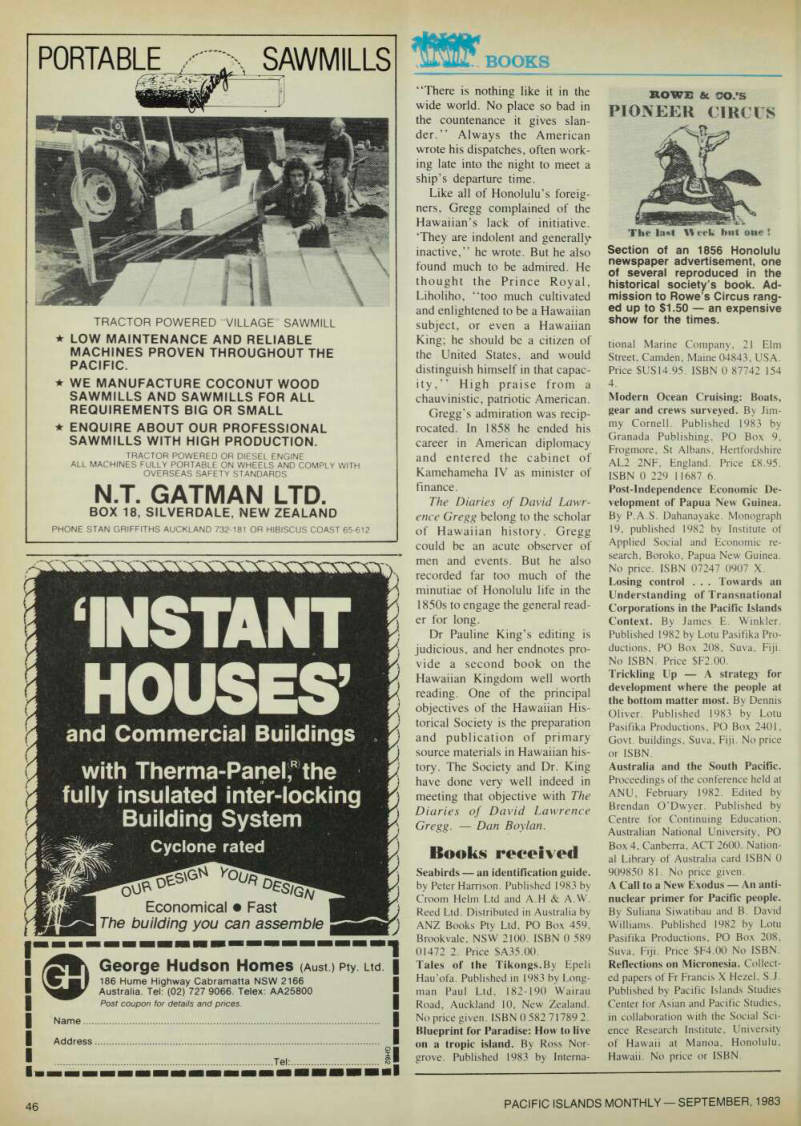
Section of an 1856 Honolulu newspaper advertisement, one of several reproduced in the historical society’s book. Ad mission to Rowe’s Circus rang ed up to $1.50 - an expensive show for the times.