So many guides to getting
pp. 43-44 · Read in the full issue
books
So many guides to getting lost in the South Seas
South Pacific Handbook. Sec ond Edition 1982-83. By David Stanley. Edited by Bill Dalton.
Published by Moon Publications, P.O. Box 1696-SF, Chico CA
95927 Usa. Isbn 0 9603322 3
5. Price SUSJ4.2S.
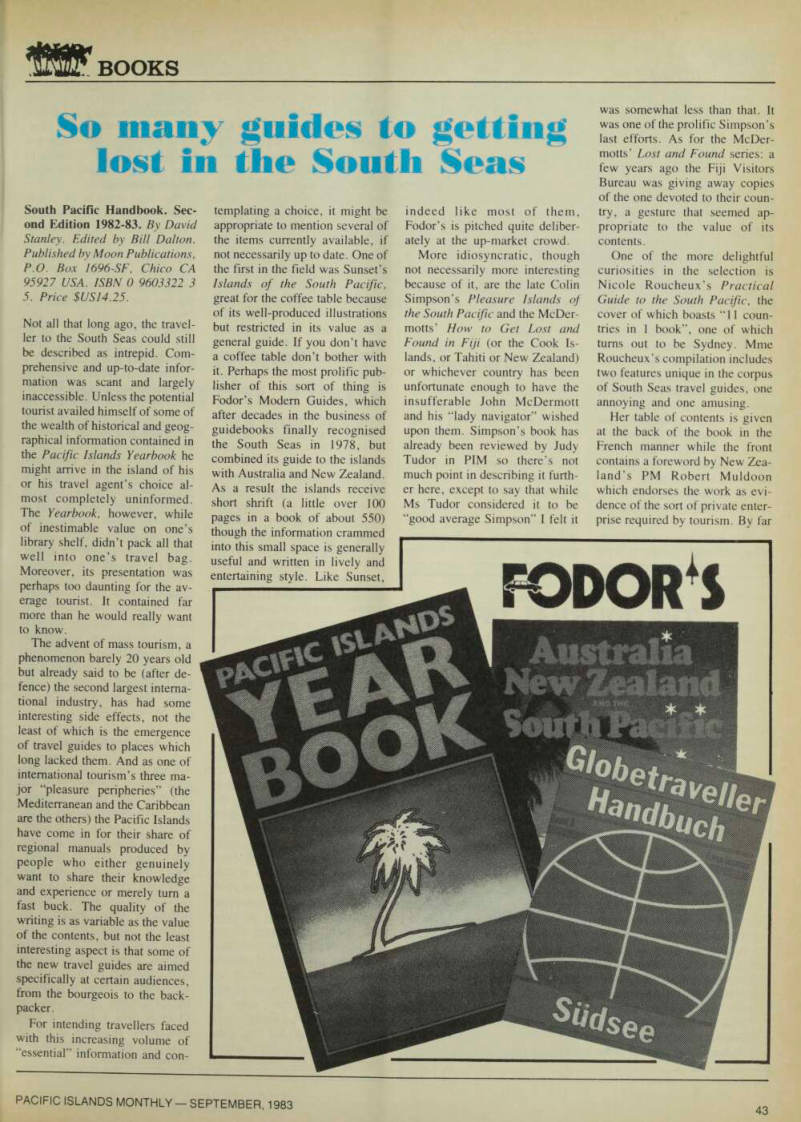
Not all that long ago, the travel ler to the South Seas could still be described as intrepid. Com prehensive and up-to-date infor mation was scant and largely inaccessible. Unless the potential tourist availed himself of some of the wealth of historical and geog raphical information contained in the Pacific Islands Yearbook he might arrive in the island of his or his travel agent’s choice al most completely uninformed.
The Yearbook, however, while of inestimable value on one’s library shelf, didn’t pack all that well into one’s travel bag.
Moreover, its presentation was perhaps too daunting for the av erage tourist. It contained far more than he would really want to know.
The advent of mass tourism, a phenomenon barely 20 years old but already said to be (after de fence) the second largest interna tional industry, has had some interesting side effects, not the least of which is the emergence of travel guides to places which long lacked them. And as one of international tourism’s three ma jor “pleasure peripheries” (the Mediterranean and the Caribbean are the others) the Pacific Islands have come in for their share of regional manuals produced by people who either genuinely want to share their knowledge and experience or merely turn a fast buck. The quality of the writing is as variable as the value of the contents, but not the least interesting aspect is that some of the new travel guides are aimed specifically at certain audiences, from the bourgeois to the back packer.
For intending travellers faced with this increasing volume of “essential” information and con
templating a choice, it might be appropriate to mention several of the items currently available, if not necessarily up to date. One of the first in the field was Sunset’s Islands of the South Pacific, great for the coffee table because of its well-produced illustrations but restricted in its value as a general guide. If you don’t have a coffee table don’t bother with it. Perhaps the most prolific pub lisher of this sort of thing is Fodor’s Modern Guides, which after decades in the business of guidebooks finally recognised the South Seas in 1978, but combined its guide to the islands with Australia and New Zealand.
As a result the islands receive short shrift (a little over 100 pages in a book of about 550) though the information crammed into this small space is generally useful and written in lively and entertaining style. Like Sunset,
indeed like most of them, Fodor’s is pitched quite deliber ately at the up-market crowd.
More idiosyncratic, though
not necessarily more interesting
because of it, are the late Colin Simpson’s Pleasure Islands of the South Pacific and the McDer motts’ How to Get Lost and Found in Fiji (or the Cook Is lands, or Tahiti or New Zealand) or whichever country has been unfortunate enough to have the insufferable John McDermott and his “lady navigator” wished upon them. Simpson’s book has already been reviewed by Judy Tudor in PIM so there’s not much point in describing it furth er here, except to say that while Ms Tudor considered it to be “good average Simpson” I felt it
was somewhat less than that. It was one of the prolific Simpson’s last efforts. As for the McDer motts’ Lost and Found series: a few years ago the Fiji Visitors Bureau was giving away copies of the one devoted to their coun try, a gesture that seemed ap propriate to the value of its contents.
One of the more delightful curiosities in the selection is Nicole Roucheux’s Practical Guide to the South Pacific, the cover of which boasts “11 coun tries in 1 book”, one of which turns out to be Sydney. Mme Roucheux’s compilation includes two features unique in the corpus of South Seas travel guides, one
annoying and one amusing.
Her table of contents is given at the back of the book in the French manner while the front contains a foreword by New Zea land’s PM Robert Muldoon which endorses the work as evi dence of the sort of private enter prise required by tourism. By far
the most interesting aspect of Mme Roucheux’s book, howev er, is her prose style which defies
excerpting.
Pacific Publications’ own South Seas Guide has two major virtues absent from most of the others. Its background detail is, as one might expect, accurate; it speaks for example of “European contacts” rather than “dis coveries”, and its price is cheap still only $3.50 in many parts of the Pacific. It also contains a couple of odd anomalies the maps are inconsistent in detail and the generally excellent black and white illustrations are all unidentified. “An island is an island is an island . . . ?” Surely not. Pacific Publications’ guide wisely avoids one of the quick routes to obsolescence by not
making qualitative pronounce
ments on available accommoda tion or specifying prices. Its pre sentation, indeed, might be re garded as democratic, aimed at no one class of traveller in
particular.
Even more democratic in its quite deliberate attempts to avoid
the standard bourgeois connota tions of tourism is David Stan ley’s South Pacific Handbook (2nd edition, ed. Bill Dalton).
Stanley, whose credentials as a travel writer include the publica tion of a painstakingly compiled handbook on Indonesia and the purchase of the longest ticket ever issued by Pan Am in Cana da, has produced what must sure ly be the densest (in terms of information contained) travel guide to the region, 560-plus pages containing an amount of words well in excess of a quarter of a million.
Missionaries
Stanley is pro-traveller but
anti-tourist and anti-expatriate, a position he demonstrates at vari ous parts of the book but rather piously in the introduction.
“White missionaries,” he writes, “anxious to maintain their hold over the islanders, generally dis courage tourism.” “Many resi dent expatriates . . . wish to pro tect their own privileges and status, which might be en
dangered by an increase in the number of visitors.”
Piety gives way occasionally
to sheer naivete. Only someone thoroughly unfamiliar with the hierarchical structure of its socie ty (and economy) could suggest that tourism in Tonga is more egalitarian than elsewhere, and only the most wishful of thinkers would insist that by buying canned food at village stores one is keeping the money in the villages. At other times Stanley is anxious to inform the reader not to pay $l.OO for a ride in a villager’s truck when bargaining may get it for less.
Fortunately, when he over comes these occasional tenden cies, Stanley provides the reader with solid and up-to-date infor mation on the geography, tradi tional and modem history, and contemporary trends of every part of the Pacific Islands in which even the most avid travel buff is likely to find himself.
Accommodation is listed for such places as Mauke (Cook Is lands), Malekula (in Vanuatu) and the Marquesas (French Poly nesia), islands all but ignored in other regional travel guides. In his accommodation recommen dations Stanley’s dedicated back packing nature obliges him to take a stance diametrically oppo site that of Sunset or Fodor’s.
“International” hotels and other non-budget facilities are usually
conspicuously omitted. (Though
if you can find them you can always use their swimming
pools.)
The maps, most of which were contributed by editor Bill Dalton, are well drawn and generously distributed throughout. The sec tion on Fiji alone has 14! Dalton also takes credit for the format which is conveniently small (perhaps too small in print size at times, or are there no myopic
back-packers?) if not quite pock
et-sized and makes maximum and intelligent use of all avail able space. Thus pages of text
are frequently graced with quite
delightful drawings of people,
places or objects, while the otherwise blank comers of map pages contain brief notes on items that perhaps would not fit conveniently into the text, from taro growing to Tongan stamps.
Photographs are plentiful and
generally well reproduced with one section in color, and thank fully all illustrations are iden tified. Curiously, this simple but necessary requirement seems to have been overlooked by most
other regional guides.
The first edition of South Pacific Handbook appeared in 1979, an illustration of the grow ing interest in the South Seas displayed by North American travellers. It contained 352 pages, making it quite easy to slip into one’s carry-on baggage.
The current edition contains another 200 pages, not all of which are put to good use. Forty five of them are occupied by a section which includes Australia, New Zealand and Hawaii, entitl
ed “Anglonesia”, a description
more cute than useful, since the five pages of text on Australia are of minimal value. Capsule vocabularies are an occasional feature of the handbook but the one devoted to “Aussie” contains expressions and usages only a North American visitor could have unearthed. Thus “Bob’s your mule (sic)” means every thing’s 0.K., while a car engine becomes a “donk”. Spare us the instant linguists. New Zealanders will doubtless be relieved to know that the 12 pages on their country contain no comparable list of words, and further relieved
by Stanley’s description of them
as “much gentler and more re served than their brash and bra zen Aussie cousins”.
Aspirations
Clearly, South Pacific Hand
book has aspirations beyond that of a mere travel guide (an Ameri can based counter-weight to the Pacific Islands Yearbook, perhaps?) and as such compels one to take its contents seriously.
Well, most of them anyway.
Despite its occasional peculiarities and at times almost
belligerent “budget travellers are
beautiful” stance (does Stanley know Niue was once considering banning back-packers because they contribute nothing to tour ism?) the handbook is probably the best value around and is likely to find a place in most budgeteers’ H-frames if not in most executives’ briefcases.
Norman Douglas.