People
pp. 39-41 · Read in the full issue
Born in Buffalo, New York State, on June 21, 1918 (come to think of it, these lines are actual ly being written on his 65th birthday), Ralph Gardner White is a longtime American expatriate resident of Tahiti.
He first arrived there on March 4, 1939, after a voyage from Panama as a steerage passenger on what he remembers as a hell ship, the Messageries Maritimes freighter, Sagittaire.
Not yet 21, the footloose young White already had behind him a year at the University of Michigan, a period studying French at a relentlessly prosely tising Catholic Ecole Superieure in Quebec, a visit to Norway, and a rough east-west trip, with mates, across the breadth of the United States. He’d also enter tained a thousand and one other ideas, including going to the Sun Yat-sen School in China as an exchange student, heading down south to explore the headwaters of the Amazon, making a visit to the Marquesas.
“I was just looking for adven ture,” he says in his soft-spoken way. “People don’t seem to understand this any more.”
But Tahiti it was to be, Tahiti for 44 years so far, give or take a few brief absences.
Along with many other long term expatriates, Ralph White appears to retain, like a fly in amber, beliefs common to his countrymen in the far-off days when he actually lived at home.
For example, when he speaks of his attitude to the future after landing in Tahiti, he says: “Americans can do anything.”
That is the authentic voice of 1920 s America, an America that had not yet dreamed that any thing certainly not the tech nology of a country such as Japan could come along to shake the assumption of U.S. technological superiority. There was nothing arrogant or boastful about his statement. As far as he was concerned, he was stating an evident fact and, to give Ralph White his due, his record of survival since the day he stepped ashore at Papeete almost seems to bear him out.
There was a little money com ing from time to time from his family, but certainly not enough
to live on. He just had to start earning some. So . . .
When World War II began soon after his arrival, one of the first things to be in short supply in Tahiti was cigarette papers.
Ralph White had noticed that the Chinese shopkeepers in town used rice-paper ledgers. He im mediately bought up as many new ledger-books as he could, and set about transforming them into cigarette papers and selling them. “It was a fine product,” he recalls with pride.
But as soon as the Chinese shopkeepers found out what he was doing, his supply of new ledger-books suddenly dried up.
Later, and for many years, he worked at repairing typewriters (“Americans can do anything”), and translating commercial cor respondence into English. “They give me a French version of a sort, and I turn it into English,” he says.
A couple of years ago he gave up typewriter repairs “people these days find it’s cheaper to buy a new machine” and now concentrates on the business cor respondence side of things.
There have been two great loves in Ralph White’s life in Tahiti his wife Ariihau a Terupe White, whom he mar ried in 1942, and the Tahitian language, on which he has be come an internationally ack nowledged authority.
He says of his early days at Paea and then Papara: “It was a completely Tahitian environ ment. I lived as the Tahitians lived, building my own house with my wife making the coconut
palm building panels eating the same food.
“In the past I had wanted to learn French as a function of
perfecting my knowledge of
English. But with Tahitian, I decided to try to learn it from the ground up. It was an almost impossible thing to do, but I tried.
“In those days I didn’t let the people around me know that I could speak French, so they had to speak to me in Tahitian.”
Of the language he has come to know so well, he says: “In a way it’s easier to learn than French. It has a more efficient vocabulary than the European languages, even though it is smaller. There are things they simply don’t have the names of the chemical elements for instance.
“There is no such thing as an irregular verb, as they exist in French and English. There’s sim ply one form of verb and that’s it.
“For everyday use it’s just as good as French or English it’s
got humor, metaphor, and highly developed wit.”
Ralph White’s absences from Tahiti since 1939 have had to do with three things; World War 11, his family in America, and his standing as a Tahitian scholar.
Towards the end of the war he was called up for service in the U.S. forces, one of four or five U.S. citizens resident in Tahiti who were selected. But, after journeying to Bora Bora, Samoa, and as far afield as Fiji he came back to Tahiti without seeing a single day’s service. “I was neither in the army nor out of it,” he says ruefully.
Soon after the war ended he took his longest time away, spending two years in the United States with his ailing mother, Neilia Gardner White, who in her time had been a successful author, writing fiction directed at the women’s market, and appear ing regularly in such magazines as The Saturday Evening Post.
His wife and their (by then) three children remained in Tahiti.
In 1956-57 he returned to America at the urging of U.S. scholar Dr Douglas Oliver to qualify formally as a linguist. He spent six months at the Hartford Seminary Foundation, Connec ticut, and then another semester at Ann Arbor, on his old home turf of the University of Michigan.
Then, in 1965, he was invited to spend six months at the East- West Center, Honolulu, as a “re-
search assistant”. “I leamt a lot of Hawaiian there,” he says.
“Offhand I’d say that the extent of the difference between Hawaiian and Tahitian is about
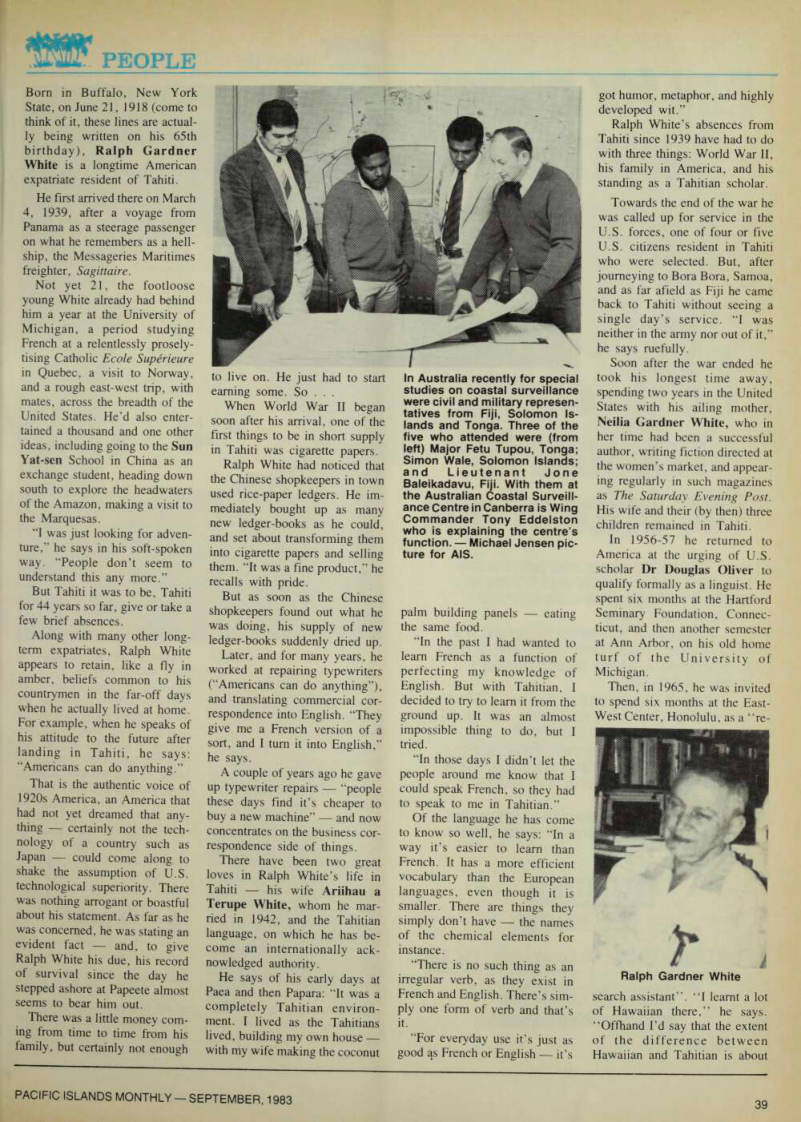
In Australia recently for special studies on coastal surveillance were civil and military represen tatives from Fiji, Solomon Is lands and Tonga. Three of the five who attended were (from left) Major Fetu Tupou, Tonga; Simon Wale, Solomon Islands; and Lieutenant Jone Baleikadavu, Fiji. With them at the Australian Coastal Surveill ance Centre in Canberra is Wing Commander Tony Eddelston who is explaining the centre’s
function. - Michael Jensen pic
ture for AIS.
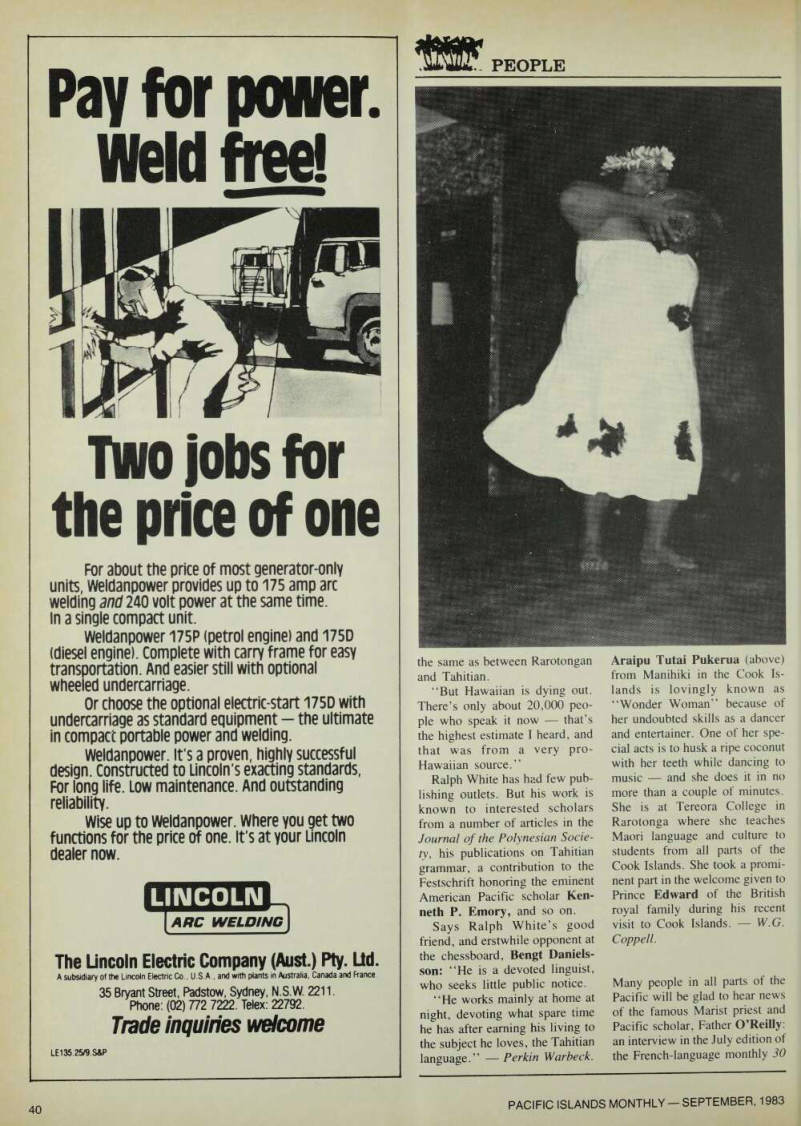
Ralph Gardner White
the same as between Rarotongan and Tahitian.
“But Hawaiian is dying out.
There’s only about 20,000 peo ple who speak it now that’s the highest estimate I heard, and that was from a very pro- Hawaiian source.’’
Ralph White has had few pub lishing outlets. But his work is known to interested scholars from a number of articles in the Journal of the Polynesian Socie ty, his publications on Tahitian grammar, a contribution to the Festschrift honoring the eminent American Pacific scholar Ken neth P. Emory, and so on.
Says Ralph White’s good friend, and erstwhile opponent at the chessboard, Bengt Daniels son: “He is a devoted linguist, who seeks little public notice.
“He works mainly at home at night, devoting what spare time he has after earning his living to the subject he loves, the Tahitian language.” Perkin Warbeck.
Araipu Tutai Pukerua (above) from Manihiki in the Cook Is lands is lovingly known as “Wonder Woman’’ because of her undoubted skills as a dancer and entertainer. One of her spe cial acts is to husk a ripe coconut with her teeth while dancing to music and she does it in no more than a couple of minutes.
She is at Tereora College in Rarotonga where she teaches Maori language and culture to students from all parts of the Cook Islands. She took a promi nent part in the welcome given to Prince Edward of the British royal family during his recent visit to Cook Islands. W.G.
Coppell.
Many people in all parts of the Pacific will be glad to hear news of the famous Marist priest and Pacific scholar, Father O’Reilly: an interview in the July edition of the French-language monthly 30
Jours dans le Pacifique reports him alive and well at 83, and still working from his office at the same Paris address as that given for him his biographical entry in the 1968 edition of the Pacific Islands Year Book & Who’s Who.
Interviewer Jean Dumonteil couldn’t help asking him his views on the burning question of New Caledonian independence.
He didn’t hesitate. “Independ ence is inevitable . . . but who is going to pay apart from France?
In the long run, it is France who is paying and will go on paying for New Caledonia.”
Dumonteil asked him what he would say if President Mitterrand (a one-time student of Father O’Reilly’s) asked him his ad vice. “The whole trend of his tory, and President Mitterrand knows it better than I do, is towards independence. All coun tries in the region are requiring it little by little, but there’s always got to be somebody to come up with the funds.
“The various populations of New Caledonia are fated to have to reach an understanding with each other and live together,”
said Father O’Reilly, adding
with a touch of malice: “Even if some of those who are demand ing land aren’t necessarily all that industrious ...”
Queen Elizabeth II has approved the appointment of Mrs Agnes
Genevieve Grey (Aggie Grey)
as an Honorary Companion of the Queen’s Service Order for Community Service (Q.S.C.), the New Zealand High Commis sion in Apia has announced.
The Governor-General of New Zealand has advised Mrs Grey of the award and conveyed His Ex cellency’s personal congratula tions and those of the people of New Zealand.
The Prime Minister of New Zealand Robert Muldoon, and Mrs Muldoon have extended their best wishes and congratula tions on the well merited honor conferred by Her Majesty The Queen of New Zealand.
Ex-boxer, ex-hotelier, ex
convalescent hospital pro perietor, ex-gambling man, John
Hepplewhite has found his niche at last. He is now the managing director of Tonga Cold Stores Ltd, manufacturers of small goods and meat wholesaler /retailer in Nukualofa.
Together with his wife, Yvon ne, he has built up a very good business and jokingly refers to himself as “the sausage king of Tonga.”
Actually King Taufa’ahau Tupou IV is a close friend of the
Hepplewhites, and he and John share an interest in good food.
John prides himself on his secret sausage recipes, and will not reveal the reasons why it is that people come back again and again to buy his sausage specialities, which go by names such as Friendly Island, Sup reme, and Breakfast.
John was recently approached with a take-over offer by a big Australian firm. He knocked it back because, he says, the price offered wasn’t big enough. W.
G. Coppell.
Australian actor Mel Gibson, who plays Fletcher Christian in Dino de Laurentiis’s production of Bounty, the latest film to be made on the world’s most fam ous mutiny, found himself in
hospital briefly in Tahiti in July.
He’d tried to break up a brawl which occurred one evening near the team’s hotel on Moorea, and the blow he collected for his pains merited flying him back to Tahiti for treatment.
Knowledgeable pepole ac
quainted with the production say Gibson’s acting is a real eye opener, revealing that the young Australian is capable of a dramatic range much greater than previous roles would have indi cated. (But, after all, his career is still in its early days).
Dino de Laurentiis is in no
doubt about Gibson’s talent. He told the Tahiti newspaper Les Nouvelles : “This Mel Gibson is a star. He’s a marvellous actor who has given the full measure of his talent in his role as Fletch er Christian.
“I think he’s a fabulous per son, something between Errol Flynn and Clark Gable.’’
Of Marlon Brando, perhaps the most famous resident of French Polynesia, de Laurentiis said: “He’s the best film actor alive today. Only he doesn’t want to work.”
When the interviewer pointed out that Brando was making a film of the life of AI Capone, de Laurentiis replied: “Yes, but where’s he doing that? He’s pre pared to work for a week, and that’s it. But he’s still an extraor
dinary type.”
After shooting at Moorea, the Bounty team moved on to New Zealand to finish off their work.
The word is out and it’s not only the likes of Mr de Laurentis who are saying it that this latest version of the Bounty mutiny is much, much closer to historical truth than any of the many previous versions.
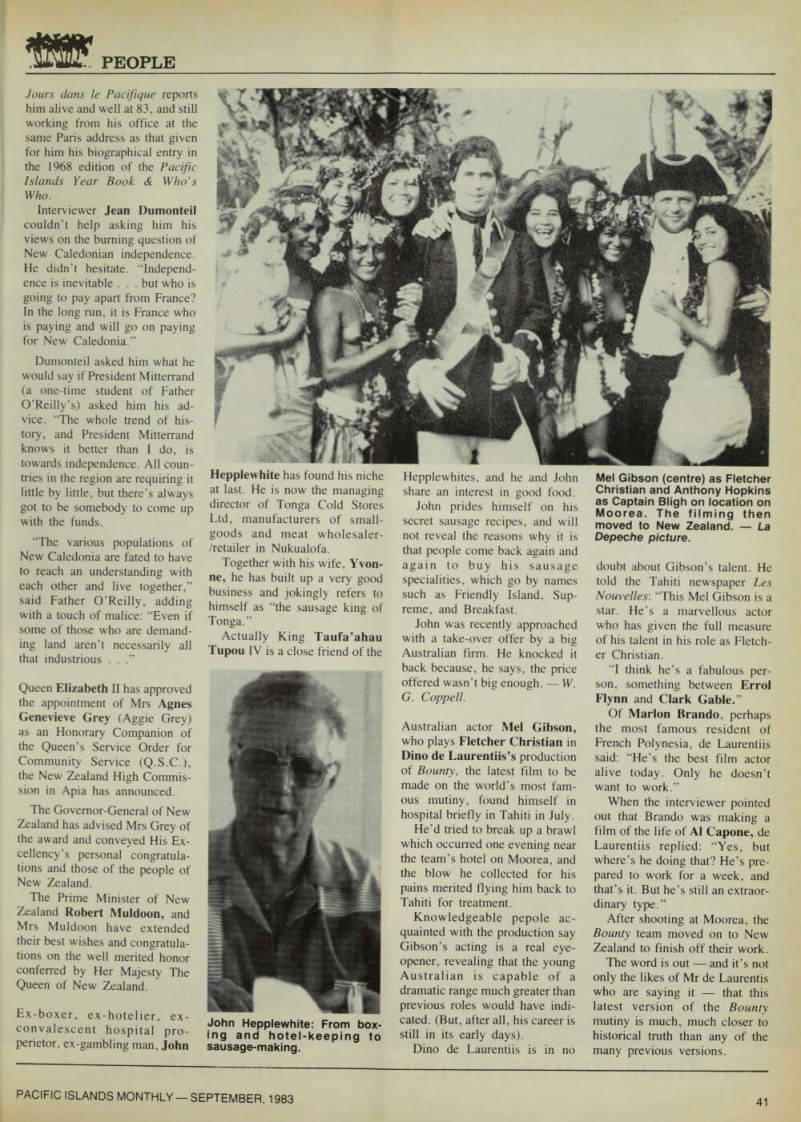
John Hepplewhite: From box ing and hotel-keeping to sausage-making.
Mel Gibson (centre) as Fletcher Christian and Anthony Hopkins as Captain Bligh on location on Moorea. The filming then moved to New Zealand. - La Depeche picture.