Land, foreign policy, set
p. 51 · Read in the full issue
Political Currents
Land, foreign policy, set to dominate Vanuatu election campaign
November 2 has been set as the date for the national elections in Vanuatu, and the tug-of-war for public opinion has begun. The Vanuaaku Party has closed ranks for the campaign, the Vanuatu Independents’ Alliance Party has issued a statement of direction, and the major Opposition party, the Union of Moderate Parties, is the first into print with an up-to date platform.
The UMP’s platform is printed in Bislama, and appears under the sign of the “Open Hand”, signalling the party’s main elec tion theme the necessity for work to develop the country.
Though the platform is largely couched in generalities, it con tains one clear major departure from present government policy.
The UMP propose to reintroduce freehold title, and the selling of land. At present, all land is deemed to belong to its custom owners by inalienable right; under UMP policy, this land will be able to be sold by the present custom owners, though only to citizens of the country. The UMP, however, do not appear to propose recognition of pre independence freehold titles to f he land.
Much of the rest of the plat mi follows current government Jicy. In the policies for ag :ulture, health, tourism, em liyment and decentralisation /ire are no surprises. In educa- Mm, the platform expresses the Rlea that free primary education would promote “justice and equality” in the country, but does not commit the UMP to a definite undertaking to change this immediately. In reference to co-operative stores, the platform states strongly that these should not compete with private stores (i.e. in selling imported goods) but should confine themselves to serving as marketing outlets for local producers, providing ag ricultural and marketing advice.
In all, the UMP document is
designed to appeal to villagers who feel unable to earn money needed to pay taxes and school fees, and who are perhaps uneasy about Vanuatu’s current strong foreign policy. It may be wel comed, too, by mixed-race and non-Melanesian citizens, who are often excluded from land ownership. Apart from the com mitment to return to freehold title, it presents more a sense of general style of policy than specific proposals something which may be remedied closer to the elections.
But if the UMP platform is unspecific, the Vanuaaku Party platform is still unpublished. It is under process of review, and will be presented first to the political commissars of the party at their October meeting.
The revision of the VP plat form was agreed to at the annual congress at Ambrym in June the congress which was to have seen big changes in the leader ship of the party. In the event, no such changes occurred. The divi sions which shook the party, and the government, in the early months of the year were ex plained as being not initiated by the party leaders, but a reflection of a grassroots disunity, due to the failure of sub-committees to work properly. Thus the leader
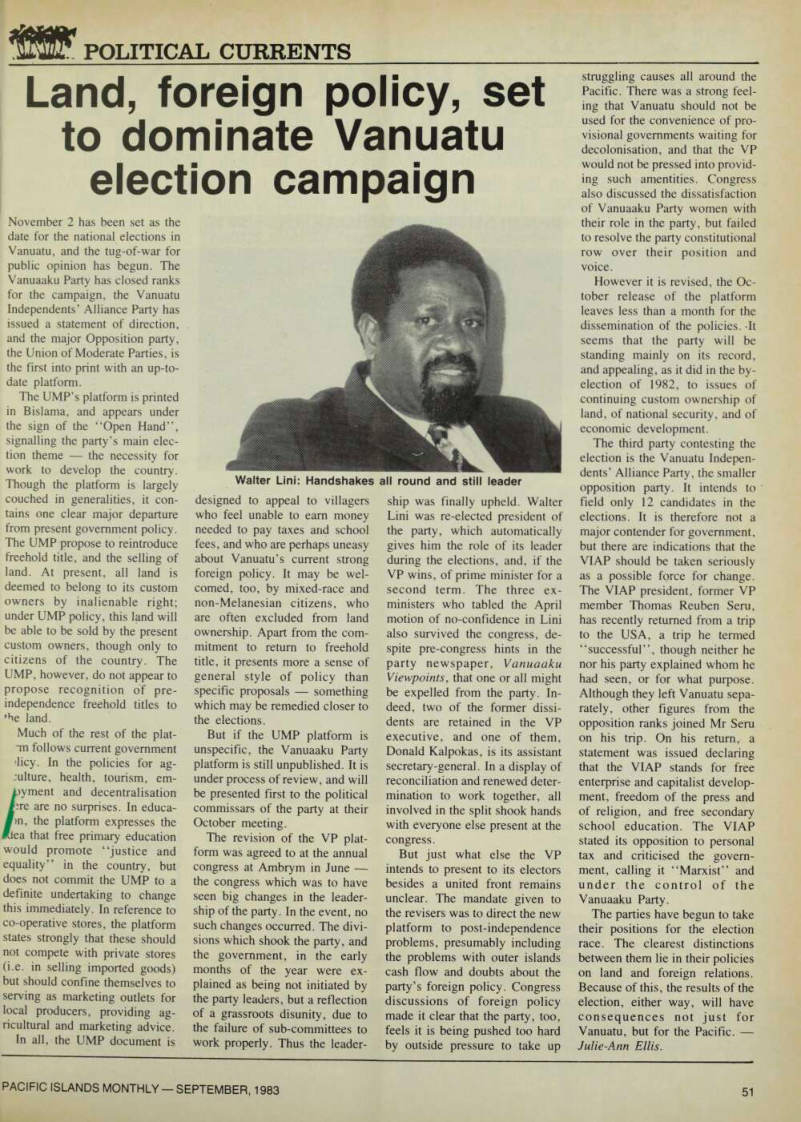
ship was finally upheld. Walter Lini was re-elected president of the party, which automatically gives him the role of its leader during the elections, and, if the VP wins, of prime minister for a second term. The three ex ministers who tabled the April motion of no-confidence in Lini also survived the congress, de spite pre-congress hints in the party newspaper, Vanuaaku Viewpoints, that one or all might be expelled from the party. In deed, two of the former dissi dents are retained in the VP executive, and one of them, Donald Kalpokas, is its assistant secretary-general. In a display of reconciliation and renewed deter mination to work together, all involved in the split shook hands with everyone else present at the congress.
But just what else the VP intends to present to its electors besides a united front remains unclear. The mandate given to the revisers was to direct the new platform to post-independence problems, presumably including the problems with outer islands cash flow and doubts about the party’s foreign policy. Congress discussions of foreign policy made it clear that the party, too, feels it is being pushed too hard by outside pressure to take up
struggling causes all around the Pacific. There was a strong feel ing that Vanuatu should not be used for the convenience of pro visional governments waiting for decolonisation, and that the VP would not be pressed into provid ing such amentities. Congress also discussed the dissatisfaction of Vanuaaku Party women with their role in the party, but failed to resolve the party constitutional row over their position and voice.
However it is revised, the Oc tober release of the platform leaves less than a month for the dissemination of the policies. It seems that the party will be standing mainly on its record, and appealing, as it did in the by election of 1982, to issues of continuing custom ownership of land, of national security, and of economic development.
The third party contesting the election is the Vanuatu Indepen dents’ Alliance Party, the smaller opposition party. It intends to field only 12 candidates in the elections. It is therefore not a major contender for government, but there are indications that the VIAP should be taken seriously as a possible force for change.
The VIAP president, former VP member Thomas Reuben Seru, has recently returned from a trip to the USA, a trip he termed “successful”, though neither he nor his party explained whom he had seen, or for what purpose.
Although they left Vanuatu sepa rately, other figures from the opposition ranks joined Mr Seru on his trip. On his return, a statement was issued declaring that the VIAP stands for free enterprise and capitalist develop ment, freedom of the press and of religion, and free secondary school education. The VIAP stated its opposition to personal tax and criticised the govern ment, calling it “Marxist” and under the control of the Vanuaaku Party.
The parties have begun to take their positions for the election race. The clearest distinctions between them lie in their policies on land and foreign relations.
Because of this, the results of the election, either way, will have consequences not just for Vanuatu, but for the Pacific.
Julie-Ann Ellis.
Walter Lini: Handshakes all round and still leader