The ‘powerless’
pp. 29-31 · Read in the full issue

sense power
The moods of the 1983 Confer ence for a Nuclear-free and Inde pendent Pacific, held in Port- Vila in July, were an invigorat ing blend of enthusiasm, politicking, warmth, sincerity, dispassionate clarity, and strong commitment. The cultures repre sented were equally diverse Polynesian, Melanesian and Micronesian, but also Japanese, American Indian, European, Filipino and Australian Abori ginal. All these had come to gether to exchange information about Pacific problems to de monstrate their support for a nuc lear-free and independent Pacif ic, and to plan how to achieve it.
The conference was held with the blessing and support mor al, not monetary of the Vanuatu Government. At the opening ceremony Deputy Prime Minister Sethy Regenvanu reiterated the anti-nuclear stance of the government, and is oppos ition to continuing colonialism in the Pacific. But support for the conference was not confined to politicians, nor to any particular political party. The president of the (politically unaligned) Coun cil of Chiefs, Chief Willie Bong matur, himself a delegate to the conference, broadcast a request to the islands for food for the delegates he was swamped by the response. The village of Pan go hosted a lavish island banquet and reception for the entire con ference. Scores of villagers throughout the archipelago also sent mats and baskets, as gifts for the visitors.
The people’s support showed
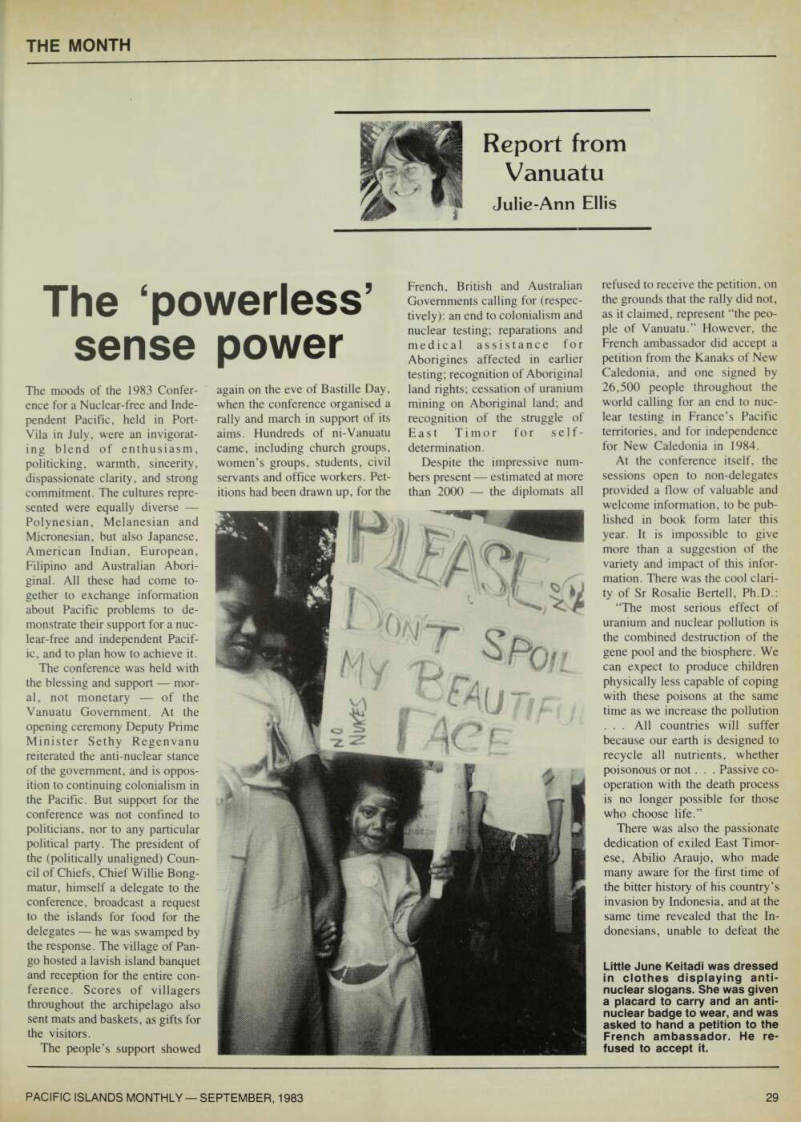
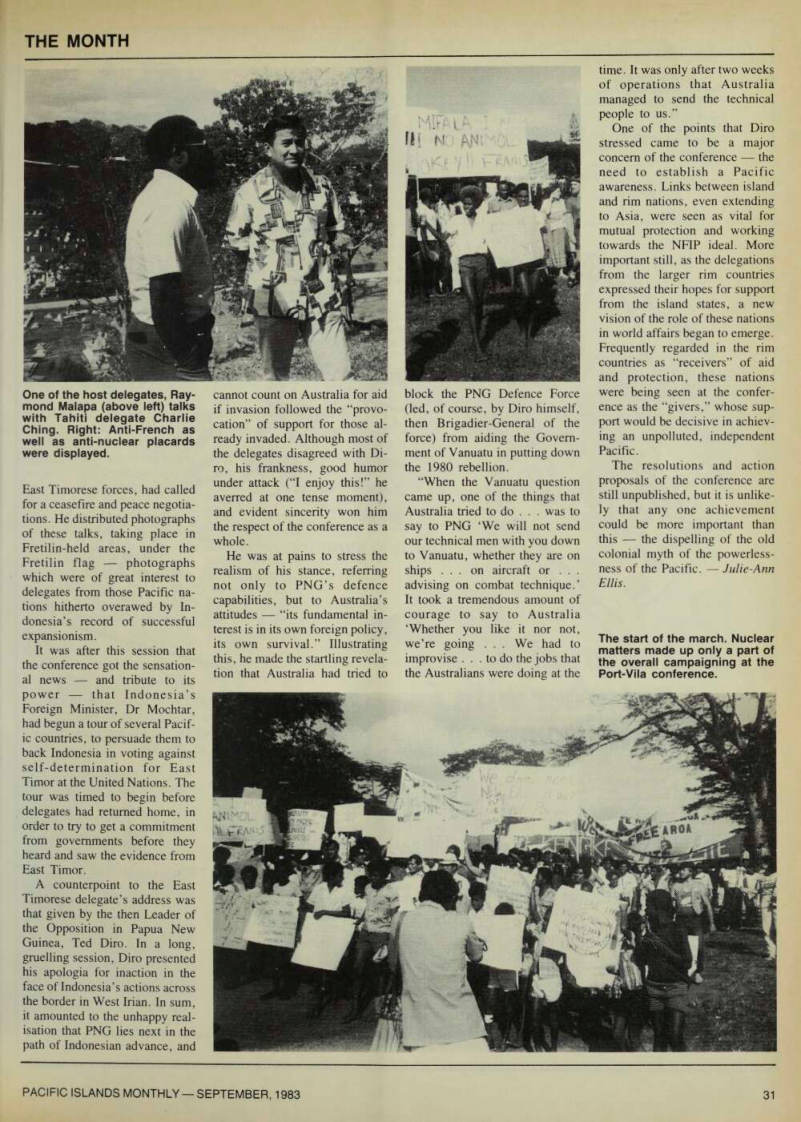
again on the eve of Bastille Day, when the conference organised a rally and march in support of its aims. Hundreds of ni-Vanuatu came, including church groups, women’s groups, students, civil servants and office workers. Pet itions had been drawn up, for the
French, British and Australian Governments calling for (respec tively): an end to colonialism and nuclear testing; reparations and medical assistance for Aborigines affected in earlier testing; recognition of Aboriginal land rights; cessation of uranium mining on Aboriginal land; and recognition of the struggle of East Timor for self determination.
Despite the impressive num bers present estimated at more than 2000 the diplomats all
refused to receive the petition, on the grounds that the rally did not, as it claimed, represent “the peo ple of Vanuatu.” However, the French ambassador did accept a petition from the Kanaks of New Caledonia, and one signed by 26,500 people throughout the world calling for an end to nuc lear testing in France’s Pacific territories, and for independence for New Caledonia in 1984.
At the conference itself, the sessions open to non-delegates provided a flow of valuable and welcome information, to be pub lished in book form later this year. It is impossible to give more than a suggestion of the variety and impact of this infor mation. There was the cool clari ty of Sr Rosalie Bertell, Ph.D.; “The most serious effect of uranium and nuclear pollution is the combined destruction of the gene pool and the biosphere. We can expect to produce children physically less capable of coping with these poisons at the same time as we increase the pollution ... All countries will suffer because our earth is designed to recycle all nutrients, whether poisonous or not. . . Passive co operation with the death process is no longer possible for those who choose life.”
There was also the passionate dedication of exiled East Timor ese, Abilio Araujo, who made many aware for the first time of the bitter history of his country’s invasion by Indonesia, and at the same time revealed that the In donesians, unable to defeat the
Report from Vanuatu Julie-Ann Ellis
Little June Keitadi was dressed in clothes displaying anti nuclear slogans. She was given a placard to carry and an anti nuclear badge to wear, and was asked to hand a petition to the French ambassador. He re fused to accept it.
East Timorese forces, had called for a ceasefire and peace negotia tions. He distributed photographs of these talks, taking place in Fretilin-held areas, under the Fretilin flag photographs which were of great interest to delegates from those Pacific na tions hitherto overawed by In donesia’s record of successful expansionism.
It was after this session that the conference got the sensation al news and tribute to its power that Indonesia’s Foreign Minister, Dr Mochtar, had begun a tour of several Pacif ic countries, to persuade them to back Indonesia in voting against self-determination for East Timor at the United Nations. The tour was timed to begin before delegates had returned home, in order to try to get a commitment from governments before they heard and saw the evidence from East Timor.
A counterpoint to the East Timorese delegate’s address was that given by the then Leader of the Opposition in Papua New Guinea, Ted Diro. In a long, gruelling session, Diro presented his apologia for inaction in the face of Indonesia’s actions across the border in West Irian. In sum, it amounted to the unhappy real isation that PNG lies next in the path of Indonesian advance, and
cannot count on Australia for aid if invasion followed the “provo cation” of support for those al ready invaded. Although most of the delegates disagreed with Di re, his frankness, good humor under attack (“I enjoy this!” he averred at one tense moment), and evident sincerity won him the respect of the conference as a whole.
He was at pains to stress the realism of his stance, referring not only to PNG’s defence capabilities, but to Australia’s attitudes “its fundamental in terest is in its own foreign policy, its own survival.” Illustrating this, he made the startling revela tion that Australia had tried to
block the PNG Defence Force (led, of course, by Diro himself, then Brigadier-General of the force) from aiding the Govern ment of Vanuatu in putting down the 1980 rebellion.
“When the Vanuatu question came up, one of the things that Australia tried to do . . . was to say to PNG ‘We will not send our technical men with you down to Vanuatu, whether they are on ships ... on aircraft or . . . advising on combat technique.’
It took a tremendous amount of courage to say to Australia ‘Whether you like it nor not, we’re going . . . We had to improvise . . . to do the jobs that the Australians were doing at the
time. It was only after two weeks of operations that Australia managed to send the technical people to us.”
One of the points that Diro stressed came to be a major concern of the conference the need to establish a Pacific awareness. Links between island and rim nations, even extending to Asia, were seen as vital for
mutual protection and working
towards the NFIP ideal. More important still, as the delegations from the larger rim countries expressed their hopes for support from the island states, a new vision of the role of these nations in world affairs began to emerge.
Frequently regarded in the rim countries as “receivers” of aid and protection, these nations were being seen at the confer ence as the “givers,” whose sup port would be decisive in achiev ing an unpolluted, independent Pacific.
The resolutions and action proposals of the conference are still unpublished, but it is unlike ly that any one achievement could be more important than this the dispelling of the old colonial myth of the powerless
ness of the Pacific.
Julie-Ann
Ellis.
One of the host delegates, Ray mond Malapa (above left) talks with Tahiti delegate Charlie Ching. Right: Anti-French as well as anti-nuclear placards were displayed.
The start of the march. Nuclear matters made up only a part of the overall campaigning at the Port-Vila conference.