Bishop Museum
pp. 25-27 · Read in the full issue

Bryan and Emory, Bishop Museum
E. H. Bryan Jr (christened Edwin Horace Bryan III), and Kenneth Pike Emory, are two of Hawaii’s most distinguished citizens.
They also have a remarkable number of things in common.
Both have devoted their entire professional lives to the Pacific together their careers at the Bernice Pauahi Bishop Museum add up to well over a century’s service to that institution.
Both were bom shortly before the turn of the century in the north-eastern United States Bryan in 1898 in Philadelphia, Pennsylvania, and Emory in 1897 in Fitchburn, Mas sachusetts. Emory was first of the two to arrive in Hawaii when his family moved to the islands in 1901. Bryan also moved west at an early age but stopped along the way to Hawaii. Before he was a year old, his family moved to California, and he spent his youth there and in the south-west before sailing to Honolulu on the
Matson liner Wilhelmina in 1916.
Both men earned their bachelor degrees in 1920.
In each case, an uncle was at least partially responsible for his nephew’s educational choice.
Bryan’s uncle was an educator in Hawaii, and he invited his young nephew to Honolulu to attend the College of Hawaii, the forerun ner of the University of Hawaii, and which Bryan’s uncle de scribed at the time as the “little cow college in our frontyard”.
Bryan took his degree in general science. An uncle of Emory’s lived near Dartmouth University in New Hampshire, and the young Kenneth returned to the American northeast and took what would today be called a degree in liberal arts.
Bryan and Emory were hired within a year of each other by Dr Herbert E. Gregory, the second director of the Bishop Museum.
Bryan was appointed as an assis
tant in entomology in 1919, and Emory was signed on as an assis tant ethnologist in 1920. Both were involved in the first Pacific Science Congress which was held in Honolulu in 1920. In fact, Bryan helped Gregory or ganise the conference, and Em ory attended as a delegate on August 2, 1920, his second day in his new job. In later years and on several occasions, Bryan and Emory have taught at the Univer sity of Hawaii, and during the years of World War 11, they both saw service in applied teaching and research capacities.
There are further similarities.
Bryan and Emory continued their educations after taking up their positions at the museum. Their dedication and commitment to the Bishop, however, often caused them to delay and sac rifice their own personal academ ic advancement. Bryan took a second B.A. degree at Yale in 1921, the M.A. in entomology at the University of Hawaii in 1924, and further graduate study in botany and zoology at Stan ford in 1929-30. Emory’s graduate work was entirely in anthropology, completing the M.A. degree at Harvard in 1923 and the Ph.D. at Yale in 1947.
According to the April 1983 Ka’Elele (the Bishop’s monthly newsletter) which celebrated Bryan’s 85th birthday, it was noted that one of director Greg ory’s first charges to Bryan in 1919 was to learn “all there is to know about the geography and natural history of the Pacific Is lands’’. The subsequent years indicate that he took the directive seriously. During the 19205, Bryan conducted extensive re search in Hawaii (including the far-flung and uninhabited north western isles) and Johnston and Wake Islands. Most of 1924 was spent on an expedition to Samoa, the Cooks, the Phoenix and To kelau Islands, and the Lau group in Fiji. In 1927 came a well deserved promotion to curator of collections, and Bryan also as sisted Margaret Mead in prepara tion for her first research in American Samoa which resulted in her famous book Coming of Age in Samoa the subject of much recent controversy. During the 19305, Bryan made several expeditions to the equatorial is lands in conjunction with the U.S. occupation of Baker, Jar vis, and Howland Islands. In addition to his administrative chores, Bryan also found time to
A View from Honolulu Robert C. Kiste
help reorganise the Guam Museum and continue research in Hawaii.
In 1941, Bryan left the museum when he was commis sioned as a captain in the U.S.
Army. During the war, he com piled data on islands that were little known to Americans but were destined to play a role in the conflict. For his distinguished service, he was decorated and promoted to the rank of Lieuten ant-Colonel. At the close of hos tilities, Bryan served with the U.S. Commercial Company which attempted to rehabilitate the war-ravaged economy of Micronesia, the Pacific Science Board which planned research that would be supported by the U.S., and the South Pacific Commission. After 10 years of such applied efforts, Bryan re turned to his curatorship at the Bishop in 1950.
In 1960, Bryan realised a long-standing dream when he founded the Pacific Scientific In formation Center (PSIC) at the museum to serve as a clearing house for Pacific geography and bibliographic information on cur rent Pacific literature. In 1968, the museum trustees honored Bryan by naming him the very first Brigham Fellow named in honor of the Bishop’s first director, William T. Brigham.
Supposedly, Bryan retired that
same year.
In reality, he continues to guide PSIC and supports much of its costs. While the museum pro vides facilities and some other assistance, funding is scarce, and as an indication of his continued commitment to the Pacific, Bryan donates his museum re tirement benefits and the pro ceeds from the sales of his Bryan’s Sectional Maps of O’ahu. The latter is an excellent and frequently up-dated guide to the streets and roads of the city and county of Honolulu, and it seems unfortunate that so many who find it useful know nothing of the man behind it.
Like Bryan, Emory’s first re search efforts were in Hawaii, and soon after his museum ap pointment, he was established as a pioneer of Hawaiian anthropol ogy, particularly in the archeolo gy of the islands. There soon followed an expedition to the Line Islands and Tahiti in 1924-5
where Emory conducted exten sive archeological surveys. In 1929-31 and 1934, there were expeditions to the culturally con servative Tuamotu Atolls where older informants could still recall much of the traditional way of life. Along with museum respon sibilities, additional research was conducted in Hawaii until Pearl
Harbor interrupted scholarly
pursuits.
During the war years, Emory gave courses and lectures for
military personnel on survival
techniques on Pacific Islands, particularly the barren coral atolls. He became the chief in structor at a special army combat school in Hawaii, and by the end of the war, he had had a hand in the training of over 150,000 men.
Peacetime brought a return to more rewarding endeavors. In 1947 and 1950, Emory ventured into Micronesia for the first time for field research among the peo ple of the Polynesian outlier, Kapingamarangi Atoll, in the eastern Carolines. As with the earlier Tuamotu experience, the
Kapingamarangi people had re
tained much that had been lost decades before by other Polyne sians, and the work was one of
the high points of Emory’s
career. Later field trips were to occur, and, by one count, Emory has made at least 14 major ones to Polynesian locales, with shor ter sojourns in Melanesia and Micronesia.
One landmark in Emory’s career came in 1950. At that time, it was commonly believed that the human occupation of the Pacific had been so recent, and tropical climatic conditions so adverse to the preservation of most artifacts, that archeological excavations were not worth while. The myth was dispelled when Emory’s excavations of a cave on Oahu yielded not only a stratified site but also the first radiocarbon date for Polynesia.
A volume of collected essays by colleagues and former stu dents often marks the end of a successful scholar’s career, and just such a tome, Polynesian Culture History: Essays in Hon or of Kenneth P. Emory, was published in 1967 by the Bishop Museum Press on the occasion of
Emory’s 70th birthday. That
volume, however, did not pay homage to the conclusion of a career, but only marked a point along the way. A good biograph ical essay, “Kia Ora Keneti”, by Bengt Danielsson opens the volume, and Danielsson closes
with comments on Emory’s in credible vitality as he was enter ing his eighth decade. Daniels son was certainly correct, and to date, Emory has added a further 16 years to his productive career.
Quite appropriately, Emory
was awarded the Herbert E.
Gregory Medal for Distinguished
Service to Pacific Science at the XV Pacific Science Congress in Dunedin, New Zealand, last Feb ruary. According to Ka'Elele (March 1983), previous reci pients of the medal are A. F.
Elkin, Australia, for anthropolo gy, 1961; G. P. Murdock, Un ited States, for anthropology, 1966; F. R. Fosberg, United States, for botany, 1971; J. L.
Gressitt, United States, for en tomology, 1975; and C. A.
Fleming, New Zealand, for biogeography, 1979. The award was established by the Bishop Museum’s Board of Trustees in 1961 to honor the man who, more than 60 years ago, had the foresight to recruit Bryan and Emory to the museum’s staff.
Robert C. Kiste.
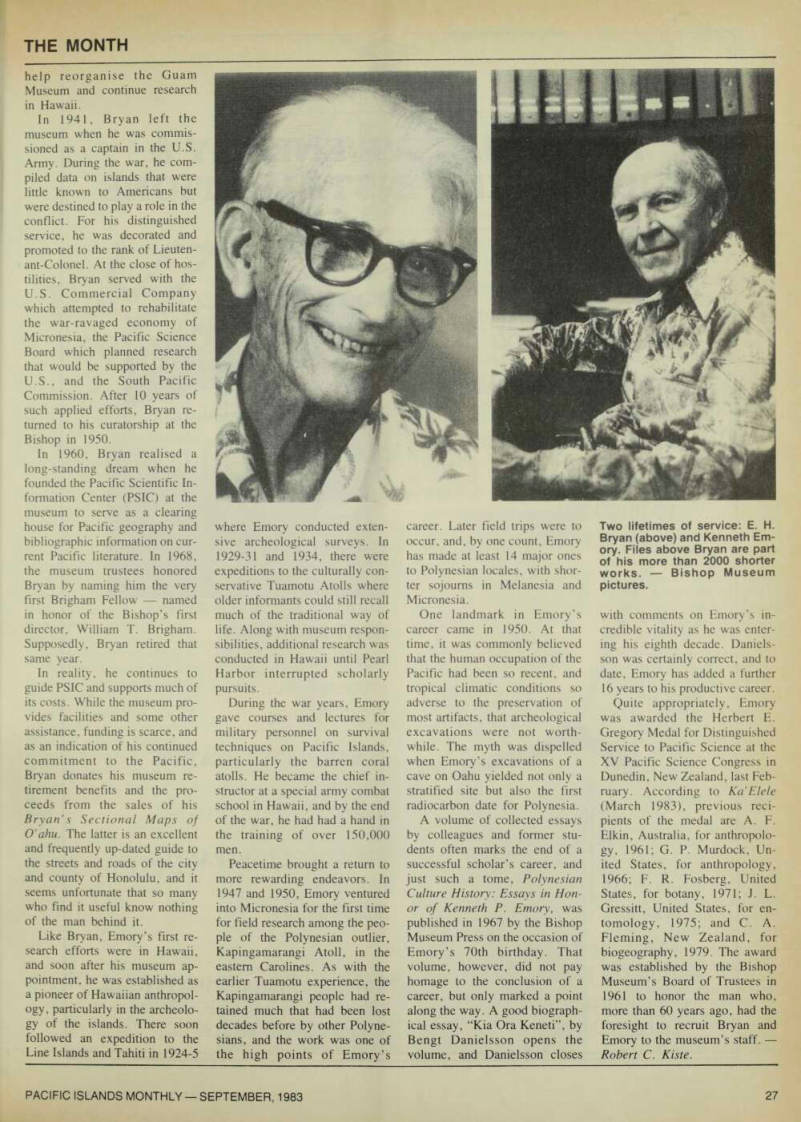
Two lifetimes of service: E. H.
Bryan (above) and Kenneth Em ory. Files above Bryan are part of his more than 2000 shorter works. - Bishop Museum pictures.