the Pitcairners?
pp. 21-25 · Read in the full issue

A way out for the Pitcairners?
At the beginning of July, we received the nearest possible thing to an EXPRESS letter from Pitcairn. It was deliverd by the Swedish yacht Northern Light and reached us in the incredibly short time of three weeks. (“Normal” delivery time via Auckland or Panama is about six months.) The writer was Norwegian born Kari, married to Brian Young, who is gradually re placing the regretted Ron Clark as the main chronicler of events on Pitcairn. (Incidental ly, Kari has written a charm ing book-length account of her daily life and that of the 57 other islanders on the fam ous rock. We hope it will soon be translated into English).
In her Special Delivery Ex press letter, Kari tells of the tremendous difficulties faced by the Pitcairners in this bois terous year, during which the island has been hit by several devastating cyclones.
Dear Friends, Nineteen eighty-three has been tough for us Pitcairners. Up to last year, the general mood was
optimistic, nobody seriously thought of leaving the island, Pitcairn was the best place in the world, and so on. But this year, we have had to endure many severe psychological and physic al hardships. After the visit of a New Zealand supply ship in June 1982, we had to wait until Feb ruary 1983 for the arrival of the
next one. However, mail arrived in between, in September, Then the weather has been bad for months, and all these eye lones sweeping down from French Polynesia have destroyed our fruit trees and vegetable gar dens. The blow is a serious one, as we depend heavily on local products and receive very little
from abroad. The roads were damaged by the heavy rains which accompanied the cyc lones, and as a result the number of public work days has doubled.
The old, leaky longboats were often stove in, and bottom planks had to be replaced.
The weather was particularly bad in February when the New
Zealand supply ship arrived at
long last. The captain very oblig
ingly delayed unloading until the next morning, so as to give us two full days for the job. But the sea in Bounty Bay was still so rough that the longboats could manage only a few trips a day.
One of them suffered damage to its keel, and the other was hurled
up on the rocky shore. Finally, the ship sailed on to Chile with half of our supplies still on board.
The captain had another try on the return voyage to New Zea land. But weather conditions were not much better, and we succeeded in landing only a few boatloads of goods. So once
again we watched much of our
treasured supplies disappear over
the horizon, this time in the direction of New Zealand.
Fortunately we have our own radio station, UR6KY, and we used it to order goods to the value of SUS4OOO from a friend in Houston, Texas, who loaded them on the Norwegian ship,
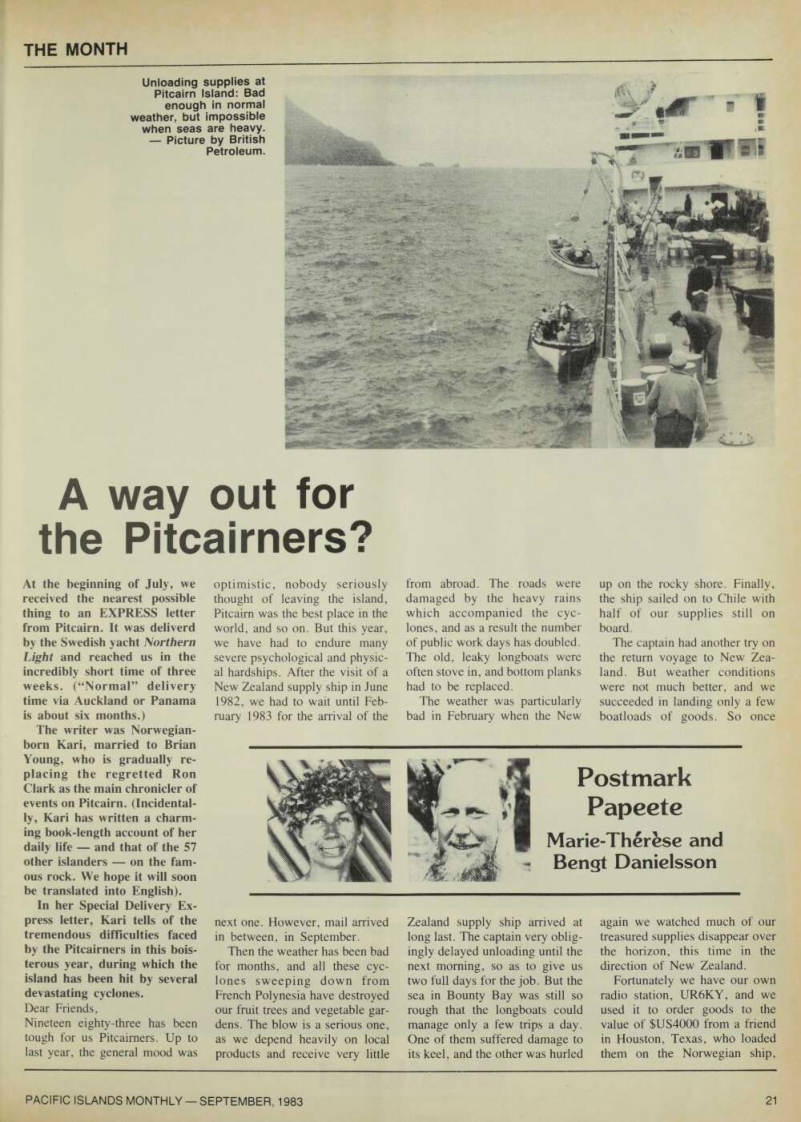
Unloading supplies at Pitcairn Island: Bad enough in normal weather, but impossible when seas are heavy. - Picture by British Petroleum.
Postmark Papeete Marie-Thérèse and Bengt Danielsson
Stolt Sincerity, bound for New Zealand.
The ship arrived here last Sun day, May 15, at 6 p.m. and the weather could not have been worse: gale force winds were
blowing into Bounty Bay from
the northeast, stirring up huge waves which washed over the jetty. The men managed to get out of the bay at 4 p.m. and sought protection off the west coast, behind the Tedside cliffs.
The rest of us gathered in a rather desperate mood in the church for a prayer meeting.
When the ship came into view, I left the children with Grandma and walked with three other wo men over to Tedside and slid down to a cave where we took shelter. We had brought food, blankets and lamps and could therfore stay as long as needed.
Not very far from the beach we could see the Swedish yacht Northern Light riding high on the crests. But as it was already almost dark, all we could see further out were a few dim
“southern lights”, showing, we
hoped, that the longboats were still there, tied up to the ship.
Then the lights disappeared, and we saw no sign of life any where until two o’clock when the beach was suddenly lit up by a flash. It was our men. They told us that they had had to leave the ship six miles out at sea (the ship then continued towards New Zealand), and that it had taken them two hours to beat back to the island against the strong head-wind. In one of the boats, the pump had broken down, and water poured in faster than they could bail it out. As a result they had been sitting up to their knees in a “soup” of salt water and diesel oil.
Worst of all, however, was the
fact that, due to the height of the waves, they had been unable to see either the island itself, or the fire which we had lit in our cave.
Halfway back the two craft became so widely separated that the men in the waterlogged boat thought their last hour had come.
When the undamaged boat caught up, it could offer only very limited assistance. Both boats in fact were seriously over loaded. With the greatest reluct ance, the men threw several drums of diesel oil overboard.
This probably saved them.
The work was not over, how ever. For as soon as the new day dawned, the supplies had to be ferried ashore from the longboats with the help of the rubber ding hy belonging to the Northern Light. Once landed, they were carried up the cliffs to the top of Tedside, where they were loaded on our tractor and taken home to Adamstown. By then, of course, the deep-frozen food had melted, and all books, magazines, and clothing were sopping wet.
When night fell, the longboats were still moored off Tedside, and the men decided not to risk capsizing them in the agitated seas in Bounty Bay but to stay on board all night in this slightly more protected place.
On Tuesday the weather was even worse. While the longboats kept bobbing in the sea below, we others continued to carry the goods up the cliffs. The contents of many boxes and crates could often be split up. But what can you do with large, heavy things like oil drums and masonite boards? Nothing, except join hands and push or drag for all we were worth.
The “sailors” had to spend still another agitated night between Tuesday and Wednesday on board the longboats off Tedside.
But the next day they “shot”
Bounty Bay and stumbled ashore dead tired, and with eyes swollen from the constant exposure to salt water. They had to set to work right away in Adamstown on the houses which had practic ally all suffered some storm damage.
As you can see, life can some times be really tough in this reputedly idyllic place. Although we love our island home, many voices have been heard lately
saying that if it goes on like this, we will eventually all end up as factory workers in New Zealand.
In reply, we have just de spatched the following letter with another yacht bound for Pitcairn: Dear Friends, We feel very sorry for you in your present plight, and send you our warmest and most compas sionate greetings. But, please, do not despair, your situation is not as desperate as you think.
Your basic problem is how to establish better communications with the rest of the world so that you may receive regular supplies in a safer manner and also perhaps, at the same time, entice some of your kinsfolk who in desperation have emigrated to New Zealand, to return home.
All you need for that is money huge amounts of money. It seems to us, however, that this is readily available. Not by build ing an airstrip and developing tourism, as a crazy American millionaire is suggesting. Your island is too small, and you are too few. Even a few thousand camera-clicking tourists per year would trap you in your homes like caged animals in a zoo. And the money would no doubt end up in the pockets of the smart developers and promoters.
Certainly, you can always is sue a few more stamps. But you’ve just about run out of themes by now. The Bounty, her launch and anchor, Captain Bligh, the mutineers and the breadfruit pots, have all been portrayed not once but several times.
All local plants and animals, down to the wasps and banana moths, have been glorified on separate stamps. Nor have the dependencies, Oeno, Henderson, and Ducie Islands, been forgotten.
In any case, there’s a limit to what stamp collectors can afford.
There is also the matter of com petition from other Pacific coun tries where the range of motifs includes genuine Polynesian roy alty, lovely hula maids, and spectacular seashells. This can only get stiffer.
To our mind the solution is simple: simply transform your
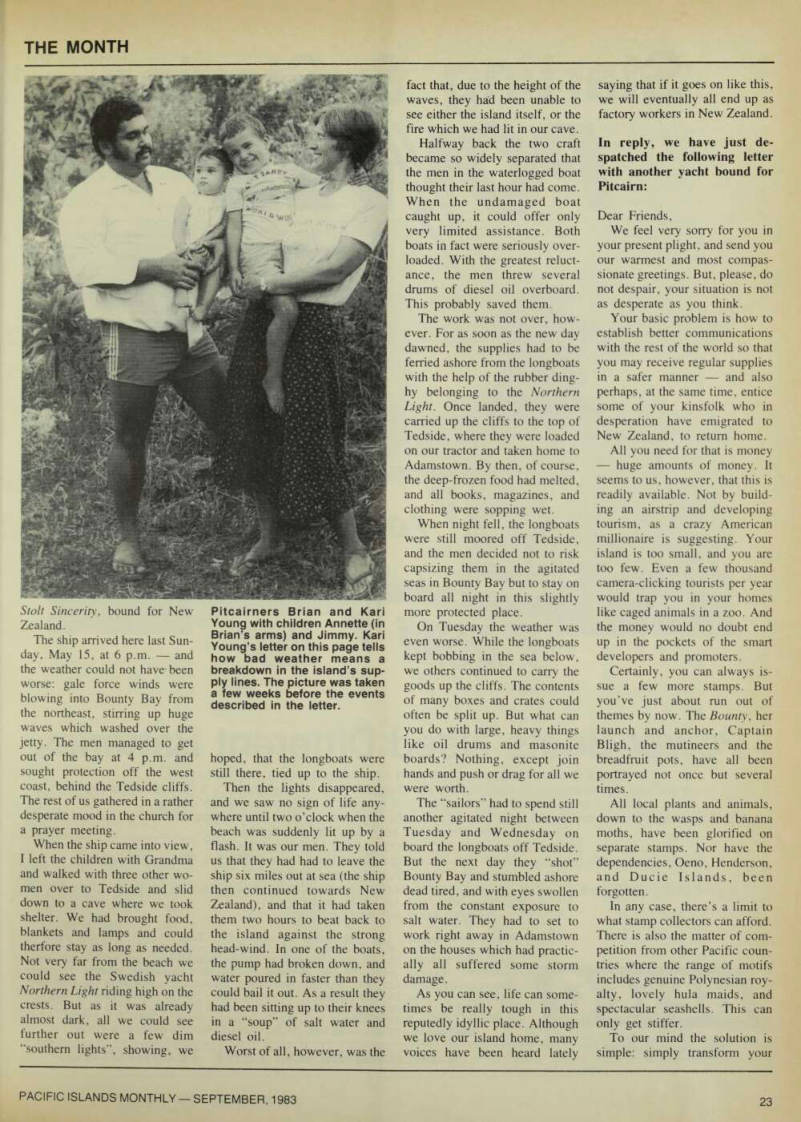
Pitcairners Brian and Kari Young with children Annette (in Brian’s arms) and Jimmy. Kari Young’s letter on this page tells how bad weather means a breakdown in the island’s sup ply lines. The picture was taken a few weeks before the events described in the letter.
greatest liability your loneliness out there in the vast Pacific Ocean into a glorious asset. All you have to do is declare independence, hoist the flag of Pitcairnia, and claim the wealth hidden in the sea within a 200-nautical-mile radius.
Dozens of foreign vessels are already fishing in your waters, and the ocean bed around Pit cairn is covered with nodules containing all sorts of valued
minerals. There may not be more fish and nodules in your chunk of the Pacific than around the al ready independent Island coun tries. But they have populations running into thousands and mill ions, whereas you are only 58 to share your slice.
By declaring independence
you will at once, without lifting a finger, enjoy an annual income of several million dollars from the sale of licences to the Ko
rean, Japanese and Taiwanese
fishing vessels already operating
in your waters.
With the money you first buy a gunboat to chase away pirates and collect arrears. Next you purchase a fine cargo ship to
bring you regular supplies of
everything you need and, eventually, to bring back lost members of the Pitcairn nation, fed up with factory work in New Zealand . . .
Last but not least, you will be able to build an all-weather har bor, where not only your own fleet but also numerous cruise ships will find protection and thus make contributions to your flourishing economy.
For a national anthem, we propose, of course: “Rule, Pit cairnia, Pitcairnia rules the waves!”
Your Pacific neighbors, Marie-Therese and Bengt.