Games salvation
pp. 33-36 · Read in the full issue


for Tofilau?
Seven months after it came to power, the government of West ern Samoa’s Prime Minister To filau Eti is showing signs of panic. During the session of Par liament in July which lasted into August, Tofilau proposed that members of the police force be allowed to be armed with hand guns. At the same time, Parlia ment’s Privileges Committee came out for the first time since Independence in 1962 to muzzle the press. Although the commit tee’s investigation was later dropped, it raised the concern that freedom of expression as guaranteed under the Constitu tion would be violated. It was widely felt that the government would opt for a controlled press.
At the heart of the govern ment’s seemingly uncontrolled panic could well be the fear that it might not be able to deliver by year’s end on the promises it has
publicly made. Tofilau Eti on several occasions, said the au stere economic measures his government has imposed were necessary if economic recovery were to be attained. Earlier in the year he stressed that a vast economic improvement would be evident before the end of the year.
So far there are no signs that things will improve. The govern ment’s tenders system of impor tation which should have brought the cost of living down, did not achieve this goal. Instead, it has pushed prices up, because al though the import prices were competitively lower, shortages of goods led to price rises. As a result, the tenders system was chopped.
However, the government’s explanation for letting the ten ders system go was that it had achieved its purpose. It said the tenders system had saved foreign exchange which had been used to reduce the country’s foreign debt.
Critics argue however that the system had been abused by those who had administered it by awarding tenders even to those who had not applied for them, in return for favors already given.
Although the government had announced in Parliament in July that exports had improved drast ically compared with the same period last year, it is not clear where the improvement was made. It was not defined whether the increase in export earnings was a result of an increase in exports, or of the devaluation of
the tala by 16 per cent earlier in the year.
But what appears to be the government’s main aim at this stage is the reduction of its debts, both foreign and internal. And in this area the International Monet ary Fund (IMF) has been most influential. Earlier in the year, a visiting IMF delegation insisted that the fund would not assist any more if harsh economic measures were not imposed.
The government immediately put into practice the conditions reportedly set down by the IMF.
At a recent meeting in Geneva between least developed coun tries (of which Western Samoa is one) and industrial nations, the IMF reportedly expressed its ap proval of the tough line of action the government was following.
To show its approval, the IMF
has agreed to provide $8 million over the next five years in gov ernment assistance, the govern ment has announced. It is not clear whether the money will be a loan or aid grant, but part of it is being used to reduce the gov ernment’s balance of payments deficit.
Meantime, the Tofilau said the government has paid back a large portion of its multi-million tala overdraft in a local bank. The problem with the New Zealand supplier of cigarette raw, mat erials which caused cigarette shortages recently has also been sorted out. The government said some $25,000 a month was being paid back to the debt with the supplier.
But internally, the public is yet to be convinced that things will improve by the end of the year.
Samoa Report
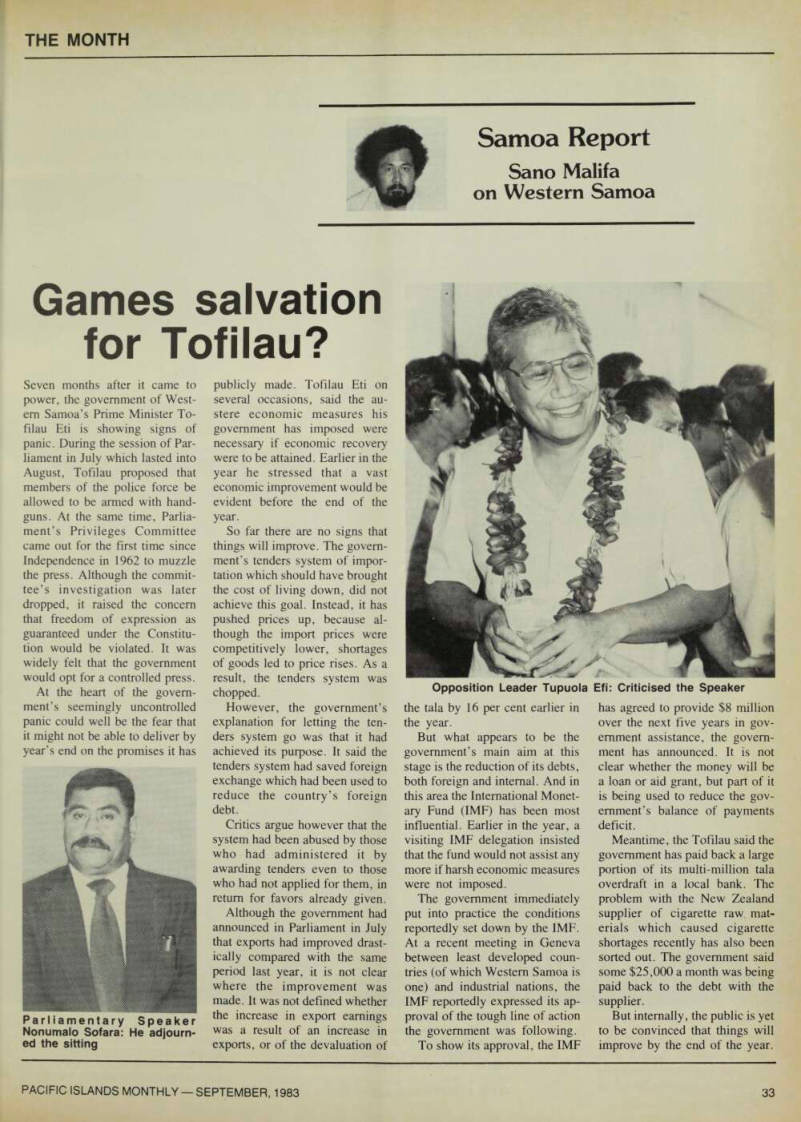
Sano Malifa on Western Samoa
Parliamentary Speaker Nonumalo Sofara: He adjourn ed the sitting
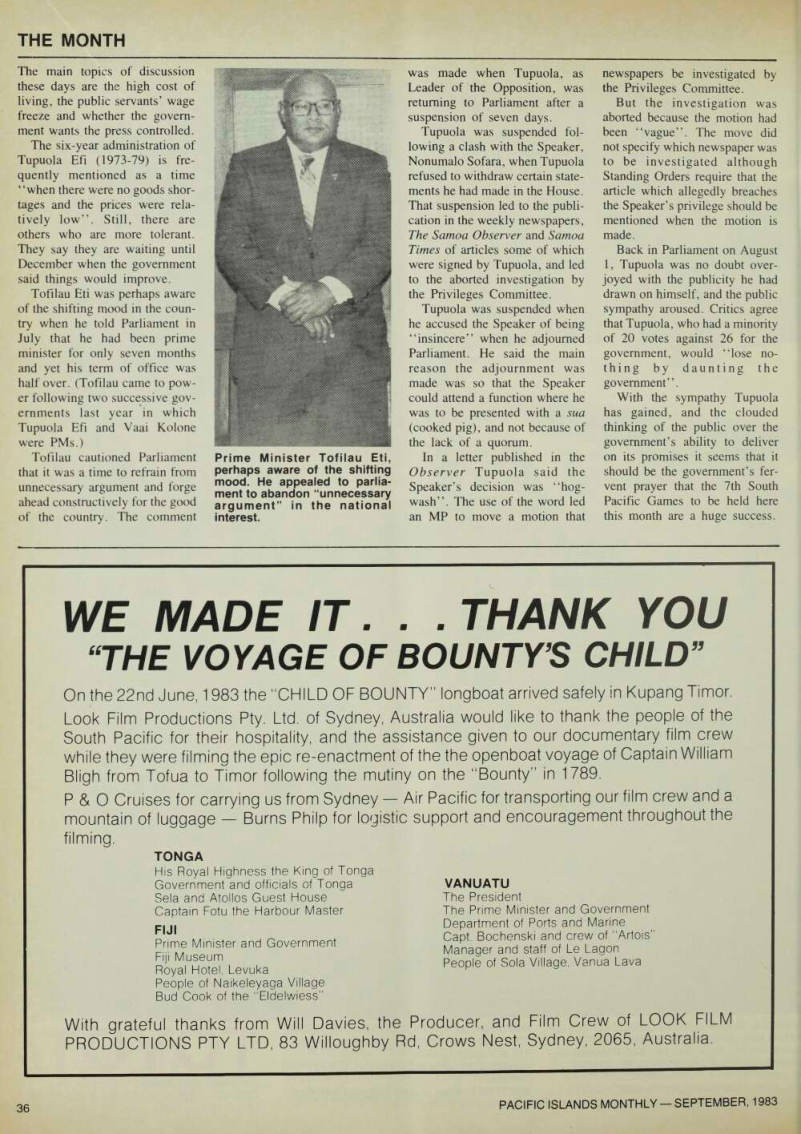
Opposition Leader Tupuola Efi: Criticised the Speaker
The main topics of discussion these days are the high cost of living, the public servants’ wage freeze and whether the govern ment wants the press controlled.
The six-year administration of Tupuola Efi (1973-79) is fre quently mentioned as a time “when there were no goods shor tages and the prices were rela tively low”. Still, there are others who are more tolerant.
They say they are waiting until December when the government said things would improve.
Tofilau Eti was perhaps aware of the shifting mood in the coun try when he told Parliament in July that he had been prime minister for only seven months and yet his term of office was half over. (Tofilau came to pow er following two successive gov ernments last year in which Tupuola Efi and Vaai Kolone were PMs.) Tofilau cautioned Parliament that it was a time to refrain from unnecessary argument and forge ahead constructively for the good of the country. The comment
was made when Tupuola, as Leader of the Opposition, was returning to Parliament after a suspension of seven days.
Tupuola was suspended fol
lowing a clash with the Speaker, Nonumalo Sofara, when Tupuola refused to withdraw certain state ments he had made in the House.
That suspension led to the publi cation in the weekly newspapers, The Samoa Observer and Samoa Times of articles some of which were signed by Tupuola, and led to the aborted investigation by the Privileges Committee.
Tupuola was suspended when
he accused the Speaker of being “insincere” when he adjourned Parliament. He said the main reason the adjournment was made was so that the Speaker could attend a function where he was to be presented with a sua (cooked pig), and not because of the lack of a quorum.
In a letter published in the Observer Tupuola said the
Speaker’s decision was “hog
wash”. The use of the word led an MP to move a motion that
newspapers be investigated by the Privileges Committee.
But the investigation was aborted because the motion had been “vague”. The move did not specify which newspaper was to be investigated although Standing Orders require that the article which allegedly breaches the Speaker’s privilege should be mentioned when the motion is made.
Back in Parliament on August 1, Tupuola was no doubt over joyed with the publicity he had drawn on himself, and the public sympathy aroused. Critics agree that Tupuola, who had a minority of 20 votes against 26 for the government, would “lose no thing by daunting the government”.
With the sympathy Tupuola has gained, and the clouded thinking of the public over the government’s ability to deliver on its promises it seems that it should be the government’s fer vent prayer that the 7th South Pacific Games to be held here this month are a huge success.
Prime Minister Tofilau Eti, perhaps aware of the shifting mood. He appealed to parlia ment to abandon “unnecessary argument” in the national interest.