of Truk Lagoon
p. 53 · Read in the full issue
The silent fleet of Truk Lagoon
Shipwrecks of Truk. By Alan Rosenberg. Edited by Francis X.
Hezel. Privately produced by Grahame, Ryder, and Fey, 1983. Available postpaid from the Micronesian Area Research Center, University of Guam, Mangilao, Guam 96913. Price
Susi 6.
On February 16-17, 1944, Marc Mitscher’s fast carrier Task Force 58 struck the Truk Lagoon and sent to the bottom over 50 capital ships in the Japanese fleet at anchor there. It was the largest American air strike of the war up to that time, and established once and for all the superiority of American air and sea power against the Japanese in the Pacific.
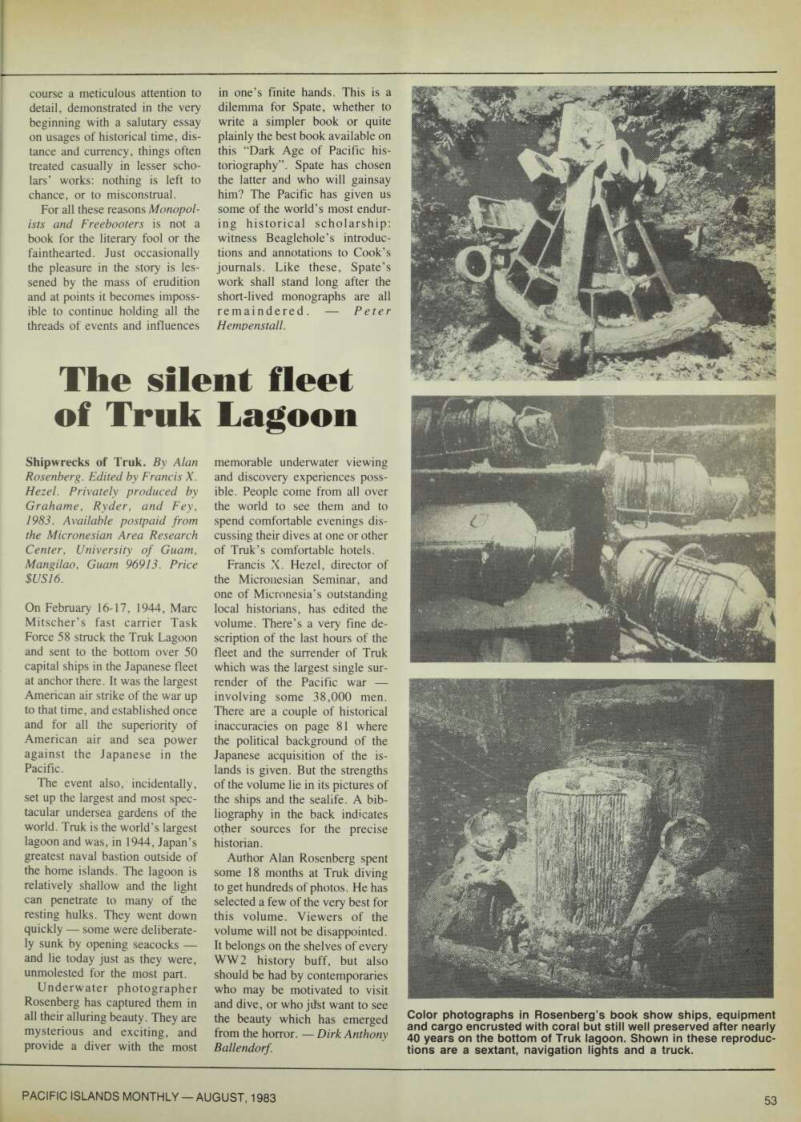
The event also, incidentally, set up the largest and most spec tacular undersea gardens of the world. Truk is the world’s largest lagoon and was, in 1944, Japan’s greatest naval bastion outside of the home islands. The lagoon is relatively shallow and the light can penetrate to many of the resting hulks. They went down quickly some were deliberate ly sunk by opening seacocks and lie today just as they were, unmolested for the most part.
Underwater photographer Rosenberg has captured them in all their alluring beauty. They are mysterious and exciting, and provide a diver with the most
memorable underwater viewing and discovery experiences poss ible. People come from all over the world to see them and to spend comfortable evenings dis cussing their dives at one or other of Truk’s comfortable hotels.
Francis X. Hezel, director of the Micronesian Seminar, and one of Micronesia’s outstanding local historians, has edited the volume. There’s a very fine de scription of the last hours of the fleet and the surrender of Truk which was the largest single sur render of the Pacific war involving some 38,000 men.
There are a couple of historical inaccuracies on page 81 where the political background of the Japanese acquisition of the is lands is given. But the strengths of the volume lie in its pictures of the ships and the sealife. A bib liography in the back indicates other sources for the precise historian.
Author Alan Rosenberg spent some 18 months at Truk diving to get hundreds of photos. He has selected a few of the very best for this volume. Viewers of the volume will not be disappointed.
It belongs on the shelves of every WW2 history buff, but also should be had by contemporaries who may be motivated to visit and dive, or who jifst want to see the beauty which has emerged
from the horror.
Dirk Anthony
Ballendorf.
Color photographs in Rosenberg’s book show ships, equipment and cargo encrusted with coral but still well preserved after nearly 40 years on the bottom of Truk lagoon. Shown in these reproduc tions are a sextant, navigation lights and a truck.